Herbs & Botanicals · Lichen for sore throat and cough
Iceland Moss
Cetraria islandica · also called Iceland lichen, Island moss
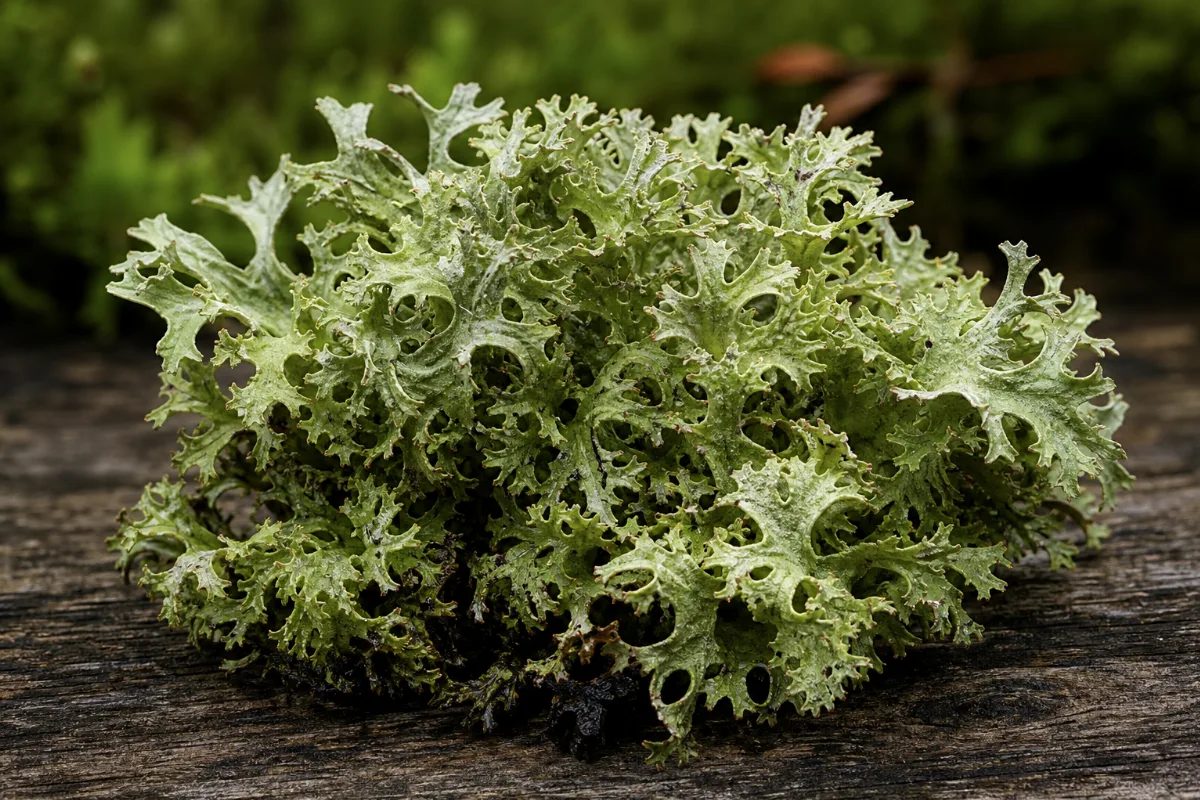
Iceland moss is a lichen, not a true moss: a fungus and an alga living together. It has long been used as a tea and in lozenges for a sore, dry throat and cough. The EU accepts this use based on tradition, but we found no placebo-controlled trial. Unlike Usnea, it has little or no usnic acid, yet lichens can collect lead and radioactive fallout, so the source matters.
General information, not medical advice. Last substantive update · Not medically reviewed. A named clinician has not signed off on this page. How this page is made
About Iceland Moss
Iceland moss (Cetraria islandica) is a lichen used in northern Europe for sore throats and dry cough. The EU accepts the use on tradition. Evidence is thin, side effects are rare, and pollution in the source lichen is the main practical concern.
A lichen, not a moss
Despite the name, Iceland moss is not a moss and not a plant. It is a lichen: a fungus living together with an alga. GBIF classifies it in the fungus kingdom, family Parmeliaceae. It grows in cold northern and mountain regions.
Do not mix it up with Irish moss, which is a red seaweed, or with Usnea, a different lichen with a liver-injury warning.
What it is used for
The EU committee (HMPC) accepted two traditional uses in 2014: soothing mouth and throat irritation with dry cough, and temporary loss of appetite in adults. "Traditional" means it rests on at least 30 years of use, not on proof. The committee said the data did not meet the bar for well-established use.
The gel-forming sugars in the lichen (lichenan and isolichenan, 25 to 50% of the dried lichen) are thought to coat the throat. That idea comes from lab work the EU said cannot be tied to human use.
What the studies show
A 1997 study of 61 people (63 in the EU report) after nasal surgery compared three strengths of a lozenge for five days. Mouth and throat changes improved in all groups, with no difference between strengths. There was no placebo group, so natural healing is a likely part of the story.
A 2004 survey of 3,143 children aged 4 to 12 found side effects in 0.2% that could not be ruled out; 39% were rated fully recovered and 55% improved. It had no control group and was written by staff of the lozenge maker.
An older open study of 100 people used a combination lozenge, so it cannot speak for Iceland moss alone. Most work on immune and antimicrobial effects is lab-only.
Usnic acid: low here, not zero
Usnic acid is the lichen compound linked to severe liver injury when it was sold in weight-loss pills. The EU report found only traces (0.04%) of it in Iceland moss in older work and none in two other studies. A 2023 analysis of one Kazakh sample did isolate usnic acid, with no amount given in the abstract. So the level may vary by origin.
No case of liver injury from Iceland moss was found. See the Usnea page for the lichen where usnic acid is the main worry.
Heavy metals and radioactive fallout
Lichens take what is in the air. A Finnish sample held 30 mg/kg lead, 0.30 mg/kg cadmium and 0.075 mg/kg mercury. The European Pharmacopoeia limits lead to 10 ppm in the medicine-grade lichen. After Chernobyl, Scandinavian lichen was hard to find below 600 Bq, and wild lichens in Austria still held 100 to 1,100 Bq/kg of caesium-137 about 17 years later. A 2025 study found Iceland moss binds caesium-137 inside its cells.
We found no recent measurement of products on sale. Ask the seller for lab tests for metals and radioactivity.
Other medicines, allergy and pregnancy
The gel may slow the absorption of other medicines taken at the same time, but this was never tested. Ask a pharmacist about timing.
Rare mild side effects in children were itching, nausea, stomach pain, heartburn and mouth burning. In an older skin-patch study, some people with light-sensitive skin reacted to the lichen. Do not use it if you are allergic to it.
The EU says safety in pregnancy and breastfeeding is not established and use is not recommended.
At a glance
Traditional uses history, not proof
- Tea or soak for sore throat and dry cough
- Lozenges for mouth and throat irritation
- Bitter remedy for temporary loss of appetite
Studied for research
- Sore, dry mouth and throat after nose surgery (small trial)
- Children's cough and throat illness (safety survey)
- Lab-only immune and antimicrobial findings
Main compounds
- Lichenan and isolichenan, gel-forming sugars (about 25 to 50% of the lichen)
- Fumarprotocetraric and cetraric acids, bitter lichen acids
- Protolichesterinic acid, an oily acid that can cause allergy
- Usnic acid, trace amounts or none
Common forms
- Dried lichen for tea or soak
- Water-extract lozenges
- Tincture (contains alcohol)
- Combination lozenges and syrups
Research links: EMA/HMPC EU herbal monograph (2014) · EMA/HMPC assessment report (2014) · Lozenges after nasal surgery, Kempe (1997) · Tolerability in 3,143 children, Hecker (2004) · Genus Cetraria review (2022) · Toxicity of usnic acid (2022) · Caesium-137 in lichens (2025) · Research Library · Genes & Biomarkers Library
The plant and its history
- Accepted scientific name
- Cetraria islandica (L.) Ach.
- Naming authority
- (L.) Ach.
- Synonyms
- Lichen islandicus; Cetraria islandica (L.) Acharius s.l.
- Common names
- Iceland moss (English); Iceland lichen (English); Island moss (Lichen islandicus) (English / Latin)
- Botanical family
- Parmeliaceae (a lichen family)
- Classification
- Fungi > Lecanorales > Parmeliaceae > Cetraria > Cetraria islandica
- Native range
- Arctic and subarctic regions of northern and eastern Europe, Siberia and North America, and mountain areas of central Europe (per the EU assessment report).
- Habitat
- Tundra, heath and mountain ground (general description; the EU report lists mountain regions in Germany, Italy and eastern Europe).
- What the plant looks like
- Roots: None. A lichen has no roots; it is attached to the ground loosely.; Leaves: The body (thallus) is made of branching, stiff, brittle bands up to 15 cm long, 0.3 to 1.5 cm wide, greenish to greenish-brown above and grey-white below.; Flowers: None. It does not flower.; Fruit: Brown disc-shaped spore bodies (apothecia) are very rarely seen.
- Cultivation
- Not cultivated; collected from the wild.
- Harvest and processing
- Whole or cut dried thallus. The EU report cites a European Pharmacopoeia monograph with a minimum swelling value.
- Look-alikes and adulterants
- Name: Cetraria ericetorum; Note: A sister species that is hard to tell apart. Lab and DNA tests can separate it from Iceland moss (Xu 2018).; Name: Usnea (old man's beard); Note: A different lichen rich in usnic acid, linked to liver injury. Not interchangeable. See the Usnea page.; Name: Irish moss (Chondrus crispus); Note: A red seaweed, not a lichen, with a similar-sounding name. See the Irish moss page.
- Sustainability and conservation
- Not assessed here.
Traditional use and history history, not clinical proof
| Tradition or era | Documented use | Source |
|---|---|---|
| European folk medicine | Tea or soak of the dried lichen for cough, sore throat and poor appetite; also eaten as food in northern countries. | s-ema-ar |
| 19th century to today (Germany and elsewhere) | Lozenges made from water extracts have been sold since the 19th century. | p15138371 |
| EU regulation 2014 | Accepted as a traditional herbal medicine for mouth and throat irritation with dry cough, and for temporary loss of appetite. | s-ema-mono |
Traditional use shows how a plant was used. It does not show that a supplement works or is safe today.
What is inside, and how it may work
What the plant contains and how those compounds act in cells and animals. Laboratory and animal mechanisms are not proven effects in people.
Main compounds
| Compound | Family | Where it is concentrated | Activity studied | Level of evidence |
|---|---|---|---|---|
| Lichen polysaccharides (lichenan and isolichenan) | beta-glucan-type sugars | thallus 25 to 50% of the dried lichen (EU report) | Gel-forming; thought to coat the mouth and throat; immune effects in cell tests 3 | Laboratory research |
| Usnic acid PubChem 5646 | dibenzofuran | thallus Trace (0.04%) in older work; not detected in two other studies; present in one 2023 sample (amount not given in the abstract) | Liver-toxic in slimming products at high intake; antimicrobial in the lab 3 8 1 | Human data |
| Fumarprotocetraric acid PubChem 5317419 | depsidone (lichen acid) | thallus One of the two main compounds in a 2023 extract analysis | Bitter lichen acid; patch-test allergen in one case 8 9 3 | Laboratory research |
| Cetraric acid (cetrarin) | depside-type lichen acid | thallus One of the two main compounds in a 2023 extract analysis | Bitter taste 8 | Laboratory research |
| Protolichesterinic acid PubChem 468953 | aliphatic lactone | thallus 0.1 to 1.5% depending on collection site (EU report) | Possible allergen; weak cell toxicity in the lab 3 9 | Laboratory research |
Mechanisms, receptors and pathways
| Target or pathway | Gene or receptor | What was found | Level |
|---|---|---|---|
| Mucus-like coating of the throat lining | Not applicable | The gel-forming sugars are thought to protect the lining. The EU said lab results cannot be linked to human use. 3 | Laboratory research |
| Immune cell signalling (IL-10 and IL-12p40) | IL10, IL12B | In a human immune-cell experiment (Freysdóttir 2008, as summarised by the EU), a water extract shifted signalling toward IL-10, mostly through lichenan. Original not read. 3 | Laboratory research |
| Bitter taste | Not applicable | The appetite use is explained only by bitterness; not tested. 3 | Traditional use |
Absorption, metabolism and elimination
- Absorption
- No data (EU report).
- Distribution
- No data.
- Metabolism
- No data.
- Elimination
- No data.
- Bioavailability
- Not established.
Isolated compounds versus whole extracts
Many lab results use isolated lichen acids or sugars. These do not show what the tea or lozenge does. The EU committee said lab results cannot be linked to use in people.
Nutritional composition
Iceland moss has been eaten in northern countries (for example in bread or soup), but it is a medicine and food of low importance, not a nutrient source.
4 very low certainty3 not enough evidence
What was looked at
The 7 benefits and uses checked for Iceland Moss, each with how strong the evidence is. Tap one to open it.
- Soothing mouth and throat irritation with dry coughVery low certainty
- Dry, inflamed mouth after nasal surgeryVery low certainty
- Cough and throat inflammation in children (safety survey)Very low certainty
- Bronchial catarrh and throat inflammation (combination lozenge)Very low certainty
- Temporary loss of appetiteNot enough evidence
- Immune and anti-inflammatory effects (lab only)Not enough evidence
- Antimicrobial, antioxidant and anti-cancer claims (lab only)Not enough evidence
Lab markers tracked in the studies
Mouth and throat lining score (coating, dryness, inflammation)Doctor and parent rating of recovery
What is Iceland Moss good for?
The evidence for every use is thin. Regulators accept the sore throat and cough use on tradition; the rest has not been tested in people.
Benefits, one by one
Each card is a research question, not a promise. Tap a goal to filter. Open a card to see the studies, doses and limits.
Soothing mouth and throat irritation with dry cough
Very low certaintyIceland moss is a traditional European remedy for a sore, irritated mouth and throat with a dry cough. The EU accepts it on the basis of long use. It has not been proven in placebo-controlled trials.
3 studiesTeas, soaks and lozenges made from a water extract. Amounts are set b…
Studies, doses and limits
What the trials found
The EU committee reviewed one dose-comparison trial, one open study and one large children's safety survey. It concluded the use is plausible from long use, but did not meet the standard for well-established use.
Results
The EU granted "traditional use" status. No trial with a placebo group was found.
Effect sizes as reported
No effect size can be given: no placebo-controlled trial exists.
Why this rating
Traditional use accepted by regulators; the only studies are small, uncontrolled or without a placebo group.
Form and dose studied
Teas, soaks and lozenges made from a water extract. Amounts are set by the product maker or by a doctor or pharmacist.
Who was studied
Adults, adolescents and children over about 6 for lozenges, per the EU. Not recommended in pregnancy or breastfeeding.
Limits
No placebo group in any study found. Symptoms of a sore throat often settle on their own.
Why researchers looked
Lozenges and teas made from the lichen have been sold in Europe since the 19th century, so regulators reviewed what evidence exists.
Traditional use
Used for centuries in Northern Europe as a tea or soak and later as lozenges. The EU committee found at least 30 years of medicinal use, which is the test for "traditional use".
Proposed mechanism Traditional use
The lichen is rich in gel-forming sugars (lichenan and isolichenan). They are thought to coat the lining of the mouth and throat. The EU committee said lab results cannot be linked directly to use in people.
A proposed mechanism does not show that the effect happens in people.
Mild itching, nausea or stomach upset were reported rarely. See the Safety tab.
Dry, inflamed mouth after nasal surgery
Very low certaintyIn a small 1997 study, people who had to breathe through the mouth after nose surgery improved over five days with lozenges. There was no placebo group, so we cannot tell how much was the lozenge and how much was normal healing.
2 studiesWater-extract lozenge, five days.
Studies, doses and limits
What the trials found
Kempe 1997: 61 people (63 in the EU report) were randomly given one of three strengths of an Iceland moss water-extract lozenge for five days after surgery. Doctors scored mouth and throat changes.
Results
Mouth and throat changes improved in all three groups. There was no significant difference between strengths. No placebo group.
Effect sizes as reported
All groups improved; no measured difference between strengths. Scores are not given in the abstract.
Why this rating
Randomised, but only three strengths of the same lozenge were compared; with no placebo, healing after surgery cannot be ruled out. Possible industry link.
Form and dose studied
Water-extract lozenge, five days.
Who was studied
Adults aged 18 to 65 recovering from nasal septum surgery.
Limits
Small, short, no placebo, German-language paper. The brand tested is named in the abstract.
Why researchers looked
After nose surgery the nose is packed, so people breathe through the mouth and get a dry, sore mouth and throat.
Traditional use
The study tested the idea that a lichen gel could protect the mouth lining.
Proposed mechanism Traditional use
Same coating idea as above. Not measured in this study.
A proposed mechanism does not show that the effect happens in people.
No side effects were reported in this study.
Cough and throat inflammation in children (safety survey)
Very low certaintyA large 2004 survey of 3,143 children aged 4 to 12 found lozenges were well tolerated. Most children were reported as better, but there was no comparison group, so the survey cannot show the lozenge worked.
2 studiesTwo lozenge products made with a water extract (one with mint).
Studies, doses and limits
What the trials found
Hecker 2004: children with irritating cough, mouth and throat inflammation, laryngitis or acute bronchitis took water-extract Iceland moss lozenges for 1 to 2 weeks in 300 mostly children's practices.
Results
73 adverse events in 57 children (1.8%), mostly from the illness. In 6 children (0.2%) a link to the lichen could not be ruled out; all settled on their own. 39% were fully recovered and 55% improved by the end.
Effect sizes as reported
Fully recovered 39%, improved 55% (doctor and parent ratings, no control group).
Why this rating
Uncontrolled and industry-run. Children usually recover from these illnesses anyway.
Form and dose studied
Two lozenge products made with a water extract (one with mint).
Who was studied
Children 4 to 12 years.
Limits
No control group; written by staff of the maker; ratings by parents and doctors who knew the treatment.
Why researchers looked
Lozenges are sold for children in Germany, and the maker wanted to check side effects.
Traditional use
A drug-monitoring study after the product was already on the market.
Proposed mechanism Traditional use
Not studied.
A proposed mechanism does not show that the effect happens in people.
Rare mild itching, nausea, stomach pain, heartburn or mouth burning.
Bronchial catarrh and throat inflammation (combination lozenge)
Very low certaintyAn old open study of 100 people used a lozenge that mixed Iceland moss with another plant extract. Most were rated better, but it had no control group and cannot show what Iceland moss did on its own.
2 studiesCombination lozenge (two plant extracts).
Studies, doses and limits
What the trials found
Vorberg 1981 (as summarised by the EU): 100 people aged 7 to 85 with mouth or throat inflammation, bronchial catarrh or more severe bronchial disease took a lozenge of Iceland moss plus hogweed (Heracleum sphondylium) extract for 4 days to 3 weeks.
Results
86% were rated as clearly better. No significant effect was seen when it was added to treatment for more serious bronchial disease.
Effect sizes as reported
86% rated better in an uncontrolled study.
Why this rating
Open study, a mixed product, and only the EU summary was read, not the original paper.
Form and dose studied
Combination lozenge (two plant extracts).
Who was studied
People aged 7 to 85.
Limits
Combination product; no control group; original paper not read.
Why researchers looked
It is one of the few human studies the EU committee could use.
Traditional use
Reported in 1981 and summarised in the EU assessment report.
Proposed mechanism Traditional use
Not studied.
A proposed mechanism does not show that the effect happens in people.
Not described in the EU summary beyond "well tolerated".
Temporary loss of appetite
Not enough evidenceThe EU lists Iceland moss as a traditional bitter remedy for temporary loss of appetite in adults. The committee found no trial in people or lab study for this use.
2 studiesTea or tincture (the tincture contains alcohol). Amounts are set by t…
Studies, doses and limits
Results
No results exist.
Why this rating
Traditional use only; plausible because of bitterness but not tested.
Form and dose studied
Tea or tincture (the tincture contains alcohol). Amounts are set by the product maker or a doctor or pharmacist.
Who was studied
Adults only, per the EU. Not for children or teenagers.
Limits
No study of any kind.
Why researchers looked
Bitter lichen acids give the tea a bitter taste, and bitter herbs have long been used before meals.
Traditional use
Traditional bitter tonic in European herbal medicine.
Proposed mechanism Traditional use
Thought to work through the bitter taste. Not tested for Iceland moss.
A proposed mechanism does not show that the effect happens in people.
See the Safety tab.
Immune and anti-inflammatory effects (lab only)
Not enough evidenceIn test tubes and animals, Iceland moss extracts and its sugars affected immune cells. We found no trial in people showing it boosts immunity or lowers inflammation.
2 studiesNot applicable (lab extracts).
Studies, doses and limits
What the trials found
No human trial found. Lab and animal work only.
Results
No human results.
Why this rating
Cell and animal findings only; the EU said they cannot be linked to human use.
Who was studied
No data.
Limits
Cannot be applied to people.
Why researchers looked
Researchers tested the lichen's sugars and acids on immune cells to look for a reason behind its traditional use.
Traditional use
Not part of the EU traditional uses.
Proposed mechanism Laboratory research
A water extract changed the balance of immune signals (more IL-10 relative to IL-12p40) in a human immune-cell experiment, and the lichen sugar lichenan seemed to account for most of it. This is as described in the EU assessment report; the original paper was not read.
A proposed mechanism does not show that the effect happens in people.
None known.
Antimicrobial, antioxidant and anti-cancer claims (lab only)
Not enough evidenceReviews list antibacterial, antioxidant and cell-killing effects of Iceland moss extracts in test tubes. None of this has been shown in people.
1 studiesNot applicable.
Studies, doses and limits
Results
No human results.
Why this rating
Lab or animal only, and often with isolated compounds at concentrations not reached by eating the lichen.
Who was studied
No data.
Limits
Cannot be applied to people.
Why researchers looked
Lichen acids are tested for many activities in the lab.
Traditional use
Not part of the EU traditional uses.
Proposed mechanism Laboratory research
Lab studies of extracts and isolated lichen acids. Isolated acids are not the same as the tea or lozenge.
A proposed mechanism does not show that the effect happens in people.
Some lichen compounds (for example usnic acid in other lichens) are harmful. See the Safety tab.
Connections to the rest of health
How Iceland Moss connects to the rest of our health knowledge graph. Every link says what kind of connection it is. A safety link (for example to the liver) is a warning, not a benefit. A study that merely mentions a topic never creates a benefit link.
Explore every connection: goals, body systems, organs, symptoms, genes
A. Wellness goals
| Connected to | Kind of connection | Evidence status | Context | Studies |
|---|---|---|---|---|
| Breathing Support | Traditional use | Very low certainty | Soothing mouth and throat irritation with dry cough: Iceland moss is a traditional European remedy for a sore, irritated mouth and throat with a dry cough. The EU accepts it on the basis of long use. It has not been proven in placebo-controlled trials. | 2 3 11 |
| Breathing Support | Very low certainty | Dry, inflamed mouth after nasal surgery: In a small 1997 study, people who had to breathe through the mouth after nose surgery improved over five days with lozenges. There was no placebo group, so we cannot tell how much was the lozenge and how much was normal healing. Cough and throat inflammation in children (safety survey): A large 2004 survey of 3,143 children aged 4 to 12 found lozenges were well tolerated. Most children were reported as better, but there was no comparison group, so the survey cannot show the lozenge worked. | 6 3 5 12 | |
| Digestive Support | Traditional use | Not enough evidence | Temporary loss of appetite: The EU lists Iceland moss as a traditional bitter remedy for temporary loss of appetite in adults. The committee found no trial in people or lab study for this use. | 2 3 |
| Immune Support | Not enough evidence | Immune and anti-inflammatory effects (lab only): In test tubes and animals, Iceland moss extracts and its sugars affected immune cells. We found no trial in people showing it boosts immunity or lowers inflammation. Antimicrobial, antioxidant and anti-cancer claims (lab only): Reviews list antibacterial, antioxidant and cell-killing effects of Iceland moss extracts in test tubes. None of this has been shown in people. | 3 11 | |
| Inflammation Balance | Not enough evidence | Immune and anti-inflammatory effects (lab only): In test tubes and animals, Iceland moss extracts and its sugars affected immune cells. We found no trial in people showing it boosts immunity or lowers inflammation. | 3 11 |
B. Body systems
| Connected to | Kind of connection | Evidence status | Context | Studies |
|---|---|---|---|---|
| Respiratory System | Biological association | Very low certainty | Studied for: Soothing mouth and throat irritation with dry cough Studied for: Dry, inflamed mouth after nasal surgery | 2 3 11 6 5 12 |
| Digestive System | Biological association | Not enough evidence | Studied for: Temporary loss of appetite | 2 3 |
| Immune System | Biological association | Not enough evidence | Studied for: Immune and anti-inflammatory effects (lab only) Studied for: Antimicrobial, antioxidant and anti-cancer claims (lab only) | 3 11 |
I. Biomarkers
| Connected to | Kind of connection | Evidence status | Context | Studies |
|---|---|---|---|---|
| Mouth and throat lining score (coating, dryness, inflammation) | Biological association | Very low certainty | Measured in trials: lowered. A lab change is not the same as a health benefit. | 6 |
| Doctor and parent rating of recovery | Biological association | Very low certainty | Measured in trials: improved. A lab change is not the same as a health benefit. | 5 |
L. Active compounds
| Connected to | Kind of connection | Evidence status | Context | Studies |
|---|---|---|---|---|
| Usnic acid | Adverse effect or risk | Low certainty | Liver-injury compound in some other lichens; low or absent in Iceland moss. Low or absent in Iceland moss; liver-injury compound in other lichens. Preparation or compound: trace to none in Iceland moss; high in Usnea |
1 3 8 |
| Lichen polysaccharides (lichenan and isolichenan) | Biological association | In vitro | Gel-forming; thought to coat the mouth and throat; immune effects in cell tests Preparation or compound: thallus |
3 |
| Usnic acid | Biological association | Human | Liver-toxic in slimming products at high intake; antimicrobial in the lab Preparation or compound: thallus |
3 8 1 |
| Fumarprotocetraric acid | Biological association | In vitro | Bitter lichen acid; patch-test allergen in one case Preparation or compound: thallus |
8 9 3 |
| Cetraric acid (cetrarin) | Biological association | In vitro | Bitter taste Preparation or compound: thallus |
8 |
| Protolichesterinic acid | Biological association | In vitro | Possible allergen; weak cell toxicity in the lab Preparation or compound: thallus |
3 9 |
Each connection is stored with the ingredient, the connected record, the kind of connection, the evidence status, the supporting studies, the preparation or compound involved, and a review date (last reviewed October 25, 2026).
Evidence at a glance: what changed in 1 lab markers
Tap a number to show only those markers. Counts are markers, not people.
The evidence
The research centre for Iceland Moss. Every record here was checked against PubMed or the publisher's page; we never list a study we have not verified.
Evidence by outcome
Bars show how many studies we found for each outcome, not how well it works. People are added up across trials only (reviews are not added, to avoid double counting).
How we rate evidence
High certainty
Several well-run trials or reviews agree; further research is unlikely to change the picture much.
Moderate certainty
Good trials point the same way, but some doubt remains.
Low certainty
Small, short or inconsistent trials. The finding could change with better research.
Very low certainty
Very little or very weak human data. Treat as a possibility only.
Mixed findings
Trials or reviews disagree with each other.
Not enough evidence
Not enough human research to say either way.
Evidence against
Good research found no benefit, or found harm.
We take the reviewers' own risk-of-bias and GRADE statements where they exist, and otherwise judge from study size, design, consistency, directness and whether a product matches what is sold. Many publications do not make evidence high. Method note: We built on our existing summary, read the EU assessment report and monograph in full text and PubMed abstracts, and checked GBIF and PubChem. Several regulators were not read and the page says so.
Study library: every study we checked 13
| Study | Design | People | Product, dose, length | Result |
|---|---|---|---|---|
| Croce 2022 Toxicity of Usnic Acid: A Narrative Review J Toxicol · PMID 36310641 · DOI |
Narrative review not applicable |
Review of usnic acid toxicity | Usnic acid (a lichen compound), not Iceland moss |
A usnic acid weight-loss product caused severe liver toxicity in a limited number of people, which led the US FDA to issue a warning letter and the product to be withdrawn in November 2001. Severe liver injury linked to usnic acid slimming products Methods, limits and fundingOutcomes: Usnic acid toxicity and liver injury in slimming products Limitations: Abstract read. About usnic acid in supplements, not about Iceland moss teas or lozenges. Authors disclose consulting for a company that may be affected. Funding and conflicts: Authors are consultants to a company that may be affected by the research (declared) Read: abstract |
| European Medicines Agency 2014 European Union herbal monograph on Cetraria islandica (L.) Acharius s.l., thallus (EMA/HMPC/678891/2013) EMA · Source |
Regulatory not applicable |
Not applicable | Not applicable Dried lichen (thallus) |
Traditional herbal medicine for soothing mouth and throat irritation with dry cough, and for temporary loss of appetite (adults). Contraindicated in hypersensitivity. Not recommended in pregnancy and breastfeeding. Medicines taken at the same time may be absorbed more slowly. No undesirable effects known. If symptoms last more than a week, see a doctor. Traditional-use status only Methods, limits and fundingOutcomes: EU position on uses, warnings and safety Limitations: Read in full text. The status rests on long use, not on proof from trials. Funding and conflicts: Public regulator Read: regulator report (full text) |
| European Medicines Agency 2014 Assessment report on Cetraria islandica (L.) Acharius s.l., thallus (EMA/HMPC/36866/2014) EMA · Source |
Regulatory not applicable |
Not applicable | Not applicable Dried lichen (thallus) |
The HMPC found the uses plausible from long-standing use, but said none of the data met the bar for "well-established use" with recognised efficacy. It found no serious adverse events and no overdose or interaction reports. Use in pregnancy and breastfeeding is not recommended for lack of data. Traditional use accepted; efficacy not proven Methods, limits and fundingOutcomes: Review of traditional use, lab data, clinical studies and safety to support an EU herbal monograph Limitations: Read in full text (machine-extracted from the PDF). An addendum dated March 2022 was listed on the EMA site but not read. Funding and conflicts: Public regulator Read: regulator report (full text) |
| GBIF 2026 GBIF Backbone Taxonomy species match: Cetraria islandica GBIF API · Source |
Database not applicable |
Not applicable | Not applicable |
Cetraria islandica (L.) Ach. is ACCEPTED (GBIF key 2605272), exact match, confidence 99; family Parmeliaceae, order Lecanorales, class Lecanoromycetes, phylum Ascomycota, kingdom Fungi. Accepted name confirmed; it is a fungus (lichen), not a plant or moss Methods, limits and fundingOutcomes: Accepted name and classification Limitations: Database record; NCBI Taxonomy not checked. Funding and conflicts: Public database Read: web page |
| Hecker 2004 Tolerability of Icelandic moss lozenges in upper respiratory tract diseases - multicentric drug monitoring study with 3,143 children [German] Forsch Komplementarmed Klass Naturheilkd · PMID 15138371 · DOI |
Other observational |
3143 Children aged 4 to 12 with upper airway illness (irritating cough, mouth and throat inflammation, laryngitis, acute bronchitis), in 300 mostly children's practices in Germany |
Two water-extract lozenge products (one with mint) Dried lichen (thallus), Cetraria islandica 1 to 2 weeks |
73 adverse events in 57 children (1.8%), mostly from the illness itself. In 6 children (0.2%) a link to the lichen extract could not be ruled out: itching, nausea, abdominal pain, heartburn, burning in the mouth. All settled on their own. By the end 39% were fully recovered and 55% improved. Side effects rare and mild; symptom ratings improved, but with no comparison group Methods, limits and fundingOutcomes: Side effects (main aim); doctor and parent ratings of symptoms Limitations: Uncontrolled surveillance study: children usually get better on their own, so the improvement cannot be credited to the lozenge. Ratings by doctors and parents. Funding and conflicts: Written by staff of the lozenge maker (Engelhard Arzneimittel); industry-linked Read: abstract + EMA report |
| Kempe 1997 Icelandic moss lozenges in the prevention or treatment of oral mucosa irritation and dried out throat mucosa [German] Laryngorhinootologie · PMID 9213408 · DOI |
Rct (three strengths compared, no placebo) |
61 People recovering from nasal septum surgery who breathed through the mouth (61 in the abstract; 63 in the EU report) |
Water-extract lozenges at three strengths Dried lichen (thallus), Cetraria islandica 5 days · vs Other strengths of the same lozenge (no placebo group) |
Mouth and throat changes improved, with no significant difference between the three strengths. The EU report says no placebo group was included and no side effects were reported. Improvement in all three groups; no difference between strengths Methods, limits and fundingOutcomes: Mouth and throat coating, dryness, inflammation, hoarseness, sore throat scored by doctors Limitations: No placebo group, so natural recovery after surgery cannot be separated from any effect of the lozenge. Short (5 days). Abstract in German; EU report used for design details. Funding and conflicts: Not stated in the abstract; a named commercial lozenge was tested, so an industry link cannot be ruled out Read: abstract + EMA report |
| Machart 2007 Ecological half-life of 137Cs in lichens in an alpine region J Environ Radioact · PMID 17602805 · DOI |
Other observational plant |
Lichen samples (Cetraria islandica, Cetraria cucullata, Cladonia arbuscula) from Bad Gastein, Austria, about 17 years after Chernobyl | Not applicable Lichen thallus |
Caesium-137 in the lichens ranged from 100 to 1100 Bq per kg dry weight depending on species and site. Ecological half-lives were 2 to 6 years (average 3 to 4). Lichens held radioactive caesium for years after fallout Methods, limits and fundingOutcomes: Caesium-137 in lichens Limitations: Wild lichens from one alpine area, not commercial products. Funding and conflicts: Not stated in abstract Read: abstract |
| Manassov 2023 Ultrastructural, Energy-Dispersive X-ray Spectroscopy, Chemical Study and LC-DAD-QToF Chemical Characterization of Cetraria islandica (L.) Ach. Molecules · PMID 37298969 · DOI |
Other observational plant |
One sample of the lichen (Kazakhstan) | Not applicable Lichen thallus |
37 compounds identified. Fumarprotocetraric acid and cetraric acid were the two major ones. Usnic acid was one of nine compounds isolated from the extract. Usnic acid present in this sample; amount not given in the abstract Methods, limits and fundingOutcomes: Compounds identified Limitations: Chemical profile of one specimen; the abstract gives no usnic acid amount, so it does not say how much. Samples from other places may differ. Funding and conflicts: No conflict declared Read: abstract |
| NCBI PubChem 2026 PubChem compound records: usnic acid, fumarprotocetraric acid, protolichesterinic acid PubChem API · Source |
Database not applicable |
Not applicable | Not applicable |
Usnic acid CID 5646 (C18H16O7); fumarprotocetraric acid CID 5317419 (C22H16O12); protolichesterinic acid CID 468953 (C19H32O4). CIDs confirmed Methods, limits and fundingOutcomes: Compound identifiers Limitations: Name search only. Cetraric acid and the polysaccharides were not given a verified CID. Funding and conflicts: Public database Read: web page |
| Osyczka 2025 Bioaccumulation of 137Cs in lichens: Insight into the patterns of extracellular and intracellular uptake of isotope in thalli J Trace Elem Med Biol · PMID 40186915 · DOI |
Other observational plant |
Three lichens including Cetraria islandica | Not applicable Lichen thallus |
C. islandica tends to accumulate caesium-137 efficiently and can bind it inside its cells, which makes it a good indicator of long-term contamination. Iceland moss takes up and holds radioactive caesium Methods, limits and fundingOutcomes: Caesium-137 uptake Limitations: Environmental study, not a food or medicine safety study. Funding and conflicts: No conflict declared Read: abstract |
| Sánchez 2022 The Genus Cetraria s. str.-A Review of Its Botany, Phytochemistry, Traditional Uses and Pharmacology Molecules · PMID 35956939 · DOI |
Narrative review not applicable |
Review of the genus Cetraria, mainly C. islandica | Not applicable Lichen thallus |
The review says traditional uses for digestive and respiratory illness have been "validated" in lab and animal studies, and that antioxidant, immune-modulating, cytotoxic, genotoxic and antigenotoxic activities are being studied. It reports usnic acid, fumarprotocetraric and protolichesterinic acids in the genus. Lab and animal findings only Methods, limits and fundingOutcomes: Botany, chemistry, traditional uses and pharmacology of Cetraria lichens Limitations: Abstract read. A narrative review, not a systematic one; it does not show benefit in people. Funding and conflicts: No conflict declared Read: abstract |
| Vorberg (as cited by EMA/HMPC) 1981 Open study of an Iceland moss plus Heracleum sphondylium lozenge (Vorberg 1981, as summarised in the EU assessment report) Cited in EMA/HMPC/36866/2014 · Source |
Other observational |
100 People aged 7 to 85 with mouth or throat inflammation (63), bronchial catarrh (29) or more severe bronchial disease (6) |
Lozenge of Iceland moss water extract combined with a small amount of hogweed (Heracleum sphondylium) extract Dried lichen (thallus) plus another plant extract 4 days to 3 weeks |
The EU report says 86% were rated as clearly better; no significant effect was seen when it was added to treatment for more serious bronchial disease. Mostly positive in an uncontrolled study Methods, limits and fundingOutcomes: Overall rating of effect Limitations: Open, no control group; a COMBINATION product, so the effect cannot be credited to Iceland moss alone. Original paper not read; only the EU summary of it. Funding and conflicts: Not stated in the EU report Read: regulator report (secondary) |
| Xu 2018 Authentication of Iceland Moss (Cetraria islandica) by UPLC-QToF-MS chemical profiling and DNA barcoding Food Chem · PMID 29287470 · DOI |
Other observational plant |
Lichen samples of the C. islandica species complex | Not applicable Lichen thallus |
C. islandica has two chemical types that can be told apart from each other and from the sister species Cetraria ericetorum; one DNA marker (RPB2) separated the species, the common nrITS marker did not. Mix-ups between look-alike lichens are possible; testing can tell them apart Methods, limits and fundingOutcomes: Telling species and chemotypes apart Limitations: Abstract read. Describes a testing method, not a market survey. Funding and conflicts: Not stated in abstract Read: abstract |
What we do not know yet
- No placebo-controlled trial for any use.
- No recent tests of lead, cadmium or radioactivity in products on sale.
- Usnic acid content in commercial material is poorly measured.
- No data in pregnancy, breastfeeding or on drug absorption.
- LiverTox, NCCIH and LactMed pages were not read.
How new research is added
New studies are found by a saved PubMed search and are placed in a review queue. A person reads each one before it changes any safety wording.
Lab markers
What changed in blood or saliva tests during trials. A changed number is not the same as feeling or being healthier, and we give no "normal ranges".
Other 2
Mouth and throat lining score (coating, dryness, inflammation)
Lowered in trials
A doctor's rating of how coated, dry and inflamed the lining of the mouth and throat looks.
Very low certaintyResults and what it means
Why it was measured
It is what the post-surgery trial used to judge the lozenges.
Statistical vs. clinical meaning
Doctor-rated and uncontrolled, so natural healing cannot be separated from any lozenge effect.
Safety implication
None reported.
| Study | Result | People | Product |
|---|---|---|---|
| 6 | Scores improved in all three lozenge groups, with no significant difference between groups. No placebo group. Actual scores are not in the abstract. | 61 to 63 people after nasal septum surgery | Iceland moss water-extract lozenges at three strengths, 5 days |
Doctor and parent rating of recovery
Improved in trials
A global rating of whether the child was recovered, improved or unchanged at the end of treatment.
Very low certaintyResults and what it means
Why it was measured
It was the only effect measure in the children's survey.
Statistical vs. clinical meaning
Cannot be credited to the lozenge because there is no comparison group.
Safety implication
Used mainly to judge tolerability.
| Study | Result | People | Product |
|---|---|---|---|
| 5 | 39% of the children were rated fully recovered and 55% improved. No control group. | 3,143 children aged 4 to 12 | Iceland moss water-extract lozenges, 1 to 2 weeks |
Safety
What studies and official sources say about side effects, medicines and who should check first. Each point shows what kind of evidence it comes from.
Main points to know 3
- Different from Usnea: little or no usnic acid. Usnic acid is the lichen compound linked to severe liver injury in weight-loss products. The EU report found it only in traces (0.04%) in Iceland moss in older work, and not at all in two other studies. A 2023 analysis of one sample from Kazakhstan did isolate usnic acid, but the abstract gives no amount. So it is low but not guaranteed to be absent, and it can vary by origin. Authoritative guidance 3 8 1
- Lichens collect metals and radioactive fallout. Lichens take up pollutants from air. A Finnish sample held 30 mg/kg lead, 0.30 mg/kg cadmium and 0.075 mg/kg mercury. After Chernobyl, Scandinavian material was hard to find below 600 Bq. Wild lichens in Austria still held 100 to 1,100 Bq/kg of caesium-137 about 17 years later. Iceland moss holds caesium-137 inside its cells. The EU notes a lead limit of 10 ppm in the European Pharmacopoeia monograph. We found no recent measurements of current shop products. Other observational 3 7 10
- Pregnancy and breastfeeding: not enough data. The EU says safety in pregnancy and breastfeeding has not been established and use is not recommended. No fertility data exist. Authoritative guidance 2 3
Side effects 4
| Effect | How often | Severity and recovery | Evidence |
|---|---|---|---|
| Itching (leg, back, arms) Seen in children aged 10 and 11 after 3 days of lozenges. | 2 of 3,143 children | mild Settled on its own within 2 days | Human case series 5 3 |
| Nausea, stomach pain, heartburn, burning in the mouth Some children were also taking other medicines at the time. | 3 events in 3,143 children | mild Settled on its own; two children refused a second lozenge | Human case series 5 3 |
| Skin allergy (contact allergy, possible light-triggered allergy) In a 1980 patch-test study of 45 people with light-sensitive dermatitis, Cetraria islandica gave 8 positive skin reactions. This is as summarised by the EU; the original was not read. | Not established | mild to moderate Not described | Human case series 3 |
| Serious side effects or deaths The EU found no serious adverse events, deaths, overdose or drug-interaction reports. That means none were found, not that none can happen. | Not established | none reported Not applicable | Authoritative guidance 3 2 |
Liver
No case of liver injury from Iceland moss was found in the EU report. Usnic acid from other sources (weight-loss products) has caused severe liver injury, which is why the usnic acid content matters. LiverTox was not read for this page (page blocked), so no LiverTox rating is given. 1 3 8
How often. Unknown for Iceland moss; no cases found.
Monitoring. No official monitoring advice found. Seek care for yellow skin or eyes, dark urine or pale stools.
This is a safety connection. It is not evidence that Iceland Moss supports liver health.
Medicines and supplements 2
| With | Why it matters | Importance | Evidence | What to do |
|---|---|---|---|---|
| Any medicine taken by mouth at the same time prescription | The gel-like fibre may form a protective layer that slows how fast other medicines are absorbed. The EU report says this comes from literature sources and that no human or animal test confirmed it. | Unknown. No case of an interaction was found. | Pharmacological theory Not enough evidence 3 2 | Ask a pharmacist how far apart to take Iceland moss and your medicines, especially ones where timing matters. The EU monograph suggests leaving a gap as a precaution. |
| Medicines for diabetes or blood-thinning medicines prescription | No mechanism or case found. | None reported. The EU says no interactions are reported. | Authoritative guidance Not enough evidence 2 | Absence of reports is not proof of safety. Tell your pharmacist what you take. |
Who should check first 4
| Situation | Advice | Evidence |
|---|---|---|
| Allergy to Iceland moss or other lichens | Do not use. The EU lists hypersensitivity as a contraindication. | Authoritative guidance 2 |
| Pregnancy and breastfeeding | Use is not recommended because data are lacking. | Authoritative guidance 2 3 |
| Children | The EU says use of the tea under 12 and of the tincture under 18 has not been established, and lozenges are not recommended under 6. Ask a doctor or pharmacist first. | Authoritative guidance 2 |
| Fever, shortness of breath or coloured phlegm | See a doctor. These signs mean this is not a simple throat irritation. | Authoritative guidance 2 |
Overdose, product quality and regulators
Summary. Used as a traditional medicine without known toxic effects at usual use. Tests on reproductive toxicity, genotoxicity and cancer risk have not been done.
Animal. In an old test described by the EU, mice fed a diet that was 50% untreated Iceland moss all died within 4 to 5 days; boiling it for 10 minutes only added about 2 days. The EU still concluded that no safety concern arises for the pharmaceutical form, given the low usnic acid and the lead limit.
Human doses studied. Not given here.
High dose or long term signals. No long-term data. The EU says to see a doctor if symptoms last more than one week.
Overdose response. No case of overdose has been reported.
Genotoxicity. No published data on the lichen itself (EU report).
Toxic plant parts. The whole dried lichen (thallus) is what is used. Heavy metals and radioactivity depend on where it grew.
The main risks are where it grew (lead, cadmium, mercury, radioactive caesium) and mix-ups with other lichens.
Heavy metals. A Finnish sample held 30 mg/kg lead, 0.30 mg/kg cadmium, 0.075 mg/kg mercury and 0.76 mg/kg arsenic, per the EU report citing a 1986 paper. The European Pharmacopoeia monograph limits lead to 10 ppm. 3
Radioactivity. Iceland moss holds caesium-137; samples from Austria 17 years after Chernobyl had 100 to 1,100 Bq/kg (mixed lichens). The EU report says material from Scandinavia was hard to find under 600 Bq after Chernobyl, improving since 1994. 3 7 10
Look-alike lichens. Cetraria ericetorum is a sister species hard to tell from Iceland moss; two chemical types of Iceland moss also exist. Lab tests can separate them. 13
| Body | Action | Date |
|---|---|---|
| European Medicines Agency (HMPC) (European Union) | EU herbal monograph (2014): traditional use as a demulcent for mouth and throat irritation with dry cough, and for temporary loss of appetite. Not accepted as well-established use. source | 24 November 2014 |
When to get medical help
- Itching, rash, swelling of the lips or face, or trouble breathing after using it
- Yellow skin or eyes, dark urine or pale stools
- Fever, shortness of breath or coloured phlegm with a cough
- A cough or sore throat that lasts more than a week
Stop the supplement and contact a clinician or emergency service. In the US, Poison Control is 1-800-222-1222.
General information only, not medical advice. Ask a clinician or pharmacist before use, especially with medicines, in pregnancy or with a health condition. See the Natural Remedy Safety guide.
Frequently asked questions
Is Iceland moss a moss?
No. It is a lichen, a fungus and an alga living together, and it is classified with fungi.
What is Iceland moss used for?
Traditionally for a sore, irritated mouth and throat with dry cough, and for temporary loss of appetite in adults.
Is there proof that it works?
Does the EU approve it?
Is it the same as Usnea?
Is it the same as Irish moss?
No. Irish moss is a seaweed. Only the name is similar.
Does it contain usnic acid?
Can it contain heavy metals or radioactivity?
Is it safe in pregnancy or breastfeeding?
Not enough data. The EU does not recommend it.
Is it safe for children?
Does it interact with medicines?
When should I see a doctor?
If you have fever, shortness of breath, coloured phlegm, or symptoms lasting more than a week.
Explore by health goal
Breathing SupportImmune SupportDigestive SupportInflammation Balance
Editorial transparency
- Written by
- AlternativeMed editorial team. Research compiled with AI assistance, then checked against PubMed records.
- Medical review
- None. This page has not been reviewed by a physician or pharmacist.
- First published
- 2026-10-25
- Last substantive update
- 2026-10-25
- How we research
- We built on our existing summary, read the EU assessment report and monograph in full text and PubMed abstracts, and checked GBIF and PubChem. Several regulators were not read and the page says so.
- How we rate evidence
- See "How we rate evidence" in the Evidence tab.
- Independence
- No product is promoted on this page. No affiliate links are shown.
Sources 13
Each source was opened and checked. Where we read only the abstract, it says so. The small numbers in the text point here.
- Croce N, Pitaro M, Gallo V, Antonini G. Toxicity of Usnic Acid: A Narrative Review. J Toxicol. 2022. PMID 36310641. DOI 10.1155/2022/8244340. (abstract)
- European Medicines Agency, HMPC. European Union herbal monograph on Cetraria islandica (L.) Acharius s.l., thallus (EMA/HMPC/678891/2013). EMA. 2014. (regulator report (full text))
- European Medicines Agency, HMPC. Assessment report on Cetraria islandica (L.) Acharius s.l., thallus (EMA/HMPC/36866/2014). EMA. 2014. (regulator report (full text))
- GBIF. GBIF Backbone Taxonomy species match: Cetraria islandica. GBIF API. 2026. (web page)
- Hecker M, Völp A. Tolerability of Icelandic moss lozenges in upper respiratory tract diseases - multicentric drug monitoring study with 3,143 children [German]. Forsch Komplementarmed Klass Naturheilkd. 2004. PMID 15138371. DOI 10.1159/000078228. (abstract + EMA report)
- Kempe C, Grüning H, Stasche N, Hörmann K. Icelandic moss lozenges in the prevention or treatment of oral mucosa irritation and dried out throat mucosa [German]. Laryngorhinootologie. 1997. PMID 9213408. DOI 10.1055/s-2007-997409. (abstract + EMA report)
- Machart P, Hofmann W, Türk R, Steger F. Ecological half-life of 137Cs in lichens in an alpine region. J Environ Radioact. 2007. PMID 17602805. DOI 10.1016/j.jenvrad.2007.05.003. (abstract)
- Manassov N, Samy MN, Datkhayev U, Avula B, Adams SJ, Katragunta K, Raman V, Khan IA, Ross SA. Ultrastructural, Energy-Dispersive X-ray Spectroscopy, Chemical Study and LC-DAD-QToF Chemical Characterization of Cetraria islandica (L.) Ach.. Molecules. 2023. PMID 37298969. DOI 10.3390/molecules28114493. (abstract)
- NCBI PubChem. PubChem compound records: usnic acid, fumarprotocetraric acid, protolichesterinic acid. PubChem API. 2026. (web page)
- Osyczka P, Saniewski M, Wietrzyk-Pełka P. Bioaccumulation of 137Cs in lichens: Insight into the patterns of extracellular and intracellular uptake of isotope in thalli. J Trace Elem Med Biol. 2025. PMID 40186915. DOI 10.1016/j.jtemb.2025.127642. (abstract)
- Sánchez M, Ureña-Vacas I, González-Burgos E, Divakar PK, Gómez-Serranillos MP. The Genus Cetraria s. str.-A Review of Its Botany, Phytochemistry, Traditional Uses and Pharmacology. Molecules. 2022. PMID 35956939. DOI 10.3390/molecules27154990. (abstract)
- Vorberg (as cited by EMA/HMPC). Open study of an Iceland moss plus Heracleum sphondylium lozenge (Vorberg 1981, as summarised in the EU assessment report). Cited in EMA/HMPC/36866/2014. 1981. (regulator report (secondary))
- Xu M, Heidmarsson S, Thorsteinsdottir M, Kreuzer M, Hawkins J, Omarsdottir S, Olafsdottir ES. Authentication of Iceland Moss (Cetraria islandica) by UPLC-QToF-MS chemical profiling and DNA barcoding. Food Chem. 2018. PMID 29287470. DOI 10.1016/j.foodchem.2017.11.073. (abstract)
Where to buy
Check the label first. Whatever you buy, look for these:
- The plant part and the extract type or ratio on the label
- A standardized amount of the active compounds, where relevant
- A third-party testing mark (USP, NSF or ConsumerLab)
- Interactions: ask a pharmacist if you take medicines, are pregnant or have a medical condition
Talk to a pharmacist or doctor before you start any supplement, especially if you take medicines. See the Safety tab for interactions.
Support our free guides: as an Amazon Associate we earn from qualifying purchases. Full disclosure.


