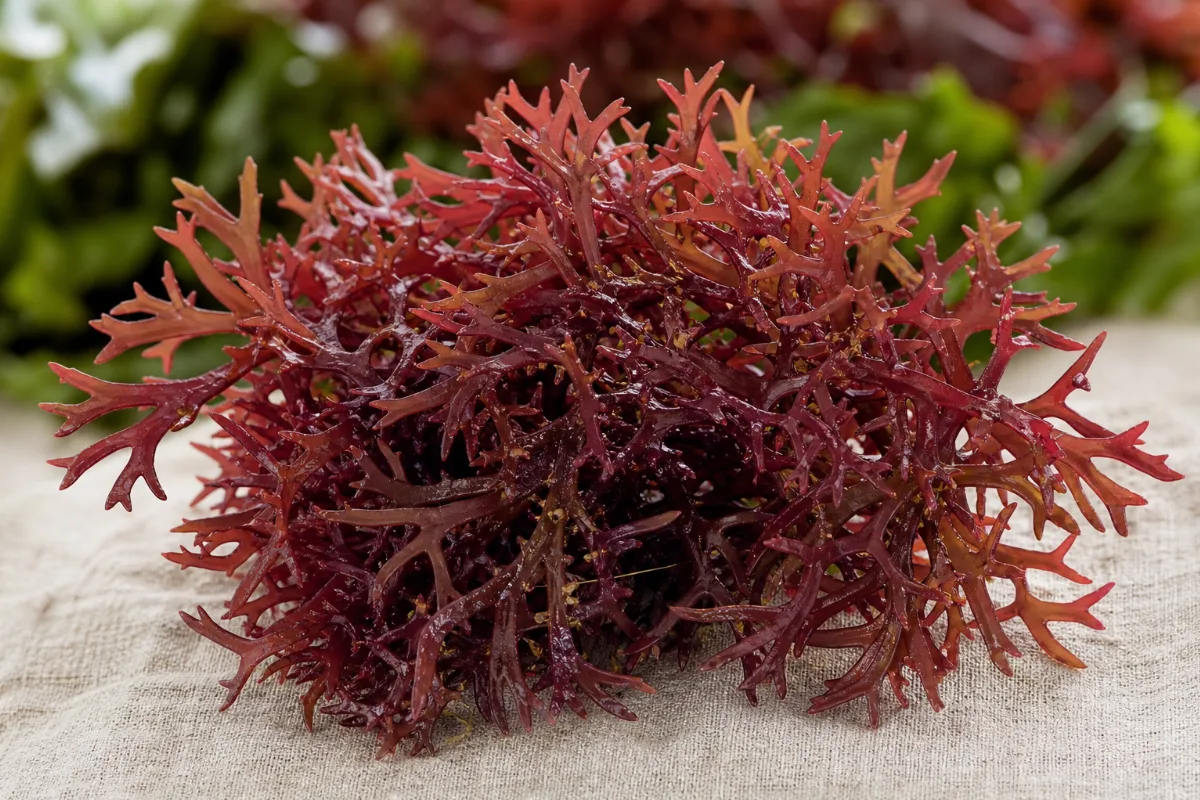
Herbs & Botanicals · Red seaweed sold as sea moss
Irish moss
Chondrus crispus · also called Sea moss, carrageen, red seaweed
Irish moss, now often sold as sea moss, is a red seaweed used as a food thickener and a trendy wellness gel. It is promoted for the thyroid, gut and immunity, but we found no human trial of it for any use. Its main cautions are too much iodine, which can upset the thyroid, and toxic metals and bacteria found in some products. People who are pregnant, breastfeeding or have thyroid disease should ask a doctor first.
General information, not medical advice. Last substantive update · Not medically reviewed. A named clinician has not signed off on this page. How this page is made
About Irish moss
Irish moss (Chondrus crispus) is a red seaweed, now widely sold as sea moss in dried form, powders, capsules and gels. Carrageenan, a food thickener, is extracted from it. It is promoted for the thyroid, gut, skin and immunity, but we found no human trial of the whole seaweed for any use, and LactMed states that no medicinal value has been proven. The main concerns are seaweed iodine, which can cause thyroid problems in some people and has suppressed thyroid function in breastfed infants, toxic metals such as arsenic, lead, cadmium and mercury, and bacteria in poorly handled products. Whether carrageenan harms the gut is genuinely debated. Ask a doctor or pharmacist before using it if you are pregnant, breastfeeding, have thyroid disease or take blood thinners or thyroid medicine.
What it is
Irish moss is a red seaweed (Chondrus crispus). Shops also sell other red seaweeds, such as Eucheuma and Gracilaria, as 'sea moss', so the exact species on a label can differ. That naming mix is not verified in a source we read.
It is not a moss or a plant with roots. It has no relation to Iceland moss, which is a lichen.
What makes it distinctive
It is rich in carrageenan, a sulfated carbohydrate that makes a thick gel. It also takes up iodine and other minerals, and unwanted metals, from the sea water it grows in.
Historical and current uses
LactMed describes it as used as food and medicine. Today it is a social-media wellness trend. UK endocrinologists describe 'thyroid detox' and 'iodine reset' trends that push seaweed products as a source of misinformation and iodine excess.
What the research shows
No trial of whole sea moss was found. A 2026 trial gave purified carrageenan to healthy adults and found no change in inflammation markers but higher gut permeability versus baseline. Reviews of carrageenan disagree: some report benefits, others gut inflammation and immune effects. Lab studies on a related red seaweed show blood-thinning effects in a dish only.
At a glance
Traditional uses history, not proof
- Eaten as food and folk medicine; LactMed notes no medicinal value has been proven
- Extracted as carrageenan, a thickener used in many foods
- Currently promoted on social media as sea moss gel for the thyroid, gut and skin
Studied for research
- Gut effects of carrageenan: mixed evidence
- Thyroid support: no benefit trial; excess iodine is a documented risk
- Immune, skin, energy and weight claims: insufficient evidence
- Blood-thinning and sugar-enzyme effects: lab only, on a different seaweed
Main compounds
- Carrageenan (sulfated polysaccharides)
- Iodine and other minerals
- Toxic metals taken up from sea water (arsenic, lead, cadmium, mercury)
Common forms
- Dried whole seaweed
- Powder
- Capsule
- Sea moss gel
- Carrageenan (extracted food additive; not the same as whole sea moss)
Research links: Sea moss record (LactMed, NIH) · Product survey: microbes and metals (2026) · Iodine misinformation and thyroid (2026) · Carrageenan review (2026) · Research Library · Genes & Biomarkers Library
The plant and its history
- Accepted scientific name
- Chondrus crispus Stackhouse
- Naming authority
- Stackhouse
- Common names
- Irish moss (English); Sea moss (English (trade name)); Carrageen (English); Red seaweed (English (general))
- Botanical family
- Gigartinaceae (a family of red seaweeds).
- Classification
- Plantae > Rhodophyta > Florideophyceae > Gigartinales > Gigartinaceae > Chondrus > Chondrus crispus
- Native range
- Not verified from a primary source we read.
- Habitat
- Not verified here; it is a red seaweed that grows in sea water.
- What the plant looks like
- Roots: Not verified.; Stems: Not verified.; Leaves: Not verified.; Flowers: Seaweed; no flowers.
- Cultivation
- Not verified.
- Harvest and processing
- Sold dried, as powder, gel or capsules; carrageenan is extracted for food use (p42560937). Handling changes contaminants (p42551155, a brown seaweed).
- Look-alikes and adulterants
- Name: Eucheuma / Kappaphycus and Gracilaria (also sold as 'sea moss'); Note: Different red seaweed genera. GBIF confirms Eucheuma denticulatum as a separate accepted species; that retailers sell them as sea moss is NOT verified in a source we read.; Name: Iceland moss (a lichen, not a seaweed); Note: Unrelated; has its own page on this site.
- Sustainability and conservation
- Not assessed.
Traditional use and history history, not clinical proof
| Tradition or era | Documented use | Source |
|---|---|---|
| Food and folk medicine (general) | LactMed describes sea moss as a red seaweed used as food and medicine, while stating that no medicinal value has been proven. | p41730053 |
| Irish and Caribbean traditions (as commonly told) | A long history as a thickened drink or jelly is widely claimed; NOT verified in a source we read. | p41730053 |
| Modern wellness trend | Social-media promotion of sea moss and kelp for the thyroid and 'detoxes' is described by UK endocrinologists as misinformation-driven. | p42144726 |
Traditional use shows how a plant was used. It does not show that a supplement works or is safe today.
What is inside, and how it may work
What the plant contains and how those compounds act in cells and animals. Laboratory and animal mechanisms are not proven effects in people.
Main compounds
| Compound | Family | Where it is concentrated | Activity studied | Level of evidence |
|---|---|---|---|---|
| Carrageenan (kappa, iota, lambda types) | sulfated galactan (polysaccharide) | whole seaweed; extracted as a food additive not reported | Gelling and thickening agent. Reviews report both possible benefits and gut inflammation. Lab only for most effects. PubChem name lookup returned no CID. 1 7 12 | Mixed |
| Iodine PubChem 807 | trace element | whole seaweed not reported; varies by product | Needed for thyroid hormone; too much disturbs the thyroid. 6 15 4 13 | Human data |
| Toxic metals (arsenic, lead, cadmium, mercury) and cobalt | trace elements taken up from sea water | whole seaweed not reported in the abstracts | Contaminants; amounts vary by water and handling. 4 14 | Human data |
| Other sulfated polysaccharides (e.g. from a related red seaweed) | sulfated galactans | whole seaweed not reported | Slowed clotting and blocked digestive enzymes in the lab (another red seaweed). 2 | In vitro |
Mechanisms, receptors and pathways
| Target or pathway | Gene or receptor | What was found | Level |
|---|---|---|---|
| Gut barrier and inflammatory signalling | not established in the abstracts | Lab, animal and limited human work reports carrageenan can alter gut bacteria, weaken the barrier and activate inflammatory signalling; a small human trial found higher permeability versus baseline but no inflammation marker change. 7 16 | In vitro / animal / limited human |
| Coagulation and digestive enzymes | alpha-amylase, alpha-glucosidase (lab) | Sulfated galactans from a different red seaweed showed anticoagulant activity and enzyme inhibition in test tubes. 2 | In vitro |
| Thyroid hormone synthesis | not named | Iodine is a building block of thyroid hormone; too much disturbs production. 6 | Human data |
Absorption, metabolism and elimination
- Absorption
- No human data on Irish moss compounds found in the abstracts read.
- Distribution
- Iodine passes into breast milk (LactMed).
- Metabolism
- Not studied for sea moss.
- Elimination
- Not studied for sea moss.
- Bioavailability
- Not established for iodine or minerals in Irish moss products.
Isolated compounds versus whole extracts
Purified carrageenan (a food additive) is not the same as whole sea moss, which also carries iodine, minerals, metals and microbes. Most carrageenan research is on the purified form, so it cannot be read straight across to sea moss gel. Poligeenan, a different degraded form linked to toxic effects, was not found under realistic conditions in one industry-linked lab study.
Nutritional composition
Sea moss contains iodine and other minerals, but the sources we read give no verified mineral count (the '92 minerals' claim is unverified) and no evidence of a nutrition benefit. Content varies by source and product.
1 mixed findings6 not enough evidence
What was looked at
The 7 benefits and uses checked for Irish moss, each with how strong the evidence is. Tap one to open it.
- Gut inflammation and gut lining: the carrageenan debateMixed findings
- Gut and digestion claims for whole sea mossNot enough evidence
- Immune support and 'antiviral' claimsNot enough evidence
- Thyroid claims and iodineNot enough evidence
- Minerals and the '92 minerals' claimNot enough evidence
- Skin, energy, weight loss, joints and 'detox' claimsNot enough evidence
- Blood sugar and blood-thinning effects of seaweed polysaccharides (lab only)Not enough evidence
Lab markers tracked in the studies
Gut permeability (transcellular)Faecal calprotectin and C-reactive protein
What is Irish moss good for?
The claims made for sea moss and how strong the human evidence is for each. Here "insufficient" means no human trial was found, and "mixed" means studies disagree. For thyroid claims the main finding is a risk, not a benefit.
Benefits, one by one
Each card is a research question, not a promise. Tap a goal to filter. Open a card to see the studies, doses and limits.
Gut inflammation and gut lining: the carrageenan debate
Mixed findingsIrish moss is a main source of carrageenan, a thickener in many foods. Scientists disagree on whether it harms the gut. Some lab and animal work links it to gut inflammation. One small 2026 trial in healthy adults found no change in inflammation blood or stool markers, but gut permeability rose in the carrageenan group compared with their own starting level. No trial tested whole sea moss.
4 studiesPurified carrageenan given in brownies in the trial. Whole sea moss g…
Studies, doses and limits
What the trials found
Arslan 2026 (p42560937) reviews carrageenan and calls the evidence contradictory: some studies report benefits, others report gut inflammation, poor glucose handling and immune effects. Fernandes 2026 (p42073323) reports that lab, animal and limited human studies link carrageenan to gut barrier disruption and pro-inflammatory responses. Wellens 2026 (p40816342) randomised 60 healthy adults across six groups (five emulsifiers or placebo) for 4 weeks: faecal calprotectin and CRP did not differ from placebo; gut permeability rose in people who ate carrageenan compared with their own baseline (P=.04). Jin 2026 (p42292694) found in the lab that carrageenan did not break into the toxic poligeenan-sized pieces in simulated stomach acid; its authors work for a capsule manufacturer.
Results
Reviews disagree. The one controlled human trial found no inflammation signal but one permeability signal. Carrageenan is an extracted additive, not whole sea moss.
Effect sizes as reported
Permeability: P=.04 versus baseline (not versus placebo). No inflammation marker differences. No effect size in the abstracts.
Why this rating
The reviews contradict one another; the trial was exploratory, small and in healthy people for 4 weeks; the permeability result is versus baseline only; most other evidence is lab or animal; nothing tested whole sea moss.
Form and dose studied
Purified carrageenan given in brownies in the trial. Whole sea moss gel or powder has not been tested for gut effects in people. Ask a doctor or pharmacist about amounts.
Who was studied
Healthy adults (one trial); lab and animal models (reviews).
Limits
Abstracts only. Trial not powered to confirm effects. Food-grade carrageenan differs from whole seaweed. No data in people with bowel disease.
Why researchers looked
Carrageenan is used in foods and some supplements, and people ask whether it is safe for the gut.
Traditional use
Irish moss was boiled to make a thick jelly in Irish cooking. This is a long folk practice; we did not verify it from a source we read.
Proposed mechanism Laboratory research
Lab, animal and limited human work reports that carrageenan can change gut bacteria, weaken the gut barrier and switch on inflammatory signals. Effects depend on type, size, purity, dose and the person.
A proposed mechanism does not show that the effect happens in people.
People with inflammatory bowel disease or a sensitive gut may want to ask their doctor before using it; this is a precaution, not a proven harm.
Gut and digestion claims for whole sea moss
Not enough evidenceSellers say sea moss helps digestion and the gut. We found no human trial of whole Irish moss or sea moss for any gut condition. Claims rest on tradition, on its fibre-like gel, and on animal work.
1 studiesNot applicable (no human studies).
Studies, doses and limits
What the trials found
Our PubMed search for Chondrus crispus with trial or participant terms returned only animal feed, fish and lab papers, no human supplement trial. The LactMed record (p41730053) states that no medicinal value of sea moss has been proven.
Results
No human results exist for digestive benefit.
Why this rating
No human trial; only a regulator statement that no medicinal value is proven.
Limits
Search was by title and abstract in PubMed; not a full systematic search.
Why researchers looked
Sea moss gel is widely marketed for digestion on social media.
Traditional use
Traditional use as a soothing jelly; not verified from a source we read.
Proposed mechanism Preliminary mechanism
No tested mechanism in people. The gel is made of carrageenan-type polysaccharides, which are not digested in the usual way; this is general chemistry, not a proven benefit.
A proposed mechanism does not show that the effect happens in people.
Gut harm is also unproven. See the carrageenan debate above and the contamination warnings on the Safety tab.
Immune support and 'antiviral' claims
Not enough evidenceSea moss is often sold as an immune booster. We found no human trial of Irish moss for immunity or infection. Lab work on carrageenan-type chemicals shows effects on immune cells in a dish, which does not show a benefit when eaten.
2 studiesNot applicable.
Studies, doses and limits
What the trials found
Darko 2026 (p42907008) tested isolated galactans from a different red seaweed in cells. Arslan 2026 (p42560937) says some studies report immune benefits and others immune dysregulation. No human trial of Irish moss for infection or immune function was found.
Results
Lab results only; no effect in people shown.
Why this rating
Cell and review evidence only; different seaweed; contradictory reports.
Limits
Test-tube findings do not carry over to eating the seaweed. Sea moss products can also carry bacteria (see Safety).
Why researchers looked
Red seaweed polysaccharides activate immune cells in the lab, and sellers extend this to the whole food.
Traditional use
Folk use for coughs and colds is commonly claimed; not verified from a source we read.
Proposed mechanism Laboratory research
In a dish, sulfated polysaccharides from a different red seaweed (Calliblepharis fimbriata) activated macrophage immune cells. Review authors also list lab immune effects of carrageenan.
A proposed mechanism does not show that the effect happens in people.
Sea moss products have carried bacteria; people with weak immune systems should be especially careful.
Thyroid claims and iodine
Not enough evidenceSea moss is sold for the thyroid because seaweed contains iodine. Iodine is a real need, and mild deficiency has returned in some countries. But the iodine in sea moss products is rarely stated and can be high. We found no trial showing sea moss helps the thyroid, and several reports of too much seaweed iodine harming thyroid function.
5 studiesWhole seaweed, powder, capsule or gel. Iodine content is usually not …
Studies, doses and limits
What the trials found
Taylor 2026 (p42144726) says UK iodine deficiency has returned, while social-media 'thyroid detox' and kelp supplements give far more iodine than recommended and a growing minority of patients have iodine-induced thyroid problems. Farebrother 2019 (p30891786) reviews excess iodine: most healthy people tolerate it, but some develop hyperthyroidism, hypothyroidism, goitre or autoimmunity, and people with thyroid disease may react at intakes slightly above needs. LactMed (p41730053) lists iodine among sea moss contents. A 2019 case (p31517826) describes thyroid over-activity after kelp tablets that resolved on stopping.
Results
No benefit trial for Irish moss. Reviews support caution about excess; they also say deficiency is a real problem in some groups, so the answer depends on the person.
Effect sizes as reported
No effect sizes; narrative reviews and a case report.
Why this rating
No trial of sea moss for the thyroid. Reviews are narrative and about iodine in general or kelp, not Irish moss. The risk of excess is documented; the benefit is not.
Form and dose studied
Whole seaweed, powder, capsule or gel. Iodine content is usually not on the label. Ask a doctor or pharmacist before using it for the thyroid.
Who was studied
People with or without thyroid disease; UK reviews.
Limits
Narrative reviews; one case of kelp (a different seaweed). Iodine content of Irish moss products not measured in the sources read.
Why researchers looked
Iodine is needed for thyroid hormones, so thyroid support is the most common claim.
Traditional use
Seaweeds are eaten in many coastal diets as an iodine source; not verified for Irish moss specifically.
Proposed mechanism Established physiology
Iodine is built into thyroid hormone. Too much can switch the thyroid off or over-drive it, especially in people with existing thyroid disease.
A proposed mechanism does not show that the effect happens in people.
People with thyroid disease, nodules, or taking thyroid medicine should ask their doctor first. See Safety tab.
Minerals and the '92 minerals' claim
Not enough evidenceSea moss is promoted as containing '92 minerals'. LactMed says it contains numerous minerals, including iodine, and also toxic metals. We found no source that verifies a count such as 92, and having a mineral present does not mean it is absorbed or that the amount matters for health.
2 studiesNot applicable.
Studies, doses and limits
What the trials found
LactMed (p41730053) states sea moss contains numerous minerals, including iodine and the metals arsenic, lead, cadmium and mercury from its water. Rejuso 2026 (p42710593) found arsenic, cobalt and mercury in dried commercial sea moss. No source we read measures a nutrient benefit from eating it.
Results
No evidence of a measurable nutrition benefit; evidence of contaminants in some products.
Why this rating
Contents are stated by LactMed; benefit is not studied; products vary widely.
Who was studied
Not studied.
Limits
Mineral amounts per serving were not found in the abstracts. Species and source vary between products.
Why researchers looked
Seaweed takes up minerals from sea water, so sellers promote it as a mineral food.
Traditional use
Not verified.
Proposed mechanism Preliminary mechanism
None needed. This is about content, not a drug effect.
A proposed mechanism does not show that the effect happens in people.
The same water that supplies minerals can supply toxic metals and iodine.
Skin, energy, weight loss, joints and 'detox' claims
Not enough evidenceSocial media says sea moss clears skin, boosts energy, helps weight loss and eases joints. We found no human trial of Irish moss or sea moss for any of these.
2 studiesNot applicable.
Studies, doses and limits
What the trials found
No human trial found in our PubMed title/abstract search. LactMed (p41730053) states that no medicinal value has been proven. Taylor 2026 (p42144726) describes social-media wellness trends promoting seaweed products as a source of misinformation.
Results
No results exist.
Why this rating
No human research; regulator-style statement that no medicinal value is proven.
Limits
Not a full systematic search. Absence of trials is not proof it does nothing.
Why researchers looked
Sea moss gel is a popular social-media trend.
Traditional use
Traditional face and skin use is popularly claimed; not verified.
Proposed mechanism Preliminary mechanism
None tested in people.
A proposed mechanism does not show that the effect happens in people.
Wellness trends can push intakes of iodine and metals higher than a person expects.
Blood sugar and blood-thinning effects of seaweed polysaccharides (lab only)
Not enough evidenceChemicals like those in red seaweed gel (sulfated polysaccharides) can slow blood clotting and block sugar-digesting enzymes in the lab. This was shown on a different red seaweed in a test tube. It has not been shown for eating Irish moss, so it is a lab curiosity and a reason to ask about blood thinners.
1 studiesNot applicable.
Studies, doses and limits
What the trials found
Darko 2026 (p42907008) tested galactans from Calliblepharis fimbriata, a different red seaweed: anticoagulant activity rose with sulfation, and enzyme inhibition was 38.2-68.8% (alpha-glucosidase) and 15.3-86% (alpha-amylase). No human or animal result for Irish moss.
Results
Lab results on a different seaweed only.
Effect sizes as reported
Enzyme inhibition 38.2-68.8% and 15.3-86% in the lab.
Why this rating
Test-tube study on another species; nothing in people.
Limits
Cannot be applied to eating sea moss.
Why researchers looked
Sulfated seaweed polysaccharides are studied as possible anticoagulant and anti-diabetes compounds.
Proposed mechanism Laboratory research
More sulfate groups on the polysaccharide gave stronger anticoagulant activity and stronger blocking of alpha-amylase and alpha-glucosidase in lab tests.
A proposed mechanism does not show that the effect happens in people.
Treat this as a reason to ask your doctor if you take blood thinners or have surgery planned. No sea moss bleeding case was found.
Connections to the rest of health
How Irish moss connects to the rest of our health knowledge graph. Every link says what kind of connection it is. A safety link (for example to the liver) is a warning, not a benefit. A study that merely mentions a topic never creates a benefit link.
Explore every connection: goals, body systems, organs, symptoms, genes
A. Wellness goals
| Connected to | Kind of connection | Evidence status | Context | Studies |
|---|---|---|---|---|
| Digestive Support | Potential benefit | Mixed findings | Gut inflammation and gut lining: the carrageenan debate: Irish moss is a main source of carrageenan, a thickener in many foods. Scientists disagree on whether it harms the gut. Some lab and animal work links it to gut inflammation. One small 2026 trial in healthy adults found no change in inflammation blood or stool markers, but gut permeability rose in the carrageenan group compared with their own starting level. No trial tested whole sea moss. | 1 7 16 12 |
| Microbiome Balance | Potential benefit | Mixed findings | Gut inflammation and gut lining: the carrageenan debate: Irish moss is a main source of carrageenan, a thickener in many foods. Scientists disagree on whether it harms the gut. Some lab and animal work links it to gut inflammation. One small 2026 trial in healthy adults found no change in inflammation blood or stool markers, but gut permeability rose in the carrageenan group compared with their own starting level. No trial tested whole sea moss. | 1 7 16 12 |
| Digestive Support | Not enough evidence | Gut and digestion claims for whole sea moss: Sellers say sea moss helps digestion and the gut. We found no human trial of whole Irish moss or sea moss for any gut condition. Claims rest on tradition, on its fibre-like gel, and on animal work. | 4 | |
| Immune Support | Not enough evidence | Immune support and 'antiviral' claims: Sea moss is often sold as an immune booster. We found no human trial of Irish moss for immunity or infection. Lab work on carrageenan-type chemicals shows effects on immune cells in a dish, which does not show a benefit when eaten. | 2 1 | |
| Thyroid Support | Adverse effect or risk | Not enough evidence | Thyroid claims and iodine: Sea moss is sold for the thyroid because seaweed contains iodine. Iodine is a real need, and mild deficiency has returned in some countries. But the iodine in sea moss products is rarely stated and can be high. We found no trial showing sea moss helps the thyroid, and several reports of too much seaweed iodine harming thyroid function. | 15 6 4 10 13 |
| Daily Vitality | Not enough evidence | Minerals and the '92 minerals' claim: Sea moss is promoted as containing '92 minerals'. LactMed says it contains numerous minerals, including iodine, and also toxic metals. We found no source that verifies a count such as 92, and having a mineral present does not mean it is absorbed or that the amount matters for health. | 4 14 | |
| Healthy Skin | Not enough evidence | Skin, energy, weight loss, joints and 'detox' claims: Social media says sea moss clears skin, boosts energy, helps weight loss and eases joints. We found no human trial of Irish moss or sea moss for any of these. | 4 15 | |
| Weight Management | Not enough evidence | Skin, energy, weight loss, joints and 'detox' claims: Social media says sea moss clears skin, boosts energy, helps weight loss and eases joints. We found no human trial of Irish moss or sea moss for any of these. | 4 15 | |
| Energy Boost | Not enough evidence | Skin, energy, weight loss, joints and 'detox' claims: Social media says sea moss clears skin, boosts energy, helps weight loss and eases joints. We found no human trial of Irish moss or sea moss for any of these. | 4 15 | |
| Joint Support | Not enough evidence | Skin, energy, weight loss, joints and 'detox' claims: Social media says sea moss clears skin, boosts energy, helps weight loss and eases joints. We found no human trial of Irish moss or sea moss for any of these. | 4 15 | |
| Blood Sugar Balance | Not enough evidence | Blood sugar and blood-thinning effects of seaweed polysaccharides (lab only): Chemicals like those in red seaweed gel (sulfated polysaccharides) can slow blood clotting and block sugar-digesting enzymes in the lab. This was shown on a different red seaweed in a test tube. It has not been shown for eating Irish moss, so it is a lab curiosity and a reason to ask about blood thinners. | 2 | |
| Healthy Circulation | Not enough evidence | Blood sugar and blood-thinning effects of seaweed polysaccharides (lab only): Chemicals like those in red seaweed gel (sulfated polysaccharides) can slow blood clotting and block sugar-digesting enzymes in the lab. This was shown on a different red seaweed in a test tube. It has not been shown for eating Irish moss, so it is a lab curiosity and a reason to ask about blood thinners. | 2 |
B. Body systems
| Connected to | Kind of connection | Evidence status | Context | Studies |
|---|---|---|---|---|
| Digestive System | Biological association | Mixed findings | Studied for: Gut inflammation and gut lining: the carrageenan debate Studied for: Gut and digestion claims for whole sea moss | 1 7 16 12 4 |
| Immune System | Biological association | Not enough evidence | Studied for: Immune support and 'antiviral' claims | 2 1 |
| Endocrine System | Biological association | Not enough evidence | Studied for: Thyroid claims and iodine | 15 6 4 10 13 |
| Whole Body Balance | Biological association | Not enough evidence | Studied for: Minerals and the '92 minerals' claim | 4 14 |
| Integumentary System | Biological association | Not enough evidence | Studied for: Skin, energy, weight loss, joints and 'detox' claims | 4 15 |
| Musculoskeletal System | Biological association | Not enough evidence | Studied for: Skin, energy, weight loss, joints and 'detox' claims | 4 15 |
| Cardiovascular System | Biological association | Not enough evidence | Studied for: Blood sugar and blood-thinning effects of seaweed polysaccharides (lab only) | 2 |
E. Health conditions
| Connected to | Kind of connection | Evidence status | Context | Studies |
|---|---|---|---|---|
| Thyroid dysfunction from excess iodine | Adverse effect or risk | Documented | Reviews and case reports link seaweed iodine excess to thyroid problems. Reviews and case reports link seaweed iodine excess to thyroid problems; Irish moss iodine is not labelled. Preparation or compound: Seaweed iodine (kelp and soup cases; Irish moss content unlabelled) |
6 15 10 |
| Heavy metal exposure | Adverse effect or risk | Not enough evidence | Metals were detected in 66 commercial products; health risk for typical use was not stated. Metals detected in 66 commercial products; health risk not stated. Preparation or compound: Dried sea moss |
14 4 |
| Pregnancy and breastfeeding | Adverse effect or risk | Documented | LactMed advises avoiding sea moss while breastfeeding unless levels are low. Preparation or compound: Seaweed iodine |
4 11 5 |
I. Biomarkers
| Connected to | Kind of connection | Evidence status | Context | Studies |
|---|---|---|---|---|
| Gut permeability (transcellular) | Biological association | Low certainty | Measured in trials: raised (versus baseline) with carrageenan. A lab change is not the same as a health benefit. | |
| Faecal calprotectin and C-reactive protein | Biological association | Low certainty | Measured in trials: no difference from placebo. A lab change is not the same as a health benefit. |
K. Biological pathways
| Connected to | Kind of connection | Evidence status | Context | Studies |
|---|---|---|---|---|
| Pro-inflammatory signalling in gut lining cells | Preliminary mechanism | In vitro / animal | Carrageenan reported to activate it in lab and animal work. | 7 |
L. Active compounds
| Connected to | Kind of connection | Evidence status | Context | Studies |
|---|---|---|---|---|
| Carrageenan (kappa, iota, lambda types) | Biological association | Mixed findings | Gelling and thickening agent. Reviews report both possible benefits and gut inflammation. Lab only for most effects. PubChem name lookup returned no CID. Preparation or compound: whole seaweed; extracted as a food additive |
1 7 12 |
| Iodine | Biological association | Human | Needed for thyroid hormone; too much disturbs the thyroid. Preparation or compound: whole seaweed |
6 15 4 13 |
| Toxic metals (arsenic, lead, cadmium, mercury) and cobalt | Biological association | Human | Contaminants; amounts vary by water and handling. Preparation or compound: whole seaweed |
4 14 |
| Other sulfated polysaccharides (e.g. from a related red seaweed) | Biological association | In vitro | Slowed clotting and blocked digestive enzymes in the lab (another red seaweed). Preparation or compound: whole seaweed |
2 |
Each connection is stored with the ingredient, the connected record, the kind of connection, the evidence status, the supporting studies, the preparation or compound involved, and a review date (last reviewed October 25, 2026).
Evidence at a glance: what the research found for 7 outcomes
Each outcome below is one thing researchers measured. Certainty is how far the evidence can be trusted, not how well it works. The full studies are on the next tab.
The evidence
The research centre for Irish moss. Every record here was checked against PubMed or the publisher's page; we never list a study we have not verified.
Evidence by outcome
Bars show how many studies we found for each outcome, not how well it works. People are added up across trials only (reviews are not added, to avoid double counting).
How we rate evidence
High certainty
Several well-run trials or reviews agree; further research is unlikely to change the picture much.
Moderate certainty
Good trials point the same way, but some doubt remains.
Low certainty
Small, short or inconsistent trials. The finding could change with better research.
Very low certainty
Very little or very weak human data. Treat as a possibility only.
Mixed findings
Trials or reviews disagree with each other.
Not enough evidence
Not enough human research to say either way.
Evidence against
Good research found no benefit, or found harm.
We take the reviewers' own risk-of-bias and GRADE statements where they exist, and otherwise judge from study size, design, consistency, directness and whether a product matches what is sold. Many publications do not make evidence high. Method note: We searched PubMed and checked GBIF and PubChem for Irish moss. Most sources were abstracts only. No study is cited that we could not verify.
Study library: every study we checked 16
| Study | Design | People | Product, dose, length | Result |
|---|---|---|---|---|
| Arslan 2026 Carrageenan: Food Additive or Health Concern? A Comprehensive Review Ann Nutr Metab · PMID 42560937 · DOI |
Narrative review mixed |
Not stated (mixed lab, animal and human research) | Carrageenan (sulfated polysaccharide from red seaweed) as a food additive purified extract not extracted not extracted · vs see results |
Evidence is contradictory. Some studies report antioxidant, antiviral, antitumour and immune benefits; others suggest impaired glucose handling, gut inflammation and immune dysregulation. Effects depend on carrageenan type, molecular weight, purity, dose and the person. FDA and EFSA generally consider it safe, but concerns remain for infant formula and long-term exposure. narrative; no pooled effect (not applicable) Methods, limits and fundingOutcomes: Health effects of carrageenan Limitations: Abstract only. FDA and EFSA positions are reported second-hand through this abstract. Food-grade carrageenan is not whole sea moss. Funding and conflicts: Authors declare no conflicts of interest. Read: abstract |
| Darko 2026 Structural complexity and biofunctional properties of highly sulfated carrageenan-agaroid galactans from Calliblepharis fimbriata: Insights from selective chemical modifications Carbohydr Polym · PMID 42907008 · DOI |
Lab study in-vitro |
Chemical and cell tests (RAW264.7 macrophage cells) | Sulfated galactans from Calliblepharis fimbriata, a different red seaweed isolated polysaccharide not extracted not extracted · vs see results |
More sulfate groups were linked to stronger anticoagulant activity in the lab test and to stronger blocking of the starch- and sugar-digesting enzymes alpha-amylase and alpha-glucosidase. The compounds also activated immune cells in a dish. lab result (not applicable) Methods, limits and fundingOutcomes: Anticoagulant activity, enzyme inhibition, macrophage activation Limitations: Different red seaweed, isolated chemicals, test tube only. Shows a chemical class (sulfated seaweed polysaccharides) can thin blood in the lab; says nothing about eating sea moss. Funding and conflicts: Authors declare no competing interests. Read: abstract |
| Dong 2026 Impact of harvesting method and advanced post-harvest processing technologies on the potentially toxic trace elements and iodine content of brown seaweed Alaria esculenta Food Chem · PMID 42551155 · DOI |
Lab study lab |
Wild and cultivated Alaria esculenta (a brown seaweed; lab) | Processing methods (blanching, drying, ultrasound, microwave) dried seaweed not extracted not extracted · vs see results |
Processing changed how much of the toxic metals and iodine stayed in the seaweed; a combined ultrasound-and-microwave step lowered both most. The authors say processing choice matters for managing metal contamination. lab result (not applicable) Methods, limits and fundingOutcomes: Arsenic, cadmium, lead, mercury and iodine content Limitations: Brown seaweed, not Irish moss; lab analysis; shows that metal and iodine content depend on handling, not what is in any given sea moss product. Funding and conflicts: Authors declare no competing interests relevant to this work. Read: abstract |
| Drugs and Lactation Database (LactMed) 2026 Sea Moss (LactMed record) Drugs and Lactation Database (LactMed) · PMID 41730053 |
Regulator record |
Breastfeeding mothers and infants (record) | Sea moss / Irish moss (Chondrus crispus), a red seaweed whole seaweed not extracted not extracted · vs see results |
Says no medicinal value has been proven. Names iodine and the toxic metals arsenic, lead, cadmium and mercury as contents. Says excess maternal iodine from seaweed has suppressed the thyroid of breastfed infants, and advises avoiding sea moss while breastfeeding unless iodine and heavy metal levels are shown to be low. Advice: avoid while breastfeeding unless levels shown low. (not applicable) Methods, limits and fundingOutcomes: Lactation safety statement Limitations: Short record; the abstract is the summary of the entry. The full NCBI Bookshelf text was not opened. Funding and conflicts: Public body (NIH); no industry link. Read: abstract |
| Emder 2011 Iodine-induced neonatal hypothyroidism secondary to maternal seaweed consumption: a common practice in some Asian cultures to promote breast milk supply J Paediatr Child Health · PMID 21276114 · DOI |
Case report |
2 Two infants (Australia/New Zealand setting) whose mothers ate seaweed soup |
Maternal seaweed soup in pregnancy and breastfeeding soup not extracted not extracted · vs see results |
Two cases showed that excess iodine from seaweed in pregnancy and breastfeeding can cause an underactive thyroid in infants. 2 cases (not applicable) Methods, limits and fundingOutcomes: Infant thyroid function Limitations: Two cases; seaweed species not named in the abstract. Funding and conflicts: Authors' conflicts not read. Read: abstract |
| Farebrother 2019 Excess iodine intake: sources, assessment, and effects on thyroid function Ann N Y Acad Sci · PMID 30891786 · DOI |
Narrative review |
General populations | Iodine from salt, water, milk, certain seaweeds and supplements not extracted not extracted · vs see results |
High iodine is well tolerated by most healthy people, but in some it can trigger hyperthyroidism, hypothyroidism, goitre or thyroid autoimmunity. People with existing thyroid disease or past iodine deficiency may react at intakes only slightly above needs. The problems are usually mild and temporary, but iodine-induced hyperthyroidism can be life-threatening in some people. Certain seaweeds are named as a source. narrative; no pooled effect (not applicable) Methods, limits and fundingOutcomes: Thyroid function, urinary iodine Limitations: Not specific to Irish moss. Funding and conflicts: Authors' conflicts not read in the abstract. Read: abstract |
| Fernandes 2026 Gut Microbiota Modulation by Carboxymethyl Cellulose and Carrageenan: Current Evidence and Health Implications Foods · PMID 42073323 · DOI |
Narrative review mixed |
In vitro, animal and limited human studies | Carrageenan and carboxymethyl cellulose (food emulsifiers) purified additive not extracted not extracted · vs see results |
Reports that carrageenan can change gut bacteria, disrupt gut barrier integrity and promote pro-inflammatory responses, based on in vitro, animal and limited human studies. Carrageenan was more consistently linked to direct activation of inflammatory signalling. Effects depended on dose, duration and experimental model. The authors call for long-term human studies. narrative; no pooled effect (not applicable) Methods, limits and fundingOutcomes: Gut bacteria, gut barrier, inflammation Limitations: Mostly lab and animal evidence; the authors themselves note limited human data. A review of additives, not of sea moss. Funding and conflicts: Authors declare no conflicts of interest. Read: abstract |
| GBIF Secretariat 2026 GBIF species match: Eucheuma denticulatum and Gracilaria edulis GBIF API · Source |
Database record not applicable |
not applicable | Eucheuma denticulatum (N.L.Burman) F.S.Collins & Hervey is ACCEPTED (key 2668123), family Solieriaceae, order Gigartinales. Gracilaria edulis is a SYNONYM of Hydropuntia edulis (accepted key 2665786), family Gracilariaceae. Methods, limits and fundingOutcomes: Accepted names Read: database record | |
| GBIF Secretariat 2026 GBIF species match: Chondrus crispus Stackhouse GBIF API · Source |
Database record not applicable |
not applicable | Chondrus crispus Stackhouse is ACCEPTED (key 5279115); phylum Rhodophyta (red algae), order Gigartinales, family Gigartinaceae. Methods, limits and fundingOutcomes: Accepted name and family Read: database record | |
| Gherbon 2019 Transient Hyperthyroidism following the ingestion of complementary medications containing kelp seaweed: A case-report Medicine (Baltimore) · PMID 31517826 · DOI |
Case report |
1 70-year-old woman, Romania, no earlier thyroid disease |
Tablets containing kelp seaweed (a brown seaweed, not Irish moss) kelp tablets not extracted not extracted · vs see results |
She developed a fast heartbeat, insomnia, anxiety and weight loss about 3 months after starting kelp tablets. Thyroid function returned to normal after stopping them and 3 months of anti-thyroid medicine. single case (not applicable) Methods, limits and fundingOutcomes: Thyroid function Limitations: One person; kelp, not Irish moss; cause is likely but a single report cannot prove it. Funding and conflicts: Authors declare no conflicts of interest. Read: abstract |
| Ilmer 2026 Transient neonatal hypothyroidism due to maternal seaweed soup ingestion: a report of 3 cases JCEM Case Rep · PMID 42729606 · DOI |
Case series |
3 3 infants of Korean descent whose mothers ate seaweed soup daily in pregnancy and after birth |
Seaweed soup (miyeok-guk); maternal iodine intake reported as often above 2000 micrograms a day soup not extracted not extracted · vs see results |
Three babies had underactive thyroids linked to the mothers' seaweed soup. In one it settled quickly after the mother stopped; one was treated for 6 years as lifelong congenital disease before the diet link was found and treatment stopped. 3 cases (not applicable) Methods, limits and fundingOutcomes: Infant thyroid function Limitations: Three cases; wakame-type soup, not Irish moss; the abstract does not name the seaweed species. Funding and conflicts: Authors' conflicts not read. Read: abstract |
| Jin 2026 Do softgel manufacturing or gastric conditions break down carrageenan into poligeenan? Biochem Biophys Rep · PMID 42292694 · DOI |
Lab study lab |
Iota carrageenan from three batches (lab) | Iota carrageenan under heat and acid stress purified carrageenan not extracted not extracted · vs see results |
Carrageenan was stable with heat alone. In simulated stomach acid at body temperature there was moderate breakdown, but fragments stayed above 20 kDa. Only strong acid plus very high heat produced fragments below 20 kDa (poligeenan-like). The authors conclude no poligeenan-like fragments were seen under relevant conditions. lab result (not applicable) Methods, limits and fundingOutcomes: Molecular weight of carrageenan fragments Limitations: Lab test of one carrageenan type (iota), not of sea moss and not in people. Funding and conflicts: All authors are full-time employees of Catalent, a company that makes softgel capsules. Industry-linked. Read: abstract |
| NCBI PubChem 2026 PubChem name lookup: iodine PubChem PUG REST · Source |
Database record not applicable |
not applicable | Name search 'iodine' returned CID 807. A name search for 'kappa-carrageenan' returned no CID. Methods, limits and fundingOutcomes: Compound identifier Read: database record | |
| Rejuso 2026 Microbial and Heavy Metal Analyses of Commercially Available Sea Moss and Sea Moss Products J Food Prot · PMID 42710593 · DOI |
Product survey lab |
66 66 products bought from major US online retailers: 53 dried sea moss and 13 gels |
Commercial sea moss products (dried and gel) dried seaweed and gel not extracted not extracted · vs see results |
Gel pH ranged from 2.71 to 7.05. Presumptive Bacillus and Staphylococcus were recovered from both product types; presumptive Escherichia, Salmonella, Listeria and Vibrio were found less often. DNA tests of selected isolates identified Salmonella, Cronobacter, Escherichia and others, but not Listeria or Vibrio. Arsenic, cobalt and mercury were found in dried sea moss; arsenic and cobalt were below detection in gels, with trace mercury. product survey; no pooled effect (not applicable) Methods, limits and fundingOutcomes: Microbes, acidity, sugar content, metals Limitations: Metal amounts and risk to health are not stated in the abstract. Species of seaweed not stated. Lab survey, no people studied. Funding and conflicts: Authors declare no competing interests. Read: abstract |
| Taylor 2026 What Endocrinologists Should Know About Iodine: Population Deficiency, Individual Excess and Misinformation in the United Kingdom Clin Endocrinol (Oxf) · PMID 42144726 · DOI |
Narrative review |
UK population and patients | Dietary iodine; kelp-based supplements promoted on social media seaweed supplements (kelp) not extracted not extracted · vs see results |
Iodine deficiency has returned in the UK, especially in women of childbearing age, while social-media trends such as 'thyroid detoxes' and 'iodine resets' promote kelp supplements that give far more iodine than recommended, and a growing minority of patients have iodine-induced thyroid problems. narrative; no pooled effect (not applicable) Methods, limits and fundingOutcomes: Iodine status, thyroid dysfunction Limitations: Narrative review about the UK, not about Irish moss specifically; kelp is a different seaweed. Funding and conflicts: Authors' conflicts not read in the abstract. Read: abstract |
| Wellens 2026 Effect of Five Dietary Emulsifiers on Inflammation, Permeability, and the Gut Microbiome: A Placebo-controlled Randomized Trial Clin Gastroenterol Hepatol · PMID 40816342 · DOI |
Controlled trial |
60 60 healthy adults (Belgium) |
Carrageenan (one of five emulsifiers) given in brownies for 4 weeks after 2 weeks on an emulsifier-free diet purified carrageenan, not whole seaweed not extracted not extracted · vs see results |
No differences in faecal calprotectin, C-reactive protein, serum markers or metabolic markers between placebo and emulsifiers at the end. Short-chain fatty acids were lower with emulsifiers overall. In people who ate carrageenan, transcellular gut permeability rose compared with their own baseline (P=.04). Permeability up vs baseline (P=.04); inflammation markers unchanged (not stated in the abstract) Methods, limits and fundingOutcomes: Faecal calprotectin, CRP, gut permeability, short-chain fatty acids, microbiome Limitations: Exploratory trial, healthy adults, brownies, short duration, 60 people split across six groups. The permeability result is within-group versus baseline, not versus placebo. Funding and conflicts: Authors' funding not read in the abstract. Registration: NCT06552156 Read: abstract |
What we do not know yet
- No human trial of whole Irish moss or sea moss was found for any use.
- Only abstracts were read; the full papers were not.
- The iodine and metal content of typical Irish moss products is not known.
- The 2001 seaweed-vitamin K-warfarin letter has no abstract and was not read.
- The FDA, EFSA, EMA/HMPC, NCCIH and LiverTox primary pages were not read.
How new research is added
New studies are found by a saved PubMed search and are placed in a review queue. A person reads each one before it changes any evidence rating or safety wording.
Lab markers
What changed in blood or saliva tests during trials. A changed number is not the same as feeling or being healthier, and we give no "normal ranges".
Other 2
Gut permeability (transcellular)
Raised (versus baseline) with carrageenan in trials
A lab measure of how easily substances cross the gut lining.
Low certaintyResults and what it means
Why it was measured
Used to ask whether a food additive weakens the gut barrier.
Statistical vs. clinical meaning
A single exploratory result versus baseline; a lab change does not by itself mean harm.
| Study | Result | People | Product |
|---|---|---|---|
| 16 | Rose in the carrageenan group compared with baseline (P=.04); value not in abstract | 60 healthy adults in six groups | Purified carrageenan in brownies, 4 weeks |
Faecal calprotectin and C-reactive protein
No difference from placebo in trials
Stool and blood markers of gut and body inflammation.
Low certaintyResults and what it means
Why it was measured
Raised in gut inflammation such as inflammatory bowel disease.
Statistical vs. clinical meaning
No inflammation signal in healthy people over 4 weeks; says nothing about people with bowel disease.
| Study | Result | People | Product |
|---|---|---|---|
| 16 | No differences between placebo and emulsifiers; values not in abstract | 60 healthy adults in six groups | Five emulsifiers including carrageenan, 4 weeks |
Safety
What studies and official sources say about side effects, medicines and who should check first. Each point shows what kind of evidence it comes from.
Main points to know 5
- Too much iodine can harm the thyroid. Seaweed can carry a lot of iodine, and product labels rarely say how much. Reviews say excess iodine can cause an over-active or under-active thyroid, goitre or thyroid autoimmunity in some people, and people with thyroid disease may react at amounts only slightly above need. Cases are mostly with kelp and seaweed soup, not Irish moss itself. Narrative review 6 15 10
- Heavy metals and microbes in products. LactMed names arsenic, lead, cadmium and mercury as contents of sea moss. In 66 products bought online, arsenic, cobalt and mercury were found in dried sea moss, gels varied widely in acidity, and presumptive Bacillus, Staphylococcus, Salmonella, Escherichia, Listeria and Vibrio were found at times. No label gave these levels. Other 4 14
- Avoid in pregnancy and breastfeeding unless levels are known. LactMed advises avoiding sea moss while breastfeeding unless iodine and heavy metals are shown to be low, because maternal seaweed iodine has suppressed infants' thyroids. Case reports of babies with underactive thyroids after mothers ate seaweed soup support this. Authoritative guidance 4 11 5
- Carrageenan and the gut: honest disagreement. Regulators such as FDA and EFSA generally consider food carrageenan safe (reported second-hand), while some reviews link it to gut inflammation in lab and animal work. A small human trial found no inflammation marker change but higher gut permeability versus baseline. The question is open; whole sea moss was not tested. Narrative review 1 7 16
- Social-media health claims. Endocrinologists describe 'thyroid detox' and 'iodine reset' trends that push seaweed or kelp products supplying far more iodine than recommended. We found no human trial showing sea moss treats any condition, and LactMed states no medicinal value has been proven. Narrative review 15 4
Side effects 5
| Effect | How often | Severity and recovery | Evidence |
|---|---|---|---|
| Over-active thyroid (fast heartbeat, anxiety, weight loss, insomnia) The case used kelp tablets, not Irish moss. Reviews say iodine-induced hyperthyroidism can be life-threatening in some people. | Not established | moderate; can be serious settled after stopping the seaweed and a course of anti-thyroid medicine in the one case read | Case report 10 6 |
| Under-active thyroid or goitre from excess iodine People with existing thyroid disease or past iodine deficiency are more susceptible. | Not established | mild to moderate usually mild and temporary per the review | Narrative review 6 15 |
| Underactive thyroid in breastfed infants Linked to maternal seaweed soup and to seaweed in general. Species not named. | 3 cases in one report; 2 in another | moderate to severe transient in most reported cases once the mother stopped | Case series 11 5 4 |
| Food poisoning from contaminated product Presumptive (not confirmed) species in culture; DNA tests of selected isolates did identify Salmonella, Cronobacter and Escherichia. | Not established; microbes were found in some of 66 products | varies not studied | Other 14 |
| Raised gut permeability (lab measure) Seen with purified carrageenan versus baseline in healthy adults, not with sea moss. | Not established | unknown clinical meaning unknown | Controlled trial 16 |
Liver
We found no report of liver injury from Irish moss or sea moss in the sources we read. A LiverTox entry was not found and not checked. Absence of reports is not proof of safety.
How often. Unknown.
Monitoring. No agency monitoring advice was found.
This is a safety connection. It is not evidence that Irish moss supports liver health.
Medicines and supplements 4
| With | Why it matters | Importance | Evidence | What to do |
|---|---|---|---|---|
| Thyroid medicines (levothyroxine, anti-thyroid drugs such as methimazole) prescription | Seaweed iodine can change how the thyroid behaves and may work against treatment. | Potentially important if iodine intake is high or changes. | Pharmacological theory Low certainty 6 10 | Tell your doctor or pharmacist before starting it. Thyroid blood tests may need to be checked. |
| Blood thinners (warfarin, heparin, aspirin and similar) and before surgery prescription | Sulfated seaweed polysaccharides slowed clotting in a lab test on a different red seaweed. Seaweeds also vary in vitamin K, which matters for warfarin. | Theoretical for sea moss; no case or trial found. | Pharmacological theory Not enough evidence 2 | Ask your doctor or pharmacist, especially before surgery or if you bruise or bleed easily. A 2001 pharmacy letter on seaweed, vitamin K and warfarin exists; it has no abstract, so we did not read it. |
| Other iodine-rich products (kelp, iodised salt in large amounts, iodine supplements) supplement | Iodine from several sources adds up. | Excess is the documented risk. | Narrative review Moderate certainty 6 15 | Count all iodine sources together; ask a doctor or dietitian. |
| Diabetes medicines prescription | Seaweed polysaccharides blocked sugar-digesting enzymes in the lab (different seaweed). | Unknown and probably small; no human data. | Laboratory research Not enough evidence 2 | Mention it to your pharmacist if you use diabetes medicine. |
Who should check first 7
| Situation | Advice | Evidence |
|---|---|---|
| Thyroid disease (over-active, under-active, Graves', Hashimoto's, nodules) or taking thyroid medicine | Ask your doctor first. Reviews say people with thyroid disease may react to iodine at amounts only slightly above need. | Narrative review 6 15 |
| Pregnancy | Ask your doctor first. Iodine is needed in pregnancy, but excess seaweed iodine has caused infant thyroid problems and metal content is unknown. We found no study of Irish moss in pregnancy; this is a precaution. | Expert precaution 5 11 15 |
| Breastfeeding | LactMed advises avoiding sea moss unless iodine and heavy metal levels are shown to be low. | Authoritative guidance 4 |
| Infants and young children | Not studied. Infants are more sensitive to iodine and metals; ask a paediatrician. Regulatory concern about carrageenan in infant formula is noted in a 2026 review. | Expert precaution 1 15 |
| Weak immune system, pregnancy or older age (food-poisoning risk) | Sea moss products have carried bacteria; use extra caution and ask your doctor. | Other 14 |
| Bleeding disorders, blood thinners or planned surgery | Precaution only; ask your doctor. No sea moss bleeding case was found. | Pharmacological theory 2 |
| Inflammatory bowel disease or a sensitive gut | Precaution only; the carrageenan question is unsettled and was not tested in people with bowel disease. | Narrative review 1 7 |
Overdose, product quality and regulators
Summary. The main concerns are iodine excess, toxic metals taken up from sea water, and microbes in poorly handled products. No safe intake of sea moss has been established.
Animal. Reviews report lab and animal work linking carrageenan to gut inflammation; details are not in the abstracts.
Human doses studied. Not given here. No safe human amount has been established.
High dose or long term signals. Long-term exposure to carrageenan is raised as a concern in the 2026 review (p42560937). Iodine excess over time can disturb the thyroid (p30891786).
Overdose response. Not described for sea moss. Seek medical advice for thyroid symptoms.
Genotoxicity. Not found in the abstracts read.
Seaweed takes up metals and iodine from its water, and gel products can grow microbes. Content varies by source, species and handling.
Metals in commercial sea moss. Arsenic, cobalt and mercury were detected in dried sea moss from 66 online products; arsenic and cobalt were below detection in gels and mercury was trace. Amounts and health risk are not stated in the abstract. 14 4
Microbes. Gels ranged from pH 2.71 to 7.05. Presumptive Bacillus and Staphylococcus were common; presumptive Salmonella, Listeria, Vibrio and Escherichia were found less often; DNA tests identified Salmonella, Cronobacter and Escherichia in some isolates. 14
Processing changes metals and iodine (brown seaweed). In Alaria esculenta (a brown seaweed), drying and ultrasound or microwave steps changed arsenic, cadmium, lead, mercury and iodine levels, so handling matters. 3
Species mix-up. Products sold as 'sea moss' may be Chondrus crispus or other red seaweeds such as Eucheuma/Kappaphycus or Gracilaria. This comes from our earlier site summary and retailer naming; NOT verified in a source we read. 8
| Body | Action | Date |
|---|---|---|
| LactMed (NICHD) (United States) | Sea moss: no proven medicinal value; avoid while breastfeeding unless iodine and heavy metals are shown to be low. source | 2026-10-25 |
When to get medical help
- Fast or irregular heartbeat, trembling, sweating, weight loss or unusual anxiety after starting a seaweed product (see a doctor; could be an over-active thyroid)
- Severe tiredness, swelling in the neck, feeling very cold or low heart rate (could be an under-active thyroid)
- Fever, vomiting or bloody diarrhoea after eating sea moss gel (possible food poisoning; get medical care)
- A breastfed or newborn baby who is unusually sleepy, feeds poorly or has a swelling in the neck (tell the paediatrician about maternal seaweed intake)
Stop the supplement and contact a clinician or emergency service. In the US, Poison Control is 1-800-222-1222.
General information only, not medical advice. Ask a clinician or pharmacist before use, especially with medicines, in pregnancy or with a health condition. See the Natural Remedy Safety guide.
Frequently asked questions
What is Irish moss or sea moss?
Does sea moss help the thyroid?
Can too much iodine from seaweed be harmful?
Who should be careful about the iodine?
Is sea moss contaminated with heavy metals?
Can sea moss gel carry bacteria?
In that survey, bacteria such as Bacillus and Staphylococcus were found in both dried products and gels, and Salmonella was identified in some isolates. Handling and storage matter.
Is carrageenan safe?
Does sea moss contain 92 minerals?
We found no source that verifies that number. LactMed says it contains numerous minerals, including iodine, and toxic metals.
Is sea moss safe in pregnancy or while breastfeeding?
Does sea moss interact with blood thinners?
No case or trial was found. Related seaweed chemicals slowed clotting in a lab test, so it is a theoretical concern. Ask a doctor or pharmacist, especially before surgery.
Does sea moss boost immunity, clear skin or help weight loss?
Should I trust social-media claims about sea moss?
Be cautious. UK endocrinologists say wellness trends promoting seaweed and kelp can push iodine far above recommended intake.
Explore by health goal
Digestive SupportMicrobiome BalanceImmune SupportThyroid SupportDaily VitalityHealthy SkinWeight ManagementEnergy BoostJoint SupportBlood Sugar BalanceHealthy Circulation
Editorial transparency
- Written by
- AlternativeMed editorial team. Research compiled with AI assistance, then checked against PubMed records.
- Medical review
- None. This page has not been reviewed by a physician or pharmacist.
- First published
- 2026-10-25
- Last substantive update
- 2026-10-25
- How we research
- We searched PubMed and checked GBIF and PubChem for Irish moss. Most sources were abstracts only. No study is cited that we could not verify.
- How we rate evidence
- See "How we rate evidence" in the Evidence tab.
- Independence
- No product is promoted on this page. No affiliate links are shown. If one is added later it will be labelled and kept apart from the evidence.
Sources 16
Each source was opened and checked. Where we read only the abstract, it says so. The small numbers in the text point here.
- Arslan S, Kiyar M, Akyüz İ, Afailal O, Sari RN, Zİber MH, Aydin A. Carrageenan: Food Additive or Health Concern? A Comprehensive Review. Ann Nutr Metab. 2026. PMID 42560937. DOI 10.1159/000553204. (abstract)
- Darko CNS, Humayun S, Rjabovs V, Goosen NJ, Tuvikene R. Structural complexity and biofunctional properties of highly sulfated carrageenan-agaroid galactans from Calliblepharis fimbriata: Insights from selective chemical modifications. Carbohydr Polym. 2026. PMID 42907008. DOI 10.1016/j.carbpol.2026.125866. (abstract)
- Dong G, Das RS, Hu Z, Chekri R, Jitaru P, Zhu X, Sun DW, Tiwari BK. Impact of harvesting method and advanced post-harvest processing technologies on the potentially toxic trace elements and iodine content of brown seaweed Alaria esculenta. Food Chem. 2026. PMID 42551155. DOI 10.1016/j.foodchem.2026.150482. (abstract)
- Drugs and Lactation Database (LactMed), NICHD. Sea Moss (LactMed record). Drugs and Lactation Database (LactMed). 2026. PMID 41730053. (abstract)
- Emder PJ, Jack MM. Iodine-induced neonatal hypothyroidism secondary to maternal seaweed consumption: a common practice in some Asian cultures to promote breast milk supply. J Paediatr Child Health. 2011. PMID 21276114. DOI 10.1111/j.1440-1754.2010.01972.x. (abstract)
- Farebrother J, Zimmermann MB, Andersson M. Excess iodine intake: sources, assessment, and effects on thyroid function. Ann N Y Acad Sci. 2019. PMID 30891786. DOI 10.1111/nyas.14041. (abstract)
- Fernandes A, Campos DA, Coscueta ER, Pintado MM. Gut Microbiota Modulation by Carboxymethyl Cellulose and Carrageenan: Current Evidence and Health Implications. Foods. 2026. PMID 42073323. DOI 10.3390/foods15081437. (abstract)
- GBIF Secretariat. GBIF species match: Eucheuma denticulatum and Gracilaria edulis. GBIF API. 2026. (database record)
- GBIF Secretariat. GBIF species match: Chondrus crispus Stackhouse. GBIF API. 2026. (database record)
- Gherbon A, Frandes M, Lungeanu D, Nicula M, Timar R. Transient Hyperthyroidism following the ingestion of complementary medications containing kelp seaweed: A case-report. Medicine (Baltimore). 2019. PMID 31517826. DOI 10.1097/MD.0000000000017058. (abstract)
- Ilmer S, Lopez-Cabreza V, Salemi P. Transient neonatal hypothyroidism due to maternal seaweed soup ingestion: a report of 3 cases. JCEM Case Rep. 2026. PMID 42729606. DOI 10.1210/jcemcr/luag263. (abstract)
- Jin SA, Fang Q, Sukuru K. Do softgel manufacturing or gastric conditions break down carrageenan into poligeenan?. Biochem Biophys Rep. 2026. PMID 42292694. DOI 10.1016/j.bbrep.2026.102645. (abstract)
- NCBI PubChem. PubChem name lookup: iodine. PubChem PUG REST. 2026. (database record)
- Rejuso A, Çobo M, Curran JE, Wang R, Humiston G, Worobo R, Vegdahl AC. Microbial and Heavy Metal Analyses of Commercially Available Sea Moss and Sea Moss Products. J Food Prot. 2026. PMID 42710593. DOI 10.1016/j.jfp.2026.100915. (abstract)
- Taylor PN, Prentice M, Bath S, Combet E, Schoenmakers N, Smith VE, Gibb FW, Zammitt N, Okosieme O, Boelaert K, Lazarus J, Vanderpump M. What Endocrinologists Should Know About Iodine: Population Deficiency, Individual Excess and Misinformation in the United Kingdom. Clin Endocrinol (Oxf). 2026. PMID 42144726. DOI 10.1111/cen.70162. (abstract)
- Wellens J, Vanderstappen J, Hoekx S, Vissers E, Luppens M, Van Elst L, Lenfant M, Raes J, Derrien M, Verstockt B, Ferrante M, Verbeke K, Matthys C, Vermeire S, Sabino J. Effect of Five Dietary Emulsifiers on Inflammation, Permeability, and the Gut Microbiome: A Placebo-controlled Randomized Trial. Clin Gastroenterol Hepatol. 2026. PMID 40816342. DOI 10.1016/j.cgh.2025.08.005. (abstract)
Where to buy
Check the label first. Whatever you buy, look for these:
- The plant part and the extract type or ratio on the label
- A standardized amount of the active compounds, where relevant
- A third-party testing mark (USP, NSF or ConsumerLab)
- Interactions: ask a pharmacist if you take medicines, are pregnant or have a medical condition
Talk to a pharmacist or doctor before you start any supplement, especially if you take medicines. See the Safety tab for interactions.
Support our free guides: as an Amazon Associate we earn from qualifying purchases. Full disclosure.


