Marshmallow Root (Althaea officinalis): Uses, Evidence and Safety
Marshmallow root (Althaea officinalis): the EU traditional-use assessment for throat irritation and dry cough, the limited trials, and the advice to space it from other medicines.
Content last updated . This page has not been medically reviewed.
Safety first. Supplements can cause side effects and interact with medicines. Read mushroom safety and interactions before you use any mushroom product.
What is Marshmallow root good for?
What the body uses it for, and how strong the evidence is. A normal job in the body is not proof that extra supplements add benefit; each card says which.
Soothing throat irritation and dry cough
Preliminary or mixedMarshmallow root is used to coat and soothe an irritated mouth or throat and ease the dry cough that goes with it.
Supplements: Accepted by the EU herbal committee on traditional use only; trial evidence is insufficient. Uncontrolled surveys of one extract were positive.
Mild stomach and gut discomfort
Not enough evidenceTraditionally used for mild stomach and gut discomfort in people over 12 (EU).
Supplements: No trial evidence was found in the sources read.
Skin soothing (topical, eczema in children)
Preliminary or mixedA very small pilot trial compared a 1% ointment with 1% hydrocortisone in children with mild-to-moderate eczema.
Supplements: Pilot only; confirmation needed. Not a reason to replace prescribed treatment.
Connected topics
Open a group to see how each topic connects and how strong the evidence is.
Health goals (1)
- Breathing SupportPreliminary or mixed
Traditionally used to soothe throat irritation and dry cough; trial evidence is limited, so this is a mild comfort use, not a treatment.
Body systems (2)
- Respiratory HealthPreliminary or mixed
Used traditionally for throat irritation with dry cough; the EU committee accepts this on traditional use and says trial evidence is insufficient. Uncontrolled surveys and a narrative review are encouraging but not firm proof.
- Respiratory SystemPreliminary or mixed
Used traditionally for throat irritation with dry cough; the EU committee accepts this on traditional use and says trial evidence is insufficient. Uncontrolled surveys and a narrative review are encouraging but not firm proof.
Functional actions (1)
- Respiratory SupportPreliminary or mixed
Used traditionally for throat irritation with dry cough; the EU committee accepts this on traditional use and says trial evidence is insufficient. Uncontrolled surveys and a narrative review are encouraging but not firm proof.
Conditions & symptoms (1)
- Dry CoughPreliminary or mixed
EU traditional-use indication with dry cough from throat irritation; trial evidence is insufficient.
Plain summary: marshmallow root is a mild, mucilage-rich root used for throat irritation and dry cough. The European Medicines Agency committee accepts it as a traditional herbal medicine, but says clinical-trial evidence is insufficient. [1] Its main documented caution is that it may delay the absorption of other medicines taken at the same time. [2]
Overview
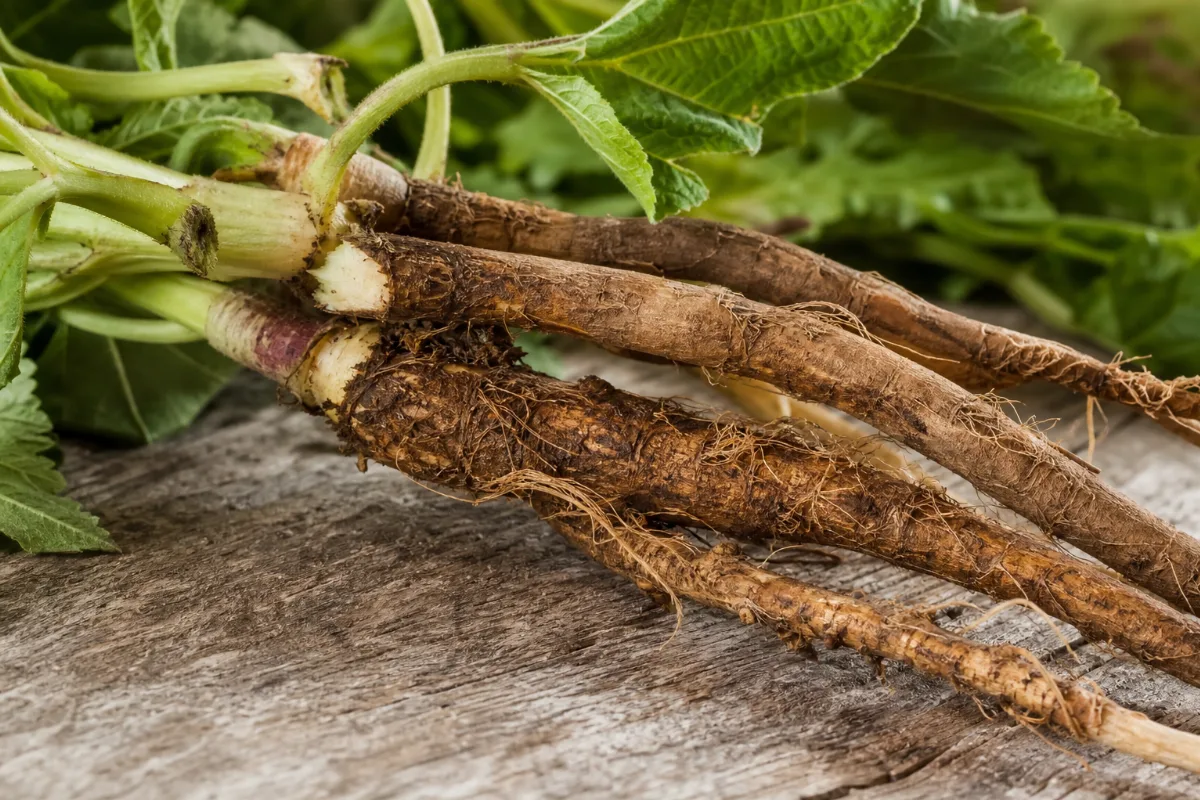
Marshmallow root is the dried root of Althaea officinalis L., in the mallow family (Malvaceae). [1][3] The root contains mucilage, a polysaccharide (long-chain sugar) substance. [4] It is not the same as the confection that borrowed its name, and this page does not cover candy. For the tea as a product, see marshmallow root tea and demulcent teas. A demulcent is a soothing, coating substance; see herbal actions terms.Traditional use (not proof)
The EU herbal committee (HMPC) concluded that, on the basis of long-standing use, marshmallow root preparations can be used for irritation of the mouth or throat with associated dry cough, and for mild stomach and gut discomfort. [1] A 2020 review says the plant has traditionally been used for cough and other breathing complaints. [5] A pilot-trial paper reports many topical uses for skin conditions in Persian medicine. [6] "Long-standing use" in EU rules means the effectiveness is plausible and use has been safe for at least 30 years (15 of them in the EU), even though clinical-trial evidence is insufficient. [1]What research shows
| Use | What the source found | Strength of evidence | Form and population |
|---|---|---|---|
| Mouth or throat irritation with dry cough | EU committee: usable on the basis of traditional use; insufficient clinical-trial evidence. [1] | Traditional use only | Root preparations and extracts, adults and children over 3 (EU) |
| Dry cough, user experience | Two pharmacy surveys of 822 users of a water-based root extract (lozenge or syrup) reported good effect and tolerability over 7 days. [7] | Insufficient evidence: no control group, self-reported | Specific extract products, adults |
| Cough, reviewed | A 2020 narrative review concluded animal and clinical studies supported the extract alone for dry cough. [5] It was not a systematic review, so treat it as a lower level of evidence than the regulator's cautious statement. | Promising but limited | Mixed extracts and combinations |
| Eczema in children (topical) | A pilot trial that ended with 22 children compared a 1% marshmallow ointment with 1% hydrocortisone ointment. [6] | Insufficient evidence (very small pilot) | Topical ointment |
| Milk supply while breastfeeding | LactMed: no scientifically valid clinical trials support this use. [4] | No good evidence of benefit | Oral, as in some proprietary mixtures |
| Stomach and gut discomfort | EU traditional use only. [1] Proper evidence not found in the trial sources we read. | Traditional use only | Root preparations, over 12 (EU) |
Results for one extract do not transfer to a tea, capsule or lozenge from another maker. See why herb studies disagree.
Forms and why the form matters
The EU assessment covers the comminuted (cut or ground) root, a macerate (soaked root) made into a syrup, and dry or liquid extracts, usually taken as tea or as solid or liquid forms by mouth or in the mouth. [1] Ethanol extracts can only be used in adults because adequate data are lacking. [1] Combination products are not covered by this assessment. [1] See herb forms and preparations.Safety
- Other medicines (absorption). The EU monograph says absorption of medicines taken at the same time may be delayed, and as a precaution marshmallow root should not be taken half an hour to one hour before or after other medicines. [2] Ask the prescriber or pharmacist about timing for your own medicines. The EU monograph lists other interactions as "none reported." [2] See how interactions work.
- Side effects. At the time of the EU assessment, no side effects had been reported. [1] LactMed says marshmallow is generally well tolerated in adults, with allergic reactions reported rarely. [4]
- Allergy. Hypersensitivity to the root is a contraindication in the EU monograph. [2] Seek care at once for hives, swelling or trouble breathing (911 in the US).
- Pregnancy. The EU monograph says safety in pregnancy and lactation has not been established and use is not recommended. [2]
- Breastfeeding. LactMed: no data on the excretion of marshmallow components into breastmilk, but it is unlikely to be harmful to a breastfed infant. [4] The two sources frame this differently; ask your clinician. See pregnancy and breastfeeding.
- Children. The EU assessment does not recommend use under 3; solid forms are not recommended under 6; ethanol extracts are for adults only. [2][1] See children and teens.
- Liver, kidney, bleeding, surgery. Not described in the sources we read. Tell the surgical team about any herb before an operation: herbs before and after surgery.
- When to get help. The EU monograph says to consult a doctor if breathlessness, fever or purulent sputum occurs, and if symptoms last longer than 1 week for throat irritation or cough, or 2 weeks for stomach and gut discomfort. [2]
Quality
LactMed notes that supplements may differ from their labels, and that results from one product may not apply to others. [4] See quality testing and certifications.Official statements
- European Medicines Agency, HMPC (EU), 2016: marshmallow root is a traditional herbal medicine for mouth or throat irritation with dry cough (over 3 years) and mild stomach and gut discomfort (over 12 years); see a doctor if symptoms last more than 1 or 2 weeks. [1]
Frequently asked questions
Does marshmallow root help a sore throat or cough?
The EU committee accepts traditional use for throat irritation and dry cough but says clinical-trial evidence is insufficient. [1] Honey and other options are covered in cough and sore throat remedies.
Does marshmallow root affect other medicines?
The EU monograph says it may delay absorption of other medicines and advises a gap of half an hour to one hour. [2] Ask a pharmacist about your medicines.
Is marshmallow root safe in pregnancy?
Safety has not been established, and the EU monograph does not recommend it. [2]
Is marshmallow root the same as marshmallow candy?
No. The herb is the root of Althaea officinalis. [1]
Can children take marshmallow root?
The EU assessment says children over 3 can usually use root medicines for throat irritation, but ethanol extracts only in adults. [1] A clinician should assess a child's cough.
References
- European Medicines Agency, Althaeae radix - herbal medicinal product (marshmallow root). Read 2026-10-23.
- European Medicines Agency, HMPC, European Union herbal monograph on Althaea officinalis L., radix (EMA/HMPC/436679/2015; revised 12 July 2016). Read 2026-10-23.
- GBIF Backbone Taxonomy, Althaea officinalis L.. Read 2026-10-23.
- National Library of Medicine, Drugs and Lactation Database (LactMed): Marshmallow. Read via the PubMed Bookshelf record (PMID 30000899). Read 2026-10-23.
- Shah SA, et al. Marsh Mallow (Althaea officinalis L.) and Its Potency in the Treatment of Cough. Complement Med Res. 2020. Read 2026-10-23.
- Effect of topical marshmallow (Althaea officinalis) on atopic dermatitis in children: a pilot double-blind active-controlled clinical trial. Phytother Res. 2021. Read 2026-10-23.
- Marshmallow Root Extract for the Treatment of Irritative Cough: Two Surveys on Users' View on Effectiveness and Tolerability. Complement Med Res. 2018. Read 2026-10-23.