Herbal Teas & Extracts · Herbal tea
Slippery Elm Tea
Ulmus rubra · also called Slippery elm bark tea, red elm tea, demulcent tea. Other soothing-root teas such as marshmallow root are grouped with it by some sellers. Not the same as slippery elm capsules, lozenges or powder mixtures.
Slippery elm tea is a thick, soothing drink made from the inner bark of the North American slippery elm tree. People use it for sore throat and an upset gut. There is no trial of the plain tea; one small trial tested a branded blend. The main cautions are slowed absorption of other medicines, pregnancy (avoid), allergy and harm to wild trees.
General information, not medical advice. Last substantive update · Not medically reviewed. A named clinician has not signed off on this page. How this page is made
About Slippery Elm Tea
Slippery elm tea is a thick drink made from the inner bark of Ulmus rubra, a North American tree. The bark gives a gel-like mucilage that people have long used to soothe the throat and gut. No trial of the plain tea was found; the only tea trial tested a branded blend. The main cautions are slower absorption of other medicines, pregnancy (avoid), allergy, and pressure on wild trees.
What it is
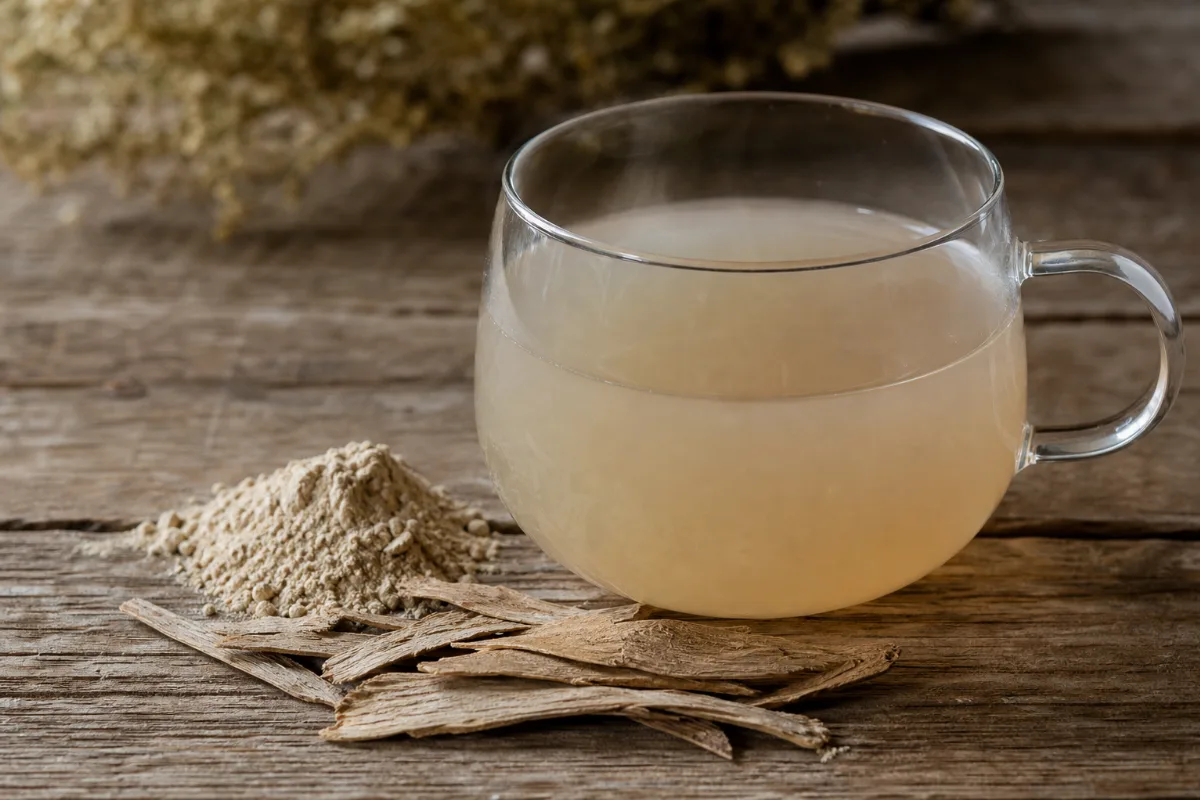
Slippery elm (Ulmus rubra, also called red elm; the old name was Ulmus fulva) is a tree in the elm family. It is not the tea plant. The inner bark is the part used; stirred into water it makes a slippery, thick drink.
Caffeine: slippery elm is not from the tea plant, and the maker of one slippery elm tea blend labels it caffeine free. We found no caffeine measurement of plain bark tea, so we give no figure. A blend with black or green tea leaves would carry that tea's caffeine.
Other 'demulcent' teas: sellers group slippery elm with marshmallow root and licorice root, which are also found in the Throat Coat blend. They are different plants with their own pages.
Tea, powder, lozenge or formula?
A tea is a water mixture of the bark's mucilage. Powders, capsules, lozenges and multi-ingredient gut formulas are different products, and most studies used those. RxList says commercial lozenges are preferred to the native herb for sore throat.
Results for a mixture or blend cannot be read as results for the tea, in either direction. We give no amounts or brewing steps; for how much to take, ask a pharmacist or doctor.
What the research shows
Sore throat: one 60-adult trial of a blend tea, short relief, industry-linked.
Gut: an open pilot of 31 people with IBS (10 with the constipation type) and a 43-person study, both of mixtures without control groups.
Essiac blend and 'detox' blend: no benefit found.
Lab work: findings in dishes only.
What regulators say
US FDA: we searched the US drug rules and the Federal Register and found no rule naming slippery elm as an over-the-counter demulcent. Wikipedia says it is marketed that way; we could not verify that, and older notices from the early 1980s were not readable here. Slippery elm teas are sold as foods or supplements.
LiverTox (US NIH): generally recognized as safe; no evidence of liver injury.
EU: no herbal monograph for slippery elm was found in earlier searches; this was not checked on the EMA site.
The tree and how the bark is taken
United Plant Savers lists slippery elm as At-Risk because the trade depends on wild bark: 78,000 to 353,000 pounds a year of wild-harvested dried bark in 1999-2010. Dutch elm disease and elm yellows kill the trees. Removing bark all the way round a trunk kills it, so harvesters should take thin vertical strips only. Cultivated bark is a small share.
A product that says how the bark was harvested is the more careful choice.
Pregnancy, breastfeeding and children
Pregnancy and breastfeeding: avoid (RxList); safety is unknown and the miscarriage claim is folklore with no reliable confirmation.
Children: no safety data for slippery elm tea in children were found. For a child's sore throat, follow NHS advice and see a doctor if there are warning signs.
At a glance
Traditional uses history, not proof
- LiverTox and RxList list sore throat, cough and stomach upset as traditional uses of the inner bark.
- United Plant Savers notes that Native Americans used many tree barks as medicine and that settlers later took up slippery elm; the maker of one tea says it was used in Native American herbal medicine for hundreds of years. This is credited from secondary sources and needs Indigenous review.
- In the 1830s doctors used the swelling bark for surgical tents and bougies (a paper title).
Studied for research
- Sore throat, very low (one small trial of a blend tea, run by its maker)
- Constipation-type irritable bowel syndrome, very low (a powder mixture, not tea)
- Gut symptoms, insufficient (seven-ingredient formula, not tea)
- Cough, insufficient (traditional use only)
- Cancer care with Essiac blend, against (no benefit on quality of life)
- Lab findings on gut bacteria, free radicals and strep bacteria, insufficient
Main compounds
- Mucilage (a gel-forming fibre of sugars)
- Tannins
Common forms
- Inner bark, cut or powdered, steeped or stirred into water as a drink
- Tea blends with licorice, marshmallow root, wild cherry bark, fennel and other herbs (check the label)
- Lozenges, capsules, powders and gut formulas (different products, not covered as tea)
Research links: Throat Coat tea trial for sore throat (abstract) · Constipation-type IBS formula pilot (abstract) · Slippery elm in LiverTox (US NIH) · Slippery elm, Memorial Sloan Kettering · Slippery elm in the herbal marketplace (United Plant Savers) · Sore throat self-care and when to get help (NHS) · Research Library · Genes & Biomarkers Library
What it is and its history
- Accepted scientific name
- Ulmus rubra Muhl.
- Naming authority
- GBIF lists Ulmus rubra Muhl. as accepted (key 5361867); Ulmus fulva Michx. is a synonym (key 5361868).
- Synonyms
- Ulmus fulva Michx.
- Common names
- Slippery elm (English); Red elm (English); Gray elm (English); Soft elm (English); Orme rouge (French); Rot-Ulme (German)
- Family or group
- Ulmaceae (elm family); not the tea plant Camellia sinensis.
- Classification
- Plantae > Tracheophyta > Magnoliopsida > Rosales > Ulmaceae > Ulmus > Ulmus rubra
- Native range
- Eastern Canada and the eastern and central United States (RxList). A fuller range is on Wikipedia and is not verified.
- Habitat
- Not verified in a source read.
- What it looks like
- Roots: Not part of tea use.; Stems: The inner bark (under the rough outer bark) is the part used; it feels slippery when chewed or mixed with water (RxList). RxList says the whole bark is not used.; Leaves: Not the studied part.; Flowers: Not described in sources read.; Fruit: Not described in sources read.
- Cultivation
- United Plant Savers: attempts to cultivate trees for bark have been sporadic and inadequate; cultivated bark is a small share of the trade.
- Harvest and processing
- United Plant Savers: bark is usually taken from trees or branches over one inch across, is 'rossed' (outer bark scraped off) while fresh, and should only be removed in thin vertical strips from live trees because girdling kills them.
- Look-alikes and adulterants
- Name: American elm (Ulmus americana); Note: Another native elm that shares diseases with slippery elm. Whether its bark is substituted in products was not found.; Name: Old name Ulmus fulva; Note: Same species. Labels using it are not a different plant.
- Sustainability and conservation
- On the United Plant Savers At-Risk List (wild-harvest dependence). Considered secure or un-ranked within its native range (same article). An IUCN Least Concern listing is on Wikipedia and is not verified.
Photographs
Traditional use and history history, not clinical proof
| Tradition or era | Documented use | Source |
|---|---|---|
| North American Indigenous and settler use | United Plant Savers notes that Native Americans used a variety of tree barks in their medicine (citing Moerman 1998) and that slippery elm was one of a few barks accepted by European settlers, which led to its later place in the US herbal trade. The maker of the tested tea says slippery elm was 'used in Native American herbal medicine for hundreds of years'. A 2022 paper studies barks used in Native American botanical medicine, including slippery elm, in the laboratory. We read no Indigenous source and do not describe specific nations' practices; this needs Indigenous and cultural review. | s-ups-slippery-elm-burkhart |
| Traditional use as a drink or paste | Memorial Sloan Kettering and LiverTox: the inner bark is used for sore throat, cough and gut upset, and on the skin for rash and irritation. | s-mskcc-slippery-elm |
| 19th century surgery (1837 title) | PubMed lists a paper on slippery elm bark used for surgical bougies, tents and catheters (1837), apparently because the bark swells when wet. Only the title was seen. | p38080966 |
| Modern market | Sold as powder, capsules, lozenges and in teas; the Throat Coat tea lists slippery elm bark among eight ingredients. Wild-harvested dried bark handled was 78,000 to 353,000 pounds a year in 1999-2010 (AHPA survey). | s-ups-slippery-elm-burkhart |
Traditional use shows how it was used. It does not show that it works or is safe today.
What is inside, and how it may work
What it contains and how those compounds act in cells and animals. Laboratory and animal mechanisms are not proven effects in people.
Main compounds
| Compound | Family | Where it is concentrated | Activity studied | Level of evidence |
|---|---|---|---|---|
| Mucilage (galactose- and other-sugar polysaccharide) | polysaccharide / soluble fibre | Inner bark | Forms a gel with water; the traditional basis of the soothing (demulcent) use. Not measured in people. 4 5 | Laboratory research |
| D-Galactose (sugar unit of the mucilage) PubChem 6036 | monosaccharide | Inner bark mucilage | A 1950 paper title reports a methylated form from the mucilage breakdown; amounts not read. 5 14 | Laboratory research |
| Tannins (for example gallic acid CID 370, tannic acid CID 16129778) | polyphenols | Bark | The KCNQ5 paper says gallic acid and tannic acid are common to the active barks tested; it does not say how much slippery elm contains. 9 14 | Laboratory research |
Mechanisms, receptors and pathways
| Target or pathway | Gene or receptor | What was found | Level |
|---|---|---|---|
| Demulcent (coating) action of mucilage | None identified | Not measured. The idea is that the gel coats an irritated throat and gut lining. Memorial Sloan Kettering also describes bulk-laxative and astringent (tannin) ideas. 10 | Pharmacological theory |
| Radical scavenging | Superoxide, peroxyl radicals | Extracts scavenged radicals in test tubes and reduced oxygen radicals from colitis biopsies in a dish. 7 | Laboratory research |
| Antibacterial action against Streptococcus pyogenes | Bacterial cell wall and membrane | Ethanol extract of inner bark: MIC 62.5 and MBC 125 microgram/mL in the laboratory. 22 | Laboratory research |
| Gut bacteria fermentation | Butyrate-producing bacteria | Ulmus rubra raised butyrate-producing bacteria in stool cultures. 13 | Laboratory research |
| Potassium channel activation | KCNQ5 | A 1% slippery elm bark extract strongly activated KCNQ5 in frog eggs; artery relaxation was not shown for slippery elm. 9 | Laboratory research |
Absorption, metabolism and elimination
- Absorption
- No human data on absorption of any slippery elm compound.
- Distribution
- No data.
- Metabolism
- No human data.
- Elimination
- No data.
- Bioavailability
- Not established.
Isolated compounds versus whole extracts
A tea or drink is a water mixture of the bark's mucilage. Powders, capsules, lozenges and multi-ingredient formulas are different products. Most research is on blends and mixtures, so a result for one cannot be read as a result for the others, in either direction.
Nutritional composition
Slippery elm bark is a fibre-rich plant material, but no nutrient table was read, so none is given here.
2 very low certainty4 not enough evidence2 evidence against
What was looked at
The 8 benefits and uses checked for Slippery Elm Tea, each with how strong the evidence is. Tap one to open it.
- Sore throat (acute pharyngitis)Very low certainty
- Constipation-type irritable bowel syndrome (IBS-C)Very low certainty
- Indigestion, reflux and bowel symptoms (seven-ingredient formula)Not enough evidence
- CoughNot enough evidence
- Cancer care with Essiac tea (a four-herb blend)Evidence against
- 'Detox' blend, body composition and bowel symptomsEvidence against
- Effects on gut bacteria (lab fermentation only)Not enough evidence
- Antioxidant and anti-strep findings (lab only)Not enough evidence
What is Slippery Elm Tea good for?
The uses people ask about and how strong the human evidence is for each. No row has a trial of plain slippery elm tea. The first row used a blend tea; the others used mixtures, or are traditional or lab only.
Benefits, one by one
Each card is a research question, not a promise. Tap a goal to filter. Open a card to see the studies, doses and limits.
Sore throat (acute pharyngitis)
Very low certaintyOne small trial tested a branded demulcent tea blend that contains slippery elm, and found less throat pain than placebo tea in the first 30 minutes. The abstract does not name the herbs, and the maker's own staff wrote it. No trial tested slippery elm tea alone.
4 studiesThe tested product was a branded herbal tea blend. Slippery elm powde…
Studies, doses and limits
What the trials found
A US multicentre randomised, double-blind trial gave 60 adults with acute pharyngitis either Throat Coat tea (30) or placebo tea (30), several times a day for 2 to 7 days. Pain on swallowing was lower with the tea at 5, 10, 15, 20 and 30 minutes after the first dose. The authors describe the relief as rapid and temporary.
Results
Tea blend lowered throat pain on swallowing more than placebo tea over 30 minutes (SPID -43.8 vs -16.5, p = 0.012; TOTPAR 53.6 vs 32.4, p = 0.031).
Effect sizes as reported
SPID least-squares mean -43.8 (SEM 11.9) vs -16.5 (SEM 13.9), p = 0.012; TOTPAR 53.6 (SEM 10.9) vs 32.4 (SEM 12.8), p = 0.031. No confidence intervals in the abstract.
Why this rating
One small trial of a blend (the abstract does not list the herbs, and licorice and marshmallow are among the maker's listed ingredients), run by the tea's maker, measured over minutes to days. It cannot be credited to slippery elm. RxList (Natural Medicines) rates sore throat 'Possibly Effective' for slippery elm and prefers lozenges to the plain herb; we could not see the evidence behind that rating.
Form and dose studied
The tested product was a branded herbal tea blend. Slippery elm powder, lozenges and plain bark tea are different products and were not tested here.
Who was studied
Adults 18 and over with acute pharyngitis, US clinics.
Limits
Industry-linked. Small. Blend. Short follow-up. A warm drink may help a sore throat by itself.
Why researchers looked
Slippery elm inner bark is a traditional North American remedy for sore throat. Its gel-like mucilage is thought to coat the throat.
Traditional use
LiverTox and RxList list sore throat as a traditional use of the inner bark; Memorial Sloan Kettering lists sore throat among its purported uses. The maker of the tested tea says slippery elm was used in Native American herbal medicine for hundreds of years (a marketing statement).
Proposed mechanism Pharmacological theory
The idea is that the mucilage forms a gel that coats and soothes the throat lining. This has not been measured in people.
A proposed mechanism does not show that the effect happens in people.
The abstract reports the trial as a safety and efficacy study but the part of the abstract we read gives no side-effect numbers. See the Safety tab.
Constipation-type irritable bowel syndrome (IBS-C)
Very low certaintyA small open study gave 10 people with constipation-type IBS a powder mixture containing slippery elm, lactulose, oat bran and licorice. Bowel habits and symptoms improved, but nobody was a comparison group and lactulose and oat bran ease constipation on their own. It was not a tea.
3 studiesDried powdered herbs in a mixture. Not a tea.
Studies, doses and limits
What the trials found
An Australian open-label pilot of two formulas included 10 people with constipation-predominant IBS and 21 with diarrhoea-predominant or alternating IBS. In the constipation group, bowel movement frequency rose 20% (p = 0.016) with less straining, pain and bloating and softer stools. The diarrhoea-type formula (slippery elm, bilberry, agrimony, cinnamon) did not improve bowel habit, though it improved some symptoms.
Results
Constipation group (n = 10): bowel movements up 20% (p = 0.016); straining p < 0.0001; abdominal pain p = 0.032; bloating p = 0.034; stool consistency p < 0.0001. Both formulas were well tolerated.
Effect sizes as reported
Only p-values and a 20% rise in frequency are given in the abstract.
Why this rating
Open-label, no control group, only 10 people in the constipation group, and the mixture contains lactulose and oat bran. Slippery elm cannot be credited, and the product was a powder mixture, not a tea.
Form and dose studied
Dried powdered herbs in a mixture. Not a tea.
Who was studied
31 adults with IBS (Rome II criteria), Lismore, Australia, recruited in 2001.
Limits
No control group, no blinding, tiny numbers, mixtures. Funding not stated.
Why researchers looked
Mucilage is a soft fibre. Slippery elm is traditionally taken for stomach and bowel upset.
Traditional use
Memorial Sloan Kettering lists gut disorders as a traditional use.
Proposed mechanism Pharmacological theory
The proposed idea is a gel that bulks and softens stool. Not tested for slippery elm in people.
A proposed mechanism does not show that the effect happens in people.
Both formulas were described as well tolerated.
Indigestion, reflux and bowel symptoms (seven-ingredient formula)
Not enough evidenceA 43-person study of a powder with seven ingredients, including slippery elm, reported fewer gut symptoms. There was no placebo group, and slippery elm cannot be credited. It was not a tea.
1 studiesA powder formula mixed with other ingredients. Not a tea.
Studies, doses and limits
What the trials found
A 16-week pre-post study of 43 adults with digestive disorders, in Melbourne. After a control phase they took a gut formula (curcumin, aloe vera, slippery elm, guar gum, pectin, peppermint oil, glutamine) in two 4-week phases. The authors report symptoms improved by 60 to 80%.
Results
Symptom frequency and severity fell 60 to 80% (self-reported). Almost half of those taking proton pump inhibitors for heartburn no longer needed them by the study end, according to the authors.
Effect sizes as reported
Percent improvements only, no confidence intervals in the abstract.
Why this rating
No placebo, no blinding, seven ingredients, self-reported symptoms. Slippery elm cannot be separated out. Do not stop or change a medicine because of this study.
Form and dose studied
A powder formula mixed with other ingredients. Not a tea.
Who was studied
43 completers, Australian adults with digestive disorders.
Limits
Uncontrolled and multi-ingredient. The authors are from an integrative medicine institute; funding not stated in the abstract.
Why researchers looked
Slippery elm is one of several soothing and fibre ingredients in some gut formulas.
Traditional use
Traditional gut use (Memorial Sloan Kettering).
Proposed mechanism None tested
Not tested for slippery elm alone.
A proposed mechanism does not show that the effect happens in people.
The authors call the formula tolerable.
Cough
Not enough evidenceSlippery elm is traditionally used for cough, but no cough trial of the tea or the bark was found.
2 studiesNot applicable.
Studies, doses and limits
What the trials found
No trial of slippery elm for cough was found.
Results
No result.
Why this rating
Traditional use only; no human study.
Limits
No data.
Why researchers looked
Traditional use for cough and bronchitis (Memorial Sloan Kettering lists bronchitis and cough).
Traditional use
Listed as a traditional use by Memorial Sloan Kettering and RxList. RxList rates cough 'Insufficient Evidence to Rate'.
Proposed mechanism Pharmacological theory
Mucilage is thought to soothe irritated airways, but this is not shown.
A proposed mechanism does not show that the effect happens in people.
See the Safety tab.
Cancer care with Essiac tea (a four-herb blend)
Evidence againstEssiac, a liquid herbal tea blend that includes slippery elm inner bark, did not improve quality of life or mood in 510 women with breast cancer. Users did slightly worse on two measures, probably because they had more advanced disease. This is evidence against the blend improving quality of life, not a test of slippery elm.
2 studiesLiquid Essiac tea blend (burdock root, Indian rhubarb, sheep sorrel, …
Studies, doses and limits
What the trials found
A Canadian retrospective cohort of 510 women with breast cancer diagnosed in 2003 compared new Essiac users with never-users. Essiac did not significantly change quality of life or mood. On physical well-being and relationship with doctor, users did worse.
Results
No significant benefit on quality of life or mood; slightly worse on two subscales. 2 women reported minor adverse events.
Effect sizes as reported
Not given in the abstract.
Why this rating
An observational study of a four-herb blend: no benefit on the measures tested. Users and non-users differ, so the 'worse' scores are not caused by the tea. No treatment effect on cancer was tested.
Form and dose studied
Liquid Essiac tea blend (burdock root, Indian rhubarb, sheep sorrel, slippery elm inner bark). Not slippery elm alone.
Who was studied
510 women with breast cancer, Ontario, Canada.
Limits
Observational; blend; self-reported; effects on cancer outcomes not studied.
Why researchers looked
Essiac is a popular blend among people with cancer. Slippery elm is one of its four herbs.
Traditional use
Memorial Sloan Kettering names slippery elm as a component of Essiac, used as an alternative cancer treatment.
Proposed mechanism Laboratory research
A lab study of the tea found it scavenged radicals in a dish. That does not show a benefit in people.
A proposed mechanism does not show that the effect happens in people.
Indian rhubarb in the blend is a laxative plant. Cancer treatment should be decided with your cancer team.
'Detox' blend, body composition and bowel symptoms
Evidence againstA four-week trial in 22 healthy young women of a multi-herb 'detox' supplement that contains slippery elm found no benefit and no harm on body composition, waist, bowel symptoms or blood markers. It was a capsule or powder blend with laxative herbs, not a tea.
1 studiesA proprietary blend supplement of eight herbs. Not a tea.
Studies, doses and limits
What the trials found
A double-blind, placebo-controlled randomised trial in 22 healthy women who completed it, for four weeks.
Results
No beneficial or harmful effects found on body composition, waist, gastrointestinal symptoms or blood safety markers.
Effect sizes as reported
Not given in the abstract.
Why this rating
A small trial that found no benefit for a blend. Slippery elm cannot be separated from the cascara, senna and other herbs in it.
Form and dose studied
A proprietary blend supplement of eight herbs. Not a tea.
Who was studied
22 healthy young women.
Limits
Tiny; healthy people; blend.
Why researchers looked
Slippery elm is a common ingredient of cleanse products.
Proposed mechanism None tested
Not studied.
A proposed mechanism does not show that the effect happens in people.
The blend contained stimulant laxatives (cascara, senna).
Effects on gut bacteria (lab fermentation only)
Not enough evidenceIn stool cultures in a dish, slippery elm bark raised bacteria that make butyrate, a gut-friendly fatty acid. No person drank anything in this study.
1 studiesHerb material in culture, not a tea.
Studies, doses and limits
Results
Ulmus rubra and triphala significantly raised the relative abundance of butyrate-producing bacteria. Licorice raised propionate-producing species the most.
Why this rating
Laboratory only. The authors say human trials are needed.
Form and dose studied
Herb material in culture, not a tea.
Who was studied
Human stool cultures.
Limits
Not tested in people. Two authors have Chopra Foundation roles (disclosed).
Why researchers looked
Researchers tested three herbs used for gut health for prebiotic effects.
Proposed mechanism Laboratory research
Fermentation of herb material by human stool bacteria in a dish.
A proposed mechanism does not show that the effect happens in people.
Not applicable.
Antioxidant and anti-strep findings (lab only)
Not enough evidenceSlippery elm extracts scavenged free radicals in test tubes and inflamed gut biopsy tissue, and an alcohol extract of the inner bark killed strep throat bacteria in a dish. None of this shows the tea does anything in people.
2 studiesLaboratory extracts.
Studies, doses and limits
Results
Antioxidant: slippery elm was among the herbs that scavenged superoxide and peroxyl radicals and cut radical output from colitis biopsies in a dish. Antibacterial: an ethanol extract of the inner bark had a minimum inhibitory concentration of 62.5 microgram/mL and a minimum bactericidal concentration of 125 microgram/mL against Streptococcus pyogenes; the authors singled out sage leaf and purple coneflower as the most promising.
Effect sizes as reported
MIC 62.5 and MBC 125 microgram/mL (alcohol extract).
Why this rating
Test-tube and tissue work. An alcohol extract is not a tea.
Form and dose studied
Laboratory extracts.
Limits
No human data.
Why researchers looked
Researchers screened herbs used for gut inflammation and sore throat.
Proposed mechanism Laboratory research
Radical scavenging and antibacterial activity in laboratory tests.
A proposed mechanism does not show that the effect happens in people.
Not applicable.
Connections to the rest of health
How Slippery Elm Tea connects to the rest of our health knowledge graph. Every link says what kind of connection it is. A safety link (for example to the liver) is a warning, not a benefit. A study that merely mentions a topic never creates a benefit link.
Explore every connection: goals, body systems, organs, symptoms, genes
A. Wellness goals
| Connected to | Kind of connection | Evidence status | Context | Studies |
|---|---|---|---|---|
| Breathing Support | Very low certainty | Sore throat (acute pharyngitis): One small trial tested a branded demulcent tea blend that contains slippery elm, and found less throat pain than placebo tea in the first 30 minutes. The abstract does not name the herbs, and the maker's own staff wrote it. No trial tested slippery elm tea alone. | 2 19 17 10 | |
| Digestive Support | Very low certainty | Constipation-type irritable bowel syndrome (IBS-C): A small open study gave 10 people with constipation-type IBS a powder mixture containing slippery elm, lactulose, oat bran and licorice. Bowel habits and symptoms improved, but nobody was a comparison group and lactulose and oat bran ease constipation on their own. It was not a tea. Indigestion, reflux and bowel symptoms (seven-ingredient formula): A 43-person study of a powder with seven ingredients, including slippery elm, reported fewer gut symptoms. There was no placebo group, and slippery elm cannot be credited. It was not a tea. | 6 10 17 16 | |
| Breathing Support | Traditional use | Not enough evidence | Cough: Slippery elm is traditionally used for cough, but no cough trial of the tea or the bark was found. | 10 17 |
| Weight Management | Evidence against | 'Detox' blend, body composition and bowel symptoms: A four-week trial in 22 healthy young women of a multi-herb 'detox' supplement that contains slippery elm found no benefit and no harm on body composition, waist, bowel symptoms or blood markers. It was a capsule or powder blend with laxative herbs, not a tea. | 18 | |
| Gut Health | Not enough evidence | Effects on gut bacteria (lab fermentation only): In stool cultures in a dish, slippery elm bark raised bacteria that make butyrate, a gut-friendly fatty acid. No person drank anything in this study. | 13 |
B. Body systems
| Connected to | Kind of connection | Evidence status | Context | Studies |
|---|---|---|---|---|
| Respiratory System | Biological association | Very low certainty | Studied for: Sore throat (acute pharyngitis) Studied for: Cough | 2 19 17 10 |
| Digestive System | Biological association | Very low certainty | Studied for: Constipation-type irritable bowel syndrome (IBS-C) Studied for: Indigestion, reflux and bowel symptoms (seven-ingredient formula) | 6 10 17 16 18 13 |
E. Health conditions
| Connected to | Kind of connection | Evidence status | Context | Studies |
|---|---|---|---|---|
| Sore throat | Very low certainty | One 60-person trial of a branded tea blend, run by its maker. Preparation or compound: Demulcent tea blend containing slippery elm |
2 | |
| Irritable bowel syndrome | Very low certainty | Open pilot of 31 people; 10 had the constipation type. Preparation or compound: Powder mixtures containing slippery elm (not tea) |
6 | |
| Coughing | Traditional use | Not enough evidence | Traditional use only. Preparation or compound: Slippery elm inner bark |
10 |
L. Active compounds
| Connected to | Kind of connection | Evidence status | Context | Studies |
|---|---|---|---|---|
| Mucilage (galactose- and other-sugar polysaccharide) | Biological association | In vitro | Forms a gel with water; the traditional basis of the soothing (demulcent) use. Not measured in people. Preparation or compound: Inner bark |
4 5 |
| D-Galactose (sugar unit of the mucilage) | Biological association | In vitro | A 1950 paper title reports a methylated form from the mucilage breakdown; amounts not read. Preparation or compound: Inner bark mucilage |
5 14 |
| Tannins (for example gallic acid CID 370, tannic acid CID 16129778) | Biological association | In vitro | The KCNQ5 paper says gallic acid and tannic acid are common to the active barks tested; it does not say how much slippery elm contains. Preparation or compound: Bark |
9 14 |
Each connection is stored with the ingredient, the connected record, the kind of connection, the evidence status, the supporting studies, the preparation or compound involved, and a review date (last reviewed October 25, 2026).
Evidence at a glance: what the research found for 8 outcomes
Each outcome below is one thing researchers measured. Certainty is how far the evidence can be trusted, not how well it works. The full studies are on the next tab.
The evidence
The research centre for Slippery Elm Tea. Every record here was checked against PubMed or the publisher's page; we never list a study we have not verified.
Evidence by outcome
Bars show how many studies we found for each outcome, not how well it works. People are added up across trials only (reviews are not added, to avoid double counting).
How we rate evidence
High certainty
Several well-run trials or reviews agree; further research is unlikely to change the picture much.
Moderate certainty
Good trials point the same way, but some doubt remains.
Low certainty
Small, short or inconsistent trials. The finding could change with better research.
Very low certainty
Very little or very weak human data. Treat as a possibility only.
Mixed findings
Trials or reviews disagree with each other.
Not enough evidence
Not enough human research to say either way.
Evidence against
Good research found no benefit, or found harm.
We take the reviewers' own risk-of-bias and GRADE statements where they exist, and otherwise judge from study size, design, consistency, directness and whether a product matches what is sold. Many publications do not make evidence high. Method note: We searched PubMed and read the abstracts of the studies listed, read the manufacturer, RxList, Memorial Sloan Kettering, United Plant Savers and NHS pages, searched US drug rules for slippery elm, and checked plant names in GBIF.
Study library: every study we checked 24
| Study | Design | People | Product, dose, length | Result |
|---|---|---|---|---|
| Amado 2021 Subserous Type of Eosinophilic Colitis: A Rare Disease. Eur J Case Rep Intern Med · PMID 34377693 · DOI |
Case report |
1 One woman with subserous eosinophilic colitis, Portugal |
An Ulmus rubra-rich product (details not in abstract) bark (presumed) |
The authors say the colitis was potentially triggered by taking an Ulmus rubra-rich product. They do not claim proof. Single case Methods, limits and fundingOutcomes: Diagnosis and likely trigger of eosinophilic colitis Limitations: One person; a possible trigger is not proof; no re-challenge reported in the abstract. Funding and conflicts: No competing interests declared. Read: abstract |
| Brinckmann 2003 Safety and efficacy of a traditional herbal medicine (Throat Coat) in symptomatic temporary relief of pain in patients with acute pharyngitis: a multicenter, prospective, randomized, double-blinded, placebo-controlled study. J Altern Complement Med · PMID 12804082 · DOI |
Controlled trial |
60 Adults (18+) with acute pharyngitis (sore throat), three US primary care clinics |
Throat Coat, a branded demulcent herbal TEA (blend; the abstract does not list the herbs) blend not given here 2 to 7 days · vs placebo tea |
60 adults with acute pharyngitis were randomised, 30 to the tea and 30 to placebo tea, in three primary care clinics in the US. Throat pain on swallowing was lower with the tea at 5, 10, 15, 20 and 30 minutes after the first dose (p = 0.007, 0.005, 0.01, 0.05, 0.04). SPID least-squares mean -43.8 (SEM 11.9) with the tea versus -16.5 (SEM 13.9) with placebo (p = 0.012). TOTPAR 53.6 (SEM 10.9) versus 32.4 (SEM 12.8) (p = 0.031). The authors call the relief rapid and temporary. Less throat pain than placebo tea in the first 30 minutes (Not given in the abstract (SEMs shown in the results)) Methods, limits and fundingOutcomes: Pain on swallowing: sum of pain intensity differences (SPID) and total pain relief (TOTPAR) over the first 30 minutes after the first dose Limitations: A blend, so the result cannot be credited to slippery elm. Small (60 people). Relief was measured over 30 minutes after a dose, and the study ran 2 to 7 days. A warm drink can soothe a sore throat by itself and the placebo tea may not have matched in taste. Industry-linked: the first author works in Research and Development at Traditional Medicinals, the company that sells the tea. Effect sizes are given only as scale scores, not as a plain pain score. Funding and conflicts: Industry-linked. The first author's affiliation in the abstract is Traditional Medicinals Inc., the maker of the tested tea. Funding is not stated in the abstract. Read: abstract |
| GBIF Backbone Taxonomy 2026 GBIF Backbone: Ulmus rubra Muhl. (usageKey 5361867) GBIF Backbone Taxonomy · Source |
Database record n/a |
n/a | n/a inner bark |
Accepted name Ulmus rubra Muhl., family Ulmaceae. Ulmus fulva Michx. is a synonym (key 5361868). Methods, limits and fundingLimitations: API record only. Read: full-text |
| GILL 1946 Constitution of the mucilage from the bark of Ulmus fulva (slippery elm mucilage); the sugars formed in the hydrolysis of the methylated mucilage. J Chem Soc · PMID 20282480 · DOI |
Chemistry in-vitro |
Laboratory chemistry (1946) | Slippery elm bark mucilage, methylated and broken down bark |
Only the title was read: it studies the sugars formed on hydrolysis of the methylated mucilage of Ulmus fulva bark. None Methods, limits and fundingOutcomes: Sugars formed when the mucilage is broken down Limitations: Title only; no abstract. Funding and conflicts: Not stated. Read: summary-only |
| HOUGH 1950 Chemical constitution of slippery elm mucilage; isolation of 3-methyl d-galactose from the hydrolysis products. Nature · PMID 15400433 · DOI |
Chemistry in-vitro |
Laboratory chemistry (1950) | Slippery elm bark mucilage bark |
Only the title was read: it reports isolating 3-methyl D-galactose from the hydrolysis products of slippery elm mucilage. None Methods, limits and fundingOutcomes: Sugar content of the mucilage Limitations: Title only; no abstract. Funding and conflicts: Not stated. Read: summary-only |
| Hawrelak 2010 Effects of two natural medicine formulations on irritable bowel syndrome symptoms: a pilot study. J Altern Complement Med · PMID 20954962 · DOI |
Open label uncontrolled |
31 Adults meeting Rome II criteria for irritable bowel syndrome (21 diarrhoea-predominant or alternating, 10 constipation-predominant), Australia, recruited 2001 |
Two mixtures of dried powdered herbs (not teas). C-IBS formula: slippery elm bark, lactulose, oat bran, licorice root. DA-IBS formula: bilberry fruit, slippery elm bark, agrimony, cinnamon inner bark (in mixtures) not given here see abstract |
C-IBS group (constipation-predominant, n=10): bowel movement frequency up 20% (p = 0.016); less straining (p < 0.0001), abdominal pain (p = 0.032), bloating (p = 0.034); better stool consistency (p < 0.0001). DA-IBS group (n=21): small rise in bowel frequency (p = 0.027) and fewer symptoms, but the authors say it was not effective for bowel habit in this group. C-IBS: +20% bowel movement frequency (p = 0.016) Methods, limits and fundingOutcomes: Bowel movement frequency, stool consistency, straining, abdominal pain, bloating, flatulence, global IBS symptoms Limitations: Open-label with no control group, 31 people, only 10 in the constipation group. Both formulas are mixtures; lactulose and oat bran in C-IBS are known to ease constipation by themselves, so slippery elm cannot be credited. No blinding. Funding and conflicts: Not stated in the abstract. The first author is affiliated with Goulds Naturopathica, Hobart, Australia. Read: abstract |
| Langmead 2002 Antioxidant effects of herbal therapies used by patients with inflammatory bowel disease: an in vitro study. Aliment Pharmacol Ther · PMID 11860402 · DOI |
Laboratory research in-vitro |
Cell-free chemical tests and biopsies from people with active ulcerative colitis | Extracts of slippery elm, fenugreek, devil's claw, Mexican yam, tormentil and wei tong ning; 5-ASA (mesalazine) for comparison bark · vs 5-ASA |
All herbs except fenugreek scavenged superoxide in a dose-dependent way. All materials scavenged peroxyl radicals. Oxygen radical release from inflamed colon biopsies fell after incubation with all herbs except Mexican yam, and with 5-ASA. Dose-dependent scavenging; no numbers in abstract Methods, limits and fundingOutcomes: Superoxide and peroxyl radical scavenging; oxygen radical release from colon biopsies Limitations: Laboratory test tubes and biopsy tissue only, not people taking the herb by mouth. Antioxidant activity in a dish does not show a benefit in the body. Funding and conflicts: No conflict statement in the abstract. Read: abstract |
| LiverTox (NIDDK) 2024 Slippery Elm. LiverTox: Clinical and Research Information on Drug-Induced Liver Injury (NIDDK), updated 5 Jan 2024 · PMID 38289993 |
Authoritative guidance |
Reference entry on liver injury from herbs | Slippery elm (Ulmus rubra) inner bark preparations inner bark |
LiverTox (NIDDK) says the inner bark is used by mouth for sore throat and stomach upset and on the skin for rash and irritation, that slippery elm preparations are generally recognized as safe, and that there is no evidence they cause raised liver enzymes or clinically apparent liver injury. No liver signal reported Methods, limits and fundingOutcomes: Liver safety Limitations: Only the abstract was read. An absence of reports is not proof of safety. Funding and conflicts: Government reference. Read: abstract |
| Manville 2022 KCNQ5 activation by tannins mediates vasorelaxant effects of barks used in Native American botanical medicine. FASEB J · PMID 35997997 · DOI |
Laboratory research in-vitro |
Frog egg cells (Xenopus oocytes) carrying a human potassium channel, and rat arteries | Bark extracts (1%) of birch, cramp bark, slippery elm, white oak, red willow, white willow and wild cherry bark 1% extract · vs Other barks |
Slippery elm bark extract strongly activated the KCNQ5 potassium channel in oocytes. The artery-relaxing tests were done only on red willow, white willow and white oak (they relaxed rat arteries); slippery elm was not reported as tested in arteries in the abstract. Not a human result Methods, limits and fundingOutcomes: KCNQ5 channel activation; blood vessel relaxation Limitations: Cell and animal tissue only. Slippery elm was not shown to relax arteries. Funding and conflicts: Authors declare no competing interests. Read: abstract |
| Memorial Sloan Kettering Cancer Center 2022 Memorial Sloan Kettering Cancer Center: Slippery Elm (page updated 30 June 2022) Memorial Sloan Kettering Cancer Center · Source |
Consumer reference n/a |
n/a | n/a inner bark |
Says slippery elm is a tree native to North America; the bark is used for gut problems, sore throat, cough and skin ulcers; the mucilage has demulcent effects. A small clinical study showed a formulation containing slippery elm improved bowel habits and symptoms in constipation-predominant IBS. It names slippery elm as one component of Essiac. Its mechanism section is theory (mucilage, fibre, tannin) plus lab antioxidant studies. Methods, limits and fundingLimitations: A patient reference page; the dosage part is behind a login and was not read. Read: full-text |
| NCBI Taxonomy 2026 NCBI Taxonomy: Ulmus rubra (taxid 102693) NCBI Taxonomy · Source |
Database record n/a |
n/a | n/a inner bark |
Taxonomy record for Ulmus rubra. Methods, limits and fundingLimitations: Record only. Read: full-text |
| NHS 2026 NHS (UK): Sore throat (viewed 2026-10-25) NHS · Source |
Authoritative guidance n/a |
n/a | n/a inner bark |
Sore throats usually get better by themselves within a week. Self-care it lists: warm salty water gargle (not for children), plenty of water, cool or soft foods, avoiding smoke. It says to ask for an urgent GP appointment or call 111 if worried, with a very high temperature or feeling hot, cold or shivery, signs of dehydration, or a weakened immune system. Call 999 or go to A&E for difficulty breathing, being unable to swallow, drooling, a high-pitched breathing sound, or severe symptoms getting worse quickly. Methods, limits and fundingLimitations: UK advice, written for the NHS in England. Read: full-text |
| Peterson 2018 Prebiotic Potential of Herbal Medicines Used in Digestive Health and Disease. J Altern Complement Med · PMID 29565634 · DOI |
Laboratory research in-vitro |
Human stool samples grown anaerobically in the laboratory | Ulmus rubra, Glycyrrhiza glabra (licorice) and triphala added to stool cultures bark · vs Unsupplemented cultures |
Ulmus rubra and triphala significantly raised the relative abundance of butyrate-producing bacteria. The herbs raised many bacteria considered helpful (Bifidobacterium, Lactobacillus, Bacteroides) and lowered some potential pathogens in the dish. No numbers in abstract Methods, limits and fundingOutcomes: Bacterial species abundance by 16S sequencing; butyrate-producing bacteria Limitations: Fermentation of stool in a dish, not in people. The authors say human trials are needed. Two authors are linked to the Chopra Foundation (disclosed). Licorice and triphala were tested alongside. Funding and conflicts: D.C. and P.J.M. have disclosed Chopra Foundation roles. Read: abstract |
| PubChem 2026 PubChem compound lookups (D-galactose CID 6036; gallic acid CID 370; tannic acid CID 16129778) PubChem · Source |
Database record n/a |
n/a | n/a inner bark |
CIDs checked in an earlier build of the slippery elm herb page by API. Methods, limits and fundingLimitations: Record lookups only. Read: full-text |
| Rahman 2017 Drug-Herb Interactions in the Elderly Patient with IBD: a Growing Concern. Curr Treat Options Gastroenterol · PMID 28918484 · DOI |
Narrative review |
Older people with inflammatory bowel disease (Crohn disease, ulcerative colitis) (review of herbs and drug interactions) | About 25 herbs and supplements including Ulmus rubra (slippery elm bark) bark |
The abstract lists Ulmus rubra among the herbs reviewed for evidence in IBD and for interactions with IBD drugs. The abstract does not give the slippery elm findings. None in abstract Methods, limits and fundingOutcomes: Herb background, evidence in IBD and possible interactions with IBD medicines Limitations: Only the abstract was read, so the slippery elm section of the review was not seen. Funding and conflicts: No conflict statement in the abstract. Read: abstract |
| Ried 2020 Herbal formula improves upper and lower gastrointestinal symptoms and gut health in Australian adults with digestive disorders. Nutr Res · PMID 32151878 · DOI |
Pre post study |
43 Australian adults with digestive disorders (upper and lower gut symptoms); 43 completed |
Nutrition Care Gut Relief Formula (powder with curcumin, aloe vera, slippery elm, guar gum, pectin, peppermint oil and glutamine) inner bark (in a mixture) not given here 16 weeks (4-week control phase, then two 4-week phases) |
Authors report symptom frequency and severity improved by 60 to 80%; most people with normal stool had normal permeability at the end; Lactobacillus, Clostridium and Faecalibacterium prausnitzii rose; almost half of those with upper gut symptoms who took proton pump inhibitors no longer needed them. Symptoms improved 60-80% (authors); about half of PPI users stopped (authors) Methods, limits and fundingOutcomes: Validated symptom questionnaires (Leeds Dyspepsia, Bristol Stool Chart, Birmingham IBS), intestinal permeability (lactulose to mannitol ratio), gut microbiota, proton pump inhibitor use Limitations: Seven-ingredient formula, so slippery elm cannot be credited. No placebo group, no blinding, small. Self-reported symptoms. Stopping medicines is a result of the study design and should not be copied at home. Funding and conflicts: Not stated in the abstract. The authors are from the National Institute of Integrative Medicine, Melbourne. Read: abstract |
| RxList 2026 RxList: Slippery Elm (uses, side effects, interactions; draws on the Natural Medicines database) RxList · Source |
Consumer reference n/a |
n/a | n/a inner bark |
Says slippery elm is native to eastern Canada and the eastern and central US and the inner bark (not the whole bark) is used. Rates sore throat 'Possibly Effective' and notes commercial lozenges are preferred to the native herb; IBS, cancer and other uses 'Insufficient Evidence to Rate'; effects of the bark alone are not clear. Possibly safe by mouth; allergic reactions and skin irritation can occur on skin. Pregnancy: folklore says the bark can cause miscarriage when inserted into the cervix and over the years it got a reputation for causing abortion even by mouth, but there is no reliable information to confirm this; it advises not taking it in pregnancy or breast-feeding. Interaction rated Moderate with medicines taken by mouth: the mucilage can decrease how much medicine the body absorbs, so take slippery elm after oral medicines (it gives a time gap). Methods, limits and fundingLimitations: A consumer reference. The ratings come from a database we could not open. The page says there is not enough scientific information to set an appropriate dose range. Read: full-text |
| Tinsley 2019 A Purported Detoxification Supplement Does Not Improve Body Composition, Waist Circumference, Blood Markers, or Gastrointestinal Symptoms in Healthy Adult Females. J Diet Suppl · PMID 29958034 · DOI |
Controlled trial |
22 Healthy young women (22 completed) |
A 1,350 mg-per-serving proprietary blend (papaya leaf, cascara sagrada bark, slippery elm bark, peppermint leaf, red raspberry leaf, fenugreek seed, ginger root, senna leaf); a supplement, not a tea inner bark (in a blend) as stated in the abstract 4 weeks · vs placebo |
No beneficial or harmful effects on body composition, waist, stomach and bowel symptoms or blood markers. The authors call the product apparently safe in healthy young women but not beneficial for those outcomes. No difference versus placebo Methods, limits and fundingOutcomes: Body composition, waist circumference, gastrointestinal symptoms, blood safety markers Limitations: Tiny trial in healthy women, not people with symptoms. A blend including two laxatives (cascara, senna) and seven other herbs; slippery elm cannot be separated out. Funding and conflicts: Not stated in the abstract. Read: abstract |
| Traditional Medicinals 2026 Traditional Medicinals: Throat Coat tea product page (viewed 2026-10-25) Traditional Medicinals · Source |
Manufacturer page n/a |
n/a | n/a inner bark |
The maker labels its original Throat Coat tea 'Caffeine Free' and lists the ingredients as organic licorice root, slippery elm bark, licorice dry aqueous extract, marshmallow root, wild cherry bark, fennel fruit, cinnamon bark and orange peel. It states the tea uses slippery elm 'used in Native American herbal medicine for hundreds of years' (a marketing statement, not independently checked here). It also sells variants with echinacea or eucalyptus. Methods, limits and fundingLimitations: A seller's page, not an independent source. Prices and brewing directions on the page are not repeated here. Read: full-text |
| US eCFR / Federal Register 2026 eCFR and Federal Register searches for slippery elm in FDA drug rules (run 2026-10-25) US eCFR / Federal Register · Source |
Regulation n/a |
n/a | n/a inner bark |
Searches of the eCFR for 'slippery elm' returned only 40 CFR 180.41 (EPA pesticide crop groups), where Ulmus rubra is listed as a spice/herb-group commodity. A search for 'elm bark' returned nothing. Federal Register searches (1994 onward) returned 3 documents, all EPA crop-group rules. No FDA drug rule listing slippery elm as an oral demulcent was found. Methods, limits and fundingLimitations: Absence in these searches is not proof. Older OTC review notices from the early 1980s, which are not searchable here, were not read. The claim that slippery elm is marketed in the US as an over-the-counter demulcent comes from Wikipedia (not verified). Read: full-text |
| United Plant Savers 2017 United Plant Savers: Slippery Elm in the Herbal Marketplace - Past, Present & Future (E. P. Burkhart) United Plant Savers · Source |
Conservation report n/a |
n/a | n/a inner bark |
Slippery elm is on the United Plant Savers At-Risk List because the trade relies on wild-harvested bark. Wild-harvested dried bark handled was 78,000 to 353,000 pounds a year (AHPA survey, 1999-2010). Cultivated bark is a small share (generally under 10,000 pounds). Dutch elm disease and elm yellows kill the trees, so they seldom reach commercial size. Harvest only thin vertical strips from live trees; girdling a tree kills it. Reports suggest about a dozen trees are needed for fifty pounds of fresh bark. Within its native range the species is considered secure or un-ranked. It notes Native Americans used a variety of tree barks in their pharmacopoeia (citing Moerman 1998) and that slippery elm was one of a few accepted by European settlers. Methods, limits and fundingLimitations: An advocacy group article; the figures are quoted from its sources (AHPA, news reports). Bark yield reports lack tree size and age. Read: full-text |
| Wijesundara 2019 Bactericidal and Anti-Biofilm Activity of Ethanol Extracts Derived from Selected Medicinal Plants against Streptococcus pyogenes. Molecules · PMID 30909644 · DOI |
Laboratory research in-vitro |
Streptococcus pyogenes (the bacterium behind strep throat) grown in the laboratory | Ethanol extracts of 14 plants, including slippery elm inner bark inner bark · vs Other plant extracts |
Licorice root, purple coneflower flower and stem, sage leaf and slippery elm inner bark extracts were among the most effective: minimum inhibitory concentration 62.5 microgram/mL and minimum bactericidal concentration 125 microgram/mL. The authors singled out sage leaf and purple coneflower flower as the most promising candidates. MIC 62.5 microgram/mL; MBC 125 microgram/mL Methods, limits and fundingOutcomes: Minimum inhibitory and bactericidal concentrations; biofilm inhibition Limitations: Alcohol extracts in a dish. A tea, lozenge or powder swallowed by a person is not the same. No human data. Funding and conflicts: The authors declare no conflict of interest. Read: abstract |
| Wikipedia 2026 Wikipedia: Ulmus rubra (NOT verified against primary sources) Wikipedia · Source |
Encyclopedia n/a |
n/a | n/a inner bark |
Says the inner bark is long used as a demulcent and is still marketed in the US as an over-the-counter demulcent; gives native range and an IUCN Least Concern listing citing Stritch 2018. These are not confirmed by a primary source here. Methods, limits and fundingLimitations: Encyclopedia, used only to flag claims that need checking. Read: full-text |
| Zick 2006 Trial of Essiac to ascertain its effect in women with breast cancer (TEA-BC). J Altern Complement Med · PMID 17212569 · DOI |
Cohort retrospective |
510 Women randomly chosen from the Ontario cancer registry with breast cancer diagnosed in 2003 |
Essiac, a liquid herbal tea blend of burdock root, Indian rhubarb, sheep sorrel and slippery elm inner bark inner bark (in a blend) label directions (about 44 mL a day on average) observational · vs women who never used Essiac |
510 women with breast cancer diagnosed in 2003 were studied in Ontario, Canada: new Essiac users compared with never-users. Apart from two subscales (physical well-being and relationship with doctor), Essiac had no significant effect on quality of life or mood. On those two subscales users did worse, which the authors link to users being younger with more advanced disease. Total daily intake averaged 43.6 mL (SD 30.8). Only 2 women reported minor adverse events; many reported benefits. The authors conclude Essiac does not appear to improve quality of life or mood. No benefit on quality of life Methods, limits and fundingOutcomes: Health-related quality of life (FACT-B), depression, anxiety, fatigue, adverse events Limitations: Observational, so users and non-users differ. A four-herb blend. Self-reported. Funding and conflicts: Not stated in the abstract. Read: abstract |
What we do not know yet
- No trial of plain slippery elm tea was found for any use.
- The one tea trial tested a branded blend and was run by its maker; the herbs are not listed in the abstract.
- Gut studies used powder mixtures without control groups.
- No study measured whether slippery elm changes the blood levels of other medicines.
- No lactation, child or long-term safety data, and no testing of products for contamination or other elm species.
- FDA demulcent status and an EU monograph were not confirmed.
- Native American use is credited from secondary sources; no Indigenous source was read.
How new research is added
New studies are found by a saved PubMed search and are placed in a review queue. A person reads each one before it changes any evidence rating or safety wording. New publications never change ratings automatically.
Lab markers
What changed in blood or saliva tests during trials. A changed number is not the same as feeling or being healthier, and we give no "normal ranges".
Safety
What studies and official sources say about side effects, medicines and who should check first. Each point shows what kind of evidence it comes from.
Main points to know 7
- It can slow the absorption of other medicines you swallow. Slippery elm is rich in mucilage, a gel-forming fibre. RxList (drawing on the Natural Medicines database) rates the interaction with medicines taken by mouth as moderate: the mucilage can decrease how much medicine the body absorbs, so it advises taking slippery elm after oral medicines, leaving a gap. No study that measured blood levels of any medicine taken with slippery elm was found, so this rests on how fibre behaves. Ask a pharmacist how to space your medicines, especially ones where small changes matter. Do not stop a medicine yourself. Authoritative guidance 17
- Pregnancy and breastfeeding: avoid, because safety is unknown and an old warning exists. RxList says folklore holds that the bark can cause a miscarriage when inserted into the cervix, and that slippery elm got a reputation for causing abortion even by mouth, but there is no reliable information to confirm this. It still advises not taking it in pregnancy or breastfeeding, to be on the safe side. We found no trial or case series of miscarriage from slippery elm taken by mouth. The traditional abortifacient claim is not shown by evidence, and the safe course is to ask your midwife or doctor. Traditional use 17
- Allergy is possible, and one case report links it to a bowel reaction. RxList says allergic reactions and skin irritation can occur on the skin. A 2021 case report from Portugal describes a woman whose rare eosinophilic colitis (an allergy-type bowel inflammation) was potentially triggered by an Ulmus rubra-rich product. One case shows something happened, not how often. Case report 17 1
- Liver: no sign of harm in LiverTox. The US government LiverTox entry says slippery elm preparations are generally recognized as safe and that there is no evidence they raise liver enzymes or cause clinically apparent liver injury. This covers slippery elm itself, not blends. Authoritative guidance 8
- Blends carry the risks of their other herbs. Most research and most tea products are blends. The tested Throat Coat tea lists licorice root and a licorice extract, marshmallow root, wild cherry bark, fennel, cinnamon and orange peel as well as slippery elm. A tested 'detox' blend contained cascara and senna, which are stimulant laxatives. Read the whole label, not only the slippery elm line, and ask a pharmacist about each ingredient. Authoritative guidance 19 18
- Harvest: the tree is under pressure. United Plant Savers puts slippery elm on its At-Risk List because the trade depends on wild-harvested bark, and Dutch elm disease and elm yellows are killing the trees. Stripping bark all the way round a trunk kills it. Within its native range the species is considered secure or un-ranked (same article). Look for a source that says how the bark was harvested. Authoritative guidance 21
- A sore throat can need a doctor. The only tea trial lasted a few days and showed short relief. The NHS says to get urgent advice for a very high temperature, signs of dehydration or a weakened immune system, and emergency help for difficulty breathing or swallowing or drooling. Authoritative guidance 2 12
Side effects 4
| Effect | How often | Severity and recovery | Evidence |
|---|---|---|---|
| Allergic reaction or skin irritation RxList says allergic reactions and skin irritation can occur on the skin. No rate is given. | Not established | can be serious Stop and get help; outcome not described | Authoritative guidance 17 |
| Eosinophilic colitis (rare allergy-type bowel inflammation) The authors say the product potentially triggered it; cause not proven. | One case report | moderate The abstract says this type responds well to corticosteroids; recovery after stopping the product is not in the abstract | Case report 1 |
| Minor side effects in blend studies All are blends or uncontrolled; counts are from abstracts, not rates for slippery elm alone. | 2 Essiac users reported minor adverse events (510 women); both IBS formulas well tolerated (31 people); no change in blood safety markers in 22 healthy women | mild Not described | Cohort study 24 6 18 |
| Slowed absorption of other swallowed medicines A theory about mucilage, rated moderate by RxList; not measured in blood-level studies. | Not established | unknown Not applicable | Pharmacological theory 17 |
Liver
LiverTox (US National Institutes of Health) says slippery elm preparations are generally recognized as safe and that there is no evidence they raise liver enzymes or cause clinically apparent liver injury. None of the studies we read reported liver harm; one 22-woman blend trial found no change in blood safety markers. 8 18
How often. No frequency given. Not finding reports is not proof of safety.
Monitoring. No monitoring advice given. Tea blends that include licorice or other herbs have their own notes.
This is a safety connection. It is not evidence that Slippery Elm Tea supports liver health.
Medicines and supplements 5
| With | Why it matters | Importance | Evidence | What to do |
|---|---|---|---|---|
| Any medicine taken by mouth at the same time prescription | The mucilage forms a gel and could slow or reduce absorption of other swallowed substances. A theory about fibre; no blood-level study of slippery elm was found. | RxList rates it moderate and advises taking slippery elm after oral medicines with a gap. We found no study showing a change in any drug level. | Pharmacological theory Not enough evidence 17 | Ask a pharmacist how to space slippery elm and each medicine. Do not stop a medicine on your own. |
| Medicines where small changes in absorption matter (for example thyroid hormone, blood thinners, seizure medicines, heart rhythm medicines) prescription | Same theory as above. The examples are our reasoning from the mucilage idea; none was tested with slippery elm. | No studies or case reports with slippery elm were found for these medicines. | Pharmacological theory Not enough evidence 17 | Tell your pharmacist and doctor before you start; they may suggest spacing or checking blood tests. |
| Inflammatory bowel disease medicines taken by mouth prescription | A review of herb-drug interactions in older people with IBD covers Ulmus rubra; its abstract does not give the details. | Not seen (abstract only). The mucilage theory applies. | Authoritative guidance Not enough evidence 15 | Talk to your gastroenterologist before adding it. |
| Other laxatives or stimulant herbs in a blend (cascara, senna, Indian rhubarb) herb | Some blends that contain slippery elm also contain stimulant laxatives, so their effects add up. | The detox trial blend contained cascara and senna; Essiac contains Indian rhubarb. Interaction with slippery elm itself not studied. | Authoritative guidance Not enough evidence 18 24 | Check the label for laxative plants. |
| Caffeine and other tea ingredients herb | Slippery elm is not from the tea plant. The maker labels its slippery elm tea blend caffeine free. Teas that mix slippery elm with black or green tea leaves would carry that tea's caffeine. | No caffeine measurement for plain slippery elm bark tea was found; we state only the maker's label for its blend. | Manufacturer label Low certainty 19 | Read the label of any blend. |
Who should check first 4
| Situation | Advice | Evidence |
|---|---|---|
| Allergy to slippery elm or any ingredient in the tea | Do not use. | Authoritative guidance 17 |
| Pregnancy and breastfeeding | Avoid unless your doctor or midwife agrees. Safety is unknown; the old abortifacient claim is folklore with no reliable confirmation (RxList). | Traditional use 17 |
| A past allergy-type bowel inflammation (eosinophilic colitis) | Avoid unless your gastroenterologist agrees; this rests on one case report. | Case report 1 |
| Taking time-critical swallowed medicines | Ask a pharmacist about timing before use. | Pharmacological theory 17 |
Overdose, product quality and regulators
Summary. No toxic dose of slippery elm bark is documented in the sources read. LiverTox says preparations are generally recognized as safe.
Animal. No animal toxicity study was found in this search.
Human doses studied. Only blends were studied; amounts are in the abstracts and are not repeated here.
High dose or long term signals. Not found. Long-term use of slippery elm alone has not been studied.
Overdose response. Not found.
Genotoxicity. Not found.
Toxic or hazardous parts. No toxic part of the inner bark was identified in the sources read. The inner bark is the part used; RxList says the whole bark is not.
We found no published testing of slippery elm products for adulteration, heavy metals, pesticides or species mix-ups, so a product-quality picture cannot be given.
Other elm species and the old name. No analysis of slippery elm powders for substitution with other elm species or fillers was found. GBIF lists Ulmus fulva only as a synonym of Ulmus rubra, so labels using the old name are the same species. 3
Diseased trees. Dutch elm disease and elm yellows kill the trees; a harvesting suggestion in the same article is to choose dying trees. No source we read says such bark is unsafe to drink. 21
Blends. The tested tea and supplement products were blends. Hidden extra ingredients (licorice, laxative herbs) matter more than contamination of the bark. 18 19
Tea, powder, extract and lozenge. A tea or drink made from the bark is a water-based mucilage. Capsules, lozenges and multi-ingredient formulas are different products, and the study results for them cannot be read as results for the tea. RxList says lozenges are preferred to the native herb for sore throat. 17 10
| Body | Action | Date |
|---|---|---|
| US National Institutes of Health, LiverTox (United States) | Slippery elm preparations are generally recognized as safe; no evidence of raised liver enzymes or clinical liver injury. source | 2024-01-05 |
| Memorial Sloan Kettering Cancer Center (United States) | Patient page: lists traditional uses (gut disorders, sore throat, cough, skin ulcers), one small IBS-C pilot, and names slippery elm as a component of Essiac. source | 2022-06-30 |
| RxList / Natural Medicines (United States) | Sore throat 'Possibly Effective'; other uses insufficient evidence; pregnancy and breastfeeding: avoid; moderate interaction with oral medicines through reduced absorption. source | 2026-10-25 |
| United Plant Savers (United States) | Slippery elm on the At-Risk List (wild-harvest dependence). source |
When to get medical help
- Hives, swelling of the face or lips, or trouble breathing after drinking it: stop and get emergency help.
- Belly pain, bloating or swelling with diarrhoea that does not settle after a product containing slippery elm: see a doctor (a rare case of eosinophilic colitis was reported).
- Sore throat with trouble breathing or swallowing, drooling, a noisy high-pitched breath or symptoms getting worse fast: get emergency help (NHS).
- Sore throat with a very high temperature, signs of dehydration or a weakened immune system: get urgent medical advice (NHS).
- Blood in stool, black stool, weight loss or chest pain: see a doctor.
- Pregnant and unsure whether you took slippery elm bark or any bark inserted into the body: tell your doctor.
- Taking a time-critical medicine (for example thyroid, seizure or heart rhythm medicine) and unsure about timing: ask your pharmacist.
Stop using the product and contact a clinician or emergency service. In the US, Poison Control is 1-800-222-1222.
General information only, not medical advice. Ask a clinician or pharmacist before use, especially with medicines, in pregnancy or with a health condition. See the Natural Remedy Safety guide.
Frequently asked questions
What is slippery elm tea?
Does slippery elm tea help a sore throat?
One trial of 60 adults found a branded tea blend that includes slippery elm lowered throat pain more than placebo tea for about 30 minutes. The tea's maker ran it and the herbs were not listed in the abstract. No trial of plain slippery elm tea was found.
Does it help constipation or irritable bowel syndrome?
An open pilot of a powder mixture with slippery elm in 10 people with constipation-type IBS saw better bowel habits, but lactulose and oat bran were in it and there was no control group. It was not a tea.
Is slippery elm tea caffeine free?
Slippery elm is not from the tea plant, and the maker of one slippery elm tea blend labels it caffeine free. We found no caffeine measurement for plain bark tea. Blends that add black or green tea would contain caffeine.
Can it affect my other medicines?
Possibly. The mucilage can slow or reduce the absorption of medicines taken by mouth; RxList rates this moderate and advises taking slippery elm after oral medicines with a gap. No blood-level study was found. Ask a pharmacist.
Is slippery elm tea safe in pregnancy?
Avoid it. Safety is unknown. An old folk claim says the bark causes miscarriage; RxList says there is no reliable information to confirm it, but still advises not taking it in pregnancy or breastfeeding. Ask your midwife or doctor.
Is it bad for the liver?
LiverTox found no evidence that slippery elm raises liver enzymes or causes clinically apparent liver injury. That covers slippery elm itself, not blends.
Can I be allergic to it?
Is slippery elm tea approved by the FDA as a demulcent?
Is the tree endangered, and does picking bark harm it?
United Plant Savers lists it as At-Risk because the trade relies on wild bark and diseases are killing the trees; removing bark all the way round kills a tree. Within its native range it is considered secure or un-ranked. Look for a harvest source you trust.
What are the Native American roots of slippery elm?
Does Essiac tea with slippery elm treat cancer?
No benefit was found. In 510 women with breast cancer, Essiac users did not have better quality of life or mood. Talk to your cancer team before taking any herbal blend.
Explore by health goal
Breathing SupportDigestive SupportWeight ManagementGut Health
Editorial transparency
- Written by
- AlternativeMed editorial team. Research compiled with AI assistance, then checked against PubMed records.
- Medical review
- None. This page has not been reviewed by a physician or pharmacist.
- First published
- 2026-10-25
- Last substantive update
- 2026-10-25
- How we research
- We searched PubMed and read the abstracts of the studies listed, read the manufacturer, RxList, Memorial Sloan Kettering, United Plant Savers and NHS pages, searched US drug rules for slippery elm, and checked plant names in GBIF.
- How we rate evidence
- See "How we rate evidence" in the Evidence tab.
- Independence
- No product is promoted on this page. No affiliate links are shown. This page is information, not a recommendation to drink or take anything.
Sources 24
Each source was opened and checked. Where we read only the abstract, it says so. The small numbers in the text point here.
- Amado C, Silva Leal M, Neto P et al.. Subserous Type of Eosinophilic Colitis: A Rare Disease.. Eur J Case Rep Intern Med. 2021. PMID 34377693. DOI 10.12890/2021_002671. (abstract)
- Brinckmann J, Sigwart H, van Houten Taylor L. Safety and efficacy of a traditional herbal medicine (Throat Coat) in symptomatic temporary relief of pain in patients with acute pharyngitis: a multicenter, prospective, randomized, double-blinded, placebo-controlled study.. J Altern Complement Med. 2003. PMID 12804082. DOI 10.1089/10755530360623400. (abstract)
- GBIF Backbone Taxonomy. GBIF Backbone: Ulmus rubra Muhl. (usageKey 5361867). GBIF Backbone Taxonomy. 2026. (full-text)
- GILL RE, HIRST EL, JONES JK. Constitution of the mucilage from the bark of Ulmus fulva (slippery elm mucilage); the sugars formed in the hydrolysis of the methylated mucilage.. J Chem Soc. 1946. PMID 20282480. DOI 10.1039/jr9460001025. (summary-only)
- HOUGH L, JONES JK, HIRST EL. Chemical constitution of slippery elm mucilage; isolation of 3-methyl d-galactose from the hydrolysis products.. Nature. 1950. PMID 15400433. DOI 10.1038/165034a0. (summary-only)
- Hawrelak JA, Myers SP. Effects of two natural medicine formulations on irritable bowel syndrome symptoms: a pilot study.. J Altern Complement Med. 2010. PMID 20954962. DOI 10.1089/acm.2009.0090. (abstract)
- Langmead L, Dawson C, Hawkins C et al.. Antioxidant effects of herbal therapies used by patients with inflammatory bowel disease: an in vitro study.. Aliment Pharmacol Ther. 2002. PMID 11860402. DOI 10.1046/j.1365-2036.2002.01157.x. (abstract)
- LiverTox (NIDDK). Slippery Elm.. LiverTox: Clinical and Research Information on Drug-Induced Liver Injury (NIDDK), updated 5 Jan 2024. 2024. PMID 38289993. (abstract)
- Manville RW, Redford KE, van der Horst J et al.. KCNQ5 activation by tannins mediates vasorelaxant effects of barks used in Native American botanical medicine.. FASEB J. 2022. PMID 35997997. DOI 10.1096/fj.202200724R. (abstract)
- Memorial Sloan Kettering Cancer Center. Memorial Sloan Kettering Cancer Center: Slippery Elm (page updated 30 June 2022). Memorial Sloan Kettering Cancer Center. 2022. (full-text)
- NCBI Taxonomy. NCBI Taxonomy: Ulmus rubra (taxid 102693). NCBI Taxonomy. 2026. (full-text)
- NHS. NHS (UK): Sore throat (viewed 2026-10-25). NHS. 2026. (full-text)
- Peterson CT, Sharma V, Uchitel S et al.. Prebiotic Potential of Herbal Medicines Used in Digestive Health and Disease.. J Altern Complement Med. 2018. PMID 29565634. DOI 10.1089/acm.2017.0422. (abstract)
- PubChem. PubChem compound lookups (D-galactose CID 6036; gallic acid CID 370; tannic acid CID 16129778). PubChem. 2026. (full-text)
- Rahman H, Kim M, Leung G et al.. Drug-Herb Interactions in the Elderly Patient with IBD: a Growing Concern.. Curr Treat Options Gastroenterol. 2017. PMID 28918484. DOI 10.1007/s11938-017-0154-y. (abstract)
- Ried K, Travica N, Dorairaj R et al.. Herbal formula improves upper and lower gastrointestinal symptoms and gut health in Australian adults with digestive disorders.. Nutr Res. 2020. PMID 32151878. DOI 10.1016/j.nutres.2020.02.008. (abstract)
- RxList. RxList: Slippery Elm (uses, side effects, interactions; draws on the Natural Medicines database). RxList. 2026. (full-text)
- Tinsley G, Urbina S, Santos E et al.. A Purported Detoxification Supplement Does Not Improve Body Composition, Waist Circumference, Blood Markers, or Gastrointestinal Symptoms in Healthy Adult Females.. J Diet Suppl. 2019. PMID 29958034. DOI 10.1080/19390211.2018.1472713. (abstract)
- Traditional Medicinals. Traditional Medicinals: Throat Coat tea product page (viewed 2026-10-25). Traditional Medicinals. 2026. (full-text)
- US eCFR / Federal Register. eCFR and Federal Register searches for slippery elm in FDA drug rules (run 2026-10-25). US eCFR / Federal Register. 2026. (full-text)
- United Plant Savers. United Plant Savers: Slippery Elm in the Herbal Marketplace - Past, Present & Future (E. P. Burkhart). United Plant Savers. 2017. (full-text)
- Wijesundara NM, Rupasinghe HPV. Bactericidal and Anti-Biofilm Activity of Ethanol Extracts Derived from Selected Medicinal Plants against Streptococcus pyogenes.. Molecules. 2019. PMID 30909644. DOI 10.3390/molecules24061165. (abstract)
- Wikipedia. Wikipedia: Ulmus rubra (NOT verified against primary sources). Wikipedia. 2026. (full-text)
- Zick SM, Sen A, Feng Y et al.. Trial of Essiac to ascertain its effect in women with breast cancer (TEA-BC).. J Altern Complement Med. 2006. PMID 17212569. DOI 10.1089/acm.2006.12.971. (abstract)
Where to buy
Check the label first. Whatever you buy, look for these:
- The herb is the first or only ingredient
- Organic or lab-tested if that matters to you
- Loose leaf or tea bags, and how long they have been stored
- If you take medicines or are pregnant, ask a pharmacist about the herb first
Talk to a pharmacist or doctor before you start any supplement, especially if you take medicines. See the Safety tab for interactions.
Support our free guides: as an Amazon Associate we earn from qualifying purchases. Full disclosure.


