Herbal Teas & Extracts · Herbal tea
Marshmallow Root Tea
Althaea officinalis · also called Marshmallow root, marsh mallow root, marshmallow root macerate. Not the same as marshmallow sweets, syrups or lozenges.
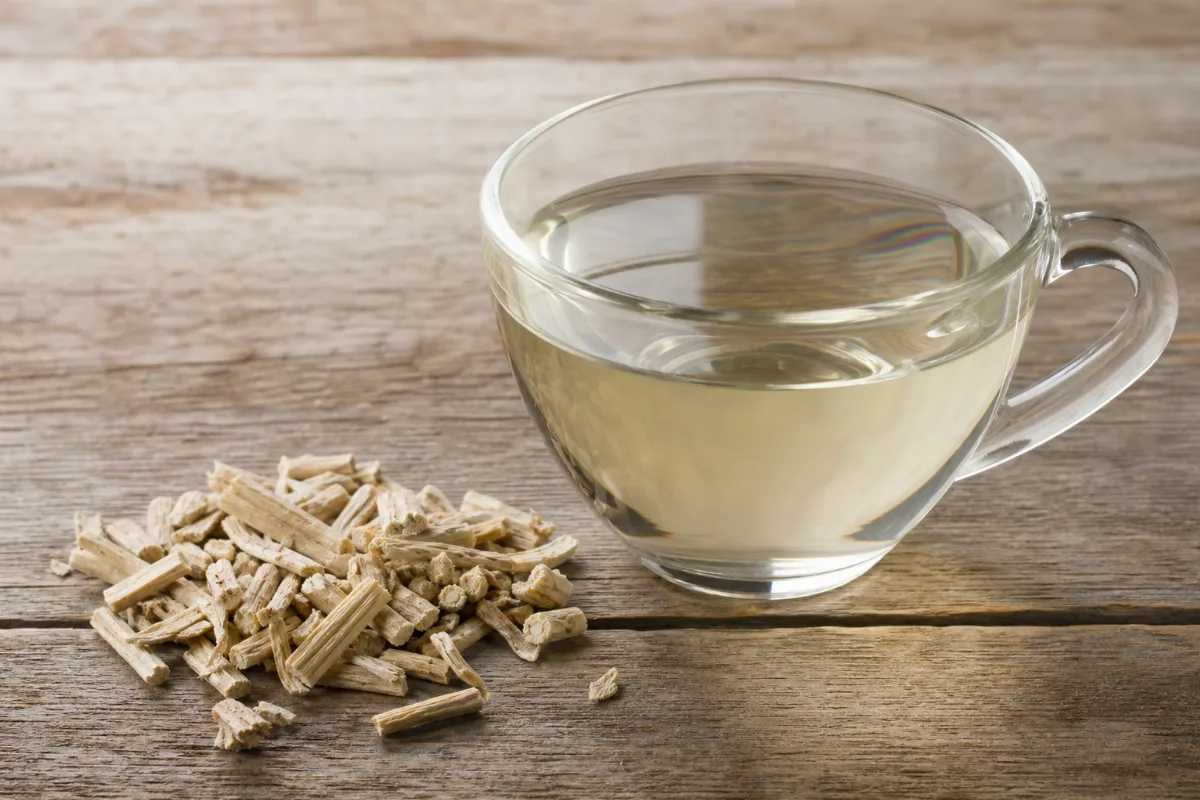
Marshmallow root tea is a drink made from the dried root of Althaea officinalis, usually by soaking the cut root in cold water. People use it to soothe a sore, scratchy throat and a dry cough. The EU lists it as a traditional use, but no trial of the tea itself was found. The main caution is that the root may slow the absorption of other medicines, so it should be kept apart from them.
General information, not medical advice. Last substantive update · Not medically reviewed. A named clinician has not signed off on this page. How this page is made
About Marshmallow Root Tea
Marshmallow root tea is the drink made from the dried root of Althaea officinalis. It is a gel-forming (mucilage) herb used for a sore, dry throat. The EU lists it as a traditional use, and the EMA found the human studies too weak to go further. No source we read says whether the tea contains caffeine. The tea is not the tea plant. The main cautions are slower absorption of other medicines, the quality of the product, and that a cough or sore throat that lingers needs a doctor.
What it is
Marshmallow is Althaea officinalis, which GBIF accepts as a species name, in the mallow family (Malvaceae). The root is the part used. The EMA report says it is collected in autumn from plants at least two years old.
The root holds mucilage, a slippery gel-like fibre (5 to 11.6% depending on the season), plus starch, pectins, sugars, flavonoids such as quercetin and kaempferol, scopoletin and phenolic acids such as caffeic acid.
It is not the tea plant that black and green tea come from. No source we read reports caffeine in marshmallow root, but none we found tested for it, so we give no figure.
Tea, syrup or extract?
The tea in the EU monograph is a cold-water soak of cut root, used right after it is made. Syrup is made from a root macerate with sugar. Lozenges, drops and dry extracts are manufactured products.
Nearly all the cough research is on syrups, lozenges or drops, or on mixtures with other herbs. The EMA says its conclusions do not cover combinations.
Results for extracts and mixtures cannot be read as results for the tea, in either direction.
What the research shows
Throat irritation with dry cough: traditional use only for the tea. No tea trial.
Dry cough, extracts: a 313-child study and a 599-child study of a root syrup had no control group and were rated by doctors and parents. A 63-person placebo trial of drops found a lower cough score (2.66 to 1.23, against 2.7 to 2.33 with placebo), but the drops were not described. Surveys of 822 users of lozenges or syrup reported quick relief.
Sore throat: two open-label trials of mixed products with marshmallow found relief, but neither used a placebo.
Stomach and gut: no clinical data. Dry mouth: one small trial. Blood sugar: mice only.
Quality and contamination
A 2017 Dutch case report describes two adults, one pregnant, who needed intensive care after a marshmallow root herbal remedy mixed into a hot drink. The product was contaminated with atropine, most likely from deadly nightshade. The root itself is not poisonous; the problem was contamination.
Lab surveys of finished marshmallow root syrups from Polish pharmacies found lead, cadmium and chromium within guideline limits. These were syrups, not tea bags or loose root.
No brand can be recommended here. Check the label for the Latin name Althaea officinalis, the plant part (root) and the country of origin.
Pregnancy, breastfeeding and children
The EU monograph says safety in pregnancy and breastfeeding has not been established and does not recommend use for lack of data. LactMed says no data exist for nursing mothers or infants, but it is unlikely to harm a breastfed infant. LactMed also says no trials support its use to raise milk supply. Talk with a midwife or doctor.
For throat irritation the EU does not recommend marshmallow root under 3 years. For stomach and gut use, under 12 has not been established. The NHS says a child under 5 with a sore throat should see a GP.
At a glance
Traditional uses history, not proof
- The EU lists marshmallow root, as a herbal tea made by a cold-water soak, as a traditional remedy for mouth and throat irritation with dry cough, based on long use only.
- The EU also lists it for mild stomach and gut discomfort, again on long use only. The EMA report found no clinical data for this use.
- The EMA says marshmallow has been used in traditional European medicine since ancient times and appears in pharmacopoeias and handbooks from 1926 onward.
Studied for research
- Throat irritation with dry cough (tea), insufficient
- Dry cough (root-extract syrups, lozenges, drops, not tea), very low
- Sore throat (mixed products, not tea), very low
- Mild stomach and gut discomfort, insufficient
- Dry mouth, very low (one small trial, root form not described)
- Blood sugar, insufficient (mice only)
- Breast milk supply, insufficient
Main compounds
- Mucilage polysaccharides (gel-forming fibre)
- Flavonoids such as quercetin and kaempferol
- Scopoletin and phenolic acids such as caffeic acid
Common forms
- Dried cut root soaked in water (a macerate), or tea bags of cut root
- Syrup, lozenges and drops made from root extract (different products, separate research)
- Capsules and powder (different products, not covered here)
Research links: EU herbal monograph on marshmallow root (EMA) · EMA public summary on marshmallow root · LactMed: Marshmallow (record) · Marshmallow root extract surveys for dry cough (abstract) · Marsh mallow and cough: 2020 review (abstract) · NHS: Sore throat · Research Library · Genes & Biomarkers Library
What it is and its history
- Accepted scientific name
- Althaea officinalis
- Naming authority
- L.
- Common names
- Marshmallow root (English); Marshmallow (English); Marsh mallow (English); Altea, raiz de (Spanish); Guimauve (racine de) (French); Eibischwurzel (German)
- Family or group
- Malvaceae (the mallow family)
- Classification
- Plantae > Malvales > Malvaceae > Althaea > Althaea officinalis
- Native range
- Not checked.
- Habitat
- Not checked.
- What it looks like
- Roots: The European Pharmacopoeia describes the dried root as cylindrical, slightly twisted, greyish-brown with deep furrows and a fibrous fracture; peeled root is greyish-white (EMA report).; Stems: Not checked.; Leaves: Not checked.; Flowers: Not checked.; Fruit: Not checked.
- Cultivation
- Not checked.
- Harvest and processing
- The EMA report says the roots are collected in autumn from plants at least two years old, then dried, whole or cut, peeled or unpeeled.
- Look-alikes and adulterants
- Name: Other mucilage (slippery) herbs; Note: Slippery elm, mullein and other mallows are different plants with their own research. Do not read one herb's results as another's.; Name: Marshmallow sweets; Note: The confection called marshmallow is a different product from the root tea.; Name: True tea (Camellia sinensis); Note: Black and green tea come from another plant. Marshmallow root is not tea in that sense.
- Sustainability and conservation
- Not checked.
Photographs
Traditional use and history history, not clinical proof
| Tradition or era | Documented use | Source |
|---|---|---|
| Ancient authors | The EMA report says Althaea is often mentioned by ancient authors, but it is not clear whether they mean this species. It says Hippocrates recommended a decoction of the root as a wound remedy. | s-ema-ar-marshmallow-root |
| Middle Ages | The EMA report says it was prescribed by Paracelsus as a soother of abscesses and by other authors as an expectorant and diuretic. | s-ema-ar-marshmallow-root |
| Pharmacopoeias and handbooks | The EMA report says use as a soothing (demulcent) agent for oral and throat irritation with dry cough and for mild stomach complaints has been documented in pharmacopoeias and handbooks from 1926 onward. | s-ema-ar-marshmallow-root |
| European Union today | A traditional herbal medicinal product for throat irritation with dry cough and for mild gut discomfort, based only on long-standing use (EU monograph, 2016). | s-ema-hmpc-marshmallow-root |
Traditional use shows how it was used. It does not show that it works or is safe today.
What is inside, and how it may work
What it contains and how those compounds act in cells and animals. Laboratory and animal mechanisms are not proven effects in people.
Main compounds
| Compound | Family | Where it is concentrated | Activity studied | Level of evidence |
|---|---|---|---|---|
| Mucilage polysaccharides | gel-forming carbohydrates | Root 5 to 11.6% mucilage depending on the growing season (EMA report). | Stick moderately to cheek tissue in a lab dish; reduced cough in cats and guinea pigs in animal work; lowered blood glucose in mice. 16 | Lab animal |
| Scopoletin PubChem 5280460 | coumarin | Root Named in the EMA report; no amount given. | Not described in the sources read. 16 18 | Not established |
| Caffeic acid PubChem 689043 | phenolic acid | Root Named in the EMA report; no amount given. | Not described in the sources read. 16 18 | Not established |
| Quercetin PubChem 5280343 | flavonol | Root Flavonoids in total 0.14 to 0.28% (EMA report). | Not described in the sources read. 16 18 | Not established |
| Kaempferol PubChem 5280863 | flavonol | Root Named in the EMA report; no amount given. | Not described in the sources read. 16 18 | Not established |
| Asparagine PubChem 6267 | amino acid | Root About 2% (EMA report, quoting a textbook). | Not described in the sources read. 16 18 | Not established |
Mechanisms, receptors and pathways
| Target or pathway | Gene or receptor | What was found | Level |
|---|---|---|---|
| Coating of the throat lining (demulcent action) | n/a | The EMA report says the mucilage is thought to form a protective layer. The only supporting study is a dish experiment in which root polysaccharides stuck moderately to pig cheek tissue. 16 | Lab |
| Cough reflex | n/a | An isolated root polysaccharide and a root extract reduced coughing in cats and guinea pigs in lab work (EMA report). Not shown for tea in people. 16 | Animal research |
| Blood glucose | n/a | Injected root polysaccharide lowered blood glucose in non-diabetic mice for several hours (EMA report). 9 | Animal research |
| Absorption of other medicines | n/a | The EU monograph warns that absorption of medicines taken at the same time may be delayed. No measuring study was found. 14 | Regulatory precaution |
Absorption, metabolism and elimination
- Absorption
- The EMA report says that, due to lack of data, no conclusion can be drawn on the root's pharmacokinetics.
- Distribution
- LactMed says no data exist on excretion of any marshmallow components into breastmilk.
- Metabolism
- Not covered.
- Elimination
- Not covered.
- Bioavailability
- Not covered.
Isolated compounds versus whole extracts
The tea in the EU monograph is a cold-water soak of cut root, which brings the gel-forming mucilage into the water. Syrups are made from a root macerate with sugar added, and lozenges, drops and dry extracts are manufactured extracts. The studies of cough are almost all on syrups, drops or lozenges, or on mixtures with other herbs. The EMA says its combinations are not covered by its conclusions. Do not carry extract or mixture results over to the tea.
Nutritional composition
Marshmallow root tea is not described as a source of nutrients in the sources read. The EMA report lists starch (25 to 35%), pectins and sugars among the root's contents, but not how much reaches a cup. No caffeine figure was found, and the root is not from the tea plant.
3 very low certainty4 not enough evidence
What was looked at
The 7 benefits and uses checked for Marshmallow Root Tea, each with how strong the evidence is. Tap one to open it.
- Throat irritation with dry cough (the tea, traditional use)Not enough evidence
- Dry cough (root-extract syrup, lozenges and drops, not tea)Very low certainty
- Sore throat (mixed products that include marshmallow, not tea)Very low certainty
- Mild stomach and gut discomfort (traditional use)Not enough evidence
- Dry mouth (marshmallow root, form not described)Very low certainty
- Blood sugar (animal work only)Not enough evidence
- Breast milk supplyNot enough evidence
Lab markers tracked in the studies
Cough score (drops, ACE-inhibitor cough)User- and doctor-rated cough relief (syrup, lozenges)Sore throat total symptom score (spray with Althaea honey)Tonsillitis symptom intensity (seven-herb extract)Dry-mouth intensity (visual scale)Oral health quality of life (OHIP-14)Blood glucose in mice (animal result)
What is Marshmallow Root Tea good for?
The uses people ask about and how strong the human evidence is for each. For most of them the research is on syrups, lozenges, drops or mixed products, not on the tea, and each row says which.
Benefits, one by one
Each card is a research question, not a promise. Tap a goal to filter. Open a card to see the studies, doses and limits.
Throat irritation with dry cough (the tea, traditional use)
Not enough evidenceThe EU lists marshmallow root, as a herbal tea made by a cold-water soak, as a traditional remedy for irritation of the mouth or throat with a dry cough. It rests on long use only. No trial of the tea itself was found.
3 studiesA cold-water soak of cut root (a macerate) is the tea form in the EU …
Studies, doses and limits
What the trials found
No clinical trial of the tea was found. The EU monograph states the use is based exclusively on long-standing use. The EMA report found no human data on the tea itself and used trials of extract products to support the traditional use.
Results
No tea trial results exist in the sources read.
Why this rating
Support is tradition and a regulator listing, not trials of the tea.
Form and dose studied
A cold-water soak of cut root (a macerate) is the tea form in the EU monograph. Syrups, lozenges and drops are different products with separate research.
Who was studied
Adults, adolescents and children over 3 years (EU). Not recommended under 3 years.
Limits
A traditional-use listing is not proof that it works. A cough can be a sign of something that needs a doctor.
Why researchers looked
The root is rich in mucilage, a slippery gel-like fibre. People have long used it to coat and soothe a sore, scratchy throat.
Traditional use
The EMA assessment report says marshmallow has been used in traditional European medicine since ancient times, and that its use for oral and throat irritation with dry cough is recorded in many pharmacopoeias and handbooks.
Proposed mechanism Lab
The idea is that the mucilage forms a protective layer over the throat lining. In a lab dish, purified root polysaccharides stuck moderately to cheek tissue from pigs. This is not shown in people drinking the tea.
A proposed mechanism does not show that the effect happens in people.
See a doctor if throat symptoms last over a week, or if breathlessness, fever or pus-coloured sputum occurs (EU monograph).
Dry cough (root-extract syrup, lozenges and drops, not tea)
Very low certaintyStudies of manufactured root-extract products found less dry cough, but most had no comparison group. One 63-person trial against placebo used drops that were not well described. These results do not apply to a cup of tea.
6 studiesRoot-extract syrup, lozenges and drops. Not tea.
Studies, doses and limits
What the trials found
The EMA report lists a 313-child post-marketing study and a 599-child retrospective study of a root-extract syrup, both without a control group, and a 63-patient placebo-controlled trial of drops for ACE-inhibitor cough. A 2018 pair of surveys of 822 pharmacy customers (lozenges or syrup of one aqueous extract) reported good relief, mostly within 10 minutes. A 2020 review by one author says extracts alone were effective for dry cough and that combinations with other herbs worked better.
Results
Syrup studies: very good or good effect in 84.3% (313 children) and over 90% (599 children), rated by doctors and parents. Placebo trial of drops: cough score fell from 2.66 to 1.23, against 2.7 to 2.33 with placebo. Surveys: good effect, tolerability very good with 3 minor adverse events (syrup).
Effect sizes as reported
Only the placebo-controlled trial can show a real effect; the others cannot separate the product from the natural course of a cough.
Why this rating
Mostly uncontrolled studies and surveys, one small placebo-controlled trial with an undescribed preparation, and possible industry links. The EMA itself judged the evidence enough only for traditional use.
Form and dose studied
Root-extract syrup, lozenges and drops. Not tea.
Who was studied
Children 0 to 12 years (syrup studies); adults with ACE-inhibitor cough (placebo trial); pharmacy customers (surveys).
Limits
No control group in the largest studies. Results judged by doctors and parents. The drops were not described. The surveyed extract is a branded product. The review mixes animal work, extracts and herb combinations.
Why researchers looked
Dry irritating cough is common, and cough syrups made from marshmallow root have a long place in European medicine.
Traditional use
Syrup made from a root macerate appears in several European pharmacopoeias (EMA assessment report).
Proposed mechanism Animal research
Root polysaccharides reduced coughing in cats and guinea pigs in lab work (EMA report). Not shown for tea in people.
A proposed mechanism does not show that the effect happens in people.
In the 313-child study there was one mild and one serious adverse event in children aged 0 to 3; the doctor judged the serious one unlikely to be related (EMA report).
Sore throat (mixed products that include marshmallow, not tea)
Very low certaintyTwo trials tested mixed products with marshmallow root or Althaea honey in them. Both found symptom relief, but neither was against placebo and neither tested the root alone or the tea.
3 studiesA throat spray and a seven-herb extract. Not marshmallow root tea.
Studies, doses and limits
What the trials found
A 2023 trial of 186 people compared a mouth and throat spray with ectoin and Althaea honey against another sore-throat spray. A 2019 trial of 238 children and teenagers with non-bacterial tonsillitis compared a seven-herb extract that includes marshmallow root, added to standard care, with standard care alone.
Results
Spray trial: symptom score fell by 90.14 versus 74.91 with the comparator (p < 0.05), with no serious adverse events. Tonsillitis trial: 81.6% responders and milder symptoms from day 2 to day 5 compared with standard care alone, with no adverse reactions.
Effect sizes as reported
Not separable from the other ingredients.
Why this rating
Open-label trials, comparison with another product or with usual care rather than placebo, mixtures of ingredients, and branded products with a possible industry link.
Form and dose studied
A throat spray and a seven-herb extract. Not marshmallow root tea.
Who was studied
People with acute pharyngitis; children and teenagers aged 6 to 18 with non-bacterial tonsillitis.
Limits
The results cannot be given to marshmallow root. Neither trial had a placebo group.
Why researchers looked
Sore throat from a viral infection is one of the most common reasons people try herbal remedies.
Traditional use
Mouth and throat irritation is the first of the two traditional EU uses.
Proposed mechanism Not established
Not established for these mixtures.
A proposed mechanism does not show that the effect happens in people.
The NHS says a child under 5 with a sore throat should see a GP, and gives emergency signs (see the Safety tab).
Mild stomach and gut discomfort (traditional use)
Not enough evidenceThe EU lists marshmallow root tea as a traditional remedy for mild stomach and gut discomfort, based on long use only. The EMA report found no clinical data on this use, so it could draw no conclusion.
3 studiesThe EU monograph lists a herbal tea (cold-water soak) for this use.
Studies, doses and limits
Results
No results exist.
Why this rating
Tradition and a regulator listing only; no human data.
Form and dose studied
The EU monograph lists a herbal tea (cold-water soak) for this use.
Who was studied
Adults and adolescents over 12 years (EU). Use under 12 has not been established.
Limits
A traditional-use listing is not proof that it works.
Why researchers looked
The mucilage is thought to coat and soothe the lining of the gut, as it is thought to do in the throat.
Traditional use
The EMA report says the root is traditionally used for mild gastric complaints. Older handbooks it quotes list gut inflammations and ulcers.
Proposed mechanism Not established
Not established. No lab work on the gut is described in the sources read.
A proposed mechanism does not show that the effect happens in people.
See a doctor if gut symptoms last over 2 weeks (EU monograph).
Dry mouth (marshmallow root, form not described)
Very low certaintyIn one small 2015 trial of people with low saliva, 15 people used marshmallow root and their dry-mouth feeling was lower after two weeks. So was it with the other two products tested, and a spring-water spray did better.
1 studiesNot described in the abstract. It cannot be read as tea.
Studies, doses and limits
What the trials found
One randomised trial of 60 people with low saliva flow compared a thermal-spring-water spray (30 people), a commercial saliva substitute (15) and marshmallow root (15), used four times a day for two weeks.
Results
Dry mouth was lower after the treatment with all three products. The spring-water spray had the biggest effect on quality of life and was judged better than marshmallow root.
Effect sizes as reported
No numbers for the marshmallow root group in the abstract.
Why this rating
Only 15 people took the root, no placebo group, and the abstract does not say what form of root was used.
Form and dose studied
Not described in the abstract. It cannot be read as tea.
Who was studied
Adults with hyposalivation.
Limits
Very small groups, no placebo.
Why researchers looked
The slippery mucilage might keep the mouth moist.
Traditional use
Not described in the sources read.
Proposed mechanism Not established
Not established.
A proposed mechanism does not show that the effect happens in people.
None noted in the abstract.
Blood sugar (animal work only)
Not enough evidenceIn mice, an injected root polysaccharide and a water-soluble root mucilage lowered blood sugar for several hours. No human study of the tea was found. This is why a pharmacist question is sensible if you take medicine for diabetes.
2 studiesIsolated polysaccharide by injection. Not tea.
Studies, doses and limits
Results
Non-diabetic mice given an isolated root polysaccharide by injection had blood glucose at 65 to 81% of the control level after 7 hours, and only a weak effect at 24 hours (EMA report).
Effect sizes as reported
Animal result only.
Why this rating
Animal work with injected polysaccharide; nothing in people.
Form and dose studied
Isolated polysaccharide by injection. Not tea.
Who was studied
Healthy mice.
Limits
An injected, purified fraction in mice cannot be read as a result for a drink.
Why researchers looked
Some plant mucilages and fibres affect blood sugar.
Traditional use
Not described in the sources read.
Proposed mechanism Animal research
Not established. Observed in healthy mice only.
A proposed mechanism does not show that the effect happens in people.
See the interaction note on the Safety tab.
Breast milk supply
Not enough evidenceMarshmallow is a purported milk booster in some proprietary mixtures, but LactMed says no scientifically valid clinical trials support this use.
1 studiesNot covered.
Studies, doses and limits
Results
No results exist.
Why this rating
No trials.
Form and dose studied
Not covered.
Who was studied
Breastfeeding mothers.
Limits
Nothing has been tested.
Why researchers looked
Many herbs are used in folk practice to raise milk supply.
Traditional use
LactMed says marshmallow is included in some proprietary mixtures promoted to increase milk supply.
Proposed mechanism Not established
Not established.
A proposed mechanism does not show that the effect happens in people.
No data exist on safety in nursing mothers or infants (LactMed).
Connections to the rest of health
How Marshmallow Root Tea connects to the rest of our health knowledge graph. Every link says what kind of connection it is. A safety link (for example to the liver) is a warning, not a benefit. A study that merely mentions a topic never creates a benefit link.
Explore every connection: goals, body systems, organs, symptoms, genes
A. Wellness goals
| Connected to | Kind of connection | Evidence status | Context | Studies |
|---|---|---|---|---|
| Breathing Support | Not enough evidence | Throat irritation with dry cough (the tea, traditional use): The EU lists marshmallow root, as a herbal tea made by a cold-water soak, as a traditional remedy for irritation of the mouth or throat with a dry cough. It rests on long use only. No trial of the tea itself was found. | 14 15 16 | |
| Breathing Support | Very low certainty | Dry cough (root-extract syrup, lozenges and drops, not tea): Studies of manufactured root-extract products found less dry cough, but most had no comparison group. One 63-person trial against placebo used drops that were not well described. These results do not apply to a cup of tea. | 13 10 11 1 4 16 | |
| Breathing Support | Very low certainty | Sore throat (mixed products that include marshmallow, not tea): Two trials tested mixed products with marshmallow root or Althaea honey in them. Both found symptom relief, but neither was against placebo and neither tested the root alone or the tea. | 7 6 17 | |
| Digestive Support | Not enough evidence | Mild stomach and gut discomfort (traditional use): The EU lists marshmallow root tea as a traditional remedy for mild stomach and gut discomfort, based on long use only. The EMA report found no clinical data on this use, so it could draw no conclusion. | 14 15 16 | |
| Digestive Support | Very low certainty | Dry mouth (marshmallow root, form not described): In one small 2015 trial of people with low saliva, 15 people used marshmallow root and their dry-mouth feeling was lower after two weeks. So was it with the other two products tested, and a spring-water spray did better. | 8 | |
| Blood Sugar Balance | Not enough evidence | Blood sugar (animal work only): In mice, an injected root polysaccharide and a water-soluble root mucilage lowered blood sugar for several hours. No human study of the tea was found. This is why a pharmacist question is sensible if you take medicine for diabetes. | 9 16 | |
| Womens Wellness | Not enough evidence | Breast milk supply: Marshmallow is a purported milk booster in some proprietary mixtures, but LactMed says no scientifically valid clinical trials support this use. | 12 |
B. Body systems
| Connected to | Kind of connection | Evidence status | Context | Studies |
|---|---|---|---|---|
| Respiratory System | Biological association | Not enough evidence | Studied for: Throat irritation with dry cough (the tea, traditional use) Studied for: Dry cough (root-extract syrup, lozenges and drops, not tea) | 14 15 16 13 10 11 1 4 7 6 17 |
| Digestive System | Biological association | Not enough evidence | Studied for: Mild stomach and gut discomfort (traditional use) Studied for: Dry mouth (marshmallow root, form not described) | 14 15 16 8 |
| Endocrine System | Biological association | Not enough evidence | Studied for: Blood sugar (animal work only) | 9 16 |
| Reproductive System | Biological association | Not enough evidence | Studied for: Breast milk supply | 12 |
C. Body parts and organs
E. Health conditions
| Connected to | Kind of connection | Evidence status | Context | Studies |
|---|---|---|---|---|
| Dry cough | Very low certainty | Uncontrolled studies and one small placebo trial of drops. Preparation or compound: Root-extract syrup, lozenges and drops (not tea) |
13 10 1 | |
| Sore throat | Very low certainty | Open-label trials of a spray and a seven-herb extract. Preparation or compound: Mixed products containing marshmallow (not tea) |
7 6 | |
| Pregnancy and breastfeeding | Contraindication | Low certainty | EU: not recommended for lack of data. LactMed: unlikely to harm a breastfed infant. Preparation or compound: Marshmallow root tea |
14 12 |
G. Root causes and contributing factors
| Connected to | Kind of connection | Evidence status | Context | Studies |
|---|---|---|---|---|
| Medication side effects | Drug or supplement interaction | Low certainty | Absorption of other medicines may be delayed; keep half an hour to an hour apart (EU monograph). Preparation or compound: Marshmallow root preparations |
14 |
I. Biomarkers
| Connected to | Kind of connection | Evidence status | Context | Studies |
|---|---|---|---|---|
| Cough score (drops, ACE-inhibitor cough) | Biological association | Very low certainty | Measured in trials: lowered (drops, not tea). A lab change is not the same as a health benefit. | 13 |
| User- and doctor-rated cough relief (syrup, lozenges) | Biological association | Very low certainty | Measured in trials: improved (extract products, no control group). A lab change is not the same as a health benefit. | 10 11 1 |
| Sore throat total symptom score (spray with Althaea honey) | Biological association | Very low certainty | Measured in trials: improved (mixed product, no placebo). A lab change is not the same as a health benefit. | 7 |
| Tonsillitis symptom intensity (seven-herb extract) | Biological association | Very low certainty | Measured in trials: improved (mixed product, open-label). A lab change is not the same as a health benefit. | 6 |
| Dry-mouth intensity (visual scale) | Biological association | Very low certainty | Measured in trials: lowered with all three products. A lab change is not the same as a health benefit. | 8 |
| Oral health quality of life (OHIP-14) | Biological association | Very low certainty | Measured in trials: best with the spring-water spray. A lab change is not the same as a health benefit. | 8 |
| Blood glucose in mice (animal result) | Biological association | Not enough evidence | Measured in trials: lowered at 7 hours (animal only). A lab change is not the same as a health benefit. | 9 |
L. Active compounds
| Connected to | Kind of connection | Evidence status | Context | Studies |
|---|---|---|---|---|
| Mucilage polysaccharides | Biological association | Lab animal | Stick moderately to cheek tissue in a lab dish; reduced cough in cats and guinea pigs in animal work; lowered blood glucose in mice. Preparation or compound: Root |
16 |
| Scopoletin | Biological association | Not established | Not described in the sources read. Preparation or compound: Root |
16 18 |
| Caffeic acid | Biological association | Not established | Not described in the sources read. Preparation or compound: Root |
16 18 |
| Quercetin | Biological association | Not established | Not described in the sources read. Preparation or compound: Root |
16 18 |
| Kaempferol | Biological association | Not established | Not described in the sources read. Preparation or compound: Root |
16 18 |
| Asparagine | Biological association | Not established | Not described in the sources read. Preparation or compound: Root |
16 18 |
Each connection is stored with the ingredient, the connected record, the kind of connection, the evidence status, the supporting studies, the preparation or compound involved, and a review date (last reviewed October 25, 2026).
Evidence at a glance: what the research found for 7 outcomes
Each outcome below is one thing researchers measured. Certainty is how far the evidence can be trusted, not how well it works. The full studies are on the next tab.
The evidence
The research centre for Marshmallow Root Tea. Every record here was checked against PubMed or the publisher's page; we never list a study we have not verified.
Evidence by outcome
Bars show how many studies we found for each outcome, not how well it works. People are added up across trials only (reviews are not added, to avoid double counting).
How we rate evidence
High certainty
Several well-run trials or reviews agree; further research is unlikely to change the picture much.
Moderate certainty
Good trials point the same way, but some doubt remains.
Low certainty
Small, short or inconsistent trials. The finding could change with better research.
Very low certainty
Very little or very weak human data. Treat as a possibility only.
Mixed findings
Trials or reviews disagree with each other.
Not enough evidence
Not enough human research to say either way.
Evidence against
Good research found no benefit, or found harm.
We take the reviewers' own risk-of-bias and GRADE statements where they exist, and otherwise judge from study size, design, consistency, directness and whether a product matches what is sold. Many publications do not make evidence high. Method note: We read the EU herbal monograph, the EMA assessment report and public summary, and the NHS sore throat page in full, read the PubMed abstract of every study listed, read the PubMed record for LactMed (the full LactMed page was not opened), and checked the plant name in GBIF and five compounds in PubChem.
Study library: every study we checked 19
| Study | Design | People | Product, dose, length | Result |
|---|---|---|---|---|
| Fink 2018 Marshmallow Root Extract for the Treatment of Irritative Cough: Two Surveys on Users' View on Effectiveness and Tolerability Complementary Medicine Research · PMID 30064132 · DOI |
Survey |
822 Pharmacy customers buying the product for dry cough (ages not given in the abstract) |
Aqueous marshmallow root extract STW42, as lozenges or syrup (not tea) root Not restated here 7 days |
Two prospective, non-interventional surveys of 822 pharmacy customers buying lozenges or syrup of an aqueous marshmallow root extract (STW42) for dry cough. Users reported a good effect on throat irritation and dry cough, with a very rapid onset, in most cases within 10 minutes. Tolerability was very good, with only 3 minor adverse events (syrup). The authors say the results justify the long-established use of both products. Good effect reported by the majority; onset mostly within 10 minutes (users' own report) Methods, limits and fundingOutcomes: Self-rated effect on dry cough, tolerability and satisfaction Limitations: No control group and no blinding, so the placebo effect and the natural course of a cough cannot be separated. Reported by users. A branded extract product, not tea. Funding and conflicts: Not stated in the abstract. The product is a branded commercial extract, so an industry link cannot be ruled out. Read: abstract |
| Jurowski 2022 The Toxicological Assessment of Content and Exposure of Heavy Metals (Pb and Cd) in Traditional Herbal Medicinal Products with Marshmallow Root (Althaea officinalis L., radix) from Polish Pharmacies Toxics · PMID 35448449 · DOI |
Lab analysis n/a |
10 10 finished products (liquid medicines) from Polish pharmacies |
n/a |
Lead and cadmium were measured in 10 marshmallow root herbal medicinal products from Polish pharmacies. Lead ranged from 1.60 to 6.80 micrograms per litre and cadmium from 0.80 to 3.81 micrograms per litre. The authors found the amounts in a single or daily dose very low and within the ICH Q3D guideline, and call the products safe. The abstract says this is the first such study of finished marshmallow root products in European pharmacies. All samples met the ICH Q3D guideline Methods, limits and fundingOutcomes: Lead and cadmium content and exposure Limitations: Finished liquid medicines (syrups), not loose root or tea bags. One country. Presence and exposure, not health outcomes. Funding and conflicts: Not stated in the abstract Read: abstract |
| Jurowski 2024 The comprehensive strategy in the human health risk assessment of total chromium impurities in cough syrups with Marshmallow Root (Althaea officinalis) available in Polish pharmacies: regulatory aspects and special emphasis on Cr(VI) mode of action Scientific Reports · PMID 38438482 · DOI |
Lab analysis n/a |
Cough syrups with marshmallow root from Polish pharmacies | n/a |
Total chromium was measured in marshmallow root cough syrups from Polish pharmacies (1.12 to 9.61 micrograms per litre). Single-dose levels were relatively high compared with raw results but all products were below the guideline limit, and the safety margin was above 10,000. The authors conclude none of the syrups is a health hazard. All products below the guideline limit Methods, limits and fundingOutcomes: Chromium impurity and risk estimate Limitations: Syrups, not loose root or tea. One country. Estimates, not health outcomes. Funding and conflicts: Not stated in the abstract Read: abstract |
| Mahboubi 2020 Marsh Mallow (Althaea officinalis L.) and Its Potency in the Treatment of Cough Complementary Medicine Research · PMID 31770755 · DOI |
Narrative review human and animal |
n/a | n/a |
A review of animal and clinical studies. The author says the studies confirmed the efficacy of A. officinalis extracts alone in dry cough, and that combining it with other herbs (Zataria multiflora, ginger, ivy) increased the effect. The review notes different expectorant and antitussive mechanisms. Methods, limits and fundingOutcomes: Evidence for cough Limitations: A narrative review by one author with no grading of study quality. Mixes animal and human work, extracts and combinations. Not about tea. Funding and conflicts: Not stated in the abstract Read: abstract |
| Oerlemans 2017 Anticholinergic syndrome caused by contaminated herbal tea; acting swiftly to identify the source Nederlands Tijdschrift voor Geneeskunde · PMID 28612694 |
Case report |
2 Two adults (one pregnant), Netherlands |
A marshmallow root herbal product mixed into a drink, contaminated with atropine root Not restated here |
A 27-year-old man and a 28-year-old pregnant woman came to the emergency department with severe anticholinergic syndrome after using a marshmallow root herbal remedy mixed into a hot chocolate drink to ease cold symptoms. After a short stay in intensive care they recovered. The herbs were contaminated with atropine, most likely from deadly nightshade (Atropa belladonna), at amounts far above a level the authors call mildly toxic. Quick contact with the Dutch poisons centre helped trace the source and prevent more cases. Two people needed intensive care and recovered Methods, limits and fundingOutcomes: Poisoning (anticholinergic syndrome) Limitations: One contaminated product, two people. It shows why quality matters; it does not mean marshmallow root itself is poisonous. The title says herbal tea; the abstract describes a herbal remedy mixed into a hot chocolate drink. Funding and conflicts: Not stated in the abstract Read: abstract |
| Popovych 2019 A randomized, open-label, multicenter, comparative study of therapeutic efficacy, safety and tolerability of BNO 1030 extract, containing marshmallow root, chamomile flowers, horsetail herb, walnut leaves, yarrow herb, oak bark, dandelion herb in the treatment of acute non-bacterial tonsillitis in children aged 6 to 18 years American Journal of Otolaryngology · PMID 30554882 · DOI |
Controlled trial |
238 Children and adolescents aged 6 to 18 with acute non-bacterial tonsillitis |
BNO 1030 (Imupret), a seven-herb extract that includes marshmallow root (not tea) root and six other herbal parts Not restated here Not restated here · vs Standard symptomatic treatment alone |
238 outpatients aged 6 to 18 with acute non-bacterial tonsillitis got the seven-herb extract BNO 1030 on top of standard symptom treatment, or standard treatment alone. Symptoms were milder from day 5, local symptoms and general condition better from day 2, and 81.6% were treatment responders (versus the standard-treatment group). No adverse reactions were seen. 81.6% responders; benefit seen from day 2 to day 5 (p < 0.005 to < 0.001) Methods, limits and fundingOutcomes: Sore throat intensity, throat irritation with cough, general condition, responders Limitations: Open-label with no placebo, so the benefit may partly be expectation. A seven-herb mixture, so nothing can be given to marshmallow root alone. Funding and conflicts: Not stated in the abstract. A branded commercial product, so an industry link cannot be ruled out. Read: abstract |
| Roventa 2023 Effectiveness and Tolerability of Ectoin Mouth and Throat Spray Althaea Honey (ERS09) for Sore Throat due to Acute Pharyngitis and Dry Cough: A Multicentre, Actively Controlled, Open Label Study in Germany Journal of Clinical Medicine · PMID 37762768 · DOI |
Controlled trial |
186 People with sore throat from acute pharyngitis, Germany (ages not given in the abstract) |
Mouth and throat spray with ectoin and Althaea honey (a combination product, not tea) Not restated here 7 +/- 2 days · vs Another sore throat spray (EMSER) |
186 people with sore throat from acute pharyngitis were randomised to a mouth and throat spray containing ectoin and Althaea honey (92 people) or to a well-established sore throat spray (94 people) for about a week. The baseline-adjusted symptom score fell by 90.14 with the new spray and 74.91 with the comparator (p < 0.05). About 78.85% vs 75.8% reached a 50% symptom reduction by day 6. Three unrelated adverse events and one device-related event were reported; none serious. The authors judged it as well tolerated and effective as the established spray. Symptom score change -90.14 vs -74.91 (p < 0.05) Methods, limits and fundingOutcomes: Change in total symptom score; adverse events Limitations: Open-label, compared with another product, not placebo. The spray is a mixture, so any effect cannot be given to marshmallow root. Not tea. Funding and conflicts: Not stated in the abstract. A branded commercial product, so an industry link cannot be ruled out. Read: abstract |
| Skrinjar 2015 Comparison between three different saliva substitutes in patients with hyposalivation Clinical Oral Investigations · PMID 25617026 · DOI |
Controlled trial |
60 Adults with low saliva flow (hyposalivation) |
Marshmallow root (form not described in the abstract) root Not restated here 2 weeks · vs Spring-water spray and commercial saliva substitute |
60 patients with low saliva flow were randomised to a thermal-spring-water spray (30 patients), a commercial saliva substitute (15) or marshmallow root (15), used four times a day for two weeks. Dry-mouth intensity was lower after the treatment whichever product was used. The spring-water spray had the biggest effect on quality of life and was judged better than the commercial substitute and marshmallow root. Dry mouth lower after all three products; marshmallow root arm was 15 people Methods, limits and fundingOutcomes: Dry-mouth intensity (visual scale) and quality of life (OHIP-14) Limitations: Only 15 people used marshmallow root. No placebo group. The form of the root is not described in the abstract, so it cannot be read as tea. Funding and conflicts: Not stated in the abstract Read: abstract |
| n/a 1987 Tomoda et al., 1987 (and Perez et al., 1998): marshmallow root mucilage and blood sugar in non-diabetic mice (as summarised in the EMA assessment report) n/a · Source |
Animal study mouse |
Non-diabetic mice | Isolated root polysaccharide (injected) and water-soluble mucilage root Not restated here 7 to 24 hours · vs Control |
An isolated root polysaccharide given by injection into the abdomen of non-diabetic mice lowered blood glucose to 74%, 81% and 65% of the control level after 7 hours at three doses; after 24 hours the effect was weak. Water-soluble root mucilage given to non-diabetic mice was also reported to lower blood sugar (Perez et al., 1998). Blood glucose 65 to 81% of control at 7 hours Methods, limits and fundingOutcomes: Blood glucose Limitations: Animal work, injected polysaccharide, healthy mice. Says nothing about a cup of tea in people. Known only through the EMA report. Funding and conflicts: Not stated in the EMA report Read: secondary-source (EMA report) |
| n/a 2005 Fasse et al., 2005: post-marketing surveillance of a marshmallow root syrup in 313 children (as summarised in the EMA assessment report) n/a · Source |
Observational study |
313 Children 0 to 12 years with dry irritating cough |
Syrup from a water extract of marshmallow root (not tea) root Not restated here about 3 days |
313 children (aged 3 months to 12.4 years) with mouth and throat irritation and dry cough took a syrup made from a water extract of marshmallow root for about 3 days on average. Physicians and parents rated effect as very good or good in 84.3% and tolerability as very good or good in 97%. One mild adverse event (obstructive bronchitis) and one serious one (bronchopneumonia needing hospital) occurred in the 0 to 3 year group; the physician judged the serious one 'unlikely' to be related. The EMA notes results were judged by physicians and parents with no objective measures. Efficacy very good or good 84.3%; tolerability very good or good 97% Methods, limits and fundingOutcomes: Cough symptoms rated by doctors and parents; tolerability Limitations: No control group, so improvement may be the natural course of the cough. Known only through the EMA report. Syrup, not tea. Funding and conflicts: Not stated in the EMA report Read: secondary-source (EMA report) |
| n/a 2005 Bassler, 2005: retrospective study of a marshmallow root syrup in 599 children (as summarised in the EMA assessment report) n/a · Source |
Observational study |
599 Children up to 12 years |
Syrup from a water extract of marshmallow root (not tea) root Not restated here 3 days to 2 weeks |
Records of 599 children up to 12 years given a water-extract root syrup for mouth and throat irritation with dry cough, collected by 53 physicians. Efficacy was rated very good or good in over 90%. No adverse effects were reported. Very good or good in over 90% (physician-rated) Methods, limits and fundingOutcomes: Doctor-rated efficacy and adverse effects Limitations: Retrospective review of records, no control group, no objective measures. Known only through the EMA report. Syrup, not tea. Funding and conflicts: Not stated in the EMA report Read: secondary-source (EMA report) |
| n/a 2006 Marshmallow (LactMed, Drugs and Lactation Database) Drugs and Lactation Database (LactMed) · PMID 30000899 |
Authoritative guidance n/a |
n/a | n/a |
Says orally marshmallow is a purported milk booster used in some proprietary mixtures, but no scientifically valid clinical trials support this. No data exist on whether any component reaches breastmilk or on safety in nursing mothers or infants. Marshmallow is generally well tolerated in adults, with allergic reactions reported rarely. It is generally recognised as safe (GRAS) in food amounts in the US. Although no data exist, it is unlikely to be harmful to a breastfed infant. Methods, limits and fundingOutcomes: Lactation safety and milk supply claims. Limitations: Database entry, not a trial. The record is dated 2006 in PubMed; the full LactMed web page was not opened, so the text read is the PubMed record. Read: abstract |
| n/a 2007 Rouhi H, Ganji F, 2007: double-blind placebo-controlled trial of Althaea officinalis drops for ACE-inhibitor cough (as summarised in the EMA assessment report) n/a · Source |
Controlled trial |
63 Adults with ACE-inhibitor cough, Iran |
Althaea officinalis drops (composition not described) Not restated here 4 weeks · vs Placebo |
63 patients (18 men, 45 women) with dry cough caused by ACE-inhibitor medicines took Althaea officinalis drops or placebo for four weeks; 3 were excluded for not following the plan. The mean cough score (0 to 4) in the Althaea group fell from 2.66 to 1.23 (a statistically significant fall, P<0.05). In the placebo group it went from 2.7 to 2.33 with no significant change. Spirometry did not change significantly. Cough score 2.66 to 1.23 vs 2.7 to 2.33 (placebo) Methods, limits and fundingOutcomes: Cough score (0 to 4) and spirometry Limitations: Known only through the EMA report, not the original paper. The EMA said the preparation was not sufficiently described. Cough caused by a medicine, not a cold. Drops, not tea. Funding and conflicts: Not stated in the EMA report Read: secondary-source (EMA report) |
| n/a 2016 EMA/HMPC: European Union herbal monograph on Althaea officinalis L., radix (marshmallow root), final, EMA/HMPC/436679/2015, 12 July 2016 n/a · Source |
Authoritative guidance n/a |
n/a | n/a |
Lists marshmallow root, as a herbal tea made by a cold-water soak (macerate) and as other preparations, as a traditional herbal medicine for (1) irritation of the mouth or throat with dry cough and (2) mild stomach and gut discomfort, based only on long-standing use. Contraindication: hypersensitivity. Absorption of other medicines taken at the same time may be delayed, so it should not be taken half an hour to one hour before or after other medicines. Throat use is not recommended under 3 years; gut use is not established under 12 years. Pregnancy and breastfeeding: safety not established, use not recommended for lack of data. Interactions: none reported. Undesirable effects: none known. Overdose: no case reported. Genotoxicity, reproductive toxicity and cancer tests have not been done. See a doctor if throat symptoms last over 1 week or gut symptoms over 2 weeks, or if breathlessness, fever or pus-coloured sputum occurs. Methods, limits and fundingOutcomes: Traditional use, contraindications, warnings, pregnancy, interactions, undesirable effects. Limitations: A regulator monograph, not a trial. It rests on long use. PDF text read in full on 2026-10-25. Read: full-text |
| n/a 2016 EMA: Althaeae radix - herbal medicinal product (public summary of the HMPC conclusions) n/a · Source |
Authoritative guidance n/a |
n/a | n/a |
Says the committee concluded, on the basis of long-standing use, that marshmallow root preparations can be used for irritation of the mouth or throat with associated dry cough (adults, adolescents and children over 3) and for relief of mild stomach and gut discomfort (adults and adolescents over 12). Says these medicines are usually available as a herbal tea. Does not cover combinations with other herbs. Methods, limits and fundingOutcomes: Plain summary of the monograph. Limitations: A summary page, not a trial. Read on 2026-10-25. Read: full-text |
| n/a 2016 EMA/HMPC: Assessment report on Althaea officinalis L., radix (EMA/HMPC/436680/2015), final, 12 July 2016 n/a · Source |
Authoritative guidance n/a |
n/a | n/a |
Reviews the root's chemistry, history, lab and animal work and human studies. The root holds mucilage polysaccharides (5 to 11.6% depending on the season), starch, pectins, sugars, flavonoids, phenolic acids, scopoletin and calcium oxalate. Human studies: a 63-patient placebo-controlled trial of drops for ACE-inhibitor cough (preparation not described), a 313-child post-marketing study and a 599-child retrospective study of a root-extract syrup. The committee judged these not strong enough for 'well-established use' but enough to support traditional use for throat irritation with dry cough. For mild stomach and gut discomfort it found no clinical data. Lab work: mucilage sticks to cheek tissue in a dish; root mucilage lowered blood sugar in non-diabetic mice. The report says tests on pregnancy and cancer were not done, so use in pregnancy and breastfeeding cannot be recommended. Methods, limits and fundingOutcomes: Evidence assessment behind the EU monograph. Limitations: A regulator assessment. Part of its human evidence is non-randomised or poorly described, as the report itself says. Read on 2026-10-25 (sections on constituents, history, lab work, clinical studies and safety). Read: full-text |
| n/a 2024 NHS (UK): Sore throat n/a · Source |
Authoritative guidance n/a |
n/a | n/a |
Says to call 999 or go to A&E for difficulty breathing or being unable to swallow, drooling, a high-pitched sound when breathing in, or fast-worsening severe symptoms. Says to see a GP if a child under 5 needs help for a sore throat, if a sore throat does not improve after a week, or if it comes often. The treatments it lists to ask a pharmacist about are painkillers and medicated lozenges. Methods, limits and fundingOutcomes: When to get help for a sore throat. Limitations: General sore throat advice, not about marshmallow. Page text read on 2026-10-25. Read: full-text |
| n/a 2026 PubChem compound records: scopoletin CID 5280460, caffeic acid CID 689043, quercetin CID 5280343, kaempferol CID 5280863, asparagine CID 6267 n/a · Source |
Database record n/a |
n/a | n/a |
Identifiers and formulas confirmed through the PubChem API on 2026-10-25: scopoletin C10H8O4, caffeic acid C9H8O4, quercetin C15H10O7, kaempferol C15H10O6, asparagine C4H8N2O3. Methods, limits and fundingOutcomes: Identifiers and formulas of compounds named in the EMA assessment report. Limitations: Database records only; they say nothing about how much of each compound reaches a cup of tea. Read: full-text |
| n/a 2026 GBIF Backbone Taxonomy: Althaea officinalis L. (usage key 3152520) n/a · Source |
Database record n/a |
n/a | n/a |
Accepted species name Althaea officinalis L., family Malvaceae, order Malvales (match type exact, status accepted). Checked through the GBIF API on 2026-10-25. Methods, limits and fundingOutcomes: Accepted name and family. Limitations: A taxonomy database record. Read: full-text |
What we do not know yet
- What the evidence supports: a traditional EU use for throat irritation with dry cough and for mild gut discomfort.
- No clinical trial of marshmallow root tea was found for any use.
- The cough studies are of syrups, lozenges, drops and mixtures; most had no control group, and the one placebo trial used a preparation that was not described.
- The delay in absorption of other medicines is an EU precaution; no study measuring it was found.
- The blood-sugar point rests on mouse work.
- No human safety data exist for pregnancy or breastfeeding.
- No source gave a caffeine measurement for marshmallow root.
How new research is added
New studies are found by a saved PubMed search and are placed in a review queue. A person reads each one before it changes any evidence rating or safety wording. New publications never change ratings automatically.
Lab markers
What changed in blood or saliva tests during trials. A changed number is not the same as feeling or being healthier, and we give no "normal ranges".
Other 7
Cough score (drops, ACE-inhibitor cough)
Lowered (drops, not tea) in trials
A rating of cough severity on a 0 to 4 scale.
Very low certaintyResults and what it means
Why it was measured
It is the symptom people want relieved.
Statistical vs. clinical meaning
A symptom score from a small trial, known only through the EMA report. The drops were not described.
Safety implication
None noted in the report.
| Study | Result | People | Product |
|---|---|---|---|
| 13 | Mean score 2.66 to 1.23 with drops; 2.7 to 2.33 with placebo | 63 adults with ACE-inhibitor cough | Althaea officinalis drops for four weeks |
User- and doctor-rated cough relief (syrup, lozenges)
Improved (extract products, no control group) in trials
Whether people, parents or doctors judged the product to have worked.
Very low certaintyResults and what it means
Why it was measured
Used when no objective measure of cough exists.
Statistical vs. clinical meaning
Opinions without a comparison group. Coughs often improve on their own.
Safety implication
Few adverse events were reported.
| Study | Result | People | Product |
|---|---|---|---|
| 10 | Efficacy very good or good in 84.3% of 313 children | Children 0 to 12 years | Root-extract syrup |
| 11 | Very good or good in over 90% of 599 children | Children up to 12 years | Root-extract syrup |
| 1 | Good effect reported by the majority, mostly within 10 minutes | 822 pharmacy customers | Root-extract lozenges or syrup |
Sore throat total symptom score (spray with Althaea honey)
Improved (mixed product, no placebo) in trials
A combined score of sore throat symptoms.
Very low certaintyResults and what it means
Why it was measured
It is the main way sore throat treatments are compared.
Statistical vs. clinical meaning
Compared with another spray, not placebo, in an open-label trial.
Safety implication
No serious adverse events.
| Study | Result | People | Product |
|---|---|---|---|
| 7 | Baseline-adjusted score change -90.14 vs -74.91 for the comparator spray (p < 0.05) | 186 people with acute pharyngitis | Ectoin and Althaea honey spray |
Tonsillitis symptom intensity (seven-herb extract)
Improved (mixed product, open-label) in trials
Ratings of sore throat and general condition on a four-point scale.
Very low certaintyResults and what it means
Why it was measured
Shows how fast symptoms settle.
Statistical vs. clinical meaning
Added to standard care and compared with standard care alone, without placebo.
Safety implication
No adverse reactions seen.
| Study | Result | People | Product |
|---|---|---|---|
| 6 | 81.6% responders; symptoms 1 point or lower from day 5 (p < 0.005) | 238 children aged 6 to 18 | BNO 1030 added to standard care |
Dry-mouth intensity (visual scale)
Lowered with all three products in trials
A self-rated scale of how dry the mouth feels.
Very low certaintyResults and what it means
Why it was measured
Dry mouth is a feeling, so people rate it themselves.
Statistical vs. clinical meaning
A self-rated scale in a small trial without a placebo group.
Safety implication
None noted.
| Study | Result | People | Product |
|---|---|---|---|
| 8 | Intensity of dry mouth was lower after therapy whichever product was used (no marshmallow-only figure in the abstract) | 60 people with low saliva flow (15 used marshmallow root) | Marshmallow root, form not described, four times a day for two weeks |
Oral health quality of life (OHIP-14)
Best with the spring-water spray in trials
A questionnaire about how mouth problems affect daily life.
Very low certaintyResults and what it means
Why it was measured
It captures the everyday effect of dry mouth.
Statistical vs. clinical meaning
Here marshmallow root was not the best performer.
Safety implication
None noted.
| Study | Result | People | Product |
|---|---|---|---|
| 8 | The spring-water spray had the biggest effect and was judged better than marshmallow root | 60 people with low saliva flow | Spring-water spray versus saliva substitute versus marshmallow root |
Blood glucose in mice (animal result)
Lowered at 7 hours (animal only) in trials
Blood sugar level in non-diabetic mice after root polysaccharide.
Not enough evidenceResults and what it means
Why it was measured
Used to look for blood-sugar effects of plant fibres.
Statistical vs. clinical meaning
Animal result only; it does not show an effect of tea in people.
Safety implication
Reason for caution with blood-sugar medicines (a precaution, not a listed warning).
| Study | Result | People | Product |
|---|---|---|---|
| 9 | Blood glucose 74%, 81% and 65% of control at three doses after 7 hours; weak at 24 hours | Non-diabetic mice | Isolated root polysaccharide, injected |
Safety
What studies and official sources say about side effects, medicines and who should check first. Each point shows what kind of evidence it comes from.
Main points to know 8
- Medicines: take it apart from other medicines. The EU monograph says absorption of other medicines taken at the same time may be delayed, because the root is a gel-forming (mucilage) herb. As a precaution it says marshmallow root should not be taken half an hour to one hour before or after other medicines. The same monograph lists no interactions as reported. Authoritative guidance 14
- Blood-sugar medicines: a precaution, not a listed warning. No source we read warns about diabetes medicines with the tea. The only blood-sugar finding is animal work: root mucilage lowered blood sugar in healthy mice. If you take medicine for diabetes, ask your pharmacist or doctor before using it regularly. Animal research 9 16
- Quality: a contaminated product caused poisoning. A 2017 Dutch case report describes two adults, one pregnant, who needed intensive care after a marshmallow root herbal remedy mixed into a hot drink. The product was contaminated with atropine, most likely from deadly nightshade. Marshmallow root itself is not poisonous; the problem was contamination. This is why the Latin name and a reliable maker matter. Case report 5
- Pregnancy and breastfeeding: not enough data. The EU monograph says safety in pregnancy and breastfeeding has not been established and does not recommend use for lack of data. LactMed says no data exist for nursing mothers or infants, but that it is unlikely to be harmful to a breastfed infant. Ask a midwife or doctor. Authoritative guidance 14 12
- Allergy. Hypersensitivity to marshmallow root rules it out (EU monograph). LactMed says allergic reactions are rarely reported and that it is generally well tolerated in adults. Authoritative guidance 14 12
- Young children. The EU does not recommend marshmallow root for throat irritation under 3 years, and use for gut discomfort under 12 has not been established. The NHS says a child under 5 with a sore throat should see a GP. Authoritative guidance 14 17
- Cough or sore throat that lingers needs a doctor. The EU monograph says to see a doctor if throat symptoms last longer than a week or gut symptoms longer than 2 weeks, or if breathlessness, fever or pus-coloured sputum appears. Authoritative guidance 14
- Tea, syrup and extracts are different products. Most of the human studies are of root-extract syrups, lozenges, drops or herb mixtures. Their results and side effects cannot be carried over to the tea, in either direction. Authoritative guidance 15 16
Side effects 4
| Effect | How often | Severity and recovery | Evidence |
|---|---|---|---|
| None known The EU monograph lists undesirable effects as none known. That means none reported, not proof of safety. | Not applicable | n/a n/a | Authoritative guidance 14 |
| Delayed absorption of other medicines A precaution in the EU monograph. No study of this effect was found in the sources read. | Not known | Not described Not described | Authoritative guidance 14 |
| Allergic reaction Hypersensitivity is a contraindication in the EU monograph. | Rare (LactMed) | Not described Not described | Authoritative guidance 14 12 |
| Mild adverse events in extract studies These are extract syrups and lozenges, not tea. | 3 minor events (syrup survey of 822 users); 2 events in 313 children (one serious, judged unlikely related) | mostly mild Not described | Observational study 1 10 |
Liver
No source read reports liver injury from marshmallow root. LiverTox was not opened. 14
How often. No rate could be found.
Monitoring. No monitoring advice was read from an agency.
This is a safety connection. It is not evidence that Marshmallow Root Tea supports liver health.
Medicines and supplements 3
| With | Why it matters | Importance | Evidence | What to do |
|---|---|---|---|---|
| Any medicine taken by mouth (timing) prescription | The root's mucilage may delay absorption of medicines taken at the same time (EU monograph). | The EU advises keeping marshmallow root apart from other medicines by half an hour to an hour. No study measuring this was found. | Authoritative guidance Low certainty 14 | Keep it apart from your medicines and ask a pharmacist, especially for medicines where timing matters. |
| Diabetes medicines prescription | Root mucilage lowered blood glucose in non-diabetic mice (injected polysaccharide). Not shown in people. | No source warns about this combination. It is a precaution based on animal work. | Animal research Not enough evidence 9 16 | If you use medicine for diabetes, tell your pharmacist or doctor before using the tea regularly and keep checking your blood sugar as advised. |
| Other medicines in general prescription | Not established. | The EU monograph lists other interactions as none reported. | Authoritative guidance Not enough evidence 14 | Ask your doctor or pharmacist if you take regular medicine. |
Who should check first 7
| Situation | Advice | Evidence |
|---|---|---|
| Hypersensitivity to marshmallow root | Do not use (EU monograph). | Authoritative guidance 14 |
| Children under 3 years (throat irritation use) | Not recommended because of concerns requiring medical advice (EU monograph). | Authoritative guidance 14 |
| Children under 12 years (stomach and gut use) | Use not established for lack of data (EU monograph). | Authoritative guidance 14 |
| Children under 5 with a sore throat | The NHS says see a GP. | Authoritative guidance 17 |
| Pregnancy and breastfeeding | EU: not recommended for lack of data. LactMed: no data, but unlikely to harm a breastfed infant. Ask a midwife or doctor. | Authoritative guidance 14 12 |
| People who take medicines for diabetes | A precaution based on animal work; ask your pharmacist or doctor. | Animal research 9 |
| Anyone taking other medicines by mouth | Keep marshmallow root half an hour to one hour apart (EU monograph). | Authoritative guidance 14 |
Overdose, product quality and regulators
Summary. No case of overdose has been reported (EU monograph). Adequate tests on genotoxicity have not been done, and tests on reproductive toxicity and cancer have not been done (EU monograph).
Animal. Not covered in the sources read for the tea.
High dose or long term signals. Unknown. The EMA report lists calcium oxalate among the root's constituents; it draws no safety conclusion from it.
Overdose response. No case reported.
Genotoxicity. Not tested adequately (EU monograph).
Toxic or hazardous parts. The root is the part used. No toxic part is described in the sources read.
One poisoning from a contaminated product is documented, and lab surveys of finished syrups found metals within guideline limits. Neither covers tea bags or loose root directly.
Atropine (deadly nightshade) in a herbal remedy. In a 2017 Dutch case report, two adults, one pregnant, needed intensive care after using a marshmallow root remedy mixed into a hot drink. Analysis found atropine at amounts far above a mildly toxic level, most likely from deadly nightshade. 5
Lead and cadmium in finished products. In 10 marshmallow root products from Polish pharmacies, lead was 1.60 to 6.80 and cadmium 0.80 to 3.81 micrograms per litre, and all met the ICH Q3D guideline. These were liquid medicines, not tea. 2
Chromium in cough syrups. Total chromium in marshmallow root syrups was 1.12 to 9.61 micrograms per litre, and all were below the guideline limit. These were syrups, not tea. 3
| Body | Action | Date |
|---|---|---|
| EMA / HMPC (European Union) | Adopted an EU herbal monograph for marshmallow root as a traditional herbal medicine for (1) oral or throat irritation with dry cough and (2) mild gastrointestinal discomfort, based only on long use. Contraindication: hypersensitivity. Other medicines may be absorbed more slowly. Not recommended in pregnancy and breastfeeding for lack of data. source | 2016-07-12 |
| EMA public summary (European Union) | Summarises the committee's conclusions: usable for throat irritation with dry cough from age 3 and for mild gut discomfort from age 12, based on long-standing use; combinations not covered. source | 2016 |
| LactMed (NIH drugs and lactation database) (United States) | Says marshmallow is generally recognised as safe (GRAS) in food amounts in the US, no data exist for nursing mothers, and it is unlikely to harm a breastfed infant. No clinical trials support its use for milk supply. source | 2006 |
When to get medical help
- Swelling of the lips, face or tongue, hives or trouble breathing after taking it: get emergency help.
- Trouble breathing, being unable to swallow, drooling or a high-pitched sound when breathing in: call emergency services (NHS sore throat advice).
- Breathlessness, fever or pus-coloured phlegm during a cough: see a doctor (EU monograph).
- A sore throat that lasts more than a week, or gut symptoms that last more than 2 weeks: see a doctor.
- Sudden severe illness after a herbal product from a source you cannot trust (the 2017 case needed intensive care): get emergency help and keep the pack.
Stop using the product and contact a clinician or emergency service. In the US, Poison Control is 1-800-222-1222.
General information only, not medical advice. Ask a clinician or pharmacist before use, especially with medicines, in pregnancy or with a health condition. See the Natural Remedy Safety guide.
Frequently asked questions
What is marshmallow root tea?
Does marshmallow root tea help a sore throat or dry cough?
Is there proof that marshmallow root syrup or lozenges work?
Does marshmallow root tea contain caffeine?
Can it affect my other medicines?
It may. The EU monograph says absorption of medicines taken at the same time may be delayed, and advises keeping marshmallow root half an hour to one hour apart from other medicines. It lists no reported interactions. Ask your pharmacist.
Is it safe to use with diabetes medicine?
Is marshmallow root tea safe in pregnancy or while breastfeeding?
Does it help with milk supply?
LactMed says marshmallow is a purported milk booster in some mixtures, but no scientifically valid clinical trials support this use.
Is marshmallow root tea safe for children?
Does it help stomach or gut problems?
Are there side effects?
Can marshmallow root products be contaminated?
Explore by health goal
Breathing SupportDigestive SupportBlood Sugar BalanceWomens Wellness
Editorial transparency
- Written by
- AlternativeMed editorial team. Research compiled with AI assistance, then checked against PubMed records.
- Medical review
- None. This page has not been reviewed by a physician or pharmacist.
- First published
- 2026-10-25
- Last substantive update
- 2026-10-25
- How we research
- We read the EU herbal monograph, the EMA assessment report and public summary, and the NHS sore throat page in full, read the PubMed abstract of every study listed, read the PubMed record for LactMed (the full LactMed page was not opened), and checked the plant name in GBIF and five compounds in PubChem.
- How we rate evidence
- See "How we rate evidence" in the Evidence tab.
- Independence
- No product is promoted on this page. No affiliate links are shown. This page is information, not a recommendation to drink or take anything.
Sources 19
Each source was opened and checked. Where we read only the abstract, it says so. The small numbers in the text point here.
- Fink C, Schmidt M, Kraft K. Marshmallow Root Extract for the Treatment of Irritative Cough: Two Surveys on Users' View on Effectiveness and Tolerability. Complementary Medicine Research. 2018. PMID 30064132. DOI 10.1159/000489560. (abstract)
- Jurowski K, Krośniak M. The Toxicological Assessment of Content and Exposure of Heavy Metals (Pb and Cd) in Traditional Herbal Medicinal Products with Marshmallow Root (Althaea officinalis L., radix) from Polish Pharmacies. Toxics. 2022. PMID 35448449. DOI 10.3390/toxics10040188. (abstract)
- Jurowski K, Krośniak M. The comprehensive strategy in the human health risk assessment of total chromium impurities in cough syrups with Marshmallow Root (Althaea officinalis) available in Polish pharmacies: regulatory aspects and special emphasis on Cr(VI) mode of action. Scientific Reports. 2024. PMID 38438482. DOI 10.1038/s41598-024-56057-7. (abstract)
- Mahboubi M. Marsh Mallow (Althaea officinalis L.) and Its Potency in the Treatment of Cough. Complementary Medicine Research. 2020. PMID 31770755. DOI 10.1159/000503747. (abstract)
- Oerlemans C, de Vries I, van Riel AJHP. Anticholinergic syndrome caused by contaminated herbal tea; acting swiftly to identify the source. Nederlands Tijdschrift voor Geneeskunde. 2017. PMID 28612694. (abstract)
- Popovych V, Koshel I, Malofiichuk A, et al. A randomized, open-label, multicenter, comparative study of therapeutic efficacy, safety and tolerability of BNO 1030 extract, containing marshmallow root, chamomile flowers, horsetail herb, walnut leaves, yarrow herb, oak bark, dandelion herb in the treatment of acute non-bacterial tonsillitis in children aged 6 to 18 years. American Journal of Otolaryngology. 2019. PMID 30554882. DOI 10.1016/j.amjoto.2018.10.012. (abstract)
- Roventa DLC, Pieper-Fürst U, Acikel C, et al. Effectiveness and Tolerability of Ectoin Mouth and Throat Spray Althaea Honey (ERS09) for Sore Throat due to Acute Pharyngitis and Dry Cough: A Multicentre, Actively Controlled, Open Label Study in Germany. Journal of Clinical Medicine. 2023. PMID 37762768. DOI 10.3390/jcm12185813. (abstract)
- Skrinjar I, Vucicevic Boras V, Bakale I, et al. Comparison between three different saliva substitutes in patients with hyposalivation. Clinical Oral Investigations. 2015. PMID 25617026. DOI 10.1007/s00784-015-1405-8. (abstract)
- n/a. Tomoda et al., 1987 (and Perez et al., 1998): marshmallow root mucilage and blood sugar in non-diabetic mice (as summarised in the EMA assessment report). n/a. 1987. (secondary-source (EMA report))
- n/a. Fasse et al., 2005: post-marketing surveillance of a marshmallow root syrup in 313 children (as summarised in the EMA assessment report). n/a. 2005. (secondary-source (EMA report))
- n/a. Bassler, 2005: retrospective study of a marshmallow root syrup in 599 children (as summarised in the EMA assessment report). n/a. 2005. (secondary-source (EMA report))
- n/a. Marshmallow (LactMed, Drugs and Lactation Database). Drugs and Lactation Database (LactMed). 2006. PMID 30000899. (abstract)
- n/a. Rouhi H, Ganji F, 2007: double-blind placebo-controlled trial of Althaea officinalis drops for ACE-inhibitor cough (as summarised in the EMA assessment report). n/a. 2007. (secondary-source (EMA report))
- n/a. EMA/HMPC: European Union herbal monograph on Althaea officinalis L., radix (marshmallow root), final, EMA/HMPC/436679/2015, 12 July 2016. n/a. 2016. (full-text)
- n/a. EMA: Althaeae radix - herbal medicinal product (public summary of the HMPC conclusions). n/a. 2016. (full-text)
- n/a. EMA/HMPC: Assessment report on Althaea officinalis L., radix (EMA/HMPC/436680/2015), final, 12 July 2016. n/a. 2016. (full-text)
- n/a. NHS (UK): Sore throat. n/a. 2024. (full-text)
- n/a. PubChem compound records: scopoletin CID 5280460, caffeic acid CID 689043, quercetin CID 5280343, kaempferol CID 5280863, asparagine CID 6267. n/a. 2026. (full-text)
- n/a. GBIF Backbone Taxonomy: Althaea officinalis L. (usage key 3152520). n/a. 2026. (full-text)
Where to buy
Check the label first. Whatever you buy, look for these:
- The herb is the first or only ingredient
- Organic or lab-tested if that matters to you
- Loose leaf or tea bags, and how long they have been stored
- If you take medicines or are pregnant, ask a pharmacist about the herb first
Talk to a pharmacist or doctor before you start any supplement, especially if you take medicines. See the Safety tab for interactions.
Support our free guides: as an Amazon Associate we earn from qualifying purchases. Full disclosure.


