Herbal Teas & Extracts · Herbal tea
Thyme Tea
Thymus vulgaris L. and Thymus zygis L. · also called Thyme, garden thyme, common thyme, Thymi herba, tomillo
Thyme tea is a herbal drink made from the dried leaf and flower of thyme, a mint-family herb. EU regulators accept it as a traditional remedy for a chesty cough with a cold, based on long use rather than trials. The trials that helped cough tested branded thyme-ivy and thyme-primrose products, not tea. The main cautions are allergy to mint-family plants, and it is not recommended in pregnancy or for children under 12.
General information, not medical advice. Last substantive update · Not medically reviewed. A named clinician has not signed off on this page. How this page is made
About Thyme Tea
Thyme tea is a herbal tea from the dried leaf and flower of Thymus vulgaris or T. zygis. The EU accepts it as a traditional remedy for chesty cough with colds; no trial of the tea itself was found. The cautions are allergy, pregnancy, breastfeeding and children under 12.
What it is
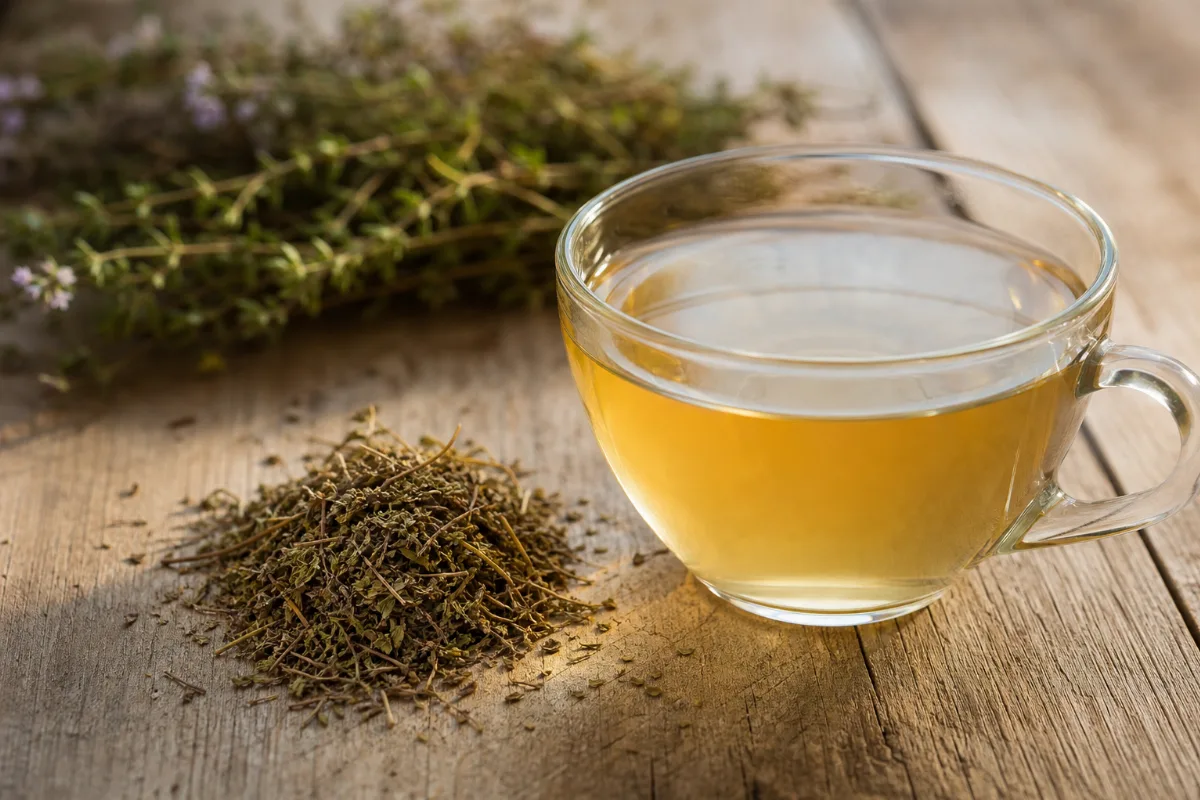
Thyme tea is made from the dried leaf and flower of Thymus vulgaris L. or Thymus zygis L., small shrubs in the mint family (Lamiaceae). Both names are accepted in the GBIF plant database. The EU monograph describes the herbal tea as the comminuted (finely broken) herb infused in water.
Thyme is not the tea plant (Camellia sinensis), so no caffeine is expected. No source we read measured caffeine in thyme tea, so this is an inference. Blends sold as thyme tea may contain true tea, so read the label.
What the research shows
The EU herbal committee says that, although there is insufficient evidence from clinical trials, thyme preparations including the herbal tea are plausible for a chesty cough with a cold and have been used safely for at least 30 years. The one trial it discussed was too limited to conclude anything.
The trials that did favour thyme tested branded products: a thyme-ivy syrup and thyme-primrose tablets in two trials of 361 adults each, and a thyme syrup in 60 children with asthma. A 2025 review of natural cough products for children says the evidence is generally scarce and of poor quality. For the tea, the best we found is a survey study on period pain.
Tea, syrup and extract
The tea is dried leaf and flower infused in water. The cough trials used standardised syrups, tablets or powdered-herb syrup, and lab studies often use isolated compounds such as thymol or strong essential oil. These are more concentrated than a cup of tea, and no study compared their safety. Results from one form should not be assumed for another. The EU summary also says combination products are outside its conclusions. Any amounts are a question for your doctor or pharmacist.
Where it is used
The EU committee bases its view on at least 30 years of use, 15 of them in the EU. A 2020 study calls thyme tea one of the most popular herbal teas in Ethiopia, and a 2026 review describes thyme as a familiar menstrual-pain remedy in Iran. We did not research older history, so none is claimed.
What happens in the body
How thyme tea might act in the body is not established. Research papers name thymol and carvacrol among thyme's compounds, and a 2026 review mentions carvacrol and prostaglandin pathways for period pain, but that is lab-level work and the EU monograph requires no such data for traditional use.
At a glance
Traditional uses history, not proof
- Europe: the EU herbal committee lists thyme herb, including the herbal tea, as a traditional medicine for productive (chesty) cough with a cold, on the basis of at least 30 years of use
- Ethiopia: a 2020 study calls thyme tea ('tossign tea') one of the most popular herbal teas, used for its medicinal reputation and for aroma and flavour
- Iran: a 2026 review describes thyme as a familiar home remedy for menstrual pain
Studied for research
- Chesty cough with colds (tea), insufficient (traditional use; no trial of the tea)
- Acute bronchitis cough (thyme-ivy and thyme-primrose products, not tea), low
- Cough in children with asthma flare-ups (thyme syrup, not tea), very low
- Period pain, very low (one survey study)
- Colds and immune support, insufficient (no trial found)
Main compounds
- Thymol, a volatile-oil compound named in thyme research
- Carvacrol, a second volatile-oil compound
- Plant polyphenols such as rosmarinic acid and luteolin (presence in tea not checked)
- No caffeine expected: thyme is not the tea plant (an inference; no source measured it)
Common forms
- Herbal tea from dried leaf and flower (the form in the EU monograph)
- Fresh sprigs steeped in water
- Syrups, juices and liquid or dry extracts, some combined with ivy or primrose (the trials tested these; results do not carry over to tea)
- Thyme essential oil (a separate product, not a drink)
Research links: EMA public summary on thyme (Thymi herba) · EMA community herbal monograph on thyme herb (2013) · Herbal medicine for cough: systematic review and meta-analysis (2015) · Thyme-ivy extract vs placebo in acute bronchitis (2006) · Thyme tea and primary dysmenorrhea (2020) · Research Library · Genes & Biomarkers Library
What it is and its history
- Accepted scientific name
- Thymus vulgaris L. and Thymus zygis L. (Lamiaceae)
- Naming authority
- Both names are ACCEPTED in the GBIF backbone: Thymus vulgaris L. (usageKey 5341442) and Thymus zygis L. (usageKey 7793938), checked by API on 2026-10-25. The EU monograph covers either species or a mixture of both.
- Synonyms
- Not listed here; GBIF synonym lists were not pulled.
- Common names
- Thyme (English); Garden thyme (English (graph summary)); Common thyme (English (graph summary)); Thymi herba (Latin pharmacopoeia name (EU monograph keyword)); Tomillo (Spanish (EU monograph translation list))
- Family or group
- Lamiaceae (mint family; also called Labiatae)
- Classification
- Plantae > Tracheophyta > Lamiales > Lamiaceae > Thymus > Thymus vulgaris; Thymus zygis
- Native range
- Not verified from a botanical source read.
- Habitat
- Not verified.
- What it looks like
- Roots: Not verified.; Stems: Not verified.; Leaves: The EU monograph and summary say the leaves and flowers are used, dried and broken up, or pressed for juice, or made into extracts.; Flowers: Used with the leaf (EU summary).; Fruit: Not verified.
- Cultivation
- Not verified.
- Harvest and processing
- The EU summary says preparations are obtained by drying and comminuting (reducing to tiny pieces) the leaves and flowers, by expressing the juice, or as dry, liquid and soft extracts.
- Look-alikes and adulterants
- Name: Wild thyme (Thymus serpyllum); Note: A different species; studies of it do not automatically apply to garden thyme tea.; Name: Thyme essential oil; Note: A separate, much stronger product made from the plant; not a tea and never a drink.; Name: Thyme combination cough syrups and tablets (with ivy or primrose); Note: Branded extract products that the cough trials tested; not the same as a cup of tea.
- Sustainability and conservation
- Not verified.
Photographs
Traditional use and history history, not clinical proof
| Tradition or era | Documented use | Source |
|---|---|---|
| European traditional medicine (regulatory view) | The EU herbal committee accepts thyme herb, including the herbal tea, as a traditional herbal medicinal product for productive cough with colds. It says the use has been safe in this way for at least 30 years, including at least 15 years within the EU. | s-ema-summary |
| Ethiopia | A 2020 study says thyme tea, locally called 'tossign tea', is one of the most popular herbal teas in Ethiopia, used for its medicinal reputation as well as aroma and flavour. | p33117031 |
| Iran, women's health | A 2026 review describes thyme as a familiar cultural remedy for menstrual pain in Iranian settings. | p41987844 |
| Older history (Egypt, Greece, Rome and others) | Not covered here. No source read for this page describes older history, so none is claimed. | none |
Traditional use shows how it was used. It does not show that it works or is safe today.
What is inside, and how it may work
What it contains and how those compounds act in cells and animals. Laboratory and animal mechanisms are not proven effects in people.
Main compounds
| Compound | Family | Where it is concentrated | Activity studied | Level of evidence |
|---|---|---|---|---|
| Thymol PubChem 6989 | Phenolic monoterpene (volatile oil) | Leaf and flower (volatile oil) | Named as a thyme volatile-oil compound in the research literature; how much reaches a cup of tea was not found. 14 | Laboratory research |
| Carvacrol PubChem 10364 | Phenolic monoterpene (volatile oil) | Leaf and flower (volatile oil) | The 2026 dysmenorrhea review points to carvacrol and prostaglandin pathways as a possible mechanism (lab-level, abstract only). 14 15 | Laboratory research |
| Rosmarinic acid PubChem 5281792 | Phenolic acid (polyphenol) | Leaf (mint-family herbs) | A polyphenol common in mint-family herbs; its presence and amount in thyme tea were not checked. 14 | Not established |
| Luteolin PubChem 5280445 | Flavone (flavonoid) | Leaf | A flavonoid found in many herbs; its amount in thyme tea was not checked. 14 | Not established |
Mechanisms, receptors and pathways
| Target or pathway | Gene or receptor | What was found | Level |
|---|---|---|---|
| Prostaglandin and oxidative-stress pathways (period pain) | Not specified | The 2026 review of thyme for period pain mentions carvacrol-mediated suppression of prostaglandin cascades and reduced oxidative stress. This is the review authors' summary of lab work; we did not read the lab papers. 15 | Laboratory research |
| How a cup of thyme tea eases a cough | Not specified | Not established. The EU monograph does not require pharmacological data for traditional-use products, and the trials we read measured symptoms only. 7 | Not established |
Absorption, metabolism and elimination
- Absorption
- Not established: the EU monograph states pharmacokinetic data are not required for this traditional-use product.
- Distribution
- Not found.
- Metabolism
- Not found.
- Elimination
- Not found.
- Bioavailability
- Not found for thyme tea.
Isolated compounds versus whole extracts
A cup of thyme tea is a water infusion of the dried leaf and flower. The trials of cough benefit used branded combination extracts or a syrup, and the strong lab results usually come from isolated oil compounds such as thymol or carvacrol, or from thyme essential oil. None of these is a cup of tea, and no study compared their safety. Do not assume findings carry across. Ask a doctor or pharmacist about concentrated products.
Nutritional composition
Thyme tea is a drink, not a meaningful source of vitamins or minerals; no nutrient data for it were read for this page.
1 low certainty2 very low certainty2 not enough evidence
What was looked at
The 5 benefits and uses checked for Thyme Tea, each with how strong the evidence is. Tap one to open it.
- Chesty cough with colds: thyme herbal tea (traditional use)Not enough evidence
- Acute bronchitis cough: thyme-ivy and thyme-primrose products (not tea)Low certainty
- Cough in children with asthma flare-ups: thyme syrup as an add-on (not tea)Very low certainty
- Period pain (primary dysmenorrhea)Very low certainty
- Preventing or shortening colds, and 'immune support'Not enough evidence
Lab markers tracked in the studies
Daytime coughing fitsBronchitis Severity Score respondersFEV1 (breathing test)Odds of primary period painMenstrual pain intensity
What is Thyme Tea good for?
The main studied uses of thyme tea and how strong the evidence is for each. 'Insufficient' means no usable trial of the tea; 'low' means decent trials of a different product; 'very low' means a single small or observational study. Where a result comes from a syrup or combination product, it is said so.
Benefits, one by one
Each card is a research question, not a promise. Tap a goal to filter. Open a card to see the studies, doses and limits.
Chesty cough with colds: thyme herbal tea (traditional use)
Not enough evidenceRegulators accept thyme herbal tea for a chesty cough with a cold because it has been used for a long time, not because trials proved it. No trial of the tea itself was found.
3 studiesHerbal tea is one of the forms in the EU monograph; amounts are not g…
Studies, doses and limits
What the trials found
The EU committee says there is insufficient evidence from clinical trials, so its view rests on long use. It looked at one trial in 60 adults comparing a thyme preparation with the cough medicine bromhexine. There was no significant difference, but the study was small and the thyme product was poorly described, so no firm conclusion was drawn. A 2025 Italian review of natural cough products for children says the evidence is generally scarce and of poor quality. No randomised trial of thyme tea itself for cough was found in our searches.
Results
No trial of the tea; traditional-use status only.
Why this rating
Regulators rate it as traditional use only; the only trial they discuss had shortcomings, and none tested the tea.
Form and dose studied
Herbal tea is one of the forms in the EU monograph; amounts are not given here. Ask a doctor or pharmacist.
Who was studied
Adults and adolescents over 12 for the tea; not recommended for children under 12 according to the EU monograph.
Limits
Traditional-use status is not proof of benefit; coughs with colds usually go away by themselves.
Why researchers looked
Thyme leaf and flower have a long reputation as a cough and chest herb in Europe, and are made into teas, syrups and extracts.
Traditional use
The EU herbal committee lists thyme herb, including the herbal tea, as a traditional herbal medicinal product for productive (chesty) cough associated with a cold, based on at least 30 years of use, 15 of them in the EU.
Proposed mechanism Not established
The reasons are not settled. Research papers name thymol and carvacrol among thyme's compounds, but no study read here shows how a cup of tea would act on a cough.
A proposed mechanism does not show that the effect happens in people.
See a doctor if the cough lasts longer than a week or gets worse, or with breathlessness, fever or pus-coloured phlegm.
Acute bronchitis cough: thyme-ivy and thyme-primrose products (not tea)
Low certaintyTwo large placebo-controlled trials of branded thyme combination products (a syrup with ivy leaf, tablets with primrose root) cut coughing fits more than placebo. These were not thyme tea and not thyme on its own.
3 studiesA syrup and a tablet of standardised extracts; amounts not reproduced…
Studies, doses and limits
What the trials found
Each trial randomised 361 adults with acute bronchitis and productive cough to 11 days of the product or a matching placebo. With the thyme-ivy syrup, daytime coughing fits fell 68.7% against 47.6% with placebo; with the thyme-primrose tablets, 67.1% against 51.3% (both p < 0.0001). Half of the coughing fits were gone about 2 days sooner. More people were 'responders' on the bronchitis severity score (for example 96.2% vs 74.7% and 92.9% vs 75.8% at the end). Side effects were no different from placebo and no serious events were reported. A 2015 meta-analysis of 34 cough trials (7,083 people) included 4 ivy/primrose/thyme trials and called the evidence for these combinations strong (RR 1.40, 95% CI 1.23 to 1.60).
Results
Larger fall in coughing fits than placebo, about 16 to 21 percentage points, in two trials of combination products.
Effect sizes as reported
Coughing fits: 68.7% vs 47.6% (thyme-ivy) and 67.1% vs 51.3% (thyme-primrose); meta-analysis RR 1.40 (1.23 to 1.60) for ivy/primrose/thyme.
Why this rating
Consistent results in two sizeable trials, but both are of branded combination products from one author group, funding is not stated, only abstracts were read, and the placebo groups also improved a lot. It cannot be carried over to tea.
Form and dose studied
A syrup and a tablet of standardised extracts; amounts not reproduced here and not the same as a tea.
Who was studied
Adult outpatients with acute bronchitis and productive cough.
Limits
Combination products; short; self-limiting illness; no tea tested.
Why researchers looked
Thyme is combined with ivy leaf or primrose root in branded cough products, and these were tested in adults with acute bronchitis.
Traditional use
The EU thyme summary says combinations of thyme with other herbs are not covered by its conclusions: they are a separate product type from the herbal tea.
Proposed mechanism Not established
Not established. The trials measured symptoms and did not test how the products work.
A proposed mechanism does not show that the effect happens in people.
Well tolerated in the trials; no serious events reported in these abstracts.
Cough in children with asthma flare-ups: thyme syrup as an add-on (not tea)
Very low certaintyOne small trial in 60 children found a little less activity-related cough with thyme syrup added to normal asthma care. Other symptoms did not differ.
2 studiesA syrup made from powdered thyme; not a tea. Amounts not reproduced.
Studies, doses and limits
What the trials found
In a triple-blind trial, 60 children aged 5 to 12 got thyme powder prepared as a syrup plus routine treatment, or placebo syrup plus routine treatment, for a week. Activity-induced cough fell more with thyme (p = 0.042). Wheezing and breathlessness did not differ significantly. FEV1 (a breathing test) differed between groups (p = 0.048), but four other breathing measures did not.
Results
Slightly less activity-related cough; no clear difference in wheeze, breathlessness or most breathing tests.
Effect sizes as reported
p = 0.042 (activity-induced cough); p = 0.048 (FEV1); others not significant.
Why this rating
One small single-centre trial, many outcomes with borderline p-values, a syrup of powdered herb rather than tea, abstract only.
Form and dose studied
A syrup made from powdered thyme; not a tea. Amounts not reproduced.
Who was studied
Children aged 5 to 12 with asthma exacerbations.
Limits
Small; one place; only one week; add-on to standard care.
Why researchers looked
Researchers in Iran tested thyme in children with mild to moderate asthma attacks, as an add-on to routine treatment.
Traditional use
No traditional-use source was read for this specific use.
Proposed mechanism Not established
Not established; the trial did not test a mechanism.
A proposed mechanism does not show that the effect happens in people.
The abstract does not report side effects. The EU monograph does not recommend thyme tea under 12.
Period pain (primary dysmenorrhea)
Very low certaintyA small survey study found fewer girls with period pain among thyme tea drinkers. This cannot show the tea works, and the trial evidence is for other forms of thyme.
2 studiesThyme tea as usually drunk in the Ethiopian study; the reviewed trial…
Studies, doses and limits
What the trials found
In a case-control study of 252 school girls in Ethiopia (86 with period pain, 166 without), 22.1% of those with pain and 33.7% of those without reported drinking thyme tea. After adjustment, thyme tea drinkers had 63.2% lower odds of period pain (adjusted odds ratio 0.368, 95% CI 0.145 to 0.934). The authors ask for more research. A 2026 narrative review of 6 studies, all in young women in Iran, reports pain relief similar to painkillers in trials, but its plain-language summary points to thyme essential oil, not tea, and no meta-analysis was possible.
Results
Thyme tea drinkers had lower odds of period pain in one survey; reviewed trials were in Iran and mostly not of tea.
Effect sizes as reported
Adjusted odds ratio 0.368 (95% CI 0.145 to 0.934) in the Ethiopian study.
Why this rating
One observational study (recall and other habits can mislead) and one narrative review of mostly non-tea preparations from one country; abstracts only.
Form and dose studied
Thyme tea as usually drunk in the Ethiopian study; the reviewed trials used other preparations. Amounts not reproduced.
Who was studied
Girls and young women with primary dysmenorrhea; no trial in adolescents.
Limits
Association only; wide interval; Iranian evidence only; unknown long-term effects.
Why researchers looked
Thyme tea ('tossign tea') is a popular drink in Ethiopia, and thyme is a familiar home remedy for period cramps in Iran.
Traditional use
A 2026 review describes thyme as a familiar cultural remedy for menstrual pain in Iranian settings.
Proposed mechanism Preliminary mechanism
The 2026 review points to carvacrol acting on prostaglandin and oxidative-stress pathways. We read only its abstract, and the mechanism is lab-level.
A proposed mechanism does not show that the effect happens in people.
The EU monograph does not recommend thyme tea in pregnancy or in children under 12.
Preventing or shortening colds, and 'immune support'
Not enough evidenceThyme tea is often said to support immunity. We found no trial showing it prevents or shortens colds.
2 studiesNot applicable.
Studies, doses and limits
What the trials found
The EU committee found insufficient clinical-trial evidence for the traditional cough use and does not claim any effect on cold prevention. Our searches of PubMed for thyme tea found no randomised trial on colds, flu or immunity.
Results
No human trial found.
Why this rating
No human trial found.
Limits
Absence of trials is not proof of no effect, and our search was not exhaustive.
Why researchers looked
Thyme is traditionally used for colds and chest complaints.
Traditional use
The EU approval is only for cough that comes with a cold, based on long use.
Proposed mechanism Not established
Lab studies of thymol and carvacrol against germs exist, but none were read here, and lab results do not show that tea treats an infection.
A proposed mechanism does not show that the effect happens in people.
Do not rely on tea for fever, breathlessness or a cough lasting over a week; see a doctor.
Connections to the rest of health
How Thyme Tea connects to the rest of our health knowledge graph. Every link says what kind of connection it is. A safety link (for example to the liver) is a warning, not a benefit. A study that merely mentions a topic never creates a benefit link.
Explore every connection: goals, body systems, organs, symptoms, genes
A. Wellness goals
| Connected to | Kind of connection | Evidence status | Context | Studies |
|---|---|---|---|---|
| Immune Support | Not enough evidence | Chesty cough with colds: thyme herbal tea (traditional use): Regulators accept thyme herbal tea for a chesty cough with a cold because it has been used for a long time, not because trials proved it. No trial of the tea itself was found. | 8 7 4 | |
| Immune Support | Low certainty | Acute bronchitis cough: thyme-ivy and thyme-primrose products (not tea): Two large placebo-controlled trials of branded thyme combination products (a syrup with ivy leaf, tablets with primrose root) cut coughing fits more than placebo. These were not thyme tea and not thyme on its own. Cough in children with asthma flare-ups: thyme syrup as an add-on (not tea): One small trial in 60 children found a little less activity-related cough with thyme syrup added to normal asthma care. Other symptoms did not differ. | 12 13 17 6 7 | |
| Womens Wellness | Very low certainty | Period pain (primary dysmenorrhea): A small survey study found fewer girls with period pain among thyme tea drinkers. This cannot show the tea works, and the trial evidence is for other forms of thyme. | 18 15 | |
| Immune Support | Not enough evidence | Preventing or shortening colds, and 'immune support': Thyme tea is often said to support immunity. We found no trial showing it prevents or shortens colds. | 8 7 |
B. Body systems
| Connected to | Kind of connection | Evidence status | Context | Studies |
|---|---|---|---|---|
| Respiratory system | Not enough evidence | EU traditional use for chesty cough with colds; no trial of the tea. Preparation or compound: Thyme herbal tea |
8 7 | |
| Immune System | Biological association | Not enough evidence | Studied for: Chesty cough with colds: thyme herbal tea (traditional use) Studied for: Acute bronchitis cough: thyme-ivy and thyme-primrose products (not tea) | 8 7 4 12 13 17 6 |
| Reproductive System | Biological association | Very low certainty | Studied for: Period pain (primary dysmenorrhea) | 18 15 |
E. Health conditions
| Connected to | Kind of connection | Evidence status | Context | Studies |
|---|---|---|---|---|
| Lamiaceae (mint family) allergy | Contraindication | Low certainty | Official contraindication; one systemic-reaction case report. Preparation or compound: Thyme herb |
7 2 |
| Pregnancy and breastfeeding | Contraindication | Low certainty | Not recommended by the EU monograph; a systematic review calls it potentially harmful with no direct studies. Not recommended by the EU monograph. Preparation or compound: Thyme herb |
7 1 |
| Babies and young children | Contraindication | Low certainty | Not recommended under 12 for tea; a newborn case report of lactic acidosis after sweetened thyme juice. Preparation or compound: Thyme tea or juice |
7 5 |
I. Biomarkers
| Connected to | Kind of connection | Evidence status | Context | Studies |
|---|---|---|---|---|
| Daytime coughing fits | Biological association | Low certainty | Measured in trials: lowered. A lab change is not the same as a health benefit. | 12 13 |
| Bronchitis Severity Score responders | Biological association | Low certainty | Measured in trials: raised. A lab change is not the same as a health benefit. | 12 13 |
| FEV1 (breathing test) | Biological association | Very low certainty | Measured in trials: mixed. A lab change is not the same as a health benefit. | 6 |
| Odds of primary period pain | Biological association | Very low certainty | Measured in trials: lowered. A lab change is not the same as a health benefit. | 18 |
| Menstrual pain intensity | Biological association | Very low certainty | Measured in trials: lowered. A lab change is not the same as a health benefit. | 15 |
K. Biological pathways
| Connected to | Kind of connection | Evidence status | Context | Studies |
|---|---|---|---|---|
| Prostaglandin synthesis | Preliminary mechanism | In vitro | Proposed by the 2026 review as a pathway for carvacrol; lab-level and unconfirmed for tea. | 15 |
L. Active compounds
| Connected to | Kind of connection | Evidence status | Context | Studies |
|---|---|---|---|---|
| Thymol | Biological association | In vitro | Named as a thyme volatile-oil compound in the research literature; how much reaches a cup of tea was not found. Preparation or compound: Leaf and flower (volatile oil) |
14 |
| Carvacrol | Biological association | In vitro | The 2026 dysmenorrhea review points to carvacrol and prostaglandin pathways as a possible mechanism (lab-level, abstract only). Preparation or compound: Leaf and flower (volatile oil) |
14 15 |
| Rosmarinic acid | Biological association | Not established | A polyphenol common in mint-family herbs; its presence and amount in thyme tea were not checked. Preparation or compound: Leaf (mint-family herbs) |
14 |
| Luteolin | Biological association | Not established | A flavonoid found in many herbs; its amount in thyme tea was not checked. Preparation or compound: Leaf |
14 |
Each connection is stored with the ingredient, the connected record, the kind of connection, the evidence status, the supporting studies, the preparation or compound involved, and a review date (last reviewed October 25, 2026).
Evidence at a glance: what changed in 5 lab markers
Tap a number to show only those markers. Counts are markers, not people.
The evidence
The research centre for Thyme Tea. Every record here was checked against PubMed or the publisher's page; we never list a study we have not verified.
Evidence by outcome
Bars show how many studies we found for each outcome, not how well it works. People are added up across trials only (reviews are not added, to avoid double counting).
How we rate evidence
High certainty
Several well-run trials or reviews agree; further research is unlikely to change the picture much.
Moderate certainty
Good trials point the same way, but some doubt remains.
Low certainty
Small, short or inconsistent trials. The finding could change with better research.
Very low certainty
Very little or very weak human data. Treat as a possibility only.
Mixed findings
Trials or reviews disagree with each other.
Not enough evidence
Not enough human research to say either way.
Evidence against
Good research found no benefit, or found harm.
We take the reviewers' own risk-of-bias and GRADE statements where they exist, and otherwise judge from study size, design, consistency, directness and whether a product matches what is sold. Many publications do not make evidence high. Method note: We read the EMA thyme monograph and its public summary in full, checked plant names through GBIF and compound identities through PubChem, searched PubMed, and read every cited abstract directly (one review's full-text table for the pregnancy statement). NCCIH and Memorial Sloan Kettering thyme pages were not found, and no thyme entry was found in LiverTox or LactMed. The no-caffeine statement is an inference and is labelled so.
Study library: every study we checked 18
| Study | Design | People | Product, dose, length | Result |
|---|---|---|---|---|
| Ahmed 2017 Safety classification of herbal medicines used among pregnant women in Asian countries: a systematic review. BMC Complement Altern Med · PMID 29137614 · DOI |
Systematic review |
2729 Eight cross-sectional surveys of herbal medicine use in pregnancy in seven Asian countries |
33 herbal medicines named in the surveys (thyme is one) mixed |
Of 33 herbal medicines, 13 were classed safe, 5 'use with caution', 8 potentially harmful and 7 had no information. The abstract does not name thyme. In the full text (PMC5686907, table read 2026-10-25) thyme (Thymus vulgaris) is listed with 'human or animal studies not available in current literature but potentially harmful due to its abortifacient activity'; thyme was named by 56 women (4.4%) in the pooled surveys and used orally. Thyme classed 'potentially harmful' on the basis of reported abortifacient activity, with no human or animal study Methods, limits and fundingOutcomes: Safety classification of herbs used in pregnancy Limitations: The classification rests on cited secondary sources, not on any study of thyme tea in pregnancy; surveys were in Asian countries; the abstract does not mention thyme (the full text does). Funding and conflicts: No competing interests declared. Read: full-text |
| Benito 1996 Labiatae allergy: systemic reactions due to ingestion of oregano and thyme. Ann Allergy Asthma Immunol · PMID 8630713 · DOI |
Case report |
1 One patient with three systemic allergic reactions after eating oregano and thyme (Valencia, Spain) |
Dried oregano and thyme herbs eaten leaf · vs Ten control patients for skin tests |
Skin tests to plants of the Labiatae (Lamiaceae) family were positive, with specific IgE to all herbs tested; the authors say the plants show cross-sensitivity. The authors state that no systemic allergic reactions to oregano or thyme had been described before this report. Systemic allergic reactions to eaten thyme and oregano in one person Methods, limits and fundingOutcomes: Allergy testing Limitations: A single case from 1996; cannot give frequency; abstract only. Funding and conflicts: Not stated. Read: abstract |
| Berghea 2025 Spices, herbs and allergic reactions in children: myth or reality - a narrative review with scoping elements. Front Allergy · PMID 41306764 · DOI |
Narrative review |
Children with spice and herb allergy (case reports, clinical and lab studies, and adult cases for context) | Spices and herbs, including Lamiaceae herbs mixed |
Says spice and herb allergies are increasingly recognised in children, from mild mouth reactions to anaphylaxis. Frequently implicated spices include mustard, celery, coriander, fennel, cumin, anise and pepper, and Lamiaceae herbs such as mint, oregano and sage. Cross-reactivity to birch and mugwort pollen is common. Management is strict avoidance and emergency preparedness. Thyme is not named in the abstract. Lamiaceae herbs listed among children's allergens Methods, limits and fundingOutcomes: Spice and herb allergy in children Limitations: Narrative review; thyme itself is not named in the abstract; abstract only. Funding and conflicts: No conflicts declared. Read: abstract |
| Ciprandi G; Nutraceutical and Medical Device Task Force of the Italian Society of Pediatric Allergy 2025 Natural antitussive products for children and adolescents: darkness and shadow. Minerva Pediatr (Torino) · PMID 40512457 · DOI |
Narrative review |
Natural cough products sold in Italy for children and adolescents, including products with Thymus vulgaris and honey | Natural cough products (mostly medical devices), several botanicals mixed varied varied · vs varied |
Says a few clinical studies looked at non-drug remedies for post-viral cough, and that the evidence is generally scarce and of poor quality. Advises doctors to know the exact composition, literature, dosing and safety of these products before recommending them. Evidence scarce and of poor quality (reviewers' words) Methods, limits and fundingOutcomes: Evidence for natural cough relievers in post-viral cough Limitations: Narrative review of marketed Italian products; abstract only; does not rate thyme alone. Funding and conflicts: Not stated in the abstract. Read: abstract |
| Erol 2014 An interesting newborn case of fructose 1-6 diphosphatase deficiency triggered after thyme juice ingestion. Clin Lab · PMID 24600990 · DOI |
Case report |
1 A 14-day-old boy in Ankara, Turkey, given sweetened thyme juice for colic |
Ready-to-use thyme juice with table sugar added A large drink (amount not reproduced) single episode |
Two hours after the drink the baby had severe breathing difficulty, low blood sugar, high uric acid and lactic acidosis. Tests showed fructose-1,6-diphosphatase deficiency, a rare inherited condition. The authors think the fructose added to sweeten the drink may have triggered the lactic acidosis, but say the phenolic compounds of thyme may also contribute. Serious metabolic reaction in a newborn with a hidden inherited disorder Methods, limits and fundingOutcomes: Emergency presentation Limitations: One case; the cause is unproven and the authors suggest the sugar as the likely trigger; not a normal cup of tea; abstract only. Funding and conflicts: Not stated. Read: abstract |
| Eskandarpour 2024 Thymus vulgaris ameliorates cough in children with asthma exacerbation: a randomized, triple-blind, placebo-controlled clinical trial. Allergol Immunopathol (Madr) · PMID 38186189 · DOI |
Controlled trial |
60 Children aged 5 to 12 with mild to moderate asthma exacerbation (Ardabil, Iran) |
Thyme (Thymus vulgaris) powder prepared as a syrup, added to routine treatment (not tea) Weight-based schedule (not reproduced here) 1 week · vs Placebo syrup plus routine treatment |
Activity-induced cough fell more with thyme syrup than placebo (p = 0.042). Wheezing and breathlessness did not differ significantly. FEV1 differed between groups (p = 0.048) but FEV1/FVC, peak flow and FEF25-75% did not. One of several cough and lung measures improved; others did not Methods, limits and fundingOutcomes: Cough, wheeze, breathlessness, spirometry Limitations: Only 60 children; one centre; many outcomes tested with borderline p-values and no mention of correction; syrup of powdered herb, not tea; add-on to standard asthma treatment; abstract only. Funding and conflicts: Not stated in the abstract. Read: abstract |
| European Medicines Agency 2013 Community herbal monograph on Thymus vulgaris L. and Thymus zygis L., herba (EMA/HMPC/342332/2013) EMA herbal monograph (final, adopted 12 November 2013) · Source |
Authoritative guidance |
not applicable | Thyme herb (Thymus vulgaris and T. zygis), including comminuted herb as herbal tea leaf+flower |
Read in full on 2026-10-25 (PDF, 8 pages). Traditional herbal medicinal product for productive cough associated with cold, based only on long-standing use. Herbal tea is one listed form. Contraindication: hypersensitivity to the plant or to other Lamiaceae (Labiatae). Use in children under 12 is not recommended for the herbal tea and most other forms (not established, lack of adequate data); two liquid extracts are listed for children from 4 years. See a doctor if symptoms last longer than 1 week or worsen, or if breathlessness, fever or pus-containing sputum occur. Interactions: none reported. Pregnancy and breastfeeding: safety not established, use not recommended. Fertility: no data. Side effects: gastric disorders, frequency not known. Overdose: no case reported. Adequate tests on reproductive toxicity, genotoxicity and carcinogenicity have not been performed. Reference summary Methods, limits and fundingOutcomes: Regulatory or reference summary Limitations: A regulator summary of other evidence; 'none reported' means none reported, not that none exist. Funding and conflicts: Not applicable (regulator document). Read: full-text |
| European Medicines Agency 2016 Thymi herba - herbal medicinal product (EMA public summary of HMPC conclusions) EMA website, herbal medicine page · Source |
Authoritative guidance |
60 Summary page; it describes one clinical study in 60 adults with productive cough |
Thyme preparations (leaf and flower; herbal tea, juice, extracts) leaf+flower · vs Bromhexine in the one study described |
Read in full on 2026-10-25 (HTTP 200; the public summary document is dated 14 October 2016). Uses are accepted on the basis of traditional use (at least 30 years, including 15 in the EU), with insufficient evidence from clinical trials. The one clinical study the committee discussed (60 adults, thyme preparation versus bromhexine) showed no significant difference, but had shortcomings (small size, no details of the thyme preparation), so firm conclusions could not be drawn. Risks: must not be used in people allergic to thyme or other Lamiaceae plants; stomach problems may occur. Most preparations only for adults and adolescents over 12; a few can be used from age 4. Combination products are not covered. Reference summary Methods, limits and fundingOutcomes: Regulatory or reference summary Limitations: Summary of a summary; the assessment report was not read. Funding and conflicts: Not applicable (regulator document). Read: full-text |
| GBIF Secretariat 2026 GBIF backbone match: Thymus vulgaris L. GBIF species API · Source |
Taxonomy database plant |
not applicable | Thymus vulgaris L. whole plant |
Checked by API on 2026-10-25: usageKey 5341442, scientificName 'Thymus vulgaris L.', rank SPECIES, status ACCEPTED, family Lamiaceae, exact match. Accepted name confirmed Methods, limits and fundingOutcomes: Accepted name and family Limitations: Taxonomy only. Funding and conflicts: Not applicable. Read: api |
| GBIF Secretariat 2026 GBIF backbone match: Thymus zygis L. GBIF species API · Source |
Taxonomy database plant |
not applicable | Thymus zygis L. whole plant |
Checked by API on 2026-10-25: usageKey 7793938, scientificName 'Thymus zygis L.', rank SPECIES, status ACCEPTED, family Lamiaceae, exact match. Accepted name confirmed Methods, limits and fundingOutcomes: Accepted name and family Limitations: Taxonomy only. Funding and conflicts: Not applicable. Read: api |
| Gumus ZP. 2023 Assessment of Toxic Pyrrolizidine and Tropane Alkaloids in Herbal Teas and Culinary Herbs Using LC-Q-ToF/MS. Foods · PMID 37835225 · DOI |
Contamination survey plant |
Herbal teas and culinary herbs sold in Turkish markets, including thyme | Retail teas and herbs (thyme among them) mixed |
At least a few of the measured toxins were found in all tested teas and herbs. Total contents across black, green, mixed, flavoured, chamomile, sage, linden, fennel and rosehip teas, peppermint and thyme ranged from 4.6 to 1054.5 ng per g. The abstract does not give a thyme-only figure. Natural plant toxins found in all samples, in a wide range Methods, limits and fundingOutcomes: Natural plant toxins (pyrrolizidine and tropane alkaloids) in herbal teas and herbs Limitations: The range pools many products, so it is not a thyme figure; Turkish market only; abstract only; compliance with limits is discussed in the full paper, which was not read. Funding and conflicts: No conflict of interest declared. Read: abstract |
| Kemmerich 2006 Efficacy and tolerability of a fluid extract combination of thyme herb and ivy leaves and matched placebo in adults suffering from acute bronchitis with productive cough. A prospective, double-blind, placebo-controlled clinical trial. Arzneimittelforschung · PMID 17063641 · DOI |
Controlled trial |
361 Adult outpatients with acute bronchitis and productive cough (at least 10 coughing fits a day) |
Branded thyme-ivy fluid extract combination syrup (not tea) leaf+flower (thyme) with ivy leaf Manufacturer schedule (not reproduced here) 11 days · vs Matched placebo syrup |
Coughing fits fell 68.7% with the thyme-ivy product against 47.6% with placebo (p < 0.0001). Half of the baseline coughing fits were gone about 2 days earlier. Responders: 83.0% vs 53.9% at day 4 and 96.2% vs 74.7% at the end. No difference in side effects; no severe or serious events reported. Faster and larger fall in coughing fits than placebo (about 21 points) Methods, limits and fundingOutcomes: Daytime coughing fits (days 7 to 9), Bronchitis Severity Score, responder rates Limitations: A combination product, not thyme alone and not tea; only the abstract was read; the placebo group also improved a lot (acute bronchitis often gets better by itself); same author group as the 2007 trial. Funding and conflicts: Not stated in the abstract; a branded commercial product, so a manufacturer link is likely but not confirmed. Read: abstract |
| Kemmerich B. 2007 Evaluation of efficacy and tolerability of a fixed combination of dry extracts of thyme herb and primrose root in adults suffering from acute bronchitis with productive cough. A prospective, double-blind, placebo-controlled multicentre clinical trial. Arzneimittelforschung · PMID 17966760 · DOI |
Controlled trial |
361 Adult outpatients with acute bronchitis and productive cough (at least 10 coughing fits a day) |
Branded thyme-primrose dry extract tablets (not tea) leaf+flower (thyme) with primrose root Manufacturer schedule (not reproduced here) 11 days · vs Matched placebo tablets |
Coughing fits fell 67.1% with the thyme-primrose product against 51.3% with placebo (p < 0.0001). Half of the baseline coughing fits were gone about 2 days earlier. Responders: 77.5% vs 60.1% at day 4 (p = 0.0006) and 92.9% vs 75.8% at the end (p < 0.0001). Side effects did not differ from placebo; no severe or serious events. Larger fall in coughing fits than placebo (about 16 points) Methods, limits and fundingOutcomes: Daytime coughing fits (days 7 to 9), Bronchitis Severity Score, responder rates Limitations: A combination product, not thyme alone and not tea; only the abstract was read; the placebo group also improved a lot; single author, same group as the 2006 trial. Funding and conflicts: Not stated in the abstract; a branded commercial product, so a manufacturer link is likely but not confirmed. Read: abstract |
| NCBI PubChem 2026 PubChem records: thymol (CID 6989), carvacrol (CID 10364), rosmarinic acid (CID 5281792), luteolin (CID 5280445) PubChem PUG REST · Source |
Chemistry database chemistry |
not applicable | Compounds named in thyme research leaf+flower |
Looked up by name on 2026-10-25: thymol C10H14O (CID 6989); carvacrol C10H14O (CID 10364); rosmarinic acid C18H16O8 (CID 5281792); luteolin C15H10O6 (CID 5280445). The records confirm identity only, not that each compound is present in a cup of tea. Identity confirmed Methods, limits and fundingOutcomes: Compound identity Limitations: Database identity only; says nothing about content in tea. Funding and conflicts: Not applicable. Read: api |
| Sahebi 2026 Evaluating the Therapeutic Effects of Thymus vulgaris on Primary Dysmenorrhea Adolescent and Young Girls (Qualitative Evidence Synthesis). Pediatr Health Med Ther · PMID 41987844 · DOI |
Systematic review |
6 studies, all in women of reproductive age in Iran (mean age 21 to 24); no trial in WHO-defined adolescents | Thyme preparations; the plain-language summary mentions thyme essential oil at 2% (not tea) mixed varied up to 3 menstrual cycles · vs Placebo or NSAIDs in the included trials |
A narrative synthesis (no meta-analysis possible). Participants described thyme as a familiar remedy; reports described pain reductions comparable to conventional painkillers (NSAIDs). The review mentions carvacrol and prostaglandin and oxidative-stress pathways as mechanisms. Short-term safety looked favourable; long-term effects are unknown. Evidence is only from Iran. Reported pain relief similar to NSAIDs, with low confidence Methods, limits and fundingOutcomes: Menstrual pain Limitations: Narrative synthesis of 6 studies in one country; the plain-language summary points to essential oil rather than tea; mechanisms are lab-level; abstract only. Funding and conflicts: No conflicts declared by the authors. Read: abstract |
| Salmani 2024 Comparison of Essential and Toxic Metals Levels in some Herbal Teas: a Systematic Review. Biol Trace Elem Res · PMID 37198356 · DOI |
Systematic review plant |
49 papers (2012 to 2023) on metals in herbal teas, searched with terms including thyme, rosemary and chamomile | Commonly consumed herbal teas mixed |
All commonly consumed herbal teas contained metals. The authors say none met WHO requirements, yet more than 70% of the health risks were judged acceptable. Risks from arsenic and lead in tea, and cadmium in black tea, were considerably higher than in others. They urge better cultivation and avoiding low-quality herbal teas. Metals present in all herbal teas; most risks acceptable Methods, limits and fundingOutcomes: Metal levels and health risks Limitations: Does not give a thyme-only result in the abstract; pooled many teas and methods; abstract only. Funding and conflicts: Not stated in the abstract. Read: abstract |
| Wagner 2015 Herbal Medicine for Cough: a Systematic Review and Meta-Analysis. Forsch Komplementmed · PMID 26840418 · DOI |
Meta-analysis |
7083 34 randomised trials of herbal medicine for cough in upper respiratory infections and colds (searches to March 2012) |
Herbal products; for ivy/primrose/thyme 4 trials of combination products mixed varied varied · vs Mostly placebo |
Strong evidence (the authors' wording) for ivy/primrose/thyme-based preparations (4 trials; RR 1.40, 95% CI 1.23 to 1.60; P < 0.001) and for Andrographis paniculata; moderate for Pelargonium sidoides; limited for Echinacea. Most studies had low risk of bias. The review says more research is needed. Ivy/primrose/thyme combinations beat placebo for cough (RR 1.40) Methods, limits and fundingOutcomes: Cough frequency and severity Limitations: Pools combination products, not thyme alone and not tea; searches ended in 2012; abstract only; no tea trial is in the thyme group. Funding and conflicts: Not stated in the abstract. Read: abstract |
| Zeru 2020 Thyme Tea and Primary Dysmenorrhea Among Young Female Students. Adolesc Health Med Ther · PMID 33117031 · DOI |
Case control |
252 School girls in Debre Berhan, Ethiopia: 86 with primary dysmenorrhea (cases) and 166 without (controls) |
Thyme tea drinking reported by questionnaire (usual tea, not a trial product) leaf+flower (as drunk locally; not specified in the abstract) Self-reported habit (not reproduced) · vs Girls who did not drink thyme tea |
Thyme tea drinking was reported by 19 of 86 cases (22.1%) and 56 of 166 controls (33.7%). After adjustment the odds of period pain were 63.2% lower in thyme tea drinkers (adjusted odds ratio 0.368, 95% CI 0.145 to 0.934). Coffee drinking tended to go with more severe pain. The authors say further studies are required. Lower odds of period pain in thyme tea drinkers (AOR 0.368); an association, not proof Methods, limits and fundingOutcomes: Odds of primary dysmenorrhea Limitations: Case-control by interview: recall and confounding are possible (diet, age, other habits); the wide interval nearly touches 1; not a trial, so tea was not tested against placebo; abstract only. Funding and conflicts: No conflicts of interest declared by the authors. Read: abstract |
What we do not know yet
- No randomised trial of thyme tea itself for cough, colds or period pain was found.
- The cough trials tested branded combination products, so they cannot show what a cup of tea does.
- No study of thyme tea in pregnancy, breastfeeding or children was found.
- No interaction study with any medicine was found.
- No human liver safety data for thyme tea were found.
- Contamination surveys give no thyme-only figures in their abstracts.
- The full EMA assessment report was not read; only the monograph and public summary were.
How new research is added
New studies are found by a saved PubMed search and placed in a review queue. A person checks each one before it is added.
Lab markers
What changed in blood or saliva tests during trials. A changed number is not the same as feeling or being healthier, and we give no "normal ranges".
Other 5
Daytime coughing fits
Lowered in trials
How many times a day a person has a coughing fit, counted by the patient.
Low certaintyResults and what it means
Why it was measured
The main outcome of the bronchitis trials.
Statistical vs. clinical meaning
A symptom count, patient-recorded, in an illness that often settles by itself; not tea.
Safety implication
No difference in side effects from placebo in either trial.
Bronchitis Severity Score responders
Raised in trials
The share of patients whose doctor-rated bronchitis symptom score improved enough to count as responding.
Low certaintyResults and what it means
Why it was measured
A doctor-assessed secondary outcome.
Statistical vs. clinical meaning
More responders than placebo, but both groups improved; combination products.
Safety implication
None noted.
FEV1 (breathing test)
Mixed results in trials
The amount of air a person can blow out in the first second.
Very low certaintyResults and what it means
Why it was measured
A lung-function check after a week of treatment.
Statistical vs. clinical meaning
One borderline result among several tests.
Safety implication
None reported in the abstract.
| Study | Result | People | Product |
|---|---|---|---|
| 6 | Differed between groups (p = 0.048); four other spirometry measures did not | 60 children with asthma exacerbation | Thyme powder syrup plus routine care |
Odds of primary period pain
Lowered in trials
How likely a girl was to have painful periods compared with a similar girl who did not drink thyme tea.
Very low certaintyResults and what it means
Why it was measured
Main result of the Ethiopian case-control study.
Statistical vs. clinical meaning
An association from interviews, not a trial.
Safety implication
None noted.
| Study | Result | People | Product |
|---|---|---|---|
| 18 | Adjusted odds ratio 0.368 (95% CI 0.145 to 0.934) | 252 school girls (86 cases, 166 controls) | Self-reported thyme tea drinking |
Menstrual pain intensity
Lowered in trials
How strong period pain is on a pain scale.
Very low certaintyResults and what it means
Why it was measured
Outcome in the trials the 2026 review pooled narratively.
Statistical vs. clinical meaning
Narrative synthesis with low confidence.
Safety implication
Short-term safety looked favourable for up to three cycles.
| Study | Result | People | Product |
|---|---|---|---|
| 15 | Reported reductions in pain intensity and duration, comparable to NSAIDs (numbers not given in the abstract) | 6 studies in young women in Iran | Thyme preparations, mostly not tea |
Safety
What studies and official sources say about side effects, medicines and who should check first. Each point shows what kind of evidence it comes from.
Main points to know 7
- Do not use if you are allergic to thyme or to mint-family (Lamiaceae) plants. The EU monograph lists hypersensitivity to thyme or other Lamiaceae plants as a contraindication. A 1996 case report describes three systemic allergic reactions after eating oregano and thyme in one patient, with skin tests and specific IgE positive to all the mint-family herbs tested. A 2025 review says mint-family herbs such as mint, oregano and sage are among the herbs that cause allergy in children, ranging from mouth reactions to anaphylaxis. How often thyme tea causes allergy is not known. Authoritative guidance 7 2 3
- Babies and children: the EU monograph does not recommend the tea under 12. For the herbal tea (and most other forms) the EU monograph says use under 12 years has not been established because of lack of adequate data; two liquid extracts are listed from age 4. A case report describes a 14-day-old baby who became seriously ill (breathing distress, low blood sugar, lactic acidosis) after a large drink of sweetened thyme juice given for colic; he was found to have a rare inherited disorder (fructose-1,6-diphosphatase deficiency). The authors think the added sugar probably triggered it, and that thyme's phenolic compounds may also play a part. Do not give thyme drinks to babies. Authoritative guidance 7 8 5
- Pregnancy and breastfeeding: not recommended. The EU monograph says safety in pregnancy and breastfeeding has not been established and, without enough data, use is not recommended. It also says no fertility data are available. A 2017 systematic review of herbs used in pregnancy in Asia classed thyme as potentially harmful because of reported abortifacient activity, while saying no human or animal studies were found in the literature it searched. That statement rests on secondary sources, not on a study of thyme tea. No source we read measured the safety of an occasional cup. Ask a doctor or midwife. Authoritative guidance 7 1
- Cough with fever, breathlessness or pus-coloured phlegm needs a doctor, not tea. The EU monograph says to consult a doctor or qualified health practitioner if breathlessness, fever or pus-containing (purulent) sputum occur, if symptoms worsen, or if they last longer than 1 week. Authoritative guidance 7 8
- Stomach upset can happen. The EU monograph lists gastric disorders as an undesirable effect, with frequency not known. Authoritative guidance 7 8
- Tea, syrups and extracts are different products. The trials of cough benefit used branded thyme-ivy and thyme-primrose products and a thyme powder syrup. The EU summary says combination products are not covered by its conclusions. The monograph also says tinctures and extracts that contain ethanol need alcohol labelling. Safety findings for one of these forms cannot be assumed for another. Ask a doctor or pharmacist about concentrated products. Authoritative guidance 7 8 12 6
- Caffeine: none expected, but blends may contain tea. Thyme is a mint-family herb, not the tea plant (Camellia sinensis), so no caffeine is expected in a pure thyme infusion. None of the sources we read measured caffeine in thyme tea, so this is an inference. Blends sold as 'thyme tea' may contain true tea or other herbs: read the label. Other 9 8
Side effects 4
| Effect | How often | Severity and recovery | Evidence |
|---|---|---|---|
| Stomach or gut upset The monograph gives no frequency or detail. | Not known (EU monograph) | not stated Not stated | Authoritative guidance 7 8 |
| Allergic reactions, including systemic reactions Mint-family cross-sensitivity is described by the case authors; frequency unknown. | Not known; a single case report of eaten thyme and oregano | can be serious (systemic reaction) Not described in the abstract | Case report 2 3 |
| Serious metabolic reaction in a newborn with a hidden inherited disorder The added sugar is the authors' leading suspect; not a normal cup of tea. | One case report | severe (emergency admission) Outcome not given in the abstract | Case report 5 |
| Overdose 'No case reported' is not proof that overdose cannot happen. | No case reported (EU monograph) | not applicable Not applicable | Authoritative guidance 7 |
Liver
We found no case report of liver injury from thyme tea in our PubMed search (which returned only laboratory and animal papers on thyme and liver). A search of the NCBI Bookshelf (where the LiverTox and LactMed texts are held) returned no thyme entry. This does not prove thyme tea is safe for the liver. 7
How often. No human liver reports found; frequency unknown.
Monitoring. No monitoring advice exists. Anyone with yellow skin or eyes, dark urine or pale stools should stop and see a doctor.
This is a safety connection. It is not evidence that Thyme Tea supports liver health.
Medicines and supplements 2
| With | Why it matters | Importance | Evidence | What to do |
|---|---|---|---|---|
| Prescription and other medicines (general) general | The EU monograph says interactions with other medicines: none reported. That means none were reported, not that none exist. | Authoritative guidance Not enough evidence 7 | Tell your pharmacist you drink it, especially if you take several medicines. | |
| Other cough or cold medicines containing thyme over-the-counter | Same herb in a different, stronger form. | No study found; extracts and syrups are more concentrated than tea. | Other Not enough evidence 8 | Check labels so you do not double up; ask a pharmacist. |
Who should check first 4
| Situation | Advice | Evidence |
|---|---|---|
| Allergy to thyme or other mint-family (Lamiaceae) plants | Do not use. | Authoritative guidance 7 2 |
| Pregnancy and breastfeeding | Use not recommended by the EU monograph; ask a doctor or midwife. | Authoritative guidance 7 1 |
| Children under 12 (tea); babies | Not recommended under 12 for the tea; do not give thyme drinks to babies. A few liquid extracts are for children from 4 on medical advice. | Authoritative guidance 7 8 5 |
| Cough with fever, breathlessness or pus-coloured phlegm, or lasting over a week | See a doctor. | Authoritative guidance 7 |
Overdose, product quality and regulators
Summary. No overdose case is reported in the EU monograph, but the monograph also says adequate tests of reproductive toxicity, genotoxicity and carcinogenicity have not been performed.
Animal. No animal toxicity study was read for this page.
Human doses studied. The trials used branded syrups and tablets of thyme extracts or powder for 1 to 11 days; amounts are not reproduced here and are not those of a tea.
Overdose response. No case of overdose has been reported (EU monograph).
Genotoxicity. Not tested adequately, according to the EU monograph.
Dried herbs can carry natural plant toxins and metals. Findings below are for herbal teas in general; none is a thyme-only result.
Natural plant toxins (pyrrolizidine and tropane alkaloids). In a Turkish market survey, at least a few of these toxins were detected in all tested herbal teas and culinary herbs, including thyme. The total ranged from 4.6 to 1054.5 ng per g across the products tested (black, green, mixed, flavoured, chamomile, sage, linden, fennel and rosehip teas, peppermint and thyme). The abstract gives no thyme-only figure. 11
Metals. A 2024 systematic review of 49 papers found metals in all commonly consumed herbal teas; the authors say none met WHO requirements, though more than 70% of health risks were judged acceptable. Arsenic and lead in tea carried the higher risks. No thyme-only result is in the abstract. 16
| Body | Action | Date |
|---|---|---|
| European Medicines Agency, Committee on Herbal Medicinal Products (HMPC) (European Union) | Community herbal monograph on thyme herb (Thymus vulgaris and T. zygis): traditional herbal medicinal product for productive cough associated with cold, based only on long-standing use; herbal tea is a listed form; contraindicated in hypersensitivity to thyme or Lamiaceae; tea not recommended under 12; pregnancy and breastfeeding not recommended; interactions none reported; gastric disorders may occur. source | 2013-11-12 |
| European Medicines Agency, HMPC public summary (European Union) | Plain-language summary: traditional use for chesty cough with colds since at least 30 years of use; insufficient clinical-trial evidence; the one 60-adult study vs bromhexine had shortcomings; do not use if allergic to thyme or Lamiaceae; stomach problems may occur; most products for over 12s; combinations not covered. source | 2016-10-14 |
When to get medical help
- Swelling of the lips, face or throat, hives, wheeze or trouble breathing after thyme: emergency care (allergy to mint-family plants can be serious).
- A baby or young child who becomes very sleepy, breathes fast or hard, or is floppy after any herbal drink: emergency care.
- Breathlessness, fever or phlegm with pus while using thyme tea for a cough: see a doctor.
- A cough that lasts longer than a week or gets worse: see a doctor.
Stop using the product and contact a clinician or emergency service. In the US, Poison Control is 1-800-222-1222.
General information only, not medical advice. Ask a clinician or pharmacist before use, especially with medicines, in pregnancy or with a health condition. See the Natural Remedy Safety guide.
Frequently asked questions
What is thyme tea?
Is thyme tea caffeine-free?
Does thyme tea help a cough?
Do the thyme-ivy and thyme-primrose cough trials apply to tea?
Is there a regulator statement on thyme tea?
Can children drink thyme tea?
Is thyme tea safe in pregnancy or while breastfeeding?
Can thyme tea cause an allergic reaction?
Does thyme tea interact with medicines?
The EU monograph says no interactions have been reported. That means none were reported, not that none exist, and we found no interaction study. Tell your pharmacist you drink it.
Does thyme tea help period pain?
When should I see a doctor instead of drinking thyme tea?
Can thyme tea contain contaminants?
Explore by health goal
Editorial transparency
- Written by
- AlternativeMed editorial team. Research compiled with AI assistance, then checked against the original sources.
- Medical review
- None. This page has not been reviewed by a physician or pharmacist.
- First published
- 2026-10-25
- Last substantive update
- 2026-10-25
- How we research
- We read the EMA thyme monograph and its public summary in full, checked plant names through GBIF and compound identities through PubChem, searched PubMed, and read every cited abstract directly (one review's full-text table for the pregnancy statement). NCCIH and Memorial Sloan Kettering thyme pages were not found, and no thyme entry was found in LiverTox or LactMed. The no-caffeine statement is an inference and is labelled so.
- How we rate evidence
- See "How we rate evidence" in the Evidence tab.
- Independence
- No product is promoted on this page. No affiliate links are shown. The two main cough trials tested a branded commercial product; funding is not stated in their abstracts.
Sources 18
Each source was opened and checked. Where we read only the abstract, it says so. The small numbers in the text point here.
- Ahmed M, Hwang JH, Choi S, Han D.. Safety classification of herbal medicines used among pregnant women in Asian countries: a systematic review.. BMC Complement Altern Med. 2017. PMID 29137614. DOI 10.1186/s12906-017-1995-6. (full-text)
- Benito M, Jorro G, Morales C, Pelaez A, Fernandez A.. Labiatae allergy: systemic reactions due to ingestion of oregano and thyme.. Ann Allergy Asthma Immunol. 1996. PMID 8630713. DOI 10.1016/S1081-1206(10)63456-4. (abstract)
- Berghea EC, Feketea G, Cosoreanu MT, Popa OM, Ionescu MD, Porr C, Berghea F, Vassilopoulou E.. Spices, herbs and allergic reactions in children: myth or reality - a narrative review with scoping elements.. Front Allergy. 2025. PMID 41306764. DOI 10.3389/falgy.2025.1698559. (abstract)
- Ciprandi G; Nutraceutical and Medical Device Task Force of the Italian Society of Pediatric Allergy, Immunology (SIAIP).. Natural antitussive products for children and adolescents: darkness and shadow.. Minerva Pediatr (Torino). 2025. PMID 40512457. DOI 10.23736/S2724-5276.25.07848-6. (abstract)
- Erol S, Aydin B, Dilli D, Okumus N, Zenciroglu A, Gunduz M.. An interesting newborn case of fructose 1-6 diphosphatase deficiency triggered after thyme juice ingestion.. Clin Lab. 2014. PMID 24600990. DOI 10.7754/clin.lab.2013.130245. (abstract)
- Eskandarpour E, Ahadi A, Jazani AM, Azgomi RND, Molatefi R.. Thymus vulgaris ameliorates cough in children with asthma exacerbation: a randomized, triple-blind, placebo-controlled clinical trial.. Allergol Immunopathol (Madr). 2024. PMID 38186189. DOI 10.15586/aei.v52i1.964. (abstract)
- European Medicines Agency, Committee on Herbal Medicinal Products (HMPC). Community herbal monograph on Thymus vulgaris L. and Thymus zygis L., herba (EMA/HMPC/342332/2013). EMA herbal monograph (final, adopted 12 November 2013). 2013. (full-text)
- European Medicines Agency, Committee on Herbal Medicinal Products (HMPC). Thymi herba - herbal medicinal product (EMA public summary of HMPC conclusions). EMA website, herbal medicine page. 2016. (full-text)
- GBIF Secretariat. GBIF backbone match: Thymus vulgaris L.. GBIF species API. 2026. (api)
- GBIF Secretariat. GBIF backbone match: Thymus zygis L.. GBIF species API. 2026. (api)
- Gumus ZP.. Assessment of Toxic Pyrrolizidine and Tropane Alkaloids in Herbal Teas and Culinary Herbs Using LC-Q-ToF/MS.. Foods. 2023. PMID 37835225. DOI 10.3390/foods12193572. (abstract)
- Kemmerich B, Eberhardt R, Stammer H.. Efficacy and tolerability of a fluid extract combination of thyme herb and ivy leaves and matched placebo in adults suffering from acute bronchitis with productive cough. A prospective, double-blind, placebo-controlled clinical trial.. Arzneimittelforschung. 2006. PMID 17063641. DOI 10.1055/s-0031-1296767. (abstract)
- Kemmerich B.. Evaluation of efficacy and tolerability of a fixed combination of dry extracts of thyme herb and primrose root in adults suffering from acute bronchitis with productive cough. A prospective, double-blind, placebo-controlled multicentre clinical trial.. Arzneimittelforschung. 2007. PMID 17966760. DOI 10.1055/s-0031-1296656. (abstract)
- NCBI PubChem. PubChem records: thymol (CID 6989), carvacrol (CID 10364), rosmarinic acid (CID 5281792), luteolin (CID 5280445). PubChem PUG REST. 2026. (api)
- Sahebi S, Rezvani Kakhki B.. Evaluating the Therapeutic Effects of Thymus vulgaris on Primary Dysmenorrhea Adolescent and Young Girls (Qualitative Evidence Synthesis).. Pediatr Health Med Ther. 2026. PMID 41987844. DOI 10.2147/PHMT.S569992. (abstract)
- Salmani MH, Gholami M, Ranjbar MJ, Mokhberi F.. Comparison of Essential and Toxic Metals Levels in some Herbal Teas: a Systematic Review.. Biol Trace Elem Res. 2024. PMID 37198356. DOI 10.1007/s12011-023-03698-w. (abstract)
- Wagner L, Cramer H, Klose P, Lauche R, Gass F, Dobos G, Langhorst J.. Herbal Medicine for Cough: a Systematic Review and Meta-Analysis.. Forsch Komplementmed. 2015. PMID 26840418. DOI 10.1159/000442111. (abstract)
- Zeru AB, Muluneh MA.. Thyme Tea and Primary Dysmenorrhea Among Young Female Students.. Adolesc Health Med Ther. 2020. PMID 33117031. DOI 10.2147/AHMT.S280800. (abstract)
Where to buy
Check the label first. Whatever you buy, look for these:
- The herb is the first or only ingredient
- Organic or lab-tested if that matters to you
- Loose leaf or tea bags, and how long they have been stored
- If you take medicines or are pregnant, ask a pharmacist about the herb first
Talk to a pharmacist or doctor before you start any supplement, especially if you take medicines. See the Safety tab for interactions.
Support our free guides: as an Amazon Associate we earn from qualifying purchases. Full disclosure.


