Sea Moss (Eucheuma & Gracilaria): Nutrients, What Research Shows and Safety
Sea moss (Eucheuma, Kappaphycus, Gracilaria) as a food: what the names mean, USDA values, iodine and metals first, and why "92 minerals" and other claims are not backed.
Content last updated . This page has not been medically reviewed.
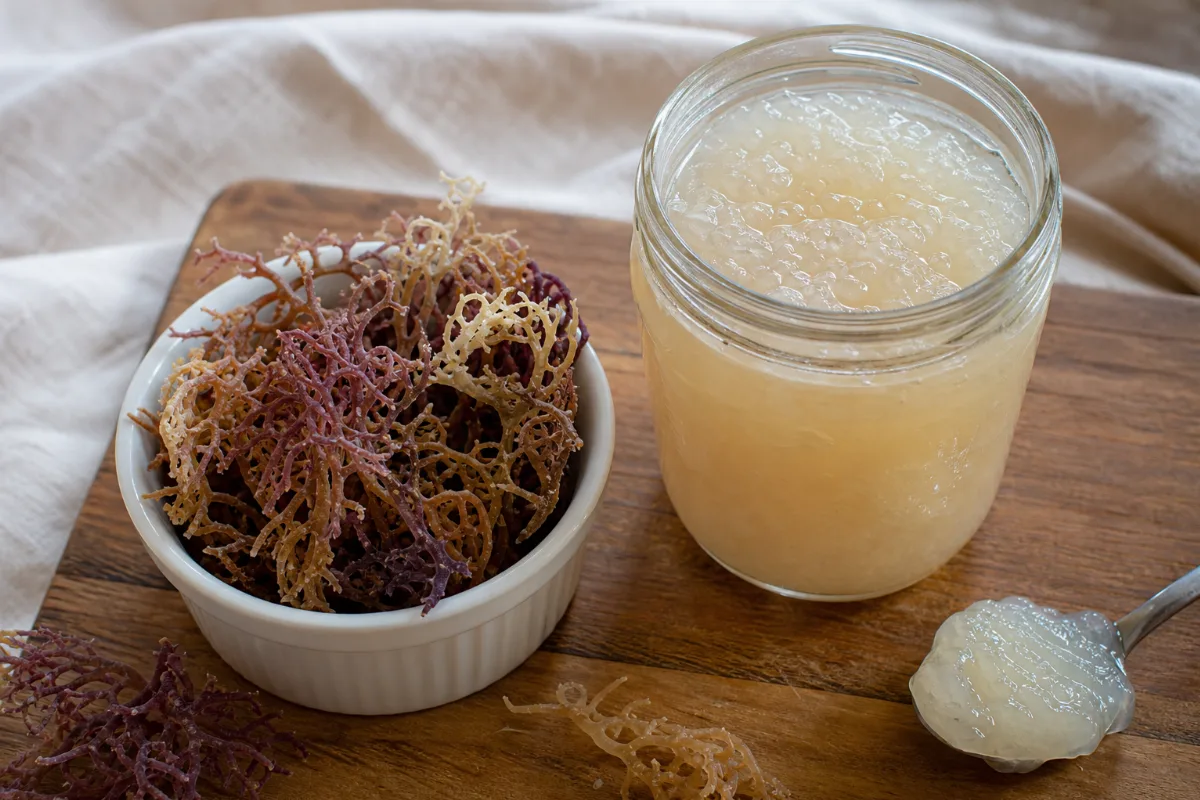
"Sea moss" is a market name, not one plant. On labels it can mean red seaweeds such as Irish moss (Chondrus crispus), or the tropical red seaweeds Eucheuma and Kappaphycus, or sometimes Gracilaria. The USDA entry this page uses is a cultivated Eucheuma type (Canadian cultivated EMI-TSUNOMATA), sold dry and eaten rehydrated. [1] [2] People eat it, or blend it into a gel, for minerals and fiber. This page looks at it as a food. It keeps claims apart from the facts, and it does not repeat the longer claim checks on our other pages: see sea moss gel: claims checked and Irish moss.
Read this first
- Iodine is the first safety point. Seaweed iodine varies hugely. A Norwegian survey of 96 seaweed products found 128 to 62,400 micrograms (mcg) of iodine per portion in whole-food seaweed products, and 54 products would exceed the iodine upper level in one portion. [5] We did not find a measured iodine value for sea moss (Eucheuma, Kappaphycus) itself, and USDA lists none. [1] [2]
- Upper levels: the American Thyroid Association gives 1,100 mcg a day as the US upper limit for adults, and says more than that may cause thyroid problems. [3] The EU upper level for adults is 600 mcg a day. [6]
- Thyroid disease, thyroid medicine, pregnancy, breastfeeding: ask a clinician first. High-dose iodine with anti-thyroid medicines can add to their effect and cause an underactive thyroid. [4] The ATA advises against iodine and kelp supplements above 500 mcg a day, including in pregnancy and breastfeeding. [3]
- Products vary. A 2026 test of 66 sea moss products bought online found bacteria in both dried products and gels, and arsenic, cobalt and mercury in dried products. [8]
- Evidence in one line: we found no human trial of sea moss for any health claim. A 2019 review says more human studies are needed for seaweed in general. [7]
- If you have trouble breathing or swelling of the face or throat after eating anything, call 911 (or your local emergency number).
What is in it (USDA values)
USDA FoodData Central (SR Legacy) has two entries for "Canadian cultivated EMI-TSUNOMATA", a Eucheuma carrageenan seaweed: dry (FDC 167602) and rehydrated (FDC 167603). [1] [2] They are different forms, so they are shown in separate columns. USDA household portions are 0.25 cup dry (5 g) and 0.25 cup rehydrated (25 g). Serving values below are the 100 g values scaled to that portion.
| Nutrient | Dry, per 100 g [1] | Rehydrated, per 100 g [2] | Rehydrated, per 25 g | % Daily Value per 25 g |
|---|---|---|---|---|
| Energy | 259 kcal | 31 kcal | 8 kcal | not set |
| Protein | 15.34 g | 1.86 g | 0.5 g | 1% |
| Fiber | 36.7 g | 4.5 g | 1.1 g | 4% |
| Iron | 66.38 mg | 8.07 mg | 2.0 mg | 11% |
| Magnesium | 692 mg | 84 mg | 21 mg | 5% |
| Manganese | 5.88 mg | 0.71 mg | 0.18 mg | 8% |
| Potassium | 2,944 mg | 358 mg | 90 mg | 2% |
| Sodium | 4,331 mg | 526 mg | 132 mg | 6% |
| Calcium | 299 mg | 36 mg | 9 mg | 1% |
For the dry form, one 5 g portion gives about 3.3 mg iron (18% DV), 0.29 mg manganese (13% DV) and 217 mg sodium (9% DV). [1] % Daily Value uses the FDA 2016 Daily Values. Values vary with species, harvest place, season and processing: a Madagascar study of Eucheuma denticulatum found minerals up to 39.5% of dry weight, with the amount changing across the seasons. [10] Dried Kappaphycus lots from four Indonesian sites differed in ash (30.8 to 39.9%), salt (9.2 to 19.9%) and carrageenan yield (15.1 to 27.0%). [9]
USDA lists no iodine and no vitamin K for these entries. [1] [2] USDA also lists a vitamin B-12 value (2.25 mcg per 100 g dry), but a food table does not show whether that is active B12 or look-alike molecules called analogues, so do not use it as a B12 source. See seaweed and vitamin B12 claims checked.
Plant compounds: the main structural compound is carrageenan, a sulfated seaweed sugar. Regulators define the food additive carrageenan as the refined extract of red seaweeds in the families Gigartinaceae and Solieriaceae, including Eucheuma cottonii. [11] Whole sea moss and the purified additive are not the same thing. See carrageenan.
What research says
| Health goal | What the sources found | Strength of evidence | What was studied |
|---|---|---|---|
| Thyroid support | The ATA says there is no known thyroid benefit of routine iodine above the US RDA, and warns of harm from excess. [3] | No good evidence of benefit; risk from excess | Iodine in general; not sea moss trials |
| Gut health, immunity, skin, energy, weight loss | Proper evidence not found in the sources we read. We found no human trial of sea moss for these. | Insufficient evidence | Not applicable |
| "92 minerals" | We found no compositional analysis that supports the number. Sea moss does contain minerals: USDA lists iron, magnesium, manganese, potassium and others, and a seaweed study measured minerals as a share of dry weight. [1] [10] A mineral being present does not mean it is absorbed or useful. | Marketing claim, not verified | Lab analysis of the food |
| Overall health benefits of seaweeds | A 2019 narrative review says more human intervention studies are needed to confirm benefits. [7] | Insufficient evidence | Whole seaweeds, extracts, seaweed foods |
| Safety of commercial products | Test of 66 online products: variable acidity and microbes, metals in dried products. [8] | Measured in products | Dried sea moss and gels |
Observational findings and lab results do not prove benefit in people. We did not read funding details for the studies above.
How much is a normal serving
The USDA household portions are 0.25 cup dry (5 g) or 0.25 cup rehydrated (25 g), with about 13 kcal or 8 kcal. [1] [2] That is information from the USDA data, not a prescription. We found no official serving size for sea moss and no standard gel amount in the sources we read, so we give none. Because iodine in sea moss is unmeasured in the sources we read, no "safe amount" can be stated. [5] [6]
Safety, allergy and medicines
- Iodine and thyroid: very high iodine can reduce thyroid function. [4] In the UK survey of 224 seaweed products, estimated iodine per serving had a median of 585 mcg, and 26 products could pass the EU adult upper level (the authors note this relied on assumptions). [6] Anyone with thyroid disease should ask their own clinician. See seaweed, iodine and thyroid.
- Thyroid medicines: MedlinePlus says high iodine with anti-thyroid medicines can have an additive effect and could cause hypothyroidism. [4]
- Pregnancy and breastfeeding: the ATA gives a suggested upper limit of 500 to 1,100 mcg a day in pregnancy and breastfeeding and advises against kelp or iodine supplements above 500 mcg. [3] We found no sea moss specific figure. See seaweed in pregnancy and breastfeeding.
- Metals: dried sea moss products had arsenic, cobalt and mercury in the 2026 test; gels had only trace mercury. [8] In dried Kappaphycus from four Indonesian sites, mercury was 0.040 to 1.760, cadmium 0.280 to 0.740 and lead 0.140 to 0.930 mg per kg dried weight. [9] We did not read a safety limit to compare these with, so we draw no verdict. See heavy metals in foods.
- Microbes: Bacillus and Staphylococcus were the most common organisms found in products; Salmonella, Listeria, Vibrio and Escherichia were found less often. [8] People with weak immune systems should ask a clinician. We did not find a source with advice for them.
- Sodium and potassium: the dry form is high in both per 100 g (sodium 4,331 mg, potassium 2,944 mg). [1] A usual portion is small, but people on a low-sodium or low-potassium plan (for example in kidney disease) should ask their care team. See foods, kidney disease, potassium and oxalates.
- Allergy: seaweed allergy: Proper evidence not found in the sources we read. For emergency signs see food allergy basics. Call 911 for trouble breathing or swelling of the face or throat.
- Blood thinners and vitamin K: USDA lists no vitamin K value for these entries, so we cannot say. [1] [2]
Choosing, storing and food safety
- Look for the Latin name on the pack (Eucheuma, Kappaphycus, Chondrus), because "sea moss" alone does not tell you the species. See Irish moss.
- Labels are unreliable on iodine: the Norwegian study found species and iodine content missing or inaccurate on several products. [5] A maker that tests for iodine, metals and microbes is the better choice.
- The 2026 authors call for evidence-based guidance on processing, storage and handling, and the abstract we read gives none. We give no gel recipe or storage times. [8]
Related pages
Health connections for Sea Moss (Eucheuma & Gracilaria)
What research links to eating or drinking this food, and how strong the evidence is. Many studies are observational or use juice, powder, oil or extracts rather than the food as eaten; each card says which.
Sea moss as a source of fiber and minerals
Not enough evidenceUSDA lists dry Eucheuma at 36.7 g fiber, 66 mg iron and 692 mg magnesium per 100 g; rehydrated, a 25 g portion gives about 11% of the iron Daily Value. Content varies with species, site and season.
Supplements: Nutrient content is not proof of benefit; absorption and effect in people were not shown in the sources read.
Sea moss and the "92 minerals" claim
Not enough evidenceNo compositional analysis supporting the number 92 was found. Sea moss contains real minerals, but a mineral being present does not mean it is absorbed or helpful.
Supplements: Marketing claim, not verified.
Sea moss and vitamin B12 claims
Not enough evidenceUSDA lists a vitamin B-12 value for the dry and rehydrated forms, but a food table does not show whether it is active B12 or look-alike analogues. Do not rely on seaweed for B12.
Supplements: See the B12 claims guide; fortified foods or supplements are the usual advice for people avoiding animal foods.
Sea moss for gut health, immunity, skin and weight loss
Not enough evidenceProper evidence not found in the sources we read: no human trial of sea moss for these claims.
Supplements: No good evidence of benefit; a 2019 review says more human studies are needed for seaweeds.
Carrageenan in sea moss and the additive debate
Preliminary or mixedSea moss species such as Eucheuma are sources of the additive carrageenan. Whole seaweed and the purified additive are not the same; the additive debate is unsettled.
Supplements: Additive findings do not transfer to whole sea moss.
Connected topics
Open a group to see how each topic connects and how strong the evidence is.
Health goals (1)
- Thyroid SupportDocumented risk
The ATA says there is no known thyroid benefit of routine iodine above the RDA and warns about excess. This is not a thyroid support food.
Body systems (1)
- Endocrine SystemDocumented risk
Excess iodine can change thyroid hormone balance; ask a clinician if you have thyroid disease or take thyroid medicine.
Body parts (1)
- ThyroidDocumented risk
Too much iodine from seaweed can disturb the thyroid. No measured iodine value for sea moss itself was found, so the amount in a product is unknown unless tested.
Root causes (2)
- Heavy Metal ExposureDocumented risk
Dried sea moss products contained arsenic, cobalt and mercury in a 2026 test; dried Kappaphycus also contained cadmium and lead. No safe amount was found.
- Medication Side EffectsDocumented risk
High iodine can add to the effect of anti-thyroid medicines and cause hypothyroidism.
Biomarkers (1)
- TSHDocumented risk
Excess iodine can change thyroid function and so thyroid tests; this is a risk, not a benefit.
Documented risks and interactions (4)
- Sea moss and iodine intake. Seaweed iodine varies enormously. A survey of 96 Norwegian seaweed products found up to 62,400 micrograms per portion, and we found no measured iodine value for Eucheuma or Kappaphycus sea moss itself.
- Sea moss, thyroid disease and thyroid medicines. High iodine with anti-thyroid medicines can add to their effect and cause an underactive thyroid; people with thyroid disease should ask their own clinician.
- Metals and microbes in sea moss products. A 2026 test of 66 online products found bacteria in dried products and gels, and arsenic, cobalt and mercury in dried products; dried Kappaphycus from four Indonesian sites also contained cadmium, lead and mercury.
- Sea moss in pregnancy and breastfeeding. The ATA suggests an upper iodine limit of 500 to 1,100 mcg a day in pregnancy and breastfeeding and advises against kelp or iodine supplements above 500 mcg. No sea moss specific figure was found.
Frequently asked questions
What is sea moss?
It is a market name for red seaweeds, mainly Eucheuma, Kappaphycus or Chondrus (Irish moss), and sometimes Gracilaria. The Latin name on the pack tells you which. [11]
Does sea moss contain 92 minerals?
We found no analysis that supports that number. It contains real minerals, but that does not show they help you. [1] [10]
How much iodine is in sea moss?
Proper evidence not found in the sources we read for sea moss itself. Seaweed products overall ranged from 128 to 62,400 mcg per portion in one survey. [5]
Is sea moss safe for thyroid problems?
Too much iodine can harm the thyroid, and iodine can add to anti-thyroid medicines. [3] [4] Ask your own clinician.
Does sea moss give you vitamin B12?
USDA lists a number, but it does not show whether it is active B12. Do not rely on seaweed for B12. [1]
References
- U.S. Department of Agriculture. FoodData Central: Seaweed, Canadian Cultivated EMI-TSUNOMATA, dry (SR Legacy, FDC 167602). April 2018 release. Read 2026-10-24.
- U.S. Department of Agriculture. FoodData Central: Seaweed, Canadian Cultivated EMI-TSUNOMATA, rehydrated (SR Legacy, FDC 167603). April 2018 release. Read 2026-10-24.
- American Thyroid Association. ATA Statement on the Potential Risks of Excess Iodine Ingestion and Exposure. Read 2026-10-24.
- MedlinePlus. Iodine in diet. Review date 2025-01-21. Read 2026-10-24.
- Aakre I, et al. Commercially available kelp and seaweed products: valuable iodine source or risk of excess intake? Food Nutr Res 2021;65 (abstract read via Europe PMC). Read 2026-10-24.
- Bouga M, Combet E. Emergence of seaweed and seaweed-containing foods in the UK. Foods 2015;4(2):240-253 (abstract read via Europe PMC). Read 2026-10-24.
- Cherry P, et al. Risks and benefits of consuming edible seaweeds. Nutr Rev 2019;77(5):307-329 (abstract read via Europe PMC). Read 2026-10-24.
- Rejuso A, Cobo M, Curran JE. Microbial and heavy metal analyses of commercially available sea moss and sea moss products. J Food Prot 2026;89(11) (abstract read via Europe PMC). Read 2026-10-24.
- Ramadhan W, et al. Multi-trait dataset on dried tropical Kappaphycus seaweed from four cultivation locations in South Sulawesi, Indonesia. Data Brief 2026;68:113178, doi 10.1016/j.dib.2026.113178 (abstract read via Europe PMC, PMID 42676627). Read 2026-10-24.
- Zamanileha EF, et al. Biochemical composition and seasonal variations of the Madagascar algae Eucheuma denticulatum. Mar Drugs 2025;23(1):30 (abstract read via Europe PMC). Read 2026-10-24.
- U.S. Government. 21 CFR 172.620 Carrageenan. Read 2026-10-24.