Herbs & Botanicals · Folk remedy for poison ivy
Jewelweed
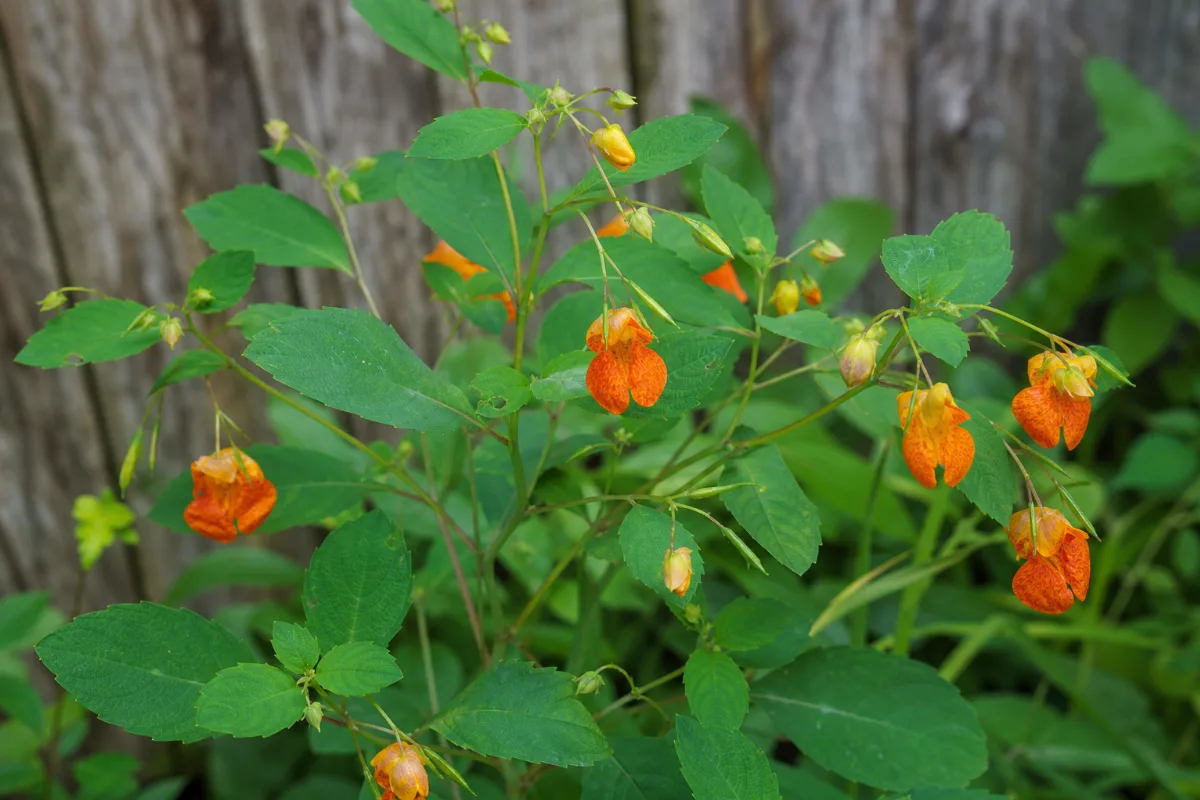
Impatiens capensis · also called Spotted jewelweed, orange jewelweed, spotted touch-me-not, orange balsam
Jewelweed is a wet-woodland plant whose crushed stem and leaf are rubbed on the skin as a folk remedy for poison ivy. The few controlled skin tests disagree, and two of three found no benefit. It should only be used on the skin, never eaten or drunk. A bad poison ivy rash needs medical care.
General information, not medical advice. Last substantive update · Not medically reviewed. A named clinician has not signed off on this page. How this page is made
About Jewelweed
Jewelweed (Impatiens capensis, also called touch-me-not) is a native North American plant of damp, shady places. Its crushed stem and leaf are an old folk remedy for poison ivy. Controlled tests give mixed results, and it is for skin use only.
What it is
Jewelweed is an annual plant with orange spotted flowers. Its ripe seed pods burst when touched, which gives it the name touch-me-not. It grows in moist, shady spots, often near poison ivy.
Related species include pale jewelweed (Impatiens pallida) and the garden plant garden balsam. Different studies used different species.
What makes it distinctive
The plant contains lawsone, the same dye compound found in henna. It also contains saponins, which are soap-like compounds. A 2012 study found lawsone levels changed with the harvest season and did not match how well a preparation worked. The authors then pointed to saponins instead.
What people use it for
Many Native American tribes used the crushed plant to reduce poison ivy rash. Some also used it for stomach cramps, although eating it is reported to cause vomiting. Long use is not proof of benefit.
What the research shows
In 1991, 25 volunteers had poison ivy applied to three forearm areas. Jewelweed juice made no difference compared with saline or nothing. In 1997, a pilot of 10 adults found a stem extract no better than distilled water on a rash that had started.
A 2012 study found that fresh crushed jewelweed reduced rash, but extracts did not, and jewelweed soaps were no better than soaps without it. In a 2015 follow-up from the same group, every soap tested reduced the rash. So washing may matter more than the plant.
At a glance
Traditional uses history, not proof
- Rubbed on the skin after poison ivy contact (crushed plant)
- Reported use for stomach cramps (traditional, not supported)
Studied for research
- Preventing poison ivy rash: mixed results; fresh plant helped in one study, juice did not
- Treating an existing rash: a 10-person pilot found no benefit over water
- Jewelweed soap: no better than other soaps
- Cancer cell and worm heart-rate tests: lab only
Main compounds
- Lawsone (a naphthoquinone also found in henna)
- Saponins (soap-like plant compounds)
- Flavonoids (reported for the genus; not confirmed in the papers we read)
Common forms
- Crushed fresh plant (mash)
- Fresh juice
- Stem or leaf extract
- Soap
Research links: Jewelweed mash, extracts and lawsone (2012) · Saponin extract and soaps (2015) · Stem extract pilot trial (1997) · Jewelweed juice trial (1991) · Poison ivy dermatitis in the emergency department (2023) · Herbal supplements in G6PD deficiency (2017) · Research Library · Genes & Biomarkers Library
The plant and its history
- Accepted scientific name
- Impatiens capensis Meerb.
- Naming authority
- Meerb.
- Common names
- Jewelweed (English); Spotted jewelweed (English); Orange jewelweed (English); Spotted touch-me-not (English); Orange balsam (English)
- Botanical family
- Balsaminaceae (balsam family)
- Classification
- Plantae > Balsaminaceae > Impatiens > Impatiens capensis
- Native range
- Native to northern and eastern North America (Wisconsin Extension); native east of the Rocky Mountains in the US and Canada (Washington weed board). Listed as an introduced noxious weed in Washington State.
- Habitat
- Moist, shady places such as low woodlands and bog margins (Wisconsin Extension).
- What the plant looks like
- Roots: Not described.; Stems: Not described in the sources read.; Leaves: Not described.; Flowers: Orange, spurred, pollinated by bees, butterflies and hummingbirds (Wisconsin Extension).; Fruit: Elongated pendant green fruits; the seed capsule bursts explosively when touched, hence touch-me-not. Green fruits are described as toxic if eaten.
- Cultivation
- Annual plant that self-seeds; can form dense carpets (Washington weed board).
- Harvest and processing
- Lawsone content of preparations varied with the harvest season (2012 study).
- Look-alikes and adulterants
- Name: Pale jewelweed (Impatiens pallida); Note: A close relative with paler yellow flowers (our general knowledge, not verified here). Used in the 1991 trial together with I. biflora.; Name: Garden balsam (Impatiens balsamina); Note: A cultivated Asian relative also tested in the 2012 study.; Name: Spurless jewelweed (Impatiens ecornuta); Note: A Washington State native that can hybridise with spotted jewelweed (weed board).
- Sustainability and conservation
- Not assessed here.
Traditional use and history history, not clinical proof
| Tradition or era | Documented use | Source |
|---|---|---|
| Native American tribes (eastern North America) | Plant mash used to reduce poison ivy rash; also reported for stomach cramps. | p25543019 |
| Folk medicine, North America | Rubbed on skin after touching poison ivy; reported to cause vomiting if eaten, so teas are not recommended. | s-wilkes-impatiens |
| Asian folk use of garden balsam (I. balsamina) | Used for similar skin purposes (per the 2012 paper). | p22766473 |
Traditional use shows how a plant was used. It does not show that a supplement works or is safe today.
What is inside, and how it may work
What the plant contains and how those compounds act in cells and animals. Laboratory and animal mechanisms are not proven effects in people.
Main compounds
| Compound | Family | Where it is concentrated | Activity studied | Level of evidence |
|---|---|---|---|---|
| Lawsone (2-hydroxy-1,4-naphthoquinone) PubChem 6755 | naphthoquinone | Not stated in abstracts Varied with harvest season (2012 study); amounts not given in the abstract. | The 2012 authors thought it was the active agent but found its level did not match rash prevention. Same compound as in henna; weak red cell toxin in rat/lab work. 1 7 9 | Laboratory research |
| Saponins | soap-like glycosides | Leaf extract (2015 study) | Saponin extracts and soaps reduced poison ivy rash in volunteers; the extract was toxic to a breast cancer cell line and raised worm heart rate. 8 | Human + in vitro |
| Flavonoids and other phenolics | plant polyphenols | Reported in the wider literature as compounds of the genus. NOT verified: not confirmed in any paper read for this page. | Not verified |
Mechanisms, receptors and pathways
| Target or pathway | Gene or receptor | What was found | Level |
|---|---|---|---|
| Removal or blocking of urushiol (poison ivy oil) | n/a | Authors propose saponins act like soap to lift the oil. All soaps worked in 2015, so washing alone may explain it. 8 1 | Human data |
| Red cell antioxidant defence (glutathione) | n/a | Lawsone is a weak direct haemolytic agent that provoked an oxidant response in glutathione-depleted rat red cells. 7 | Animal research |
Absorption, metabolism and elimination
- Absorption
- Not studied for jewelweed. Whether lawsone passes through skin from jewelweed is unknown.
- Distribution
- Not studied.
- Metabolism
- Not studied.
- Elimination
- Not studied.
- Bioavailability
- Not established.
Isolated compounds versus whole extracts
The forms behave differently. Fresh crushed plant helped in 2012, but extracts did not and the 1991 juice and the 1997 stem extract did not either. Lawsone and saponins were studied as parts, with unclear results. Results from one form should not be carried over to another.
Nutritional composition
Jewelweed is not a food or a nutrient source.
1 mixed findings1 low certainty1 very low certainty2 not enough evidence
What is Jewelweed good for?
What jewelweed has been studied for and how strong the evidence is. Nothing here is proven.
Benefits, one by one
Each card is a research question, not a promise. Tap a goal to filter. Open a card to see the studies, doses and limits.
Preventing poison ivy rash after contact
Mixed findingsJewelweed is an old folk remedy rubbed on the skin after touching poison ivy. The few controlled skin tests disagree. One found the juice did nothing. One found fresh crushed plant helped but extracts did not. Washing with any soap also helped.
3 studiesJuice, crushed fresh plant, extracts and soaps were tested; results d…
Studies, doses and limits
What the trials found
Three controlled studies in volunteers. 1991: 25 volunteers, jewelweed juice versus saline versus nothing, poison ivy leaves on the forearm. No significant difference in rash or symptoms. 2012 (Ohio Northern University): fresh jewelweed mash reduced rash, but extracts did not, and soaps made from the extracts were no better than soaps without jewelweed. 2015 (same group, 23 volunteers): saponin extracts and all soaps tested reduced the rash.
Results
1 of 3 studies found the fresh plant mash helped; 1 found the juice did not; the soap results do not separate the plant from the washing.
Effect sizes as reported
Not given in the abstracts read.
Why this rating
Small skin-test studies with conflicting results, two from the same group, and the abstracts do not give numbers.
Form and dose studied
Juice, crushed fresh plant, extracts and soaps were tested; results differed by form. No amounts are given here.
Who was studied
Healthy adult volunteers with poison ivy deliberately applied to the forearm.
Limits
Skin-exposure models, small numbers, no real-world outdoor trial. The 2012 authors state they aimed to support the folk use and refute earlier negative papers. The abstract does not give volunteer numbers or scores.
Why researchers looked
Native American use and folk use. Jewelweed often grows near poison ivy, and people reach for it after exposure.
Traditional use
Many Native American tribes used the plant mash to reduce a poison ivy rash. Long use is not proof of benefit.
Proposed mechanism Preliminary mechanism
Not established. The 2012 authors first suggested lawsone, then found it did not track with benefit and proposed saponins (soap-like plant compounds). Washing urushiol (the allergenic oil) off the skin may explain much of the effect.
A proposed mechanism does not show that the effect happens in people.
Poison ivy rash can be severe. Do not delay proper care. See the Safety tab.
Treating a poison ivy rash that has already started
Not enough evidenceIn a pilot test on 10 adults, a jewelweed stem extract did not work better than plain water on rash that had already started.
1 studiesFresh-stem extract; no amounts given here.
Studies, doses and limits
What the trials found
1997 randomized, double-blind, paired pilot: 10 adults patch tested to urushiol. One site was treated with a fresh-stem extract and one with distilled water. All developed dermatitis at every site and scores did not differ significantly. The authors concluded the extract was not effective as a treatment.
Results
No significant difference from distilled water.
Effect sizes as reported
No significant difference; scores not given in the abstract.
Why this rating
One tiny pilot of 10 people, one extract, a patch-test model. It points against benefit but cannot settle the question.
Form and dose studied
Fresh-stem extract; no amounts given here.
Who was studied
Ten adult volunteers.
Limits
Very small. Only one preparation. Patch-test model, not a natural rash.
Why researchers looked
Jewelweed is widely sold and described as a cure for poison ivy and oak rash.
Traditional use
Used as a rub or poultice for existing itchy rash.
Proposed mechanism Pharmacological theory
None shown.
A proposed mechanism does not show that the effect happens in people.
A poison ivy rash that is spreading, on the face or genitals, or infected needs medical care.
Jewelweed soap and the effect of washing
Low certaintySoaps made with jewelweed reduced the rash, but so did soaps without it. This suggests washing the oil off the skin matters, not necessarily the plant.
2 studiesSoaps with and without plant extract; Dawn dish soap was one comparat…
Studies, doses and limits
What the trials found
2012: soaps made from jewelweed extracts worked but no more than soaps without jewelweed; the authors wrote that soap is more effective than the plant. 2015: all soaps tested reduced the rash.
Results
Jewelweed soap was not shown to beat other soaps.
Effect sizes as reported
Not given in the abstracts.
Why this rating
Small skin tests from one group; they show soap helps, not that jewelweed adds to it.
Form and dose studied
Soaps with and without plant extract; Dawn dish soap was one comparator in 2012.
Who was studied
Healthy volunteers.
Limits
Same research group for both. The abstracts do not give the number of volunteers for the 2012 study or the scores.
Why researchers looked
Jewelweed soaps are sold. The 2012 group tested whether the plant adds anything.
Traditional use
Not a traditional preparation.
Proposed mechanism Preliminary mechanism
Saponins in the plant are soapy compounds; ordinary soaps also lift urushiol oil from the skin.
A proposed mechanism does not show that the effect happens in people.
No safety signal in the abstracts. A severe rash still needs a clinician.
Cancer cell, antibacterial and heart-rate tests (lab only)
Very low certaintyA saponin extract was toxic to one breast cancer cell line and slowed one colon cancer cell line in dishes, and it raised the heart rate of tiny black worms. It showed no antibacterial effect. None of this was tested in people.
1 studiesMethanol-based leaf saponin extract in the lab; not a home preparatio…
Studies, doses and limits
What the trials found
No human evidence.
Results
MCF-7 breast cancer cells: dose-related toxicity. HT-29 colon cells: growth slowed. Black worm heart rate +138% over baseline. No bacterial effect.
Effect sizes as reported
+138% worm heart rate (n=5 worms).
Why this rating
Test-tube and worm tests only.
Form and dose studied
Methanol-based leaf saponin extract in the lab; not a home preparation.
Who was studied
Cell lines and worms.
Limits
Laboratory results rarely carry over to people. An extract that harms cancer cells may also harm healthy cells.
Why researchers looked
Researchers checked whether the soapy compounds in jewelweed had other biological activity.
Traditional use
None.
Proposed mechanism Laboratory research
Not studied beyond the cell test.
A proposed mechanism does not show that the effect happens in people.
The heart-rate rise in worms is a reason for caution, not a benefit.
Eaten or drunk for stomach cramps (traditional, not supported)
Not enough evidenceSome Native American groups used jewelweed for stomach cramps. A student review notes this seems odd because eating the plant is reported to cause vomiting. No trial supports any internal use.
1 studiesTea or eaten plant; not studied.
Studies, doses and limits
What the trials found
No human trial. Only a secondary student paper describing the folk use and the vomiting reports.
Results
No results.
Effect sizes as reported
None.
Why this rating
Tradition only, from a secondary source.
Form and dose studied
Tea or eaten plant; not studied.
Who was studied
None.
Limits
Source is a student paper citing a 1958 reference we did not open.
Why researchers looked
Historic use only.
Traditional use
Reported use for stomach cramps (secondary source).
Proposed mechanism Pharmacological theory
None shown.
A proposed mechanism does not show that the effect happens in people.
Internal use is not supported and may cause vomiting and loose stools. See the Safety tab.
Connections to the rest of health
How Jewelweed connects to the rest of our health knowledge graph. Every link says what kind of connection it is. A safety link (for example to the liver) is a warning, not a benefit. A study that merely mentions a topic never creates a benefit link.
Explore every connection: goals, body systems, organs, symptoms, genes
A. Wellness goals
| Connected to | Kind of connection | Evidence status | Context | Studies |
|---|---|---|---|---|
| Healthy Skin | Traditional use | Mixed findings | Preventing poison ivy rash after contact: Jewelweed is an old folk remedy rubbed on the skin after touching poison ivy. The few controlled skin tests disagree. One found the juice did nothing. One found fresh crushed plant helped but extracts did not. Washing with any soap also helped. Treating a poison ivy rash that has already started: In a pilot test on 10 adults, a jewelweed stem extract did not work better than plain water on rash that had already started. | 12 1 8 6 |
| Digestive Support | Traditional use | Not enough evidence | Eaten or drunk for stomach cramps (traditional, not supported): Some Native American groups used jewelweed for stomach cramps. A student review notes this seems odd because eating the plant is reported to cause vomiting. No trial supports any internal use. | 3 |
B. Body systems
| Connected to | Kind of connection | Evidence status | Context | Studies |
|---|---|---|---|---|
| Integumentary System | Biological association | Mixed findings | Studied for: Preventing poison ivy rash after contact Studied for: Treating a poison ivy rash that has already started | 12 1 8 6 |
| Digestive System | Biological association | Not enough evidence | Studied for: Eaten or drunk for stomach cramps (traditional, not supported) | 3 |
E. Health conditions
| Connected to | Kind of connection | Evidence status | Context | Studies |
|---|---|---|---|---|
| G6PD deficiency | Contraindication | Not enough evidence | Henna, not jewelweed, is linked to haemolysis in a systematic review. Preparation or compound: lawsone |
5 |
I. Biomarkers
| Connected to | Kind of connection | Evidence status | Context | Studies |
|---|---|---|---|---|
| Poison ivy rash score (skin exam) | Biological association | Mixed findings | Measured in trials: mixed. A lab change is not the same as a health benefit. | 12 1 6 |
| Cancer cell survival in a dish | Biological association | Very low certainty | Measured in trials: lowered. A lab change is not the same as a health benefit. | 8 |
K. Biological pathways
L. Active compounds
| Connected to | Kind of connection | Evidence status | Context | Studies |
|---|---|---|---|---|
| Lawsone | Contraindication | Not enough evidence | Same naphthoquinone as henna; G6PD deficiency precaution only. Same compound as in henna; G6PD deficiency precaution only. Preparation or compound: lawsone |
5 7 |
| Lawsone (2-hydroxy-1,4-naphthoquinone) | Biological association | In vitro | The 2012 authors thought it was the active agent but found its level did not match rash prevention. Same compound as in henna; weak red cell toxin in rat/lab work. Preparation or compound: Not stated in abstracts |
1 7 9 |
| Saponins | Biological association | Human + in vitro | Saponin extracts and soaps reduced poison ivy rash in volunteers; the extract was toxic to a breast cancer cell line and raised worm heart rate. Preparation or compound: Leaf extract (2015 study) |
8 |
| Flavonoids and other phenolics | Biological association | Not verified | Reported in the wider literature as compounds of the genus. NOT verified: not confirmed in any paper read for this page. |
Each connection is stored with the ingredient, the connected record, the kind of connection, the evidence status, the supporting studies, the preparation or compound involved, and a review date (last reviewed October 25, 2026).
Evidence at a glance: what changed in 2 lab markers
Tap a number to show only those markers. Counts are markers, not people.
The evidence
The research centre for Jewelweed. Every record here was checked against PubMed or the publisher's page; we never list a study we have not verified.
Evidence by outcome
Bars show how many studies we found for each outcome, not how well it works. People are added up across trials only (reviews are not added, to avoid double counting).
How we rate evidence
High certainty
Several well-run trials or reviews agree; further research is unlikely to change the picture much.
Moderate certainty
Good trials point the same way, but some doubt remains.
Low certainty
Small, short or inconsistent trials. The finding could change with better research.
Very low certainty
Very little or very weak human data. Treat as a possibility only.
Mixed findings
Trials or reviews disagree with each other.
Not enough evidence
Not enough human research to say either way.
Evidence against
Good research found no benefit, or found harm.
We take the reviewers' own risk-of-bias and GRADE statements where they exist, and otherwise judge from study size, design, consistency, directness and whether a product matches what is sold. Many publications do not make evidence high. Method note: We built on our existing summary, read PubMed abstracts and checked GBIF and PubChem. Most studies were read as abstracts only. The 1991 trial was read from its Crossref record. Secondary sources (a student paper and plant pages) are labelled as such.
Study library: every study we checked 12
| Study | Design | People | Product, dose, length | Result |
|---|---|---|---|---|
| Abrams Motz 2012 The effectiveness of jewelweed, Impatiens capensis, the related cultivar I. balsamina and the component, lawsone in preventing post poison ivy exposure contact dermatitis Journal of Ethnopharmacology · PMID 22766473 · DOI |
Experimental human skin test |
Volunteers (number not given in the abstract); poison ivy brushed onto the forearm in 6 places | Jewelweed (Impatiens capensis) fresh plant mash, extracts and soaps made from extracts; garden balsam (I. balsamina) and lawsone also tested whole plant (not further specified in abstract) not given in abstract Water and Dawn dish soap · vs none |
Fresh jewelweed mash reduced poison ivy rash. Jewelweed extracts did not. Soaps made from the extracts worked but were no better than soaps without jewelweed. Lawsone content varied with the harvest season and did not appear to affect the rash. Mash: effective. Extracts: not effective. Jewelweed soap: no better than plain soap. Numbers not given in the abstract. Methods, limits and fundingOutcomes: Rash score (0-14 scale) after poison ivy contact; lawsone content of the preparations Limitations: Abstract only. The authors state they set out to support the folk use and to refute earlier papers that found no effect. Number of volunteers, blinding and exact scores not read. Skin-exposure model, not people with an existing rash. Read: abstract |
| Argo 2023 Evaluation and Management of Toxicodendron Dermatitis in the Emergency Department: A Review of Current Practices Wilderness & Environmental Medicine · PMID 37120383 · DOI |
Narrative review |
Toxicodendron (poison ivy, oak, sumac) dermatitis | Not applicable (review) not applicable not applicable not applicable · vs none |
Toxicodendron dermatitis is self-limiting but can be distressing and last for weeks if untreated, especially with re-exposure. Consensus on treatment is varied and poorly supported; many providers rely on past practice, expert opinion and experience. Not applicable. Methods, limits and fundingOutcomes: Prevention and treatment of Toxicodendron dermatitis Limitations: Narrative review; abstract read only. Jewelweed is not named in the abstract. Read: abstract |
| Becker S (student paper 2001 Medical attributes of Impatiens sp. - Jewelweed, Touch-me-not Wilkes University (klemow.wilkes.edu) · Source |
Secondary source human-reports |
Genus Impatiens (jewelweed, touch-me-not) | Impatiens species plant not applicable not applicable · vs none |
States that when eaten jewelweed can cause vomiting, catharsis and act as a diuretic (citing Lipton 1958), so teas for poison ivy may cause digestive upset; notes use for stomach cramps among Native Americans. Names I. capensis and I. pallida as common Northeastern species. Not applicable. Methods, limits and fundingOutcomes: Traditional uses and reported effects Limitations: A student web paper, not peer reviewed. The Lipton 1958 source was NOT verified. Read: full-text |
| GBIF Backbone Taxonomy (API) 2026 GBIF species match: Impatiens capensis Meerb. and Impatiens pallida Nutt. api.gbif.org · Source |
Database record not-applicable |
Taxonomy | not applicable not applicable not applicable not applicable · vs none |
Impatiens capensis Meerb. is ACCEPTED (key 2891774, family Balsaminaceae, exact match). Impatiens pallida Nutt. is ACCEPTED (key 2891767, Balsaminaceae, exact match). Checked 2026-10-25. Not applicable. Methods, limits and fundingOutcomes: Accepted names Limitations: NCBI Taxonomy not checked. Synonym I. biflora was not checked. Read: full-text |
| Lee 2017 Adverse effects of herbal or dietary supplements in G6PD deficiency: a systematic review British Journal of Clinical Pharmacology · PMID 27081765 · DOI |
Systematic review |
People with G6PD deficiency; 32 publications on 10 herbal and dietary supplements | Herbal and dietary supplements (jewelweed not one of those named in the abstract) various various search to Nov 2015 · vs none |
Evidence linking haemolysis to a herbal or dietary supplement was found only for henna. No evidence of harm for vitamin C, E, K, Ginkgo biloba or alpha-lipoic acid. The authors found insufficient evidence to advise against most herbal products at therapeutic doses. Henna only. Methods, limits and fundingOutcomes: Haemolysis (red blood cell breakdown) Limitations: Narrative summary of mostly case-level data. Jewelweed was not named in the abstract. Link to jewelweed is only that both contain lawsone. Read: abstract |
| Long 1997 Treatment of poison ivy/oak allergic contact dermatitis with an extract of jewelweed American Journal of Contact Dermatitis · PMID 9249283 |
Controlled trial |
10 10 adult volunteers patch tested to urushiol (the allergenic resin in poison ivy/oak) |
Jewelweed stem extract (Impatiens biflora, prepared from fresh stems) stem not given in abstract Applied once the patch-test reaction was under way; compared with distilled water · vs paired: one site extract, one site distilled water, same person |
All volunteers developed dermatitis at every patch-test site. There was no statistically significant difference between sites treated with the extract and sites treated with distilled water. No significant difference. Methods, limits and fundingOutcomes: Reaction scores at days 2, 3, 7 and 9 Limitations: Pilot study of 10 people, one extract, patch-test model. The authors concluded the extract was not effective as a treatment. Read: abstract |
| McMillan 2004 Role of oxidant stress in lawsone-induced hemolytic anemia Toxicological Sciences · PMID 15456924 · DOI |
Animal + in vitro animal |
Rat red blood cells in vitro and in vivo | Lawsone (2-hydroxy-1,4-naphthoquinone) and its hydroquinone form pure compound not stated here not stated here · vs control cells |
Lawsone is the active ingredient of henna, and henna applied to skin can cause severe haemolytic anaemia. Lawsone alone was a weak direct haemolytic agent; it provoked an oxidant response when red cells were short of glutathione. The authors suggest the response to henna may be restricted to people with weak antioxidant defences. Weak direct haemolytic agent. Methods, limits and fundingOutcomes: Red cell survival, glutathione, oxidant damage Limitations: Rat and test-tube study with pure lawsone, not jewelweed. How much lawsone reaches the skin or blood from jewelweed is unknown. Read: abstract |
| Motz 2015 Efficacy of the saponin component of Impatiens capensis Meerb. in preventing urushiol-induced contact dermatitis Journal of Ethnopharmacology · PMID 25543019 · DOI |
Experimental human skin test + in vitro + invertebrate human + in-vitro + invertebrate |
23 23 volunteers; poison ivy brushed onto forearms in 6 places. Plus cell lines (A-375, HT-29, MCF-7), bacteria and black worms (n=5) |
Jewelweed (Impatiens capensis) leaf saponin-containing extracts, fresh plant mashes, and soaps made with and without plant extracts leaf (extracts) not given in abstract Distilled water · vs arm sites |
Saponin extracts and all soaps tested reduced the poison ivy rash, so the authors concluded saponin content correlates with rash prevention. No antibacterial activity was seen. The extract was toxic to MCF-7 breast cancer cells in a dish, slowed HT-29 colon cancer cells, and raised black worm heart rate by 138% over baseline. All soaps and saponin extracts reduced rash. Worm heart rate +138%. Methods, limits and fundingOutcomes: Poison ivy rash reduction; antibacterial and cell-culture tests; black worm heart rate Limitations: Small, same research group as the 2012 study. All soaps reduced the rash, so washing itself may explain much of it. Cell and worm results are laboratory only. Read: abstract |
| PubChem (API) 2026 PubChem compound 6755: 2-hydroxy-1,4-naphthoquinone (lawsone) pubchem.ncbi.nlm.nih.gov · Source |
Database record not-applicable |
Compound identity | Lawsone pure compound not applicable not applicable · vs none |
CID 6755; formula C10H6O3; title 2-hydroxy-1,4-naphthoquinone. A name search for lawsone returned only CID 6755. Checked 2026-10-25. Not applicable. Methods, limits and fundingOutcomes: Identity Limitations: Identity record only. Read: full-text |
| University of Wisconsin Extension (Horticulture) 2026 Jewelweed, Impatiens capensis hort.extension.wisc.edu · Source |
Authoritative guidance not-applicable |
Impatiens capensis as a native plant | Impatiens capensis plant not applicable not applicable · vs none |
Describes an annual native to northern and eastern North America and lists common names orange jewelweed, spotted jewelweed, spotted touch-me-not. States the elongated green fruits are toxic if ingested. The seed capsule bursts when touched. Not applicable. Methods, limits and fundingOutcomes: Plant description Limitations: Horticulture extension page; no clinical detail. Read: full-text |
| Washington State Noxious Weed Control Board 2018 Spotted jewelweed, Impatiens capensis nwcb.wa.gov · Source |
Authoritative guidance human-reports |
Impatiens capensis as a listed weed | Impatiens capensis plant not applicable not applicable · vs none |
Page says the genus Impatiens contains naphthoquinone, which may cause mild to moderate irritation of the digestive tract. Not applicable. Methods, limits and fundingOutcomes: Plant toxicity statement Limitations: Weed-control agency page, not a medical source. No human case data. Read: full-text |
| Zink 1991 The effect of jewel weed in preventing poison ivy dermatitis Journal of Wilderness Medicine · Source · DOI |
Controlled trial |
25 25 volunteers; 3 forearm areas exposed to poison ivy leaves |
Jewelweed juice (Impatiens biflora, Impatiens pallida) plant juice not given in record Saline, or no agent · vs each forearm area got juice, saline or nothing |
No significant differences were found between the three categories in severity of dermatitis or symptoms. The authors concluded jewelweed juice was not effective in preventing poison ivy dermatitis in this model. No significant difference. Methods, limits and fundingOutcomes: Severity of dermatitis and symptoms at 48, 72 and 96 hours Limitations: Read as the Crossref record abstract (not on PubMed in our search). Small trial; only juice tested; skin-exposure model. Read: abstract |
What we do not know yet
- No trial in people with a natural poison ivy rash outdoors.
- No trial of commercial jewelweed creams or sprays.
- No independent repeat of the positive 2012 result.
- No safety data for pregnancy, breastfeeding or children.
- No interaction data.
- EMA, LiverTox, NCCIH and LactMed were not searched.
How new research is added
New studies are found by a saved PubMed search and are placed in a review queue. A person reads each one before it changes any evidence rating or safety wording.
Lab markers
What changed in blood or saliva tests during trials. A changed number is not the same as feeling or being healthier, and we give no "normal ranges".
Other 2
Poison ivy rash score (skin exam)
Mixed results in trials
A numbered score given to the redness and blisters at each skin site.
Mixed findingsResults and what it means
Why it was measured
It is the outcome in the skin-test studies.
Statistical vs. clinical meaning
These are exam scores in skin tests, not proof the rash is prevented or cured in real life.
Safety implication
None from the tests; a severe rash still needs medical care.
| Study | Result | People | Product |
|---|---|---|---|
| 1 | Fresh mash lowered rash scores (0-14 scale); extracts did not; soaps with jewelweed no better than soaps without. Numbers not in abstract. | Healthy volunteers | Mash, extracts, soaps |
| 12 | No significant difference between juice, saline or nothing at 48, 72 and 96 hours. | 25 volunteers | Juice |
| 6 | No significant difference from distilled water on days 2, 3, 7, 9. | 10 adults | Stem extract |
Cancer cell survival in a dish
Lowered in trials
How many cultured cells stay alive after contact with the extract.
Very low certaintyResults and what it means
Why it was measured
A first lab screen for cell-killing activity.
Statistical vs. clinical meaning
Lab screen only.
Safety implication
None for people from this test.
| Study | Result | People | Product |
|---|---|---|---|
| 8 | Dose-related cell death in MCF-7 cells; growth slowed in HT-29 cells; the abstract also tested A-375 cells but gives no result for them. | Cell lines | Leaf saponin extract |
Safety
What studies and official sources say about side effects, medicines and who should check first. Each point shows what kind of evidence it comes from.
Main points to know 4
- Topical use only. Eating or drinking jewelweed is not supported. Every controlled study applied jewelweed to the skin. No study supports eating it or drinking it as a tea. A student review says eating it can cause vomiting, loose stools and extra urination, and a weed-control agency says the naphthoquinone compounds in the genus may irritate the digestive tract. The University of Wisconsin Extension says the green fruits are toxic if eaten. These are secondary sources with no case data. Other observational 3 11 10
- A bad poison ivy rash needs medical care, not a home remedy. Poison ivy, oak and sumac rash is usually self-limiting but can be distressing and last for weeks, especially with repeat exposure, according to an emergency-medicine review. That review says treatment consensus is varied and poorly supported. Jewelweed has not been shown to treat a rash that has started. Do not rely on it for severe or spreading rash. Narrative review 2 6
- The controlled studies do not reliably show it works. Two of three controlled skin studies (1991 juice, 1997 stem extract) found no benefit. The 2012 study found a benefit only for fresh crushed plant, not extracts. Relying on it may give false reassurance after exposure. Controlled trial 12 6 1
- Lawsone: a precaution for people with G6PD deficiency. Jewelweed contains lawsone (2-hydroxy-1,4-naphthoquinone), the same compound that is the active ingredient of henna. A systematic review found harm evidence in G6PD deficiency only for henna. Lab work suggests lawsone is a weak red cell toxin that matters mainly when antioxidant defences are low. No report of jewelweed causing this was found. This is a precaution, not a documented jewelweed harm. People with G6PD deficiency should ask a clinician. Other observational 5 7 1
Side effects 3
| Effect | How often | Severity and recovery | Evidence |
|---|---|---|---|
| Digestive upset, vomiting and loose stools if eaten or drunk From secondary sources. No case series or poison-centre data found. | Not established | mild to moderate (reported) Unknown | Other observational 3 11 |
| Skin irritation or allergy from jewelweed applied to the skin The abstracts of the skin studies reported no adverse skin reactions, but they were not designed to look for them. Any plant can irritate or sensitise skin. | Not established | unknown Unknown | Not studied |
| Toxic seed pods (green fruits) One extension page states the green fruits are toxic if eaten. Keep them away from children. | Not established | unknown Unknown | Authoritative guidance 10 |
Liver
No human case of liver injury from jewelweed was found. LiverTox was not searched for this page.
How often. Unknown.
Monitoring. No monitoring advice found. Topical use is not expected to be a liver question, but this has not been studied.
This is a safety connection. It is not evidence that Jewelweed supports liver health.
Medicines and supplements 2
| With | Why it matters | Importance | Evidence | What to do |
|---|---|---|---|---|
| Medicines and creams used for poison ivy (steroid creams, tablets, antihistamines) prescription | None known. | No interaction study was found. | Not studied Not enough evidence | Tell the clinician or pharmacist that you used jewelweed. Do not use it in place of treatment for a severe rash. |
| Eaten or drunk jewelweed with any medicine prescription | Unknown; the plant can cause vomiting and loose stools, which can change how some medicines are absorbed. | Theoretical; not studied. | Pharmacological theory Not enough evidence 3 | Internal use is not supported. If you have taken it, tell your pharmacist. |
Who should check first 5
| Situation | Advice | Evidence |
|---|---|---|
| Severe, spreading or infected poison ivy rash, or rash on the face, eyes or genitals | Get medical care. Do not use jewelweed as the only treatment. This is general medical caution, not taken from a jewelweed source. | Narrative review 2 |
| Eating or drinking jewelweed (tea, juice, fruits) | Avoid. No benefit is shown and vomiting and digestive upset are reported. Green fruits are described as toxic. | Other observational 3 10 |
| G6PD deficiency | Ask a clinician before use. Precaution because jewelweed contains lawsone, also found in henna. | Laboratory research 5 7 |
| Pregnancy and breastfeeding | No safety data found. Ask a clinician before using it. Do not eat or drink it. | Not studied |
| Children | No safety data found. Keep fruits and plant away from small children. Ask a clinician about rashes in children. | Not studied 10 |
Overdose, product quality and regulators
Summary. No toxicity study of jewelweed itself was found. The concerns come from the plant genus: naphthoquinone compounds that may irritate the gut, vomiting reported after eating the plant, and toxic green fruits. The sap (the juice) was applied to skin in a 1991 trial without a reported problem in the record we read, but that trial was not a safety study.
Animal. None found for jewelweed. The 2015 study applied a saponin extract to black worms and heart rate rose 138%; this is an unexplained effect, not a safety limit.
Human doses studied. Not given here.
High dose or long term signals. None studied.
Overdose response. Not described.
Genotoxicity. Not found in the sources read.
Toxic plant parts. Green fruits (seed pods) are described as toxic if eaten. The genus contains naphthoquinone. Which part holds most is not stated in the sources read. The sap itself was not separately assessed.
No analysis of jewelweed products was found. Wild-picked plants can be confused with other Impatiens species and may carry urushiol if they grow among poison ivy.
Species mix-ups. The studies used Impatiens capensis, I. biflora and I. pallida; I. balsamina (garden balsam) was also tested. Products rarely say which one they contain. 1 12 6
Poison ivy oil on harvested plants. Jewelweed often grows near poison ivy. Whether picked plants carry urushiol was not found in a source; this is a common-sense caution.
| Body | Action | Date |
|---|---|---|
| Washington State Noxious Weed Control Board (USA) | Lists spotted jewelweed as a Class C noxious weed in Washington (listed 2018) and notes naphthoquinone may irritate the gut. source | 2018 |
When to get medical help
- Rash spreading widely, on the face, eyes, mouth or genitals, or with swelling (general advice; ask a clinician)
- Fever, pus or increasing pain or redness (possible infection)
- Trouble breathing or swallowing after plant contact (call emergency services)
- Rash not improving after a few days, or lasting weeks
- Repeated vomiting after eating any part of the plant
- Dark urine, yellow skin or sudden tiredness in someone with G6PD deficiency
Stop the supplement and contact a clinician or emergency service. In the US, Poison Control is 1-800-222-1222.
General information only, not medical advice. Ask a clinician or pharmacist before use, especially with medicines, in pregnancy or with a health condition. See the Natural Remedy Safety guide.
Frequently asked questions
What is jewelweed?
Does jewelweed prevent poison ivy rash?
Does jewelweed treat poison ivy rash that has started?
A 10-person pilot found a stem extract no better than water. There is no good evidence that it treats a rash.
Why did the studies disagree?
Does jewelweed soap work better than ordinary soap?
What is lawsone?
Can I drink jewelweed tea or eat it?
When does a poison ivy rash need a doctor?
Seek medical care if the rash is widespread, on the face or genitals, swollen, infected or not improving. Emergency doctors note the rash can last for weeks. Jewelweed has not been shown to replace treatment.
Is jewelweed safe in pregnancy, breastfeeding or for children?
We found no safety data, so ask a clinician. Keep the plant and pods away from small children.
Does jewelweed interact with medicines?
No interaction study was found. Tell your pharmacist you used it if you are treating a rash with prescription creams or tablets.
Is lawsone a problem for people with G6PD deficiency?
How much should I use?
We cannot give amounts because no tested amount exists. Ask a doctor or pharmacist before using it.
Explore by health goal
Editorial transparency
- Written by
- AlternativeMed editorial team. Research compiled with AI assistance, then checked against PubMed records.
- Medical review
- None. This page has not been reviewed by a physician or pharmacist.
- First published
- 2026-10-25
- Last substantive update
- 2026-10-25
- How we research
- We built on our existing summary, read PubMed abstracts and checked GBIF and PubChem. Most studies were read as abstracts only. The 1991 trial was read from its Crossref record. Secondary sources (a student paper and plant pages) are labelled as such.
- How we rate evidence
- See "How we rate evidence" in the Evidence tab.
- Independence
- No product is promoted on this page. No affiliate links are shown. If one is added later it will be labelled and kept apart from the evidence.
Sources 12
Each source was opened and checked. Where we read only the abstract, it says so. The small numbers in the text point here.
- Abrams Motz V, Bowers CP, Mull Young L, et al.. The effectiveness of jewelweed, Impatiens capensis, the related cultivar I. balsamina and the component, lawsone in preventing post poison ivy exposure contact dermatitis. Journal of Ethnopharmacology. 2012. PMID 22766473. DOI 10.1016/j.jep.2012.06.038. (abstract)
- Argo KA, Massey RC, Luth SK, et al.. Evaluation and Management of Toxicodendron Dermatitis in the Emergency Department: A Review of Current Practices. Wilderness & Environmental Medicine. 2023. PMID 37120383. DOI 10.1016/j.wem.2023.03.001. (abstract)
- Becker S (student paper, Wilkes University). Medical attributes of Impatiens sp. - Jewelweed, Touch-me-not. Wilkes University (klemow.wilkes.edu). 2001. (full-text)
- GBIF Backbone Taxonomy (API). GBIF species match: Impatiens capensis Meerb. and Impatiens pallida Nutt.. api.gbif.org. 2026. (full-text)
- Lee SW, Lai NM, Chaiyakunapruk N, et al.. Adverse effects of herbal or dietary supplements in G6PD deficiency: a systematic review. British Journal of Clinical Pharmacology. 2017. PMID 27081765. DOI 10.1111/bcp.12976. (abstract)
- Long D, Ballentine NH, Marks JG Jr. Treatment of poison ivy/oak allergic contact dermatitis with an extract of jewelweed. American Journal of Contact Dermatitis. 1997. PMID 9249283. (abstract)
- McMillan DC, Sarvate SD, Oatis JE Jr, et al.. Role of oxidant stress in lawsone-induced hemolytic anemia. Toxicological Sciences. 2004. PMID 15456924. DOI 10.1093/toxsci/kfh288. (abstract)
- Motz VA, Bowers CP, Kneubehl AR, et al.. Efficacy of the saponin component of Impatiens capensis Meerb. in preventing urushiol-induced contact dermatitis. Journal of Ethnopharmacology. 2015. PMID 25543019. DOI 10.1016/j.jep.2014.12.024. (abstract)
- PubChem (API). PubChem compound 6755: 2-hydroxy-1,4-naphthoquinone (lawsone). pubchem.ncbi.nlm.nih.gov. 2026. (full-text)
- University of Wisconsin Extension (Horticulture). Jewelweed, Impatiens capensis. hort.extension.wisc.edu. 2026. (full-text)
- Washington State Noxious Weed Control Board. Spotted jewelweed, Impatiens capensis. nwcb.wa.gov. 2018. (full-text)
- Zink BJ, Otten EJ, Rosenthal L, Singal B. The effect of jewel weed in preventing poison ivy dermatitis. Journal of Wilderness Medicine. 1991. DOI 10.1580/0953-9859-2.3.178. (abstract)