Herbs & Botanicals · Poisonous heart-glycoside plant
Lily of the valley
Convallaria majalis · also called May lily, lily-of-the-valley, convallaria
Do not eat, drink or use any part of lily of the valley. Flowers, leaves, berries and even vase water are poisonous and can disturb the heartbeat in the same way as too much of the medicine digoxin. It has an old European reputation as a heart remedy, but we found no modern trial and no safe amount. If any was swallowed, call Poison Control (US: 1-800-222-1222) or go to emergency care.
General information, not medical advice. Last substantive update · Not medically reviewed. A named clinician has not signed off on this page. How this page is made
About Lily of the valley
Lily of the valley is a garden flower whose compounds act on the heart like digoxin. The plant is poisonous and not a remedy.
Safety first
Do not use lily of the valley. Every part is poisonous: flowers, leaves, red berries and, according to a poison-centre story, the water from a vase. The plant contains heart-active compounds such as convallatoxin. There is no safe self-use, and we give no amount or preparation.
Signs of poisoning: nausea, vomiting, stomach pain and diarrhoea, then confusion, drowsiness, headache, weakness, blurred vision, halos around lights, and a slow or irregular heartbeat. The BfR warns of arrhythmia after a large amount. MedlinePlus says death is unlikely, and the Hong Kong reference says poor absorption usually keeps toxicity minimal, but serious heart effects are documented.
What to do: if any was swallowed, call Poison Control (US: 1-800-222-1222) or go to emergency care. Outside the US, call your local poison centre. Do not wait for symptoms.
Children, pets and vase water: the berries and flowers can attract young children. The BfR says the berries taste very bitter, and child cases were usually mild, but a poison centre should still be called. A poison-centre article mentions a confused older woman who drank vase water (no outcome given). Lily of the valley is also listed among garden plants that poison pets in Europe. Keep all of it out of reach.
Pregnancy and breastfeeding: no safety data were found. Do not use.
The wild garlic mix-up
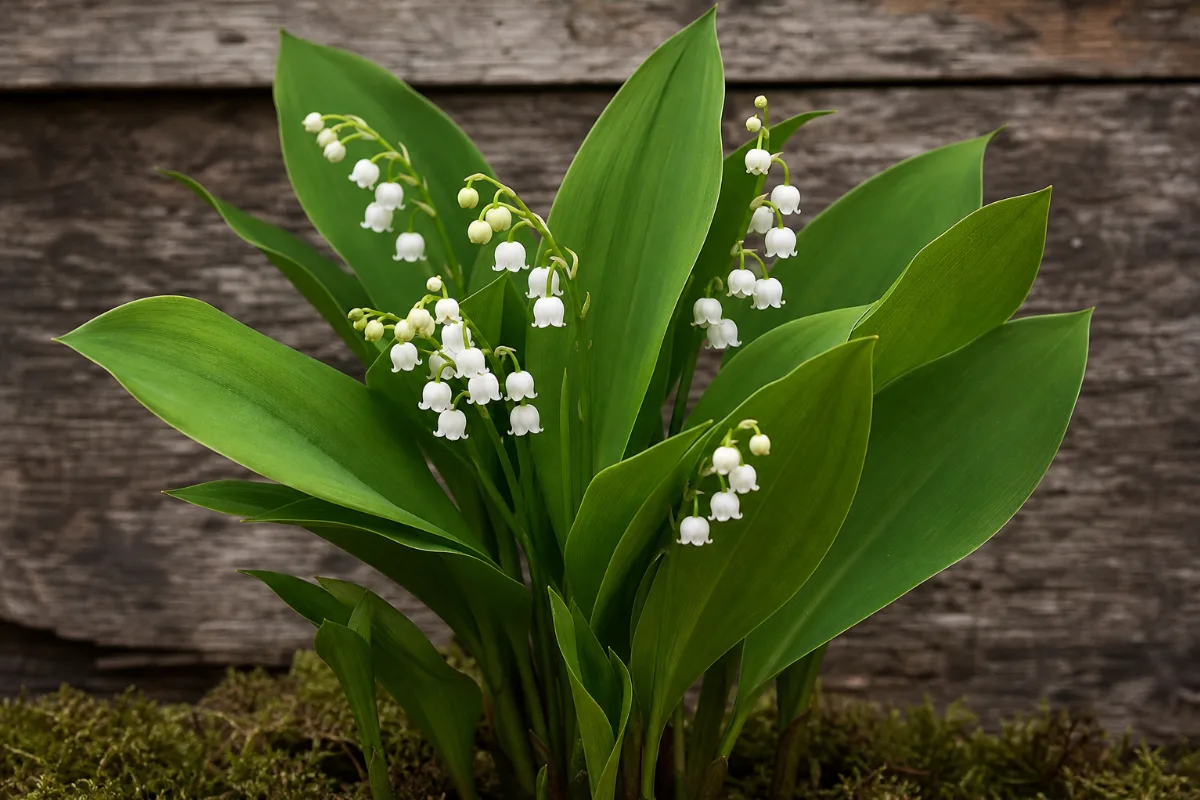
Without flowers, lily of the valley leaves look like the leaves of wild garlic (also called ramsons or bear's garlic). Researchers say this mix-up has repeatedly caused serious poisonings in people and animals, and the BfR names it too. Do not gather wild leaves for eating unless an expert has identified them.
In the US, three foragers who thought they had picked ramps became ill with slow heartbeats and digoxin-like blood results. The sample tested was not lily of the valley (it held a false-hellebore alkaloid), but the authors name lily of the valley as a known look-alike. All three recovered.
What it is
Lily of the valley is Convallaria majalis, accepted in GBIF in the family Asparagaceae. Its main compounds are cardiac glycosides: convallatoxin, convallatoxol and convalloside.
It is different from foxglove (Digitalis), which also has heart-active compounds, and from oleander. They are separate plants with their own poisoning reports; see the related pages.
Old heart uses and what the evidence shows
In Europe the plant, and extracts or glycoside mixtures made from it, were used for weak hearts. We found four clinical papers from 1954 to 1977 (German, Italian and Ukrainian), but PubMed holds no abstracts for them, so we cannot say what they found or how good they were. We found no modern controlled trial. Certainty: insufficient. The German Commission E position was not read and is not verified.
This is history, not advice. Heart weakness needs a doctor and proven medicines.
Blood tests and treatment
Several digoxin blood tests pick up convallatoxin, to different degrees, and one common test read it only minimally. A low or negative digoxin result therefore does not rule out exposure. Doctors should be told the plant was swallowed.
Sources disagree on the digoxin antidote (antibody fragments). A clinicians' teaching article says it is the antidote for significant plant glycoside poisoning, while a mouse and lab study found that convallatoxin did not bind it. This is for poison specialists to decide.
Interactions
No study tested the plant with any drug. Because it acts like digoxin, adding it to digoxin or other heart medicines could add to the effect, and medicines that change potassium or calcium (water pills, calcium products) are a theoretical concern. These links are theory and were not backed by a source we read. Ask a pharmacist about your own medicines, and do not use the plant.
Regulatory status
We could not confirm any EMA/HMPC monograph (the search page returned an error), and the German Commission E position, NCCIH, LiverTox, LactMed and WHO were not checked. These are marked not verified.
At a glance
Traditional uses history, not proof
- Heart weakness in European herbal medicine (history, not a recommended use)
Studied for research
- Heart weakness (old clinical reports): insufficient
- Modern controlled trials: none found
- Plant as a remedy, tea or food: against (poisoning)
Main compounds
- Convallatoxin
- Convallatoxol
- Convalloside
Common forms
- Flowers, leaves and red berries (all poisonous)
- Vase water (poison-centre story)
- Historical heart extracts (not recommended)
Research links: MedlinePlus: Lily of the valley poisoning · BfR: Lily of the Valley · Convallatoxin and digoxin tests (PubMed) · Wild garlic look-alike study (PubMed) · Research Library · Genes & Biomarkers Library
The plant and its history
- Accepted scientific name
- Convallaria majalis L.
- Naming authority
- GBIF species match, read 2026-10-25: Convallaria majalis L. ACCEPTED, key 7459480, family Asparagaceae.
- Common names
- Lily of the valley, May lily (English); Convallaria (Latin/trade)
- Botanical family
- Asparagaceae (GBIF). The Hong Kong reference uses the older grouping Liliaceae.
- Classification
- Plantae > Asparagaceae > Convallaria > Convallaria majalis
- Native range
- Not verified in the sources read.
- Habitat
- Garden and woodland plant (garden plant in poison-centre reports).
- What the plant looks like
- Roots: Not verified.; Stems: Not verified.; Leaves: Without flowers, the leaves can be mistaken for wild garlic (Allium ursinum); they have different leaf-surface structure under a microscope.; Flowers: Small white bell-shaped flowers (common knowledge, not verified in sources read).; Fruit: Red berries (BfR; very bitter).
- Cultivation
- Not covered.
- Harvest and processing
- Not covered.
- Look-alikes and adulterants
- Name: Wild garlic, ramsons, bear's garlic (Allium ursinum); Note: Edible leaves that look alike without flowers; mix-ups have caused serious poisonings. GBIF accepted: family Amaryllidaceae.; Name: Ramps (Allium tricoccum, North America); Note: A US foraging series linked ramps look-alikes (lily of the valley, false hellebore) to digoxin-like poisoning.; Name: Autumn crocus (Colchicum autumnale); Note: A different poison also confused with wild garlic.
- Sustainability and conservation
- Not covered.
Traditional use and history history, not clinical proof
| Tradition or era | Documented use | Source |
|---|---|---|
| Mid-20th-century European clinical reports (1954-1977) | Convallaria preparations and glycoside mixtures studied in heart conditions. Only titles were read; results unknown. | p13577371 |
| Traditional European heart remedy | Used for heart weakness in German and other European herbal medicine. German Commission E status is NOT verified. | p14038778 |
| Modern toxicology | Now described by poison centres, the BfR and MedlinePlus mainly as a poisonous garden plant. | s-medlineplus-lotv |
Traditional use shows how a plant was used. It does not show that a supplement works or is safe today.
What is inside, and how it may work
What the plant contains and how those compounds act in cells and animals. Laboratory and animal mechanisms are not proven effects in people.
Main compounds
| Compound | Family | Where it is concentrated | Activity studied | Level of evidence |
|---|---|---|---|---|
| Convallatoxin PubChem 441852 | cardiac glycoside (cardenolide) | Described as the primary cardiac glycoside of the plant; which part holds most was not verified | Acts on the heart like digoxin; detected by several digoxin blood tests. 8 6 15 | Laboratory research |
| Convallatoxol PubChem 49799113 | cardiac glycoside | Not verified | Named as a plant glycoside; activity not read. 15 | Insufficient |
| Convalloside PubChem 114652 | cardiac glycoside | Not verified | Named as a plant glycoside; activity not read. 15 | Insufficient |
Mechanisms, receptors and pathways
| Target or pathway | Gene or receptor | What was found | Level |
|---|---|---|---|
| Heart rhythm and conduction | Not applicable (cellular mechanism not read in these sources) | Cardiac glycosides slow and disturb the heartbeat in poisoning (poison-centre and case evidence). 13 2 18 | Human data |
| Digoxin antibody binding | Not applicable | Convallatoxin showed no binding to digoxin immune Fab in a lab test. 8 | Lab |
Absorption, metabolism and elimination
- Absorption
- The Hong Kong reference says poor absorption usually keeps toxicity minimal (summary-only).
- Distribution
- Not covered.
- Metabolism
- Not covered.
- Elimination
- Not covered.
- Bioavailability
- Not covered.
Isolated compounds versus whole extracts
Old clinical papers describe purified or mixed Convallaria glycosides, not the whole plant, but we could read only titles. Whole-plant content varies and cannot be controlled at home.
Nutritional composition
Not a nutrient. Not a food. Do not eat or drink any part.
2 not enough evidence1 evidence against
What was looked at
The 3 benefits and uses checked for Lily of the valley, each with how strong the evidence is. Tap one to open it.
What is Lily of the valley good for?
The plant has no tested benefit. What you may read about lily of the valley and the heart is history, shown here as context and rated honestly.
Benefits, one by one
Each card is a research question, not a promise. Tap a goal to filter. Open a card to see the studies, doses and limits.
Heart weakness (historical clinical reports, mid-1950s to 1970s)
Not enough evidenceLily of the valley extracts were used in Europe for weak hearts, and a handful of clinical reports from 1954 to 1977 exist. We could read only their titles, so we cannot tell you what they found. This is history, not a reason to use the plant.
4 studiesNot applicable. No amount, preparation or form of the plant is recomm…
Studies, doses and limits
What the trials found
Four old papers (German, Italian, Ukrainian) on Convallaria preparations or glycoside mixtures in heart conditions. PubMed holds no abstract for any of them, so no results are claimed.
Results
Not known: titles only.
Why this rating
We could not read results, sizes or methods. Papers of this age are usually uncontrolled reports, and none can be compared with today's standards. No modern trial was found.
Who was studied
Adults with heart conditions in mid-20th-century Europe (as the titles indicate)
Limits
Titles only; old language; results unknown; whether the preparations were purified, standardised or the whole plant is not known to us.
Why researchers looked
The plant's glycosides act on the heart in the same family as digoxin, so doctors in Germany and elsewhere tried purified or mixed Convallaria glycoside preparations.
Traditional use
German and other European preparations of Convallaria for heart weakness. The German Commission E position is not verified (not read).
Proposed mechanism Pharmacological theory
Cardiac glycosides act on the heart muscle; in poisoning this means rhythm problems (see Safety).
A proposed mechanism does not show that the effect happens in people.
All parts of lily of the valley are poisonous. Do not use it. See the Safety tab first.
Modern controlled trials of lily of the valley for the heart
Not enough evidenceWe found none. A PubMed search for Convallaria and clinical heart-failure use returned only the old papers above.
2 studiesNot applicable. No amount, preparation or form of the plant is recomm…
Studies, doses and limits
What the trials found
No randomised trial, review or meta-analysis of any Convallaria product in people was found in our search.
Why this rating
No modern evidence exists in what we searched. One mouse and lab study found that the usual antidote for digoxin may not bind convallatoxin, which is one more reason this plant cannot be treated like a standard heart drug.
Limits
One PubMed search only; non-English and old literature may hold more.
Why researchers looked
A safe, tested heart use would need a randomised trial; none was found.
Proposed mechanism Pharmacological theory
Not applicable.
A proposed mechanism does not show that the effect happens in people.
All parts are poisonous. Do not use. See the Safety tab first.
Flowers, leaves or berries as a remedy, tea or food
Evidence againstNo evidence supports taking the plant. The reports we found describe poisoning, including accidental poisonings after the leaves were mistaken for wild garlic.
8 studiesNot applicable. No amount, preparation or form of the plant is recomm…
Studies, doses and limits
What the trials found
No trial. Poison-centre guidance and case reports describe stomach upset, confusion, vision changes and slow or irregular heartbeat. In Hungary, lily of the valley was the most frequent plant in nearly 2,700 reports, mostly children, and most had no or mild symptoms.
Results
Hungary 2012-2025 (all plants together): 65.9% no symptoms, 25.6% mild, 1.0% severe, 0.2% fatal.
Why this rating
The only human evidence is poisoning. Most reported exposures are mild, but serious heart effects are documented and there is no tested benefit to weigh against them.
Who was studied
Mostly young children (berries, flowers); adults who mistook leaves for wild garlic or ramps
Limits
Poison-centre data are for all plants together; the Circulation case report was title-only.
Why researchers looked
Its old heart-remedy reputation leads some people to treat it as a natural heart herb or to use it by mistake as a cooking herb.
Traditional use
Used historically as a heart remedy in Europe (see the first tab). Poison-centre material describes only poisoning.
Proposed mechanism Pharmacological theory
Cardiac glycosides such as convallatoxin act on the heart like digoxin; in poisoning that means a slow or irregular heartbeat (case and poison-centre evidence).
A proposed mechanism does not show that the effect happens in people.
Do not eat, drink or make tea from any part, and do not drink the water from a vase of cut flowers. If any was swallowed, call poison control (US: 1-800-222-1222) or go to emergency care.
Connections to the rest of health
How Lily of the valley connects to the rest of our health knowledge graph. Every link says what kind of connection it is. A safety link (for example to the liver) is a warning, not a benefit. A study that merely mentions a topic never creates a benefit link.
Explore every connection: goals, body systems, organs, symptoms, genes
A. Wellness goals
| Connected to | Kind of connection | Evidence status | Context | Studies |
|---|---|---|---|---|
| Heart Health | Traditional use | Not enough evidence | Heart weakness (historical clinical reports, mid-1950s to 1970s): Lily of the valley extracts were used in Europe for weak hearts, and a handful of clinical reports from 1954 to 1977 exist. We could read only their titles, so we cannot tell you what they found. This is history, not a reason to use the plant. Modern controlled trials of lily of the valley for the heart: We found none. A PubMed search for Convallaria and clinical heart-failure use returned only the old papers above. | 7 16 17 3 8 |
| Heart Health | Adverse effect or risk | Evidence against | Flowers, leaves or berries as a remedy, tea or food: No evidence supports taking the plant. The reports we found describe poisoning, including accidental poisonings after the leaves were mistaken for wild garlic. | 13 10 11 2 1 18 5 14 |
B. Body systems
| Connected to | Kind of connection | Evidence status | Context | Studies |
|---|---|---|---|---|
| Digestive system | Adverse effect or risk | Documented | Nausea, vomiting and diarrhoea are early signs. Preparation or compound: Whole plant |
13 10 |
| Cardiovascular System | Biological association | Not enough evidence | Studied for: Heart weakness (historical clinical reports, mid-1950s to 1970s) Studied for: Modern controlled trials of lily of the valley for the heart | 7 16 17 3 8 13 10 11 2 1 18 5 14 |
| Digestive System | Biological association | Evidence against | Studied for: Flowers, leaves or berries as a remedy, tea or food | 13 10 11 2 1 18 5 14 |
C. Body parts and organs
| Connected to | Kind of connection | Evidence status | Context | Studies |
|---|---|---|---|---|
| Heart | Adverse effect or risk | Documented | Slow or irregular heartbeat and heart block in poisoning. Preparation or compound: Convallatoxin and related glycosides |
13 2 18 |
| Eyes | Adverse effect or risk | Documented | Blurred vision and halos around lights. Preparation or compound: Whole plant |
13 2 |
L. Active compounds
| Connected to | Kind of connection | Evidence status | Context | Studies |
|---|---|---|---|---|
| Convallatoxin | Biological association | In vitro | Acts on the heart like digoxin; detected by several digoxin blood tests. Preparation or compound: Described as the primary cardiac glycoside of the plant; which part holds most was not verified |
8 6 15 |
| Convallatoxol | Biological association | Not enough evidence | Named as a plant glycoside; activity not read. Preparation or compound: Not verified |
15 |
| Convalloside | Biological association | Not enough evidence | Named as a plant glycoside; activity not read. Preparation or compound: Not verified |
15 |
Each connection is stored with the ingredient, the connected record, the kind of connection, the evidence status, the supporting studies, the preparation or compound involved, and a review date (last reviewed October 25, 2026).
Evidence at a glance: what the research found for 3 outcomes
Each outcome below is one thing researchers measured. Certainty is how far the evidence can be trusted, not how well it works. The full studies are on the next tab.
The evidence
The research centre for Lily of the valley. Every record here was checked against PubMed or the publisher's page; we never list a study we have not verified.
Evidence by outcome
Bars show how many studies we found for each outcome, not how well it works. People are added up across trials only (reviews are not added, to avoid double counting).
How we rate evidence
High certainty
Several well-run trials or reviews agree; further research is unlikely to change the picture much.
Moderate certainty
Good trials point the same way, but some doubt remains.
Low certainty
Small, short or inconsistent trials. The finding could change with better research.
Very low certainty
Very little or very weak human data. Treat as a possibility only.
Mixed findings
Trials or reviews disagree with each other.
Not enough evidence
Not enough human research to say either way.
Evidence against
Good research found no benefit, or found harm.
We take the reviewers' own risk-of-bias and GRADE statements where they exist, and otherwise judge from study size, design, consistency, directness and whether a product matches what is sold. Many publications do not make evidence high. Method note: We read our existing herb summary, searched PubMed, read the abstract of each PubMed record cited where one exists (several old papers have only a title), and checked names in GBIF and compounds in PubChem. Pages that could not be opened are marked not verified.
Study library: every study we checked 18
| Study | Design | People | Product, dose, length | Result |
|---|---|---|---|---|
| Alexandre 2012 Digitalis intoxication induced by an acute accidental poisoning by lily of the valley Circulation · PMID 22371443 · DOI |
Case report |
Case report (letter) of accidental poisoning | Convallaria majalis Not given here Not given here |
Title only: the PubMed record has no abstract, so no results are claimed. The title says lily of the valley caused a digitalis-type poisoning. Methods, limits and fundingOutcomes: Poisoning course Limitations: Title-only. Not read. Read: title-only |
| American College of Medical Toxicology (via ALiEM) 2023 ACMT Toxicology Visual Pearl: The Heart Won't Go On and On aliem.com · Source |
Authoritative guidance |
Educational toxicology article for clinicians | Plant cardiac glycosides including lily of the valley whole plant Not given here Not given here |
Describes digoxin-like poisoning from plant glycosides, with stomach, nerve and vision effects and a high blood potassium level in severe cases. States that digoxin-specific antibody fragments (Fab) are the antidote for significant poisoning. Methods, limits and fundingOutcomes: Poisoning features and treatment Limitations: Summary-only: read for our graph file and not re-opened. Not specific to one plant. Read: summary-only |
| Chekman 1977 [Clinical pharmacology of convallaria preparations] Farm Zh · PMID 328297 |
Narrative review |
Ukrainian-language paper (1977) | Convallaria preparations Not given here Not given here |
Title only: no abstract on PubMed. Results not known to us. Methods, limits and fundingOutcomes: Not read Limitations: Title-only. Ukrainian. Not read. Read: title-only |
| Cortinovis 2013 Epidemiology of intoxication of domestic animals by plants in Europe Vet J · PMID 23570777 · DOI |
Narrative review animal |
European reports of poisoning in livestock and pets | Poisonous plants incl. Convallaria majalis Not given here Not given here |
Lists Convallaria majalis among the house and garden plants behind most plant poisonings in pets. Methods, limits and fundingOutcomes: Which plants poison animals Limitations: Abstract read. The abstract gives no numbers for lily of the valley. Read: abstract |
| Cserhalmi 2026 Human plant exposures in Hungary (2012-2025): a nationwide toxicovigilance study Clin Toxicol (Phila) · PMID 42554029 · DOI |
Cohort study |
2720 2,720 plant exposures reported to Hungarian health authorities; children about 90% |
Plants incl. Convallaria majalis (most common species) Not given here Not given here |
Children made up nearly 90% of cases, 91.9% were accidental. Of cases with severity data (1,794), 65.9% had no symptoms, 25.6% mild, 1.0% severe and 0.2% fatal. Convallaria majalis and yew were the most common plants. Methods, limits and fundingOutcomes: Who is exposed and how severe Limitations: Abstract read. Results are for all plants together, not lily of the valley alone. Read: abstract |
| Dasgupta 2018 Convallatoxin, the active cardiac glycoside of lily of the valley, minimally affects the ADVIA Centaur digoxin assay J Clin Lab Anal · PMID 29855084 · DOI |
Laboratory research lab |
Lab serum pools spiked with convallatoxin or lily of the valley extract | Convallatoxin and plant extract (lab) Not given here Not given here |
One digoxin test (LOCI) read very high with convallatoxin or the extract; another (ADVIA Centaur) read only minimally. So a digoxin blood test can miss or overstate lily of the valley exposure depending on the test used. Methods, limits and fundingOutcomes: Apparent digoxin result on two assays Limitations: Abstract read. Lab study, no patients. Read: abstract |
| Eggers 1958 [Clinical studies on a new Convallaria glycoside mixture] Medizinische · PMID 13577371 |
Uncontrolled clinical |
German clinical report (1958) | Convallaria glycoside mixture Not given here Not given here |
Title only: no abstract on PubMed. Results not known to us. Methods, limits and fundingOutcomes: Not read Limitations: Title-only. Old German paper. Not read. Read: title-only |
| Fink 2014 Rapid detection of convallatoxin using five digoxin immunoassays Clin Toxicol (Phila) · PMID 24980812 · DOI |
Laboratory research animal/lab |
Purified convallatoxin, mouse serum and lab antibody binding tests | Convallatoxin (purified) Not given here Not given here |
Five common digoxin blood tests detected convallatoxin, though to different degrees. Mice given sublethal convallatoxin showed apparent digoxin levels. Convallatoxin showed no binding by digoxin immune Fab, so the authors judged that Fab is unlikely to neutralise it. Methods, limits and fundingOutcomes: Digoxin test cross-reaction; antibody (Fab) binding Limitations: Abstract read. Lab and mouse study, no patients. Conflicts with the ACMT teaching article on Fab. Read: abstract |
| GBIF 2026 GBIF species match: Convallaria majalis L. and Allium ursinum L. api.gbif.org · Source |
Database record |
Name check | Taxonomy Not given here Not given here |
Convallaria majalis L. ACCEPTED (key 7459480), family Asparagaceae. Allium ursinum L. (wild garlic, ramsons) ACCEPTED (key 2857601), family Amaryllidaceae. Methods, limits and fundingOutcomes: Accepted names Limitations: Read 2026-10-25. Read: full-text |
| German Federal Institute for Risk Assessment (BfR) Lily of the Valley (BfR poisonous plants in the garden) bfr.bund.de · Source |
Authoritative guidance |
Public risk-communication article | Convallaria majalis whole plant Not given here Not given here |
Warns of heart-rhythm problems after a large amount; notes the red berries taste very bitter so few are likely to be eaten; names the mix-up of the leaves with wild garlic (ramsons) as a cause of poisonings. Methods, limits and fundingOutcomes: Poisoning risk Limitations: Summary-only: read for our graph file and not re-opened. Undated. Read: summary-only |
| Hospital Authority Toxicology Reference Laboratory 2018 Convallaria majalis (toxic plant database) www3.ha.org.hk · Source |
Authoritative guidance |
Toxic plant reference entry | Convallaria majalis whole plant Not given here Not given here |
All parts contain cardiac glycosides. The entry says poor absorption means toxicity is usually minimal, and that reported child cases were usually mild. Methods, limits and fundingOutcomes: Toxicity Limitations: Summary-only: read for our graph file and not re-opened. Uses the older family name Liliaceae. Read: summary-only |
| M-Hamvas 2025 Histological Features Detected for Separation of the Edible Leaves of Allium ursinum L. from the Poisonous Leaves of Convallaria majalis L. and Colchicum autumnale L. Plants (Basel) · PMID 40805725 · DOI |
Laboratory plant |
Leaves of wild garlic, lily of the valley and autumn crocus grown in one garden | Leaf anatomy comparison leaf Not given here Not given here |
The authors state that mistaking the leaves of autumn crocus or lily of the valley for wild garlic has repeatedly caused serious poisonings in people and animals, since their habitats overlap and the leaves look alike without flowers. They found leaf-surface differences that separate them under a microscope. Methods, limits and fundingOutcomes: Microscope differences Limitations: Abstract read. Microscope method, not a field guide for readers. Read: abstract |
| MedlinePlus (US National Library of Medicine) 2025 Lily of the valley poisoning medlineplus.gov · Source |
Authoritative guidance |
Public health encyclopedia article | Convallaria majalis whole plant Not given here Not given here |
Lists nausea, vomiting, stomach pain, diarrhoea, confusion, drowsiness, headache, weakness, blurred vision and halos, and slow or irregular heartbeat. Says death is unlikely. Methods, limits and fundingOutcomes: Poisoning symptoms and outlook Limitations: Summary-only: read for our graph file and not re-opened for this page. Read: summary-only |
| National Capital Poison Center True stories for springtime: Avoiding poisons and outdoor hazards poison.org · Source |
Authoritative guidance |
Public poison-centre article with short case stories | Convallaria majalis vase water Not given here Not given here |
Mentions a confused older woman who drank water from a vase of lily of the valley. The page gives no outcome or other details. Methods, limits and fundingOutcomes: Case story Limitations: Summary-only: read for our graph file and not re-opened. Anecdote, undated. Read: summary-only |
| PubChem 2026 PubChem: convallatoxin, convallatoxol, convalloside pubchem.ncbi.nlm.nih.gov · Source |
Database record |
Compound record check by name | Compounds Not given here Not given here |
Convallatoxin CID 441852 C29H42O10; convallatoxol CID 49799113 C29H44O10; convalloside CID 114652 C35H52O15. Methods, limits and fundingOutcomes: IDs and formulas Limitations: Matched by name only. Read: full-text |
| Rosselli 1962 [Clinical use of native Convallaria glycoside in cardiac insufficiency and fresh heart infarct] Ther Ggw · PMID 14038778 |
Uncontrolled clinical |
German clinical report (1962) | Native Convallaria glycoside Not given here Not given here |
Title only: no abstract on PubMed. Results not known to us. Methods, limits and fundingOutcomes: Not read Limitations: Title-only. Old German paper. Not read. Read: title-only |
| Storti 1955 [Clinical study of the use of Convallaria majalis in the therapy of cardiomyopathies] Minerva Med · PMID 13279729 |
Uncontrolled clinical |
Italian clinical report (1955) | Convallaria majalis Not given here Not given here |
Title only: no abstract on PubMed. Results not known to us. Methods, limits and fundingOutcomes: Not read Limitations: Title-only. Old Italian paper. Not read. Read: title-only |
| Trebach 2022 Detectable Digoxin Concentrations in 3 Patients with Ramps Misadventure Wilderness Environ Med · PMID 35691768 · DOI |
Case series |
3 Three adults who foraged and ate a plant they believed was ramps (Allium tricoccum) |
Mixed foraged plant (lab found a false-hellebore alkaloid) leaf Not given here Not given here |
All three were low in blood pressure and had slow heartbeats, with detectable digoxin levels (0.08 to 0.13 ng/mL). One got digoxin antibody fragments. All recovered. The plant sample tested positive for cyclopamine from false hellebore, not for lily of the valley, but the authors warn that lily of the valley and false hellebore are look-alikes of ramps and both can give a digoxin-test result. Methods, limits and fundingOutcomes: Poisoning course Limitations: Abstract read. Ramps is a North American wild garlic relative, not the European ramsons. The poisoning in these three was not proven to be lily of the valley. Read: abstract |
What we do not know yet
- No modern trial of any Convallaria product.
- Old clinical papers were title-only.
- How often serious poisoning happens for this plant alone is unknown.
- No pregnancy, breastfeeding or liver data.
- EMA/HMPC, Commission E, NCCIH, LiverTox, LactMed and WHO not verified.
How new research is added
New studies are found by a saved PubMed search and placed in a review queue. A person reads each one before it changes any rating or safety wording.
Lab markers
What changed in blood or saliva tests during trials. A changed number is not the same as feeling or being healthier, and we give no "normal ranges".
Safety
What studies and official sources say about side effects, medicines and who should check first. Each point shows what kind of evidence it comes from.
Main points to know 6
- Do not eat, drink or use any part of lily of the valley. Every part is poisonous: flowers, leaves, red berries and, reportedly, the water in a vase of cut flowers. The plant contains heart-active compounds (convallatoxin and related glycosides) that act like the medicine digoxin. Poisoning can slow or disturb the heartbeat. There is no safe self-use. Authoritative guidance 13 10 11 2
- If any was swallowed: call poison control. US: Poison Control 1-800-222-1222. Outside the US, call your local poison centre or emergency number. Do not wait for symptoms. Tell the doctor which plant and which part was swallowed, because heart effects can be delayed and a digoxin blood test may be misleading. Authoritative guidance 2 6 8
- Children, vase water and pets. The red berries and flowers can attract young children. The German BfR says the berries taste very bitter, so few are likely to be eaten, and the Hong Kong reference says reported child cases were usually mild, but a poison centre should still be called. A poison-centre article mentions an older, confused woman who drank vase water (no outcome given). Lily of the valley is listed among the garden plants that poison pets in Europe. Authoritative guidance 10 11 14 4 5
- The leaves are mistaken for wild garlic (ramsons). Without flowers, lily of the valley leaves look like the edible leaves of wild garlic (Allium ursinum, also called ramsons or bear's garlic). Researchers say this mix-up has repeatedly caused serious poisonings in people and animals. A US case series of foragers who thought they had ramps (a different wild garlic relative) also showed digoxin-like poisoning, though the plant tested was not proven to be lily of the valley. Do not forage leaves unless an expert has identified them. Case series 12 10 18
- No tested heart benefit; not a substitute for heart medicines. Old clinical reports (1950s to 1970s) exist but we could read only their titles. No modern controlled trial was found. Never replace or add to a prescribed heart medicine with this plant. Traditional use 7 16 17 3
- Related poisonous heart-glycoside plants. Foxglove and oleander also contain heart-active glycosides and are also poisonous. They are different plants. Lily of the valley is not interchangeable with either. Authoritative guidance 2 8
Side effects 5
| Effect | How often | Severity and recovery | Evidence |
|---|---|---|---|
| Nausea, vomiting, stomach pain and diarrhoea Usually the first signs. No frequency data for the plant. | Not established | moderate Usually settles; not quantified | Authoritative guidance 13 10 2 |
| Slow or irregular heartbeat, heart block, collapse The BfR warns of arrhythmia after a large amount. The Hong Kong reference says poor absorption usually keeps toxicity minimal. | Not established | severe Three adults in a foraging series recovered, one with antibody fragments; severity in other cases not read | Case series 13 10 2 18 1 |
| Confusion, drowsiness, headache, weakness Confusion was reported in the vase-water story. | Not established | moderate Not stated | Authoritative guidance 13 2 |
| Blurred vision and halos around lights Halos are mainly linked to repeated overdose. | Not established | moderate Not stated | Authoritative guidance 13 2 |
| High blood potassium (severe cases) From the ACMT teaching article on plant glycosides in general. | Not established | severe Not stated | Authoritative guidance 2 |
Liver
No liver injury was described in the sources read for this page. LiverTox was not checked. The main organ affected is the heart. 2
How often. No data.
This is a safety connection. It is not evidence that Lily of the valley supports liver health.
Medicines and supplements 4
| With | Why it matters | Importance | Evidence | What to do |
|---|---|---|---|---|
| Digoxin or other heart-glycoside medicines drug | Both act on the heart in the same way. | Adding the plant to a prescription could add to the effect. This is a theoretical concern; no study of the plant with any drug was found. | Pharmacological theory Not enough evidence 2 | Never combine. Tell a doctor or poison centre about any plant swallowed. |
| Water pills (diuretics), calcium products and other medicines that change potassium or calcium drug | Heart glycosides are sensitive to blood potassium and calcium levels; the ACMT article notes high potassium in severe poisoning. | Theoretical for this plant. The link to diuretics and calcium comes from general digoxin pharmacology and was NOT verified in a source read for this page. | Pharmacological theory Not enough evidence 2 | Ask a pharmacist about your own medicines. Do not use the plant. |
| Digoxin blood tests lab test | Convallatoxin is picked up by some digoxin immunoassays. | Five tests detected it to different degrees, and one common test read it only minimally. A negative or low result does not rule out exposure. | Laboratory research Low certainty 8 6 | Tell the care team the plant was swallowed. |
| Digoxin immune Fab (antidote question) treatment | Antibody fragments bind digoxin. | ACMT says Fab is the antidote for significant plant glycoside poisoning. A mouse and lab study found no binding to convallatoxin. Sources disagree; a three-patient foraging series used it with recovery. | Laboratory research Mixed findings 2 8 18 | A decision for poison specialists. |
Who should check first 5
| Situation | Advice | Evidence |
|---|---|---|
| Everyone: swallowing any part of the plant or its vase water | Avoid completely. All parts are poisonous. | Authoritative guidance 13 10 11 |
| People with heart disease, a slow or irregular heartbeat, or taking digoxin or other heart medicines | Do not use. The plant could add to prescription effects (theoretical, no study). | Pharmacological theory 2 |
| Pregnancy and breastfeeding | No safety data for the plant were found, and LactMed was not checked. Do not use. | Insufficient 10 |
| Children | Keep the plant, berries and vase water out of reach. Call poison control if any was swallowed, even if the child seems well. | Authoritative guidance 10 11 5 |
| Pets | Lily of the valley is listed among the garden plants that poison pets in Europe. Call a vet or animal poison service if a pet chewed it. | Narrative review 4 |
Overdose, product quality and regulators
Summary. Lily of the valley is poisonous in all parts. Most reported exposures, especially by children, were symptom-free or mild, but serious heart effects are documented.
Animal. Mouse and lab work shows convallatoxin is picked up by digoxin tests; no animal toxicity data are relied on here.
Human doses studied. No safe amount exists and none is given. Sources describe wide differences between cases.
High dose or long term signals. Slow or irregular heartbeat and heart block; visual halos linked mainly to repeated overdose.
Overdose response. Emergency care and poison control (US 1-800-222-1222). Whether antibody fragments help is disputed (see Interactions).
Genotoxicity. Not covered.
Toxic plant parts. All parts: flowers, leaves, berries and, reportedly, vase water.
The main risk is look-alike confusion rather than product contamination.
Mistaken for wild garlic (ramsons). Researchers say confusing lily of the valley leaves with wild garlic has repeatedly caused serious poisonings of people and animals. The leaves look similar without flowers. 12 10
Foraged ramps. Three US adults with digoxin-like poisoning had foraged a plant they believed was ramps. Lab analysis found a false-hellebore alkaloid, not lily of the valley, but the authors name lily of the valley as a known look-alike. 18
Herbal or homeopathic products. Not covered by the sources read; no safety support found.
| Body | Action | Date |
|---|
When to get medical help
- If any part of lily of the valley (flower, leaf, berry, or vase water) was swallowed: call poison control now (US: 1-800-222-1222) or go to emergency care. Do not wait for symptoms and do not make the person vomit unless told to.
- Nausea, vomiting, confusion, a very slow or irregular pulse, fainting or vision changes after eating a plant thought to be wild garlic or another leaf: emergency care at once.
- A child has chewed or swallowed any part of the plant: call poison control, even if the child seems well.
- A pet has chewed the plant: call your vet or an animal poison service.
Stop the supplement and contact a clinician or emergency service. In the US, Poison Control is 1-800-222-1222.
General information only, not medical advice. Ask a clinician or pharmacist before use, especially with medicines, in pregnancy or with a health condition. See the Natural Remedy Safety guide.
Frequently asked questions
Is lily of the valley poisonous?
What should I do if someone swallowed some?
What are the signs of poisoning?
Are the red berries dangerous for children?
Is the water from a vase of lily of the valley harmful?
A poison-centre article mentions an older woman who became confused after drinking it. No outcome was given. Do not drink it.
Is it dangerous to pets?
It is listed among the garden plants that poison pets in Europe. Call a vet if a pet chewed it.
Can it be mistaken for wild garlic?
Is it the same as foxglove or oleander?
Does lily of the valley help the heart?
Does it interact with digoxin or water pills?
No study tested this. It acts like digoxin, so adding it to heart medicines could add to the effect; this is theory. Ask a pharmacist about your own medicines.
Is it safe in pregnancy or breastfeeding?
No safety data were found. Do not use it.
Explore by health goal
Editorial transparency
- Written by
- AlternativeMed editorial team. Research compiled with AI assistance, then checked against PubMed records.
- Medical review
- None. This page has not been reviewed by a physician or pharmacist.
- First published
- 2026-10-25
- Last substantive update
- 2026-10-25
- How we research
- We read our existing herb summary, searched PubMed, read the abstract of each PubMed record cited where one exists (several old papers have only a title), and checked names in GBIF and compounds in PubChem. Pages that could not be opened are marked not verified.
- How we rate evidence
- See "How we rate evidence" in the Evidence tab.
- Independence
- No product is promoted on this page. No affiliate links are shown.
Sources 18
Each source was opened and checked. Where we read only the abstract, it says so. The small numbers in the text point here.
- Alexandre J, Foucault A, Coutance G, et al.. Digitalis intoxication induced by an acute accidental poisoning by lily of the valley. Circulation. 2012. PMID 22371443. DOI 10.1161/CIRCULATIONAHA.111.044628. (title-only)
- American College of Medical Toxicology (via ALiEM). ACMT Toxicology Visual Pearl: The Heart Won't Go On and On. aliem.com. 2023. (summary-only)
- Chekman IS, Gorchakova NO, Dombrovskaia AM. [Clinical pharmacology of convallaria preparations]. Farm Zh. 1977. PMID 328297. (title-only)
- Cortinovis C, Caloni F. Epidemiology of intoxication of domestic animals by plants in Europe. Vet J. 2013. PMID 23570777. DOI 10.1016/j.tvjl.2013.03.007. (abstract)
- Cserhalmi D, Péli ER. Human plant exposures in Hungary (2012-2025): a nationwide toxicovigilance study. Clin Toxicol (Phila). 2026. PMID 42554029. DOI 10.1080/15563650.2026.2711080. (abstract)
- Dasgupta A, Bourgeois L. Convallatoxin, the active cardiac glycoside of lily of the valley, minimally affects the ADVIA Centaur digoxin assay. J Clin Lab Anal. 2018. PMID 29855084. DOI 10.1002/jcla.22583. (abstract)
- Eggers P, Zylmann E. [Clinical studies on a new Convallaria glycoside mixture]. Medizinische. 1958. PMID 13577371. (title-only)
- Fink SL, Robey TE, Tarabar AF, Hodsdon ME. Rapid detection of convallatoxin using five digoxin immunoassays. Clin Toxicol (Phila). 2014. PMID 24980812. DOI 10.3109/15563650.2014.932366. (abstract)
- GBIF. GBIF species match: Convallaria majalis L. and Allium ursinum L.. api.gbif.org. 2026. (full-text)
- German Federal Institute for Risk Assessment (BfR). Lily of the Valley (BfR poisonous plants in the garden). bfr.bund.de. . (summary-only)
- Hospital Authority Toxicology Reference Laboratory, Hong Kong. Convallaria majalis (toxic plant database). www3.ha.org.hk. 2018. (summary-only)
- M-Hamvas M, Tótik A, Freytag C, et al.. Histological Features Detected for Separation of the Edible Leaves of Allium ursinum L. from the Poisonous Leaves of Convallaria majalis L. and Colchicum autumnale L.. Plants (Basel). 2025. PMID 40805725. DOI 10.3390/plants14152377. (abstract)
- MedlinePlus (US National Library of Medicine). Lily of the valley poisoning. medlineplus.gov. 2025. (summary-only)
- National Capital Poison Center. True stories for springtime: Avoiding poisons and outdoor hazards. poison.org. . (summary-only)
- PubChem. PubChem: convallatoxin, convallatoxol, convalloside. pubchem.ncbi.nlm.nih.gov. 2026. (full-text)
- Rosselli T. [Clinical use of native Convallaria glycoside in cardiac insufficiency and fresh heart infarct]. Ther Ggw. 1962. PMID 14038778. (title-only)
- Storti R. [Clinical study of the use of Convallaria majalis in the therapy of cardiomyopathies]. Minerva Med. 1955. PMID 13279729. (title-only)
- Trebach J, Calleo V, Akbar S, et al.. Detectable Digoxin Concentrations in 3 Patients with Ramps Misadventure. Wilderness Environ Med. 2022. PMID 35691768. DOI 10.1016/j.wem.2022.04.008. (abstract)


