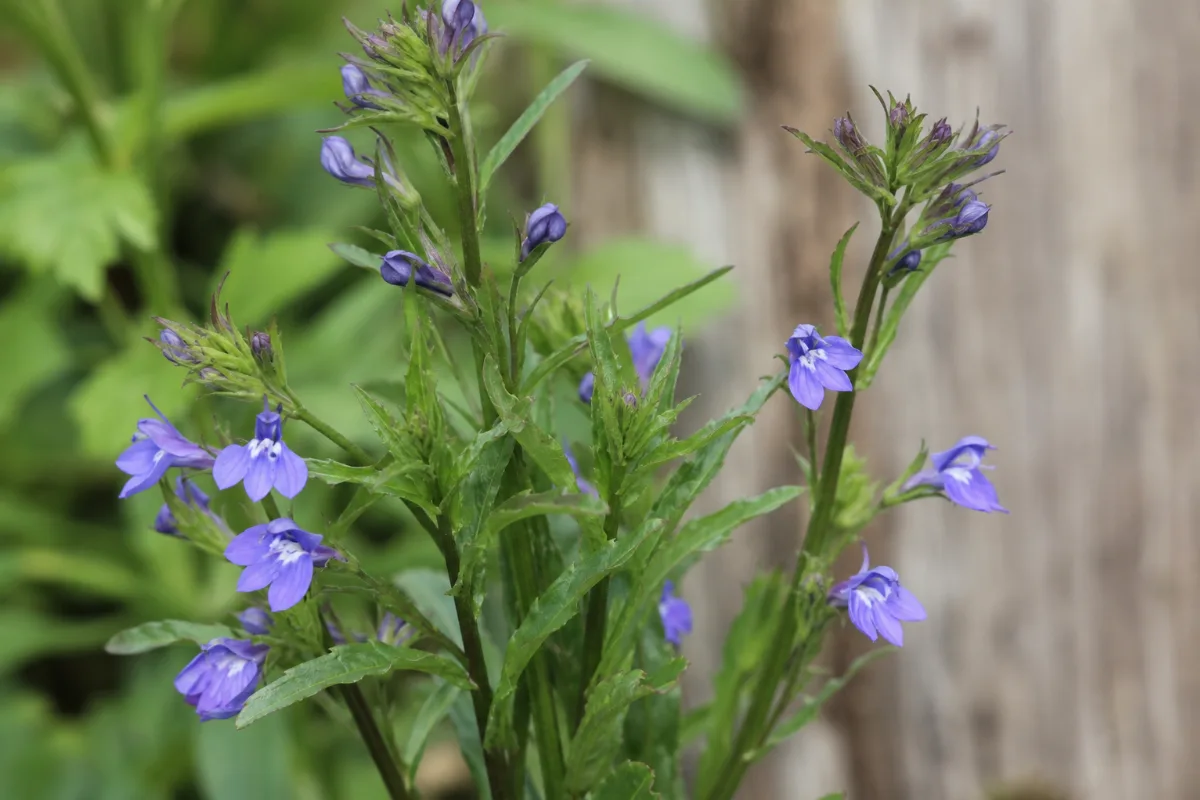
Herbs & Botanicals · Herbs · Indian tobacco, nicotine-like plant, little human research, safety first
Lobelia
Lobelia inflata L. · also called Indian tobacco, asthma weed, gagroot, pukeweed, vomit weed
Lobelia is a North American plant. Its above-ground parts contain lobeline, a chemical that acts on nicotine receptors. It was sold for quitting smoking and asthma, but the research does not support those uses, and higher amounts can slow breathing and poison.
General information, not medical advice. Last substantive update · Not medically reviewed. A named clinician has not signed off on this page. How this page is made
About Lobelia
Lobelia (Lobelia inflata) is a plant whose above-ground parts hold lobeline and many other alkaloids. Lobeline acts like nicotine on some nerve receptors. It was sold to help people quit smoking and for asthma, but trials do not support those uses and higher amounts can poison. Almost all human research is on isolated lobeline, not the herb.
What it is
Lobelia inflata is in the bellflower family. Memorial Sloan Kettering says the aerial (above-ground) parts are used. Other Lobelia species are different plants with different chemistry, so a label that just says lobelia may not mean this one.
Its main studied chemical is lobeline. One extract analysis found 52 related alkaloids.
What the research shows
The best human evidence is on quitting smoking, and it is negative. Cochrane found no long-term evidence, and a 750-smoker trial of lobeline sulfate found no benefit. Other human data are one tiny study in smokeless tobacco users and a nine-person ADHD laboratory study.
For asthma, depression, alcohol, seizures and inflammation there is no human treatment trial; results are from mice, rats or cells.
At a glance
Traditional uses history, not proof
- Asthma and chest complaints (name: asthma weed)
- Causing vomiting (names: pukeweed, vomit weed)
- Sold as a stop-smoking aid (the FDA acted against OTC products from 1993)
Studied for research
- Quitting smoking, against (no benefit in a 750-person trial; no long-term evidence)
- Smokeless tobacco withdrawal, insufficient (22 men, no lobeline benefit)
- Working memory in ADHD, very low (nine adults, single doses)
- Asthma, insufficient (no human trial)
- Depression, alcohol, seizures, inflammation: animal or lab only
Main compounds
- Lobeline (CID 101616), the main studied alkaloid
- About 52 piperidine alkaloids found in one extract
Common forms
- Isolated lobeline sulfate tablets or liquids (in trials, not the herb)
- Injected lobeline (research use only)
- Dried herb, tincture, tea, capsule (not tested in the trials read)
Research links: US rule on OTC smoking deterrents (21 CFR 310.544) · Memorial Sloan Kettering: Lobelia · Cochrane review: Lobeline for smoking cessation · Research Library · Genes & Biomarkers Library
The plant and its history
- Accepted scientific name
- Lobelia inflata L. (Indian tobacco)
- Naming authority
- L. (Linnaeus), as returned by the GBIF Backbone (usageKey 5408737).
- Common names
- Lobelia (English); Indian tobacco (English); Asthma weed (English); Gagroot (English); Pukeweed (English); Vomit weed (English)
- Botanical family
- Campanulaceae (bellflower family).
- Classification
- Plantae > Tracheophyta > Magnoliopsida > Asterales > Campanulaceae > Lobelia > Lobelia inflata
- Native range
- Not verified from a source read.
- Habitat
- Not verified.
- What the plant looks like
- Roots: Not described in sources read.; Stems: Not described.; Leaves: Not described.; Flowers: Described by title only (Hughes 2015) as a self-fertilising herbaceous monocarp, meaning it flowers once and dies; abstract not read.; Fruit: Not described.
- Cultivation
- Not verified.
- Harvest and processing
- MSK states the herb is the aerial (above-ground) parts. Processing not verified.
- Look-alikes and adulterants
- Name: Other Lobelia species; Note: MSK also lists Lobelia berlandieri and Lobelia cardinalis; studies exist on L. chinensis, L. nicotianaefolia and others, with different chemistry. Findings on those species must not be assigned to Lobelia inflata. Garden lobelia (Lobelia erinus) is an ornamental, not the medicinal species.
- Sustainability and conservation
- Not verified.
Traditional use and history history, not clinical proof
| Tradition or era | Documented use | Source |
|---|---|---|
| Traditional use, North America | Used for asthma and chest complaints and to cause vomiting, as shown by its common names (asthma weed, pukeweed, vomit weed, gagroot) listed by MSK. Details of who used it and when are not documented in sources read. | s-msk-lobelia |
| 1846 medical journal | An article titled 'On the Uses of the Lobelia Inflata' (Livezey, Medical Examiner, July 1846) exists; only its record was opened, so its content is not described. | p38120237 |
| Smoking-cessation products | Lobeline products were sold over the counter to help stop smoking; the FDA made non-compliant OTC lobeline smoking deterrents subject to action after 1 Dec 1993. | s-fda-21cfr310544 |
| Respiratory stimulant and emetic | A 2022 paper says lobeline has a long history of use as an emetic, respiratory stimulant and smoking-cessation agent, and that injected lobeline has since been replaced by other first-aid drugs in many settings. | p36234790 |
Traditional use shows how a plant was used. It does not show that a supplement works or is safe today.
What is inside, and how it may work
What the plant contains and how those compounds act in cells and animals. Laboratory and animal mechanisms are not proven effects in people.
Main compounds
| Compound | Family | Where it is concentrated | Activity studied | Level of evidence |
|---|---|---|---|---|
| Lobeline PubChem 101616 | piperidine alkaloid | Aerial parts (alkaloid-rich plant material) | Blocks several nicotinic receptor types in cells; binds mu opioid receptors and VMAT2 in the lab; crosses the blood-brain barrier in preclinical studies (MSK). 29 1 14 27 | Laboratory research |
| Other piperidine alkaloids (about 52 identified in one extract) | alkaloids | Plant extract (part not stated in abstract) | Mostly 2,6-disubstituted piperidines; activity of most is not known. 9 | Laboratory research |
| Nicotine (comparison, not in lobelia) PubChem 89594 | alkaloid | Not present in lobelia; shown for comparison | Reference nicotinic agonist. 29 | Authoritative guidance |
Mechanisms, receptors and pathways
| Target or pathway | Gene or receptor | What was found | Level |
|---|---|---|---|
| Nicotinic acetylcholine receptors | alpha4beta2, alpha4beta4, alpha3beta4, muscle-type | Lobeline neither activated nor enhanced human alpha4beta2/alpha4beta4 receptors but blocked them (about 10-fold stronger at alpha4beta4); it blocked a human muscle-type receptor and had mixed boost-then-block effects on rat alpha3beta4. MSK describes it as nicotine-like in the body. These descriptions differ and the human meaning is unclear. 1 8 27 | Laboratory research |
| Vesicular monoamine transporter 2 and dopamine release | VMAT2 | MSK reports lobeline redistributes dopamine in nerve vesicles; in rats lobeline did not alter methamphetamine's effect on dopamine. 27 13 | Animal research |
| Mu opioid receptor | OPRM1 | Lobeline acted as an antagonist in tissue and cell tests. 14 | Laboratory research |
| Heart-related potassium channels | HERG (KCNH2), Kv1.5 | Lobeline blocked HERG with IC50 0.34 micromolar and also Kv1.5, Kv3.1 and Kv4.3. 7 | Laboratory research |
| Cholinesterase and NMDA receptor | ACHE, NMDA receptor | Lobeline inhibited cholinesterase and blocked NMDA receptor activity in lab tests. 16 | Laboratory research |
| Inflammation signalling | NF-kappaB, MAPK | Reduced nitric oxide in mouse cells and lung oedema in mice. 10 | Animal research |
| Lung reflex | Juxtapulmonary receptors | Injected lobeline caused a reflex cough in healthy and unconscious people. 15 | Human data |
Absorption, metabolism and elimination
- Absorption
- No human blood-level data for lobeline from the herb or sublingual products were found. Sublingual tablets and liquids were used in trials.
- Distribution
- MSK says lobeline crosses the blood-brain barrier (from in vitro and animal studies).
- Metabolism
- No data found.
- Elimination
- No data found.
- Bioavailability
- Not established in humans.
Isolated compounds versus whole extracts
Human research is on isolated lobeline (sublingual or injected), not on the whole herb. The whole herb contains many other alkaloids, and no trial tested it, so lobeline results do not transfer to the herb. The FDA smoking-deterrent rule names lobeline, lobelia alkaloids and the herb together.
Nutritional composition
Lobelia has no nutritional role and is not a food. It is not an essential nutrient.
1 very low certainty8 not enough evidence1 evidence against
What is Lobelia good for?
The studied uses and how strong the human evidence is. "Against" means the best evidence found no benefit. "Insufficient" and "very low" mean little or no human research. Everything here is about safety first: see the Safety tab.
Benefits, one by one
Each card is a research question, not a promise. Tap a goal to filter. Open a card to see the studies, doses and limits.
Quitting smoking (lobeline products and lobelia herb)
Evidence againstLobeline products were sold for decades to help people quit smoking. A Cochrane review found no long-term evidence that they work, and a large 750-person trial of lobeline sulfate found no benefit. This is about isolated lobeline, not the herb, and no trial tested the herb itself.
5 studiesLobeline sulfate sublingual tablets or lozenges in trials; herb not t…
Studies, doses and limits
What the trials found
Cochrane (Stead and Hughes 2012) found no trials that met its criteria for long-term follow-up and said one large trial failed to find any effect on short-term abstinence. That large trial is the Glover 2010 phase 3 study: 750 smokers at 3 sites got sublingual lobeline sulfate or placebo with brief counselling; the difference was not statistically significant (P = 0.62). Memorial Sloan Kettering says clinical studies do not support lobelia for quitting smoking.
Results
No benefit shown. Isolated lobeline did not help smokers quit in the best available trial.
Effect sizes as reported
Glover 2010: P = 0.62 (efficacy). No pooled estimate (Cochrane found no eligible trials).
Why this rating
Reviewers found no benefit and the largest trial was null.
Form and dose studied
Lobeline sulfate sublingual tablets or lozenges in trials; herb not tested. Amounts not given in the abstracts read.
Who was studied
Adult cigarette smokers
Limits
Abstract-level reading only. Trials are old. No trial tested the whole herb. Cochrane's own search ended in December 2011.
Why researchers looked
Lobeline acts on the same brain receptors as nicotine, so it was tried as a stop-smoking aid.
Traditional use
Not documented in the sources read.
Proposed mechanism Laboratory research
Lobeline binds nicotinic receptors. In cell tests it blocked two human receptor types rather than switching them on, so the 'nicotine substitute' idea is not simple.
A proposed mechanism does not show that the effect happens in people.
Lobelia is a poisonous-at-higher-amounts plant with nicotine-like effects; see the safety section. Do not use it with nicotine products. The US FDA has barred over-the-counter smoking-deterrent products containing lobeline since 1993.
Withdrawal from smokeless tobacco
Not enough evidenceOne tiny crossover study in 22 men compared a lobeline liquid with a non-nicotine chew during 48 hours without tobacco. The chew reduced withdrawal symptoms more than the lobeline liquid; no craving benefit was seen. This study gives no support for lobeline.
1 studiesDIPSTOP liquid containing lobeline (amount not in abstract).
Studies, doses and limits
What the trials found
McChargue 2002: 22 men used smokeless tobacco and each tried four conditions for 48 hours (chew plus lobeline liquid, chew plus placebo, lobeline liquid alone, placebo alone). The chew significantly reduced withdrawal symptoms compared with the lobeline liquid, but not craving. The abstract does not report any benefit of lobeline itself.
Results
No benefit of lobeline reported; the non-nicotine chew did better.
Effect sizes as reported
Numbers not in abstract.
Why this rating
One very small study with a combination programme and no clear lobeline result.
Form and dose studied
DIPSTOP liquid containing lobeline (amount not in abstract).
Who was studied
22 men, smokeless tobacco users
Limits
Tiny, short, abstract only, not cigarette smokers.
Why researchers looked
Lobeline was proposed as a nicotine-like help when stopping tobacco.
Traditional use
Not documented in the sources read.
Proposed mechanism Pharmacological theory
Lobeline is a nicotinic receptor ligand; effect on withdrawal in people is unproven.
A proposed mechanism does not show that the effect happens in people.
Lobelia is a poisonous-at-higher-amounts plant with nicotine-like effects; see the safety section. Do not use it with nicotine products.
Attention and working memory in adults with ADHD
Very low certaintyIn a laboratory study of nine adults with ADHD, single doses of lobeline under the tongue seemed to improve working memory a little, but not attention, and caused mild nausea. It is far too small to say lobeline helps.
2 studiesSublingual lobeline 7.5 to 30 mg in one laboratory session (isolated …
Studies, doses and limits
What the trials found
Martin 2018 (online 2013): nine volunteers with ADHD tested lobeline 0, 7.5, 15 or 30 mg under the tongue and methylphenidate 0, 15 or 30 mg by mouth on thinking tasks and questionnaires. Working memory improved modestly; attention did not; mild side effects, including nausea, were seen with lobeline. The authors say more study of working memory may be warranted. Memorial Sloan Kettering describes it as a small proof-of-concept study.
Results
Modest working-memory change, no attention change, in nine people.
Effect sizes as reported
Numbers not in abstract.
Why this rating
Nine people, single doses, abstract-level reading, an author is linked to a company (Yaupon Therapeutics).
Form and dose studied
Sublingual lobeline 7.5 to 30 mg in one laboratory session (isolated lobeline, not the herb).
Who was studied
Nine adults with ADHD (mean age about 31)
Limits
Tiny, single session, no long-term data.
Why researchers looked
Animal studies suggested lobeline could help learning and calm hyperactivity.
Traditional use
None.
Proposed mechanism Preliminary mechanism
Lobeline acts on nicotinic receptors and on the transporter that packs dopamine into nerve cell storage vesicles (rodent and cell work).
A proposed mechanism does not show that the effect happens in people.
Nausea was reported. Lobelia is a poisonous-at-higher-amounts plant with nicotine-like effects; see the safety section. Do not use it with nicotine products.
Stimulant (methamphetamine) use
Not enough evidenceIsolated lobeline and chemical cousins were studied in rats for methamphetamine use. In one rat study lobeline did not change methamphetamine's effect on dopamine. No human trial in this area was found in the sources read.
1 studiesIsolated lobeline in rats.
Studies, doses and limits
What the trials found
Meyer 2013 (rats): lobeline 1 or 3 mg/kg did not change methamphetamine's effect on dopamine. We found no human treatment trial of lobeline for stimulant use in the sources read.
Results
Animal only; no human result.
Effect sizes as reported
None.
Why this rating
Only a rat study read; no human trial found.
Form and dose studied
Isolated lobeline in rats.
Who was studied
Rats
Limits
Animal work cannot show a benefit in people.
Why researchers looked
Lobeline blocks the vesicular monoamine transporter 2 (VMAT2) in lab tests, which may change how stimulants act.
Traditional use
None.
Proposed mechanism Preliminary mechanism
In rats, lobeline did not alter the methamphetamine-induced dopamine rise in the nucleus accumbens, but a more selective lobeline-like drug did.
A proposed mechanism does not show that the effect happens in people.
Low mood and anxiety (animal studies only)
Not enough evidenceIn mice, lobeline reduced behaviours used as models of depression. Memorial Sloan Kettering says support comes from animals and human studies are needed. No human trial was found.
2 studiesInjected isolated lobeline in mice.
Studies, doses and limits
What the trials found
Roni 2013 (C57BL/6J mice): lobeline 1 or 4 mg/kg reduced immobility in the forced swim test (not the tail suspension test) and shortened feeding latency after 21 days. MSK states the support is animal only. No human trial was found.
Results
Mouse behaviour only.
Effect sizes as reported
Numbers not in abstract.
Why this rating
Mouse behaviour tests only.
Form and dose studied
Injected isolated lobeline in mice.
Who was studied
Mice
Limits
Not shown in people.
Why researchers looked
Rodent behaviour tests suggested antidepressant-like effects.
Traditional use
Not documented.
Proposed mechanism Animal research
In mice lobeline lowered the stress-hormone rise and prefrontal noradrenaline.
A proposed mechanism does not show that the effect happens in people.
Alcohol drinking (animal studies only)
Not enough evidenceIn mice, lobeline lowered alcohol drinking and preference. No human study was found in the sources read.
3 studiesInjected isolated lobeline.
Studies, doses and limits
What the trials found
Farook 2009: male C57BL/6J mice (5 per group) given lobeline 3, 5 or 10 mg/kg under the skin drank significantly less alcohol and showed less preference; total fluid intake was unchanged. Miller 2007 (cell and tissue lab work) found lobeline acts as a mu opioid receptor antagonist.
Results
Reduced alcohol intake in mice.
Effect sizes as reported
Numbers not in abstract.
Why this rating
Mice only.
Form and dose studied
Injected isolated lobeline.
Who was studied
Mice
Limits
No human data.
Why researchers looked
Nicotinic receptors are involved in alcohol reward.
Traditional use
None.
Proposed mechanism Laboratory research
Lobeline acts on nicotinic receptors (cells) and may block mu opioid receptors (lab).
A proposed mechanism does not show that the effect happens in people.
Lobeline with alcohol has not been studied in people; one mouse study found no extra DNA damage from the mix.
Asthma and breathing problems
Not enough evidenceLobelia was traditionally used for asthma and chest complaints. Memorial Sloan Kettering says human data are lacking and current evidence shows it is not effective for asthma. No trial in people with asthma was found.
2 studiesInjected lobeline in physiology experiments; none for treatment.
Studies, doses and limits
What the trials found
No human trial in asthma was found. MSK says lobelia is thought to widen the airways but human data are lacking, and it is not effective. In a physiology experiment, injected lobeline caused a repeatable, dose-related cough in 5 normal volunteers (mean 35 micrograms/kg) and in comatose or anaesthetised people (Raj 2005); MSK reports that about 12 micrograms/kg injected caused cough, apnea and a choking feeling. These are tests of a reflex, not treatment results.
Results
No treatment benefit shown.
Effect sizes as reported
Cough at a mean 35 +/- 5 micrograms/kg i.v. in normal volunteers (research test only).
Why this rating
No treatment trial.
Form and dose studied
Injected lobeline in physiology experiments; none for treatment.
Who was studied
Healthy volunteers and unconscious patients in research tests
Limits
Not a treatment study.
Why researchers looked
Traditional name 'asthma weed'; it was thought to open the airways.
Traditional use
Traditionally used for asthma; recorded in MSK common names (asthma weed).
Proposed mechanism Preliminary mechanism
At low amounts lobelia stimulates breathing; at higher amounts it depresses the nervous system and breathing (MSK). Injected lobeline triggers a cough reflex in people.
A proposed mechanism does not show that the effect happens in people.
Higher amounts depress breathing. Never replace asthma medicines with lobelia.
Causing vomiting (traditional emetic)
Not enough evidenceLobelia has old names like 'pukeweed' and 'vomit weed' because it was used to make people vomit. Memorial Sloan Kettering says there is no research to back this claim. Vomiting is also one of its side effects, not a benefit.
1 studiesNone.
Studies, doses and limits
What the trials found
MSK states there is no research to back the claim and lists vomiting as a side effect. Do not use lobelia to induce vomiting.
Results
No research.
Effect sizes as reported
None.
Why this rating
No research.
Form and dose studied
None.
Who was studied
None.
Limits
Using it to cause vomiting is unsafe.
Why researchers looked
Historical use.
Traditional use
Common names recorded by MSK: pukeweed, vomit weed, gagroot.
Proposed mechanism Pharmacological theory
Not established.
A proposed mechanism does not show that the effect happens in people.
Nausea and vomiting are listed adverse effects.
Inflammation and lung injury (lab and mouse only)
Not enough evidenceIn cells and mice, lobeline lowered inflammation markers and lung swelling. MSK says there is no scientific evidence of an anti-inflammatory use in people.
2 studiesInjected isolated lobeline.
Studies, doses and limits
What the trials found
Li 2016: lobeline 5, 10 or 20 mg/kg injected into mice before an LPS lung insult reduced lung oedema; in cells it reduced nitric oxide. MSK says no scientific evidence supports an anti-inflammatory use in people.
Results
Animal and cell only.
Effect sizes as reported
Numbers not in abstract.
Why this rating
Animal only.
Form and dose studied
Injected isolated lobeline.
Who was studied
Mice and cells
Limits
No human test.
Why researchers looked
Lab work on NF-kappaB and oxidative stress.
Traditional use
None.
Proposed mechanism Animal research
Lobeline reduced MAPK/NF-kappaB signalling and nitric oxide in mouse cells and lowered lung oedema in mice.
A proposed mechanism does not show that the effect happens in people.
Seizures and nerve protection (mouse studies only)
Not enough evidenceIn mice, lobeline delayed seizures and protected brain cells from DNA damage. No human study was found, and seizures are listed as a feature of poisoning in secondary sources, so this is not a use to try.
3 studiesInjected isolated lobeline in mice.
Studies, doses and limits
What the trials found
da Costa E Silva 2018: in mice with pilocarpine-induced seizures, lobeline delayed the first seizure and lowered seizure percentage similarly to diazepam. Remya 2023 found lobeline blocked NMDA receptor activity and inhibited cholinesterase in lab tests. No human data.
Results
Animal and lab only.
Effect sizes as reported
Not given in abstracts.
Why this rating
Animal and cell work only.
Form and dose studied
Injected isolated lobeline in mice.
Who was studied
Mice, rat nerve cells
Limits
Mice are not people; high amounts in people are linked to nervous-system poisoning.
Why researchers looked
Mouse seizure models.
Traditional use
None.
Proposed mechanism Animal research
Antioxidant-like effects and NMDA receptor block (cells and mice).
A proposed mechanism does not show that the effect happens in people.
Convulsions are described in unverified secondary summaries of lobelia poisoning.
Connections to the rest of health
How Lobelia connects to the rest of our health knowledge graph. Every link says what kind of connection it is. A safety link (for example to the liver) is a warning, not a benefit. A study that merely mentions a topic never creates a benefit link.
Explore every connection: goals, body systems, organs, symptoms, genes
A. Wellness goals
| Connected to | Kind of connection | Evidence status | Context | Studies |
|---|---|---|---|---|
| Stress Reduction | Demonstrated clinical effect | Evidence against | Quitting smoking (lobeline products and lobelia herb): Lobeline products were sold for decades to help people quit smoking. A Cochrane review found no long-term evidence that they work, and a large 750-person trial of lobeline sulfate found no benefit. This is about isolated lobeline, not the herb, and no trial tested the herb itself. | 18 5 27 24 1 |
| Calm Relaxation | Potential benefit | Not enough evidence | Withdrawal from smokeless tobacco: One tiny crossover study in 22 men compared a lobeline liquid with a non-nicotine chew during 48 hours without tobacco. The chew reduced withdrawal symptoms more than the lobeline liquid; no craving benefit was seen. This study gives no support for lobeline. | 12 |
| Memory Support | Potential benefit | Very low certainty | Attention and working memory in adults with ADHD: In a laboratory study of nine adults with ADHD, single doses of lobeline under the tongue seemed to improve working memory a little, but not attention, and caused mild nausea. It is far too small to say lobeline helps. | 11 27 |
| Better Focus | Potential benefit | Very low certainty | Attention and working memory in adults with ADHD: In a laboratory study of nine adults with ADHD, single doses of lobeline under the tongue seemed to improve working memory a little, but not attention, and caused mild nausea. It is far too small to say lobeline helps. | 11 27 |
| Cognitive Performance | Potential benefit | Very low certainty | Attention and working memory in adults with ADHD: In a laboratory study of nine adults with ADHD, single doses of lobeline under the tongue seemed to improve working memory a little, but not attention, and caused mild nausea. It is far too small to say lobeline helps. | 11 27 |
| Resilience Support | Preliminary mechanism | Not enough evidence | Stimulant (methamphetamine) use: Isolated lobeline and chemical cousins were studied in rats for methamphetamine use. In one rat study lobeline did not change methamphetamine's effect on dopamine. No human trial in this area was found in the sources read. Alcohol drinking (animal studies only): In mice, lobeline lowered alcohol drinking and preference. No human study was found in the sources read. | 13 4 14 22 |
| Mood Balance | Preliminary mechanism | Not enough evidence | Low mood and anxiety (animal studies only): In mice, lobeline reduced behaviours used as models of depression. Memorial Sloan Kettering says support comes from animals and human studies are needed. No human trial was found. | 17 27 |
| Anxiety Support | Preliminary mechanism | Not enough evidence | Low mood and anxiety (animal studies only): In mice, lobeline reduced behaviours used as models of depression. Memorial Sloan Kettering says support comes from animals and human studies are needed. No human trial was found. | 17 27 |
| Calm Relaxation | Traditional use | Not enough evidence | Asthma and breathing problems: Lobelia was traditionally used for asthma and chest complaints. Memorial Sloan Kettering says human data are lacking and current evidence shows it is not effective for asthma. No trial in people with asthma was found. | 27 15 |
| Digestive Support | Traditional use | Not enough evidence | Causing vomiting (traditional emetic): Lobelia has old names like 'pukeweed' and 'vomit weed' because it was used to make people vomit. Memorial Sloan Kettering says there is no research to back this claim. Vomiting is also one of its side effects, not a benefit. | 27 |
| Inflammation Balance | Preliminary mechanism | Not enough evidence | Inflammation and lung injury (lab and mouse only): In cells and mice, lobeline lowered inflammation markers and lung swelling. MSK says there is no scientific evidence of an anti-inflammatory use in people. | 10 27 |
| Brain Health | Preliminary mechanism | Not enough evidence | Seizures and nerve protection (mouse studies only): In mice, lobeline delayed seizures and protected brain cells from DNA damage. No human study was found, and seizures are listed as a feature of poisoning in secondary sources, so this is not a use to try. | 21 10 16 |
B. Body systems
| Connected to | Kind of connection | Evidence status | Context | Studies |
|---|---|---|---|---|
| Nervous System | Biological association | Evidence against | Studied for: Quitting smoking (lobeline products and lobelia herb) Studied for: Withdrawal from smokeless tobacco | 18 5 27 24 1 12 11 13 17 4 14 22 21 10 16 |
| Respiratory System | Biological association | Evidence against | Studied for: Quitting smoking (lobeline products and lobelia herb) Studied for: Asthma and breathing problems | 18 5 27 24 1 15 10 |
| Digestive System | Biological association | Not enough evidence | Studied for: Causing vomiting (traditional emetic) | 27 |
| Immune System | Biological association | Not enough evidence | Studied for: Inflammation and lung injury (lab and mouse only) | 10 27 |
E. Health conditions
| Connected to | Kind of connection | Evidence status | Context | Studies |
|---|---|---|---|---|
| Heart conditions | Contraindication | Very low certainty | Stimulant herb with heart effects; lab HERG block. Preparation or compound: Lobeline |
3 7 |
| Pregnancy | Contraindication | Very low certainty | Reduced fetal movement in pregnant goats. Preparation or compound: Lobeline |
6 |
| Smoking cessation | Contraindication | Evidence against | No benefit; OTC products barred by FDA from 1993. Preparation or compound: Lobeline products |
18 5 24 |
| Smoking cessation | Demonstrated clinical effect | Evidence against | No benefit in the best trial; no long-term evidence. Preparation or compound: Lobeline sulfate |
18 5 |
| ADHD | Potential benefit | Very low certainty | Nine adults, single doses. Preparation or compound: Sublingual lobeline |
11 |
I. Biomarkers
| Connected to | Kind of connection | Evidence status | Context | Studies |
|---|---|---|---|---|
| Short-term smoking abstinence | Biological association | Evidence against | Measured in trials: no-change. A lab change is not the same as a health benefit. | 5 18 |
| Self-reported withdrawal symptoms | Biological association | Not enough evidence | Measured in trials: mixed. A lab change is not the same as a health benefit. | 12 |
| Working-memory task performance | Biological association | Very low certainty | Measured in trials: raised. A lab change is not the same as a health benefit. | 11 |
| Cough reflex after injected lobeline | Biological association | Low certainty | Measured in trials: raised. A lab change is not the same as a health benefit. | 15 27 |
| Lung swelling in a mouse injury model | Biological association | Not enough evidence | Measured in trials: lowered. A lab change is not the same as a health benefit. | 10 |
J. Genes, receptors and enzymes
| Connected to | Kind of connection | Evidence status | Context | Studies |
|---|---|---|---|---|
| CHRNA4 / CHRNB2 (alpha4beta2 nicotinic receptor) | Preliminary mechanism | In vitro | Blocked by lobeline in cell tests. | 1 |
| KCNH2 (HERG potassium channel) | Preliminary mechanism | In vitro | Blocked by lobeline in cell tests, relevant to heart rhythm in theory. | 7 |
| SLC18A2 (VMAT2) | Preliminary mechanism | Animal | Target of lobeline in lab studies. | 27 13 |
| OPRM1 (mu opioid receptor) | Preliminary mechanism | In vitro | Antagonised by lobeline in vitro. | 14 |
| ACHE (acetylcholinesterase) | Preliminary mechanism | In vitro | Inhibited by lobeline in vitro. | 16 |
L. Active compounds
| Connected to | Kind of connection | Evidence status | Context | Studies |
|---|---|---|---|---|
| Lobeline | Biological association | In vitro | Blocks several nicotinic receptor types in cells; binds mu opioid receptors and VMAT2 in the lab; crosses the blood-brain barrier in preclinical studies (MSK). Preparation or compound: Aerial parts (alkaloid-rich plant material) |
29 1 14 27 |
| Other piperidine alkaloids (about 52 identified in one extract) | Biological association | In vitro | Mostly 2,6-disubstituted piperidines; activity of most is not known. Preparation or compound: Plant extract (part not stated in abstract) |
9 |
| Nicotine (comparison, not in lobelia) | Biological association | Authoritative guidance | Reference nicotinic agonist. Preparation or compound: Not present in lobelia; shown for comparison |
29 |
Each connection is stored with the ingredient, the connected record, the kind of connection, the evidence status, the supporting studies, the preparation or compound involved, and a review date (last reviewed October 25, 2026).
Evidence at a glance: what changed in 5 lab markers
Tap a number to show only those markers. Counts are markers, not people.
The evidence
The research centre for Lobelia. Every record here was checked against PubMed or the publisher's page; we never list a study we have not verified.
Evidence by outcome
Bars show how many studies we found for each outcome, not how well it works. People are added up across trials only (reviews are not added, to avoid double counting).
How we rate evidence
High certainty
Several well-run trials or reviews agree; further research is unlikely to change the picture much.
Moderate certainty
Good trials point the same way, but some doubt remains.
Low certainty
Small, short or inconsistent trials. The finding could change with better research.
Very low certainty
Very little or very weak human data. Treat as a possibility only.
Mixed findings
Trials or reviews disagree with each other.
Not enough evidence
Not enough human research to say either way.
Evidence against
Good research found no benefit, or found harm.
We take the reviewers' own risk-of-bias and GRADE statements where they exist, and otherwise judge from study size, design, consistency, directness and whether a product matches what is sold. Many publications do not make evidence high. Method note: We searched PubMed, read the Memorial Sloan Kettering page and the US federal rule on OTC smoking deterrents, and recorded each study's design and limits. Pages that could not be opened are marked not read.
Study library: every study we checked 30
| Study | Design | People | Product, dose, length | Result |
|---|---|---|---|---|
| Arias 2015 Functional and structural interaction of (-)-lobeline with human alpha4beta2 and alpha4beta4 nicotinic acetylcholine receptor subtypes. Int J Biochem Cell Biol · PMID 25794424 · DOI |
Laboratory research in-vitro |
Human receptors expressed in cells; computer modelling | (-)-Lobeline isolated alkaloid Lab concentrations Lab experiments · vs None |
Lobeline neither activated nor enhanced these two human nicotinic receptor types, but blocked them, about 10 times more strongly at the alpha4beta4 type than alpha4beta2. About 10-fold stronger block at alpha4beta4 Methods, limits and fundingOutcomes: Receptor activation and block Limitations: Cells and models. Funding and conflicts: Author affiliation includes Novartis Institutes for Biomedical Research Read: abstract |
| Carlier 2015 Screening approach by ultra-high performance liquid chromatography-tandem mass spectrometry for the blood quantification of thirty-four toxic principles of plant origin. Application to forensic toxicology. J Chromatogr B · PMID 25438245 · DOI |
Other |
Laboratory method paper | Blood assay including alpha-lobeline not applicable Calibration range 0.5 or 5 to 1000 micrograms per litre not applicable · vs not applicable |
A blood test method includes alpha-lobeline among 39 plant toxins and was used in forensic cases; the abstract gives no lobeline blood levels or case details. No lobeline-specific numbers Methods, limits and fundingOutcomes: Assay validation Limitations: Methods paper; no poisoning data are given in the abstract. Read: abstract |
| Cohen 2010 Safety of herbal supplements: a guide for cardiologists. Cardiovasc Ther · PMID 20633025 · DOI |
Systematic review |
Narrative review of herbal supplements and heart effects | Herbal stimulants (lobelia is one of many named) unspecified not applicable not applicable · vs not applicable |
The abstract names lobelia among herbal stimulants (with bitter orange, ephedra, caffeine, guarana, mate, kola, areca, khat and others) that are the most common herbal category to cause cardiovascular effects. No lobelia-specific numbers in abstract Methods, limits and fundingOutcomes: Cardiovascular adverse effects of herbs Limitations: Abstract only; it does not give lobelia-specific cases, doses or rates. Called a review; it is a narrative guide, not a systematic search. Funding and conflicts: Not stated in abstract Read: abstract |
| Farook JM et al. 2009 Lobeline, a nicotinic partial agonist attenuates alcohol consumption and preference in male C57BL/6J mice. Physiol Behav · PMID 19268674 · DOI |
Animal research animal |
Male C57BL/6J mice (n=5 per group) | Lobeline injected under the skin isolated alkaloid 3, 5 or 10 mg/kg s.c. Repeated injections · vs Saline |
Lobeline significantly reduced alcohol consumption and preference while total fluid intake stayed the same. Reduced alcohol intake in mice Methods, limits and fundingOutcomes: Alcohol drinking and preference Limitations: Five mice per group; small mouse study, no human data. Funding and conflicts: Not stated in abstract Read: abstract |
| Glover 2010 A multicenter phase 3 trial of lobeline sulfate for smoking cessation. Am J Health Behav · PMID 19663757 · DOI |
Controlled trial |
750 750 smokers at 3 sites (250 per site) |
Lobeline sulfate, sublingual unspecified (lobeline sulfate) not given in abstract not given in abstract · vs Placebo, plus up to about 10 minutes of counselling |
No statistically significant benefit of lobeline sulfate (P = 0.62). Authors: it does not appear to be an effective smoking cessation aid. P = 0.62 (efficacy) Methods, limits and fundingOutcomes: Smoking cessation (efficacy) Limitations: Only the abstract was read; abstract gives no abstinence rates, dose or safety numbers. Funding not stated in abstract. Read: abstract |
| Green 2013 Piperidine, pyridine alkaloid inhibition of fetal movement in a day 40 pregnant goat model. Food Chem Toxicol · PMID 23603380 · DOI |
Animal research animal |
Day-40 pregnant goats; TE-671 cells with fetal-type muscle nicotinic receptors | Lobeline (and anabasine, myosmine), given intravenously isolated alkaloid not given in abstract (anabasine 0.8 mg/kg abolished movement) Single dose, movement checked at 30 and 60 min · vs Other alkaloids |
Lobeline, anabasine and myosmine all significantly decreased fetal movement. Authors say this suggests a potential for these alkaloids to cause multiple congenital contracture-type defects. Lobeline reduced fetal movement (size not in abstract) Methods, limits and fundingOutcomes: Fetal movement; cell receptor response Limitations: Goat and cell work; no human pregnancy data; dose not given for lobeline in abstract. Funding and conflicts: US Department of Agriculture research laboratory authors Read: abstract |
| Jeong I et al. 2010 Effects of lobeline, a nicotinic receptor ligand, on the cloned Kv1.5. Pflugers Arch · PMID 20734202 · DOI |
Laboratory research in-vitro |
Cloned human potassium channels in CHO and HEK293 cells | Lobeline (lab concentrations) isolated alkaloid Lab concentrations; IC50 for HERG channel 0.34 micromolar, Kv1.5 not given in this abstract's text, Kv3.1 21.7 and Kv4.3 28.2 micromolar Cell experiments · vs None |
Lobeline blocked Kv1.5 and also Kv3.1, Kv4.3 and HERG channels in a concentration-dependent way; HERG IC50 was 0.34 micromolar. HERG IC50 0.34 micromolar Methods, limits and fundingOutcomes: Heart-related potassium channel current Limitations: Cell work only; blood levels reached by people are not known, so the heart relevance is a theory. Read: abstract |
| Kaniakova M et al. 2014 Different effects of lobeline on neuronal and muscle nicotinic receptors. Eur J Pharmacol · PMID 24929055 · DOI |
Laboratory research in-vitro |
Cells expressing rat neuronal alpha3beta4 receptors and human embryonic muscle receptors | Lobeline isolated alkaloid Lab concentrations Lab experiments · vs None |
Lobeline blocked responses of the human embryonic muscle-type receptor, and boosted rat alpha3beta4 responses at low acetylcholine but blocked them at high acetylcholine. Mixed boost and block depending on conditions Methods, limits and fundingOutcomes: Receptor currents Limitations: Cell work only. Read: abstract |
| Kursinszki 2015 HPLC-ESI-MS/MS of brain neurotransmitter modulator lobeline and related piperidine alkaloids in Lobelia inflata L. J Mass Spectrom · PMID 26259655 · DOI |
Other in-vitro |
Plant extract analysis | Aqueous methanolic extract of Lobelia inflata not stated in abstract not applicable not applicable · vs not applicable |
52 alkaloids were identified in the extract (previously about 20 were known), mostly 2,6-disubstituted piperidines. Several were new to the plant. 52 alkaloids identified Methods, limits and fundingOutcomes: Alkaloid profile Limitations: Chemistry paper; says nothing about effects in people. Read: abstract |
| Li KC et al. 2016 Lobeline improves acute lung injury via nuclear factor-kappaB-signaling pathway and oxidative stress. Respir Physiol Neurobiol · PMID 26702732 · DOI |
Animal research animal |
Mouse macrophage cells and mice with LPS-induced lung injury | Lobeline isolated alkaloid 5, 10 or 20 mg/kg i.p. in mice Single dose before lung insult · vs Saline; dexamethasone 10 mg/kg |
Lobeline reduced nitric oxide production in cells and lung oedema in mice. Lung oedema reduced (numbers not in abstract) Methods, limits and fundingOutcomes: Nitric oxide, cytokines, lung oedema Limitations: Cells and mice; no human test. Read: abstract |
| Martin 2018 Lobeline Effects on Cognitive Performance in Adult ADHD. J Atten Disord · PMID 23966351 · DOI |
Controlled trial |
9 Nine adult volunteers with ADHD (mean age about 31) |
Lobeline, sublingual (and methylphenidate by mouth as comparison) unspecified (lobeline) Lobeline 0, 7.5, 15 or 30 mg sublingual; methylphenidate 0, 15 or 30 mg by mouth Single-session laboratory testing · vs Placebo; methylphenidate |
Evidence suggested lobeline could modestly improve working memory, but no significant improvement in attention. Lobeline was associated with mild side effects (nausea). Modest working-memory change; no attention change (numbers not in abstract) Methods, limits and fundingOutcomes: Cognitive tasks and self-report Limitations: Nine people, laboratory proof-of-concept, single doses. One author is affiliated with Yaupon Therapeutics (a company); other authors are University of Kentucky researchers. Published online 2013, print issue 2018. Funding and conflicts: Industry-linked author affiliation (Yaupon Therapeutics); funding not stated in abstract. Read: abstract |
| McChargue 2002 Effect of non-nicotinic moist snuff replacement and lobeline on withdrawal symptoms during 48-h smokeless tobacco deprivation. Nicotine Tob Res · PMID 12028852 · DOI |
Controlled trial |
22 22 men using smokeless tobacco |
DIPSTOP (liquid containing lobeline) and BACCOFF (non-nicotine chew), alone and together, vs placebo unspecified not given in abstract 48 hours of deprivation per condition, one condition per week for 4 weeks (counterbalanced) · vs Placebo only |
BACCOFF, compared with DIPSTOP, significantly reduced withdrawal symptoms but not craving. The abstract does not report a lobeline benefit. Chew beat the lobeline liquid on withdrawal symptoms; no craving difference (numbers not in abstract) Methods, limits and fundingOutcomes: Subjective withdrawal symptoms and craving Limitations: Tiny crossover study of smokeless tobacco users, not cigarette smokers; combination product; short deprivation; abstract has no numbers. Read: abstract |
| Meyer AC et al. 2013 Effects of VMAT2 inhibitors lobeline and GZ-793A on methamphetamine-induced changes in dopamine release, metabolism and synthesis in the nucleus accumbens of rats. J Neurochem · PMID 23875705 · DOI |
Animal research animal |
Rats (nucleus accumbens microdialysis) | Lobeline 1 or 3 mg/kg and the lobeline analogue GZ-793A 15 mg/kg isolated alkaloid 1 or 3 mg/kg Acute · vs Methamphetamine alone |
Lobeline did not alter methamphetamine's effect on dopamine in the nucleus accumbens, while the more selective analogue GZ-793A shortened it. Lobeline: no change in methamphetamine-induced dopamine rise Methods, limits and fundingOutcomes: Brain dopamine and its metabolite Limitations: Rat study; says nothing about whether lobeline treats methamphetamine use in people. Read: abstract |
| Miller DK et al. 2007 Lobeline, a potential pharmacotherapy for drug addiction, binds to mu opioid receptors and diminishes the effects of opioid receptor agonists. Drug Alcohol Depend · PMID 17368966 · DOI |
Laboratory research in-vitro |
Guinea pig brain tissue, frog oocytes, rat striatal slices | Lobeline (lab concentrations) isolated alkaloid 0.1 to 0.3 micromolar reduced morphine-evoked dopamine overflow by about 50% Lab experiments · vs None |
Lobeline functioned as a mu opioid receptor antagonist in these lab systems. About 50% reduction of morphine effect at 0.1-0.3 micromolar Methods, limits and fundingOutcomes: Mu opioid receptor binding and function Limitations: Lab only; whether this happens at doses people take is unknown. Read: abstract |
| Raj 2005 How does lobeline injected intravenously produce a cough? Respir Physiol Neurobiol · PMID 15652790 · DOI |
Other |
14 Four comatose subjects, five anaesthetised subjects and five normal volunteers |
Lobeline injected into a vein or the right atrium (research test) unspecified (isolated lobeline) 8 to 44 micrograms per kilogram (in normal volunteers a mean of 35 micrograms per kilogram i.v.) Single injections · vs Pre- vs post-anaesthesia |
Lobeline injection produced a repeatable, dose-related cough, even in comatose or anaesthetised subjects, so the cough is a true reflex. In five normal people the mean dose that produced cough was 35 +/- 5 micrograms/kg. Cough latency about 14 +/- 2 s in normal volunteers Methods, limits and fundingOutcomes: Cough response to lobeline injection Limitations: A physiology experiment, not a treatment trial; injected lobeline is not the same as swallowing the herb. Read: abstract |
| Remya 2023 Lobeline: A multifunctional alkaloid modulates cholinergic and glutamatergic activities. IUBMB Life · PMID 37335270 · DOI |
Laboratory research in-vitro |
Computer modelling, enzyme tests, rat nerve cells | Lobeline isolated alkaloid Lab concentrations Lab experiments · vs Donepezil as structural comparison |
Lobeline inhibited cholinesterase (more for acetylcholinesterase than butyrylcholinesterase) and its protection of rat cortical neurons against glutamate injury appeared to come from blocking NMDA receptors. Not given in abstract Methods, limits and fundingOutcomes: Cholinesterase inhibition; NMDA receptor activity Limitations: Lab and computer work only. Read: abstract |
| Roni MA et al. 2013 Antidepressant-like effects of lobeline in mice: behavioral, neurochemical, and neuroendocrine evidence. Prog Neuropsychopharmacol Biol Psychiatry · PMID 23200829 · DOI |
Animal research animal |
C57BL/6J mice | Lobeline injected under the skin isolated alkaloid 1 or 4 mg/kg s.c. (21 days repeated) and 1 or 10 mg/kg for brain chemistry Acute and 21 days · vs Saline |
Lobeline reduced immobility in the forced swim test but not the tail suspension test, shortened feeding latency after 21 days, reduced the stress-hormone rise and lowered noradrenaline in the prefrontal cortex. Reduced immobility in one of two tests Methods, limits and fundingOutcomes: Forced swim test, tail suspension test, novelty-suppressed feeding, stress hormone, brain noradrenaline Limitations: Mouse behaviour tests are an imperfect model of human depression. Read: abstract |
| Stead 2012 Lobeline for smoking cessation. Cochrane Database Syst Rev · PMID 22336780 · DOI |
Systematic review |
0 No trials met inclusion criteria (randomised, lobeline vs placebo/alternative, at least 6 months follow-up) |
Lobeline preparations unspecified not given in abstract not applicable (no included trials) · vs Placebo or alternative control |
No trials with long-term follow-up were found. One large trial failed to detect any effect on short-term abstinence. Authors: no evidence from long-term trials that lobeline can aid smoking cessation, and short-term evidence suggests no benefit. No pooled effect (no eligible trials) Methods, limits and fundingOutcomes: Long-term (6+ months) smoking cessation Limitations: Search ended December 2011; evidence base thin; review is old. Funding and conflicts: Second author Hughes reports consulting fees from for-profit and non-profit smoking-cessation organisations. Read: abstract |
| Verde Rodrigues 2014 Neurotoxicological profile assessment of lobeline after acute treatment in mice. Basic Clin Pharmacol Toxicol · PMID 24373424 · DOI |
Animal research animal |
Mice | Lobeline injected into the abdomen isolated alkaloid 5 or 10 mg/kg i.p. Single dose; DNA damage checked 24 h later · vs Saline |
No impairment in the behaviour tests and no DNA damage or bone-marrow toxicity were seen at either dose. No effect on tested measures Methods, limits and fundingOutcomes: Memory and anxiety-type behaviour tests; DNA damage (comet assay, micronucleus) Limitations: One acute dose in mice; not a long-term or human safety study. Read: abstract |
| Xu HH et al. 2022 From cis-Lobeline to trans-Lobeline: Study on the Pharmacodynamics and Isomerization Factors. Molecules · PMID 36234790 · DOI |
Animal research animal |
Anaesthetised rats | Lobeline injection (cis vs partly trans) isolated alkaloid not given in abstract Acute · vs cis-Lobeline injection |
Injections containing 36.9% trans-lobeline had a 50.2% smaller breathing-stimulant effect than cis-lobeline. Cis converts to trans, depending on temperature and pH. 50.2% reduction Methods, limits and fundingOutcomes: Respiratory stimulation Limitations: Rat study of injections; says nothing about swallowed herb. Read: abstract |
| da Costa E Silva 2018 DNA damage and oxidative stress induced by seizures are decreased by anticonvulsant and neuroprotective effects of lobeline, a candidate to treat alcoholism. Metab Brain Dis · PMID 29032429 · DOI |
Animal research animal |
Mice with pilocarpine-induced seizures | Lobeline injected isolated alkaloid not given in abstract Acute · vs Saline; diazepam |
Lobeline delayed the first seizure and reduced the percentage of seizures in a similar way to diazepam, and reduced DNA damage in the hippocampus and cortex. Similar to diazepam in mice (numbers not in abstract) Methods, limits and fundingOutcomes: Seizure latency and percentage; brain DNA damage Limitations: Mouse model; says nothing about people; poisoning reports (secondary sources) mention convulsions at high amounts. Read: abstract |
| da Costa E Silva LD et al. 2014 Evaluation of mutagenic and genotoxic activities of lobeline and its modulation on genomic instability induced by ethanol. Life Sci · PMID 24727238 · DOI |
Animal research animal |
Male CF-1 mice; Salmonella strains | Lobeline injected into the abdomen isolated alkaloid 5 or 10 mg/kg i.p. Single dose · vs Saline; ethanol |
Lobeline was not genotoxic or mutagenic, did not increase ethanol-induced DNA damage, and did not change liver or kidney blood measures. No effect on tested measures Methods, limits and fundingOutcomes: DNA damage, mutation tests, liver and kidney blood chemistry Limitations: Mice and bacteria; one dose; no human data. Read: abstract |
| s-ema-lobelia EMA / HMPC herbal monograph or assessment report for Lobelia inflata · Source |
Authoritative guidance n/a |
Methods, limits and fundingRead: not-found | ||
| s-fda-21cfr310544 US Code of Federal Regulations, 21 CFR 310.544: Drug products containing active ingredients offered over-the-counter (OTC) for use as a smoking deterrent · Source |
Authoritative guidance n/a |
Methods, limits and fundingRead: full-text | ||
| s-gbif-lobelia-inflata GBIF Backbone: Lobelia inflata L. (usageKey 5408737) · Source |
Reference database n/a |
Methods, limits and fundingRead: full-text | ||
| s-livertox-lobelia NIH LiverTox: lobelia / lobeline · Source |
Authoritative guidance n/a |
Methods, limits and fundingRead: not-found | ||
| s-msk-lobelia Memorial Sloan Kettering Cancer Center: Lobelia (About Herbs, Botanicals and Other Products) · Source |
Authoritative guidance n/a |
Methods, limits and fundingRead: full-text | ||
| s-nccih-lobelia NIH NCCIH: lobelia · Source |
Authoritative guidance n/a |
Methods, limits and fundingRead: not-found | ||
| s-pubchem-lobeline PubChem compound records: lobeline (CID 101616), nicotine (CID 89594) · Source |
Reference database n/a |
Methods, limits and fundingRead: full-text | ||
| s-secondary-toxicity Secondary summaries of lobelia toxicity (Natural Medicines database, Drugs.com natural products monograph, a university plant guide) seen as web-search snippets · Source |
Other n/a |
Methods, limits and fundingRead: summary-only |
What we do not know yet
- No trial of the whole lobelia herb for any use.
- No sourced safe or toxic amount; poisoning details beyond MSK rest on unverified secondary summaries.
- No human pregnancy, breastfeeding or child safety data.
- EMA/HMPC, NCCIH, LiverTox, LactMed, Commission E and WHO were not found or not read.
- No long-term smoking-cessation trial exists, per Cochrane.
- Lobeline content and quality of herbal products is unstudied.
How new research is added
New studies are found by a saved PubMed search and placed in a review queue. A person reads each one before it changes any rating or safety wording.
Lab markers
What changed in blood or saliva tests during trials. A changed number is not the same as feeling or being healthier, and we give no "normal ranges".
Other 5
Short-term smoking abstinence
No clear change in trials
Whether smokers had stopped smoking when checked after treatment.
Evidence againstResults and what it means
Why it was measured
Main outcome of the smoking trials.
Statistical vs. clinical meaning
A clear null result in a large trial; Cochrane found no long-term evidence either.
Safety implication
None for the result itself.
| Study | Result | People | Product |
|---|---|---|---|
| 5 | No statistically significant benefit of lobeline sulfate over placebo (P = 0.62). | 750 smokers | Sublingual lobeline sulfate vs placebo plus counselling |
Self-reported withdrawal symptoms
Mixed results in trials
Questionnaire scores during 48 hours without smokeless tobacco.
Not enough evidenceResults and what it means
Why it was measured
Outcome of the smokeless tobacco study.
Statistical vs. clinical meaning
Self-report in 22 men; no lobeline benefit shown.
Safety implication
None.
| Study | Result | People | Product |
|---|---|---|---|
| 12 | The non-nicotine chew reduced withdrawal symptoms more than the lobeline liquid; craving did not differ (numbers not in abstract). | 22 men | Lobeline liquid vs chew vs both vs placebo |
Working-memory task performance
Raised in trials
Scores on a laboratory task that tests holding information in mind.
Very low certaintyResults and what it means
Why it was measured
Outcome of the ADHD proof-of-concept study.
Statistical vs. clinical meaning
A change on a lab task is not a proven everyday benefit; nine people.
Safety implication
Nausea reported.
| Study | Result | People | Product |
|---|---|---|---|
| 11 | Modest improvement in working memory with sublingual lobeline; no attention improvement (numbers not in abstract). | 9 adults with ADHD | Lobeline 7.5, 15 or 30 mg sublingual |
Cough reflex after injected lobeline
Raised in trials
Time to and size of the cough caused by a lobeline injection in a vein.
Low certaintyResults and what it means
Why it was measured
Lobeline is used as a research test of lung reflexes.
Statistical vs. clinical meaning
Shows a reflex, not a benefit.
Safety implication
Injection causes cough and a choking feeling; MSK also reports apnea at about 12 micrograms/kg.
| Study | Result | People | Product |
|---|---|---|---|
| 15 | Cough latency about 14 +/- 2 s, duration 10 +/- 3 s at mean 35 +/- 5 micrograms/kg i.v. in five normal volunteers. | 5 healthy volunteers (plus 4 comatose and 5 anaesthetised subjects) | Lobeline injection |
Lung swelling in a mouse injury model
Lowered in trials
Fluid build-up in mouse lungs after an inflammatory insult.
Not enough evidenceSafety
What studies and official sources say about side effects, medicines and who should check first. Each point shows what kind of evidence it comes from.
Main points to know 6
- Lobelia can poison: higher amounts depress the nervous system and breathing. Memorial Sloan Kettering says lobelia stimulates the central nervous system at low amounts but at higher amounts has the opposite effect, causing nervous-system depression and a slower breathing rate. Its listed side effects are dizziness, nausea and vomiting, and possible throat irritation with tablets or pastilles. Secondary summaries of poisoning (NOT verified; the pages were not opened) add sweating, fast heartbeat, convulsions, low body temperature, low blood pressure, coma and death, and say severity is disputed. We found no modern case series of lobelia poisoning and no sourced dose that is safe. Do not treat any amount as safe. Authoritative guidance 27 30
- Lobelia acts like nicotine: do not combine it with nicotine products. MSK lists nicotine-containing products as a do-not-take situation because lobelia may add to nicotine's effects and cause toxicity. MSK also notes lobeline can both add to and oppose nicotine's effects, so the result is hard to predict. In cell tests lobeline blocked human nicotinic receptors rather than switching them on, which shows the picture is more complex than a simple nicotine substitute. Authoritative guidance 27 1
- Heart conditions: stimulant herbs including lobelia can affect the heart. A review for cardiologists names lobelia among herbal stimulants, the most common herbal category to cause cardiovascular effects. In lab tests lobeline blocked the heart-related HERG potassium channel at 0.34 micromolar, which is a theory-level warning sign for heart rhythm, not a proven human effect. No human study of lobelia and heart rhythm was found. People with heart disease, rhythm problems or who take heart medicines should not use it without their doctor. Pharmacological theory 3 7
- Pregnancy and breastfeeding: no human safety data; avoid. No human pregnancy, breastfeeding or child safety study was found. In pregnant goats, lobeline given by vein reduced fetal movement, and the authors say this suggests a potential for contracture-type birth defects (animal data only). Secondary summaries advise avoiding lobelia in pregnancy and breastfeeding (NOT verified). LactMed and other agency pages were not read. Animal research 6 30
- Regulatory: the US FDA barred over-the-counter smoking-deterrent products containing lobeline in 1993. Under 21 CFR 310.544 (58 FR 31241, 1 June 1993) the FDA found a lack of adequate data to show lobeline (as lobeline sulfate, natural lobelia alkaloids or Lobelia inflata herb) is generally recognised as safe and effective as an OTC smoking deterrent. Such a product is regarded as a new drug needing an approved application, and after 1 December 1993 non-compliant OTC products containing lobeline are subject to regulatory action. This applies to products promoted for smoking cessation. We found no EMA/HMPC monograph and no NCCIH page for lobelia. Authoritative guidance 24 23 28
- Isolated lobeline is not the same as the herb. Every human trial read used isolated lobeline (sublingual tablets or liquid) or injections, not the dried herb, tea or tincture. The amount of lobeline in herbal products is not documented in the sources read, so findings about lobeline cannot be assumed to apply to the herb, and herb poisoning risk cannot be judged from the trials. Authoritative guidance 5 11 27
Side effects 6
| Effect | How often | Severity and recovery | Evidence |
|---|---|---|---|
| Dizziness, nausea and vomiting Listed by MSK. No frequency given. | Not established | moderate Not stated | Authoritative guidance 27 |
| Throat irritation with tablets or pastilles Listed by MSK. No frequency given. | Not established | mild Not stated | Authoritative guidance 27 |
| Nausea after sublingual lobeline Mild nausea reported with lobeline 7.5 to 30 mg under the tongue in nine adults. | Not established | mild Not stated | Controlled trial 11 |
| Cough, apnea (pause in breathing), choking feeling and chest pressure after injected lobeline MSK reports about 12 micrograms/kg injected in healthy people caused these; injected research doses, not herb use. | Not established | moderate Brief in the research tests | Authoritative guidance 27 15 |
| Nervous-system and breathing depression at higher amounts MSK describes it; no threshold amount given in the page read. | Not established | severe Unknown | Authoritative guidance 27 |
| Fast heartbeat, low blood pressure, convulsions, coma NOT verified: seen only in search-result summaries of secondary databases; frequency unknown. | Not established | severe Unknown | Case report 30 |
Liver
We found no published human case of liver injury from lobelia or lobeline. LiverTox could not be opened, so its position is unknown. In mice, one injected dose of lobeline (5 or 10 mg/kg) did not change liver or kidney blood measures. This does not show liver safety in people. 22 26
How often. No frequency of human liver injury was found. Not finding reports is not proof of safety.
Monitoring. No agency monitoring advice was found. Stop and seek care for yellow skin or eyes, dark urine or severe stomach pain.
This is a safety connection. It is not evidence that Lobelia supports liver health.
Medicines and supplements 7
| With | Why it matters | Importance | Evidence | What to do |
|---|---|---|---|---|
| Nicotine products (cigarettes, vapes, patches, gum, lozenges) other | Lobeline acts on nicotinic receptors and can add to or oppose nicotine (MSK). | MSK advises not to take lobelia with nicotine products because toxicity can result. | Authoritative guidance Low certainty 27 | Do not combine. |
| Heart-rhythm medicines and other medicines that affect heart rhythm (QT-prolonging drugs) prescription | Lobeline blocked HERG potassium channels in cells (IC50 0.34 micromolar). | Never tested in people; a theory-level concern. | Pharmacological theory Very low certainty 7 3 | Ask a doctor or pharmacist before use. |
| Opioid pain medicines and opioid-use treatments prescription | Lobeline acted as a mu opioid receptor antagonist in tissue and cell tests. | No human study. | Laboratory research Very low certainty 14 | Ask a doctor or pharmacist. |
| Dementia medicines that raise acetylcholine (cholinesterase inhibitors such as donepezil) prescription | Lobeline inhibited cholinesterase in the lab and resembles donepezil in structure. | No human study. | Laboratory research Very low certainty 16 | Ask a doctor or pharmacist. |
| Sedatives, sleep medicines and other nervous-system depressants prescription | MSK says higher amounts of lobelia depress the nervous system and breathing; combining depressants is a theoretical concern. | No study tested this. | Pharmacological theory Very low certainty 27 | Ask a doctor or pharmacist. |
| Stimulants (ADHD medicines, caffeine, decongestants, other stimulant herbs) prescription | Lobelia is named among stimulant herbs with cardiovascular effects; the ADHD study tested lobeline and methylphenidate on separate days, not together. | No combination was tested. | Pharmacological theory Very low certainty 3 11 | Ask a doctor or pharmacist. |
| Alcohol other | One mouse study found lobeline did not add to ethanol-induced DNA damage; human data are absent. | No human data. | Animal research Very low certainty 22 | No safe amount can be given from the sources read. |
Who should check first 7
| Situation | Advice | Evidence |
|---|---|---|
| Using nicotine products | Do not take lobelia at the same time. | Authoritative guidance 27 |
| Heart disease, heart rhythm problems or taking heart medicines | Do not use without a doctor's advice. | Pharmacological theory 3 7 |
| Pregnancy | Avoid. No human safety data and an animal signal for reduced fetal movement. | Animal research 6 |
| Breastfeeding | Avoid; no data were found (LactMed was not read). | Authoritative guidance 30 |
| Children | Avoid; no safety data were found. | Authoritative guidance 27 |
| Asthma or other breathing disease | Do not use lobelia in place of prescribed treatment; higher amounts can slow breathing. | Authoritative guidance 27 |
| Seizure disorders | No data. Convulsions are described in unverified summaries of poisoning; ask a doctor. | Case report 30 |
Overdose, product quality and regulators
Summary. Lobelia contains lobeline and many related alkaloids (52 identified in one extract). Memorial Sloan Kettering says higher amounts depress the nervous system and breathing. No safe amount or lethal amount is established by the sources we read.
Animal. Mice given one injection of lobeline at 5 or 10 mg/kg showed no behaviour impairment, no DNA damage and no bone-marrow toxicity (Verde Rodrigues 2014; da Costa E Silva 2014). In pregnant goats lobeline reduced fetal movement (Green 2013).
Human doses studied. Sublingual lobeline 7.5, 15 or 30 mg in nine adults, with mild nausea (Martin 2018). Injected lobeline 8 to 44 micrograms/kg in a breathing-reflex experiment (Raj 2005). A trial gave sublingual lobeline sulfate to 750 smokers; amounts and safety numbers are not in the abstract (Glover 2010).
High dose or long term signals. No long-term human safety data were found. Secondary summaries (NOT verified) say 0.6 to 1 g of leaf is toxic and about 4 g fatal; these figures were not seen in a primary source.
Overdose response. MSK: nervous-system and breathing depression at higher amounts. Poisoning symptoms listed by secondary sources (NOT verified): vomiting, sweating, fast heartbeat, convulsions, low blood pressure, coma. A blood test for alpha-lobeline exists for forensic use but no case data were read.
Genotoxicity. Not genotoxic or mutagenic in mice and Salmonella tests at 5 or 10 mg/kg (isolated lobeline, one dose).
Toxic plant parts. The aerial parts are the part used (MSK). The alkaloids are in the plant; which part holds most was not shown in the sources read.
No contamination or adulteration testing of lobelia products was found.
Other Lobelia species and plants sold under 'lobelia'. Several other Lobelia species are studied, including L. chinensis and L. nicotianaefolia, and MSK lists L. berlandieri and L. cardinalis alongside L. inflata. Their chemistry can differ, so a label that only says 'lobelia' may not mean Lobelia inflata. This is a caution drawn from species names, not a testing result. 27 25
Lobeline content varies. One extract analysis found 52 different alkaloids in Lobelia inflata; no study of how much lobeline products contain was found. Lab work also shows cis-lobeline converts to trans-lobeline with heat and pH, reducing the breathing-stimulant effect of an injection by 50.2% at 36.9% trans (rats). 9 20
| Body | Action | Date |
|---|---|---|
| US Food and Drug Administration (21 CFR 310.544) (United States) | OTC smoking-deterrent drug products: lobeline (as lobeline sulfate, natural lobelia alkaloids or Lobelia inflata herb) lacks adequate data for general recognition of safety and effectiveness; products promoted as smoking deterrents are regarded as new drugs; after 1 Dec 1993 non-compliant OTC products containing lobeline are subject to regulatory action. source | 1993-06-01 |
| Memorial Sloan Kettering Cancer Center (not a regulator) (United States) | States lobelia is not effective for smoking cessation, asthma or any other medical condition; do not take with nicotine products. source | 2022-02-09 |
When to get medical help
- Slow or difficult breathing, blue lips, or fainting after taking lobelia: call emergency services now.
- Repeated vomiting, severe dizziness, confusion, fast or irregular heartbeat, chest pain, or a seizure after taking lobelia: get emergency help or call a poison control centre.
- A child or pet that has eaten lobelia plant or products: call a poison control centre or emergency services.
Stop the supplement and contact a clinician or emergency service. In the US, Poison Control is 1-800-222-1222.
General information only, not medical advice. Ask a clinician or pharmacist before use, especially with medicines, in pregnancy or with a health condition. See the Natural Remedy Safety guide.
Frequently asked questions
What is lobelia?
Does lobelia help you quit smoking?
Why was lobelia banned for stopping smoking?
In 1993 the US FDA found a lack of adequate data that lobeline (including the Lobelia inflata herb) is safe and effective as an over-the-counter smoking deterrent. Non-compliant products after 1 December 1993 are subject to regulatory action.
Is lobelia poisonous?
Higher amounts can be. MSK says lobelia depresses the nervous system and slows breathing at higher amounts, and lists dizziness, nausea and vomiting as side effects. Summaries of poisoning from other databases mention fast heartbeat, convulsions, low blood pressure and coma, but we could not open those pages to check, so treat that list as unverified.
Can I take lobelia with nicotine patches, gum or vapes?
No. MSK advises against using lobelia with nicotine products because the effects can add up and cause toxicity.
Is lobelia safe for people with heart conditions?
Is lobelia safe in pregnancy or while breastfeeding?
No human safety data were found. In pregnant goats, lobeline reduced fetal movement, and the researchers say that suggests a potential for birth defects. It is best avoided.
Does lobelia help asthma?
MSK says human data are lacking and lobelia is not effective for asthma. Do not replace asthma medicine with it.
Is there a difference between lobelia and lobeline?
Does lobelia help ADHD or depression?
Does lobelia affect the liver?
What do European and US health bodies say?
The US FDA rule on smoking-deterrent products names lobeline. MSK says lobelia is not effective for any medical condition. We found no EMA/HMPC monograph and no NCCIH page; LiverTox, LactMed, Commission E and WHO were not read. If you want to know about amounts, ask a doctor or pharmacist.
Explore by health goal
Calm RelaxationResilience SupportStress ReductionMemory SupportBetter FocusCognitive PerformanceMood BalanceAnxiety SupportDigestive SupportInflammation BalanceBrain Health
Editorial transparency
- Written by
- AlternativeMed editorial team. Research compiled with AI assistance, then checked against PubMed records.
- Medical review
- None. This page has not been reviewed by a physician or pharmacist.
- First published
- 2026-10-25
- Last substantive update
- 2026-10-25
- How we research
- We searched PubMed, read the Memorial Sloan Kettering page and the US federal rule on OTC smoking deterrents, and recorded each study's design and limits. Pages that could not be opened are marked not read.
- How we rate evidence
- See "How we rate evidence" in the Evidence tab.
- Independence
- No product is promoted on this page. No affiliate links are shown.
Sources 30
Each source was opened and checked. Where we read only the abstract, it says so. The small numbers in the text point here.
- Arias HR, Feuerbach D, Ortells M. Functional and structural interaction of (-)-lobeline with human alpha4beta2 and alpha4beta4 nicotinic acetylcholine receptor subtypes.. Int J Biochem Cell Biol. 2015. PMID 25794424. DOI 10.1016/j.biocel.2015.03.003. (abstract)
- Carlier J, Guitton J, Romeuf L et al.. Screening approach by ultra-high performance liquid chromatography-tandem mass spectrometry for the blood quantification of thirty-four toxic principles of plant origin. Application to forensic toxicology.. J Chromatogr B. 2015. PMID 25438245. DOI 10.1016/j.jchromb.2014.10.028. (abstract)
- Cohen PA, Ernst E. Safety of herbal supplements: a guide for cardiologists.. Cardiovasc Ther. 2010. PMID 20633025. DOI 10.1111/j.1755-5922.2010.00193.x. (abstract)
- Farook JM et al.. Lobeline, a nicotinic partial agonist attenuates alcohol consumption and preference in male C57BL/6J mice.. Physiol Behav. 2009. PMID 19268674. DOI 10.1016/j.physbeh.2009.02.031. (abstract)
- Glover ED, Rath JM, Sharma E et al.. A multicenter phase 3 trial of lobeline sulfate for smoking cessation.. Am J Health Behav. 2010. PMID 19663757. DOI 10.5993/ajhb.34.1.12. (abstract)
- Green BT, Lee ST, Welch KD et al.. Piperidine, pyridine alkaloid inhibition of fetal movement in a day 40 pregnant goat model.. Food Chem Toxicol. 2013. PMID 23603380. DOI 10.1016/j.fct.2013.04.009. (abstract)
- Jeong I et al.. Effects of lobeline, a nicotinic receptor ligand, on the cloned Kv1.5.. Pflugers Arch. 2010. PMID 20734202. DOI 10.1007/s00424-010-0868-3. (abstract)
- Kaniakova M et al.. Different effects of lobeline on neuronal and muscle nicotinic receptors.. Eur J Pharmacol. 2014. PMID 24929055. DOI 10.1016/j.ejphar.2014.05.057. (abstract)
- Kursinszki L, Szoke E. HPLC-ESI-MS/MS of brain neurotransmitter modulator lobeline and related piperidine alkaloids in Lobelia inflata L.. J Mass Spectrom. 2015. PMID 26259655. DOI 10.1002/jms.3581. (abstract)
- Li KC et al.. Lobeline improves acute lung injury via nuclear factor-kappaB-signaling pathway and oxidative stress.. Respir Physiol Neurobiol. 2016. PMID 26702732. DOI 10.1016/j.resp.2015.12.003. (abstract)
- Martin CA, Nuzzo PA, Ranseen JD et al.. Lobeline Effects on Cognitive Performance in Adult ADHD.. J Atten Disord. 2018. PMID 23966351. DOI 10.1177/1087054713497791. (abstract)
- McChargue DE, Collins FL Jr, Cohen LM. Effect of non-nicotinic moist snuff replacement and lobeline on withdrawal symptoms during 48-h smokeless tobacco deprivation.. Nicotine Tob Res. 2002. PMID 12028852. DOI 10.1080/14622200210124463. (abstract)
- Meyer AC et al.. Effects of VMAT2 inhibitors lobeline and GZ-793A on methamphetamine-induced changes in dopamine release, metabolism and synthesis in the nucleus accumbens of rats.. J Neurochem. 2013. PMID 23875705. DOI 10.1111/jnc.12373. (abstract)
- Miller DK et al.. Lobeline, a potential pharmacotherapy for drug addiction, binds to mu opioid receptors and diminishes the effects of opioid receptor agonists.. Drug Alcohol Depend. 2007. PMID 17368966. DOI 10.1016/j.drugalcdep.2007.02.003. (abstract)
- Raj H, Bakshi GS, Tiwari RR et al.. How does lobeline injected intravenously produce a cough?. Respir Physiol Neurobiol. 2005. PMID 15652790. DOI 10.1016/j.resp.2004.09.001. (abstract)
- Remya C, Dileep KV, Variyar EJ et al.. Lobeline: A multifunctional alkaloid modulates cholinergic and glutamatergic activities.. IUBMB Life. 2023. PMID 37335270. DOI 10.1002/iub.2762. (abstract)
- Roni MA et al.. Antidepressant-like effects of lobeline in mice: behavioral, neurochemical, and neuroendocrine evidence.. Prog Neuropsychopharmacol Biol Psychiatry. 2013. PMID 23200829. DOI 10.1016/j.pnpbp.2012.11.011. (abstract)
- Stead LF, Hughes JR. Lobeline for smoking cessation.. Cochrane Database Syst Rev. 2012. PMID 22336780. DOI 10.1002/14651858.CD000124.pub2. (abstract)
- Verde Rodrigues LC, Decker N, Picada JN et al.. Neurotoxicological profile assessment of lobeline after acute treatment in mice.. Basic Clin Pharmacol Toxicol. 2014. PMID 24373424. DOI 10.1111/bcpt.12189. (abstract)
- Xu HH et al.. From cis-Lobeline to trans-Lobeline: Study on the Pharmacodynamics and Isomerization Factors.. Molecules. 2022. PMID 36234790. DOI 10.3390/molecules27196253. (abstract)
- da Costa E Silva LD, Pereira P, Regner GG et al.. DNA damage and oxidative stress induced by seizures are decreased by anticonvulsant and neuroprotective effects of lobeline, a candidate to treat alcoholism.. Metab Brain Dis. 2018. PMID 29032429. DOI 10.1007/s11011-017-0130-1. (abstract)
- da Costa E Silva LD et al.. Evaluation of mutagenic and genotoxic activities of lobeline and its modulation on genomic instability induced by ethanol.. Life Sci. 2014. PMID 24727238. DOI 10.1016/j.lfs.2014.03.034. (abstract)
- . EMA / HMPC herbal monograph or assessment report for Lobelia inflata. . . (not-found)
- . US Code of Federal Regulations, 21 CFR 310.544: Drug products containing active ingredients offered over-the-counter (OTC) for use as a smoking deterrent. . . (full-text)
- . GBIF Backbone: Lobelia inflata L. (usageKey 5408737). . . (full-text)
- . NIH LiverTox: lobelia / lobeline. . . (not-found)
- . Memorial Sloan Kettering Cancer Center: Lobelia (About Herbs, Botanicals and Other Products). . . (full-text)
- . NIH NCCIH: lobelia. . . (not-found)
- . PubChem compound records: lobeline (CID 101616), nicotine (CID 89594). . . (full-text)
- . Secondary summaries of lobelia toxicity (Natural Medicines database, Drugs.com natural products monograph, a university plant guide) seen as web-search snippets. . . (summary-only)