Herbs & Botanicals · Traditional late-pregnancy herb
Partridgeberry
Mitchella repens · also called Partridge berry, twinberry, checkerberry, deerberry, running box, winter clover
Partridgeberry is a small creeping forest plant. Its leaves and stems have long been used in midwifery and Native American traditions to prepare for childbirth and to treat women's complaints. We found no human trial of any use, only one small experiment on mouse womb tissue. Do not use it in pregnancy or while breastfeeding without advice from a midwife or doctor.
General information, not medical advice. Last substantive update · Not medically reviewed. A named clinician has not signed off on this page. How this page is made
About Partridgeberry
Partridgeberry (Mitchella repens) is a creeping forest plant of eastern North America. Its leaves and stems are a traditional late-pregnancy and women's-health herb. No human study exists, safety in pregnancy is unknown, and the evidence amounts to one small mouse-tissue experiment.
What it is
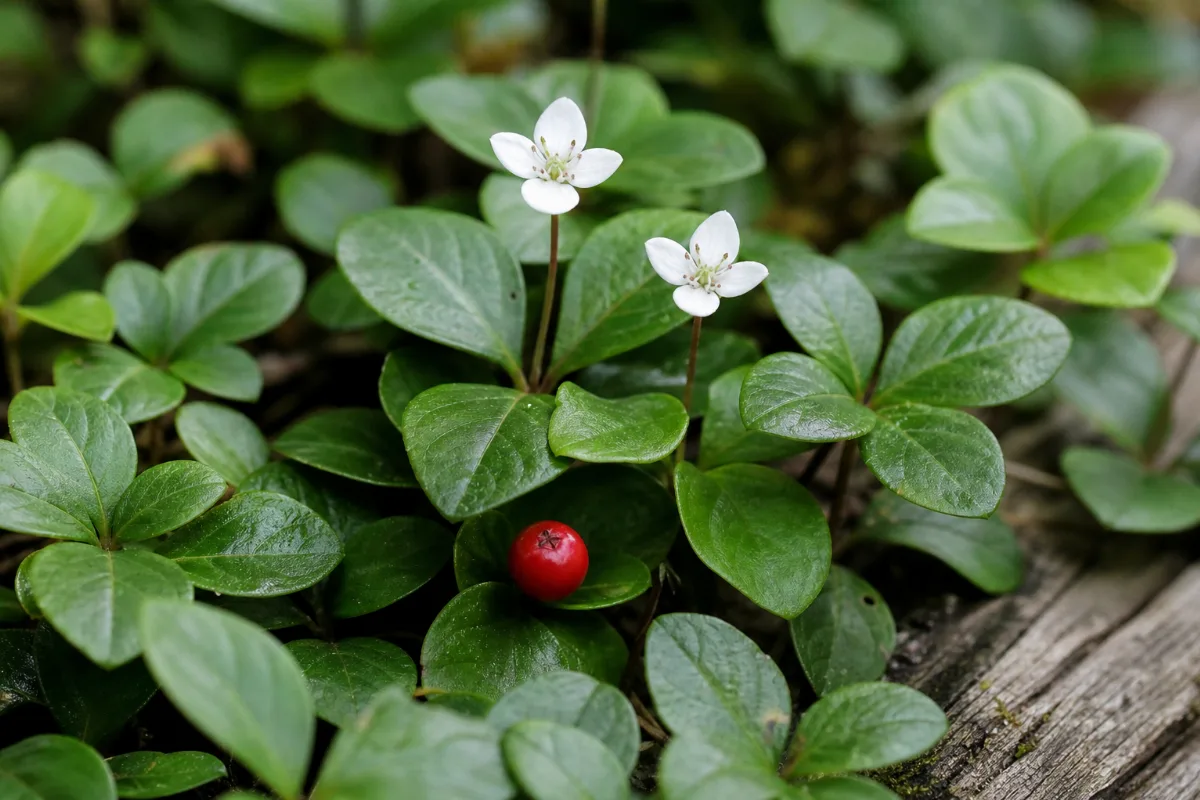
Partridgeberry is a low, creeping evergreen of eastern North America with paired white flowers and red berries. It is in the madder family (Rubiaceae). The leaves and stems are the part sold as medicine.
Do not confuse it with wintergreen or teaberry (Gaultheria procumbens), a different plant in a different family. The name 'partridge berry' is used for other plants in some regions, so check the Latin name.
Historical and current uses
Midwives and herbalists have used it to prepare for labor, and Wikipedia reports that Indigenous American women made a tea of the leaves and berries for childbirth (not verified against a primary source). It is also used for menstrual problems and sore nipples.
The authors of the 2021 mouse study say these claims rest mainly on tradition, with very little research behind them.
What the research shows
We found no clinical trial. The one experiment on its main traditional use used isolated womb tissue from 18 mice. A water extract made it contract, on average about 80% as much as oxytocin did. That is a lab result, with very small numbers, and it does not show the herb works or is safe in women.
A test-tube study ranked it second-weakest of five obstetric plants for antioxidant activity.
At a glance
Traditional uses history, not proof
- Native American and midwifery tradition: tea of leaves (and berries) used in late pregnancy and during childbirth
- Also used traditionally for menstrual problems, water retention, diarrhea and sore nipples
Studied for research
- Late-pregnancy and labor preparation: insufficient evidence (tradition only)
- Womb muscle contraction: mouse tissue in a dish only
- Menstrual problems, anxiety, postpartum depression and others: insufficient evidence
Main compounds
- Saponins (suggested by one study, not identified)
- Monoterpenes in the flower scent (plant biology; not a health finding)
Common forms
- Dried leaves and stems, tea or infusion
- Capsules or tablets
- Liquid extracts or tinctures
- None has been tested in people
Research links: Mouse uterine tissue study (JMPS 2021) · Free radical test of obstetric infusions (Plants 2021) · Flower scent study (2024) · RxList squawvine page · Research Library · Genes & Biomarkers Library
The plant and its history
- Accepted scientific name
- Mitchella repens L.
- Naming authority
- L.
- Common names
- Partridgeberry (English); Partridge berry (English); Twinberry (English); Squawvine (older name, considered offensive by many) (English); Checkerberry (English); Deerberry (English); Running box (English); Winter clover (English)
- Botanical family
- Rubiaceae (madder or coffee family).
- Classification
- Plantae > not checked > not checked > not checked > Rubiaceae > Mitchella > Mitchella repens
- Native range
- Eastern North America (Grennan 2024 abstract); Wikipedia (not verified) adds eastern Canada south to Florida, Texas and Guatemala.
- Habitat
- A creeping, understory forest plant (Grennan 2024). Wikipedia: dry or moist woods and stream banks (not verified).
- What the plant looks like
- Roots: Not verified.; Stems: Creeping, ground-hugging (Grennan 2024 calls it a creeping plant).; Leaves: Not verified in a source read. Leaves and stems are the part used as medicine (RxList).; Flowers: Twinned, tubular, bright white flowers; two flower forms (distylous), and insects must carry pollen between them (Grennan 2024).; Fruit: Red berry (Wikipedia, not verified): edible but tasteless.
- Cultivation
- Not verified. Wikipedia says it is grown as an ornamental and over-collecting has hurt some wild populations.
- Harvest and processing
- Not verified.
- Look-alikes and adulterants
- Name: Wintergreen or teaberry (Gaultheria procumbens L.); Note: A different plant, family Ericaceae (GBIF). Sometimes also called partridge berry in some regions; not verified in a primary source. Do not swap.; Name: Other plants called partridgeberry; Note: Regional names vary; check the Latin name.
- Sustainability and conservation
- Not assessed; Wikipedia mentions local over-collection (not verified).
Traditional use and history history, not clinical proof
| Tradition or era | Documented use | Source |
|---|---|---|
| Native American and midwifery tradition | Tea of leaves and berries used during childbirth; leaves and stems used for pregnancy, labor readiness and women's complaints. | s-wikipedia |
| Midwifery and herbal practice | Described as an herbal with a long history for female reproductive concerns, documented mainly in traditional medicine and midwifery. Very little empirical research supports the claims (authors' statement). | s-jmps-2021 |
Traditional use shows how a plant was used. It does not show that a supplement works or is safe today.
What is inside, and how it may work
What the plant contains and how those compounds act in cells and animals. Laboratory and animal mechanisms are not proven effects in people.
Main compounds
| Compound | Family | Where it is concentrated | Activity studied | Level of evidence |
|---|---|---|---|---|
| Saponins (unidentified) | saponin | leaves and stems (water extract) not reported | Suggested by the 2021 mouse-tissue authors to be involved in the contractions; not tested or identified. 2 | Speculation |
| Alpha-pinene, camphene, D-limonene, verbenone | monoterpenes (flower scent) | flowers not reported | Flower scent compounds that attract insects. Not studied for health effects here. Not the leaf or berry chemistry. 1 | Plant biology |
Mechanisms, receptors and pathways
| Target or pathway | Gene or receptor | What was found | Level |
|---|---|---|---|
| Uterine smooth muscle contraction | not established | A water extract made isolated mouse uterine tissue contract, about 80% of the oxytocin response on average. Not shown in people. 2 | Lab/animal tissue |
| Free-radical scavenging | not applicable | Weak and slow in a test tube compared with four other plants. 3 | In vitro |
Absorption, metabolism and elimination
- Absorption
- No data found.
- Distribution
- No data found.
- Metabolism
- No data found.
- Elimination
- No data found.
- Bioavailability
- Not established.
Isolated compounds versus whole extracts
No compound has been isolated and tested. The only experiment used a whole-herb water extract.
Nutritional composition
A nutrient table is not meaningful here; no composition data for the leaves or berries was read.
7 not enough evidence
What was looked at
The 7 benefits and uses checked for Partridgeberry, each with how strong the evidence is. Tap one to open it.
- Late-pregnancy and labor preparation (traditional use)Not enough evidence
- Contracting womb muscle (mouse tissue in a dish)Not enough evidence
- Menstrual problems and other women's complaints (traditional use)Not enough evidence
- Anxiety and depression after childbirth (traditional use)Not enough evidence
- Antioxidant activity (test tube only)Not enough evidence
- Water retention, diarrhea, heart and kidney complaints (traditional use)Not enough evidence
- Sore nipples when applied to the skin (traditional use)Not enough evidence
What is Partridgeberry good for?
The traditional uses and how strong the human evidence is for each. For partridgeberry the honest answer is: none is supported by human research.
Benefits, one by one
Each card is a research question, not a promise. Tap a goal to filter. Open a card to see the studies, doses and limits.
Late-pregnancy and labor preparation (traditional use)
Not enough evidencePartridgeberry leaves and stems have long been used in midwifery and Native American traditions to prepare the womb for labor. We found no trial in pregnant women. The only experiment is a small 2021 dish study on mouse womb tissue. This is tradition, not proof, and the same herb is called unsafe in pregnancy by one drug reference.
3 studiesDried leaves and stems, tea, capsules and liquid extracts are all sol…
Studies, doses and limits
What the trials found
None found. A Europe PMC and PubMed search for Mitchella repens returned no human trial of any use (search of 4 PubMed records plus our earlier Europe PMC check).
Results
No human results.
Effect sizes as reported
None.
Why this rating
Tradition only; no human study of benefit or of safety.
Form and dose studied
Dried leaves and stems, tea, capsules and liquid extracts are all sold. No studied human product or amount. Ask a midwife, doctor or pharmacist about amounts.
Who was studied
No pregnant women studied.
Limits
We read one full paper (mouse tissue), one abstract-level record and one drug reference. We did not read herbalist books.
Why researchers looked
It is one of the best-known traditional 'womb tonic' herbs in North American herbal practice.
Traditional use
Wikipedia (not verified against a primary source) says Indigenous American women made a tea of the leaves and berries for use during childbirth. The 2021 mouse-tissue paper says the herb has a long history for pregnancy, readiness for labor and labor itself, mainly from traditional medicine and midwifery, with very little research behind it.
Proposed mechanism Preliminary mechanism
Unknown in people. The 2021 mouse paper suggests saponins may be involved but did not identify the compounds.
A proposed mechanism does not show that the effect happens in people.
One consumer drug reference (RxList) calls use in pregnancy unsafe and says some evidence suggests it might cause a miscarriage, but cites no study. Herbalists differ on timing. Do not use in pregnancy without guidance from a midwife or doctor.
Contracting womb muscle (mouse tissue in a dish)
Not enough evidenceIn a 2021 experiment, a water extract made the isolated womb muscle of mice contract strongly, on average about 80% as strongly as it responded to oxytocin. This was tissue in a bath, from 18 mice, with only 2 to 4 pieces of tissue at each strength. It does not show what the herb does in a pregnant woman.
1 studiesWater extract of commercial herb in a lab bath; not tea made for drin…
Studies, doses and limits
What the trials found
None. Horner & DeGolier 2021: ground commercial herb (leaves and stems) boiled in water, filtered, added to isolated uterine horns from 18 virgin female mice that had been primed with an estrogen-like drug.
Results
Contractions began at 0.19 mg/mL and above, were stronger than the tissue's own movement (p < 0.0001) and averaged 80.45% (SEM 6.12) of the oxytocin response (14 tissues). Contractions faded rather than holding steady like oxytocin.
Effect sizes as reported
About 80% of oxytocin response in the dish.
Why this rating
Dish study in mouse tissue; cannot show benefit or safety in women.
Form and dose studied
Water extract of commercial herb in a lab bath; not tea made for drinking.
Who was studied
Mouse tissue only.
Limits
Very small numbers, tissue primed with an estrogen-like drug, one product, a lesser-known journal. The authors say the contractions 'may still' point to effects in the whole body; that is their view, not shown.
Why researchers looked
Midwives have claimed it tones the womb. This paper tested that claim in the simplest possible way.
Traditional use
See late-pregnancy preparation.
Proposed mechanism Lab
Muscle contractions in isolated tissue. The authors think saponins in the extract may be involved but did not test this.
A proposed mechanism does not show that the effect happens in people.
The result is also a reason for caution: a herb that makes womb tissue contract in the lab might matter in pregnancy. This is a possibility, not shown in people.
Menstrual problems and other women's complaints (traditional use)
Not enough evidencePartridgeberry is used traditionally for menstrual problems, vaginal discharge, fibrocystic breasts and to ease childbirth. We found no trial for any of these.
1 studiesNot applicable. Ask a doctor or pharmacist about amounts.
Studies, doses and limits
What the trials found
None found.
Results
No human results.
Effect sizes as reported
None.
Why this rating
No trials found.
Form and dose studied
Not applicable. Ask a doctor or pharmacist about amounts.
Who was studied
None studied.
Limits
Drug reference and search only; no herbalist books read.
Why researchers looked
Part of its traditional reputation as a herb for women.
Traditional use
RxList lists menstrual disorders, lumpy breasts, vaginal discharge, easing childbirth and improving breast-milk flow as ways it is used, and rates menstrual disorders 'insufficient evidence to rate'.
Proposed mechanism None
Not known. RxList says there is not enough information to know how it works.
A proposed mechanism does not show that the effect happens in people.
Heavy, painful or irregular periods need a proper diagnosis. Do not rely on an unstudied herb.
Anxiety and depression after childbirth (traditional use)
Not enough evidenceSome herbal sources list anxiety and postpartum depression as uses. There is no human study. If you feel very low or anxious after a baby, talk to a doctor or midwife.
1 studiesNot applicable.
Studies, doses and limits
What the trials found
None found.
Results
No human results.
Effect sizes as reported
None.
Why this rating
No studies found.
Form and dose studied
Not applicable.
Who was studied
None studied.
Limits
One drug reference only.
Why researchers looked
Listed as a traditional use by one drug reference.
Traditional use
RxList lists anxiety and 'depression after childbirth' under 'insufficient evidence to rate'.
Proposed mechanism None
Not known.
A proposed mechanism does not show that the effect happens in people.
Postpartum depression is treatable. Do not delay seeing a doctor. Breastfeeding is a reason to avoid the herb (see safety).
Antioxidant activity (test tube only)
Not enough evidenceIn a 2021 test-tube comparison of five plants used in obstetrics, partridgeberry herb infusion came second-weakest at mopping up free radicals and reacted most slowly. This does not show a benefit in people.
1 studiesInfusion of herb in the lab.
Studies, doses and limits
What the trials found
None. Jarco 2021 (p34685825) tested an infusion of Mitchella repens herb against a model free radical.
Results
Second-weakest of five infusions; slowest reaction. UVA light lowered activity of all infusions.
Effect sizes as reported
No numbers given in the abstract.
Why this rating
Test tube only.
Form and dose studied
Infusion of herb in the lab.
Who was studied
None.
Limits
Abstract only.
Why researchers looked
Researchers compared plant infusions used in obstetric care.
Traditional use
Not a traditional use.
Proposed mechanism Lab
Free-radical scavenging measured by EPR spectroscopy in a test tube.
A proposed mechanism does not show that the effect happens in people.
None specific.
Water retention, diarrhea, heart and kidney complaints (traditional use)
Not enough evidenceOne drug reference lists water retention, diarrhea, colitis, varicose veins, heart failure and kidney failure among the uses people try. It rates the ones it names as 'insufficient evidence to rate'. We found no trial. Heart and kidney failure need a doctor, and an unstudied herb is not a safe substitute.
1 studiesNot applicable.
Studies, doses and limits
What the trials found
None found.
Results
No human results.
Effect sizes as reported
None.
Why this rating
No studies.
Form and dose studied
Not applicable.
Who was studied
None studied.
Limits
One drug reference.
Why researchers looked
Listed as traditional uses.
Traditional use
From the RxList overview of how people use stem and leaf.
Proposed mechanism None
Not known.
A proposed mechanism does not show that the effect happens in people.
Tell your doctor if you use any herb while having heart or kidney disease or taking water pills.
Sore nipples when applied to the skin (traditional use)
Not enough evidenceSome women apply it to the skin for sore nipples while breastfeeding. No study was found, and RxList says there is not enough information to know whether it is safe on the skin. Breastfeeding mothers are advised to avoid the herb by mouth.
1 studiesNot applicable.
Studies, doses and limits
What the trials found
None found.
Results
No human results.
Effect sizes as reported
None.
Why this rating
No studies.
Form and dose studied
Not applicable.
Who was studied
None studied.
Limits
One drug reference.
Why researchers looked
Listed use.
Traditional use
RxList.
Proposed mechanism None
Not known.
A proposed mechanism does not show that the effect happens in people.
Anything on the nipple can reach the baby. Ask a midwife or lactation consultant first.
Connections to the rest of health
How Partridgeberry connects to the rest of our health knowledge graph. Every link says what kind of connection it is. A safety link (for example to the liver) is a warning, not a benefit. A study that merely mentions a topic never creates a benefit link.
Explore every connection: goals, body systems, organs, symptoms, genes
A. Wellness goals
| Connected to | Kind of connection | Evidence status | Context | Studies |
|---|---|---|---|---|
| Womens Wellness | Traditional use | Not enough evidence | Late-pregnancy and labor preparation (traditional use): Partridgeberry leaves and stems have long been used in midwifery and Native American traditions to prepare the womb for labor. We found no trial in pregnant women. The only experiment is a small 2021 dish study on mouse womb tissue. This is tradition, not proof, and the same herb is called unsafe in pregnancy by one drug reference. Menstrual problems and other women's complaints (traditional use): Partridgeberry is used traditionally for menstrual problems, vaginal discharge, fibrocystic breasts and to ease childbirth. We found no trial for any of these. | 2 6 7 |
| Womens Wellness | Not enough evidence | Contracting womb muscle (mouse tissue in a dish): In a 2021 experiment, a water extract made the isolated womb muscle of mice contract strongly, on average about 80% as strongly as it responded to oxytocin. This was tissue in a bath, from 18 mice, with only 2 to 4 pieces of tissue at each strength. It does not show what the herb does in a pregnant woman. | 2 | |
| Anxiety Support | Traditional use | Not enough evidence | Anxiety and depression after childbirth (traditional use): Some herbal sources list anxiety and postpartum depression as uses. There is no human study. If you feel very low or anxious after a baby, talk to a doctor or midwife. | 6 |
| Calm Relaxation | Traditional use | Not enough evidence | Anxiety and depression after childbirth (traditional use): Some herbal sources list anxiety and postpartum depression as uses. There is no human study. If you feel very low or anxious after a baby, talk to a doctor or midwife. | 6 |
| Cellular Protection | Not enough evidence | Antioxidant activity (test tube only): In a 2021 test-tube comparison of five plants used in obstetrics, partridgeberry herb infusion came second-weakest at mopping up free radicals and reacted most slowly. This does not show a benefit in people. | 3 |
B. Body systems
| Connected to | Kind of connection | Evidence status | Context | Studies |
|---|---|---|---|---|
| Reproductive Health | Biological association | Not enough evidence | Studied for: Late-pregnancy and labor preparation (traditional use) Studied for: Menstrual problems and other women's complaints (traditional use) | 2 6 7 |
| Reproductive System | Biological association | Not enough evidence | Studied for: Contracting womb muscle (mouse tissue in a dish) | 2 |
| Stress Mood | Biological association | Not enough evidence | Studied for: Anxiety and depression after childbirth (traditional use) | 6 |
E. Health conditions
| Connected to | Kind of connection | Evidence status | Context | Studies |
|---|---|---|---|---|
| Pregnancy | Precautionary | Drug reference calls it unsafe; mouse tissue contracted in a dish. Drug reference calls it unsafe; no human study. Preparation or compound: Leaves and stems (water extract in lab) |
6 2 | |
| Miscarriage | Precautionary | RxList says some evidence suggests it might; no study cited. Preparation or compound: Leaves and stems |
6 |
L. Active compounds
| Connected to | Kind of connection | Evidence status | Context | Studies |
|---|---|---|---|---|
| Saponins (unidentified) | Biological association | Speculation | Suggested by the 2021 mouse-tissue authors to be involved in the contractions; not tested or identified. Preparation or compound: leaves and stems (water extract) |
2 |
| Alpha-pinene, camphene, D-limonene, verbenone | Biological association | Plant biology | Flower scent compounds that attract insects. Not studied for health effects here. Not the leaf or berry chemistry. Preparation or compound: flowers |
1 |
Each connection is stored with the ingredient, the connected record, the kind of connection, the evidence status, the supporting studies, the preparation or compound involved, and a review date (last reviewed October 25, 2026).
The evidence
The research centre for Partridgeberry. Every record here was checked against PubMed or the publisher's page; we never list a study we have not verified.
Evidence by outcome
Bars show how many studies we found for each outcome, not how well it works. People are added up across trials only (reviews are not added, to avoid double counting).
How we rate evidence
High certainty
Several well-run trials or reviews agree; further research is unlikely to change the picture much.
Moderate certainty
Good trials point the same way, but some doubt remains.
Low certainty
Small, short or inconsistent trials. The finding could change with better research.
Very low certainty
Very little or very weak human data. Treat as a possibility only.
Mixed findings
Trials or reviews disagree with each other.
Not enough evidence
Not enough human research to say either way.
Evidence against
Good research found no benefit, or found harm.
We take the reviewers' own risk-of-bias and GRADE statements where they exist, and otherwise judge from study size, design, consistency, directness and whether a product matches what is sold. Many publications do not make evidence high. Method note: We searched PubMed for Mitchella repens, read the one mouse-tissue paper in full, and checked GBIF, RxList and Wikipedia. Evidence is extremely sparse and we say so. No study is cited that we could not verify.
Study library: every study we checked 7
| Study | Design | People | Product, dose, length | Result |
|---|---|---|---|---|
| Grennan 2024 Floral Volatile Organic Compounds of Mitchella repens (Rubiaceae) Plant Environ Interact · PMID 39678448 · DOI |
Plant biology plant |
Partridgeberry flowers (plant biology study) | Headspace analysis of flower scent compounds flowers not extracted not extracted · vs see results |
Describes the plant as a creeping, understory plant native to eastern North America with twinned white flowers. 27 scent compounds found, mostly monoterpenes; the main four were alpha-pinene, camphene, D-limonene and verbenone. not applicable (not applicable) Methods, limits and fundingOutcomes: Scent compounds of the flowers and visiting insects Limitations: A plant-pollination study of the flower scent. Not about health or the leaves and berries. Funding and conflicts: Authors declare no conflicts of interest. Read: abstract |
| Horner 2021 Mitchella repens (Partridge Berry) contracts uterine smooth muscle in isolated mouse tissues Journal of Medicinal Plants Studies 9(3):123-128 · Source |
Animal study animal |
18 Isolated uterine horns from 18 virgin female mice (outbred ICR/CD-1), primed with the estrogen-like drug diethylstilbestrol |
Water extract of ground commercial Mitchella repens herb (leaves and stems), added to the organ bath leaves and stems six concentrations tested, 0.045 to 1.44 mg per mL of bath 10 minutes per application · vs the tissue's own spontaneous motility and an oxytocin positive control |
Increases in contractile force appeared from 0.19 mg/mL upward, greater than the tissue's own spontaneous motility (p < 0.0001), and on average 80.45% (SEM 6.12) of each tissue's oxytocin response (n=14 tissues). The authors suggest saponins may be involved but did not identify the compounds. About 80% of the oxytocin response in isolated mouse tissue (not reported (mean 80.45 +/- 6.12 SEM)) Methods, limits and fundingOutcomes: Contractile force of isolated uterine tissue Limitations: Isolated mouse tissue in a dish, tiny numbers per concentration (2 to 4), tissue primed with an estrogen-like drug, a single supplier's product, an extract not made like tea for drinking, small journal. Cannot show an effect, benefit or safety in pregnant women. Funding and conflicts: not read Read: full-text |
| Jarco 2021 Free Radical Scavenging Activity of Infusions of Different Medicinal Plants for Use in Obstetrics Plants (Basel) · PMID 34685825 · DOI |
Laboratory research in vitro |
Test-tube infusions of five plant materials | Infusions of Mitchella repens herb and four other obstetric plants, tested by electron paramagnetic resonance (EPR) with a model free radical herb not extracted not extracted · vs see results |
Order of scavenging ability from weakest to strongest: Asparagus racemosus root, then Mitchella repens herb, then three others. The Mitchella infusion reacted with free radicals the slowest. UVA light reduced the antioxidant activity of all the infusions. Second-weakest of five in the test; slowest reaction (not applicable) Methods, limits and fundingOutcomes: Free-radical scavenging strength and speed, with and without UVA light Limitations: Test-tube chemistry only. Says nothing about effects in the body. Funding and conflicts: Authors declare no conflict of interest. Read: abstract |
| s-gbif-gaultheria GBIF species match: Gaultheria procumbens L. · Source |
Reference database n/a |
Methods, limits and fundingRead: full-text | ||
| s-gbif-mitchella GBIF species match: Mitchella repens L. · Source |
Reference database n/a |
Methods, limits and fundingRead: full-text | ||
| s-rxlist Squawvine (Mitchella repens): Health Benefits, Side Effects, Uses, Dose and Precautions (RxList) · Source |
Consumer drug reference n/a |
Methods, limits and fundingRead: full-text | ||
| s-wikipedia Wikipedia: Mitchella repens · Source |
Encyclopedia n/a |
Methods, limits and fundingRead: full-text |
What we do not know yet
- No human trial of any use was found.
- The only experiment on pregnancy-related use is one small mouse-tissue study.
- No safety data for pregnancy, breastfeeding, children, liver, interactions or hormone-sensitive conditions.
- The drug reference's miscarriage statement cites no study we could find.
- Leaf and berry chemistry was not found.
- NCCIH, LiverTox, LactMed, EMA/HMPC and WHO records were not found or not checked in detail.
How new research is added
New studies are found by a saved PubMed search and are placed in a review queue. A person reads each one before it changes any evidence rating or safety wording.
Lab markers
What changed in blood or saliva tests during trials. A changed number is not the same as feeling or being healthier, and we give no "normal ranges".
Safety
What studies and official sources say about side effects, medicines and who should check first. Each point shows what kind of evidence it comes from.
Main points to know 4
- Pregnancy: the traditional late-pregnancy use is unproven, and safety is unknown. Partridgeberry is traditionally taken in late pregnancy to prepare for labor. What is known: one consumer drug reference (RxList) calls it unsafe in pregnancy and says some evidence suggests it might cause a miscarriage, but cites no study; and in a 2021 dish experiment a water extract made mouse womb muscle contract strongly. What is not known: whether it helps or harms pregnant women at any stage, as no human study was found. Herbalists disagree on timing. Talk to a midwife or doctor before any use in pregnancy. Expert precaution 6 2
- Breastfeeding: avoid, because nothing is known. RxList advises avoiding it while breastfeeding because the effect on a nursing baby is not understood. No LactMed entry was found. This is lack of data, not proof of harm. Expert precaution 6
- Different plants share the name partridgeberry. Mitchella repens is in the madder family (Rubiaceae). Wintergreen or teaberry (Gaultheria procumbens) is a different plant in the heath family (Ericaceae), and sources, including Wikipedia, note that 'partridge berry' is also used for other plants in Canada. They should not be swapped. Check the Latin name on any label. Reference database 5 4 7
- Almost nothing else is known about safety. No studies of side effects, liver safety, interactions, hormone-sensitive conditions or use in children were found. RxList says it seems safe for most people by mouth, but gives no data. 'No known problems' here means 'not studied'. Expert precaution 6
Side effects 3
| Effect | How often | Severity and recovery | Evidence |
|---|---|---|---|
| Possible womb contractions or miscarriage in pregnancy Mouse tissue in a dish, plus an uncited statement in a drug reference. No human case report found. | Not established | potentially serious unknown | Lab 2 6 |
| Stomach upset, constipation or other digestive effects Herbs rich in tannins can bother the stomach, but we found no source that measured tannins in partridgeberry or reported digestive side effects in people. Not verified. | Not established | unknown unknown | None |
| Allergic reaction No reports found. Stop and seek care for hives, swelling or trouble breathing after any herb. | Not established | unknown unknown | None |
Liver
No liver injury case, LiverTox entry or liver study was found for Mitchella repens. This is absence of data, not proof of safety.
How often. Unknown.
Monitoring. No agency advice found. Tell a doctor about any herb if you have liver disease.
This is a safety connection. It is not evidence that Partridgeberry supports liver health.
Medicines and supplements 2
| With | Why it matters | Importance | Evidence | What to do |
|---|---|---|---|---|
| Oxytocin, labor-inducing or labor-slowing medicines in hospital prescription | In a mouse-tissue dish the extract made womb muscle contract. Never tested alongside these medicines. | Theoretical. Unknown in people. | Lab Not enough evidence 2 | Tell your midwife and doctor if you have used it near term. |
| Any medicine or herb general | RxList lists no known interactions; this appears to reflect lack of study. | Unknown. | Reference database Not enough evidence 6 | Ask a pharmacist before combining it with medicines. Herbs high in tannins can bind some oral medicines in the gut, but this was not studied for partridgeberry. |
Who should check first 4
| Situation | Advice | Evidence |
|---|---|---|
| Pregnancy | Avoid unless a midwife or doctor who knows your situation advises otherwise. The traditional late-pregnancy use is unproven and safety is unknown. | Expert precaution 6 2 |
| Breastfeeding | Avoid; not enough is known. | Expert precaution 6 |
| Hormone-sensitive conditions (for example some breast, womb or ovarian conditions, endometriosis or fibroids) | No study checked this. The 2021 mouse tissue was primed with an estrogen-like drug, but nothing shows the herb has hormone effects in people. Ask your doctor first. | Expert precaution 2 |
| Children | No safety data found; do not give it. | Expert precaution |
Overdose, product quality and regulators
Summary. No toxicity study, poisoning report or toxic dose was found. The berries are described by Wikipedia as edible but tasteless (not verified).
Animal. Only the dish experiment on mouse womb tissue, which is not a toxicity test.
Human doses studied. None.
High dose or long term signals. Not studied.
Overdose response. Not known.
Genotoxicity. Not found.
Toxic plant parts. None identified in the sources read.
No contamination or adulteration testing of partridgeberry products was found. The wild plant is sometimes over-collected (Wikipedia, not verified), which is a reason to ask where a product comes from.
Species confusion. Mitchella repens (Rubiaceae) and Gaultheria procumbens (Ericaceae) are different plants in the GBIF database, but common names such as partridgeberry can refer to more than one. 5 4
| Body | Action | Date |
|---|
When to get medical help
- Vaginal bleeding, cramping, fluid leaking or less baby movement in pregnancy: contact your midwife or doctor or go to hospital now.
- Hives, swelling of the face or throat, or trouble breathing after taking it: seek emergency care.
- Severe vomiting or stomach pain that does not settle.
Stop the supplement and contact a clinician or emergency service. In the US, Poison Control is 1-800-222-1222.
General information only, not medical advice. Ask a clinician or pharmacist before use, especially with medicines, in pregnancy or with a health condition. See the Natural Remedy Safety guide.
Frequently asked questions
What is partridgeberry used for?
Is partridgeberry safe in pregnancy?
Nobody knows. No human study was found. One drug reference calls it unsafe and says it might cause a miscarriage but cites no study. Talk to a midwife or doctor before any use.
Does partridgeberry bring on labor?
This is not shown. A 2021 dish experiment found a water extract made mouse womb tissue contract. That does not show it brings on labor in women.
Is there any human research on it?
Is it safe while breastfeeding?
Not enough is known, so a drug reference advises avoiding it. No LactMed entry was found.
Is partridgeberry the same as teaberry or wintergreen?
Can it affect hormone-sensitive conditions?
It has not been studied. Nothing shows it acts like a hormone in people. If you have a hormone-sensitive condition, ask your doctor first.
Does it cause stomach upset?
We found no study of side effects. Herbs with tannins can upset some stomachs, but we did not find tannin data for partridgeberry.
Does it interact with medicines?
No interactions are listed, which appears to reflect lack of study. Tell your pharmacist and midwife about any use.
Does it help anxiety or postpartum depression?
It is listed as a traditional use, but no human study was found. Talk to a doctor or midwife if you feel low or anxious after birth.
Why do some sources call it squawvine?
That is an older common name that many people consider offensive. Partridgeberry is used here.
Where should I ask about amounts?
No amounts have been established. Ask a midwife, doctor or pharmacist.
Explore by health goal
Womens WellnessAnxiety SupportCalm RelaxationCellular Protection
Editorial transparency
- Written by
- AlternativeMed editorial team. Research compiled with AI assistance, then checked against PubMed records.
- Medical review
- None. This page has not been reviewed by a physician or pharmacist.
- First published
- 2026-10-25
- Last substantive update
- 2026-10-25
- How we research
- We searched PubMed for Mitchella repens, read the one mouse-tissue paper in full, and checked GBIF, RxList and Wikipedia. Evidence is extremely sparse and we say so. No study is cited that we could not verify.
- How we rate evidence
- See "How we rate evidence" in the Evidence tab.
- Independence
- No product is promoted on this page. No affiliate links are shown. If one is added later it will be labelled and kept apart from the evidence.
Sources 7
Each source was opened and checked. Where we read only the abstract, it says so. The small numbers in the text point here.
- Grennan AK, Murphy KC, Fowler M, Bengtson A, Turner J, Horan L, Fitzpatrick J, Desilets L. Floral Volatile Organic Compounds of Mitchella repens (Rubiaceae). Plant Environ Interact. 2024. PMID 39678448. DOI 10.1002/pei3.70022. (abstract)
- Horner S, DeGolier T. Mitchella repens (Partridge Berry) contracts uterine smooth muscle in isolated mouse tissues. Journal of Medicinal Plants Studies 9(3):123-128. 2021. (full-text)
- Jarco S, Pilawa B, Ramos P. Free Radical Scavenging Activity of Infusions of Different Medicinal Plants for Use in Obstetrics. Plants (Basel). 2021. PMID 34685825. DOI 10.3390/plants10102016. (abstract)
- . GBIF species match: Gaultheria procumbens L.. . . (full-text)
- . GBIF species match: Mitchella repens L.. . . (full-text)
- . Squawvine (Mitchella repens): Health Benefits, Side Effects, Uses, Dose and Precautions (RxList). . . (full-text)
- . Wikipedia: Mitchella repens. . . (full-text)