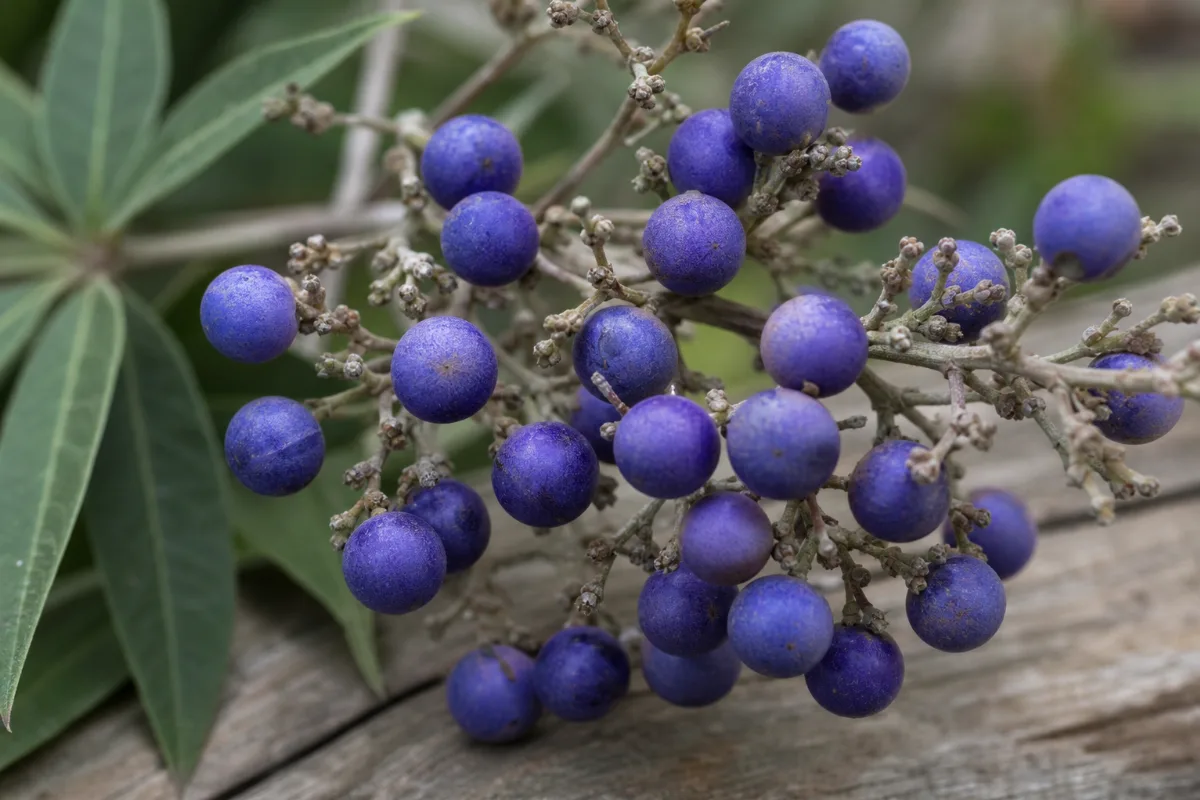
Herbs & Botanicals · Herbs · Mediterranean shrub used for PMS and period problems, with low-certainty evidence
Chasteberry
Vitex agnus-castus L. · also called Chasteberry, chaste tree, monk's pepper, lilac chaste tree, vitex, sauzgatillo and árbol casto (Spanish), gattilier and poivre des moines (French), Mönchspfeffer (German)
Chasteberry is the dried fruit of a Mediterranean shrub of the mint family, made into extracts that Europeans have long used for premenstrual and period-related complaints. It is the best-studied herb for PMS, yet nothing is rated above low certainty: PMS overall, premenstrual mood, cyclical breast pain, mildly raised prolactin, irregular periods, luteal phase problems and PCOS are low, severe PMS (PMDD) is very low, and menstrual bleeding, hot flashes, breastfeeding and bone are insufficient. One review's very large pooled effect for PMS is called likely overestimated by its own authors. Side effects in trials were mild, but it should be avoided in pregnancy and breastfeeding, and people with hormone-sensitive conditions should ask a doctor first.
General information, not medical advice. Last substantive update · Not medically reviewed. A named clinician has not signed off on this page. How this page is made
About Chasteberry
Chasteberry (Vitex agnus-castus), also called chaste tree or monk's pepper, is a Mediterranean shrub whose dried fruit is made into extracts used in Europe for premenstrual and period-related complaints. Nothing is rated above low certainty. PMS overall, premenstrual mood, cyclical breast pain, mildly raised prolactin, irregular periods, luteal phase problems and PCOS are low; severe PMS (PMDD) is very low; menstrual bleeding, hot flashes, breastfeeding and bone are insufficient. The biggest pooled PMS result is called likely overestimated by its own authors. Side effects in trials were mild, but it should be avoided in pregnancy and breastfeeding, and people with hormone-sensitive conditions or on hormone or dopamine medicines should ask a doctor first. For amounts, ask a doctor or pharmacist.
What it is
Chasteberry (Vitex agnus-castus) is a shrub or small tree of the mint family (Lamiaceae), native to the Mediterranean, central Asia and parts of India. The part used is the ripe, dried fruit, often called the berry. The names "agnus" and "castus" both mean chaste, from the old belief that it reduced sexual desire.
Trials mostly use standardised extracts, chiefly Ze 440 and BNO 1095, and results for one extract should not be assumed for another. A related plant, Vitex negundo (Chinese chaste tree), is a different species, and a Japanese study suspected one supplement of containing it.
Traditional and current uses
The EU assessment says the fruit has been used for centuries for women's complaints such as premenstrual syndrome, and mentions the plant in Ancient Greece. Persian traditional medicine used it to reduce an excess of breast milk, according to LactMed. Which exact traditions and texts are behind these statements was not checked.
Today it is sold mainly for PMS, breast tenderness and irregular periods. German medicines made from the fruit have been on the market since the 1970s, and in 2018 the EU herbal committee accepted a well-established-use indication for PMS for one specific dry extract and a traditional-use indication for other preparations.
What is in it and how it works
The fruit holds fat-soluble diterpenes, flavonoids such as casticin and apigenin, iridoids such as agnuside and aucubin, and an aromatic oil. In cells, some diterpenes switch on the dopamine D2 receptor, which can lower the hormone prolactin. This is the strongest lab finding, but the lab concentrations are high and no one has shown it working in women.
The EMA concludes that a reduction of raised prolactin by the fruit has not been conclusively proven in people. Other lab findings, such as opioid-receptor and estrogen-receptor binding, are mixed between laboratories and unproven in people. Several key mechanism papers came from authors linked to extract makers.
What the research shows
PMS is the best-studied use and is rated low: most placebo-controlled trials of Ze 440 and BNO 1095 beat placebo, but many trials are weak, placebo groups improve a lot, and the authors of the largest pooled analysis say its very large effect is probably too high. Premenstrual mood and cyclical breast pain are also low, and severe PMS (PMDD) is very low. Some papers describe the same trial and are counted once: the two Ma 2010 reports and the Halaska 1998 and 1999 reports.
Fertility, prolactin, irregular periods and PCOS are low, and thin: the only single-herb placebo trial for luteal phase problems analysed 37 women, and most fertility and hot flash trials used multi-herb mixes, so chasteberry cannot be credited alone. A meta-analysis found no effect on menstrual bleeding, and hot flashes, breastfeeding and bone are insufficient.
At a glance
Traditional uses history, not proof
- European medicine: the EU herbal assessment says the fruit has been used for centuries for women's complaints such as premenstrual syndrome, and mentions the plant in Ancient Greece.
- Persian traditional medicine: used to reduce an excess of breast milk, according to LactMed.
- Modern use: standardised extracts sold for PMS, breast tenderness and irregular periods.
Studied for research
- PMS overall, premenstrual mood and physical symptoms, cyclical breast pain, low
- Mildly raised prolactin, luteal phase problems and fertility, irregular periods and PCOS, low (thin; most fertility trials use multi-herb mixes)
- Severe PMS (PMDD), premenstrual anxiety and sleep, very low
- Menstrual bleeding, hot flashes, breastfeeding, bone and teenagers, insufficient evidence
Main compounds
- Diterpenes such as rotundifuran and viteagnusin I, linked to dopamine receptor activity in cells
- Flavonoids such as casticin, apigenin and vitexin
- Iridoids such as agnuside and aucubin, and an aromatic oil rich in 1,8-cineole and sabinene
Common forms
- Standardised dry extracts used in trials (for example Ze 440 and BNO 1095)
- Tinctures made with alcohol
- Powdered fruit
- Mixed women's-health products
Research links: US National Center for Complementary and Integrative Health: Chasteberry · EU herbal monograph on Vitex agnus-castus fruit (European Medicines Agency) · EU assessment report on Vitex agnus-castus fruit (European Medicines Agency) · Vitex agnus-castus for PMS: systematic review and meta-analysis (abstract) · Vitex agnus-castus for cyclic breast pain: systematic review and meta-analysis (abstract) · Research Library · Genes & Biomarkers Library
The plant and its history
- Accepted scientific name
- Vitex agnus-castus L. (chasteberry, chaste tree, monk's pepper)
- Naming authority
- L. (Linnaeus), published in Species Plantarum, page 638 (1753) (GBIF).
- Synonyms
- Vitex agnus Stokes; Vitex agnus-castus var. latifolia (Mill.) G.Don (also Vitex latifolia Mill.); Vitex agnus-castus var. angustifolia Aiton; Vitex agnus-castus var. caerulea Rehder; Vitex agnus-castus var. alba Weston; Vitex agnus-castus f. rosea Rehder; Vitex agnus-castus f. albiflora Moldenke; Vitex agnus-castus var. pseudonegundo Hausskn.; Vitex pseudonegundo (Hausskn.) Hand.-Mazz.; Vitex haussknechtii (Bornm.) Prain; Vitex integra Medik.; Vitex robusta Lebas; Vitex verticillata Lam.; Agnus-castus vulgaris Carriere
- Common names
- Chasteberry (English); Chaste tree (English); Lilac chaste tree (English); Monk's pepper (English); Vitex (English); Sauzgatillo (Spanish); Sauce gatillo (Spanish); Arbol casto (Spanish); Gattilier; poivre des moines; agneau chaste (French); Moenchspfeffer; Keuschstrauch (German); Agnocasto (Italian); Agno-casto (Portuguese); Monnikenpeper (Dutch); Ligaria (Greek); Drmek obecny (Czech); Niepokalanek pospolity (Polish); Kyskhedstrae (Danish); Hayit (Turkish)
- Botanical family
- Lamiaceae (the mint family, order Lamiales). EMA's assessment report writes 'Lamiaceae (former Verbenaceae)': Vitex used to be placed in the verbena family, and some papers cited here (for example p35406879) still say Verbenaceae. Current databases (GBIF, NCBI) place the genus in Lamiaceae.
- Classification
- Plantae > Tracheophyta > Magnoliopsida > Lamiales > Lamiaceae > Vitex > Vitex agnus-castus
- Native range
- EMA describes it as a shrub or small tree native to Mediterranean Europe, central Asia and parts of India (s-ema-hmpc-ar-vitex-2018). A 2023 review says the Mediterranean area, Crimea and central Asia (p38075075). Spread outside this range and local status (for example as a garden plant) were not checked against Plants of the World Online.
- Habitat
- Not described in the scientific sources read. Wikipedia (secondary, not verified) says it prefers full sun and well-drained, neutral to alkaline soil and is damaged by cold, wet conditions.
- What the plant looks like
- Roots: Not described in the sources read; roots are not a medicinal part.; Stems: A shrub or small tree. Wikipedia (secondary, not verified) gives 1-5 m tall.; Leaves: Not described in the sources read. Fruit and leaf surfaces carry tiny hairs (trichomes) that store the diterpenoids (p29315936).; Flowers: Not described in the scientific sources read. Wikipedia (secondary, not verified) says lavender flower spikes appear in mid to late summer.; Fruit: The part used is the ripe, dried fruit (often called the berry or 'agni casti fructus'). The European Pharmacopoeia describes the herbal drug as the whole, ripe, dried fruit, with at least 0.08% casticin in the dried drug; the dry extract must contain at least 0.10% casticin (EMA report, quoting Ph. Eur. 2147 and 2309). EMA also uses the phrase 'mellowed and dried fruits'. Seed and leaf extracts are sometimes studied separately in the lab, but the medicinal drug in Europe is the fruit.
- Cultivation
- Propagated by cuttings or in the lab by tissue culture, according to Wikipedia (secondary, not verified). Fruits ripen unevenly, so harvest practice matters, but no cultivation guidance or yield figures were verified. Fruit composition varies by region and method: the same species grown in Bulgaria, Crete, Egypt and Tunisia gave different essential-oil profiles (p35406879, p10821051, p37446759).
- Harvest and processing
- EMA lists these preparations: powdered herbal substance, tinctures (1:5, ethanol about 68-70% V/V) and dry extracts made with ethanol of different strengths (about 50-70%) and different drug-to-extract ratios (s-ema-hmpc-ar-vitex-2018). The European Pharmacopoeia dry extract is made with ethanol 40-80% V/V. Harvest timing and drying practice were not verified. How the essential oil is made (whole or ground fruit, distillation time) changes its composition a lot (p10821051).
- Look-alikes and adulterants
- Name: Vitex negundo (Chinese chaste tree / five-leaved chaste tree) and Viticis fructus species; Note: Vitex negundo is a related species with its own traditional use. Japanese market surveys found chasteberry supplements whose agnuside-to-casticin ratio was closer to V. negundo than to true chasteberry, and one supplement was suspected to be contaminated with V. negundo from its marker negundoside (p31155557, p24695348). In Asia the fruits of Vitex rotundifolia and Vitex trifolia are used as 'Shrub Chaste Tree Fruit' (Viticis fructus); the diterpenes chastol and epichastol were proposed as markers that tell true Agnus castus fruit from them (p26756820). A Chinese study of Viticis fructus shows how much casticin and agnuside differ between those species (p37282876, abstract only). Several lab papers on 'agnuside' used material from V. negundo (for example p22228102), so findings must not be assumed to apply to V. agnus-castus.; Name: Other Vitex species sold as 'vitex'; Note: The genus Vitex has many species (mostly tropical). Product labels that simply say 'vitex' do not always say which species or which part (fruit, leaf or seed) was used. Leaf and seed extracts are studied in the lab but are not the part used in the European medicinal products.; Name: Poor-quality or mislabelled chasteberry products; Note: Supplement quality surveys found products with very low or missing marker compounds (agnuside and/or casticin not detected in two of eleven Japanese supplements, p31155557) and products whose marker ratio resembled V. negundo (p24695348), so a Latin name on a label is not proof of content.
- Sustainability and conservation
- Not verified. No conservation status was checked (IUCN or national lists).
Traditional use and history history, not clinical proof
| Tradition or era | Documented use | Source |
|---|---|---|
| Ancient Greece (Dioscorides, first century AD) | EMA's assessment report says the plant was already mentioned by Dioscorides, and that 'agnos' and 'castus' both mean 'chaste'. The plants, or their seeds, taken as a drink were believed to reduce sexual desire (EMA, citing Schulz and Haensel 1999). This is the origin of the name 'chaste tree'. Whether the belief was ever true was not tested; the report does not give it as an indication. | s-ema-hmpc-ar-vitex-2018 |
| Ancient Greek and Roman religion and craft (Theophrastus, Pausanias) | Wikipedia (secondary, NOT verified from the original authors) says Theophrastus mentioned the shrub as 'agnos', and links it to women's festivals such as the Thesmophoria and to sacred use at temple sites. A 2023 review states the fruit has been used 'for more than 2500 years' as a plant medicine (p38075075). Neither claim was traced to a primary text here. | s-wikipedia-vitex-agnus-castus |
| Centuries of European use for women's complaints | EMA states that the fruit has been used for centuries for a variety of gynaecological complaints such as premenstrual syndrome, without giving individual historical texts. This is the report's summary of tradition, not a dated source list. | s-ema-hmpc-ar-vitex-2018 |
| Persian traditional medicine | The LactMed monograph says chasteberry has been used in Persian traditional medicine to reduce an excess of breast milk. It also says it is a purported galactogogue (milk-increasing herb) with no scientifically valid trials, that low doses may raise prolactin and high doses may lower it, and that it should be avoided while breastfeeding. This is tradition plus a caution, not evidence of benefit. | p30000866 |
| German Commission E monograph (1998) | The German Commission E (Blumenthal et al. 1998, as quoted by EMA) accepted the fruit for irregular menstruation, premenstrual syndrome and breast pain (mastodynia), using liquid or dry ethanol extracts (ethanol 50-70% V/V). | s-ema-hmpc-ar-vitex-2018 |
| Modern European products (from 1968) | EMA's market review lists tinctures marketed in Austria since 1968 and in Germany since 1976, a powdered-fruit product in the UK since 1979, and dry-extract products in Germany since 1976, for irregular periods, premenstrual syndrome and breast pain. Medicines made from the fruit are therefore decades old in Germany and Austria. Market presence shows long use, not proof of benefit. | s-ema-hmpc-ar-vitex-2018 |
| EMA/HMPC assessment (final report 27 March 2018) | EMA's committee accepted a 'well-established use' indication for one specific dry extract (drug-to-extract ratio 6-12:1, 60% ethanol m/m) for premenstrual syndrome, and a 'traditional use' indication (relief of minor symptoms in the days before menstruation) for powdered fruit, tinctures and other dry extracts. Traditional use means long safe use and plausibility, not proof from trials. The report also records that repeat-dose studies in rats gave signs of liver toxicity, which the committee called a signal but not a reason for a label warning because no matching human reports existed. It does not recommend a list entry because gene-toxicity data are missing. | s-ema-hmpc-ar-vitex-2018 |
| Spread to Japan (21st century) | A 2016 paper notes that Agnus castus fruit is becoming popular in Japan as a raw material for over-the-counter drugs and health foods, although the local traditional 'shrub chaste tree fruit' comes from different Vitex species. This is why Japanese quality studies of chasteberry products exist (p31155557, p24695348). | p26756820 |
| Important note | Everything above describes tradition and regulation, not proof. What the research shows about benefits is judged only from trials, in the benefit and safety sections of the profile. | n/a |
Traditional use shows how a plant was used. It does not show that a supplement works or is safe today.
What is inside, and how it may work
What the plant contains and how those compounds act in cells and animals. Laboratory and animal mechanisms are not proven effects in people.
Main compounds
| Compound | Family | Where it is concentrated | Activity studied | Level of evidence |
|---|---|---|---|---|
| Agnuside PubChem 442416 | iridoid glycoside | Fruit (also leaf; also present in related Vitex species) Amount in the fruit not found from a verified source. Used with casticin as a quality marker (p24695348); amounts in 17 health foods differed greatly from the standard drug (p24695348). | In cells and animals: encourages growth of human blood-vessel cells through VEGFR2 (p30340142); reduced inflammation in rat arthritis tests (p22228102, agnuside taken from V. negundo leaf) and in a mouse asthma model (p35144202). It did not show dopamine-receptor activity in the work found, so it is not known to explain chasteberry's hormone effects. 82 79 98 51 48 31 91 | Animal research |
| Aucubin PubChem 91458 | iridoid glycoside | Fruit and flowering stems Amount not found in verified sources. | Identified in fruit (p23662135, p18415863) and in flowering stems (p12895546). EMA reports aucubin did not block dopamine D2 binding in the assay it describes. 51 48 44 110 | Laboratory research |
| Mussaenosidic acid PubChem 21633105 | iridoid (carboxylic acid glycoside) | Flowering stems Not reported. | Isolated together with new iridoids (agnucastosides A-C) from flowering stems; no health activity shown in the abstract. 48 | Laboratory research |
| Casticin PubChem 5315263 | polymethoxylated flavone | Fruit (marker compound); also aerial parts European Pharmacopoeia minimum 0.08% in the dried fruit and 0.10% in the dry extract (EMA). One NMR study put casticin at about 1% of the weight of a fruit extract (p24126491). | In cells: strong lipoxygenase inhibitor (p19173281), the only one of three flavonoids that strongly stopped lipid peroxidation (p17262892), reduced immune-cell activity (p19441009, aerial parts), killed leukaemia cell lines in a dish (p24126491), and activated the delta opioid receptor at high concentrations (p20854795). Not shown to bind dopamine D2 receptors. 13 33 62 47 103 12 110 | Laboratory research |
| Vitexin PubChem 5280441 | flavone C-glycoside (apigenin-8-C-glucoside) | Fruit Not reported. | Isolated from the estrogen-receptor-beta-active fractions (p14648399); EMA quotes a rodent paper in which vitexin reduced inflammation and pain (Borghi 2013, not checked in the original). No marked antioxidant effect in the test used by p17262892. 46 33 110 | Animal research |
| Orientin PubChem 5281675 | flavone C-glycoside (luteolin-8-C-glucoside) | Fruit Not reported. | Isolated from fruit (p17262892, p18415863); no marked antioxidant effect in the test used by p17262892. No other activity verified. 33 44 | Laboratory research |
| Apigenin PubChem 5280443 | flavone | Fruit Not reported. | Named as the most active estrogen-receptor-beta-selective compound found in a bio-guided search (p14648399) and as a weak binder of delta and mu opioid receptors (p21163339). Apigenin also occurs widely in other plants. 46 12 | Laboratory research |
| Penduletin PubChem 5320462 | polymethoxylated flavone | Fruit Not reported. | Isolated from estrogen-receptor-beta-active fractions (p14648399); named by EMA as one of the estrogenic flavonoids; isolated again in p19173281 and p17262892. 46 13 33 110 | Laboratory research |
| Artemetin PubChem 5320351 | polymethoxylated flavone | Fruit Not reported. | Potent lipoxygenase inhibitor in a test-tube assay (p19173281). 13 51 | Laboratory research |
| Rotundifuran PubChem 9841926 | labdane-type diterpene (furan ring) | Fruit; concentrated in the fat-soluble fraction and in the fruit's surface hairs 0.04-0.30% of the dried drug and 1.04-2.23% of extracts (p10865453). | Blocked dopamine D2 binding (p11081988) and acted as a D2 agonist in human-D2 cells (EC50 12.8 micromolar, p39519010). Important for the prolactin-lowering story, but a micromolar test-tube concentration is not a measured human blood level. 60 85 42 51 33 40 | Laboratory research |
| Vitexilactone PubChem 21636178 | labdane-type diterpene (lactone) | Fruit 0.016-0.167% of the dried drug and 0.34-1.01% of extracts (p10865453). | Inactive at the dopamine D2 receptor in cells (EC50 above 50 micromolar, p39519010), although it was chosen as a diterpene marker in earlier analytical work (p10865453). 85 42 51 | Laboratory research |
| 6beta,7beta-Diacetoxy-13-hydroxylabda-8,14-diene PubChem 10409083 | labdane/clerodane-type diterpene (diacetate) | Fruit, fat-soluble fraction 0.02-0.10% of the dried drug and 0.18-0.80% of extracts (p10865453). | Blocked dopamine D2 binding in the radioligand assay (p11081988). Papers disagree on whether to call this skeleton labdane or clerodane; EMA uses 'clerodane' for the group. 60 42 110 | Laboratory research |
| Viteagnusin I PubChem 73349491 | labdane-type diterpene (new compound) | Fruit (Ze 440 extract) Not reported. | Most potent diterpene at the human dopamine D2 receptor in cells (EC50 6.6 micromolar), described first in p21163339 and re-tested in p39519010. 85 12 | Laboratory research |
| 3-epi-Maslinic acid PubChem 25564831 | pentacyclic triterpene | Fruit (Ze 440 extract) Not reported. | The most active compound at the D2 receptor in p39519010 (EC50 5.1 micromolar), showing for the first time that triterpenes also contribute. 85 | Laboratory research |
| Vitetrifolin D PubChem 11015016 | labdane-type diterpene | Fruit Not reported. | Showed the best induction of a cancer-chemoprevention marker enzyme (QR1) among the isolates tested; a lab marker, not a health outcome. 51 33 | Laboratory research |
| 1,8-Cineole (eucalyptol) PubChem 2758 | monoterpene (essential oil) | Fruit essential oil 16.9-18.8% of Bulgarian fruit oil (p35406879); 8.4-15.2% in mature Cretan fruit (p10821051); 30.3% of volatiles in Tunisian fruit (p37446759). | Part of the aroma; antimicrobial effects of the whole oil seen in dishes (p35406879). No link to chasteberry's hormone effects is shown. 109 96 9 | Laboratory research |
| Sabinene PubChem 18818 | monoterpene (essential oil) | Fruit essential oil 16.4-44.1% of mature Cretan fruit oil depending on method (p10821051). | Main aroma component; no human activity shown. 96 109 | Laboratory research |
| alpha-Pinene PubChem 6654 | monoterpene (essential oil) | Fruit essential oil 7.2-16.6% of Bulgarian fruit oil (p35406879). | Part of the aroma; no activity specific to chasteberry shown. 109 | Laboratory research |
| beta-Caryophyllene PubChem 5281515 | sesquiterpene (essential oil) | Fruit essential oil 2.1-5.0% of mature Cretan fruit oil (p10821051). | Part of the aroma; no activity specific to chasteberry shown. 96 | Laboratory research |
| p-Hydroxybenzoic acid PubChem 135 | phenolic acid | Fruit Not reported. | Showed significant anti-inflammatory activity in a cell assay (p19173281). 13 51 | Laboratory research |
Mechanisms, receptors and pathways
| Target or pathway | Gene or receptor | What was found | Level |
|---|---|---|---|
| Dopamine D2 receptor and prolactin release (lab and cell evidence) | DRD2 (dopamine D2 receptor); prolactin (PRL) release from pituitary lactotroph cells | Fruit extracts lowered prolactin release from rat pituitary cells and the fall was blocked by a dopamine blocker (p8330858). Extracts blocked dopamine D2 receptor binding (p11081988) and fat-soluble diterpenes such as rotundifuran acted as D2 agonists in cells carrying the human receptor (EC50 12.8 micromolar), with viteagnusin I (6.6) and the triterpene 3-epi-maslinic acid (5.1) more potent; vitexilactone was inactive (p39519010). EMA also says the active part sits in the fat-soluble fraction. Concentrations in these tests are micromolar; human blood levels of these compounds are not known, and the same action in people is not proven. This is the most consistent mechanism across labs, but several of the key papers come from authors linked to the extract maker Zeller. 90 60 85 106 40 89 110 | Laboratory research |
| Prolactin and hormone changes in animals | Prolactin, luteinizing hormone (LH), progesterone, estrogens; the dopamine system | In rats, an ethanol extract of Egyptian fruit raised uterus weight in ovariectomised animals, raised plasma progesterone and total estrogens and lowered LH and prolactin (p18415863). EMA also quotes mouse and rat studies in which extracts lowered LH and testosterone in male mice (like bromocriptine) and reduced milk intake of rat pups after treating lactating mothers, read as a prolactin-lowering effect (Nasri 2007; Winterhoff 1991; secondary, not checked in the original). Doses in these experiments were large and given for short periods. 44 110 | Animal research |
| Prolactin in people (healthy men and women with latent high prolactin) | PRL; hypothalamic-pituitary axis | In 20 healthy men a special extract raised prolactin over 24 hours at the lowest of three doses and slightly reduced it at higher doses, and the TRH-stimulated prolactin rise went up at the lowest dose and fell at the highest dose, so the effect depended on dose and starting level (p9021345). In a randomised placebo-controlled trial of 52 women with luteal-phase defects due to latent raised prolactin (37 analysed), prolactin release after TRH fell and luteal phase and progesterone normalised only with the extract (p8369008). A systematic review of trials counted two trials in latent hyperprolactinaemia and found one better than placebo and one comparable to bromocriptine (p23136064). EMA concludes that a reduction of raised prolactin by the fruit has not been conclusively proven in people. 61 63 116 83 110 | Human data |
| Opioid receptors (mu, delta, kappa) | OPRM1 (mu), OPRD1 (delta), OPRK1 (kappa) | The native extract blocked binding to mu and kappa opioid receptors (p11081988). A second group found the extract bound and activated mu and delta receptors but not kappa; of the flavonoids, only casticin acted as an activator (delta, at high concentrations) (p20854795), and apigenin, luteolin, 3-methylkaempferol and casticin were weak binders (p21163339). EMA also quotes a rat study in which beta-endorphin rose after oral extract (secondary, not checked). Whether this matters for pain or mood claims is untested in people. 60 103 12 110 | Laboratory research |
| Estrogen receptor beta (and alpha) | ESR2 (estrogen receptor beta); ESR1 (alpha) | A fraction-guided study found the extract bound estrogen receptor beta only, not alpha; apigenin was the most active compound, with vitexin and penduletin also isolated (p14648399). A methanol extract bound both alpha and beta and increased progesterone receptor expression in endometrial-type cells but did not switch on alkaline phosphatase (p11368622). EMA notes contradictory results (one yeast assay found no estrogenic activity). So binding is reported in the lab but a hormone effect in women is not established; this mechanism has been proposed, not shown in people. 46 52 110 | Laboratory research |
| Other receptors tested (ruled out) and acetylcholine release | H1 histamine, benzodiazepine site, nociceptin (OFQ) receptor, serotonin transporter; D2-linked control of acetylcholine release | The extract did not significantly block binding to histamine H1, benzodiazepine or OFQ receptors or the serotonin transporter (p11081988). In superfusion tests a water fraction of a methanol extract reduced acetylcholine release and a D2 blocker reversed it, read as D2-linked activity (p11081988). EMA reports this was interpreted as dopamine-agonist and possibly cholinergic action. 60 110 | Laboratory research |
| Inflammation enzymes (lipoxygenase) and immune cells | ALOX (lipoxygenase); monocyte oxidative burst; T-cell proliferation | Casticin and artemetin were potent lipoxygenase inhibitors in a test-tube assay (p19173281). Casticin from aerial parts reduced the oxidative burst of monocytes and, at higher concentrations, white-cell movement and T-cell proliferation in vitro (p19441009). These are cell results only and concentrations are high compared with likely body levels. 13 62 | Laboratory research |
| Antioxidant activity | Lipid peroxidation; radical scavenging (DPPH assay) | The ethyl-acetate fraction of a fruit extract was antioxidant in two test-tube assays; of three flavonoids tested, only casticin strongly stopped lipid peroxidation (p17262892). A test-tube antioxidant effect is not a proven benefit in the body. 33 | Laboratory research |
| Cell growth and cell death in cancer cell lines | Apoptosis pathways, ICAM-1 (leukaemia cell resistance) | Fruit extract and casticin killed leukaemia cell lines in a dish, with less mature cells more sensitive (p24126491). EMA also lists earlier work in which extracts killed several cancer cell lines and prostate cells in dishes (Ohyama 2003; Weisskopf 2005; quoted by EMA, not checked in the original) while sparing normal fetal fibroblasts. These findings do not show any anticancer effect in people. 47 110 | Laboratory research |
| Blood-vessel growth (VEGFR2) by agnuside | KDR (VEGFR2) | Agnuside, picked by computer screening as a VEGFR2 binder, increased growth, tube formation and migration of human blood-vessel cells (p30340142). Cell work only; no link to chasteberry's women's-health uses is shown. 82 | Laboratory research |
| Drug-metabolising enzymes (CYP) | CYP2C19, CYP3A4 (inhibition); CYP1A1 and CYP2C9 not affected | A commercial chaste tree berry preparation inhibited CYP2C19 (IC50 0.22 microgram/mL) and CYP3A4 (IC50 0.3 microgram/mL) in an enzyme test, and did not affect CYP1A1 or CYP2C9 at the concentrations tested (p21213356). EMA says it is doubtful that this translates into clinically meaningful drug interactions; no study in people was found. 41 110 | Laboratory research |
Absorption, metabolism and elimination
- Absorption
- EMA states there is no specific information on the pharmacokinetics of agnus castus fruit. A 2025 paper developed a blood-plasma test for agnuside (calibration 5-125 microgram/mL) and tested pure agnuside in a single healthy volunteer, but the abstract gives no concentration or timing values (p39835650). For the plant extract in lab models, solubility is low in water (below 6 mg/mL) and a lipid-based nanoemulsion increased passage across artificial membranes and Caco-2 gut-wall cells (p28165811). How much of the diterpenes (the compounds most linked to dopamine activity) reaches the blood after an ordinary product was not found in any human study read.
- Distribution
- Not found in the sources read for any compound in humans.
- Metabolism
- No human metabolism data found. In a commercial preparation, enzyme tests showed inhibition of CYP2C19 and CYP3A4 and no effect on CYP1A1 or CYP2C9 at the concentrations tested (p21213356); EMA doubts this has clinical importance. Metabolism of the diterpenes in people was not found.
- Elimination
- Not found in the sources read for any constituent in humans.
- Bioavailability
- Not established. Human blood levels of the proposed active diterpenes are unknown, so it cannot be said whether the micromolar concentrations needed in lab receptor tests are ever reached. In healthy men the effect on prolactin differed by dose and by starting prolactin level (p9021345), which suggests a non-simple dose response. Marker amounts differ widely between products on the market (p31155557, p24695348).
Isolated compounds versus whole extracts
No single compound has been shown to explain chasteberry's effects in people. Dopamine D2 activity was traced to fat-soluble diterpenes (rotundifuran, viteagnusin I, a diacetoxy-labdadiene) and to a triterpene (3-epi-maslinic acid), but other diterpenes such as vitexilactone were inactive (p39519010, p11081988). Flavonoids are linked to other targets: apigenin, vitexin and penduletin to estrogen receptor beta (p14648399) and casticin to delta opioid receptors, inflammation enzymes and antioxidant tests (p20854795, p19173281, p17262892). Iridoids such as agnuside and aucubin have lab effects of their own but did not show dopamine activity (p30340142, EMA). Opioid-receptor binding was strongest in fat-soluble fractions, but delta receptor binding was mainly in a water fraction (p11081988). So the whole fruit hits several targets, and which one matters most for a person is unproven. Practical points: the compounds used as quality markers (casticin, agnuside) are not the ones shown to lower prolactin; diterpene content varies several-fold between extracts (p10865453); and supplements can differ greatly from the pharmaceutical extracts used in trials (p24695348, p31155557), so results from one standardised extract (for example Ze 440 or BNO 1095) do not carry over automatically to another product (p31780016). The very high spread between PMS trials in a large pooled analysis (I2 91%) is one sign of how different products and trial quality can be (p28237870).
Nutritional composition
A nutrient table is not meaningful for chasteberry: it is used as a small amount of dried fruit, tincture or extract for its plant compounds, not as a food, and no vitamin or mineral content was verified or is claimed here. Analyses of Bulgarian fruit found protein, carbohydrate, a fatty oil in which linoleic acid predominates, plant sterols such as beta-sitosterol and an essential oil rich in 1,8-cineole, sabinene and alpha-pinene (p35406879), but none of this is relevant at medicinal amounts. The name 'monk's pepper' suggests the dried fruit was once used like a pepper; that culinary use was not verified.
8 low certainty2 very low certainty8 not enough evidence
What was looked at
The 18 benefits and uses checked for Chasteberry, each with how strong the evidence is. Tap one to open it.
- Premenstrual syndrome (PMS): overall symptomsLow certainty
- Premenstrual dysphoric disorder (PMDD): severe mood symptomsVery low certainty
- Premenstrual mood: irritability, anger and low moodLow certainty
- Premenstrual anxiety and inner tensionNot enough evidence
- Premenstrual physical symptoms: bloating, headache, breast fullnessLow certainty
- Cyclical breast pain (mastalgia)Low certainty
- Premenstrual sleep problems and insomniaVery low certainty
- Menopause: mood and anxietyNot enough evidence
- Menopause: sleepNot enough evidence
- Teenagers: menstrual symptomsNot enough evidence
- Luteal phase problems and female fertilityLow certainty
- Mildly raised prolactin (hyperprolactinemia)Low certainty
- Irregular or missing periods (oligomenorrhea and amenorrhea)Low certainty
- Menstrual bleeding amountNot enough evidence
- Polycystic ovary syndrome (PCOS)Low certainty
- Menopausal hot flashesNot enough evidence
- Breastfeeding and milk supplyNot enough evidence
- Bone health after estrogen lossNot enough evidence
Lab markers tracked in the studies
PMS total symptom scoreResponder rate (at least 50% symptom reduction)Negative mood (negative affect) scoreIrritability and mood alteration (visual analogue scale)Depression score (Hamilton or Greene)Anxiety scoreBreast pain (visual analogue scale or pain score)Sleep quality (Pittsburgh scale, Insomnia Severity Index)ProlactinMid-luteal progesteroneEstradiol (17-beta-estradiol)Luteinising hormone (LH)Follicle-stimulating hormone (FSH)Testosterone (androgens)Anti-Mullerian hormone (AMH)
What is Chasteberry good for?
The main proposed uses and how strong the human evidence is for each. "Low" is the best rating found for any use, "very low" means a single small or unclear study, and "insufficient" means there is not enough to judge. Results come from specific extracts, and a tea, powder or other product may behave differently.
Benefits, one by one
Each card is a research question, not a promise. Tap a goal to filter. Open a card to see the studies, doses and limits.
Premenstrual syndrome (PMS): overall symptoms
Low certaintyChasteberry is the most studied herb for PMS. Most placebo-controlled trials of the extracts Ze 440 and BNO 1095 found more symptom relief than placebo, and two meta-analyses lean positive. But many trials are weak, some unfavourable results may be unpublished, and the placebo response is large (about 25% to 50%). Overall the evidence is modest.
24 studiesResults come from specific standardised extracts and cannot be assume…
Studies, doses and limits
What the trials found
Two placebo-controlled trials of Ze 440 are the core evidence. Schellenberg 2001 (170 women, one tablet daily for 3 cycles) found responder rates (at least 50% symptom reduction) of 52% on chasteberry vs 24% on placebo. Schellenberg 2012 (162 women) compared 8, 20 and 30 mg a day of Ze 440 with placebo and found 20 mg worked better than placebo and than 8 mg, with no extra gain at 30 mg. Two Chinese placebo-controlled trials of BNO 1095 support these results: He 2009 (217 women, 40 mg herbal drug equivalent, 3 cycles) saw the total diary score fall by 22.7 points vs 15.5 on placebo (p<0.0001) with a strong placebo response of about 50%, and Ma 2010 (67 women; two reports of what appears to be the same trial) found a larger fall on BNO 1095 (29.4 to 4.3 vs 28.8 to 11.8). Zamani 2012 (128 women, liquid extract, 6 cycles, mild to moderate PMS) was also positive but the product is not named and no effect size is given. Against vitamin B6, Lauritzen 1997 (175 women, Agnolyt capsules) found equal overall score reductions (about 47% vs 48%). Open studies of Ze 440 (Berger 2000, 43 women, 42.5% score reduction) and a Japanese study of Prefemin 20 mg (69 women, 91% responders at cycle 3) cannot separate drug from placebo effect. A large uncontrolled study (Loch 2000, 1,634 women) found 93% reported fewer symptoms. Reviews: Verkaik 2017 (14 trials pooled) found a very large average effect (Hedges g -1.21) but called it exploratory and likely overestimated because of high risk of bias, 91% heterogeneity and signs of publication bias. Csupor 2019 limited itself to three well-described trials of Ze 440 and BNO 1095 (520 women) and found women were about 2.6 times as likely to have symptoms remit as on placebo. Cerqueira 2017 (8 trials), van Die 2013 (12 trials) and Dante 2011 reported mostly positive results. A 2025 clinical guide lists chasteberry as an option beside CBT, exercise and acupuncture, with SSRIs first-line. Mixed products that include chasteberry cannot be credited to it: PREMEN-CALM (a supplement with chasteberry, rhodiola, GABA, B6 and melatonin; 42 women) showed no difference from placebo between groups (Herrera 2024), while an open-label trial of Ezedayz (chasteberry EVX40 with B6 and magnesium; 59 women analysed) and an uncontrolled seed-cycling capsule study (40 women, sponsored) reported improvement without a placebo comparison.
Results
Mostly better than placebo for the standardised extracts Ze 440 (20 mg a day) and BNO 1095, but the size of the benefit is uncertain because of weak trials and publication bias. Not shown to be better than vitamin B6 on overall score.
Effect sizes as reported
Responders 52% vs 24% (Ze 440, 1 tablet/day, 3 cycles); relative risk of remission 2.57, 95% CI 1.52 to 4.35 (3 well-described trials, 520 women); Hedges g -1.21, 95% CI -1.53 to -0.88 (14 trials, probably overestimated, I2 91%).
Why this rating
Several placebo-controlled trials and two meta-analyses are positive, but the larger meta-analysis authors say risk of bias is high and publication bias is likely, and the stricter meta-analysis rests on only three trials. Placebo response is large.
Form and dose studied
Results come from specific standardised extracts and cannot be assumed for other chasteberry products. Ze 440 (Max Zeller Soehne) and BNO 1095 (Bionorica; sold as Agnucaston and other names) are the two best-characterised extracts. Ze 440: 20 mg a day was the best-supported dose in a dose-finding trial. BNO 1095: 40 mg herbal drug equivalent in one trial. Trial length was usually 3 menstrual cycles.
Who was studied
Women aged about 18 to 45 with PMS, mostly mild to severe by the authors' own scales. Few data in adolescents (a 2026 case series of 6).
Limits
Many trials are small and short; products differ; PMS is measured with different scales; some trials were run by the extract makers (funding was not checked); unfavourable studies may be unpublished.
Why researchers looked
PMS means physical and mood symptoms (irritability, low mood, bloating, headache, breast tenderness) in the one to two weeks before a period. Standard options include SSRI antidepressants and the pill. Many women look for a plant-based option, and chasteberry has the largest body of trials.
Traditional use
Chasteberry (also called chaste tree or monk's pepper) is a long-standing European herbal remedy for women's cycle-related complaints. This traditional use was not checked against a primary historical source for this profile.
Proposed mechanism Preliminary mechanism
Lab and animal work suggests chasteberry compounds act on dopamine receptors (which lowers the hormone prolactin), and possibly on opioid and serotonin pathways and weak estrogen-like targets. One 2026 review lists these as proposed routes. None has been shown to explain the effect in women with PMS.
A proposed mechanism does not show that the effect happens in people.
Side effects in the PMS trials were mild and uncommon. Safety in pregnancy, with hormone medicines and with dopamine-related drugs is covered in the safety section.
87 88 38 55 56 108 50 5 69 54 100 18 11 116 20 105 45 58 7 29 28 39 95 76
Premenstrual dysphoric disorder (PMDD): severe mood symptoms
Very low certaintyFor the severe form of PMS, called PMDD, the evidence is small. In one small trial chasteberry extract worked about as well as the antidepressant fluoxetine (57.9% responders vs 68.4%, not a significant difference), but fluoxetine was better for mood symptoms. SSRIs remain the first-line treatment. Do not stop or replace prescribed treatment for PMDD without a doctor.
4 studiesDose and extract are not given in the abstract of the key trial. Dura…
Studies, doses and limits
What the trials found
Atmaca 2003 randomised 41 women with PMDD to fluoxetine or chasteberry extract (product not named) for 2 months, with the rater blinded. Response rates were 68.4% (13 women) on fluoxetine and 57.9% (11 women) on chasteberry, not significantly different. Fluoxetine did better for psychological symptoms and chasteberry for physical ones. Ciotta 2011 (an Italian report) described chasteberry as effective in PMDD compared with a fluoxetine group, but the abstract has no numbers and could not be checked in detail. The systematic review by van Die 2013 summarised two PMDD studies: one found chasteberry equal to fluoxetine and one found fluoxetine better. A 2023 review of drug treatment for PMDD says SSRIs are first-line and notes independent meta-analyses showing efficacy of chasteberry in mild to moderate cases. No placebo-controlled trial of a named extract limited to women with a PMDD diagnosis was found.
Results
Possibly similar to fluoxetine in a small trial, but fluoxetine was better for mood symptoms; no placebo-controlled PMDD trial found.
Effect sizes as reported
Responders 68.4% fluoxetine vs 57.9% chasteberry (n=41, not significant).
Why this rating
Only one small, short, single-blind comparison with fluoxetine and one report without numbers. No placebo group, product not named.
Form and dose studied
Dose and extract are not given in the abstract of the key trial. Duration was 2 months.
Who was studied
Women with PMDD diagnosed by DSM-IV criteria.
Limits
Tiny sample; short; the extract is not named; a non-significant difference in 41 women does not prove the two are equal.
Why researchers looked
PMDD is a diagnosed condition with marked mood symptoms (depression, anger, anxiety, feeling out of control) that interfere with work and relationships. Because SSRIs cause side effects in some women, a plant-based option is of interest.
Traditional use
Chasteberry (also called chaste tree or monk's pepper) is a long-standing European herbal remedy for women's cycle-related complaints. This traditional use was not checked against a primary historical source for this profile.
Proposed mechanism Preliminary mechanism
Lab and animal work suggests chasteberry compounds act on dopamine receptors (which lowers the hormone prolactin), and possibly on opioid and serotonin pathways and weak estrogen-like targets. One 2026 review lists these as proposed routes. None has been shown to explain the effect in women with PMS.
A proposed mechanism does not show that the effect happens in people.
Side effects in the PMS trials were mild and uncommon. Safety in pregnancy, with hormone medicines and with dopamine-related drugs is covered in the safety section. Severe mood symptoms, including thoughts of self-harm, need medical care.
Premenstrual mood: irritability, anger and low mood
Low certaintyMood symptoms are part of nearly every chasteberry PMS trial. Extracts Ze 440 and BNO 1095 reduced irritability, mood swings and low mood more than placebo in the main trials, and Chinese BNO 1095 trials singled out negative mood as one of the most improved symptom groups. Mood has usually been one part of a symptom total, not a separate main goal, so this is supportive but not strong.
9 studiesResults come from specific standardised extracts and cannot be assume…
Studies, doses and limits
What the trials found
In Schellenberg 2001 (Ze 440, 170 women) the symptom total included irritability, mood alteration and anger, and improved more than on placebo (P<0.001). The 2012 Ze 440 dose trial (162 women) scored the same items and found 20 mg a day better than placebo. In the BNO 1095 trials, Ma 2010 reported a larger improvement in the negative-affect factor than placebo and singled out negative mood and insomnia as improving most. Lauritzen 1997 (Agnolyt vs vitamin B6) reported more relief of depression and inner tension on chasteberry, although the overall scores matched. In Atmaca 2003 (PMDD), fluoxetine was better than chasteberry for psychological symptoms. The Japanese open Prefemin study (69 women) saw irritability and depressed mood scores fall over 3 cycles without a control group. In a 2025 trial in students (108 women, Vitagnus capsules), chasteberry alone lowered PMS symptoms but did less on psychological symptoms than chasteberry plus soy, and there was no placebo group.
Results
Reduced mood symptoms vs placebo within PMS trials; not tested as a standalone mood treatment, and fluoxetine was better in PMDD.
Effect sizes as reported
No separate pooled effect size for mood. Total symptom scores: see PMS overall.
Why this rating
Mood items improved in several placebo-controlled trials of standardised extracts, but they were parts of a total score, and the same risk-of-bias problems apply.
Form and dose studied
Results come from specific standardised extracts and cannot be assumed for other chasteberry products. Ze 440 (Max Zeller Soehne) and BNO 1095 (Bionorica; sold as Agnucaston and other names) are the two best-characterised extracts. Ze 440 20 mg a day; BNO 1095 40 mg herbal drug equivalent; 3 cycles.
Who was studied
Women with PMS; PMDD only in two small studies.
Limits
Mood was rarely the main outcome; no mood-only trial; placebo response around 50% in the Chinese trials.
Why researchers looked
Irritability, mood swings, anger and low mood are among the most disruptive premenstrual symptoms.
Traditional use
Chasteberry (also called chaste tree or monk's pepper) is a long-standing European herbal remedy for women's cycle-related complaints. This traditional use was not checked against a primary historical source for this profile.
Proposed mechanism Preliminary mechanism
Lab and animal work suggests chasteberry compounds act on dopamine receptors (which lowers the hormone prolactin), and possibly on opioid and serotonin pathways and weak estrogen-like targets. One 2026 review lists these as proposed routes. None has been shown to explain the effect in women with PMS.
A proposed mechanism does not show that the effect happens in people.
Side effects in the PMS trials were mild and uncommon. Safety in pregnancy, with hormone medicines and with dopamine-related drugs is covered in the safety section.
Premenstrual anxiety and inner tension
Not enough evidenceAnxiety and inner tension are measured in some PMS trials but rarely as a main outcome. A few trials report less inner tension or anxiety on chasteberry, but the evidence is thin and no extract-specific number is available.
4 studiesNot established.
Studies, doses and limits
What the trials found
Lauritzen 1997 (Agnolyt capsules, 175 women) reported more relief of inner tension on chasteberry than on vitamin B6. Loch 2000 (1,634 women, open, product not named in the abstract) found improvement across depression, anxiety, craving and fluid retention groups, with no control group. A 2018 review of herbs for anxiety and depression (100 trials) listed chasteberry among herbs that appear promising, without chasteberry-specific figures in the abstract. In menopause, Naseri 2019 (52 women, 8 weeks, extract not named) found a lower Greene anxiety score than placebo, discussed below.
Results
Hints of benefit only; no trial with anxiety as the primary outcome.
Why this rating
Evidence comes from sub-scores and open studies; there is no extract-specific anxiety result.
Form and dose studied
Not established.
Who was studied
Women with PMS.
Limits
No anxiety-specific trial; sub-scores not corrected for multiple comparisons; open studies.
Why researchers looked
Feeling tense, anxious or on edge before a period is common, and anxiety is one of the four symptom groups (depression, anxiety, cravings, fluid retention) tracked in large PMS studies.
Traditional use
Chasteberry (also called chaste tree or monk's pepper) is a long-standing European herbal remedy for women's cycle-related complaints. This traditional use was not checked against a primary historical source for this profile.
Proposed mechanism Preliminary mechanism
Lab and animal work suggests chasteberry compounds act on dopamine receptors (which lowers the hormone prolactin), and possibly on opioid and serotonin pathways and weak estrogen-like targets. One 2026 review lists these as proposed routes. None has been shown to explain the effect in women with PMS.
A proposed mechanism does not show that the effect happens in people.
Side effects in the PMS trials were mild and uncommon. Safety in pregnancy, with hormone medicines and with dopamine-related drugs is covered in the safety section.
Premenstrual physical symptoms: bloating, headache, breast fullness
Low certaintyThe physical symptoms of PMS (bloating, headache, breast fullness and tenderness) are included in the Ze 440 and BNO 1095 symptom scores and improved more than on placebo. In one small PMDD comparison, chasteberry did relatively better on physical symptoms and fluoxetine on mood.
6 studiesResults come from specific standardised extracts and cannot be assume…
Studies, doses and limits
What the trials found
The Ze 440 trials scored headache, bloating and breast fullness together with mood items (Schellenberg 2001 and 2012). A BNO 1095 trial found a larger fall in the water-retention factor than placebo (Ma 2010, PMID 20334585). Atmaca 2003 reported that chasteberry reduced physical symptoms while fluoxetine did better on psychological ones. Lauritzen 1997 reported more relief of breast tenderness, swelling, headache and constipation on chasteberry than vitamin B6. Zamani 2012 found improved headache, bloating and breast fullness (liquid extract, 128 women, no figures in the abstract). Breast pain itself is covered separately.
Results
Reduced physical PMS symptoms vs placebo in the standardised extract trials.
Effect sizes as reported
No separate pooled effect for physical symptoms.
Why this rating
Same trials and same limits as overall PMS; physical items were not the primary outcome.
Form and dose studied
Results come from specific standardised extracts and cannot be assumed for other chasteberry products. Ze 440 (Max Zeller Soehne) and BNO 1095 (Bionorica; sold as Agnucaston and other names) are the two best-characterised extracts.
Who was studied
Women with PMS.
Limits
Part of total scores; no separate pooled analysis.
Why researchers looked
For many women the physical symptoms are the main problem.
Traditional use
Chasteberry (also called chaste tree or monk's pepper) is a long-standing European herbal remedy for women's cycle-related complaints. This traditional use was not checked against a primary historical source for this profile.
Proposed mechanism Preliminary mechanism
Lab and animal work suggests chasteberry compounds act on dopamine receptors (which lowers the hormone prolactin), and possibly on opioid and serotonin pathways and weak estrogen-like targets. One 2026 review lists these as proposed routes. None has been shown to explain the effect in women with PMS.
A proposed mechanism does not show that the effect happens in people.
Side effects in the PMS trials were mild and uncommon. Safety in pregnancy, with hormone medicines and with dopamine-related drugs is covered in the safety section.
Cyclical breast pain (mastalgia)
Low certaintyBreast tenderness before a period is one of the better-supported uses. A 2020 review pooled six placebo-controlled studies (718 women) and found a moderate benefit over placebo, and chasteberry matched some drugs in other trials. The quality of the trials is limited, and the effect after three months was borderline in one key trial.
7 studiesResults come from specific standardised extracts and cannot be assume…
Studies, doses and limits
What the trials found
Ooi 2020 (systematic review of 25 studies, 17 randomised) found chasteberry relieved breast pain; the conservative pooled analysis of 6 placebo-controlled studies (718 women, typical dose 20 to 40 mg a day for about 3 months) gave SMD 0.67 (95% CI 0.50 to 0.85). Seven trials found it not worse than dopamine agonists, NSAIDs, SSRIs or hormonal contraceptives. Mirzaee 2022 (20 herbal studies) gave the chasteberry subgroup SMD -0.642 (95% CI -0.84 to -0.44) but flagged low methodological quality in some studies. Halaska 1999 (97 women, extract solution, 2 x 30 drops a day, 3 cycles) found larger pain falls on chasteberry after one and two cycles (21.4 vs 10.6 mm, p=0.018; 33.7 vs 20.3 mm, p=0.006), but after three cycles the difference (34.3 vs 25.7 mm) was only borderline (p=0.064). A Czech report from the same group (Halaska 1998) has matching group sizes and is probably the same trial. Mirghafourvand 2016 (159 women, chasteberry tablets 3.2 to 4.8 mg a day, 2 months) found lower breast pain than placebo (adjusted difference -3.3 points at month 1 and -6.4 at month 2), similar to flaxseed. Dinc 2014 (114 women under 40) found chasteberry extract and flurbiprofen not different. A 2019 review of herbs for breast pain also lists chasteberry among plants that eased it.
Results
Moderate improvement vs placebo in pooled analyses; not worse than some drugs. Borderline at month 3 in one key trial.
Effect sizes as reported
SMD 0.67, 95% CI 0.50 to 0.85 (6 placebo-controlled studies, n=718); chasteberry subgroup SMD -0.642, 95% CI -0.84 to -0.44.
Why this rating
Meta-analyses are positive, but the authors report unclear or low quality in many studies, and one key placebo-controlled trial was borderline at 3 months.
Form and dose studied
Results come from specific standardised extracts and cannot be assumed for other chasteberry products. Ze 440 (Max Zeller Soehne) and BNO 1095 (Bionorica; sold as Agnucaston and other names) are the two best-characterised extracts. Typical dose 20 to 40 mg a day of extract for 3 months; liquid extracts (2 x 30 drops a day) in older trials.
Who was studied
Women aged 18 to 45 with cyclic breast pain, with or without PMS.
Limits
Variable products and scales; risk of bias unclear in most; short follow-up.
Why researchers looked
Cyclical breast pain is common in women of reproductive age and is often linked to the premenstrual phase. Standard drugs (danazol, bromocriptine) have side effects.
Traditional use
Chasteberry (also called chaste tree or monk's pepper) is a long-standing European herbal remedy for women's cycle-related complaints. This traditional use was not checked against a primary historical source for this profile.
Proposed mechanism Preliminary mechanism
Lab work suggests chasteberry compounds activate dopamine receptors, which lowers the hormone prolactin, and prolactin is thought to contribute to breast pain in some women. This is a proposed route; breast pain has several causes.
A proposed mechanism does not show that the effect happens in people.
Side effects in the PMS trials were mild and uncommon. Safety in pregnancy, with hormone medicines and with dopamine-related drugs is covered in the safety section.
Premenstrual sleep problems and insomnia
Very low certaintySleep is rarely measured on its own. One Chinese trial of the extract BNO 1095 singled out insomnia as one of the most improved PMS symptoms, and a Japanese open study of the extract Prefemin scored sleeplessness as one of ten symptoms. There is no sleep-focused trial.
2 studiesBNO 1095 in the Chinese trial.
Studies, doses and limits
What the trials found
Ma 2010 (BNO 1095, 67 women, 3 cycles) reported that all PMS diary items except lower abdominal cramping improved more than on placebo, with negative mood and insomnia improving most. The Japanese open study (Momoeda 2014, 69 women) scored drowsiness and sleeplessness among ten symptoms, and all ten fell over three cycles, with no control group. No trial used a sleep scale as the main outcome.
Results
Possibly less insomnia as part of PMS relief; not tested alone.
Why this rating
Single sub-item from one small trial and one uncontrolled study.
Form and dose studied
BNO 1095 in the Chinese trial.
Who was studied
Women with PMS.
Limits
Sleep was a diary item, not measured with a sleep scale.
Why researchers looked
Poor sleep in the days before a period is a common PMS complaint.
Traditional use
Chasteberry (also called chaste tree or monk's pepper) is a long-standing European herbal remedy for women's cycle-related complaints. This traditional use was not checked against a primary historical source for this profile.
Proposed mechanism Preliminary mechanism
Lab and animal work suggests chasteberry compounds act on dopamine receptors (which lowers the hormone prolactin), and possibly on opioid and serotonin pathways and weak estrogen-like targets. One 2026 review lists these as proposed routes. None has been shown to explain the effect in women with PMS.
A proposed mechanism does not show that the effect happens in people.
Side effects in the PMS trials were mild and uncommon. Safety in pregnancy, with hormone medicines and with dopamine-related drugs is covered in the safety section.
Menopause: mood and anxiety
Not enough evidenceFor mood in menopause there is one small trial of chasteberry alone. It found lower anxiety than placebo but no difference in depression. Trials of mixed products, including the combination with St John's wort, did not clearly help. The evidence for chasteberry alone is thin.
8 studiesExtract and dose of the single trial are not given in its abstract; 8…
Studies, doses and limits
What the trials found
Naseri 2019 (52 women, extracts not named, 8 weeks) found lower total menopausal score, anxiety and vasomotor scores than on placebo (P<0.05), but no difference in depression, somatic or sexual scores. Van Die 2009 (100 late-perimenopausal or postmenopausal women, St John's wort plus chasteberry twice daily for 16 weeks) found no difference from placebo on hot flushes, the Greene scale or the Hamilton depression inventory, and both groups improved. A 2012 review (Laakmann) concluded that agnus castus with St John's wort showed no better effect than placebo for climacteric complaints. A small subgroup of 14 late-perimenopausal women from the van Die trial scored better on PMS-like symptoms with the combination (total p=0.02, depression p=0.006), but the numbers are very small and the product is a mix. Maffei 2022 (71 women, an uncontrolled study of a combination of soy isoflavones, agnus castus and magnolia for 12 months) saw mood disorders fall from 67% to 25%, and a 2025 uncontrolled study of a multi-ingredient capsule (30 women) reported anxiety and low mood resolved in about 90%, but neither can credit chasteberry. Hot flashes are covered elsewhere.
Results
Lower anxiety than placebo in one small trial; no depression benefit; mixed products unclear.
Effect sizes as reported
No effect sizes in the abstracts; P<0.05 for total and anxiety scores in Naseri 2019.
Why this rating
One small trial of chasteberry alone with an unnamed extract; the other studies use mixtures or have no control.
Form and dose studied
Extract and dose of the single trial are not given in its abstract; 8 weeks.
Who was studied
Menopausal and perimenopausal women.
Limits
Very small samples; mixed products; no control groups in the supportive combination studies; extract not named.
Why researchers looked
Mood changes, anxiety and low mood are common during the menopause transition, and some women try chasteberry for them.
Traditional use
Chasteberry (also called chaste tree or monk's pepper) is a long-standing European herbal remedy for women's cycle-related complaints. This traditional use was not checked against a primary historical source for this profile.
Proposed mechanism Preliminary mechanism
Reviews suggest dopamine-related, estrogen-like, opioid and indirect serotonin effects, based on lab work. Not proven in women.
A proposed mechanism does not show that the effect happens in people.
Side effects in the PMS trials were mild and uncommon. Safety in pregnancy, with hormone medicines and with dopamine-related drugs is covered in the safety section.
Menopause: sleep
Not enough evidenceSleep improved in one long study of a combination containing chasteberry, magnolia and soy isoflavones, but that result cannot be credited to chasteberry. There is no sleep trial of chasteberry alone.
2 studiesCombination products only; 12 months.
Studies, doses and limits
What the trials found
De Franciscis 2017 (180 postmenopausal women, 12 months) compared a combination of agnus castus, magnolia, soy isoflavones and lactobacilli with isoflavones alone. Sleep quality (Pittsburgh Sleep Quality Index) and well-being improved more in the combination group, with no adverse events and no change in endometrium, breast density or liver function. Maffei 2022 (71 women, uncontrolled, similar combination) saw sleep disorders fall from 89% to 19%. In both studies the contribution of chasteberry cannot be separated.
Results
Better sleep with a mixed product; unknown for chasteberry alone.
Effect sizes as reported
Numbers not in the abstracts.
Why this rating
Only combination products tested; one comparison with an active control, one without a control.
Form and dose studied
Combination products only; 12 months.
Who was studied
Postmenopausal women.
Limits
Mixed ingredients; no placebo; both studies come from Italian research groups.
Why researchers looked
Poor sleep and night waking are among the most common complaints in menopause.
Traditional use
Chasteberry (also called chaste tree or monk's pepper) is a long-standing European herbal remedy for women's cycle-related complaints. This traditional use was not checked against a primary historical source for this profile.
Proposed mechanism Preliminary mechanism
No sleep mechanism has been tested for chasteberry in people; reviews mention dopamine and serotonin pathways from lab work.
A proposed mechanism does not show that the effect happens in people.
Side effects in the PMS trials were mild and uncommon. Safety in pregnancy, with hormone medicines and with dopamine-related drugs is covered in the safety section.
Teenagers: menstrual symptoms
Not enough evidenceThere is almost no good research in adolescents. A 2026 report of six girls aged 12 to 17 using Ze 440 for period problems described less period pain and a steadier cycle with no side effects, but it is a tiny case series and says nothing about PMS or mood.
1 studiesZe 440; strength not given in the abstract.
Studies, doses and limits
What the trials found
Erkert 2026 describes 6 patients aged 12 to 17 treated with Ze 440 in routine practice for up to 6 months. Period pain eased and the cycle steadied in several, and NSAID use could be reduced; two with heavy bleeding needed tranexamic acid. No adverse events were reported.
Results
Tiny case series only.
Why this rating
Six patients, no control group, not about mood.
Form and dose studied
Ze 440; strength not given in the abstract.
Who was studied
Girls aged 12 to 17.
Limits
Case series only.
Why researchers looked
Teenagers also have painful or irregular periods and PMS, and parents sometimes ask about plant options.
Traditional use
Chasteberry (also called chaste tree or monk's pepper) is a long-standing European herbal remedy for women's cycle-related complaints. This traditional use was not checked against a primary historical source for this profile.
Proposed mechanism Preliminary mechanism
No mechanism specific to adolescents has been tested.
A proposed mechanism does not show that the effect happens in people.
Side effects in the PMS trials were mild and uncommon. Safety in pregnancy, with hormone medicines and with dopamine-related drugs is covered in the safety section. Teenagers should only use it with medical advice.
Luteal phase problems and female fertility
Low certaintyOne small placebo-controlled trial found that chasteberry extract normalised short luteal phases and low progesterone in women with a hidden form of high prolactin. Two mixed-product trials found more pregnancies, but chasteberry cannot be credited alone. Evidence is small and early.
5 studiesSingle-herb trial: 20 mg Vitex preparation (Strotan) once daily for 3…
Studies, doses and limits
What the trials found
Milewicz 1993 (Germany/Poland): 52 women with luteal phase defects due to latent high prolactin were given a 20 mg Vitex capsule (Strotan) or placebo daily for 3 months; 37 completed (17 Vitex, 20 placebo). Prolactin release after a TRH injection fell, short luteal phases lengthened to normal, luteal progesterone rose, and mid-luteal 17-beta-estradiol rose, all only in the Vitex group; two women became pregnant. Westphal 2006 (Stanford): 93 women who had tried to conceive for 6 to 36 months took FertilityBlend (chasteberry plus green tea, L-arginine, vitamins and minerals) or placebo; at 3 months 26% (14 of 53) versus 10% (4 of 40) were pregnant (p = 0.01) and progesterone rose in women with low starting levels. Antoine 2019 (Romania): 189 women, no placebo group, took a Vitex, maca and folate blend; 37% became pregnant and ovulation rose from 10% to 42.9%. The 2013 systematic review rated the two latent-hyperprolactinaemia trials positive, with small samples.
Results
Better luteal measures than placebo in one small single-herb trial; more pregnancies than placebo in one mixed-product trial.
Effect sizes as reported
Pregnancy 26% versus 10% at 3 months (mixed product, p = 0.01). The 1993 abstract gives no effect sizes or confidence intervals.
Why this rating
Only one single-herb placebo-controlled trial (37 women analysed, 1993). The pregnancy results come from products that contain other ingredients, and one study had no control group. This rating is the compiler's.
Form and dose studied
Single-herb trial: 20 mg Vitex preparation (Strotan) once daily for 3 months. Mixed trials: FertilityBlend, and a Vitex-maca-folate tablet once daily; chasteberry amount not stated in the abstracts.
Who was studied
Women with luteal phase defects, women trying to conceive
Limits
Small numbers; only 37 of 52 analysed in the 1993 trial; mixed products; no large single-herb fertility trial; no live-birth data for chasteberry alone.
Why researchers looked
The luteal phase is the second half of the cycle, after ovulation. If it is too short or progesterone is low, it may be harder to conceive. A mild rise in prolactin can shorten it, and chasteberry has been studied for that reason.
Traditional use
A 2023 review says the fruit has been used for more than 2500 years as a herbal remedy; use for fertility problems is among its main modern uses.
Proposed mechanism Preliminary mechanism
Compounds in the fruit act on dopamine D2 receptors in laboratory tests, which lowers prolactin release in cells. Whether this explains any effect in women is not shown.
A proposed mechanism does not show that the effect happens in people.
The trials report mild and infrequent side effects, but this is not a safety review; see the safety section. Chasteberry acts on hormone pathways, so ask a doctor or pharmacist before using it with hormone treatments, dopamine-acting medicines, or if pregnant or trying to conceive. A rat study at a high dose found changes in pregnancy and birth outcomes, depending on when treatment began.
Mildly raised prolactin (hyperprolactinemia)
Low certaintyChasteberry lowered prolactin in lab cells, and small trials suggest it lowers prolactin in women with mild or hidden high prolactin. There are no large trials, and it is not a replacement for medical care when prolactin is high.
6 studies20 mg Vitex preparation daily for 3 months in the placebo-controlled …
Studies, doses and limits
What the trials found
Milewicz 1993: in 37 women analysed with latent high prolactin (shown by a TRH stimulation test), 3 months of a 20 mg Vitex capsule reduced the prolactin rise after TRH compared with placebo. The 2013 review described a second trial in which Vitex was comparable to bromocriptine for lowering serum prolactin and easing cyclic breast pain. Puglia 2023 reviewed small studies, series and case reports, found some evidence of a role in selected patients with mild high prolactin, uneven results, and no large randomised trials. A Polish case report describes one woman with mild high prolactin and oligomenorrhea who could not tolerate bromocriptine and improved on Vitex. In cells, Sliutz 1993 showed rat pituitary prolactin release was lowered and that a dopamine blocker stopped the effect.
Results
Lower prolactin response in a small placebo-controlled trial; equal to bromocriptine in another small trial (per review).
Why this rating
A few small trials and case reports, 1993 era, from a limited set of groups; no large randomised trial; the 2023 review itself says larger high-quality studies are needed. Rating is the compiler's.
Form and dose studied
20 mg Vitex preparation daily for 3 months in the placebo-controlled trial; other doses not stated in the abstracts.
Who was studied
Women with latent or mild hyperprolactinaemia
Limits
Latent high prolactin was defined by a stimulation test; small samples; unclear which extracts; not tested in prolactinoma.
Why researchers looked
Prolactin is the pituitary hormone that tells the breasts to make milk. Too much outside pregnancy can disturb periods and fertility, and a very high level can point to a pituitary tumour that needs a doctor.
Traditional use
The link is a modern one, made through the herb's use for menstrual irregularities and premenstrual complaints.
Proposed mechanism Preliminary mechanism
Laboratory work shows compounds in the fruit, mainly clerodane diterpenes, bind to dopamine D2 receptors, the same switch the hormone-lowering drug bromocriptine uses. In lab cells, compounds from the extract Ze 440 activated the human D2 receptor at about 5 to 13 micromolar.
A proposed mechanism does not show that the effect happens in people.
A high prolactin level should be checked by a doctor first, because it can be caused by a pituitary tumour, thyroid problems or medicines. The trials report mild and infrequent side effects, but this is not a safety review; see the safety section. Chasteberry acts on hormone pathways, so ask a doctor or pharmacist before using it with hormone treatments, dopamine-acting medicines, or if pregnant or trying to conceive.
Irregular or missing periods (oligomenorrhea and amenorrhea)
Low certaintyA German trial of a chasteberry-containing complex remedy helped women with infrequent periods more than placebo, but not women with absent periods. A large before-and-after study of 1700 women reported far fewer irregular cycles. Evidence is low-certainty.
4 studies50 drops of the complex three times a day for 3 months; Cyclodynon or…
Studies, doses and limits
What the trials found
Bergmann 2000 (Heidelberg): 67 women with fertility problems (37 with oligomenorrhea, 30 with amenorrhea) used 50 drops of an Agnus castus-containing homeopathic complex or placebo 3 times a day for 3 months. The target outcome (spontaneous periods, luteal progesterone, shorter cycle, earlier ovulation or pregnancy) was reached more often in the oligomenorrhea subgroup (82% versus 45%, p = 0.021) but not in the whole group; births were 6 versus 2, not significant. Höller 2024 (Germany): 1700 women with cycle disorders took Cyclodynon or Mastodynon for about 3 months; irregular cycles fell from 9.1% to 0.1% with no control group. A 2018 review of herbs for oligomenorrhea and amenorrhea listed Vitex among 8 plants with clinical studies and said few plants have proven effective. A 2014 review of herbal medicine in PCOS and related menstrual irregularity found some evidence of ovulation regulation, with variable quality.
Results
Benefit in a subgroup of one mixed-product trial; large before-and-after improvement in an uncontrolled cohort.
Effect sizes as reported
82% versus 45% reaching the target outcome in oligomenorrhea (p = 0.021); irregular cycle 9.1% to 0.1% (no control).
Why this rating
The only placebo-controlled trial used a homeopathic multi-ingredient complex and showed no overall effect; the cohort study had no control group and was linked to the manufacturer. Compiler's rating.
Form and dose studied
50 drops of the complex three times a day for 3 months; Cyclodynon or Mastodynon for about 3 months (doses not stated in the abstract).
Who was studied
Women with oligomenorrhea or amenorrhea, women with cycle complaints
Limits
Mixed products; no single-herb placebo trial in cycle length; recall bias in the cohort study.
Why researchers looked
Infrequent or absent periods can signal hormone imbalances such as high prolactin or polycystic ovary syndrome, and chasteberry has traditionally been used for cycle regulation.
Traditional use
A 2023 review says the fruit has been used for more than 2500 years as a herbal remedy, and in the last century mostly for premenstrual syndrome, menstrual irregularities, fertility problems and menopause symptoms.
Proposed mechanism Pharmacological theory
Possibly via its dopamine-like action and effects on pituitary hormones. In this setting the mechanism is a theory, not shown in these trials.
A proposed mechanism does not show that the effect happens in people.
The trials report mild and infrequent side effects, but this is not a safety review; see the safety section. Chasteberry acts on hormone pathways, so ask a doctor or pharmacist before using it with hormone treatments, dopamine-acting medicines, or if pregnant or trying to conceive. Skipped or missed periods can also mean pregnancy, so that should be ruled out first.
Menstrual bleeding amount
Not enough evidenceA meta-analysis of five trials found no clear difference in bleeding amount between chasteberry and placebo, and a higher bleeding score than with mefenamic acid in the first cycle. The trials were low quality.
1 studiesTablets, capsules or oral drops at varied doses; not specified in the…
Studies, doses and limits
What the trials found
Mollazadeh 2019 meta-analysis of 5 trials in women of reproductive age without a gynaecological disorder: versus placebo, the mean difference in bleeding score was 3.08 (95% CI -3.11 to 9.26; p = 0.33) in cycle 1 and 0.00 (95% CI -5.75 to 5.75; p = 1.00) in cycle 2. Versus mefenamic acid, the bleeding score was higher with Vitex in cycle 1 (MD 7.17; 95% CI 0.33 to 14.01; p = 0.04) and not different in cycle 2 (MD 12.18; 95% CI -5.57 to 29.94; p = 0.18). Only nausea and abdominal pain were reported as side effects.
Results
No significant effect on bleeding amount versus placebo.
Effect sizes as reported
MD 3.08 (95% CI -3.11 to 9.26) in cycle 1 versus placebo.
Why this rating
Five trials of low quality, women without a bleeding disorder, only two cycles. The authors call for better-designed trials.
Form and dose studied
Tablets, capsules or oral drops at varied doses; not specified in the abstract.
Who was studied
Reproductive-age women without a gynaecological disorder.
Limits
Not studied in women with heavy menstrual bleeding as a diagnosis; short follow-up.
Why researchers looked
Heavy periods are common, and women ask whether a herbal option helps.
Traditional use
Chasteberry is traditionally associated with cycle regulation rather than heavy bleeding specifically.
Proposed mechanism Pharmacological theory
No mechanism for bleeding was established in these trials.
A proposed mechanism does not show that the effect happens in people.
The trials report mild and infrequent side effects, but this is not a safety review; see the safety section. Chasteberry acts on hormone pathways, so ask a doctor or pharmacist before using it with hormone treatments, dopamine-acting medicines, or if pregnant or trying to conceive.
Polycystic ovary syndrome (PCOS)
Low certaintyOne small Iranian placebo-controlled trial found better oxidative-stress, blood-sugar and cycle measures with a standardised chasteberry extract over 12 weeks. Other studies are uncontrolled or use mixed products, so this is early, low-certainty evidence.
5 studies5.8 mg per day of an aucubin-standardised extract for 12 weeks in the…
Studies, doses and limits
What the trials found
Hatami 2026 (Arak, Iran): 60 women with PCOS took a standardised Vitex extract (5.8 mg per day, 0.42 to 0.82 mg aucubin) or placebo for 12 weeks. Versus placebo, antioxidant markers, HDL and menstrual frequency improved, and fasting blood sugar, HOMA-IR (insulin resistance), LDL, ALT, hirsutism score and left ovarian volume fell (all p < 0.05). A secondary analysis of 40 samples from this trial (Hatami 2026b) found TNF-alpha, IL-6 and anti-Mullerian hormone fell with Vitex but not placebo. Akad 2022 (Romania): 14 women took Vitex 400 mg plus myo-inositol 750 mg daily for 3 months without a control group; kisspeptin, estradiol, FSH and prolactin changed significantly, LH rose, and testosterone and insulin did not change. A 2014 review of herbs in PCOS reported lower LH, prolactin and testosterone in some studies, and a 2023 review states Vitex lowers testosterone, but the abstract gives no trial detail.
Results
Fewer oxidative-stress and insulin-resistance markers and more regular cycles than placebo in one small trial.
Effect sizes as reported
HOMA-IR -0.31; fasting blood sugar -5.10; menstrual frequency 3.51; modified Ferriman-Gallwey score -5.38 (as reported, units not given in the abstract); TNF-alpha 141.27 to 91.28 pg/mL.
Why this rating
One small single-centre placebo-controlled trial, plus a secondary analysis of the same trial, and one tiny uncontrolled mixed-treatment study. No pregnancy outcomes. Compiler's rating.
Form and dose studied
5.8 mg per day of an aucubin-standardised extract for 12 weeks in the placebo-controlled trial; 400 mg Vitex plus myo-inositol in the uncontrolled study.
Who was studied
Women with PCOS (Iran, Romania)
Limits
Small samples; single centre; abstract units unclear; hormone results (testosterone, LH) not reported for the placebo-controlled trial in its abstract; no long-term data.
Why researchers looked
PCOS involves irregular periods, raised male-type hormones, insulin resistance and sometimes high prolactin or LH, and women often ask about herbal add-ons.
Traditional use
Not a documented traditional use for PCOS, which is a modern diagnosis.
Proposed mechanism Preliminary mechanism
Possible actions on dopamine receptors and on pituitary hormones such as LH and prolactin; antioxidant effects were measured, but how Vitex acts in PCOS is not shown.
A proposed mechanism does not show that the effect happens in people.
The trials report mild and infrequent side effects, but this is not a safety review; see the safety section. Chasteberry acts on hormone pathways, so ask a doctor or pharmacist before using it with hormone treatments, dopamine-acting medicines, or if pregnant or trying to conceive. The trial reported a lower ALT with Vitex, but it was not a liver-safety study.
Menopausal hot flashes
Not enough evidenceNo good trial of chasteberry alone for hot flashes was found. Mixed-herb products that contain it reduced hot flashes in two small trials, but they included other herbs. A 2012 review found no better effect than placebo for a St John's wort and Agnus castus combination.
4 studiesMixed products only; chasteberry amounts not stated in the abstracts.
Studies, doses and limits
What the trials found
Rotem 2007 (Israel): 50 women aged 44 to 65 took Phyto-Female Complex (six herbs including chaste-tree berry) or placebo twice daily for 3 months; hot flushes fell 73% and night sweats 69%, and hot flushes stopped completely in 47% versus 19%; estradiol and FSH did not change. Rattanatantikul 2022 (Thailand): 101 postmenopausal women took a four-herb mix (soy isoflavone, black cohosh, chasteberry, evening primrose oil) or placebo for 12 weeks; hot flushes and sweating, sleep, mood and irritability improved versus placebo, and hormone levels did not differ. A 2012 systematic review concluded Agnus castus (with St John's wort) showed no better effect than placebo, and a 2009 review concluded rigorous trials of the single herb are lacking.
Results
Fewer hot flashes in two mixed-herb trials; no single-herb trial.
Effect sizes as reported
73% fewer hot flushes in the six-herb trial; no effect sizes for chasteberry alone.
Why this rating
The positive trials used mixtures, so chasteberry's own part is unknown; the systematic review found nothing better than placebo for Agnus castus. Compiler's rating.
Form and dose studied
Mixed products only; chasteberry amounts not stated in the abstracts.
Who was studied
Postmenopausal and perimenopausal women (Israel, Thailand)
Limits
Cannot separate chasteberry from other herbs; short trials (3 months); hormone levels did not change.
Why researchers looked
Hot flashes are a common reason for seeking alternatives to hormone therapy, and chasteberry is sold for menopause.
Traditional use
Use in menopause appears relatively recent, according to a 2009 review; it is not an old traditional indication.
Proposed mechanism Pharmacological theory
Laboratory data suggest dopamine and estrogen-receptor type actions, but how chasteberry might relieve hot flashes is not shown.
A proposed mechanism does not show that the effect happens in people.
The trials report mild and infrequent side effects, but this is not a safety review; see the safety section. Chasteberry acts on hormone pathways, so ask a doctor or pharmacist before using it with hormone treatments, dopamine-acting medicines, or if pregnant or trying to conceive.
Breastfeeding and milk supply
Not enough evidenceNo human trial shows whether chasteberry raises or lowers breast milk supply. Experts disagree. Because it lowers prolactin in lab tests, it could in theory reduce milk, so it is generally not advised while breastfeeding without medical advice.
2 studiesNot studied.
Studies, doses and limits
What the trials found
Dugoua 2008 reviewed seven databases and found no human trial of milk supply. In lactation, theory and expert opinion conflict on whether chasteberry increases or decreases lactation. Sliutz 1993 showed rat pituitary cells released less prolactin with Agnus castus extract in the dish.
Results
Unknown.
Why this rating
No human trial; only expert opinion, theory and cell data, which point in different directions.
Form and dose studied
Not studied.
Who was studied
Lactating women
Limits
No data on infant exposure in these sources.
Why researchers looked
Chasteberry is sometimes listed among herbs for milk supply, and mothers ask whether it helps.
Traditional use
A 2008 review found that theory and expert opinion conflict on whether it increases or decreases milk.
Proposed mechanism Pharmacological theory
Prolactin drives milk production. Chasteberry compounds reduced prolactin release in cells and animals, which points to reduced rather than increased milk, but this is theory.
A proposed mechanism does not show that the effect happens in people.
Safety in pregnancy and breastfeeding has not been established. Tell your midwife or doctor before use.
Bone health after estrogen loss
Not enough evidenceOnly animal and cell studies exist. In rats without ovaries, a high dose of chasteberry gave limited bone protection and did not match estradiol. There is no human evidence.
2 studiesRat dose 200 mg/kg.
Studies, doses and limits
What the trials found
No human trials. Coelho 2026: in rats whose ovaries were removed, 200 mg/kg Vitex for 12 weeks gave limited protection of the thigh bone, while estradiol preserved bone structure; micro-CT showed Vitex did not prevent loss of trabecular number. In stressed bone cells Vitex partly restored alkaline phosphatase. Suguimoto 2026: Vitex alone had limited effects on skull-defect healing in ovariectomised rats and modest effects in cells.
Results
Limited protection in rats; none shown in people.
Effect sizes as reported
No human numbers.
Why this rating
Animal and cell studies only, both from one group, with limited effects.
Form and dose studied
Rat dose 200 mg/kg.
Who was studied
Ovariectomised rats; bone cells
Limits
Not human; the rat dose is far above a typical supplement dose per kilogram.
Why researchers looked
Bone loss accelerates after menopause because estrogen falls, and plant extracts with estrogen-like actions are being tested.
Traditional use
Not a traditional use.
Proposed mechanism Animal research
Chasteberry contains plant compounds that resemble estrogens in shape and have bone-cell effects in a dish (raising some bone-forming genes under oxidative stress).
A proposed mechanism does not show that the effect happens in people.
The trials report mild and infrequent side effects, but this is not a safety review; see the safety section. Chasteberry acts on hormone pathways, so ask a doctor or pharmacist before using it with hormone treatments, dopamine-acting medicines, or if pregnant or trying to conceive.
Connections to the rest of health
How Chasteberry connects to the rest of our health knowledge graph. Every link says what kind of connection it is. A safety link (for example to the liver) is a warning, not a benefit. A study that merely mentions a topic never creates a benefit link.
Explore every connection: goals, body systems, organs, symptoms, genes
A. Wellness goals
| Connected to | Kind of connection | Evidence status | Context | Studies |
|---|---|---|---|---|
| Fertility support | Contraindication | Very low certainty | Used by some women trying to conceive, but no fertility data exist (EU monograph), there is one IVF case report, and a rat study found altered pregnancy outcomes. Ask a doctor before using it while trying to conceive or having fertility treatment. Preparation or compound: Fruit extract |
25 10 71 30 |
| Hormone balance | Drug or supplement interaction | Very low certainty | Hormone-active; interaction with hormone and dopamine medicines is theoretical. Do not use to self-treat high prolactin or irregular periods without a doctor's check. Preparation or compound: Fruit extract |
25 83 |
| Women's wellness | Potential benefit | Low certainty | Best-studied for PMS, breast tenderness before a period and mood symptoms before a period. Low certainty; the largest pooled effect is likely overestimated. Preparation or compound: Standardised fruit extracts (Ze 440, BNO 1095) |
18 100 77 |
| Hormone balance | Potential benefit | Low certainty | Small trials suggest lower prolactin in women with mild or hidden high prolactin, but the EMA says this is not conclusively proven in people. Premenstrual physical symptoms: bloating, headache, breast fullness: The physical symptoms of PMS (bloating, headache, breast fullness and tenderness) are included in the Ze 440 and BNO 1095 symptom scores and improved more than on placebo. In one small PMDD comparison, chasteberry did relatively better on physical symptoms and fluoxetine on mood. Preparation or compound: Fruit extract |
63 83 110 87 88 55 50 4 108 77 65 35 34 64 22 75 28 116 104 2 71 70 90 85 6 43 66 3 36 37 1 59 |
| Womens Wellness | Demonstrated clinical effect | Low certainty | Premenstrual syndrome (PMS): overall symptoms: Chasteberry is the most studied herb for PMS. Most placebo-controlled trials of the extracts Ze 440 and BNO 1095 found more symptom relief than placebo, and two meta-analyses lean positive. But many trials are weak, some unfavourable results may be unpublished, and the placebo response is large (about 25% to 50%). Overall the evidence is modest. | 87 88 38 55 56 108 50 5 69 54 100 18 11 116 20 105 45 58 7 29 28 39 95 76 |
| Hormone Balance | Demonstrated clinical effect | Low certainty | Premenstrual syndrome (PMS): overall symptoms: Chasteberry is the most studied herb for PMS. Most placebo-controlled trials of the extracts Ze 440 and BNO 1095 found more symptom relief than placebo, and two meta-analyses lean positive. But many trials are weak, some unfavourable results may be unpublished, and the placebo response is large (about 25% to 50%). Overall the evidence is modest. | 87 88 38 55 56 108 50 5 69 54 100 18 11 116 20 105 45 58 7 29 28 39 95 76 |
| Mood Balance | Demonstrated clinical effect | Low certainty | Premenstrual syndrome (PMS): overall symptoms: Chasteberry is the most studied herb for PMS. Most placebo-controlled trials of the extracts Ze 440 and BNO 1095 found more symptom relief than placebo, and two meta-analyses lean positive. But many trials are weak, some unfavourable results may be unpublished, and the placebo response is large (about 25% to 50%). Overall the evidence is modest. | 87 88 38 55 56 108 50 5 69 54 100 18 11 116 20 105 45 58 7 29 28 39 95 76 |
| Mood Balance | Potential benefit | Very low certainty | Premenstrual dysphoric disorder (PMDD): severe mood symptoms: For the severe form of PMS, called PMDD, the evidence is small. In one small trial chasteberry extract worked about as well as the antidepressant fluoxetine (57.9% responders vs 68.4%, not a significant difference), but fluoxetine was better for mood symptoms. SSRIs remain the first-line treatment. Do not stop or replace prescribed treatment for PMDD without a doctor. Premenstrual mood: irritability, anger and low mood: Mood symptoms are part of nearly every chasteberry PMS trial. Extracts Ze 440 and BNO 1095 reduced irritability, mood swings and low mood more than placebo in the main trials, and Chinese BNO 1095 trials singled out negative mood as one of the most improved symptom groups. Mood has usually been one part of a symptom total, not a separate main goal, so this is supportive but not strong. | 4 16 116 15 87 88 38 56 55 50 69 80 72 113 114 49 57 67 14 93 |
| Womens Wellness | Potential benefit | Very low certainty | Premenstrual dysphoric disorder (PMDD): severe mood symptoms: For the severe form of PMS, called PMDD, the evidence is small. In one small trial chasteberry extract worked about as well as the antidepressant fluoxetine (57.9% responders vs 68.4%, not a significant difference), but fluoxetine was better for mood symptoms. SSRIs remain the first-line treatment. Do not stop or replace prescribed treatment for PMDD without a doctor. Premenstrual mood: irritability, anger and low mood: Mood symptoms are part of nearly every chasteberry PMS trial. Extracts Ze 440 and BNO 1095 reduced irritability, mood swings and low mood more than placebo in the main trials, and Chinese BNO 1095 trials singled out negative mood as one of the most improved symptom groups. Mood has usually been one part of a symptom total, not a separate main goal, so this is supportive but not strong. | 4 16 116 15 87 88 38 56 55 50 69 80 108 77 65 35 34 64 22 75 28 63 104 2 71 83 70 90 85 6 43 66 3 68 36 37 1 59 86 84 49 115 |
| Anxiety Support | Potential benefit | Very low certainty | Premenstrual dysphoric disorder (PMDD): severe mood symptoms: For the severe form of PMS, called PMDD, the evidence is small. In one small trial chasteberry extract worked about as well as the antidepressant fluoxetine (57.9% responders vs 68.4%, not a significant difference), but fluoxetine was better for mood symptoms. SSRIs remain the first-line treatment. Do not stop or replace prescribed treatment for PMDD without a doctor. Premenstrual anxiety and inner tension: Anxiety and inner tension are measured in some PMS trials but rarely as a main outcome. A few trials report less inner tension or anxiety on chasteberry, but the evidence is thin and no extract-specific number is available. | 4 16 116 15 50 54 107 72 113 114 49 57 67 14 93 |
| Calm Relaxation | Potential benefit | Low certainty | Premenstrual mood: irritability, anger and low mood: Mood symptoms are part of nearly every chasteberry PMS trial. Extracts Ze 440 and BNO 1095 reduced irritability, mood swings and low mood more than placebo in the main trials, and Chinese BNO 1095 trials singled out negative mood as one of the most improved symptom groups. Mood has usually been one part of a symptom total, not a separate main goal, so this is supportive but not strong. Premenstrual anxiety and inner tension: Anxiety and inner tension are measured in some PMS trials but rarely as a main outcome. A few trials report less inner tension or anxiety on chasteberry, but the evidence is thin and no extract-specific number is available. | 87 88 38 56 55 50 4 69 80 54 107 72 |
| Stress Reduction | Potential benefit | Not enough evidence | Premenstrual anxiety and inner tension: Anxiety and inner tension are measured in some PMS trials but rarely as a main outcome. A few trials report less inner tension or anxiety on chasteberry, but the evidence is thin and no extract-specific number is available. | 50 54 107 72 |
| Better Sleep | Potential benefit | Very low certainty | Premenstrual sleep problems and insomnia: Sleep is rarely measured on its own. One Chinese trial of the extract BNO 1095 singled out insomnia as one of the most improved PMS symptoms, and a Japanese open study of the extract Prefemin scored sleeplessness as one of ten symptoms. There is no sleep-focused trial. Menopause: sleep: Sleep improved in one long study of a combination containing chasteberry, magnolia and soy isoflavones, but that result cannot be credited to chasteberry. There is no sleep trial of chasteberry alone. | 56 69 21 57 |
| Sleep Quality | Potential benefit | Very low certainty | Premenstrual sleep problems and insomnia: Sleep is rarely measured on its own. One Chinese trial of the extract BNO 1095 singled out insomnia as one of the most improved PMS symptoms, and a Japanese open study of the extract Prefemin scored sleeplessness as one of ten symptoms. There is no sleep-focused trial. Menopause: sleep: Sleep improved in one long study of a combination containing chasteberry, magnolia and soy isoflavones, but that result cannot be credited to chasteberry. There is no sleep trial of chasteberry alone. | 56 69 21 57 |
| Menopause Support | Potential benefit | Not enough evidence | Menopause: mood and anxiety: For mood in menopause there is one small trial of chasteberry alone. It found lower anxiety than placebo but no difference in depression. Trials of mixed products, including the combination with St John's wort, did not clearly help. The evidence for chasteberry alone is thin. Menopause: sleep: Sleep improved in one long study of a combination containing chasteberry, magnolia and soy isoflavones, but that result cannot be credited to chasteberry. There is no sleep trial of chasteberry alone. | 72 113 114 49 57 67 14 93 21 86 84 115 |
| Fertility Support | Potential benefit | Low certainty | Luteal phase problems and female fertility: One small placebo-controlled trial found that chasteberry extract normalised short luteal phases and low progesterone in women with a hidden form of high prolactin. Two mixed-product trials found more pregnancies, but chasteberry cannot be credited alone. Evidence is small and early. Irregular or missing periods (oligomenorrhea and amenorrhea): A German trial of a chasteberry-containing complex remedy helped women with infrequent periods more than placebo, but not women with absent periods. A large before-and-after study of 1700 women reported far fewer irregular cycles. Evidence is low-certainty. | 63 116 104 2 71 6 43 66 3 36 37 1 59 |
| Metabolic Health | Potential benefit | Low certainty | Polycystic ovary syndrome (PCOS): One small Iranian placebo-controlled trial found better oxidative-stress, blood-sugar and cycle measures with a standardised chasteberry extract over 12 weeks. Other studies are uncontrolled or use mixed products, so this is early, low-certainty evidence. | 36 37 1 3 59 |
| Womens Wellness | Biological association | Not enough evidence | Breastfeeding and milk supply: No human trial shows whether chasteberry raises or lowers breast milk supply. Experts disagree. Because it lowers prolactin in lab tests, it could in theory reduce milk, so it is generally not advised while breastfeeding without medical advice. | 24 90 |
| Healthy Aging | Preliminary mechanism | Not enough evidence | Bone health after estrogen loss: Only animal and cell studies exist. In rats without ovaries, a high dose of chasteberry gave limited bone protection and did not match estradiol. There is no human evidence. | 17 94 |
| Menopause Support | Preliminary mechanism | Not enough evidence | Bone health after estrogen loss: Only animal and cell studies exist. In rats without ovaries, a high dose of chasteberry gave limited bone protection and did not match estradiol. There is no human evidence. | 17 94 |
| Womens Wellness | Preliminary mechanism | Not enough evidence | Bone health after estrogen loss: Only animal and cell studies exist. In rats without ovaries, a high dose of chasteberry gave limited bone protection and did not match estradiol. There is no human evidence. | 17 94 |
B. Body systems
| Connected to | Kind of connection | Evidence status | Context | Studies |
|---|---|---|---|---|
| Reproductive system | Contraindication | Low certainty | Not recommended in pregnancy, breastfeeding or under 18 (EU monograph); NCCIH says use in pregnancy or breastfeeding may be unsafe. Preparation or compound: Fruit extract |
25 74 23 |
| Endocrine system | Drug or supplement interaction | Very low certainty | Dopamine receptor activity in cells, a theoretical interaction with dopamine agonists and antagonists, and possible effects on prolactin; also conflicting oestrogen-receptor results. No interaction reported in people. Preparation or compound: Diterpenes and triterpenes in the fruit extract; flavonoids |
25 85 19 |
| Hepatic system | Adverse effect or risk | Very low certainty | Animal liver signal; no human case reports found. Safety relationship only. Preparation or compound: Extract (rat studies); no human cases |
53 26 101 |
| Integumentary system | Adverse effect or risk | Low certainty | Itching, rash, hives and acne are among the most frequently reported side effects. Preparation or compound: Fruit extract |
19 25 23 74 |
| Digestive system | Adverse effect or risk | Low certainty | Nausea, stomach pain and diarrhoea are common mild side effects; one case report of a seed bezoar blocking the colon. Preparation or compound: Fruit extract |
19 74 92 |
| Nervous system | Adverse effect or risk | Low certainty | Headache and dizziness are listed side effects. Preparation or compound: Fruit extract |
19 25 74 |
| Immune system | Adverse effect or risk | Very low certainty | Severe allergic reactions (face swelling, breathing and swallowing difficulty) are listed on the EU monograph and on German labels; frequency unknown. Preparation or compound: Fruit extract |
25 26 |
| Reproductive System | Biological association | Low certainty | Studied for: Premenstrual syndrome (PMS): overall symptoms Studied for: Premenstrual dysphoric disorder (PMDD): severe mood symptoms | 87 88 38 55 56 108 50 5 69 54 100 18 11 116 20 105 45 58 7 29 28 39 95 76 4 16 15 77 65 35 34 64 22 75 72 113 114 49 57 67 14 93 21 63 104 2 71 83 70 90 85 6 43 66 3 68 36 37 1 59 86 84 115 24 17 94 |
| Endocrine System | Biological association | Low certainty | Studied for: Premenstrual syndrome (PMS): overall symptoms Studied for: Premenstrual physical symptoms: bloating, headache, breast fullness | 87 88 38 55 56 108 50 5 69 54 100 18 11 116 20 105 45 58 7 29 28 39 95 76 4 77 65 35 34 64 22 75 63 104 2 71 83 70 90 85 6 43 66 3 36 37 1 59 86 84 49 115 |
| Stress Mood | Biological association | Low certainty | Studied for: Premenstrual syndrome (PMS): overall symptoms Studied for: Premenstrual dysphoric disorder (PMDD): severe mood symptoms | 87 88 38 55 56 108 50 5 69 54 100 18 11 116 20 105 45 58 7 29 28 39 95 76 4 16 15 80 107 72 113 114 49 57 67 14 93 |
| Nervous System | Biological association | Very low certainty | Studied for: Premenstrual dysphoric disorder (PMDD): severe mood symptoms Studied for: Premenstrual mood: irritability, anger and low mood | 4 16 116 15 87 88 38 56 55 50 69 80 54 107 72 |
| Sleep Recovery | Biological association | Very low certainty | Studied for: Premenstrual sleep problems and insomnia Studied for: Menopause: sleep | 56 69 21 57 |
| Metabolism Weight | Biological association | Low certainty | Studied for: Polycystic ovary syndrome (PCOS) | 36 37 1 3 59 |
| Musculoskeletal System | Biological association | Not enough evidence | Studied for: Bone health after estrogen loss | 17 94 |
C. Body parts and organs
| Connected to | Kind of connection | Evidence status | Context | Studies |
|---|---|---|---|---|
| Reproductive organs | Adverse effect or risk | Very low certainty | Hormone-related activity: menstrual changes (EU monograph), one case report of ovary over-activity in an IVF cycle, and animal pregnancy and milk effects. Not for pregnancy or breastfeeding. Preparation or compound: Fruit extract (many types) |
19 25 10 71 |
| Liver | Adverse effect or risk | Very low certainty | Two rat studies showed signs of liver toxicity (EU assessment). LiverTox says oral chasteberry has not been implicated in liver injury in people. This is shown as a safety relationship only, not a benefit. Preparation or compound: Extract (rat studies); no human cases |
53 26 |
G. Root causes and contributing factors
| Connected to | Kind of connection | Evidence status | Context | Studies |
|---|---|---|---|---|
| Medication side effects | Drug or supplement interaction | Very low certainty | Possible interactions with dopamine, oestrogen and anti-oestrogen medicines (theory) and CYP3A4 and CYP2C19 inhibition in test tubes; no human interaction study found. Preparation or compound: Fruit extract |
25 41 |
I. Biomarkers
| Connected to | Kind of connection | Evidence status | Context | Studies |
|---|---|---|---|---|
| Estrogen | Drug or supplement interaction | Very low certainty | Laboratory results on oestrogen-receptor binding conflict. The EU monograph asks people with an oestrogen-sensitive cancer, or on oestrogens or anti-oestrogens, to consult a doctor. Preparation or compound: Unspecified |
25 26 74 |
| Prolactin | Biological association | Low certainty | Dopamine D2 activity in cells and lowered prolactin in a small trial; a prolactin-lowering effect in people is not conclusively proven (EMA). Measured in trials: lowered. A lab change is not the same as a health benefit. Preparation or compound: Diterpenes in the fruit extract |
90 85 63 110 116 1 |
| PMS total symptom score | Biological association | Low certainty | Measured in trials: lowered. A lab change is not the same as a health benefit. | 87 88 38 55 5 100 18 |
| Responder rate (at least 50% symptom reduction) | Biological association | Low certainty | Measured in trials: raised. A lab change is not the same as a health benefit. | 87 18 69 4 |
| Negative mood (negative affect) score | Biological association | Low certainty | Measured in trials: lowered. A lab change is not the same as a health benefit. | 55 56 4 |
| Irritability and mood alteration (visual analogue scale) | Biological association | Low certainty | Measured in trials: lowered. A lab change is not the same as a health benefit. | 87 69 88 |
| Depression score (Hamilton or Greene) | Biological association | Very low certainty | Measured in trials: mixed. A lab change is not the same as a health benefit. | 4 72 113 |
| Anxiety score | Biological association | Very low certainty | Measured in trials: lowered. A lab change is not the same as a health benefit. | 72 114 |
| Breast pain (visual analogue scale or pain score) | Biological association | Low certainty | Measured in trials: lowered. A lab change is not the same as a health benefit. | 77 65 35 64 22 |
| Sleep quality (Pittsburgh scale, Insomnia Severity Index) | Biological association | Not enough evidence | Measured in trials: lowered. A lab change is not the same as a health benefit. | 21 57 |
| Mid-luteal progesterone | Biological association | Low certainty | Measured in trials: raised. A lab change is not the same as a health benefit. | 63 104 6 |
| Estradiol (17-beta-estradiol) | Biological association | Low certainty | Measured in trials: mixed. A lab change is not the same as a health benefit. | 63 86 1 84 |
| Luteinising hormone (LH) | Biological association | Not enough evidence | Measured in trials: mixed. A lab change is not the same as a health benefit. | 1 3 |
| Follicle-stimulating hormone (FSH) | Biological association | Not enough evidence | Measured in trials: no-change. A lab change is not the same as a health benefit. | 86 1 |
| Testosterone (androgens) | Biological association | Not enough evidence | Measured in trials: mixed. A lab change is not the same as a health benefit. | 1 36 59 |
| Anti-Mullerian hormone (AMH) | Biological association | Low certainty | Measured in trials: lowered. A lab change is not the same as a health benefit. | 37 |
J. Genes, receptors and enzymes
| Connected to | Kind of connection | Evidence status | Context | Studies |
|---|---|---|---|---|
| DRD2 (dopamine D2 receptor) | Preliminary mechanism | In vitro | Fat-soluble diterpenes and a triterpene bind and activate the receptor in cells and lower prolactin release from rat pituitary cells; human proof of the receptor effect is missing | 60 85 90 106 |
| PRL (prolactin) and the pituitary prolactin axis | Preliminary mechanism | Human | Prolactin release fell in rat pituitary cells and in rats; in men the effect depended on dose and starting level; in women with latent high prolactin, TRH-stimulated prolactin fell in one small trial | 90 61 63 116 44 |
| ESR2 (estrogen receptor beta) | Preliminary mechanism | In vitro | Extract and apigenin bind beta in the lab; EMA notes conflicting results and no confirmed estrogen-like effect in women | 46 52 110 |
| ESR1 (estrogen receptor alpha) | Preliminary mechanism | In vitro | A methanol extract bound alpha and beta in a screen; a fraction-guided binding assay found beta only | 52 46 |
| PGR (progesterone receptor) | Preliminary mechanism | In vitro | A methanol extract increased progesterone receptor expression in endometrial-type cells; in rats the Egyptian fruit extract raised plasma progesterone | 52 44 |
| OPRM1 (mu opioid receptor) and OPRD1 (delta opioid receptor) | Preliminary mechanism | In vitro | Extract and some flavonoids bind and activate these receptors in cells | 60 103 12 |
| OPRK1 (kappa opioid receptor) | Preliminary mechanism | In vitro | Binding inhibited by the extract in one study, no activation in another | 60 103 |
| ALOX (lipoxygenase) | Preliminary mechanism | In vitro | Casticin and artemetin strongly inhibit the enzyme in a test tube | 13 |
| KDR (VEGFR2) | Preliminary mechanism | In vitro | Agnuside increased growth and tube formation of human blood-vessel cells and bound the receptor in computer docking | 82 |
| CYP2C19 and CYP3A4 (drug-metabolising enzymes) | Preliminary mechanism | In vitro | A commercial chaste tree berry preparation inhibited both in a lab assay; clinical relevance unknown | 41 110 |
| VacCYP76BK1 and the diterpene synthase genes (inside the plant) | Preliminary mechanism | In vitro | Plant genes that build the diterpenoid skeleton; located in surface hairs; relevant to how the active compounds are made, not to human biology | 40 |
K. Biological pathways
| Connected to | Kind of connection | Evidence status | Context | Studies |
|---|---|---|---|---|
| Dopaminergic control of prolactin (hypothalamus to pituitary) | Preliminary mechanism | In vitro | Dopamine from the hypothalamus normally holds prolactin down; the extract is proposed to act like dopamine at the D2 receptor on pituitary cells | 106 90 110 |
| Hypothalamic-pituitary-ovarian axis (LH, estradiol, progesterone) | Preliminary mechanism | Human | Rat data show lower LH and higher progesterone; one small trial reported higher luteal estradiol and progesterone and a normalised luteal phase | 44 63 83 |
| Endogenous opioid signalling | Preliminary mechanism | In vitro | Extract activates mu and delta opioid receptors in cells; EMA quotes a rat beta-endorphin rise | 103 60 110 |
| Inflammation (arachidonic acid / lipoxygenase) | Preliminary mechanism | Animal | Casticin and artemetin inhibit lipoxygenase in vitro; agnuside reduced inflammation in rodent models | 13 79 98 |
| Apoptosis and cell proliferation | Preliminary mechanism | In vitro | Extract and casticin killed cancer cell lines in dishes; no clinical meaning shown | 47 110 |
| Biosynthesis of labdane/clerodane diterpenoids in the plant | Preliminary mechanism | In vitro | Diterpene synthases and a P450 build the active diterpenoids in fruit and leaf hairs | 40 |
L. Active compounds
| Connected to | Kind of connection | Evidence status | Context | Studies |
|---|---|---|---|---|
| Agnuside | Biological association | Animal | In cells and animals: encourages growth of human blood-vessel cells through VEGFR2 (p30340142); reduced inflammation in rat arthritis tests (p22228102, agnuside taken from V. negundo leaf) and in a mouse asthma model (p35144202). It did not show dopamine-receptor activity in the work found, so it is not known to explain chasteberry's hormone effects. Preparation or compound: Fruit (also leaf; also present in related Vitex species) |
82 79 98 51 48 31 91 |
| Aucubin | Biological association | In vitro | Identified in fruit (p23662135, p18415863) and in flowering stems (p12895546). EMA reports aucubin did not block dopamine D2 binding in the assay it describes. Preparation or compound: Fruit and flowering stems |
51 48 44 110 |
| Mussaenosidic acid | Biological association | In vitro | Isolated together with new iridoids (agnucastosides A-C) from flowering stems; no health activity shown in the abstract. Preparation or compound: Flowering stems |
48 |
| Casticin | Biological association | In vitro | In cells: strong lipoxygenase inhibitor (p19173281), the only one of three flavonoids that strongly stopped lipid peroxidation (p17262892), reduced immune-cell activity (p19441009, aerial parts), killed leukaemia cell lines in a dish (p24126491), and activated the delta opioid receptor at high concentrations (p20854795). Not shown to bind dopamine D2 receptors. Preparation or compound: Fruit (marker compound); also aerial parts |
13 33 62 47 103 12 110 |
| Vitexin | Biological association | Animal | Isolated from the estrogen-receptor-beta-active fractions (p14648399); EMA quotes a rodent paper in which vitexin reduced inflammation and pain (Borghi 2013, not checked in the original). No marked antioxidant effect in the test used by p17262892. Preparation or compound: Fruit |
46 33 110 |
| Orientin | Biological association | In vitro | Isolated from fruit (p17262892, p18415863); no marked antioxidant effect in the test used by p17262892. No other activity verified. Preparation or compound: Fruit |
33 44 |
| Apigenin | Biological association | In vitro | Named as the most active estrogen-receptor-beta-selective compound found in a bio-guided search (p14648399) and as a weak binder of delta and mu opioid receptors (p21163339). Apigenin also occurs widely in other plants. Preparation or compound: Fruit |
46 12 |
| Penduletin | Biological association | In vitro | Isolated from estrogen-receptor-beta-active fractions (p14648399); named by EMA as one of the estrogenic flavonoids; isolated again in p19173281 and p17262892. Preparation or compound: Fruit |
46 13 33 110 |
| Artemetin | Biological association | In vitro | Potent lipoxygenase inhibitor in a test-tube assay (p19173281). Preparation or compound: Fruit |
13 51 |
| Rotundifuran | Biological association | In vitro | Blocked dopamine D2 binding (p11081988) and acted as a D2 agonist in human-D2 cells (EC50 12.8 micromolar, p39519010). Important for the prolactin-lowering story, but a micromolar test-tube concentration is not a measured human blood level. Preparation or compound: Fruit; concentrated in the fat-soluble fraction and in the fruit's surface hairs |
60 85 42 51 33 40 |
| Vitexilactone | Biological association | In vitro | Inactive at the dopamine D2 receptor in cells (EC50 above 50 micromolar, p39519010), although it was chosen as a diterpene marker in earlier analytical work (p10865453). Preparation or compound: Fruit |
85 42 51 |
| 6beta,7beta-Diacetoxy-13-hydroxylabda-8,14-diene | Biological association | In vitro | Blocked dopamine D2 binding in the radioligand assay (p11081988). Papers disagree on whether to call this skeleton labdane or clerodane; EMA uses 'clerodane' for the group. Preparation or compound: Fruit, fat-soluble fraction |
60 42 110 |
| Viteagnusin I | Biological association | In vitro | Most potent diterpene at the human dopamine D2 receptor in cells (EC50 6.6 micromolar), described first in p21163339 and re-tested in p39519010. Preparation or compound: Fruit (Ze 440 extract) |
85 12 |
| 3-epi-Maslinic acid | Biological association | In vitro | The most active compound at the D2 receptor in p39519010 (EC50 5.1 micromolar), showing for the first time that triterpenes also contribute. Preparation or compound: Fruit (Ze 440 extract) |
85 |
| Vitetrifolin D | Biological association | In vitro | Showed the best induction of a cancer-chemoprevention marker enzyme (QR1) among the isolates tested; a lab marker, not a health outcome. Preparation or compound: Fruit |
51 33 |
| 1,8-Cineole (eucalyptol) | Biological association | In vitro | Part of the aroma; antimicrobial effects of the whole oil seen in dishes (p35406879). No link to chasteberry's hormone effects is shown. Preparation or compound: Fruit essential oil |
109 96 9 |
| Sabinene | Biological association | In vitro | Main aroma component; no human activity shown. Preparation or compound: Fruit essential oil |
96 109 |
| alpha-Pinene | Biological association | In vitro | Part of the aroma; no activity specific to chasteberry shown. Preparation or compound: Fruit essential oil |
109 |
| beta-Caryophyllene | Biological association | In vitro | Part of the aroma; no activity specific to chasteberry shown. Preparation or compound: Fruit essential oil |
96 |
| p-Hydroxybenzoic acid | Biological association | In vitro | Showed significant anti-inflammatory activity in a cell assay (p19173281). Preparation or compound: Fruit |
13 51 |
Each connection is stored with the ingredient, the connected record, the kind of connection, the evidence status, the supporting studies, the preparation or compound involved, and a review date (last reviewed October 25, 2026).
The evidence
The research centre for Chasteberry. Every record here was checked against PubMed or the publisher's page; we never list a study we have not verified.
Evidence by outcome
Bars show how many studies we found for each outcome, not how well it works. People are added up across trials only (reviews are not added, to avoid double counting).
How we rate evidence
High certainty
Several well-run trials or reviews agree; further research is unlikely to change the picture much.
Moderate certainty
Good trials point the same way, but some doubt remains.
Low certainty
Small, short or inconsistent trials. The finding could change with better research.
Very low certainty
Very little or very weak human data. Treat as a possibility only.
Mixed findings
Trials or reviews disagree with each other.
Not enough evidence
Not enough human research to say either way.
Evidence against
Good research found no benefit, or found harm.
We take the reviewers' own risk-of-bias and GRADE statements where they exist, and otherwise judge from study size, design, consistency, directness and whether a product matches what is sold. Many publications do not make evidence high. Method note: We searched PubMed, read the EU herbal monograph and assessment report and the US National Center for Complementary and Integrative Health page on chasteberry, read the LiverTox and LactMed summaries through PubMed, and checked plant names in GBIF and the NCBI taxonomy and compound identities in PubChem. Only abstracts were read for nearly all studies. Some sources were not verified: the original German Commission E monograph, the WHO monograph and the FDA website, and the full LiverTox and LactMed pages. Certainty ratings are the compiler's own reading, not formal grades. No study is cited that we could not verify.
Study library: every study we checked 116
| Study | Design | People | Product, dose, length | Result |
|---|---|---|---|---|
| Akad 2022 Treatments in Patients with Polycystic Ovary Syndrome and Effects on Kisspeptin Serum Levels. Maedica (Bucur) · PMID 36818240 · DOI |
Uncontrolled prospective study |
14 Women with PCOS and primary or secondary infertility, Iasi, Romania |
Vitex 400 mg per day plus myo-inositol 750 mg per day (a combination) unspecified Vitex 400 mg per day 3 months |
Kisspeptin, estradiol, FSH and prolactin changed significantly after treatment (the abstract does not state the direction for estradiol, FSH or prolactin); testosterone and insulin did not change significantly; LH rose. Mean ovarian volume fell slightly (right 14.0 to 13.5, left 13.8 to 13.4). Significant changes in four hormones; no effect sizes in the abstract Methods, limits and fundingOutcomes: Kisspeptin, LH, FSH, estradiol, testosterone, insulin, prolactin, blood sugar, ovarian volume Limitations: Only 14 women, no control group, Vitex given together with myo-inositol and lifestyle advice, so Vitex cannot be separated; direction of three changes not given in the abstract. Read: abstract |
| Antoine 2019 A Patented Blend Consisting of a Combination of Vitex agnus-castus Extract, Lepidium meyenii (Maca) Extract and Active Folate, a Nutritional Supplement for Improving Fertility in Women. Maedica (Bucur) · PMID 31798745 · DOI |
Uncontrolled prospective study |
189 Women trying to conceive in Romania (group A 103, group B 86) |
Patented blend of Vitex agnus-castus extract, maca (Lepidium meyenii) extract and active folate, with or without a vitamin/mineral/omega-3 capsule unspecified one tablet daily 6 months of tests, study up to 18 months |
Pregnancy rate 37%, with no difference between the two arms. Women with ovulation rose from 10% to 42.9% by the end of the study. No side effects were reported. Pregnancy 37%; ovulation 10% to 42.9% (before-and-after, no control) Methods, limits and fundingOutcomes: Pregnancy, ovulation by home tests Limitations: Multicentre prospective interventional study without placebo or untreated comparison group; mixed product (Vitex plus maca plus folate); cannot show that the blend caused the pregnancies or ovulation change. Read: abstract |
| Arentz 2014 Herbal medicine for the management of polycystic ovary syndrome (PCOS) and associated oligo/amenorrhoea and hyperandrogenism; a review of the laboratory evidence for effects with corroborative clinical findings. BMC Complement Altern Med · PMID 25524718 · DOI |
Systematic review |
762 Women with menstrual irregularities, hyperandrogenism or polycystic ovary syndrome (33 studies, 8 randomised trials, 762 women across all herbs) |
Herbal extracts including Vitex agnus-castus unspecified varied varied · vs Bromocriptine (for Vitex); clomiphene (for Cimicifuga) |
Across six herbs, hormone outcomes included lower LH, prolactin, fasting insulin and testosterone, and some evidence for regulating ovulation. Vitex showed an effect equivalent to bromocriptine. The authors say the amount of laboratory data was limited and the quality of clinical evidence varied. Qualitative; no Vitex-only numbers in the abstract Methods, limits and fundingOutcomes: Hormone outcomes (LH, prolactin, fasting insulin, testosterone), ovulation, fertility Limitations: Mixes six herbs; quality varied; the abstract does not say which Vitex trials were included. Read: abstract |
| Atmaca 2003 Fluoxetine versus Vitex agnus castus extract in the treatment of premenstrual dysphoric disorder. Hum Psychopharmacol · PMID 12672170 · DOI |
Controlled trial |
41 Women with PMDD (DSM-IV) |
Chasteberry extract (product not named) fruit 2 months · vs Fluoxetine |
Response was similar: 68.4% (13 women) on fluoxetine and 57.9% (11 women) on chasteberry, not a significant difference. Fluoxetine worked better for psychological symptoms and the extract for physical symptoms. Responders 68.4% vs 57.9% Methods, limits and fundingOutcomes: Daily symptom report, Hamilton depression scale, clinical global impression Limitations: Single-blind, small, no placebo, short; dose not given in the abstract; described by the authors as preliminary. Read: abstract |
| Berger 2000 Efficacy of Vitex agnus castus L. extract Ze 440 in patients with pre-menstrual syndrome (PMS). Arch Gynecol Obstet · PMID 11129515 · DOI |
Case series |
43 Women with PMS (diagnosed by DSM-III); 50 started, 43 completed |
Chasteberry extract Ze 440 fruit One tablet daily (20 mg native extract) 3 cycles of treatment, 3 cycles of follow-up |
The questionnaire score fell by 42.5% (p<0.001); 20 of 43 women were responders (at least 50% reduction). Symptoms gradually returned after stopping, with 20% below the starting level up to 3 cycles later. 20 women reported 37 side effects, none serious; one stopped because of fatigue and headache. Prolactin stayed in the normal range. Score reduction 42.5%; responders 20 of 43 Methods, limits and fundingOutcomes: Moos menstrual distress questionnaire score; visual analogue scale; global impression Limitations: No control group, so placebo response cannot be separated; open label. Read: abstract |
| Bergmann 2000 [The efficacy of the complex medication Phyto-Hypophyson L in female, hormone-related sterility. A randomized, placebo-controlled clinical double-blind study]. Forsch Komplementarmed Klass Naturheilkd · PMID 11025394 · DOI |
Controlled trial |
67 Women with fertility disorders: 37 with oligomenorrhea and 30 with amenorrhea (Heidelberg, Germany) |
Phyto Hypophyson L: an Agnus castus-containing homeopathic complex preparation (more than one ingredient) unspecified 50 drops three times a day 3 months (3 cycles) · vs Placebo drops |
Reaching the outcome was more common in women with oligomenorrhea on the preparation than on placebo (82% versus 45%, p = 0.021). There was no significant effect in the whole group. Live births during treatment and for 6 months after were 6 versus 2 (18.7% versus 6.4%), which was not significant. Luteal progesterone rose more in the oligomenorrhea treated group. Very few unwanted effects. 82% versus 45% reaching the outcome in oligomenorrhea (p = 0.021); no significant effect overall Methods, limits and fundingOutcomes: Outcome of spontaneous menstruation, luteal progesterone, shorter cycle, earlier ovulation, or pregnancy Limitations: Mixed homeopathic product, so Vitex alone cannot be separated; no overall effect in all 67 women; the benefit shown is in a subgroup; births not significantly different; German-language paper. Read: abstract |
| Biggs 2025 Premenstrual Syndrome and Premenstrual Dysphoric Disorder: Common Questions and Answers. Am Fam Physician · PMID 40238977 |
Authoritative guidance |
Clinical guidance for PMS and PMDD (American Family Physician) | Chasteberry (Vitex agnus castus) mentioned as an option fruit · vs SSRIs are first-line |
SSRIs are first-line. CBT, exercise, acupuncture or acupressure, and chasteberry may be used to ease symptoms. Not applicable (Not applicable) Methods, limits and fundingOutcomes: Treatment guidance Limitations: Short mention; no figures or product named. Read: abstract |
| Bischoff-Kont 2021 BNO 1095, a Standardized Dry Extract from the Fruits of Vitex agnus-castus, Impairs Angiogenesis-related Endothelial Cell Functions In Vitro Planta Medica · PMID 33530113 · DOI |
Laboratory research in-vitro |
Human endothelial cells | BNO 1095 fruit |
The extract inhibited migration, proliferation, tube formation and sprouting of endothelial cells in the laboratory. Methods, limits and fundingOutcomes: Angiogenesis Limitations: Cell study; a coauthor works for the product maker; relevance to people unknown. Funding and conflicts: Bionorica SE employee among authors Read: abstract |
| Boujbiha 2023 Wild Vitex agnus-castus L.: Phytochemical Characterization, Acute Toxicity, and Bioactive Properties Molecules · PMID 37446759 · DOI |
Animal research animal |
Wild Tunisian fruits; rats and mice | Fruits and fruit decoctions fruit · vs Acetylsalicylic acid for pain and gastric tests |
Forty-one volatile components were found, 1,8-cineole (30.3%) the largest. Fruit decoction caused no toxicity or deaths in rats at doses above 200 mg/kg (as reported) and reduced writhing and gastric lesions in animal models. Methods, limits and fundingOutcomes: Volatile composition; antioxidant, antimicrobial, pain and stomach-lining tests Limitations: Animal and lab work from one region; numbers are as reported. Read: abstract |
| Cahill 1994 Multiple follicular development associated with herbal medicine Human Reproduction · PMID 7989506 · DOI |
Case report |
1 Woman in an unstimulated IVF programme |
Herbal medicine named Vitex agnus castus (later said to contain two other herbs) fruit One cycle · vs Her own earlier cycles |
Disordered hormone readings, four developing follicles, symptoms suggesting mild ovarian hyperstimulation; two later cycles normal. The EU assessment says the authors later explained the product also contained Viburnum opulus and Mitchella repens. Methods, limits and fundingOutcomes: Hormones and follicles Limitations: One case; cause cannot be assigned to chasteberry. Read: abstract |
| Cerqueira 2017 Vitex agnus castus for premenstrual syndrome and premenstrual dysphoric disorder: a systematic review. Arch Womens Ment Health · PMID 29063202 · DOI |
Systematic review |
Women with PMS or PMDD; 8 randomized trials | Chasteberry; three different preparations fruit Varied Varied · vs Placebo or active comparator |
All 8 trials were positive for chasteberry and it was generally well tolerated. The authors list differing diagnostic criteria, outcome scales and extracts as limits, and conclude it is a safe and efficacious option to consider. Not pooled (Not pooled) Methods, limits and fundingOutcomes: PMS or PMDD symptom scores Limitations: No pooled analysis, no formal bias rating reported in the abstract; every included trial was positive, which can reflect publication bias. Read: abstract |
| Chen 2011 Phytoconstituents from Vitex agnus-castus fruits Fitoterapia · PMID 21163339 · DOI |
Laboratory research in-vitro |
Chemical isolation from fruits, with receptor-binding tests | Fruit extract fractions fruit |
One new labdane diterpene (viteagnusin I) and 23 known compounds were isolated: ten flavonoids, five terpenoids, three neolignans, four phenolic compounds and one glyceride. Apigenin, 3-methylkaempferol, luteolin and casticin were weak, dose-dependent ligands of delta and mu opioid receptors. Methods, limits and fundingOutcomes: Isolation and identification of compounds; opioid receptor binding Limitations: Laboratory work; 'weak' binders; no human data. Read: abstract |
| Choudhary 2009 Antiinflammatory and lipoxygenase inhibitory compounds from Vitex agnus-castus Phytother Res · PMID 19173281 · DOI |
Laboratory research in-vitro |
Chemical isolation and lab screening | Plant extract (plant part not stated in abstract) unspecified |
Artemetin and casticin were potent lipoxygenase inhibitors. Compounds including p-hydroxybenzoic acid showed significant anti-inflammatory activity in a cell-based assay. Several compounds (penduletin and others) were isolated from this plant for the first time. Methods, limits and fundingOutcomes: Anti-inflammatory activity in a cell assay; lipoxygenase inhibition Limitations: Test-tube assays only. Read: abstract |
| Choudhury 2025 Effectiveness of Multisymptom Support for Better Relief and Alleviation of Common Effects in Perimenopause (EMBRACE PERIMENOPAUSE). Cureus · PMID 40677428 · DOI |
Case series |
30 Perimenopausal women aged 40 to 48 |
Arth multisymptom capsule (a multi-ingredient product; the abstract names ashwagandha, vitex and black cohosh as examples of such nutraceuticals but gives no ingredient list) fruit One capsule daily 60 days |
The score fell from 39 to 2.74 over 60 days. About 91% of women reported complete resolution of anxiety and 90% of depressed mood. Anxiety resolution 91%; depressed mood 90% Methods, limits and fundingOutcomes: Menopause Rating Scale; anxiety and depressed mood Limitations: Uncontrolled and mixed product; chasteberry cannot be credited. Funded by the manufacturer. Funding and conflicts: Funded by Emcure Pharmaceuticals; authors are employees Read: abstract |
| Ciccone 2023 The pharmacotherapeutic management of premenstrual dysphoric disorder. Expert Opin Pharmacother · PMID 35974667 · DOI |
Authoritative guidance |
Review of PMDD drug treatment | Chasteberry extract mentioned fruit · vs SSRIs first-line, then combined oral contraceptives |
Serotonin-based antidepressants are first-line. In mild to moderate cases, independent meta-analyses have shown efficacy of chasteberry extract. Not applicable (Not applicable) Methods, limits and fundingOutcomes: Treatment guidance Limitations: Expert-opinion narrative review; no figures or product named. Read: abstract |
| Ciotta 2011 [Psychic aspects of the premenstrual dysphoric disorders. New therapeutic strategies: our experience with Vitex agnus castus]. Minerva Ginecol · PMID 21654609 |
Case series |
Women with PMDD | Chasteberry (product not named) fruit · vs A group treated with fluoxetine |
The authors say the study confirmed that chasteberry is effective with no side effects. The abstract gives no numbers. No numbers in abstract Methods, limits and fundingOutcomes: PMDD symptoms Limitations: Abstract has no figures, no design detail and no extract name; treat as unverified. Read: abstract |
| Coelho 2026 Comparative effects of Vitex agnus-castus and estradiol on bone tissue and osteoblasts under estrogen-deficient and oxidative stress conditions. Tissue Cell · PMID 41819044 · DOI |
Animal research animal |
Ovariectomised rats and bone cell cultures | Vitex agnus-castus compared with estradiol unspecified 200 mg/kg in rats 12 weeks · vs Beta-estradiol 20 micrograms/kg |
Ovariectomy cut femoral bone volume by up to 60%. Estradiol preserved the bone structure; Vitex showed limited protective effects and did not prevent loss of trabecular number. In cells under oxidative stress Vitex partly restored alkaline phosphatase and raised some bone-forming genes. The authors conclude Vitex alone is insufficient to replace estrogen therapy. Limited protection versus estradiol Methods, limits and fundingOutcomes: Femur and mandible bone structure (histomorphometry and micro-CT); bone-cell activity Limitations: Rats and cells; not human; dose far higher per kilogram than a human supplement would give. Read: abstract |
| Csupor 2019 Vitex agnus-castus in premenstrual syndrome: A meta-analysis of double-blind randomised controlled trials. Complement Ther Med · PMID 31780016 · DOI |
Meta-analysis |
520 Women with PMS; 3 of 21 trials met strict reporting criteria |
Chasteberry special extracts Ze 440 and BNO 1095 fruit Not given in abstract Not given in abstract · vs Placebo |
Women taking the characterised extracts were about 2.6 times as likely to have a remission of symptoms as women on placebo. The authors say most of the 21 trials could not be used as evidence because the product was not described properly. Relative risk 2.57 for remission vs placebo (95% CI 1.52 to 4.35) Methods, limits and fundingOutcomes: Responder rate (decrease in Total Symptom Score or PMS Diary score) Limitations: Only 3 trials qualified (520 women); the other 18 trials were excluded for incomplete reporting of the product. Read: abstract |
| Daniele 2005 Vitex agnus castus: a systematic review of adverse events Drug Safety · PMID 15783241 · DOI |
Systematic review |
Users of single-ingredient chasteberry products | Vitex agnus castus monopreparations fruit Various Various |
Adverse events were mild and reversible; most frequent were nausea, headache, GI disturbances, menstrual disorders, acne, itching and red rash; no drug interactions reported; avoid in pregnancy or lactation; theoretical interference with dopamine antagonists. Methods, limits and fundingOutcomes: Adverse events and interactions Limitations: Data came from trials, surveillance, surveys, manufacturers and herbalist groups; number of users unknown; combination products excluded. Read: abstract |
| Dante 2011 Herbal treatments for alleviating premenstrual symptoms: a systematic review. J Psychosom Obstet Gynaecol · PMID 21171936 · DOI |
Systematic review |
Women with PMS or PMDD; 10 randomized trials included | Chasteberry (4 trials, about 500 women), plus other herbs fruit Varied Varied · vs Placebo |
Chasteberry was the most studied herb and was reported to consistently improve PMS better than placebo. Evening primrose oil and St John's wort did not differ from placebo. No major health risks were seen but too few patients were tested to be sure. Not pooled (Not pooled) Methods, limits and fundingOutcomes: PMS symptoms Limitations: Too varied to pool; Jadad scale used for quality. Read: abstract |
| De Franciscis 2017 Adding Agnus Castus and Magnolia to Soy Isoflavones Relieves Sleep Disturbances Besides Postmenopausal Vasomotor Symptoms-Long Term Safety and Effectiveness. Nutrients · PMID 28208808 · DOI |
Controlled trial |
180 Postmenopausal women (100 combination, 80 isoflavones only) |
Combination: agnus castus extract with magnolia, soy isoflavones and lactobacilli fruit Not given in abstract 12 months · vs Soy isoflavones alone |
Sleep quality and well-being improved more in the combination group; no adverse events; endometrium, breast density and liver function were unchanged. Greater improvement in sleep quality (numbers not in abstract) Methods, limits and fundingOutcomes: Kupperman index, Pittsburgh Sleep Quality Index, quality of life Limitations: Mixed product, so effects cannot be assigned to chasteberry; control was another active product, not placebo. Funding and conflicts: Authors declare no conflict of interest Read: abstract |
| Dinç 2014 Comparison of fructus agni casti and flurbiprofen in the treatment of cyclic mastalgia in premenopausal women. Ulus Cerrahi Derg · PMID 25931888 · DOI |
Controlled trial |
114 Premenopausal women under 40 with cyclic breast pain |
Chasteberry (fructus agni casti) extract fruit · vs Flurbiprofen (an anti-inflammatory) |
Both treatments reduced complaints and neither was shown to be better. No significant difference between groups Methods, limits and fundingOutcomes: Breast pain score Limitations: No placebo group; dose and duration not given in the abstract. Read: abstract |
| Drugs and Lactation Database 2024 Chasteberry (LactMed) LactMed (updated 15 Nov 2024) · PMID 30000866 |
Authoritative guidance |
Breastfeeding mothers and infants | Chasteberry fruit |
Low doses may raise and high doses lower prolactin; no valid clinical trial supports use as a galactogogue; most frequent adverse events nausea, headache, GI disturbance, menstrual disorders, acne, itching, rash; among 352 nursing mothers given tincture, 15 had itching, rash or hives and some early periods; should be avoided during lactation. Methods, limits and fundingOutcomes: Safety during lactation Limitations: Summary read through PubMed; full page not accessible. Underlying human data are old and uncontrolled as far as we could tell. Funding and conflicts: US government database Read: summary-only |
| Dugoua 2008 Safety and efficacy of chastetree (Vitex agnus-castus) during pregnancy and lactation. Can J Clin Pharmacol · PMID 18204102 |
Systematic review |
Pregnancy and lactation literature on chastetree | Vitex agnus-castus fruit varied varied |
In pregnancy there is poor evidence, based on theory, expert opinion and cell studies, that chastetree may have estrogenic and progesterone-like activity, uterine stimulant activity and emmenagogue activity, and may prevent miscarriage. For lactation, theory and expert opinion conflict as to whether it increases or decreases milk production. The authors warn some women take it unknowingly while pregnant. Qualitative; no trial data in the abstract Methods, limits and fundingOutcomes: Safety and efficacy in pregnancy and lactation Limitations: Based on grade of evidence found: theoretical, expert opinion and in-vitro work; no human trial of milk supply was found in the abstract. Read: abstract |
| EMA Committee on Herbal Medicinal Products (HMPC) 2018 European Union herbal monograph on Vitex agnus-castus L., fructus (EMA/HMPC/606742/2017) European Medicines Agency, adopted 27 March 2018 · Source |
Authoritative guidance |
Adult women | Dry extract (DER 6-12:1, ethanol 60 percent) and traditional preparations fruit |
Read in full. Contraindication: hypersensitivity. Warnings: oestrogen-sensitive cancer, pituitary disorder, dopamine agonists and antagonists, oestrogens and anti-oestrogens; not recommended in pregnancy, breastfeeding, or under 18. Adverse effects of unknown frequency: severe allergy, rash, hives, acne, headache, dizziness, nausea, abdominal pain, menstrual disorders. No overdose reported. Preclinical: liver toxicity signs in two rat studies; no mutagenicity or carcinogenicity tests. Methods, limits and fundingOutcomes: Indications, contraindications, warnings, interactions, pregnancy and lactation, adverse reactions, preclinical safety Limitations: Regulatory summary, not a trial. Read: full-text |
| EMA Committee on Herbal Medicinal Products (HMPC) 2018 Assessment report on Vitex agnus-castus L., fructus (EMA/HMPC/606741/2017) European Medicines Agency · Source |
Authoritative guidance |
Agnus castus fruit preparations fruit |
Safety sections read in full: more than 6,000 women in trials; no serious adverse events in any trial; German labelled reactions; 1994 IVF case report; 1996 healthy-volunteer tolerance study (20 men, laboratory values); rat liver signal (4 and 26 weeks); rat lactation and pregnancy findings; conclusions on special populations, interactions and pregnancy. Efficacy sections were not used here. Methods, limits and fundingOutcomes: Non-clinical and clinical safety assessment Limitations: Regulatory summary; trials inside it were not read individually (e.g. Loew 1996, Winterhoff 1991, Amann and Kerres 1966). Read: full-text | |
| Egeli 2025 Quantification of Agnuside in Human Plasma with a Novel High-Performance Liquid Chromatographic Method and Pharmacokinetic Study J Chromatogr Sci · PMID 39835650 · DOI |
Human pharmacokinetic (analytical method plus one volunteer) |
1 One healthy volunteer given pure agnuside |
Pure agnuside isolated compound |
A new HPLC method to measure agnuside in human plasma was validated (calibration 5-125 microgram/mL, recovery 101.4%). A pharmacokinetic study was done in a single healthy volunteer; no results are given in the abstract. Methods, limits and fundingOutcomes: Method to measure agnuside in human plasma; pharmacokinetic test Limitations: One person; the result numbers were not in the abstract so none are quoted. Read: abstract |
| Erkert 2026 Case Series: Real-Life Experience with Vitex Agnus-Castus Extract Ze 440 Medication in Adolescents. Complement Med Res · PMID 42424191 · DOI |
Case series |
6 Adolescents aged 12 to 17 with menstrual disorders |
Chasteberry extract Ze 440 fruit Up to 6 months |
Ze 440 was reported to ease period pain and steady the cycle, with no side effects. This is not a PMS or mood study. Qualitative Methods, limits and fundingOutcomes: Period pain and cycle regularity Limitations: Six patients only, no control group. Funding and conflicts: Author declares no conflict of interest Read: abstract |
| Fisher 2019 Is there a role for Western herbal medicine in treating cyclic perimenstrual pain and discomfort? Aust N Z J Obstet Gynaecol · PMID 30136281 · DOI |
Authoritative guidance |
Short commentary on herbs for cyclic perimenstrual pain | Chasteberry fruit |
Says clinical evidence supports chasteberry while other herbs commonly used for menstrual symptoms lack trials. Not applicable (Not applicable) Methods, limits and fundingOutcomes: Evidence overview Limitations: Short commentary; no figures. Read: abstract |
| Friedman 2023 Herbal supplement use among reproductive-aged women in an academic infertility practice F&S Reports · PMID 36959959 · DOI |
Other |
95 Patients at an infertility practice |
Herbal supplements incl. chasteberry (3 users) fruit |
Chasteberry was used for fertility by 3 women; the interaction checker flagged 41 moderate-risk supplement-drug interactions overall (mainly CYP3A4 and CYP2C19) and called chasteberry possibly unsafe in pregnancy. Methods, limits and fundingOutcomes: Supplement use and flagged interactions Limitations: Survey; interaction checker output is not clinical evidence; chasteberry-specific data are 3 users. Read: abstract |
| Fukahori 2014 Quality evaluation of medicinal products and health foods containing chaste berry (Vitex agnus-castus) in Japanese, European and American markets Chemical and Pharmaceutical Bulletin · PMID 24695348 · DOI |
Other in-vitro |
30 7 Japanese and 6 European medicines, 17 health foods |
Chaste berry products fruit |
Medicines had similar profiles, health foods varied widely (agnuside 14 to 5,054 percent, casticin 3 to 1,272 percent of reference); about half of health foods had ratios closer to Vitex negundo. Methods, limits and fundingOutcomes: Fingerprint and marker content Limitations: Laboratory chemistry study of products on sale at the time. Funding and conflicts: Authors include Zeria Pharmaceutical employees Read: abstract |
| Grandi 2023 Phyto-progestins for the treatment of abnormal uterine bleeding without organic cause in women at high risk for breast cancer and breast cancer survivors: a prospective, pilot study Gynecological Endocrinology · PMID 37494965 · DOI |
Other |
15 Breast cancer survivors or high-risk carriers with irregular cycles |
Combination of Dioscorea villosa, Vitex agnus-castus and Turnera diffusa mixed 3 months |
All 15 women had regular cycles; no worsening on questionnaires; breast safety was not the study's measured endpoint. Methods, limits and fundingOutcomes: Cycle regularity, symptoms Limitations: Pilot, 15 women, no control, mixed product. Read: abstract |
| Hajdú 2007 Diterpenoids and flavonoids from the fruits of Vitex agnus-castus and antioxidant activity of the fruit extracts and their constituents Phytother Res · PMID 17262892 · DOI |
Laboratory research in-vitro |
Chemical isolation and antioxidant assays | Methanol extract fractions and isolated flavonoids fruit · vs Ascorbic acid as positive control |
Two new labdane diterpenes (vitetrifolin B and C) were isolated along with rotundifuran, vitexilactone, spathulenol, eupatorin (first time), casticin, penduletin, vitexin and orientin. The ethyl-acetate fraction was clearly antioxidant (IC50 14 microgram/mL in rat brain homogenate). Of casticin, vitexin and orientin, only casticin strongly inhibited lipid peroxidation (IC50 0.049 mM versus 0.703 mM for ascorbic acid). Methods, limits and fundingOutcomes: Antioxidant activity (DPPH, rat brain lipid peroxidation) Limitations: Antioxidant assays in a test tube; not evidence of a health effect. Read: abstract |
| Halaska 1998 [Treatment of cyclical mastodynia using an extract of Vitex agnus castus: results of a double-blind comparison with a placebo]. Ceska Gynekol · PMID 9818496 |
Controlled trial |
97 Women with cyclical breast pain (48 chasteberry, 49 placebo) |
Chasteberry extract solution (VACS) fruit 2 x 30 drops a day (1.8 ml) 3 cycles · vs Placebo |
Breast pain eased faster with chasteberry; tolerability was satisfactory. Quicker pain reduction (no numbers in abstract) Methods, limits and fundingOutcomes: Breast pain on a visual analogue scale Limitations: Czech-language report; the group sizes (48 and 49) match PMID 14731436, so it is probably the same trial. Read: abstract |
| Halaska 1999 Treatment of cyclical mastalgia with a solution containing a Vitex agnus castus extract: results of a placebo-controlled double-blind study. Breast · PMID 14731436 · DOI |
Controlled trial |
97 Women with cyclical breast pain on at least 5 days per cycle (48 chasteberry, 49 placebo) |
Chasteberry extract solution (VACS) fruit 2 x 30 drops a day 3 cycles · vs Placebo |
The fall in pain was greater on chasteberry after 1 and 2 cycles (21.4 vs 10.6 mm, p=0.018; 33.7 vs 20.3 mm, p=0.006). After 3 cycles it was 34.3 vs 25.7 mm, borderline (p=0.064). Side effects were 5 vs 4. VAS fall 34.3 vs 25.7 mm after 3 cycles (p=0.064) Methods, limits and fundingOutcomes: Breast pain on a 100 mm visual analogue scale Limitations: The 3-cycle difference was not statistically significant. Read: abstract |
| Hatami 2026 The Effect of Vitex Agnus - Castus Plant on Some Markers of Oxidative Stress, Lipid Profile and Insulin Resistance in Women with Polycystic Ovary Syndrome: A Randomized, Double-Blind Controlled Clinical Trial Study. JBRA Assist Reprod · PMID 41428718 · DOI |
Controlled trial |
60 Women with polycystic ovary syndrome, Arak, Iran |
Standardised Vitex agnus-castus extract (aucubin 0.42-0.82 mg) unspecified 5.8 mg per day 12 weeks · vs Placebo |
Versus placebo, Vitex increased total antioxidant capacity, glutathione peroxidase, reduced glutathione, total thiol and HDL, and lowered total oxidant status, oxidative stress index, malondialdehyde, fasting blood sugar, HOMA-IR, LDL, ALT and the modified Ferriman-Gallwey (hirsutism) score. Menstrual frequency improved and left ovarian volume fell (all p < 0.05). Effect sizes as reported: HOMA-IR -0.31; fasting blood sugar -5.10; HDL 5.74; LDL -2.85; modified Ferriman-Gallwey score -5.38; menstrual frequency 3.51; left ovarian volume -0.80 (units not given in the abstract) Methods, limits and fundingOutcomes: Oxidative stress markers (primary); lipids, insulin resistance, hirsutism score, menstrual frequency Limitations: Small, single centre, 12 weeks; the abstract gives effect sizes without units or confidence intervals; hormone levels such as testosterone, LH or prolactin are not reported in the abstract; surrogate markers rather than pregnancy or symptom outcomes. Read: abstract |
| Hatami 2026 The effects of Vitex agnus-castus supplementation on inflammatory markers in women with PCOS: a randomized, double-blind, placebocontrolled trial. Res Pharm Sci · PMID 42163905 · DOI |
Controlled trial |
40 Women with PCOS: 40 stored serum samples (20 Vitex, 20 placebo) from the trial above (secondary analysis) |
Standardised Vitex agnus-castus extract (aucubin 0.42-0.82 mg) unspecified 5.8 mg per day 12 weeks · vs Placebo |
In the Vitex group TNF-alpha fell from 141.27 +/- 24.27 to 91.28 +/- 19.57 pg/mL, IL-6 from 71.72 +/- 13.63 to 48.91 +/- 24.19 pg/mL and anti-Mullerian hormone from 11.21 +/- 3.89 to 7.88 +/- 4.87 ng/mL, with no significant change on placebo; between-group differences were significant. Significant between-group differences in all three markers Methods, limits and fundingOutcomes: Serum TNF-alpha, IL-6 (primary) and anti-Mullerian hormone (secondary) Limitations: A secondary analysis of 40 samples picked from the same 60-woman trial, not an independent trial; blood markers rather than symptoms; authors say confirmation in clinical outcome studies is needed. Read: abstract |
| He 2009 Treatment for premenstrual syndrome with Vitex agnus castus: A prospective, randomized, multi-center placebo controlled study in China. Maturitas · PMID 19269753 · DOI |
Controlled trial |
217 Chinese women with moderate to severe PMS (108 chasteberry, 109 placebo) |
Chasteberry extract BNO 1095 (corresponding to 40 mg of herbal drug) fruit BNO 1095, 40 mg herbal drug equivalent Up to 3 cycles · vs Placebo |
Total diary score fell from 29.23 to 6.41 on chasteberry and from 28.14 to 12.64 on placebo; the change from baseline was larger on chasteberry (22.71 vs 15.50 points, P<0.0001). Placebo response was about 50%. No serious adverse events. Change 22.71 vs 15.50 points Methods, limits and fundingOutcomes: PMS diary total score and premenstrual tension scale Limitations: Funding not stated in the abstract. Read: abstract |
| Herrera 2024 Effects of the PREMEN-CALM® in the Management of the Premenstrual Syndrome: A Randomized, Double-Blind, Placebo-Controlled Pilot Study. J Diet Suppl · PMID 38213037 · DOI |
Controlled trial |
42 Women with PMS |
PREMEN-CALM, a mixed supplement (GABA, rhodiola, chasteberry, vitamin B6, melatonin) fruit Not given in abstract 3 months · vs Placebo |
Women on the supplement improved within the group (mood state and affective symptoms), but the comparison with placebo showed no significant difference, which the authors say suggests a placebo effect. No difference vs placebo Methods, limits and fundingOutcomes: Antioxidant and inflammation markers, sleep quality, mood, quality of life Limitations: Mixed product; effects cannot be assigned to chasteberry; small pilot. Read: abstract |
| Heskes 2018 Biosynthesis of bioactive diterpenoids in the medicinal plant Vitex agnus-castus Plant J · PMID 29315936 · DOI |
Laboratory research in-vitro |
Plant tissue analysis, gene discovery and yeast expression | Fruit and leaf trichome tissue fruit+leaf |
Mass-spectrometry imaging placed diterpenoids in trichomes (tiny hairs) on fruit and leaf surfaces. Seven candidate genes were found (three class II diterpene synthases, three class I diterpene synthases and one cytochrome P450, VacCYP76BK1), which together can make several of the diterpene backbones seen in the plant. Methods, limits and fundingOutcomes: Where diterpenoids sit in the plant; genes that make them Limitations: Plant biochemistry, not a health study. Read: abstract |
| Ho 2011 The effects of commercial preparations of herbal supplements commonly used by women on the biotransformation of fluorogenic substrates by human cytochromes P450 Phytotherapy Research · PMID 21213356 · DOI |
Laboratory research in-vitro |
Cell-free enzyme assay | Commercial chaste tree berry preparation fruit Up to about 1 microgram per millilitre range · vs Black cohosh, crampbark, false unicorn |
Chaste tree inhibited CYP2C19 (IC50 0.22 micrograms per millilitre) and CYP3A4 (0.3); no effect on CYP1A1 or CYP2C9 at concentrations tested. Methods, limits and fundingOutcomes: CYP enzyme inhibition Limitations: Test tube only; product components interfered with the assays. Read: abstract |
| Hoberg 2000 Quantitative high performance liquid chromatographic analysis of diterpenoids in agni-casti fructus Planta Med · PMID 10865453 · DOI |
Other n/a |
Analytical chemistry of drug and extract samples | Agni casti fructus drug samples, trade samples and extracts fruit |
Rotundifuran ranged 0.04-0.30% in the drug and 1.04-2.23% in extracts; vitexilactone 0.016-0.167% in the drug and 0.34-1.01% in extracts; 6beta,7beta-diacetoxy-13-hydroxy-labda-8,14-diene 0.02-0.10% in the drug and 0.18-0.80% in extracts. Methods, limits and fundingOutcomes: Content of three diterpenoids by HPLC Limitations: Method paper from 2000; content varies a lot between samples. Authors include Zeller-affiliated staff (Meier). Read: abstract |
| Höller 2024 Use of Vitex agnus-castus in patients with menstrual cycle disorders: a single-center retrospective longitudinal cohort study. Arch Gynecol Obstet · PMID 38393671 · DOI |
Retrospective cohort |
1700 Women (mean age 30.2) with menstrual cycle disorders such as period pain and breast tenderness, in one German centre |
Vitex agnus-castus products Cyclodynon or Mastodynon (Bionorica) unspecified 3 months (plus or minus 1) |
The share of women with an irregular cycle fell from 9.1% to 0.1%. Improvement was reported by 83.4% for bleeding intensity, 79.2% for bleeding frequency and 85.2% for menstrual pain. Treatment was well tolerated. Before-and-after percentages; no control group Methods, limits and fundingOutcomes: Cycle regularity, bleeding intensity and frequency, menstrual pain, breast tenderness, quality of life Limitations: Retrospective, no placebo group, data partly from telephone interviews, so recall and placebo effects are possible; two named products whose ingredients are not listed in the abstract, so Vitex alone may not be what was tested; most authors work for the manufacturer. Funding and conflicts: Several authors are employees of Bionorica SE, the maker of the products Read: abstract |
| Ibrahim 2008 Gynecological efficacy and chemical investigation of Vitex agnus-castus L. fruits growing in Egypt Nat Prod Res · PMID 18415863 · DOI |
Animal research animal |
Normal and ovariectomised female rats | Ethanolic extract of fruits grown in Egypt fruit 0.6 and 1.2 g/kg body weight · vs Control group |
Orientin, apigenin 3,8-di-C-glycosides and aucubin were isolated. The extract increased uterine weight in ovariectomised rats, raised plasma progesterone and total estrogens, and reduced luteinizing hormone and plasma prolactin. Methods, limits and fundingOutcomes: Uterine weight, vaginal smear, plasma hormones Limitations: Rat study at high oral doses; not translated to people. Read: abstract |
| Jang 2014 Effects and treatment methods of acupuncture and herbal medicine for premenstrual syndrome/premenstrual dysphoric disorder: systematic review. BMC Complement Altern Med · PMID 24410911 · DOI |
Systematic review |
Women with PMS or PMDD; 19 trials (8 acupuncture, 11 herbal) | Chasteberry among several herbal medicines fruit Varied Varied · vs Varied |
Herbal medicine and acupuncture trials mostly showed 50% or better symptom reduction from the starting level and no serious side effects were reported. The authors call the evidence limited. Not pooled (Not pooled) Methods, limits and fundingOutcomes: Rate of improvement in PMS or PMDD symptoms Limitations: Limited evidence; improvement from baseline is not the same as benefit over placebo. Read: abstract |
| Jarry 2003 Evidence for estrogen receptor beta-selective activity of Vitex agnus-castus and isolated flavones Planta Med · PMID 14648399 · DOI |
Laboratory research in-vitro |
Receptor-binding assays and bio-guided fractionation | Fruit extract fractions; isolated flavones fruit |
Extract bound estrogen receptor beta only (not alpha). Apigenin was the most active beta-selective compound identified; vitexin and penduletin were also isolated from active fractions. Methods, limits and fundingOutcomes: Binding to estrogen receptor alpha versus beta Limitations: Binding in a test system does not show a hormone effect in a person; contradicted in part by other assays (see EMA report and Liu 2001). Read: abstract |
| Kikuchi 2013 Cytotoxicity of Vitex agnus-castus fruit extract and its major component, casticin, correlates with differentiation status in leukemia cell lines Int J Oncol · PMID 24126491 · DOI |
Laboratory research in-vitro |
Human leukaemia cell lines (HL-60 and U-937) | Vitex fruit extract and casticin fruit |
NMR showed casticin to be about 1% of the extract weight. Both extract and casticin were toxic to the cells in a dose-dependent way, more so to the less mature HL-60 line, and ICAM-1 appeared to matter in resistance. Methods, limits and fundingOutcomes: Cell death, proliferation, differentiation Limitations: Cancer cell lines in a dish; no clinical meaning from this paper alone. Read: abstract |
| Kuruüzüm-Uz 2003 Glucosides from Vitex agnus-castus Phytochemistry · PMID 12895546 · DOI |
Laboratory research in-vitro |
Chemical isolation, antimicrobial and cancer-cell tests | Methanol extract of flowering stems stem+flower |
Three new iridoids (agnucastosides A, B and C) were isolated, plus known aucubin, agnuside, mussaenosidic acid and 6'-O-p-hydroxybenzoylmussaenosidic acid, and one phenylbutanone glucoside. Methods, limits and fundingOutcomes: Isolation of iridoids Limitations: Flowering stems, not fruit; the abstract gives no activity numbers. Read: abstract |
| Laakmann 2012 Efficacy of Cimicifuga racemosa, Hypericum perforatum and Agnus castus in the treatment of climacteric complaints: a systematic review. Gynecol Endocrinol · PMID 22385322 · DOI |
Systematic review |
Menopausal women; randomized trials of black cohosh, St John's wort and agnus castus | Agnus castus (alone and with St John's wort) for menopause complaints fruit Varied Varied · vs Placebo, hormone therapy |
The combination of St John's wort and agnus castus showed no significant difference from placebo in climacteric complaints. No difference vs placebo Methods, limits and fundingOutcomes: Hot flashes, genital and psychological complaints Limitations: Few trials; search ended around 2011. Read: abstract |
| Lauritzen 1997 Treatment of premenstrual tension syndrome with Vitex agnus castus controlled, double-blind study versus pyridoxine. Phytomedicine · PMID 23195474 · DOI |
Controlled trial |
175 Women with premenstrual tension syndrome (90 chasteberry, 85 vitamin B6) |
Chasteberry extract in Agnolyt capsules fruit One capsule daily (strength not stated in abstract) 3 cycles · vs Vitamin B6 (pyridoxine), 2 capsules a day |
The tension scale fell by about 47% on chasteberry and 48% on B6, so overall scores were equal. The authors report chasteberry gave a more marked relief of breast tenderness, swelling, inner tension, headache, constipation and depression. Side effects: 12 patients on chasteberry, 5 on B6; none serious. Score 15.2 to 5.1 (-47.4%) vs 11.9 to 5.1 (-48%) Methods, limits and fundingOutcomes: Premenstrual tension syndrome scale; clinical global impression Limitations: No placebo group; older trial (1997); overall scores did not differ. Read: abstract |
| Li 2013 Compounds from the Fruits of the Popular European Medicinal Plant Vitex agnus-castus in Chemoprevention via NADP(H):Quinone Oxidoreductase Type 1 Induction Evid Based Complement Alternat Med · PMID 23662135 · DOI |
Laboratory research in-vitro |
Chemical isolation from fruit extracts | Fruit extracts fruit |
Compounds identified include vitexilactone, rotundifuran, vitetrifolin D, casticin, artemetin, aucubin, agnuside, beta-sitosterol and p-hydroxybenzoic acid, plus two new nitrogen-containing labdane diterpenes (vitexlactams B and C). Vitetrifolin D showed the best QR1 induction; vitexlactam was only slightly active. Methods, limits and fundingOutcomes: Isolation of 18 compounds; test for cancer-chemoprevention enzyme (QR1) induction Limitations: Lab assay of an enzyme marker, not a health outcome. Read: abstract |
| Liu 2001 Evaluation of estrogenic activity of plant extracts for the potential treatment of menopausal symptoms J Agric Food Chem · PMID 11368622 · DOI |
Laboratory research in-vitro |
Eight botanical extracts tested in cell and binding assays | Methanol extract of chasteberry (and seven other botanicals) fruit · vs Red clover, hops, ginseng, dong quai, licorice, black cohosh extracts |
Chasteberry methanol extract showed significant competitive binding to both estrogen receptors alpha and beta and stimulated progesterone receptor expression, but did not induce alkaline phosphatase activity in Ishikawa cells. Methods, limits and fundingOutcomes: Estrogen receptor alpha/beta binding; progesterone receptor expression and alkaline phosphatase in Ishikawa cells Limitations: Laboratory screen; the other botanicals are not the focus here; no human data. Read: abstract |
| LiverTox 2023 Chaste Tree (LiverTox) LiverTox: Clinical and Research Information on Drug-Induced Liver Injury (updated 20 Jan 2023) · PMID 36745730 |
Authoritative guidance |
Chaste tree extract fruit |
Oral chaste tree has not been implicated in serum aminotransferase elevations or in clinically apparent liver injury. Methods, limits and fundingOutcomes: Liver injury Limitations: Only the summary paragraph (as shown in PubMed) was read; the full page was not accessible. Funding and conflicts: US government database Read: summary-only | |
| Loch 2000 Treatment of premenstrual syndrome with a phytopharmaceutical formulation containing Vitex agnus castus. J Womens Health Gend Based Med · PMID 10787228 · DOI |
Case series |
1634 Women with PMS in routine care |
Chasteberry extract in a solid preparation (product not named in abstract) fruit 3 cycles |
93% of women reported fewer or no PMS complaints; 81% rated themselves much or very much better. Doctors suspected a drug reaction in 1.2% of patients; none serious. 93% improved; 81% much better Methods, limits and fundingOutcomes: Questionnaire on depression, anxiety, craving and fluid retention symptoms Limitations: No control group, so the figures cannot be compared with placebo. Read: abstract |
| Ma 2010 Treatment of moderate to severe premenstrual syndrome with Vitex agnus castus (BNO 1095) in Chinese women. Gynecol Endocrinol · PMID 20334585 · DOI |
Controlled trial |
67 Chinese women with moderate to severe PMS |
Chasteberry extract BNO 1095 fruit One tablet a day 3 cycles · vs Placebo |
Diary sum score fell from 29.38 to 4.28 on chasteberry and from 28.76 to 11.79 on placebo. The difference between groups was significant for the sum score, negative affect and water retention at cycle 3 (P<0.05). Sum score 29.38 to 4.28 vs 28.76 to 11.79 Methods, limits and fundingOutcomes: PMS diary sum score and four factors: negative affect, water retention, food cravings, pain Limitations: Probably the same trial as PMID 20522079 (same authors, extract and 67 women); small sample. Read: abstract |
| Ma 2010 Evaluating therapeutic effect in symptoms of moderate-to-severe premenstrual syndrome with Vitex agnus castus (BNO 1095) in Chinese women. Aust N Z J Obstet Gynaecol · PMID 20522079 · DOI |
Controlled trial |
67 Chinese women with moderate to severe PMS; 64 completed |
Chasteberry extract BNO 1095 fruit 3 cycles · vs Placebo |
All 17 symptoms improved more on chasteberry than placebo (P<0.05) except lower abdominal cramping. The authors single out negative mood (negative affect) and insomnia as the symptoms that improved most. 17 of 18 symptom items better than placebo Methods, limits and fundingOutcomes: 17-item PMS diary Limitations: Same group, same extract and same number of women (67) as another 2010 report (PMID 20334585); the two may describe the same trial. They are not added together here. Read: abstract |
| Maffei 2022 Long-term effects of a combination of isoflavones, agnus castus and magnolia extracts on climacteric symptoms and cardiometabolic risk profile in postmenopausal women. Gynecol Endocrinol · PMID 35257639 · DOI |
Case series |
71 Healthy postmenopausal women |
Combination of soy isoflavones, agnus castus and magnolia extracts fruit Not given in abstract 12 months |
Women reporting mood disorders fell from 67% to 25% and sleep disorders from 89% to 19%. Mood disorders 67% to 25%; sleep disorders 89% to 19% Methods, limits and fundingOutcomes: Mood and sleep complaints, Greene scale, Insomnia Severity Index Limitations: No control group; mixed product, so effects cannot be assigned to chasteberry. Registration: NCT03699150 Read: abstract |
| Maleki-Saghooni 2018 The effectiveness and safety of Iranian herbal medicines for treatment of premenstrual syndrome: A systematic review. Avicenna J Phytomed · PMID 29632841 |
Systematic review |
Women with PMS; 18 Iranian randomized trials of herbs | Chasteberry among many Iranian herbal medicines fruit Varied Varied · vs Varied |
Chasteberry was among the herbs the authors say might ease PMS symptoms. The abstract gives no chasteberry-specific numbers. Not pooled (Not pooled) Methods, limits and fundingOutcomes: PMS symptoms Limitations: Only Iranian trials; abstract has no figures; evidence for each herb is thin. Read: abstract |
| Manouchehri 2023 Polycystic ovaries and herbal remedies: A systematic review. JBRA Assist Reprod · PMID 35916457 · DOI |
Systematic review |
Women with polycystic ovary syndrome (herbal literature 1990-2021) | Many herbs including Vitex agnus-castus unspecified varied varied · vs varied |
The review states that Vitex agnus-castus reduces hirsutism by lowering testosterone and androgen levels, and that herbal medicines can improve PCOS symptoms with minimal side effects but a longer treatment cycle. Qualitative; no numbers in the abstract Methods, limits and fundingOutcomes: Overview of herbal remedies in polycystic ovary syndrome Limitations: Broad review of many herbs searched in several databases including Google Scholar; the Vitex claim is stated without trial detail in the abstract, so it is treated here as unverified. Read: abstract |
| Meier 2000 Pharmacological activities of Vitex agnus-castus extracts in vitro Phytomedicine · PMID 11081988 · DOI |
Laboratory research in-vitro |
Receptor-binding and superfusion experiments (tissue/cell preparations) | Ethanolic fruit extracts (mainly Ze 440) and fractions of different polarity fruit · vs Spiperone (D2 antagonist) used to test the acetylcholine-release effect |
Native extract blocked binding to D2 and to mu and kappa opioid receptors (IC50 in the 20-70 range; the abstract prints the unit as mg/mL, EMA quotes microgram/mL). The diterpenes rotundifuran and 6beta,7beta-diacetoxy-13-hydroxy-labda-8,14-diene were in the fat-soluble fractions that blocked D2 binding. No significant binding to H1, benzodiazepine, OFQ or serotonin transporter. In superfusion tests, the water fraction of a methanol extract reduced acetylcholine release and spiperone opposed this, read as D2 activation. Different batches of Ze 440 gave consistent D2 binding. Methods, limits and fundingOutcomes: Receptor binding at dopamine D2, mu/kappa/delta opioid, histamine H1, benzodiazepine, OFQ receptors and the serotonin transporter; acetylcholine release Limitations: Laboratory binding work; not shown in people. The lead author works for the extract maker Zeller (affiliation in the abstract). Funding and conflicts: Authors affiliated with Zeller AG (maker of Ze 440); full funding statement not checked Read: abstract |
| Merz 1996 The effects of a special Agnus castus extract (BP1095E1) on prolactin secretion in healthy male subjects Exp Clin Endocrinol Diabetes · PMID 9021345 · DOI |
Controlled trial |
20 20 healthy men |
Special Agnus castus extract (BP1095E1) fruit three dose levels (amounts in the original paper) 14 days per dose phase · vs Placebo |
Well tolerated. The lowest dose significantly increased the 24-hour prolactin profile versus placebo; higher doses gave a slight reduction. After TRH, the 1-hour prolactin AUC rose with the lowest dose and fell significantly with the highest dose. The authors conclude the effect depends on dose and the starting prolactin level. Methods, limits and fundingOutcomes: 24-hour prolactin profile and TRH-stimulated prolactin; tolerability Limitations: Healthy men, not the usual users; small, short, one proprietary extract. Funding and conflicts: Extract-maker involvement not checked Read: abstract |
| Mesaik 2009 Isolation and immunomodulatory properties of a flavonoid, casticin from Vitex agnus-castus Phytother Res · PMID 19441009 · DOI |
Laboratory research in-vitro |
Immune-cell assays | Casticin isolated from aerial parts aerial parts |
Casticin significantly reduced monocyte oxidative burst in a dose-dependent way and, at higher concentrations, suppressed chemotaxis and the proliferation of stimulated T cells; it was also cytotoxic in vitro. Methods, limits and fundingOutcomes: Oxidative burst, chemotaxis, T-cell proliferation and cytotoxicity in vitro Limitations: Aerial parts (not the fruit) were the source; lab-only. Read: abstract |
| Milewicz 1993 [Vitex agnus castus extract in the treatment of luteal phase defects due to latent hyperprolactinemia. Results of a randomized placebo-controlled double-blind study]. Arzneimittelforschung · PMID 8369008 |
Controlled trial |
52 Women with luteal phase defects due to latent hyperprolactinaemia (52 enrolled; 37 complete case reports: 17 Vitex, 20 placebo) |
Vitex agnus-castus preparation (Strotan capsules) unspecified (fruit extract; part not stated in abstract) 20 mg per day (one capsule) 3 months · vs Placebo capsule |
Prolactin release was reduced after 3 months, shortened luteal phases were normalised, and deficits in luteal progesterone were eliminated; these changes were significant and occurred only in the Vitex group. Mid-luteal 17-beta-estradiol rose with Vitex; other hormones did not change. Two women on Vitex became pregnant. No side effects were seen. Improvement versus placebo in the three main measures; the abstract gives no numbers, effect sizes or confidence intervals Methods, limits and fundingOutcomes: TRH-stimulated prolactin release, luteal phase length, luteal progesterone, other hormones (blood on cycle days 5-8 and 20) Limitations: Small; only 37 of 52 women were analysed (so 15 are unaccounted for in the abstract); numbers not in the abstract; 1993 German-language paper; one product; funding not stated in the abstract. Latent hyperprolactinaemia was defined by a stimulation test, not by a routine blood prolactin level. Read: abstract |
| Mirghafourvand 2016 Effects of Vitex agnus and Flaxseed on cyclic mastalgia: A randomized controlled trial. Complement Ther Med · PMID 26860808 · DOI |
Controlled trial |
159 Women with cyclical breast pain |
Chasteberry tablet (product not named) fruit 3.2 to 4.8 mg a day 2 months · vs Placebo (and a flaxseed arm) |
Breast pain was lower than in the placebo group after 1 and 2 months. The chasteberry difference was -3.3 points after month 1 and -6.4 after month 2. Flaxseed worked similarly. Adjusted mean difference -3.3 at month 1; -6.4 at month 2 (95% CI -4.3 to -2.2 (month 1); -7.5 to -5.3 (month 2)) Methods, limits and fundingOutcomes: Nominal day breast pain score Limitations: Short follow-up; the authors say long-term benefit is not known. Read: abstract |
| Mirzaee 2022 The Effectiveness of Herbal Medicines on Cyclic Mastalgia: A Systematic Review on Meta-analysis. Rev Bras Ginecol Obstet · PMID 36446563 · DOI |
Meta-analysis |
Women with cyclic breast pain; 20 studies of herbal medicines | Chasteberry (subgroup) among other herbs fruit Varied Varied · vs Control groups |
Herbal medicines overall reduced pain; the chasteberry subgroup showed a similar moderate benefit. The authors warn of low methodological quality in some studies. Chasteberry subgroup SMD -0.642 (95% CI -0.84 to -0.44) Methods, limits and fundingOutcomes: Cyclic breast pain severity Limitations: Low methodological quality in some studies; searched to February 2020. Read: abstract |
| Moini Jazani 2018 Herbal Medicine for Oligomenorrhea and Amenorrhea: A Systematic Review of Ancient and Conventional Medicine. Biomed Res Int · PMID 29744355 · DOI |
Systematic review |
Women with oligomenorrhea or amenorrhea (12 conventional-medicine studies on 8 plants) | Medicinal plants including Vitex agnus-castus unspecified varied varied · vs varied |
Vitex agnus-castus was one of 8 plants with conventional studies. The authors say only a few plants have been proven effective for menstrual irregularity and that the results are an outline for future studies. Qualitative Methods, limits and fundingOutcomes: Evidence for herbs used for infrequent or absent periods Limitations: Abstract does not give Vitex-specific numbers. Review also draws on traditional Persian texts. Read: abstract |
| Molaie 2019 Effects of a combination of Nigella sativa and Vitex agnus-castus with citalopram on healthy menopausal women with hot flashes: results from a subpopulation analysis. Gynecol Endocrinol · PMID 30129806 · DOI |
Controlled trial |
46 Menopausal women aged 40 to 60 with more than 4 hot flashes a day |
Nigella sativa plus chasteberry, taken with citalopram fruit Capsule once daily (strength not given in abstract) 8 weeks · vs Placebo and citalopram |
Adding the herbal combination to citalopram improved the vasomotor, physical and psychosocial scores more than placebo plus citalopram. Sexual function did not differ. Psychosocial p=0.001 Methods, limits and fundingOutcomes: Menopause quality-of-life scores (vasomotor, physical, psychosocial, sexual) Limitations: Mixed product; small; hot-flash results belong in the body section. Read: abstract |
| Mollazadeh 2019 The effects of Vitex agnus-castus on menstrual bleeding: A systematic review and meta-analysis. J Complement Integr Med · PMID 31369395 · DOI |
Meta-analysis |
Women of reproductive age with no gynaecological disorder (5 trials) | Vitex agnus-castus tablets, capsules or oral drops unspecified varied varied (first and second menstrual cycles) · vs Placebo or mefenamic acid |
Versus placebo, Vitex made no significant difference to the amount of menstrual bleeding in the first cycle (mean difference 3.08; 95% CI -3.11 to 9.26; p = 0.33) or the second (0.00; 95% CI -5.75 to 5.75; p = 1.00). The bleeding score was higher with Vitex than with mefenamic acid in the first cycle (7.17; 95% CI 0.33 to 14.01; p = 0.04) but not in the second (12.18; 95% CI -5.57 to 29.94; p = 0.18). Only nausea and abdominal pain were reported as side effects. No effect on bleeding versus placebo (Versus placebo, first cycle: MD 3.08, 95% CI -3.11 to 9.26) Methods, limits and fundingOutcomes: Menstrual blood loss (mean score) Limitations: The authors rate the included papers as relatively low quality; few trials; women without a gynaecological problem; abstract does not say which direction higher score means beyond bleeding amount. Read: abstract |
| Momoeda 2014 Efficacy and safety of Vitex agnus-castus extract for treatment of premenstrual syndrome in Japanese patients: a prospective, open-label study. Adv Ther · PMID 24604699 · DOI |
Case series |
69 Japanese women aged 18 to 44 with PMS |
Chasteberry extract in Prefemin (maker Max Zeller Soehne; abstract does not name it Ze 440) fruit 20 mg of extract once daily 3 cycles |
Total score fell significantly after the first cycle and kept falling. Responder rate at cycle 3 was 91.0%. Eight patients had non-serious side effects, one an allergic skin reaction that could not be ruled out as caused by the extract. Responder rate 91.0% at cycle 3 Methods, limits and fundingOutcomes: Visual analogue scale for 10 symptoms including irritability, depressed mood, anger, sleeplessness; responder rate Limitations: No control group; open label. Read: abstract |
| Męczekalski 2015 [Vitex Agnus Castus in the treatment of hyperprolactinemia and menstrual disorders - a case report]. Pol Merkur Lekarski · PMID 26277178 |
Case report |
1 One woman with mild hyperprolactinaemia and oligomenorrhea who could not tolerate bromocriptine, Poland |
Vitex agnus-castus extract unspecified |
The authors report that Vitex therapy was effective, with symptom relief and improvement of hormonal tests, after a pituitary tumour was ruled out by MRI. One patient Methods, limits and fundingOutcomes: Symptoms and hormone tests Limitations: One case; no numbers in the abstract; Polish-language paper. Read: abstract |
| Najib 2022 Does Vitex Agnus-Castus L. Have Deleterious Effect on Fertility and Pregnancy Outcome? An Experimental Study on Rats for Prediction of Its Safety. J Pharmacopuncture · PMID 35837144 · DOI |
Animal research animal |
48 Rats (six groups of eight) |
Vitex agnus-castus extract unspecified 365 mg/kg from insemination or 30 days before pregnancy · vs Untreated controls |
Vitex extract may affect pregnancy rate, live-birth rate, abortion and stillbirth rates; the effect on fetal weight and sex showed a dual pattern depending on when treatment began. The authors advise caution in people prone to pregnancy. Significant differences in several measures; no effect size in the abstract Methods, limits and fundingOutcomes: Pregnancy rate, live birth, abortion and stillbirth rates, fetal weight and sex, estradiol Limitations: Rat study with a very high dose per kilogram; not human; direction varied. Read: abstract |
| Naseri 2019 Comparison of Vitex agnus-castus Extracts with Placebo in Reducing Menopausal Symptoms: A Randomized Double-Blind Study. Korean J Fam Med · PMID 31067851 · DOI |
Controlled trial |
52 Menopausal women (26 chasteberry, 26 placebo) |
Chasteberry extracts (product not named) fruit 8 weeks · vs Placebo |
Total score, anxiety and vasomotor scores were lower than on placebo (P<0.05). Depression, somatic and sexual scores did not differ. Anxiety and total scores lower (P<0.05); depression no difference Methods, limits and fundingOutcomes: Greene Climacteric Scale (anxiety, depression, somatic, vasomotor, sexual) Limitations: Small; product and dose not given in the abstract. Read: abstract |
| Nasri 2007 The effects of Vitex agnus castus extract and its interaction with dopaminergic system on LH and testosterone in male mice Pakistan Journal of Biological Sciences · PMID 19070148 · DOI |
Animal research animal |
Male mice | Hydroalcoholic extract with bromocriptine or haloperidol fruit 65 to 465 mg/kg, injected 30 days · vs Bromocriptine, haloperidol, vehicle |
Extract lowered LH and testosterone; with haloperidol it still lowered them. Methods, limits and fundingOutcomes: LH and testosterone Limitations: Mice, injected, small unreported group sizes in the abstract. Read: abstract |
| National Center for Complementary and Integrative Health (NIH) 2025 Chasteberry: Usefulness and Safety (NCCIH Herbs at a Glance) NCCIH web page (last updated April 2025) · Source |
Authoritative guidance |
Chasteberry fruit extract fruit |
Read in full. Generally well tolerated in the short term; used safely in research up to 3 months; mild side effects (nausea, stomach pain, diarrhoea, headache, itching); may not be safe for women with hormone-sensitive conditions such as breast, uterine or ovarian cancer; use in pregnancy or breastfeeding may be unsafe. Methods, limits and fundingOutcomes: Safety summary Limitations: Consumer fact sheet; no frequencies or numbers for side effects. Read: full-text | |
| Niazi 2019 Effective Medicinal Plants in the Treatment of the Cyclic Mastalgia (Breast Pain): A Review. J Pharmacopuncture · PMID 31673442 · DOI |
Systematic review |
Herbal treatments for breast pain; 19 clinical trials | Chasteberry among other herbs fruit Varied Varied · vs Varied |
The authors say several plants, including chasteberry, reduced breast pain, and call for more work on side effects. Not pooled (Not pooled) Methods, limits and fundingOutcomes: Breast pain Limitations: Narrative; very mixed designs. Read: abstract |
| O'Gorman 2026 Symptoms of Premenstrual Syndrome in Women Receiving Seed Cycling Capsules With Chasteberry: A Single-Arm Clinical Trial Over Two Cycles. Cureus · PMID 42639569 · DOI |
Case series |
40 Women aged 21 to 46 with PMS |
Seed-cycling capsules; the second-half-of-cycle capsule (ZEN) contains chasteberry plus seeds and psyllium fruit Not given in abstract 2 cycles |
All nine PMS measures improved by cycle 2 and sick days from period problems fell 73.86%. The authors say a controlled trial is needed. Sick days -73.86% Methods, limits and fundingOutcomes: Menstrual Symptom Questionnaire, pain score, sick days Limitations: Single arm, no control group, mixed product, sponsored study; effects cannot be assigned to chasteberry. Funding and conflicts: Sponsored by Two Moons Health; one author is the company's co-founder Registration: NCT07655466 Read: abstract |
| Ooi 2020 Vitex Agnus-Castus for the Treatment of Cyclic Mastalgia: A Systematic Review and Meta-Analysis. J Womens Health (Larchmt) · PMID 31464546 · DOI |
Meta-analysis |
718 Women of reproductive age with cyclic breast pain; 25 studies (17 randomized, 8 not) in the review |
Chasteberry preparations, typical dose 20 to 40 mg/day fruit 20 to 40 mg a day (typical) About 3 months · vs Placebo and drugs (dopamine agonists, NSAIDs, SSRIs, hormonal contraceptives) |
In the conservative pooled analysis of 6 placebo-controlled studies, chasteberry gave a moderate benefit on breast pain. Seven trials found it not worse than drug treatments. Side effects were mild and reversible. Risk of bias was unclear in most studies. SMD 0.67 vs placebo (6 studies; 356 chasteberry, 362 placebo) (95% CI 0.50 to 0.85) Methods, limits and fundingOutcomes: Breast pain intensity Limitations: Risk of bias unclear in most studies; products differ. Read: abstract |
| Oshima 2016 Identification of New Diterpenes as Putative Marker Compounds Distinguishing Agnus Castus Fruit (Chaste Tree) from Shrub Chaste Tree Fruit (Viticis Fructus) Planta Med · PMID 26756820 · DOI |
Other n/a |
LC-MS comparison of two crude drugs | Agnus castus fruit versus Shrub Chaste Tree fruit (Viticis fructus: V. rotundifolia and V. trifolia) fruit |
A peak specific to Agnus castus fruit was isolated and identified as an equilibrium mixture of two new diterpenes, chastol and epichastol, proposed as markers to separate the two crude drugs. Methods, limits and fundingOutcomes: Finding marker compounds that tell the two apart Limitations: Proposal of marker compounds; no health outcome. Read: abstract |
| Pandey 2012 Anti-arthritic activity of agnuside mediated through the down-regulation of inflammatory mediators and cytokines Inflamm Res · PMID 22228102 · DOI |
Animal research animal |
Rats | Agnuside isolated from Vitex negundo leaf isolated compound 1.56-12.50 mg/kg |
Agnuside reduced paw swelling in a rat arthritis test and lowered inflammatory mediators and T-cell cytokines; the effect did not depend on the adrenal axis. Methods, limits and fundingOutcomes: Anti-inflammatory and anti-arthritic effects Limitations: The agnuside was taken from Vitex negundo leaf, a different species; rat study. Read: abstract |
| Partovi Golshan 2025 Comparison of the Effects of Vitagnus, Soy, and Vitagnus-soy Capsules on Premenstrual Syndrome in University Students: A Randomized Clinical Trial. Int J Community Based Nurs Midwifery · PMID 39906250 · DOI |
Controlled trial |
108 University students with moderate to severe PMS |
Chasteberry capsules (Vitagnus) fruit One capsule daily (strength not stated in abstract) 2 cycles · vs Soy capsules; chasteberry plus soy |
Symptoms fell in all three groups. The chasteberry plus soy combination did better on psychological and total symptoms than either alone. There was no placebo group. Combination better than either alone (P<0.001) Methods, limits and fundingOutcomes: Psychological, physical and total PMS symptoms Limitations: No placebo group, so improvement in the chasteberry-only arm may include placebo response. Registration: IRCT2022072005514N Read: abstract |
| Piazzini 2017 Nanoemulsion for improving solubility and permeability of Vitex agnus-castus extract: formulation and in vitro evaluation using PAMPA and Caco-2 approaches Drug Deliv · PMID 28165811 · DOI |
Laboratory research in-vitro |
Lab absorption models (PAMPA and Caco-2 cells) | Vitex agnus-castus extract in a nanoemulsion versus water fruit · vs Saturated aqueous solution |
The extract was poorly soluble in water (below 6 mg per mL) but fully soluble at 60 mg/mL in the lipid-based nanoemulsion; permeation across artificial membrane and Caco-2 cells was greater from the nanoemulsion. Methods, limits and fundingOutcomes: Solubility and permeability of extract constituents Limitations: Formulation study in the lab; says nothing about the absorption of ordinary products in people. Funding and conflicts: Financial support from Bionorica SE Read: abstract |
| Pillarisetti 2018 Identification and characterization of agnuside, a natural proangiogenic small molecule Eur J Med Chem · PMID 30340142 · DOI |
Laboratory research in-vitro |
Computer screening then human endothelial cells (HUVEC) | Agnuside (isolated) fruit-derived compound |
Agnuside was identified by virtual screening as a strong VEGFR2 binder and increased HUVEC growth (EC50 1.376 microgram/mL), tube formation and wound migration. Methods, limits and fundingOutcomes: VEGFR2 binding; cell growth, tube formation, migration Limitations: Computer plus cell work; not a treatment study. Read: abstract |
| Puglia 2023 Vitex agnus castus effects on hyperprolactinaemia. Front Endocrinol (Lausanne) · PMID 38075075 · DOI |
Narrative review |
Patients with hyperprolactinaemia in published studies, case series and case reports | Vitex agnus-castus extracts fruit varied varied |
Some evidence suggests a possible role in selected patients with mild hyperprolactinaemia, but in an uneven way. There are no large randomised trials, and the exact way the extract works in this setting is still unclear. The authors conclude Vitex may be a useful, safe option for selected patients who want phytotherapy, but larger high-quality studies are needed. Narrative; no pooled numbers in the abstract Methods, limits and fundingOutcomes: Narrative review of use of Vitex in hyperprolactinaemia Limitations: Narrative review; included small studies and case reports; no large randomised trials exist. Read: abstract |
| Rattanatantikul 2022 Efficacy and Safety of Nutraceutical on Menopausal Symptoms in Post-Menopausal Women: A Randomized, Double-Blind, Placebo-Controlled Clinical Trial. J Diet Suppl · PMID 33331798 · DOI |
Controlled trial |
101 Post-menopausal women aged 45-60, Thailand (50 treatment, 51 placebo) |
Proprietary combination of soy isoflavone, black cohosh, chasteberry and evening primrose oil extracts unspecified 12 weeks · vs Placebo |
Hot flushes and sweating, sleep problems, depressed mood and irritability all improved versus placebo (p < 0.0005 or smaller). Hormone levels did not differ significantly between groups; C-reactive protein and LDL-C and triglycerides fell. No adverse effects reported. Significant symptom improvement (p < 0.0001 for hot flushes and sweating); no hormone difference Methods, limits and fundingOutcomes: Hot flushes and sweating, sleep, mood, hormone levels, blood chemistry Limitations: A four-herb mix, so chasteberry cannot be credited; no breakdown by herb; funding not stated in the abstract. Read: abstract |
| Reinhardt 2024 Vitex agnus castus Extract Ze 440: Diterpene and Triterpene's Interactions with Dopamine D2 Receptor. Int J Mol Sci · PMID 39519010 · DOI |
Laboratory research in-vitro |
Human D2 dopamine receptor expressed in CHO-K1 cells; computer docking | Vitex agnus castus extract Ze 440 and isolated diterpenes and triterpenes fruit |
Six diterpenes were isolated; viteagnusin I was the most potent diterpene (EC50 6.6 micromolar), then rotundifuran (12.8 micromolar), and vitexilactone was inactive. The triterpene 3-epi-maslinic acid was the most active compound (5.1 micromolar). EC50 values as listed Methods, limits and fundingOutcomes: Activation of the D2 dopamine receptor by compounds in the extract Limitations: Cell and computer work, not a human study; amounts needed in the body are unknown. Funding and conflicts: Several authors are employees of Max Zeller Soehne AG, maker of Ze 440 Read: abstract |
| Rotem 2007 Phyto-Female Complex for the relief of hot flushes, night sweats and quality of sleep: randomized, controlled, double-blind pilot study. Gynecol Endocrinol · PMID 17454163 · DOI |
Controlled trial |
50 Healthy pre- and postmenopausal women aged 44-65, Israel |
Phyto-Female Complex: standardised extracts of black cohosh, dong quai, milk thistle, red clover, American ginseng and chaste-tree berry unspecified twice daily (amount not stated in abstract) 3 months · vs Matched placebo |
By 3 months there was a 73% decrease in hot flushes and a 69% reduction in night sweats. Hot flushes stopped completely in 47% of the treated women and 19% of placebo women. No changes in estradiol, FSH, liver enzymes or TSH were found in either group. 73% fewer hot flushes; complete relief 47% versus 19% Methods, limits and fundingOutcomes: Hot flushes, night sweats, sleep quality, hormones, uterus scan Limitations: A six-herb formula, so chaste-tree berry cannot be credited; pilot study of 50 women; hormones such as estradiol and FSH did not change. Read: abstract |
| Schellenberg 2001 Treatment for the premenstrual syndrome with agnus castus fruit extract: prospective, randomised, placebo controlled study. BMJ · PMID 11159568 · DOI |
Controlled trial |
170 Women with PMS, mean age 36 (general medicine clinics) |
Chasteberry dry extract Ze 440 fruit One tablet daily (strength not stated in abstract) 3 cycles · vs Placebo |
Improvement was greater on chasteberry than placebo (P<0.001) and each global impression item favoured chasteberry. Responder rates were 52% on chasteberry and 24% on placebo. Seven women reported mild side effects (4 chasteberry, 3 placebo); none stopped treatment. Responders 52% vs 24% Methods, limits and fundingOutcomes: Self-rated irritability, mood alteration, anger, headache, breast fullness, bloating; clinical global impression; 50% responder rate Limitations: Abstract gives no effect size on the symptom score; funding not stated in the abstract. Read: abstract |
| Schellenberg 2012 Dose-dependent efficacy of the Vitex agnus castus extract Ze 440 in patients suffering from premenstrual syndrome. Phytomedicine · PMID 23022391 · DOI |
Controlled trial |
162 Women aged 18 to 45 with PMS |
Chasteberry extract Ze 440 fruit 8, 20 or 30 mg a day 3 cycles · vs Placebo |
The 20 mg group improved more than placebo and more than the 8 mg group. The 30 mg dose was no better than 20 mg. All doses were well tolerated. 20 mg beat placebo and 8 mg (P values not in abstract) Methods, limits and fundingOutcomes: Total symptom score (irritability, mood alteration, anger, headache, bloating, breast fullness) Limitations: Abstract gives no numbers for the size of the benefit; funding not stated in the abstract. Read: abstract |
| Sirotkin 2025 Effects, Mechanisms of Action and Application of Vitex agnus-castus for Improvement of Health and Female Reproduction. Phytother Res · PMID 39853839 · DOI |
Narrative review |
Mostly laboratory and clinical literature on female reproduction, 1995-2024 | Vitex agnus-castus and its constituents (isoflavones, essential oils) fruit varied varied |
The author reports that Vitex affects the ovarian cycle and fertility through many hormone pathways, including dopamine receptors, and discusses menstrual disorders, premenstrual syndrome, cyclic breast pain, corpus luteum insufficiency, abnormal progesterone and prolactin production, low fertility and polycystic ovary syndrome. He concludes that further high-quality studies are needed to establish biological and clinical efficacy. Narrative; none Methods, limits and fundingOutcomes: Narrative review of effects and mechanisms on female reproduction Limitations: Narrative review; mixes animal, cell and human work, so it cannot show clinical benefit by itself. Read: abstract |
| Sliutz 1993 Agnus castus extracts inhibit prolactin secretion of rat pituitary cells. Horm Metab Res · PMID 8330858 · DOI |
Laboratory research in-vitro |
Rat pituitary cells in culture | Agnus castus extracts and preparations fruit · vs Lisuride (a dopamine-acting drug) |
The extracts significantly reduced both baseline and TRH-stimulated prolactin release, as the dopamine-acting drug did, and the effect was blocked by a dopamine-receptor blocker, which suggests a dopamine-type action. Significant inhibition; no numbers in the abstract Methods, limits and fundingOutcomes: Prolactin secretion by pituitary cells, basal and TRH-stimulated Limitations: Rat cells in a dish: not evidence of effect in people. Read: abstract |
| Sogame 2019 Quality Assessment of Medicinal Product and Dietary Supplements Containing Vitex agnus-castus by HPLC Fingerprint and Quantitative Analyses Chemical and Pharmaceutical Bulletin · PMID 31155557 · DOI |
Other in-vitro |
11 1 medicinal product and 10 supplements sold in Japan |
Chasteberry products fruit |
Supplements varied widely; two lacked agnuside and/or casticin; one suspected Vitex negundo; two disintegrated poorly. Methods, limits and fundingOutcomes: Quality Limitations: Small sample of Japanese products. Read: abstract |
| Somuncu 2022 Colonic Obstruction Secondary to Phytobezoar Caused by Vitex Agnus-Castus Seeds: A Case Report Journal of the College of Physicians and Surgeons Pakistan · PMID 36210666 · DOI |
Case report |
1 Patient with colonic obstruction |
Whole chasteberry seeds seed |
A bezoar of chasteberry seeds caused colonic obstruction. Methods, limits and fundingOutcomes: Bowel obstruction Limitations: One case; the abstract does not give age, amount or outcome details. Read: abstract |
| Sopjani 2026 Vitex agnus-castus in Menopause: Phytochemistry, Mechanistic Insights, Clinical Applications, and Safety Perspectives. Phytother Res · PMID 41630367 · DOI |
Authoritative guidance |
Narrative review of chasteberry in menopause | Chasteberry fruit |
Proposes dopamine, estrogen-like, opioid and indirect serotonin pathways. Calls chasteberry generally safe and well tolerated but says more research is needed on targets, dosing and who responds. Not applicable (Not applicable) Methods, limits and fundingOutcomes: Mechanisms, safety Limitations: Narrative review; mechanisms from lab and animal work. Read: abstract |
| Suguimoto 2026 M1 macrophage-conditioned medium and Vitex agnus-castus effects on bone tissue organization in ovariectomized rats: In vivo and in vitro study. Ann Anat · PMID 42314913 · DOI |
Animal research animal |
Ovariectomised and sham rats; bone-marrow stem cells | Oral Vitex agnus-castus, alone or with M1 macrophage-conditioned medium unspecified 60 days · vs Untreated and sham groups |
Vitex alone had limited effects on tissue architecture, and the combined treatment raised osteocyte numbers without improving overall bone organisation. In cells, Vitex showed modest effects. Limited or modest Methods, limits and fundingOutcomes: Bone formation, osteocyte density, collagen organisation in skull defects Limitations: Rats and cells; skull defect model; not human. Read: abstract |
| Sureja 2023 Efficacy and Tolerability Evaluation of a Nutraceutical Composition Containing Vitex agnus-castus Extract (EVX40™), Pyridoxine, and Magnesium in Premenstrual Syndrome: A Real-World, Interventional, Comparative Study. Cureus · PMID 37664371 · DOI |
Case series |
64 Women with PMS (59 analysed) |
Ezedayz tablets: chasteberry extract EVX40 with vitamin B6 and magnesium fruit Not given in abstract 90 days · vs Standard therapies (open label) |
Women on the tablets (alone or with standard care) improved more than women on standard care alone, with no serious side effects. Greater improvement on tablets Methods, limits and fundingOutcomes: Pain symptoms (cramps, backache, headache, joint or muscle pain) and quality of life Limitations: Open label, not blinded, mixed product, small groups. Funding and conflicts: Authors declare no competing interests Read: abstract |
| Sørensen 2000 Parameters influencing the yield and composition of the essential oil from Cretan Vitex agnus-castus fruits Planta Med · PMID 10821051 · DOI |
Other n/a |
Fruits from a Cretan population | Mature and immature fruit, hydrodistillation versus solvent extraction fruit |
In mature fruits the main components varied with method: sabinene 16.4-44.1%, 1,8-cineole 8.4-15.2%, beta-caryophyllene 2.1-5.0% and trans-beta-farnesene 5.0-11.7%. Grinding, ripeness, distillation time and method strongly changed the oil. Methods, limits and fundingOutcomes: Essential oil yield and composition Limitations: Shows that oil composition depends on how it is made. Read: abstract |
| Tamagno 2007 Vitex agnus castus might enrich the pharmacological armamentarium for medical treatment of prolactinoma European Journal of Obstetrics and Gynecology and Reproductive Biology · PMID 17602822 · DOI |
Other |
Letter about prolactinoma | Vitex agnus castus fruit |
Title only was read; no abstract is available. Methods, limits and fundingOutcomes: Prolactinoma Limitations: Not read beyond the title; not used for any number. Read: summary-only |
| Tirpude 2022 Agnuside mitigates OVA-LPS induced perturbed lung homeostasis via modulating inflammatory, autophagy, apoptosis-fibrosis response and myeloid lineages in mice model of allergic asthma Int Immunopharmacol · PMID 35144202 · DOI |
Animal research animal |
Mice with allergic asthma induced by OVA-LPS | Agnuside isolated compound |
Agnuside given before challenge reduced lung inflammation, fibrosis and several immune markers (IgE, IL-4/IFN-gamma ratios) in the mouse model. Methods, limits and fundingOutcomes: Lung inflammation and airway changes Limitations: Mouse model; source of agnuside not given in the abstract. Read: abstract |
| Tjeerdsma 2023 Analysis of Safety Concerns on Herbal Products with Assumed Phytoestrogenic Activity Pharmaceuticals (Basel) · PMID 37631050 · DOI |
Systematic review |
21944 Adverse-reaction reports (Lareb and WHO VigiBase) plus a literature scan |
Herbal products with assumed phytoestrogenic activity fruit |
In VigiBase (21,944 reports) chasteberry accounted for 6.4 percent; reactions were most often stomach, skin, reproductive-system and breast, and general disorders; use of such products was linked to postmenopausal bleeding in the literature scan. Methods, limits and fundingOutcomes: Adverse reactions Limitations: Spontaneous reports cannot prove cause or give rates; not specific to chasteberry. Read: abstract |
| Verkaik 2017 The treatment of premenstrual syndrome with preparations of Vitex agnus castus: a systematic review and meta-analysis. Am J Obstet Gynecol · PMID 28237870 · DOI |
Meta-analysis |
Women with PMS or PMDD; 17 randomized trials found, 14 in the pooled analysis | Chasteberry (Vitex agnus-castus) preparations, several different products fruit Varied At least 2 cycles · vs Placebo, dietary supplements, herbal preparations |
13 of 14 trials with placebo or dietary-supplement or herbal controls reported a positive effect of chasteberry on total symptoms. The authors call most trials high risk of bias, found extremely high heterogeneity and signs of publication bias, and say the pooled effect is exploratory and probably overestimates the true effect. Pooled Hedges g -1.21 (placebo-controlled trials); I2 91% (95% CI -1.53 to -0.88) Methods, limits and fundingOutcomes: Total premenstrual symptoms Limitations: High risk of bias in most trials; I2 91% unexplained; funnel plot and Egger test suggest publication bias; products differ. Searched to January 2016. Read: abstract |
| Wang 2011 Computational analysis for hepatic safety signals of constituents present in botanical extracts widely used by women in the United States for treatment of menopausal symptoms Regulatory Toxicology and Pharmacology · PMID 20920542 · DOI |
Other in-vitro |
Computer model of compounds | Constituents of black cohosh, red clover, hops and chasteberry fruit |
Benzofuran and 4-vinylphenol from chasteberry were predicted positive for liver toxicity; margins of safety versus animal data varied. Methods, limits and fundingOutcomes: Predicted liver toxicity Limitations: Computer prediction used to prioritise testing, not human evidence. Funding and conflicts: FDA authors Read: abstract |
| Webster 2006 Activation of the mu-opiate receptor by Vitex agnus-castus methanol extracts: implication for its use in PMS Journal of Ethnopharmacology · PMID 16439081 · DOI |
Laboratory research in-vitro |
Cell assays | Methanol extracts fruit |
Both extracts bound the mu-opiate receptor (IC50 159.8 and 69.5 micrograms per millilitre) and stimulated receptor activation by 41 and 61 percent. Methods, limits and fundingOutcomes: Mu-opioid receptor binding Limitations: Cells only; high concentrations. Read: abstract |
| Webster 2011 Opioidergic mechanisms underlying the actions of Vitex agnus-castus L. Biochemical Pharmacology · PMID 20854795 · DOI |
Laboratory research in-vitro |
Cell assays | Extract and fractions fruit |
Extract bound and activated mu and delta, but not kappa, opioid receptors; casticin was a delta agonist at high concentrations. Methods, limits and fundingOutcomes: Opioid receptor activity Limitations: Cells only. Read: abstract |
| Westphal 2006 Double-blind, placebo-controlled study of Fertilityblend: a nutritional supplement for improving fertility in women. Clin Exp Obstet Gynecol · PMID 17211965 |
Controlled trial |
93 Women aged 24-42 who had tried unsuccessfully to conceive for 6 to 36 months (93 completed: 53 supplement, 40 placebo) |
FertilityBlend for Women: proprietary mix of chasteberry, green tea, L-arginine, vitamins (including folate) and minerals unspecified 3 months (a further 3 months of follow-up reported) · vs Placebo |
Mid-luteal progesterone trended up overall and rose significantly in women whose starting level was below 9 ng/ml. Days of raised luteal basal temperature increased and short and long cycles normalised in the supplement group only. After 3 months, 14 of 53 (26%) were pregnant versus 4 of 40 (10%) on placebo (p = 0.01). Three more conceived by 6 months. No significant side effects. Pregnancy 26% versus 10% at 3 months (p = 0.01) Methods, limits and fundingOutcomes: Mid-luteal progesterone, luteal-phase basal temperature, cycle length, pregnancy rate, side effects Limitations: A multi-ingredient product: chasteberry cannot be credited alone. Dose of chasteberry not stated in the abstract. The number of women who dropped out is not given in the abstract. Small trial. Funding and conflicts: Not stated in the abstract Read: abstract |
| Whelan 2009 Herbs, vitamins and minerals in the treatment of premenstrual syndrome: a systematic review. Can J Clin Pharmacol · PMID 19923637 |
Systematic review |
Women with PMS or PMDD; randomized trials of herbs, vitamins and minerals (search to April 2008) | Chasteberry among 10 natural products with trial evidence fruit Varied Varied · vs Placebo or recognised therapy |
Only calcium had good-quality evidence. The authors say the data suggest chasteberry and vitamin B6 may be effective. Not pooled (Not pooled) Methods, limits and fundingOutcomes: PMS or PMDD symptom severity Limitations: Trials differ in length, products, doses and outcomes; older search (2008). Read: abstract |
| Wuttke 2003 Chaste tree (Vitex agnus-castus)--pharmacology and clinical indications Phytomedicine · PMID 12809367 · DOI |
Review |
Narrative review of pharmacology and clinical use | Chaste tree fruit extracts fruit |
Reviews that fractions with dopamine-like activity bound recombinant dopamine D2 protein and lowered prolactin release from cultured lactotrophs and in animals; clerodadienol diterpenes were the most important for this. Reports reduced serum prolactin in patients in one double-blind placebo-controlled study. The authors conclude that dopamine-like compounds explain the benefit in premenstrual breast pain and possibly other symptoms. Methods, limits and fundingOutcomes: Mechanism and clinical indications Limitations: Narrative review by researchers involved in the original experiments; the clinical conclusion is the authors' interpretation. Read: abstract |
| Yeung 2018 Herbal medicine for depression and anxiety: A systematic review with assessment of potential psycho-oncologic relevance. Phytother Res · PMID 29464801 · DOI |
Systematic review |
Single-herb randomized trials for anxiety or depression in any population (100 articles, 38 botanicals) | Chasteberry among many herbs fruit Varied Varied · vs Varied |
The authors call chasteberry, black cohosh, chamomile, lavender, passionflower and saffron useful for anxiety or depression symptoms. They also stress that larger well-designed trials are needed. The abstract gives no chasteberry-specific numbers. Not pooled (Not pooled) Methods, limits and fundingOutcomes: Anxiety and depression symptoms Limitations: Anxiety or depression was not always the main outcome; 45% of all studies were positive; written for cancer-care relevance. Read: abstract |
| Zamani 2012 Therapeutic effect of Vitex agnus castus in patients with premenstrual syndrome. Acta Med Iran · PMID 22359078 |
Controlled trial |
128 Women with mild to moderate PMS |
Chasteberry extract (liquid) fruit 40 drops for the 6 days before menses 6 cycles · vs Placebo |
Symptoms fell more on chasteberry than on placebo (P<0.0001). The abstract gives no figures for the size of the change. P<0.0001 vs placebo; no numbers in abstract Methods, limits and fundingOutcomes: Self-rated headache, anger, irritability, depression, breast fullness, bloating (visual analogue scale) Limitations: The product is not named; no effect size in the abstract. Read: abstract |
| Zhelev 2022 Chemical Composition and Antimicrobial Activity of Essential Oil of Fruits from Vitex agnus-castus L., Growing in Two Regions in Bulgaria Plants (Basel) · PMID 35406879 · DOI |
Other in-vitro |
Fruits from two regions of Bulgaria | Fruit essential oil fruit |
Main oil compounds were 1,8-cineole (16.9-18.8%) and alpha-pinene (7.2-16.6%) with sabinene also main. Oil from north-east Bulgaria was active against Salmonella abony, Staphylococcus aureus and Bacillus subtilis but E. coli and Pseudomonas aeruginosa resisted it. Fruits also had protein 5.3-7.4%. Methods, limits and fundingOutcomes: Oil composition and antimicrobial activity Limitations: Lab antimicrobial test; the paper calls the family Verbenaceae (old name). Read: abstract |
| s-ema-hmpc-ar-vitex-2018 EMA/HMPC Assessment report on Vitex agnus-castus L., fructus (final, revision 1), EMA/HMPC/606741/2018, 27 March 2018 · Source |
Authoritative guidance n/a |
Methods, limits and fundingRead: full-text | ||
| s-gbif-vitex-agnus-castus GBIF Backbone: Vitex agnus-castus L. (usageKey 2925562) · Source |
Reference database n/a |
Methods, limits and fundingRead: full-text | ||
| s-ncbi-taxonomy-54477 NCBI Taxonomy: Vitex agnus-castus (taxid 54477) · Source |
Reference database n/a |
Methods, limits and fundingRead: full-text | ||
| van Die 2009 Hypericum perforatum with Vitex agnus-castus in menopausal symptoms: a randomized, controlled trial. Menopause · PMID 18791483 · DOI |
Controlled trial |
100 Late-perimenopausal or postmenopausal women with hot flushes |
St John's wort combined with chasteberry fruit Tablets twice daily 16 weeks · vs Placebo |
No difference from placebo on any measure, including the depression inventory. Both groups improved over time. The combination was well tolerated. No difference vs placebo Methods, limits and fundingOutcomes: Hot flush episodes; Greene scale; Hamilton depression inventory; quality of life Limitations: Mixed product; 93 of 100 finished. Read: abstract |
| van Die 2009 Effects of a combination of Hypericum perforatum and Vitex agnus-castus on PMS-like symptoms in late-perimenopausal women: findings from a subpopulation analysis. J Altern Complement Med · PMID 19757982 · DOI |
Controlled trial |
14 Late-perimenopausal women, a small subgroup of the trial above |
St John's wort combined with chasteberry fruit Tablets twice daily 16 weeks · vs Placebo |
The combination beat placebo for total PMS-like score (p=0.02), depression (p=0.006) and cravings (p=0.027), and reduced anxiety and fluid retention within the group. The authors call for a dedicated trial. Total PMS-like score p=0.02 Methods, limits and fundingOutcomes: PMS-like symptom scores (anxiety, depression, hydration, cravings) Limitations: Only 14 women; a sub-analysis; mixed product. Read: abstract |
| van Die 2009 Vitex agnus-castus (Chaste-Tree/Berry) in the treatment of menopause-related complaints. J Altern Complement Med · PMID 19678775 · DOI |
Narrative review |
Menopause-related complaints (pharmacology and clinical research) | Vitex agnus-castus fruit varied varied |
The authors conclude that rigorous randomised trials of Vitex alone for menopause are lacking, while emerging pharmacological evidence supports a possible role and justifies further investigation. They also note the use in menopause appears relatively recent. Narrative; none Methods, limits and fundingOutcomes: Whether laboratory and clinical research supports use in menopause Limitations: Narrative review; written in 2009, so newer trials are not covered. Read: abstract |
| van Die 2013 Vitex agnus-castus extracts for female reproductive disorders: a systematic review of clinical trials. Planta Med · PMID 23136064 · DOI |
Systematic review |
Women's health trials of chasteberry; 12 randomized trials included (8 PMS, 2 PMDD, 2 latent high prolactin) | Chasteberry extracts as a single agent fruit Varied Varied · vs Placebo, pyridoxine (vitamin B6), magnesium oxide, fluoxetine, bromocriptine |
For PMS, 7 of 8 trials found chasteberry better than the comparator (5 of 6 versus placebo, 1 versus pyridoxine, 1 versus magnesium oxide). In PMDD, one study found chasteberry equal to fluoxetine and the other found fluoxetine better. Side effects were mild and generally infrequent. Quality was rated generally moderate to high by the authors. Not pooled (Not pooled) Methods, limits and fundingOutcomes: PMS and PMDD symptoms; prolactin Limitations: Small samples in some studies; mixed conditions and comparators. Read: abstract |
What we do not know yet
- What the evidence supports: nothing is rated above low certainty. PMS, premenstrual mood, cyclical breast pain, prolactin, irregular periods, luteal phase problems and PCOS are low; PMDD is very low; bleeding, hot flashes, breastfeeding and bone are insufficient.
- What is uncertain: many trials are small, short and weak, placebo groups improve a lot, unfavourable studies may be unpublished, and the largest pooled PMS effect is called likely overestimated by its own authors. Some papers are probably the same trial (the two Ma 2010 reports and the Halaska 1998 and 1999 reports) and are counted once. Results for one extract do not carry over to another product.
- What has never been tested: chasteberry alone in large fertility trials with live-birth results, in menopause hot flashes, in pregnancy or breastfeeding, or in men; a placebo-controlled trial limited to PMDD; and combinations with the pill, hormone therapy, tamoxifen-type drugs and dopamine medicines. Long-term safety beyond about three to six months, genotoxicity and cancer risk are also unstudied.
- What we could not verify: the original German Commission E monograph, the WHO monograph and the FDA website were not read, and the full LiverTox and LactMed pages were read only as summaries through PubMed.
- Almost all studies were read as abstracts only, and the two rat studies behind the EU liver signal were known only through the EU assessment.
How new research is added
New studies are found by a saved PubMed search and are placed in a review queue. A person reads each one before it changes any evidence rating or safety wording. New publications never change ratings automatically.
Lab markers
What changed in blood or saliva tests during trials. A changed number is not the same as feeling or being healthier, and we give no "normal ranges".
Hormonal 6
Prolactin
Lowered in trials
A hormone made by the pituitary gland that triggers milk production; too much outside pregnancy can disturb periods and fertility.
Low certaintyResults and what it means
Why it was measured
Chasteberry is thought to act like dopamine, which turns prolactin release down.
Statistical vs. clinical meaning
A lower prolactin response is a lab measure, not proof of better health. Placebo-controlled data are limited to one small 1993 trial.
Safety implication
If prolactin is high for no known reason, see a doctor: a pituitary tumour must be excluded before any herb.
| Study | Result | People | Product |
|---|---|---|---|
| 63 | TRH-stimulated prolactin release was reduced after 3 months with Vitex; significant only in the Vitex group (no numbers in abstract) | Women with luteal phase defects and latent hyperprolactinaemia (37 analysed) | Vitex 20 mg/day (Strotan) vs placebo, 3 months |
| 116 | One trial: Vitex comparable to bromocriptine for lowering serum prolactin (reported in the review; no numbers in abstract) | Women with latent hyperprolactinaemia | Vitex vs bromocriptine |
| 1 | Prolactin changed significantly after treatment (direction not stated in abstract) | 14 women with PCOS and infertility | Vitex 400 mg/day + myo-inositol 750 mg/day, 3 months, no control |
| 90 | Lowered both baseline and TRH-stimulated prolactin release; blocked by a dopamine-receptor blocker | Rat pituitary cells (in vitro) | Agnus castus extracts |
Mid-luteal progesterone
Raised in trials
A hormone made after ovulation that prepares the womb lining; its level in the second half of the cycle shows whether ovulation and the luteal phase worked.
Low certaintyResults and what it means
Why it was measured
Low luteal progesterone is linked to shortened luteal phases and difficulty conceiving.
Statistical vs. clinical meaning
A higher progesterone value is a hormone result; the link to a healthy pregnancy is not shown by these trials.
Safety implication
No safety signal in these abstracts.
| Study | Result | People | Product |
|---|---|---|---|
| 63 | Deficits in luteal progesterone were eliminated with Vitex; no change on placebo (no numbers in abstract) | Women with latent hyperprolactinaemia and luteal phase defects | Vitex 20 mg/day vs placebo, 3 months |
| 104 | Trend toward higher mid-luteal progesterone overall; highly significant rise in women starting below 9 ng/ml | 93 women trying to conceive | FertilityBlend (chasteberry-containing mix) vs placebo, 3 months |
| 6 | Significant rise in luteal progesterone versus placebo in the oligomenorrhea group | 37 women with oligomenorrhea | Phyto Hypophyson L vs placebo, 3 months |
Estradiol (17-beta-estradiol)
Mixed results in trials
The main estrogen made by the ovaries.
Low certaintyResults and what it means
Why it was measured
To see whether chasteberry acts as an estrogen or shifts the cycle hormones.
Statistical vs. clinical meaning
Results differ between studies and populations; a hormone shift in one study is not shown to be a benefit.
Safety implication
Hormone-sensitive conditions need a doctor's advice before using any herb that may affect hormones.
| Study | Result | People | Product |
|---|---|---|---|
| 63 | Luteal 17-beta-estradiol rose in the Vitex group; other hormones unchanged | Women with latent hyperprolactinaemia | Vitex 20 mg/day vs placebo, 3 months |
| 86 | No change in estradiol or FSH in either group | 50 pre- and postmenopausal women | Phyto-Female Complex (six herbs incl. chaste-tree berry) vs placebo, 3 months |
| 1 | Estradiol changed significantly (direction not stated in abstract) | 14 women with PCOS | Vitex + myo-inositol, 3 months, no control |
| 84 | No significant hormone differences between groups | 101 postmenopausal women | Four-herb mix including chasteberry vs placebo, 12 weeks |
Luteinising hormone (LH)
Mixed results in trials
A pituitary hormone that triggers ovulation; often raised in PCOS.
Not enough evidenceResults and what it means
Why it was measured
LH is often high relative to FSH in PCOS.
Statistical vs. clinical meaning
Opposite directions in the two sources, and neither is Vitex alone in a controlled trial.
Safety implication
None.
| Study | Result | People | Product |
|---|---|---|---|
| 1 | LH serum levels rose after treatment | 14 women with PCOS and infertility | Vitex + myo-inositol, 3 months, no control |
| 3 | Across six herbs including Vitex, outcomes included reduced LH (review; not Vitex-specific in the abstract) | Women with PCOS, oligo/amenorrhoea, hyperandrogenism | Herbal extracts, review of 33 studies |
Follicle-stimulating hormone (FSH)
No clear change in trials
A pituitary hormone that helps eggs mature in the ovaries.
Not enough evidenceResults and what it means
Why it was measured
To check whether the herb alters the pituitary-ovary signal.
Statistical vs. clinical meaning
Conflicting, mixed-product results; no single-herb controlled FSH data.
Safety implication
None.
Testosterone (androgens)
Mixed results in trials
A male-type hormone that women also make; raised in many women with PCOS.
Not enough evidenceResults and what it means
Why it was measured
High androgens cause acne, extra hair growth and irregular periods in PCOS.
Statistical vs. clinical meaning
The only measured testosterone result in these abstracts showed no change; the review statement could not be checked.
Safety implication
None.
| Study | Result | People | Product |
|---|---|---|---|
| 1 | No significant change in testosterone | 14 women with PCOS | Vitex + myo-inositol, 3 months, no control |
| 36 | Hirsutism score (modified Ferriman-Gallwey) fell with Vitex versus placebo (effect size -5.38); testosterone itself not given in the abstract | 60 women with PCOS | Vitex 5.8 mg/day vs placebo, 12 weeks |
| 59 | Review states Vitex reduces hirsutism by lowering testosterone and androgen levels (no trial detail in abstract; not verified) | Women with PCOS (review) | Various |
Other 9
PMS total symptom score
Lowered in trials
A total of the severity of many PMS symptoms, kept in a daily diary or questionnaire (for example the PMS Diary, the Moos questionnaire, a visual analogue scale).
Low certaintyResults and what it means
Why it was measured
The main outcome in most chasteberry PMS trials.
Statistical vs. clinical meaning
A score drop on a self-rated diary is a symptom outcome, not a lab value. Placebo groups also improve a lot (for example 28 to 12 points in one trial), so only the gap between groups matters.
| Study | Result | People | Product |
|---|---|---|---|
| 87 | Better than placebo (P<0.001); responders 52% vs 24% | 170 women with PMS | Ze 440, one tablet daily, 3 cycles |
| 88 | 20 mg a day better than placebo and 8 mg; 30 mg no better than 20 mg | 162 women with PMS | Ze 440, 8/20/30 mg, 3 cycles |
| 38 | Diary score 29.23 to 6.41 vs 28.14 to 12.64 on placebo; change 22.71 vs 15.50 points | 217 Chinese women | BNO 1095 (40 mg herbal drug), 3 cycles |
| 55 | Diary sum score 29.38 to 4.28 vs 28.76 to 11.79 on placebo | 67 Chinese women | BNO 1095, 3 cycles |
| 5 | Moos score down 42.5% (open study, no control) | 43 women | Ze 440 20 mg, 3 cycles |
| 100 | Pooled Hedges g -1.21 (CI -1.53 to -0.88); likely overestimated, high bias and publication bias | 14 trials in the pooled analysis | Various chasteberry products |
Responder rate (at least 50% symptom reduction)
Raised in trials
The share of women whose symptom score fell by at least half.
Low certaintyResults and what it means
Why it was measured
An easier-to-read way to judge benefit than an average score.
Statistical vs. clinical meaning
Responder rates in open studies cannot be compared with placebo-controlled results.
| Study | Result | People | Product |
|---|---|---|---|
| 87 | 52% on chasteberry vs 24% on placebo | 170 women with PMS | Ze 440, 3 cycles |
| 18 | Relative risk of remission 2.57 (CI 1.52 to 4.35) vs placebo | 520 women, 3 trials | Ze 440 and BNO 1095 |
| 69 | 91.0% at cycle 3 (open study, no control) | 69 Japanese women | Prefemin 20 mg daily |
| 4 | 57.9% on chasteberry vs 68.4% on fluoxetine (not significant) | 41 women with PMDD | Chasteberry extract, 2 months |
Negative mood (negative affect) score
Lowered in trials
The part of a PMS diary that records low mood, irritability, anger, anxiety and tension.
Low certaintyResults and what it means
Why it was measured
Shows whether mood symptoms improve, not just physical ones.
Statistical vs. clinical meaning
The two Ma 2010 reports are probably the same trial, so they count once.
| Study | Result | People | Product |
|---|---|---|---|
| 55 | Negative affect score was lower than placebo at cycle 3 (P<0.05) | 67 Chinese women | BNO 1095, 3 cycles |
| 56 | Negative affect and insomnia were the symptoms that improved most vs placebo (P<0.05 for 17 of 18 items) | 64 completers | BNO 1095, 3 cycles |
| 4 | Fluoxetine more effective than chasteberry for psychological symptoms | 41 women with PMDD | Chasteberry extract vs fluoxetine |
Irritability and mood alteration (visual analogue scale)
Lowered in trials
A patient-marked line from none to worst for individual symptoms.
Low certaintyResults and what it means
Why it was measured
Used in the Ze 440 and Prefemin studies as part of the main score.
Statistical vs. clinical meaning
Individual items are secondary and numbers are not in the abstracts.
| Study | Result | People | Product |
|---|---|---|---|
| 87 | Irritability, mood alteration and anger improved more than placebo as part of the main score (P<0.001) | 170 women with PMS | Ze 440, 3 cycles |
| 69 | Irritability and depressed mood scores fell significantly in an open study | 69 Japanese women | Prefemin 20 mg daily |
| 88 | Single symptom scores matched the total score pattern | 162 women with PMS | Ze 440 8/20/30 mg |
Depression score (Hamilton or Greene)
Mixed results in trials
Rating scales for depressive symptoms.
Very low certaintyResults and what it means
Why it was measured
Used to see whether mood symptoms improve beyond the PMS diary.
Statistical vs. clinical meaning
Scores were secondary outcomes with small samples.
| Study | Result | People | Product |
|---|---|---|---|
| 4 | Hamilton scale measured; fluoxetine better for psychological symptoms; no separate numbers in abstract | 41 women with PMDD | Chasteberry extract vs fluoxetine |
| 72 | Depression scores did not differ from placebo | 52 menopausal women | Chasteberry extracts, 8 weeks |
| 113 | No difference from placebo on the Hamilton depression inventory | 100 menopausal women | St John's wort plus chasteberry, 16 weeks |
Anxiety score
Lowered in trials
Rating of anxiety symptoms, for example the Greene scale anxiety cluster.
Very low certaintyResults and what it means
Why it was measured
Anxiety is a common PMS and menopause complaint.
Statistical vs. clinical meaning
One small trial and one very small sub-analysis.
Breast pain (visual analogue scale or pain score)
Lowered in trials
A patient-marked rating of how strong breast pain is.
Low certaintyResults and what it means
Why it was measured
The main outcome in mastalgia trials.
Statistical vs. clinical meaning
The trials vary in quality and in how pain is scored.
| Study | Result | People | Product |
|---|---|---|---|
| 77 | Pooled SMD 0.67 (CI 0.50 to 0.85) favouring chasteberry | 718 women, 6 placebo-controlled studies | Chasteberry 20 to 40 mg a day |
| 35 | VAS fall 34.3 vs 25.7 mm after 3 cycles (p=0.064, borderline) | 97 women | Chasteberry solution, 2 x 30 drops a day |
| 64 | Adjusted difference -3.3 (month 1) and -6.4 (month 2) points vs placebo | 159 women | Chasteberry tablets 3.2 to 4.8 mg a day |
| 22 | No significant difference vs flurbiprofen | 114 women | Chasteberry extract |
Sleep quality (Pittsburgh scale, Insomnia Severity Index)
Lowered in trials
Questionnaires that rate how well and how long a person sleeps.
Not enough evidenceResults and what it means
Why it was measured
Used in the menopause combination studies.
Statistical vs. clinical meaning
Combination products only; chasteberry's own contribution unknown.
| Study | Result | People | Product |
|---|---|---|---|
| 21 | Pittsburgh sleep quality improved more than on isoflavones alone | 180 postmenopausal women | Agnus castus, magnolia, soy and lactobacilli, 12 months |
| 57 | Sleep disorders reported by 89% at baseline vs 19% after 12 months (uncontrolled) | 71 postmenopausal women | Soy isoflavones, agnus castus and magnolia |
Anti-Mullerian hormone (AMH)
Lowered in trials
A hormone made by small ovarian follicles; usually high in PCOS.
Low certaintyResults and what it means
Why it was measured
Used as a rough marker of the number of small follicles in the ovaries.
Statistical vs. clinical meaning
A lower AMH is a blood marker and not shown to mean more pregnancies; the finding comes from a secondary analysis of 40 samples.
Safety implication
None.
| Study | Result | People | Product |
|---|---|---|---|
| 37 | AMH fell from 11.21 +/- 3.89 to 7.88 +/- 4.87 ng/mL with Vitex; no significant change on placebo | 40 stored samples from women with PCOS | Vitex 5.8 mg/day vs placebo, 12 weeks |
Safety
What studies and official sources say about side effects, medicines and who should check first. Each point shows what kind of evidence it comes from.
Main points to know 7
- Short-term use is usually well tolerated; side effects reported are mostly mild. A systematic review of safety data on single-ingredient chasteberry products (clinical trials, surveys, manufacturer data and national and WHO reporting schemes) found that the side effects were mild and reversible. The most frequent were nausea, headache, stomach and bowel upset, menstrual changes, acne, itching and red rash. NCCIH (the US government's complementary health centre) says chasteberry fruit extract has been used safely in research studies for up to 3 months and lists nausea, stomach pain, diarrhoea, headache or itching as the usual side effects. The European Medicines Agency reports that more than 6,000 women took part in the trials it reviewed and that no serious adverse events were reported in any trial. These findings come mostly from short trials of 3 months or less, many of them funded by makers of the products, so they cannot show what happens over years or how often rare reactions occur. Systematic review 19 74 26 43 87
- Avoid during pregnancy and breastfeeding. No study has tested chasteberry in pregnant women. The EU herbal monograph says it is not recommended in pregnancy or while breastfeeding, LactMed (the US drug and lactation database) says it should be avoided while breastfeeding, and NCCIH says use in either situation may be unsafe. The concern is that the plant acts on the hormones that control periods, pregnancy and milk. A review of pregnancy and breastfeeding evidence found only poor-quality evidence (theory, expert opinion and laboratory studies). A rat study found that giving the extract before and during pregnancy changed pregnancy and birth outcomes. Women who could become pregnant should stop and ask their doctor if they find they are pregnant. Authoritative guidance 25 74 23 24 71
- It may interact with medicines that act on dopamine, and with hormone medicines. Laboratory work suggests that some chasteberry compounds switch on the dopamine D2 receptor (the target of drugs for Parkinson's disease, high prolactin and some other conditions) and may lower prolactin. The EU monograph therefore says that people who use dopamine agonists, dopamine antagonists (for example many antipsychotics and anti-sickness drugs), oestrogens or anti-oestrogens (this includes hormone therapy and tamoxifen-type drugs) should talk to a doctor first, and that an interaction cannot be excluded. No interaction has been reported in people. This is a precaution based on how the plant works, not on proven harm. Pharmacological theory 25 26 19 85
- People with a hormone-sensitive cancer, a pituitary problem or fertility treatment should ask a doctor first. NCCIH says chasteberry may not be safe for women with hormone-sensitive conditions such as breast, uterine or ovarian cancer. The EU monograph asks anyone who has or had an oestrogen-sensitive cancer, or a pituitary disorder, to consult a doctor first, and warns that in people with a prolactin-producing pituitary tumour, chasteberry could hide the symptoms of the tumour. There is no good human evidence that chasteberry makes a cancer worse or better; the warning rests on its hormone-like activity and on conflicting laboratory results about its effect on oestrogen receptors. One published report describes unusual ovary activity in a woman having IVF who took a herbal product containing chasteberry. In a cell study, a chasteberry extract also slowed the growth and movement of blood-vessel cells, which is a laboratory finding only and does not show an effect on tumours in people. Authoritative guidance 25 26 74 10 8
- Liver: no human liver injury has been linked to it, but animal studies raised a signal. LiverTox (the US government's liver-injury database) says oral chasteberry has not been implicated in raised liver enzymes or in clinically apparent liver injury. The European regulator notes two older rat studies (4 weeks and 26 weeks) that showed signs of liver toxicity, and treated this as a signal to watch. It did not add a warning because no matching observations came from human studies or case reports. We found no published human case reports of liver injury from chasteberry. Not finding reports is not proof of safety, particularly since many products are taken for months. Authoritative guidance 53 26 25
- Product quality is uneven, which affects safety. Two Japanese laboratory studies compared chasteberry products. Prescription-type products matched the reference pattern, but many supplements varied widely, some lacked the expected marker compounds, and one was suspected to contain a different plant species (Vitex negundo). A meta-analysis of PMS trials found that most trials could not be counted as evidence, partly because the product was not described properly. The products used in the best trials are not the same as every supplement on the shelf. Laboratory research 31 91 18
- Not studied well enough in teenagers and children. The EU monograph does not recommend use under 18 because there is not enough data, and says there is no use in children before puberty. One small case series (6 girls aged 12 to 17, up to 6 months) reported no adverse events, which is too little to show safety. Authoritative guidance 25 28
Side effects 11
| Effect | How often | Severity and recovery | Evidence |
|---|---|---|---|
| Nausea, stomach pain, diarrhoea or other stomach and bowel upset A review of menstrual bleeding trials found nausea and abdominal pain were the only side effects reported in those trials. | The EU monograph says the frequency is not known; no rate is given by the sources we read. | mild Reversible | Systematic review 19 74 25 68 |
| Headache and dizziness In a 50-woman PMS study of the Ze 440 extract one woman stopped after four days because of fatigue and headache. | Not established | mild Reversible | Systematic review 19 74 25 5 |
| Itching, rash, hives or other skin reactions LactMed cites a report of 352 nursing mothers given a chasteberry tincture: 15 had itching, rash or hives, and some had an early return of their period. That is from older, uncontrolled work reported in the EU assessment. One of the eight non-serious adverse events in a 69-woman Japanese study was allergic dermatitis that the authors could not rule out as related. | Not established | mild to moderate Reversible | Systematic review 19 74 25 23 |
| Acne (new or worse) Acne is listed as a side effect even though the plant is also traditionally used for it. The EU assessment says there are no controlled trials showing it helps acne. | Not established | mild Reversible | Systematic review 19 25 26 |
| Changes to the menstrual cycle (earlier, later or irregular periods, spotting) Because the plant is used to change the cycle, a changed cycle is partly an expected effect. Tell a doctor if periods stop, become very heavy or if bleeding happens at an unusual time. | Not established | mild Usually reversible; not stated | Systematic review 19 25 26 23 |
| Severe allergic reaction (face swelling, difficulty breathing or swallowing) Listed in the EU monograph and on German product labels because of reports to the German drug-safety database (BfArM). The number of cases is not given in the sources we read. | Not established | severe Not stated | Authoritative guidance 25 26 |
| Itchy eczema or fatigue in a small healthy-volunteer study Reported through the EU assessment of a 1996 study (not read in the original): 13 of 20 healthy men reported 27 adverse events at rising doses for 14 days; the most common were eczema with itching, itching, stomach upset, headache, fatigue and slight confusion. The effects did not clearly rise with dose. | Not established | mild Reversible | Controlled trial 26 |
| Bowel blockage from swallowed whole seeds or fruit A single case report describes a ball of undigested chasteberry seeds (a phytobezoar) blocking the colon. This is not a risk of a standard extract tablet, but it is a reason not to swallow quantities of whole seeds or fruit. | Not established | severe Required treatment | Case report 92 |
| Unusual ovary response during IVF (multiple follicles, signs of mild ovarian hyperstimulation) One woman in an unstimulated IVF cycle had disordered hormone readings, four developing follicles and symptoms suggesting mild ovarian hyperstimulation after taking a herbal medicine. The EU assessment notes that, according to the authors' later reply, the product also contained two other herbs (Viburnum opulus and Mitchella repens), so chasteberry cannot be named as the cause. This is the only such report we found. | Not established | moderate Normal in the next cycles after stopping | Case report 10 26 |
| Changes in milk supply while breastfeeding Experts disagree. LactMed says low doses may raise prolactin and are used as a claimed milk booster, but that no valid clinical trial supports this and some evidence suggests high doses lower prolactin and might reduce milk. Rat work found a milk-lowering effect similar to a dopamine drug (EU assessment). The EU monograph says the effect on milk and the risk to the baby cannot be excluded. | Not established | unknown Not stated | Authoritative guidance 23 25 24 |
| Small lengthening of blood clotting time in one study In the same 1996 volunteer study (20 men, 14 days), clotting time (thromboplastin time) was 3 to 5 percent longer at the middle and high doses. Other blood tests, heart tracings and sex hormones (FSH, LH, testosterone) were not changed. We did not find a study of what this means for people taking blood thinners. | Not established | mild Not stated | Controlled trial 26 |
Liver
We found no published human case report of liver injury from chasteberry. LiverTox, the US government's liver-injury database, says oral chasteberry has not been implicated in raised liver enzymes or in clinically apparent liver injury (we read its summary, not the full page). In clinical trials that checked liver and other blood tests (the Ze 440 extract in a placebo-controlled trial, in a Japanese open-label study and in older trials), the EU assessment says laboratory values were not affected. The European regulator did note a signal in animals: two repeat-dose rat studies (4 and 26 weeks) showed signs of liver toxicity, and in the 26-week study effects were seen at every dose tested. Because chasteberry is often taken for three months or longer, the regulators say this has to be kept in mind, but they did not add a liver warning because no matching human reports existed. A US FDA computer model screened the parts of chasteberry (and three other herbs) for liver-injury alerts and flagged two small constituents (benzofuran and 4-vinylphenol); the authors say the margins of safety varied and that this is only a way to decide what to test, not evidence of harm in people. 53 26 25 101 5 69
How often. No source we read gives the number of liver problems per chasteberry user, and no human liver case report was found, so no frequency can be given. Absence of reports in a small, short-term research literature is not proof that it never happens.
Monitoring. No guideline we found recommends routine liver tests for ordinary chasteberry users. People with existing liver disease, and anyone who takes it for many months, can ask their doctor whether to check liver blood tests. Yellow skin or eyes, dark urine or pale stools are reasons to stop and get medical advice.
This is a safety connection. It is not evidence that Chasteberry supports liver health.
Medicines and supplements 10
| With | Why it matters | Importance | Evidence | What to do |
|---|---|---|---|---|
| Dopamine agonists (medicines that act like dopamine, such as bromocriptine and cabergoline for high prolactin, and pramipexole or ropinirole for Parkinson's disease or restless legs) prescription | Laboratory studies suggest some chasteberry compounds activate the dopamine D2 receptor, the same target these drugs use. In a 2024 cell study of the Ze 440 extract (by the extract's maker and university researchers), the diterpenes viteagnusin I and rotundifuran and the triterpene 3-epi-maslinic acid activated the human D2 receptor with half-maximal concentrations of 6.6, 12.8 and 5.1 micromolar; another diterpene, vitexilactone, was inactive. Two dopamine-active products together could in theory add up. | No human interaction study or case report was found. The EU monograph says an interaction cannot be excluded and tells these patients to consult a doctor first. A meta-analysis of mastalgia trials found seven trials in which chasteberry did about as well as drugs including dopamine agonists, but these tested one or the other, not both together. | Pharmacological theory Very low certainty 25 26 85 83 77 | Ask the prescriber before combining. Do not stop a Parkinson's or prolactin medicine to try chasteberry. |
| Dopamine antagonists (medicines that block dopamine: antipsychotics such as haloperidol, and anti-sickness drugs such as metoclopramide) prescription | These drugs block dopamine receptors, and chasteberry may act in the opposite direction, so each could weaken the other. In male mice injected daily for 30 days, the extract lowered luteinising hormone and testosterone even when given together with haloperidol, which on its own raised them. | No human interaction study was found. The 2005 safety review says chasteberry theoretically might interfere with dopamine antagonists, and the EU monograph asks these patients to consult a doctor. Whether it affects the control of psychosis, nausea or other conditions is not known. | Pharmacological theory Very low certainty 25 19 73 | Ask the prescriber or pharmacist before taking chasteberry with these drugs, especially if your condition is unstable. |
| Oral contraceptives (the pill) prescription | Chasteberry has hormone-related activity (a dopamine effect and a possible effect on oestrogen receptors), so a change in the pill's effect cannot be ruled out. The EU monograph lists oestrogens among the medicines to ask a doctor about. | No study tested whether chasteberry changes how well the pill prevents pregnancy. In one open study of 43 women with PMS, 13 were also on oral contraceptives and the authors saw no difference in results between them and the others; that study was not designed to test contraception. | Pharmacological theory Very low certainty 25 5 26 | Do not rely on chasteberry in place of contraception, and do not stop the pill for it. Ask a doctor or pharmacist about combining them. |
| Hormone therapy for menopause (oestrogen, progestogen) and anti-oestrogen medicines (tamoxifen, aromatase inhibitors, clomiphene) prescription | The EU assessment reports conflicting laboratory results on whether chasteberry binds oestrogen receptors, and some work suggests progesterone-like effects. It could in theory add to or work against these drugs. | No human interaction study was found. The EU monograph names oestrogens and anti-oestrogens and asks patients to consult a doctor. A 15-woman Italian pilot gave breast cancer survivors and women at high genetic risk a combination of chasteberry, wild yam and damiana for irregular periods and reported no worsening on questionnaires; with 15 women, no control group and a mixed product, it cannot show breast safety. | Pharmacological theory Very low certainty 25 26 32 74 | People on these medicines, especially after breast or other hormone-sensitive cancer, should clear any chasteberry use with their cancer team. |
| IVF and other fertility treatment (hormone injections, clomiphene, ovulation induction) prescription | Chasteberry may alter the hormones that control ovulation, so it could add to or interfere with fertility drugs. A woman in an unstimulated IVF cycle had a disordered hormone pattern and symptoms like mild ovarian hyperstimulation after a herbal product containing chasteberry, though the product also had two other herbs. | Only one case report exists, plus a survey of 95 women at an infertility clinic where a commercial interaction checker flagged 41 moderate-risk supplement-drug pairs across all supplements (the reasons given were CYP3A4 and CYP2C19 inhibition, which is unproven for chasteberry in people). The EU monograph says no fertility data are available. | Case report Very low certainty 10 26 30 25 | Tell the fertility clinic about chasteberry before treatment; it is usually safest to stop it during stimulated cycles unless the clinic says otherwise. |
| Medicines broken down by the liver enzymes CYP3A4 and CYP2C19 prescription | In a test-tube study of a commercial chasteberry product, the extract blocked CYP2C19 (half-maximal inhibition at 0.22 micrograms per millilitre) and CYP3A4 (0.3 micrograms per millilitre), with no effect on CYP1A1 or CYP2C9 at the concentrations tested. These enzymes help clear many common drugs. | The authors say this potential can only be confirmed in studies in people, and none was found. The 2005 safety review found no drug interactions reported in people. Test-tube concentrations may not be reached in the body. | Laboratory research Very low certainty 41 19 30 | If you take a medicine with a narrow safety margin (for example a blood thinner, transplant drug or seizure drug), ask the prescriber or pharmacist before adding chasteberry. |
| Opioid medicines and other opioid-active products prescription | Extracts bound to and activated the mu-opioid receptor (and some compounds the delta receptor) in cell assays; the EU monograph also mentions endorphin-like activity. | No human interaction was found; the activity was shown only in cells at high extract concentrations (IC50 of 70 to 160 micrograms per millilitre in the mu-receptor binding test). | Laboratory research Very low certainty 102 103 25 | Not a known problem. Mention chasteberry to a pharmacist if you take opioid pain medicines. |
| Blood thinners (warfarin and similar) prescription | Not a proven mechanism. In a 14-day study in 20 healthy men, clotting time (thromboplastin time) was 3 to 5 percent longer at the middle and high doses. | No interaction with a blood thinner has been reported. The finding is small and was not repeated in the sources we read. | Pharmacological theory Very low certainty 26 | Tell the prescriber you use chasteberry so clotting tests can be read in context. |
| Other herbs with hormone or dopamine activity (for example black cohosh, soy, red clover, hops) supplement | Taking several hormone-active herbs together adds up unknown effects. In VigiBase, the WHO's global drug-safety reports database, chasteberry was among the three plants most often named in reports for herbs with assumed phytoestrogen activity (6.4 percent of 21,944 reports; many reports named several ingredients). | Reports in such databases do not prove the herb caused the problem. The authors say the most common problems reported were stomach, skin, breast and reproductive-system, and general complaints. | Systematic review Very low certainty 99 41 | One hormone-active product at a time, and tell your doctor what you take. |
| Alcohol (in tinctures and liquid products) otc | Many liquid chasteberry products are made with ethanol (the EU monograph describes tinctures in 68 to 70 percent ethanol and requires an alcohol warning on the label). | Matters mainly for people avoiding alcohol, people with liver disease, pregnancy, or those taking drugs that react with alcohol. | Authoritative guidance Low certainty 25 | Check the label. Choose a capsule or tablet if you must avoid alcohol. |
Who should check first 11
| Situation | Advice | Evidence |
|---|---|---|
| Allergy to chasteberry or to any ingredient in the product | Do not use. The EU monograph lists hypersensitivity to the active substance as the only formal contraindication. | Authoritative guidance 25 |
| Pregnancy, or trying to conceive without medical advice | Do not use. The EU monograph says it is not recommended during pregnancy and that animal studies on reproduction are inadequate; NCCIH says it may be unsafe. A rat study found altered pregnancy outcomes. Stop and call your doctor if you find you are pregnant. | Authoritative guidance 25 74 71 24 |
| Breastfeeding | Do not use. LactMed says it should be avoided because of concerning safety data and possible suppression of milk. The EU monograph says use during breastfeeding is not recommended. | Authoritative guidance 23 25 74 |
| Current or past hormone-sensitive cancer (breast, uterine, ovarian) or another oestrogen-sensitive condition | Ask the cancer team first. NCCIH says it may not be safe for these women; the EU monograph asks these patients to consult a doctor. We found no human study showing harm or safety. | Authoritative guidance 74 25 26 |
| A pituitary disorder or a prolactin-producing pituitary tumour (prolactinoma) | See a doctor before using it. The EU monograph warns it can mask the symptoms of a prolactin-secreting tumour, so a growing tumour could go unnoticed. Do not use chasteberry as a substitute for diagnosis and treatment of high prolactin. | Authoritative guidance 25 26 83 97 |
| Taking dopamine agonists or antagonists (Parkinson's drugs, bromocriptine, cabergoline, antipsychotics, metoclopramide) | Ask the prescriber first. Interaction is theoretical but cannot be excluded. | Authoritative guidance 25 19 |
| Taking oestrogens, hormone therapy, oral contraceptives, or anti-oestrogens such as tamoxifen | Ask the prescriber or pharmacist first. Interaction is theoretical but cannot be excluded. | Authoritative guidance 25 |
| Having IVF or other fertility treatment | Ask the fertility clinic before taking it; there is one case report of an unusual ovary response and the EU monograph says no fertility data exist. | Case report 10 25 26 |
| Children before puberty, and teenagers under 18 | Not recommended. The EU monograph says there is no use before puberty and not enough data under 18. A six-girl case series reported no adverse events but is too small to show safety. | Authoritative guidance 25 28 |
| People who must avoid alcohol (tincture products) | Choose a non-alcohol form or avoid it. Tinctures contain ethanol. | Authoritative guidance 25 |
| Existing liver disease | No liver warning is on the EU monograph, but two rat studies showed liver signs. Ask the doctor before taking it for months. | Authoritative guidance 26 53 |
Overdose, product quality and regulators
Summary. Few toxicity studies exist. The European regulator says safety data on the fruit are limited: no tests for gene damage (mutagenicity) or cancer risk have been done, tests on reproductive toxicity are not adequate, and two rat studies (4 weeks and 26 weeks) showed signs of liver toxicity. No human overdose has been reported.
Animal. The EU assessment reports signs of liver toxicity in rats in a 4-week and a 26-week repeat-dose study (in the 26-week study effects were seen at all doses tested; the doses were not given in the sources we read). A diluted tincture given to nursing rats was judged to have a lactation-inhibiting effect comparable to the dopamine drug bromocriptine. Powdered seeds slightly reduced the number of foetuses in pregnant rats (1 or 2 milligrams per kilogram on days 1 to 10 of pregnancy), and a water extract of seeds reduced spontaneous contractions of isolated rat uterus. In a separate rat study (48 rats), 365 milligrams per kilogram of extract altered pregnancy rate, live births, abortions and still births depending on when it was started. In male mice the extract lowered luteinising hormone and testosterone at 65 to 465 milligrams per kilogram, injected for 30 days.
Human doses studied. Most trials used a dry extract of about 20 milligrams a day (Ze 440), or about 4 milligrams of other extracts, for about 3 menstrual cycles. A dose-finding trial of 162 women compared 8, 20 and 30 milligrams for three cycles and reported each dose well tolerated. A systematic review of breast-pain trials gives a typical range of 20 to 40 milligrams a day for 3 months. A 14-day safety study in 20 healthy men used up to 480 milligrams of herb a day. NCCIH says chasteberry fruit extract has been used safely in studies for up to 3 months.
High dose or long term signals. No long-term human safety study was found. The EU monograph advises seeing a doctor if symptoms persist after three months. The rat liver signal appeared with long exposure (26 weeks).
Overdose response. The EU monograph states that no case of overdose has been reported. If a large amount is swallowed, or a child takes it, call your local poison centre (US 1-800-222-1222).
Genotoxicity. Not tested. The EU assessment says tests on gene damage have not been performed, and that this is why a European Union list entry for chasteberry could not be recommended.
Toxic plant parts. The part used is the dried ripe fruit (often called the berry or seeds). No toxic plant part has been identified in the sources we read. A case report shows a bowel blockage from swallowed whole seeds, so do not swallow quantities of whole seeds. Do not confuse with Vitex negundo (Chinese chaste tree), a related species that has been found in some supplements.
Chasteberry supplements vary a lot. Laboratory fingerprint studies from Japan found that medicine-type products matched the standard pattern but many health foods did not, and one supplement was suspected to contain another Vitex species. We found no published tests for heavy metals, pesticides or moulds in chasteberry products.
Variable marker compounds between products. In 30 products (7 Japanese and 6 European medicines, and 17 health foods from Japan and the US), the medicines had similar fingerprints but the health foods varied widely. The measured amounts of the two marker compounds, agnuside and casticin, ranged in health foods from 14 to 5,054 percent and 3 to 1,272 percent respectively. In about half of the health foods the agnuside to casticin ratio looked closer to that of Vitex negundo, a related Chinese herb, than to chasteberry. Five traditional-use medicines had much lower marker amounts than two EU well-established-use medicines. 31
Missing markers and possible substitution with Vitex negundo. Of 11 Japanese products (1 medicine and 10 supplements), the medicine matched the European reference extract. Some supplements had different peak patterns or missing peaks; agnuside and/or casticin was not found in 2 supplements; one supplement was suspected of containing Vitex negundo (based on the agnuside-to-casticin ratio and a negundoside test); and 2 supplements disintegrated poorly. The authors call attention to incorrect or poor-quality origin and unauthorised manufacturing. 91
Trial results may not apply to every product. A meta-analysis found that of 21 PMS trials, only 3 (520 women) used properly described, placebo-controlled products (Ze 440 and BNO 1095). Results from those extracts cannot be assumed for other brands. An earlier meta-analysis of 17 PMS trials found most were at high risk of bias. 18 100
Alcohol content of tinctures. The EU monograph describes tinctures made with 68 to 70 percent ethanol and requires the ethanol warning on the label. Dry extracts use 50 to 60 percent ethanol as the extraction solvent and are sold as tablets or capsules. 25
Contaminants (heavy metals, pesticides, moulds). No published testing of chasteberry products for these contaminants was found in our searches.
| Body | Action | Date |
|---|---|---|
| European Medicines Agency, Committee on Herbal Medicinal Products (HMPC) (European Union) | Herbal monograph on Vitex agnus-castus fruit (revision 1, EMA/HMPC/606742/2017). Well-established use: herbal medicine for premenstrual syndrome (dry extract, 6-12:1, ethanol 60 percent, taken by adult women). Traditional use: relief of minor symptoms before periods. Contraindication: allergy only. Warnings: oestrogen-sensitive cancer, pituitary disorder (may mask a prolactin-producing tumour), dopamine agonists and antagonists, oestrogens and anti-oestrogens; not recommended in pregnancy, breastfeeding or under 18. Side effects of unknown frequency: severe allergic reactions, rash and hives, acne, headache, dizziness, nausea, abdominal pain, menstrual disorders. No overdose reported. source | 2018-03-27 |
| European Medicines Agency, HMPC assessment report (European Union) | Assessment report (EMA/HMPC/606741/2017). Notes: more than 6,000 women in the trials, no serious adverse events in any trial; German labelling of allergic reactions; two rat studies (4 and 26 weeks) with signs of liver toxicity, treated as a signal without added labelling; no mutagenicity or carcinogenicity tests; a European Union list entry cannot be recommended because of the lack of genotoxicity data. source | 2018-03-27 |
| National Center for Complementary and Integrative Health (NCCIH, US National Institutes of Health) (United States) | Chasteberry: Usefulness and Safety. Generally well tolerated in the short term; used safely in studies up to 3 months; side effects are generally mild (nausea, stomach pain, diarrhoea, headache, itching); may not be safe for women with hormone-sensitive conditions such as breast, uterine or ovarian cancer; use during pregnancy or breastfeeding may be unsafe. source | 2025-04 |
| LiverTox, US National Institute of Diabetes and Digestive and Kidney Diseases (United States) | Chaste tree entry: oral forms have not been implicated in serum aminotransferase elevations or in clinically apparent liver injury. source | 2023-01-20 |
| LactMed, US National Institute of Child Health and Human Development (United States) | Chasteberry entry: no valid clinical trial supports use as a milk booster; high doses may lower prolactin and milk; because of concerning safety data and possible suppression of lactation, chasteberry should be avoided while breastfeeding. source | 2024-11-15 |
| US Food and Drug Administration (FDA) (United States) | Chasteberry is sold in the US as a dietary supplement. NCCIH explains that supplements are not approved by the FDA before they are sold, and that makers are responsible for safety and labelling. No FDA warning, ban or approval specific to chasteberry was found. source | n/a |
When to get medical help
- Swelling of the face, lips or throat, trouble breathing or swallowing, or a spreading hives rash: stop and get emergency help. The EU monograph lists severe allergic reactions.
- Severe belly pain with a swollen belly, vomiting and no passing of stool or gas after swallowing whole seeds or fruit: seek urgent care. A case report describes a bowel blockage from chasteberry seeds.
- Yellow skin or eyes, dark urine, pale stools or severe itching: stop and see a doctor promptly. No human liver injury has been linked to chasteberry, but rat studies raised a signal.
- A positive pregnancy test, or a missed period when you could be pregnant: stop and tell your doctor.
- Severe pelvic pain, a swollen belly or fast weight gain during or after fertility treatment: contact your fertility clinic promptly. Chasteberry has been linked in one case report to ovary over-activity.
- Ongoing headaches, vision changes, or milk-like discharge from the nipple when you are not pregnant or breastfeeding: see a doctor for a check of your pituitary gland. The EU monograph warns chasteberry can hide the symptoms of a prolactin-producing tumour.
- A new breast lump, or any bleeding after menopause: see a doctor. A review of hormone-active herbs found an association with postmenopausal bleeding (not specific to chasteberry).
- A breastfed baby who is feeding poorly, or your milk supply dropping after starting chasteberry: stop it and ask a midwife, lactation consultant or doctor.
- A rash that spreads, itching all over, or new severe acne: stop the product and see a doctor or pharmacist.
Stop the supplement and contact a clinician or emergency service. In the US, Poison Control is 1-800-222-1222.
General information only, not medical advice. Ask a clinician or pharmacist before use, especially with medicines, in pregnancy or with a health condition. See the Natural Remedy Safety guide.
Frequently asked questions
Does chasteberry help PMS?
A little, but the evidence is low certainty. Most placebo-controlled trials of two standardised extracts found more relief than placebo, and a stricter pooled analysis of three trials found women were about 2.6 times as likely to see symptoms clear. The largest pooled analysis found a much bigger effect, but its own authors say that is likely overestimated. Placebo groups improve a lot too. Premenstrual mood is also low, and severe PMS (PMDD) is very low, with one small trial finding it about as good as fluoxetine but weaker for mood.
Does chasteberry help breast pain?
Can chasteberry help with fertility?
The evidence is low and thin. Only one single-herb placebo trial exists for luteal phase problems, with 37 women analysed. The trials that found more pregnancies used mixed products with other ingredients, so chasteberry cannot be credited alone. Ask a doctor before using it while trying to conceive, and avoid it once pregnant.
Does chasteberry lower prolactin?
In lab cells it does, through the dopamine D2 receptor, and two small trials in women with mild or hidden high prolactin were positive. But the EMA says a prolactin-lowering effect in people has not been conclusively proven, and there are no large trials. High prolactin needs a doctor's check, and chasteberry could hide the symptoms of a prolactin-producing pituitary tumour.
Can chasteberry regulate irregular periods?
Evidence is low. The only placebo-controlled trial used a multi-herb homeopathic complex and showed no overall effect, though women with infrequent periods did better. A large before-and-after study had no comparison group. A changed cycle is also a listed side effect, and a missed period can mean pregnancy.
Is chasteberry good for PCOS?
Can I take chasteberry with birth control or during IVF?
Ask a doctor first. No study has tested chasteberry with the pill, and the concern is theoretical because it acts on hormone pathways. For IVF, there is one 1994 report of unusual ovary activity after a multi-herb product, and the EU monograph says no fertility data exist. Do not rely on chasteberry in place of contraception, and tell a fertility clinic before treatment.
Is chasteberry safe in pregnancy or breastfeeding?
Avoid it. No study has tested it in pregnant women, the EU monograph does not recommend it in pregnancy or breastfeeding, and NCCIH and LactMed advise against it. Its effect on milk is unresolved: some sources say it could raise milk and others that it could lower it, and no human trial settles this.
What are the side effects?
Mostly mild: nausea, stomach upset, headache, dizziness, itching, rash, acne and changes to the cycle. The EU monograph also lists severe allergic reactions, with swelling of the face or trouble breathing, which need emergency help. The frequency of side effects is not known, and most trials lasted three months or less.
Is chasteberry bad for the liver?
No human liver injury has been linked to it. LiverTox says oral chasteberry has not been implicated in liver injury, and we found no human case reports. The EU notes signs of liver toxicity in two older rat studies but added no warning. Not finding reports is not proof of safety, so people with liver disease should ask a doctor before taking it for months.
Why is it called the chaste tree?
"Agnus" and "castus" both mean chaste. Ancient writers, including Dioscorides, are said to have believed the plant reduced sexual desire. The EMA assessment reports this, but the original texts were not checked, and the monk's pepper story was not verified.
Who should avoid chasteberry?
Avoid it in pregnancy, breastfeeding and under 18, and if you are allergic to it. Ask a doctor first if you have had a hormone-sensitive cancer, have a pituitary problem, are having IVF, or take dopamine medicines (for Parkinson's or high prolactin), antipsychotics, hormone therapy, the pill or tamoxifen-type drugs. Do not use it to treat high prolactin or severe PMS without medical care. For amounts, ask a doctor or pharmacist.
Explore by health goal
Womens WellnessHormone BalanceMood BalanceMenopause SupportAnxiety SupportFertility SupportCalm RelaxationBetter SleepSleep QualityStress ReductionMetabolic HealthHealthy Aging
Editorial transparency
- Written by
- AlternativeMed editorial team. Research compiled with AI assistance, then checked against PubMed records.
- Medical review
- None. This page has not been reviewed by a physician or pharmacist.
- First published
- 2026-10-25
- Last substantive update
- 2026-10-25
- How we research
- We searched PubMed, read the EU herbal monograph and assessment report and the US National Center for Complementary and Integrative Health page on chasteberry, read the LiverTox and LactMed summaries through PubMed, and checked plant names in GBIF and the NCBI taxonomy and compound identities in PubChem. Only abstracts were read for nearly all studies. Some sources were not verified: the original German Commission E monograph, the WHO monograph and the FDA website, and the full LiverTox and LactMed pages. Certainty ratings are the compiler's own reading, not formal grades. No study is cited that we could not verify.
- How we rate evidence
- See "How we rate evidence" in the Evidence tab.
- Independence
- No product is promoted on this page. No affiliate links are shown. If one is added later it will be labelled and kept apart from the evidence.
Sources 116
Each source was opened and checked. Where we read only the abstract, it says so. The small numbers in the text point here.
- Akad M, Socolov D, Akad F, et al.. Treatments in Patients with Polycystic Ovary Syndrome and Effects on Kisspeptin Serum Levels.. Maedica (Bucur). 2022. PMID 36818240. DOI 10.26574/maedica.2022.17.4.799. (abstract)
- Antoine E, Chirila S, Teodorescu C. A Patented Blend Consisting of a Combination of Vitex agnus-castus Extract, Lepidium meyenii (Maca) Extract and Active Folate, a Nutritional Supplement for Improving Fertility in Women.. Maedica (Bucur). 2019. PMID 31798745. DOI 10.26574/maedica.2019.14.3.274. (abstract)
- Arentz S, Abbott JA, Smith CA, et al.. Herbal medicine for the management of polycystic ovary syndrome (PCOS) and associated oligo/amenorrhoea and hyperandrogenism; a review of the laboratory evidence for effects with corroborative clinical findings.. BMC Complement Altern Med. 2014. PMID 25524718. DOI 10.1186/1472-6882-14-511. (abstract)
- Atmaca M, Kumru S, Tezcan E. Fluoxetine versus Vitex agnus castus extract in the treatment of premenstrual dysphoric disorder.. Hum Psychopharmacol. 2003. PMID 12672170. DOI 10.1002/hup.470. (abstract)
- Berger D, Schaffner W, Schrader E, et al. Efficacy of Vitex agnus castus L. extract Ze 440 in patients with pre-menstrual syndrome (PMS).. Arch Gynecol Obstet. 2000. PMID 11129515. DOI 10.1007/s004040000123. (abstract)
- Bergmann J, Luft B, Boehmann S, et al.. [The efficacy of the complex medication Phyto-Hypophyson L in female, hormone-related sterility. A randomized, placebo-controlled clinical double-blind study].. Forsch Komplementarmed Klass Naturheilkd. 2000. PMID 11025394. DOI 10.1159/000021343. (abstract)
- Biggs WS, Romeu JM, Gaudard T. Premenstrual Syndrome and Premenstrual Dysphoric Disorder: Common Questions and Answers.. Am Fam Physician. 2025. PMID 40238977. (abstract)
- Bischoff-Kont I, Brabenec L, Ingelfinger R, et al.. BNO 1095, a Standardized Dry Extract from the Fruits of Vitex agnus-castus, Impairs Angiogenesis-related Endothelial Cell Functions In Vitro. Planta Medica. 2021. PMID 33530113. DOI 10.1055/a-1351-1038. (abstract)
- Boujbiha MA, Chahdoura H, Adouni K et al.. Wild Vitex agnus-castus L.: Phytochemical Characterization, Acute Toxicity, and Bioactive Properties. Molecules. 2023. PMID 37446759. DOI 10.3390/molecules28135096. (abstract)
- Cahill DJ, Fox R, Wardle PG, et al.. Multiple follicular development associated with herbal medicine. Human Reproduction. 1994. PMID 7989506. DOI 10.1093/oxfordjournals.humrep.a138731. (abstract)
- Cerqueira RO, Frey BN, Leclerc E, et al. Vitex agnus castus for premenstrual syndrome and premenstrual dysphoric disorder: a systematic review.. Arch Womens Ment Health. 2017. PMID 29063202. DOI 10.1007/s00737-017-0791-0. (abstract)
- Chen SN, Friesen JB, Webster D et al.. Phytoconstituents from Vitex agnus-castus fruits. Fitoterapia. 2011. PMID 21163339. DOI 10.1016/j.fitote.2010.12.003. (abstract)
- Choudhary MI, Azizuddin, Jalil S et al.. Antiinflammatory and lipoxygenase inhibitory compounds from Vitex agnus-castus. Phytother Res. 2009. PMID 19173281. DOI 10.1002/ptr.2639. (abstract)
- Choudhury R, Coelho K, Suryawanshi S, et al. Effectiveness of Multisymptom Support for Better Relief and Alleviation of Common Effects in Perimenopause (EMBRACE PERIMENOPAUSE).. Cureus. 2025. PMID 40677428. DOI 10.7759/cureus.86091. (abstract)
- Ciccone N, Kovacheff MB, Frey BN. The pharmacotherapeutic management of premenstrual dysphoric disorder.. Expert Opin Pharmacother. 2023. PMID 35974667. DOI 10.1080/14656566.2022.2114345. (abstract)
- Ciotta L, Pagano I, Stracquadanio M, et al. [Psychic aspects of the premenstrual dysphoric disorders. New therapeutic strategies: our experience with Vitex agnus castus].. Minerva Ginecol. 2011. PMID 21654609. (abstract)
- Coelho MC, de Mello LGPG, Camargo YT, et al.. Comparative effects of Vitex agnus-castus and estradiol on bone tissue and osteoblasts under estrogen-deficient and oxidative stress conditions.. Tissue Cell. 2026. PMID 41819044. DOI 10.1016/j.tice.2026.103463. (abstract)
- Csupor D, Lantos T, Hegyi P, et al. Vitex agnus-castus in premenstrual syndrome: A meta-analysis of double-blind randomised controlled trials.. Complement Ther Med. 2019. PMID 31780016. DOI 10.1016/j.ctim.2019.08.024. (abstract)
- Daniele C, Thompson Coon J, Pittler MH, et al.. Vitex agnus castus: a systematic review of adverse events. Drug Safety. 2005. PMID 15783241. DOI 10.2165/00002018-200528040-00004. (abstract)
- Dante G, Facchinetti F. Herbal treatments for alleviating premenstrual symptoms: a systematic review.. J Psychosom Obstet Gynaecol. 2011. PMID 21171936. DOI 10.3109/0167482X.2010.538102. (abstract)
- De Franciscis P, Grauso F, Luisi A, et al. Adding Agnus Castus and Magnolia to Soy Isoflavones Relieves Sleep Disturbances Besides Postmenopausal Vasomotor Symptoms-Long Term Safety and Effectiveness.. Nutrients. 2017. PMID 28208808. DOI 10.3390/nu9020129. (abstract)
- Dinç T, Coşkun F. Comparison of fructus agni casti and flurbiprofen in the treatment of cyclic mastalgia in premenopausal women.. Ulus Cerrahi Derg. 2014. PMID 25931888. DOI 10.5152/UCD.2014.2409. (abstract)
- Drugs and Lactation Database, NICHD. Chasteberry (LactMed). LactMed (updated 15 Nov 2024). 2024. PMID 30000866. (summary-only)
- Dugoua JJ, Seely D, Perri D, et al.. Safety and efficacy of chastetree (Vitex agnus-castus) during pregnancy and lactation.. Can J Clin Pharmacol. 2008. PMID 18204102. (abstract)
- EMA Committee on Herbal Medicinal Products (HMPC). European Union herbal monograph on Vitex agnus-castus L., fructus (EMA/HMPC/606742/2017). European Medicines Agency, adopted 27 March 2018. 2018. (full-text)
- EMA Committee on Herbal Medicinal Products (HMPC). Assessment report on Vitex agnus-castus L., fructus (EMA/HMPC/606741/2017). European Medicines Agency. 2018. (full-text)
- Egeli D, Tiris G, Kepekci Tekkeli E. Quantification of Agnuside in Human Plasma with a Novel High-Performance Liquid Chromatographic Method and Pharmacokinetic Study. J Chromatogr Sci. 2025. PMID 39835650. DOI 10.1093/chromsci/bmaf007. (abstract)
- Erkert AK. Case Series: Real-Life Experience with Vitex Agnus-Castus Extract Ze 440 Medication in Adolescents.. Complement Med Res. 2026. PMID 42424191. DOI 10.1159/000553039. (abstract)
- Fisher CY, Adams J, Frawley JE, et al. Is there a role for Western herbal medicine in treating cyclic perimenstrual pain and discomfort?. Aust N Z J Obstet Gynaecol. 2019. PMID 30136281. DOI 10.1111/ajo.12883. (abstract)
- Friedman J, Sheeder J, Lazorwitz A, et al.. Herbal supplement use among reproductive-aged women in an academic infertility practice. F&S Reports. 2023. PMID 36959959. DOI 10.1016/j.xfre.2022.12.001. (abstract)
- Fukahori M, Kobayashi S, Naraki Y, et al.. Quality evaluation of medicinal products and health foods containing chaste berry (Vitex agnus-castus) in Japanese, European and American markets. Chemical and Pharmaceutical Bulletin. 2014. PMID 24695348. DOI 10.1248/cpb.c13-00588. (abstract)
- Grandi G, Facchinetti F, Melotti C, et al.. Phyto-progestins for the treatment of abnormal uterine bleeding without organic cause in women at high risk for breast cancer and breast cancer survivors: a prospective, pilot study. Gynecological Endocrinology. 2023. PMID 37494965. DOI 10.1080/09513590.2023.2239936. (abstract)
- Hajdú Z, Hohmann J, Forgo P et al.. Diterpenoids and flavonoids from the fruits of Vitex agnus-castus and antioxidant activity of the fruit extracts and their constituents. Phytother Res. 2007. PMID 17262892. DOI 10.1002/ptr.2021. (abstract)
- Halaska M, Raus K, Bĕles P, et al. [Treatment of cyclical mastodynia using an extract of Vitex agnus castus: results of a double-blind comparison with a placebo].. Ceska Gynekol. 1998. PMID 9818496. (abstract)
- Halaska M, Beles P, Gorkow C, et al. Treatment of cyclical mastalgia with a solution containing a Vitex agnus castus extract: results of a placebo-controlled double-blind study.. Breast. 1999. PMID 14731436. DOI 10.1054/brst.1999.0039. (abstract)
- Hatami A, Seidi F, Khosrowbeygi A, et al.. The Effect of Vitex Agnus - Castus Plant on Some Markers of Oxidative Stress, Lipid Profile and Insulin Resistance in Women with Polycystic Ovary Syndrome: A Randomized, Double-Blind Controlled Clinical Trial Study.. JBRA Assist Reprod. 2026. PMID 41428718. DOI 10.5935/1518-0557.20250165. (abstract)
- Hatami A, Taheri H, Khosrowbeygi A, et al.. The effects of Vitex agnus-castus supplementation on inflammatory markers in women with PCOS: a randomized, double-blind, placebocontrolled trial.. Res Pharm Sci. 2026. PMID 42163905. DOI 10.4103/RPS.RPS_152_25. (abstract)
- He Z, Chen R, Zhou Y, et al. Treatment for premenstrual syndrome with Vitex agnus castus: A prospective, randomized, multi-center placebo controlled study in China.. Maturitas. 2009. PMID 19269753. DOI 10.1016/j.maturitas.2009.01.006. (abstract)
- Herrera A, Al Adib M, Rodríguez AB, et al. Effects of the PREMEN-CALM® in the Management of the Premenstrual Syndrome: A Randomized, Double-Blind, Placebo-Controlled Pilot Study.. J Diet Suppl. 2024. PMID 38213037. DOI 10.1080/19390211.2023.2301398. (abstract)
- Heskes AM, Sundram TCM, Boughton BA et al.. Biosynthesis of bioactive diterpenoids in the medicinal plant Vitex agnus-castus. Plant J. 2018. PMID 29315936. DOI 10.1111/tpj.13822. (abstract)
- Ho SH, Singh M, Holloway AC, et al.. The effects of commercial preparations of herbal supplements commonly used by women on the biotransformation of fluorogenic substrates by human cytochromes P450. Phytotherapy Research. 2011. PMID 21213356. DOI 10.1002/ptr.3371. (abstract)
- Hoberg E, Meier B, Sticher O. Quantitative high performance liquid chromatographic analysis of diterpenoids in agni-casti fructus. Planta Med. 2000. PMID 10865453. DOI 10.1055/s-2000-8535. (abstract)
- Höller M, Steindl H, Abramov-Sommariva D, et al.. Use of Vitex agnus-castus in patients with menstrual cycle disorders: a single-center retrospective longitudinal cohort study.. Arch Gynecol Obstet. 2024. PMID 38393671. DOI 10.1007/s00404-023-07363-4. (abstract)
- Ibrahim NA, Shalaby AS, Farag RS et al.. Gynecological efficacy and chemical investigation of Vitex agnus-castus L. fruits growing in Egypt. Nat Prod Res. 2008. PMID 18415863. DOI 10.1080/14786410701592612. (abstract)
- Jang SH, Kim DI, Choi MS. Effects and treatment methods of acupuncture and herbal medicine for premenstrual syndrome/premenstrual dysphoric disorder: systematic review.. BMC Complement Altern Med. 2014. PMID 24410911. DOI 10.1186/1472-6882-14-11. (abstract)
- Jarry H, Spengler B, Porzel A et al.. Evidence for estrogen receptor beta-selective activity of Vitex agnus-castus and isolated flavones. Planta Med. 2003. PMID 14648399. DOI 10.1055/s-2003-45105. (abstract)
- Kikuchi H, Yuan B, Nishimura Y et al.. Cytotoxicity of Vitex agnus-castus fruit extract and its major component, casticin, correlates with differentiation status in leukemia cell lines. Int J Oncol. 2013. PMID 24126491. DOI 10.3892/ijo.2013.2133. (abstract)
- Kuruüzüm-Uz A, Ströch K, Demirezer LO et al.. Glucosides from Vitex agnus-castus. Phytochemistry. 2003. PMID 12895546. DOI 10.1016/s0031-9422(03)00285-1. (abstract)
- Laakmann E, Grajecki D, Doege K, et al. Efficacy of Cimicifuga racemosa, Hypericum perforatum and Agnus castus in the treatment of climacteric complaints: a systematic review.. Gynecol Endocrinol. 2012. PMID 22385322. DOI 10.3109/09513590.2011.650772. (abstract)
- Lauritzen C, Reuter HD, Repges R, et al. Treatment of premenstrual tension syndrome with Vitex agnus castus controlled, double-blind study versus pyridoxine.. Phytomedicine. 1997. PMID 23195474. DOI 10.1016/S0944-7113(97)80066-9. (abstract)
- Li S, Qiu S, Yao P et al.. Compounds from the Fruits of the Popular European Medicinal Plant Vitex agnus-castus in Chemoprevention via NADP(H):Quinone Oxidoreductase Type 1 Induction. Evid Based Complement Alternat Med. 2013. PMID 23662135. DOI 10.1155/2013/432829. (abstract)
- Liu J, Burdette JE, Xu H et al.. Evaluation of estrogenic activity of plant extracts for the potential treatment of menopausal symptoms. J Agric Food Chem. 2001. PMID 11368622. DOI 10.1021/jf0014157. (abstract)
- LiverTox, NIDDK. Chaste Tree (LiverTox). LiverTox: Clinical and Research Information on Drug-Induced Liver Injury (updated 20 Jan 2023). 2023. PMID 36745730. (summary-only)
- Loch EG, Selle H, Boblitz N. Treatment of premenstrual syndrome with a phytopharmaceutical formulation containing Vitex agnus castus.. J Womens Health Gend Based Med. 2000. PMID 10787228. DOI 10.1089/152460900318515. (abstract)
- Ma L, Lin S, Chen R, et al. Treatment of moderate to severe premenstrual syndrome with Vitex agnus castus (BNO 1095) in Chinese women.. Gynecol Endocrinol. 2010. PMID 20334585. DOI 10.3109/09513591003632126. (abstract)
- Ma L, Lin S, Chen R, et al. Evaluating therapeutic effect in symptoms of moderate-to-severe premenstrual syndrome with Vitex agnus castus (BNO 1095) in Chinese women.. Aust N Z J Obstet Gynaecol. 2010. PMID 20522079. DOI 10.1111/j.1479-828X.2010.01137.x. (abstract)
- Maffei S, Franchini M, Fortunato L, et al. Long-term effects of a combination of isoflavones, agnus castus and magnolia extracts on climacteric symptoms and cardiometabolic risk profile in postmenopausal women.. Gynecol Endocrinol. 2022. PMID 35257639. DOI 10.1080/09513590.2022.2047171. (abstract)
- Maleki-Saghooni N, Karimi FZ, Behboodi Moghadam Z, et al. The effectiveness and safety of Iranian herbal medicines for treatment of premenstrual syndrome: A systematic review.. Avicenna J Phytomed. 2018. PMID 29632841. (abstract)
- Manouchehri A, Abbaszadeh S, Ahmadi M, et al.. Polycystic ovaries and herbal remedies: A systematic review.. JBRA Assist Reprod. 2023. PMID 35916457. DOI 10.5935/1518-0557.20220024. (abstract)
- Meier B, Berger D, Hoberg E et al.. Pharmacological activities of Vitex agnus-castus extracts in vitro. Phytomedicine. 2000. PMID 11081988. DOI 10.1016/S0944-7113(00)80058-6. (abstract)
- Merz PG, Gorkow C, Schrödter A et al.. The effects of a special Agnus castus extract (BP1095E1) on prolactin secretion in healthy male subjects. Exp Clin Endocrinol Diabetes. 1996. PMID 9021345. DOI 10.1055/s-0029-1211483. (abstract)
- Mesaik MA, Azizuddin, Murad S et al.. Isolation and immunomodulatory properties of a flavonoid, casticin from Vitex agnus-castus. Phytother Res. 2009. PMID 19441009. DOI 10.1002/ptr.2492. (abstract)
- Milewicz A, Gejdel E, Sworen H, et al.. [Vitex agnus castus extract in the treatment of luteal phase defects due to latent hyperprolactinemia. Results of a randomized placebo-controlled double-blind study].. Arzneimittelforschung. 1993. PMID 8369008. (abstract)
- Mirghafourvand M, Mohammad-Alizadeh-Charandabi S, Ahmadpour P, et al. Effects of Vitex agnus and Flaxseed on cyclic mastalgia: A randomized controlled trial.. Complement Ther Med. 2016. PMID 26860808. DOI 10.1016/j.ctim.2015.12.009. (abstract)
- Mirzaee F, Fakari FR, Babakhanian M, et al. The Effectiveness of Herbal Medicines on Cyclic Mastalgia: A Systematic Review on Meta-analysis.. Rev Bras Ginecol Obstet. 2022. PMID 36446563. DOI 10.1055/s-0042-1755456. (abstract)
- Moini Jazani A, Hamdi K, Tansaz M, et al.. Herbal Medicine for Oligomenorrhea and Amenorrhea: A Systematic Review of Ancient and Conventional Medicine.. Biomed Res Int. 2018. PMID 29744355. DOI 10.1155/2018/3052768. (abstract)
- Molaie M, Darvishi B, Jafari Azar Z, et al. Effects of a combination of Nigella sativa and Vitex agnus-castus with citalopram on healthy menopausal women with hot flashes: results from a subpopulation analysis.. Gynecol Endocrinol. 2019. PMID 30129806. DOI 10.1080/09513590.2018.1499086. (abstract)
- Mollazadeh S, Mirghafourvand M, Abdollahi NG. The effects of Vitex agnus-castus on menstrual bleeding: A systematic review and meta-analysis.. J Complement Integr Med. 2019. PMID 31369395. DOI 10.1515/jcim-2018-0053. (abstract)
- Momoeda M, Sasaki H, Tagashira E, et al. Efficacy and safety of Vitex agnus-castus extract for treatment of premenstrual syndrome in Japanese patients: a prospective, open-label study.. Adv Ther. 2014. PMID 24604699. DOI 10.1007/s12325-014-0106-z. (abstract)
- Męczekalski B, Czyżyk A. [Vitex Agnus Castus in the treatment of hyperprolactinemia and menstrual disorders - a case report].. Pol Merkur Lekarski. 2015. PMID 26277178. (abstract)
- Najib FS, Poordast T, Mahmudi MS, et al.. Does Vitex Agnus-Castus L. Have Deleterious Effect on Fertility and Pregnancy Outcome? An Experimental Study on Rats for Prediction of Its Safety.. J Pharmacopuncture. 2022. PMID 35837144. DOI 10.3831/KPI.2022.25.2.106. (abstract)
- Naseri R, Farnia V, Yazdchi K, et al. Comparison of Vitex agnus-castus Extracts with Placebo in Reducing Menopausal Symptoms: A Randomized Double-Blind Study.. Korean J Fam Med. 2019. PMID 31067851. DOI 10.4082/kjfm.18.0067. (abstract)
- Nasri S, Oryan S, Rohani AH, et al.. The effects of Vitex agnus castus extract and its interaction with dopaminergic system on LH and testosterone in male mice. Pakistan Journal of Biological Sciences. 2007. PMID 19070148. DOI 10.3923/pjbs.2007.2300.2307. (abstract)
- National Center for Complementary and Integrative Health (NIH). Chasteberry: Usefulness and Safety (NCCIH Herbs at a Glance). NCCIH web page (last updated April 2025). 2025. (full-text)
- Niazi A, Rahimi VB, Hatami H, et al. Effective Medicinal Plants in the Treatment of the Cyclic Mastalgia (Breast Pain): A Review.. J Pharmacopuncture. 2019. PMID 31673442. DOI 10.3831/KPI.2019.22.017. (abstract)
- O'Gorman E, Kaunzner UW, Mitschke S. Symptoms of Premenstrual Syndrome in Women Receiving Seed Cycling Capsules With Chasteberry: A Single-Arm Clinical Trial Over Two Cycles.. Cureus. 2026. PMID 42639569. DOI 10.7759/cureus.115036. (abstract)
- Ooi SL, Watts S, McClean R, et al. Vitex Agnus-Castus for the Treatment of Cyclic Mastalgia: A Systematic Review and Meta-Analysis.. J Womens Health (Larchmt). 2020. PMID 31464546. DOI 10.1089/jwh.2019.7770. (abstract)
- Oshima N, Masada S, Suzuki R et al.. Identification of New Diterpenes as Putative Marker Compounds Distinguishing Agnus Castus Fruit (Chaste Tree) from Shrub Chaste Tree Fruit (Viticis Fructus). Planta Med. 2016. PMID 26756820. DOI 10.1055/s-0035-1558089. (abstract)
- Pandey A, Bani S, Satti NK et al.. Anti-arthritic activity of agnuside mediated through the down-regulation of inflammatory mediators and cytokines. Inflamm Res. 2012. PMID 22228102. DOI 10.1007/s00011-011-0410-x. (abstract)
- Partovi Golshan R, Moradi M, Rakhshandeh H, et al. Comparison of the Effects of Vitagnus, Soy, and Vitagnus-soy Capsules on Premenstrual Syndrome in University Students: A Randomized Clinical Trial.. Int J Community Based Nurs Midwifery. 2025. PMID 39906250. DOI 10.30476/ijcbnm.2024.102930.2543. (abstract)
- Piazzini V, Monteforte E, Luceri C et al.. Nanoemulsion for improving solubility and permeability of Vitex agnus-castus extract: formulation and in vitro evaluation using PAMPA and Caco-2 approaches. Drug Deliv. 2017. PMID 28165811. DOI 10.1080/10717544.2016.1256002. (abstract)
- Pillarisetti P, Myers KA. Identification and characterization of agnuside, a natural proangiogenic small molecule. Eur J Med Chem. 2018. PMID 30340142. DOI 10.1016/j.ejmech.2018.10.009. (abstract)
- Puglia LT, Lowry J, Tamagno G. Vitex agnus castus effects on hyperprolactinaemia.. Front Endocrinol (Lausanne). 2023. PMID 38075075. DOI 10.3389/fendo.2023.1269781. (abstract)
- Rattanatantikul T, Maiprasert M, Sugkraroek P, et al.. Efficacy and Safety of Nutraceutical on Menopausal Symptoms in Post-Menopausal Women: A Randomized, Double-Blind, Placebo-Controlled Clinical Trial.. J Diet Suppl. 2022. PMID 33331798. DOI 10.1080/19390211.2020.1853648. (abstract)
- Reinhardt JK, Schertler L, Bussmann H, et al.. Vitex agnus castus Extract Ze 440: Diterpene and Triterpene's Interactions with Dopamine D2 Receptor.. Int J Mol Sci. 2024. PMID 39519010. DOI 10.3390/ijms252111456. (abstract)
- Rotem C, Kaplan B. Phyto-Female Complex for the relief of hot flushes, night sweats and quality of sleep: randomized, controlled, double-blind pilot study.. Gynecol Endocrinol. 2007. PMID 17454163. DOI 10.1080/09513590701200900. (abstract)
- Schellenberg R. Treatment for the premenstrual syndrome with agnus castus fruit extract: prospective, randomised, placebo controlled study.. BMJ. 2001. PMID 11159568. DOI 10.1136/bmj.322.7279.134. (abstract)
- Schellenberg R, Zimmermann C, Drewe J, et al. Dose-dependent efficacy of the Vitex agnus castus extract Ze 440 in patients suffering from premenstrual syndrome.. Phytomedicine. 2012. PMID 23022391. DOI 10.1016/j.phymed.2012.08.006. (abstract)
- Sirotkin AV. Effects, Mechanisms of Action and Application of Vitex agnus-castus for Improvement of Health and Female Reproduction.. Phytother Res. 2025. PMID 39853839. DOI 10.1002/ptr.8438. (abstract)
- Sliutz G, Speiser P, Schultz AM, et al.. Agnus castus extracts inhibit prolactin secretion of rat pituitary cells.. Horm Metab Res. 1993. PMID 8330858. DOI 10.1055/s-2007-1002090. (abstract)
- Sogame M, Naraki Y, Sasaki T, et al.. Quality Assessment of Medicinal Product and Dietary Supplements Containing Vitex agnus-castus by HPLC Fingerprint and Quantitative Analyses. Chemical and Pharmaceutical Bulletin. 2019. PMID 31155557. DOI 10.1248/cpb.c18-00725. (abstract)
- Somuncu E, Solak IHA. Colonic Obstruction Secondary to Phytobezoar Caused by Vitex Agnus-Castus Seeds: A Case Report. Journal of the College of Physicians and Surgeons Pakistan. 2022. PMID 36210666. DOI 10.29271/jcpsp.2022.Supp2.S115. (abstract)
- Sopjani M, Murati V, Mataj-Berisha D, et al. Vitex agnus-castus in Menopause: Phytochemistry, Mechanistic Insights, Clinical Applications, and Safety Perspectives.. Phytother Res. 2026. PMID 41630367. DOI 10.1002/ptr.70237. (abstract)
- Suguimoto SP, Coelho MC, da Silva LTR, et al.. M1 macrophage-conditioned medium and Vitex agnus-castus effects on bone tissue organization in ovariectomized rats: In vivo and in vitro study.. Ann Anat. 2026. PMID 42314913. DOI 10.1016/j.aanat.2026.152875. (abstract)
- Sureja VP, Kheni DB, Dubey VP, et al. Efficacy and Tolerability Evaluation of a Nutraceutical Composition Containing Vitex agnus-castus Extract (EVX40™), Pyridoxine, and Magnesium in Premenstrual Syndrome: A Real-World, Interventional, Comparative Study.. Cureus. 2023. PMID 37664371. DOI 10.7759/cureus.42832. (abstract)
- Sørensen JM, Katsiotis ST. Parameters influencing the yield and composition of the essential oil from Cretan Vitex agnus-castus fruits. Planta Med. 2000. PMID 10821051. DOI 10.1055/s-2000-10685. (abstract)
- Tamagno G, Burlacu MC, Daly AF, et al.. Vitex agnus castus might enrich the pharmacological armamentarium for medical treatment of prolactinoma. European Journal of Obstetrics and Gynecology and Reproductive Biology. 2007. PMID 17602822. DOI 10.1016/j.ejogrb.2007.05.004. (summary-only)
- Tirpude NV, Sharma A, Bhardwaj N. Agnuside mitigates OVA-LPS induced perturbed lung homeostasis via modulating inflammatory, autophagy, apoptosis-fibrosis response and myeloid lineages in mice model of allergic asthma. Int Immunopharmacol. 2022. PMID 35144202. DOI 10.1016/j.intimp.2022.108579. (abstract)
- Tjeerdsma AM, van Hunsel FPAM, van de Koppel S, et al.. Analysis of Safety Concerns on Herbal Products with Assumed Phytoestrogenic Activity. Pharmaceuticals (Basel). 2023. PMID 37631050. DOI 10.3390/ph16081137. (abstract)
- Verkaik S, Kamperman AM, van Westrhenen R, et al. The treatment of premenstrual syndrome with preparations of Vitex agnus castus: a systematic review and meta-analysis.. Am J Obstet Gynecol. 2017. PMID 28237870. DOI 10.1016/j.ajog.2017.02.028. (abstract)
- Wang YJ, Dou J, Cross KP, et al.. Computational analysis for hepatic safety signals of constituents present in botanical extracts widely used by women in the United States for treatment of menopausal symptoms. Regulatory Toxicology and Pharmacology. 2011. PMID 20920542. DOI 10.1016/j.yrtph.2010.09.012. (abstract)
- Webster DE, Lu J, Chen SN, et al.. Activation of the mu-opiate receptor by Vitex agnus-castus methanol extracts: implication for its use in PMS. Journal of Ethnopharmacology. 2006. PMID 16439081. DOI 10.1016/j.jep.2005.12.025. (abstract)
- Webster DE, He Y, Chen SN, et al.. Opioidergic mechanisms underlying the actions of Vitex agnus-castus L.. Biochemical Pharmacology. 2011. PMID 20854795. DOI 10.1016/j.bcp.2010.09.013. (abstract)
- Westphal LM, Polan ML, Trant AS. Double-blind, placebo-controlled study of Fertilityblend: a nutritional supplement for improving fertility in women.. Clin Exp Obstet Gynecol. 2006. PMID 17211965. (abstract)
- Whelan AM, Jurgens TM, Naylor H. Herbs, vitamins and minerals in the treatment of premenstrual syndrome: a systematic review.. Can J Clin Pharmacol. 2009. PMID 19923637. (abstract)
- Wuttke W, Jarry H, Christoffel V et al.. Chaste tree (Vitex agnus-castus)--pharmacology and clinical indications. Phytomedicine. 2003. PMID 12809367. DOI 10.1078/094471103322004866. (abstract)
- Yeung KS, Hernandez M, Mao JJ, et al. Herbal medicine for depression and anxiety: A systematic review with assessment of potential psycho-oncologic relevance.. Phytother Res. 2018. PMID 29464801. DOI 10.1002/ptr.6033. (abstract)
- Zamani M, Neghab N, Torabian S. Therapeutic effect of Vitex agnus castus in patients with premenstrual syndrome.. Acta Med Iran. 2012. PMID 22359078. (abstract)
- Zhelev I, Petkova Z, Kostova I et al.. Chemical Composition and Antimicrobial Activity of Essential Oil of Fruits from Vitex agnus-castus L., Growing in Two Regions in Bulgaria. Plants (Basel). 2022. PMID 35406879. DOI 10.3390/plants11070896. (abstract)
- . EMA/HMPC Assessment report on Vitex agnus-castus L., fructus (final, revision 1), EMA/HMPC/606741/2018, 27 March 2018. . . (full-text)
- . GBIF Backbone: Vitex agnus-castus L. (usageKey 2925562). . . (full-text)
- . NCBI Taxonomy: Vitex agnus-castus (taxid 54477). . . (full-text)
- van Die MD, Burger HG, Bone KM, et al. Hypericum perforatum with Vitex agnus-castus in menopausal symptoms: a randomized, controlled trial.. Menopause. 2009. PMID 18791483. DOI 10.1097/gme.0b013e31817fa9e0. (abstract)
- van Die MD, Bone KM, Burger HG, et al. Effects of a combination of Hypericum perforatum and Vitex agnus-castus on PMS-like symptoms in late-perimenopausal women: findings from a subpopulation analysis.. J Altern Complement Med. 2009. PMID 19757982. DOI 10.1089/acm.2008.0539. (abstract)
- van Die MD, Burger HG, Teede HJ, et al.. Vitex agnus-castus (Chaste-Tree/Berry) in the treatment of menopause-related complaints.. J Altern Complement Med. 2009. PMID 19678775. DOI 10.1089/acm.2008.0447. (abstract)
- van Die MD, Burger HG, Teede HJ, et al. Vitex agnus-castus extracts for female reproductive disorders: a systematic review of clinical trials.. Planta Med. 2013. PMID 23136064. DOI 10.1055/s-0032-1327831. (abstract)
Where to buy
Check the label first. Whatever you buy, look for these:
- The plant part and the extract type or ratio on the label
- A standardized amount of the active compounds, where relevant
- A third-party testing mark (USP, NSF or ConsumerLab)
- Interactions: ask a pharmacist if you take medicines, are pregnant or have a medical condition
Talk to a pharmacist or doctor before you start any supplement, especially if you take medicines. See the Safety tab for interactions.
Support our free guides: as an Amazon Associate we earn from qualifying purchases. Full disclosure.


