Legumes · Legume sprouts
Alfalfa and Clover Sprouts
Medicago sativa and Trifolium pratense · also called Alfalfa sprouts, clover sprouts, red clover sprouts, sprout mixes, brotes de alfalfa (Spanish)
Alfalfa and clover sprouts are the thin young shoots of two legume plants, eaten raw in sandwiches and salads. Raw sprouts have repeatedly caused serious Salmonella and E. coli food poisoning, including a US outbreak the FDA was still investigating on 1 October 2026. The FDA and CDC say children, older adults, pregnant women and people with weakened immune systems should avoid raw or lightly cooked sprouts. We found no human trial of eating these sprouts for any health benefit. Alfalfa seeds and tablets also raise a separate lupus caution.
General information, not medical advice. Last substantive update · Not medically reviewed. A named clinician has not signed off on this page. How this page is made
About Alfalfa and Clover Sprouts
Alfalfa and clover sprouts are light, mostly-water shoots eaten raw. They are not a proven remedy for anything, and raw sprouts have a long record of causing serious food poisoning. If you are in a higher-risk group, avoid them raw. If you eat them, the CDC says cook them thoroughly.
What it is
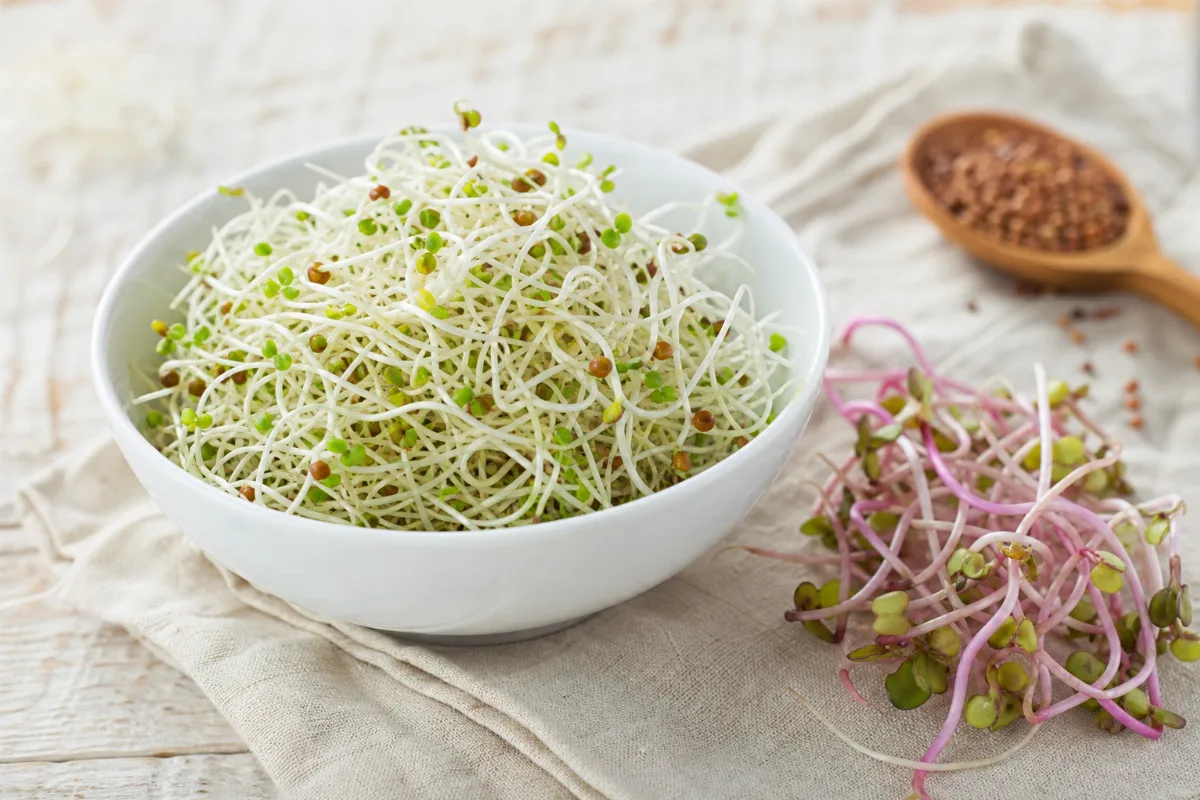
Alfalfa (Medicago sativa) and red clover (Trifolium pratense) are plants in the pea or legume family. The sprouts are the young seedlings, eaten while the shoots are thin and pale, usually raw and often sold as a mix. This page keeps them apart from alfalfa tablets and clover extracts, and from mung bean sprouts.
USDA data for raw alfalfa sprouts, per 100 g: 23 kcal, 92.8 g water, 3.99 g protein, 1.9 g fibre, 30.5 micrograms vitamin K, 8.2 mg vitamin C and 36 micrograms folate (DFE). A cup (33 g) has about 7.6 kcal, 1.32 g protein and 0.63 g fibre. Sprouts are mostly water, so a cup adds little of any nutrient. USDA has no entry for clover sprouts in the data we used.
What the research shows
For benefits, very little. We found no human trial of eating alfalfa or clover sprouts for cholesterol, blood sugar, menopause, cancer or any other outcome.
The one cholesterol study found was a small before-and-after trial of 15 patients who ate large amounts of heat-prepared alfalfa seeds (not sprouts) for 8 weeks; LDL fell by about 18% in type II patients and went back up after stopping. Memorial Sloan Kettering says larger controlled trials are needed.
Lab work is not a health result. Red clover sprouts had up to 426.2 mg of isoflavones per 100 g dry weight in a lab study, and alfalfa extract made estrogen-dependent breast cancer cells grow more than estradiol did in dishes. The authors of the clover study note that the link between isoflavone-rich diets and breast and prostate cancer risk is still unclear.
Sprouts versus seeds, tablets and extracts
Most lupus and cholesterol findings come from alfalfa seeds, tablets, pure L-canavanine, or monkeys. They are not tests of sprouts as people eat them. The outbreak data are about raw sprouts as food. Do not carry results from one product to another.
In monkeys, autoclaved (heat-treated) alfalfa seeds fed for up to a year did not produce lupus-like blood signs, unlike raw seeds in earlier reports. That is a lab animal study of seeds, not a cooking rule for sprouts.
Amounts
No official daily amount for sprouts was found. This page gives no amounts to eat. Ask a doctor, pharmacist or dietitian what is right for you, especially if you are pregnant, have lupus or another immune condition, or take warfarin.
At a glance
Traditional uses history, not proof
- Eaten raw or lightly cooked as a salad and sandwich food
- Alfalfa as a herb has traditional uses for many complaints, but these are not backed by studies for the sprout food
- Long use as food is not proof that it treats any condition
Studied for research
- Nutrients (small amounts of vitamins and fibre), low certainty
- Cholesterol, insufficient evidence (small uncontrolled trials of alfalfa seeds and tablets, not sprouts)
- Blood sugar, insufficient evidence (animal only, per Memorial Sloan Kettering)
- Cancer and hormone effects, insufficient evidence (lab only)
- Other traditional claims, insufficient evidence (no studies found)
Main compounds
- L-canavanine
- Isoflavones (red clover)
- Saponins
- Vitamin K
- Vitamin C
- Folate
Common forms
- Raw sprouts (the form tied to food poisoning outbreaks)
- Cooked sprouts (the CDC advises cooking thoroughly; no sprout cooking time was read)
- Sprout mixes (alfalfa, clover, radish and other sprouts)
- Alfalfa seeds, tablets and red clover extracts are different products and are not covered
Research links: 2026 FDA outbreak page: alfalfa sprouts · 2025 study: Salmonella outbreak in Norway · 2014 review: US sprout outbreaks 1998 to 2010 · Research Library · Genes & Biomarkers Library
What it is and its history
- Accepted scientific name
- Medicago sativa (alfalfa); Trifolium pratense (red clover)
- Naming authority
- Both accepted names per GBIF (Medicago sativa L.; Trifolium pratense L.).
- Common names
- Alfalfa sprouts (English); Clover sprouts (English); Red clover sprouts (English); Sprout mixes (often alfalfa, clover and radish) (English); Brotes de alfalfa (Spanish)
- Family or group
- Fabaceae (the legume or pea family), as given by GBIF for both plants.
- Classification
- Plantae > Tracheophyta > Magnoliopsida > Fabales > Fabaceae > Medicago and Trifolium > Medicago sativa; Trifolium pratense
- Native range
- Not verified from a source read.
- Habitat
- Not verified from a source read.
- What it looks like
- Roots: Not verified.; Stems: Not verified.; Leaves: Not verified.; Flowers: Not verified.; Fruit: The food is the young seedling grown from the seed, eaten while the shoots are thin and pale. Sprouting uses warm, moist conditions (FDA).
- Cultivation
- Sprouts are grown from seeds, in commercial sprout houses or at home, under warm and humid conditions (FDA). Which seed lot is used is the main safety question.
- Harvest and processing
- Eaten raw in sandwiches and salads, or cooked. CDC says raw clover sprouts have about a 14-day shelf life.
- Look-alikes and adulterants
- Name: Other sprouts (radish, mung bean, onion); Note: The FDA and CDC advise vulnerable people to avoid raw sprouts of any kind, including these. Mung bean sprouts have their own page.; Name: Alfalfa seeds, tablets and supplements; Note: Different products. Most lupus and cholesterol findings are for seeds and tablets, not the sprout food.; Name: Red clover extracts and supplements; Note: Concentrated isoflavone products; not the sprout food.; Name: Broccoli sprouts; Note: A different plant with different research; not covered here.
- Sustainability and conservation
- Not assessed.
Photographs
Traditional use and history history, not clinical proof
| Tradition or era | Documented use | Source |
|---|---|---|
| 1994, Sweden and Finland | Two large Salmonella outbreaks were linked to alfalfa sprouts: 282 cases in Sweden and 210 in Finland. The sprouts were grown from Australian alfalfa seeds. | s-eid-1999-taormina |
| 1996, California | The largest recorded sprout-linked outbreak in the United States, with more than 450 culture-confirmed Salmonella cases; the same strain was found in patients and in alfalfa sprouts. | s-eid-1999-taormina |
| 1999, United States | After outbreaks in the mid-1990s, the FDA published guidelines for sprout producers, including treating seeds with an antimicrobial and testing spent irrigation water. | p25076040 |
| 2009, United States | A Salmonella Saintpaul outbreak with 228 cases in 13 states was traced to alfalfa sprouts; the FDA and CDC recommended consumers not eat raw alfalfa sprouts, including blends, until further notice. | p19444155 |
| 2014, United States | A CDC advisory covered an E. coli outbreak linked to raw clover sprouts. | s-cdc-2014-clover |
| 2024, Sweden and Norway | Salmonella outbreaks of 100 cases (Sweden) and 230 cases (Norway) were linked to alfalfa sprouts. | p40916032 |
| 2026, Europe and the United States | A European outbreak (109 cases, 2 deaths) and a US outbreak (76 cases in 16 states as of 1 October) were linked to alfalfa sprouts or sprouted seeds. | p42453129 |
Traditional use shows how it was used. It does not show that it works or is safe today.
What is inside, and how it may work
What it contains and how those compounds act in cells and animals. Laboratory and animal mechanisms are not proven effects in people.
Main compounds
| Compound | Family | Where it is concentrated | Activity studied | Level of evidence |
|---|---|---|---|---|
| L-canavanine | non-protein amino acid | Seeds and sprouts 1.5% of dry weight of alfalfa seeds and sprouts (Memorial Sloan Kettering); 1.3 to 2.4% of dry matter in commercially grown sprouts and 1.4 to 1.8% in seeds (Rosenthal 2000). Fresh sprouts are about 93% water, so far less per gram. | Called a toxic amino acid. Caused a lupus-like illness in monkeys and changed human immune cells in the lab. Levels vary between crops and fall as the plant matures. 24 14 7 1 | Animal and lab |
| Isoflavones | phytoestrogens | Clover sprouts, especially red clover Up to 426.2 mg per 100 g dry weight in red clover sprouts (lab measurement). | Plant compounds that can act a little like estrogen. Measured in the lab; no human health outcome was measured. 5 24 | Lab |
| Saponins | steroidal saponins | Leaves and sprouts No figure read. | Memorial Sloan Kettering says a steroidal saponin fraction, along with fibre, binds cholesterol in vitro and is credited with alfalfa's cholesterol-lowering and red-cell-breaking (haemolytic) activity. 24 | Lab |
| Vitamin K (phylloquinone) | fat-soluble vitamin | Sprout USDA: 30.5 micrograms per 100 g; about 10.1 micrograms per cup (33 g) | Needed for blood clotting; relevant to people who take warfarin. 25 23 | Human data |
| Vitamin C, folate and fibre | nutrients | Sprout USDA per 100 g: vitamin C 8.2 mg; folate 36 micrograms (DFE); fibre 1.9 g | Small amounts per cup; no trial of sprouts for any of these. 25 | Nutrient database |
Mechanisms, receptors and pathways
| Target or pathway | Gene or receptor | What was found | Level |
|---|---|---|---|
| Germ growth during sprouting | Not applicable | Warm, moist sprouting multiplies germs that were on the seed. A 1999 review quotes a Salmonella increase of about 5 to 6 logs (hundred-thousand to million-fold) during sprouting in one study of contaminated seeds, and reports that E. coli O157:H7 on alfalfa seeds reached 1 to 10 million per gram within 48 hours of sprouting. 16 19 | Lab |
| Immune cell regulation by L-canavanine | T cells (human immune cells) | In test tubes L-canavanine reduced the response of human immune cells to two stimulants and abolished the suppressor-cell function switched on by concanavalin A, raising release of IgG and DNA-binding activity. This is the proposed route for alfalfa-linked lupus relapse; some researchers question whether alfalfa holds enough L-canavanine. 1 24 | Lab |
| Lupus-like illness in monkeys | Not specified | Monkeys fed alfalfa sprouts developed blood and immune signs like human lupus; added L-canavanine reactivated the syndrome. Autoclaved alfalfa seeds fed for up to a year did not produce lupus-like blood signs. 7 8 | Animal research |
| Estrogen receptor activity of alfalfa extracts | Estrogen receptor beta | Memorial Sloan Kettering says alfalfa extracts preferentially acted on estrogen receptor beta and increased growth of estrogen-dependent MCF-7 breast cancer cells even more than estradiol did. 24 | Lab |
| Cholesterol binding | Not specified | Saponins and fibre in alfalfa bind cholesterol in vitro (Memorial Sloan Kettering). 24 | Lab |
Absorption, metabolism and elimination
- Absorption
- Not found.
- Distribution
- Not found.
- Metabolism
- Not found.
- Elimination
- Not found.
- Bioavailability
- Not established for any sprout compound in the sources read.
Isolated compounds versus whole extracts
The sprout food, alfalfa seeds, alfalfa tablets, red clover extracts and pure L-canavanine are different things. The lupus findings come from seeds, tablets, monkeys fed sprouts or seeds, and the pure compound. The cholesterol data come from seeds and supplements. The outbreak data are about raw sprouts as food. Do not carry results from one to another.
Nutritional composition
Nutrition from USDA FoodData Central, SR Legacy (alfalfa seeds, sprouted, raw, FDC 168384; record last updated 4/1/2019; values read 2026-10-26 from the FoodData Central site data feed). Per 100 g: 23 kcal (96 kJ), water 92.8 g, protein 3.99 g, total fat 0.69 g, carbohydrate 2.1 g, fibre 1.9 g, total sugars 0.2 g, calcium 32 mg, iron 0.96 mg, magnesium 27 mg, phosphorus 70 mg, potassium 79 mg, sodium 6 mg, zinc 0.92 mg, copper 0.157 mg, manganese 0.188 mg, vitamin C 8.2 mg, folate 36 micrograms (DFE), vitamin A 8 micrograms (RAE), vitamin K 30.5 micrograms. USDA household portions: 1 cup = 33 g; 1 tablespoon = 3 g. One cup (33 g) therefore holds about 7.6 kcal, 1.32 g protein, 0.63 g fibre, 10.6 mg calcium, 0.32 mg iron, 26 mg potassium, 2.7 mg vitamin C, 11.9 micrograms folate and 10.1 micrograms vitamin K (per-100-g values multiplied by 0.33). Sprouts are mostly water, so they add little energy. There is no USDA entry for clover sprouts in the data we used. This is information about the food, not advice on how much to eat.
1 low certainty4 not enough evidence
What was looked at
The 5 benefits and uses checked for Alfalfa and Clover Sprouts, each with how strong the evidence is. Tap one to open it.
- A light food with small amounts of vitamins and fibreLow certainty
- CholesterolNot enough evidence
- Blood sugarNot enough evidence
- Cancer and hormone effects (lab only)Not enough evidence
- Other traditional claims (water loss, digestion, asthma, thyroid, milk supply, periods)Not enough evidence
Lab markers tracked in the studies
LDL cholesterolApolipoprotein B
What is Alfalfa and Clover Sprouts good for?
What these sprouts are studied for, and how strong the evidence is. Safety comes first on this page: the benefit evidence is thin, and raw sprouts carry a real food poisoning risk.
Benefits, one by one
Each card is a research question, not a promise. Tap a goal to filter. Open a card to see the studies, doses and limits.
A light food with small amounts of vitamins and fibre
Low certaintyAlfalfa sprouts are about 93% water. Per 100 g (USDA) they have 23 kcal, 3.99 g protein, 1.9 g fibre, 30.5 micrograms of vitamin K, 8.2 mg of vitamin C and 36 micrograms of folate (DFE). A cup (33 g) has about 7.6 kcal and 10.1 micrograms of vitamin K. This is a nutrient fact, not a trial of sprouts.
1 studiesRaw sprouts as food. Values vary with seed, growing time and storage.
Studies, doses and limits
What the trials found
USDA FoodData Central lists alfalfa seeds, sprouted, raw (FDC 168384). There is no USDA item for clover sprouts in the data we used. No trial of eating alfalfa or clover sprouts for any health outcome was found.
Results
Sprouts add water, a little protein and fibre, and small amounts of vitamins and minerals. A cup is a small portion (33 g), so the amounts per cup are small.
Effect sizes as reported
USDA, per 100 g: 23 kcal; water 92.8 g; protein 3.99 g; fibre 1.9 g; vitamin K 30.5 micrograms; vitamin C 8.2 mg; folate (DFE) 36 micrograms. Per cup (33 g): 7.6 kcal, 1.32 g protein, 0.63 g fibre, 10.1 micrograms vitamin K, 2.7 mg vitamin C, 11.9 micrograms folate.
Why this rating
The numbers come from a reliable database, but amounts per cup are small and no study shows a health benefit from them. Raw sprouts also carry a food poisoning risk (see Safety).
Form and dose studied
Raw sprouts as food. Values vary with seed, growing time and storage.
Who was studied
General adult diet. People at higher risk of food poisoning are advised to avoid raw sprouts (see Safety).
Limits
A nutrient fact for alfalfa sprouts only. Clover sprouts were not measured. Values are from an older USDA release.
Why researchers looked
Sprouts are eaten raw in sandwiches and salads, so people ask what they add to the diet.
Traditional use
Eaten raw or lightly cooked as a salad and sandwich food. Long use as food is not proof that it treats any condition.
Proposed mechanism Nutrient database
Not a mechanism question: the values are food composition from the USDA database.
A proposed mechanism does not show that the effect happens in people.
Raw sprouts have caused repeated outbreaks of Salmonella and E. coli. Read the Safety tab first.
Cholesterol
Not enough evidenceNo trial of eating alfalfa or clover sprouts for cholesterol was found. The only human data found are older small trials of alfalfa seeds or tablets, which are different products. In one 8-week trial of 15 patients with high blood fats, heat-prepared alfalfa seeds (not sprouts) in large amounts went with lower LDL cholesterol.
3 studiesHeat-prepared alfalfa seeds (not sprouts); alfalfa supplements. Neith…
Studies, doses and limits
What the trials found
Molgaard 1987: 15 patients with high blood fats ate 40 g of heat-prepared alfalfa seeds three times a day for 8 weeks. In type II patients, median LDL fell from 7.69 to 6.33 mmol/L (about 18%) and levels returned to starting values after stopping. Memorial Sloan Kettering says two small trials of alfalfa supplements lowered cholesterol in people with high cholesterol and that larger controlled trials are needed; it also calls them small uncontrolled trials. In monkeys, autoclaved alfalfa seeds kept their cholesterol-lowering effect.
Results
Possible small effect of alfalfa seeds in a small uncontrolled trial. Nothing is known about sprouts eaten as food. A very large daily amount of seeds was used in that trial, so it does not describe sprouts on a sandwich.
Effect sizes as reported
Seeds, 8 weeks: LDL 7.69 to 6.33 mmol/L (median, type II, P < 0.01); total cholesterol 9.58 to 8.00 mmol/L; apolipoprotein B 2.17 to 1.43 g/L.
Why this rating
No study of sprouts. One small uncontrolled study of seeds and tablets. Not enough to say sprouts lower cholesterol.
Form and dose studied
Heat-prepared alfalfa seeds (not sprouts); alfalfa supplements. Neither is the sprout food.
Who was studied
15 patients with high blood fats (types IIA, IIB and IV).
Limits
Small, no control group, seeds not sprouts. The effect disappeared after stopping.
Why researchers looked
Alfalfa contains saponins and fibre that bind cholesterol in the lab, so alfalfa has been tried for high cholesterol.
Traditional use
Alfalfa has a long history as a herb. Sprouts as a cholesterol food are not backed by trials.
Proposed mechanism Laboratory research
Memorial Sloan Kettering says a steroidal saponin fraction in alfalfa leaves and sprouts, together with fibre, binds cholesterol in vitro (in the lab). This is a lab finding.
A proposed mechanism does not show that the effect happens in people.
Alfalfa seeds raise the L-canavanine and lupus concern; see Safety. Memorial Sloan Kettering lists loose stools, gas and discomfort with alfalfa supplements.
Blood sugar
Not enough evidenceMemorial Sloan Kettering says alfalfa appears to lower blood glucose in animals, but no studies have tested whether it has a significant effect in patients with diabetes. Nothing was found for sprouts as food.
1 studiesAlfalfa as a herb; not the sprout food.
Studies, doses and limits
Results
Animal findings only, reported second-hand by Memorial Sloan Kettering.
Effect sizes as reported
Not available.
Why this rating
Animal data only (reported by a health centre) and no human study.
Form and dose studied
Alfalfa as a herb; not the sprout food.
Limits
We did not read the animal studies themselves.
Why researchers looked
Alfalfa has a traditional name as a diabetes herb.
Traditional use
A traditional herb claim. Long use is not proof that it treats any condition.
Proposed mechanism None found
Not described in the source read.
A proposed mechanism does not show that the effect happens in people.
People who take diabetes medicines should ask their clinician before big diet changes.
Cancer and hormone effects (lab only)
Not enough evidenceRed clover sprouts have more isoflavones than other clover sprouts in lab tests, and sprout extracts affected some cancer cells in dishes. Alfalfa extracts made estrogen-dependent breast cancer cells grow more than estradiol did in the lab. No human health result exists. Memorial Sloan Kettering says there is no evidence that alfalfa can treat cancer.
2 studiesSprout extracts in cell tests; alfalfa extracts in cell tests.
Studies, doses and limits
Results
Chemistry and cell-dish results only. They are not health results and do not show that eating sprouts helps or harms cancer risk.
Effect sizes as reported
Up to 426.2 mg isoflavones per 100 g dry weight (red clover sprouts).
Why this rating
Lab only. The authors themselves say the link between isoflavone-rich diets and breast and prostate cancer risk is still unclear.
Form and dose studied
Sprout extracts in cell tests; alfalfa extracts in cell tests.
Limits
Cells in dishes; sprouts as eaten were not tested in people. Memorial Sloan Kettering's cell finding was read second-hand.
Why researchers looked
Isoflavones are plant compounds that can act a little like the hormone estrogen, so researchers look at clover and alfalfa in hormone-related cancers.
Traditional use
Red clover and alfalfa are used as herbs for hormone-related complaints. Sprouts as a remedy are not backed by trials.
Proposed mechanism Laboratory research
Isoflavones are phytoestrogens. Memorial Sloan Kettering says alfalfa extracts preferentially acted on estrogen receptor beta and increased the growth of estrogen-dependent MCF-7 breast cancer cells even more than estradiol did. Both are lab results.
A proposed mechanism does not show that the effect happens in people.
Memorial Sloan Kettering says alfalfa should be avoided in pregnancy and nursing because of its hormonal effects. People with hormone-sensitive conditions should ask their clinician.
Other traditional claims (water loss, digestion, asthma, thyroid, milk supply, periods)
Not enough evidenceMemorial Sloan Kettering lists these traditional uses of alfalfa and says they are not backed by experimental evidence or studies. This is about alfalfa as a herb. Nothing was found for the sprout food.
1 studiesAlfalfa as a herb; not the sprout food.
Studies, doses and limits
Results
No support found. This is evidence of absence of studies, not proof that these uses never work.
Effect sizes as reported
Not available.
Why this rating
No studies were found by the source we read.
Form and dose studied
Alfalfa as a herb; not the sprout food.
Limits
One health-centre summary read; we did not search each claim separately.
Why researchers looked
Alfalfa is a long-used herb, and people ask whether these uses hold up.
Traditional use
Listed as purported uses: diuretic, stomach and bowel complaints, asthma and hay fever, thyroid problems, increasing lactation, promoting menstruation.
Proposed mechanism None found
None established.
A proposed mechanism does not show that the effect happens in people.
See the Safety tab, especially for pregnancy and breastfeeding.
Connections to the rest of health
How Alfalfa and Clover Sprouts connects to the rest of our health knowledge graph. Every link says what kind of connection it is. A safety link (for example to the liver) is a warning, not a benefit. A study that merely mentions a topic never creates a benefit link.
Explore every connection: goals, body systems, organs, symptoms, genes
A. Wellness goals
| Connected to | Kind of connection | Evidence status | Context | Studies |
|---|---|---|---|---|
| Nutrient Support | Low certainty | A light food with small amounts of vitamins and fibre: Alfalfa sprouts are about 93% water. Per 100 g (USDA) they have 23 kcal, 3.99 g protein, 1.9 g fibre, 30.5 micrograms of vitamin K, 8.2 mg of vitamin C and 36 micrograms of folate (DFE). A cup (33 g) has about 7.6 kcal and 10.1 micrograms of vitamin K. This is a nutrient fact, not a trial of sprouts. | 25 | |
| Cholesterol Balance | Not enough evidence | Cholesterol: No trial of eating alfalfa or clover sprouts for cholesterol was found. The only human data found are older small trials of alfalfa seeds or tablets, which are different products. In one 8-week trial of 15 patients with high blood fats, heat-prepared alfalfa seeds (not sprouts) in large amounts went with lower LDL cholesterol. | 10 24 8 | |
| Blood Sugar Balance | Not enough evidence | Blood sugar: Memorial Sloan Kettering says alfalfa appears to lower blood glucose in animals, but no studies have tested whether it has a significant effect in patients with diabetes. Nothing was found for sprouts as food. | 24 | |
| Hormone Balance | Not enough evidence | Cancer and hormone effects (lab only): Red clover sprouts have more isoflavones than other clover sprouts in lab tests, and sprout extracts affected some cancer cells in dishes. Alfalfa extracts made estrogen-dependent breast cancer cells grow more than estradiol did in the lab. No human health result exists. Memorial Sloan Kettering says there is no evidence that alfalfa can treat cancer. | 5 24 | |
| Traditional Use | Traditional use | Not enough evidence | Other traditional claims (water loss, digestion, asthma, thyroid, milk supply, periods): Memorial Sloan Kettering lists these traditional uses of alfalfa and says they are not backed by experimental evidence or studies. This is about alfalfa as a herb. Nothing was found for the sprout food. | 24 |
B. Body systems
| Connected to | Kind of connection | Evidence status | Context | Studies |
|---|---|---|---|---|
| Nutrition | Biological association | Low certainty | Studied for: A light food with small amounts of vitamins and fibre | 25 |
| Cardiovascular System | Biological association | Not enough evidence | Studied for: Cholesterol | 10 24 8 |
| Blood Sugar Support | Biological association | Not enough evidence | Studied for: Blood sugar | 24 |
| Endocrine System | Biological association | Not enough evidence | Studied for: Cancer and hormone effects (lab only) | 5 24 |
| Whole Body | Biological association | Not enough evidence | Studied for: Other traditional claims (water loss, digestion, asthma, thyroid, milk supply, periods) | 24 |
E. Health conditions
| Connected to | Kind of connection | Evidence status | Context | Studies |
|---|---|---|---|---|
| Food poisoning | Adverse effect or risk | Documented risk | Raw alfalfa and clover sprouts are a documented source of Salmonella and E. coli outbreaks. Preparation or compound: Raw alfalfa and clover sprouts |
3 12 4 17 |
| Salmonella infections | Adverse effect or risk | Documented risk | Large Salmonella outbreaks, for example 228 cases in 13 US states in 2009. Preparation or compound: Raw alfalfa sprouts |
2 6 |
| E. coli infections | Adverse effect or risk | Documented risk | Shiga toxin-producing E. coli outbreaks in 2014 (clover) and 2026 (alfalfa); some infections cause kidney failure. Preparation or compound: Raw alfalfa and clover sprouts |
15 17 |
| Lupus (systemic lupus erythematosus) | Animal and case report evidence, mostly for seeds and tablets | Lupus-like illness in monkeys fed alfalfa sprouts; case reports with seeds and tablets; not shown for sprouts eaten by people. Preparation or compound: Alfalfa seeds, tablets and sprouts; L-canavanine |
7 1 11 13 24 |
I. Biomarkers
| Connected to | Kind of connection | Evidence status | Context | Studies |
|---|---|---|---|---|
| LDL cholesterol | Biological association | Not enough evidence | Measured in trials: lowered. A lab change is not the same as a health benefit. | 10 |
| Apolipoprotein B | Biological association | Not enough evidence | Measured in trials: lowered. A lab change is not the same as a health benefit. | 10 |
K. Biological pathways
| Connected to | Kind of connection | Evidence status | Context | Studies |
|---|---|---|---|---|
| Vitamin K | Preliminary mechanism | Human | Present in alfalfa sprouts; relevant to warfarin. | 25 23 |
| L-canavanine | Preliminary mechanism | Animal and lab | Amino acid in alfalfa seeds and sprouts; lupus-like illness in monkeys; changes human immune cells in the lab. | 7 1 14 |
| Estrogen receptor signalling | Preliminary mechanism | Lab | Phytoestrogens in alfalfa and clover act on estrogen receptors in lab studies. | 24 5 |
L. Active compounds
| Connected to | Kind of connection | Evidence status | Context | Studies |
|---|---|---|---|---|
| L-canavanine | Biological association | Animal and lab | Called a toxic amino acid. Caused a lupus-like illness in monkeys and changed human immune cells in the lab. Levels vary between crops and fall as the plant matures. Preparation or compound: Seeds and sprouts |
24 14 7 1 |
| Isoflavones | Biological association | Lab | Plant compounds that can act a little like estrogen. Measured in the lab; no human health outcome was measured. Preparation or compound: Clover sprouts, especially red clover |
5 24 |
| Saponins | Biological association | Lab | Memorial Sloan Kettering says a steroidal saponin fraction, along with fibre, binds cholesterol in vitro and is credited with alfalfa's cholesterol-lowering and red-cell-breaking (haemolytic) activity. Preparation or compound: Leaves and sprouts |
24 |
| Vitamin K (phylloquinone) | Biological association | Human | Needed for blood clotting; relevant to people who take warfarin. Preparation or compound: Sprout |
25 23 |
| Vitamin C, folate and fibre | Biological association | Nutrient database | Small amounts per cup; no trial of sprouts for any of these. Preparation or compound: Sprout |
25 |
Each connection is stored with the ingredient, the connected record, the kind of connection, the evidence status, the supporting studies, the preparation or compound involved, and a review date (last reviewed October 26, 2026).
The evidence
The research centre for Alfalfa and Clover Sprouts. Every record here was checked against PubMed or the publisher's page; we never list a study we have not verified.
Evidence by outcome
Bars show how many studies we found for each outcome, not how well it works. People are added up across trials only (reviews are not added, to avoid double counting).
How we rate evidence
High certainty
Several well-run trials or reviews agree; further research is unlikely to change the picture much.
Moderate certainty
Good trials point the same way, but some doubt remains.
Low certainty
Small, short or inconsistent trials. The finding could change with better research.
Very low certainty
Very little or very weak human data. Treat as a possibility only.
Mixed findings
Trials or reviews disagree with each other.
Not enough evidence
Not enough human research to say either way.
Evidence against
Good research found no benefit, or found harm.
We take the reviewers' own risk-of-bias and GRADE statements where they exist, and otherwise judge from study size, design, consistency, directness and whether a product matches what is sold. Many publications do not make evidence high. Method note: We started from our existing summary for this food, re-checked nutrition against USDA FoodData Central, re-read FDA and CDC pages and Memorial Sloan Kettering, and re-read PubMed abstracts for outbreak investigations, reviews, animal and lab studies and the small cholesterol trial. For one 1983 letter only its title and indexing were available. Items we could not verify are flagged in the research gaps.
Study library: every study we checked 25
| Study | Design | People | Product, dose, length | Result |
|---|---|---|---|---|
| Alcocer-Varela 1985 Effects of L-canavanine on T cells may explain the induction of systemic lupus erythematosus by alfalfa. Arthritis Rheum · PMID 3155617 · DOI |
In vitro study human cells |
Immune cells from healthy volunteers and people with lupus, studied in the lab | L-canavanine (isolated amino acid) Isolated compound Dose-related in the lab |
L-canavanine had dose-related effects on human immune-regulating cells in vitro: it reduced the response of cells to two stimulants and abolished the suppressor-cell function that was switched on by concanavalin A, which increased release of IgG and DNA-binding activity by cells from both healthy people and lupus patients. The authors say this may explain how alfalfa could cause or worsen lupus. The abstract also says autoimmune haemolytic anaemia and lupus flare have been linked to alfalfa tablets that contain L-canavanine. Dose-related effects in cell tests (Not applicable) Methods, limits and fundingOutcomes: Effects on human immune cells in test tubes Limitations: Test-tube study of a pure compound, not of sprouts eaten as food. Funding and conflicts: Funding is not stated in the abstract. Read: abstract |
| Centers for Disease Control and Prevention (CDC) 2009 Outbreak of Salmonella serotype Saintpaul infections associated with eating alfalfa sprouts - United States, 2009. MMWR Morb Mortal Wkly Rep · PMID 19444155 |
Outbreak investigation |
228 Cases in 13 US states, February to May 2009 |
Raw alfalfa sprouts and blends containing them Sprouts |
228 cases in 13 states were linked to alfalfa sprouts made at several facilities from seeds that likely came from a common grower. On April 26 the FDA and CDC recommended that consumers not eat raw alfalfa sprouts, including blends containing alfalfa sprouts, until further notice. On May 1 a seed supplier withdrew all lots of alfalfa seeds with a specific three-digit prefix. 228 cases in 13 states (Not applicable) Methods, limits and fundingOutcomes: Cases, source of the outbreak, public health advice Limitations: A preliminary report. Case numbers in the abstract only. Funding and conflicts: Written by the US public health agency; no commercial funding stated. Read: abstract |
| Dechet 2014 Outbreaks caused by sprouts, United States, 1998-2010: lessons learned and solutions needed. Foodborne Pathog Dis · PMID 25076040 · DOI |
Outbreak review |
33 outbreaks linked to seed and bean sprouts in the United States, 1998 to 2010 | Raw seed and bean sprouts (several kinds) Sprouts |
33 outbreaks from seed and bean sprouts were documented, affecting 1330 reported people. 28 were caused by Salmonella, 4 by Shiga toxin-producing E. coli and 1 by Listeria. In 15 of 18 outbreaks with information, growers had not followed key FDA guidelines. In 3 outbreaks the sprouts came from firms that appeared to have followed key guidelines. Seed chlorination reduces germs if used consistently but does not remove the risk of infection. 33 outbreaks, 1330 people (1998 to 2010) (Not applicable) Methods, limits and fundingOutcomes: Number of outbreaks and people affected, pathogens, whether growers followed FDA guidelines Limitations: Counts all seed and bean sprouts, not alfalfa or clover alone. Counts reported cases only. The period ends in 2010. Funding and conflicts: Funding is not stated in the abstract. Read: abstract |
| ECDC and EFSA (rapid outbreak assessment) 2026 Multi-country outbreak of Salmonella Bovismorbificans ST377 infections linked to the consumption of alfalfa sprouted seeds 25 June 2026. EFSA J · PMID 42453129 · DOI |
Outbreak investigation |
109 109 confirmed cases in 10 EU/EEA countries and the United Kingdom, January to May 2026 |
Raw alfalfa sprouted seeds Sprouts |
109 confirmed cases; 18 needed hospital care; 2 deaths were reported in Finland (one confirmed and one probable case). Alfalfa sprouted seeds traded from Italy were judged the main vehicle, and the outbreak strain was found in water samples taken during alfalfa sprout harvesting in the Netherlands and Northern Ireland. Tracing pointed to a seed supplier in India. The agencies rated the risk of infection as low-to-moderate for people in the EU/EEA who frequently eat sprouted seeds, and noted that sprouted seeds can be sold ready to eat. 109 cases; 18 hospitalised; 2 deaths (Not applicable) Methods, limits and fundingOutcomes: Cases, hospitalisations, deaths, source tracing, risk assessment Limitations: An outbreak assessment by public health agencies, not a controlled study. The source of the seed contamination was not fully identified. Funding and conflicts: Written by European public health agencies; no commercial funding stated. Read: abstract |
| Galanty 2022 In the Search for Novel, Isoflavone-Rich Functional Foods-Comparative Studies of Four Clover Species Sprouts and Their Chemopreventive Potential for Breast and Prostate Cancer. Pharmaceuticals (Basel) · PMID 35890104 · DOI |
Laboratory study human cell lines |
Sprouts of red, white, crimson and Persian clover grown for up to 10 days; human cancer cell lines | Clover sprout extracts Sprouts Lab concentrations Up to 10 days of sprouting · vs Other clover species |
Red clover sprouts were richest in isoflavones (up to 426.2 mg per 100 g dry weight) and crimson clover lowest. Estrogen-dependent MCF7 breast cancer cells were more affected by the extracts than hormone-insensitive MDA-MB-231 cells, and androgen-dependent LNCaP prostate cells were most susceptible of the prostate lines. The authors say the cell-killing effect was not linked to isoflavone content. The sprouts showed high antioxidant potential and were described as safe for normal breast and prostate cells in the lab. Up to 426.2 mg isoflavones per 100 g dry weight (red clover sprouts) (Not applicable) Methods, limits and fundingOutcomes: Isoflavone content; effects on breast and prostate cancer cells in the lab; antioxidant activity Limitations: Cells in dishes and chemistry only. No human health outcome was measured. The authors note that the link between isoflavone-rich diets and breast and prostate cancer risk is still unclear. Funding and conflicts: The authors declare no conflict of interest. Read: abstract |
| Lillepold 2025 Multi-cluster outbreak of Salmonella Typhimurium sequence type 36 linked to alfalfa sprouts, Sweden, August-November 2024. Epidemiol Infect · PMID 40916032 · DOI |
Case control outbreak |
100 100 reported cases in Sweden, August to November 2024 |
Raw alfalfa sprouts Sprouts · vs Matched people without illness |
A matched case-control study found cases were linked to eating alfalfa sprouts (adjusted odds ratio 8.94). Tracing pointed to seeds used by two Swedish sprout producers. Salmonella was not found in the producers' sprouted seeds when tested, but international investigations linked seeds from the same origin, so the seeds were judged the ultimate source. Adjusted odds ratio 8.94 (95% CI 2.96 to 27.1) Methods, limits and fundingOutcomes: Link between illness and eating alfalfa sprouts; source tracing Limitations: Observational outbreak study. Testing of the sprouts themselves did not find the germ. Funding and conflicts: The authors declare no competing interests. Read: abstract |
| Malinow 1982 Systemic lupus erythematosus-like syndrome in monkeys fed alfalfa sprouts: role of a nonprotein amino acid. Science · PMID 7071589 · DOI |
Animal study animal |
Cynomolgus macaques (monkeys) | Alfalfa sprouts; L-canavanine sulfate added to the diet Sprouts or seeds; isolated amino acid |
Blood and immune abnormalities similar to those in human lupus developed in monkeys fed alfalfa sprouts. L-canavanine sulfate, a constituent of alfalfa sprouts, added to the diet reactivated the syndrome in monkeys that had developed it earlier from alfalfa seeds or sprouts. Lupus-like blood and immune changes in monkeys (Not applicable) Methods, limits and fundingOutcomes: Blood and immune signs resembling human systemic lupus erythematosus Limitations: Monkeys, not people. Details of amounts and numbers were not in the abstract. Does not show what happens in people who eat sprouts as food. Funding and conflicts: Funded by US government health institutes (NHLBI, NCRR) per the record. Read: abstract |
| Malinow 1984 Elimination of toxicity from diets containing alfalfa seeds. Food Chem Toxicol · PMID 6540232 · DOI |
Animal study animal |
Female cynomolgus macaques (monkeys) | Autoclaved (heat-treated) alfalfa seeds Seeds Up to 1 year · vs Raw alfalfa seeds in earlier reports |
Monkeys fed autoclaved alfalfa seeds for up to a year showed no blood signs of a syndrome resembling systemic lupus. This contrasts with earlier reports in monkeys fed raw alfalfa seeds, in which a lupus-like syndrome appeared in a shorter time. The autoclaved seeds kept their cholesterol-lowering effect. No lupus-like blood signs with autoclaved seeds (Not applicable) Methods, limits and fundingOutcomes: Signs of a lupus-like syndrome; cholesterol effects Limitations: Monkeys and seeds, not people and sprouts. Autoclaving is a lab heat method and is not a cooking rule for sprouts. Funding and conflicts: Funded by US government health institutes per the record. Read: abstract |
| Miyahira 2021 Bacteriological safety of sprouts: A brief review. Int J Food Microbiol · PMID 34111728 · DOI |
Narrative review |
Published reports of sprout-linked foodborne outbreaks worldwide since 1988 | Raw sprouts (several kinds) Sprouts |
Sprout eating is linked to more than 60 outbreaks of foodborne illness worldwide since 1988. Alfalfa sprouts were most often involved, and Salmonella and disease-causing E. coli (especially Shiga toxin-producing) were the usual germs. The review says sprouts should be kept cold and, if possible, cooked before eating. More than 60 outbreaks worldwide since 1988 (Not applicable) Methods, limits and fundingOutcomes: Number of outbreaks, kinds of sprouts and germs involved, ways to make sprouts safer Limitations: A brief narrative review, not a systematic one. It gives no cooking time or temperature in the abstract. Funding and conflicts: Funding is not stated in the abstract. Read: abstract |
| Molgaard 1987 Alfalfa seeds lower low density lipoprotein cholesterol and apolipoprotein B concentrations in patients with type II hyperlipoproteinemia. Atherosclerosis · PMID 3606731 · DOI |
Uncontrolled trial |
15 15 patients with high blood fats (type IIA n=8, IIB n=3, IV n=4) |
Heat-prepared alfalfa seeds (not sprouts) Seeds 40 g three times daily at mealtimes 8 weeks |
In patients with type II high blood fats, median total cholesterol fell from 9.58 to 8.00 mmol/L and LDL cholesterol from 7.69 to 6.33 mmol/L (about 17% and 18%). Apolipoprotein B fell from 2.17 to 1.43 g/L. In two patients with high cholesterol, LDL fell by less than 5%. All levels returned to pre-treatment values after stopping. Body weight rose slightly in the first 4 weeks. LDL cholesterol -1.36 mmol/L (median, type II) (P < 0.01 for LDL (no confidence interval in the abstract)) Methods, limits and fundingOutcomes: Total cholesterol, LDL cholesterol, apolipoprotein B Limitations: Small, uncontrolled, before-and-after study of heat-prepared alfalfa seeds in large amounts, not sprouts as eaten. Nothing is known about long-term safety from this study. Funding and conflicts: Funding is not stated in the abstract. Read: abstract |
| Montanaro 1991 Dietary amino acid-induced systemic lupus erythematosus. Rheum Dis Clin North Am · PMID 1862241 |
Narrative review human and animal |
1 One person plus experimental work in primates |
Alfalfa seeds; L-canavanine Seeds; isolated amino acid |
The authors describe one person who developed autoimmune haemolytic anaemia during a research study that required eating alfalfa seeds. They also present studies in primates fed alfalfa sprout seeds and L-canavanine, and say these point to a possible toxic and immune-regulating role of L-canavanine in a lupus-like disease in primates. One human case plus primate studies (Not applicable) Methods, limits and fundingOutcomes: Autoimmune signs after eating alfalfa seeds Limitations: Seeds, not sprouts, in the human case. A single case and animal studies; cause is not proven. Funding and conflicts: Funding is not stated in the abstract. Read: abstract |
| Rakover 2025 A large outbreak of multiple Salmonella serovars linked to alfalfa sprouts in Norway, October to December 2024. Infection · PMID 40394450 · DOI |
Case control outbreak |
230 230 cases in Norway, October to December 2024 (69% female, median age 48) |
Raw alfalfa sprouts Sprouts · vs Matched people without illness |
Of 230 cases, 33% needed hospital care. Sprout eating was reported by 69% of cases interviewed. A matched case-control study linked cases to sprouts (penalised adjusted odds ratio 3.13). Genome sequencing of human, food and environmental samples identified alfalfa sprouts as the source. Tracing pointed to seeds from an Italian supplier, whose own seed checks for Salmonella had been negative. 230 cases; 33% hospitalised; adjusted odds ratio 3.13 (Not applicable) Methods, limits and fundingOutcomes: Link between illness and sprouts; hospitalisation; source tracing by genome sequencing Limitations: Observational outbreak investigation. The abstract does not report deaths. Funding and conflicts: The authors declare no competing interests. Read: abstract |
| Roberts 1983 Exacerbation of SLE associated with alfalfa ingestion. N Engl J Med · PMID 6843625 |
Case report |
1 One adult woman with systemic lupus erythematosus (per the record's indexing) |
Alfalfa (form not stated in the record) |
A letter reporting a lupus flare linked to alfalfa. The record has no abstract, so only its title, article type (case report, letter) and indexing were read; amounts, form and outcome details were not. One case (Not applicable) Methods, limits and fundingOutcomes: Lupus flare Limitations: No abstract was available; details were not read. A single case cannot show cause. Funding and conflicts: Not stated. Read: title only |
| Rosenthal 2000 The natural abundance of L-canavanine, an active anticancer agent, in alfalfa, medicago sativa (L.). Pharm Biol · PMID 21214431 · DOI |
Laboratory analysis plant chemistry |
Commercially grown alfalfa sprouts and ten varieties of alfalfa seed | Alfalfa sprouts and seeds (chemical analysis) Sprouts and seeds |
Canavanine in commercially grown sprouts varied by source and ranged from 1.3 to 2.4% of the dry matter. Alfalfa seeds ranged from 1.4 to 1.8%, on average 1.54%. L-canavanine is described as a potentially toxic antimetabolite of L-arginine stored by many legume plants. Sprouts 1.3 to 2.4% of dry matter; seeds average 1.54% (Not applicable) Methods, limits and fundingOutcomes: L-canavanine content as a share of dry matter Limitations: A chemical analysis. It measures content, not effects in people, and sprouts are mostly water so the amount in fresh sprouts is much lower than the dry-matter figure. Funding and conflicts: Funding is not stated in the abstract. Read: abstract |
| s-cdc-2014-clover CDC: 2014 E. coli outbreak linked to raw clover sprouts: advice to consumers · Source |
Health agency n/a |
Methods, limits and fundingRead: full-text | ||
| s-eid-1999-taormina Taormina PJ, Beuchat LR, Slutsker L. Infections associated with eating seed sprouts: an international concern. Emerg Infect Dis 1999;5(5) · Source |
Narrative review n/a |
Methods, limits and fundingRead: full-text | ||
| s-fda-outbreak-2026 FDA: Outbreak Investigation of Shiga Toxin-producing E. coli and Salmonella: Sprouts (August 2026) · Source |
Health agency n/a |
Methods, limits and fundingRead: full-text | ||
| s-fda-people-at-risk FDA: People at Risk of Foodborne Illness · Source |
Health agency n/a |
Methods, limits and fundingRead: full-text | ||
| s-fda-selecting-produce FDA: Selecting and Serving Produce Safely · Source |
Health agency n/a |
Methods, limits and fundingRead: full-text | ||
| s-gbif-medicago-sativa GBIF species match: Medicago sativa L. · Source |
Reference database n/a |
Methods, limits and fundingRead: full-text | ||
| s-gbif-trifolium-pratense GBIF species match: Trifolium pratense L. · Source |
Reference database n/a |
Methods, limits and fundingRead: full-text | ||
| s-medlineplus-food-allergy MedlinePlus: Food allergy · Source |
Health agency n/a |
Methods, limits and fundingRead: full-text | ||
| s-medlineplus-warfarin MedlinePlus: Warfarin (drug information) · Source |
Health agency n/a |
Methods, limits and fundingRead: full-text | ||
| s-msk-alfalfa Memorial Sloan Kettering Cancer Center: Alfalfa (About Herbs) · Source |
Health agency n/a |
Methods, limits and fundingRead: full-text | ||
| s-usda-fdc-168384 USDA FoodData Central: Alfalfa seeds, sprouted, raw (FDC 168384) · Source |
Reference database n/a |
Methods, limits and fundingRead: full-text |
What we do not know yet
- No human trial of eating alfalfa or clover sprouts was found for cholesterol, blood sugar, cancer, menopause or any other benefit; the only human cholesterol data are small, uncontrolled trials of alfalfa seeds or tablets.
- No sprout-specific cooking time or temperature was read; the CDC says only to cook sprouts thoroughly.
- No study tested sprouts eaten as food in people with lupus, and the amount of L-canavanine in clover sprouts and in a normal serving of fresh sprouts was not found.
- No source on allergy to alfalfa or clover sprouts was read, and pesticides, heavy metals, mould toxins, choking risk for small children and kidney advice were not researched.
- USDA has no entry for clover sprouts in the data we used. The CDC's 2026 outbreak page could not be opened, so figures are as reported on the FDA page.
How new research is added
New studies are found by a saved PubMed search and placed in a review queue before the page changes. Outbreak numbers change; check the FDA page.
Lab markers
What changed in blood or saliva tests during trials. A changed number is not the same as feeling or being healthier, and we give no "normal ranges".
Metabolic 1
LDL cholesterol
Lowered in trials
The 'bad' cholesterol carried in the blood. Higher levels are linked to more heart disease.
Not enough evidenceResults and what it means
Why it was measured
It is the usual blood marker used to judge diet and treatment effects on heart risk.
Statistical vs. clinical meaning
A small uncontrolled trial of seeds. It says nothing firm about alfalfa or clover sprouts as food.
Safety implication
Alfalfa seeds contain L-canavanine; see Safety.
| Study | Result | People | Product |
|---|---|---|---|
| 10 | Median LDL 7.69 to 6.33 mmol/L in type II patients (about 18% fall), back to starting level after stopping; two patients with high cholesterol fell by less than 5% | 15 patients with high blood fats | Heat-prepared alfalfa seeds (not sprouts), 40 g three times daily for 8 weeks; before-and-after, no control group |
Other 1
Apolipoprotein B
Lowered in trials
A protein carried on the particles that deliver cholesterol; higher levels go with more artery disease.
Not enough evidenceResults and what it means
Why it was measured
It is another blood marker of heart risk.
Statistical vs. clinical meaning
Same small trial of seeds; no sprout data.
Safety implication
See Safety.
| Study | Result | People | Product |
|---|---|---|---|
| 10 | Apolipoprotein B fell from 2.17 to 1.43 g/L in type II patients (about 34%); apolipoprotein A-I did not change | 15 patients with high blood fats | Heat-prepared alfalfa seeds (not sprouts), 40 g three times daily for 8 weeks |
Safety
What studies and official sources say about side effects, medicines and who should check first. Each point shows what kind of evidence it comes from.
Main points to know 5
- Raw alfalfa and clover sprouts have repeatedly caused serious food poisoning. Raw sprouts are one of the best-documented causes of Salmonella and E. coli outbreaks. In the United States 33 outbreaks from seed and bean sprouts affected 1330 people between 1998 and 2010. Alfalfa sprouts are the kind most often involved worldwide. Recent examples: 230 cases in Norway (33% in hospital) in late 2024; 109 cases in Europe between January and May 2026 with 2 deaths; and 76 people ill in 16 US states in 2026 (6 in hospital, none died as of 1 October 2026), still under investigation. Clover sprouts were behind a 2014 E. coli outbreak advisory from the CDC. Outbreak investigation 3 9 12 4 17 15
- Some people should not eat them raw at all. The FDA and CDC say children, older adults, pregnant women and people with weakened immune systems should avoid raw or lightly cooked sprouts of any kind, naming alfalfa and clover. The FDA's higher-risk list includes people with cancer, diabetes, HIV/AIDS, autoimmune diseases and organ transplants. Some E. coli infections can lead to kidney failure (haemolytic uraemic syndrome). Authoritative guidance 18 15 17
- Washing or growing them at home does not make them safe. The germs usually start on the seed. The FDA says a few bacteria on a seed can grow to high levels during sprouting even when you sprout at home under clean conditions. A 1999 review found that washing sprouts reduced E. coli and Salmonella by no more than about 10-fold, and that germs can reach very high numbers without changing how the sprouts look. A review of US outbreaks found chlorine treatment of seeds lowers germs but does not remove the risk, and 3 outbreaks came from firms that appeared to follow the main FDA guidelines. Authoritative guidance 19 16 3
- Cooking is the safeguard the CDC points to. The CDC says to cook sprouts thoroughly, which kills any harmful bacteria. A 2021 review also says that, if possible, sprouts should be cooked before eating. We did not read a cooking time or temperature for sprouts, so none is given here. Authoritative guidance 15 9
- Lupus: an amino acid in alfalfa (L-canavanine) is a concern, mostly from seeds and tablets. Memorial Sloan Kettering says people with systemic lupus should avoid alfalfa tablets because they may cause a relapse, and it says L-canavanine makes up 1.5% of the dry weight of alfalfa seeds and sprouts. In monkeys, alfalfa sprouts caused a lupus-like illness and L-canavanine alone reactivated it. In test tubes it changed the behaviour of human immune cells. One person developed autoimmune haemolytic anaemia during a study that required eating alfalfa seeds, and a letter reported a lupus flare linked to alfalfa. Some researchers question whether the amounts in alfalfa are high enough to do this in people. We found no study of sprouts eaten as food in people with lupus, and none saying they are safe. Animal research 24 7 1 11 13 14
Side effects 4
| Effect | How often | Severity and recovery | Evidence |
|---|---|---|---|
| Salmonella or E. coli food poisoning: stomach cramps, diarrhoea (sometimes bloody), fever, nausea and vomiting The FDA says Salmonella illness usually starts 12 to 72 hours after eating and lasts 4 to 7 days; E. coli symptoms start a few days to up to nine days after. Children under five, the elderly and people with weakened immune systems are more likely to have severe Salmonella infections. | Outbreak figures: 33 US outbreaks and 1330 people, 1998 to 2010; 228 cases in 13 states in 2009; 100 cases in Sweden and 230 in Norway in 2024 (33% hospitalised); 109 cases and 2 deaths in Europe, 2026; 76 cases in 16 US states in 2026 with 6 hospitalised and no deaths as of 1 October. No overall chance per serving can be worked out from these counts. | can be severe or life-threatening, especially in high-risk groups (FDA) The FDA says Salmonella illness usually lasts 4 to 7 days. It also says some E. coli infections cause severe bloody diarrhoea and life-threatening kidney failure (haemolytic uraemic syndrome), or later high blood pressure, chronic kidney disease or nerve problems. | Outbreak investigation 3 2 6 12 4 17 |
| Allergic reaction (not documented for these sprouts) Both plants are legumes. MedlinePlus says to call 911 or the local emergency number for any serious or whole-body reaction after eating any food, particularly wheezing or difficulty breathing. | No source on allergy to alfalfa or clover sprouts was found. | any food allergy can be severe Not applicable. | None found 22 |
| Loose stools, diarrhoea, abdominal discomfort and gas Memorial Sloan Kettering reports these in patients taking alfalfa supplements. They are not data on sprouts eaten as food. | Not stated. | mild Not stated. | Reference work 24 |
| Lupus flare or other autoimmune problems The reports and warnings are about alfalfa seeds and tablets, not shown for sprouts eaten as food. | Not known. Only single human case reports were found. | can be serious Not stated in the abstracts read. | Case report 11 13 24 |
Liver
No liver injury linked to eating alfalfa or clover sprouts was found in the sources read.
How often. Not found.
Monitoring. No agency monitoring advice was found.
This is a safety connection. It is not evidence that Alfalfa and Clover Sprouts supports liver health.
Medicines and supplements 4
| With | Why it matters | Importance | Evidence | What to do |
|---|---|---|---|---|
| Warfarin (a blood thinner) prescription | Alfalfa sprouts contain vitamin K, which can change how warfarin works. USDA lists 30.5 micrograms per 100 g, about 10.1 micrograms in a cup (33 g). | MedlinePlus says some foods that contain vitamin K can affect warfarin and to eat consistent amounts of vitamin K-containing foods from week to week. No source read names alfalfa or clover sprouts as an interaction; the amount per cup is small compared with leafy greens, but this was not measured against a clinical effect. | Authoritative guidance Low certainty 25 23 | Keep your intake steady and tell your clinic about big diet changes if you take warfarin. |
| Medicines used for lupus or other autoimmune disease prescription | L-canavanine changed immune cell behaviour in test tubes and caused a lupus-like illness in monkeys. A flare could in theory work against treatment. | No source read tested sprouts with any specific lupus medicine. This is a general caution, not a documented interaction. | Theoretical Not enough evidence 24 7 1 | Ask your clinician before eating alfalfa sprouts if you have lupus or another autoimmune disease. |
| Hormone-related medicines or conditions (for example estrogen-sensitive breast conditions) prescription | Memorial Sloan Kettering says alfalfa contains phytoestrogens, which act like some human hormones. Alfalfa extract made estrogen-dependent breast cancer cells grow more than estradiol did in the lab (Memorial Sloan Kettering). | Lab findings only. No source read tested sprouts eaten as food in people. This is not a documented interaction. | Laboratory research Not enough evidence 24 5 | Ask your clinician if you have a hormone-sensitive condition or take hormone-related medicine. |
| Blood tests for uric acid and urea lab-test | Memorial Sloan Kettering lists that alfalfa may raise serum urate and urea levels. | Stated for alfalfa as a herb; not shown for sprouts eaten as food. | Reference work Low certainty 24 | Tell the clinician who orders your tests that you eat alfalfa products. |
Who should check first 5
| Situation | Advice | Evidence |
|---|---|---|
| Pregnancy | The FDA lists raw sprouts (alfalfa, bean or any other sprout) among foods pregnant women should avoid. Memorial Sloan Kettering also says alfalfa should be avoided in pregnancy and nursing because of its hormonal effects. Ask your doctor or midwife. | Authoritative guidance 18 24 |
| Breastfeeding | Memorial Sloan Kettering says alfalfa should be avoided during nursing because of its hormonal effects. No official body was read that gives separate advice on sprouts and breastfeeding. Ask your doctor or midwife. | Reference work 24 |
| Young children, older adults, and people with a weakened immune system, cancer, diabetes, HIV/AIDS, an organ transplant or an autoimmune disease | Avoid raw or lightly cooked sprouts of any kind, including alfalfa and clover (FDA and CDC). | Authoritative guidance 18 15 |
| Lupus | Memorial Sloan Kettering says patients with systemic lupus should avoid alfalfa tablets. Whether sprouts as food have the same risk was not shown; ask your clinician. | Reference work 24 7 |
| Gout | Memorial Sloan Kettering says alfalfa should be avoided in gout because of its high purine content. This is stated for alfalfa as a herb; a purine figure for sprouts was not read. | Reference work 24 |
Overdose, product quality and regulators
Summary. The main hazard is germs on the sprouts, not a poison in the plant. Alfalfa also contains L-canavanine, an amino acid Memorial Sloan Kettering calls toxic in seeds, but no source read gives a harmful amount for sprouts eaten as food.
Animal. Monkeys fed alfalfa sprouts developed a lupus-like illness; added L-canavanine sulfate reactivated it. Monkeys fed autoclaved (heat-treated) alfalfa seeds for up to a year showed no lupus-like blood signs, unlike earlier reports with raw seeds.
High dose or long term signals. Memorial Sloan Kettering says large levels of L-canavanine from alfalfa supplementation may have additional detrimental effects in humans. No long-term study of sprouts was found.
Overdose response. Not found.
Genotoxicity. Not researched.
Toxic or hazardous parts. L-canavanine makes up 1.5% of the dry weight of alfalfa seeds and sprouts (Memorial Sloan Kettering). In a chemical analysis it was 1.3 to 2.4% of the dry matter in commercially grown sprouts and 1.4 to 1.8% in seeds. Sprouts are mostly water, so fresh sprouts hold much less. Levels vary between crops and fall as the plant matures. We did not read a figure for clover sprouts.
Contamination usually starts in the seed and grows during warm, moist sprouting. Recalls of seed and sprouts happen. The 2026 US outbreak is linked to a recalled alfalfa seed lot, and recalled sprouts should no longer be on sale.
Germs from the seed. The FDA says sprouts are grown from seeds under warm, humid conditions that suit Salmonella, Listeria and E. coli, and a few germs on the seed can grow to high levels. A 1999 review reported pathogens can exceed 10 million per gram of sprouts without changing how the sprouts look. 19 16
Seed lots and recalls in 2026. The FDA links the 2026 outbreak to recalled alfalfa seed lot SAL2-24JB (a Berlin Seeds recall on 23 September 2026) and to recalls by Everything Sprouts, LLC. The best-by dates of the recalled sprouts have passed. The FDA says not to eat, sell or serve recalled sprouts, to throw away or return them, and to clean surfaces and containers they touched. 17
Europe 2024 to 2026. Outbreaks in Sweden, Norway and across Europe were traced to alfalfa seeds from the same suppliers. In Norway the supplier's own seed tests for Salmonella had been negative, so a negative seed test does not guarantee safe sprouts. In Sweden the producers' sprouted seeds tested negative too. 12 6 4
Shelf life. The CDC says raw clover sprouts have about a 14-day shelf life, and said that sprouts made from the implicated 2014 seed lot were likely no longer available by the time of its advice. 15
| Body | Action | Date |
|---|---|---|
| FDA (United States) | Outbreak investigation, August 2026: recalled alfalfa seed and sprouts; do not eat, sell or serve recalled sprouts; see a health care provider immediately if you ate recalled sprouts and have symptoms. source | 2026-10-01 |
| FDA (United States) | People at risk: more vulnerable people should avoid raw or lightly cooked sprouts of any kind (onion, alfalfa, clover, radish and mung bean); pregnant women are told to avoid raw sprouts. source | 2025-01-16 |
| FDA (United States) | Produce safety: sprouts served raw or lightly cooked may contain harmful bacteria; germs on seed can grow to high levels even in home sprouting under clean conditions. source | 2024-03-05 |
| CDC (United States) | 2014 advice on raw clover sprouts: high-risk groups should avoid raw sprouts of any kind; cook sprouts thoroughly. source | 2014-08-01 |
| ECDC and EFSA (European Union) | Outbreak assessment 2026: 109 cases, alfalfa sprouted seeds traded from Italy; risk judged low-to-moderate for people who frequently eat sprouted seeds. source | 2026-06-25 |
| Memorial Sloan Kettering Cancer Center (United States) | Alfalfa herb page: sprouts linked to E. coli and Salmonella outbreaks; avoid alfalfa tablets in lupus; avoid in pregnancy, nursing and gout. source | 2023-04-05 |
When to get medical help
- Trouble breathing, swelling of the lips, face or throat, widespread hives or collapse after eating any food: call your local emergency number (911 in the US).
- Severe stomach cramps, bloody diarrhoea, fever, nausea or vomiting after eating sprouts: contact a health care provider. The FDA says some E. coli infections lead to life-threatening kidney failure, and to consult your provider immediately if you ate recalled sprouts and have symptoms.
- If you have lupus and think a flare started after eating alfalfa products: contact your clinician.
Stop using the product and contact a clinician or emergency service. In the US, Poison Control is 1-800-222-1222.
General information only, not medical advice. Ask a clinician or pharmacist before use, especially with medicines, in pregnancy or with a health condition. See the Natural Remedy Safety guide.
Frequently asked questions
Are alfalfa sprouts safe to eat raw?
Not for everyone. Raw alfalfa sprouts have caused repeated Salmonella and E. coli outbreaks, and the FDA and CDC say children, older adults, pregnant women and people with weakened immune systems should avoid raw or lightly cooked sprouts. In 2009 the FDA and CDC even advised all consumers not to eat raw alfalfa sprouts during an outbreak.
Is there an alfalfa sprout outbreak right now?
As of 1 October 2026 the FDA reported an ongoing outbreak of E. coli and Salmonella linked to alfalfa sprouts: 76 people ill in 16 states, 6 in hospital, no deaths. It is linked to a recalled alfalfa seed lot, and the best-by dates of the recalled sprouts have passed. Check the FDA page for newer updates.
Who should avoid raw sprouts?
Does washing or growing sprouts at home make them safe?
No. The FDA says germs on a seed can grow to high levels during sprouting even when you grow them at home under clean conditions. A 1999 review found that washing reduced E. coli and Salmonella by no more than about 10-fold, and a review of US outbreaks found seed chlorination does not remove the risk.
Does cooking make sprouts safe?
Can I eat alfalfa sprouts if I have lupus?
Ask your clinician. Memorial Sloan Kettering says people with systemic lupus should avoid alfalfa tablets because they may cause a relapse. The warning rests on seeds, tablets, monkeys and lab tests of the amino acid L-canavanine, which is also in the sprouts (1.5% of dry weight by that source). We found no study of sprouts in people with lupus, and none saying they are safe.
Are alfalfa sprouts OK with warfarin?
Are alfalfa and clover sprouts safe in pregnancy or breastfeeding?
Do alfalfa sprouts lower cholesterol or blood sugar?
How are clover sprouts different from alfalfa sprouts?
What is in a cup of alfalfa sprouts?
A cup (33 g) has about 7.6 kcal, 1.32 g protein, 0.63 g fibre, 10.1 micrograms vitamin K, 2.7 mg vitamin C and 11.9 micrograms folate, by USDA data. Sprouts are about 93% water, so they are light on everything.
Can you be allergic to alfalfa or clover sprouts?
Both are legumes, but we read no source on allergy to these sprouts. For trouble breathing or swelling of the face or throat after eating any food, call your local emergency number. Ask an allergist if you have a legume allergy.
Explore by health goal
Nutrient SupportCholesterol BalanceBlood Sugar BalanceHormone BalanceTraditional Use
Editorial transparency
- Written by
- AlternativeMed editorial team. Research compiled with AI assistance, then checked against the sources listed.
- Medical review
- None. This page has not been reviewed by a physician or pharmacist.
- First published
- 2026-10-26
- Last substantive update
- 2026-10-26
- How we research
- We started from our existing summary for this food, re-checked nutrition against USDA FoodData Central, re-read FDA and CDC pages and Memorial Sloan Kettering, and re-read PubMed abstracts for outbreak investigations, reviews, animal and lab studies and the small cholesterol trial. For one 1983 letter only its title and indexing were available. Items we could not verify are flagged in the research gaps.
- How we rate evidence
- See "How we rate evidence" in the Evidence tab.
- Independence
- No product is promoted on this page. No affiliate links are shown.
Sources 25
Each source was opened and checked. Where we read only the abstract, it says so. The small numbers in the text point here.
- Alcocer-Varela J, Iglesias A, Llorente L, Alarcon-Segovia D. Effects of L-canavanine on T cells may explain the induction of systemic lupus erythematosus by alfalfa.. Arthritis Rheum. 1985. PMID 3155617. DOI 10.1002/art.1780280109. (abstract)
- Centers for Disease Control and Prevention (CDC). Outbreak of Salmonella serotype Saintpaul infections associated with eating alfalfa sprouts - United States, 2009.. MMWR Morb Mortal Wkly Rep. 2009. PMID 19444155. (abstract)
- Dechet AM, Herman KM, Chen Parker C, et al.. Outbreaks caused by sprouts, United States, 1998-2010: lessons learned and solutions needed.. Foodborne Pathog Dis. 2014. PMID 25076040. DOI 10.1089/fpd.2013.1705. (abstract)
- ECDC and EFSA (rapid outbreak assessment). Multi-country outbreak of Salmonella Bovismorbificans ST377 infections linked to the consumption of alfalfa sprouted seeds 25 June 2026.. EFSA J. 2026. PMID 42453129. DOI 10.2903/j.efsa.2026.10220. (abstract)
- Galanty A, Niepsuj M, Grudzinska M, et al.. In the Search for Novel, Isoflavone-Rich Functional Foods-Comparative Studies of Four Clover Species Sprouts and Their Chemopreventive Potential for Breast and Prostate Cancer.. Pharmaceuticals (Basel). 2022. PMID 35890104. DOI 10.3390/ph15070806. (abstract)
- Lillepold K, Karamehmedovic N, Bujila I, et al.. Multi-cluster outbreak of Salmonella Typhimurium sequence type 36 linked to alfalfa sprouts, Sweden, August-November 2024.. Epidemiol Infect. 2025. PMID 40916032. DOI 10.1017/S0950268825100526. (abstract)
- Malinow MR, Bardana EJ Jr, Pirofsky B, et al.. Systemic lupus erythematosus-like syndrome in monkeys fed alfalfa sprouts: role of a nonprotein amino acid.. Science. 1982. PMID 7071589. DOI 10.1126/science.7071589. (abstract)
- Malinow MR, McLaughlin P, Bardana EJ Jr, Craig S. Elimination of toxicity from diets containing alfalfa seeds.. Food Chem Toxicol. 1984. PMID 6540232. DOI 10.1016/0278-6915(84)90230-8. (abstract)
- Miyahira RF, Antunes AEC. Bacteriological safety of sprouts: A brief review.. Int J Food Microbiol. 2021. PMID 34111728. DOI 10.1016/j.ijfoodmicro.2021.109266. (abstract)
- Molgaard J, von Schenck H, Olsson AG. Alfalfa seeds lower low density lipoprotein cholesterol and apolipoprotein B concentrations in patients with type II hyperlipoproteinemia.. Atherosclerosis. 1987. PMID 3606731. DOI 10.1016/0021-9150(87)90019-0. (abstract)
- Montanaro A, Bardana EJ Jr. Dietary amino acid-induced systemic lupus erythematosus.. Rheum Dis Clin North Am. 1991. PMID 1862241. (abstract)
- Rakover A, Odeskaug LE, Lund H, et al.. A large outbreak of multiple Salmonella serovars linked to alfalfa sprouts in Norway, October to December 2024.. Infection. 2025. PMID 40394450. DOI 10.1007/s15010-025-02556-2. (abstract)
- Roberts JL, Hayashi JA. Exacerbation of SLE associated with alfalfa ingestion.. N Engl J Med. 1983. PMID 6843625. (title only)
- Rosenthal GA, Nkomo P. The natural abundance of L-canavanine, an active anticancer agent, in alfalfa, medicago sativa (L.).. Pharm Biol. 2000. PMID 21214431. DOI 10.1076/1388-0209(200001)3811-BFT001. (abstract)
- . CDC: 2014 E. coli outbreak linked to raw clover sprouts: advice to consumers. . . (full-text)
- . Taormina PJ, Beuchat LR, Slutsker L. Infections associated with eating seed sprouts: an international concern. Emerg Infect Dis 1999;5(5). . . (full-text)
- . FDA: Outbreak Investigation of Shiga Toxin-producing E. coli and Salmonella: Sprouts (August 2026). . . (full-text)
- . FDA: People at Risk of Foodborne Illness. . . (full-text)
- . FDA: Selecting and Serving Produce Safely. . . (full-text)
- . GBIF species match: Medicago sativa L.. . . (full-text)
- . GBIF species match: Trifolium pratense L.. . . (full-text)
- . MedlinePlus: Food allergy. . . (full-text)
- . MedlinePlus: Warfarin (drug information). . . (full-text)
- . Memorial Sloan Kettering Cancer Center: Alfalfa (About Herbs). . . (full-text)
- . USDA FoodData Central: Alfalfa seeds, sprouted, raw (FDC 168384). . . (full-text)
Where to buy
Check the label first. Whatever you buy, look for these:
- A recent packed-on date: very old dried beans cook unevenly
- Organic or not, and the country of origin
- Whether you want dried or canned
- Soak and cook thoroughly; some raw beans are unsafe
Talk to a pharmacist or doctor before you start any supplement, especially if you take medicines. See the Safety tab for interactions.
Support our free guides: as an Amazon Associate we earn from qualifying purchases. Full disclosure.


