Herbs & Botanicals · Nutritive green tonic and sprout
Alfalfa
Medicago sativa · also called Lucerne, alfalfa sprouts, alfalfa leaf, alfalfa seeds
Alfalfa is a leafy legume eaten as sprouts and taken as leaf powder, tablets or seeds, mainly as a nutritive tonic and for cholesterol. Evidence for benefit is very thin, from one small uncontrolled study and animal work. The main cautions are food poisoning from raw sprouts, lupus flares with seeds and tablets, and vitamin K with warfarin.
General information, not medical advice. Last substantive update · Not medically reviewed. A named clinician has not signed off on this page. How this page is made
About Alfalfa
Alfalfa is a legume grown for animal feed and eaten as sprouts or taken as leaf, seed or tablets. Benefit is unproven. Raw-sprout infections, lupus flares and vitamin K with warfarin are the main cautions.
What it is
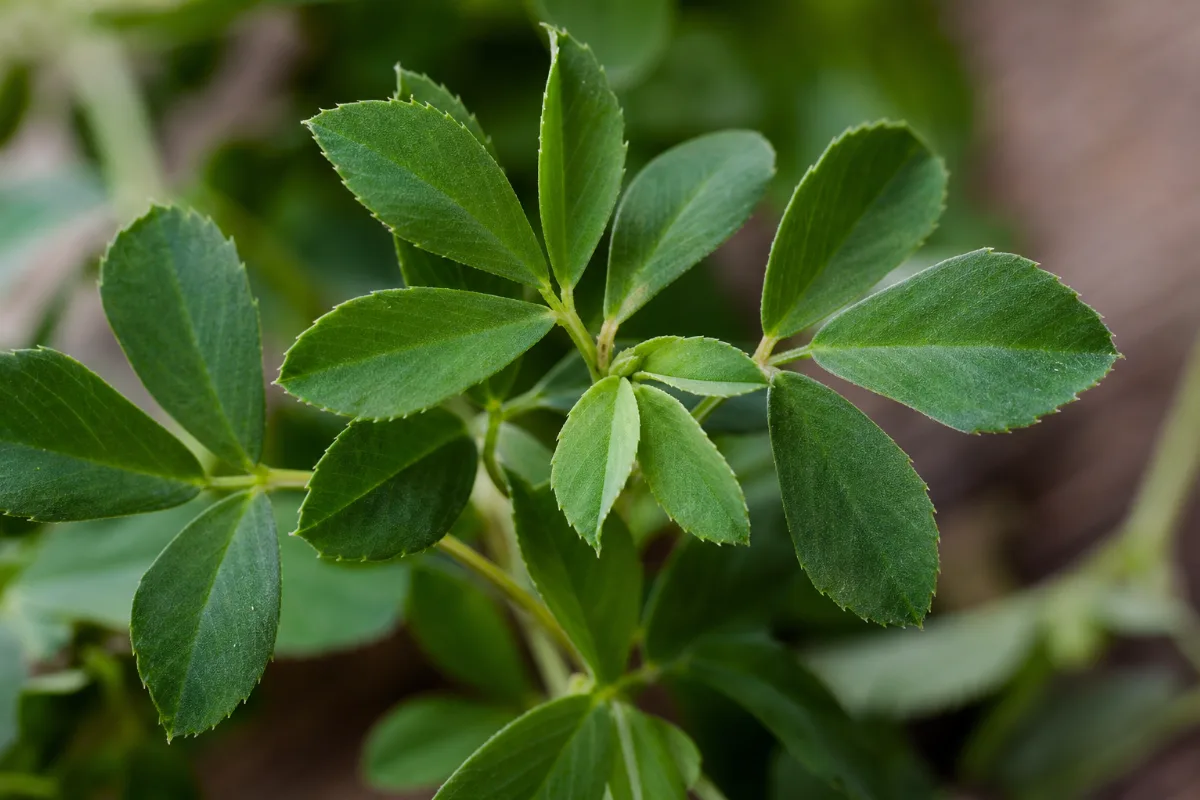
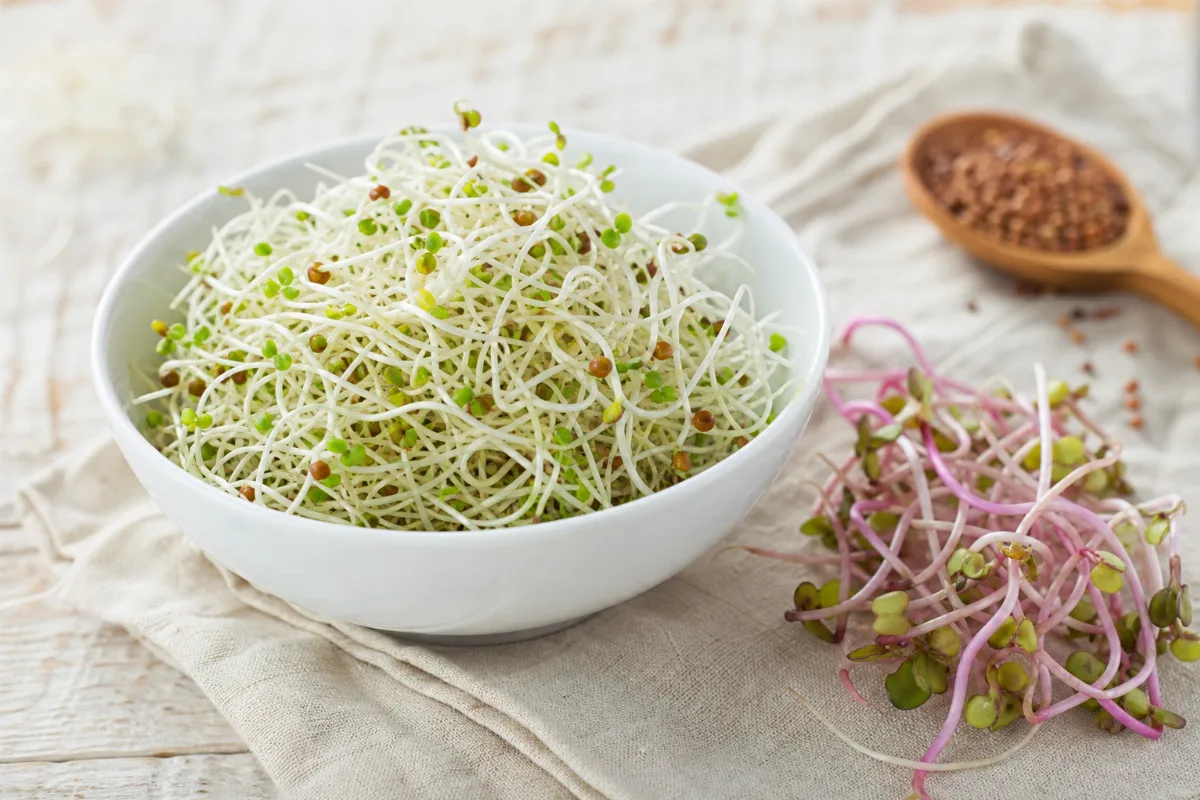
Alfalfa (Medicago sativa, also called lucerne) is a plant in the pea family. People use the leaf, sprouts and seeds. The sprouts are a salad food; leaf powders and tablets are sold as supplements.
The seeds and sprouts contain a toxic amino acid, L-canavanine, as well as saponins, plant estrogens and vitamin K.
How it may work
Saponins bind cholesterol in the gut, which is why alfalfa has been tested for cholesterol. Plant estrogens act on estrogen receptors in cells. L-canavanine changed immune cell behaviour in the lab.
These are lab and animal findings. How well people absorb these compounds is not known.
What the research shows
The best human result is one small before-and-after study of seeds that lowered LDL cholesterol in people with high cholesterol. It had no control group. We found no trials of alfalfa for menopause, diabetes, milk supply or cancer.
Reviews list many proposed uses and call for more research.
Raw sprouts and food poisoning
Alfalfa sprouts are the sprout most often tied to outbreaks, mainly Salmonella and E. coli. In 2024, Sweden had 100 cases and Norway 230, with a third of the Norwegian cases needing hospital care. Seeds were the likely source, and tests of the seeds were sometimes negative anyway.
Pregnant people, older adults, young children and people with weak immune systems should avoid raw sprouts.
At a glance
Traditional uses history, not proof
- Western and other folk medicine as a nutritive tonic and for high cholesterol
- Traditional use for diabetes, arthritis, asthma and hay fever
- Traditional use to promote menstruation and breast milk
Studied for research
- Cholesterol, very low certainty (one small uncontrolled seed study)
- Menopause and plant estrogens, insufficient (lab only)
- Blood sugar, insufficient (animal only)
- Milk supply, insufficient (no trial)
- Immune effects, a caution rather than a benefit
Main compounds
- Saponins, which bind cholesterol in the gut
- L-canavanine, a toxic amino acid in seeds and sprouts
- Plant estrogens: isoflavones (daidzein, genistein) and coumestrol
- Vitamin K
Common forms
- Raw sprouts
- Leaf powder, tablets and capsules
- Seeds
- Tea
Research links: Alfalfa seeds and cholesterol (PubMed) · Norway 2024 sprout outbreak (PubMed) · L-canavanine and lupus in monkeys (PubMed) · Alfalfa in LactMed (PubMed) · Research Library · Genes & Biomarkers Library
The plant and its history
- Accepted scientific name
- Medicago sativa L. (GBIF: ACCEPTED, species, usageKey 9151957)
- Naming authority
- L.
- Common names
- Alfalfa (English); Lucerne (English (UK, Australia)); Alfalfa sprouts (English (food name for the sprouted seed))
- Botanical family
- Fabaceae (legume or pea family, order Fabales)
- Classification
- Plantae > Fabales > Fabaceae > Medicago > Medicago sativa
- Native range
- Not verified from a primary source.
- Habitat
- Not verified.
- What the plant looks like
- Roots: Not verified.; Stems: Not verified.; Leaves: The leaf is the main part used in tablets and powders.; Flowers: Not verified.; Fruit: Not verified.; Seeds: Seeds are sprouted for food and also eaten or sold as supplements.
- Cultivation
- A widely grown forage and feed crop; reviews describe alfalfa as a major animal feed (not verified at source).
- Harvest and processing
- Not verified.
- Look-alikes and adulterants
- Name: Other sprouts (clover, mung bean, broccoli); Note: Different plants; outbreaks have also been linked to clover sprouts in California.
- Sustainability and conservation
- Not verified.
The plant and the parts used
Traditional use and history history, not clinical proof
| Tradition or era | Documented use | Source |
|---|---|---|
| Traditional herbal medicine (China, Iraq, Turkey, India, Americas) | Used for a variety of ailments, according to a 2011 review. | p20969516 |
| Western herbal practice | Leaves and seeds thought to be diuretic and used for diabetes, thyroid problems, arthritis, high cholesterol and peptic ulcers, and to promote menstruation and lactation; also used for asthma and hay fever (MSK; the underlying reference books were not read). | s-msk-alfalfa |
Traditional use shows how a plant was used. It does not show that a supplement works or is safe today.
What is inside, and how it may work
What the plant contains and how those compounds act in cells and animals. Laboratory and animal mechanisms are not proven effects in people.
Main compounds
| Compound | Family | Where it is concentrated | Activity studied | Level of evidence |
|---|---|---|---|---|
| Saponins (including medicagenic acid) PubChem 65048 | triterpenoid saponins | Leaf, sprout, seed | Bind cholesterol in the gut in lab and animal work; hemolytic activity noted by MSK. 12 15 | Animal research |
| L-canavanine PubChem 439202 | non-protein amino acid | Seed and sprout (about 1.5% of dry weight, per MSK) About 1.5% of dry seed and sprout weight (MSK; primary data not read) | Re-triggered a lupus-like syndrome in monkeys; changed human T-cell function in the lab. 14 1 15 | Animal and in vitro |
| Coumestrol PubChem 5281707 | coumestan phytoestrogen | Sprout (tested as a single compound in mice) | A plant estrogen; on its own it did not match the benefit of the sprout extract in lupus-prone mice. 9 19 | Animal research |
| Daidzein and genistein (isoflavones) | isoflavone | Leaf and sprout (LactMed) | Estrogenic isoflavonoids named by LactMed; excreted into breast milk in small amounts after other intakes, not measured after alfalfa. 10 | Authoritative guidance |
| Vitamin K (phylloquinone) PubChem 5284607 | vitamin | Leaf and sprout | Clotting vitamin; reason for warfarin caution. 10 19 | Authoritative guidance |
Mechanisms, receptors and pathways
| Target or pathway | Gene or receptor | What was found | Level |
|---|---|---|---|
| Cholesterol and bile acid handling | Not specified | Saponins reduced cholesterol absorption and raised faecal bile acid loss in monkeys. 12 | Animal research |
| Estrogen receptor beta | ESR2 | Alfalfa sprout extract acted mainly on estrogen receptor beta in cell lines and made estrogen-dependent breast cancer cells grow. 4 | Laboratory research |
| T-cell regulation (L-canavanine) | Not specified | L-canavanine reduced mitogen responses and suppressor-cell function in human cells in the lab. 1 | Laboratory research |
| Innate immune signalling | Toll-like receptors, NF-kB, MAPK | The scoping review says the leading immune-stimulating herbs, including alfalfa, share these pathways; this is a summary of lab, animal and human reports. 22 | Mixed |
Absorption, metabolism and elimination
- Absorption
- No human data found on alfalfa components. LactMed says daidzein and genistein from other sources reach breast milk in small amounts but were not measured after alfalfa.
- Distribution
- Not found.
- Metabolism
- Not found.
- Elimination
- Not found.
- Bioavailability
- Not established in humans.
Isolated compounds versus whole extracts
Results differ by form: seeds (cholesterol study), saponin extract (monkeys), sprout chemical extract (mice) and tablets (case reports) cannot be treated as the same product. In lupus-prone mice, an extract helped while whole sprout and coumestrol alone did not.
Nutritional composition
Alfalfa contains vitamin K, relevant to warfarin. MSK says it is claimed to supply vitamins A, C, E and K and minerals; amounts were not verified.
1 very low certainty6 not enough evidence
What is Alfalfa good for?
The studied uses and how strong the human evidence is for each. No placebo-controlled trial of alfalfa was found.
Benefits, one by one
Each card is a research question, not a promise. Tap a goal to filter. Open a card to see the studies, doses and limits.
Cholesterol and blood fats
Very low certaintyAlfalfa seeds lowered LDL ('bad') cholesterol in a very small before-and-after study of people with high cholesterol, and alfalfa saponins lowered cholesterol in monkeys. There is no placebo-controlled trial, and the human result used seeds eaten with meals, not leaf tablets or sprouts.
3 studiesNot covered; no dose advice is given.
Studies, doses and limits
What the trials found
One small before-and-after study gave 15 people with high blood fats heat-prepared alfalfa seeds with meals for 8 weeks. In the 11 with type II high cholesterol, median total cholesterol fell about 17% and LDL about 18%, and cholesterol returned to starting levels after stopping. Memorial Sloan Kettering describes two small uncontrolled trials. We found no randomised placebo-controlled trial.
Results
LDL and total cholesterol fell in a small uncontrolled study, and went back up when seeds were stopped. Two patients had little change. Body weight rose slightly.
Effect sizes as reported
Type II patients: total cholesterol 9.58 to 8.00 mmol/l (P<0.001); LDL 7.69 to 6.33 mmol/l (P<0.01); apolipoprotein B about 34% lower (P<0.05). No confidence intervals given in the abstract.
Why this rating
One tiny uncontrolled study of seeds (n=15) and monkey data. No control group, no placebo, and a different form from the tablets and capsules sold today.
Form and dose studied
Not covered; no dose advice is given.
Who was studied
Adults with type II hyperlipoproteinaemia (high LDL cholesterol) in one Swedish study.
Limits
No control group. Seeds are the form with most L-canavanine and the highest concern for lupus-like illness (see Safety). Long-term toxicity of saponins was an open question in the monkey authors' own words.
Why researchers looked
Saponins in alfalfa bind cholesterol in the gut, so researchers tested whether eating the seeds or taking the saponins changes blood cholesterol.
Traditional use
Memorial Sloan Kettering lists cholesterol lowering among alfalfa's purported uses.
Proposed mechanism Animal research
Saponins and fibre are thought to bind cholesterol and bile acids in the gut so more leaves the body in stool. In monkeys, saponins cut cholesterol absorption and raised faecal bile acids.
A proposed mechanism does not show that the effect happens in people.
Seeds and tablets carry the lupus, blood-count and warfarin cautions on the Safety tab. Do not use alfalfa instead of cholesterol medicine.
General 'nutritive tonic' use
Not enough evidenceAlfalfa is sold as a green, nutrient-rich tonic. Reviews list vitamins, minerals and plant compounds in the plant, but no trial shows that taking alfalfa improves health or fixes a nutrient shortage.
3 studiesNot covered; no dose advice is given.
Studies, doses and limits
What the trials found
No clinical trial of alfalfa as a general tonic was found. Two review papers list its constituents and the laboratory and animal work, and both call for more research.
Results
No human outcome data for tonic use.
Effect sizes as reported
None.
Why this rating
Constituent lists and lab work do not show benefit in people.
Form and dose studied
Not covered; no dose advice is given.
Who was studied
None studied.
Limits
LactMed notes supplement labels may not match the contents, and results on one product may not apply to another.
Why researchers looked
The plant contains vitamins (including vitamin K), saponins and other plant compounds, and is a major animal feed crop.
Traditional use
Used traditionally in China, India, Iraq, Turkey and the Americas for many ailments, according to a 2011 review.
Proposed mechanism Pharmacological theory
No tested mechanism for a general tonic effect. The idea rests on the constituents listed in reviews.
A proposed mechanism does not show that the effect happens in people.
Vitamin K content matters for people taking warfarin.
Plant estrogens and menopause-type uses
Not enough evidenceAlfalfa contains plant estrogens and extracts act on estrogen receptors in the lab. Reviews list menopause as a proposed use, but no human trial was found. The same lab work raises a caution for hormone-sensitive conditions.
4 studiesNot covered; no dose advice is given.
Studies, doses and limits
What the trials found
No human trial of alfalfa for menopausal symptoms was found. A 2011 review lists menopause among proposed uses; a 2016 review of forage legumes refers to anti-menopause potential.
Results
Lab only: estrogen-like activity, including growth of estrogen-dependent breast cancer cells in a dish.
Effect sizes as reported
None reported as numbers in the abstract.
Why this rating
Cell data and review statements only; no trial in women.
Form and dose studied
Not covered; no dose advice is given.
Who was studied
None studied.
Limits
Cell results do not show what happens in the body. They do justify caution for breast, uterine and ovarian conditions that respond to estrogen.
Why researchers looked
Isoflavonoids such as daidzein and genistein (named by LactMed) give alfalfa estrogen-like activity.
Traditional use
Reviews list menopausal symptoms among proposed uses.
Proposed mechanism Laboratory research
Alfalfa sprout extract acted mainly on estrogen receptor beta in cells and made estrogen-dependent breast cancer cells grow more than estradiol did.
A proposed mechanism does not show that the effect happens in people.
See hormone-sensitive conditions on the Safety tab.
Blood sugar and diabetes
Not enough evidenceAlfalfa is traditionally used for diabetes. Memorial Sloan Kettering lists it as a purported use. Reviews point to animal findings, and no study in people with diabetes was found.
2 studiesNot covered; no dose advice is given.
Studies, doses and limits
What the trials found
None found. The 2016 forage-legumes review lists antidiabetic effects of some compounds in these plants but names no alfalfa human trial.
Results
No human results.
Effect sizes as reported
None.
Why this rating
Review statements and animal findings only.
Form and dose studied
Not covered; no dose advice is given.
Who was studied
None studied.
Limits
We did not open the animal studies themselves.
Why researchers looked
Reviews list antidiabetic activity of alfalfa and related forage legumes.
Traditional use
Listed among purported uses by MSK.
Proposed mechanism Animal research
No confirmed mechanism. Reviews cite animal work only.
A proposed mechanism does not show that the effect happens in people.
If you take diabetes medicines, ask your doctor before adding alfalfa: an added blood-sugar effect is possible in theory but not shown.
Breast milk supply
Not enough evidenceAlfalfa is in some mixtures sold to raise milk supply, but LactMed says no valid clinical trial supports this and nothing is known about its safety for nursing mothers or babies.
2 studiesNot covered; no dose advice is given.
Studies, doses and limits
What the trials found
LactMed found no scientifically valid clinical trials and no data on alfalfa components in breast milk.
Results
No evidence of effect.
Effect sizes as reported
None.
Why this rating
Authoritative guidance finds no trial evidence.
Form and dose studied
Not covered; no dose advice is given.
Who was studied
None studied.
Limits
No data.
Why researchers looked
Traditional lactation use.
Traditional use
A purported galactogogue (milk-boosting herb) in proprietary blends.
Proposed mechanism Pharmacological theory
Not established.
A proposed mechanism does not show that the effect happens in people.
MSK advises not consuming alfalfa during nursing; LactMed says safety is unstudied. Talk to a lactation consultant or doctor.
Immune effects (a safety question, not a benefit)
Not enough evidenceAlfalfa is not shown to help immunity. Reviews describe it as an immune-stimulating herb, which is a reason for caution in people with lupus or other autoimmune conditions. One mouse study of a chemical extract found the opposite, which shows how unclear the picture is.
4 studiesNot covered; no dose advice is given.
Studies, doses and limits
What the trials found
Case reports (not read in full) link alfalfa tablets or seeds to lupus relapse and low blood counts. A 2025 scoping review ranked alfalfa among 15 herbs with the strongest evidence of immune-stimulating effects.
Results
Possible harm in autoimmune disease; no benefit shown.
Effect sizes as reported
None.
Why this rating
Mixed lab, animal and case-report evidence; no trial.
Form and dose studied
Not covered; no dose advice is given.
Who was studied
People with lupus or other autoimmune disease are the group of concern.
Limits
In lupus-prone mice, an ethyl acetate extract of sprouts reduced disease, while whole sprout and coumestrol did not. This was a chemical extract, not a supplement.
Why researchers looked
Case reports of lupus flares and the L-canavanine story led researchers to study immune effects.
Traditional use
Sold for 'immune support' in some products.
Proposed mechanism Laboratory research
L-canavanine changed human T-cell function in the lab. The 2025 scoping review says the top immune-stimulating herbs share pathways such as toll-like receptor and NF-kB signalling.
A proposed mechanism does not show that the effect happens in people.
See the lupus topic on the Safety tab.
Cancer
Not enough evidenceMemorial Sloan Kettering finds no evidence that alfalfa treats cancer, and notes lab findings that its extracts can stimulate estrogen-dependent breast cancer cells.
2 studiesNot covered; no dose advice is given.
Studies, doses and limits
What the trials found
None found.
Results
No evidence of benefit.
Effect sizes as reported
None.
Why this rating
No supporting human studies.
Form and dose studied
Not covered; no dose advice is given.
Who was studied
None.
Limits
None found.
Why researchers looked
Claimed in folk use.
Traditional use
Not established.
Proposed mechanism Laboratory research
None shown.
A proposed mechanism does not show that the effect happens in people.
Hormone-sensitive cancers: see Safety.
Connections to the rest of health
How Alfalfa connects to the rest of our health knowledge graph. Every link says what kind of connection it is. A safety link (for example to the liver) is a warning, not a benefit. A study that merely mentions a topic never creates a benefit link.
Explore every connection: goals, body systems, organs, symptoms, genes
A. Wellness goals
| Connected to | Kind of connection | Evidence status | Context | Studies |
|---|---|---|---|---|
| Cholesterol Balance | Potential benefit | Very low certainty | Cholesterol and blood fats: Alfalfa seeds lowered LDL ('bad') cholesterol in a very small before-and-after study of people with high cholesterol, and alfalfa saponins lowered cholesterol in monkeys. There is no placebo-controlled trial, and the human result used seeds eaten with meals, not leaf tablets or sprouts. | 18 12 15 |
| Heart Health | Potential benefit | Very low certainty | Cholesterol and blood fats: Alfalfa seeds lowered LDL ('bad') cholesterol in a very small before-and-after study of people with high cholesterol, and alfalfa saponins lowered cholesterol in monkeys. There is no placebo-controlled trial, and the human result used seeds eaten with meals, not leaf tablets or sprouts. | 18 12 15 |
| Healthy Aging | Traditional use | Not enough evidence | General 'nutritive tonic' use: Alfalfa is sold as a green, nutrient-rich tonic. Reviews list vitamins, minerals and plant compounds in the plant, but no trial shows that taking alfalfa improves health or fixes a nutrient shortage. | 3 5 10 |
| Menopause Support | Preliminary mechanism | Not enough evidence | Plant estrogens and menopause-type uses: Alfalfa contains plant estrogens and extracts act on estrogen receptors in the lab. Reviews list menopause as a proposed use, but no human trial was found. The same lab work raises a caution for hormone-sensitive conditions. | 4 3 5 10 |
| Womens Wellness | Preliminary mechanism | Not enough evidence | Plant estrogens and menopause-type uses: Alfalfa contains plant estrogens and extracts act on estrogen receptors in the lab. Reviews list menopause as a proposed use, but no human trial was found. The same lab work raises a caution for hormone-sensitive conditions. | 4 3 5 10 |
| Hormone Balance | Preliminary mechanism | Not enough evidence | Plant estrogens and menopause-type uses: Alfalfa contains plant estrogens and extracts act on estrogen receptors in the lab. Reviews list menopause as a proposed use, but no human trial was found. The same lab work raises a caution for hormone-sensitive conditions. | 4 3 5 10 |
| Blood Sugar Balance | Traditional use | Not enough evidence | Blood sugar and diabetes: Alfalfa is traditionally used for diabetes. Memorial Sloan Kettering lists it as a purported use. Reviews point to animal findings, and no study in people with diabetes was found. | 15 5 |
| Metabolic Health | Traditional use | Not enough evidence | Blood sugar and diabetes: Alfalfa is traditionally used for diabetes. Memorial Sloan Kettering lists it as a purported use. Reviews point to animal findings, and no study in people with diabetes was found. | 15 5 |
| Womens Wellness | Traditional use | Not enough evidence | Breast milk supply: Alfalfa is in some mixtures sold to raise milk supply, but LactMed says no valid clinical trial supports this and nothing is known about its safety for nursing mothers or babies. | 10 15 |
| Immune Support | Adverse effect or risk | Not enough evidence | Immune effects (a safety question, not a benefit): Alfalfa is not shown to help immunity. Reviews describe it as an immune-stimulating herb, which is a reason for caution in people with lupus or other autoimmune conditions. One mouse study of a chemical extract found the opposite, which shows how unclear the picture is. | 22 2 9 1 |
| Immune Support | Traditional use | Not enough evidence | Cancer: Memorial Sloan Kettering finds no evidence that alfalfa treats cancer, and notes lab findings that its extracts can stimulate estrogen-dependent breast cancer cells. | 15 4 |
B. Body systems
| Connected to | Kind of connection | Evidence status | Context | Studies |
|---|---|---|---|---|
| Cardiovascular System | Biological association | Very low certainty | Studied for: Cholesterol and blood fats | 18 12 15 |
| Digestive System | Biological association | Not enough evidence | Studied for: General 'nutritive tonic' use | 3 5 10 |
| Reproductive System | Biological association | Not enough evidence | Studied for: Plant estrogens and menopause-type uses Studied for: Breast milk supply | 4 3 5 10 15 |
| Endocrine System | Biological association | Not enough evidence | Studied for: Plant estrogens and menopause-type uses Studied for: Blood sugar and diabetes | 4 3 5 10 15 |
| Immune System | Biological association | Not enough evidence | Studied for: Immune effects (a safety question, not a benefit) Studied for: Cancer | 22 2 9 1 15 4 |
E. Health conditions
| Connected to | Kind of connection | Evidence status | Context | Studies |
|---|---|---|---|---|
| Systemic lupus erythematosus | Adverse effect or risk | Very low certainty | Case reports and monkey and lab work; avoid seeds and tablets. Case reports plus monkey and lab data; avoid seeds and tablets. Preparation or compound: Seeds, sprouts and tablets; L-canavanine |
14 1 15 10 |
| Salmonella and E. coli infection | Adverse effect or risk | High certainty | Repeated outbreaks with genome and case-control evidence. Repeated outbreaks with genomic and case-control evidence. Preparation or compound: Raw alfalfa sprouts |
11 20 17 |
| Pregnancy and breastfeeding | Contraindication | Not enough evidence | Advised against by MSK; no safety data (LactMed). Preparation or compound: Alfalfa supplements; raw sprouts |
15 10 |
I. Biomarkers
| Connected to | Kind of connection | Evidence status | Context | Studies |
|---|---|---|---|---|
| LDL cholesterol | Biological association | Very low certainty | Measured in trials: lowered. A lab change is not the same as a health benefit. | 18 12 |
| Apolipoprotein B | Biological association | Very low certainty | Measured in trials: lowered. A lab change is not the same as a health benefit. | 18 |
| Blood urate and urea | Biological association | Very low certainty | Measured in trials: raised. A lab change is not the same as a health benefit. | 15 |
J. Genes, receptors and enzymes
| Connected to | Kind of connection | Evidence status | Context | Studies |
|---|---|---|---|---|
| ESR2 (estrogen receptor beta) | Preliminary mechanism | In vitro | Preferred target of alfalfa sprout extract in cells. | 4 |
K. Biological pathways
| Connected to | Kind of connection | Evidence status | Context | Studies |
|---|---|---|---|---|
| NF-kB and toll-like receptor signalling | Preliminary mechanism | Mixed findings | Shared by immune-stimulating herbs per a scoping review. | 22 |
L. Active compounds
| Connected to | Kind of connection | Evidence status | Context | Studies |
|---|---|---|---|---|
| Saponins (including medicagenic acid) | Biological association | Animal | Bind cholesterol in the gut in lab and animal work; hemolytic activity noted by MSK. Preparation or compound: Leaf, sprout, seed |
12 15 |
| L-canavanine | Biological association | Animal and in vitro | Re-triggered a lupus-like syndrome in monkeys; changed human T-cell function in the lab. Preparation or compound: Seed and sprout (about 1.5% of dry weight, per MSK) |
14 1 15 |
| Coumestrol | Biological association | Animal | A plant estrogen; on its own it did not match the benefit of the sprout extract in lupus-prone mice. Preparation or compound: Sprout (tested as a single compound in mice) |
9 19 |
| Daidzein and genistein (isoflavones) | Biological association | Authoritative guidance | Estrogenic isoflavonoids named by LactMed; excreted into breast milk in small amounts after other intakes, not measured after alfalfa. Preparation or compound: Leaf and sprout (LactMed) |
10 |
| Vitamin K (phylloquinone) | Biological association | Authoritative guidance | Clotting vitamin; reason for warfarin caution. Preparation or compound: Leaf and sprout |
10 19 |
Each connection is stored with the ingredient, the connected record, the kind of connection, the evidence status, the supporting studies, the preparation or compound involved, and a review date (last reviewed October 25, 2026).
The evidence
The research centre for Alfalfa. Every record here was checked against PubMed or the publisher's page; we never list a study we have not verified.
Evidence by outcome
Bars show how many studies we found for each outcome, not how well it works. People are added up across trials only (reviews are not added, to avoid double counting).
How we rate evidence
High certainty
Several well-run trials or reviews agree; further research is unlikely to change the picture much.
Moderate certainty
Good trials point the same way, but some doubt remains.
Low certainty
Small, short or inconsistent trials. The finding could change with better research.
Very low certainty
Very little or very weak human data. Treat as a possibility only.
Mixed findings
Trials or reviews disagree with each other.
Not enough evidence
Not enough human research to say either way.
Evidence against
Good research found no benefit, or found harm.
We take the reviewers' own risk-of-bias and GRADE statements where they exist, and otherwise judge from study size, design, consistency, directness and whether a product matches what is sold. Many publications do not make evidence high. Method note: We started from our existing alfalfa summary, re-opened the PubMed records it relied on, added safety searches, and checked names with GBIF and PubChem.
Study library: every study we checked 22
| Study | Design | People | Product, dose, length | Result |
|---|---|---|---|---|
| Alcocer-Varela 1985 Effects of L-canavanine on T cells may explain the induction of systemic lupus erythematosus by alfalfa. Arthritis & Rheumatism · PMID 3155617 · DOI |
Laboratory research in-vitro |
Immune cells from healthy people and people with lupus | L-canavanine isolated compound Not stated here; no dose advice n/a · vs n/a |
L-canavanine had dose-related effects on human T cells in the lab, including loss of suppressor-cell function and increased release of antibodies, including DNA-binding antibody. The authors say this may explain lupus induction or flares with alfalfa. n/a (n/a) Methods, limits and fundingOutcomes: T-cell function and antibody release Limitations: Lab study; dose and relevance to eating or taking alfalfa not established. Funding and conflicts: Not stated in the abstract Read: abstract |
| Bax 2021 The effects of immunostimulatory herbal supplements on autoimmune skin diseases. Journal of the American Academy of Dermatology · PMID 32553683 · DOI |
Narrative review review |
Review of herbs and autoimmune skin disease | Spirulina, Aphanizomenon, chlorella, echinacea and alfalfa (and others) various Not stated here; no dose advice n/a · vs n/a |
Says lab and animal studies show alfalfa and several other herbs activate immune cells, and case reports link immune-stimulating herbs with onset or flares of lupus, dermatomyositis and blistering disorders. Calls for more study. n/a (n/a) Methods, limits and fundingOutcomes: Immune activation and flares Limitations: Narrative review; case reports; alfalfa is one of several herbs. Funding and conflicts: Not stated in the abstract Read: abstract |
| Bora 2011 Phytochemical and pharmacological potential of Medicago sativa: a review. Pharmaceutical Biology · PMID 20969516 · DOI |
Narrative review review |
Review of 117 references | Medicago sativa (whole plant) whole plant Not stated here; no dose advice n/a · vs n/a |
Lists saponins, flavonoids, phytoestrogens, coumarins, alkaloids, amino acids, phytosterols and vitamins as main constituent classes. Reports cholesterol-lowering, antioxidant, estrogenic and other effects and says the plant deserves further study, especially for brain and heart effects. n/a (n/a) Methods, limits and fundingOutcomes: Phytochemistry and reported pharmacology Limitations: Narrative review; mostly lab and animal work; does not grade the evidence. Funding and conflicts: Not stated in the abstract Read: abstract |
| Boue 2003 Evaluation of the estrogenic effects of legume extracts containing phytoestrogens. Journal of Agricultural and Food Chemistry · PMID 12670155 · DOI |
Laboratory research in-vitro |
Human breast cancer (MCF-7) and kidney (HEK 293) cell lines | Methanol extracts of seven legumes including alfalfa sprout sprout Not stated here; no dose advice n/a · vs n/a |
All seven extracts, including alfalfa sprout, acted mainly on estrogen receptor beta. Alfalfa sprout extract made estrogen-dependent breast cancer cells grow more than estradiol did, and an estrogen blocker suppressed this effect. Not given as a number in the abstract (n/a) Methods, limits and fundingOutcomes: Estrogen receptor binding and cell growth Limitations: Cell-line study only; not shown in people. Funding and conflicts: Not stated in the abstract Read: abstract |
| Cornara 2016 Therapeutic Potential of Temperate Forage Legumes: A Review. Critical Reviews in Food Science and Nutrition · PMID 26507574 · DOI |
Narrative review review |
Review of nine forage legumes including alfalfa | Medicago sativa and other forage legumes whole plant Not stated here; no dose advice n/a · vs n/a |
Says alfalfa and related legumes contain saponins, flavonoids, coumarins and other compounds linked to cholesterol-lowering, antidiabetic and menopause-related effects in the literature, and calls for more investigation. Notes that the blood thinner warfarin was inspired by coumarin from sweet clover, a different plant. n/a (n/a) Methods, limits and fundingOutcomes: Compounds and proposed therapeutic uses Limitations: Narrative review of several plants; not alfalfa only; no clinical grading. Funding and conflicts: Not stated in the abstract Read: abstract |
| Czajka 1994 Verification of causal relationships between Listeria monocytogenes isolates implicated in food-borne outbreaks of listeriosis by randomly amplified polymorphic DNA patterns. Journal of Clinical Microbiology · PMID 8051257 · DOI |
Laboratory study lab |
Isolates from four outbreaks including a 1989 Canadian alfalfa-tablet outbreak | Alfalfa tablets (as outbreak vehicle) leaf tablet Not stated here; no dose advice n/a · vs n/a |
Isolates from the alfalfa-tablet outbreak matched at 19 of 20 DNA probes but differed at one, so the authors concluded the food and patient isolates were not identical. n/a (n/a) Methods, limits and fundingOutcomes: DNA fingerprint matching Limitations: Method paper; small isolate set. Funding and conflicts: Not stated in the abstract Read: abstract |
| Farber 1990 Listeriosis traced to the consumption of alfalfa tablets and soft cheese. New England Journal of Medicine · PMID 2296279 · DOI |
Case report |
Listeria cases in Canada (letter, no abstract) | Alfalfa tablets leaf tablet Not stated here; no dose advice n/a · vs n/a |
Title only: a letter linking listeriosis to alfalfa tablets and soft cheese. Text not read. A 1994 genetic study of the same alfalfa-tablet outbreak found the tablet and patient bacteria were not identical, so the link is not clear-cut. n/a (n/a) Methods, limits and fundingOutcomes: Listeria infection Limitations: Letter; not read. Funding and conflicts: Not stated Read: summary-only |
| GBIF Secretariat 2026 GBIF backbone: Medicago sativa L. GBIF API (checked 2026-10-25) · Source |
Identity record n/a |
n/a | n/a n/a Not stated here; no dose advice n/a · vs n/a |
GBIF match: Medicago sativa L., ACCEPTED, species, usageKey 9151957, family Fabaceae, order Fabales. n/a (n/a) Methods, limits and fundingOutcomes: Accepted name check Limitations: Taxonomy database only. Funding and conflicts: n/a Read: full-text |
| Hong 2009 The ethyl acetate extract of alfalfa sprout ameliorates disease severity of autoimmune-prone MRL-lpr/lpr mice. Lupus · PMID 19213858 · DOI |
Animal study animal |
Female lupus-prone mice | Ethyl acetate extract of alfalfa sprout; whole lyophilised sprout; coumestrol sprout Not stated here; no dose advice n/a · vs n/a |
The extract delayed protein in urine, increased survival and lowered inflammatory signals in these mice. Whole freeze-dried sprout and coumestrol alone did not show the same benefit. Not given as one number in the abstract (n/a) Methods, limits and fundingOutcomes: Kidney disease onset, survival, immune markers Limitations: Mouse study of a chemical extract, not a food or supplement; it contrasts with human case reports of flares. Funding and conflicts: Not stated in the abstract Read: abstract |
| LactMed 2021 Alfalfa. In: Drugs and Lactation Database (LactMed). LactMed (US National Library of Medicine) · PMID 30000890 |
Authoritative guidance authoritative |
Nursing mothers (no data) | Alfalfa leaves and sprouts leaf and sprout Not stated here; no dose advice n/a · vs n/a |
Alfalfa leaves and sprouts contain saponins, estrogen-like isoflavonoids, vitamin K and L-canavanine. No valid clinical trials support its use to raise milk supply, and no data exist on safety in nursing mothers or infants. It is a US food GRAS. Worsening of lupus has been reported, possibly through L-canavanine, and it should be avoided in people taking warfarin because of vitamin K. n/a (n/a) Methods, limits and fundingOutcomes: Safety in breastfeeding; general safety notes Limitations: Database entry (record dated 2021); gives no study numbers. Funding and conflicts: None (public database) Read: abstract |
| Lillepold 2025 Multi-cluster outbreak of Salmonella Typhimurium sequence type 36 linked to alfalfa sprouts, Sweden, August-November 2024. Epidemiology and Infection · PMID 40916032 · DOI |
Outbreak investigation |
100 100 cases across Sweden |
Raw alfalfa sprouts sprout Not stated here; no dose advice n/a · vs n/a |
Case-control study linked illness to alfalfa sprouts (adjusted odds ratio 8.94). Seeds from the same origin were the likely ultimate source, even though tests on sprouted seed did not find Salmonella. Highest case shares were among ages 0-10 (17%) and 41-50 (20%). aOR 8.94 (95% CI 2.96 to 27.1) Methods, limits and fundingOutcomes: Source of a Salmonella outbreak Limitations: Observational outbreak study. Funding and conflicts: Authors declare none Read: abstract |
| Malinow 1981 Cholesterol and bile acid balance in Macaca fascicularis. Effects of alfalfa saponins. Journal of Clinical Investigation · PMID 7451648 · DOI |
Animal study animal |
8 Eight cynomolgus macaques fed cholesterol |
Alfalfa top saponins mixed into feed aerial top (saponin fraction) Not stated here; no dose advice n/a · vs n/a |
Saponins lowered blood cholesterol without changing HDL, reduced cholesterol absorption and raised faecal excretion of sterols and bile acids. No signs of toxicity at 6 to 8 weeks. Authors said long-term toxicity studies were needed before use in people. Not given as one number in the abstract (n/a) Methods, limits and fundingOutcomes: Blood cholesterol, cholesterol absorption, faecal bile acids Limitations: Monkeys, 8 animals, short term; saponin extract, not whole herb. Funding and conflicts: Not stated in the abstract Read: abstract |
| Malinow 1981 Pancytopenia during ingestion of alfalfa seeds. Lancet · PMID 6110847 · DOI |
Case report |
Case letter (no abstract) | Alfalfa seeds seed Not stated here; no dose advice n/a · vs n/a |
Title only: a letter reporting pancytopenia (low red cells, white cells and platelets) during alfalfa seed ingestion. The text was not read. n/a (n/a) Methods, limits and fundingOutcomes: Low blood cell counts Limitations: Letter; content not read; cause not established from the title. Funding and conflicts: Not stated Read: summary-only |
| Malinow 1982 Systemic lupus erythematosus-like syndrome in monkeys fed alfalfa sprouts: role of a nonprotein amino acid. Science · PMID 7071589 · DOI |
Animal study animal |
Cynomolgus macaques | Alfalfa sprouts, seeds and L-canavanine sulfate sprout and seed Not stated here; no dose advice n/a · vs n/a |
Monkeys fed alfalfa sprouts developed blood and antibody abnormalities like human lupus. L-canavanine added to the diet re-triggered the syndrome in monkeys that had developed it from seeds or sprouts. n/a (n/a) Methods, limits and fundingOutcomes: Blood and antibody abnormalities Limitations: Monkeys; unclear if human supplements reach comparable levels. Funding and conflicts: Not stated in the abstract Read: abstract |
| Memorial Sloan Kettering Cancer Center 2023 Alfalfa (Herbs, Botanicals and Supplements) MSK Integrative Medicine · Source |
Authoritative guidance authoritative |
Patient and clinician summary | Alfalfa leaf, seeds, sprouts and tablets various Not stated here; no dose advice n/a · vs n/a |
Lists cholesterol lowering in small uncontrolled trials, estrogen-receptor effects in the lab (including breast cancer cell growth above estradiol), L-canavanine effects on T cells, lupus relapse after tablets, sprout-linked E. coli and Salmonella infections, Listeria from contaminated tablets, digestive effects (loose stools, gas), possible rise in blood urate and urea, gout caution, and advice not to consume it in pregnancy and nursing. It does not list warfarin. n/a (n/a) Methods, limits and fundingOutcomes: Uses, mechanism, warnings, adverse effects Limitations: Secondary summary; cites older references; some statements (for example colon cancer in rats) are not repeated here. Funding and conflicts: None (non-profit) Read: full-text |
| Miyahira 2021 Bacteriological safety of sprouts: A brief review. International Journal of Food Microbiology · PMID 34111728 · DOI |
Narrative review review |
Review of sprout outbreaks worldwide | Sprouts (alfalfa most often implicated) sprout Not stated here; no dose advice n/a · vs n/a |
More than 60 outbreaks of food illness have been tied to sprouts since 1988, with alfalfa sprouts most often involved, and Salmonella and Shiga toxin-producing E. coli the usual germs. Warm, moist sprouting favours bacterial growth. The authors suggest cooking sprouts if possible. More than 60 outbreaks since 1988 (n/a) Methods, limits and fundingOutcomes: Outbreaks and control Limitations: Brief review; no risk calculation for individuals. Funding and conflicts: Not stated in the abstract Read: abstract |
| Mohle-Boetani 2001 Escherichia coli O157 and Salmonella infections associated with sprouts in California, 1996-1998. Annals of Internal Medicine · PMID 11511138 · DOI |
Outbreak investigation |
600 600 culture-confirmed patients |
Alfalfa and clover sprouts sprout Not stated here; no dose advice n/a · vs n/a |
Five Salmonella outbreaks and one E. coli O157 outbreak, 600 culture-confirmed patients and two deaths. Odds ratios for alfalfa sprouts ranged from 5.0 to infinity. The authors say seeds can be contaminated before sprouting, no method can remove all germs, and high-risk groups should avoid sprouts. Matched odds ratios 5.0 to infinity (n/a) Methods, limits and fundingOutcomes: Outbreak sources Limitations: Older US data; investigations, not trials. Funding and conflicts: Not stated in the abstract Read: abstract |
| Molgaard 1987 Alfalfa seeds lower low density lipoprotein cholesterol and apolipoprotein B concentrations in patients with type II hyperlipoproteinemia. Atherosclerosis · PMID 3606731 · DOI |
Uncontrolled trial |
15 15 adults with high blood fats (types IIA, IIB and IV); 11 with type II |
Heat-prepared alfalfa seeds added to meals taken with meals; amount not repeated here seed Not stated here; no dose advice n/a · vs n/a |
In type II patients, median total cholesterol fell from 9.58 to 8.00 mmol/l (about 17%) and LDL from 7.69 to 6.33 mmol/l (about 18%) after 8 weeks; two patients with high cholesterol had LDL falls under 5%. Apolipoprotein B fell about 34%. Levels returned to starting values after stopping. Body weight rose slightly. Total cholesterol P<0.001; LDL P<0.01; apo B P<0.05 (before/after, no control group) Methods, limits and fundingOutcomes: Total cholesterol, LDL cholesterol, apolipoprotein B Limitations: Very small, no placebo or control group, 8 weeks, seeds eaten in bulk. Not a leaf tablet or sprout study. Funding and conflicts: Not stated in the abstract Read: abstract |
| NCBI PubChem 2026 PubChem records: coumestrol, L-canavanine, medicagenic acid, phylloquinone PubChem API (checked 2026-10-25) · Source |
Identity record n/a |
n/a | n/a n/a Not stated here; no dose advice n/a · vs n/a |
Coumestrol CID 5281707 (C15H8O5); canavanine CID 439202 (C5H12N4O3); medicagenic acid CID 65048 (C30H46O6); phylloquinone (vitamin K1) CID 5284607 (C31H46O2). n/a (n/a) Methods, limits and fundingOutcomes: Compound ID check Limitations: Names and formulas only. Funding and conflicts: n/a Read: full-text |
| Rakover 2025 A large outbreak of multiple Salmonella serovars linked to alfalfa sprouts in Norway, October to December 2024. Infection · PMID 40394450 · DOI |
Outbreak investigation |
230 230 cases in Norway |
Raw alfalfa sprouts sprout Not stated here; no dose advice n/a · vs n/a |
230 cases, 33% needing hospital care. Genome sequencing identified alfalfa sprouts as the source; seeds from one supplier were implicated although the supplier's own tests were negative. Control steps included product withdrawal and public advisories. Penalised aOR 3.13 for sprout consumption (n/a) Methods, limits and fundingOutcomes: Source of a Salmonella outbreak Limitations: Observational outbreak study. Funding and conflicts: Authors declare no competing interests Read: abstract |
| Roberts 1983 Exacerbation of SLE associated with alfalfa ingestion. New England Journal of Medicine · PMID 6843625 |
Case report |
1 A lupus patient (case letter) |
Alfalfa tablets (as described by later sources) leaf Not stated here; no dose advice n/a · vs n/a |
The PubMed record is a letter with no abstract. Memorial Sloan Kettering and LactMed cite it for a lupus relapse after alfalfa tablets. We did not read the letter itself. n/a (n/a) Methods, limits and fundingOutcomes: Lupus flare Limitations: Single-patient letter; details not read. Funding and conflicts: Not stated Read: summary-only |
| Weiner 2025 Identifying immunostimulatory herbal supplements that may flare autoimmune skin diseases: a systematic scoping review. Lupus Science & Medicine · PMID 41475897 · DOI |
Systematic scoping review review |
469 469 studies; 227 immune-stimulating herbs |
Herbal supplements including alfalfa various Not stated here; no dose advice n/a · vs n/a |
Alfalfa was one of 15 herbs with the strongest evidence of immune-stimulating effects across human, animal and lab studies. The authors say the list may help clinicians counsel people with autoimmune skin disease. It does not prove alfalfa causes flares. 227 herbs found; 15 with most robust evidence (n/a) Methods, limits and fundingOutcomes: Herbs with immune-stimulating effects Limitations: Scoping review: maps evidence, does not judge cause or size of risk. Funding and conflicts: Not stated in the abstract Read: abstract |
What we do not know yet
- No placebo-controlled trial of any alfalfa product.
- The only human cholesterol study used seeds, had 15 people and no control group.
- No warfarin interaction study; sources disagree.
- Lupus risk comes from case reports, monkeys and lab data; frequency in people is unknown.
- EMA/HMPC, WHO, NCCIH and LiverTox entries were not located.
How new research is added
New studies are found by a saved PubMed search and placed in a review queue. A person reads each one before it is added.
Lab markers
What changed in blood or saliva tests during trials. A changed number is not the same as feeling or being healthier, and we give no "normal ranges".
Metabolic 1
LDL cholesterol
Lowered in trials
The cholesterol carried in low-density lipoprotein particles, often called 'bad' cholesterol.
Very low certaintyResults and what it means
Why it was measured
The main blood-fat target in heart-disease prevention.
Statistical vs. clinical meaning
A fall in LDL is a lab change, not proof of fewer heart attacks, and this one comes from an uncontrolled study.
Safety implication
Seed and tablet forms have separate safety cautions (see Safety).
| Study | Result | People | Product |
|---|---|---|---|
| 18 | Median LDL fell from 7.69 to 6.33 mmol/l (about 18%) after 8 weeks in type II patients; two patients fell less than 5%; levels returned after stopping | 15 adults with high blood fats, 11 type II | Heat-prepared alfalfa seeds with meals (uncontrolled) |
| 12 | Lower blood cholesterol with unchanged HDL in cholesterol-fed monkeys | 8 monkeys | Alfalfa top saponins (animal) |
Other 2
Apolipoprotein B
Lowered in trials
The main protein on LDL and related particles; a count of artery-clogging particles.
Very low certaintyResults and what it means
Why it was measured
Used alongside LDL as a heart-risk marker.
Statistical vs. clinical meaning
Same limits as LDL: tiny, uncontrolled, seeds only.
Safety implication
None specific.
| Study | Result | People | Product |
|---|---|---|---|
| 18 | Fell from 2.17 to 1.43 g/l (about 34%) in type II patients; apolipoprotein A-I did not change | 11 type II patients | Heat-prepared alfalfa seeds (uncontrolled) |
Blood urate and urea
Raised in trials
Waste products measured in blood; high urate is linked to gout.
Very low certaintyResults and what it means
Why it was measured
MSK lists a possible rise as a laboratory-test effect and advises avoiding alfalfa in gout.
Statistical vs. clinical meaning
A possible lab effect from a secondary summary, not a measured trial result.
Safety implication
People with gout or kidney disease should ask a doctor.
| Study | Result | People | Product |
|---|---|---|---|
| 15 | Alfalfa 'may increase serum urate and urea levels'; MSK links this to purine content and a gout caution. No numbers given and the underlying study was not read. | Not stated | Alfalfa supplementation (MSK summary) |
Safety
What studies and official sources say about side effects, medicines and who should check first. Each point shows what kind of evidence it comes from.
Main points to know 5
- Raw sprouts: repeated Salmonella and E. coli outbreaks. Alfalfa sprouts are the sprout most often tied to food-poisoning outbreaks. Seeds can carry bacteria that multiply in warm, moist sprouting, and washing does not remove all germs. In 2024, outbreaks in Sweden (100 cases) and Norway (230 cases, 33% needing hospital care) were traced to alfalfa sprout seed. The California authors advise that high-risk groups avoid sprouts. Pregnant people, older adults, young children and people with weak immune systems should avoid raw sprouts. Outbreak investigation 11 20 17 16
- Lupus and other autoimmune conditions: avoid seeds and tablets. The amino acid L-canavanine in seeds and sprouts triggered a lupus-like illness in monkeys and changed human T-cell behaviour in the lab. Case reports describe lupus relapse after alfalfa tablets and low blood counts during seed use. Memorial Sloan Kettering advises people with systemic lupus to avoid alfalfa tablets; LactMed reports lupus worsening. Whether supplements reach high enough levels in people is not clear. Case report 14 1 21 13 10 15 22
- Warfarin: vitamin K. LactMed says alfalfa contains vitamin K and should be avoided with warfarin. Memorial Sloan Kettering does not list a warfarin interaction. No interaction study was found, so sources differ. If you take warfarin, tell the prescriber before using alfalfa in any form. Authoritative guidance 10 15
- Plant estrogens: hormone-sensitive conditions. Alfalfa extracts acted on estrogen receptors in the lab and made estrogen-dependent breast cancer cells grow more than estradiol did. This is not shown in people, but anyone with a breast, uterine or ovarian condition that responds to estrogen should ask a doctor first. Laboratory research 4 15
- Pregnancy and breastfeeding: avoid. MSK says alfalfa should not be consumed during pregnancy and nursing. LactMed found no data on safety for nursing mothers or infants. Raw sprouts add an infection risk in pregnancy. Authoritative guidance 15 10
Side effects 6
| Effect | How often | Severity and recovery | Evidence |
|---|---|---|---|
| Looser or more frequent stools, diarrhoea, belly discomfort and gas Listed by Memorial Sloan Kettering as reported after alfalfa supplementation. | Not established | mild Not stated | Authoritative guidance 15 |
| Salmonella or E. coli infection from raw sprouts California 1996-1998: 600 culture-confirmed patients, two deaths. | Not established | moderate to severe Usually recovers; hospital care was needed for 33% of the Norwegian cases | Outbreak investigation 20 11 17 |
| Lupus flare or lupus-like illness A case letter (not read in full) and monkey work; frequency in people unknown. | Not established | serious Not stated | Case report 21 14 15 |
| Low blood counts (pancytopenia) during seed use Known only from a letter whose title we read; details not read. | Not established | serious Not stated | Case report 13 |
| Listeria infection from contaminated alfalfa tablets A 1989 Canadian outbreak was linked to alfalfa tablets; a later genetic comparison found the tablet and patient isolates not identical, so the link is uncertain. | Not established | serious Not stated | Case report 7 6 15 |
| Higher blood urate and urea Listed as a laboratory-test effect; the underlying data were not read. | Not established | unclear Not stated | Authoritative guidance 15 |
Liver
We found no published case of liver injury from alfalfa in the sources read. LiverTox has no alfalfa entry that we could confirm in this build, so liver safety is unstudied rather than shown safe. 15 10
How often. No frequency available.
Monitoring. No monitoring advice found. Stop and seek care for yellow skin or eyes, dark urine or severe belly pain.
This is a safety connection. It is not evidence that Alfalfa supports liver health.
Medicines and supplements 4
| With | Why it matters | Importance | Evidence | What to do |
|---|---|---|---|---|
| Warfarin and other vitamin K antagonists prescription | Alfalfa contains vitamin K, which opposes warfarin. | No interaction study was found. LactMed says avoid; MSK does not list it. | Authoritative guidance Very low certainty 10 15 | Do not add alfalfa without your prescriber, who may want extra clotting tests. |
| Immunosuppressants and medicines for lupus or other autoimmune disease prescription | Alfalfa may stimulate immune cells; this could in theory work against suppression. | No interaction study. The concern comes from lab data and case reports. | Pharmacological theory Very low certainty 1 2 22 | Ask the prescriber before use; avoid seeds and tablets in lupus. |
| Diabetes medicines prescription | Animal findings suggest alfalfa may lower blood sugar; unproven in people. | Not studied. An added effect is possible in theory. | Pharmacological theory Not enough evidence 15 5 | Tell your doctor or pharmacist; keep your usual glucose checks. |
| Hormone therapies, tamoxifen and other estrogen-related medicines prescription | Plant estrogens could add to or compete with hormone effects. | Lab data only; no human interaction study. | Laboratory research Very low certainty 4 | Ask your prescriber first. |
Who should check first 6
| Situation | Advice | Evidence |
|---|---|---|
| Systemic lupus or other autoimmune disease (seeds and tablets) | Avoid. Memorial Sloan Kettering advises people with lupus to avoid alfalfa tablets. | Case report 15 10 22 |
| Raw sprouts in pregnancy, older age, young children, weak immune system | Avoid raw sprouts. If sprouts are eaten, cooking them is the safer option, as a 2021 review suggests. | Outbreak investigation 17 16 |
| Pregnancy and breastfeeding | Do not use supplements; MSK advises not consuming alfalfa; LactMed found no safety data. | Authoritative guidance 15 10 |
| Warfarin treatment | Avoid without prescriber supervision (LactMed). | Authoritative guidance 10 |
| Breast, uterine or ovarian conditions sensitive to estrogen | Ask your doctor first, based on lab data. | Laboratory research 4 15 |
| Gout | MSK advises avoiding alfalfa because of purine content. | Authoritative guidance 15 |
Overdose, product quality and regulators
Summary. Seeds and sprouts contain L-canavanine (about 1.5% of dry seed and sprout weight, according to MSK), a toxic amino acid. Alfalfa is generally recognised as safe as a food in the US, according to LactMed, but that does not cover concentrated tablets.
Animal. Monkeys fed alfalfa sprouts developed lupus-like blood and antibody changes; L-canavanine reproduced the illness. Alfalfa saponins showed no obvious toxicity in monkeys over 6 to 8 weeks, though the authors called for long-term studies.
Human doses studied. Not given here; no dose advice.
High dose or long term signals. Unknown for people.
Overdose response. Not found.
Genotoxicity. Not found in the sources read.
Toxic plant parts. Seeds and sprouts have the most L-canavanine. Photosensitivity: livestock eating alfalfa have developed light-triggered skin reactions (veterinary reports); we found no human reports and did not open them.
Bacterial contamination of seed and sprouts is the main quality risk. Tablets have also been linked to Listeria in one older outbreak.
Sprout and seed contamination. More than 60 sprout outbreaks worldwide since 1988, alfalfa most often. In 2024 Norway's supplier tested negative yet seeds were still the source, so negative tests are not a guarantee. 16 20 11
Supplement quality. LactMed notes supplement labels can differ from contents and that results on one product may not apply to another. 10
| Body | Action | Date |
|---|
When to get medical help
- Fever, severe diarrhoea, bloody stool or vomiting after eating sprouts, especially in pregnancy, older age or with a weak immune system
- New joint pain, rash (especially from sun), fever, chest pain or swelling in a person with lupus after using alfalfa
- Unusual bruising, bleeding, pallor or repeated infections (possible low blood counts)
- Yellow skin or eyes or dark urine
- Unusual bleeding if you take warfarin
Stop the supplement and contact a clinician or emergency service. In the US, Poison Control is 1-800-222-1222.
General information only, not medical advice. Ask a clinician or pharmacist before use, especially with medicines, in pregnancy or with a health condition. See the Natural Remedy Safety guide.
Frequently asked questions
What is alfalfa?
Does alfalfa lower cholesterol?
Are alfalfa sprouts safe to eat?
Who should avoid raw sprouts?
Can alfalfa trigger lupus?
Case reports link alfalfa tablets and seeds to lupus relapse. A compound in the seeds and sprouts, L-canavanine, caused a lupus-like illness in monkeys and altered human immune cells in the lab. Memorial Sloan Kettering advises people with lupus to avoid the tablets. It is unclear whether supplements reach high enough levels in people.
Does it interact with warfarin?
Is alfalfa safe in pregnancy or while breastfeeding?
Does it act like estrogen?
Does it help with diabetes or blood sugar?
Does it increase breast milk?
There is no valid trial showing this, and nursing safety is unknown.
Can alfalfa cause side effects?
How much should I take?
This page does not give amounts, because no trial tested a modern alfalfa product. Ask a doctor or pharmacist, especially if you are pregnant, have lupus or take medicines.
Explore by health goal
Womens WellnessImmune SupportCholesterol BalanceHeart HealthHealthy AgingMenopause SupportHormone BalanceBlood Sugar BalanceMetabolic Health
Editorial transparency
- Written by
- AlternativeMed editorial team. Research compiled with AI assistance, then checked against PubMed records.
- Medical review
- None. This page has not been reviewed by a physician or pharmacist.
- First published
- 2026-10-25
- Last substantive update
- 2026-10-25
- How we research
- We started from our existing alfalfa summary, re-opened the PubMed records it relied on, added safety searches, and checked names with GBIF and PubChem.
- How we rate evidence
- See "How we rate evidence" in the Evidence tab.
- Independence
- No product is promoted on this page. No affiliate links are shown. Industry links are flagged where an abstract states them.
Sources 22
Each source was opened and checked. Where we read only the abstract, it says so. The small numbers in the text point here.
- Alcocer-Varela J, Iglesias A, Llorente L, et al.. Effects of L-canavanine on T cells may explain the induction of systemic lupus erythematosus by alfalfa.. Arthritis & Rheumatism. 1985. PMID 3155617. DOI 10.1002/art.1780280109. (abstract)
- Bax CE, Chakka S, Concha JSS, et al.. The effects of immunostimulatory herbal supplements on autoimmune skin diseases.. Journal of the American Academy of Dermatology. 2021. PMID 32553683. DOI 10.1016/j.jaad.2020.06.037. (abstract)
- Bora KS, Sharma A. Phytochemical and pharmacological potential of Medicago sativa: a review.. Pharmaceutical Biology. 2011. PMID 20969516. DOI 10.3109/13880209.2010.504732. (abstract)
- Boue SM, Wiese TE, Nehls S, et al.. Evaluation of the estrogenic effects of legume extracts containing phytoestrogens.. Journal of Agricultural and Food Chemistry. 2003. PMID 12670155. DOI 10.1021/jf021114s. (abstract)
- Cornara L, Xiao J, Burlando B. Therapeutic Potential of Temperate Forage Legumes: A Review.. Critical Reviews in Food Science and Nutrition. 2016. PMID 26507574. DOI 10.1080/10408398.2015.1038378. (abstract)
- Czajka J, Batt CA. Verification of causal relationships between Listeria monocytogenes isolates implicated in food-borne outbreaks of listeriosis by randomly amplified polymorphic DNA patterns.. Journal of Clinical Microbiology. 1994. PMID 8051257. DOI 10.1128/jcm.32.5.1280-1287.1994. (abstract)
- Farber JM, Carter AO, Varughese PV, et al.. Listeriosis traced to the consumption of alfalfa tablets and soft cheese.. New England Journal of Medicine. 1990. PMID 2296279. DOI 10.1056/nejm199002013220519. (summary-only)
- GBIF Secretariat. GBIF backbone: Medicago sativa L.. GBIF API (checked 2026-10-25). 2026. (full-text)
- Hong YH, Huang CJ, Wang SC, et al.. The ethyl acetate extract of alfalfa sprout ameliorates disease severity of autoimmune-prone MRL-lpr/lpr mice.. Lupus. 2009. PMID 19213858. DOI 10.1177/0961203308095450. (abstract)
- LactMed, NICHD/NLM. Alfalfa. In: Drugs and Lactation Database (LactMed).. LactMed (US National Library of Medicine). 2021. PMID 30000890. (abstract)
- Lillepold K, Karamehmedovic N, Bujila I, et al.. Multi-cluster outbreak of Salmonella Typhimurium sequence type 36 linked to alfalfa sprouts, Sweden, August-November 2024.. Epidemiology and Infection. 2025. PMID 40916032. DOI 10.1017/S0950268825100526. (abstract)
- Malinow MR, Connor WE, McLaughlin P, et al.. Cholesterol and bile acid balance in Macaca fascicularis. Effects of alfalfa saponins.. Journal of Clinical Investigation. 1981. PMID 7451648. DOI 10.1172/JCI110008. (abstract)
- Malinow MR, Bardana EJ Jr, Goodnight SH Jr. Pancytopenia during ingestion of alfalfa seeds.. Lancet. 1981. PMID 6110847. DOI 10.1016/s0140-6736(81)92063-8. (summary-only)
- Malinow MR, Bardana EJ Jr, Pirofsky B, et al.. Systemic lupus erythematosus-like syndrome in monkeys fed alfalfa sprouts: role of a nonprotein amino acid.. Science. 1982. PMID 7071589. DOI 10.1126/science.7071589. (abstract)
- Memorial Sloan Kettering Cancer Center. Alfalfa (Herbs, Botanicals and Supplements). MSK Integrative Medicine. 2023. (full-text)
- Miyahira RF, Antunes AEC. Bacteriological safety of sprouts: A brief review.. International Journal of Food Microbiology. 2021. PMID 34111728. DOI 10.1016/j.ijfoodmicro.2021.109266. (abstract)
- Mohle-Boetani JC, Farrar JA, Werner SB, et al.. Escherichia coli O157 and Salmonella infections associated with sprouts in California, 1996-1998.. Annals of Internal Medicine. 2001. PMID 11511138. DOI 10.7326/0003-4819-135-4-200108210-00008. (abstract)
- Molgaard J, von Schenck H, Olsson AG. Alfalfa seeds lower low density lipoprotein cholesterol and apolipoprotein B concentrations in patients with type II hyperlipoproteinemia.. Atherosclerosis. 1987. PMID 3606731. DOI 10.1016/0021-9150(87)90019-0. (abstract)
- NCBI PubChem. PubChem records: coumestrol, L-canavanine, medicagenic acid, phylloquinone. PubChem API (checked 2026-10-25). 2026. (full-text)
- Rakover A, Odeskaug LE, Lund H, et al.. A large outbreak of multiple Salmonella serovars linked to alfalfa sprouts in Norway, October to December 2024.. Infection. 2025. PMID 40394450. DOI 10.1007/s15010-025-02556-2. (abstract)
- Roberts JL, Hayashi JA. Exacerbation of SLE associated with alfalfa ingestion.. New England Journal of Medicine. 1983. PMID 6843625. (summary-only)
- Weiner JD, Hill A, Shen C, et al.. Identifying immunostimulatory herbal supplements that may flare autoimmune skin diseases: a systematic scoping review.. Lupus Science & Medicine. 2025. PMID 41475897. DOI 10.1136/lupus-2025-001803. (abstract)