Legumes · Legume
Falafel
Cicer arietinum (chickpea) or Vicia faba (fava bean) · also called Chickpea fritters
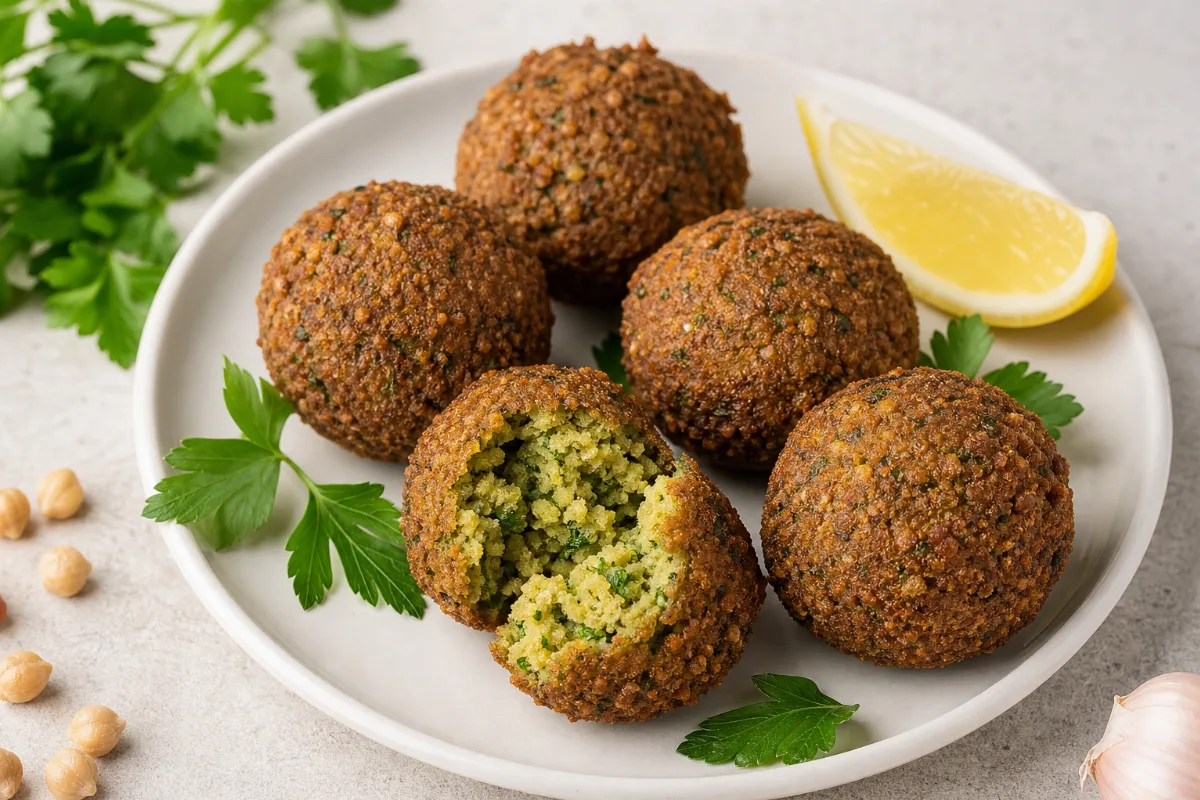
Falafel are small fried patties or balls of ground chickpeas, fava (broad) beans or both, with herbs and spices. They give plant protein, iron and magnesium, but frying makes them energy dense. If you have G6PD deficiency, fava beans can cause a dangerous breakdown of red blood cells (favism), so check what the falafel is made of. Falafel itself has not been tested for health benefits; the cholesterol findings come from beans and other pulses in general.
General information, not medical advice. Last substantive update · Not medically reviewed. A named clinician has not signed off on this page. How this page is made
About Falafel
Falafel is a fried legume food. It brings plant protein, iron and magnesium, but it is energy dense, and recipes can use fava beans, which matter for people with G6PD deficiency. It is a food to understand, not a remedy: no study tested falafel for health benefits.
What it is
Falafel are small fried patties or balls made from ground legume seeds, herbs and spices. Chickpeas (Cicer arietinum L.) and fava or broad beans (Vicia faba L.) are the two seeds used, alone or together, depending on the recipe. GBIF lists both names as accepted. They are eaten in wraps, with salads and as a snack.
USDA data for home-prepared falafel (SR Legacy item 172455), per 100 g: 333 kcal, 13.31 g protein, 17.8 g fat (2.383 g saturated), 31.84 g carbohydrate, 294 mg sodium, 585 mg potassium, 3.42 mg iron, 82 mg magnesium and 104 micrograms folate (DFE). The only USDA portion is one patty (17 g), about 57 kcal, 2.26 g protein and 3.03 g fat (our multiplication). USDA lists no fibre or sugars value. Values vary with the recipe and the oil, and bought falafel can differ.
What the research shows
No trial or cohort study of falafel and health was found. The firmest facts are the USDA nutrient values.
Cholesterol: a 2014 meta-analysis of 26 trials (1,037 people) found that diets emphasising pulses lowered LDL cholesterol by 0.17 mmol/L (95% CI 0.09 to 0.25). The trials used mostly plain cooked pulses, not fried patties.
Fried food: a 2021 meta-analysis of observational studies found more major cardiovascular events (RR 1.28), coronary heart disease (1.22) and heart failure (1.37) with the highest fried-food intake, and no clear link to stroke or death. A 2022 meta-analysis found more overweight or obesity (RR 1.16) and hypertension (1.20) but not type 2 diabetes. Intake was self-reported, results differed a lot between studies, and falafel was not separated. A 2025 market survey in Iran found falafel among foods with the most unsaturated fat and normal fat-quality indexes.
Acrylamide: a 2024 study of commercial falafel in Tehran found an average of 1.23 mg/kg (0.12 to 3.75), 0.73 with an electric oven and little oil and 1.72 with high-temperature immersion frying. The authors judged the risk not significant. A 2022 review of 16 studies in people found no link between dietary acrylamide and most cancers.
Falafel versus plain chickpeas
The cholesterol findings are for plain cooked pulses. Frying changes the food by adding fat and calories and forming acrylamide, and we read no study comparing baked and fried falafel for health outcomes. Oven-baked falafel had lower acrylamide in the Tehran study, but that comparison also differed in other ways.
Pregnancy, breastfeeding and children
No falafel-specific advice from an official body was found. The one favism review says severity is highest in pregnant women and the youngest children, so the fava-bean check matters most then. Ask your doctor or midwife.
Amounts
This page gives no amounts to eat. Ask a doctor, pharmacist or dietitian what is right for you, especially if you have G6PD deficiency, a food allergy, kidney problems, high blood pressure or a sodium limit.
At a glance
Traditional uses history, not proof
- Eaten as a fried street food and in wraps and salads
- Long use as food is not proof that it treats any condition
Studied for research
- Protein, iron, magnesium and folate, high certainty for the nutrient figures (USDA data)
- LDL cholesterol, very low certainty (pulses as a group, not falafel)
- Type of fat in ready-to-eat falafel, very low certainty (one market survey)
- Fried food and heart disease, low certainty (observational, fried food in general)
- Fried food, weight and blood pressure, low certainty (observational, fried food in general)
- Acrylamide from frying and cancer, low certainty (no link found for most cancers)
Main compounds
- Plant protein
- Unsaturated fat from frying oil
- Iron
- Magnesium
- Folate (vitamin B9)
- Acrylamide (formed by frying)
- Vicine and convicine (fava beans only)
Common forms
- Home-prepared fried falafel (the form behind the USDA figures)
- Oven-baked falafel (lower acrylamide in one study, with other differences)
- Mixes, frozen and restaurant falafel differ and are not covered by the USDA values
Research links: 2018 Egyptian review: triggers of hemolysis in G6PD deficiency · 2024 study: acrylamide in commercial falafel · 2014 meta-analysis: pulses and LDL cholesterol · Research Library · Genes & Biomarkers Library
What it is and its history
- Accepted scientific name
- Falafel is a prepared food, not a species. It is made from the seeds of Cicer arietinum (chickpea), Vicia faba (fava or broad bean), or both, depending on the recipe.
- Naming authority
- Cicer arietinum L. and Vicia faba L. (GBIF accepted)
- Common names
- Falafel (English); Chickpea fritters (English); Falafel (Spanish)
- Family or group
- Fabaceae (the legume or pea family), as given by GBIF.
- Classification
- Plantae > Tracheophyta > Magnoliopsida > Fabales > Fabaceae > Cicer (chickpea) and Vicia (fava bean) > Cicer arietinum; Vicia faba
- Native range
- Not verified from a source read.
- Habitat
- Not verified from a source read.
- What it looks like
- Fruit: Small fried patties or balls of ground legume seeds, herbs and spices. USDA's only household portion for home-prepared falafel is 1 patty, about 2-1/4 inches across, 17 g.
- Harvest and processing
- Per the existing nutrient summary: fried patties or balls; oven-baked falafel; mixes and frozen falafel. The USDA values are for home-prepared falafel and do not cover mixes or restaurant falafel. How long the beans are soaked or cooked before frying was not read from a source.
- Look-alikes and adulterants
- Name: Chickpeas, hummus and chickpea flour (besan); Note: Made from the same seed but cooked or processed differently. They have their own pages.; Name: Fava beans; Note: Some falafel uses fava beans, which is why the G6PD warning is on this page.
- Sustainability and conservation
- Not assessed.
Photographs
What is inside, and how it may work
What it contains and how those compounds act in cells and animals. Laboratory and animal mechanisms are not proven effects in people.
Main compounds
| Compound | Family | Where it is concentrated | Activity studied | Level of evidence |
|---|---|---|---|---|
| Dietary fat (mostly unsaturated) | lipid | Frying oil absorbed by the patty USDA: 17.8 g per 100 g (saturated 2.383, monounsaturated 10.171, polyunsaturated 4.16 g); cholesterol 0 mg | Adds energy. A 2025 market survey found falafel among the foods with the most unsaturated fatty acids and very low trans fat. 22 9 | Human data |
| Acrylamide | process contaminant | Forms in the fried crust Mean 1.23 mg/kg in commercial falafel from Tehran (range 0.12 to 3.75) | FDA: forms from sugars and asparagine during high-temperature cooking; a human health concern per NTP and JECFA; no consistent epidemiological evidence of cancer from food. 4 15 5 | Human data |
| Vicine and convicine | pyrimidine glycosides | Fava (faba) bean seed Not given in the abstracts read | Trigger favism in people with G6PD deficiency. Breeding of low-vicine lines is under way. 13 3 | Human data |
| Protein, iron, magnesium, manganese and folate | nutrients | Legume seed Per 100 g: protein 13.31 g, iron 3.42 mg, magnesium 82 mg, manganese 0.691 mg, folate 104 micrograms (DFE) | Nutrient roles; no effect on health shown for falafel. 22 | Human data |
| Resistant starch and fermentable sugars (oligosaccharides) | carbohydrate | Legume seed Not measured in the sources read | The existing nutrient summary says gut bacteria ferment them, which can cause gas in some people. Bean-feeding trials (not falafel) found gas varied between people. 14 | Human data |
Mechanisms, receptors and pathways
| Target or pathway | Gene or receptor | What was found | Level |
|---|---|---|---|
| Acrylamide formation | Not applicable | The FDA says acrylamide forms from sugars and the amino acid asparagine in plant foods during frying, roasting and baking. 15 | Human data |
| Hemolysis in G6PD deficiency (red blood cell breakdown) | G6PD gene | MedlinePlus Genetics says the G6PD enzyme protects red blood cells from reactive oxygen species; fava beans, infections or certain drugs raise those levels and red blood cells break down faster than they are replaced. The 2025 review names vicine and convicine in fava beans as the trigger compounds. 20 13 | Human data |
| Cholesterol (pulses) | Not specified | Not established in the abstract read; see the Evidence tab. 7 | Human data |
Absorption, metabolism and elimination
- Absorption
- Not found.
- Distribution
- Not found.
- Metabolism
- Not found.
- Elimination
- Not found.
- Bioavailability
- Not established for falafel nutrients in the sources read.
Isolated compounds versus whole extracts
The cholesterol evidence is for plain cooked pulses as a group, not for fried falafel. The fried-food and acrylamide findings are about frying in general, apart from one laboratory study of commercial falafel. The G6PD findings concern fava beans and falafel named as a trigger without ingredients. No extract or supplement is covered.
Nutritional composition
Nutrition from USDA FoodData Central (SR Legacy, April 2018 release; item 172455, falafel, home-prepared; values read 2026-10-26 from a saved copy held with the project). Per 100 g: 333 kcal, 13.31 g protein, 17.8 g total fat (2.383 g saturated, 10.171 g monounsaturated, 4.16 g polyunsaturated), 31.84 g carbohydrate, 294 mg sodium, 585 mg potassium, 54 mg calcium, 3.42 mg iron, 82 mg magnesium, 192 mg phosphorus, 1.5 mg zinc, 0.691 mg manganese, 104 micrograms folate (DFE), 0 mg cholesterol. USDA lists no fibre or sugars value for this item. One patty (17 g, USDA's only household portion) is about 57 kcal, 2.26 g protein, 3.03 g fat, 5.4 g carbohydrate, 50 mg sodium and 99.5 mg potassium (our multiplication of the 100 g values by 0.17). USDA also lists a vitamin D value that looks unusual for this food and is not repeated here because it was not verified. Values vary with the recipe, the oil and how much oil the patties absorb, and bought falafel can differ.
1 high certainty3 low certainty2 very low certainty
What was looked at
The 6 benefits and uses checked for Falafel, each with how strong the evidence is. Tap one to open it.
- Protein, iron, magnesium and folateHigh certainty
- LDL cholesterol (from pulses in general, not falafel)Very low certainty
- Type of fat in ready-to-eat falafelVery low certainty
- Fried food and heart disease (fried food in general)Low certainty
- Fried food, body weight, blood pressure and diabetes (fried food in general)Low certainty
- Acrylamide from frying and cancer riskLow certainty
Lab markers tracked in the studies
LDL cholesterolAtherogenicity and thrombogenicity indexes of the foodAcrylamide in the cooked foodRisk of hypertension (in fried-food studies)
What is Falafel good for?
The main studied uses and how strong the human evidence is for each. Nothing here was tested on falafel itself except the acrylamide measurement and one fat survey.
Benefits, one by one
Each card is a research question, not a promise. Tap a goal to filter. Open a card to see the studies, doses and limits.
Protein, iron, magnesium and folate
High certaintyHome-prepared falafel in the USDA tables has plant protein, iron, magnesium, manganese and folate. It is also energy dense because of the frying oil. These are nutrient facts about the food, not trial results.
1 studiesHome-prepared fried falafel as listed by USDA. No amounts to eat are …
Studies, doses and limits
What the trials found
No trial of falafel was found. USDA data (SR Legacy item 172455, home-prepared falafel) give per 100 g: 333 kcal, 13.31 g protein, 17.8 g fat, 31.84 g carbohydrate, 3.42 mg iron, 82 mg magnesium, 0.691 mg manganese and 104 micrograms folate (DFE). One 17 g patty is about 57 kcal, 2.26 g protein and 3.03 g fat (our multiplication of the 100 g values).
Results
A patty is small, so it adds a modest amount of each nutrient. Real falafel varies a lot with the recipe, the oil and how much oil it absorbs.
Effect sizes as reported
Per 100 g: protein 13.31 g, iron 3.42 mg, magnesium 82 mg, folate 104 micrograms (USDA).
Why this rating
High for the USDA numbers as measured for that one home-prepared item. It does not mean falafel treats anything, and bought falafel can differ.
Form and dose studied
Home-prepared fried falafel as listed by USDA. No amounts to eat are given here.
Limits
USDA lists no fibre or sugars for this item. Restaurant and packaged falafel can have different recipes.
Why researchers looked
People choose falafel as a plant-based protein food, so the first question is what it contains.
Traditional use
Falafel is eaten as a street food and in wraps and salads. Long use as food is not proof that it treats any condition.
Proposed mechanism Unknown
Not a mechanism; the nutrients come from the ground chickpeas and the oil absorbed in frying.
A proposed mechanism does not show that the effect happens in people.
See the Safety tab: fava beans and G6PD deficiency come first.
LDL cholesterol (from pulses in general, not falafel)
Very low certaintyPooled trials of diets rich in pulses (beans, chickpeas, lentils and peas) found a small drop in LDL cholesterol. Falafel is made from pulses but is fried, and it was not tested.
1 studiesPulse diets as food. Trial amounts are not advice.
Studies, doses and limits
What the trials found
A 2014 meta-analysis of 26 randomised trials (1,037 people, at least 3 weeks) found that diets emphasising pulses, at a median of 130 g a day, lowered LDL cholesterol by 0.17 mmol/L (95% CI 0.09 to 0.25) compared with matched diets without pulses. Apolipoprotein B and non-HDL cholesterol did not change.
Results
A small average fall in LDL in the pulse trials. The trials used mainly plain cooked pulses. No study of falafel and cholesterol was found.
Effect sizes as reported
LDL mean difference -0.17 mmol/L (95% CI -0.25 to -0.09); no change in apolipoprotein B or non-HDL cholesterol.
Why this rating
Rated very low for falafel because the evidence is indirect: the trials did not use falafel, and deep frying changes the food (fat and calories added). The reviewers themselves ask for longer, higher-quality trials.
Form and dose studied
Pulse diets as food. Trial amounts are not advice.
Who was studied
Adults in 26 trials.
Limits
Not falafel. Not fried. Pulses as a group.
Why researchers looked
Pulses are fibre and plant protein foods, so researchers test what they do to blood fats.
Traditional use
Chickpeas and fava beans have long been staple foods in many places. Long use as food is not proof of any health effect.
Proposed mechanism Unknown
Not established in the abstract read.
A proposed mechanism does not show that the effect happens in people.
None specific for the pulse trials.
Type of fat in ready-to-eat falafel
Very low certaintyA laboratory survey of ready-to-eat foods in Iran found falafel among the products with the most unsaturated fat and low trans fat, and normal 'hazard indexes' for blood-vessel risk. It is a food analysis, not a study of people.
2 studiesReady-to-eat falafel bought in Iranian markets.
Studies, doses and limits
What the trials found
No human study. A 2025 survey of four industrial and seven retail ready-to-eat foods found trans fats at very low levels. The most unsaturated fatty acids were in products made with vegetable oils or non-meat ingredients, including falafel. The atherogenicity (0.2 to 0.85) and thrombogenicity (0.46 to 1.51) indexes were in normal ranges for all but one industrial hamburger.
Results
Falafel was one of the products with a favourable fat profile in that survey. The abstract does not give falafel-only numbers.
Effect sizes as reported
Indexes across all foods: atherogenicity 0.2 to 0.85; thrombogenicity 0.46 to 1.51.
Why this rating
A single market survey in one country, a food analysis rather than a trial, with no falafel-only numbers in the abstract.
Form and dose studied
Ready-to-eat falafel bought in Iranian markets.
Limits
Oil type and frying method for the falafel are not given in the abstract. USDA still lists 17.8 g of fat per 100 g of home-prepared falafel, so the food remains energy dense.
Why researchers looked
Frying adds fat, so researchers check which kinds of fat end up in fried ready-to-eat foods.
Traditional use
Falafel is fried in vegetable oil in many places. Long use as food is not proof that it is healthy.
Proposed mechanism Unknown
The atherogenicity and thrombogenicity indexes are calculated from the fatty acids in a food. They are a rough guide, not a measure of harm in people.
A proposed mechanism does not show that the effect happens in people.
Fried-food findings are on the Evidence tab; acrylamide too.
Fried food and heart disease (fried food in general)
Low certaintyStudies that follow large groups of people link the highest fried-food intake to more heart disease and heart failure. These studies cannot prove cause, they did not separate falafel, and the results differ a lot between studies.
2 studiesFried food in general, mostly not falafel.
Studies, doses and limits
What the trials found
A 2021 meta-analysis of observational studies compared the highest with the lowest fried-food intake. Summary risk ratios were 1.28 (95% CI 1.15 to 1.43) for major cardiovascular events, 1.22 (1.07 to 1.40) for coronary heart disease and 1.37 (1.07 to 1.75) for heart failure. Stroke (1.37; 0.97 to 1.94), cardiovascular death (1.02; 0.93 to 1.14) and death from any cause (1.03; 0.96 to 1.12) showed no clear link. The authors warn of high differences between studies and of recall and misclassification bias. A 2015 narrative review found mixed results, with some studies finding a link and others not, and noted that most data came from questionnaires.
Results
More fried food was linked to somewhat more heart disease and heart failure in observational data. Falafel was not separated from other fried foods.
Effect sizes as reported
Major cardiovascular events RR 1.28; coronary heart disease RR 1.22; heart failure RR 1.37; stroke, cardiovascular death and all-cause death not clearly different.
Why this rating
Observational data with high differences between studies and self-reported intake; the direction is unfavourable but cause is not shown. The 2015 reviewers wrote that there is strong evidence of a higher risk when fried food is eaten four or more times a week, but they also list large gaps in how frying was recorded, so we rate the evidence low rather than higher.
Form and dose studied
Fried food in general, mostly not falafel.
Who was studied
General adults in observational studies.
Limits
Falafel is mostly chickpeas, which may differ from fried meat, fish and potatoes in these studies. Frying oil and method were often not recorded.
Why researchers looked
Deep frying adds fat and calories and changes the food, so researchers ask whether eating fried food often is linked to illness.
Traditional use
Fried street foods are everyday food in many places. Long use as food is not proof of safety.
Proposed mechanism Unknown
Not established. The reviewers point to missing details on oil type, frying method and temperature, oil re-use and overall diet.
A proposed mechanism does not show that the effect happens in people.
See the Safety tab.
Fried food, body weight, blood pressure and diabetes (fried food in general)
Low certaintyObservational studies link the highest fried-food intake to more overweight or obesity and to more high blood pressure, but not to type 2 diabetes. Results differ a lot between studies and falafel was not studied.
1 studiesFried food in general.
Studies, doses and limits
What the trials found
A 2022 meta-analysis of observational studies compared the highest with the lowest fried-food intake. Risk ratios were 1.16 (95% CI 1.07 to 1.25) for overweight or obesity, 1.20 (1.05 to 1.38) for hypertension and 1.07 (0.90 to 1.27) for type 2 diabetes, which is not a clear link. In cohort studies alone the hypertension result was 1.06 (0.98 to 1.15), also not clear. The authors say the findings need caution because of high differences between studies and unstable subgroup results.
Results
A link to overweight and hypertension in pooled data, and none to type 2 diabetes. Falafel was not separated.
Effect sizes as reported
Overweight or obesity RR 1.16; hypertension RR 1.20 (1.06 in cohorts only, not clear); type 2 diabetes RR 1.07 (not clear).
Why this rating
Observational, with very high differences between studies (I2 up to 92%) and mostly cross-sectional data for overweight and hypertension. We rate it low.
Form and dose studied
Fried food in general.
Who was studied
Adults in observational studies.
Limits
Cross-sectional studies cannot show which came first. Falafel not separated.
Why researchers looked
Fried foods are energy dense, so researchers look at weight, blood pressure and blood sugar.
Traditional use
Fried street foods are everyday food in many places. Long use as food is not proof of safety.
Proposed mechanism Unknown
Not established in the abstract.
A proposed mechanism does not show that the effect happens in people.
See the Safety tab.
Acrylamide from frying and cancer risk
Low certaintyFrying forms acrylamide. A Tehran study found acrylamide in commercial falafel, higher with high-temperature immersion frying, and judged the risk not significant. A pooled review of food-acrylamide studies in people found no link to most cancers. Agencies still call acrylamide a health concern.
3 studiesCommercial falafel from Tehran; dietary acrylamide from all foods.
Studies, doses and limits
What the trials found
Falafel itself: a 2024 laboratory study of commercial falafel from Tehran found an average of 1.23 mg/kg (range 0.12 to 3.75). Falafel cooked at a lower temperature in an electric oven with little oil averaged 0.73 mg/kg, and falafel fried at high temperature in gas-heated oil with the patties immersed averaged 1.72 mg/kg. Canola oil gave the highest average (1.57) and soybean oil the lowest (0.92). A computer model gave an adult lifetime cancer risk of 2.77E-5 and a child risk of 9.25E-5, and the authors concluded there is no significant health risk. People: a 2022 review of 16 studies (1,151,189 adults) found no link between high dietary acrylamide and each cancer examined, except lung cancer in smokers; gynaecological cancers were not covered. The FDA says there is no consistent epidemiological evidence on cancer from food acrylamide, but the US National Toxicology Program and the FAO/WHO expert committee JECFA both consider acrylamide a human health concern.
Results
Falafel does contain acrylamide, and the amount depends on how it is fried. In people, high acrylamide from food has not been linked to most cancers.
Effect sizes as reported
Falafel acrylamide: mean 1.23 mg/kg (0.12 to 3.75); 0.73 (oven, low oil); 1.72 (gas, immersed). Cancer meta-analysis: no association for each site examined (lung cancer higher in smokers only).
Why this rating
Low that there is no big cancer link: the pooled studies are observational and exclude gynaecological cancers. The falafel numbers come from one city's commercial samples and a computer model, and the cooking methods differ in more than temperature.
Form and dose studied
Commercial falafel from Tehran; dietary acrylamide from all foods.
Limits
Falafel was not tested in the cancer studies. The risk model is not a measurement in people.
Why researchers looked
Acrylamide forms when plant foods are cooked at high temperature, and animal studies at very high doses found cancer.
Traditional use
Frying has been used for falafel for a long time. Long use as food is not proof of safety.
Proposed mechanism Regulator
The FDA says acrylamide forms from sugars and the amino acid asparagine in plant foods during frying, roasting and baking.
A proposed mechanism does not show that the effect happens in people.
See the Safety tab for what the FDA says.
Connections to the rest of health
How Falafel connects to the rest of our health knowledge graph. Every link says what kind of connection it is. A safety link (for example to the liver) is a warning, not a benefit. A study that merely mentions a topic never creates a benefit link.
Explore every connection: goals, body systems, organs, symptoms, genes
A. Wellness goals
| Connected to | Kind of connection | Evidence status | Context | Studies |
|---|---|---|---|---|
| General Nutrition | High certainty | Protein, iron, magnesium and folate: Home-prepared falafel in the USDA tables has plant protein, iron, magnesium, manganese and folate. It is also energy dense because of the frying oil. These are nutrient facts about the food, not trial results. | 22 | |
| Heart Health | Very low certainty | LDL cholesterol (from pulses in general, not falafel): Pooled trials of diets rich in pulses (beans, chickpeas, lentils and peas) found a small drop in LDL cholesterol. Falafel is made from pulses but is fried, and it was not tested. | 7 | |
| Heart Health | Very low certainty | Type of fat in ready-to-eat falafel: A laboratory survey of ready-to-eat foods in Iran found falafel among the products with the most unsaturated fat and low trans fat, and normal 'hazard indexes' for blood-vessel risk. It is a food analysis, not a study of people. | 9 22 | |
| Heart Health | Low certainty | Fried food and heart disease (fried food in general): Studies that follow large groups of people link the highest fried-food intake to more heart disease and heart failure. These studies cannot prove cause, they did not separate falafel, and the results differ a lot between studies. | 10 6 | |
| Blood Pressure | Low certainty | Fried food, body weight, blood pressure and diabetes (fried food in general): Observational studies link the highest fried-food intake to more overweight or obesity and to more high blood pressure, but not to type 2 diabetes. Results differ a lot between studies and falafel was not studied. | 11 | |
| Weight Management | Low certainty | Fried food, body weight, blood pressure and diabetes (fried food in general): Observational studies link the highest fried-food intake to more overweight or obesity and to more high blood pressure, but not to type 2 diabetes. Results differ a lot between studies and falafel was not studied. | 11 | |
| Food Safety | Low certainty | Acrylamide from frying and cancer risk: Frying forms acrylamide. A Tehran study found acrylamide in commercial falafel, higher with high-temperature immersion frying, and judged the risk not significant. A pooled review of food-acrylamide studies in people found no link to most cancers. Agencies still call acrylamide a health concern. | 4 5 15 |
B. Body systems
| Connected to | Kind of connection | Evidence status | Context | Studies |
|---|---|---|---|---|
| Metabolism Weight | Biological association | High certainty | Studied for: Protein, iron, magnesium and folate Studied for: Fried food, body weight, blood pressure and diabetes (fried food in general) | 22 11 |
| Cardiovascular System | Biological association | Very low certainty | Studied for: LDL cholesterol (from pulses in general, not falafel) Studied for: Type of fat in ready-to-eat falafel | 7 9 22 10 6 11 |
| Immune System | Biological association | Low certainty | Studied for: Acrylamide from frying and cancer risk | 4 5 15 |
E. Health conditions
| Connected to | Kind of connection | Evidence status | Context | Studies |
|---|---|---|---|---|
| G6PD deficiency (favism) | Adverse effect or risk | Documented risk | Falafel was named as a trigger of hemolysis in 19.4% of 1,000 Egyptian patients with G6PD deficiency; fava beans trigger favism. Preparation or compound: Fava beans in falafel |
8 3 20 |
| Food allergy | Adverse effect or risk | Documented risk | Chickpea allergy is reported, from mild to severe, with links to other legumes and peanut in clinic studies. Preparation or compound: Chickpea protein and other ingredients |
1 12 2 |
I. Biomarkers
| Connected to | Kind of connection | Evidence status | Context | Studies |
|---|---|---|---|---|
| LDL cholesterol | Biological association | Very low certainty | Measured in trials: lowered. A lab change is not the same as a health benefit. | 7 |
| Atherogenicity and thrombogenicity indexes of the food | Biological association | Very low certainty | Measured in trials: within normal range. A lab change is not the same as a health benefit. | 9 |
| Acrylamide in the cooked food | Biological association | Low certainty | Measured in trials: higher with high-temperature immersion frying. A lab change is not the same as a health benefit. | 4 |
| Risk of hypertension (in fried-food studies) | Biological association | Low certainty | Measured in trials: raised in pooled data, not clear in cohorts. A lab change is not the same as a health benefit. | 11 |
J. Genes, receptors and enzymes
| Connected to | Kind of connection | Evidence status | Context | Studies |
|---|---|---|---|---|
| G6PD | Preliminary mechanism | Human | Inherited changes in the G6PD gene cause G6PD deficiency; fava beans can then trigger hemolysis (MedlinePlus Genetics). | 20 |
K. Biological pathways
L. Active compounds
| Connected to | Kind of connection | Evidence status | Context | Studies |
|---|---|---|---|---|
| Dietary fat (mostly unsaturated) | Biological association | Human | Adds energy. A 2025 market survey found falafel among the foods with the most unsaturated fatty acids and very low trans fat. Preparation or compound: Frying oil absorbed by the patty |
22 9 |
| Acrylamide | Biological association | Human | FDA: forms from sugars and asparagine during high-temperature cooking; a human health concern per NTP and JECFA; no consistent epidemiological evidence of cancer from food. Preparation or compound: Forms in the fried crust |
4 15 5 |
| Vicine and convicine | Biological association | Human | Trigger favism in people with G6PD deficiency. Breeding of low-vicine lines is under way. Preparation or compound: Fava (faba) bean seed |
13 3 |
| Protein, iron, magnesium, manganese and folate | Biological association | Human | Nutrient roles; no effect on health shown for falafel. Preparation or compound: Legume seed |
22 |
| Resistant starch and fermentable sugars (oligosaccharides) | Biological association | Human | The existing nutrient summary says gut bacteria ferment them, which can cause gas in some people. Bean-feeding trials (not falafel) found gas varied between people. Preparation or compound: Legume seed |
14 |
Each connection is stored with the ingredient, the connected record, the kind of connection, the evidence status, the supporting studies, the preparation or compound involved, and a review date (last reviewed October 26, 2026).
Evidence at a glance: what changed in 1 lab markers
Tap a number to show only those markers. Counts are markers, not people.
The evidence
The research centre for Falafel. Every record here was checked against PubMed or the publisher's page; we never list a study we have not verified.
Evidence by outcome
Bars show how many studies we found for each outcome, not how well it works. People are added up across trials only (reviews are not added, to avoid double counting).
How we rate evidence
High certainty
Several well-run trials or reviews agree; further research is unlikely to change the picture much.
Moderate certainty
Good trials point the same way, but some doubt remains.
Low certainty
Small, short or inconsistent trials. The finding could change with better research.
Very low certainty
Very little or very weak human data. Treat as a possibility only.
Mixed findings
Trials or reviews disagree with each other.
Not enough evidence
Not enough human research to say either way.
Evidence against
Good research found no benefit, or found harm.
We take the reviewers' own risk-of-bias and GRADE statements where they exist, and otherwise judge from study size, design, consistency, directness and whether a product matches what is sold. Many publications do not make evidence high. Method note: We started from our existing falafel summary, re-checked nutrition at USDA FoodData Central, read the health agency pages (FDA, MedlinePlus) and searched PubMed for reviews, laboratory and clinic studies. Only abstracts were read for studies. Items we could not verify are flagged in the research gaps.
Study library: every study we checked 22
| Study | Design | People | Product, dose, length | Result |
|---|---|---|---|---|
| Abu Risha M et al. 2024 Legume Allergens Pea, Chickpea, Lentil, Lupine and Beyond. Curr Allergy Asthma Rep · PMID 38990406 · DOI |
Narrative review |
Review of legume allergen sources, mostly case reports | Legumes other than peanut and soy, including chickpea Seed |
Chickpea is among the "non-priority" legumes that can cause mild to severe allergic reactions. Food-dependent exercise-induced anaphylaxis has been described for soy, lentils and chickpea. Most reactions come from cross-reacting proteins, for example between peanut and lupine. Most data are case reports. Not applicable (Not applicable) Methods, limits and fundingOutcomes: Legume allergens and reactions Limitations: Mostly case reports; no rate of allergy in the general population. Funding and conflicts: No conflict of interest declared. Read: abstract |
| Atwah A et al. 2025 The prevalence of outgrowing non-priority legume allergies in children. Pediatr Allergy Immunol · PMID 41424376 · DOI |
Retrospective cohort |
203 203 children aged 5 to 15 with IgE-mediated allergy to lentils, chickpeas, peas or beans at a London hospital |
Children already diagnosed with non-priority legume allergy Seed Median follow-up 7 years |
By age 5, 4.9% had outgrown chickpea allergy; by age 10, 8.8%; by age 15, 19.3%. Children with low skin-test and blood test results were more likely to outgrow it. Chickpea allergy outgrown: 4.9% (age 5), 8.8% (10), 19.3% (15) (Not given in the abstract) Methods, limits and fundingOutcomes: Chance of outgrowing the allergy Limitations: Hospital records at one clinic. Not about falafel. Funding and conflicts: The authors declare no conflicts of interest. Read: abstract |
| Beretta A et al. 2023 Favism: Clinical Features at Different Ages. Nutrients · PMID 36678214 · DOI |
Narrative review case reports |
Case reports and case series of favism in pregnant women and infants, children, adolescents and adults | Fava beans eaten by people with G6PD deficiency (not falafel) Seed |
Favism is a hemolytic disease after eating fava beans in people with G6PD deficiency. Quantity, quality, ripeness of the beans and age all affect whether a crisis develops, with wide differences between people and even in the same person. Severity is highest in the youngest children and in pregnant women. Common signs were jaundice, dark urine, pallor, abdominal pain, vomiting, dizziness and anaemia. Most cases are self-limited and leave no lasting problems, but hospital care and transfusion are often needed. Not a pooled estimate (Not applicable) Methods, limits and fundingOutcomes: Clinical features of favism by age Limitations: A narrative review of case reports; it does not give how common favism is and does not mention falafel. Funding and conflicts: The authors declare no conflict of interest. Read: abstract |
| Faraji F et al. 2024 Evaluation of acrylamide concentration in commercial falafel available in Tehran City by different cooking methods: A health risk assessment study. Food Chem X · PMID 39257496 · DOI |
Laboratory food analysis lab (food analysis and risk model) |
Commercial falafel samples from Tehran, Iran (sample number not given in the abstract) | Commercial falafel, measured by GC-MS Prepared food · vs Other cooking methods and oils within the same samples |
Average acrylamide was 1.23 mg/kg (range 0.12 to 3.75). Lower-temperature cooking in an electric oven with little oil gave a lower average (0.73 mg/kg). High-temperature gas frying with the falafel immersed in oil gave a higher one (1.72 mg/kg). Canola oil gave the highest average (1.57 mg/kg) and soybean oil the lowest (0.92 mg/kg). A computer model for adults gave a hazard quotient of 2.72E-2 and a lifetime cancer risk of 2.77E-5, and for children 9.69E-2 and 9.25E-5. The authors concluded there is no significant health risk from falafel. Mean 1.23 +/- 0.83 mg/kg (0.12-3.75); 0.73 +/- 0.42 (oven, low oil); 1.72 +/- 0.86 (gas, immersed) (Not applicable) Methods, limits and fundingOutcomes: Acrylamide concentration; modelled hazard quotient and lifetime cancer risk Limitations: One city, commercial falafel, and a computer risk model rather than people. The cooking methods differ in more than temperature, so the comparison is rough. Not a study of illness in people. Funding and conflicts: The authors declare no conflicts of interest. Read: abstract |
| Filippini T et al. 2022 Dietary Acrylamide Exposure and Risk of Site-Specific Cancer: A Systematic Review and Dose-Response Meta-Analysis of Epidemiological Studies. Front Nutr · PMID 35548558 · DOI |
Systematic review meta analysis |
1151189 16 studies, 1,151,189 non-occupationally exposed adults, 48,175 with cancer, median follow-up 14.9 years |
Dietary acrylamide from all foods (not falafel specifically) Mean estimated intake across studies 23 micrograms a day Median 14.9 years follow-up · vs Lowest acrylamide exposure |
High dietary acrylamide exposure was not linked to more site-specific non-gynaecological cancer, and there was no sign of a threshold. The one exception was lung cancer in smokers. No association for each site-specific cancer examined; increased lung cancer risk in smokers only (Not given in the abstract) Methods, limits and fundingOutcomes: Risk of site-specific cancer (all but gynaecological cancers) Limitations: Observational and based on questionnaires. Gynaecological cancers were not included in this review. Falafel was not separated from other sources of acrylamide. Funding and conflicts: No commercial or financial relationships declared. Read: abstract |
| Gadiraju TV et al. 2015 Fried Food Consumption and Cardiovascular Health: A Review of Current Evidence. Nutrients · PMID 26457715 · DOI |
Narrative review |
Case-control and cohort studies on fried food and heart disease, diabetes, hypertension and obesity | Fried food in general (not falafel) Prepared food |
Most data came from questionnaires. A few studies found more coronary artery disease, heart failure, diabetes or hypertension with more frequent fried food; others did not. The reviewers say there is strong evidence of a higher risk of chronic disease when fried foods are eaten four or more times a week, and note big gaps: oil type, frying method, temperature, oil re-use and overall diet were often not recorded. Not a pooled estimate (Not applicable) Methods, limits and fundingOutcomes: Cardiovascular disease, diabetes, hypertension, obesity Limitations: Narrative review with questionnaire data and case-control and cohort designs only. It describes the evidence on frying habits in general, not falafel. The newer 2021 and 2022 meta-analyses above give pooled numbers. Funding and conflicts: No competing interests stated in the abstract. Read: abstract |
| Ha V et al. 2014 Effect of dietary pulse intake on established therapeutic lipid targets for cardiovascular risk reduction: a systematic review and meta-analysis of randomized controlled trials. CMAJ · PMID 24710915 · DOI |
Systematic review meta analysis |
1037 26 randomised trials, 1,037 people |
Diets emphasising pulses (beans, chickpeas, lentils, peas), mostly plain cooked pulses Seed Median 130 g a day (reported by the authors) At least 3 weeks · vs Matched diets without pulses |
Pulse diets lowered LDL cholesterol compared with control diets. Apolipoprotein B and non-HDL cholesterol did not change. Falafel was not tested. LDL mean difference -0.17 mmol/L (95% CI -0.25 to -0.09 mmol/L) Methods, limits and fundingOutcomes: LDL cholesterol, apolipoprotein B, non-HDL cholesterol Limitations: Pulses as a group, not falafel and not fried food. The authors ask for longer, higher-quality trials. Funding and conflicts: Listed as non-US government research support; no industry funding stated in the abstract. Registration: NCT01594567 Read: abstract |
| Hagag AA et al. 2018 Study of Glucose-6-Phosphate Dehydrogenase Deficiency: 5 Years Retrospective Egyptian Study. Endocr Metab Immune Disord Drug Targets · PMID 28982343 · DOI |
Retrospective case series |
1000 1,000 patients with G6PD deficiency anaemia registered at a children's hematology unit in Tanta, Egypt (2011 to 2016) |
Foods, drugs and infections recorded as triggers of hemolysis |
Food was the most common trigger of hemolysis (834 patients, 83.4%). Fava beans were named in 326 patients (32.6%) and falafel in 194 (19.4%), the two most common food products. Chickpea was named in 108 (10.8%), broad bean in 76, green pea in 44, peanut in 38, lentil in 28 and black-eyed pea in 20. Infections were the second most common cause (124, 12.4%) and drugs the least common (42, 4.2%). Patients presented with pallor, dark red urine and jaundice about 24 to 72 hours (mean 36 hours) after exposure. Falafel named as the trigger in 19.4% of 1,000 patients; fava beans 32.6% (Not applicable) Methods, limits and fundingOutcomes: Triggers of hemolytic crisis; symptoms and lab findings Limitations: A retrospective chart review in one Egyptian hospital among people who already had G6PD deficiency and hemolysis. It does not say what was in the falafel, whether it contained fava beans, or how much was eaten, and it cannot tell how common reactions are in people who eat falafel. Funding and conflicts: Funding and conflicts not stated in the abstract. Read: abstract |
| Moslemi M et al. 2025 Fatty Acid Profile and Hazard Index of Ready-to-Eat Foods Available in the Market: A Risk Survey. Int J Prev Med · PMID 41409791 · DOI |
Laboratory market survey lab (food analysis) |
11 Four industrial and seven retail ready-to-eat foods bought in local markets (Iran), including falafel |
Ready-to-eat foods including falafel (number of falafel samples not given in the abstract) Prepared food · vs Other ready-to-eat foods |
Trans fats were very low. The highest share of unsaturated fatty acids was in products made with vegetable oils or non-meat ingredients, including sausage, salami, falafel and samosa. Atherogenicity (0.2 to 0.85) and thrombogenicity (0.46 to 1.51) indexes were in normal ranges for all but one hamburger. Atherogenicity index 0.2-0.85 and thrombogenicity index 0.46-1.51 across the foods (Not applicable) Methods, limits and fundingOutcomes: Fatty acid profile; atherogenicity and thrombogenicity indexes Limitations: A laboratory survey of bought foods, not a study of people. The abstract does not give falafel-only numbers. Oil type and frying method are not stated for falafel. Funding and conflicts: No conflict of interest declared. Read: abstract |
| Qin P et al. 2021 Fried-food consumption and risk of cardiovascular disease and all-cause mortality: a meta-analysis of observational studies. Heart · PMID 33468573 · DOI |
Systematic review meta analysis |
Observational studies in general adults (17 studies for major cardiovascular events) | Fried food in general (not falafel), highest against lowest intake Prepared food · vs Lowest fried-food intake |
Highest fried-food intake was linked to more major cardiovascular events, coronary heart disease and heart failure. Stroke, cardiovascular death and all-cause death showed no clear link. The association looked linear for the three raised outcomes. Major cardiovascular events RR 1.28; coronary heart disease RR 1.22; heart failure RR 1.37; stroke RR 1.37 (not clear); cardiovascular death RR 1.02; all-cause death RR 1.03 (Major events 1.15 to 1.43; coronary disease 1.07 to 1.40; heart failure 1.07 to 1.75; stroke 0.97 to 1.94; cardiovascular death 0.93 to 1.14; all-cause death 0.96 to 1.12) Methods, limits and fundingOutcomes: Major cardiovascular events, coronary heart disease, stroke, heart failure, cardiovascular and all-cause death Limitations: Observational, so it cannot show cause. Very different results between studies (I2 up to 82%), and fried-food intake was self-reported, which the authors say can be wrong. Falafel was not separated. Funding and conflicts: Competing interests: none declared. Read: abstract |
| Qin P et al. 2022 Fried-food consumption and risk of overweight/obesity, type 2 diabetes mellitus, and hypertension in adults: a meta-analysis of observational studies. Crit Rev Food Sci Nutr · PMID 33825582 · DOI |
Systematic review meta analysis |
Observational studies in adults (cohort, cross-sectional and case-control) | Fried food in general (not falafel), highest against lowest intake Prepared food · vs Lowest fried-food intake |
Highest fried-food intake was linked to more overweight or obesity and more hypertension, but not to type 2 diabetes. The authors say the findings need caution because the results differed a lot between studies and subgroup results were unstable. Overweight or obesity RR 1.16; hypertension RR 1.20; type 2 diabetes RR 1.07 (no clear link) (Overweight or obesity 1.07 to 1.25; hypertension 1.05 to 1.38; type 2 diabetes 0.90 to 1.27) Methods, limits and fundingOutcomes: Overweight or obesity, type 2 diabetes, hypertension Limitations: Observational. In the cohort studies alone the hypertension result was RR 1.06 (0.98 to 1.15), which is not clear. High differences between studies (I2 up to 92%). Falafel was not separated. Funding and conflicts: Funding and conflicts not stated in the abstract. Read: abstract |
| Serra B et al. 2026 IgE-Mediated Legume Allergy in Children: Insights from a Single-Center Experience in Italy. Nutrients · PMID 42280453 · DOI |
Retrospective cohort |
55 55 children (under 18) allergic to at least one of pea, lentil, chickpea, common bean or soy, one Italian centre, 2022 to 2024 |
Children already diagnosed with legume allergy Seed |
Multi-legume allergy was common (74.5%), with frequent co-allergy among pea, lentil and chickpea (56 to 86%). Peanut co-allergy occurred in 25.5%. Pea caused the most severe reactions. Anaphylaxis occurred at the first reaction in 12.7%. Multi-legume allergy 74.5%; peanut co-allergy 25.5% (Not applicable) Methods, limits and fundingOutcomes: Clinical features, co-allergies, oral food challenges Limitations: Small, one clinic, children who already had allergy; it says nothing about how common legume allergy is, or about falafel. Funding and conflicts: Two authors report personal fees from Sanofi and other companies; others declare none. Read: abstract |
| Singh M et al. 2025 Faba Bean: Unlocking nutritional potential and agricultural sustainability. Curr Res Food Sci · PMID 40689289 · DOI |
Narrative review |
Review of faba bean (Vicia faba L.) nutrition and the compounds vicine and convicine | Faba (fava) bean seed Seed |
Faba bean contains vicine and convicine, which trigger favism in people with G6PD deficiency. Breeders are developing low-vicine and low-convicine lines, but the review describes this as work in progress. Not applicable (Not applicable) Methods, limits and fundingOutcomes: Vicine and convicine content; breeding of low-vicine lines Limitations: A review about the crop and breeding, not about falafel or about cooking. It says nothing on how frying changes these compounds. Funding and conflicts: Two authors report support from and employment at Virginia Polytechnic Institute and State University; no industry funder named. Read: abstract |
| Winham DM et al. 2011 Perceptions of flatulence from bean consumption among adults in 3 feeding studies. Nutr J · PMID 22104320 · DOI |
Randomized trials symptom questionnaire |
Adults in three bean-feeding studies (two crossover, one parallel) | Half a cup a day of pinto beans, black-eyed peas or baked beans (no chickpeas, no falafel) Seed 8 or 12 weeks · vs Canned carrots or control soup |
Fewer than half reported more flatulence from pinto or baked beans in the first week, and 19% with black-eyed peas. Between 3% and 11% reported more flatulence even on control diets. Fewer than 50% (pinto, baked beans) and 19% (black-eyed peas) reported more gas in week 1 (Not applicable) Methods, limits and fundingOutcomes: Weekly reports of flatulence, stool changes and bloating Limitations: Chickpeas and falafel were not tested. Self-reported questionnaires in small studies. Funding and conflicts: Funding not stated in the abstract. Read: abstract |
| s-fda-acrylamide FDA: Acrylamide · Source |
Regulator page n/a |
Methods, limits and fundingRead: full-text | ||
| s-fda-allergens FDA: Food Allergies · Source |
Regulator page n/a |
Methods, limits and fundingRead: full-text | ||
| s-fda-natural-toxins FDA: Natural Toxins in Food · Source |
Regulator page n/a |
Methods, limits and fundingRead: full-text | ||
| s-gbif-cicer-arietinum GBIF species match: Cicer arietinum and Vicia faba · Source |
Reference database n/a |
Methods, limits and fundingRead: full-text | ||
| s-medlineplus-food-allergy MedlinePlus Medical Encyclopedia: Food allergy · Source |
Health agency n/a |
Methods, limits and fundingRead: full-text | ||
| s-medlineplus-g6pd MedlinePlus Genetics: Glucose-6-phosphate dehydrogenase deficiency · Source |
Health agency n/a |
Methods, limits and fundingRead: full-text | ||
| s-medlineplus-potassium MedlinePlus Medical Encyclopedia: Potassium in diet · Source |
Health agency n/a |
Methods, limits and fundingRead: full-text | ||
| s-usda-fdc-172455 USDA FoodData Central: Falafel, home-prepared (SR Legacy, FDC 172455) · Source |
Reference database n/a |
Methods, limits and fundingRead: full-text |
What we do not know yet
- No trial or cohort study of falafel itself and cholesterol, weight, blood pressure or heart disease was found; the findings are for pulses or fried food in general.
- How often falafel is made with fava beans, and how often falafel reactions in G6PD deficiency come from fava beans, was not found.
- No source tests whether frying cooks through a soaked, uncooked chickpea or fava mix.
- No study compared baked and fried falafel for health outcomes, and the Tehran acrylamide study covers one city's commercial samples.
- Fibre, sugars, pregnancy and children, medicines and kidney advice specific to falafel were not found.
How new research is added
New studies are found by a saved PubMed search and placed in a review queue before the page changes.
Lab markers
What changed in blood or saliva tests during trials. A changed number is not the same as feeling or being healthier, and we give no "normal ranges".
Metabolic 1
LDL cholesterol
Lowered in trials
The 'bad' cholesterol carried in the blood, measured with a standard blood test.
Very low certaintyResults and what it means
Why it was measured
It is a common marker of heart and blood-vessel risk in diet trials.
Statistical vs. clinical meaning
A small fall in a blood marker from pulses as a group. Not tested with fried falafel.
Safety implication
None specific.
| Study | Result | People | Product |
|---|---|---|---|
| 7 | LDL mean difference -0.17 mmol/L (95% CI -0.25 to -0.09); apolipoprotein B and non-HDL cholesterol not changed | 26 trials, 1,037 people | Pulse-rich diets against matched diets without pulses (not falafel) |
Other 3
Atherogenicity and thrombogenicity indexes of the food
Within normal range in trials
Numbers calculated from the fatty acids in a food to give a rough idea of how it might affect blood vessels.
Very low certaintyResults and what it means
Why it was measured
They let researchers compare the fat quality of foods without a trial.
Statistical vs. clinical meaning
A food-analysis number, not a result in people.
Safety implication
None specific.
| Study | Result | People | Product |
|---|---|---|---|
| 9 | Atherogenicity 0.2 to 0.85 and thrombogenicity 0.46 to 1.51 across the foods; all in normal ranges except one hamburger | 11 ready-to-eat foods including falafel | Laboratory analysis of bought foods |
Acrylamide in the cooked food
Higher with high-temperature immersion frying in trials
How many milligrams of acrylamide are found in each kilogram of the cooked food, measured in a laboratory.
Low certaintyResults and what it means
Why it was measured
It shows how cooking method and oil change the amount of a heat-formed compound.
Statistical vs. clinical meaning
A food-analysis number. It is not a measure of illness in people.
Safety implication
See the Safety tab.
| Study | Result | People | Product |
|---|---|---|---|
| 4 | Mean 1.23 mg/kg (0.12 to 3.75); 0.73 with lower temperature, electric oven and low oil; 1.72 with high-temperature gas frying with immersion; canola oil 1.57, soybean oil 0.92 | Commercial falafel samples, Tehran | Laboratory measurement by GC-MS |
Risk of hypertension (in fried-food studies)
Raised in pooled data, not clear in cohorts in trials
How much more or less likely people were to have high blood pressure when they reported the most fried food.
Low certaintyResults and what it means
Why it was measured
High blood pressure is a common risk factor for heart disease.
Statistical vs. clinical meaning
An association, not proof that fried food causes high blood pressure.
Safety implication
Ask your doctor if you have high blood pressure.
| Study | Result | People | Product |
|---|---|---|---|
| 11 | Hypertension RR 1.20 (95% CI 1.05 to 1.38) overall; cohort studies alone RR 1.06 (0.98 to 1.15) | Adults in observational studies | Highest against lowest fried-food intake (not falafel) |
Safety
What studies and official sources say about side effects, medicines and who should check first. Each point shows what kind of evidence it comes from.
Main points to know 5
- Fava beans in falafel can trigger favism in people with G6PD deficiency. Some falafel is made with fava (broad) beans, alone or with chickpeas, and the recipe is often not stated. In people with G6PD deficiency, a common inherited enzyme condition, fava beans can cause hemolytic anemia (red blood cells break down faster than the body replaces them), called favism. In a retrospective Egyptian review of 1,000 patients with G6PD deficiency and hemolysis, falafel was named as the trigger in 194 (19.4%), second only to fava beans themselves (326, 32.6%). That study does not say what was in the falafel. Signs such as pallor, dark urine and jaundice appeared about 24 to 72 hours after exposure. A 2023 review says severity is highest in the youngest children and in pregnant women, and hospital care and transfusion are often needed. Many people with G6PD deficiency never have symptoms and do not know they have it. Ask the cook, or read the ingredients, if you have it or someone in your family does. Observational 8 3 20 13
- Allergy: chickpea and other legumes, and what else is in the mix. Chickpea is a legume that can cause mild to severe allergic reactions, and exercise-related anaphylaxis has been linked to chickpea. In a clinic study of 55 Italian children with legume allergy, most (74.5%) were allergic to more than one legume, and 25.5% also had peanut allergy. In a London clinic study of 203 children, about 1 in 5 (19.3%) had outgrown chickpea allergy by age 15. Falafel is a prepared food, so it can also come with sauces, breads or coatings. The FDA lists nine major allergens, including wheat, soy and sesame, so read labels or ask. These clinic studies cannot say how common allergy is in everyone. Observational 1 12 2 16
- Acrylamide forms in frying; the FDA calls it a concern but cancer in people is not proven. A 2024 laboratory study found acrylamide in commercial falafel from Tehran at an average of 1.23 mg/kg, higher with high-temperature immersion frying. The authors concluded the risk was not significant. The FDA says high levels caused cancer in laboratory animals at doses much greater than in human food, that there is no consistent epidemiological evidence on cancer from food acrylamide, and that the US National Toxicology Program and the FAO/WHO expert committee JECFA consider it a human health concern. A 2022 pooled review of 16 studies found no link between dietary acrylamide and most cancers. Authoritative guidance 4 15 5
- Fried and energy dense. USDA lists 333 kcal and 17.8 g of fat per 100 g of home-prepared falafel (one 17 g patty is about 57 kcal) and 294 mg of sodium per 100 g. Pooled observational studies link the highest fried-food intake to more heart disease and heart failure, overweight and high blood pressure, although they did not separate falafel and cannot prove cause. Sauces, bread and toppings add more and were not studied. Observational 22 10 11 6
- Is the soaked chickpea mix cooked through? Not tested. The FDA says the lectin phytohaemagglutinin is found in raw or undercooked beans and can cause nausea, severe vomiting and diarrhea at high levels; its example is kidney beans. We found no source that tests whether frying cooks through a soaked, uncooked chickpea or fava mix, so no claim is made either way. Falafel should be cooked through, and a source that says how long was not read. Authoritative guidance 17
Side effects 3
| Effect | How often | Severity and recovery | Evidence |
|---|---|---|---|
| Hemolytic anemia (favism) after eating fava-bean-containing falafel in people with G6PD deficiency Whether the falafel in the Egyptian review contained fava beans is not stated. | Not known for people who eat falafel. 194 of 1,000 Egyptian patients with G6PD deficiency and hemolysis named falafel as the trigger; the study does not give a rate among eaters | can be severe; hospital care and blood transfusion are often needed, and severity is highest in young children and pregnant women In most cases the illness is self-limited and leaves no lasting problems (2023 review) | Observational 8 3 |
| Allergic reactions to chickpea or other ingredients, from mild symptoms to anaphylaxis Clinic studies and case reports of people already allergic. They do not show how common the allergy is. | Not known for the general population. Co-allergy among pea, lentil and chickpea was 56 to 86% in 55 Italian children who already had legume allergy | can be severe (anaphylaxis) 4.9% by age 5, 8.8% by age 10 and 19.3% by age 15 had outgrown chickpea allergy (London clinic study) | Observational 1 12 2 |
| Gas and bloating From other beans, not falafel. | In bean-feeding trials, fewer than half of people reported more gas from pinto or baked beans in week 1. Chickpeas and falafel were not tested | mild Not studied for falafel | Randomized trial 14 |
Liver
No liver injury from eating falafel was found. A liver-safety source (such as LiverTox) was not searched for this food page.
How often. No frequency was found.
Monitoring. No agency monitoring advice was found.
This is a safety connection. It is not evidence that Falafel supports liver health.
Medicines and supplements 2
| With | Why it matters | Importance | Evidence | What to do |
|---|---|---|---|---|
| Medicines that can trigger hemolysis in G6PD deficiency (for example some antibiotics and malaria medicines) prescription | MedlinePlus Genetics lists infections, certain drugs and fava beans as separate triggers of hemolytic anemia in G6PD deficiency. The Egyptian review found that drugs were the least common trigger (4.2%) and food the most common (83.4%). | No source read tests fava-containing falafel together with a medicine. The link is our reading of separate facts. | Authoritative guidance Low certainty 20 8 | If you have G6PD deficiency, tell your doctor or pharmacist about it before taking new medicines, and ask about fava-containing foods. |
| Medicines that raise blood potassium (ACE inhibitors, angiotensin II receptor blockers, potassium-sparing diuretics) prescription | MedlinePlus says people with kidney problems, particularly those on dialysis, should not eat too many potassium-rich foods. USDA lists 585 mg of potassium per 100 g of home-prepared falafel. | MedlinePlus does not name falafel. Normal food amounts have not been tested in a trial, and the medicine link is our reading of separate facts. | Authoritative guidance Low certainty 21 22 | If you have kidney disease or take one of these medicines, ask a clinician or pharmacist about potassium-rich foods. |
Who should check first 5
| Situation | Advice | Evidence |
|---|---|---|
| G6PD deficiency (known, suspected, or in the family) and falafel made with, or possibly made with, fava beans | Avoid fava-containing falafel and check the ingredients or ask the cook. If dark urine, yellow skin or eyes or unusual tiredness follow, seek medical care promptly. | Observational 8 3 20 |
| Known or suspected chickpea or other legume allergy, or allergy to another ingredient (sesame, wheat, soy and others) | Avoid falafel until an allergist has advised you. For trouble breathing or swelling of the face or throat, call emergency services. | Observational 1 12 16 |
| Peanut allergy | Ask an allergist before trying falafel. In one clinic study, 25.5% of children with a legume allergy also had a peanut allergy, but that does not mean everyone reacts. | Observational 12 1 |
| Pregnancy, breastfeeding and young children | No falafel-specific advice from an official body was found. The one favism review says severity is highest in pregnant women and the youngest children, so the fava-bean check matters most then. Ask your doctor or midwife. | Observational 3 |
| Kidney disease with a potassium limit | Ask your kidney team whether falafel fits your limits. MedlinePlus does not name falafel; USDA lists 585 mg of potassium and 192 mg of phosphorus per 100 g. | Authoritative guidance 21 22 |
Overdose, product quality and regulators
Summary. No poisoning from properly cooked falafel was found in the sources read. The cautions are for G6PD deficiency (fava beans), allergy, frying by-products and undercooked bean mixes.
Animal. Not reviewed for falafel. The FDA says very high acrylamide doses caused cancer in laboratory animals.
High dose or long term signals. Fried food at higher frequency was linked to chronic disease in observational data (see the Evidence tab). Falafel itself was not studied.
Overdose response. Not found.
Genotoxicity. Not researched.
Toxic or hazardous parts. Fava bean seeds contain vicine and convicine, which trigger favism in G6PD deficiency (2025 review). Raw or undercooked beans can contain a lectin (FDA, with kidney beans as the example).
Frying forms acrylamide, and levels in falafel differ with the frying method and oil. Mould, pesticide residues and heavy metals in the dry beans were not researched.
Acrylamide. Commercial falafel in Tehran averaged 1.23 mg/kg of acrylamide (0.12 to 3.75): 0.73 with a lower temperature, electric oven and little oil, and 1.72 with high-temperature frying with the patties immersed in oil. Canola oil gave the highest average and soybean oil the lowest. The comparison is rough because the methods differ in more than temperature. 4
Lectins in raw or undercooked beans. The FDA says raw or undercooked beans can contain the lectin PHA and gives kidney beans as the example. No source read tests a soaked chickpea or fava mix that is fried without being boiled first. 17
| Body | Action | Date |
|---|---|---|
| FDA (US) (United States) | Acrylamide forms in plant foods during high-temperature cooking such as frying. There is no consistent epidemiological evidence on cancer from food acrylamide, but the National Toxicology Program and JECFA consider acrylamide a human health concern. source | 2024-03-05 |
| FDA (US) (United States) | Nine major food allergens in US law: milk, eggs, fish, crustacean shellfish, tree nuts, peanuts, wheat, soybeans and sesame. source | 2026-03-11 |
| FDA (US) (United States) | Natural toxins in food: the lectin PHA is found in raw or undercooked beans; the page uses kidney beans as the example and does not mention falafel. source | 2024-09-26 |
| MedlinePlus Genetics (US National Library of Medicine) (United States) | G6PD deficiency: hemolytic anemia can occur after eating fava beans (favism). Many people with the condition never have symptoms. The page does not mention falafel. source | |
| MedlinePlus (US National Library of Medicine) (United States) | Food allergy: call 911 or the local emergency number for any serious or whole-body reaction, particularly wheezing or trouble breathing, after eating any food. source | 2024-10-29 |
| MedlinePlus (US National Library of Medicine) (United States) | People with kidney problems, particularly those on dialysis, should not eat too many potassium-rich foods. Falafel is not named. source | 2026-04-30 |
When to get medical help
- Dark or cola-coloured urine, yellow skin or eyes, pallor, unusual tiredness, fast heartbeat or abdominal pain 1 to 3 days after eating falafel in a person with or at risk of G6PD deficiency (possible favism): seek medical care promptly
- Trouble breathing, swelling of the lips, face or throat, widespread hives, repeated vomiting or collapse after eating falafel or its sauces (possible anaphylaxis): call emergency services
Stop using the product and contact a clinician or emergency service. In the US, Poison Control is 1-800-222-1222.
General information only, not medical advice. Ask a clinician or pharmacist before use, especially with medicines, in pregnancy or with a health condition. See the Natural Remedy Safety guide.
Frequently asked questions
Is falafel healthy?
It starts from legumes, which give plant protein, iron and magnesium, but frying makes it energy dense: USDA lists 333 kcal and 17.8 g of fat per 100 g of home-prepared falafel. Observational studies link the most fried food to more heart disease and hypertension, but none were about falafel.
Can people with G6PD deficiency eat falafel?
Ask your doctor. Fava beans can trigger favism in G6PD deficiency, and some falafel is made with them. In an Egyptian review of 1,000 patients with G6PD deficiency and hemolysis, falafel was named as the trigger in 194 (19.4%). That study did not say what the falafel contained, so check the ingredients.
Is falafel made from chickpeas or fava beans?
Does falafel lower cholesterol?
Not shown for falafel. Pooled trials of diets rich in pulses found LDL cholesterol 0.17 mmol/L lower, but those used mostly plain cooked pulses, not fried patties.
Does falafel contain acrylamide?
Does acrylamide from fried food cause cancer?
Is baked falafel better than fried?
Oven-baked falafel had lower acrylamide (0.73 mg/kg) than high-temperature immersion frying (1.72 mg/kg) in one Tehran study, though the products differed in other ways too. No study compared baked and fried falafel for health outcomes.
Can you be allergic to falafel?
If I am allergic to peanuts, can I eat falafel?
Does falafel cause gas?
It can in some people, because beans contain fermentable sugars. In bean-feeding trials of other beans, fewer than half of people reported more gas in the first week. Falafel was not tested.
Is falafel safe in pregnancy?
No falafel-specific advice was found. The main issue is the fava-bean check, since favism is most severe in pregnant women and the youngest children according to one review. Ask your doctor or midwife.
Explore by health goal
Heart HealthGeneral NutritionBlood PressureWeight ManagementFood Safety
Editorial transparency
- Written by
- AlternativeMed editorial team. Research compiled with AI assistance, then checked against the sources listed.
- Medical review
- None. This page has not been reviewed by a physician or pharmacist.
- First published
- 2026-10-26
- Last substantive update
- 2026-10-26
- How we research
- We started from our existing falafel summary, re-checked nutrition at USDA FoodData Central, read the health agency pages (FDA, MedlinePlus) and searched PubMed for reviews, laboratory and clinic studies. Only abstracts were read for studies. Items we could not verify are flagged in the research gaps.
- How we rate evidence
- See "How we rate evidence" in the Evidence tab.
- Independence
- No product is promoted on this page. No affiliate links are shown.
Sources 22
Each source was opened and checked. Where we read only the abstract, it says so. The small numbers in the text point here.
- Abu Risha M et al.. Legume Allergens Pea, Chickpea, Lentil, Lupine and Beyond.. Curr Allergy Asthma Rep. 2024. PMID 38990406. DOI 10.1007/s11882-024-01165-7. (abstract)
- Atwah A et al.. The prevalence of outgrowing non-priority legume allergies in children.. Pediatr Allergy Immunol. 2025. PMID 41424376. DOI 10.1111/pai.70269. (abstract)
- Beretta A et al.. Favism: Clinical Features at Different Ages.. Nutrients. 2023. PMID 36678214. DOI 10.3390/nu15020343. (abstract)
- Faraji F et al.. Evaluation of acrylamide concentration in commercial falafel available in Tehran City by different cooking methods: A health risk assessment study.. Food Chem X. 2024. PMID 39257496. DOI 10.1016/j.fochx.2024.101750. (abstract)
- Filippini T et al.. Dietary Acrylamide Exposure and Risk of Site-Specific Cancer: A Systematic Review and Dose-Response Meta-Analysis of Epidemiological Studies.. Front Nutr. 2022. PMID 35548558. DOI 10.3389/fnut.2022.875607. (abstract)
- Gadiraju TV et al.. Fried Food Consumption and Cardiovascular Health: A Review of Current Evidence.. Nutrients. 2015. PMID 26457715. DOI 10.3390/nu7105404. (abstract)
- Ha V et al.. Effect of dietary pulse intake on established therapeutic lipid targets for cardiovascular risk reduction: a systematic review and meta-analysis of randomized controlled trials.. CMAJ. 2014. PMID 24710915. DOI 10.1503/cmaj.131727. (abstract)
- Hagag AA et al.. Study of Glucose-6-Phosphate Dehydrogenase Deficiency: 5 Years Retrospective Egyptian Study.. Endocr Metab Immune Disord Drug Targets. 2018. PMID 28982343. DOI 10.2174/1871530317666171003160350. (abstract)
- Moslemi M et al.. Fatty Acid Profile and Hazard Index of Ready-to-Eat Foods Available in the Market: A Risk Survey.. Int J Prev Med. 2025. PMID 41409791. DOI 10.4103/ijpvm.ijpvm_118_24. (abstract)
- Qin P et al.. Fried-food consumption and risk of cardiovascular disease and all-cause mortality: a meta-analysis of observational studies.. Heart. 2021. PMID 33468573. DOI 10.1136/heartjnl-2020-317883. (abstract)
- Qin P et al.. Fried-food consumption and risk of overweight/obesity, type 2 diabetes mellitus, and hypertension in adults: a meta-analysis of observational studies.. Crit Rev Food Sci Nutr. 2022. PMID 33825582. DOI 10.1080/10408398.2021.1906626. (abstract)
- Serra B et al.. IgE-Mediated Legume Allergy in Children: Insights from a Single-Center Experience in Italy.. Nutrients. 2026. PMID 42280453. DOI 10.3390/nu18111810. (abstract)
- Singh M et al.. Faba Bean: Unlocking nutritional potential and agricultural sustainability.. Curr Res Food Sci. 2025. PMID 40689289. DOI 10.1016/j.crfs.2025.101136. (abstract)
- Winham DM et al.. Perceptions of flatulence from bean consumption among adults in 3 feeding studies.. Nutr J. 2011. PMID 22104320. DOI 10.1186/1475-2891-10-128. (abstract)
- . FDA: Acrylamide. . . (full-text)
- . FDA: Food Allergies. . . (full-text)
- . FDA: Natural Toxins in Food. . . (full-text)
- . GBIF species match: Cicer arietinum and Vicia faba. . . (full-text)
- . MedlinePlus Medical Encyclopedia: Food allergy. . . (full-text)
- . MedlinePlus Genetics: Glucose-6-phosphate dehydrogenase deficiency. . . (full-text)
- . MedlinePlus Medical Encyclopedia: Potassium in diet. . . (full-text)
- . USDA FoodData Central: Falafel, home-prepared (SR Legacy, FDC 172455). . . (full-text)
Where to buy
Check the label first. Whatever you buy, look for these:
- A recent packed-on date: very old dried beans cook unevenly
- Organic or not, and the country of origin
- Whether you want dried or canned
- Soak and cook thoroughly; some raw beans are unsafe
Talk to a pharmacist or doctor before you start any supplement, especially if you take medicines. See the Safety tab for interactions.
Support our free guides: as an Amazon Associate we earn from qualifying purchases. Full disclosure.


