Legumes · Legume
Fava Beans (Broad Beans)
Vicia faba · also called Broad beans, faba beans, horse beans, habas (Spanish)
Fava beans are the large flat seeds of Vicia faba, eaten fresh, dried or cooked, and a good source of fibre, plant protein and folate. The main caution comes first: in people with G6PD deficiency they can destroy red blood cells (favism), and many people do not know they have it. Health findings come from studies of pulses in general, such as slightly lower cholesterol, not from fava beans alone. Fava beans also contain levodopa, but they are not a Parkinson's treatment.
General information, not medical advice. Last substantive update · Not medically reviewed. A named clinician has not signed off on this page. How this page is made
About Fava Beans (Broad Beans)
Fava beans are a nutritious legume with fibre, plant protein and folate. They are a food, not a proven remedy, and they carry one serious warning: people with G6PD deficiency can get hemolytic anemia (favism) from eating them.
What it is
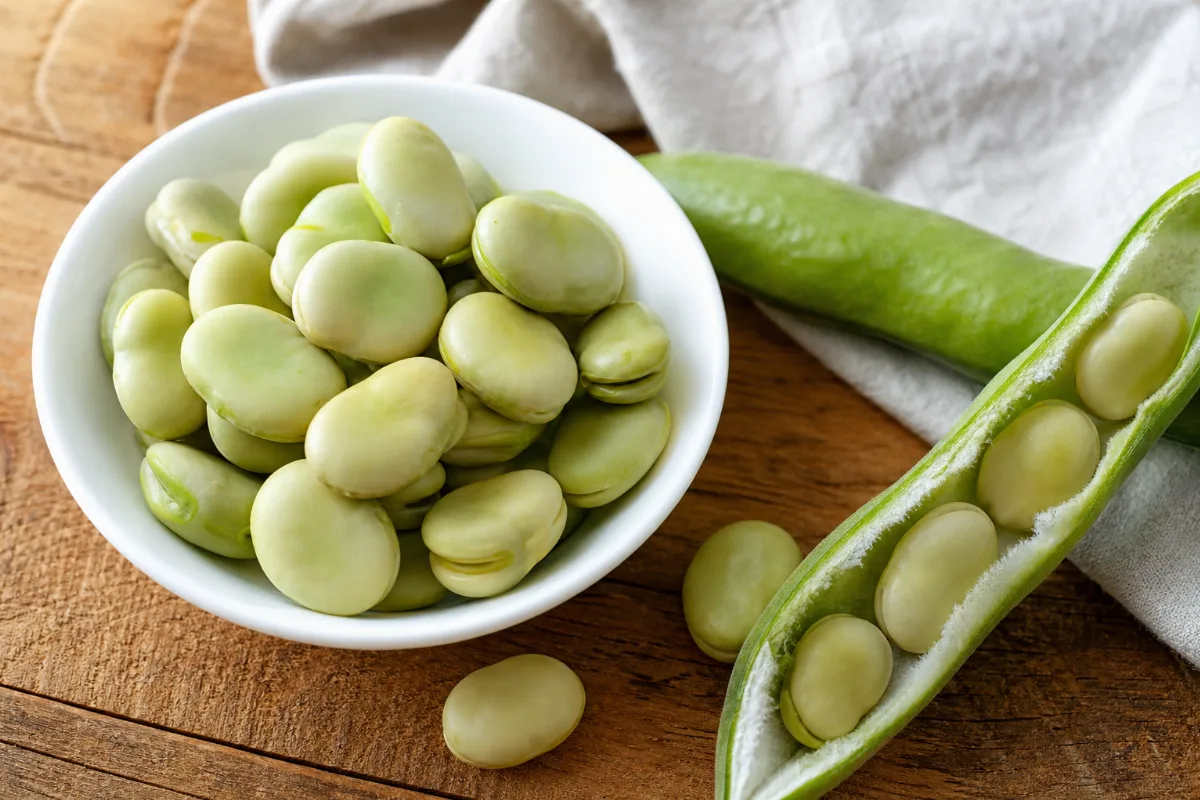
Fava beans (Vicia faba), also called broad beans or faba beans, are the large flat seeds of a plant in the legume family (Fabaceae). People eat them fresh from the pod, shelled, dried, or cooked into stews, dips and flours.
USDA data for fava beans, mature seeds, boiled without salt: 110 kcal per 100 g. One cup (170 g) has about 187 kcal, 12.9 g protein, 9.2 g fibre, 177 micrograms folate (DFE), 456 mg potassium and 2.6 mg iron. The dry raw bean is much more concentrated (25 g fibre and 26.1 g protein per 100 g) because cooking adds water. Fresh green, canned and flour forms were not read.
What the research shows
The firmest facts are about nutrients: fibre helps bowel function and soluble fibre is linked to lower cholesterol, and folate is a B vitamin. These are not trials of fava beans.
Pooled trials of pulses (beans, chickpeas, lentils and peas) found LDL cholesterol 0.14 to 0.17 mmol/L lower, a very small weight loss of about 0.34 kg and lower blood sugar markers. Trials of legumes found no clear blood pressure change, while cohort studies link more legumes to lower blood pressure risk (RR 0.84) and a little less cardiovascular disease and early death (HR 0.94). Cohort studies cannot prove cause.
Fava beans were not tested alone in any of these. The one human study of eating broad beans was a 1993 single-meal study of 5 healthy people and 6 people with Parkinson's disease.
Food versus extracts and pod products
The cholesterol, blood sugar and weight results come from trials of whole pulses eaten as food. The Parkinson's findings include extracts and pod valves, which are different products from a plate of beans: pod valves had much more levodopa than seeds in a laboratory paper (28.65 versus 0.76 mg per gram of dry weight). Flours, protein isolates and supplements are not covered.
Soaking and boiling
In a 2026 laboratory study, soaking faba beans with a bacterium (Lactiplantibacillus plantarum) and then boiling lowered vicine by about 46% and convicine by about 47%, and lowered resistant starch from 12.8% to 3.7 to 6.0% of dry matter. It did not test whether this makes the beans safe for people with G6PD deficiency.
Amounts
This page gives no amounts to eat. Ask a doctor, pharmacist or dietitian what is right for you, especially if you may have G6PD deficiency, take Parkinson's or MAOI medicines, or have kidney problems.
At a glance
Traditional uses history, not proof
- Eaten fresh, shelled, dried or cooked in stews, dips and flours
- Long use as food is not proof that it treats any condition
Studied for research
- Fibre, protein and folate, high certainty for the nutrients, no fava bean trial
- Cholesterol, low certainty (trials of pulses as a group)
- Blood sugar, low certainty (trials of pulses as a group)
- Parkinson's disease, insufficient evidence (one tiny single-meal study, with a harm signal)
- Body weight, low certainty (very small effect, pulses as a group)
- Blood pressure, low certainty (trials null; cohort studies link legumes to lower risk)
- Heart disease and early death, low certainty (observational)
Main compounds
- Vicine and convicine (the compounds responsible for favism)
- Levodopa (L-DOPA)
- Fibre
- Folate
- Phytic acid
Common forms
- Cooked (boiled) fava beans as food
- Dried beans, which must be cooked fully
- Fresh raw beans (the trigger in a favism case report)
- Canned beans, flour and extracts are different products and are not covered
Research links: 2023 review: favism at different ages · MedlinePlus Genetics: G6PD deficiency · 2026 review: whole pulses and cholesterol · 2019 review: beans in Parkinson's disease · Research Library · Genes & Biomarkers Library
What it is and its history
- Accepted scientific name
- Vicia faba
- Naming authority
- L. (GBIF accepted)
- Common names
- Fava beans (English); Broad beans (English); Faba beans (English); Horse beans (English); Habas (Spanish)
- Family or group
- Fabaceae (the legume or pea family), per GBIF.
- Classification
- Plantae > Tracheophyta > Magnoliopsida > Fabales > Fabaceae > Vicia > Vicia faba
- Native range
- Not verified from a source read.
- Habitat
- Not verified from a source read.
- What it looks like
- Roots: Not verified.; Stems: Not verified.; Leaves: Not verified.; Flowers: Not verified.; Fruit: The large flat seeds are eaten fresh from the pod, shelled, dried or cooked (existing summary). USDA gives a household portion of 1 cup cooked beans as 170 g.
- Cultivation
- Not verified from a source read. A 2026 laboratory paper says faba bean is increasingly cultivated in Nordic regions.
- Harvest and processing
- A 2026 laboratory study soaked faba beans in water, sodium bicarbonate or a bacterium and then boiled them; this changed vicine, convicine, phytic acid and resistant starch (see compounds).
- Look-alikes and adulterants
- Name: Mucuna pruriens (velvet bean); Note: Another bean that contains levodopa (about 5% L-DOPA in the seeds, per the 2019 review). It is a different plant and a different product.; Name: Fava bean flour and canned fava beans; Note: Different products with different nutrient values; the USDA figures here are for cooked and dry whole beans.
- Sustainability and conservation
- Not researched.
Photographs
What is inside, and how it may work
What it contains and how those compounds act in cells and animals. Laboratory and animal mechanisms are not proven effects in people.
Main compounds
| Compound | Family | Where it is concentrated | Activity studied | Level of evidence |
|---|---|---|---|---|
| Vicine PubChem 135413566 | pyrimidine glycoside | Seed Lowered about 46% by soaking with a bacterium then boiling in one lab study; not detected in pod valves in another | With convicine, a compound responsible for favism (2024 lab paper). 17 6 | Lab |
| Convicine PubChem 88000 | pyrimidine glycoside | Seed Lowered about 47% by soaking with a bacterium then boiling in one lab study; not detected in pod valves in another | With vicine, a compound responsible for favism (2024 lab paper). 17 6 | Lab |
| Levodopa (L-DOPA) PubChem 6047 | amino acid | Pod valves more than seeds 0.76 mg/g dry weight in seeds; 28.65 mg/g dry weight in pod valves (2024 lab paper) | Turned into dopamine in the brain; a main Parkinson's medicine (NHS). Beans raised blood levodopa in a tiny 1993 study. 17 11 28 | Human data |
| Fibre (dietary fibre) | carbohydrate | Seed USDA: 5.4 g per 100 g cooked; 25 g per 100 g dry | Beans are named among soluble fibre foods by MedlinePlus; soluble fibre helps lower cholesterol. 23 29 30 | Human data |
| Folate (vitamin B9) PubChem 135398658 | vitamin | Seed USDA: 104 micrograms DFE per 100 g cooked; 423 per 100 g dry | B vitamin; dried beans and peas are natural sources (MedlinePlus). 24 29 | Human data |
| Phytic acid (phytate) PubChem 890 | phosphorus compound | Seed Lowered by 71.3% by soaking with a bacterium then boiling in one lab study | Described in the 2026 paper as an anti-nutritional factor; not studied for health here. 6 | Lab |
Mechanisms, receptors and pathways
| Target or pathway | Gene or receptor | What was found | Level |
|---|---|---|---|
| G6PD and red cell protection | G6PD gene (named by MedlinePlus Genetics) | The G6PD enzyme protects red blood cells from reactive oxygen species. In G6PD deficiency, factors such as infections, certain drugs or eating fava beans raise those species and red cells are destroyed faster than they are replaced. 26 | Human data |
| Levodopa and dopamine | Not specified | Levodopa is taken up by nerve cells and turned into dopamine (NHS). Beans raised plasma levodopa in the 1993 study. 28 11 | Human data |
| Fibre and cholesterol | Not specified | MedlinePlus says soluble fibre turns to a gel in digestion and helps lower cholesterol. Pulse trials found small falls in LDL cholesterol, but the abstracts do not prove the fibre is the cause. 23 7 2 | Human data |
Absorption, metabolism and elimination
- Absorption
- After 250 g of cooked broad beans, plasma levodopa peaked at 0.66 to 1.20 micrograms/ml (AUC 1.82 to 4.12 micrograms/ml/h) in 5 healthy volunteers and 6 patients with Parkinson's disease.
- Distribution
- Not found.
- Metabolism
- Not found.
- Elimination
- Not found.
- Bioavailability
- Not established. The 1993 abstract compared the response with 125 mg levodopa plus 12.5 mg carbidopa taken on another day but does not give a direct ratio.
Isolated compounds versus whole extracts
The cholesterol, blood sugar and weight results are from trials of whole pulses as food. The Parkinson's studies used cooked beans in one single-meal study and extracts or pod valves in the others, which are different products. Pod valves had about 38 times the levodopa of seeds in one lab paper. Fava bean flour, protein isolates and extracts were not covered.
Nutritional composition
Nutrition from USDA FoodData Central: Broadbeans (fava beans), mature seeds, cooked, boiled, without salt (FDC 173753) and raw (FDC 175205), SR Legacy, April 2018 release. The values were read 2026-10-26 from the copy of the USDA data already saved in the project, because the live USDA API was rate-limited that day. Cooked, per 100 g: 110 kcal, 7.6 g protein, 0.4 g fat, 19.65 g carbohydrate, 5.4 g fibre, 1.82 g total sugars, about 72 g water, 36 mg calcium, 1.5 mg iron, 43 mg magnesium, 268 mg potassium, 5 mg sodium, 104 micrograms folate (DFE), 2.9 micrograms vitamin K, 0.421 mg manganese, 0.259 mg copper, 0.097 mg thiamin, 0.072 mg vitamin B6. One cup of cooked beans (170 g, the USDA household portion, 100 g values times 1.7): about 187 kcal, 12.9 g protein, 9.2 g fibre, 177 micrograms folate, 456 mg potassium and 2.6 mg iron. Dry raw beans, per 100 g: 341 kcal, 26.1 g protein, 25 g fibre, 423 micrograms folate, 1,062 mg potassium, 6.7 mg iron; do not compare these with cooked values because cooking adds water. Fresh green fava beans, canned beans and fava flour are different products with different numbers and were not read. Figures vary with variety, growing place and cooking time.
1 high certainty5 low certainty1 not enough evidence
What was looked at
The 7 benefits and uses checked for Fava Beans (Broad Beans), each with how strong the evidence is. Tap one to open it.
- Fibre, folate and proteinHigh certainty
- Cholesterol (pulses as a group)Low certainty
- Blood sugar (pulses as a group)Low certainty
- Parkinson's disease (levodopa in beans)Not enough evidence
- Body weight (pulses as a group)Low certainty
- Blood pressure (legumes)Low certainty
- Heart disease and early death (legumes, observational)Low certainty
Lab markers tracked in the studies
LDL cholesterolFasting blood glucosePlasma levodopaBody weightSystolic blood pressureDeath from any cause
What is Fava Beans (Broad Beans) good for?
The main studied uses and how strong the human evidence is for each. Most results are for pulses or legumes as a group, not for eating fava beans alone.
Benefits, one by one
Each card is a research question, not a promise. Tap a goal to filter. Open a card to see the studies, doses and limits.
Fibre, folate and protein
High certaintyCooked fava beans give 5.4 g of fibre, 7.6 g of protein and 104 micrograms of folate (DFE) per 100 g, by USDA data. A cup of cooked beans (170 g) gives about 9.2 g of fibre, 12.9 g of protein and 177 micrograms of folate. These are nutrient facts, not trials of fava beans. People with G6PD deficiency should read the Safety tab first.
4 studiesCooked fava beans as food (boiled, no salt). Dry, canned, fresh and f…
Studies, doses and limits
What the trials found
USDA lists, for fava beans cooked without salt, 5.4 g fibre, 7.6 g protein and 104 micrograms folate (DFE) per 100 g, and for the dry raw bean 25 g fibre, 26.1 g protein and 423 micrograms folate per 100 g. MedlinePlus names beans among soluble fibre foods and dried beans and peas among natural folate foods, and says research has shown that soluble fibre helps lower cholesterol.
Results
Fava beans are a fibre, protein and folate food. No trial of eating fava beans for any of these was read.
Effect sizes as reported
USDA, cooked, per 100 g: fibre 5.4 g, protein 7.6 g, folate 104 micrograms DFE. Per cup (170 g): about 9.2 g, 12.9 g and 177 micrograms.
Why this rating
High for the nutrient facts (USDA data and health-agency statements). No trial of fava beans.
Form and dose studied
Cooked fava beans as food (boiled, no salt). Dry, canned, fresh and flour have different values.
Who was studied
General adult diet.
Limits
A nutrient fact, not a trial. USDA does not split the fibre into soluble and insoluble. Cooked, canned and fresh beans differ.
Why researchers looked
Fava beans are a well-known fibre and protein food, so people ask what they add to the diet.
Traditional use
Fava (broad) beans are eaten fresh, shelled, dried or cooked into stews, dips and flours. Long use as food is not proof that it treats any condition.
Proposed mechanism Authoritative guidance
Soluble fibre attracts water and forms a gel that slows digestion (MedlinePlus). Folate is a B vitamin the body uses to make cells.
A proposed mechanism does not show that the effect happens in people.
Fibre-rich beans can cause gas (see Safety). Beans are the food that can trigger favism in G6PD deficiency.
Cholesterol (pulses as a group)
Low certaintyPooled trials of pulses (beans, chickpeas, lentils and peas) found LDL ("bad") cholesterol about 0.14 to 0.17 mmol/L lower. These trials did not test fava beans alone, so the result for fava beans is not known.
3 studiesPulses as food (trial detail: median about 130 g a day, not advice). …
Studies, doses and limits
What the trials found
A 2014 meta-analysis of 26 trials (1,037 adults) found pulse diets at a median of 130 g a day lowered LDL by 0.17 mmol/L (95% CI -0.25 to -0.09) with no effect on apoB or non-HDL. A 2026 update of 38 trials (2,095 adults, median 6 weeks) found LDL -0.14 mmol/L (-0.19 to -0.08), non-HDL -0.22, apoB -0.08 g/L, with a trivial fall in HDL (-0.03), and similar results across pulse types.
Results
Eating pulses as part of the diet slightly lowered LDL cholesterol in short trials. Fava beans were not tested separately in the abstracts read.
Effect sizes as reported
LDL -0.17 mmol/L (2014; 26 trials); LDL -0.14, non-HDL -0.22, apoB -0.08 g/L, HDL -0.03 (2026; 38 trials).
Why this rating
The 2026 review rates its certainty moderate to high for pulses as a group, but we rate it low for fava beans because they were not tested separately, the trials were short and LDL is a marker, not a heart attack count.
Form and dose studied
Pulses as food (trial detail: median about 130 g a day, not advice). Not fava beans specifically.
Who was studied
Adults in randomised trials.
Limits
Pulses are mostly dried beans, chickpeas and lentils. Short trials. Cholesterol is a marker, not a measure of heart attacks.
Why researchers looked
Pulses are high in fibre and protein, so researchers test whether eating them changes blood fats.
Traditional use
Fava (broad) beans are eaten fresh, shelled, dried or cooked into stews, dips and flours. Long use as food is not proof that it treats any condition.
Proposed mechanism Authoritative guidance
Not established in the abstracts read. MedlinePlus says soluble fibre helps lower cholesterol, and beans contain fibre.
A proposed mechanism does not show that the effect happens in people.
No safety signal for cholesterol. People with G6PD deficiency should not use this result to add fava beans.
Blood sugar (pulses as a group)
Low certaintyPooled trials of pulses found lower fasting blood sugar and lower long-term sugar markers, with large differences between trials. A 2026 review found lower after-meal glucose with pulses than with wheat products or white rice in 28 of 40 studies. Fava beans were not tested alone.
2 studiesPulses as food. Fava beans were not separated in the abstracts read.
Studies, doses and limits
What the trials found
A 2009 meta-analysis of 41 trials of at least 7 days found pulses alone (11 trials) lowered fasting glucose (SMD -0.82, 95% CI -1.36 to -0.27) and insulin (-0.49); pulses in low-GI diets (19 trials) lowered HbA1c or fructosamine (-0.28); pulses in high-fibre diets lowered fasting glucose (-0.32). A 2026 systematic review of 40 single-meal studies found lower glucose than other starchy foods in 28 of 40 and lower insulin in 16 of 24.
Results
Pulses lowered blood sugar markers in pooled analyses, with high unexplained differences between trials. They are not a treatment for diabetes.
Effect sizes as reported
Fasting glucose SMD -0.82; HbA1c/fructosamine SMD -0.28 (low-GI diets); lower after-meal glucose in 28 of 40 studies.
Why this rating
Low for fava beans: the evidence is for pulses as a group, the 2009 review is old and its heterogeneity was high, and the single-meal studies did not all use fava beans.
Form and dose studied
Pulses as food. Fava beans were not separated in the abstracts read.
Who was studied
Adults with and without diabetes.
Limits
Pulses as a group; high unexplained differences between trials; the single-meal review counts studies without pooled sizes.
Why researchers looked
Pulses are digested slowly, so researchers test whether eating them changes blood sugar.
Traditional use
Fava (broad) beans are eaten fresh, shelled, dried or cooked into stews, dips and flours. Long use as food is not proof that it treats any condition.
Proposed mechanism Unknown
The 2009 abstract describes pulses as a good source of slowly digestible carbohydrate, fibre and vegetable protein. Not tested here as a mechanism.
A proposed mechanism does not show that the effect happens in people.
People who take diabetes medicines should talk to their clinician before big diet changes. People with G6PD deficiency should not eat fava beans without asking a clinician.
Parkinson's disease (levodopa in beans)
Not enough evidenceFava beans contain levodopa, the same compound as a main Parkinson's medicine. In one very small study, people with Parkinson's disease who ate 250 g of cooked broad beans after going without medicine had higher blood levodopa and better movement for a few hours, but three also had severe involuntary movements. A review says the evidence is too thin to treat beans as a natural therapy. Do not replace medicine with beans.
4 studiesCooked broad beans as food in the trial (250 g, not advice). The othe…
Studies, doses and limits
What the trials found
A 1993 report of 5 healthy volunteers and 6 patients (mean age 63.5, stage III) who ate 250 g cooked broad beans after 12 hours off medicine: blood levodopa rose (Cmax 0.66 to 1.20 micrograms/ml), motor performance improved for about 4 hours, and three patients showed severe dyskinesias. The authors compared this with 125 mg levodopa plus 12.5 mg carbidopa on another day. A 2019 review lists four reasons for reservation (animal results may not apply to people, beans have bioactive compounds that can be harmful in large doses, patient studies are scarce and short, and there is no long-term data).
Results
Beans raised blood levodopa in a tiny single-meal study. There is no long-term or controlled evidence that eating fava beans helps Parkinson's disease, and there was a clear risk signal (dyskinesias).
Effect sizes as reported
Plasma levodopa Cmax 0.66 to 1.20 micrograms/ml and AUC 1.82 to 4.12 micrograms/ml/h after 250 g cooked beans; 3 patients with severe dyskinesias.
Why this rating
Insufficient: one tiny uncontrolled single-meal study from 1993 with a harm signal, plus a review that urges reservations. No modern trial was found.
Form and dose studied
Cooked broad beans as food in the trial (250 g, not advice). The other studies used extracts or pod valves, which are different products.
Who was studied
People with Parkinson's disease, off their medicine, in a single study.
Limits
Eleven people, one meal, no placebo food, and the authors tested people off medicine, which is not how people take medicine at home.
Why researchers looked
Because beans contain levodopa, people ask whether they could help Parkinson's disease.
Traditional use
Fava (broad) beans are eaten fresh, shelled, dried or cooked into stews, dips and flours. Long use as food is not proof that it treats any condition.
Proposed mechanism Human data
Levodopa is turned into dopamine in the brain (NHS). The bean seed contains levodopa (a 2024 lab study measured 0.76 mg/g dry weight in seeds).
A proposed mechanism does not show that the effect happens in people.
Severe dyskinesias were seen. Beans also carry the favism risk in G6PD deficiency. Ask a neurologist before changing diet or medicine.
Body weight (pulses as a group)
Low certaintyDiets with pulses gave a very small extra weight loss, about 0.34 kg over a median of 6 weeks. This is for pulses as a group, not fava beans alone.
1 studiesPulses as food (trial detail: median 132 g a day, not advice).
Studies, doses and limits
What the trials found
A 2016 meta-analysis of 21 trials (940 adults, at least 3 weeks) found diets containing pulses (median 132 g/day) gave a weight change of -0.34 kg (95% CI -0.63 to -0.04, P = 0.03) compared with diets without pulses, even when diets were not meant to cut calories. Six trials suggested body fat percentage may fall.
Results
A very small average effect in short trials. Long-term weight loss was not tested.
Effect sizes as reported
Body weight -0.34 kg (95% CI -0.63 to -0.04)
Why this rating
Low: very small effect, short trials, pulses as a group.
Form and dose studied
Pulses as food (trial detail: median 132 g a day, not advice).
Who was studied
Adults in randomised trials.
Limits
Pulses as a group. Short. Effect is under half a kilogram.
Why researchers looked
Pulses are filling, so researchers test whether they help with body weight.
Traditional use
Fava (broad) beans are eaten fresh, shelled, dried or cooked into stews, dips and flours. Long use as food is not proof that it treats any condition.
Proposed mechanism Not established
Not established in the abstract.
A proposed mechanism does not show that the effect happens in people.
None specific. Not advice for people with G6PD deficiency.
Blood pressure (legumes)
Low certaintyTrials of legumes found no clear overall change in blood pressure. In studies that follow people over time, those who ate the most legumes had about 16% lower risk of developing high blood pressure. That is an association, not proof, and it is about legumes as a group.
3 studiesLegumes as food; powders were included in some trials.
Studies, doses and limits
What the trials found
A 2023 meta-analysis of 16 randomised trials (1,092 people) found no significant overall effect of legumes on systolic blood pressure (-1.06 mm Hg, 95% CI -2.57 to 0.44) or diastolic (-0.48, -1.06 to 0.10), with low certainty; a fall of 2.79 mm Hg systolic appeared only in the overweight or obese subgroup. A 2026 meta-analysis of 12 prospective cohort studies found a relative risk of 0.84 (95% CI 0.77 to 0.93) for hypertension with the highest legume intake, and 0.88 per 100 g a day. A 2019 umbrella review found pulses with or without other legumes linked to lower hypertension incidence (RR 0.91, 0.86 to 0.97), graded very low certainty.
Results
Trials did not show a clear blood pressure effect. Cohort studies link more legumes to lower risk, but they cannot show cause.
Effect sizes as reported
Trials: SBP -1.06 mm Hg (NS). Cohorts: RR 0.84 (high vs low); 0.88 per 100 g/day; RR 0.91 (2019).
Why this rating
Low: trials are null with low certainty; cohort results are observational (the 2019 review grades them very low) and about legumes as a group.
Form and dose studied
Legumes as food; powders were included in some trials.
Who was studied
Adults in trials and cohorts.
Limits
People who eat more legumes may differ in other ways. The 2026 cohort paper was funded by Plant-Based Health Professionals UK, which three authors belong to or direct; the paper says the funder had no role.
Why researchers looked
Large population studies ask whether people who eat more legumes get high blood pressure less often.
Traditional use
Fava (broad) beans are eaten fresh, shelled, dried or cooked into stews, dips and flours. Long use as food is not proof that it treats any condition.
Proposed mechanism Unknown
Not established. The cohort studies are observational.
A proposed mechanism does not show that the effect happens in people.
None specific.
Heart disease and early death (legumes, observational)
Low certaintyIn long-term population studies, people who ate more legumes had a little less cardiovascular disease and a lower risk of dying from any cause (HR 0.94). These are associations in legumes as a group and do not prove fava beans protect anyone.
2 studiesLegumes as food, in cohort questionnaires.
Studies, doses and limits
What the trials found
A 2019 umbrella review of 28 cohort studies found the highest intake of pulses with or without other legumes linked to lower cardiovascular disease (RR 0.92, 95% CI 0.85 to 0.99) and coronary heart disease (RR 0.90, 0.83 to 0.99), with no link to heart attack, stroke or diabetes incidence or to cardiovascular, coronary or stroke mortality. A 2023 meta-analysis of 32 cohorts (1,141,793 people) found higher legume intake linked to lower all-cause mortality (HR 0.94, 0.91 to 0.98) and stroke mortality (HR 0.91, 0.84 to 0.99), but not cardiovascular, coronary or cancer mortality. Each extra 50 g a day went with 6% lower all-cause mortality.
Results
Small, consistent links in cohorts for some outcomes, none for others. Observational data cannot show cause.
Effect sizes as reported
CVD RR 0.92; CHD RR 0.90; all-cause mortality HR 0.94; stroke mortality HR 0.91.
Why this rating
Low: observational only; the 2019 review grades certainty low for cardiovascular disease and very low for the rest, and the 2023 review low to moderate.
Form and dose studied
Legumes as food, in cohort questionnaires.
Who was studied
Adults in cohort studies.
Limits
Legumes are grouped; diet and lifestyle differences between high and low eaters can explain part of it.
Why researchers looked
Large cohorts ask whether eating legumes goes with fewer heart problems and longer life.
Traditional use
Fava (broad) beans are eaten fresh, shelled, dried or cooked into stews, dips and flours. Long use as food is not proof that it treats any condition.
Proposed mechanism Unknown
Not established. The studies are observational.
A proposed mechanism does not show that the effect happens in people.
None specific.
Connections to the rest of health
How Fava Beans (Broad Beans) connects to the rest of our health knowledge graph. Every link says what kind of connection it is. A safety link (for example to the liver) is a warning, not a benefit. A study that merely mentions a topic never creates a benefit link.
Explore every connection: goals, body systems, organs, symptoms, genes
A. Wellness goals
| Connected to | Kind of connection | Evidence status | Context | Studies |
|---|---|---|---|---|
| Digestive Support | High certainty | Fibre, folate and protein: Cooked fava beans give 5.4 g of fibre, 7.6 g of protein and 104 micrograms of folate (DFE) per 100 g, by USDA data. A cup of cooked beans (170 g) gives about 9.2 g of fibre, 12.9 g of protein and 177 micrograms of folate. These are nutrient facts, not trials of fava beans. People with G6PD deficiency should read the Safety tab first. | 29 30 23 24 | |
| Cholesterol Balance | Low certainty | Cholesterol (pulses as a group): Pooled trials of pulses (beans, chickpeas, lentils and peas) found LDL ("bad") cholesterol about 0.14 to 0.17 mmol/L lower. These trials did not test fava beans alone, so the result for fava beans is not known. | 7 2 23 | |
| Heart Health | Low certainty | Cholesterol (pulses as a group): Pooled trials of pulses (beans, chickpeas, lentils and peas) found LDL ("bad") cholesterol about 0.14 to 0.17 mmol/L lower. These trials did not test fava beans alone, so the result for fava beans is not known. | 7 2 23 | |
| Blood Sugar Balance | Low certainty | Blood sugar (pulses as a group): Pooled trials of pulses found lower fasting blood sugar and lower long-term sugar markers, with large differences between trials. A 2026 review found lower after-meal glucose with pulses than with wheat products or white rice in 28 of 40 studies. Fava beans were not tested alone. | 15 14 | |
| Brain Health | Not enough evidence | Parkinson's disease (levodopa in beans): Fava beans contain levodopa, the same compound as a main Parkinson's medicine. In one very small study, people with Parkinson's disease who ate 250 g of cooked broad beans after going without medicine had higher blood levodopa and better movement for a few hours, but three also had severe involuntary movements. A review says the evidence is too thin to treat beans as a natural therapy. Do not replace medicine with beans. | 11 13 17 28 | |
| Weight Management | Low certainty | Body weight (pulses as a group): Diets with pulses gave a very small extra weight loss, about 0.34 kg over a median of 6 weeks. This is for pulses as a group, not fava beans alone. | 8 | |
| Blood Pressure Support | Low certainty | Blood pressure (legumes): Trials of legumes found no clear overall change in blood pressure. In studies that follow people over time, those who ate the most legumes had about 16% lower risk of developing high blood pressure. That is an association, not proof, and it is about legumes as a group. | 12 10 18 | |
| Heart Health | Low certainty | Blood pressure (legumes): Trials of legumes found no clear overall change in blood pressure. In studies that follow people over time, those who ate the most legumes had about 16% lower risk of developing high blood pressure. That is an association, not proof, and it is about legumes as a group. Heart disease and early death (legumes, observational): In long-term population studies, people who ate more legumes had a little less cardiovascular disease and a lower risk of dying from any cause (HR 0.94). These are associations in legumes as a group and do not prove fava beans protect anyone. | 12 10 18 20 | |
| Healthy Aging | Low certainty | Heart disease and early death (legumes, observational): In long-term population studies, people who ate more legumes had a little less cardiovascular disease and a lower risk of dying from any cause (HR 0.94). These are associations in legumes as a group and do not prove fava beans protect anyone. | 18 20 |
B. Body systems
| Connected to | Kind of connection | Evidence status | Context | Studies |
|---|---|---|---|---|
| Digestive System | Biological association | High certainty | Studied for: Fibre, folate and protein | 29 30 23 24 |
| Cardiovascular System | Biological association | Low certainty | Studied for: Cholesterol (pulses as a group) Studied for: Blood pressure (legumes) | 7 2 23 12 10 18 20 |
| Endocrine System | Biological association | Low certainty | Studied for: Blood sugar (pulses as a group) | 15 14 |
| Metabolism Weight | Biological association | Low certainty | Studied for: Blood sugar (pulses as a group) Studied for: Body weight (pulses as a group) | 15 14 8 |
| Nervous System | Biological association | Not enough evidence | Studied for: Parkinson's disease (levodopa in beans) | 11 13 17 28 |
E. Health conditions
| Connected to | Kind of connection | Evidence status | Context | Studies |
|---|---|---|---|---|
| G6PD deficiency | Adverse effect or risk | Documented risk | Fava beans can trigger hemolytic anemia (favism) in people with G6PD deficiency. Preparation or compound: Fava beans (vicine and convicine) |
26 3 4 |
| Parkinson's disease | Drug or supplement interaction | Insufficient evidence | Beans raise blood levodopa in a tiny study and caused severe dyskinesias in three patients; reviewers urge reservations. Beans contain levodopa; one tiny study saw higher blood levodopa and severe dyskinesias in three patients. Preparation or compound: Levodopa in broad beans |
11 13 |
I. Biomarkers
| Connected to | Kind of connection | Evidence status | Context | Studies |
|---|---|---|---|---|
| LDL cholesterol | Biological association | Low certainty | Measured in trials: lowered. A lab change is not the same as a health benefit. | 7 2 |
| Fasting blood glucose | Biological association | Low certainty | Measured in trials: lowered. A lab change is not the same as a health benefit. | 15 |
| Plasma levodopa | Biological association | Not enough evidence | Measured in trials: raised. A lab change is not the same as a health benefit. | 11 |
| Body weight | Biological association | Low certainty | Measured in trials: lowered. A lab change is not the same as a health benefit. | 8 |
| Systolic blood pressure | Biological association | Low certainty | Measured in trials: no-clear-change. A lab change is not the same as a health benefit. | 12 |
| Death from any cause | Biological association | Low certainty | Measured in trials: lowered. A lab change is not the same as a health benefit. | 20 |
J. Genes, receptors and enzymes
| Connected to | Kind of connection | Evidence status | Context | Studies |
|---|---|---|---|---|
| G6PD | Preliminary mechanism | Human | Fava beans can trigger hemolytic anemia in people with G6PD deficiency (variants in the G6PD gene). | 26 |
K. Biological pathways
L. Active compounds
| Connected to | Kind of connection | Evidence status | Context | Studies |
|---|---|---|---|---|
| Vicine | Biological association | Lab | With convicine, a compound responsible for favism (2024 lab paper). Preparation or compound: Seed |
17 6 |
| Convicine | Biological association | Lab | With vicine, a compound responsible for favism (2024 lab paper). Preparation or compound: Seed |
17 6 |
| Levodopa (L-DOPA) | Biological association | Human | Turned into dopamine in the brain; a main Parkinson's medicine (NHS). Beans raised blood levodopa in a tiny 1993 study. Preparation or compound: Pod valves more than seeds |
17 11 28 |
| Fibre (dietary fibre) | Biological association | Human | Beans are named among soluble fibre foods by MedlinePlus; soluble fibre helps lower cholesterol. Preparation or compound: Seed |
23 29 30 |
| Folate (vitamin B9) | Biological association | Human | B vitamin; dried beans and peas are natural sources (MedlinePlus). Preparation or compound: Seed |
24 29 |
| Phytic acid (phytate) | Biological association | Lab | Described in the 2026 paper as an anti-nutritional factor; not studied for health here. Preparation or compound: Seed |
6 |
Each connection is stored with the ingredient, the connected record, the kind of connection, the evidence status, the supporting studies, the preparation or compound involved, and a review date (last reviewed October 26, 2026).
The evidence
The research centre for Fava Beans (Broad Beans). Every record here was checked against PubMed or the publisher's page; we never list a study we have not verified.
Evidence by outcome
Bars show how many studies we found for each outcome, not how well it works. People are added up across trials only (reviews are not added, to avoid double counting).
How we rate evidence
High certainty
Several well-run trials or reviews agree; further research is unlikely to change the picture much.
Moderate certainty
Good trials point the same way, but some doubt remains.
Low certainty
Small, short or inconsistent trials. The finding could change with better research.
Very low certainty
Very little or very weak human data. Treat as a possibility only.
Mixed findings
Trials or reviews disagree with each other.
Not enough evidence
Not enough human research to say either way.
Evidence against
Good research found no benefit, or found harm.
We take the reviewers' own risk-of-bias and GRADE statements where they exist, and otherwise judge from study size, design, consistency, directness and whether a product matches what is sold. Many publications do not make evidence high. Method note: We started from our existing fava bean summary, re-checked nutrition against USDA FoodData Central data, read the health agency pages (MedlinePlus, FDA, NHS) and searched PubMed for reviews, trials and case reports. Only abstracts were read for studies. Items we could not verify are flagged in the research gaps.
Study library: every study we checked 30
| Study | Design | People | Product, dose, length | Result |
|---|---|---|---|---|
| Asiedu 2026 Prevalence, knowledge, awareness, attitudes, perceptions and practices of G6PD deficiency among mothers, children and pregnant women. J Public Health Res · PMID 42639153 · DOI |
Systematic review |
27 studies (Africa 55.6%, Middle East 25.9%, Asia 14.8%, Latin America 3.7%) | Not an intervention (prevalence and awareness) Studies from 2000 to 2025 |
Prevalence varied widely, from 1.1% in Turkish neonates to 60% among Nigerian pregnant women, with more cases in males because of X-linked inheritance. Up to 80.2% of mothers reported inadequate understanding of favism, and only 17.1% showed knowledge of the disorder. Neonatal jaundice was the most reported consequence. The authors call for screening and health education. Prevalence 1.1% to 60% in different groups; up to 80.2% of mothers with poor favism understanding. (Not applicable) Methods, limits and fundingOutcomes: G6PD deficiency prevalence and awareness Limitations: Systematic review of mixed study types; it is about awareness and prevalence, not about bean exposure. Funding and conflicts: The authors declare no conflicts. Read: abstract |
| Back 2026 Effect of Different Types of Whole Dietary Pulses on Established Therapeutic Lipid Targets for Cardiovascular Risk Reduction: An Updated Systematic Review and Dose-Response Meta-Analysis of Randomized Controlled Trials. J Am Heart Assoc · PMID 42132198 · DOI |
Meta-analysis |
2095 38 trials (52 comparisons) in adults |
Whole dietary pulses Whole pulses as food Median 130 g a day (0.5 to 0.67 cup; trial detail, not advice) Median 6 weeks · vs Comparison diets without pulses |
Whole pulses lowered LDL, non-HDL cholesterol and apoB, with a trivial fall in HDL. Results were similar across pulse types. A dose-response gradient was seen for beans up to 1 cup a day. GRADE certainty was moderate to high for all outcomes except apoB (very low). The authors say future studies on chickpeas, dried peas and lentils are warranted. LDL -0.14 mmol/L; non-HDL -0.22; apoB -0.08 g/L; HDL -0.03 (LDL 95% CI -0.19 to -0.08; non-HDL -0.30 to -0.14; apoB -0.13 to -0.03; HDL -0.05 to -0.01) Methods, limits and fundingOutcomes: LDL cholesterol (main), non-HDL, apoB, HDL Limitations: Pulses mostly dried beans, chickpeas and lentils; the abstract does not give a fava-only result. Short trials. Funding and conflicts: No conflicts stated in the abstract. Read: abstract |
| Beretta 2023 Favism: Clinical Features at Different Ages. Nutrients · PMID 36678214 · DOI |
Review |
Published case reports and case series of favism in four age groups: pregnant women and exclusively breastfed infants, children, adolescents and adults | Fava beans eaten by people with G6PD deficiency Fava beans as food |
The review (a narrative review of case reports and case series) says there is wide variation between people, and in the same person, in whether a hemolytic crisis develops. Quantity, quality and ripeness of the beans and the age of onset all matter. Severity is highest in the youngest children and in pregnant women. Death was reported in infants, visual impairment in children, and kidney failure in adults. Jaundice, pallor, dark urine, fast heart rate, abdominal pain and vomiting appeared in all groups. Most cases were self-limited with no lasting harm, but hospital care and transfusion were often needed. Narrative review of case reports; no pooled numbers. (Not applicable) Methods, limits and fundingOutcomes: Predisposing factors and symptoms of favism by age group Limitations: Narrative review of case reports and case series, which cannot say how often favism happens. Case reports favour unusual or severe cases. Funding and conflicts: The authors declare no conflict of interest. Read: abstract |
| Chen 2025 Co-occurrence of acute hemolytic anemia and methemoglobinemia in a 74-year-old female with G6PD deficiency: A case report. Medicine (Baltimore) · PMID 40527851 · DOI |
Case report |
1 One 74-year-old woman with G6PD deficiency |
Fresh raw fava beans (ingested) and then methylene blue treatment Fresh raw fava beans Single episode; recovered within a month |
Acute hemolytic anemia and methemoglobinemia after eating fresh raw fava beans. Hemoglobin was 81 g/L, methemoglobin 7.3%. Methylene blue, the usual treatment for methemoglobinemia, made the hemolysis worse (hemoglobin fell from 81 to 38 g/L). Treatment was switched to vitamin C and methylprednisolone and hemoglobin was back in the normal range one month after discharge. Hemoglobin 81 g/L at presentation; fell to 38 g/L after methylene blue; normal at 1 month. (Not applicable) Methods, limits and fundingOutcomes: Hemoglobin, hemolysis markers, methemoglobin Limitations: One case. It cannot show how common this is or that the beans were the only trigger. Funding and conflicts: The authors report no funding or conflicts. Read: abstract |
| Damiani 2011 Vicia faba Hypersensitivity and ASA Intolerance in a Farmer: A Case Report. J Allergy (Cairo) · PMID 21747863 · DOI |
Case report |
1 One farmer |
Broad beans (Vicia faba) handled during picking; previous reaction after eating cooked and raw beans Fresh broad beans Single case |
The report describes an IgE-mediated occupational allergy triggered by handling fresh broad beans while picking them, in a farmer who also had a history of adverse reaction after eating the cooked and raw vegetable. One case. (Not applicable) Methods, limits and fundingOutcomes: Allergic reaction Limitations: One case. It cannot show how common broad bean allergy is. Funding and conflicts: No funding or conflicts are stated in the abstract. Read: abstract |
| Fernandez Castaneda 2026 Compositional and microstructural changes in faba bean (Vicia faba L.) during soaking and boiling. Curr Res Food Sci · PMID 41884578 · DOI |
Lab analysis lab |
Laboratory analysis of faba beans | Faba beans soaked in water, sodium bicarbonate or Lactiplantibacillus plantarum, then boiled Whole beans Soaking then boiling (times not given in the abstract) · vs Raw beans |
Soaking with L. plantarum then boiling gave the largest drops in vicine (45.7%), convicine (47.1%) and phytic acid (71.3%). Resistant starch fell from 12.8% of dry matter in raw beans to 3.7 to 6.0% after processing. Protein ranged from 28 to 37% of dry matter. Vicine -45.7%, convicine -47.1%, phytic acid -71.3% (best treatment). (Not applicable) Methods, limits and fundingOutcomes: Vicine, convicine, phytic acid, resistant starch, protein Limitations: Laboratory measurement only. It did not test whether processed beans are safe for people with G6PD deficiency. Funding and conflicts: The authors declare no known competing interests. Read: abstract |
| Ha 2014 Effect of dietary pulse intake on established therapeutic lipid targets for cardiovascular risk reduction: a systematic review and meta-analysis of randomized controlled trials. CMAJ · PMID 24710915 · DOI |
Meta-analysis |
1037 26 randomised trials in adults |
Diets emphasising pulses (beans, chickpeas, lentils and peas) Whole pulses as food Median 130 g a day (trial detail, not advice) At least 3 weeks · vs Isocaloric diet without pulses |
LDL cholesterol was lower with pulse diets. No effect was seen on apolipoprotein B or non-HDL cholesterol. LDL mean difference -0.17 mmol/L (95% CI -0.25 to -0.09 mmol/L) Methods, limits and fundingOutcomes: LDL cholesterol, apolipoprotein B, non-HDL cholesterol Limitations: Pulses as a group, not fava beans alone. The authors call for longer, higher quality trials. Cholesterol is a marker, not a heart attack count. Funding and conflicts: No conflicts stated in the abstract; the PubMed record lists Canadian Institutes of Health Research support. Read: abstract |
| Kim 2016 Effects of dietary pulse consumption on body weight: a systematic review and meta-analysis of randomized controlled trials. Am J Clin Nutr · PMID 27030531 · DOI |
Meta-analysis |
940 21 randomised trials of at least 3 weeks |
Diets containing whole dietary pulses (beans, lentils, chickpeas, dry peas) Whole pulses as food Median 132 g a day (about 1 serving; trial detail, not advice) Median 6 weeks · vs Diets without pulses |
Diets with pulses gave a small extra weight loss, including in diets not meant to cut calories. Six trials suggested body fat percentage may fall. Body weight -0.34 kg (P = 0.03) (95% CI -0.63 to -0.04 kg) Methods, limits and fundingOutcomes: Body weight, waist circumference, body fat Limitations: Very small average effect over a short time; long-term weight loss was not tested. Not fava-specific. Funding and conflicts: The abstract lists no conflicts. Read: abstract |
| Laito 2022 Effect of oat or rice flour on pulse-induced gastrointestinal symptoms and breath hydrogen in subjects sensitive to pulses and controls - a randomised cross-over trial with two parallel groups. Br J Nutr · PMID 35086570 · DOI |
Controlled trial |
42 21 people with a sensitive gut or irritable bowel syndrome and 21 controls |
Pulse meals eaten with oat or rice flour (the pulses used are not named in the abstract) Pulses as food Not given in the abstract 4-day crossover · vs Rice flour versus oat flour |
The sensitive group reported more symptoms than controls after both meals. Oat flour with pulses gave more breath hydrogen and, on day 4, more mostly mild flatulence than rice flour in both groups. Moderate or severe symptoms did not differ. Sensitive group more symptoms than controls (P = 0.001 after both meals) (Not given) Methods, limits and fundingOutcomes: Gut symptoms and exhaled hydrogen Limitations: Small. The abstract does not say that fava beans were the pulse tested, so it is about pulses as a group. Funding and conflicts: Funding is not stated in the abstract. Read: abstract |
| Metoudi 2026 Legume and soy consumption and the risk of hypertension: a systematic review and dose-response meta-analysis of prospective studies. BMJ Nutr Prev Health · PMID 42539997 · DOI |
Meta-analysis |
309853 12 prospective cohort studies; 10 for legumes (86,098 cases among 309,853 people) |
Legume intake (high vs low) Legumes as food Per 100 g a day for the dose-response Cohort follow-up · vs Lowest intake group |
The highest legume intake group had a lower risk of hypertension than the lowest. Each 100 g a day was linked to a lower risk. The authors judged causality probable by World Cancer Research Fund criteria, though the design cannot prove it. Relative risk 0.84 (high vs low); 0.88 per 100 g/day (95% CI 0.77 to 0.93; 0.80 to 0.97) Methods, limits and fundingOutcomes: New high blood pressure (hypertension) Limitations: Observational; heterogeneity I2 65%; possible publication bias (explained by two outlying studies, say the authors). Funded by Plant-Based Health Professionals UK, with three authors affiliated; the paper says the funder had no role. Funding and conflicts: Three authors are members or the director of Plant-Based Health Professionals UK (the funder); one author reports no conflict. Read: abstract |
| Rabey 1993 Broad bean (Vicia faba) consumption and Parkinson's disease. Adv Neurol · PMID 8420210 |
Clinical trial |
11 5 healthy volunteers and 6 people with Parkinson's disease (mean age 63.5 years, stage III), after 12 hours without their medicine |
Cooked broad beans (Vicia faba) Cooked beans as food 250 g cooked beans (trial detail, not advice) Single meal; blood samples for 4 hours · vs 125 mg levodopa plus 12.5 mg carbidopa taken on another day |
A substantial clinical improvement was noted during the 4 hours and three patients also showed severe dyskinesias (involuntary movements). Plasma levodopa rose (Cmax 0.66 to 1.20 micrograms/ml; AUC 1.82 to 4.12 micrograms/ml/h). The authors say beans produced a substantial rise in plasma levodopa that correlated with better motor performance, and that this may matter for treatment, especially in patients with mild symptoms. Plasma levodopa Cmax 0.66 to 1.20 micrograms/ml after 250 g cooked beans; 3 of the patients had severe dyskinesias. (Not given in the abstract) Methods, limits and fundingOutcomes: Plasma levodopa and clinical performance Limitations: Tiny, single-meal study without a placebo food, done off medicine. It does not show that eating beans is a safe or lasting treatment. A short 1992 report of the same work (PubMed 1527547) gave the same main points. Funding and conflicts: No funding or conflicts are stated in the abstract. Read: abstract |
| Reyneke 2023 The Effect of Non-Oil Seed Legume Intake on Blood Pressure: A Systematic Review and Meta-Analysis of Randomized Controlled Trials. Adv Nutr · PMID 37031751 · DOI |
Meta-analysis |
1092 16 randomised trials (age 17 to 75 years, 4 to 52 weeks) |
Non-oil-seed legumes in whole or powdered form Legumes as food Weekly amounts of 450 to 3150 g across trials 4 to 52 weeks · vs Comparator diets |
No significant overall effect of legumes on blood pressure. A fall in systolic pressure was found in the subgroup with overweight or obesity. Certainty was low for both outcomes. Systolic MD -1.06 mm Hg; diastolic MD -0.48 mm Hg (not significant). Overweight/obese subgroup systolic -2.79 mm Hg (Systolic -2.57 to 0.44; diastolic -1.06 to 0.10; subgroup -4.68 to -0.90) Methods, limits and fundingOutcomes: Systolic and diastolic blood pressure Limitations: Mixed legumes and forms, including powders. The subgroup result is a secondary analysis. Funding and conflicts: The abstract lists no conflicts. Read: abstract |
| Rijntjes 2019 Knowing Your Beans in Parkinson's Disease: A Critical Assessment of Current Knowledge about Different Beans and Their Compounds in the Treatment of Parkinson's Disease and in Animal Models. Parkinsons Dis · PMID 31781363 · DOI |
Review |
Review of animal models and patient studies of beans in Parkinson's disease | Bean extracts and bean-derived compounds (including broad beans) Beans, extracts and compounds |
The review says several patient studies saw better motor performance after bean extracts, and that broad beans, common beans and soybeans contain levodopa (L-DOPA). It lists four reasons for reservation: animal results do not necessarily apply to people; beans have many bioactive ingredients, some harmful in large doses; patient studies are scarce and report only single doses or short courses of extract; and no long-term efficacy or safety data exist. It concludes that reservations about beans as a natural therapy seem justified. Narrative review; no pooled numbers. (Not applicable) Methods, limits and fundingOutcomes: Motor performance in Parkinson's disease Limitations: Narrative review; the abstract does not list how many patient studies it covers. Funding and conflicts: The author declares no conflicts of interest. Read: abstract |
| Schiemann 2026 Acute Effects of Non-Oil-Seed Pulses on Parameters of Cardiometabolic Health: A Systematic Review of Human Intervention Studies. Nutr Rev · PMID 41317035 · DOI |
Systematic review |
40 human intervention studies of single meals | Non-oil-seed pulses and pulse products Pulses as food Varied Single meals (after-meal responses) · vs Other starchy foods, mainly wheat products or white rice |
Pulses gave lower after-meal glucose than the comparison foods in 28 of 40 studies and lower insulin in 16 of 24. Fewer than half of the studies found less hunger or more fullness that reached significance, and lipid and vascular outcomes were studied in few trials, mostly with no significant effect. The authors conclude that pulses can be classified as low-glycemic foods. 28 of 40 studies lower glucose; 16 of 24 lower insulin. (Not applicable) Methods, limits and fundingOutcomes: After-meal glucose, insulin, hunger and satiety Limitations: Counts of studies, not pooled sizes. Pulse type varied; a fava-only result was not given in the abstract. Funding and conflicts: The authors declare no conflicts; the PubMed record lists German government agriculture funding. Read: abstract |
| Sievenpiper 2009 Effect of non-oil-seed pulses on glycaemic control: a systematic review and meta-analysis of randomised controlled experimental trials in people with and without diabetes. Diabetologia · PMID 19526214 · DOI |
Meta-analysis |
41 trials of at least 7 days in people with and without diabetes | Non-oil-seed pulses (chickpeas, beans, peas, lentils), alone or in low-GI or high-fibre diets Whole pulses as food Varied between trials At least 7 days · vs Control diets |
Pulses alone (11 trials) lowered fasting glucose and insulin. Pulses in low-GI diets (19 trials) lowered HbA1c or fructosamine. Pulses in high-fibre diets (11 trials) lowered fasting glucose and glycosylated proteins. Heterogeneity was high and mostly unexplained. Standardised mean differences: fasting glucose -0.82; insulin -0.49; HbA1c or fructosamine -0.28 (low-GI); fasting glucose -0.32 (high-fibre) (Fasting glucose -1.36 to -0.27; insulin -0.93 to -0.04; HbA1c/fructosamine -0.42 to -0.14) Methods, limits and fundingOutcomes: Fasting glucose and insulin; HbA1c or fructosamine Limitations: Pulses as a group, high unexplained differences between trials, old review (2009). Not fava-specific. Funding and conflicts: The abstract lists no funding or conflicts. Read: abstract |
| Sweet 1995 Monoamine oxidase inhibitor dietary restrictions: what are we asking patients to give up? J Clin Psychiatry · PMID 7737959 |
Survey |
139 139 psychiatric patients not yet on an MAOI (a food-use survey) |
Foods found on MAOI diet lists, including broad beans Broad beans (part not stated in the abstract) Survey |
Broad beans were among foods eaten at least monthly by more than 50% of patients, along with yeast products, dry sausage, corned beef, sauerkraut and beer. The authors say the long list of commonly eaten items does not support loosening MAOI diet restrictions, and recommend individual dietary assessment and education. More than 50% ate broad beans at least monthly. (Not applicable) Methods, limits and fundingOutcomes: How often patients ate foods on MAOI diet lists Limitations: A food-use survey, not a trial of broad beans with an MAOI. It shows broad beans appear on MAOI diet lists; it does not measure any reaction. Funded by US NIMH grants. Funding and conflicts: The PubMed record lists NIMH grants. Read: abstract |
| Tesoro 2024 Vicia faba L. Pod Valves: A By-Product with High Potential as an Adjuvant in the Treatment of Parkinson's Disease. Molecules · PMID 39203021 · DOI |
Lab analysis lab |
Laboratory analysis of Lucan broad bean pod valve extracts and a human nerve-cell line | Aqueous extracts of broad bean pod valves (not the beans as food) Pod valves · vs Synthetic levodopa |
Levodopa was 28.65 mg/g dry weight in pod valves compared with 0.76 mg/g dry weight in seeds. Vicine and convicine, which the paper calls the compounds responsible for favism, were not detected in the pods. The extracts protected SH-SY5Y cells from MPP+ toxicity in the dish. Levodopa 28.65 mg/g dw (pod valves) vs 0.76 mg/g dw (seeds). (Not applicable) Methods, limits and fundingOutcomes: Levodopa, vicine and convicine content; protection of cells in a toxin model Limitations: Laboratory and cell-line study of pod extract, not a human study. It says nothing about whether eating the beans is safe or helpful. Funding and conflicts: The authors declare no conflicts of interest. Read: abstract |
| Viguiliouk 2019 Associations between Dietary Pulses Alone or with Other Legumes and Cardiometabolic Disease Outcomes: An Umbrella Review and Updated Systematic Review and Meta-analysis of Prospective Cohort Studies. Adv Nutr · PMID 31728500 · DOI |
Meta-analysis |
28 unique prospective cohort studies | Dietary pulses with or without other legumes (highest vs lowest intake) Pulses and legumes as food Cohort follow-up · vs Lowest intake |
Higher intake was associated with lower incidence of cardiovascular disease, coronary heart disease, hypertension and obesity. There was no association with heart attack, stroke or diabetes incidence or with cardiovascular, coronary or stroke mortality. Certainty was low for cardiovascular disease incidence and very low for all other outcomes. RR: CVD 0.92; CHD 0.90; hypertension 0.91; obesity 0.87 (CVD 0.85 to 0.99; CHD 0.83 to 0.99; hypertension 0.86 to 0.97; obesity 0.81 to 0.94) Methods, limits and fundingOutcomes: Cardiovascular disease, heart disease, hypertension, obesity, diabetes, stroke, mortality Limitations: Observational; certainty low to very low; mixed legumes. Funding and conflicts: The PubMed record lists CIHR support; no conflicts are given in the abstract. Read: abstract |
| Walker 1984 Patient compliance with MAO inhibitor therapy. J Clin Psychiatry · PMID 6735998 |
Review |
Literature review of MAO inhibitor (MAOI) diet interactions | Foods named in MAOI diet reviews, including pods of broad beans Broad bean pods |
A review of the literature found seven food items most likely to produce a hypertensive crisis with an MAOI: aged cheeses, smoked or pickled fish, beef or chicken liver, dry fermented sausage, pods of broad beans, brewer's yeast products and certain alcoholic beverages. Not applicable (Not applicable) Methods, limits and fundingOutcomes: Foods most likely to cause a hypertensive crisis with an MAOI Limitations: A 1984 abstract. It names broad bean pods, not shelled beans, and gives no mechanism or case counts. Funding and conflicts: No funding or conflicts are stated in the abstract. Read: abstract |
| Zargarzadeh 2023 Legume Consumption and Risk of All-Cause and Cause-Specific Mortality: A Systematic Review and Dose-Response Meta-Analysis of Prospective Studies. Adv Nutr · PMID 36811595 · DOI |
Meta-analysis |
1141793 32 cohorts (1,141,793 people, 93,373 deaths) |
Legume intake (higher vs lower) Legumes as food Per 50 g a day for the dose-response Cohort follow-up · vs Lower intake |
Higher intake was associated with lower all-cause and stroke mortality, but not with cardiovascular, coronary or cancer mortality. Each extra 50 g a day was linked to 6% lower all-cause mortality. The authors judged the certainty low to moderate. HR all-cause 0.94; stroke 0.91; no association for CVD 0.99, CHD 0.93, cancer 0.85 (All-cause 0.91 to 0.98; stroke 0.84 to 0.99; CVD 0.91 to 1.09; CHD 0.78 to 1.09; cancer 0.72 to 1.01) Methods, limits and fundingOutcomes: All-cause, stroke, cardiovascular, coronary and cancer mortality Limitations: Observational; legumes as a group; cannot prove cause. Funding and conflicts: The abstract lists no conflicts. Read: abstract |
| s-fda-natural-toxins FDA: Natural Toxins in Food · Source |
Health agency n/a |
Methods, limits and fundingRead: full-text | ||
| s-gbif-vicia-faba GBIF Backbone: Vicia faba L. (usageKey 2974832) · Source |
Reference database n/a |
Methods, limits and fundingRead: full-text | ||
| s-medlineplus-fiber MedlinePlus: Soluble vs. insoluble fiber · Source |
Health agency n/a |
Methods, limits and fundingRead: full-text | ||
| s-medlineplus-folate MedlinePlus: Folate · Source |
Health agency n/a |
Methods, limits and fundingRead: full-text | ||
| s-medlineplus-foodallergy MedlinePlus: Food Allergy · Source |
Health agency n/a |
Methods, limits and fundingRead: full-text | ||
| s-medlineplus-g6pd MedlinePlus Genetics: Glucose-6-phosphate dehydrogenase deficiency · Source |
Health agency n/a |
Methods, limits and fundingRead: full-text | ||
| s-medlineplus-potassium MedlinePlus: Potassium in diet · Source |
Health agency n/a |
Methods, limits and fundingRead: full-text | ||
| s-nhs-parkinsons NHS: Parkinson's disease treatment · Source |
Health agency n/a |
Methods, limits and fundingRead: full-text | ||
| s-usda-fdc-173753 USDA FoodData Central: Broadbeans (fava beans), mature seeds, cooked, boiled, without salt (SR Legacy, FDC 173753) · Source |
Reference database n/a |
Methods, limits and fundingRead: full-text | ||
| s-usda-fdc-175205 USDA FoodData Central: Broadbeans (fava beans), mature seeds, raw (SR Legacy, FDC 175205) · Source |
Reference database n/a |
Methods, limits and fundingRead: full-text |
What we do not know yet
- No trial of eating fava beans on their own was found for cholesterol, blood sugar, blood pressure, weight or heart disease.
- The only human study of eating broad beans in Parkinson's disease was a single-meal study of 11 people from 1993; no modern or long-term trial was found.
- No current official page naming fava beans for MAOI antidepressants or levodopa medicines was found; the MAOI link rests on 1984 and 1995 abstracts.
- No source says whether cooking, canning or sprouting makes fava beans safe for G6PD deficiency.
- How common fava bean allergy is, choking risk for young children, pesticide residues, mycotoxins, heavy metals and sodium in canned beans were not researched.
How new research is added
New studies are found by a saved PubMed search and placed in a review queue before the page changes.
Lab markers
What changed in blood or saliva tests during trials. A changed number is not the same as feeling or being healthier, and we give no "normal ranges".
Metabolic 3
LDL cholesterol
Lowered in trials
The "bad" cholesterol carried in the blood. Higher levels are linked to more heart disease.
Low certaintyResults and what it means
Why it was measured
It is the usual blood marker used in diet trials for heart risk.
Statistical vs. clinical meaning
A small fall in a blood marker from pulses as a group. It does not show fewer heart attacks, and fava beans were not tested alone.
Safety implication
None specific.
| Study | Result | People | Product |
|---|---|---|---|
| 7 | LDL mean difference -0.17 mmol/L (95% CI -0.25 to -0.09); no effect on apoB or non-HDL | 1,037 adults in 26 trials | Diets emphasising pulses (beans, chickpeas, lentils, peas), median 130 g/day, at least 3 weeks |
| 2 | LDL -0.14 mmol/L (95% CI -0.19 to -0.08); non-HDL -0.22; apoB -0.08 g/L; HDL -0.03 | 2,095 adults in 38 trials | Whole dietary pulses, median 130 g/day, median 6 weeks |
Fasting blood glucose
Lowered in trials
Blood sugar measured after a night without food.
Low certaintyResults and what it means
Why it was measured
A basic marker used in diet trials on blood sugar.
Statistical vs. clinical meaning
Lower sugar markers in pooled trials with high, unexplained differences between trials. Pulses as a group, not fava beans alone.
Safety implication
People on diabetes medicines should ask their clinician.
| Study | Result | People | Product |
|---|---|---|---|
| 15 | Pulses alone: fasting glucose SMD -0.82 (95% CI -1.36 to -0.27); insulin -0.49 (-0.93 to -0.04). Low-GI diets: HbA1c or fructosamine -0.28 (-0.42 to -0.14) | 41 trials in people with and without diabetes | Pulses alone or in low-GI or high-fibre diets, at least 7 days |
Body weight
Lowered in trials
Weight in kilograms measured in a trial.
Low certaintyResults and what it means
Why it was measured
A basic measure used in diet trials.
Statistical vs. clinical meaning
A very small average change in short trials of pulses, not fava beans.
Safety implication
None specific.
| Study | Result | People | Product |
|---|---|---|---|
| 8 | Body weight -0.34 kg (95% CI -0.63 to -0.04), P = 0.03, median 6 weeks | 940 adults in 21 trials | Diets with whole pulses, median 132 g/day |
Other 3
Plasma levodopa
Raised in trials
The amount of levodopa in the blood plasma.
Not enough evidenceResults and what it means
Why it was measured
It shows whether eating the beans delivers levodopa to the blood.
Statistical vs. clinical meaning
Beans delivered levodopa to the blood in a tiny study. It does not show that this is safe or helpful over time.
Safety implication
Severe dyskinesias were reported in three patients.
| Study | Result | People | Product |
|---|---|---|---|
| 11 | Cmax 0.66 to 1.20 micrograms/ml and AUC 1.82 to 4.12 micrograms/ml/h after 250 g cooked broad beans; three patients had severe dyskinesias | 5 healthy volunteers and 6 people with Parkinson's disease | 250 g cooked broad beans, single meal, 4 hours of blood samples |
Systolic blood pressure
No-clear-change in trials
The top number in a blood pressure reading.
Low certaintyResults and what it means
Why it was measured
Raised blood pressure is a risk factor for heart disease and stroke.
Statistical vs. clinical meaning
No clear overall effect in trials; a subgroup result needs confirming.
Safety implication
None specific.
| Study | Result | People | Product |
|---|---|---|---|
| 12 | Systolic -1.06 mm Hg (95% CI -2.57 to 0.44), not significant; overweight or obese subgroup -2.79 mm Hg (-4.68 to -0.90) | 1,092 people in 16 trials | Legumes (whole or powdered), 4 to 52 weeks |
Death from any cause
Lowered in trials
Dying from any cause during a study follow-up.
Low certaintyResults and what it means
Why it was measured
The broadest long-term outcome in cohort studies.
Statistical vs. clinical meaning
An association in observational studies, not proof, and for legumes as a group.
Safety implication
None specific.
| Study | Result | People | Product |
|---|---|---|---|
| 20 | Higher legume intake HR 0.94 (95% CI 0.91 to 0.98); 6% lower risk per 50 g/day | 32 cohorts, 1,141,793 people, 93,373 deaths | Legume intake, observational |
Safety
What studies and official sources say about side effects, medicines and who should check first. Each point shows what kind of evidence it comes from.
Main points to know 8
- Favism: fava beans can destroy red blood cells in people with G6PD deficiency. This is the main safety point. In people with glucose-6-phosphate dehydrogenase (G6PD) deficiency, eating fava beans can cause hemolytic anemia, where red blood cells are destroyed faster than the body can replace them. MedlinePlus Genetics lists eating fava beans or inhaling fava pollen (favism) as a trigger. It estimates 400 million people worldwide have G6PD deficiency, most often in parts of Africa, Asia, the Mediterranean and the Middle East, and many never have symptoms and do not know they have it. Warning signs are paleness, yellow skin or eyes, dark urine, tiredness, shortness of breath and a fast heart rate. A review of case reports found that quantity, quality and ripeness of the beans and the age of onset all matter, and that hospital care and transfusion were often needed. If you or a family member has G6PD deficiency, ask your clinician before eating fava beans. If the signs appear after eating them, get medical care promptly. Authoritative guidance 26 3 4
- Pregnancy, breastfeeding and infants have the most severe cases in case reports. The 2023 review of case reports says severity of favism is highest in the youngest children and in pregnant women, and groups pregnant women with exclusively breastfed infants as one age group. It reports death in infants. A 2026 systematic review found up to 80.2% of mothers had inadequate understanding of favism. Pregnant and breastfeeding women, and families with G6PD deficiency in the family, should ask a clinician before eating fava beans. G6PD deficiency is also a significant cause of newborn jaundice (MedlinePlus Genetics). Review 3 1 26
- Cooking is not shown to make fava beans safe for G6PD deficiency. No source we read says that cooking, soaking or canning makes fava beans safe for people with G6PD deficiency. A 2026 laboratory study found that soaking with a bacterium and then boiling lowered vicine by about 46% and convicine by about 47% in faba beans, but it did not test whether this protects people. A 2024 laboratory paper found no vicine or convicine in bean pods it tested, but that does not make pods safe for people with the condition. A case report of hemolysis followed fresh raw beans. People with G6PD deficiency should ask their clinician about every form. Lab 6 17 4
- Parkinson's medicines: beans contain levodopa and caused severe movements in a small study. Fava beans contain levodopa, the compound in a main Parkinson's medicine. In a small 1993 study, 250 g of cooked broad beans raised blood levodopa in people with Parkinson's disease who had gone without medicine, and three of the patients had severe involuntary movements (dyskinesias). A 2019 review says beans have many bioactive compounds, some harmful in large doses, and that reservations about beans as a natural therapy are justified. The NHS says to check with your care team before using an alternative treatment along with prescribed medicines. We read no source on fava beans as a food together with levodopa or MAO-B inhibitor medicines. Do not replace or change medicine with beans. Controlled trial 11 13 28
- MAOI antidepressants: broad bean pods appear on old MAOI diet lists. A 1984 review of the literature listed pods of broad beans among seven foods most likely to cause a hypertensive crisis (a dangerous rise in blood pressure) with a monoamine oxidase inhibitor (MAOI) medicine. A 1995 survey found broad beans on the food lists given to MAOI patients. These abstracts name the pods, and do not give a mechanism or any case counts. We did not find a current official page that names fava beans, so this is a precaution based on old sources. If you take an MAOI, ask your prescriber or pharmacist before eating fava beans, especially the pods. Review 19 16
- Raw or undercooked beans: cook them fully. The FDA says phytohaemagglutinin (PHA), a lectin in raw or undercooked beans, can cause nausea, severe vomiting and diarrhea, and that soaking beans for at least 5 hours then boiling them in fresh water for at least 30 minutes removes and destroys it. The FDA example is kidney beans and the page does not name fava beans, and we read no fava-specific cooking time. Dried fava beans should be cooked fully. Fresh raw beans were the trigger in a case report of hemolysis in G6PD deficiency. Authoritative guidance 21 4
- Gas and bloating in a sensitive gut. Pulses can cause gas and bloating in people with a sensitive gut or irritable bowel syndrome. In a small trial (21 people with a sensitive gut, 21 controls) the sensitive group reported more symptoms than controls after pulse meals. The abstract does not say which pulse was used, so this is about pulses as a group. Controlled trial 9
- Kidney disease and potassium. USDA lists 268 mg of potassium per 100 g of cooked fava beans (about 456 mg in a cup). MedlinePlus says people with kidney problems, particularly those on dialysis, should not eat too many potassium-rich foods, and names beans among good potassium sources. Ask your kidney team whether fava beans fit your potassium limit. Authoritative guidance 27 29
Side effects 4
| Effect | How often | Severity and recovery | Evidence |
|---|---|---|---|
| Hemolytic anemia (favism) in G6PD deficiency: pallor, jaundice, dark urine, fast heart rate, tiredness Only applies to people with G6PD deficiency, but many do not know they have it. | Not given; the reports are case series. MedlinePlus says many people with G6PD deficiency never have symptoms. The 2023 review says most cases are self-limited but hospital care and transfusion are often needed; death was reported in infants. | can be severe, including death in infants In most reported cases symptoms were self-limited with no lasting harm (2023 review). In the 2025 case report hemoglobin was back to normal one month after discharge. | Authoritative guidance 26 3 4 |
| Severe involuntary movements (dyskinesias) in people with Parkinson's disease after a large bean meal A tiny single-meal study; the authors did not describe how it was managed. | Three patients showed severe dyskinesias in the 1993 study (6 patients ate 250 g cooked broad beans after 12 hours off medicine). | moderate to severe Not stated in the abstract. | Controlled trial 11 |
| Gas, bloating and flatulence 21 people with a sensitive gut or IBS and 21 controls; the pulse is not named, so it is about pulses as a group. | More symptoms than controls in the sensitive-gut group after pulse meals (P = 0.001); day-4 flatulence mostly mild; no difference in moderate or severe symptoms. | mild to moderate Not stated in the abstract. | Controlled trial 9 |
| Allergic reaction to fava beans (including from handling the fresh beans) One case report. How common fava bean allergy is was not found. | Not found. A 2011 case report describes an IgE-mediated occupational allergy to handling fresh broad beans in a farmer who had also reacted after eating them. | varies; anaphylaxis is a medical emergency (MedlinePlus) Not stated. | Case report 5 25 |
Liver
No liver injury from eating fava beans was found in the sources read. A liver-safety source such as LiverTox was not searched for this food page.
How often. No frequency was found.
Monitoring. No agency monitoring advice was found.
This is a safety connection. It is not evidence that Fava Beans (Broad Beans) supports liver health.
Medicines and supplements 4
| With | Why it matters | Importance | Evidence | What to do |
|---|---|---|---|---|
| Medicines that can trigger hemolysis in G6PD deficiency (some antibiotics, malaria medicines, methylene blue) prescription | MedlinePlus Genetics says hemolytic anemia in G6PD deficiency is most often triggered by infections or certain drugs, such as some antibiotics and malaria medicines. In a 2025 case report, methylene blue made hemolysis worse after raw fava beans. | The beans and these medicines each can set off hemolysis in G6PD deficiency. No study of the two together was read apart from the single case report. | Case report Low certainty 26 4 | If you have G6PD deficiency, tell every treating clinician and pharmacist. Do not take a new medicine without checking. |
| Levodopa medicines for Parkinson's disease prescription | Fava beans contain levodopa (a 2024 lab study measured 0.76 mg/g dry weight in seeds). In a 1993 study, 250 g of cooked beans raised blood levodopa. | The effect of beans on the dose of a person taking levodopa medicine was not read. Three patients had severe dyskinesias after the beans in the small study. | Controlled trial Very low certainty 11 17 13 | Ask your neurologist before eating fava beans in large amounts or changing your diet or medicines. |
| MAOI antidepressants (monoamine oxidase inhibitors) prescription | Old sources that name pods, without case counts or a mechanism. No current official page naming fava beans was found. | Review Very low certainty 19 16 | If you take an MAOI, ask your prescriber or pharmacist before eating fava beans, especially the pods. | |
| Medicines that raise blood potassium (ACE inhibitors and some others) prescription | MedlinePlus lists some heart and blood pressure medicines such as ACE inhibitors among causes of high blood potassium and says people with kidney problems should not eat too many potassium-rich foods. Cooked fava beans contain potassium (USDA: 268 mg per 100 g). | MedlinePlus names beans among good potassium sources but does not name fava beans. The link is our reading of two facts; ordinary food amounts were not tested. | Authoritative guidance Low certainty 27 29 | If you have kidney disease or take one of these medicines, ask a clinician or pharmacist about potassium-rich foods. |
Who should check first 8
| Situation | Advice | Evidence |
|---|---|---|
| G6PD deficiency (known, suspected or in the family) | Ask your clinician before eating fava beans in any form. Get medical care promptly for paleness, yellow skin or eyes, dark urine, tiredness, shortness of breath or a fast heart rate after eating them. | Authoritative guidance 26 3 |
| Pregnancy and breastfeeding | The 2023 review put pregnant women and exclusively breastfed infants in the group with the highest severity of favism. Ask your doctor or midwife, especially if G6PD deficiency runs in the family. No official body page on fava beans in pregnancy was read. | Review 3 1 |
| Babies and young children | Severity of favism is highest in the youngest children (2023 review). Ask a paediatrician before giving fava beans if G6PD deficiency is known or runs in the family. Choking risk for whole beans in young children was not found in the sources read. | Review 3 |
| Taking levodopa or other Parkinson's medicines | Ask your neurologist before eating fava beans in large amounts. Do not replace medicine with beans. | Controlled trial 11 13 28 |
| Taking an MAOI antidepressant | Ask your prescriber or pharmacist before eating fava beans, especially the pods. | Review 19 16 |
| Known or suspected legume allergy | Ask an allergist. For trouble breathing or swelling of the face or throat, call emergency services. | Case report 5 25 |
| Kidney disease with a potassium limit | Ask your kidney team whether fava beans fit your limit. MedlinePlus does not name fava beans. | Authoritative guidance 27 29 |
| Irritable bowel syndrome or a gut that reacts to pulses | A dietitian can help you test pulses safely. | Controlled trial 9 |
Overdose, product quality and regulators
Summary. The main toxic effect of fava beans is favism in people with G6PD deficiency. In other people no toxicity from eating properly cooked beans was found in the sources read. Raw or undercooked beans can contain lectins (PHA) that cause vomiting and diarrhea.
Animal. Not reviewed.
Human doses studied. In the 1993 study, 250 g of cooked broad beans were eaten as one meal by 5 healthy volunteers and 6 patients with Parkinson's disease; three patients had severe dyskinesias.
High dose or long term signals. The 2019 review says beans have bioactive ingredients, some harmful in large doses, and that no long-term safety data on bean therapy exist.
Overdose response. Not found.
Genotoxicity. Not researched.
Toxic or hazardous parts. Vicine and convicine (the compounds responsible for favism, per a 2024 lab paper) were not detected in the pod valves tested in that paper; pod valves had much more levodopa than seeds. Fava pollen can also trigger favism (MedlinePlus Genetics).
Raw or undercooked beans can contain lectins. Pesticide residues, mycotoxins, heavy metals and canned-bean sodium were not researched for this page.
Lectins (PHA) in raw or undercooked beans. The FDA says PHA is a lectin in raw or undercooked beans and can cause nausea, severe vomiting and diarrhea. It says that soaking beans for at least 5 hours and boiling them in fresh water for at least 30 minutes will remove and destroy the toxin. The FDA example is kidney beans; fava beans are not named and no fava-specific time was read. 21
Processing lowers some natural compounds. A 2026 laboratory study found soaking with Lactiplantibacillus plantarum and then boiling lowered vicine by 45.7%, convicine by 47.1% and phytic acid by 71.3% in faba beans, and lowered resistant starch from 12.8% to 3.7 to 6.0% of dry matter. It did not test safety in G6PD deficiency. 6
| Body | Action | Date |
|---|---|---|
| MedlinePlus Genetics (US National Library of Medicine) (United States) | G6PD deficiency: hemolytic anemia can follow eating fava beans or inhaling fava pollen (favism); triggers also include infections and certain drugs such as some antibiotics and malaria medicines; an estimated 400 million people worldwide have the condition and many never have symptoms. source | 2026-10-26 |
| FDA (US) (United States) | Natural Toxins in Food: PHA lectin in raw or undercooked beans; soak at least 5 hours then boil in fresh water at least 30 minutes. Fava beans not named. source | 2024-09-26 |
| NHS (UK) (United Kingdom) | Parkinson's disease treatment: levodopa, dopamine agonists and MAO-B inhibitors are the main medicines; check with your care team before using an alternative treatment along with prescribed medicines. Fava beans are not named. source | 2022-11-03 |
| MedlinePlus (US National Library of Medicine) (United States) | Potassium in diet: beans are good sources; people with kidney problems, particularly on dialysis, should not eat too many potassium-rich foods. source | 2026-04-30 |
When to get medical help
- Paleness, yellow skin or eyes, dark urine, unusual tiredness, shortness of breath or a fast heart rate after eating fava beans (possible hemolytic anemia in G6PD deficiency): get medical care promptly
- Trouble breathing, swelling of the lips, face or throat, widespread hives or collapse after eating beans (possible anaphylaxis): call emergency services
- A sudden severe headache, chest pain or a very fast heartbeat while taking an MAOI antidepressant after eating fava beans: seek urgent medical help
- Severe vomiting or diarrhea after eating undercooked beans: seek medical care if severe or lasting
Stop using the product and contact a clinician or emergency service. In the US, Poison Control is 1-800-222-1222.
General information only, not medical advice. Ask a clinician or pharmacist before use, especially with medicines, in pregnancy or with a health condition. See the Natural Remedy Safety guide.
Frequently asked questions
Who should not eat fava beans?
What are the signs of favism?
Does cooking remove the favism risk?
Are fava beans safe in pregnancy or for babies?
Do fava beans help Parkinson's disease?
Can I eat fava beans if I take levodopa or an MAOI?
Do fava beans lower cholesterol?
Do fava beans help with blood sugar or weight?
Do fava beans lower blood pressure?
Can you be allergic to fava beans?
Why do fava beans cause gas?
Pulses can cause more gut symptoms in people with a sensitive gut or irritable bowel syndrome. The trial we read did not say which pulse was used. A dietitian can help you test your own limits.
Do fava beans need to be cooked?
Yes. The FDA says raw or undercooked beans contain a lectin that can cause severe vomiting and diarrhea, and advises soaking at least 5 hours then boiling at least 30 minutes. Its example is kidney beans; no fava-specific time was read.
Explore by health goal
Heart HealthDigestive SupportCholesterol BalanceBlood Sugar BalanceBrain HealthWeight ManagementBlood Pressure SupportHealthy Aging
Editorial transparency
- Written by
- AlternativeMed editorial team. Research compiled with AI assistance, then checked against the sources listed.
- Medical review
- None. This page has not been reviewed by a physician or pharmacist.
- First published
- 2026-10-26
- Last substantive update
- 2026-10-26
- How we research
- We started from our existing fava bean summary, re-checked nutrition against USDA FoodData Central data, read the health agency pages (MedlinePlus, FDA, NHS) and searched PubMed for reviews, trials and case reports. Only abstracts were read for studies. Items we could not verify are flagged in the research gaps.
- How we rate evidence
- See "How we rate evidence" in the Evidence tab.
- Independence
- No product is promoted on this page. No affiliate links are shown.
Sources 30
Each source was opened and checked. Where we read only the abstract, it says so. The small numbers in the text point here.
- Asiedu C, Asiedu EFO, Johnson E, Bilson SE. Prevalence, knowledge, awareness, attitudes, perceptions and practices of G6PD deficiency among mothers, children and pregnant women.. J Public Health Res. 2026. PMID 42639153. DOI 10.1177/22799036261480292. (abstract)
- Back S, Yang S, Rossi A, et al.. Effect of Different Types of Whole Dietary Pulses on Established Therapeutic Lipid Targets for Cardiovascular Risk Reduction: An Updated Systematic Review and Dose-Response Meta-Analysis of Randomized Controlled Trials.. J Am Heart Assoc. 2026. PMID 42132198. DOI 10.1161/JAHA.125.046659. (abstract)
- Beretta A, Manuelli M, Cena H. Favism: Clinical Features at Different Ages.. Nutrients. 2023. PMID 36678214. DOI 10.3390/nu15020343. (abstract)
- Chen B, Han Y. Co-occurrence of acute hemolytic anemia and methemoglobinemia in a 74-year-old female with G6PD deficiency: A case report.. Medicine (Baltimore). 2025. PMID 40527851. DOI 10.1097/MD.0000000000042826. (abstract)
- Damiani E, Aloia AM, Priore MG, et al.. Vicia faba Hypersensitivity and ASA Intolerance in a Farmer: A Case Report.. J Allergy (Cairo). 2011. PMID 21747863. DOI 10.1155/2011/191787. (abstract)
- Fernandez Castaneda LA, Kravchenko O, Matl P, et al.. Compositional and microstructural changes in faba bean (Vicia faba L.) during soaking and boiling.. Curr Res Food Sci. 2026. PMID 41884578. DOI 10.1016/j.crfs.2026.101383. (abstract)
- Ha V, Sievenpiper JL, de Souza RJ, et al.. Effect of dietary pulse intake on established therapeutic lipid targets for cardiovascular risk reduction: a systematic review and meta-analysis of randomized controlled trials.. CMAJ. 2014. PMID 24710915. DOI 10.1503/cmaj.131727. (abstract)
- Kim SJ, de Souza RJ, Choo VL, et al.. Effects of dietary pulse consumption on body weight: a systematic review and meta-analysis of randomized controlled trials.. Am J Clin Nutr. 2016. PMID 27030531. DOI 10.3945/ajcn.115.124677. (abstract)
- Laito S, Valkonen N, Laaksonen O, et al.. Effect of oat or rice flour on pulse-induced gastrointestinal symptoms and breath hydrogen in subjects sensitive to pulses and controls - a randomised cross-over trial with two parallel groups.. Br J Nutr. 2022. PMID 35086570. DOI 10.1017/S0007114522000332. (abstract)
- Metoudi M, Sadler I, Kassam S, Aune D. Legume and soy consumption and the risk of hypertension: a systematic review and dose-response meta-analysis of prospective studies.. BMJ Nutr Prev Health. 2026. PMID 42539997. DOI 10.1136/bmjnph-2025-001449. (abstract)
- Rabey JM, Vered Y, Shabtai H, et al.. Broad bean (Vicia faba) consumption and Parkinson's disease.. Adv Neurol. 1993. PMID 8420210. (abstract)
- Reyneke GL, Beck EJ, Lambert K, Neale EP. The Effect of Non-Oil Seed Legume Intake on Blood Pressure: A Systematic Review and Meta-Analysis of Randomized Controlled Trials.. Adv Nutr. 2023. PMID 37031751. DOI 10.1016/j.advnut.2023.04.002. (abstract)
- Rijntjes M. Knowing Your Beans in Parkinson's Disease: A Critical Assessment of Current Knowledge about Different Beans and Their Compounds in the Treatment of Parkinson's Disease and in Animal Models.. Parkinsons Dis. 2019. PMID 31781363. DOI 10.1155/2019/1349509. (abstract)
- Schiemann TB, Diekmann C, Egert S. Acute Effects of Non-Oil-Seed Pulses on Parameters of Cardiometabolic Health: A Systematic Review of Human Intervention Studies.. Nutr Rev. 2026. PMID 41317035. DOI 10.1093/nutrit/nuaf190. (abstract)
- Sievenpiper JL, Kendall CW, Esfahani A, et al.. Effect of non-oil-seed pulses on glycaemic control: a systematic review and meta-analysis of randomised controlled experimental trials in people with and without diabetes.. Diabetologia. 2009. PMID 19526214. DOI 10.1007/s00125-009-1395-7. (abstract)
- Sweet RA, Brown EJ, Heimberg RG, et al.. Monoamine oxidase inhibitor dietary restrictions: what are we asking patients to give up?. J Clin Psychiatry. 1995. PMID 7737959. (abstract)
- Tesoro C, Lelario F, Piscitelli F, et al.. Vicia faba L. Pod Valves: A By-Product with High Potential as an Adjuvant in the Treatment of Parkinson's Disease.. Molecules. 2024. PMID 39203021. DOI 10.3390/molecules29163943. (abstract)
- Viguiliouk E, Glenn AJ, Nishi SK, et al.. Associations between Dietary Pulses Alone or with Other Legumes and Cardiometabolic Disease Outcomes: An Umbrella Review and Updated Systematic Review and Meta-analysis of Prospective Cohort Studies.. Adv Nutr. 2019. PMID 31728500. DOI 10.1093/advances/nmz113. (abstract)
- Walker JI, Davidson J, Zung WW. Patient compliance with MAO inhibitor therapy.. J Clin Psychiatry. 1984. PMID 6735998. (abstract)
- Zargarzadeh N, Mousavi SM, Santos HO, Aune D. Legume Consumption and Risk of All-Cause and Cause-Specific Mortality: A Systematic Review and Dose-Response Meta-Analysis of Prospective Studies.. Adv Nutr. 2023. PMID 36811595. DOI 10.1016/j.advnut.2022.10.009. (abstract)
- . FDA: Natural Toxins in Food. . . (full-text)
- . GBIF Backbone: Vicia faba L. (usageKey 2974832). . . (full-text)
- . MedlinePlus: Soluble vs. insoluble fiber. . . (full-text)
- . MedlinePlus: Folate. . . (full-text)
- . MedlinePlus: Food Allergy. . . (full-text)
- . MedlinePlus Genetics: Glucose-6-phosphate dehydrogenase deficiency. . . (full-text)
- . MedlinePlus: Potassium in diet. . . (full-text)
- . NHS: Parkinson's disease treatment. . . (full-text)
- . USDA FoodData Central: Broadbeans (fava beans), mature seeds, cooked, boiled, without salt (SR Legacy, FDC 173753). . . (full-text)
- . USDA FoodData Central: Broadbeans (fava beans), mature seeds, raw (SR Legacy, FDC 175205). . . (full-text)
Where to buy
Check the label first. Whatever you buy, look for these:
- A recent packed-on date: very old dried beans cook unevenly
- Organic or not, and the country of origin
- Whether you want dried or canned
- Soak and cook thoroughly; some raw beans are unsafe
Talk to a pharmacist or doctor before you start any supplement, especially if you take medicines. See the Safety tab for interactions.
Support our free guides: as an Amazon Associate we earn from qualifying purchases. Full disclosure.


