Legumes · Legume
Hummus
Cicer arietinum (chickpeas, prepared) · also called Houmous, chickpea dip
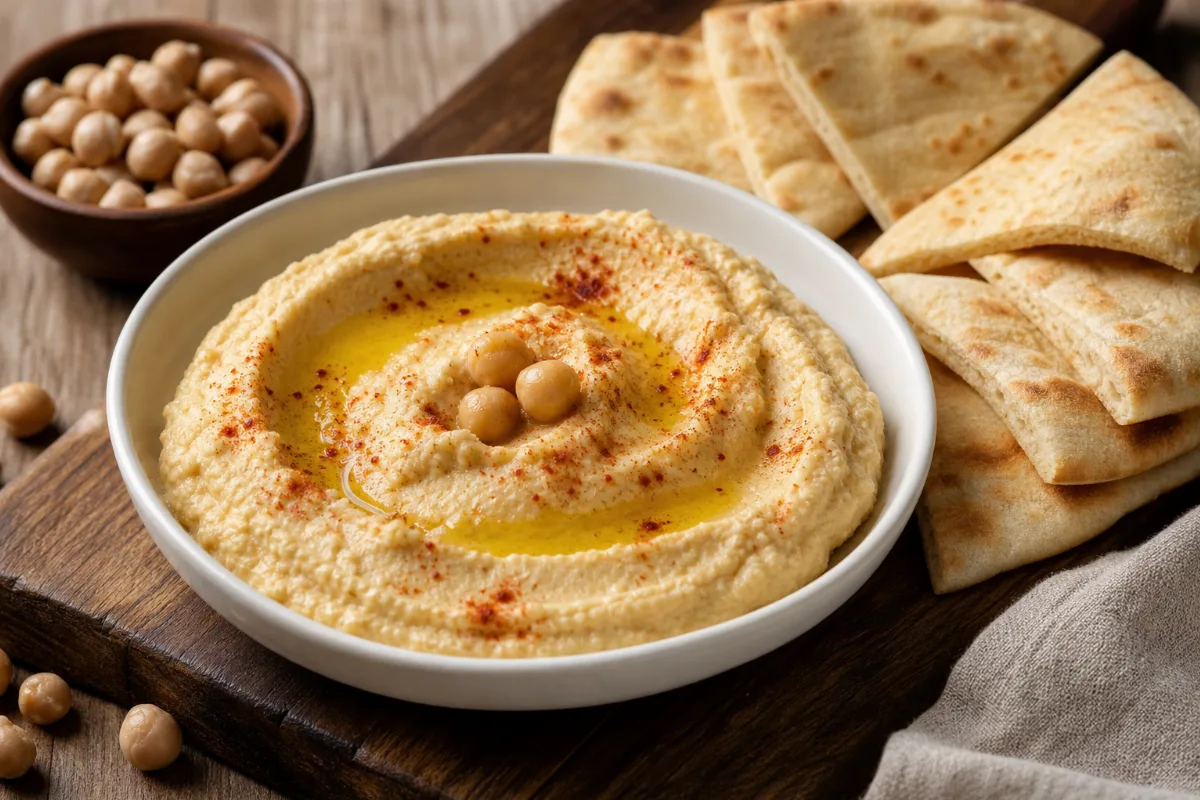
Hummus is a spread of mashed chickpeas blended with tahini (sesame paste), olive oil, lemon juice and spices. It gives some fibre and plant protein. In small trials in healthy adults it raised blood sugar much less than white bread, but the cholesterol and heart research is on pulses in general, not hummus. The main cautions are sesame allergy (tahini), chickpea allergy, salt and fat that vary a lot by recipe, and food safety if it is not kept chilled.
General information, not medical advice. Last substantive update · Not medically reviewed. A named clinician has not signed off on this page. How this page is made
About Hummus
Hummus is a chickpea and tahini spread with some fibre and plant protein. It is a food, not a proven remedy: the hummus-specific trials are small, and the cholesterol and heart research is on pulses in general. Sesame allergy, salt and fat are the main cautions.
What it is
Hummus is a dip or spread. A 2016 review describes traditional hummus as cooked, mashed chickpeas blended with tahini, olive oil, lemon juice and spices. Tahini is made from sesame, so hummus is also a sesame food. Chickpeas (Cicer arietinum) are a legume.
USDA data for commercial hummus: 237 kcal, 7.78 g protein, 17.82 g fat and 5.5 g fibre per 100 g. Two tablespoons (30 g) have about 71 kcal, 5.3 g fat, 2.3 g protein, 1.7 g fibre and 128 mg sodium. Home-prepared hummus is lower in fat and sodium per 100 g (177 kcal, 8.59 g fat, 242 mg sodium), but recipes vary, so do not mix the two when comparing.
What the research shows
The firmest facts are about nutrients and recipes, not health effects. Hummus-specific research is small: two trials of 10 and 15 healthy adults on blood sugar after a meal, and one trial of 39 healthy adults on an afternoon snack.
Blood sugar: hummus alone had a glycaemic index of 15, well below white bread. Adding hummus to white bread did not change the overall glucose or insulin response. These were single meals in healthy people.
Cholesterol, long-term blood sugar and heart disease: pooled trials of whole pulses found LDL 0.17 mmol/L lower and lower fasting glucose and HbA1c in some diets. Cohort studies link pulses with fewer new cases of heart disease and high blood pressure. None of this was tested in hummus, which also contains tahini and oil.
Hummus versus chickpeas, flour and falafel
Most chickpea and pulse trials used whole cooked chickpeas or pulses. Hummus has tahini, oil and often salt added, so its calories, fat and sodium differ from cooked chickpeas. Chickpea flour, falafel and roasted chickpeas are other products again. No claim is made for them here.
Pregnancy and breastfeeding
No source read says hummus is unsafe in pregnancy. The NHS foods-to-avoid page names pre-packaged sandwiches and salads, vegetable pate and enoki mushrooms as ready-to-eat foods that may carry listeria, and says to keep them chilled and eat them before the use-by date. It does not name hummus or tahini. The CDC Listeria page could not be read. Breastfeeding was not researched. Ask your doctor or midwife.
At a glance
Traditional uses history, not proof
- Eaten as a dip or spread
- Long use as food is not proof that it treats any condition
Studied for research
- Blood sugar after a meal, low certainty (two small trials in healthy adults)
- LDL cholesterol, low certainty (pulses as a group, not hummus)
- Long-term blood sugar control, low certainty (pulses as a group)
- Heart disease and blood pressure, very low certainty (observational, pulses as a group)
- Appetite and later snacking, very low certainty (one short trial)
- Diet quality, very low certainty (surveys)
- Body weight, insufficient evidence for hummus
- Fibre and minerals, high certainty for the nutrient values
Main compounds
- Fibre
- Plant protein
- Fat from tahini and olive oil
- Manganese
- Copper
- Phytic acid, sterols and polyphenols
Common forms
- Commercial hummus (the form behind most of the nutrition figures here)
- Home-prepared hummus (lower in fat and sodium per 100 g in USDA data)
- Flavoured hummus, chickpea flour, falafel and roasted chickpeas are different products and are not covered
Research links: 2016 trial: hummus and blood sugar · 2014 review: pulses and LDL cholesterol · 2024 review: sesame allergy diagnosis and management · Research Library · Genes & Biomarkers Library
What it is and its history
- Accepted scientific name
- Hummus (prepared food; main ingredient Cicer arietinum, chickpeas)
- Common names
- Hummus (English); Houmous (English); Chickpea dip (English)
- Family or group
- Chickpeas belong to Fabaceae (the legume or pea family). Tahini comes from sesame, which was not looked up in a taxonomy source for this page.
- Classification
- Plantae > Tracheophyta > Magnoliopsida > Fabales > Fabaceae > Cicer > Cicer arietinum
- Native range
- Not verified from a source read.
- What it looks like
- Fruit: A smooth spread of mashed chickpeas. Traditional hummus is described in a 2016 review as a nutrient-dense dip or spread made from cooked, mashed chickpeas, blended with tahini, olive oil, lemon juice and spices.
- Harvest and processing
- Sold refrigerated and packaged (commercial), or made at home. USDA lists commercial and home-prepared hummus as separate foods with different values. Flavoured hummus adds ingredients that change calories, sodium and allergens (existing nutrient summary).
- Look-alikes and adulterants
- Name: Chickpeas (the whole food); Note: The main ingredient. Cooked chickpeas have different nutrient values and most chickpea trials used them, not hummus.; Name: Falafel and chickpea flour (besan); Note: Other chickpea foods with separate pages and different ingredients.
Photographs
What is inside, and how it may work
What it contains and how those compounds act in cells and animals. Laboratory and animal mechanisms are not proven effects in people.
Main compounds
| Compound | Family | Where it is concentrated | Activity studied | Level of evidence |
|---|---|---|---|---|
| Dietary fibre | carbohydrate | Seed USDA: 5.5 g per 100 g commercial hummus; 4.0 g per 100 g home-prepared | A nutrient value. No fibre effect was tested in hummus in the sources read. 21 20 | Human data |
| Fat (mostly unsaturated) | lipid | Sesame and olive oil USDA: total fat 17.82 g, saturated 2.562 g, polyunsaturated 8.812 g per 100 g commercial hummus; total fat 8.59 g per 100 g home-prepared | Adds calories. Fat comes from tahini and oil, so amounts vary with the recipe. 21 20 | Human data |
| Plant protein | protein | Seed USDA: 7.78 g per 100 g commercial; 4.86 g per 100 g home-prepared | Chickpea and sesame proteins can also cause allergic reactions in sensitive people. 21 20 1 6 | Human data |
| Manganese and copper | mineral | Seed USDA commercial: manganese 1.155 mg and copper 0.377 mg per 100 g | Nutrient values only; no effect was tested in the sources read. 21 | Human data |
| Sodium | mineral | USDA: 426 mg per 100 g commercial; 242 mg per 100 g home-prepared | Added salt. The FDA Daily Value for sodium is less than 2,300 mg a day. 21 20 16 | Human data |
| Phytic acid, sterols, tannins, carotenoids and polyphenols (including isoflavones) | plant bioactives | Seed Amounts not read | A 2016 review lists these as bioactives in raw or cooked chickpeas and hummus. It describes what is present, not proof of a health effect. 13 | Review |
Mechanisms, receptors and pathways
| Target or pathway | Gene or receptor | What was found | Level |
|---|---|---|---|
| Slower starch digestion and blood sugar | Not specified | In a 2024 crossover trial of 15 healthy adults, hummus made from intact chickpea cells gave lower insulin and GIP than hummus from ruptured cells, and lab tests showed slower starch digestion. The authors link this to food structure. 2 | Human data |
| Allergy (IgE) | IgE antibodies to sesame (Ses i 1 to Ses i 7) and legume proteins | Sesame allergy is mainly IgE-mediated and seven sesame allergens are named; most reactions to non-priority legumes come from IgE cross-reactions to similar proteins in different legumes. 7 1 | Human data |
Absorption, metabolism and elimination
- Absorption
- Not found.
- Distribution
- Not found.
- Metabolism
- Not found.
- Elimination
- Not found.
- Bioavailability
- Not established for hummus nutrients in the sources read.
Isolated compounds versus whole extracts
The cholesterol, long-term blood sugar and heart results come from trials and cohorts of whole pulses, not hummus. Hummus adds tahini and oil, so those results cannot be assumed for hummus. The hummus-specific results are short single-meal and snack trials in healthy adults. Hummus is also not the same as plain cooked chickpeas, chickpea flour or falafel.
Nutritional composition
Nutrition from USDA FoodData Central (SR Legacy, April 2018 release; values read 2026-10-26 from a saved copy held with the project). COMMERCIAL hummus (FDC 174289), per 100 g: 237 kcal, 7.78 g protein, 17.82 g fat (2.562 g saturated), 15.0 g carbohydrate, 5.5 g fibre, 0.62 g sugars, 426 mg sodium, 312 mg potassium, 2.54 mg iron, 75 mg magnesium, 1.155 mg manganese, 0.377 mg copper, 48 micrograms folate (DFE). A typical portion of two tablespoons (30 g, two of the USDA 15 g tablespoon portions) has about 71 kcal, 2.3 g protein, 5.3 g fat (0.8 g saturated), 4.5 g carbohydrate, 1.7 g fibre, 128 mg sodium, 94 mg potassium, 0.76 mg iron, 22.5 mg magnesium, 0.35 mg manganese and 0.11 mg copper. USDA's household cup is 246 g, which comes to about 583 kcal, 43.8 g fat and 1,050 mg sodium. HOME-PREPARED hummus (FDC 172454), per 100 g: 177 kcal, 4.86 g protein, 8.59 g fat (1.141 g saturated), 20.12 g carbohydrate, 4.0 g fibre, 242 mg sodium, 173 mg potassium; two tablespoons (30 g) is about 53 kcal, 2.6 g fat and 73 mg sodium. Do not mix the two when comparing, and expect shop brands and home recipes to differ with the amounts of tahini, oil and salt.
3 low certainty3 very low certainty1 not enough evidence
What was looked at
The 7 benefits and uses checked for Hummus, each with how strong the evidence is. Tap one to open it.
- Blood sugar after a mealLow certainty
- Cholesterol (LDL), from pulses as a groupLow certainty
- Diet quality (survey data)Very low certainty
- Long-term blood sugar control, from pulses as a groupLow certainty
- Heart disease, blood pressure and obesity, from pulses as a groupVery low certainty
- Appetite and later snackingVery low certainty
- Body weightNot enough evidence
Lab markers tracked in the studies
Glycaemic index and post-meal blood glucoseLDL cholesterolFasting glucose and HbA1cNew high blood pressure (risk)Hunger and fullness ratings
What is Hummus good for?
The main studied uses and how strong the human evidence is for each. Many results are for pulses or legumes as a group, not for hummus itself.
Benefits, one by one
Each card is a research question, not a promise. Tap a goal to filter. Open a card to see the studies, doses and limits.
Blood sugar after a meal
Low certaintyIn small trials in healthy adults, hummus raised blood sugar much less than white bread. Hummus eaten alone had a glycaemic index of 15. These were short single-meal tests, mostly in healthy people, so they do not show that hummus helps people with diabetes.
2 studiesHummus eaten as food at one meal. Trial amounts are not advice.
Studies, doses and limits
What the trials found
In a 2016 randomised crossover trial of 10 healthy adults, hummus alone had a glycaemic index of 15 and an insulin index of 52, both significantly lower than white bread, and the peak rise in glucose and insulin was lower. Adding hummus to white bread did not change the glucose or insulin response compared with bread alone. A 2024 crossover trial of 15 healthy adults compared hummus made from intact chickpea cells with hummus from ruptured cells and found lower insulin and GIP with the intact-cell hummus.
Results
Hummus eaten alone raised blood glucose less than white bread. Hummus added to white bread did not lower the overall response.
Effect sizes as reported
Glycaemic index 15 plus or minus 3; insulin index 52 plus or minus 13 (2016). Insulin P < 0.02 and GIP P < 0.03, intact versus ruptured cells (2024).
Why this rating
Two small single-meal trials in healthy adults. No trial in people with diabetes and no long-term trial of hummus was read.
Form and dose studied
Hummus eaten as food at one meal. Trial amounts are not advice.
Who was studied
Healthy adults only.
Limits
Ten and fifteen people. Short tests of one or two meals. The second trial compares two types of hummus with each other, not hummus with another food.
Why researchers looked
Chickpeas digest slowly, so researchers tested what a hummus meal does to blood sugar and insulin.
Traditional use
Hummus is eaten as a dip or spread. Long use as food is not proof that it treats any condition.
Proposed mechanism Human data
A 2024 trial found a rise in insulin and GIP was lower when hummus was made from intact chickpea cells, and lab tests showed slower starch digestion. The authors link this to food structure. This is their explanation, not proven here.
A proposed mechanism does not show that the effect happens in people.
See the Safety tab for sesame allergy, salt and fat.
Cholesterol (LDL), from pulses as a group
Low certaintyEating pulses such as beans, chickpeas, lentils and peas lowered LDL cholesterol a little in pooled trials. No cholesterol trial of hummus itself was found, and hummus also contains tahini and oil, so the result cannot be assumed to carry over.
1 studiesWhole pulses in trials (median 130 g a day). Not hummus and not advic…
Studies, doses and limits
What the trials found
A 2014 systematic review of 26 randomised trials (1,037 people) found diets emphasising pulses at a median 130 g a day lowered LDL cholesterol by 0.17 mmol/L compared with similar diets without pulses (95% CI -0.25 to -0.09). Apolipoprotein B and non-HDL cholesterol did not change. The trials used whole pulses, not hummus.
Results
A small fall in LDL cholesterol with pulses as a group. Hummus was not tested.
Effect sizes as reported
LDL mean difference -0.17 mmol/L (95% CI -0.25 to -0.09).
Why this rating
The result is for whole pulses, not hummus, and the authors call for longer, higher-quality trials. Rated low for hummus.
Form and dose studied
Whole pulses in trials (median 130 g a day). Not hummus and not advice.
Who was studied
Adults in 26 trials.
Limits
Pulses as a group. Hummus adds fat from tahini and oil, which may change the picture; no study read says.
Why researchers looked
Pulses are high in fibre and plant protein, and researchers test whether eating them changes blood fats.
Traditional use
Hummus is made from chickpeas, which are a pulse. Long use as food is not proof of a health effect.
Proposed mechanism Unknown
Not tested for hummus. The mechanism is unknown from the sources read.
A proposed mechanism does not show that the effect happens in people.
None specific. See the Safety tab for allergy.
Diet quality (survey data)
Very low certaintyIn surveys, people who eat chickpeas or hummus tend to have better overall diets. That does not show that hummus caused it, because these people also differ in income, education and activity.
2 studiesSelf-reported eating of chickpea foods.
Studies, doses and limits
What the trials found
A 2016 review says chickpea and hummus eaters had higher intakes of fibre, polyunsaturated fat, vitamins A, E and C, folate, magnesium, potassium and iron, and higher Healthy Eating Index 2005 scores, than non-eaters. A 2023 survey of US adults found chickpea eaters had a Healthy Eating Index score of 62.1 against 51.2 in people who ate no legumes; the abstract does not name hummus.
Results
Chickpea and hummus eaters had better-scoring diets in surveys.
Effect sizes as reported
Healthy Eating Index 62.1 versus 51.2 (2023 survey, chickpea foods).
Why this rating
Observational surveys. Chickpea eaters differ in income, education and activity, and the review and survey have links to food companies.
Form and dose studied
Self-reported eating of chickpea foods.
Who was studied
US adults.
Limits
Cannot show cause. Two authors of the review are on the advisory board of a hummus maker; two authors of the 2023 survey list PepsiCo affiliations.
Why researchers looked
Researchers compare the diets of people who do and do not eat chickpea foods to see how hummus fits into a whole diet.
Traditional use
Hummus is a traditional dip made from chickpeas. Long use as food is not proof of a health effect.
Proposed mechanism Unknown
Not applicable. These are surveys of eating habits.
A proposed mechanism does not show that the effect happens in people.
None specific.
Long-term blood sugar control, from pulses as a group
Low certaintyPooled trials of pulses found lower fasting blood sugar and lower HbA1c in some diets, but the results varied a lot between trials. These trials did not test hummus.
1 studiesWhole pulses in the trials. Not hummus and not advice.
Studies, doses and limits
What the trials found
A 2009 review of 41 randomised trials (people with and without diabetes) found pulses alone (11 trials) lowered fasting glucose and insulin, pulses in low-GI diets (19 trials) lowered HbA1c or fructosamine, and pulses in high-fibre diets (11 trials) lowered fasting glucose and HbA1c or fructosamine. The authors say differences between trials were high and mostly unexplained.
Results
Lower fasting glucose and HbA1c or fructosamine with pulses in some diet types. Hummus was not tested.
Effect sizes as reported
Pulses alone: fasting glucose SMD -0.82 (95% CI -1.36 to -0.27). Low-GI diets: HbA1c or fructosamine SMD -0.28 (-0.42 to -0.14).
Why this rating
Pulses as a group, 2009 trials, high unexplained variation, and none tested hummus.
Form and dose studied
Whole pulses in the trials. Not hummus and not advice.
Who was studied
People with and without diabetes.
Limits
High unexplained differences between trials; the authors call for larger, better-designed trials.
Why researchers looked
Slowly digested carbohydrate and fibre in pulses might help longer-term blood sugar control.
Traditional use
Hummus is made from chickpeas, which are a pulse. Long use as food is not proof of a health effect.
Proposed mechanism Unknown
Not tested for hummus.
A proposed mechanism does not show that the effect happens in people.
None specific.
Heart disease, blood pressure and obesity, from pulses as a group
Very low certaintyIn long-term observation studies, people who ate the most pulses had lower rates of new heart disease, high blood pressure and obesity. This shows a link, not a cause, and it is about pulses and legumes in general, not hummus.
1 studiesReported intake of pulses and legumes. Not advice.
Studies, doses and limits
What the trials found
A 2019 review pooled 28 unique cohort studies. Comparing the highest with the lowest intake, pulses with or without other legumes were linked with lower new cases of cardiovascular disease (RR 0.92), coronary heart disease (RR 0.90), high blood pressure (RR 0.91) and obesity (RR 0.87). There was no link with heart attack, stroke or diabetes, or with deaths from heart disease or stroke. The authors rated certainty low for cardiovascular disease and very low for all other outcomes.
Results
Lower new cases of some heart-related conditions in people who ate the most pulses, with low or very low certainty.
Effect sizes as reported
CVD RR 0.92 (0.85 to 0.99); CHD RR 0.90 (0.83 to 0.99); hypertension RR 0.91 (0.86 to 0.97); obesity RR 0.87 (0.81 to 0.94).
Why this rating
Observational and graded low for cardiovascular disease and very low for the rest by the authors. Pulses as a group, not hummus.
Form and dose studied
Reported intake of pulses and legumes. Not advice.
Who was studied
Adults in 28 cohort studies.
Limits
Cannot show cause. Hummus was not studied alone.
Why researchers looked
Researchers follow large groups of people to see whether diets high in pulses are linked to later disease.
Traditional use
Hummus is made from chickpeas, which are a pulse. Long use as food is not proof of a health effect.
Proposed mechanism Unknown
Not applicable. These are observation studies.
A proposed mechanism does not show that the effect happens in people.
None specific.
Appetite and later snacking
Very low certaintyIn one short trial in healthy adults, a hummus-and-pretzel afternoon snack cut hunger and later dessert snacking more than no snack, and gave a bit lower afternoon blood sugar than a granola bar. One small short trial is not enough to say hummus helps weight.
1 studiesA 240 kcal hummus and pretzel snack in the trial. Not advice.
Studies, doses and limits
What the trials found
In a 2020 randomised crossover trial, 39 healthy adults had an afternoon snack of hummus with pretzels, granola bars (same calories) or no snack for 6 days each. The hummus snack reduced later dessert snacking by about 20% compared with no snack and bars, reduced hunger and desire to eat by about 70% compared with no snack, and gave about 5% lower afternoon blood glucose than the bars. Fullness was about 30% greater after both snacks than with no snack.
Results
Less hunger and less later dessert snacking, and slightly lower afternoon glucose than the granola bar, in healthy adults over a short test.
Effect sizes as reported
Dessert snacking about 20% lower (P = 0.001 versus no snack); afternoon glucose about 5% lower than bars (P < 0.05).
Why this rating
One short trial of 39 healthy adults, snack was hummus with pretzels, comparison snack was higher in sugar.
Form and dose studied
A 240 kcal hummus and pretzel snack in the trial. Not advice.
Who was studied
Healthy, mostly young adults.
Limits
Six days per pattern. Not hummus alone. No weight outcome in the abstract. The authors call for long-term trials.
Why researchers looked
Protein and fibre may make a snack more filling, so researchers compared a hummus snack with other snacks.
Traditional use
Hummus is eaten as a dip or spread. Long use as food is not proof of a health effect.
Proposed mechanism Unknown
Not tested in the abstract.
A proposed mechanism does not show that the effect happens in people.
See the Safety tab for fat and salt.
Body weight
Not enough evidenceA 2016 review calls research on chickpeas, hummus and weight 'emerging'. No trial of hummus on body weight was read, so there is not enough evidence to say.
2 studiesNot applicable.
Studies, doses and limits
What the trials found
The 2016 review of chickpeas and hummus says emerging research suggests a possible role in weight management and glucose and insulin regulation. The abstract gives no numbers and no hummus weight trial was read. Hummus is higher in calories than cooked chickpeas (USDA: 237 kcal per 100 g commercial hummus), so its effect on weight may differ from beans.
Results
No weight result for hummus was found.
Why this rating
No hummus weight trial was found, and the review is a narrative review with ties to a hummus maker.
Limits
The review does not rate certainty.
Why researchers looked
Fibre and protein may affect fullness and weight.
Traditional use
Hummus is eaten as a dip or spread. Long use as food is not proof of a health effect.
Proposed mechanism Unknown
Not established.
A proposed mechanism does not show that the effect happens in people.
See the Safety tab for fat and salt.
Connections to the rest of health
How Hummus connects to the rest of our health knowledge graph. Every link says what kind of connection it is. A safety link (for example to the liver) is a warning, not a benefit. A study that merely mentions a topic never creates a benefit link.
Explore every connection: goals, body systems, organs, symptoms, genes
A. Wellness goals
| Connected to | Kind of connection | Evidence status | Context | Studies |
|---|---|---|---|---|
| Blood Sugar Balance | Low certainty | Blood sugar after a meal: In small trials in healthy adults, hummus raised blood sugar much less than white bread. Hummus eaten alone had a glycaemic index of 15. These were short single-meal tests, mostly in healthy people, so they do not show that hummus helps people with diabetes. Long-term blood sugar control, from pulses as a group: Pooled trials of pulses found lower fasting blood sugar and lower HbA1c in some diets, but the results varied a lot between trials. These trials did not test hummus. | 3 2 11 | |
| Cholesterol Balance | Low certainty | Cholesterol (LDL), from pulses as a group: Eating pulses such as beans, chickpeas, lentils and peas lowered LDL cholesterol a little in pooled trials. No cholesterol trial of hummus itself was found, and hummus also contains tahini and oil, so the result cannot be assumed to carry over. | 5 | |
| Balanced Nutrition | Very low certainty | Diet quality (survey data): In surveys, people who eat chickpeas or hummus tend to have better overall diets. That does not show that hummus caused it, because these people also differ in income, education and activity. | 13 8 | |
| Heart Health | Very low certainty | Heart disease, blood pressure and obesity, from pulses as a group: In long-term observation studies, people who ate the most pulses had lower rates of new heart disease, high blood pressure and obesity. This shows a link, not a cause, and it is about pulses and legumes in general, not hummus. | 12 | |
| Healthy Weight | Very low certainty | Appetite and later snacking: In one short trial in healthy adults, a hummus-and-pretzel afternoon snack cut hunger and later dessert snacking more than no snack, and gave a bit lower afternoon blood sugar than a granola bar. One small short trial is not enough to say hummus helps weight. | 9 | |
| Healthy Weight | Not enough evidence | Body weight: A 2016 review calls research on chickpeas, hummus and weight 'emerging'. No trial of hummus on body weight was read, so there is not enough evidence to say. | 13 21 |
B. Body systems
| Connected to | Kind of connection | Evidence status | Context | Studies |
|---|---|---|---|---|
| Endocrine System | Biological association | Low certainty | Studied for: Blood sugar after a meal Studied for: Long-term blood sugar control, from pulses as a group | 3 2 11 |
| Metabolism Weight | Biological association | Low certainty | Studied for: Blood sugar after a meal Studied for: Diet quality (survey data) | 3 2 13 8 9 21 |
| Cardiovascular System | Biological association | Low certainty | Studied for: Cholesterol (LDL), from pulses as a group Studied for: Heart disease, blood pressure and obesity, from pulses as a group | 5 12 |
C. Body parts and organs
E. Health conditions
| Connected to | Kind of connection | Evidence status | Context | Studies |
|---|---|---|---|---|
| Food allergy | Adverse effect or risk | Documented risk | Hummus is a sesame food and a chickpea food; both can cause allergic reactions, sometimes severe. Hummus is a sesame food (tahini) and a chickpea food; both can cause allergic reactions, sometimes severe. Preparation or compound: Tahini (sesame) and chickpea protein in hummus |
15 6 1 |
| Salmonella infections | Adverse effect or risk | Documented risk | A 2011 US outbreak of 23 cases was traced to contaminated tahini used in hummus at a restaurant. Preparation or compound: Contaminated tahini used in hummus |
4 |
I. Biomarkers
| Connected to | Kind of connection | Evidence status | Context | Studies |
|---|---|---|---|---|
| Glycaemic index and post-meal blood glucose | Biological association | Low certainty | Measured in trials: lowered. A lab change is not the same as a health benefit. | 3 2 |
| LDL cholesterol | Biological association | Low certainty | Measured in trials: lowered. A lab change is not the same as a health benefit. | 5 |
| Fasting glucose and HbA1c | Biological association | Low certainty | Measured in trials: lowered. A lab change is not the same as a health benefit. | 11 |
| New high blood pressure (risk) | Biological association | Very low certainty | Measured in trials: lowered. A lab change is not the same as a health benefit. | 12 |
| Hunger and fullness ratings | Biological association | Very low certainty | Measured in trials: lowered. A lab change is not the same as a health benefit. | 9 |
K. Biological pathways
| Connected to | Kind of connection | Evidence status | Context | Studies |
|---|---|---|---|---|
| Fibre | Preliminary mechanism | Human | Hummus supplies some fibre from chickpeas: 5.5 g per 100 g commercial (USDA). | 21 |
| LDL cholesterol | Preliminary mechanism | Human | Whole pulses lowered LDL a little in pooled trials; hummus was not tested. | 5 |
| Post-meal blood glucose | Preliminary mechanism | Human | Hummus alone gave a low glycaemic index in a small trial of healthy adults. | 3 |
L. Active compounds
| Connected to | Kind of connection | Evidence status | Context | Studies |
|---|---|---|---|---|
| Dietary fibre | Biological association | Human | A nutrient value. No fibre effect was tested in hummus in the sources read. Preparation or compound: Seed |
21 20 |
| Fat (mostly unsaturated) | Biological association | Human | Adds calories. Fat comes from tahini and oil, so amounts vary with the recipe. Preparation or compound: Sesame and olive oil |
21 20 |
| Plant protein | Biological association | Human | Chickpea and sesame proteins can also cause allergic reactions in sensitive people. Preparation or compound: Seed |
21 20 1 6 |
| Manganese and copper | Biological association | Human | Nutrient values only; no effect was tested in the sources read. Preparation or compound: Seed |
21 |
| Sodium | Biological association | Human | Added salt. The FDA Daily Value for sodium is less than 2,300 mg a day. | 21 20 16 |
| Phytic acid, sterols, tannins, carotenoids and polyphenols (including isoflavones) | Biological association | Review | A 2016 review lists these as bioactives in raw or cooked chickpeas and hummus. It describes what is present, not proof of a health effect. Preparation or compound: Seed |
13 |
Each connection is stored with the ingredient, the connected record, the kind of connection, the evidence status, the supporting studies, the preparation or compound involved, and a review date (last reviewed October 26, 2026).
The evidence
The research centre for Hummus. Every record here was checked against PubMed or the publisher's page; we never list a study we have not verified.
Evidence by outcome
Bars show how many studies we found for each outcome, not how well it works. People are added up across trials only (reviews are not added, to avoid double counting).
How we rate evidence
High certainty
Several well-run trials or reviews agree; further research is unlikely to change the picture much.
Moderate certainty
Good trials point the same way, but some doubt remains.
Low certainty
Small, short or inconsistent trials. The finding could change with better research.
Very low certainty
Very little or very weak human data. Treat as a possibility only.
Mixed findings
Trials or reviews disagree with each other.
Not enough evidence
Not enough human research to say either way.
Evidence against
Good research found no benefit, or found harm.
We take the reviewers' own risk-of-bias and GRADE statements where they exist, and otherwise judge from study size, design, consistency, directness and whether a product matches what is sold. Many publications do not make evidence high. Method note: We started from our existing hummus summary, re-checked nutrition at USDA FoodData Central, read the health agency pages (FDA, MedlinePlus, NIDDK, NHS) and searched PubMed for reviews, trials, allergy and food-safety reports. Only abstracts were read for studies. Items we could not verify are flagged in the research gaps.
Study library: every study we checked 21
| Study | Design | People | Product, dose, length | Result |
|---|---|---|---|---|
| Abu Risha M et al. 2024 Legume Allergens Pea, Chickpea, Lentil, Lupine and Beyond. Curr Allergy Asthma Rep · PMID 38990406 · DOI |
Narrative review |
Review of allergens in non-priority legumes | Legumes including chickpea Seed |
The review lists chickpea among 'non-priority' legumes that can cause mild to severe allergic reactions and links exercise-related anaphylaxis to soybean, lentils and chickpea. Most reactions come from IgE cross-reactions to similar proteins in different legumes. The authors note that most data are case reports. Not applicable (Not applicable) Methods, limits and fundingOutcomes: Allergen sources, reactions, cross-reactivity Limitations: A narrative review built mostly on case reports. It does not give how common chickpea allergy is. Funding and conflicts: Authors declare no conflict of interest. Read: abstract |
| Alshaalan RA et al. 2024 Impact of chickpea hummus on postprandial blood glucose, insulin and gut hormones in healthy humans combined with mechanistic studies of food structure, rheology and digestion kinetics. Food Res Int · PMID 38823849 · DOI |
Randomized crossover trial |
15 15 healthy adults |
Hummus made from intact chickpea cells or from ruptured chickpea cells (27 g of starch) Seed 27 g of starch per meal Two single test meals · vs The other hummus meal (ruptured cells) |
Insulin and GIP were significantly lower after the intact-cell hummus meal than after the ruptured-cell meal. In lab tests starch digested more slowly from the intact-cell hummus. Insulin P < 0.02; GIP P < 0.03 (intact versus ruptured cells) (Not given in the abstract) Methods, limits and fundingOutcomes: Blood glucose, insulin and GIP after a meal; lab digestion tests Limitations: Fifteen healthy people and two meals. Compares two kinds of hummus with each other, not hummus with another food. Not people with diabetes. Funding and conflicts: Authors declare no competing interests. Registered NCT03424187. Read: abstract |
| Augustin LS et al. 2016 Post-prandial glucose and insulin responses of hummus alone or combined with a carbohydrate food: a dose-response study. Nutr J · PMID 26818604 · DOI |
Randomized crossover trial |
10 10 healthy adults |
Hummus alone (2.7, 10.8 or 25 g available carbohydrate) and hummus with white bread (50 g available carbohydrate from bread) Seed paste Three hummus doses alone; three doses added to bread 11 breakfast meals in random order over 15 weeks · vs White bread (25 g and 50 g available carbohydrate portions) |
Hummus had a glycaemic index of 15 and an insulin index of 52, both significantly lower than white bread. Peak rise in blood glucose and insulin was lower after hummus alone than after white bread. Adding hummus to white bread did not change the glucose or insulin area under the curve compared with bread alone; at 45 minutes glucose was lower and at 120 minutes it was higher with the largest hummus portion. Glycaemic index 15 (plus or minus 3); insulin index 52 (plus or minus 13); P < 0.05 versus white bread (Not given in the abstract) Methods, limits and fundingOutcomes: Blood glucose and insulin over two hours; glycaemic index and insulin index Limitations: Ten healthy people, a short two-hour test of single meals. Not people with diabetes. Says nothing about long-term control. Funding and conflicts: Funding listed as non-US government research support; no sponsor is named in the abstract. Several authors list Glycemic Index Laboratories Inc. and a consulting company as their workplaces. Competing interests are not shown in the abstract. Read: abstract |
| Centers for Disease Control and Prevention 2012 Multistate outbreak of Salmonella serotype Bovismorbificans infections associated with hummus and tahini--United States, 2011. MMWR Morb Mortal Wkly Rep · PMID 23169315 |
Outbreak report |
23 23 people in seven states and DC, illness onset August 19 to November 21, 2011 |
Hummus made at a restaurant with contaminated tahini Prepared food 2011 outbreak |
Twenty-three cases of Salmonella Bovismorbificans infection were found. Traceback on May 30, 2012 pointed to contaminated tahini (sesame seed paste) used in hummus prepared at a Mediterranean-style restaurant in DC as a plausible source. The DC health department restricted sale of hummus and the use of hummus ingredients in other foods at the implicated restaurants. 23 cases (Not applicable) Methods, limits and fundingOutcomes: Salmonella infections traced to food Limitations: One outbreak at one restaurant. It shows that an ingredient can carry germs; it does not say how often hummus causes illness. Funding and conflicts: Government report (CDC). Read: abstract |
| Ha V et al. 2014 Effect of dietary pulse intake on established therapeutic lipid targets for cardiovascular risk reduction: a systematic review and meta-analysis of randomized controlled trials. CMAJ · PMID 24710915 · DOI |
Systematic review meta analysis |
1037 26 randomised trials, 1,037 people |
Diets emphasising pulses (beans, chickpeas, lentils, peas) Seed Median 130 g a day (about 1 serving) 3 weeks or longer · vs Matched diets without pulses |
Pulse diets lowered LDL cholesterol compared with control diets. Apolipoprotein B and non-HDL cholesterol did not change significantly. The trials were of pulses as whole foods, not hummus. LDL mean difference -0.17 mmol/L (95% CI -0.25 to -0.09 mmol/L) Methods, limits and fundingOutcomes: LDL cholesterol, apolipoprotein B, non-HDL cholesterol Limitations: Pulses as a group, not hummus. The authors say trials of longer duration and higher quality are needed. Funding and conflicts: Research support listed as non-US government; the funder is not named in the abstract. Registered NCT01594567. Read: abstract |
| Oriel 2024 Comprehensive Diagnosis, Management, and Treatment of Sesame Allergy. J Allergy Clin Immunol Pract · PMID 37952774 · DOI |
Narrative review |
Review of sesame allergy diagnosis and management | Sesame Seed |
The review gives sesame allergy prevalence of 0.1% to 0.9%, varying by region and age. Reactions can be severe and potentially fatal. About 20% to 50% of people outgrow it. Clinically relevant cross-reactivity with other foods appears uncommon, but sesame is a prominent allergen for people with several food allergies. Products differ greatly in protein: many people tolerate low-protein forms such as scattered seeds, but not protein-dense sesame paste. Allergists advise on avoidance for each person. Prevalence 0.1% to 0.9%; resolution 20% to 50% (Not applicable) Methods, limits and fundingOutcomes: Prevalence, severity, outgrowing, cross-reactivity, avoidance Limitations: A review by allergists. It does not tell any one person what is safe; that needs an allergist. Funding and conflicts: Research support listed from the US National Institutes of Health and non-US government sources. Read: abstract |
| Pi X et al. 2024 Sesame allergy: mechanisms, prevalence, allergens, residue detection, effects of processing and cross-reactivity. Crit Rev Food Sci Nutr · PMID 36165272 · DOI |
Narrative review |
Review of sesame allergy research | Sesame (the seed paste tahini is made from sesame) Seed |
The review calls sesame allergy a serious public health problem, mainly IgE-mediated, and says sesame is on the priority allergen list in many countries. It names seven sesame allergens (Ses i 1 to Ses i 7). Few processing methods reduce its allergenicity (microwave heating, high hydrostatic pressure, salt and pH treatment) and any reduction should be confirmed by clinical studies. Sesame may cross-react with peanut and tree nuts. Not applicable (Not applicable) Methods, limits and fundingOutcomes: Mechanism, prevalence, allergens, detection, processing, cross-reactivity Limitations: A narrative review of the lab and clinical literature. Cross-reactivity is described as potential. Funding and conflicts: Not stated in the abstract. Read: abstract |
| Rehm CD et al. 2023 Trends and Patterns of Chickpea Consumption among United States Adults: Analyses of National Health and Nutrition Examination Survey Data. J Nutr · PMID 36990184 · DOI |
Cross sectional survey |
35029 US adults in NHANES 2003-2018 (diet analysis 2015-2018: 8,342 adults) |
Eating chickpeas or chickpea foods on 24-hour diet recalls Seed Self-reported Survey years 2003-2018 · vs Other legume eaters and people who ate no legumes |
The share of US adults who ate chickpeas rose from 1.9% (2003-2006) to 4.5% (2015-2018). Chickpea eaters had higher incomes, education and physical activity. Their Healthy Eating Index score was 62.1 against 51.2 in people who ate no legumes, with more whole grains and nuts or seeds and less red meat. The abstract does not name hummus. Healthy Eating Index 62.1 versus 51.2 (P < 0.05) (Not given in the abstract) Methods, limits and fundingOutcomes: Share of adults who eat chickpeas; diet quality scores Limitations: A survey of eating habits, not a trial. It cannot show that chickpeas caused better diets, because chickpea eaters differ in income, education and activity. The abstract covers chickpea foods in general, not hummus alone. Funding and conflicts: First two authors list PepsiCo affiliations; the others work at Midwest Biomedical Research and universities. Read: abstract |
| Reister 2020 An Afternoon Hummus Snack Affects Diet Quality, Appetite, and Glycemic Control in Healthy Adults. J Nutr · PMID 32488233 · DOI |
Randomized crossover trial |
39 39 healthy adults (mean age 26, mean BMI 24.4) |
Afternoon snack of hummus and pretzels (240 kcal; 6 g protein, 31 g carbohydrate, 11 g fat) Prepared food One 240 kcal snack a day 6 days per pattern, three patterns, outcomes measured on day 7 · vs Granola bars (240 kcal; 16 g sugar) or no snack |
Compared with no snack and with granola bars, the hummus snack reduced later dessert snacking by about 20%. Hunger and desire to eat fell by about 70% against no snack (granola bars did not). Fullness was about 30% greater after both snacks than with no snack. Afternoon blood glucose was about 5% lower after hummus than after bars. Dessert snacking about 20% lower (P = 0.001 versus no snack; P < 0.001 versus bars); afternoon glucose about 5% lower than bars (P < 0.05) (Not given in the abstract) Methods, limits and fundingOutcomes: Later snacking, appetite, fullness, mood, 24-hour glucose by continuous monitor Limitations: Healthy, mostly young adults and a short test (6 days per pattern). The snack was hummus with pretzels, not hummus alone. The comparison snack was higher in sugar. Long-term trials are still needed (the authors say so). Funding and conflicts: Research support listed as non-US government; competing interests are not stated in the abstract. Read: abstract |
| Serra B et al. 2026 IgE-Mediated Legume Allergy in Children: Insights from a Single-Center Experience in Italy. Nutrients · PMID 42280453 · DOI |
Retrospective case series |
55 55 Italian children allergic to at least one of pea, lentil, chickpea, common bean or soy |
Legume allergy (clinic study) Seed January 2022 to January 2024 |
Most children (74.5%) were allergic to more than one legume, and pea, lentil and chickpea allergy often went together (56% to 86%). Peanut allergy also occurred in 25.5%. Among 34 food challenges, 23.5% were positive. Multi-legume allergy 74.5%; peanut co-allergy 25.5% (Not applicable) Methods, limits and fundingOutcomes: Clinical features and co-allergies Limitations: One clinic, 55 children who already had legume allergy. It cannot say how common legume allergy is in everyone. Funding and conflicts: Two authors report personal fees from allergy-related companies; the rest report none. Read: abstract |
| Sievenpiper JL et al. 2009 Effect of non-oil-seed pulses on glycaemic control: a systematic review and meta-analysis of randomised controlled experimental trials in people with and without diabetes. Diabetologia · PMID 19526214 · DOI |
Systematic review meta analysis |
41 trials (39 reports), people with and without diabetes | Non-oil-seed pulses (chickpeas, beans, peas, lentils) alone or in low-GI or high-fibre diets Seed Varied 7 days or longer · vs Control diets |
Pulses alone (11 trials) lowered fasting glucose and insulin. Pulses in low-GI diets (19 trials) lowered HbA1c or fructosamine. Pulses in high-fibre diets (11 trials) lowered fasting glucose and HbA1c or fructosamine. The authors say differences between trials were high and mostly unexplained. Pulses alone: fasting glucose SMD -0.82; insulin SMD -0.49. Low-GI diets: glycosylated proteins SMD -0.28 (Fasting glucose -1.36 to -0.27; insulin -0.93 to -0.04; glycosylated proteins -0.42 to -0.14) Methods, limits and fundingOutcomes: Fasting glucose, fasting insulin, HbA1c or fructosamine Limitations: Pulses as a group, not hummus. High unexplained variation between trials. 2009 studies. Funding and conflicts: Not stated in the abstract. Read: abstract |
| Viguiliouk E et al. 2019 Associations between Dietary Pulses Alone or with Other Legumes and Cardiometabolic Disease Outcomes: An Umbrella Review and Updated Systematic Review and Meta-analysis of Prospective Cohort Studies. Adv Nutr · PMID 31728500 · DOI |
Systematic review meta analysis cohorts |
28 unique prospective cohort studies | Highest versus lowest intake of pulses, with or without other legumes Seed Highest versus lowest intake Cohort follow-up · vs Lowest intake |
Highest intake was linked with lower new cases of cardiovascular disease, coronary heart disease, high blood pressure and obesity. There was no link with heart attack, stroke, diabetes, or deaths from heart disease and stroke. The authors rated the certainty low for cardiovascular disease and very low for every other outcome. CVD RR 0.92; CHD RR 0.90; hypertension RR 0.91; obesity RR 0.87 (CVD 0.85-0.99; CHD 0.83-0.99; hypertension 0.86-0.97; obesity 0.81-0.94) Methods, limits and fundingOutcomes: Heart disease, high blood pressure, obesity, diabetes, stroke Limitations: Observational: associations, not proof. Pulses and other legumes as a group, not hummus. Funding and conflicts: Not stated in the abstract. Registered NCT03555734. Read: abstract |
| Wallace 2016 The Nutritional Value and Health Benefits of Chickpeas and Hummus. Nutrients · PMID 27916819 · DOI |
Narrative review |
Review of studies of chickpeas and hummus | Chickpeas and hummus Seed |
The review says chickpea and hummus eaters had higher intakes of fibre, polyunsaturated fat, vitamins A, E and C, folate, magnesium, potassium and iron, and higher Healthy Eating Index 2005 scores than non-eaters. It calls research on weight management, glucose and insulin control and heart markers 'emerging'. It lists phytic acid, sterols, tannins, carotenoids and polyphenols such as isoflavones as bioactives in raw or cooked chickpeas and hummus. No pooled effect size in the abstract (Not applicable) Methods, limits and fundingOutcomes: Nutrient intakes, diet quality, weight, glucose and insulin, cardiovascular markers Limitations: A narrative review, not a systematic one. It describes what studies exist; it does not rate the certainty of evidence. Funding and conflicts: Two authors (Murray, Zelman) are on the Scientific Advisory Board of Sabra Dipping Co., LLC, a hummus maker. Read: abstract |
| du Toit SA et al. 2025 Profiling Listeria monocytogenes in Hummus, Fresh Produce, and Food Processing Environments in the Western Cape, South Africa. Microbiologyopen · PMID 40922468 · DOI |
Surveillance study |
60 60 Listeria monocytogenes isolates from ready-to-eat hummus, fresh produce and food-processing sites, 2018-2021 |
Ready-to-eat hummus, fresh produce, processing environments Prepared food 2018-2021 sampling |
Listeria monocytogenes was found in ready-to-eat hummus, fresh produce and food-processing environments in the Western Cape. The authors conclude these are susceptible to contamination by diverse and virulent strains. The abstract does not say how many hummus samples were tested or what share was contaminated. 60 isolates typed (Not applicable) Methods, limits and fundingOutcomes: Types, virulence genes and resistance of Listeria found Limitations: A lab-typing study of bacteria in one South African region. It does not give how common contamination is, and it does not show illness from hummus. Funding and conflicts: Authors declare no conflicts of interest. Read: abstract |
| s-fda-allergy FDA: Food Allergies · Source |
Health agency n/a |
Methods, limits and fundingRead: full-text | ||
| s-fda-sodium FDA: Sodium in Your Diet · Source |
Health agency n/a |
Methods, limits and fundingRead: full-text | ||
| s-medlineplus-allergy MedlinePlus: Food Allergy · Source |
Health agency n/a |
Methods, limits and fundingRead: full-text | ||
| s-nhs-foods-to-avoid NHS: Foods to avoid in pregnancy · Source |
Health agency n/a |
Methods, limits and fundingRead: full-text | ||
| s-niddk-gas NIDDK: Eating, Diet, and Nutrition for Gas in the Digestive Tract · Source |
Health agency n/a |
Methods, limits and fundingRead: full-text | ||
| s-usda-fdc-172454 USDA FoodData Central: Hummus, home prepared (FDC 172454) · Source |
Reference database n/a |
Methods, limits and fundingRead: full-text | ||
| s-usda-fdc-174289 USDA FoodData Central: Hummus, commercial (FDC 174289) · Source |
Reference database n/a |
Methods, limits and fundingRead: full-text |
What we do not know yet
- No trial of hummus on LDL cholesterol, blood pressure, heart disease or body weight was found, and none in people with diabetes.
- The hummus blood sugar trials were small, in healthy adults and over one or two meals; the funder of the 2016 trial is not stated in the abstract.
- How common hummus-related allergic reactions and contamination are was not found; the CDC Listeria page could not be read.
- Origin and history, lectins and other natural compounds, aflatoxin, heavy metals and pesticide residues, oxalate, purines (gout), kidney guidance, choking risk for young children and breastfeeding were not researched.
How new research is added
New studies are found by a saved PubMed search and placed in a review queue before the page changes.
Lab markers
What changed in blood or saliva tests during trials. A changed number is not the same as feeling or being healthier, and we give no "normal ranges".
Metabolic 1
LDL cholesterol
Lowered in trials
The cholesterol carried in low-density lipoproteins, a common heart risk marker.
Low certaintyResults and what it means
Why it was measured
It is a standard blood marker used to judge heart risk.
Statistical vs. clinical meaning
A small fall in LDL with pulses as a group. Not tested for hummus.
Safety implication
None specific.
| Study | Result | People | Product |
|---|---|---|---|
| 5 | LDL mean difference -0.17 mmol/L (95% CI -0.25 to -0.09) with pulse diets; apolipoprotein B and non-HDL unchanged | 26 trials, 1,037 people | Diets emphasising whole pulses (median 130 g a day); not hummus |
Other 4
Glycaemic index and post-meal blood glucose
Lowered in trials
How much and how fast blood sugar rises after a food compared with a reference such as white bread.
Low certaintyResults and what it means
Why it was measured
It shows how a food affects blood sugar in the two hours after it is eaten.
Statistical vs. clinical meaning
A low blood sugar rise after hummus alone in small healthy-adult trials. It is not a long-term measure and does not show diabetes control.
Safety implication
None specific.
| Study | Result | People | Product |
|---|---|---|---|
| 3 | Hummus alone glycaemic index 15 and insulin index 52, significantly below white bread; no change when hummus was added to bread | 10 healthy adults | Hummus alone or with white bread, single breakfast meals |
| 2 | Lower insulin and GIP after hummus from intact chickpea cells than from ruptured cells | 15 healthy adults | Two hummus meals (27 g starch) |
Fasting glucose and HbA1c
Lowered in trials
Blood sugar after fasting, and the longer-term marker HbA1c (or fructosamine).
Low certaintyResults and what it means
Why it was measured
They show blood sugar control over hours to weeks.
Statistical vs. clinical meaning
Lower markers with pulses as a group in 2009 trials, with high variation. Not tested for hummus.
Safety implication
None specific.
| Study | Result | People | Product |
|---|---|---|---|
| 11 | Pulses alone: fasting glucose SMD -0.82 (95% CI -1.36 to -0.27); low-GI diets: HbA1c or fructosamine SMD -0.28 (-0.42 to -0.14); high unexplained variation | 41 trials | Pulses alone or in low-GI or high-fibre diets; not hummus |
New high blood pressure (risk)
Lowered in trials
How many people go on to develop high blood pressure over years of follow-up.
Very low certaintyResults and what it means
Why it was measured
High blood pressure is a main risk for heart disease and stroke.
Statistical vs. clinical meaning
An association with lower new cases of high blood pressure, not proof of cause.
Safety implication
Salt in hummus matters for people on a sodium limit.
| Study | Result | People | Product |
|---|---|---|---|
| 12 | Hypertension incidence RR 0.91 (95% CI 0.86 to 0.97), highest versus lowest intake; very low certainty | Cohort studies (83,284 hypertension cases) | Pulses with or without other legumes; not hummus |
Hunger and fullness ratings
Lowered in trials
Questionnaire scores for hunger, desire to eat and fullness.
Very low certaintyResults and what it means
Why it was measured
They show how filling a food or snack feels.
Statistical vs. clinical meaning
A short-term effect on how hungry people felt, in healthy adults.
Safety implication
None specific.
| Study | Result | People | Product |
|---|---|---|---|
| 9 | Hunger and desire to eat about 70% lower than no snack; fullness about 30% greater than no snack with both hummus and bars | 39 healthy adults | 240 kcal hummus and pretzel snack versus granola bars or no snack |
Safety
What studies and official sources say about side effects, medicines and who should check first. Each point shows what kind of evidence it comes from.
Main points to know 5
- Hummus normally contains tahini, so it is a sesame food. Tahini is a paste made from sesame, and traditional hummus is made from chickpeas, tahini, olive oil, lemon juice and spices. Sesame is a serious allergen. A 2024 allergist review gives sesame allergy prevalence of 0.1% to 0.9%, says reactions can be severe and potentially fatal, and says about 20% to 50% of people outgrow it. It also says sesame paste is protein-dense, unlike scattered seeds, which some people with sesame allergy tolerate. In the US, sesame became the 9th major food allergen on January 1, 2023, and the FDA recommends checking with the maker if you are not sure whether a product contains sesame. If you have a sesame allergy, ask an allergist before eating hummus, and read every label. Authoritative guidance 15 6 13
- Chickpea and other legume allergy. Chickpea is a legume, and chickpea allergy is reported, from mild to severe. A 2024 review lists chickpea among 'non-priority' legumes that can cause mild to severe reactions and says most data are case reports. In an Italian clinic study of 55 children with legume allergy, most (74.5%) were allergic to more than one legume and 25.5% also had peanut allergy. Clinic studies cannot say how common this is in everyone. Ask an allergist if you have a legume or peanut allergy. Observational 1 10
- Tahini and hummus have been linked to food poisoning outbreaks. In 2011, 23 people in seven states and DC got Salmonella Bovismorbificans infections, and traceback pointed to contaminated tahini used in hummus at a restaurant in DC. A 2025 South African lab study found Listeria monocytogenes in ready-to-eat hummus, fresh produce and food-processing sites; it did not give how common this is or show illness from hummus. These findings show that ingredients and factory hygiene matter, not that hummus is generally unsafe. Keep hummus chilled and follow the use-by date and storage directions on the pack. Observational 4 14
- Salt, fat and calories vary a lot by recipe. USDA lists 426 mg of sodium and 17.82 g of fat per 100 g of commercial hummus, against 242 mg of sodium and 8.59 g of fat for home-prepared hummus. A USDA cup of commercial hummus (246 g) has about 1,050 mg of sodium and 583 kcal. The FDA Daily Value for sodium is less than 2,300 mg a day. People on a salt or calorie limit should check labels and ask a clinician. Authoritative guidance 21 20 16
- Gas and bloating. NIDDK lists legumes, a group that includes beans, peas and lentils, among foods that can cause gas. Chickpeas are legumes, so hummus can cause gas or bloating in sensitive people. NIDDK does not name hummus. Authoritative guidance 19
Side effects 4
| Effect | How often | Severity and recovery | Evidence |
|---|---|---|---|
| Allergic reaction to sesame (tahini), from mild symptoms to anaphylaxis A review of sesame allergy in general, not a study of hummus. MedlinePlus lists sesame among common food allergens. | Sesame allergy prevalence 0.1% to 0.9% depending on region and age (2024 allergist review); about 20% to 50% outgrow it | can be severe (anaphylaxis) and potentially fatal 20% to 50% outgrow sesame allergy (review) | Authoritative guidance 6 15 17 |
| Allergic reaction to chickpea or other legumes Clinic studies and case reports of people already allergic. They do not show how common chickpea allergy is. | Not known for the general population. In 55 Italian children who already had legume allergy, 74.5% were allergic to more than one legume | mild to severe Not established here | Observational 1 10 |
| Gas and bloating NIDDK names legumes in general. | Not found for hummus | mild Temporary | Authoritative guidance 19 |
| Food poisoning from contaminated ingredients (tahini-linked Salmonella outbreak in 2011) One outbreak at one restaurant. | One outbreak of 23 cases; how often it happens was not found | varies Not described in the abstract | Observational 4 |
Liver
No liver injury from eating hummus was found. A liver-safety source (such as LiverTox) was not searched for this food page.
How often. No frequency was found.
Monitoring. No agency monitoring advice was found.
This is a safety connection. It is not evidence that Hummus supports liver health.
Medicines and supplements 2
| With | Why it matters | Importance | Evidence | What to do |
|---|---|---|---|---|
| Medicines that raise blood potassium (ACE inhibitors, angiotensin II receptor blockers, potassium-sparing diuretics), for people with kidney disease prescription | USDA lists 312 mg of potassium per 100 g of commercial hummus. A kidney-specific source on hummus was not read, so no claim is made beyond the potassium figure. | Not studied for hummus. Normal food amounts have not been tested in a trial. | Unknown Not enough evidence 21 | If you have kidney disease or a potassium limit, ask your kidney team or a pharmacist about potassium-rich foods such as legume dips. |
| Blood sugar medicines (insulin, tablets for diabetes) prescription | Hummus alone raised blood sugar less than white bread in a small healthy-adult trial. No study of hummus with diabetes medicines was read. | Not studied. A food that raises blood sugar less is not known to need a medicine change. | Unknown Not enough evidence 3 | Ask your diabetes team before changing medicines or meals because of any food. |
Who should check first 2
| Situation | Advice | Evidence |
|---|---|---|
| Known or suspected sesame allergy | Avoid hummus that contains tahini or sesame until an allergist has advised you. For trouble breathing or swelling of the face or throat, call emergency services. | Authoritative guidance 15 6 17 |
| Known or suspected chickpea or other legume allergy | Avoid hummus until an allergist has advised you. Ask about peanut and other legumes too. | Observational 1 10 |
Overdose, product quality and regulators
Summary. No toxicity from hummus as an ordinary food was found in the sources read. The cautions are allergy, contaminated ingredients, salt and fat, and gas.
Animal. Not reviewed.
Overdose response. Not found.
Genotoxicity. Not researched.
Tahini and hummus have been linked to germs in an outbreak and a lab survey. Aflatoxin, heavy metals and pesticide residues were not researched.
Salmonella. In 2011, 23 cases of Salmonella Bovismorbificans infection in seven states and DC were traced, as a plausible source, to contaminated tahini used in hummus at a restaurant in DC. The DC health department restricted the sale of hummus there. 4
Listeria. A 2025 study of 60 Listeria monocytogenes isolates from the Western Cape, South Africa (2018-2021) found the bacteria in ready-to-eat hummus, fresh produce and food-processing environments. The abstract does not say how many hummus samples were tested or how often they were contaminated. 14
| Body | Action | Date |
|---|---|---|
| FDA (US) (United States) | Food allergens: the FASTER Act, signed April 23, 2021, made sesame the 9th major food allergen, effective January 1, 2023. Products already in interstate commerce did not need relabelling. Consumers who are unsure whether a product contains sesame should check with the maker. Hummus is not named. source | 2026-03-11 |
| FDA (US) (United States) | Sodium in Your Diet: the Daily Value for sodium is less than 2,300 mg a day. Hummus is not named. source | 2024-03-05 |
| NHS (UK) (United Kingdom) | Foods to avoid in pregnancy: some ready-to-eat foods, such as pre-packaged sandwiches and salads, vegetable pate and enoki mushrooms, may contain listeria, which can cause listeriosis, miscarriage or stillbirth; keep them chilled and eat them before the use-by date. Hummus, tahini and sesame are not named in the text read. source | 2026-06-15 |
When to get medical help
- Trouble breathing, wheezing, swelling of the lips, face or throat, widespread hives, repeated vomiting, a sudden drop in blood pressure or collapse after eating hummus (possible anaphylaxis): call emergency services (911 in the US)
- Fever, diarrhoea and stomach cramps after eating hummus or other chilled foods, especially if you are pregnant or have a weak immune system: contact a clinician
Stop using the product and contact a clinician or emergency service. In the US, Poison Control is 1-800-222-1222.
General information only, not medical advice. Ask a clinician or pharmacist before use, especially with medicines, in pregnancy or with a health condition. See the Natural Remedy Safety guide.
Frequently asked questions
Is hummus healthy?
Does hummus lower cholesterol?
Not shown for hummus. Pooled trials of whole pulses found LDL about 0.17 mmol/L lower, but hummus also contains tahini and oil and was not tested.
Is hummus good for blood sugar?
Can people with a sesame allergy eat hummus?
If I am allergic to peanuts or chickpeas, can I eat hummus?
Is hummus high in salt or fat?
Does hummus help with weight or appetite?
Why does hummus give me gas?
NIDDK lists legumes, including beans, peas and lentils, among foods that can cause gas. Chickpeas are legumes. NIDDK does not name hummus.
Can hummus cause food poisoning?
It has been linked to it. A 2011 Salmonella outbreak of 23 cases was traced to contaminated tahini used in hummus at a restaurant, and a 2025 South African study found Listeria in ready-to-eat hummus. These show ingredients and hygiene matter, not that all hummus is unsafe. Keep it chilled and follow the use-by date.
Is hummus safe in pregnancy?
No source read says it is unsafe. The NHS lists some ready-to-eat foods that may carry listeria and says to keep them chilled and eat them before the use-by date, but it does not name hummus. Ask your doctor or midwife.
Is home-made hummus different from shop-bought?
Explore by health goal
Blood Sugar BalanceHealthy WeightCholesterol BalanceBalanced NutritionHeart Health
Editorial transparency
- Written by
- AlternativeMed editorial team. Research compiled with AI assistance, then checked against the sources listed.
- Medical review
- None. This page has not been reviewed by a physician or pharmacist.
- First published
- 2026-10-26
- Last substantive update
- 2026-10-26
- How we research
- We started from our existing hummus summary, re-checked nutrition at USDA FoodData Central, read the health agency pages (FDA, MedlinePlus, NIDDK, NHS) and searched PubMed for reviews, trials, allergy and food-safety reports. Only abstracts were read for studies. Items we could not verify are flagged in the research gaps.
- How we rate evidence
- See "How we rate evidence" in the Evidence tab.
- Independence
- No product is promoted on this page. No affiliate links are shown.
Sources 21
Each source was opened and checked. Where we read only the abstract, it says so. The small numbers in the text point here.
- Abu Risha M et al.. Legume Allergens Pea, Chickpea, Lentil, Lupine and Beyond.. Curr Allergy Asthma Rep. 2024. PMID 38990406. DOI 10.1007/s11882-024-01165-7. (abstract)
- Alshaalan RA et al.. Impact of chickpea hummus on postprandial blood glucose, insulin and gut hormones in healthy humans combined with mechanistic studies of food structure, rheology and digestion kinetics.. Food Res Int. 2024. PMID 38823849. DOI 10.1016/j.foodres.2024.114517. (abstract)
- Augustin LS et al.. Post-prandial glucose and insulin responses of hummus alone or combined with a carbohydrate food: a dose-response study.. Nutr J. 2016. PMID 26818604. DOI 10.1186/s12937-016-0129-1. (abstract)
- Centers for Disease Control and Prevention. Multistate outbreak of Salmonella serotype Bovismorbificans infections associated with hummus and tahini--United States, 2011.. MMWR Morb Mortal Wkly Rep. 2012. PMID 23169315. (abstract)
- Ha V et al.. Effect of dietary pulse intake on established therapeutic lipid targets for cardiovascular risk reduction: a systematic review and meta-analysis of randomized controlled trials.. CMAJ. 2014. PMID 24710915. DOI 10.1503/cmaj.131727. (abstract)
- Oriel RC, Elizur A, Sicherer SH. Comprehensive Diagnosis, Management, and Treatment of Sesame Allergy.. J Allergy Clin Immunol Pract. 2024. PMID 37952774. DOI 10.1016/j.jaip.2023.11.008. (abstract)
- Pi X et al.. Sesame allergy: mechanisms, prevalence, allergens, residue detection, effects of processing and cross-reactivity.. Crit Rev Food Sci Nutr. 2024. PMID 36165272. DOI 10.1080/10408398.2022.2128031. (abstract)
- Rehm CD et al.. Trends and Patterns of Chickpea Consumption among United States Adults: Analyses of National Health and Nutrition Examination Survey Data.. J Nutr. 2023. PMID 36990184. DOI 10.1016/j.tjnut.2023.03.029. (abstract)
- Reister EJ, Leidy HJ. An Afternoon Hummus Snack Affects Diet Quality, Appetite, and Glycemic Control in Healthy Adults.. J Nutr. 2020. PMID 32488233. DOI 10.1093/jn/nxaa139. (abstract)
- Serra B et al.. IgE-Mediated Legume Allergy in Children: Insights from a Single-Center Experience in Italy.. Nutrients. 2026. PMID 42280453. DOI 10.3390/nu18111810. (abstract)
- Sievenpiper JL et al.. Effect of non-oil-seed pulses on glycaemic control: a systematic review and meta-analysis of randomised controlled experimental trials in people with and without diabetes.. Diabetologia. 2009. PMID 19526214. DOI 10.1007/s00125-009-1395-7. (abstract)
- Viguiliouk E et al.. Associations between Dietary Pulses Alone or with Other Legumes and Cardiometabolic Disease Outcomes: An Umbrella Review and Updated Systematic Review and Meta-analysis of Prospective Cohort Studies.. Adv Nutr. 2019. PMID 31728500. DOI 10.1093/advances/nmz113. (abstract)
- Wallace TC, Murray R, Zelman KM. The Nutritional Value and Health Benefits of Chickpeas and Hummus.. Nutrients. 2016. PMID 27916819. DOI 10.3390/nu8120766. (abstract)
- du Toit SA et al.. Profiling Listeria monocytogenes in Hummus, Fresh Produce, and Food Processing Environments in the Western Cape, South Africa.. Microbiologyopen. 2025. PMID 40922468. DOI 10.1002/mbo3.70060. (abstract)
- . FDA: Food Allergies. . . (full-text)
- . FDA: Sodium in Your Diet. . . (full-text)
- . MedlinePlus: Food Allergy. . . (full-text)
- . NHS: Foods to avoid in pregnancy. . . (full-text)
- . NIDDK: Eating, Diet, and Nutrition for Gas in the Digestive Tract. . . (full-text)
- . USDA FoodData Central: Hummus, home prepared (FDC 172454). . . (full-text)
- . USDA FoodData Central: Hummus, commercial (FDC 174289). . . (full-text)
Where to buy
Check the label first. Whatever you buy, look for these:
- A recent packed-on date: very old dried beans cook unevenly
- Organic or not, and the country of origin
- Whether you want dried or canned
- Soak and cook thoroughly; some raw beans are unsafe
Talk to a pharmacist or doctor before you start any supplement, especially if you take medicines. See the Safety tab for interactions.
Support our free guides: as an Amazon Associate we earn from qualifying purchases. Full disclosure.


