Legumes · Legume
Canned Beans (Drained, Rinsed)
Phaseolus vulgaris and others · also called Canned beans, tinned beans, canned kidney beans, canned chickpeas
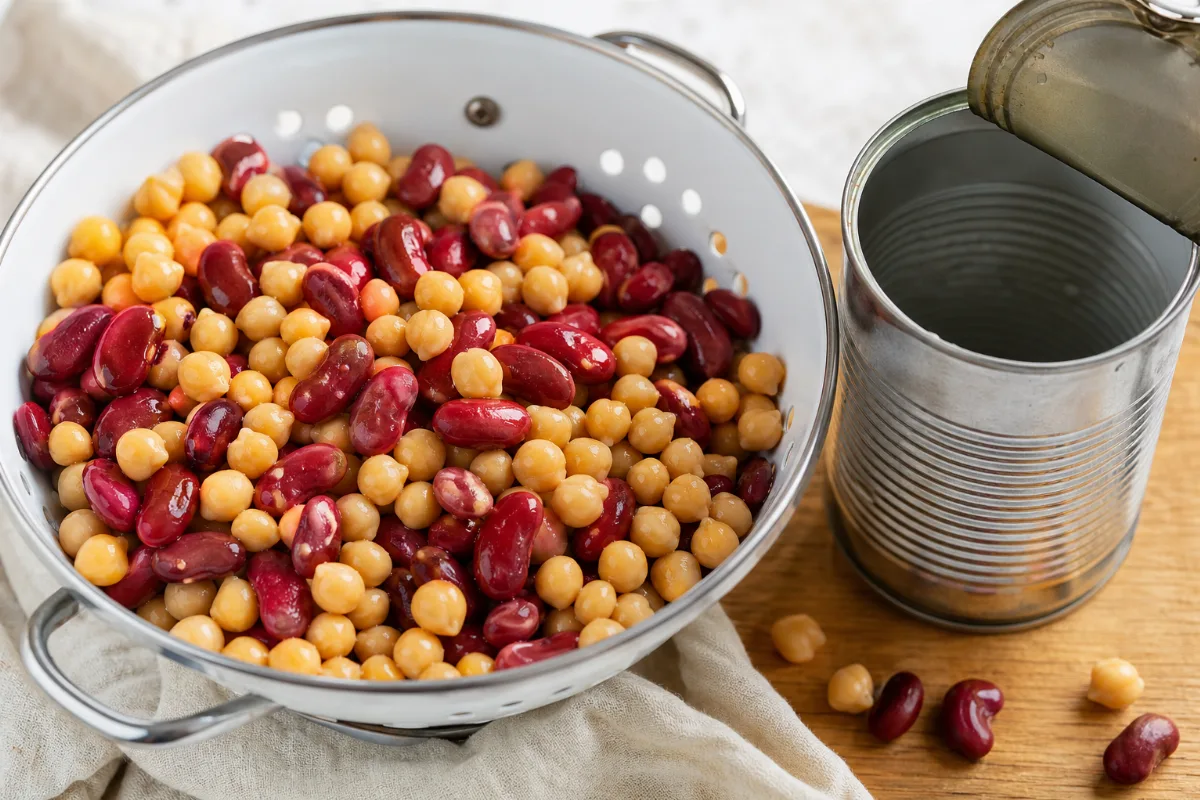
Canned beans are cooked mature beans, such as kidney beans or chickpeas, sealed in a can and ready to eat. They give fibre and plant protein, but the brine adds sodium, which rinsing lowers but does not remove. In trials, diets with pulses lowered LDL cholesterol a little, though canned beans were not tested on their own. Canned kidney beans are already cooked, so the raw-bean lectin risk does not apply to them.
General information, not medical advice. Last substantive update · Not medically reviewed. A named clinician has not signed off on this page. How this page is made
About Canned Beans (Drained, Rinsed)
Canned beans are cooked mature beans sealed in a can. They are a ready-to-eat source of fibre and plant protein, with sodium from the brine. They are a food, not a remedy: the cholesterol finding comes from trials of pulses as a group, and the heart disease finding is observational.
What it is
Canned beans are mature beans such as red kidney beans (Phaseolus vulgaris) and chickpeas (Cicer arietinum) that are cooked and canned, so they need no soaking or boiling. USDA lists them as "mature seeds, canned, drained solids" (kidney) and "canned, drained, rinsed in tap water" (chickpeas).
USDA values per 100 g: canned red kidney beans, drained, have 124 kcal, 7.98 g protein, 1.05 g fat, 21.49 g carbohydrate, 5.5 g fibre, 231 mg sodium and 277 mg potassium. Canned chickpeas, drained and rinsed, have 138 kcal, 7.04 g protein, 2.47 g fat, 22.87 g carbohydrate, 6.3 g fibre, 212 mg sodium and 109 mg potassium. Half a cup (76 g) of the chickpeas has about 105 kcal, 4.8 g of fibre, 161 mg of sodium, and about 26% of the Daily Value for manganese and 21% for copper.
Sodium: rinse, and read the label
The FDA Daily Value for sodium is less than 2,300 mg a day, and Americans eat about 3,400 mg. The FDA advises rinsing canned beans to remove some sodium and says low sodium means 140 mg or less per serving.
Rinsing helps but does not remove it: the USDA rinsed chickpea item still lists 212 mg per 100 g. A whole 266 g can of drained kidney beans works out to about 614 mg by multiplying the USDA value (our calculation). Beans in sauce or with added ingredients change the numbers, so check the label.
What the research shows
Cholesterol: across 26 trials, diets with about a serving a day of pulses lowered LDL by 0.17 mmol/L. That is a small change, and apolipoprotein B and non-HDL cholesterol did not change. The abstract does not say how many trials used canned beans.
Blood pressure and blood sugar: 8 feeding trials found systolic pressure 2.25 mm Hg lower. For blood sugar, a 2009 pooled analysis found lower fasting glucose and HbA1c-type markers with high variation, while a 2020 review found effects only in type 2 diabetes trials and rated the evidence very low quality.
Heart disease and weight: observational studies link more legumes with about 10% lower coronary heart disease risk (RR 0.90) but not lower stroke risk, with low to very low certainty. Pulses raise fullness for a few hours, and weight loss was supported only with calorie restriction. No comparison of canned with dried beans was found.
At a glance
Traditional uses history, not proof
- Eaten as a convenient, ready-to-use staple food
- Long use as food is not proof that it treats any condition
Studied for research
- Fibre, protein and minerals, high certainty for the nutrient content
- LDL cholesterol, moderate certainty (pulses as a group)
- Heart disease, low certainty (observational)
- Blood sugar, mixed
- Blood pressure, low certainty
- Fullness and weight, low certainty
- Canned compared with dried beans, insufficient evidence
Main compounds
- Dietary fibre
- Plant protein
- Sodium (from the brine)
- Lectins (low in canned kidney beans)
- Potassium, manganese and copper
Common forms
- Canned red kidney beans, drained solids (USDA item read)
- Canned chickpeas, drained and rinsed (USDA item read)
- Low sodium and no-salt-added cans (labels only, values not read)
- Beans in sauce or with added ingredients (not read)
Research links: 2014 review: pulses and LDL cholesterol (26 trials) · 2014 review: pulses and blood pressure · FDA: Natural Toxins in Food (kidney bean lectin) · Research Library · Genes & Biomarkers Library
What it is and its history
- Accepted scientific name
- Phaseolus vulgaris and others (canned mature beans)
- Naming authority
- Not verified against a taxonomy database for this page; canned beans are a prepared food made from several species.
- Common names
- Canned beans (English); Tinned beans (English)
- Family or group
- Beans are mature legume seeds. Canned beans are a processed food: the beans are cooked and sealed in a can, so they are ready to eat.
- Classification
- Plantae > Fabaceae (legume family), general knowledge > Phaseolus (kidney beans) and Cicer (chickpeas) > Several
- Native range
- Not verified from a source read.
- Habitat
- Not verified from a source read.
- What it looks like
- Roots: Not verified.; Stems: Not verified.; Leaves: Not verified.; Flowers: Not verified.; Fruit: USDA household portions: 1 can of drained red kidney beans is 266 g; 1 can of drained, rinsed chickpeas is 254 g and 1 cup is 152 g.
- Cultivation
- Not verified from a source read.
- Harvest and processing
- USDA lists the kidney bean item as "mature seeds, canned, drained solids" and the chickpea item as "canned, drained, rinsed in tap water". How the beans are cooked and canned was not read from a source.
- Look-alikes and adulterants
- Name: Dried beans; Note: Need soaking and boiling; raw kidney beans contain a lectin that cooking destroys.; Name: Baked beans and refried beans; Note: Different foods with sauces or added ingredients; nutrient values differ.; Name: Green beans; Note: Eaten as a vegetable, not a mature dried-bean legume.
- Sustainability and conservation
- Not assessed.
Photographs
What is inside, and how it may work
What it contains and how those compounds act in cells and animals. Laboratory and animal mechanisms are not proven effects in people.
Main compounds
| Compound | Family | Where it is concentrated | Activity studied | Level of evidence |
|---|---|---|---|---|
| Dietary fibre | carbohydrate | Seed USDA per 100 g: 5.5 g (kidney, drained) and 6.3 g (chickpeas, drained and rinsed) | Gas and bloating are common with beans (NIDDK). 16 15 14 | Human data |
| Protein | protein | Seed USDA per 100 g: 7.98 g (kidney) and 7.04 g (chickpeas) | A nutrient fact; not tested as a treatment. 16 15 | Nutrient database |
| Sodium (from the brine) | mineral | Brine, absorbed by the beans USDA per 100 g: 231 mg (kidney, drained) and 212 mg (chickpeas, drained and rinsed) | Rinsing removes some, not all. 16 15 12 | Nutrient database |
| Lectins (including phytohaemagglutinin) | protein | Seed Not given in the sources read | Higher in raw or undercooked beans; low in canned kidney beans (FDA). Harvard says lectins can interfere with absorption of calcium, iron, phosphorus and zinc, with the amount lost unknown. 11 13 | Authoritative guidance |
| Potassium | mineral | Seed USDA per 100 g: 277 mg (kidney) and 109 mg (chickpeas) | Matters mainly for people told to limit potassium. 16 15 | Nutrient database |
Mechanisms, receptors and pathways
| Target or pathway | Gene or receptor | What was found | Level |
|---|---|---|---|
| Fullness and blood sugar (fibre, slowly digested carbohydrate) | Not specified in the sources read | The pulse reviews describe beans as a source of slowly digestible carbohydrate, fibre and protein. A 2010 review suggests part of the fullness effect may relate to available carbohydrate. These are suggestions, not proven mechanisms. 4 6 | Human data |
| Lectin inactivation by cooking | Not applicable | The FDA says soaking then boiling dried kidney beans removes and destroys the toxin, and that canned beans have only low levels. 11 | Authoritative guidance |
Absorption, metabolism and elimination
- Absorption
- Not found for canned beans. Harvard says lectins can interfere with mineral absorption; how much is not known.
- Distribution
- Not found.
- Metabolism
- Not found.
- Elimination
- Not found.
- Bioavailability
- Not established.
Isolated compounds versus whole extracts
All trial results here are for pulses or legumes eaten as food, as a group. No result is for canned beans alone. Fibre or mineral supplements are a different question.
Nutritional composition
Nutrition from USDA FoodData Central (SR Legacy, April 2018 release; values read 2026-10-26 from the saved copy in the repo). Red kidney beans, canned, drained solids (FDC 174285), per 100 g: 124 kcal, 7.98 g protein, 1.05 g fat (0.181 g saturated), 21.49 g carbohydrate (3.8 g sugars), 5.5 g fibre, 231 mg sodium, 277 mg potassium, 57 mg calcium, 1.5 mg iron, 30 mg magnesium, 121 mg phosphorus, 0.75 mg zinc, 0.384 mg manganese, 0.272 mg copper, 28 mcg folate (DFE). One USDA can of drained solids is 266 g, so about 330 kcal and 614 mg sodium by multiplying the 100 g values (our calculation). Chickpeas, canned, drained and rinsed in tap water (FDC 173801), per 100 g: 138 kcal, 7.04 g protein, 2.47 g fat (0.213 g saturated), 22.87 g carbohydrate (4.0 g sugars), 6.3 g fibre, 212 mg sodium, 109 mg potassium, 43 mg calcium, 0.98 mg iron, 24 mg magnesium, 80 mg phosphorus, 0.8 mg manganese, 0.25 mg copper, 41 mcg folate (DFE). Half a cup (76 g, half the USDA 1 cup rinsed portion; the 100 g values multiplied by 0.76, our calculation): about 105 kcal, 5.4 g protein, 1.9 g fat, 17.4 g carbohydrate, 4.8 g fibre, 161 mg sodium, 83 mg potassium, 0.61 mg manganese (about 26% of the FDA Daily Value) and 0.19 mg copper (about 21%). Values vary with bean type, brand, brine and rinsing; the rinsed chickpea item still has 212 mg sodium per 100 g. Beans in sauce, with added sugar or with meat were not read, so check the label.
1 high certainty1 moderate certainty1 mixed findings3 low certainty1 not enough evidence
What was looked at
The 7 benefits and uses checked for Canned Beans (Drained, Rinsed), each with how strong the evidence is. Tap one to open it.
- Fibre, protein and minerals (nutrient content)High certainty
- LDL cholesterol (diets with pulses)Moderate certainty
- Heart disease risk (observational)Low certainty
- Blood sugar control (pulses)Mixed findings
- Blood pressure (pulses)Low certainty
- Fullness and body weight (pulses)Low certainty
- Canned beans compared with dried beansNot enough evidence
Lab markers tracked in the studies
LDL cholesterolApolipoprotein B and non-HDL cholesterolCoronary heart disease eventsFasting blood glucoseHbA1c and fructosamineSystolic blood pressure
What is Canned Beans (Drained, Rinsed) good for?
The main studied uses and how strong the human evidence is for each. Almost all results are for pulses or legumes as a group, not for canned beans on their own.
Benefits, one by one
Each card is a research question, not a promise. Tap a goal to filter. Open a card to see the studies, doses and limits.
Fibre, protein and minerals (nutrient content)
High certaintyHalf a cup (76 g) of drained, rinsed canned chickpeas has about 105 kcal, 5.4 g of protein and 4.8 g of fibre, plus about 26% of the Daily Value for manganese and 21% for copper (USDA). Canned red kidney beans, drained, have 124 kcal, 7.98 g of protein and 5.5 g of fibre per 100 g. Both also carry sodium, 231 mg per 100 g for the kidney beans.
2 studiesTwo USDA items: canned red kidney beans, drained solids, and canned c…
Studies, doses and limits
What the trials found
No trial was read that tested whether eating canned beans corrects a shortfall of fibre, protein or any mineral.
Results
Canned beans are a source of fibre and plant protein on paper, with notable manganese and copper. Values change with the bean, the brand and the brine.
Effect sizes as reported
USDA, per 100 g: red kidney beans, canned, drained solids: 124 kcal, 7.98 g protein, 5.5 g fibre, 231 mg sodium, 277 mg potassium. Chickpeas, canned, drained and rinsed: 138 kcal, 7.04 g protein, 6.3 g fibre, 212 mg sodium, 109 mg potassium.
Why this rating
High that the food contains these nutrients (USDA data). Not tested as a treatment for any shortfall.
Form and dose studied
Two USDA items: canned red kidney beans, drained solids, and canned chickpeas, drained and rinsed. Beans in sauce, with added sugar or with meat were not read.
Who was studied
General adult diet.
Limits
Nutrient facts, not trials. Only two bean types were read. The USDA chickpea item is rinsed; the kidney bean item is drained only.
Why researchers looked
People use canned beans as a ready-to-eat way to get plant protein and fibre.
Traditional use
Beans are eaten as a staple food in many cuisines. Long use as food is not proof that it treats any condition.
Proposed mechanism Nutrient database
These are nutrient amounts in the food, taken from USDA tables.
A proposed mechanism does not show that the effect happens in people.
Sodium is the main watch point; see the Safety tab.
LDL cholesterol (diets with pulses)
Moderate certaintyIn 26 trials (1,037 people), diets with about a serving a day of pulses (beans, chickpeas, lentils, peas) lowered LDL, the so-called bad cholesterol, by 0.17 mmol/L compared with similar diets without pulses. Apolipoprotein B and non-HDL cholesterol did not change.
1 studiesPulses as a group, mostly eaten in the diet; canned beans not separat…
Studies, doses and limits
What the trials found
A 2014 pooled analysis of 26 randomised trials of at least 3 weeks compared diets emphasising pulses (median 130 g a day) with similar-calorie diets without them. The abstract does not say how many trials used canned beans, so canned and dried beans were not compared.
Results
A small fall in LDL cholesterol. The change in non-HDL cholesterol and apolipoprotein B was not observed.
Effect sizes as reported
LDL -0.17 mmol/L (95% CI -0.25 to -0.09). No effect on apolipoprotein B or non-HDL cholesterol.
Why this rating
Moderate: a pooled analysis of randomised trials with a small, consistent LDL change, but the authors ask for longer, higher-quality trials, and it is indirect for canned beans.
Form and dose studied
Pulses as a group, mostly eaten in the diet; canned beans not separated.
Who was studied
Adults in 26 trials.
Limits
Pulses as a group. Trial quality and length were limited. It is a change in a blood measure, not in heart attacks.
Why researchers looked
Beans are rich in fibre and plant protein, and heart-health guidance often mentions pulses.
Traditional use
Beans are eaten as a staple food in many cuisines. Long use as food is not proof that it treats any condition.
Proposed mechanism Human trial pooled
Not established in the abstract read. This is an effect on a blood measure in trials.
A proposed mechanism does not show that the effect happens in people.
Canned beans add sodium unless rinsed or labelled low sodium; see the Safety tab.
Heart disease risk (observational)
Low certaintyIn studies that follow people over time, those who ate the most legumes had slightly lower risk of coronary heart disease (about 10% lower) and cardiovascular disease, but no lower risk of stroke. Certainty is low or very low and it cannot show cause.
2 studiesLegumes and pulses as a group.
Studies, doses and limits
What the trials found
A 2023 analysis of 26 observational studies and a 2019 umbrella review of 28 prospective cohort studies compared highest with lowest intake of legumes or pulses. Neither separates canned from dried beans.
Results
Lower risk of coronary heart disease and cardiovascular disease with the highest intake, no link with stroke in the 2023 analysis. The 2019 review also found no link with heart attack or with deaths from these causes, and rated certainty low for cardiovascular disease and very low for the other results.
Effect sizes as reported
2023: CVD RR 0.94, CHD RR 0.90, stroke RR 1.00. 2019: CVD RR 0.92, CHD RR 0.90.
Why this rating
Low: observational only, and the 2019 review rates certainty low or very low.
Form and dose studied
Legumes and pulses as a group.
Who was studied
Adults in cohort studies.
Limits
Observational. People who eat more beans may differ in other ways. Canned beans not separated.
Why researchers looked
Large studies ask whether people who eat more beans have fewer heart problems.
Traditional use
Beans are eaten as a staple food in many cuisines. Long use as food is not proof that it treats any condition.
Proposed mechanism Observational
Not shown. These are links between eating habits and disease, and other healthy habits may explain some of it.
A proposed mechanism does not show that the effect happens in people.
None specific.
Blood sugar control (pulses)
Mixed findingsPooled trials of pulses found lower fasting glucose and lower long-term blood sugar markers, but differences between trials were high. A 2020 review found significant effects only in the 5 trials in type 2 diabetes and rated the evidence very low quality.
2 studiesWhole pulses, not canned beans specifically.
Studies, doses and limits
What the trials found
A 2009 analysis pooled 41 trials of at least 7 days; a 2020 review looked at 18 randomised trials of at least 6 weeks. The abstract does not say how many trials used canned beans, so canned and dried beans were not compared.
Results
Mixed. Lower fasting glucose and HbA1c-type markers in the 2009 pooled analysis, and a benefit mainly in type 2 diabetes trials in the 2020 review, with very low quality evidence.
Effect sizes as reported
2009: fasting glucose SMD -0.82 (pulses alone, -1.36 to -0.27); HbA1c or fructosamine SMD -0.28 (low-GI diets, -0.42 to -0.14). 2020: no pooled number.
Why this rating
Mixed: positive pooled results with high unexplained variation, and a more recent review rating the evidence very low quality.
Form and dose studied
Whole pulses, not canned beans specifically.
Who was studied
People with and without diabetes.
Limits
High differences between trials; very low quality evidence in the 2020 review. One 2020 author works at a legume industry body (non-profit).
Why researchers looked
Beans are digested slowly and are rich in fibre.
Traditional use
Beans are eaten as a staple food in many cuisines. Long use as food is not proof that it treats any condition.
Proposed mechanism Human trial pooled
Not established in the abstracts read.
A proposed mechanism does not show that the effect happens in people.
If you take diabetes medicine, ask your prescriber before changing your diet a lot.
Blood pressure (pulses)
Low certaintyIn 8 feeding trials (554 people), swapping other foods for pulses lowered systolic blood pressure by 2.25 mm Hg. The change in diastolic pressure was not significant.
2 studiesPulses as a group in controlled diets.
Studies, doses and limits
What the trials found
A 2014 pooled analysis of 8 controlled feeding trials of at least 3 weeks. The abstract does not say how many trials used canned beans, so canned and dried beans were not compared.
Results
A small fall in systolic and mean arterial pressure; diastolic not significant; heterogeneity significant.
Effect sizes as reported
Systolic -2.25 mm Hg (95% CI -4.22 to -0.28); mean arterial -0.75 mm Hg (-1.44 to -0.06); diastolic -0.71 mm Hg (-1.74 to 0.31, not significant).
Why this rating
Low: few trials, a small change, significant differences between trials, and the authors ask for larger, higher-quality trials.
Form and dose studied
Pulses as a group in controlled diets.
Who was studied
People with and without high blood pressure.
Limits
Only 8 trials. Canned beans add sodium unless rinsed or low sodium, which could work against blood pressure; this was not tested.
Why researchers looked
Beans provide potassium and fibre, and heart diets often include them.
Traditional use
Beans are eaten as a staple food in many cuisines. Long use as food is not proof that it treats any condition.
Proposed mechanism Human trial pooled
Not established in the abstract read.
A proposed mechanism does not show that the effect happens in people.
Sodium in canned beans; see the Safety tab.
Fullness and body weight (pulses)
Low certaintyShort meal studies found pulses raised fullness for 2 to 4 hours. Observational studies link more pulses with lower body weight, but many did not control for other habits. Trials supported weight loss only together with calorie restriction.
2 studiesPulses as a group.
Studies, doses and limits
What the trials found
A 2010 narrative review of observational studies, short meal studies and a few randomised trials of 3 to 8 weeks. A 2019 umbrella review also linked the highest pulse intake with lower obesity risk (RR 0.87), with very low certainty.
Results
Some short-term fullness and weight loss only with calorie restriction.
Effect sizes as reported
Obesity incidence RR 0.87 (0.81 to 0.94), very low certainty (2019 umbrella review).
Why this rating
Low: a narrative review of few, short trials, plus very low certainty observational data.
Form and dose studied
Pulses as a group.
Who was studied
Adults.
Limits
Few and short trials; observational links may reflect other habits.
Why researchers looked
Fibre, protein and slowly digested carbohydrate may help people feel full.
Traditional use
Beans are eaten as a staple food in many cuisines. Long use as food is not proof that it treats any condition.
Proposed mechanism Narrative review
The review suggests part of the fullness effect may come from the amount or type of available carbohydrate. This is a suggestion, not a proven mechanism.
A proposed mechanism does not show that the effect happens in people.
None specific.
Canned beans compared with dried beans
Not enough evidenceNo study comparing canned with dried beans on health outcomes was read. The only differences we can state come from nutrient tables, such as sodium.
2 studiesNot applicable.
Studies, doses and limits
Results
Insufficient evidence. The USDA canned items carry 212 to 231 mg of sodium per 100 g; the chickpea item was rinsed and still has 212 mg.
Why this rating
No direct comparison was found.
Limits
This is a gap, not a finding of no difference.
Why researchers looked
Many people ask whether canned beans are as good as cooking dried beans.
Traditional use
Both forms are common food.
Proposed mechanism None
Not applicable.
A proposed mechanism does not show that the effect happens in people.
Sodium; see the Safety tab.
Connections to the rest of health
How Canned Beans (Drained, Rinsed) connects to the rest of our health knowledge graph. Every link says what kind of connection it is. A safety link (for example to the liver) is a warning, not a benefit. A study that merely mentions a topic never creates a benefit link.
Explore every connection: goals, body systems, organs, symptoms, genes
A. Wellness goals
| Connected to | Kind of connection | Evidence status | Context | Studies |
|---|---|---|---|---|
| Preventive Wellness | High certainty | Fibre, protein and minerals (nutrient content): Half a cup (76 g) of drained, rinsed canned chickpeas has about 105 kcal, 5.4 g of protein and 4.8 g of fibre, plus about 26% of the Daily Value for manganese and 21% for copper (USDA). Canned red kidney beans, drained, have 124 kcal, 7.98 g of protein and 5.5 g of fibre per 100 g. Both also carry sodium, 231 mg per 100 g for the kidney beans. | 16 15 | |
| Cholesterol Balance | Demonstrated clinical effect | Moderate certainty | LDL cholesterol (diets with pulses): In 26 trials (1,037 people), diets with about a serving a day of pulses (beans, chickpeas, lentils, peas) lowered LDL, the so-called bad cholesterol, by 0.17 mmol/L compared with similar diets without pulses. Apolipoprotein B and non-HDL cholesterol did not change. | 2 |
| Heart Health | Demonstrated clinical effect | Moderate certainty | LDL cholesterol (diets with pulses): In 26 trials (1,037 people), diets with about a serving a day of pulses (beans, chickpeas, lentils, peas) lowered LDL, the so-called bad cholesterol, by 0.17 mmol/L compared with similar diets without pulses. Apolipoprotein B and non-HDL cholesterol did not change. | 2 |
| Heart Health | Low certainty | Heart disease risk (observational): In studies that follow people over time, those who ate the most legumes had slightly lower risk of coronary heart disease (about 10% lower) and cardiovascular disease, but no lower risk of stroke. Certainty is low or very low and it cannot show cause. | 5 7 | |
| Blood Sugar Balance | Demonstrated clinical effect | Mixed findings | Blood sugar control (pulses): Pooled trials of pulses found lower fasting glucose and lower long-term blood sugar markers, but differences between trials were high. A 2020 review found significant effects only in the 5 trials in type 2 diabetes and rated the evidence very low quality. | 6 1 |
| Blood Pressure Support | Demonstrated clinical effect | Low certainty | Blood pressure (pulses): In 8 feeding trials (554 people), swapping other foods for pulses lowered systolic blood pressure by 2.25 mm Hg. The change in diastolic pressure was not significant. | 3 7 |
| Weight Management | Low certainty | Fullness and body weight (pulses): Short meal studies found pulses raised fullness for 2 to 4 hours. Observational studies link more pulses with lower body weight, but many did not control for other habits. Trials supported weight loss only together with calorie restriction. | 4 7 | |
| Preventive Wellness | Not enough evidence | Canned beans compared with dried beans: No study comparing canned with dried beans on health outcomes was read. The only differences we can state come from nutrient tables, such as sodium. | 16 15 |
B. Body systems
| Connected to | Kind of connection | Evidence status | Context | Studies |
|---|---|---|---|---|
| Digestive System | Biological association | High certainty | Studied for: Fibre, protein and minerals (nutrient content) Studied for: Canned beans compared with dried beans | 16 15 |
| Cardiovascular System | Biological association | Moderate certainty | Studied for: LDL cholesterol (diets with pulses) Studied for: Heart disease risk (observational) | 2 5 7 3 |
| Endocrine System | Biological association | Mixed findings | Studied for: Blood sugar control (pulses) | 6 1 |
| Metabolic System | Biological association | Low certainty | Studied for: Fullness and body weight (pulses) | 4 7 |
E. Health conditions
| Connected to | Kind of connection | Evidence status | Context | Studies |
|---|---|---|---|---|
| Food poisoning | Adverse effect or risk | Documented risk | Raw or undercooked kidney beans can cause serious stomach symptoms; canned beans are already cooked. Preparation or compound: Raw or undercooked red kidney beans (not canned) |
11 |
| Gas and bloating | Adverse effect or risk | Documented risk | NIDDK names beans among foods that may cause gas. Preparation or compound: Beans |
14 |
| High cholesterol | Preliminary | Diets with pulses lowered LDL a little in pooled trials; not a treatment. Preparation or compound: Pulses |
2 |
I. Biomarkers
| Connected to | Kind of connection | Evidence status | Context | Studies |
|---|---|---|---|---|
| LDL cholesterol | Biological association | Moderate certainty | Measured in trials: lowered. A lab change is not the same as a health benefit. | 2 |
| Apolipoprotein B and non-HDL cholesterol | Biological association | Low certainty | Measured in trials: no clear change. A lab change is not the same as a health benefit. | 2 |
| Coronary heart disease events | Biological association | Low certainty | Measured in trials: lower risk (association). A lab change is not the same as a health benefit. | 5 7 |
| Fasting blood glucose | Biological association | Mixed findings | Measured in trials: lowered. A lab change is not the same as a health benefit. | 6 1 |
| HbA1c and fructosamine | Biological association | Mixed findings | Measured in trials: lowered. A lab change is not the same as a health benefit. | 6 1 |
| Systolic blood pressure | Biological association | Low certainty | Measured in trials: lowered. A lab change is not the same as a health benefit. | 3 |
K. Biological pathways
L. Active compounds
| Connected to | Kind of connection | Evidence status | Context | Studies |
|---|---|---|---|---|
| Dietary fibre | Biological association | Human | Gas and bloating are common with beans (NIDDK). Preparation or compound: Seed |
16 15 14 |
| Protein | Biological association | Nutrient database | A nutrient fact; not tested as a treatment. Preparation or compound: Seed |
16 15 |
| Sodium (from the brine) | Biological association | Nutrient database | Rinsing removes some, not all. Preparation or compound: Brine, absorbed by the beans |
16 15 12 |
| Lectins (including phytohaemagglutinin) | Biological association | Authoritative guidance | Higher in raw or undercooked beans; low in canned kidney beans (FDA). Harvard says lectins can interfere with absorption of calcium, iron, phosphorus and zinc, with the amount lost unknown. Preparation or compound: Seed |
11 13 |
| Potassium | Biological association | Nutrient database | Matters mainly for people told to limit potassium. Preparation or compound: Seed |
16 15 |
Each connection is stored with the ingredient, the connected record, the kind of connection, the evidence status, the supporting studies, the preparation or compound involved, and a review date (last reviewed October 26, 2026).
The evidence
The research centre for Canned Beans (Drained, Rinsed). Every record here was checked against PubMed or the publisher's page; we never list a study we have not verified.
Evidence by outcome
Bars show how many studies we found for each outcome, not how well it works. People are added up across trials only (reviews are not added, to avoid double counting).
How we rate evidence
High certainty
Several well-run trials or reviews agree; further research is unlikely to change the picture much.
Moderate certainty
Good trials point the same way, but some doubt remains.
Low certainty
Small, short or inconsistent trials. The finding could change with better research.
Very low certainty
Very little or very weak human data. Treat as a possibility only.
Mixed findings
Trials or reviews disagree with each other.
Not enough evidence
Not enough human research to say either way.
Evidence against
Good research found no benefit, or found harm.
We take the reviewers' own risk-of-bias and GRADE statements where they exist, and otherwise judge from study size, design, consistency, directness and whether a product matches what is sold. Many publications do not make evidence high. Method note: We started from our existing canned beans summary, re-checked nutrition against saved USDA FoodData Central data, re-read the FDA, CDC, NIDDK, Harvard and NHS pages, and re-read PubMed abstracts for seven reviews. Only abstracts were read for studies. Items we could not verify are flagged in the research gaps.
Study library: every study we checked 16
| Study | Design | People | Product, dose, length | Result |
|---|---|---|---|---|
| Bielefeld 2020 The Effects of Legume Consumption on Markers of Glycaemic Control in Individuals with and without Diabetes Mellitus: A Systematic Literature Review of Randomised Controlled Trials. Nutrients · PMID 32708949 · DOI |
Systematic review |
18 randomised trials (5 in type 2 diabetes, 12 without diabetes, 1 in prediabetes) | Legumes Legumes as eaten Varied At least 6 weeks · vs Control diets |
Only the 5 trials in type 2 diabetes reported significant effects (lower fasting glucose in three, lower HbA1c in two, lower insulin in one, lower 2-hour glucose in another). The authors rate the overall quality of evidence very low. No pooled number given (Not applicable) Methods, limits and fundingOutcomes: Fasting glucose, fasting insulin, HbA1c, HOMA-IR, 2-hour glucose Limitations: No pooled analysis. Very low quality evidence by the authors' own rating. Funding and conflicts: One author works at the Grains & Legumes Nutrition Council, a non-profit charity; the others declare no conflict. Read: abstract |
| Ha 2014 Effect of dietary pulse intake on established therapeutic lipid targets for cardiovascular risk reduction: a systematic review and meta-analysis of randomized controlled trials. CMAJ · PMID 24710915 · DOI |
Systematic review meta analysis |
26 randomised trials, 1,037 people | Diets emphasising pulses (beans, chickpeas, lentils, peas) Cooked pulses (beans, chickpeas, lentils, peas) eaten as food Median 130 g a day (about 1 serving) At least 3 weeks · vs Similar-calorie diet without pulses |
Diets emphasising pulses lowered LDL cholesterol. Apolipoprotein B and non-HDL cholesterol showed no effect. LDL -0.17 mmol/L (-0.25 to -0.09) Methods, limits and fundingOutcomes: LDL cholesterol, apolipoprotein B, non-HDL cholesterol Limitations: Pulses as a group, not canned beans; the abstract does not say how many trials used canned beans. The authors call for longer, higher-quality trials. Funding and conflicts: Funding is not stated in the abstract. Registration: NCT01594567 Read: abstract |
| Jayalath 2014 Effect of dietary pulses on blood pressure: a systematic review and meta-analysis of controlled feeding trials. Am J Hypertens · PMID 24014659 · DOI |
Systematic review meta analysis |
8 trials, 554 people with and without high blood pressure | Dietary pulses swapped for other foods, same calories Cooked pulses (beans, chickpeas, lentils, peas) eaten as food Not given in the abstract At least 3 weeks · vs Control diet |
Pulses lowered systolic and mean arterial pressure. The diastolic change was not significant. Differences between trials were significant for all measures. Systolic -2.25 mm Hg; mean arterial -0.75 mm Hg; diastolic -0.71 mm Hg (not significant) (Systolic -4.22 to -0.28; mean arterial -1.44 to -0.06; diastolic -1.74 to 0.31) Methods, limits and fundingOutcomes: Systolic, diastolic and mean arterial blood pressure Limitations: Small number of trials, significant differences between them, pulses as a group. Funding and conflicts: Funding is not stated in the abstract. Registration: NCT01594567 Read: abstract |
| McCrory 2010 Pulse consumption, satiety, and weight management. Adv Nutr · PMID 22043448 · DOI |
Narrative review |
Observational studies, short meal studies and a few randomised trials | Pulses (dry beans, peas, chickpeas, lentils) Pulses as eaten Varied 3 to 8 weeks for whole pulses in most trials · vs Control diets |
Observational studies consistently link more pulses with lower BMI or obesity risk, but many did not control for other habits. Meals with pulses raised fullness over 2 to 4 hours in short studies. Trials supported weight loss only when pulses were paired with calorie restriction. No pooled number given (Not applicable) Methods, limits and fundingOutcomes: Fullness (satiety), body weight, BMI Limitations: A 2010 narrative review, few and short trials, older evidence. Funding and conflicts: The authors report no conflicts. Read: abstract |
| Mendes 2023 Intake of legumes and cardiovascular disease: A systematic review and dose-response meta-analysis. Nutr Metab Cardiovasc Dis · PMID 36411221 · DOI |
Systematic review meta analysis |
26 observational studies (21 prospective cohort, 5 case-control) | Legumes Legumes as eaten · vs Lowest intake |
Highest versus lowest legume intake went with lower cardiovascular disease and coronary heart disease risk, but not stroke. CVD RR 0.94; CHD RR 0.90; stroke RR 1.00 (CVD 0.89 to 0.99; CHD 0.85 to 0.96; stroke 0.93 to 1.08) Methods, limits and fundingOutcomes: Cardiovascular disease, coronary heart disease, stroke Limitations: Observational, so it cannot show cause. Legumes as a group, not canned beans. Funding and conflicts: The authors declare no competing interests. Registration: PROSPERO CRD42021247565 Read: abstract |
| Sievenpiper 2009 Effect of non-oil-seed pulses on glycaemic control: a systematic review and meta-analysis of randomised controlled experimental trials in people with and without diabetes. Diabetologia · PMID 19526214 · DOI |
Systematic review meta analysis |
41 trials (39 reports), people with and without diabetes | Non-oil-seed pulses alone, or in low-GI or high-fibre diets Cooked pulses (beans, chickpeas, lentils, peas) eaten as food Varied At least 7 days · vs Control diets |
Pulses alone (11 trials) lowered fasting glucose and insulin. In low-GI diets (19 trials) they lowered HbA1c or fructosamine. In high-fibre diets (11 trials) they lowered fasting glucose and those long-term markers. Differences between trials were high and mostly unexplained. Pulses alone: fasting glucose SMD -0.82; insulin -0.49. Low-GI diets: HbA1c or fructosamine -0.28. High-fibre diets: fasting glucose -0.32; long-term markers -0.27 (Fasting glucose -1.36 to -0.27; insulin -0.93 to -0.04; low-GI -0.42 to -0.14; high-fibre -0.49 to -0.15 and -0.45 to -0.09) Methods, limits and fundingOutcomes: Fasting glucose, insulin, HbA1c or fructosamine Limitations: High unexplained differences between trials. Standardised units, not mg/dL. Whole pulses, not canned beans specifically. Old (2009). Funding and conflicts: Funding is not stated in the abstract. Read: abstract |
| Viguiliouk 2019 Associations between Dietary Pulses Alone or with Other Legumes and Cardiometabolic Disease Outcomes: An Umbrella Review and Updated Systematic Review and Meta-analysis of Prospective Cohort Studies. Adv Nutr · PMID 31728500 · DOI |
Systematic review meta analysis |
28 unique prospective cohort studies | Dietary pulses with or without other legumes Pulses and legumes as eaten · vs Lowest intake |
Highest versus lowest intake went with lower risk of cardiovascular disease, coronary heart disease, high blood pressure and obesity. No link with heart attack, stroke or diabetes, or with deaths from cardiovascular disease, coronary heart disease or stroke. The authors rate certainty low for cardiovascular disease and very low for the rest. CVD RR 0.92; CHD RR 0.90; high blood pressure RR 0.91; obesity RR 0.87 (CVD 0.85 to 0.99; CHD 0.83 to 0.99; high blood pressure 0.86 to 0.97; obesity 0.81 to 0.94) Methods, limits and fundingOutcomes: Cardiovascular disease, coronary heart disease, stroke, diabetes, high blood pressure, obesity Limitations: Observational, so it cannot show cause. Pulses and legumes as a group; canned beans not separated. Funding and conflicts: Funding is not stated in the abstract. Registration: NCT03555734 Read: abstract |
| s-cdc-botulism US CDC: Preventing Botulism · Source |
Health agency n/a |
Methods, limits and fundingRead: full-text | ||
| s-fda-allergens US FDA: Food Allergies · Source |
Health agency n/a |
Methods, limits and fundingRead: full-text | ||
| s-fda-bpa US FDA: Bisphenol A (BPA): Use in Food Contact Application · Source |
Health agency n/a |
Methods, limits and fundingRead: full-text | ||
| s-fda-natural-toxins US FDA: Natural Toxins in Food · Source |
Health agency n/a |
Methods, limits and fundingRead: full-text | ||
| s-fda-sodium US FDA: Sodium in Your Diet · Source |
Health agency n/a |
Methods, limits and fundingRead: full-text | ||
| s-harvard-antinutrients Harvard T.H. Chan School of Public Health, The Nutrition Source: Antinutrients · Source |
Health agency n/a |
Methods, limits and fundingRead: full-text | ||
| s-niddk-gas NIDDK: Eating, Diet, and Nutrition for Gas in the Digestive Tract · Source |
Health agency n/a |
Methods, limits and fundingRead: full-text | ||
| s-usda-fdc-173801 USDA FoodData Central: Chickpeas (garbanzo beans, bengal gram), mature seeds, canned, drained, rinsed in tap water (FDC 173801, SR Legacy, April 2018) · Source |
Reference database n/a |
Methods, limits and fundingRead: full-text | ||
| s-usda-fdc-174285 USDA FoodData Central: Beans, kidney, red, mature seeds, canned, drained solids (FDC 174285, SR Legacy, April 2018) · Source |
Reference database n/a |
Methods, limits and fundingRead: full-text |
What we do not know yet
- No study comparing canned with dried beans was found; all trial results are for pulses or legumes as a group.
- The heart disease results are observational and cannot show cause.
- Only two USDA items were read (canned red kidney beans and canned chickpeas); other beans, low-sodium cans and beans in sauce were not.
- Pregnancy, children, medicine interactions, heavy metals, oxalate, FODMAP and purine content were not researched for canned beans.
- A UK Food Standards Agency statement on canned beans could not be re-verified and is not used.
- This page is smaller than a typical profile because little research exists on canned beans as a separate food.
How new research is added
New studies are found by a saved PubMed search and placed in a review queue before the page changes.
Lab markers
What changed in blood or saliva tests during trials. A changed number is not the same as feeling or being healthier, and we give no "normal ranges".
Metabolic 1
LDL cholesterol
Lowered in trials
The 'bad' cholesterol carried in the blood. Higher levels are linked to more heart disease.
Moderate certaintyResults and what it means
Why it was measured
It is the usual blood marker used in diet trials for heart risk.
Statistical vs. clinical meaning
A small average fall from pulses as a group; canned beans were not tested separately.
Safety implication
None specific.
| Study | Result | People | Product |
|---|---|---|---|
| 2 | LDL -0.17 mmol/L (95% CI -0.25 to -0.09) with pulse diets versus similar diets without pulses | 26 trials, 1,037 people | Diets emphasising pulses, median 130 g a day, at least 3 weeks |
Other 5
Apolipoprotein B and non-HDL cholesterol
No clear change in trials
Other blood measures of the cholesterol-carrying particles linked to heart disease.
Low certaintyResults and what it means
Why it was measured
Often checked alongside LDL in diet trials.
Statistical vs. clinical meaning
A result against a wider cholesterol benefit: only LDL fell.
Safety implication
None specific.
| Study | Result | People | Product |
|---|---|---|---|
| 2 | Treatment effects were not observed for apolipoprotein B or non-HDL cholesterol | 26 trials | Diets emphasising pulses, at least 3 weeks |
Coronary heart disease events
Lower risk (association) in trials
Heart attacks and deaths from coronary heart disease, counted over many years.
Low certaintyResults and what it means
Why it was measured
The outcome that matters most, but only seen in long observational studies.
Statistical vs. clinical meaning
A link, not proof of cause.
Safety implication
None specific.
| Study | Result | People | Product |
|---|---|---|---|
| 5 | Highest versus lowest legume intake: CHD RR 0.90 (0.85 to 0.96); stroke RR 1.00 (0.93 to 1.08) | 26 observational studies | Legumes as eaten (observational) |
| 7 | CHD RR 0.90 (0.83 to 0.99); certainty very low | 28 prospective cohort studies | Pulses with or without other legumes (observational) |
Fasting blood glucose
Lowered in trials
Blood sugar measured after not eating overnight.
Mixed findingsResults and what it means
Why it was measured
A common measure of blood sugar control in diet trials.
Statistical vs. clinical meaning
Lower in some analyses, with high variation and very low quality in the newer review.
Safety implication
Ask your prescriber if you take diabetes medicine.
| Study | Result | People | Product |
|---|---|---|---|
| 6 | Pulses alone: SMD -0.82 (95% CI -1.36 to -0.27); in high-fibre diets SMD -0.32 (-0.49 to -0.15) | 41 trials (39 reports) | Pulses, at least 7 days |
| 1 | Lower fasting glucose in 3 of the 5 trials in type 2 diabetes; very low quality of evidence | 18 randomised trials | Legumes, at least 6 weeks |
HbA1c and fructosamine
Lowered in trials
Blood measures of average sugar levels over weeks to months.
Mixed findingsResults and what it means
Why it was measured
Longer-term markers of blood sugar control.
Statistical vs. clinical meaning
A small lower trend with high variation.
Safety implication
None specific.
Systolic blood pressure
Lowered in trials
The top number in a blood pressure reading.
Low certaintyResults and what it means
Why it was measured
A standard heart-risk measure in diet trials.
Statistical vs. clinical meaning
A small average fall, with significant differences between trials.
Safety implication
None specific.
| Study | Result | People | Product |
|---|---|---|---|
| 3 | Systolic -2.25 mm Hg (95% CI -4.22 to -0.28); diastolic -0.71 mm Hg (-1.74 to 0.31, not significant) | 8 trials, 554 people | Pulses swapped for other foods, at least 3 weeks |
Safety
What studies and official sources say about side effects, medicines and who should check first. Each point shows what kind of evidence it comes from.
Main points to know 4
- Sodium is the main watch point. USDA lists 231 mg of sodium per 100 g in drained canned red kidney beans and 212 mg per 100 g in drained, rinsed canned chickpeas. The FDA Daily Value for sodium is less than 2,300 mg a day and Americans eat about 3,400 mg. The FDA advises rinsing canned beans to remove some of the sodium, and says low sodium means 140 mg or less per serving. Rinsing lowers sodium but does not remove it: the rinsed chickpea item still lists 212 mg per 100 g. Authoritative guidance 16 15 12
- Canned kidney beans are already cooked. Raw or undercooked red kidney beans contain a lectin (phytohaemagglutinin) that can cause serious stomach symptoms. The FDA says that in canned and properly cooked kidney beans the low levels will not affect you. The risk is with raw or undercooked dried beans, not with canned beans as sold. Authoritative guidance 11
- Damaged or unsafe cans. The CDC says store-bought food can, uncommonly, be contaminated with botulism toxin. Do not eat food if the food or container shows signs of contamination, refrigerate canned food after opening, and if in doubt, throw it out. Authoritative guidance 8
- Gas and bloating. NIDDK lists beans among foods with carbohydrates that may cause gas, and says some people have more gas when they eat too much fibre. Authoritative guidance 14
Side effects 3
| Effect | How often | Severity and recovery | Evidence |
|---|---|---|---|
| Gas and bloating NIDDK names beans in general, not canned beans specifically. | No frequency given by NIDDK. | mild Not described. | Authoritative guidance 14 |
| Severe nausea, vomiting and diarrhea from raw or undercooked kidney beans (not from canned beans as sold) The FDA says the low levels of lectin in canned and properly cooked kidney beans will not affect you. | No frequency given in the page read. | can be serious Not described. | Authoritative guidance 11 |
| Extra sodium from the brine Beans in sauce or with added salt were not read. | USDA: 231 mg per 100 g (kidney beans, drained) and 212 mg per 100 g (chickpeas, drained and rinsed). | mild per serving; adds up across a day Not applicable. | Nutrient database 16 15 12 |
Liver
No liver injury from eating canned beans was found in the sources read. A liver-safety source (such as LiverTox) was not searched for this food.
How often. No frequency was found.
Monitoring. No agency monitoring advice was found.
This is a safety connection. It is not evidence that Canned Beans (Drained, Rinsed) supports liver health.
Medicines and supplements 2
| With | Why it matters | Importance | Evidence | What to do |
|---|---|---|---|---|
| Prescription medicines (general) prescription | We did not read any source that reports a medicine interaction with canned beans. Absence of a source is not proof that there is none. | None found Not enough evidence | Ask your pharmacist if you take medicine and change your diet a lot. | |
| Blood pressure or sodium-restricted diets diet | Canned beans carry sodium from the brine. | The FDA advises rinsing canned beans and choosing low sodium or no-salt-added products. This is general sodium advice, not a drug interaction. | Authoritative guidance Moderate certainty 12 16 15 | If you have been told to limit sodium, read the label and ask your clinician or dietitian. |
Who should check first 4
| Situation | Advice | Evidence |
|---|---|---|
| Raw or undercooked dried red kidney beans | Do not eat them. The FDA says to soak dried kidney beans for at least 5 hours and boil them in fresh water for at least half an hour. Canned kidney beans are already cooked. | Authoritative guidance 11 |
| A bulging, leaking or damaged can, or food of uncertain safety | Do not eat it. The CDC says: if in doubt, throw it out. | Authoritative guidance 8 |
| A diet limited in sodium | Choose low sodium or no-salt-added cans, rinse, and check the label. Ask your clinician about your own limit. | Authoritative guidance 12 |
| Kidney disease | USDA lists 277 mg of potassium per 100 g in the canned kidney bean item. Whether that matters depends on your kidney function; ask your kidney care team. | Nutrient database 16 |
Overdose, product quality and regulators
Summary. No toxicity from canned beans as ordinary food was found in the sources read. The safety points are sodium, raw or undercooked kidney beans (not canned), can safety, gas, and BPA in can linings.
Animal. Not reviewed.
High dose or long term signals. Not researched.
Overdose response. Not found.
Genotoxicity. Not researched.
Toxic or hazardous parts. Raw dried kidney beans contain a lectin that cooking destroys; canned beans are already cooked.
Heavy metals, pesticides and mould in canned beans were not researched. Two points were read: lectins and BPA.
Lectins and mineral absorption. Harvard says lectins in beans can interfere with absorption of calcium, iron, phosphorus and zinc, that it is not known how much is lost in typical diets, and that soaking, sprouting or boiling lowers them. Some of these compounds also have health benefits. 13
BPA in can linings. The FDA says available information continues to support the safety of BPA for currently approved uses in food containers and packaging. BPA is used in epoxy linings that keep food from touching the metal of cans. In 2012 and 2013 the FDA stopped authorising certain uses in baby bottles, sippy cups and infant formula packaging because those uses had been abandoned, not because of a safety finding. Some people prefer to ask the maker about the lining; no source was read that compares brands. 10
| Body | Action | Date |
|---|---|---|
| US FDA (United States) | Natural Toxins in Food: canned and properly cooked kidney beans have low levels of the lectin PHA that will not affect you; raw or undercooked beans can cause serious stomach symptoms; soak dried beans at least 5 hours and boil at least half an hour. source | 2024-09-26 |
| US FDA (United States) | Sodium in Your Diet: Daily Value is less than 2,300 mg a day; rinse canned beans to remove some sodium; low sodium means 140 mg or less per serving. source | 2024-03-05 |
| US FDA (United States) | Food Allergies: lists the nine major allergens; kidney beans and chickpeas are not on the list, peanuts and soybeans are. source | 2026-03-11 |
| US FDA (United States) | Bisphenol A (BPA): Use in Food Contact Application: the available information continues to support the safety of BPA for currently approved uses in food containers and packaging. source | 2023-04-20 |
| US CDC (United States) | Preventing Botulism: store-bought food can also be contaminated; refrigerate canned food after opening; if in doubt, throw it out. source | 2026-02-26 |
When to get medical help
- After eating raw or undercooked kidney beans: severe vomiting or diarrhea that does not settle. Seek medical advice.
- Signs of botulism after eating improperly preserved food (double vision, drooping eyelids, slurred speech, trouble swallowing, muscle weakness): seek emergency care.
- Trouble breathing, swelling of the lips, face or throat, or widespread hives after eating a food in sauce or with other ingredients: call 911 or your local emergency number.
Stop using the product and contact a clinician or emergency service. In the US, Poison Control is 1-800-222-1222.
General information only, not medical advice. Ask a clinician or pharmacist before use, especially with medicines, in pregnancy or with a health condition. See the Natural Remedy Safety guide.
Frequently asked questions
What are canned beans?
Are canned beans as healthy as dried beans?
Does rinsing canned beans help?
Do I need to boil canned kidney beans?
No. The FDA says the low levels of lectin in canned and properly cooked kidney beans will not affect you. Raw dried kidney beans do need soaking and boiling.
Do beans lower cholesterol?
A little. In 26 trials, diets with pulses lowered LDL by 0.17 mmol/L. Canned beans were not tested separately.
Do beans protect the heart?
Do beans help with blood sugar or blood pressure?
Do beans help with weight loss?
Pulses raised fullness for 2 to 4 hours in short studies. Trials supported weight loss only together with calorie restriction.
Is BPA in cans a problem?
The FDA says available information supports the safety of BPA for currently approved uses in food containers and packaging. It stopped authorising certain uses in baby bottles and infant formula packaging because manufacturers had abandoned them, not because of a safety finding.
Why do beans cause gas?
NIDDK lists beans among foods with carbohydrates that may cause gas, and says some people have more gas when they eat too much fibre.
Are canned beans a common allergen?
Kidney beans and chickpeas are not among the nine major US food allergens, but peanuts and soybeans, which are also legumes, are. Beans in sauce may contain other allergens, so read the label.
Is an opened or damaged can safe?
The CDC says to refrigerate canned food after opening, not to eat food from a damaged or contaminated container, and if in doubt, throw it out.
Explore by health goal
Preventive WellnessHeart HealthCholesterol BalanceBlood Sugar BalanceBlood Pressure SupportWeight Management
Editorial transparency
- Written by
- AlternativeMed editorial team. Research compiled with AI assistance, then checked against the sources listed.
- Medical review
- None. This page has not been reviewed by a physician or pharmacist.
- First published
- 2026-10-26
- Last substantive update
- 2026-10-26
- How we research
- We started from our existing canned beans summary, re-checked nutrition against saved USDA FoodData Central data, re-read the FDA, CDC, NIDDK, Harvard and NHS pages, and re-read PubMed abstracts for seven reviews. Only abstracts were read for studies. Items we could not verify are flagged in the research gaps.
- How we rate evidence
- See "How we rate evidence" in the Evidence tab.
- Independence
- No product is promoted on this page. No affiliate links are shown. One blood sugar review cited lists an author at a legume industry body (a non-profit); this is stated where it is used.
Sources 16
Each source was opened and checked. Where we read only the abstract, it says so. The small numbers in the text point here.
- Bielefeld D, Grafenauer S, Rangan A. The Effects of Legume Consumption on Markers of Glycaemic Control in Individuals with and without Diabetes Mellitus: A Systematic Literature Review of Randomised Controlled Trials.. Nutrients. 2020. PMID 32708949. DOI 10.3390/nu12072123. (abstract)
- Ha V, Sievenpiper JL, de Souza RJ, et al.. Effect of dietary pulse intake on established therapeutic lipid targets for cardiovascular risk reduction: a systematic review and meta-analysis of randomized controlled trials.. CMAJ. 2014. PMID 24710915. DOI 10.1503/cmaj.131727. (abstract)
- Jayalath VH, de Souza RJ, Sievenpiper JL, et al.. Effect of dietary pulses on blood pressure: a systematic review and meta-analysis of controlled feeding trials.. Am J Hypertens. 2014. PMID 24014659. DOI 10.1093/ajh/hpt155. (abstract)
- McCrory MA, Hamaker BR, Lovejoy JC, Eichelsdoerfer PE. Pulse consumption, satiety, and weight management.. Adv Nutr. 2010. PMID 22043448. DOI 10.3945/an.110.1006. (abstract)
- Mendes V, Niforou A, Kasdagli MI, et al.. Intake of legumes and cardiovascular disease: A systematic review and dose-response meta-analysis.. Nutr Metab Cardiovasc Dis. 2023. PMID 36411221. DOI 10.1016/j.numecd.2022.10.006. (abstract)
- Sievenpiper JL, Kendall CW, Esfahani A, et al.. Effect of non-oil-seed pulses on glycaemic control: a systematic review and meta-analysis of randomised controlled experimental trials in people with and without diabetes.. Diabetologia. 2009. PMID 19526214. DOI 10.1007/s00125-009-1395-7. (abstract)
- Viguiliouk E, Glenn AJ, Nishi SK, et al.. Associations between Dietary Pulses Alone or with Other Legumes and Cardiometabolic Disease Outcomes: An Umbrella Review and Updated Systematic Review and Meta-analysis of Prospective Cohort Studies.. Adv Nutr. 2019. PMID 31728500. DOI 10.1093/advances/nmz113. (abstract)
- . US CDC: Preventing Botulism. . . (full-text)
- . US FDA: Food Allergies. . . (full-text)
- . US FDA: Bisphenol A (BPA): Use in Food Contact Application. . . (full-text)
- . US FDA: Natural Toxins in Food. . . (full-text)
- . US FDA: Sodium in Your Diet. . . (full-text)
- . Harvard T.H. Chan School of Public Health, The Nutrition Source: Antinutrients. . . (full-text)
- . NIDDK: Eating, Diet, and Nutrition for Gas in the Digestive Tract. . . (full-text)
- . USDA FoodData Central: Chickpeas (garbanzo beans, bengal gram), mature seeds, canned, drained, rinsed in tap water (FDC 173801, SR Legacy, April 2018). . . (full-text)
- . USDA FoodData Central: Beans, kidney, red, mature seeds, canned, drained solids (FDC 174285, SR Legacy, April 2018). . . (full-text)
Where to buy
Check the label first. Whatever you buy, look for these:
- A recent packed-on date: very old dried beans cook unevenly
- Organic or not, and the country of origin
- Whether you want dried or canned
- Soak and cook thoroughly; some raw beans are unsafe
Talk to a pharmacist or doctor before you start any supplement, especially if you take medicines. See the Safety tab for interactions.
Support our free guides: as an Amazon Associate we earn from qualifying purchases. Full disclosure.


