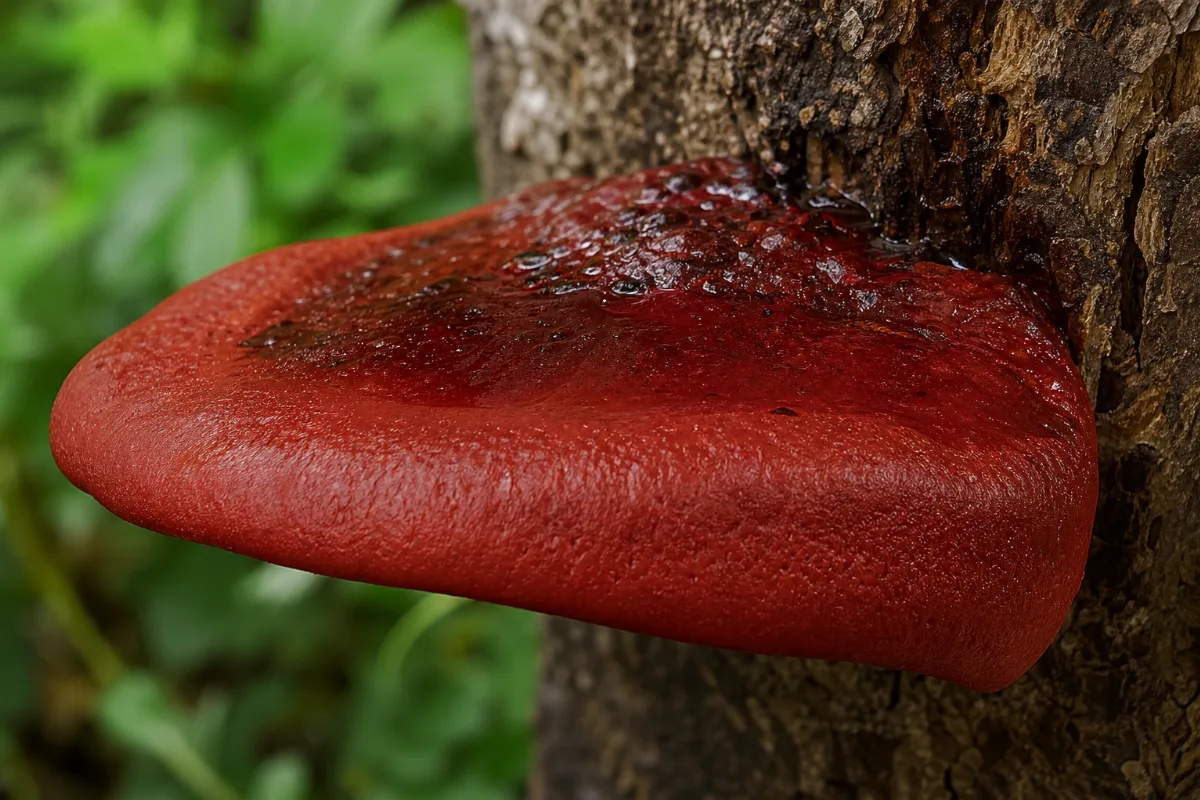
Mushrooms · Wild culinary fungus
Beefsteak fungus
Fistulina hepatica · also called Ox tongue fungus, beefsteak polypore, langue de boeuf (French), Ochsenzunge (German), hongo bistec (Spanish)
Beefsteak fungus is a red, tongue-shaped wild bracket that grows on oaks and sweet chestnuts. Young ones are eaten as a tart wild food. We found no study in people, only laboratory work on its chemistry, antioxidant tests and germ-killing compounds in dishes. The most important caution: wild fungi can poison you if you pick the wrong one, and this page cannot help you identify one.
General information, not medical advice. Last substantive update · Not medically reviewed. A named clinician has not signed off on this page. How this page is made
About Beefsteak fungus
Beefsteak fungus (Fistulina hepatica) is a wild bracket eaten young and cooked. We found no study in people. Laboratory work shows antioxidant behaviour that is mixed, and germ-killing compounds in dishes. None of this shows a health benefit. The main cautions are wild-mushroom identification and the lack of any safety data.
What it is
Beefsteak fungus is a red, soft bracket that grows low on oaks and sweet chestnuts, and it rots the wood from the inside (brown rot). It was first described in 1784. Its accepted name in GBIF is Fistulina hepatica, in the fungus family Fistulinaceae.
A 2022 study split samples from East Asia and North America that were once called F. hepatica into two new species, Fistulina americana and Fistulina orientalis. So older papers may describe a different species than the one in your area.
As a food, and traditional use
A naturalist source says young, fresh brackets are edible and best simmered slowly, and that the taste is acidic and bitter rather than like beef. We found no source for any traditional medicine use, so we do not claim one.
Nutrition data are thin. A Portuguese study ranked it lowest of 11 wild species for free amino acids. A Sicilian study measured basic composition but the abstract has no numbers for this species.
What the research shows
All the research is from the laboratory. An extract of wild fruiting body scavenged some radicals in test tubes but acted as a pro-oxidant against another. Solvent extracts and isolated polyacetylene compounds blocked bacteria and a lab yeast in dishes, and several extracts raised the effect of antibiotics against MRSA. Water extracts were weak.
One 2026 review mentions a single cell-line report on a culture-made polysaccharide. A result in a dish does not show what happens in a body. Do not use beefsteak fungus to treat an infection or cancer.
Fruiting body, mycelium and extracts
The antioxidant work used wild fruiting bodies, the antifungal feldin work used a culture extract, and the antibacterial work used solvent extracts. We found no powder, capsule or mycelium-on-grain product with data, so no result here applies to a supplement.
Legal and regulatory status
We did not read any regulator statement about this species, so none is stated here. Rules differ by country and change.
At a glance
Traditional uses history, not proof
- Eaten as a wild food when young and fresh; simmered slowly (First Nature, a naturalist website).
- Oak wood infected by it is prized by woodworkers as "brown oak" (First Nature).
- We found no source for any traditional medicine use.
Studied for research
- Any health effect in people, insufficient (no human study found)
- Antioxidant activity in test tubes, very low (lab only, mixed)
- Antibacterial and antifungal activity in dishes, very low (lab only)
- Cancer cells in a dish, insufficient (one report seen only through a review)
- As a food (nutrition), insufficient
- Flavour and aroma, not a health effect
Main compounds
- Ellagic acid, the main phenolic
- Organic acids such as malic acid (oxalic acid is among them)
- Polyacetylene compounds and a polyyne called feldin, studied for germ-killing activity in dishes
Common forms
- Fresh young fruiting body, cooked (the only form in use)
- No powder, capsule or extract with data was found
- Lab extracts and cultures exist only in research
Research links: Beefsteak fungus: GBIF taxonomy record · First Nature: naturalist guide to this fungus · Phenolics and antioxidant tests (abstract) · Antibacterial screen of wild mushroom extracts (abstract) · Mercury in wild edible mushrooms (abstract) · Two new Fistulina species (abstract) · Research Library · Genes & Biomarkers Library
What it is and its history
- Accepted scientific name
- Fistulina hepatica
- Naming authority
- (Schaeff.) With. (GBIF)
- Synonyms
- Boletus hepaticus Schaeff. (the 1784 original name, per First Nature; GBIF lists it as a synonym); Fistulina buglossoides Bull.; Hypodrys hepaticus (Schaeff.) Pers.; Confistulina hepatica (Lloyd) Stalpers; Fistulina endoxantha Speg. (listed as a synonym by GBIF; some papers treat it as a separate species)
- Common names
- Beefsteak fungus (English); Ox tongue fungus (English); Ochsenzunge, Leberreischling (German); Langue de boeuf, Fistuline hépatique (French); Hongo bistec (Spanish)
- Family or group
- Fistulinaceae (a fungus family), not a plant
- Classification
- Fungi > Basidiomycota > Agaricomycetes > Agaricales > Fistulinaceae > Fistulina > Fistulina hepatica
- Native range
- First Nature says it is widespread in Britain and Ireland, found throughout mainland Europe and in parts of North America. A 2022 paper says samples from East Asia and North America once called this species are now two other species.
- Habitat
- A bracket usually low on the trunks of oaks and sweet chestnuts, seen July to October in Britain (First Nature). It is a brown-rot wood decayer (Floudas 2015).
- What it looks like
- Fruiting body: Reddish, tongue- or liver-shaped bracket; separate (not fused) tubes distinguish the genus (First Nature). Not enough to identify a fungus and not meant to be used that way.
- Cultivation
- Not checked.
- Harvest and processing
- Not checked.
- Look-alikes and adulterants
- Name: Inonotus hispidus; Note: First Nature names it as a similar large reddish-orange bracket. We give no way to tell them apart.; Name: Fistulina americana and Fistulina orientalis; Note: Two species described in 2022 from samples once called F. hepatica (North-east USA and East Asia).
- Sustainability and conservation
- Not checked.
Traditional use and history history, not clinical proof
| Tradition or era | Documented use | Source |
|---|---|---|
| Naming history | Described in 1784 by Jacob Christian Schaeffer as Boletus hepaticus, and given its present scientific name in 1792 by William Withering. It is the type species of the genus Fistulina (First Nature). | s-first-nature |
| Food use | Young, fresh brackets are edible and best simmered slowly; the taste is acidic and bitter and does not match the look of a beefsteak (First Nature). We found no source for a traditional medicine use. | s-first-nature |
| Wood | Oak timber infected by this fungus is called brown oak and is valued by woodworkers (First Nature). | s-first-nature |
Traditional use shows how it was used. It does not show that it works or is safe today.
What is inside, and how it may work
What it contains and how those compounds act in cells and animals. Laboratory and animal mechanisms are not proven effects in people.
Main compounds
| Compound | Family | Where it is concentrated | Activity studied | Level of evidence |
|---|---|---|---|---|
| Ellagic acid PubChem 5281855 | phenolic acid | Fruiting body About 49.7% of the phenolics measured (share, not an amount). | Main phenolic of the fruiting body; antioxidant activity in test tubes (Ribeiro 2007). 11 | Laboratory research |
| Quercetin, hyperoside, caffeic acid and p-coumaric acid | phenolics | Fruiting body Not given in the abstract. | Reported in the phenolic profile (PubChem CIDs: quercetin 5280343, hyperoside 5281643, caffeic acid 689043, p-coumaric acid 637542). 11 | Laboratory research |
| Malic, oxalic, citric, aconitic, ascorbic and fumaric acids | organic acids | Fruiting body Malic acid about 57.9% of the organic acids (share, not an amount). | Organic acid profile (malic acid CID 525; oxalic acid CID 971). Oxalic acid is listed among the six. 11 | Laboratory research |
| Polyacetylene fatty acids (cinnatriacetins A to C, isocinnatriacetins A and B, ethylcinnatriacetin A) | polyacetylene | Fruiting body Not given in the abstracts. | Antibacterial in dishes against ESKAPE bacteria; MICs set for two of them (Whaley 2023). 16 15 | Laboratory research |
| Feldin | polyyne | Culture (mycelium) extract Not given. | Antifungal against a lab yeast (Lee 2020). 7 | Laboratory research |
Mechanisms, receptors and pathways
| Target or pathway | Gene or receptor | What was found | Level |
|---|---|---|---|
| Free-radical chemistry and xanthine oxidase | xanthine oxidase (enzyme) | In the lab, the extract scavenged DPPH and superoxide radicals and inhibited xanthine oxidase, but acted as a pro-oxidant against hydroxyl radical, possibly by reducing iron ions. 11 | Laboratory research |
| Antifungal activity | unknown | Feldin inhibited a lab yeast much more than a smut fungus. The mechanism was not described in the abstract. 7 | Laboratory research |
| Wood decay | cellulose and lignin degradation genes | Genome work shows a brown-rot wood decayer with cellulose-degrading genes still present and four wood-degradation genes showing signs of pseudogenization. 4 | Genomic |
Absorption, metabolism and elimination
- Absorption
- Not found.
- Distribution
- Not found.
- Metabolism
- Not found.
- Elimination
- Not found.
- Bioavailability
- Not established.
Isolated compounds versus whole extracts
The lab work used solvent extracts, culture extracts and isolated compounds, none of which is the cooked mushroom. Water extracts were weak in the one screen that compared them (Liktor-Busa 2016). We found no consumer powder, capsule or extract with any data.
Nutritional composition
It is a wild food, not a supplement. USDA FoodData Central had no entry in our earlier reading, and the abstracts give no usable per-species amounts. One study ranked it lowest of 11 wild species for free amino acids.
2 very low certainty4 not enough evidence
What was looked at
The 6 benefits and uses checked for Beefsteak fungus, each with how strong the evidence is. Tap one to open it.
- Any health effect in peopleNot enough evidence
- Antioxidant activity in test tubesVery low certainty
- Antibacterial and antifungal activity in dishesVery low certainty
- As a food (nutrition)Not enough evidence
- Cancer-cell studiesNot enough evidence
- Flavour and aroma (not a health effect)Not enough evidence
Lab markers tracked in the studies
DPPH radical scavenging (test tube)Minimum inhibitory concentration (MIC) against bacteriaFree amino acid content of the mushroom
What is Beefsteak fungus good for?
What has been studied and how strong the evidence is. For this fungus none of it comes from people. Read this together with the Safety tab.
Benefits, one by one
Each card is a research question, not a promise. Tap a goal to filter. Open a card to see the studies, doses and limits.
Any health effect in people
Not enough evidenceWe found no study in people. Everything known about health-related effects comes from test tubes and dishes, and most of it is about chemistry.
2 studiesNot applicable.
Studies, doses and limits
What the trials found
A PubMed search on 2026-10-25 for Fistulina or "beefsteak fungus" returned 26 records. None was a trial, case report or observational study in people.
Results
No human result exists.
Why this rating
There is no human research at all. Absence of research is not proof of no effect, or of safety.
Limits
Lab and chemistry papers cannot be turned into advice for eating it.
Why researchers looked
Beefsteak fungus is mainly a wild food, so little work has asked whether it affects health.
Traditional use
We found no source that describes a traditional medicine use. It was eaten as a wild food.
Proposed mechanism None
Not applicable: no human study to explain.
A proposed mechanism does not show that the effect happens in people.
Wild-mushroom safety comes first. See the Safety tab.
Antioxidant activity in test tubes
Very low certaintyIn laboratory tests, an extract of wild beefsteak fungus mopped up some free radicals, blocked an enzyme called xanthine oxidase, and acted as a pro-oxidant against another radical. This is chemistry in a dish, not a health benefit.
1 studiesExtract of wild fruiting body in the lab; no product tested.
Studies, doses and limits
Results
Good activity against DPPH radical (concentration-dependent) and against superoxide radical (scavenger and xanthine oxidase inhibitor). Pro-oxidant effect on hydroxyl radical. Little iron chelation. Weak protection against hypochlorous acid.
Effect sizes as reported
Mixed: good against two radicals, bad or weak against two others
Why this rating
Test-tube chemistry on one set of wild-collected samples. Test-tube antioxidant activity does not show that eating or taking something changes antioxidant status in people.
Form and dose studied
Extract of wild fruiting body in the lab; no product tested.
Limits
One study; no animal or human follow-up found; mixed result including a pro-oxidant effect.
Why researchers looked
The researchers described its chemistry and tested how it behaves with free radicals in the lab.
Proposed mechanism Laboratory research
Free-radical scavenging and xanthine oxidase inhibition in vitro; the pro-oxidant effect against hydroxyl radical may come from reducing iron ions (Ribeiro 2007 abstract). Laboratory finding only.
A proposed mechanism does not show that the effect happens in people.
None specific; see the Safety tab for wild-mushroom risks.
Antibacterial and antifungal activity in dishes
Very low certaintyExtracts of beefsteak fungus, and compounds isolated from it, stopped some bacteria and yeasts growing in laboratory dishes, and made an antibiotic work better against MRSA in dishes. Nobody has tested whether this does anything in an animal or a person.
6 studiesMethanol, chloroform and ethyl acetate extracts, cultures and isolate…
Studies, doses and limits
Results
A methanol-water extract inhibited several bacteria and killed three species at MBCs of 20, 10 and 5 mg per ml (Alves 2012). Fistulina hepatica extracts were among the best at increasing the effect of antibiotics against MRSA in dishes (Alves 2014; Liktor-Busa 2016, cefuroxime). A culture extract and the compound feldin blocked a lab yeast much more than a smut fungus (Lee 2020). Isolated polyacetylene compounds were screened against ESKAPE bacteria (Whaley 2023).
Effect sizes as reported
Dish results only; strength varies by solvent. Water extracts were weak.
Why this rating
Dish and solvent-extract work only, with no animal or human data. Water extracts, the closest thing to cooking, were weak in the one screen that compared them.
Form and dose studied
Methanol, chloroform and ethyl acetate extracts, cultures and isolated compounds, none of which a person eats.
Limits
Concentrations used in dishes are not what a person reaches by eating the mushroom. Mushroom extracts are not antibiotics and must not replace medical treatment.
Why researchers looked
Fungi make chemicals to defend themselves from microbes, so researchers screen them for antibiotic-like compounds.
Proposed mechanism Laboratory research
Polyacetylene fatty acids (cinnatriacetins and related compounds) and a polyyne called feldin were isolated. Their mechanism was not described in the abstracts. Laboratory finding only.
A proposed mechanism does not show that the effect happens in people.
Do not use this as a reason to self-treat an infection. See the Safety tab.
As a food (nutrition)
Not enough evidenceIt is eaten young and cooked as a wild food. Published nutrition data are thin: one Sicilian study analysed its basic composition without numbers in the abstract, and a Portuguese study ranked it lowest of 11 wild species for free amino acids.
4 studiesFresh young fruiting body, cooked. No powder or capsule with data fou…
Studies, doses and limits
Results
Free amino acids: F. hepatica was the poorest of 11 species (Ribeiro 2008). Sicily: basic composition measured, no figures in the abstract (Palazzolo 2012). USDA FoodData Central had no entry on 2026-10-25 per our earlier reading (summary-only).
Why this rating
Few measurements, none in people, and the abstracts give no usable numbers for this species.
Form and dose studied
Fresh young fruiting body, cooked. No powder or capsule with data found.
Limits
Wild samples vary by place and season. Oxalic acid is present among its organic acids (Ribeiro 2007), but no amount is available from the abstract.
Why researchers looked
Local communities eat wild fungi, so researchers measured what they contain.
Traditional use
Eaten as a wild food (First Nature). No traditional medicine use found.
Proposed mechanism None
Not applicable: a food, not a mechanism.
A proposed mechanism does not show that the effect happens in people.
See the Safety tab: wild-mushroom identification and contamination come first.
Cancer-cell studies
Not enough evidenceA 2026 review reports that a polysaccharide made from a liquid culture of this fungus reduced the survival of rat brain-tumour cells in a dish. Nothing is known in animals or people, so this is not a treatment.
1 studiesPolysaccharide from liquid culture, not the food.
Studies, doses and limits
Results
One cell-line report is mentioned (carried over from an earlier reading; the underlying paper was not found or opened).
Effect sizes as reported
Not given here
Why this rating
Single cell-line report seen only through a review summary; no animal or human work.
Form and dose studied
Polysaccharide from liquid culture, not the food.
Who was studied
Cells in a dish
Limits
A result in a dish does not show what happens in a body. The underlying paper was not read.
Why researchers looked
Wood-rotting fungi are screened for polysaccharides and other compounds that affect tumour cells in the lab.
Proposed mechanism Laboratory research
Not described in what we read. Laboratory finding only.
A proposed mechanism does not show that the effect happens in people.
Do not use beefsteak fungus instead of cancer treatment. Ask your doctor about any complementary product.
Flavour and aroma (not a health effect)
Not enough evidenceFlavour studies of wild mushrooms found mushroom-like and fruity aroma compounds. This is about taste only. A naturalist source calls the taste acidic and slightly bitter.
2 studiesFresh fruiting body.
Studies, doses and limits
What the trials found
A trained sensory panel was used across 11 species; no health outcome.
Results
Not specific to this species in the abstract.
Why this rating
Taste is not a health benefit; included because people ask.
Form and dose studied
Fresh fruiting body.
Who was studied
Sensory panel (food study)
Limits
Not a health claim.
Why researchers looked
To explain why edible fungi taste the way they do.
Traditional use
Eaten as a meat stand-in because of how it looks; the taste is not like meat (First Nature).
Proposed mechanism Laboratory research
Volatile compounds such as C8 alcohols and ketones drive "mushroom-like" aroma across species (de Pinho 2008). Per-species results are not in the abstract.
A proposed mechanism does not show that the effect happens in people.
None specific.
Connections to the rest of health
How Beefsteak fungus connects to the rest of our health knowledge graph. Every link says what kind of connection it is. A safety link (for example to the liver) is a warning, not a benefit. A study that merely mentions a topic never creates a benefit link.
Explore every connection: goals, body systems, organs, symptoms, genes
B. Body systems
| Connected to | Kind of connection | Evidence status | Context | Studies |
|---|---|---|---|---|
| Antioxidant activity (test tube) | Preliminary mechanism | Very low certainty | Scavenged some radicals; pro-oxidant against hydroxyl radical; lab only. Preparation or compound: Wild fruiting body extract |
11 |
E. Health conditions
| Connected to | Kind of connection | Evidence status | Context | Studies |
|---|---|---|---|---|
| Wild-mushroom poisoning (mistaken identity) | Adverse effect or risk | Not enough evidence | A general risk of picking wild fungi; no case was found for this species. Preparation or compound: Wild-picked fruiting body |
3 |
I. Biomarkers
| Connected to | Kind of connection | Evidence status | Context | Studies |
|---|---|---|---|---|
| DPPH radical scavenging (test tube) | Biological association | Very low certainty | Measured in trials: raised (in the test tube). A lab change is not the same as a health benefit. | 11 |
| Minimum inhibitory concentration (MIC) against bacteria | Biological association | Very low certainty | Measured in trials: growth lowered (in dishes). A lab change is not the same as a health benefit. | 1 8 |
| Free amino acid content of the mushroom | Biological association | Not enough evidence | Measured in trials: lowest of 11 species. A lab change is not the same as a health benefit. | 12 |
J. Genes, receptors and enzymes
| Connected to | Kind of connection | Evidence status | Context | Studies |
|---|---|---|---|---|
| Xanthine oxidase | Preliminary mechanism | In vitro | Inhibited by the fruiting body extract in test tubes. | 11 |
L. Active compounds
| Connected to | Kind of connection | Evidence status | Context | Studies |
|---|---|---|---|---|
| Ellagic acid | Biological association | In vitro | Main phenolic of the fruiting body; antioxidant activity in test tubes (Ribeiro 2007). Preparation or compound: Fruiting body |
11 |
| Quercetin, hyperoside, caffeic acid and p-coumaric acid | Biological association | In vitro | Reported in the phenolic profile (PubChem CIDs: quercetin 5280343, hyperoside 5281643, caffeic acid 689043, p-coumaric acid 637542). Preparation or compound: Fruiting body |
11 |
| Malic, oxalic, citric, aconitic, ascorbic and fumaric acids | Biological association | In vitro | Organic acid profile (malic acid CID 525; oxalic acid CID 971). Oxalic acid is listed among the six. Preparation or compound: Fruiting body |
11 |
| Polyacetylene fatty acids (cinnatriacetins A to C, isocinnatriacetins A and B, ethylcinnatriacetin A) | Biological association | In vitro | Antibacterial in dishes against ESKAPE bacteria; MICs set for two of them (Whaley 2023). Preparation or compound: Fruiting body |
16 15 |
| Feldin | Biological association | In vitro | Antifungal against a lab yeast (Lee 2020). Preparation or compound: Culture (mycelium) extract |
7 |
Each connection is stored with the ingredient, the connected record, the kind of connection, the evidence status, the supporting studies, the preparation or compound involved, and a review date (last reviewed October 25, 2026).
Evidence at a glance: what the research found for 6 outcomes
Each outcome below is one thing researchers measured. Certainty is how far the evidence can be trusted, not how well it works. The full studies are on the next tab.
The evidence
The research centre for Beefsteak fungus. Every record here was checked against PubMed or the publisher's page; we never list a study we have not verified.
Evidence by outcome
Bars show how many studies we found for each outcome, not how well it works. People are added up across trials only (reviews are not added, to avoid double counting).
How we rate evidence
High certainty
Several well-run trials or reviews agree; further research is unlikely to change the picture much.
Moderate certainty
Good trials point the same way, but some doubt remains.
Low certainty
Small, short or inconsistent trials. The finding could change with better research.
Very low certainty
Very little or very weak human data. Treat as a possibility only.
Mixed findings
Trials or reviews disagree with each other.
Not enough evidence
Not enough human research to say either way.
Evidence against
Good research found no benefit, or found harm.
We take the reviewers' own risk-of-bias and GRADE statements where they exist, and otherwise judge from study size, design, consistency, directness and whether a product matches what is sold. Many publications do not make evidence high. Method note: We read PubMed records and abstracts for 15 papers (laboratory chemistry and antimicrobial work, composition and metal studies, a naming study and a genome study) and the title only of one older paper with no abstract. We also read the First Nature guide in full and checked the accepted name in GBIF. A 2026 review is cited in summary only. Only abstracts were read for papers, so numbers come from abstracts. Certainty ratings are the compiler's own reading.
Study library: every study we checked 19
| Study | Design | People | Product, dose, length | Result |
|---|---|---|---|---|
| Alves 2012 Antimicrobial activity of wild mushroom extracts against clinical isolates resistant to different antibiotics. J Appl Microbiol · PMID 22621239 · DOI |
Laboratory research fungus and bacteria in vitro |
Aqueous methanolic extracts of 13 wild mushroom species tested on clinical bacterial isolates (Portugal) | Aqueous methanolic extract of Fistulina hepatica (one of 13 species) Fruiting body |
Russula delica and Fistulina hepatica extracts inhibited growth of Gram-negative (E. coli, Morganella morganii, Pasteurella multocida) and Gram-positive bacteria (S. aureus, MRSA, E. faecalis, Listeria monocytogenes, Streptococcus agalactiae, S. pyogenes). Both extracts killed Pasteurella multocida, S. agalactiae and S. pyogenes at MBCs of 20, 10 and 5 mg per ml. The authors called Fistulina hepatica, Ramaria botrytis and Russula delica the most promising species. Growth of several bacteria blocked by the extract in dishes Methods, limits and fundingOutcomes: Minimum inhibitory (MIC) and minimum bactericidal concentrations (MBC) against resistant clinical isolates Limitations: Concentrations in dishes are far above what a person could reach by eating; no animal or human data. Laboratory work only; it does not show what happens in a body. Funding and conflicts: Non-US government research support per the PubMed record; no industry funding shown Read: abstract |
| Alves 2014 Wild mushroom extracts potentiate the action of standard antibiotics against multiresistant bacteria. J Appl Microbiol · PMID 24107088 · DOI |
Laboratory research fungus and bacteria in vitro |
Wild mushroom extracts combined with standard antibiotics against resistant bacteria (E. coli, ESBL E. coli, MRSA) | Wild mushroom extracts, including Fistulina hepatica, plus antibiotics Fruiting body |
Synergistic effects were higher against MRSA than against E. coli. Mycena rosea and Fistulina hepatica were the best extracts for synergy against MRSA. Extract plus antibiotic worked better than antibiotic alone in dishes (MRSA) Methods, limits and fundingOutcomes: Synergy with antibiotics (MICs by microdilution) Limitations: Lab test only; the authors suggest extracts might lower antibiotic doses but this was not tested in any animal or person. Laboratory work only; it does not show what happens in a body. Funding and conflicts: Non-US government research support per the PubMed record Read: abstract |
| First Nature (volunteer-run natural history website) 2026 First Nature: Fistulina hepatica, Beefsteak Fungus (naturalist identification guide, read in full 2026-10-25) n/a · Source |
Authoritative guidance fungus |
n/a | n/a |
Describes the fungus as a parasitic bracket on oaks and sweet chestnuts, with a bitter, acidic taste. Says young, fresh specimens are edible and best simmered slowly, but that the taste does not live up to the look. Notes oak timber infected by it is valued by woodworkers as brown oak. Names Inonotus hispidus as a similar large reddish-orange bracket. Gives its history of naming (1784 Schaeffer, 1792 Withering). Methods, limits and fundingOutcomes: Describes the fungus as a parasitic bracket on oaks and sweet chestnuts, with a bitter, acidic taste. Says young, fresh specimens are edible and best simmered slowly, but that the taste does not live up to the look. Notes oak timber infected by it is valued by woodworkers as brown oak. Names Inonotus hispidus as a similar large reddish-orange bracket. Gives its history of naming (1784 Schaeffer, 1792 Withering). Limitations: A naturalist website, not a medical or toxicology source; no safety testing. Identification details in it are not reproduced here and must not be used to pick wild fungi from text. Funding and conflicts: Volunteer-run site; asks for donations Read: full text |
| Floudas 2015 Evolution of novel wood decay mechanisms in Agaricales revealed by the genome sequences of Fistulina hepatica and Cylindrobasidium torrendii. Fungal Genet Biol · PMID 25683379 · DOI |
Genomics fungus |
Genome sequences of Fistulina hepatica and Cylindrobasidium torrendii with wood decay experiments | Not applicable (genome and wood-decay study) Mycelium on wood |
F. hepatica shows characteristics of brown rot both in its wood decay genes and in the decay it causes. Genes for cellulose breakdown are still present, and four wood-degradation genes show signs of pseudogenization, so the move towards a brown-rot way of life could be ongoing. Brown-rot wood decayer Methods, limits and fundingOutcomes: Wood decay genes and decay type Limitations: About how the fungus rots wood, not about food or health. Funding and conflicts: US NIH and other public research support per the PubMed record Read: abstract |
| García 2009 Lead in edible mushrooms: levels and bioaccumulation factors. J Hazard Mater · PMID 19217716 · DOI |
Observational fungus |
238 samples of 28 wild edible species from Lugo, north-west Spain | Lead in wild mushroom fruiting bodies Fruiting body |
The lowest mean lead contents were in Agaricus bisporus and Fistulina hepatica (0.41 in the tube layer, the hymenophore, and 0.50 in the rest of the fruiting body, mg/kg dry weight). All species kept lead out relative to the soil (BCF below 1). The authors concluded these mushrooms are not a lead risk. Low lead in this species at these sites Methods, limits and fundingOutcomes: Lead concentration and bioaccumulation factor Limitations: One region of Spain, 2005 and 2006 samples. Funding and conflicts: Non-US government research support per the PubMed record Read: abstract |
| Grodzinskaya 2019 Radiocesium (137Cs) and Mineral Elements in Culinary-Medicinal Mushrooms from the Southern Outskirts of Kyiv, Ukraine. Int J Med Mushrooms · PMID 30806257 · DOI |
Observational fungus |
Mushrooms from the southern outskirts of Kyiv, Ukraine | Radiocesium (137Cs) in 14 species, including Fistulina hepatica Fruiting body |
Radiocesium was measured in fruit bodies of 14 species collected in 2015, F. hepatica among them. The authors said the data suggest safe levels of radiocesium and some essential and toxic elements. The abstract does not give a number for F. hepatica, and the mineral-element work in this paper covered other species. No species-specific number in the abstract Methods, limits and fundingOutcomes: Radiocesium activity Limitations: Single area; abstract is general. Used only to show that this species has been tested for radiocesium. Funding and conflicts: Not stated in the abstract Read: abstract |
| Lee 2020 Identification of Feldin, an Antifungal Polyyne from the Beefsteak Fungus Fistulina hepatica. Biomolecules · PMID 33142735 · DOI |
Laboratory research fungus (culture) and yeast |
Cultures of 35 mushroom species screened; one extract followed up (named in the title as Fistulina hepatica) | Ethyl acetate crude extracts of mushroom cultures; compound feldin isolated Culture (mycelium) extract · vs Baker's yeast (S. cerevisiae) versus a smut fungus (U. maydis) |
One extract inhibited the yeast much more than the smut fungus. Bioactivity-guided fractionation found a polyyne the authors named feldin, which showed prominent antifungal activity. Antifungal activity against a lab yeast Methods, limits and fundingOutcomes: Growth of the yeast Saccharomyces cerevisiae and the plant fungus Ustilago maydis Limitations: Tested on lab yeasts, not on human pathogens or people; the abstract gives no figures. Culture extract, not the food. Laboratory work only; it does not show what happens in a body. Funding and conflicts: German research council and state grants per the PubMed record; no industry funding shown Read: abstract |
| Liktor-Busa 2016 Investigation of Hungarian mushrooms for antibacterial activity and synergistic effects with standard antibiotics against resistant bacterial strains. Lett Appl Microbiol · PMID 27100065 · DOI |
Laboratory research fungus and bacteria in vitro |
160 extracts of 40 Hungarian mushroom species tested on bacteria | Hexane, chloroform, 50% methanol and aqueous extracts; Fistulina hepatica among them Fruiting body |
16 of 40 species had antibacterial effects. Chloroform extracts were the most active; aqueous and aqueous-methanolic extracts had low or no activity. Fistulina hepatica, Tapinella atrotomentosa and Rhodocybe popinalis were the most active species and each increased the effect of cefuroxime against MRSA. Strong antibacterial screen result for the chloroform extract; synergy with cefuroxime against MRSA Methods, limits and fundingOutcomes: Antibacterial activity (disc diffusion, MIC) and synergy with antibiotics (checkerboard) Limitations: Solvent extracts a person cannot make by eating or cooking; the water extracts were weak. Laboratory work only; it does not show what happens in a body. Funding and conflicts: No industry funding shown in the PubMed record; full text not read. Read: abstract |
| Melgar 2009 Mercury in edible mushrooms and underlying soil: bioconcentration factors and toxicological risk. Sci Total Environ · PMID 19631362 · DOI |
Observational fungus |
238 samples of 28 wild edible species from Lugo, north-west Spain | Mercury in wild mushroom fruiting bodies and underlying soil Fruiting body |
The lowest mean mercury was in Agrocybe cylindrica (0.34 in the tube layer, the hymenophore, and 0.26 in the rest of the fruiting body) and Fistulina hepatica (0.30 and 0.22 mg/kg dry weight in the same two parts). All species accumulated mercury relative to the soil (BCF above 1). The authors concluded that eating most of the species is not a mercury risk, with a few high-mercury species eaten only in low amounts. Low mercury in this species at these sites Methods, limits and fundingOutcomes: Mercury concentration and bioconcentration factor Limitations: One region of Spain; still concentrates mercury compared with the soil. Funding and conflicts: Non-US government research support per the PubMed record Read: abstract |
| Palazzolo 2012 The nutritional composition of selected wild edible mushrooms from Sicily (southern Italy). Int J Food Sci Nutr · PMID 21749273 · DOI |
Compositional analysis fungus |
Wild edible mushrooms from Sicilian forests, including Fistulina hepatica | Wild Fistulina hepatica and four other species, analysed for basic composition Fruiting body |
The five mushrooms were analysed for ash, water, protein, fat, carbohydrate and vitamin content. The authors concluded they could be suggested as a source of nutritional elements. The abstract gives no values for individual species. No numbers in the abstract Methods, limits and fundingOutcomes: Ash, water, protein, fat, carbohydrate and vitamin content Limitations: Abstract has no numbers, so we cannot give any for this species. Composition of wild samples varies with place and season. Funding and conflicts: Not stated in the abstract Read: abstract |
| Ribeiro 2007 Phenolic compounds, organic acids profiles and antioxidative properties of beefsteak fungus (Fistulina hepatica). Food and Chemical Toxicology · PMID 17493733 · DOI |
Laboratory research fungus |
Wild-collected fruiting bodies of Fistulina hepatica (laboratory analysis) | Extract of wild Fistulina hepatica fruiting body Fruiting body |
Five phenolic compounds (caffeic, p-coumaric and ellagic acids, hyperoside, quercetin) and six organic acids (oxalic, aconitic, citric, malic, ascorbic, fumaric). Ellagic acid was about 49.7% of the phenolics and malic acid about 57.9% of the organic acids. It scavenged DPPH in a concentration-dependent way and superoxide (as a scavenger and xanthine oxidase inhibitor). It acted as a pro-oxidant against hydroxyl radical, chelated iron only a little, and protected only weakly against hypochlorous acid. Good scavenging of two radicals, a pro-oxidant effect against another, weak against a fourth Methods, limits and fundingOutcomes: Phenolic compounds and organic acids (HPLC); scavenging of free radicals (DPPH, superoxide, hydroxyl, hypochlorous acid); xanthine oxidase; iron chelation Limitations: Test-tube chemistry on wild-collected samples; shares of a group are not amounts per serving; no animal or human data. Laboratory work only; it does not show what happens in a body. Funding and conflicts: Non-US government research support per the PubMed record Read: abstract |
| Ribeiro 2008 Comparative study on free amino acid composition of wild edible mushroom species. J Agric Food Chem · PMID 18942845 · DOI |
Compositional analysis fungus |
11 wild edible mushroom species from Portugal, including Fistulina hepatica | Free amino acids (HPLC) in 11 species Fruiting body |
Twenty free amino acids were measured. Boletus edulis and Tricholoma equestre were the most nutritious species, whereas F. hepatica was the poorest. Alanine was generally the main amino acid. The authors said the species have moderate amino acid contents overall. Beefsteak fungus ranked lowest of 11 species for free amino acids Methods, limits and fundingOutcomes: Free amino acid profile Limitations: Free amino acids are only one part of protein value; no amounts for this species in the abstract. Funding and conflicts: Not stated in the abstract Read: abstract |
| Roszczenko 2026 Anticancer Properties of Selected Wood-Inhabiting Fungi (review, Nutrients, 2026) Nutrients · Source · DOI |
Review cells (rat brain-tumour cell line, per the earlier reading) |
Cell-line and animal research on wood-inhabiting fungi | Fungal extracts and polysaccharides (review) Various |
The DOI and abstract exist (checked in Crossref on 2026-10-25). The abstract does not name beefsteak fungus. Our earlier reading of the full text, carried over unchanged and not re-opened this round, reported a single cell-line report on polysaccharides from liquid cultures of this species and nothing in animals or people. Methods, limits and fundingOutcomes: Cell-line anticancer research on wood-inhabiting fungi Limitations: Summary-only for the beefsteak claim: the underlying cell-line paper was not found or read. Cell results do not show a treatment effect. Funding and conflicts: Not read Read: summary-only |
| Sarikurkcu 2020 Metal concentration and health risk assessment of wild mushrooms collected from the Black Sea region of Turkey. Environ Sci Pollut Res Int · PMID 32363460 · DOI |
Observational fungus |
Wild mushrooms from hazelnut gardens in the eastern Black Sea region of Turkey (Arsin, Trabzon), free of industrial pollution | Metals (Cd, Co, Cu, Fe, Mn, Ni, Pb, Zn) in wild mushroom fruiting bodies Fruiting body |
Daily intakes of all the elements were below the reference dose in Fistulina hepatica, Hydnum repandum, Macrolepiota procera and Tapinella atrotomentosa. Other species, including Ganoderma lucidum and Cantharellus cibarius, had high risk index values especially for Cd, Co and Pb. Concentration ranges across all species were 0.29 to 9.11 (Cd) up to 63.0 to 7769.0 (Zn) mg/kg dry weight; the abstract does not give figures for F. hepatica alone. Metal intake below the reference dose for this species at this site Methods, limits and fundingOutcomes: Metal concentrations, daily intake and health risk index Limitations: One region, few samples of each species, and the result depends on the intake assumed; says nothing about polluted places. Funding and conflicts: Not stated in the abstract Read: abstract |
| Tsuge 1999 Cinnatriacetins A and B, new antibacterial triacetylene derivatives from the fruiting bodies of Fistulina hepatica. J Antibiot (Tokyo) · PMID 10470684 · DOI |
Laboratory research fungus |
Fruiting bodies of Fistulina hepatica (chemistry paper) | Cinnatriacetins A and B, triacetylene compounds Fruiting body |
The PubMed record has no abstract, so only the title was read: it reports two new antibacterial triacetylene compounds (cinnatriacetins A and B) from the fruiting bodies. Antibacterial compounds named; no figures read Methods, limits and fundingOutcomes: Title only: new antibacterial triacetylene derivatives from the fruiting bodies Limitations: Only the title was read; no numbers taken from it. Laboratory work only; it does not show what happens in a body. Funding and conflicts: Not stated in the record Read: title only |
| Whaley 2023 Polyacetylene Derivatives from the Polypore Fungus (Fistulina hepatica, Agaricomycetes) and Their Antimicrobial Activity. Int J Med Mushrooms · PMID 37947063 · DOI |
Laboratory research fungus and bacteria in vitro |
Fruiting bodies of Fistulina hepatica (laboratory chemistry and antibacterial screen) | Five isolated polyacetylene fatty acid compounds Fruiting body |
Five compounds were isolated, four of them new (isocinnatriacetin A and B, cinnatriacetin C, ethylcinnatriacetin A) plus cinnatriacetin A. All five were screened against ESKAPE bacterial strains in vitro; minimum inhibitory concentrations were set for the most active two (compounds 3 and 4). Antibacterial activity of isolated compounds in dishes Methods, limits and fundingOutcomes: Compound structures; antibacterial zones of inhibition and minimum inhibitory concentrations against ESKAPE bacterial strains Limitations: Abstract gives no MIC numbers; isolated compounds, not the whole mushroom or the food. Laboratory work only; it does not show what happens in a body. Funding and conflicts: No industry funding shown in the PubMed record; full text not read. Read: abstract |
| Zhou 2022 Two new species of Fistulina (Agaricales, Basidiomycota) from the Northern Hemisphere. Front Microbiol · PMID 36569068 · DOI |
Taxonomy study fungus |
Samples of Fistulina from East Asia and North America (DNA and structure) | Not applicable (naming study) Fruiting body |
Two new species were described, Fistulina americana (on Quercus in north-east USA) and Fistulina orientalis (on Castanopsis in East Asia). Both were previously known as Fistulina hepatica. Two former F. hepatica groups are now separate species Methods, limits and fundingOutcomes: Species boundaries within Fistulina Limitations: Naming may still be revised; older papers may cover a different species than the one in your area. Funding and conflicts: None shown in the record Read: abstract |
| de Pinho 2008 Correlation between the pattern volatiles and the overall aroma of wild edible mushrooms. J Agric Food Chem · PMID 18266318 · DOI |
Compositional analysis fungus |
11 wild edible mushroom species from Portugal, including Fistulina hepatica | Volatile and semi-volatile compounds (GC-MS) and sensory descriptors Fruiting body |
Fifty volatile and non-volatile components were identified across the 11 species and 13 more tentatively. The species fell into three groups: rich in C8 compounds (such as 1-octen-3-ol and 1-octen-3-one), rich in terpenes, or rich in methional. The abstract does not say which group F. hepatica fell in. Describes aroma, not health Methods, limits and fundingOutcomes: Aroma compounds linked to sensory descriptors Limitations: Aroma chemistry is not a health claim; per-species results are not in the abstract. Funding and conflicts: Non-US government research support per the PubMed record Read: abstract |
| n/a 2026 GBIF Backbone Taxonomy: Fistulina hepatica (Schaeff.) With. (species key 2531012) n/a · Source |
Registry or database fungus |
n/a | n/a |
Accepted name, family Fistulinaceae, order Agaricales, class Agaricomycetes, phylum Basidiomycota, kingdom Fungi; a list of synonyms; English, German, French and Spanish common names. Methods, limits and fundingOutcomes: Accepted name, family Fistulinaceae, order Agaricales, class Agaricomycetes, phylum Basidiomycota, kingdom Fungi; a list of synonyms; English, German, French and Spanish common names. Limitations: A taxonomy database; it does not reflect the 2022 split into F. americana and F. orientalis, which is why papers may cover different species. Index Fungorum was not checked. Funding and conflicts: Independent public database Read: API record, 2026-10-25 |
What we do not know yet
- No study in people, and no animal study of health effects.
- No toxicology, allergy, liver, kidney or pregnancy data for this species.
- Nutrient and compound amounts in the cooked food are not available in the abstracts we read.
- Old papers may cover other species after the 2022 split into F. americana and F. orientalis.
- No regulator statement for this species was read; Index Fungorum was not checked.
How new research is added
New studies are found by a saved PubMed search and placed in a review queue. A person reads each one before it changes any evidence rating or safety wording. New publications never change ratings automatically.
Lab markers
What changed in blood or saliva tests during trials. A changed number is not the same as feeling or being healthier, and we give no "normal ranges".
Other 3
DPPH radical scavenging (test tube)
Raised (in the test tube) in trials
A colour test that shows how well a substance can neutralise a stable laboratory free radical. It is a chemistry test, not a measure of anything in the body.
Very low certaintyResults and what it means
Why it was measured
A quick way to compare antioxidant activity of extracts.
Statistical vs. clinical meaning
Test-tube result; no human biomarker was measured.
Safety implication
None known.
| Study | Result | People | Product |
|---|---|---|---|
| 11 | Good scavenging in a concentration-dependent way. | Extract of wild Fistulina hepatica fruiting body | Laboratory assay |
Minimum inhibitory concentration (MIC) against bacteria
Growth lowered (in dishes) in trials
The lowest amount of an extract that stops bacteria growing in a dish. Lower means stronger in the dish.
Very low certaintyResults and what it means
Why it was measured
A standard screen for antibacterial activity.
Statistical vs. clinical meaning
Dish result only; the concentrations are not reachable by eating the mushroom.
Safety implication
None known.
| Study | Result | People | Product |
|---|---|---|---|
| 1 | Extract inhibited growth of Gram-negative and Gram-positive bacteria, with MBCs of 20, 10 and 5 mg per ml for three species. | Clinical bacterial isolates in a dish | Aqueous methanolic extract of F. hepatica |
Free amino acid content of the mushroom
Lowest of 11 species in trials
The amount of free amino acids, the small building blocks of protein, measured in a mushroom sample. It describes the food, not the person eating it.
Not enough evidenceResults and what it means
Why it was measured
To compare the nutritional value of wild edible species.
Statistical vs. clinical meaning
A measurement of the food; not a health outcome.
Safety implication
None.
| Study | Result | People | Product |
|---|---|---|---|
| 12 | Fistulina hepatica was the poorest of 11 wild species for free amino acids; alanine was generally the main amino acid across species. | Wild fruiting bodies, Portugal | HPLC analysis |
Safety
What studies and official sources say about side effects, medicines and who should check first. Each point shows what kind of evidence it comes from.
Main points to know 4
- Wild fungus: a wrong pick can poison you, and a page cannot tell you which one you have. Beefsteak fungus is a wild bracket. A naturalist source names a similar large reddish-orange bracket, Inonotus hispidus, and says young fresh specimens are edible. We give no way to tell fungi apart, because identifying wild fungi from words, photos or an app is not safe. If you are unsure, do not eat it. Ask an experienced local expert or a mycological society in person. Authoritative guidance 3
- No human safety data were found for this species. A PubMed search on 2026-10-25 found no poisoning report, allergy report, liver or kidney report, or toxicity study for Fistulina hepatica. That means nothing was studied or reported, not that it is proven safe. Authoritative guidance 11
- Where it grew matters: wild mushrooms take up metals. In studies from Turkey and Spain, beefsteak fungus was among the lowest species for mercury and lead, and its daily intake of tested metals was below the reference dose at one clean site. It still concentrated mercury compared with the soil. These results do not cover polluted places. Observational 14 9 5
- Not a replacement for medical treatment. The antibacterial and cancer-cell findings are from dishes only. Do not use this mushroom, or any extract of it, to treat an infection or cancer. Laboratory research 1 13
Side effects 2
| Effect | How often | Severity and recovery | Evidence |
|---|---|---|---|
| No adverse effects documented for this species No human report was found; this is a gap, not a safety finding. | Not established | Unknown Not applicable | Authoritative guidance 11 |
| Poisoning from picking the wrong wild fungus This is a general risk of wild picking, not an effect of beefsteak fungus itself. | Not established | Can be serious depending on the species picked Not applicable | Authoritative guidance 3 |
Liver
No liver injury report or liver study for Fistulina hepatica was found in PubMed on 2026-10-25.
How often. Unknown: no reports and no studies.
Monitoring. No monitoring advice was read.
This is a safety connection. It is not evidence that Beefsteak fungus supports liver health.
Medicines and supplements 2
| With | Why it matters | Importance | Evidence | What to do |
|---|---|---|---|---|
| Antibiotics prescription | In dishes, solvent extracts of the fungus increased the effect of several antibiotics against MRSA. | Laboratory only. No study in animals or people tested an interaction with the food or any extract. | Laboratory research Very low certainty 2 8 | No sign that eating it affects antibiotics, but this was never studied. Ask your pharmacist if you take medicines. |
| Any other medicine or supplement (blood thinners, immune medicines, diabetes medicines and others) general | Not studied. | No interaction data of any kind were found for this species. Some other medicinal mushrooms have interaction cautions, but those results do not carry over. | Authoritative guidance Not enough evidence 11 | Ask a doctor or pharmacist if you take regular medicines and plan to eat a wild mushroom you have not eaten before. |
Who should check first 5
| Situation | Advice | Evidence |
|---|---|---|
| Not sure what the fungus is | Do not eat it. This page cannot help you identify it. | Authoritative guidance 3 |
| Pregnancy or breastfeeding | No data were found. Ask a doctor or midwife before eating wild mushrooms you have not had before. | Authoritative guidance 11 |
| Children | No data were found. Wild mushrooms can be dangerous if the wrong one is picked, so supervise children and keep wild fungi out of reach. | Authoritative guidance 3 |
| Allergy to mushrooms or moulds | No allergy report was found for this species. If you have reacted to other mushrooms, ask a doctor first. | Authoritative guidance 11 |
| History of kidney stones | Oxalic acid is one of six organic acids found in the fruiting body, but the amount was not available from the abstract. We found no data on whether this matters when eating it, so ask a doctor if you are prone to stones. | Laboratory research 11 |
Overdose, product quality and regulators
Summary. No toxicity study or poisoning report for Fistulina hepatica was found in the sources we read. It is eaten as a wild food when young.
Animal. No animal study found.
Human doses studied. No human study. This page gives no amounts and none are advised.
High dose or long term signals. Unknown.
Overdose response. Not described. For any suspected poisoning from a wild mushroom, get urgent medical help.
Genotoxicity. Not found.
Toxic or hazardous parts. Fungus: the young fruiting body is the part eaten. Mycelium cultures were used only in lab work.
Wild mushrooms reflect where they grew. Studies of beefsteak fungus found low mercury and lead and intakes of tested metals under the reference dose at one clean site, but they cover few places.
Mercury. Mean 0.30 (tube layer) and 0.22 (rest of the fruiting body) mg/kg dry weight, among the lowest of 28 species in north-west Spain, but still above soil level (BCF above 1). 9
Lead. Mean 0.41 (tube layer) and 0.50 (rest) mg/kg dry weight, among the lowest of 28 species; it kept lead out compared with soil. 5
Other metals. In a Black Sea region study, daily intakes of Cd, Co, Cu, Fe, Mn, Ni, Pb and Zn were below the reference dose for this species, at a site free of industrial pollution. 14
Radiocesium. It was among 14 species tested for radiocesium near Kyiv, and the authors said levels looked safe. The abstract gives no figure for this species. 6
| Body | Action | Date |
|---|
When to get medical help
- Vomiting, severe stomach pain or diarrhoea after eating any wild mushroom: get urgent medical help or call your local poison centre. Do not wait to see if it passes.
- Confusion, fainting, trouble breathing, swelling of the face or throat, or hives after eating a mushroom: call emergency services.
- Yellow skin or eyes, or dark urine, after eating a wild mushroom: get medical help the same day.
- If you are not sure what you ate, tell the doctor it was a wild fungus and, if possible, bring a sample.
If someone may be poisoned or in a crisis, contact a clinician or emergency service straight away. In the US, Poison Control is 1-800-222-1222.
General information only, not medical advice. Ask a clinician or pharmacist before use, especially with medicines, in pregnancy or with a health condition. See the Natural Remedy Safety guide.
Frequently asked questions
What is beefsteak fungus?
Is beefsteak fungus edible?
A naturalist guide says young, fresh specimens are edible and best simmered slowly. It is a naturalist website, not a medical or toxicology source. We found no safety study, so edible here means reported as eaten, not proven safe.
Is it safe to eat?
Can this page help me identify it?
No. Identifying wild fungi from text, photos or an app is not safe. A naturalist guide names a similar reddish-orange bracket, Inonotus hispidus. If you are not sure, do not eat it. Ask an experienced local expert in person.
Does it have health benefits?
Is it an antioxidant?
In test tubes, a wild fruiting body extract scavenged some free radicals and blocked xanthine oxidase, but it acted as a pro-oxidant against hydroxyl radical. That is a lab result, not a health effect in people.
Does it fight bacteria or fungi?
Does it fight cancer?
No. A 2026 review mentions one cell-line report on a polysaccharide from liquid culture. It is not a treatment, and nothing is known in animals or people.
Does it contain heavy metals?
Wild mushrooms take up metals from where they grow. In studies from Spain and Turkey, beefsteak fungus had some of the lowest mercury and lead levels among species tested and intakes of tested metals below the reference dose at one clean site. It still concentrated mercury compared with soil, and polluted places were not studied.
Does it interact with medicines?
Is it safe in pregnancy or for children?
No data were found. Ask a doctor or midwife before eating wild mushrooms you have not had before, and keep wild fungi out of reach of young children.
Explore by health goal
Editorial transparency
- Written by
- AlternativeMed editorial team. Research compiled with AI assistance, then checked against PubMed records.
- Medical review
- None. This page has not been reviewed by a physician or pharmacist.
- First published
- 2026-10-25
- Last substantive update
- 2026-10-25
- How we research
- We read PubMed records and abstracts for 15 papers (laboratory chemistry and antimicrobial work, composition and metal studies, a naming study and a genome study) and the title only of one older paper with no abstract. We also read the First Nature guide in full and checked the accepted name in GBIF. A 2026 review is cited in summary only. Only abstracts were read for papers, so numbers come from abstracts. Certainty ratings are the compiler's own reading.
- How we rate evidence
- See "How we rate evidence" in the Evidence tab.
- Independence
- No product is promoted on this page. No affiliate links are shown. This page is information, not a recommendation to eat wild fungi.
Sources 19
Each source was opened and checked. Where we read only the abstract, it says so. The small numbers in the text point here.
- Alves MJ, Ferreira IC, Martins A, et al. Antimicrobial activity of wild mushroom extracts against clinical isolates resistant to different antibiotics.. J Appl Microbiol. 2012. PMID 22621239. DOI 10.1111/j.1365-2672.2012.05347.x. (abstract)
- Alves MJ, Ferreira IC, Lourenço I, et al. Wild mushroom extracts potentiate the action of standard antibiotics against multiresistant bacteria.. J Appl Microbiol. 2014. PMID 24107088. DOI 10.1111/jam.12348. (abstract)
- First Nature (volunteer-run natural history website). First Nature: Fistulina hepatica, Beefsteak Fungus (naturalist identification guide, read in full 2026-10-25). n/a. 2026. (full text)
- Floudas D, Held BW, Riley R, et al. Evolution of novel wood decay mechanisms in Agaricales revealed by the genome sequences of Fistulina hepatica and Cylindrobasidium torrendii.. Fungal Genet Biol. 2015. PMID 25683379. DOI 10.1016/j.fgb.2015.02.002. (abstract)
- García MA, Alonso J, Melgar MJ. Lead in edible mushrooms: levels and bioaccumulation factors.. J Hazard Mater. 2009. PMID 19217716. DOI 10.1016/j.jhazmat.2009.01.058. (abstract)
- Grodzinskaya AA, Samchuk AI, Nebesnyi VB, et al. Radiocesium (137Cs) and Mineral Elements in Culinary-Medicinal Mushrooms from the Southern Outskirts of Kyiv, Ukraine.. Int J Med Mushrooms. 2019. PMID 30806257. DOI 10.1615/IntJMedMushrooms.2018029583. (abstract)
- Lee J, Shi YM, Grün P, et al. Identification of Feldin, an Antifungal Polyyne from the Beefsteak Fungus Fistulina hepatica.. Biomolecules. 2020. PMID 33142735. DOI 10.3390/biom10111502. (abstract)
- Liktor-Busa E, Kovács B, Urbán E, et al. Investigation of Hungarian mushrooms for antibacterial activity and synergistic effects with standard antibiotics against resistant bacterial strains.. Lett Appl Microbiol. 2016. PMID 27100065. DOI 10.1111/lam.12576. (abstract)
- Melgar MJ, Alonso J, García MA. Mercury in edible mushrooms and underlying soil: bioconcentration factors and toxicological risk.. Sci Total Environ. 2009. PMID 19631362. DOI 10.1016/j.scitotenv.2009.07.001. (abstract)
- Palazzolo E, Gargano ML, Venturella G. The nutritional composition of selected wild edible mushrooms from Sicily (southern Italy).. Int J Food Sci Nutr. 2012. PMID 21749273. DOI 10.3109/09637486.2011.598850. (abstract)
- Ribeiro B, Valentão P, Baptista P, et al. Phenolic compounds, organic acids profiles and antioxidative properties of beefsteak fungus (Fistulina hepatica).. Food and Chemical Toxicology. 2007. PMID 17493733. DOI 10.1016/j.fct.2007.03.015. (abstract)
- Ribeiro B, Andrade PB, Silva BM, et al. Comparative study on free amino acid composition of wild edible mushroom species.. J Agric Food Chem. 2008. PMID 18942845. DOI 10.1021/jf802076p. (abstract)
- Roszczenko K, Szewczyk-Roszczenko O, Gornowicz A, et al. Anticancer Properties of Selected Wood-Inhabiting Fungi (review, Nutrients, 2026). Nutrients. 2026. DOI 10.3390/nu18152495. (summary-only)
- Sarikurkcu C, Akata I, Guven G, et al. Metal concentration and health risk assessment of wild mushrooms collected from the Black Sea region of Turkey.. Environ Sci Pollut Res Int. 2020. PMID 32363460. DOI 10.1007/s11356-020-09025-3. (abstract)
- Tsuge N, Mori T, Hamano T, et al. Cinnatriacetins A and B, new antibacterial triacetylene derivatives from the fruiting bodies of Fistulina hepatica.. J Antibiot (Tokyo). 1999. PMID 10470684. DOI 10.7164/antibiotics.52.578. (title only)
- Whaley AO, Whaley AK, Orlova AA, et al. Polyacetylene Derivatives from the Polypore Fungus (Fistulina hepatica, Agaricomycetes) and Their Antimicrobial Activity.. Int J Med Mushrooms. 2023. PMID 37947063. DOI 10.1615/IntJMedMushrooms.2023050525. (abstract)
- Zhou M, Liu ZB, Lim YW, et al. Two new species of Fistulina (Agaricales, Basidiomycota) from the Northern Hemisphere.. Front Microbiol. 2022. PMID 36569068. DOI 10.3389/fmicb.2022.1063038. (abstract)
- de Pinho PG, Ribeiro B, Gonçalves RF, et al. Correlation between the pattern volatiles and the overall aroma of wild edible mushrooms.. J Agric Food Chem. 2008. PMID 18266318. DOI 10.1021/jf073181y. (abstract)
- n/a. GBIF Backbone Taxonomy: Fistulina hepatica (Schaeff.) With. (species key 2531012). n/a. 2026. (API record, 2026-10-25)


