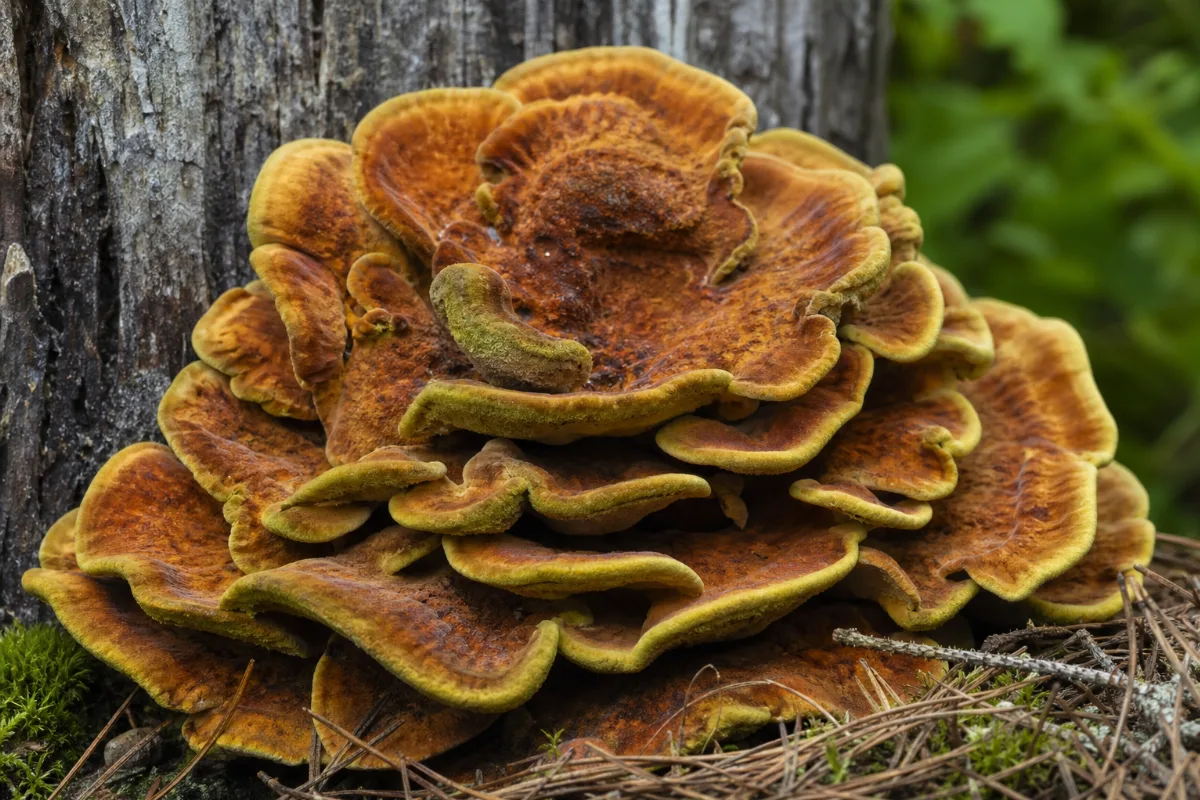
Mushrooms · Wild polypore (dye mushroom)
Dyer's polypore
Phaeolus schweinitzii · also called Velvet-top fungus, dyer's mazegill, pine dye polypore
Dyer's polypore is a large, tough fungus that rots the roots and base of conifer trees. It is known as a source of natural dye. One general source says it is not edible, and we found no supplement made from it. The research is very thin: laboratory chemistry on its yellow pigments, and nothing in people.
General information, not medical advice. Last substantive update · Not medically reviewed. A named clinician has not signed off on this page. How this page is made
About Dyer's polypore
Dyer's polypore is a large, tough fungus that rots the roots of conifers and is known as a dye source. Human research does not exist. The little that is known comes from test-tube work on its yellow pigments, and one general source says it is not edible. We found no safety data and no product. Do not use a wild fungus without an expert.
What it is
Dyer's polypore, Phaeolus schweinitzii, is a fungus in the family Laetiporaceae. It causes brown butt rot of conifers such as pine, spruce, fir and larch. The fruiting body appears in late summer or fall and can grow larger than 25 cm across. It may look as if it grows from the ground when it comes from the roots.
A 2022 DNA study shows that the name covers a species complex of six taxa, with different fungi in Eurasia, China and North America. A result on one may not apply to another.
A dye mushroom, not a remedy
The common name points to its use as a natural dye. One general source says it gives green, yellow, gold or brown, depending on the cloth and the mordant. We did not open a craft or dye source, so we only report that claim. We found no source describing a medicinal or food use.
What the research shows
Nothing has been tested in people. In 2013, seven compounds were isolated from fruiting bodies collected on the Tibetan Plateau, and hispidin was the strongest antioxidant in three chemical tests. In 2017, isolated hispidin matched or beat the reference antioxidant Trolox in every assay used.
These results show interesting chemistry. They cannot show a health effect, because test-tube results often fail in people.
How strong is the evidence?
Every result is rated insufficient. It is abstract-only laboratory work on isolated compounds, with no numbers in the abstracts. The rest of the literature is DNA, ecology and element analysis.
Forms and products
We found no consumer product made from dyer's polypore, so we cannot say what one would contain. The lab work used isolated compounds and solvent extracts, which are not tea, powder or capsules. For medicinal mushrooms in general, NCI says supplement ingredients may vary considerably from lot to lot.
At a glance
Traditional uses history, not proof
- No traditional medicinal or food use was found in the sources we read. It is described as a source of green, yellow, gold or brown natural dye.
Studied for research
- Antioxidant tests, not enough evidence (test tube only)
- Pigment chemistry, not a health benefit (hispidin-type compounds)
- Any use in people, not enough evidence (nothing found)
Main compounds
- Hispidin (a yellow pigment)
- Phaeolschidins A to E and pinillidine (hispidin relatives)
Common forms
- Isolated compounds and lab extracts (laboratory only)
- No consumer product was found
Research links: Phaeolschidins A-E from Phaeolus schweinitzii (abstract) · Antioxidant and genotoxic properties of hispidin (abstract) · Elements in wood-decay fungi (abstract) · Phaeolus species complex, DNA study (abstract) · NCI: Medicinal mushrooms (PDQ) · Research Library · Genes & Biomarkers Library
What it is and its history
- Accepted scientific name
- Phaeolus schweinitzii
- Naming authority
- (Fr.) Pat. (GBIF)
- Common names
- Dyer's polypore (English); Velvet-top fungus (English); Dyer's mazegill (English); Pine dye polypore (English)
- Family or group
- Laetiporaceae (a fungus family), not a plant
- Classification
- Fungi > Basidiomycota > Agaricomycetes > Polyporales > Laetiporaceae > Phaeolus > Phaeolus schweinitzii
- Native range
- Eurasia (Wikipedia article text), identified as an exotic species in New Zealand, Australia and South Africa. A 2022 DNA paper places P. schweinitzii in the strict sense in Eurasia and finds different taxa in North America.
- Habitat
- Causes brown butt rot of conifers such as Douglas-fir, spruce, fir, hemlock, pine and larch (Wikipedia). A 2025 paper calls it saprotrophic/parasitic and brown-rot.
- What it looks like
- Fruiting body: A polypore that may look terrestrial when growing from roots or the base of the host tree. Fruiting bodies appear in late summer or fall, may exceed 25 cm, are tannish with darker brown centres and orange to pale margins when young, and turn harder and more wood-like with age; the pores bruise brown (Wikipedia article text).
- Cultivation
- Not found in the sources read.
- Harvest and processing
- Not found in the sources read.
- Look-alikes and adulterants
- Name: Heterobasidion irregulare and H. occidentale; Note: Listed as similar species in the Wikipedia article text.; Name: Inonotus dryophilus and Onnia tomentosa; Note: Listed as similar species in the Wikipedia article text.; Name: Other Phaeolus taxa (P. tabulaeformis, P. asiae-orientalis, P. yunnanensis); Note: A 2022 DNA paper split the group into six taxa, so fungi sold or studied under this name may be different species.
Traditional use and history history, not clinical proof
| Tradition or era | Documented use | Source |
|---|---|---|
| Natural dye | Described as a source of green, yellow, gold or brown dye, depending on the material dyed and the mordant used. Source: a general encyclopedia article; no dyeing paper or craft source was opened, so this is not independently verified. | s-wikipedia-phaeolus-schweinitzii |
| Traditional medicine or food | No traditional medicinal or food use was found in the sources read. | p23869482 |
Traditional use shows how it was used. It does not show that it works or is safe today.
What is inside, and how it may work
What it contains and how those compounds act in cells and animals. Laboratory and animal mechanisms are not proven effects in people.
Main compounds
| Compound | Family | Where it is concentrated | Activity studied | Level of evidence |
|---|---|---|---|---|
| Hispidin | hispidin-type polyphenol (yellow pyrone pigment) | Fruiting body Not given in the abstracts. | Strongest antioxidant of seven compounds in 2013; matched or beat Trolox in all assays in 2017. Raised sister chromatid exchanges in human lymphocytes in a dish. 2 6 | Laboratory research |
| Phaeolschidins A to D (bishispidins) | bishispidin | Fruiting body Not given in the abstract. | Antioxidant activity measured in three chemical assays; less than hispidin. 2 | Laboratory research |
| Phaeolschidin E | hispidin with a pyrrolidin-2-one group | Fruiting body Not given in the abstract. | A new class of hispidin derivative; antioxidant activity tested in chemical assays. 2 | Laboratory research |
| Pinillidine | hispidin-type polyphenol | Fruiting body Not given in the abstract. | Known compound isolated alongside the others; antioxidant activity tested in chemical assays. 2 | Laboratory research |
Mechanisms, receptors and pathways
| Target or pathway | Gene or receptor | What was found | Level |
|---|---|---|---|
| Free-radical scavenging (DPPH, ORAC, FRAP, lipid peroxidation, total antioxidant capacity) | Isolated hispidin acted as an antioxidant in tubes. This does not show antioxidant action in a body. 2 6 | Laboratory research | |
| Cell division and chromosome exchange in human lymphocytes | Isolated hispidin raised sister chromatid exchanges in a dose-dependent way and lowered replication and nuclear division indices in a dish; other DNA-damage end points were not raised. 6 | Laboratory research |
Absorption, metabolism and elimination
- Absorption
- Not found in the sources read.
- Distribution
- Not found in the sources read.
- Metabolism
- Not found in the sources read.
- Elimination
- Not found in the sources read.
- Bioavailability
- Not established.
Isolated compounds versus whole extracts
All activity data are for isolated compounds (hispidin and its derivatives). No work on the whole fungus, a tea, powder or capsule was found, so nothing can be said about a product.
Nutritional composition
A general source says the species is not edible. We found no food-composition data and give no nutrition claim.
3 not enough evidence
What was looked at
The 3 benefits and uses checked for Dyer's polypore, each with how strong the evidence is. Tap one to open it.
- Antioxidant tests (test tube only)Not enough evidence
- Pigment chemistry (hispidin-type compounds)Not enough evidence
- Any use in peopleNot enough evidence
Lab markers tracked in the studies
Chemical antioxidant tests (DPPH and others)
What is Dyer's polypore good for?
The uses people ask about and how strong the human evidence is for each. None is shown in people. Read this together with the Safety tab.
Benefits, one by one
Each card is a research question, not a promise. Tap a goal to filter. Open a card to see the studies, doses and limits.
Antioxidant tests (test tube only)
Not enough evidenceIn chemical tests, hispidin and related yellow pigments from dyer's polypore mopped up test radicals as well as or better than a reference antioxidant. These were isolated compounds in test tubes. Nothing was tested in animals or people.
2 studiesIsolated compounds and solvent extracts made in a lab. We found no te…
Studies, doses and limits
Results
No human results. In 2013, seven compounds from fruiting bodies collected on the Tibetan Plateau were tested in three chemical assays; hispidin was the strongest. In 2017, isolated hispidin matched or beat the reference antioxidant Trolox in every assay used. The abstracts give no figures.
Effect sizes as reported
Test-tube activity only; no size of effect given
Why this rating
Abstract-only laboratory work on isolated compounds from the fungus. Chemical tests cannot show an effect in a body.
Form and dose studied
Isolated compounds and solvent extracts made in a lab. We found no tea, powder, capsule or other consumer product.
Who was studied
Chemical assays
Limits
Two papers; abstracts only; no numbers; no animal or human data; the part of the fungus used in 2017 is not stated in the abstract.
Why researchers looked
Chemists looked at the pigments that give the fungus its colour, and antioxidant tests are cheap and common first checks.
Traditional use
No traditional medicinal or food use was found in the sources we read. The fungus is known as a source of natural dye.
Proposed mechanism Laboratory research
Hispidin-type pigments (yellow polyphenols that fungi make) were measured in DPPH, total antioxidant capacity, lipid peroxidation, oxygen radical absorbance and ferric-reducing assays. These show what a molecule does in a tube. They do not show what happens in a body.
A proposed mechanism does not show that the effect happens in people.
No human safety data were found. See the Safety tab. Do not eat or use a wild fungus unless an expert has identified it.
Pigment chemistry (hispidin-type compounds)
Not enough evidenceThe fruiting body holds hispidin and hispidin-derived compounds, the yellow pigments reported as its main chemistry. This is a description of what is in the fungus, not a health benefit.
1 studiesFruiting body (lab extract).
Studies, doses and limits
Results
Phaeolschidins A to D are new bishispidins; phaeolschidin E carries a pyrrolidin-2-one group linked to hispidin. The paper calls this the first report of secondary metabolites from the fungus. Amounts in the fungus are not given in the abstract.
Why this rating
This shows what is in the fungus, not what it does to a person.
Form and dose studied
Fruiting body (lab extract).
Who was studied
Fungus collected on the Tibetan Plateau
Limits
One collection site; abstract only; no content values. Fungi from other regions may differ (see the Science notes on a species complex).
Why researchers looked
A 2013 paper reported the first secondary metabolites isolated from this fungus.
Traditional use
No traditional medicinal or food use was found in the sources we read. The fungus is known as a source of natural dye.
Proposed mechanism Lab analysis
Five new hispidin derivatives (phaeolschidins A to E), plus pinillidine and hispidin, were isolated and their structures worked out by spectroscopy.
A proposed mechanism does not show that the effect happens in people.
No human safety data were found. See the Safety tab. Do not eat or use a wild fungus unless an expert has identified it.
Any use in people
Not enough evidenceWe found no human trial, case report, animal study of a health outcome or safety study of dyer's polypore. For every health claim the honest answer is: not enough evidence.
1 studiesNo consumer product was found.
Studies, doses and limits
Results
No human results to report.
Why this rating
No human study exists in the sources we searched.
Form and dose studied
No consumer product was found.
Limits
Absence of evidence is not evidence of safety or of benefit.
Why researchers looked
Readers ask whether it is a medicinal mushroom like the sanghuang group, which shares hispidin chemistry. For dyer's polypore the research is not there.
Traditional use
No traditional medicinal or food use was found in the sources we read. The fungus is known as a source of natural dye.
Proposed mechanism None
Not applicable.
A proposed mechanism does not show that the effect happens in people.
No human safety data were found. See the Safety tab. Do not eat or use a wild fungus unless an expert has identified it.
Connections to the rest of health
How Dyer's polypore connects to the rest of our health knowledge graph. Every link says what kind of connection it is. A safety link (for example to the liver) is a warning, not a benefit. A study that merely mentions a topic never creates a benefit link.
Explore every connection: goals, body systems, organs, symptoms, genes
A. Wellness goals
| Connected to | Kind of connection | Evidence status | Context | Studies |
|---|---|---|---|---|
| Healthy Aging | Preliminary mechanism | Not enough evidence | Antioxidant tests (test tube only): In chemical tests, hispidin and related yellow pigments from dyer's polypore mopped up test radicals as well as or better than a reference antioxidant. These were isolated compounds in test tubes. Nothing was tested in animals or people. | 2 6 |
B. Body systems
| Connected to | Kind of connection | Evidence status | Context | Studies |
|---|---|---|---|---|
| Cellular Protection | Biological association | Not enough evidence | Studied for: Antioxidant tests (test tube only) | 2 6 |
E. Health conditions
| Connected to | Kind of connection | Evidence status | Context | Studies |
|---|---|---|---|---|
| Pregnancy and breastfeeding | Contraindication | Not enough evidence | No safety data found. Preparation or compound: All dyer's polypore products |
4 |
I. Biomarkers
| Connected to | Kind of connection | Evidence status | Context | Studies |
|---|---|---|---|---|
| Chemical antioxidant tests (DPPH and others) | Biological association | Not enough evidence | Measured in trials: increased activity in the tube. A lab change is not the same as a health benefit. | 2 6 |
L. Active compounds
| Connected to | Kind of connection | Evidence status | Context | Studies |
|---|---|---|---|---|
| Hispidin | Biological association | In vitro | Strongest antioxidant of seven compounds in 2013; matched or beat Trolox in all assays in 2017. Raised sister chromatid exchanges in human lymphocytes in a dish. Preparation or compound: Fruiting body |
2 6 |
| Phaeolschidins A to D (bishispidins) | Biological association | In vitro | Antioxidant activity measured in three chemical assays; less than hispidin. Preparation or compound: Fruiting body |
2 |
| Phaeolschidin E | Biological association | In vitro | A new class of hispidin derivative; antioxidant activity tested in chemical assays. Preparation or compound: Fruiting body |
2 |
| Pinillidine | Biological association | In vitro | Known compound isolated alongside the others; antioxidant activity tested in chemical assays. Preparation or compound: Fruiting body |
2 |
Each connection is stored with the ingredient, the connected record, the kind of connection, the evidence status, the supporting studies, the preparation or compound involved, and a review date (last reviewed October 25, 2026).
Evidence at a glance: what the research found for 3 outcomes
Each outcome below is one thing researchers measured. Certainty is how far the evidence can be trusted, not how well it works. The full studies are on the next tab.
The evidence
The research centre for Dyer's polypore. Every record here was checked against PubMed or the publisher's page; we never list a study we have not verified.
Evidence by outcome
Bars show how many studies we found for each outcome, not how well it works. People are added up across trials only (reviews are not added, to avoid double counting).
How we rate evidence
High certainty
Several well-run trials or reviews agree; further research is unlikely to change the picture much.
Moderate certainty
Good trials point the same way, but some doubt remains.
Low certainty
Small, short or inconsistent trials. The finding could change with better research.
Very low certainty
Very little or very weak human data. Treat as a possibility only.
Mixed findings
Trials or reviews disagree with each other.
Not enough evidence
Not enough human research to say either way.
Evidence against
Good research found no benefit, or found harm.
We take the reviewers' own risk-of-bias and GRADE statements where they exist, and otherwise judge from study size, design, consistency, directness and whether a product matches what is sold. Many publications do not make evidence high. Method note: We read PubMed records and abstracts for 4 papers (2 laboratory studies of the fungus's chemistry, 1 element-analysis study, 1 DNA study), checked the name in GBIF, read the Wikipedia article text for common names, dye use, ecology and edibility, and read the National Cancer Institute medicinal mushrooms page. Full texts were not opened, so abstracts give no numbers. LiverTox and LactMed were searched through NCBI Books and nothing was found. Certainty ratings are the compiler's own reading.
Study library: every study we checked 8
| Study | Design | People | Product, dose, length | Result |
|---|---|---|---|---|
| GBIF 2026 GBIF Backbone Taxonomy: Phaeolus schweinitzii GBIF · Source |
Database record n/a |
n/a | n/a |
On 2026-10-25 the GBIF match API gave Phaeolus schweinitzii (Fr.) Pat. as ACCEPTED (key 2542126), family Laetiporaceae, order Polyporales, class Agaricomycetes, exact match, confidence 100. Name checked Methods, limits and fundingOutcomes: As described Limitations: Index Fungorum was not checked. Funding and conflicts: Not applicable Read: database record |
| Han 2013 Phaeolschidins A-E, five hispidin derivatives with antioxidant activity from the fruiting body of Phaeolus schweinitzii collected in the Tibetan Plateau. Journal of Natural Products · PMID 23869482 · DOI |
Laboratory (chemistry) study Phaeolus schweinitzii |
Chemical assays | Five new hispidin derivatives (phaeolschidins A-E) plus pinillidine and hispidin, isolated from the fungus Fruiting body |
Seven compounds were isolated from fruiting bodies collected on the Tibetan Plateau. Their antioxidant activity was measured by the DPPH scavenging assay, a total antioxidant capacity assay and a lipid peroxidation assay. Hispidin showed the strongest activity of all seven. The abstract gives no figures. Antioxidant in chemical tests Methods, limits and fundingOutcomes: Antioxidant in chemical tests Limitations: Abstract only; no figures. Chemical tests on isolated compounds. Funding not stated in the abstract. Funding and conflicts: Funding not stated in the abstract Read: abstract |
| Krzeslowska 2025 Elemental uptake and accumulation by wood decay fungi in relation to their nutrition strategy, rot type and mineral profile of the colonized wood. Fungal Biology · PMID 40707114 · DOI |
Laboratory (element analysis) study Phaeolus schweinitzii |
13 wood-decay fungi from coniferous and deciduous trees; four species compared in detail, including Phaeolus schweinitzii (brown rot) | Fruiting bodies (sporocarps) and the wood under them Fruiting body |
White-rot fungi accumulated significantly more of most minor elements (B, Cu, Fe, Ni, Zn) and toxic elements (Al, As, Cd, Pb, Tl) in their fruiting bodies than brown-rot fungi. P. schweinitzii is one of the two brown-rot species in the detailed comparison. The abstract gives no species-specific numbers. Element levels in fruiting bodies Methods, limits and fundingOutcomes: Element levels in fruiting bodies Limitations: Abstract only; no numbers for this species. It does not say whether this fungus is safe to eat. Funding and conflicts: Funding not stated in the abstract Read: abstract |
| NCBI Bookshelf 2026 NCBI Books search for LiverTox and LactMed entries (Phaeolus schweinitzii, dyer's polypore) NCBI Bookshelf · Source |
Database search n/a |
n/a | n/a |
A search of NCBI Books on 2026-10-25 for Phaeolus schweinitzii and for dyer's polypore returned 0 results. No LiverTox or LactMed entry for this fungus was found. No entry found Methods, limits and fundingOutcomes: As described Limitations: A search for a name is not a full review. EMA, NCCIH and MSK pages were not checked. Funding and conflicts: Not applicable Read: search result |
| National Cancer Institute 2024 NCI PDQ: Medicinal Mushrooms (health professional version) National Cancer Institute · Source |
Authoritative guidance n/a |
n/a | n/a |
Page text read on 2026-10-25 (updated November 6, 2024). It says supplement ingredients may vary considerably from lot to lot with no guarantee that label ingredients are present, and that the FDA has not approved medicinal mushrooms as a treatment for cancer or any other medical condition. It has no section on dyer's polypore. General caution; nothing specific to this fungus Methods, limits and fundingOutcomes: As described Limitations: Not about this fungus; applies by analogy only. Funding and conflicts: Not applicable Read: page text |
| Smolskaite 2017 Antioxidant and Genotoxic Properties of Hispidin Isolated from the Velvet-Top Mushroom, Phaeolus schweinitzii (Agaricomycetes). International Journal of Medicinal Mushrooms · PMID 29345559 · DOI |
Laboratory study Phaeolus schweinitzii (isolated hispidin) |
Chemical assays; human lymphocytes in a dish; Salmonella bacteria | Hispidin isolated from the mushroom Fungus (part not stated in the abstract) · vs Trolox (reference antioxidant) |
Isolated hispidin showed strong free-radical scavenging, oxygen radical absorbance capacity and ferric-reducing power, similar to or higher than Trolox in every assay. In human lymphocytes in vitro it did not raise chromosome aberrations, micronuclei or comet-assay DNA damage, and did not cause mutation in bacteria. It did raise sister chromatid exchanges in a dose-dependent way and lowered the replication and nuclear division index values. The abstract gives no figures. Antioxidant in chemical tests; mixed cell-safety result Methods, limits and fundingOutcomes: Antioxidant in chemical tests; mixed cell-safety result Limitations: Abstract only; no figures. Isolated compound in a dish, not the whole mushroom and not a person. Source and funding not stated in the abstract. Funding and conflicts: Funding not stated in the abstract Read: abstract |
| Wikipedia 2026 Wikipedia: Phaeolus schweinitzii (article text) Wikipedia · Source |
Encyclopedia n/a |
n/a | n/a |
Read 2026-10-25. It gives the common names velvet-top fungus, dyer's polypore, dyer's mazegill and pine dye polypore and calls the fungus a plant pathogen causing brown butt rot of conifers (Douglas-fir, spruce, fir, hemlock, pine, larch). Fruiting bodies appear in late summer or fall and may exceed 25 cm. Similar species listed: Heterobasidion irregulare, H. occidentale, Inonotus dryophilus and Onnia tomentosa. Under uses it says the fungus is a source of green, yellow, gold or brown dye depending on material and mordant, and states 'The species is not edible.' Common names, dye use, and a general statement that it is not edible Methods, limits and fundingOutcomes: As described Limitations: A general source with no citation read here for the edibility line or the dye line; used for naming, ecology and look-alike names only, and flagged as such. Funding and conflicts: Not applicable Read: article text |
| Yuan 2022 Two new forest pathogens in Phaeolus (Polyporales, Basidiomycota) on Chinese coniferous trees were confirmed by molecular phylogeny. Frontiers in Microbiology · PMID 36212865 · DOI |
DNA (taxonomy) study Phaeolus schweinitzii complex |
Samples from China, Europe and North America | n/a |
DNA work on samples from China, Europe and North America showed that P. schweinitzii is a species complex of six taxa. P. schweinitzii in the strict sense occurs in Eurasia. Two new species were described in China, and three taxa in North America differ from the Eurasian one: Phaeolus tabulaeformis, 'P. schweinitzii-1' (Northeast) and 'P. schweinitzii-2' (west). The paper calls P. schweinitzii a common forest pathogen on conifers in the Northern Hemisphere. Naming: P. schweinitzii is a species complex Methods, limits and fundingOutcomes: Naming: P. schweinitzii is a species complex Limitations: Taxonomy only; no health content. It means a lab result on one 'Phaeolus schweinitzii' may not apply to another region's fungus. Funding and conflicts: Funding not stated in the abstract Read: abstract |
What we do not know yet
- No human trial and no human safety study of dyer's polypore were found.
- No animal study of any health outcome was found.
- No toxicity study of the whole fungus, and no edibility guide beyond one general statement.
- The name covers a species complex, so lab results may not carry across regions.
- No test of heavy metals, pesticides or mould toxins for this species was read. LiverTox and LactMed entries were not found.
How new research is added
New studies are found by a saved PubMed search and placed in a review queue. A person reads each one before it changes any evidence rating or safety wording. New publications never change ratings automatically.
Lab markers
What changed in blood or saliva tests during trials. A changed number is not the same as feeling or being healthier, and we give no "normal ranges".
Other 1
Chemical antioxidant tests (DPPH and others)
Increased activity in the tube in trials
How well a substance neutralises a test radical or resists oxidation in a tube.
Not enough evidenceResults and what it means
Why it was measured
A quick chemical first look at antioxidant potential.
Statistical vs. clinical meaning
Lab screening result only.
Safety implication
Not a measure of safety or of any health effect.
| Study | Result | People | Product |
|---|---|---|---|
| 2 | Of seven isolated compounds, hispidin had the strongest antioxidant activity in DPPH, total antioxidant capacity and lipid peroxidation assays. No figures in the abstract. | Chemical tests | Isolated compounds from the fruiting body |
| 6 | Isolated hispidin showed antioxidant capacity similar to or higher than Trolox in all assays used. No figures in the abstract. | Chemical tests | Isolated hispidin |
Safety
What studies and official sources say about side effects, medicines and who should check first. Each point shows what kind of evidence it comes from.
Main points to know 5
- Not a food: a general source says it is not edible. One general encyclopedia article states that the species is not edible. We found no toxicity study, poisoning report or edibility guide that says either way, so the reason is not known. We give no advice to eat it. General source 7
- No human safety data were found. We found no clinical trial, case report or poison-centre report for dyer's polypore. That means the risks are unknown, not that there are none. Nothing here is a safety all-clear. None 4
- A mixed result for its main pigment in cell tests. In human lymphocytes in a dish, isolated hispidin did not raise chromosome aberrations, micronuclei or comet-assay DNA damage, and did not cause mutation in bacteria. It did raise sister chromatid exchanges in a dose-dependent way and lowered the replication and nuclear division index values. This is a reason for caution, not proof of harm in people. It was an isolated compound, not the whole fungus. Laboratory research 6
- Wild fungus: identify with an expert, do not guess. A general source lists other woody fungi that look similar (Heterobasidion, Inonotus dryophilus and Onnia tomentosa). Do not collect or use a wild fungus unless a trained local expert has identified it. It also grows on the roots of living conifers, so it can be found near trees that may fall. Identification caution 7
- No known consumer product, so label quality cannot be judged. We found no supplement made from dyer's polypore. For medicinal mushrooms in general, NCI says ingredients may vary considerably from lot to lot and there is no guarantee that label ingredients are present. Authoritative guidance 5
Side effects 1
| Effect | How often | Severity and recovery | Evidence |
|---|---|---|---|
| No adverse effects have been reported, but none have been looked for in people Absence of reports in the sources we read is not proof of safety. | Unknown | unknown Not applicable | None |
Liver
We found no case report or trial linking dyer's polypore to liver injury, and no LiverTox entry. 4
How often. No liver reports found; this is not proof of liver safety.
Monitoring. No agency monitoring advice exists in the sources we read. Ask a doctor if you have liver disease.
This is a safety connection. It is not evidence that Dyer's polypore supports liver health.
Medicines and supplements 3
| With | Why it matters | Importance | Evidence | What to do |
|---|---|---|---|---|
| Any medicine, including blood thinners and immune-suppressing medicines prescription | Unknown. No interaction study or case report was found. | None Not enough evidence | Ask your prescriber or pharmacist before using any medicinal fungus. | |
| Herbal products and other supplements supplement | Unknown. | None Not enough evidence | Tell your pharmacist about every product you use. | |
| Food and alcohol food | Unknown. A general source says the fungus is not edible. | None Not enough evidence 7 | Not applicable. |
Who should check first 4
| Situation | Advice | Evidence |
|---|---|---|
| Pregnancy and breastfeeding | No safety data were found, so it is not known whether it is safe. Ask a doctor. Our NCBI Books search found no LactMed entry. | None 4 |
| Children and babies | No safety data were found. Ask a doctor before giving any medicinal fungus to a child. Keep wild fungi out of children's reach. | None |
| Mushroom allergy, asthma or a history of reactions to fungi or moulds | Allergy to this fungus has not been studied. Take extra care and ask a doctor. This is general caution, not from a source on this fungus. | General caution |
| Before surgery, or with immune disease or an organ transplant | Nothing is known. Ask your doctor before using any medicinal fungus. | None |
Overdose, product quality and regulators
Summary. No toxicity study in people or animals was found for the whole fungus. The only safety-type test is a cell-dish test of isolated hispidin.
Human doses studied. No human study. This page gives no amounts and none are advised.
Overdose response. No description was found. If someone becomes unwell after eating a wild fungus, get urgent medical or poison-centre help and keep a sample of what was eaten.
Toxic parts. Not described in the sources read.
Wild wood-decay fungi take up elements from wood and surroundings. A 2025 study of 13 such fungi found brown-rot species, including this one, accumulated less of several toxic elements than white-rot species. We read only the abstract, so we cannot give a number for this fungus or say whether it is clean.
Metals in wood-decay fungi. White-rot fungi accumulated significantly more of the toxic elements Al, As, Cd, Pb and Tl than brown-rot fungi. This species is brown-rot. No species-specific figures were read. 3
Pesticides and mould toxins. No data for this species were found.
| Body | Action | Date |
|---|---|---|
| US National Cancer Institute (PDQ) (United States) | States that the FDA has not approved medicinal mushrooms as a treatment for cancer or any other medical condition, and that supplement ingredients may vary considerably from lot to lot. The page has no section on dyer's polypore. source | 2024-11-06 |
| LiverTox / LactMed (US NIH) (United States) | No entry found for Phaeolus schweinitzii by NCBI Books search. source | 2026-10-25 |
When to get medical help
- Itching, hives, swelling of the lips, tongue or face, wheeze or trouble breathing after contact with or eating a fungus: get emergency help.
- Vomiting, severe stomach pain or diarrhoea after eating any wild fungus: contact a poison centre or doctor and keep a sample of what was eaten.
If someone may be poisoned or in a crisis, contact a clinician or emergency service straight away. In the US, Poison Control is 1-800-222-1222.
General information only, not medical advice. Ask a clinician or pharmacist before use, especially with medicines, in pregnancy or with a health condition. See the Natural Remedy Safety guide.
Frequently asked questions
What is dyer's polypore?
Is dyer's polypore edible?
One general encyclopedia article says the species is not edible. We found no other source either way, and we give no advice to eat it. Do not eat a wild fungus without an expert's identification.
Does it have proven health benefits?
Is it an antioxidant?
Is it safe?
What did the cell tests on hispidin show?
Isolated hispidin did not raise chromosome damage, micronuclei, comet-assay DNA damage or bacterial mutation. It did raise sister chromatid exchanges in human lymphocytes in a dish in a dose-dependent way. This was a dish test of one compound, not a person eating the fungus.
Is it the same as sanghuang?
No. Sanghuang fungi are different species in the Phellinus group. They share hispidin-type pigments, but that does not mean they share evidence or safety.
Can I tell it from look-alikes myself?
Why is it a problem near trees?
It rots the roots and base of conifers. A general source says the decay weakens the wood and can lead to snapping near the base. If you see it on a tree, ask a tree specialist.
Does it hold heavy metals?
Not tested for this fungus specifically that we could read. A 2025 study of 13 wood-decay fungi, including this brown-rot species, found brown-rot species held less of several toxic elements than white-rot species. We read only the abstract.
Can I buy a dyer's polypore supplement?
We found no consumer product made from it. Be careful with any product that claims to contain it; for mushroom supplements in general NCI says label contents are not guaranteed.
Does it interact with medicines?
Unknown. No interaction study or case report was found. Ask a pharmacist before using any medicinal fungus.
Explore by health goal
Editorial transparency
- Written by
- AlternativeMed editorial team. Research compiled with AI assistance, then checked against PubMed records.
- Medical review
- None. This page has not been reviewed by a physician or pharmacist.
- First published
- 2026-10-25
- Last substantive update
- 2026-10-25
- How we research
- We read PubMed records and abstracts for 4 papers (2 laboratory studies of the fungus's chemistry, 1 element-analysis study, 1 DNA study), checked the name in GBIF, read the Wikipedia article text for common names, dye use, ecology and edibility, and read the National Cancer Institute medicinal mushrooms page. Full texts were not opened, so abstracts give no numbers. LiverTox and LactMed were searched through NCBI Books and nothing was found. Certainty ratings are the compiler's own reading.
- How we rate evidence
- See "How we rate evidence" in the Evidence tab.
- Independence
- No product is promoted on this page. No affiliate links are shown. This page is information, not a recommendation to use dyer's polypore.
Sources 8
Each source was opened and checked. Where we read only the abstract, it says so. The small numbers in the text point here.
- GBIF. GBIF Backbone Taxonomy: Phaeolus schweinitzii. GBIF. 2026. (database record)
- Han JJ, Bao L, He LW, Zhang XQ, Yang XL, Li SJ. Phaeolschidins A-E, five hispidin derivatives with antioxidant activity from the fruiting body of Phaeolus schweinitzii collected in the Tibetan Plateau.. Journal of Natural Products. 2013. PMID 23869482. DOI 10.1021/np400234u. (abstract)
- Krzeslowska M, Mleczek P, Budka A, Siwulski M, Budzynska S, Niedzielski P. Elemental uptake and accumulation by wood decay fungi in relation to their nutrition strategy, rot type and mineral profile of the colonized wood.. Fungal Biology. 2025. PMID 40707114. DOI 10.1016/j.funbio.2025.101592. (abstract)
- NCBI Bookshelf. NCBI Books search for LiverTox and LactMed entries (Phaeolus schweinitzii, dyer's polypore). NCBI Bookshelf. 2026. (search result)
- National Cancer Institute. NCI PDQ: Medicinal Mushrooms (health professional version). National Cancer Institute. 2024. (page text)
- Smolskaite L, Slapsyte G, Mierauskiene J, Dedonyte V, Venskutonis PR. Antioxidant and Genotoxic Properties of Hispidin Isolated from the Velvet-Top Mushroom, Phaeolus schweinitzii (Agaricomycetes).. International Journal of Medicinal Mushrooms. 2017. PMID 29345559. DOI 10.1615/IntJMedMushrooms.2017024522. (abstract)
- Wikipedia. Wikipedia: Phaeolus schweinitzii (article text). Wikipedia. 2026. (article text)
- Yuan Y, Wu YD, Wang YR, Zhou M, Qiu JZ, Li DW. Two new forest pathogens in Phaeolus (Polyporales, Basidiomycota) on Chinese coniferous trees were confirmed by molecular phylogeny.. Frontiers in Microbiology. 2022. PMID 36212865. DOI 10.3389/fmicb.2022.942603. (abstract)


