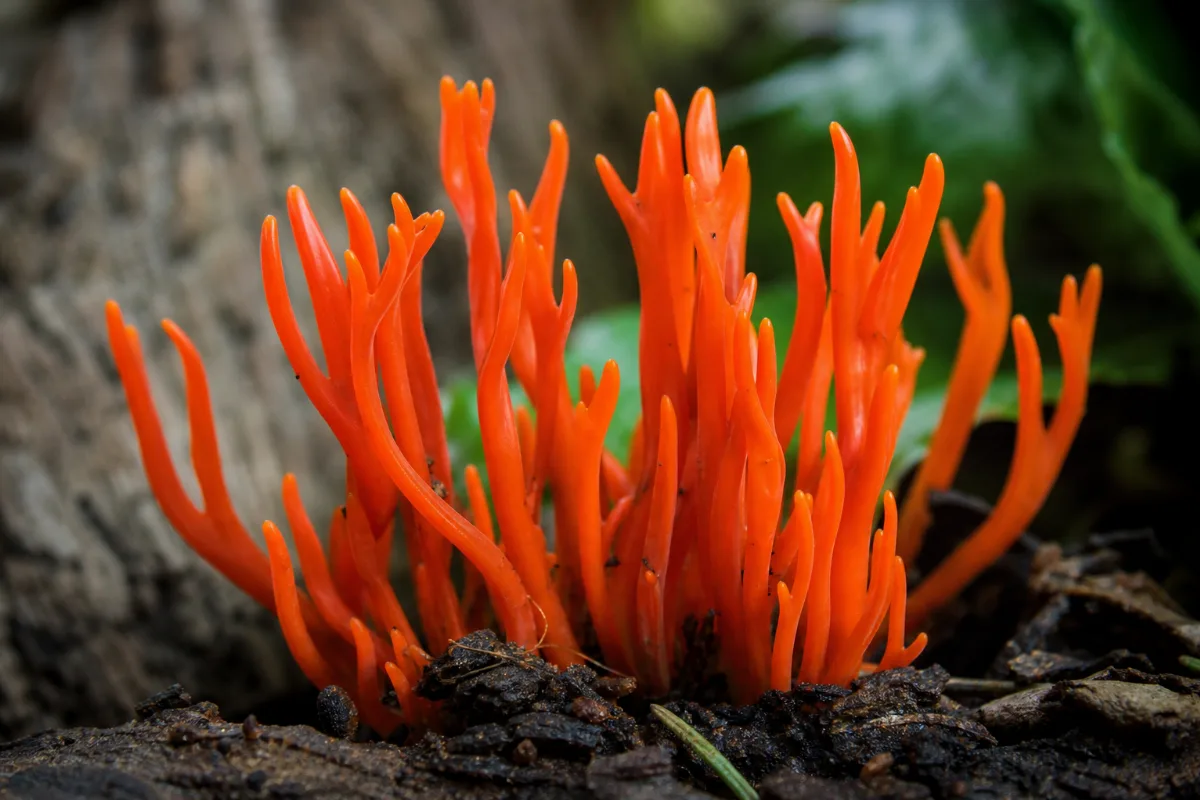
Mushrooms · Poisonous mushroom
Poison Fire Coral
Podostroma cornu-damae (now Trichoderma cornu-damae) · also called Red deer's horn mushroom (a fungus, not a plant)
Poison fire coral (Podostroma cornu-damae) is a deadly poisonous fungus. Doctors in Japan and Korea have reported people who died after eating it or drinking tea, boiled water or liquor made from it, and a small amount may be enough. Cooking and tea did not make it safe. No study shows it helps health. If anyone may have eaten it, or any gathered wild fungus, call a poison centre or emergency number now, even if they feel well.
General information, not medical advice. Last substantive update · Not medically reviewed. A named clinician has not signed off on this page. How this page is made
About Poison Fire Coral
Poison fire coral (Podostroma cornu-damae, now often called Trichoderma cornu-damae) is a deadly poisonous fungus reported in Japan and Korea. Case reports describe people who died after eating it or drinking tea, boiled water or liquor made from it. The poisons attack the blood-forming marrow, skin, gut, lungs and kidneys. There is no antidote. In the 7 patients in the individual reports we read, 3 died. No study shows any health benefit. If anyone may have eaten it, call a poison centre or emergency number at once.
Danger first: what it does
Doctors in Korea and Japan have described people who died after eating this fungus, or after drinking tea, boiled water or liquor made from it. A Korean paper quotes Japanese reports of one death among five people who ate about 1 g soaked in sake in 1999, and two deaths among 13 ingestions from 1983 to 2008. Korean authors say eating only a small amount can be extremely fatal.
The reports describe very low white cells and platelets, infection and sepsis, peeling skin on the palms and soles, hair loss, severe vomiting and diarrhoea, low blood pressure, lung failure and kidney failure. In the individual reports we read, 3 of 7 patients died (two Korean men and one man in a forensic case) and 4 recovered after hospital care. These are case reports, so they cannot give a true death rate.
Why it can be missed: the timing
After eating the fruit body, one Korean man had nausea, vomiting, diarrhoea and fever about 3 hours later, then lung failure, and died on day 13. In a Japanese case a man had severe vomiting and diarrhoea and needed about 9 litres of fluid in 12 hours.
With a small amount as tea or boiled water, the Korean authors say symptoms took 2 to 4 weeks to appear, and the first signs were often peeling skin or hair loss. A Korean couple who drank water boiled with gathered mushrooms for over a month had fever, peeling skin and very low blood counts; the husband died on hospital day 6. The wife recovered after about 4 weeks. Do not wait for symptoms.
What hospitals do (this is medicine, not self-care)
The 2013 Korean authors say there is still no curative treatment. Care is supportive: large amounts of fluid into a vein, antibiotics, a white-cell growth drug (granulocyte colony stimulating factor), platelet transfusions and, in the worst cases, a ventilator and blood filtering.
A Japanese man survived after fluids, continuous blood filtering, plasma exchange and the growth drug, and a Korean couple recovered with preventive antibiotics, the growth drug and platelet transfusions. A Korean man died despite a ventilator, kidney replacement, the growth drug and removal of a lung. No trial compares treatments. No home treatment is known to work.
Boiling, tea, frying and alcohol did not make it safe
A man who ate it boiled died. A man who drank water boiled with it for over a month died. Japanese deaths followed fungus soaked in sake, and a Korean man died after drinking a mushroom liquor. No paper tested what heat, drying or alcohol does to the toxins, so no preparation can be called safe.
Where it has been reported
The poisonings in the sources we read are from Japan and Korea. Two Korean papers say the fungus is known in Japan, China, Java (Indonesia) and Korea. We found no poisoning reports from Southeast Asia. A 2013 Korean report said it was the first poisoning of its kind reported in Korea, and a 2016 report said the number of cases was increasing.
The history of mix-ups, and why this page gives no identification help
Korean papers say this fungus has been mistaken for the antler form of reishi (Ganoderma lucidum) and for cordyceps by people gathering wild fungi. In one report, a couple's dried gathered mushrooms were mostly reishi-like with a single poisonous piece, and they drank water boiled with the lot.
This is a warning about mistakes, not a way to tell fungi apart. A photo, a name or an app is never proof that a wild fungus is safe. Cultivated reishi and cordyceps are different things from gathered fungi; a gathered fungus should never be made into tea or a drink.
The toxins
Papers name macrocyclic trichothecene mycotoxins such as satratoxin H and roridin E as the poisons. In a fatal Korean case, a laboratory found several trichothecenes in the mushroom liquor, and only satratoxin H in the man's blood and stomach contents. A 2019 classification of mushroom poisoning lists trichothecene poisoning from Podostroma as its own syndrome. The Korean authors say the exact way the toxins poison the body is not known.
What research exists
Beyond case reports, laboratories in Korea have grown the fungus on plates and pulled out its toxins. In test tubes, some killed human cancer cells and mouse skin-cancer cells at very low concentrations, which is what makes them poisons. No animal or person has been treated, and the authors' hopes for anti-cancer drugs are early research. No study shows a health benefit of the fungus, and none supports eating it.
At a glance
Traditional uses history, not proof
- No food or medicinal tradition for this fungus is described in the sources we read.
- Korean papers say it has been mistaken for the antler form of reishi (Ganoderma lucidum) and for cordyceps by people gathering wild fungi (Kim 2016; Ahn 2013).
- Poisonings are described when people ate it, or drank tea, boiled water or liquor made from it.
Studied for research
- Eating it or drinking a tea or liquor of it: no benefit; every report describes harm, and against
- Cancer-cell killing by its isolated toxins: test-tube work only, very low evidence
- Hospital care for poisoning: case reports only, very low evidence, and not a use of the fungus
Main compounds
- Macrocyclic trichothecene mycotoxins such as satratoxin H and roridin E (fungal cell poisons; named as the toxins in poisoning reports)
- Other trichothecenes found in laboratory cultures; one fatal case found satratoxin H in blood and stomach contents
Common forms
- Wild fungus eaten, or made into tea, boiled water or liquor, in the reports we read
- No safe preparation exists: boiling, tea, frying and soaking in alcohol did not make it safe
Research links: Poison Control (US): get help online or call 1-800-222-1222 · NHS (UK): what to do in poisoning · NSW Poisons Information Centre (Australia): 13 11 26 · Two cases of mushroom poisoning by Podostroma cornu-damae, Korea 2013 (open access) · Two cases of incidental poisoning from tea, Korea 2016 (open access) · Toxins found in a mushroom liquor and in blood from a fatal case (abstract) · Research Library · Genes & Biomarkers Library
What it is and its history
- Accepted scientific name
- Trichoderma cornu-damae
- Naming authority
- (Pat.) Z.X.Zhu & W.Y.Zhuang
- Synonyms
- Podostroma cornu-damae (Pat.) Boedijn; Hypocrea cornu-damae Pat.
- Common names
- Poison fire coral (English); Red deer's horn mushroom (English)
- Family or group
- Hypocreaceae, a family of ascomycete fungi (a fungus, not a plant). The case reports call the older name Podostroma cornu-damae.
- Classification
- Fungi > Ascomycota > Sordariomycetes > Hypocreales > Hypocreaceae > Trichoderma > Trichoderma cornu-damae
- Native range
- Two case reports say the fungus is known in Japan, China, Java (Indonesia) and Korea. The Yonsei report says it was first discovered in China in 1895; the 2016 report says it was said to originate in Tibet. We state only the 1895 date on which the two agree.
- Habitat
- Not described in the sources we read. This page does not describe where or how to find it.
- What it looks like
- Part used: The fruit body (the visible fungus). This page does not describe how it looks.
- Look-alikes and adulterants
- Name: Antler form of reishi (Ganoderma lucidum) and cordyceps; Note: Korean case reports say the fungus has been mistaken for these health-food fungi when young. This is the history of a mistake, not a way to tell them apart. Do not try to identify any wild fungus from a description.
- Sustainability and conservation
- Not checked.
Traditional use and history history, not clinical proof
| Tradition or era | Documented use | Source |
|---|---|---|
| Naming | The fungus was described in 1895 as Hypocrea cornu-damae and later moved to Podostroma. GBIF now lists the accepted name as Trichoderma cornu-damae. | GBIF; Ahn 2013; Kim 2016 |
| Poisonings in Japan | Korean papers quote Japanese reports: in 1999 five people ate about 1 g soaked in sake and one died two days later; 13 ingestions from 1983 to 2008 included two deaths. A 2002 Japanese case report describes a man who survived intensive treatment. | Ahn 2013; Suzuki 2002; Yokoyama 2009 (quoted) |
| Poisonings in Korea | The Yonsei authors say this was the first poisoning reported in Korea (2013). Later Korean reports describe tea and liquor poisonings, and the 2016 authors say the number of cases is increasing. | Ahn 2013; Jang 2013; Kim 2016; Choe 2018 |
| Toxin chemistry | Korean papers say Japanese chemists isolated the macrocyclic trichothecenes in 2001. Korean laboratories have since isolated more of these compounds from plate cultures. | Lee 2019; Lee 2023; Lee 2025 |
Traditional use shows how it was used. It does not show that it works or is safe today.
What is inside, and how it may work
What it contains and how those compounds act in cells and animals. Laboratory and animal mechanisms are not proven effects in people.
Main compounds
| Compound | Family | Where it is concentrated | Activity studied | Level of evidence |
|---|---|---|---|---|
| Macrocyclic trichothecene mycotoxins (satratoxin H, roridin E and related) | Fungal cell poisons | Fruit body; also made in laboratory plate cultures | Named as the toxins in the poisoning reports. Satratoxin H was the only one found in the blood and stomach contents of a fatal Korean case. In the laboratory the toxins kill cells at nanomolar concentrations. 2 5 6 7 10 | Case report and laboratory |
| Other trichothecenes: roridin D, Q, F, satratoxin G, 12'-episatratoxin H, verrucarol, miophytocen D | Fungal cell poisons | Fruit body liquor; plate-culture extracts | Identified by laboratory analysis in a mushroom liquor and in plate-culture extracts. 2 5 6 | Laboratory |
| N-hydroxy-Phe-Phe | Dipeptide | Plate culture | A new dipeptide found in 2023; no activity is reported in the abstract. 6 | Laboratory |
Mechanisms, receptors and pathways
| Target or pathway | Gene or receptor | What was found | Level |
|---|---|---|---|
| Cell poisoning (unknown in people) | Not established | The Korean authors say the exact way the toxins poison the body is unknown. Symptoms in people (bone-marrow failure, skin peeling, organ failure) are described as similar to animals dosed with trichothecene toxins (2016 report). 1 4 | Not established |
| Ribosomes and endoplasmic-reticulum stress in cultured cells | Ribosomal targets (computer docking); ATF6, PERK and IRE1 signalling | In mouse melanoma cells, roridin E and satratoxin H raised reactive oxygen and cell-stress signals and cell-death markers; glutathione weakened the effect. Docking suggested ribosome binding. 7 | Laboratory research |
| Place among mushroom poisoning syndromes | Not applicable | A 2019 classification lists trichothecene mushroom poisoning (Podostroma species) as syndrome 4D, within metabolic, endocrine and related toxicity. 9 | Review |
Absorption, metabolism and elimination
- Absorption
- Not studied. Poisoning followed eating, drinking tea or boiled water, and drinking a liquor.
- Distribution
- One fatal case found satratoxin H in heart blood, peripheral blood and stomach contents.
- Metabolism
- Not studied.
- Elimination
- Not studied.
- Bioavailability
- Not studied.
Isolated compounds versus whole extracts
The laboratory studies used purified toxins from a plate culture. The people were poisoned by the wild fungus in food, tea, boiled water or liquor. Cancer-cell results for isolated compounds do not describe, and do not make safe, the fungus.
Nutritional composition
This is not a food or nutrient source. No nutrient data are given in the sources we read.
3 very low certainty1 evidence against
What was looked at
The 4 benefits and uses checked for Poison Fire Coral, each with how strong the evidence is. Tap one to open it.
- Cancer-cell killing by the isolated toxins (human cancer cell lines)Very low certainty
- Skin-cancer cell killing (mouse melanoma cells)Very low certainty
- Eating it, or drinking a tea, boiled water or liquor made from itEvidence against
- Hospital care reported after poisoning (supportive treatment)Very low certainty
What is Poison Fire Coral good for?
The uses people ask about and what the evidence says about each. None is a reason to go near this fungus. Read every row together with the Safety tab: it is deadly poisonous.
Benefits, one by one
Each card is a research question, not a promise. Tap a goal to filter. Open a card to see the studies, doses and limits.
Cancer-cell killing by the isolated toxins (human cancer cell lines)
Very low certaintyOnly test-tube work exists. Chemists grew the fungus on plates in a laboratory, pulled out its toxins, and found that some killed human cancer cells at very low concentrations. These toxins are the same family that poisons people, so this is a drug-discovery lead, not a use of the fungus.
3 studiesNot covered. This page gives no amounts, preparation or ways of using…
Studies, doses and limits
Results
In a 2019 study, three isolated trichothecenes killed four human breast cancer cell lines at 0.02 to 80 nM, stronger than the comparison drug doxorubicin. In a 2023 study, 12'-episatratoxin H killed four human-derived cancer cell lines at 0.7 to 2.8 nM, stronger than doxorubicin, and satratoxin H was less strong (1.93 to 4.22 micromolar).
Effect sizes as reported
IC50 0.02 to 80 nM (2019, breast cancer cell lines); 0.7 to 2.8 nM and 1.93 to 4.22 micromolar (2023, four cancer cell lines). IC50 is the concentration that stops half the cells growing.
Why this rating
Cells in a dish, isolated compounds from a laboratory culture, no animal or human data, and no information in the abstracts on harm to normal cells.
Form and dose studied
Not covered. This page gives no amounts, preparation or ways of using it.
Limits
Very potent cell-killing is what makes these compounds poisons. A result in cancer cells does not show any treatment effect, and the fungus itself cannot be used. The authors say the fungus may be a source for anticancer agents; that is a research hope, not a result.
Why researchers looked
Macrocyclic trichothecenes are very strong cell poisons, so researchers screen them for anti-cancer activity.
Traditional use
No traditional medicinal use is described in the sources we read.
Proposed mechanism Laboratory research
Not established for these studies. The family of toxins is known to damage cells strongly; a 2025 mouse-cell study points to ribosomes and stress in the cell's protein-folding system.
A proposed mechanism does not show that the effect happens in people.
This is a deadly poisonous fungus. Nothing on this page is a reason to eat it, drink a tea or liquor made from it, or handle it.
Skin-cancer cell killing (mouse melanoma cells)
Very low certaintyIn a 2025 laboratory study, two of the fungus's toxins, roridin E and satratoxin H, killed mouse skin-cancer cells in a dish by setting off cell stress and cell death. No animal or person was treated.
1 studiesNot covered. This page gives no amounts, preparation or ways of using…
Studies, doses and limits
Results
Roridin E and satratoxin H showed clear dose-dependent growth inhibition of B16F10 mouse melanoma cells among 13 isolated trichothecenes.
Effect sizes as reported
Not given in the abstract.
Why this rating
One laboratory study on mouse cells, with computer modelling. No animal or human data.
Form and dose studied
Not covered. This page gives no amounts, preparation or ways of using it.
Limits
Mouse cells in a dish. The authors call the toxins promising candidates; the abstract does not address the danger of the same compounds to the whole body.
Why researchers looked
The same drug-discovery screening as above; the authors say anti-melanoma effects of these toxins had not been recorded before.
Traditional use
No traditional medicinal use is described in the sources we read.
Proposed mechanism Laboratory research
The abstract reports more reactive oxygen, activation of the cell's stress response, and cell-death signals; protecting the cells with glutathione weakened the effect. Computer docking suggested the toxins bind to ribosomes (docking is a prediction).
A proposed mechanism does not show that the effect happens in people.
This is a deadly poisonous fungus. Nothing on this page is a reason to eat it, drink a tea or liquor made from it, or handle it.
Eating it, or drinking a tea, boiled water or liquor made from it
Evidence againstNo source describes a benefit. Every human report describes harm: severe vomiting and diarrhoea, very low blood counts, peeling skin, hair loss, organ failure and deaths. Boiling, frying, tea and soaking in alcohol did not make it safe.
6 studiesNot covered. This page gives no amounts, preparation or ways of using…
Studies, doses and limits
What the trials found
Case reports only. In the individual reports we read (Korea 2013, 2013, 2016; Japan 2002; a Korean forensic case 2018), 7 people were poisoned: 3 died and 4 recovered after hospital care. A Korean paper quotes Japanese figures: five people ate about 1 g soaked in sake in 1999 and one died; and 13 ingestions from 1983 to 2008, two fatal.
Results
Eating boiled fruit body: nausea, vomiting, diarrhoea and fever 3 hours later, then lung failure; death on day 13 (Korea, 73-year-old man). Drinking water boiled with the fungus daily for over a month: fever, peeling skin, very low blood counts, sepsis and organ failure; one death on day 6, one recovery (Korea, couple). Drinking tea for about 12 days: very low blood counts, peeling skin, hair loss; both recovered with hospital care (Korea, couple). Eating a piece by mistake: severe vomiting and diarrhoea, dehydration, leaking blood vessels, very low blood counts, skin peeling and severe hair loss; survived after intensive treatment (Japan, 62-year-old man). Mushroom liquor: death (Korea, forensic case).
Why this rating
Every human report describes harm, several of them deaths, and no source reports a benefit. Case reports over-represent severe cases, so the real risk per person is unknown.
Form and dose studied
Not covered. This page gives no amounts, preparation or ways of using it.
Who was studied
Adults in Japan and Korea who gathered the fungus from the wild; no data on children.
Limits
Small case reports. In several, the fungus was identified from leftover pieces or by looks; one report found only one piece among many mushrooms, so amounts are unknown. Recovery in some people does not mean a small amount is safe.
Why researchers looked
Not studied as a food. The human reports come from people who gathered it from the wild, in Japan and Korea.
Traditional use
No food or medicinal tradition for this fungus is described in the sources we read. Korean papers say it has been mistaken for the antler form of reishi (Ganoderma lucidum) and for cordyceps by people gathering wild fungi.
Proposed mechanism Case report
Trichothecene mycotoxins (satratoxin H, roridin E and related compounds) are named as the toxins. The Korean authors say the exact way they poison the body is unknown.
A proposed mechanism does not show that the effect happens in people.
This is a deadly poisonous fungus. Nothing on this page is a reason to eat it, drink a tea or liquor made from it, or handle it.
Hospital care reported after poisoning (supportive treatment)
Very low certaintyThere is no known antidote. Doctors have treated poisoning with fluids, antibiotics, a blood-cell growth drug, platelet transfusions, and in the worst cases breathing machines and blood filtering. Some people recovered, some did not. No study compares treatments.
4 studiesNot covered. This page gives no amounts, preparation or ways of using…
Studies, doses and limits
What the trials found
Case reports only: the Japanese patient (2002) recovered after fluid, blood filtering, plasma exchange and a growth drug; the Korean couple (2016) recovered with preventive antibiotics, a growth drug and platelet transfusions; a Korean man (2013) died despite a ventilator, kidney replacement, a growth drug and lung removal.
Results
Two reports describe recovery with supportive care; one describes death despite the same kind of care. The Korean 2013 authors state that there is still no curative treatment.
Why this rating
A handful of single case reports, no comparison group, and survival may reflect a smaller amount eaten rather than the treatment.
Form and dose studied
Not covered. This page gives no amounts, preparation or ways of using it.
Who was studied
Adults in Japan and Korea.
Limits
No trial and no case series. The Japanese authors suggest blood purification may be recommended based on one patient; that is an opinion from one case.
Why researchers looked
Doctors write up poisonings to help colleagues recognise and treat them.
Proposed mechanism Case report
Treatment is supportive: it keeps people alive while the blood-forming marrow and organs recover or fail. One Japanese report used large amounts of fluid, continuous blood filtering, plasma exchange and a white-cell growth drug (granulocyte colony stimulating factor).
A proposed mechanism does not show that the effect happens in people.
This describes emergency hospital care reported in case reports. It is not something to do at home.
Connections to the rest of health
How Poison Fire Coral connects to the rest of our health knowledge graph. Every link says what kind of connection it is. A safety link (for example to the liver) is a warning, not a benefit. A study that merely mentions a topic never creates a benefit link.
Explore every connection: goals, body systems, organs, symptoms, genes
B. Body systems
| Connected to | Kind of connection | Evidence status | Context | Studies |
|---|---|---|---|---|
| Digestive system | Adverse effect or risk | Low certainty | Severe vomiting, diarrhoea and dehydration in case reports. Preparation or compound: Fungus (trichothecene mycotoxins) |
8 3 2 |
| Immune system and blood cells | Adverse effect or risk | Low certainty | Very low white cells and platelets, sepsis and nearly empty bone marrow in case reports. Preparation or compound: Fungus (trichothecene mycotoxins) |
1 4 8 |
| Kidneys | Adverse effect or risk | Low certainty | Kidney failure needing replacement therapy in both Korean deaths. Preparation or compound: Fungus (trichothecene mycotoxins) |
1 3 |
| Liver | Adverse effect or risk | Low certainty | High liver enzymes in one fatal case, as part of organ failure. Preparation or compound: Fungus (trichothecene mycotoxins) |
1 |
| Immune System | Biological association | Very low certainty | Studied for: Cancer-cell killing by the isolated toxins (human cancer cell lines) Studied for: Skin-cancer cell killing (mouse melanoma cells) | 5 6 10 7 1 3 4 8 2 11 |
| Digestive System | Biological association | Evidence against | Studied for: Eating it, or drinking a tea, boiled water or liquor made from it | 1 3 4 8 2 11 |
K. Biological pathways
| Connected to | Kind of connection | Evidence status | Context | Studies |
|---|---|---|---|---|
| Ribosome (protein-making machinery) | Preliminary mechanism | In vitro | Predicted binding target of roridin E and satratoxin H in a mouse-cell study; docking is a prediction. | 7 |
L. Active compounds
| Connected to | Kind of connection | Evidence status | Context | Studies |
|---|---|---|---|---|
| Macrocyclic trichothecene mycotoxins (satratoxin H, roridin E and related) | Biological association | Case report and laboratory | Named as the toxins in the poisoning reports. Satratoxin H was the only one found in the blood and stomach contents of a fatal Korean case. In the laboratory the toxins kill cells at nanomolar concentrations. Preparation or compound: Fruit body; also made in laboratory plate cultures |
2 5 6 7 10 |
| Other trichothecenes: roridin D, Q, F, satratoxin G, 12'-episatratoxin H, verrucarol, miophytocen D | Biological association | Laboratory | Identified by laboratory analysis in a mushroom liquor and in plate-culture extracts. Preparation or compound: Fruit body liquor; plate-culture extracts |
2 5 6 |
| N-hydroxy-Phe-Phe | Biological association | Laboratory | A new dipeptide found in 2023; no activity is reported in the abstract. Preparation or compound: Plate culture |
6 |
Each connection is stored with the ingredient, the connected record, the kind of connection, the evidence status, the supporting studies, the preparation or compound involved, and a review date (last reviewed October 25, 2026).
Evidence at a glance: what the research found for 4 outcomes
Each outcome below is one thing researchers measured. Certainty is how far the evidence can be trusted, not how well it works. The full studies are on the next tab.
The evidence
The research centre for Poison Fire Coral. Every record here was checked against PubMed or the publisher's page; we never list a study we have not verified.
Evidence by outcome
Bars show how many studies we found for each outcome, not how well it works. People are added up across trials only (reviews are not added, to avoid double counting).
How we rate evidence
High certainty
Several well-run trials or reviews agree; further research is unlikely to change the picture much.
Moderate certainty
Good trials point the same way, but some doubt remains.
Low certainty
Small, short or inconsistent trials. The finding could change with better research.
Very low certainty
Very little or very weak human data. Treat as a possibility only.
Mixed findings
Trials or reviews disagree with each other.
Not enough evidence
Not enough human research to say either way.
Evidence against
Good research found no benefit, or found harm.
We take the reviewers' own risk-of-bias and GRADE statements where they exist, and otherwise judge from study size, design, consistency, directness and whether a product matches what is sold. Many publications do not make evidence high. Method note: We read the abstracts of 12 papers in PubMed (full text for two case reports through PubMed Central and Europe PMC) and poison-help pages from the US, UK and Australia, and checked the scientific name in GBIF. Index Fungorum could not be opened. Where a statement could not be checked it is marked as such.
Study library: every study we checked 15
| Study | Design | People | Product, dose, length | Result |
|---|---|---|---|---|
| Ahn 2013 Two cases of mushroom poisoning by Podostroma cornu-damae. Yonsei Med J · PMID 23225831 · DOI |
Case report |
2 Two Korean adults, a husband and wife aged 64 and 60 |
n/a |
A couple gathered and dried wild mushrooms, mistaken for Ganoderma lucidum, and drank water boiled with them daily for over a month (full text). The 64-year-old man arrived with fever, peeling skin on the palms, soles and scalp, hair loss, very low blood counts (white cells 120 per microlitre, platelets 5,000), sepsis and low blood pressure. Multiple organ failure followed and he died on hospital day 6 despite intensive care, a ventilator and kidney replacement. His 60-year-old wife had very low blood counts too and was discharged on day 27 without complications. Only one piece of the fungus was found among the remaining mushrooms, so the authors think they ate a very small amount; they say the exact way the toxins poison the body is unknown. The discussion says the fungus is known in Japan, China, Java and Korea, that in 1999 five people in Japan ate about 1 g soaked in sake and one died two days later, and that no curative treatment is available. Methods, limits and fundingOutcomes: Course and outcome after drinking water boiled with a wild fungus Limitations: Two patients. The fungus was identified from a leftover piece, not from the patients' tissue. The Japanese figures are quoted from other papers. Funding and conflicts: No financial conflicts of interest declared. Read: full-text |
| Choe 2018 Identification of trichothecene-type mycotoxins in toxic mushroom Podostroma cornu-damae and biological specimens from a fatal case by LC-QTOF/MS. Forensic Sci Int · PMID 30227371 · DOI |
Case report |
1 One fatal case, South Korea |
n/a |
A man drank mushroom liquor with a meal at home. The abstract gives 7 hours to reach the emergency room and 12 hours to death, without making clear from what point the 12 hours are counted. The pieces in the liquor were estimated to be this fungus from how they looked. Laboratory analysis found several trichothecene toxins in the liquor (roridin D, E and Q, satratoxin G and H, and others). Only satratoxin H was found in the heart blood, peripheral blood and stomach contents. The authors call this the first finding of a trichothecene toxin in a human sample from a suspected case. Methods, limits and fundingOutcomes: Chemical identification of toxins in a mushroom liquor and in the person's samples Limitations: One case. The species was estimated by appearance, not by DNA. The abstract gives no amounts. Funding and conflicts: Not stated in the abstract. Read: abstract |
| Jang 2013 An Elderly Man with Fatal Respiratory Failure after Eating a Poisonous Mushroom Podostroma cornu-damae. Tuberc Respir Dis (Seoul) · PMID 24416059 · DOI |
Case report |
1 One previously healthy 73-year-old man, Korea |
n/a |
Three hours after eating boiled wild mushrooms he had nausea, vomiting, diarrhoea, dry mouth and fever. He then developed severe breathing trouble, very low blood counts, kidney strain, low blood pressure and low oxygen, with the whole left lung affected. The left lung was removed because of suspected dead lung tissue; the tissue showed bleeding and death of tissue. Despite a ventilator, kidney replacement, granulocyte colony stimulating factor and antibiotics he died on hospital day 13. The mushroom was identified afterwards. Methods, limits and fundingOutcomes: Course and outcome after eating boiled wild mushrooms Limitations: One patient. The abstract does not give the amount eaten. Identification was made after the death. Funding and conflicts: Not stated in the abstract. Read: abstract |
| Kim 2016 Two cases of incidental Podostroma cornu-damae poisoning. Clin Exp Emerg Med · PMID 27752639 · DOI |
Case report |
2 Two Korean adults, a married couple (a 62-year-old woman and a 62-year-old man) |
n/a |
The woman had gathered wild mushrooms from a nearby mountain and drank 2 or 3 cups of tea for 12 days (full text; the abstract says about 2 weeks). Both had very low blood counts in two kinds of cells; she also had peeling skin on the hands and feet and hair loss. They were treated with preventive antibiotics and granulocyte colony stimulating factor; one needed intensive care and platelet transfusions. Both were discharged without complications. The authors say the fungus can easily be mistaken for the antler form of Ganoderma lucidum. The discussion says that when the fruit body is eaten directly, symptoms come within hours or days, while with small amounts of tea over a long time they take 2 to 4 weeks. Methods, limits and fundingOutcomes: Course and outcome after drinking tea made from a gathered fungus Limitations: Two patients. Recovery was in people who were treated in hospital; it does not show that the tea was safe. Funding and conflicts: No conflict of interest reported. Read: full-text |
| Lee 2019 Macrocyclic Trichothecene Mycotoxins from a Deadly Poisonous Mushroom, Podostroma cornu-damae. J Nat Prod · PMID 30457333 · DOI |
Laboratory study in-vitro |
Compounds isolated from a plate culture of the fungus; four human breast cancer cell lines | Isolated macrocyclic trichothecenes from a methanol extract Plate culture of the fungus (not a wild fruit body) · vs Doxorubicin |
Three new and five known macrocyclic trichothecenes were isolated from a methanol extract of a plate culture. Three of the compounds killed breast cancer cells at very low concentrations (IC50 0.02 to 80 nM), stronger than the comparison drug doxorubicin. Methods, limits and fundingOutcomes: Cell-killing strength of isolated toxins Limitations: Cells in a dish; a culture grown in the laboratory, not wild fruit bodies. The abstract does not say how toxic the compounds are to normal cells or animals. Funding and conflicts: Not stated in the abstract. Read: abstract |
| Lee 2023 N-Hydroxy-Phe-Phe, a new dipeptide, and cytotoxic macrocyclic trichothecenes from the lethal toxic mushroom Podostroma cornu-damae. Org Biomol Chem · PMID 37819425 · DOI |
Laboratory study in-vitro |
Compounds isolated from a plate culture; four human-derived cancer cell lines | Isolated trichothecenes and a dipeptide from a methanol extract Plate culture of the fungus (not a wild fruit body) · vs Doxorubicin |
A new dipeptide and three known trichothecenes were isolated from a plate culture. The toxin 12'-episatratoxin H killed all four cancer cell lines at 0.7 to 2.8 nM, stronger than doxorubicin. Satratoxin H was less strong (1.93 to 4.22 micromolar). The authors suggest the fungus may be a source of anticancer agents. Methods, limits and fundingOutcomes: Cell-killing strength of isolated compounds Limitations: Cells in a dish; a laboratory culture. The abstract says nothing about animals, people or the danger of the same compounds to normal cells. Funding and conflicts: Not stated in the abstract. Read: abstract |
| Lee 2025 Roridin E and satratoxin H, macrocyclic trichothecene mycotoxins, induce endoplasmic reticulum stress-dependent apoptosis through ribosome interaction in B16 mouse melanoma cells. Bioorg Chem · PMID 40811904 · DOI |
Laboratory study in-vitro |
Thirteen trichothecenes from a plate culture; B16F10 mouse melanoma cells | Isolated roridin E and satratoxin H Plate culture of the fungus (not a wild fruit body) · vs Untreated cells |
Roridin E and satratoxin H clearly killed the mouse skin-cancer cells, with more cell-death signals and more reactive oxygen; the effect fell when the cells were protected with glutathione. Computer docking suggested the toxins bind to ribosomes. The authors call them promising candidates for melanoma treatment. Methods, limits and fundingOutcomes: Cell killing and the cell pathways involved Limitations: Mouse cells in a dish, plus computer modelling. No animal or human data in the abstract. Funding and conflicts: The authors declared no competing interests. Read: abstract |
| Suzuki 2002 [Successful treatment in a case of podostroma cornu-damae poisoning, a deadly poisonous mushroom]. Chudoku Kenkyu · PMID 12108023 |
Case report |
1 One 62-year-old man, Yamagata, Japan |
n/a |
He ate a piece by mistake and had severe diarrhoea, vomiting and dehydration. He received about 9 litres of fluid into a vein over 12 hours, then had low blood pressure from leaking blood vessels, a high white count and a faint skin rash. He was treated with continuous blood filtering and large amounts of fluid. On day 7 white cells and platelets fell severely and the abstract reports hemophagocytosis. Plasma exchange and granulocyte colony stimulating factor were used. He also had low uric acid, severe hair loss and peeling skin, and needed over 30 days to recover his white cells. He survived. Methods, limits and fundingOutcomes: Course and treatment after eating a piece of the fungus by mistake Limitations: One patient. Japanese-language paper; only the English abstract was read. The authors' view that blood purification may be recommended rests on this single case. Funding and conflicts: Not stated in the abstract. Read: abstract |
| White 2019 Mushroom poisoning: A proposed new clinical classification. Toxicon · PMID 30439442 · DOI |
Review review |
Review of mushroom poisoning syndromes by poison-centre and toxinology experts | n/a |
The authors propose six groups of mushroom poisoning. They list trichothecene mushroom poisoning (Podostroma species) as syndrome 4D, in the group of metabolic, endocrine and related toxicity. They also note that stomach and gut symptoms are common to many mushroom poisonings. Methods, limits and fundingOutcomes: Where trichothecene poisoning fits among mushroom poisoning syndromes Limitations: A classification paper, not a case series. The abstract gives no case counts for Podostroma. Funding and conflicts: Not stated in the abstract. Read: abstract |
| Yan 2025 Recent progress in macrocyclic trichothecene research: structures, biosynthetic pathways, and biological activities. Arch Microbiol · PMID 40906220 · DOI |
Review review |
Review of macrocyclic trichothecenes from several fungal genera including Podostroma | n/a |
The review says macrocyclic trichothecenes show antibacterial, antitumour and immune-modulating activities in research, and lists Podostroma among the fungal genera that produced 30 new derivatives between 2015 and 2025. It says structure, such as epoxy groups, strongly affects activity. Methods, limits and fundingOutcomes: What is known about the structures and activities of this toxin family Limitations: Covers the toxin family, not this fungus alone. Only the abstract was read. Funding and conflicts: The authors declared no competing interests. Read: abstract |
| Yokoyama 2009 [Increase of poisoning by tropical mushrooms in Japan in recent years]. Chudoku Kenkyu · PMID 19882971 |
Review |
Japanese review of poisonous mushrooms | n/a |
The abstract is mostly about a mushroom that has spread in Japan. It says only that the distribution and poisoning by Russula subnigricans and Podostroma cornu-damae are briefly discussed. The abstract gives no figures for Podostroma. A 2013 Korean paper cites this review for 13 ingestions in Japan from 1983 to 2008, two of them fatal; we did not open the review itself. Methods, limits and fundingOutcomes: Distribution and poisoning by tropical mushrooms in Japan Limitations: Japanese-language paper; only the English abstract was read. The Podostroma figures are known only second-hand. Funding and conflicts: Not stated in the abstract. Read: abstract |
| n/a 2026 Poison Control (US): Need immediate assistance? (page read 25 October 2026) n/a · Source |
Authoritative guidance n/a |
n/a | n/a |
The page says to call 1-800-222-1222 or use the online tool; both are free, confidential and open 24 hours a day. It says to call 911 right away if the person collapses, has a seizure, has trouble breathing or cannot be awakened. Methods, limits and fundingOutcomes: What to do in a suspected poisoning in the US Limitations: A public help page, general to all poisonings. Read: full-text |
| n/a 2026 NHS (UK): Poisoning (page read 25 October 2026) n/a · Source |
Authoritative guidance n/a |
n/a | n/a |
The page says to call 999 or go to A&E if you think someone has swallowed, touched or breathed in something harmful, and to call NHS 111 if you are not sure. It says to take a sample of the substance or its packaging to show doctors if possible, and not to try to make someone sick. Methods, limits and fundingOutcomes: What to do in suspected poisoning in the UK Limitations: A public help page, general to all poisonings. Read: full-text |
| n/a 2026 NSW Poisons Information Centre (Australia): home page (read 25 October 2026) n/a · Source |
Authoritative guidance n/a |
n/a | n/a |
The page says to call 13 11 26 (24 hours) if you think someone has been poisoned, and not to wait for symptoms. It says to call Triple Zero (000) if someone is unconscious or not breathing. Methods, limits and fundingOutcomes: What to do in suspected poisoning in Australia Limitations: A public help page, general to all poisonings. Read: full-text |
| n/a 2026 GBIF Backbone Taxonomy: Trichoderma cornu-damae (Pat.) Z.X.Zhu & W.Y.Zhuang (species key 9698565), with Podostroma cornu-damae (Pat.) Boedijn (key 3449173) as a synonym n/a · Source |
Registry or database n/a |
n/a | n/a |
GBIF lists Trichoderma cornu-damae (Pat.) Z.X.Zhu & W.Y.Zhuang as the accepted name (Fungi, Ascomycota, Sordariomycetes, Hypocreales, Hypocreaceae). The name Podostroma cornu-damae (Pat.) Boedijn is listed as a synonym of it. Read through the GBIF species-match service on 25 October 2026. Methods, limits and fundingOutcomes: Accepted name, authority, family, synonym status Limitations: A database record. Index Fungorum and MycoBank were not opened. Read: full-text |
What we do not know yet
- No registry or case series with a count of poisonings or a death rate was found.
- No study compares treatments for poisoning, so what works is unknown.
- No study of what heat, drying or alcohol does to the toxins, and no measured toxin amount per piece.
- No reports from Southeast Asia, children, pregnancy or pets, and no regulator statement specific to this fungus.
- The cancer-cell studies used laboratory plate cultures and cells in a dish, with no animal or human data.
- The 2001 Japanese isolation paper of the toxins and a third 2013 Korean case report were not opened.
How new research is added
New studies are found by a saved PubMed search and placed in a review queue. A person reads each one before it changes this page. Poison-help pages are rechecked on a schedule.
Lab markers
What changed in blood or saliva tests during trials. A changed number is not the same as feeling or being healthier, and we give no "normal ranges".
Safety
What studies and official sources say about side effects, medicines and who should check first. Each point shows what kind of evidence it comes from.
Main points to know 7
- This is a deadly poisonous fungus: if anyone may have eaten it, or drunk a tea, boiled water or liquor made from it, call a poison centre now. In the US call Poison Help at 1-800-222-1222 (free, confidential, 24 hours), or 911 if the person collapses, has a seizure, has trouble breathing or cannot be awakened. In the UK call 999 or go to A&E, or NHS 111 if you are unsure. In Australia call the Poisons Information Centre on 13 11 26. Elsewhere call your local poison centre or emergency number. Do not wait for symptoms, and do not wait to see whether they pass. Tell them exactly what was eaten or drunk, when, and who else shared it. Authoritative guidance 12 13 14
- Poisonings and deaths are reported from Japan and Korea. Korean papers describe deaths in 2013 and a forensic death after mushroom liquor; a 2013 Korean paper quotes Japanese reports of one death among five people who ate about 1 g soaked in sake (1999) and two deaths among 13 ingestions between 1983 and 2008. The fungus is said in two papers to live in Japan, China, Java (Indonesia) and Korea. We found no poisoning reports from Southeast Asia. Case report 1 3 2 4 11
- A small amount can be enough, and boiling, frying, tea and alcohol did not make it safe. The Korean authors say eating only a small amount can be extremely fatal. A man who ate it boiled died, a man who drank water boiled with it for over a month died, and Japanese and Korean deaths followed fungus soaked in sake or mushroom liquor. No paper tested what heat or alcohol does to the toxins, so no preparation can be called safe. Case report 1 3 2
- Symptoms can start within hours, or only after days to weeks of repeated tea. After eating the fruit body, symptoms began about 3 hours later in one Korean man. After small amounts as tea or boiled water, Korean authors say symptoms took 2 to 4 weeks to appear, and the first sign was often peeling skin or hair loss. One Korean 2013 couple had no stomach symptoms at all at first. A person who feels well hours after eating it is not out of danger. Case report 3 4 1
- The bone marrow, skin, gut, lungs, kidneys and liver can be hurt. Reports describe very low counts of white cells and platelets (the blood-forming marrow is hit), infection and sepsis, peeling skin on the palms and soles, hair loss, severe vomiting and diarrhoea with dehydration, low blood pressure, lung failure, kidney failure and in one fatal case a very high liver enzyme (AST 3,414). Death is usually from multiple organ failure. Case report 1 3 4 8
- There is no antidote. Care is supportive and is given in hospital. The 2013 Korean authors say there is still no curative treatment. Reports describe fluids, antibiotics, a white-cell growth drug, platelet transfusions, continuous blood filtering, plasma exchange and breathing machines. Four of the seven people in the individual reports we read recovered and three died. Case report 1 8 4 3
- Do not try to identify wild fungi from text, photos or apps, and do not treat tea made from a gathered fungus as safe. Korean papers say this fungus has been mistaken for the antler form of reishi (Ganoderma lucidum) and for cordyceps, and a couple drank water boiled with gathered mushrooms that were mostly reishi-like, with one piece of the poisonous kind. This page gives no way to tell fungi apart and none should be tried from a description. Case report 1 4
Side effects 7
| Effect | How often | Severity and recovery | Evidence |
|---|---|---|---|
| Severe vomiting, diarrhoea and dehydration Seen after eating the fruit body. In the Japanese case, about 9 litres of fluid went into a vein over 12 hours. | Not established | severe Improved with fluids in the survivors | Case report 8 3 2 |
| Very low white cells, platelets and sometimes red cells (bone-marrow failure) Marrow looked nearly empty on biopsy in the Korean wife (under 10% cellularity); full recovery took weeks. The Japanese patient needed over 30 days. | Not established | life-threatening Recovered over days to weeks in the 4 survivors; not recovered in the Korean man who died | Case report 1 4 8 |
| Infection and sepsis Low white cells leave the body open to infection; preventive antibiotics were used. | Not established | life-threatening Blood infections were treated in the survivor; fatal in the man who died | Case report 1 |
| Peeling skin on palms and soles, hair loss Often the first sign in people who drank tea over days to weeks. The authors say the reason is not known. | Not established | moderate Skin changes were described in survivors; hair loss was severe in one | Case report 1 4 8 |
| Lung failure and bleeding lung tissue One man's whole left lung was affected and was removed; the Yonsei man had new lung consolidation and needed a ventilator. | Not established | life-threatening Fatal in the one case with lung removal | Case report 3 1 |
| Kidney failure and multi-organ failure Kidney replacement therapy was used in both Korean deaths. | Not established | life-threatening Not reversed in the deaths | Case report 1 3 |
| Low blood pressure from leaking blood vessels Described in three reports. | Not established | severe Treated with large amounts of fluid | Case report 8 3 1 |
Liver
Liver injury is reported in the fatal Korean case, with AST 3,414 and ALT 873 IU/L on hospital day 2 and bilirubin 4.6 mg/dL. The survivor of that pair had normal liver tests, and the 2016 couple had normal liver tests. Liver harm is part of multi-organ failure, not the main feature as with some other deadly mushrooms. 1 4
How often. No counts beyond the case reports.
- Ahn et al. 2013, Yonsei Med J (full text). AST 3,414 and ALT 873 IU/L and bilirubin 4.6 mg/dL in the man who died on day 6; the wife's liver tests were normal. 1
This is a safety connection. It is not evidence that Poison Fire Coral supports liver health.
Medicines and supplements 1
| With | Why it matters | Importance | Evidence | What to do |
|---|---|---|---|---|
| Medicines, alcohol and supplements all | No interaction has been studied. Alcohol was the soaking liquid in two Japanese and Korean fatal cases, but those reports do not show alcohol made the poison worse or less bad. | Unknown. Tell the poison centre or emergency team about every medicine, supplement and drink taken. | None Not enough evidence 12 13 | Tell the poison centre or emergency team about every medicine, supplement and substance taken, and ask them what to do. |
Who should check first 5
| Situation | Advice | Evidence |
|---|---|---|
| Anyone | This is a deadly poisonous fungus with no proven benefit. It should not be eaten, drunk as a tea, boiled water or liquor, or used as a supplement. | Case report 1 3 2 |
| Children | No pediatric reports were found. Call a poison centre at once for any child who may have eaten a wild fungus. | None 12 13 14 |
| Pregnancy and breastfeeding | No data were found. A deadly poisonous fungus has no place in pregnancy or breastfeeding. Call a poison centre if one was eaten. | None |
| People with allergy, long-term illness, a weak immune system or blood problems | No study looked at these groups. The reports describe sepsis in people with very low white-cell counts, so any exposure is a medical emergency. Call a poison centre or doctor. | Expert opinion 1 4 |
| Pets | No data were found. Call a vet or animal poison service if a pet may have eaten a wild fungus. | None |
Overdose, product quality and regulators
Summary. The fruit body is described as highly toxic. Papers name macrocyclic trichothecene mycotoxins, such as satratoxin H and roridin E, as the poisons. A Korean 2013 paper says eating only a small amount can be extremely fatal.
Amounts. No safe amount exists. The reports give no reliable amounts: one Japanese report quotes about 1 g soaked in sake for five people, and a Korean report found only one piece among many mushrooms. A 2016 Korean paper says mice died the day after toxin injections; we did not read the original work.
Onset and course. Within hours of eating the fruit body in some cases (3 hours in one; 7 hours to reach hospital in another). After days to weeks of tea in others. Death was on hospital day 6 and day 13 in the two Korean deaths.
Repeated use. Repeated daily tea or boiled water over 12 days to over a month produced very low blood counts, skin peeling and hair loss in the Korean couples.
Animal data. Not reviewed here beyond the second-hand mouse figure above.
Toxic parts. The fruit body (the fungus). Pieces in tea, boiled water and liquor were poisonous.
Not read. The 2001 Japanese isolation paper of the toxins (Saikawa et al.), the Japanese case reports quoted by the Korean papers, a third 2013 Korean case report, and any Southeast Asian reports.
Mix-ups with health-food fungi. Korean papers say the fungus has been mistaken for the antler form of reishi (Ganoderma lucidum) and for cordyceps. One couple's dried gathered mushrooms were mostly reishi-like with a single poisonous piece, and they drank water boiled with the lot. 1 4
Gathered from the wild. In the reports we read the fungus was gathered from the wild (Korea) or eaten by mistake (Japan). No report we read involves a shop-bought product. 1 4 8
| Body | Action | Date |
|---|---|---|
| Poison Control (US, National Capital Poison Center) (United States) | Call 1-800-222-1222 for free, confidential help; call 911 immediately if the person collapses, has a seizure, has trouble breathing or cannot be awakened. source | |
| NHS (UK) (United Kingdom) | Call 999 or go to A&E if someone may have swallowed something harmful; call NHS 111 if unsure. source | |
| NSW Poisons Information Centre (Australia) | Call 13 11 26 (24 hours) and do not wait for symptoms; call 000 if someone is unconscious or not breathing. source |
When to get medical help
- If someone may have eaten this fungus, or any wild fungus, or drunk a tea, boiled water or liquor made from one, call a poison centre or emergency number now, even if the person feels well.
- Call emergency services at once if the person collapses, has a seizure, has trouble breathing or cannot be woken.
- Severe vomiting or diarrhoea, signs of dehydration (dry mouth, very little urine, dizziness) or a fever after a gathered fungus meal or tea.
- Peeling skin on the palms and soles, or hair loss, in someone who has been drinking a tea made from gathered fungi.
- Easy bruising or bleeding, repeated infections or a sore throat with fever after such a tea (reports describe very low blood counts).
- Tell doctors exactly what was eaten or drunk, over how long, and who shared it. If possible, keep a piece of the fungus for the poison centre, as poison-help guidance advises for suspected poisonings.
If someone may be poisoned or in a crisis, contact a clinician or emergency service straight away. In the US, Poison Control is 1-800-222-1222.
General information only, not medical advice. Ask a clinician or pharmacist before use, especially with medicines, in pregnancy or with a health condition. See the Natural Remedy Safety guide.
Frequently asked questions
Is poison fire coral deadly?
What should I do if someone has eaten it, or a wild fungus that might be it?
Does boiling or making tea make it safe?
How long until symptoms start?
What does it do to the body?
Is there an antidote?
Where has it caused poisonings?
Is it related to reishi or cordyceps?
Does it have any health benefit?
What is the poison?
Can an app, a photo or a description tell me if a wild fungus is safe?
Explore by health goal
Editorial transparency
- Written by
- AlternativeMed editorial team. Research compiled with AI assistance, then checked against PubMed records, poison-help pages and GBIF.
- Medical review
- None. This page has not been reviewed by a physician or pharmacist.
- First published
- 2026-10-25
- Last substantive update
- 2026-10-25
- How we research
- We read the abstracts of 12 papers in PubMed (full text for two case reports through PubMed Central and Europe PMC) and poison-help pages from the US, UK and Australia, and checked the scientific name in GBIF. Index Fungorum could not be opened. Where a statement could not be checked it is marked as such.
- How we rate evidence
- See "How we rate evidence" in the Evidence tab.
- Independence
- No product is promoted on this page. No affiliate links are shown. This page gives no dose, preparation, identification, picking or sourcing advice.
Sources 15
Each source was opened and checked. Where we read only the abstract, it says so. The small numbers in the text point here.
- Ahn JY, Seok SJ, Song JE, Choi JH, Han SH, Choi JY, Kim CO, Song YG, Kim JM. Two cases of mushroom poisoning by Podostroma cornu-damae.. Yonsei Med J. 2013. PMID 23225831. DOI 10.3349/ymj.2013.54.1.265. (full-text)
- Choe S, In S, Jeon Y, Choi H, Kim S. Identification of trichothecene-type mycotoxins in toxic mushroom Podostroma cornu-damae and biological specimens from a fatal case by LC-QTOF/MS.. Forensic Sci Int. 2018. PMID 30227371. DOI 10.1016/j.forsciint.2018.08.043. (abstract)
- Jang J, Kim CH, Yoo JJ, Kim MK, Lee JE, Lim AL, Choi JH, Hyun IG, Shim JW, Shin HS, Han J, Seok SJ. An Elderly Man with Fatal Respiratory Failure after Eating a Poisonous Mushroom Podostroma cornu-damae.. Tuberc Respir Dis (Seoul). 2013. PMID 24416059. DOI 10.4046/trd.2013.75.6.264. (abstract)
- Kim HN, Do HH, Seo JS, Kim HY. Two cases of incidental Podostroma cornu-damae poisoning.. Clin Exp Emerg Med. 2016. PMID 27752639. DOI 10.15441/ceem.15.028. (full-text)
- Lee SR, Seok S, Ryoo R, Choi SU, Kim KH. Macrocyclic Trichothecene Mycotoxins from a Deadly Poisonous Mushroom, Podostroma cornu-damae.. J Nat Prod. 2019. PMID 30457333. DOI 10.1021/acs.jnatprod.8b00823. (abstract)
- Lee BS, Jung SM, Ryoo R, Choi SU, An S, Kim KH. N-Hydroxy-Phe-Phe, a new dipeptide, and cytotoxic macrocyclic trichothecenes from the lethal toxic mushroom Podostroma cornu-damae.. Org Biomol Chem. 2023. PMID 37819425. DOI 10.1039/d3ob01387a. (abstract)
- Lee J, Kim KA, Yu E, Oh SW, Kwon K, Kim G, Lee BS, Ryoo R, Kim KH, Lee J. Roridin E and satratoxin H, macrocyclic trichothecene mycotoxins, induce endoplasmic reticulum stress-dependent apoptosis through ribosome interaction in B16 mouse melanoma cells.. Bioorg Chem. 2025. PMID 40811904. DOI 10.1016/j.bioorg.2025.108842. (abstract)
- Suzuki M, Katoh Y, Kumagai H, Saitoh M, Ishikawa H, Itoh H, Shimazu K. [Successful treatment in a case of podostroma cornu-damae poisoning, a deadly poisonous mushroom].. Chudoku Kenkyu. 2002. PMID 12108023. (abstract)
- White J, Weinstein SA, De Haro L, Bedry R, Schaper A, Rumack BH, Zilker T. Mushroom poisoning: A proposed new clinical classification.. Toxicon. 2019. PMID 30439442. DOI 10.1016/j.toxicon.2018.11.007. (abstract)
- Yan P, Zhang H, Li L. Recent progress in macrocyclic trichothecene research: structures, biosynthetic pathways, and biological activities.. Arch Microbiol. 2025. PMID 40906220. DOI 10.1007/s00203-025-04454-5. (abstract)
- Yokoyama K, Gonmori K. [Increase of poisoning by tropical mushrooms in Japan in recent years].. Chudoku Kenkyu. 2009. PMID 19882971. (abstract)
- n/a. Poison Control (US): Need immediate assistance? (page read 25 October 2026). n/a. 2026. (full-text)
- n/a. NHS (UK): Poisoning (page read 25 October 2026). n/a. 2026. (full-text)
- n/a. NSW Poisons Information Centre (Australia): home page (read 25 October 2026). n/a. 2026. (full-text)
- n/a. GBIF Backbone Taxonomy: Trichoderma cornu-damae (Pat.) Z.X.Zhu & W.Y.Zhuang (species key 9698565), with Podostroma cornu-damae (Pat.) Boedijn (key 3449173) as a synonym. n/a. 2026. (full-text)


