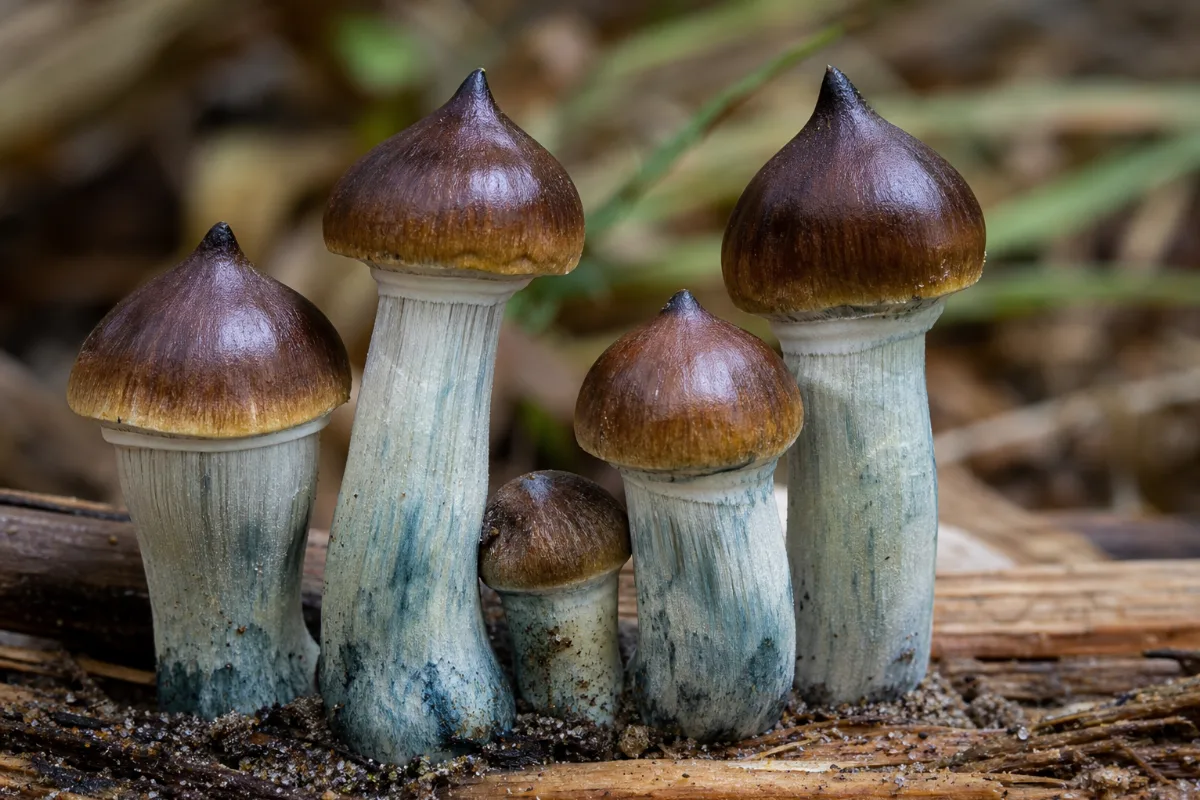
Psychedelic Therapy · Fungus
Psilocybe azurescens
Psilocybe azurescens Stamets & Gartz · also called Magic mushroom (a general term for many species)
Psilocybe azurescens is a mushroom that contains psilocybin, which the body turns into psilocin, a drug that changes perception and mood. It has almost no health research: no human study and one rat study that found more anxiety-like behaviour. A laboratory measured its psilocybin as high, and wild mushrooms can look like deadly ones. A name or photo never makes a mushroom safe.
General information, not medical advice. Last substantive update · Not medically reviewed. A named clinician has not signed off on this page. How this page is made
About Psilocybe azurescens
Psilocybe azurescens is a mushroom whose main compounds are psilocybin and psilocin. GBIF records cluster along the Pacific coast of North America. No human study of it exists, and the one animal study found more anxiety-like behaviour in rats. Safety risks include fear, raised blood pressure, mental-health crises, seizure reports with lithium, a weakness syndrome seen with some wood-loving Psilocybe species, and fatal mix-ups with toxic wild mushrooms.
What it is
Psilocybe azurescens Stamets & Gartz is an accepted species in the family Hymenogastraceae (GBIF), published in 1995. GBIF lists no older names for it.
GBIF holds 615 records. Most are in Washington, Oregon, California and British Columbia, and 501 of 521 North American records with coordinates lie west of longitude 122 W. Records show where it was seen by people, not where it is native. A few European records exist, and an Austrian checklist lists it among cultivated fungi that have escaped into natural habitats.
What it contains
The fruiting body holds psilocybin and psilocin, with baeocystin also detected and norbaeocystin minor. In one company laboratory set of 12 samples, psilocybin averaged 1.33% of dry weight (range 0.81 to 1.77%) and psilocin 0.20% (range 0.08 to 0.29%).
Among the six species in that paper, only P. zapotecorum averaged higher in psilocybin. The authors work for the company that grew the samples. It is one method on one set of samples, and wild mushrooms may differ.
How it works in the body
Psilocybin is turned into psilocin, which activates serotonin 2A receptors (NIDA). That is thought to drive the psychedelic experience. How long effects last and how the body clears psilocin were not studied for this species.
What research exists on this species
Human research: none found. Clinical trials of psilocybin use purified drug and are covered on the Psilocybin page.
Animal research: one 2026 rat study found more anxiety-like and depressive-like behaviour and disrupted social behaviour, with more brain inflammation and lower growth factors. The authors say high amounts may cause mood disorders.
Genetics: a draft genome was published in 2025, and a 2022 genome survey suggests many unexplored natural products in the genus.
At a glance
Traditional uses history, not proof
- No traditional use of this species is documented in the sources read. GBIF gives its formal naming date as 1995. NIDA's note about Central American tradition is about psilocybin mushrooms in general.
Studied for research
- Depression, anxiety and addiction, studied for purified psilocybin only, not this species, insufficient evidence
- Mood and social behaviour, one rat study of the mushroom, very low (worse behaviour, not a benefit)
- Brain inflammation and growth-factor markers, same rat study, very low
Main compounds
- Psilocybin (becomes psilocin in the body)
- Psilocin, the active form
- Baeocystin
- Norbaeocystin
Common forms
- Not covered: this page gives no preparation, growing or sourcing information.
- Purified synthetic psilocybin is what clinical trials used (see the Psilocybin page).
Research links: NIDA: Psilocybin (Magic Mushrooms) · Rat study of Psilocybe azurescens, 2026 (abstract) · Species strength measurements, 2026 (abstract) · Wood-lover paralysis survey, 2025 (abstract) · Research Library · Genes & Biomarkers Library
What it is and its history
- Accepted scientific name
- Psilocybe azurescens
- Naming authority
- Stamets & Gartz
- Common names
- Flying saucer mushroom (English); Blue angel (English); Magic mushroom (English)
- Family or group
- Hymenogastraceae (GBIF).
- Classification
- Fungi > Basidiomycota > Agaricomycetes > Agaricales > Hymenogastraceae > Psilocybe > Psilocybe azurescens
- Native range
- Not established in a source read. GBIF holds 615 records: United States 521, Canada 17, and about 28 in Europe. By state or province: Washington 273, Oregon 191, California 41, British Columbia 14. Of 521 North American records with coordinates, 501 lie west of longitude 122 W, between about 36.8 and 54.1 N, so the records cluster along the Pacific coast of North America. Records show where it was recorded, not where it is native. A 2023 Austrian checklist lists it among cultivated fungi that have escaped into natural habitats there.
- Habitat
- Not verified in a source read.
- What it looks like
- Stems: Not covered on purpose.; Fruit: The fruiting body (cap and stalk) is the part measured in the laboratory study. Appearance is not covered on purpose.
- Cultivation
- Not covered on purpose.
- Harvest and processing
- Not covered on purpose.
- Look-alikes and adulterants
- Name: Deadly amatoxin mushrooms (Amanita, Lepiota, Galerina) and other toxic species; Note: NIDA lists mistaking a toxic mushroom for a psilocybin one as a risk, and a review says most fatal mushroom poisonings involve amatoxins. No source we read names a specific look-alike for this species. This page does not teach identification and no photo or name makes a mushroom safe.
- Sustainability and conservation
- Not checked.
Traditional use and history history, not clinical proof
| Tradition or era | Documented use | Source |
|---|---|---|
| Naming | GBIF gives the original publication as Integration: Journal for Mind Moving Plants and Culture, volume 6, page 21 (1995), by Stamets and Gartz. No traditional or historical use of this species was found in the sources read; claims of ancient use for it are NOT verified. | s-gbif-pazu |
| Psilocybin mushrooms in general | NIDA says there is evidence that Indigenous people in Central America used psilocybin mushrooms for healing and spiritual rituals as far back as 3000 B.C. This concerns psilocybin mushrooms in general, not this species. | s-nida-psilocybin |
Traditional use shows how it was used. It does not show that it works or is safe today.
What is inside, and how it may work
What it contains and how those compounds act in cells and animals. Laboratory and animal mechanisms are not proven effects in people.
Main compounds
| Compound | Family | Where it is concentrated | Activity studied | Level of evidence |
|---|---|---|---|---|
| Psilocybin PubChem 10624 | tryptamine (prodrug) | Fruiting body Mean 1.33% of dry weight (range 0.81 to 1.77%, 12 samples grown in one company laboratory; one method). | Turned into psilocin in the body (NIDA). 16 12 14 | Lab |
| Psilocin PubChem 4980 | tryptamine | Fruiting body Mean 0.20% of dry weight (range 0.08 to 0.29%) in the same samples. | The active form; acts mainly on serotonin 2A receptors (NIDA). 16 12 14 | Lab |
| Baeocystin PubChem 161359 | tryptamine | Fruiting body Detected in P. azurescens in the same study; not quantified in the abstract or text read. | Effects not established from the sources read. 16 12 | Lab |
| Norbaeocystin PubChem 9795063 | tryptamine | Fruiting body Minor across all six species in the same study. | Effects not established from the sources read. 16 12 | Lab |
Mechanisms, receptors and pathways
| Target or pathway | Gene or receptor | What was found | Level |
|---|---|---|---|
| Serotonin 2A receptor | 5-HT2A receptor (HTR2A) | NIDA says psilocin attaches to and activates serotonin receptors, mainly 5-HT2A, which researchers think is responsible for much of the subjective experience. This is a general statement about psilocybin, not a test of this species. 14 | Authoritative guidance |
| Brain inflammation, oxidative stress, BDNF and GDNF | IL-6, TNF-alpha, ROS, SOD, BDNF, GDNF | In one rat study of the mushroom, the authors report more inflammation and oxidative stress and lower BDNF and GDNF in three brain regions. 8 | Animal research |
| Unexplored chemistry (genome analysis) | Genes for natural products | Genome analysis of five Psilocybe species including P. azurescens suggests much more chemistry than is known. The authors link this to the unexplained paralytic effects attributed to some magic mushrooms. It does not show that this species causes them. 4 2 | Lab |
Absorption, metabolism and elimination
- Absorption
- Not studied for this species in people.
- Distribution
- Not read.
- Metabolism
- NIDA says the body converts psilocybin to psilocin.
- Elimination
- Not read for this species. Timing figures for purified psilocybin are on the Psilocybin page.
- Bioavailability
- Not established for whole mushrooms of this species.
Isolated compounds versus whole extracts
Human trials use purified psilocybin. A mushroom holds psilocybin, psilocin and other tryptamines in amounts that vary, and the only study of this species (in rats) tested the whole mushroom. Results from one cannot be assumed for the other.
Nutritional composition
Not a nutrient and has no nutritional claim.
2 very low certainty1 not enough evidence
What was looked at
The 3 benefits and uses checked for Psilocybe azurescens, each with how strong the evidence is. Tap one to open it.
- Depression, anxiety and addiction (research on purified psilocybin)Not enough evidence
- Mood, anxiety and social behaviour (one animal study of the mushroom)Very low certainty
- Brain inflammation, oxidative stress and growth factors (rat study)Very low certainty
Lab markers tracked in the studies
Anxiety-like behaviour (elevated plus maze, rats)Depressive-like behaviour (forced swim test, rats)Social interaction (three-chamber test, rats)Brain inflammation markers (IL-6, TNF-alpha, rats)Oxidative stress markers (ROS, SOD, rats)Nerve growth factors (BDNF, GDNF, rats)
What is Psilocybe azurescens good for?
The uses people ask about and how strong the evidence is for this species. There is no human evidence. The only study of the mushroom itself was in rats.
Benefits, one by one
Each card is a research question, not a promise. Tap a goal to filter. Open a card to see the studies, doses and limits.
Depression, anxiety and addiction (research on purified psilocybin)
Not enough evidenceClinical research in this area uses purified psilocybin. No human study tested Psilocybe azurescens, so nothing here shows this mushroom helps any condition. See the Psilocybin page for the trial evidence.
2 studiesNot covered here.
Studies, doses and limits
What the trials found
NIDA says researchers are testing psilocybin for substance use disorders, depression, anxiety and obsessive-compulsive disorder. We found no human trial, case series or survey of Psilocybe azurescens for any benefit.
Results
No result exists for this species. Trial results for purified psilocybin are covered on the Psilocybin page, where they are rated low certainty with mixed findings.
Why this rating
No human study of this species exists in the sources read. Results from purified psilocybin cannot be assumed to apply to a mushroom of unknown and variable strength.
Form and dose studied
Not covered here.
Limits
A mushroom can hold other tryptamines besides psilocybin, and its content varies between samples (one laboratory set ranged from 0.81 to 1.77% psilocybin by dry weight).
Why researchers looked
Psilocybin is the main research focus in several mental-health conditions; this mushroom is one of many that contain it.
Traditional use
No traditional use of this species is documented in the sources read. GBIF gives its formal naming date as 1995. NIDA's note about Central American tradition is about psilocybin mushrooms in general.
Proposed mechanism Authoritative guidance
Psilocybin is turned into psilocin, which switches on serotonin 2A receptors in the brain (NIDA). This is thought to drive the psychedelic experience. NIDA does not discuss this species separately.
A proposed mechanism does not show that the effect happens in people.
See the Safety tab, including look-alike poisonings and the weakness syndrome linked to some wood-loving Psilocybe species.
Mood, anxiety and social behaviour (one animal study of the mushroom)
Very low certaintyIn rats given the mushroom by mouth for 14 days, anxiety-like and depressive-like behaviour went up and social interaction went down. This is evidence against a mood benefit in that model, and it is only one animal study.
1 studiesAmounts are not reproduced here.
Studies, doses and limits
Results
Male Wistar rats got three different amounts of Psilocybe azurescens by tube every other day for 14 days. Compared with the study's controls, the mushroom significantly increased anxiety-like behaviour (elevated plus maze) and depressive-like behaviour (forced swim test) and disrupted social behaviour (three-chamber test). The authors say high amounts may cause mood disorders.
Effect sizes as reported
Not given in the abstract.
Why this rating
A single rat study; the abstract gives no group sizes or effect sizes; amounts used were very high compared with clinical work; rat behaviour tests do not map neatly onto human mood.
Form and dose studied
Amounts are not reproduced here.
Who was studied
Male Wistar rats only.
Limits
One lab, one species, males only, behaviour tests that are imperfect stand-ins for human feelings. The abstract does not say whether lower amounts behaved differently.
Why researchers looked
The authors say the adverse effects of psilocybin mushrooms have been less studied than their benefits, and tested Psilocybe azurescens for the first time in rats.
Traditional use
No traditional use of this species is documented in the sources read. GBIF gives its formal naming date as 1995. NIDA's note about Central American tradition is about psilocybin mushrooms in general.
Proposed mechanism Animal research
The authors of the rat study propose that high amounts of the mushroom raise brain inflammation and oxidative stress and lower nerve growth factors. This is a proposal from one animal study, not shown in people.
A proposed mechanism does not show that the effect happens in people.
A reason for caution, not proof of harm in people.
Brain inflammation, oxidative stress and growth factors (rat study)
Very low certaintyIn the same rat study, the mushroom was linked to more brain inflammation and oxidative stress and lower nerve growth factors. This is a lab and animal finding, not a health benefit and not shown in people.
1 studiesAmounts are not reproduced here.
Studies, doses and limits
Results
Measured by ELISA in the hippocampus, prefrontal cortex and amygdala, the authors report increased inflammation markers (IL-6 and TNF-alpha) and oxidative stress (ROS and SOD), and decreased neurotrophic factors (BDNF and GDNF).
Effect sizes as reported
Not given in the abstract.
Why this rating
One animal study, abstract only, marker values and group sizes not available to us.
Form and dose studied
Amounts are not reproduced here.
Who was studied
Male Wistar rats.
Limits
Markers measured at the end of 14 days; no human equivalent shown; direction of change in each individual marker is as the authors summarise it.
Why researchers looked
The authors looked for biological reasons behind the behaviour changes they saw in the rats.
Traditional use
No traditional use of this species is documented in the sources read. GBIF gives its formal naming date as 1995. NIDA's note about Central American tradition is about psilocybin mushrooms in general.
Proposed mechanism Animal research
The authors of the rat study propose that high amounts of the mushroom raise brain inflammation and oxidative stress and lower nerve growth factors. This is a proposal from one animal study, not shown in people.
A proposed mechanism does not show that the effect happens in people.
Treated as a possible safety signal, not a finding about people.
Connections to the rest of health
How Psilocybe azurescens connects to the rest of our health knowledge graph. Every link says what kind of connection it is. A safety link (for example to the liver) is a warning, not a benefit. A study that merely mentions a topic never creates a benefit link.
Explore every connection: goals, body systems, organs, symptoms, genes
B. Body systems
| Connected to | Kind of connection | Evidence status | Context | Studies |
|---|---|---|---|---|
| Nervous System | Biological association | Not enough evidence | Studied for: Depression, anxiety and addiction (research on purified psilocybin) Studied for: Mood, anxiety and social behaviour (one animal study of the mushroom) | 14 12 8 |
I. Biomarkers
| Connected to | Kind of connection | Evidence status | Context | Studies |
|---|---|---|---|---|
| Anxiety-like behaviour (elevated plus maze, rats) | Biological association | Very low certainty | Measured in trials: raised. A lab change is not the same as a health benefit. | 8 |
| Depressive-like behaviour (forced swim test, rats) | Biological association | Very low certainty | Measured in trials: raised. A lab change is not the same as a health benefit. | 8 |
| Social interaction (three-chamber test, rats) | Biological association | Very low certainty | Measured in trials: lowered. A lab change is not the same as a health benefit. | 8 |
| Brain inflammation markers (IL-6, TNF-alpha, rats) | Biological association | Very low certainty | Measured in trials: raised. A lab change is not the same as a health benefit. | 8 |
| Oxidative stress markers (ROS, SOD, rats) | Biological association | Very low certainty | Measured in trials: raised. A lab change is not the same as a health benefit. | 8 |
| Nerve growth factors (BDNF, GDNF, rats) | Biological association | Very low certainty | Measured in trials: lowered. A lab change is not the same as a health benefit. | 8 |
J. Genes, receptors and enzymes
| Connected to | Kind of connection | Evidence status | Context | Studies |
|---|---|---|---|---|
| HTR2A (serotonin 2A receptor) | Preliminary mechanism | Authoritative guidance | Main receptor target of psilocin (NIDA). | 14 |
K. Biological pathways
| Connected to | Kind of connection | Evidence status | Context | Studies |
|---|---|---|---|---|
| Psilocybin biosynthetic genes | Preliminary mechanism | Lab | A draft genome of P. azurescens was published in 2025 to help study the genes that make psilocybin. | 2 |
L. Active compounds
| Connected to | Kind of connection | Evidence status | Context | Studies |
|---|---|---|---|---|
| Psilocybin | Biological association | Lab | Turned into psilocin in the body (NIDA). Preparation or compound: Fruiting body |
16 12 14 |
| Psilocin | Biological association | Lab | The active form; acts mainly on serotonin 2A receptors (NIDA). Preparation or compound: Fruiting body |
16 12 14 |
| Baeocystin | Biological association | Lab | Effects not established from the sources read. Preparation or compound: Fruiting body |
16 12 |
| Norbaeocystin | Biological association | Lab | Effects not established from the sources read. Preparation or compound: Fruiting body |
16 12 |
Each connection is stored with the ingredient, the connected record, the kind of connection, the evidence status, the supporting studies, the preparation or compound involved, and a review date (last reviewed October 25, 2026).
Evidence at a glance: what changed in 6 lab markers
Tap a number to show only those markers. Counts are markers, not people.
The evidence
The research centre for Psilocybe azurescens. Every record here was checked against PubMed or the publisher's page; we never list a study we have not verified.
Evidence by outcome
Bars show how many studies we found for each outcome, not how well it works. People are added up across trials only (reviews are not added, to avoid double counting).
How we rate evidence
High certainty
Several well-run trials or reviews agree; further research is unlikely to change the picture much.
Moderate certainty
Good trials point the same way, but some doubt remains.
Low certainty
Small, short or inconsistent trials. The finding could change with better research.
Very low certainty
Very little or very weak human data. Treat as a possibility only.
Mixed findings
Trials or reviews disagree with each other.
Not enough evidence
Not enough human research to say either way.
Evidence against
Good research found no benefit, or found harm.
We take the reviewers' own risk-of-bias and GRADE statements where they exist, and otherwise judge from study size, design, consistency, directness and whether a product matches what is sold. Many publications do not make evidence high. Method note: We read the abstracts of 12 PubMed papers (full text for two of them), read NIDA, the US federal drug schedule, the UN 1971 convention schedule list and the poison.org home page, checked the name and records in GBIF and compounds in PubChem. Certainty ratings are the compiler's own reading. The strength figures come from a company-linked paper. The FDA page itself was not opened.
Study library: every study we checked 18
| Study | Design | People | Product, dose, length | Result |
|---|---|---|---|---|
| Beck 2025 "Wood-lover paralysis": Describing a toxidrome with symptoms of weakness caused by some lignicolous "wood-loving" Psilocybe mushrooms. Toxicon · PMID 40490153 · DOI |
Survey |
392 392 survey respondents, mainly from Australia and New Zealand |
Wood-loving Psilocybe mushrooms (species not named in the abstract) Not reproduced here |
In a 2020 retrospective online survey, 42.1% of respondents reported wood-lover paralysis. Onset was typically within 4 hours. Weakness hit mobility in 80.4%, swallowing in 26.7% and breathing in 16.6%. Symptoms lasted into the next day for 48.1%, and 21.5% had a fall or accident. The cause is unknown. Under-recognised weakness syndrome with some wood-loving species Methods, limits and fundingOutcomes: Reported weakness after mushroom ingestion Limitations: Self-selected online survey, self-reported, retrospective. The abstract does not name P. azurescens. Funding and conflicts: No competing interests declared Read: abstract |
| Bollinger 2025 High-quality draft genomes of ecologically and geographically diverse Psilocybe species. Microbiol Resour Announc · PMID 39727395 · DOI |
Genome announcement lab |
Five Psilocybe genomes including P. azurescens | DNA sequencing |
The paper announces draft genomes of five Psilocybe species, including P. azurescens, to help study the genes that make psilocybin and to improve how the genus is classified. Genetic resource only Methods, limits and fundingOutcomes: Genome sequences Limitations: Short data announcement; no chemistry or health results. Funding and conflicts: No competing interests declared Read: abstract |
| Diaz 2018 Amatoxin-Containing Mushroom Poisonings: Species, Toxidromes, Treatments, and Outcomes. Wilderness Environ Med · PMID 29325729 · DOI |
Review |
Review of amatoxin mushroom poisonings | Amanita, Lepiota and Galerina mushrooms Not reproduced here |
Most mushroom poisonings are caused by unknown mushrooms, and most fatal ones by amatoxin mushrooms (Amanita, Lepiota, Galerina). Galerina marginata is the most frequently reported fatal Galerina. Late-appearing stomach symptoms, with or without a false recovery, can come before acute liver failure. Treatment is supportive apart from liver transplant, and about half of those with amatoxin liver failure will need a transplant. Deadly poisonings come mostly from unidentified wild mushrooms Methods, limits and fundingOutcomes: Epidemiology and outcomes Limitations: Narrative review. Funding and conflicts: Not stated in the abstract Read: abstract |
| Dörner 2022 Genetic Survey of Psilocybe Natural Products. Chembiochem · PMID 35583969 · DOI |
Genome analysis lab |
Genomes of five Psilocybe species (P. azurescens, P. cubensis, P. cyanescens, P. mexicana, P. serbica) | Computer analysis of genomes |
The genomes pointed to far more unexplored chemistry than lab tests show. P. cyanescens and P. mexicana were found to make aeruginascin. The authors say this may help explain poorly understood effects such as the paralytic effects blamed on some magic mushrooms. Genes suggest more chemistry than is known Methods, limits and fundingOutcomes: Predicted natural products Limitations: Genome browsing, not a test of what the mushroom contains or does. The abstract does not say which species makes which unknown compounds. Funding and conflicts: One author reports an ownership interest in CaaMTech, LLC Read: abstract |
| Hinkle 2024 Adverse Events in Studies of Classic Psychedelics: A Systematic Review and Meta-Analysis. JAMA Psychiatry · PMID 39230883 · DOI |
Systematic review |
3504 114 of 214 studies reported usable adverse-event data (3,504 participants) |
Not reproduced here |
Serious adverse events were reported for no healthy participants and for about 4% of participants with existing neuropsychiatric disorders, including worsening depression, suicidal behaviour, psychosis and convulsive episodes. No deaths by suicide, persistent psychosis or hallucinogen persisting perception disorder were reported in contemporary research settings. Only 16 of 68 recent studies used systematic adverse-event assessment. Generally well tolerated in research settings, but monitoring was uneven Methods, limits and fundingOutcomes: Serious and non-serious adverse events Limitations: Quality of adverse-event reporting varied a lot. Funding and conflicts: Philanthropic support for the authors' centre disclosed; no other conflicts Read: abstract |
| Jorgenson 2026 Psychoactive mushroom edibles: trends and toxicities reported to the United States National Poison Data System, 2023-2024. Clin Toxicol (Phila) · PMID 41493095 · DOI |
Observational |
362 362 poison-centre exposures to mushroom edibles (Amanita muscaria, psilocybin or unspecified) |
Unregulated psychoactive mushroom edibles Not reproduced here |
Polysubstance exposure, confusion and central nervous system depression were linked to admission and worse toxicity. No deaths were reported. The authors call the effects unpredictable and the products unregulated with unlisted ingredients. Unpredictable effects from edibles Methods, limits and fundingOutcomes: Hospital admission, severity Limitations: Reported cases only; product contents unknown. Funding and conflicts: Not stated in the abstract Read: abstract |
| Leonard 2018 Does getting high hurt? J Psychopharmacol · PMID 30182795 · DOI |
Observational |
5883 5,883 single-substance psilocybin-mushroom exposures reported to US poison centres |
Psilocybin-containing mushrooms (unsupervised use; species not recorded) Not reproduced here |
Most patients were 13 to 29 years old and male. Common effects were hallucinations (45.8%), agitation (24.1%) and fast heart rate (18.0%). Serious effects were infrequent but included overheating, seizures, coma and cardiac arrest. Most were treated and released from the emergency department. Mostly mild or moderate, with rare serious cases Methods, limits and fundingOutcomes: Clinical effects and outcomes Limitations: Reported cases only; mushroom species and amount not confirmed. Funding and conflicts: Not stated in the abstract Read: abstract |
| Moghadam 2026 The Effect of Magic Mushroom (Psilocybe azurescens) on Social Interaction, Anxiety- and Depressive-Like Behaviors in Male Rats; the Role of Neuroinflammation, Oxidative Stress, and Neurotrophic Factors. J Neurosci Res · PMID 41493855 · DOI |
Animal study animal |
Male Wistar rats (group sizes not given in the abstract) | Oral Psilocybe azurescens given by tube Not reproduced here Every other day for 14 days |
The authors report that the mushroom significantly increased anxiety-like and depressive-like behaviours and disrupted social interaction. This came with more brain inflammation and oxidative stress and lower nerve growth factors (BDNF and GDNF) in the hippocampus, prefrontal cortex and amygdala. They say high amounts may cause mood disorders. Worse mood-like behaviour in rats Methods, limits and fundingOutcomes: Social interaction, anxiety-like and depressive-like behaviour; brain levels of inflammation, oxidative stress and growth-factor markers Limitations: Animal study. Rats are not people, the amounts were far above anything used in clinics, and the abstract gives no group sizes. Funding and conflicts: Not stated in the abstract Read: abstract |
| Nayak 2021 Classic Psychedelic Coadministration with Lithium, but Not Lamotrigine, is Associated with Seizures: An Analysis of Online Psychedelic Experience Reports. Pharmacopsychiatry · PMID 34348413 · DOI |
Case report series |
Online experience reports (Erowid, Shroomery, Reddit) | Classic psychedelics taken with mood stabilisers Not reproduced here |
In 62 lithium plus psychedelic reports, 47% involved seizures and 39% involved medical attention; none of 34 lamotrigine reports did. The authors provisionally conclude a significant seizure risk with lithium. Possible seizure risk with lithium Methods, limits and fundingOutcomes: Seizures and medical attention Limitations: Self-selected anonymous online reports, not verified, not a trial. Funding and conflicts: Authors include staff of Erowid, one of the data sources; one author sits on the board of the Heffter Research Institute Read: abstract |
| Silvester 2026 Three cases of wood-lover paralysis: clinical insights from Victoria, Australia. Clin Toxicol (Phila) · PMID 41910179 · DOI |
Case series |
3 Three patients with muscle weakness after eating Psilocybe mushrooms |
Psilocybe subaeruginosa (DNA-confirmed in two cases) Not reproduced here |
One patient had mild weakness. One had severe weakness with takotsubo cardiomyopathy. One had severe weakness with respiratory failure needing a breathing tube. Samples from two cases were Psilocybe subaeruginosa by DNA. Psilocin was found in the blood of two patients. The authors say no specific alkaloid has been proven to cause the weakness. Wood-lover paralysis can be life-threatening Methods, limits and fundingOutcomes: Clinical course Limitations: Three cases; species other than P. subaeruginosa not tested. Funding and conflicts: Not stated in the abstract Read: abstract |
| Voglmayr 2023 Alien and cryptogenic fungi and oomycetes in Austria: an annotated checklist (2nd edition). Biol Invasions · PMID 36643959 · DOI |
Checklist n/a |
375 alien fungal taxa in Austria | n/a |
The full text lists Psilocybe azurescens among five cultivated fungi that have escaped into natural habitats in Austria, and says it was expected to be recorded there and has since been recorded. Recorded outside North America in Austria Methods, limits and fundingOutcomes: Which fungi are alien to Austria Limitations: Checklist; the abstract does not mention this species (read in the full text). Funding and conflicts: Not stated Read: full-text |
| Windsor 2026 Development of Psilocybe Mushroom Species Reference Material-Cultivation Parameters and Chemical Profiles. J AOAC Int · PMID 39960890 · DOI |
Lab analysis lab |
Six Psilocybe species grown in a company laboratory, including P. azurescens (12 samples) | Psilocybin, psilocin and related tryptamines measured by thin-layer chromatography Not reproduced here |
In the full text, P. azurescens averaged 1.33% psilocybin (range 0.81 to 1.77%, 12 samples) and 0.20% psilocin (range 0.08 to 0.29%) by dry weight. Among the six species, average psilocybin was highest in P. zapotecorum, then P. azurescens. Baeocystin was detected in P. azurescens; norbaeocystin was minor in all species; aeruginascin was not seen. Lab values for one set of laboratory-grown samples Methods, limits and fundingOutcomes: Psilocybin and psilocin content (percent of dry weight) by species Limitations: Laboratory measurement only (says nothing about effects in people). Only six species compared, one method, samples grown indoors by the authors' company, so wild mushrooms may differ. The abstract notes a 2026 erratum. Funding and conflicts: All authors work for Nammex, which states a financial interest in developing Psilocybe cultivars (industry-linked) Read: full-text |
| n/a 1971 United Nations Convention on Psychotropic Substances, 1971 (UNODC PDF), list of substances in Schedule I n/a · Source |
Regulation n/a |
n/a | n/a |
The 'List of Substances in the Schedules', under Schedule I, includes psilocine (psilotsin) and psilocybine. Under Schedule I, parties agree to prohibit all use except for scientific and very limited medical purposes by authorised persons. The convention text does not name mushrooms or this species. Methods, limits and fundingOutcomes: The 'List of Substances in the Schedules', under Schedule I, includes psilocine (psilotsin) and psilocybine. Under Schedule I, parties agree to prohibit all use except for scientific and very limited medical purposes by authorised persons. The convention text does not name mushrooms or this species. Limitations: Treaty text as published by UNODC; the file read may not show later changes to the schedules. How each country applies it differs. Not legal advice. Read: full-text |
| n/a 2026 NIDA: Psilocybin (Magic Mushrooms) (page read 2026-10-25) n/a · Source |
Authoritative guidance n/a |
n/a | n/a |
NIDA says psilocybin has low toxicity, raises blood pressure and heart rate, and can cause fear, panic or risky behaviour such as unsafe driving. It lists misidentifying a mushroom and taking a toxic one as a risk, and says some candies marketed as psilocybin products caused severe illness (CDC). It says psilocybin converts to psilocin, which acts mainly on the serotonin 2A receptor, and that researchers are testing psilocybin for depression, anxiety and substance use disorders. It says there is no data on the safety of psilocybin in pregnancy and that the FDA granted Breakthrough Therapy designation to a few psilocybin formulations being studied for depression. It describes evidence of use by Indigenous people in Central America as far back as 3000 B.C. It is about psilocybin mushrooms in general, not this species. Methods, limits and fundingOutcomes: NIDA says psilocybin has low toxicity, raises blood pressure and heart rate, and can cause fear, panic or risky behaviour such as unsafe driving. It lists misidentifying a mushroom and taking a toxic one as a risk, and says some candies marketed as psilocybin products caused severe illness (CDC). It says psilocybin converts to psilocin, which acts mainly on the serotonin 2A receptor, and that researchers are testing psilocybin for depression, anxiety and substance use disorders. It says there is no data on the safety of psilocybin in pregnancy and that the FDA granted Breakthrough Therapy designation to a few psilocybin formulations being studied for depression. It describes evidence of use by Indigenous people in Central America as far back as 3000 B.C. It is about psilocybin mushrooms in general, not this species. Limitations: Government fact page, not a trial. It does not name Psilocybe azurescens. Read: full-text |
| n/a 2026 US eCFR: 21 CFR 1308.11 Schedule I (version dated 2026-10-21) n/a · Source |
Regulation n/a |
n/a | n/a |
Paragraph (d), hallucinogenic substances, covers any material, compound, mixture or preparation containing any quantity of the listed substances, and the list includes Psilocybin (code 7437) and Psilocyn (code 7438). Methods, limits and fundingOutcomes: Paragraph (d), hallucinogenic substances, covers any material, compound, mixture or preparation containing any quantity of the listed substances, and the list includes Psilocybin (code 7437) and Psilocyn (code 7438). Limitations: Federal regulation text only. State laws, enforcement and any exemptions are not covered; this is not legal advice. Read: full-text |
| n/a 2026 PubChem: Psilocybin (CID 10624), psilocin (CID 4980), baeocystin (CID 161359), norbaeocystin (CID 9795063) n/a · Source |
Database n/a |
n/a | n/a |
Psilocybin C12H17N2O4P, molecular weight 284.25; psilocin C12H16N2O, 204.27; baeocystin C11H15N2O4P, 270.22; norbaeocystin C10H13N2O4P, 256.19. Methods, limits and fundingOutcomes: Psilocybin C12H17N2O4P, molecular weight 284.25; psilocin C12H16N2O, 204.27; baeocystin C11H15N2O4P, 270.22; norbaeocystin C10H13N2O4P, 256.19. Limitations: Chemical database, not a safety source. Read: api |
| n/a 2026 GBIF Backbone Taxonomy and occurrence records: Psilocybe azurescens Stamets & Gartz (key 5242469), retrieved 2026-10-25 n/a · Source |
Database n/a |
n/a | n/a |
Accepted species with no listed synonyms, family Hymenogastraceae, order Agaricales, phylum Basidiomycota; published in Integration: Journal for Mind Moving Plants and Culture 6: 21 (1995). 615 occurrence records: United States 521, Canada 17, and about 28 in Europe. By state or province: Washington 273, Oregon 191, California 41, British Columbia 14. Of 521 North American records with coordinates, 501 lie west of longitude 122 W, between about 36.8 and 54.1 N. Most records (531) are human observations, many from the public iNaturalist platform. Methods, limits and fundingOutcomes: Accepted species with no listed synonyms, family Hymenogastraceae, order Agaricales, phylum Basidiomycota; published in Integration: Journal for Mind Moving Plants and Culture 6: 21 (1995). 615 occurrence records: United States 521, Canada 17, and about 28 in Europe. By state or province: Washington 273, Oregon 191, California 41, British Columbia 14. Of 521 North American records with coordinates, 501 lie west of longitude 122 W, between about 36.8 and 54.1 N. Most records (531) are human observations, many from the public iNaturalist platform. Limitations: GBIF records show where it was recorded and photographed, not where it is native. Records are uneven because they depend on where people look and report. Read: api |
| n/a 2026 America's Poison Centers (poison.org): home page, read 2026-10-25 n/a · Source |
Public health guidance n/a |
n/a | n/a |
Says to use the Poison Control online tool or call a poison center at 1-800-222-1222; both are free, expert and confidential. Methods, limits and fundingOutcomes: Says to use the Poison Control online tool or call a poison center at 1-800-222-1222; both are free, expert and confidential. Limitations: United States number only. Read: full-text |
What we do not know yet
- No human study of Psilocybe azurescens for any use or safety question.
- One rat study only; group sizes and effect sizes not available from the abstract.
- Only one set of strength measurements, from a company-linked laboratory.
- Not known whether it can cause the weakness syndrome described for some wood-loving Psilocybe mushrooms.
- Native range and conservation were not verified.
How new research is added
New studies go to a review queue and a person reads each before any rating changes.
Lab markers
What changed in blood or saliva tests during trials. A changed number is not the same as feeling or being healthier, and we give no "normal ranges".
Other 6
Anxiety-like behaviour (elevated plus maze, rats)
Raised in trials
A test in which rats choose between open and enclosed arms of a raised maze. Less time in open arms is read as more anxiety-like behaviour.
Very low certaintyResults and what it means
Why it was measured
It is a common animal test used to look for anxiety-like effects of a substance.
Statistical vs. clinical meaning
Suggests a possible unwanted effect at high amounts in rats; says little about people.
Safety implication
Signals possible anxiety with high amounts; human data for this species are lacking.
| Study | Result | People | Product |
|---|---|---|---|
| 8 | The mushroom significantly increased anxiety-like behaviour. | Male Wistar rats | Psilocybe azurescens by tube every other day for 14 days |
Depressive-like behaviour (forced swim test, rats)
Raised in trials
A test in which rats are placed in water and the time spent floating is read as depressive-like behaviour.
Very low certaintyResults and what it means
Why it was measured
It is a standard animal test used to screen for mood effects.
Statistical vs. clinical meaning
Opposite of a mood benefit in this animal model; not a measure of human depression.
Safety implication
A reason for caution with repeated high amounts.
| Study | Result | People | Product |
|---|---|---|---|
| 8 | The mushroom significantly increased depressive-like behaviour. | Male Wistar rats | Psilocybe azurescens by tube every other day for 14 days |
Social interaction (three-chamber test, rats)
Lowered in trials
A test of how much a rat chooses to spend time with another rat rather than an empty space.
Very low certaintyResults and what it means
Why it was measured
Changes in sociability are used as a sign of altered mood or brain function in animals.
Statistical vs. clinical meaning
Animal behaviour result only.
Safety implication
No human implication can be drawn.
| Study | Result | People | Product |
|---|---|---|---|
| 8 | Social interaction behaviour was disrupted. | Male Wistar rats | Psilocybe azurescens by tube every other day for 14 days |
Brain inflammation markers (IL-6, TNF-alpha, rats)
Raised in trials
Proteins the body makes during inflammation, measured here in brain tissue.
Very low certaintyResults and what it means
Why it was measured
The authors wanted to test whether inflammation could explain the behaviour changes.
Statistical vs. clinical meaning
Possible mechanism proposed by the authors; not proven.
Safety implication
No human implication can be drawn.
| Study | Result | People | Product |
|---|---|---|---|
| 8 | Neuroinflammation increased in the hippocampus, prefrontal cortex and amygdala. | Male Wistar rats | Psilocybe azurescens by tube every other day for 14 days |
Oxidative stress markers (ROS, SOD, rats)
Raised in trials
Measures of damaging reactive oxygen molecules and the enzyme (SOD) that helps clear them.
Very low certaintyResults and what it means
Why it was measured
Oxidative stress is often studied alongside brain and mood changes.
Statistical vs. clinical meaning
Animal laboratory finding only.
Safety implication
No human implication can be drawn.
| Study | Result | People | Product |
|---|---|---|---|
| 8 | The authors report increased oxidative stress in the same three brain regions. | Male Wistar rats | Psilocybe azurescens by tube every other day for 14 days |
Nerve growth factors (BDNF, GDNF, rats)
Lowered in trials
Proteins that support the survival and growth of nerve cells.
Very low certaintyResults and what it means
Why it was measured
Lower levels are linked in animal work to mood problems, so they were measured.
Statistical vs. clinical meaning
Opposite of what is often hoped for from psilocybin in other work; this is one rat study of the whole mushroom.
Safety implication
No human implication can be drawn.
| Study | Result | People | Product |
|---|---|---|---|
| 8 | BDNF and GDNF were decreased in the hippocampus, prefrontal cortex and amygdala. | Male Wistar rats | Psilocybe azurescens by tube every other day for 14 days |
Safety
What studies and official sources say about side effects, medicines and who should check first. Each point shows what kind of evidence it comes from.
Main points to know 11
- Wild mushrooms can look like deadly ones: a name or a photo does not make a mushroom safe. Most mushroom poisonings come from unidentified wild mushrooms, and most deaths come from mushrooms that contain amatoxins, found in Amanita, Lepiota and Galerina species. NIDA lists mistaking a toxic mushroom for a psilocybin one as a risk. Deadly poisoning can seem to ease and then end in liver failure days later. We found no source that names a specific look-alike for this species, and this page does not teach identification. Nothing here makes any mushroom safe to eat. Review 3 14
- A weakness syndrome linked to some wood-loving Psilocybe mushrooms. A 2025 survey of 392 people, mostly in Australia and New Zealand, found 42.1% reported temporary weakness after wood-loving Psilocybe mushrooms, usually within 4 hours. Some had trouble swallowing (26.7%) or breathing (16.6%). A 2026 case series described three patients, one with respiratory failure needing a breathing tube, after Psilocybe subaeruginosa. The cause is unknown. None of the sources we read names Psilocybe azurescens, so we cannot say whether it can cause this. Survey 1 10 4
- Strength is uncertain and may be high. In one laboratory set (12 samples grown in a company lab), P. azurescens averaged 1.33% psilocybin and 0.20% psilocin by dry weight, with psilocybin ranging from 0.81 to 1.77%. That was the second highest of six species in that set. These are one company's measurements by one method, and wild mushrooms may differ. The numbers describe chemistry, not what a person will feel, and say nothing about safe amounts. Lab analysis 12
- Psychosis, mania, bipolar disorder and serious mental illness. Clinical studies of classic psychedelics report serious events in about 4% of participants with existing neuropsychiatric disorders, including worsening depression, suicidal behaviour, psychosis and convulsions. NIDA says people with mental-health conditions face higher risk outside clinical settings. Systematic review 5 14
- Possible mood harm shown in rats. In one study, rats given this mushroom for 14 days showed more anxiety-like and depressive-like behaviour and lower nerve growth factors. It is an animal study at high amounts and may not apply to people, but no human safety study of this species exists to set against it. Animal study 8
- Fear, panic and risky behaviour. NIDA says the experience can be frightening and can lead to dangerous behaviour such as unsafe driving or walking into traffic. In US poison-centre data on psilocybin mushrooms, the most common effects were hallucinations, agitation and a fast heart rate, and serious effects were infrequent. Observational 14 7
- Heart and blood pressure. NIDA says psilocybin typically raises blood pressure and heart rate, which may be dangerous for people with heart conditions. Authoritative guidance 14
- Lithium and seizures. In 62 online reports of lithium combined with a classic psychedelic, 47% involved seizures. These are anonymous, unverified reports, not a trial, but the authors call the seizure risk significant. Case report 9
- Edibles and look-alike products. US poison centres received 362 reports of mushroom edibles in 2023-2024. Effects were unpredictable, ingredients were often unlisted, and mixing substances raised the chance of admission. NIDA cites CDC reports that some candies marketed as psilocybin products caused severe illness. Observational 6 14
- Pregnancy. NIDA says there is no data on the safety of taking psilocybin during pregnancy, for the mother or the baby. Anyone who is pregnant or breastfeeding should ask a health provider. Authoritative guidance 14
- Legal status. Psilocybin and psilocyn are Schedule I in US federal regulation, and psilocybin and psilocin are listed in Schedule I of the 1971 UN Convention. Laws differ by country, state and region, and they change. Check a current official source. This is not legal advice. Regulation 15 13
Side effects 6
| Effect | How often | Severity and recovery | Evidence |
|---|---|---|---|
| Hallucinations, agitation and fast heart rate Reported cases only; the species eaten was not confirmed. | 45.8%, 24.1% and 18.0% in US poison-centre cases of psilocybin mushrooms (species unconfirmed) | mild to moderate Usually resolves | Observational 7 |
| Raised blood pressure and heart rate NIDA warns about heart conditions. | Not established | mild to moderate; risky with heart disease Usually while effects last | Authoritative guidance 14 |
| Anxiety, fear, panic, paranoia ("bad trip") NIDA says this can lead to dangerous behaviour. | Not established | moderate Usually resolves | Authoritative guidance 14 |
| Temporary muscle weakness, sometimes with swallowing or breathing trouble ("wood-lover paralysis") Not linked to P. azurescens in the sources read; a self-selected survey. | 42.1% of 392 survey respondents reported it with wood-loving Psilocybe mushrooms | mild to life-threatening Symptoms lasted into the next day for 48.1% | Survey 1 10 |
| Worse anxiety-like and depressive-like behaviour (rats) One animal study. | Not established | unknown in people Not studied | Animal study 8 |
| Serious events in people with existing mental-health conditions Includes worsening depression, suicidal behaviour, psychosis and convulsions. | About 4% of participants with existing neuropsychiatric disorders in research studies | severe Varies | Systematic review 5 |
Liver
No liver injury from psilocybin or from this species was found in the sources read. Liver failure is the hallmark of poisoning by deadly amatoxin mushrooms, which are a different group. 3
Monitoring. Not assessed.
This is a safety connection. It is not evidence that Psilocybe azurescens supports liver health.
Medicines and supplements 3
| With | Why it matters | Importance | Evidence | What to do |
|---|---|---|---|---|
| Lithium prescription | Unknown. | 47% of 62 online reports involved seizures. | Case report Very low certainty 9 | Do not combine without a doctor; reports suggest a real seizure risk. |
| Antidepressants such as SSRIs, and MAOIs prescription | Serotonin-system overlap is expected, but no interaction study was read for this page. | Not verified. | Not read Not enough evidence | Ask a doctor or pharmacist; do not stop any medicine on your own. |
| Alcohol, cannabis and other drugs recreational | Not studied here. | Poison-centre data link combined substances to higher admission rates for mushroom edibles. | Observational Low certainty 6 | Mixing substances makes outcomes less predictable. |
Who should check first 5
| Situation | Advice | Evidence |
|---|---|---|
| History of psychosis, mania or bipolar disorder (or a close family history) | Talk to a doctor. Serious events including psychosis occurred in people with existing conditions in research. | Systematic review 5 |
| Heart disease or high blood pressure | Psilocybin raises blood pressure and heart rate (NIDA). | Authoritative guidance 14 |
| Pregnancy and breastfeeding | No safety data (NIDA). | Authoritative guidance 14 |
| Taking lithium | Reports of seizures. See Interactions. | Case report 9 |
| Driving or operating machinery | NIDA warns of dangerous behaviour including unsafe driving. | Authoritative guidance 14 |
Overdose, product quality and regulators
Summary. NIDA describes psilocybin as having low toxicity, meaning breathing failure or heart attack are unlikely, but real risks exist. For this species there is almost no safety research: one rat study and a strength measurement. The biggest danger from a wild mushroom is eating the wrong species.
Animal. One rat study reported worse mood-like behaviour and brain markers at high amounts over 14 days.
High dose or long term signals. Rat study only.
Overdose response. Not reviewed; seek emergency care for severe effects.
Genotoxicity. Not read.
Edible products are unregulated and may contain unlisted ingredients; mushrooms of unknown origin may not be what they are sold as, and strength varies.
Edibles. 362 poison-centre reports, ingredients often unlisted; NIDA cites CDC reports of toxic chemicals in some psilocybin-labelled candies. 6 14
Content variability. In one laboratory set, psilocybin in P. azurescens ranged from 0.81 to 1.77% of dry weight across 12 samples. 12
| Body | Action | Date |
|---|---|---|
| US Drug Enforcement Administration (via 21 CFR 1308.11) (United States) | Psilocybin (code 7437) and psilocyn (code 7438) are listed in Schedule I. The paragraph covers any material, compound, mixture or preparation containing any quantity of the listed substances. source | 2026-10-25 |
| United Nations Convention on Psychotropic Substances, 1971 (International) | Psilocine and psilocybine are listed in Schedule I of the convention text. The convention does not name mushrooms or this species, and each country applies it differently. source | 2026-10-25 |
| US Food and Drug Administration (as described by NIDA) (United States) | NIDA says FDA granted Breakthrough Therapy designation to a few psilocybin formulations being studied for depression. This is a development status, not an approval, and does not concern wild mushrooms. source | 2026-10-25 |
When to get medical help
- Anyone who has eaten a wild mushroom and develops vomiting, diarrhea or belly pain, even if they feel better later: call poison control or emergency services at once. Amatoxin poisoning can seem to improve before the liver fails.
- Trouble swallowing or breathing, sudden weakness, chest pain, seizure, very high temperature, confusion that does not clear, or loss of consciousness: call your local emergency number now.
- Thoughts of suicide or self-harm after use: call your local emergency number or crisis line.
- In the US, call a poison center at 1-800-222-1222 (poison.org). Numbers in other countries were not verified here; use your local emergency number.
If someone may be poisoned or in a crisis, contact a clinician or emergency service straight away. In the US, Poison Control is 1-800-222-1222.
General information only, not medical advice. Ask a clinician or pharmacist before use, especially with medicines, in pregnancy or with a health condition. See the Natural Remedy Safety guide.
Frequently asked questions
What is Psilocybe azurescens?
Where has it been recorded?
GBIF holds 615 records, mostly from Washington (273), Oregon (191), California (41) and British Columbia (14), so records cluster along the Pacific coast of North America. A few records come from Europe, and an Austrian checklist lists it among cultivated fungi that have escaped there. Records show where it was seen, not where it is native.
Is it stronger than other magic mushrooms?
One company laboratory measured 12 samples at an average of 1.33% psilocybin by dry weight (range 0.81 to 1.77%). In that set of six species, only P. zapotecorum averaged higher. That is one lab, one method and indoor-grown samples, so it does not settle how strong any particular mushroom is, and it is not a guide to effects.
Has it been tested in people?
We found no human study of this species. Clinical trials use purified psilocybin, not mushrooms. See the Psilocybin page for those results.
What did the animal study find?
In one 2026 rat study, the mushroom given by mouth for 14 days increased anxiety-like and depressive-like behaviour and disrupted social behaviour, with more brain inflammation and lower nerve growth factors. It is one animal study at high amounts, so it is a caution rather than proof of harm in people.
Is it safe?
Can it be confused with deadly mushrooms?
Mix-ups are the main danger of wild mushrooms. Most mushroom poisonings come from unidentified mushrooms and most deaths from amatoxin mushrooms such as some Amanita, Lepiota and Galerina. No source we read names a particular look-alike for this species, and this page does not teach identification.
What is wood-lover paralysis, and does it apply here?
It is a temporary weakness reported after some wood-loving Psilocybe mushrooms. In a 2025 survey of 392 people, 42.1% reported it, some with trouble swallowing or breathing. A 2026 case series involved Psilocybe subaeruginosa. None of the sources we read names Psilocybe azurescens, so we cannot say whether it applies.
Is it legal?
How is it different from psilocybin and Psilocybe cubensis?
Does it treat depression or any other condition?
No evidence shows that this mushroom treats anything. Research on psilocybin for depression, anxiety and addiction is on purified psilocybin in supervised trials and is still being tested.
Explore by health goal
Editorial transparency
- Written by
- AlternativeMed editorial team. Research compiled with AI assistance, then checked against PubMed records.
- Medical review
- None. This page has not been reviewed by a physician or pharmacist.
- First published
- 2026-10-25
- Last substantive update
- 2026-10-25
- How we research
- We read the abstracts of 12 PubMed papers (full text for two of them), read NIDA, the US federal drug schedule, the UN 1971 convention schedule list and the poison.org home page, checked the name and records in GBIF and compounds in PubChem. Certainty ratings are the compiler's own reading. The strength figures come from a company-linked paper. The FDA page itself was not opened.
- How we rate evidence
- See "How we rate evidence" in the Evidence tab.
- Independence
- No product is promoted. No affiliate links are shown. This page is information, not encouragement to use anything, and does not teach identification, growing or foraging.
Sources 18
Each source was opened and checked. Where we read only the abstract, it says so. The small numbers in the text point here.
- Beck SA, Barlow C, Engel L et al. "Wood-lover paralysis": Describing a toxidrome with symptoms of weakness caused by some lignicolous "wood-loving" Psilocybe mushrooms.. Toxicon. 2025. PMID 40490153. DOI 10.1016/j.toxicon.2025.108450. (abstract)
- Bollinger IM, Singer H, Jacobs J et al. High-quality draft genomes of ecologically and geographically diverse Psilocybe species.. Microbiol Resour Announc. 2025. PMID 39727395. DOI 10.1128/mra.00250-24. (abstract)
- Diaz JH. Amatoxin-Containing Mushroom Poisonings: Species, Toxidromes, Treatments, and Outcomes.. Wilderness Environ Med. 2018. PMID 29325729. DOI 10.1016/j.wem.2017.10.002. (abstract)
- Dörner S, Rogge K, Fricke J et al. Genetic Survey of Psilocybe Natural Products.. Chembiochem. 2022. PMID 35583969. DOI 10.1002/cbic.202200249. (abstract)
- Hinkle JT, Graziosi M, Nayak SM et al. Adverse Events in Studies of Classic Psychedelics: A Systematic Review and Meta-Analysis.. JAMA Psychiatry. 2024. PMID 39230883. DOI 10.1001/jamapsychiatry.2024.2546. (abstract)
- Jorgenson DM, Santos Leon E, Vakkalanka JP et al. Psychoactive mushroom edibles: trends and toxicities reported to the United States National Poison Data System, 2023-2024.. Clin Toxicol (Phila). 2026. PMID 41493095. DOI 10.1080/15563650.2025.2599402. (abstract)
- Leonard JB, Anderson B, Klein-Schwartz W. Does getting high hurt?. J Psychopharmacol. 2018. PMID 30182795. DOI 10.1177/0269881118793086. (abstract)
- Moghadam H, Akbari P, Beirami E et al. The Effect of Magic Mushroom (Psilocybe azurescens) on Social Interaction, Anxiety- and Depressive-Like Behaviors in Male Rats; the Role of Neuroinflammation, Oxidative Stress, and Neurotrophic Factors.. J Neurosci Res. 2026. PMID 41493855. DOI 10.1002/jnr.70107. (abstract)
- Nayak SM, Gukasyan N, Barrett FS et al. Classic Psychedelic Coadministration with Lithium, but Not Lamotrigine, is Associated with Seizures: An Analysis of Online Psychedelic Experience Reports.. Pharmacopsychiatry. 2021. PMID 34348413. DOI 10.1055/a-1524-2794. (abstract)
- Silvester A, Hampton S, May TW et al. Three cases of wood-lover paralysis: clinical insights from Victoria, Australia.. Clin Toxicol (Phila). 2026. PMID 41910179. DOI 10.1080/15563650.2026.2640196. (abstract)
- Voglmayr H, Schertler A, Essl F, Krisai-Greilhuber I. Alien and cryptogenic fungi and oomycetes in Austria: an annotated checklist (2nd edition).. Biol Invasions. 2023. PMID 36643959. DOI 10.1007/s10530-022-02896-2. (full-text)
- Windsor C, Kreynes AE, Chilton JS et al. Development of Psilocybe Mushroom Species Reference Material-Cultivation Parameters and Chemical Profiles.. J AOAC Int. 2026. PMID 39960890. DOI 10.1093/jaoacint/qsaf007. (full-text)
- n/a. United Nations Convention on Psychotropic Substances, 1971 (UNODC PDF), list of substances in Schedule I. n/a. 1971. (full-text)
- n/a. NIDA: Psilocybin (Magic Mushrooms) (page read 2026-10-25). n/a. 2026. (full-text)
- n/a. US eCFR: 21 CFR 1308.11 Schedule I (version dated 2026-10-21). n/a. 2026. (full-text)
- n/a. PubChem: Psilocybin (CID 10624), psilocin (CID 4980), baeocystin (CID 161359), norbaeocystin (CID 9795063). n/a. 2026. (api)
- n/a. GBIF Backbone Taxonomy and occurrence records: Psilocybe azurescens Stamets & Gartz (key 5242469), retrieved 2026-10-25. n/a. 2026. (api)
- n/a. America's Poison Centers (poison.org): home page, read 2026-10-25. n/a. 2026. (full-text)


