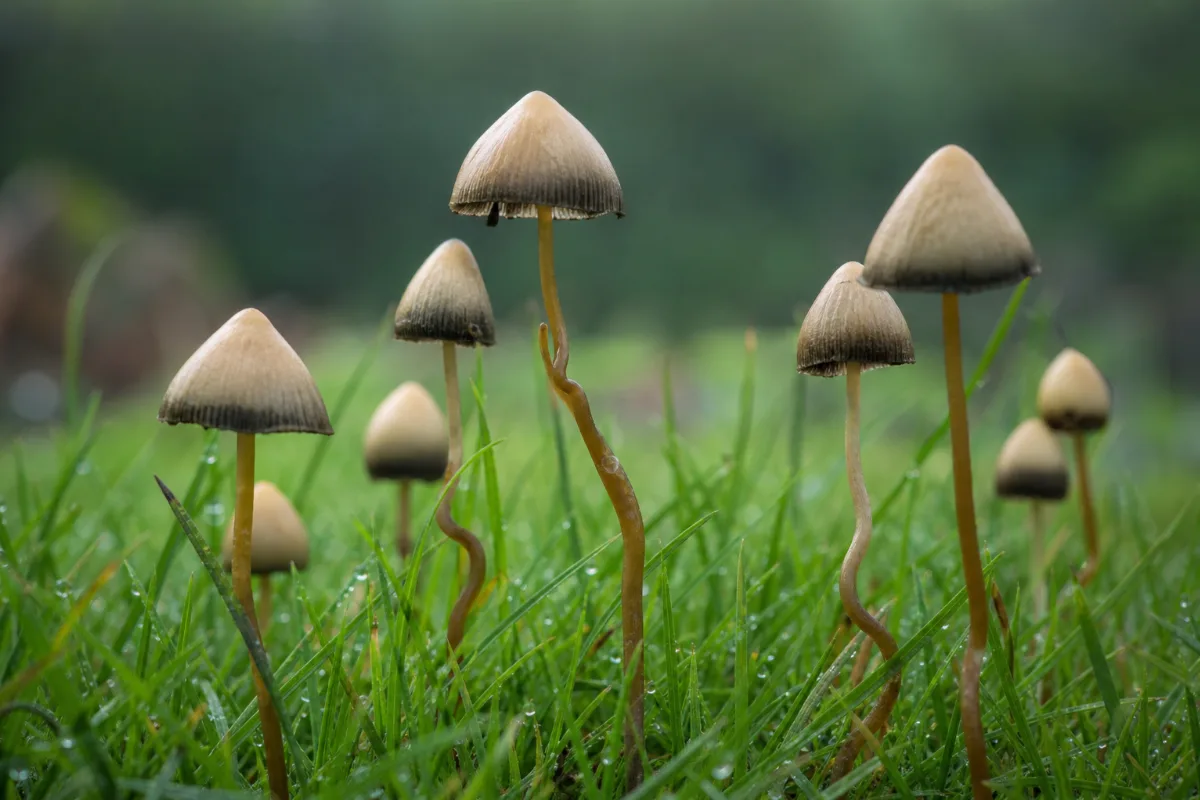
Psychedelic Therapy · Fungus
Psilocybe semilanceata (Liberty Cap)
Psilocybe semilanceata (Fr.) P. Kumm. · also called Liberty cap; magic mushroom (a general term for many species)
The liberty cap, Psilocybe semilanceata, is a small wild mushroom that contains psilocybin, which changes perception and mood. Nobody has tested the mushroom itself in a clinical trial, and its psilocybin content varies widely from one mushroom to another. Case reports describe panic, psychosis and heart problems. Some small brown mushrooms are deadly, and a name or photo never makes a mushroom safe.
General information, not medical advice. Last substantive update · Not medically reviewed. A named clinician has not signed off on this page. How this page is made
About Psilocybe semilanceata (Liberty Cap)
Psilocybe semilanceata is a small mushroom recorded mostly in Europe, whose main compounds are psilocybin, baeocystin and small amounts of psilocin. No clinical trial of it exists. Published work is mostly chemistry and case reports. Reported harms include hallucinations, fast heart rate, panic, psychosis, a heart attack and takotsubo cardiomyopathy. Deadly Galerina look-alikes make eating wild mushrooms dangerous.
What it is
Psilocybe semilanceata (Fr.) P. Kumm. is an accepted species in the family Hymenogastraceae (GBIF; Index Fungorum lists the same current name). It has older names such as Agaricus semilanceatus and Panaeolus semilanceatus.
GBIF holds 9,258 records, mostly in Europe (8,740), led by the United Kingdom, Sweden, Norway and Denmark. Records show where it was seen, not where it is native. The IUCN Red List has not evaluated it.
What is in it
Along with psilocybin, the mushroom holds baeocystin, norbaeocystin, a little psilocin and tiny amounts of aeruginascin. In 18 liberty caps from 5 collections, psilocybin ranged from 1.28 to 11.42 mg per gram of dry mushroom. Older Finnish and Norwegian studies measured 0.62 to 2.37% and 0.17 to 1.96% of dry weight.
A 1998 study also found phenylethylamine, which varied even more than psilocybin. The authors suggest it may help explain fast heart rate in some cases, but this is unproven. Museum specimens lose psilocybin over time.
What the research shows
No clinical trial of the liberty cap was found. Trials of psilocybin for depression, cancer-related distress, alcohol use and smoking used purified psilocybin; they are covered on the Psilocybe cubensis and psilocybin pages and are not repeated here.
What exists for this species: chemistry papers, case reports of poisoning and a 2025 genome release. The 2022 chemistry authors say the mix of tryptamines in wild mushrooms could change effects compared with pure psilocybin.
What the case reports describe
A 1981 series of 27 cases reported widened pupils, exaggerated reflexes and changes in perception and mood. In four people treated in Kraków, three had visual hallucinations and one had a psychosis; symptoms disappeared in about 6 hours and there was no organ damage.
US poison-centre data on psilocybin mushrooms in general show mostly mild to moderate effects; serious ones are infrequent but include seizures, coma and cardiac arrest.
At a glance
Traditional uses history, not proof
- No traditional or Indigenous use of this species is described in the sources we read. Where use is mentioned in the research papers, it is recent recreational use in Britain, Norway and Finland.
Studied for research
- Depression, anxiety and mood: no trial of this mushroom, not enough evidence (trials exist only for purified psilocybin)
- Alcohol use, smoking, distress in serious illness: no trial of this mushroom, not enough evidence
- Most published work on this species is chemistry and case reports of poisoning
Main compounds
- Psilocybin (becomes psilocin in the body)
- Psilocin (small amounts)
- Baeocystin (relatively high in this species)
- Norbaeocystin and aeruginascin
- Phenethylamine (varies widely; role unproven)
Common forms
- Wild-collected fruiting bodies (the form measured in the research)
- No other forms are discussed on this page
Research links: Poison Help (US): 1-800-222-1222 · Amatoxin mushroom poisonings review, 2018 (abstract) · Tryptamine levels in wild mushrooms, 2022 (abstract) · Heart attack after liberty caps, case report (abstract) · Which Galerina species hold deadly toxins, 2021 (abstract) · Research Library · Genes & Biomarkers Library
What it is and its history
- Accepted scientific name
- Psilocybe semilanceata
- Naming authority
- (Fr.) P. Kumm.
- Synonyms
- Agaricus semilanceatus Fr.; Agaricus callosus var. semilanceatus (Fr.) Weinm.; Coprinarius semilanceatus (Fr.) J.Schröt.; Geophila semilanceata (Fr.) Quél.; Panaeolus semilanceatus (Fr.) Quél.; Panaeolus semilanceatus (Fr.) J.E.Lange; Stropharia semilanceata (Fr.) P.Karst.
- Common names
- Liberty cap (English); Spitzkegeliger Kahlkopf (German); Spids nøgenhat (Danish)
- Family or group
- Hymenogastraceae (GBIF). Older sources place Psilocybe in Strophariaceae.
- Classification
- Fungi > Basidiomycota > Agaricomycetes > Agaricales > Hymenogastraceae > Psilocybe > Psilocybe semilanceata
- Native range
- Not verified as a native range. GBIF holds 9,258 records, mostly in Europe (8,740), then North America (245), Oceania (62), South America (18), Africa (3) and Asia (3). The top countries are the United Kingdom (4,158), Sweden (980), Norway (929), Denmark (567) and Switzerland (396). A 1984 Finnish paper says it is widely distributed in Finland.
- Habitat
- A 2022 paper calls it a grassland-dwelling species of temperate regions. No identification or locating detail is given here on purpose.
- What it looks like
- Stems: Not covered on purpose.; Fruit: The fruiting body (cap and stalk) was analysed as a whole in the 2022 chemistry study. A description for identification is not given on purpose.
- Cultivation
- Not covered on purpose.
- Harvest and processing
- Not covered on purpose.
- Look-alikes and adulterants
- Name: Galerina marginata group and other small brown mushrooms; Note: The G. marginata group holds deadly amatoxins at levels like the death cap. Galerina has about 300 species that are hard to tell apart by shape (Landry 2021). The most frequent fatal Galerina poisonings are due to G. marginata (Diaz 2018).; Name: Conocybe filaris; Note: A 2003 abstract states that amatoxins are present in Conocybe filaris, a small mushroom; the lawn mushroom Conocybe lactea had no amatoxins but small amounts of phallotoxins.; Name: Other Psilocybe and unrelated species; Note: A 2022 DNA study found museum names for Psilocybe often unreliable. This page does not teach identification.
- Sustainability and conservation
- IUCN Red List category: Not evaluated (as shown by GBIF).
Traditional use and history history, not clinical proof
| Tradition or era | Documented use | Source |
|---|---|---|
| Finland (research report, 1984) | The authors say use of this mushroom as a hallucinogen has been occasionally reported in Finland. | p17340315 |
| Norway (research report, 1981) | The authors say the mushroom has been used as a narcotic drug in Norway. | p17401967 |
| Britain (case reports, 1978) | Hyde and colleagues describe use of an indigenous British mushroom, P. semilanceata, for hallucinogenic purposes and call it a new fashion. | p566144 |
| Traditional or Indigenous use | No traditional or Indigenous use of this species is described in the sources read. Claims found elsewhere are NOT verified. |
Traditional use shows how it was used. It does not show that it works or is safe today.
What is inside, and how it may work
What it contains and how those compounds act in cells and animals. Laboratory and animal mechanisms are not proven effects in people.
Main compounds
| Compound | Family | Where it is concentrated | Activity studied | Level of evidence |
|---|---|---|---|---|
| Psilocybin PubChem 10624 | tryptamine (prodrug) | Fruiting body 1.280 to 11.421 mg/g dry mass (18 fruiting bodies, 5 collections); 0.62 to 2.37% in Finnish samples; 0.17 to 1.96% in Norwegian samples (different methods and years). | Becomes psilocin in the body (described on the psilocybin page). 27 8 12 6 | Lab analysis |
| Psilocin PubChem 4980 | tryptamine | Fruiting body (small amounts) 0.033 to 0.619 mg/g dry mass (same 18 fruiting bodies). | The active form of psilocybin. 27 8 | Lab analysis |
| Baeocystin PubChem 161359 | tryptamine | Fruiting body 0.725 to 4.467 mg/g dry mass. The 2022 authors call relatively high baeocystin typical for the species. | Related to psilocybin; human effects not reviewed here. 27 22 8 21 | Lab analysis |
| Norbaeocystin PubChem 9795063 | tryptamine | Fruiting body 0.121 to 0.510 mg/g dry mass. | Not reviewed here. 27 8 | Lab analysis |
| Aeruginascin PubChem 60208480 | tryptamine | Fruiting body 0.010 to 0.033 mg/g dry mass. | Not reviewed here. 27 8 | Lab analysis |
| Phenethylamine PubChem 1001 | phenethylamine | Fruiting body Up to 146 micrograms per gram wet weight in mushrooms from one hospital case. | May play a part in fast heart rate and other adverse reactions (authors' suggestion). 27 2 | Lab analysis |
Mechanisms, receptors and pathways
| Target or pathway | Gene or receptor | What was found | Level |
|---|---|---|---|
| Serotonin 2A receptor | 5-HT2A receptor (HTR2A) | Psilocybin is turned into psilocin, which acts on this receptor. This is described on the psilocybin and Psilocybe cubensis pages; it was not re-reviewed for this species. | Described elsewhere on site |
| Other tryptamines in the mix | Not specified | The 2022 authors say the varied mix of tryptamines in wild mushrooms could influence medicinal effects compared with pure psilocybin. No human study was read. 8 | Lab analysis |
| Phenethylamine | Not specified | The 1998 authors compare symptoms in clinical cases with those after pure psilocybin or phenethylamine and suggest phenethylamine may help explain adverse reactions. Not proven. 2 | Hypothesis (human clinical comparison) |
Absorption, metabolism and elimination
- Absorption
- Not reviewed for this species; see the psilocybin page.
- Distribution
- Not read.
- Metabolism
- Not reviewed for this species.
- Elimination
- Not reviewed. In the Kraków case series, symptoms disappeared in about 6 hours (observation, not a measurement of drug levels).
- Bioavailability
- Not established for whole mushrooms in the sources read.
Isolated compounds versus whole extracts
Human trials use purified psilocybin. The liberty cap holds psilocybin plus baeocystin, norbaeocystin, aeruginascin, psilocin and phenethylamine, and the amounts vary widely between mushrooms. Museum specimens also lose psilocybin over time. So trial results cannot be carried over to liberty caps. No trial of the mushroom itself was found.
Nutritional composition
Not a nutrient and has no nutritional claim.
2 not enough evidence
What was looked at
The 2 benefits and uses checked for Psilocybe semilanceata (Liberty Cap), each with how strong the evidence is. Tap one to open it.
What is Psilocybe semilanceata (Liberty Cap) good for?
The uses people ask about and how strong the human evidence is. For the liberty cap itself there is none. Trials used purified psilocybin in clinics.
Benefits, one by one
Each card is a research question, not a promise. Tap a goal to filter. Open a card to see the studies, doses and limits.
Depression, anxiety and mood
Not enough evidenceTrials of purified psilocybin with therapy are studied for depression and anxiety, but nobody has tested the liberty cap itself. Its psilocybin content varies a lot from one mushroom to the next, so trial results cannot be carried over to it.
3 studiesNot covered. This page gives no amounts or ways of using it.
Studies, doses and limits
What the trials found
No clinical trial of Psilocybe semilanceata itself was found. A PubMed search on the species name (top 30 results, 2026-10-25) turned up only chemistry, case reports and poison-centre style reports. The trial research is on purified psilocybin; see the Psilocybe cubensis and psilocybin pages.
Results
Nothing measured for the mushroom. In a 2022 laboratory study of 226 wild mushrooms, the authors say the amount of psilocybin and related compounds is extremely variable and that the mix of compounds could change effects compared with pure psilocybin.
Why this rating
No human trial of the mushroom. Measured psilocybin in 18 liberty caps from 5 collections ranged from 1.28 to 11.42 mg per gram of dry mushroom, so a trial of purified psilocybin does not tell us what a mushroom would do.
Form and dose studied
Not covered. This page gives no amounts or ways of using it.
Who was studied
No clinical group has been studied with this mushroom.
Limits
Evidence about this mushroom is chemistry and case reports only. Case reports include fear, psychosis and heart problems.
Why researchers looked
Psilocybin is the main compound in the liberty cap, and psilocybin is being studied for depression. That research is on the pure drug in supervised clinics. The details are on the psilocybin and Psilocybe cubensis pages and are not repeated here.
Traditional use
No traditional or ceremonial use of this species is described in the sources we read.
Proposed mechanism Pharmacological theory
The main active compound, psilocybin, becomes psilocin in the body, which acts on serotonin 2A receptors. This is described on the psilocybin page and was not re-reviewed for this mushroom.
A proposed mechanism does not show that the effect happens in people.
This mushroom is a controlled drug in places such as the US and UK, and eating a wrong wild mushroom can kill. Cases of hallucinations, fast heart rate, panic and psychosis are reported, and heart attack and takotsubo case reports exist. See the Safety tab first.
Alcohol use, quitting smoking and distress in serious illness
Not enough evidenceThese uses were studied with purified psilocybin in clinics, not with liberty caps. No study of this mushroom exists for any of them.
2 studiesNot covered. This page gives no amounts or ways of using it.
Studies, doses and limits
What the trials found
No clinical trial of Psilocybe semilanceata itself was found. A PubMed search on the species name (top 30 results, 2026-10-25) turned up only chemistry, case reports and poison-centre style reports. The trial research is on purified psilocybin; see the Psilocybe cubensis and psilocybin pages.
Results
Nothing measured for the mushroom.
Why this rating
No human study of the species. Strength differs widely between mushrooms and the mix of compounds is not the same as the pure drug used in trials.
Form and dose studied
Not covered. This page gives no amounts or ways of using it.
Who was studied
No group has been studied with this mushroom.
Limits
Only chemistry papers and case reports exist for this species.
Why researchers looked
Researchers study psilocybin in alcohol use disorder, tobacco quitting and distress in life-threatening illness. See the Psilocybe cubensis page for what those trials found.
Traditional use
No traditional use for these conditions is described in the sources we read.
Proposed mechanism Pharmacological theory
The main active compound, psilocybin, becomes psilocin in the body, which acts on serotonin 2A receptors. This is described on the psilocybin page and was not re-reviewed for this mushroom.
A proposed mechanism does not show that the effect happens in people.
This mushroom is a controlled drug in places such as the US and UK, and eating a wrong wild mushroom can kill. Cases of hallucinations, fast heart rate, panic and psychosis are reported, and heart attack and takotsubo case reports exist. See the Safety tab first.
Connections to the rest of health
How Psilocybe semilanceata (Liberty Cap) connects to the rest of our health knowledge graph. Every link says what kind of connection it is. A safety link (for example to the liver) is a warning, not a benefit. A study that merely mentions a topic never creates a benefit link.
Explore every connection: goals, body systems, organs, symptoms, genes
B. Body systems
| Connected to | Kind of connection | Evidence status | Context | Studies |
|---|---|---|---|---|
| Nervous System | Biological association | Not enough evidence | Studied for: Depression, anxiety and mood Studied for: Alcohol use, quitting smoking and distress in serious illness | 8 5 12 2 |
K. Biological pathways
| Connected to | Kind of connection | Evidence status | Context | Studies |
|---|---|---|---|---|
| Psilocybin biosynthesis gene cluster | Preliminary mechanism | Lab | A 2025 genome release for P. semilanceata and four other Psilocybe species supports study of the gene cluster; no effects or safety results. | 3 |
L. Active compounds
| Connected to | Kind of connection | Evidence status | Context | Studies |
|---|---|---|---|---|
| Psilocybin | Biological association | Lab analysis | Becomes psilocin in the body (described on the psilocybin page). Preparation or compound: Fruiting body |
27 8 12 6 |
| Psilocin | Biological association | Lab analysis | The active form of psilocybin. Preparation or compound: Fruiting body (small amounts) |
27 8 |
| Baeocystin | Biological association | Lab analysis | Related to psilocybin; human effects not reviewed here. Preparation or compound: Fruiting body |
27 22 8 21 |
| Norbaeocystin | Biological association | Lab analysis | Not reviewed here. Preparation or compound: Fruiting body |
27 8 |
| Aeruginascin | Biological association | Lab analysis | Not reviewed here. Preparation or compound: Fruiting body |
27 8 |
| Phenethylamine | Biological association | Lab analysis | May play a part in fast heart rate and other adverse reactions (authors' suggestion). Preparation or compound: Fruiting body |
27 2 |
Each connection is stored with the ingredient, the connected record, the kind of connection, the evidence status, the supporting studies, the preparation or compound involved, and a review date (last reviewed October 25, 2026).
Evidence at a glance: what the research found for 2 outcomes
Each outcome below is one thing researchers measured. Certainty is how far the evidence can be trusted, not how well it works. The full studies are on the next tab.
The evidence
The research centre for Psilocybe semilanceata (Liberty Cap). Every record here was checked against PubMed or the publisher's page; we never list a study we have not verified.
Evidence by outcome
Bars show how many studies we found for each outcome, not how well it works. People are added up across trials only (reviews are not added, to avoid double counting).
How we rate evidence
High certainty
Several well-run trials or reviews agree; further research is unlikely to change the picture much.
Moderate certainty
Good trials point the same way, but some doubt remains.
Low certainty
Small, short or inconsistent trials. The finding could change with better research.
Very low certainty
Very little or very weak human data. Treat as a possibility only.
Mixed findings
Trials or reviews disagree with each other.
Not enough evidence
Not enough human research to say either way.
Evidence against
Good research found no benefit, or found harm.
We take the reviewers' own risk-of-bias and GRADE statements where they exist, and otherwise judge from study size, design, consistency, directness and whether a product matches what is sold. Many publications do not make evidence high. Method note: We searched PubMed and read the abstracts of 24 papers (the species values of one in its open full text), read the US drug schedule and the UK Drugs Act section, and checked the name in GBIF and Index Fungorum and compounds in PubChem. Certainty ratings are the compiler's own reading. Much of the case literature is old. The UN schedule and other countries' laws were not verified with regulators.
Study library: every study we checked 29
| Study | Design | People | Product, dose, length | Result |
|---|---|---|---|---|
| Akata 2020 Toxin components and toxicological importance of Galerina marginata from Turkey. Toxicon · PMID 32866473 · DOI |
Lab analysis fungus-lab |
Galerina marginata from three regions of Turkey | Wild mushroom (toxic) Not reproduced here |
Alpha- and beta-amanitin were measured; beta-amanitin was higher than alpha in all three regions. Gamma-amanitin was below detection and no phallotoxins were found. The authors say Galerina is rare but can poison humans and animals worldwide. Methods, limits and fundingOutcomes: Amatoxin and phallotoxin levels Limitations: Laboratory analysis; no patients. Funding and conflicts: Not stated in the abstract. Read: abstract |
| Beck 1998 Presence of phenylethylamine in hallucinogenic Psilocybe mushroom: possible role in adverse reactions. J Anal Toxicol · PMID 9491968 · DOI |
Lab analysis fungus-lab and human case |
P. semilanceata, including mushrooms from a case of three young men admitted to hospital | Wild mushroom Not reproduced here |
Phenylethylamine was found in P. semilanceata. The amount varied much more than psilocybin. The highest level (146 micrograms per gram wet weight) came from mushrooms in a case of three young men hospitalised with adverse reactions. The authors suggest it may play a role in adverse reactions such as fast heart rate. Methods, limits and fundingOutcomes: Presence of phenylethylamine (GC-MS) and link to adverse reactions Limitations: Suggestion only; a role for phenylethylamine is not proven. Funding and conflicts: Not stated in the abstract. Read: abstract |
| Bollinger 2025 High-quality draft genomes of ecologically and geographically diverse Psilocybe species. Microbiol Resour Announc · PMID 39727395 · DOI |
Genome fungus-lab |
Five Psilocybe genomes, including P. semilanceata | Fungal DNA Not reproduced here |
High-quality draft genomes were released for P. semilanceata and four other Psilocybe species, to help study the psilocybin gene cluster and the species tree. Methods, limits and fundingOutcomes: Genome sequence Limitations: Data release; no results about effects or safety. Funding and conflicts: Not stated in the abstract. Read: abstract |
| Borowiak 1998 Psilocybin mushroom (Psilocybe semilanceata) intoxication with myocardial infarction. J Toxicol Clin Toxicol · PMID 9541042 · DOI |
Case report |
1 18-year-old man who ate P. semilanceata (intentional) |
Wild mushroom Not reproduced here |
An 18-year-old man developed Wolff-Parkinson-White syndrome, an abnormal heart rhythm and a heart attack (myocardial infarction). The authors suggest that the indole content of such mushrooms may predict the risk of nerve and heart toxicity. One case Methods, limits and fundingOutcomes: Heart effects Limitations: Single case; a cause-and-effect link cannot be proven. Mushroom strength was not given in the abstract. Funding and conflicts: Not stated in the abstract. Read: abstract |
| Bradshaw 2022 DNA Authentication and Chemical Analysis of Psilocybe Mushrooms Reveal Widespread Misdeterminations in Fungaria and Inconsistencies in Metabolites. Appl Environ Microbiol · PMID 36445079 · DOI |
Lab analysis fungus-lab |
94 94 fungarium specimens of 18 Psilocybe species; psilocybin stability in 25 specimens of P. cubensis, P. cyanescens and P. semilanceata |
Museum (fungarium) specimens Not reproduced here |
The authors found the names on museum specimens largely unreliable, even at genus level. Psilocybin and psilocin decayed with time and by species, and some specimens had none left. They say chemical studies are often inconsistent. Methods, limits and fundingOutcomes: DNA-barcode names, and decay of psilocybin and related compounds over time Limitations: Museum specimens, not fresh wild mushrooms; the abstract does not give a species-level result for P. semilanceata. Funding and conflicts: Not stated in the abstract. Read: abstract |
| Christiansen 1981 The content of Psilocybin in Norwegian Psilocybe semilanceata. Planta Med · PMID 17401967 · DOI |
Lab analysis fungus-lab |
P. semilanceata from Norway | Wild-collected mushrooms (dried) Not reproduced here |
Psilocybin in dried mushrooms ranged from 0.17 to 1.96%. Smaller mushrooms had higher percentages; larger ones had more in total. 0.17 to 1.96% psilocybin (dry weight) Methods, limits and fundingOutcomes: Psilocybin content Limitations: 1981 study; sample numbers not in the abstract. Funding and conflicts: Not stated in the abstract. Read: abstract |
| Diaz 2018 Amatoxin-Containing Mushroom Poisonings: Species, Toxidromes, Treatments, and Outcomes. Wilderness Environ Med · PMID 29325729 · DOI |
Review |
Review of amatoxin mushroom poisoning | Amanita, Lepiota and Galerina mushrooms Not reproduced here |
Most mushroom poisonings are caused by unknown mushrooms, and most deaths by amatoxin mushrooms. The most frequently reported fatal Galerina cases are due to Galerina marginata. Late-appearing stomach and bowel symptoms, with or without a false recovery, can come before acute liver failure. Treatment is supportive except liver transplant and has not been tested in randomised trials; about half of patients with liver failure will need a transplant. Methods, limits and fundingOutcomes: Which species, symptoms, treatments and outcomes Limitations: Narrative review using internet searches; no pooled numbers. Funding and conflicts: Not stated in the abstract. Read: abstract |
| Gotvaldová 2022 Extensive Collection of Psychotropic Mushrooms with Determination of Their Tryptamine Alkaloids. Int J Mol Sci · PMID 36430546 · DOI |
Lab analysis fungus-lab |
226 226 fruiting bodies from 82 collections of about 30 species in seven genera, including 18 P. semilanceata fruiting bodies from 5 collections |
Wild-collected mushrooms (dried) Not reproduced here |
Tryptamine levels were extremely variable. The authors warn of an apparent risk of overdose for consumers and say the mix of tryptamines could change effects compared with pure psilocybin. In P. semilanceata (full-text table, mg per gram dry mass): psilocybin 1.280 to 11.421, psilocin 0.033 to 0.619, baeocystin 0.725 to 4.467, norbaeocystin 0.121 to 0.510, aeruginascin 0.010 to 0.033. Psilocybin 1.28 to 11.42 mg/g dry mass across 18 fruiting bodies Methods, limits and fundingOutcomes: Psilocybin, psilocin, baeocystin, norbaeocystin and aeruginascin (UHPLC-MS/MS) Limitations: Species numbers come from the open full text, not the abstract. Only 5 P. semilanceata collections. No human effects were measured. Funding and conflicts: Not stated in the abstract. Read: full-text (PubMed Central table) |
| Hallen 2003 Taxonomy and toxicity of Conocybe lactea and related species. Mycol Res · PMID 14531619 · DOI |
Lab analysis fungus-lab |
Conocybe lactea, a small lawn mushroom, and related species | Mushrooms of the genus Conocybe Not reproduced here |
Amatoxins are present in the related Conocybe filaris, as the authors state. Conocybe lactea had no amatoxins but held small amounts of phallotoxins. Methods, limits and fundingOutcomes: Amatoxins and phallotoxins by HPLC and mass spectrometry Limitations: Taxonomy and toxin study; no patients. Funding and conflicts: Not stated in the abstract. Read: abstract |
| Hinkle 2024 Adverse Events in Studies of Classic Psychedelics: A Systematic Review and Meta-Analysis. JAMA Psychiatry · PMID 39230883 · DOI |
Systematic review |
3504 |
Classic psychedelics in supervised research Not reproduced here |
Serious events were reported for none of the healthy participants and for about 4% of people with existing neuropsychiatric disorders (worsening depression, suicidal behaviour, psychosis and convulsive episodes). The authors say the drugs were generally well tolerated in research settings, though monitoring quality varied. Methods, limits and fundingOutcomes: Serious and non-serious adverse events Limitations: Research settings with screening, not wild mushrooms. Quality of adverse-event reporting was uneven. Funding and conflicts: Not stated in the abstract. Read: abstract |
| Hyde 1978 Abuse of indigenous psilocybin mushrooms: a new fashion and some psychiatric complications. Br J Psychiatry · PMID 566144 · DOI |
Case series |
3 Three patients in Britain |
Wild mushroom (P. semilanceata) Not reproduced here |
Typical psychedelic effects, short psychotic states and longer states like schizophrenia were seen. Stimulant-like (sympathomimetic) signs were noted in two patients and lasted in one. Methods, limits and fundingOutcomes: Psychiatric effects Limitations: Three cases from 1978; the abstract does not say how long follow-up lasted. Funding and conflicts: Not stated in the abstract. Read: abstract |
| Jokiranta 1984 Psilocybin in Finnish Psilocybe semilanceata. Planta Med · PMID 17340315 · DOI |
Lab analysis fungus-lab |
P. semilanceata samples from different parts of Finland | Wild-collected mushrooms (dried) Not reproduced here |
Psilocybin 0.62 to 2.37% of dry weight (mean 1.42%); some samples also held low psilocin (0.01 to 0.02%). The authors note the species is widely distributed in Finland. Mean 1.42% psilocybin (dry weight) Methods, limits and fundingOutcomes: Psilocybin and psilocin content (HPLC) Limitations: 1984 study; sample numbers are not in the abstract; methods and drying differ from later work. Funding and conflicts: Not stated in the abstract. Read: abstract |
| Jorgenson 2026 Psychoactive mushroom edibles: trends and toxicities reported to the United States National Poison Data System®, 2023-2024. Clin Toxicol (Phila) · PMID 41493095 · DOI |
Observational |
362 US poison-centre reports 2023 to 2024 of psychoactive mushroom edibles |
Mushroom edibles (Amanita, psilocybin or unspecified) Not reproduced here |
Of 362 reports, no deaths were reported. Mixing substances, confusion and CNS depression were linked with admission and with worse toxicity. Products often had unlisted ingredients. Methods, limits and fundingOutcomes: Admission and toxicity Limitations: Phone reports; not specific to liberty caps. Funding and conflicts: Not stated in the abstract. Read: abstract |
| Kaneko 2001 Amatoxin poisoning from ingestion of Japanese Galerina mushrooms. J Toxicol Clin Toxicol · PMID 11527238 · DOI |
Case report |
1 6-year-old boy in Japan |
Galerina species (toxic), most likely G. fasciculata Not reproduced here |
Cholera-like diarrhoea followed by severe late liver deterioration. Alpha-amanitin was found in leftover mushroom. The authors call it the first Japanese Galerina case where an amatoxin was shown to be responsible. Methods, limits and fundingOutcomes: Course of poisoning Limitations: Single case; shows that children are affected. Funding and conflicts: Not stated in the abstract. Read: abstract |
| Kotts 2022 Psilocybin-induced takotsubo cardiomyopathy. BMJ Case Rep · PMID 35580942 · DOI |
Case report |
1 One patient after recreational ingestion of P. semilanceata |
Wild mushroom Not reproduced here |
Takotsubo cardiomyopathy (a temporary heart muscle weakness) with breathing trouble and fluid on the lungs. It responded to standard medical care. The authors say it was only the second recognised case in the published literature. One case Methods, limits and fundingOutcomes: Heart effects Limitations: Single case; cause cannot be proven. Funding and conflicts: Not stated in the abstract. Read: abstract |
| Landry 2021 Phylogenetic analysis of the distribution of deadly amatoxins among the little brown mushrooms of the genus Galerina. PLoS One · PMID 33566818 · DOI |
Lab analysis fungus-lab |
70 70 samples of Galerina and close relatives from British Columbia |
Wild mushrooms (toxic) Not reproduced here |
Some Galerina species hold amatoxins at levels equal to the death cap. Amatoxins were found only in the 24 samples of the G. marginata complex, not in the other 46. The genus has about 300 species that are notoriously hard to tell apart by shape. Methods, limits and fundingOutcomes: Which Galerina species hold amatoxins (LC-MS and DNA barcoding) Limitations: One region (western Canada). The authors report that morphology-based naming of the G. marginata complex matched DNA barcoding in their samples. Funding and conflicts: Not stated in the abstract. Read: abstract |
| Leonard 2018 Does getting high hurt? J Psychopharmacol · PMID 30182795 · DOI |
Observational |
9437 |
Psilocybin-containing mushrooms (species not specified) Not reproduced here |
Hallucinations 45.8%, agitation 24.1% and fast heart rate 18.0% in mushroom cases. Serious effects were infrequent but included overheating, seizures, coma, raised creatinine and cardiac arrest. Moderate effect was the most frequent outcome (61.0%). Moderate effect in 61.0% Methods, limits and fundingOutcomes: Clinical effects and outcomes Limitations: Phone reports; the mushroom species is not given. Funding and conflicts: Not stated in the abstract. Read: abstract |
| Liu 2020 N-acetylcysteine as a treatment for amatoxin poisoning: a systematic review. Clin Toxicol (Phila) · PMID 32609548 · DOI |
Systematic review |
506 13 studies of people with amatoxin poisoning treated with N-acetylcysteine |
Amatoxin mushrooms Not reproduced here |
In 506 treated patients, 40 died (7.9%) and 22 had a liver transplant (4.3%). Gastrointestinal bleeding occurred in 21% of 71 and acute kidney injury in 19% of 27 reported. Methods, limits and fundingOutcomes: Deaths, liver transplants and complications Limitations: Studies without a no-treatment comparison group, so the effect of the treatment cannot be judged from these figures. Funding and conflicts: Not stated in the abstract. Read: abstract |
| Nayak 2021 Classic Psychedelic Coadministration with Lithium, but Not Lamotrigine, is Associated with Seizures: An Analysis of Online Psychedelic Experience Reports. Pharmacopsychiatry · PMID 34348413 · DOI |
Observational |
62 Online reports of classic psychedelics taken with lithium (62 reports) or lamotrigine (34 reports) |
Classic psychedelics (including psilocybin mushrooms) Not reproduced here |
47% of 62 lithium reports involved seizures; none of 34 lamotrigine reports did. The authors provisionally conclude psychedelic use may pose a significant seizure risk for patients on lithium. Methods, limits and fundingOutcomes: Seizures and bad experiences Limitations: Anonymous online posts; cannot prove cause; does not name P. semilanceata. Funding and conflicts: Not stated in the abstract. Read: abstract |
| Peden 1981 Clinical toxicology of "magic mushroom" ingestion. Postgrad Med J · PMID 7199140 · DOI |
Case series |
27 27 people who ate "magic mushrooms" (1981 report) |
Wild mushrooms (appeared to be P. semilanceata) Not reproduced here |
Widened pupils and exaggerated reflexes were common, along with disorders of perception and mood. P. semilanceata appears to have been the species involved. Methods, limits and fundingOutcomes: Clinical features Limitations: Old case series; the species was not confirmed by modern methods in the abstract. Funding and conflicts: Not stated in the abstract. Read: abstract |
| Pedersen-Bjergaard 1997 Determination of psilocybin in Psilocybe semilanceata by capillary zone electrophoresis. J Chromatogr B Biomed Sci Appl · PMID 9252052 · DOI |
Lab analysis fungus-lab |
P. semilanceata extracts | Wild-collected mushrooms Not reproduced here |
A method was developed to measure psilocybin in P. semilanceata. It was also suitable for measuring the related compound baeocystin. Methods, limits and fundingOutcomes: Method to measure psilocybin (capillary zone electrophoresis) Limitations: Analytical method paper; no human data. Funding and conflicts: Not stated in the abstract. Read: abstract |
| Repke 1977 Baeocystin in Psilocybe semilanceata. J Pharm Sci · PMID 556766 · DOI |
Lab analysis fungus-lab |
Extracts of P. semilanceata (and a related species) | Wild-collected mushroom extracts Not reproduced here |
Baeocystin and psilocybin were found in extracts of a variety of P. semilanceata. Traces of psilocin were present. Structures were confirmed by mass spectrometry and UV spectroscopy. Methods, limits and fundingOutcomes: Which tryptamines are present Limitations: 1977 laboratory paper; abstract gives no amounts. Funding and conflicts: Not stated in the abstract. Read: abstract |
| Satora 2005 Poisonings resulting from the ingestion of magic mushrooms in Kraków. Przegl Lek · PMID 16225077 |
Case series |
4 Four people treated in Kraków, Poland, autumn 2004 |
Wild mushrooms (P. semilanceata) Not reproduced here |
Three had visual hallucinations; the fourth had hallucinations plus an exogenous psychosis. One was hospitalised for several days. No organ damage; symptoms went away in about 6 hours. The internet was the patients' main source of information. Methods, limits and fundingOutcomes: Symptoms and outcome Limitations: Four cases only. Funding and conflicts: Not stated in the abstract. Read: abstract |
| n/a 2005 UK Drugs Act 2005, section 21 (legislation.gov.uk), read 2026-10-25 n/a · Source |
Regulation n/a |
n/a | n/a |
Section 21 inserts into Part 1 of Schedule 2 to the Misuse of Drugs Act 1971 (Class A drugs) the entry "Fungus (of any kind) which contains psilocin or an ester of psilocin". In force from 18 July 2005. Methods, limits and fundingOutcomes: Class A listing of psilocin-containing fungi Limitations: The Act text as read; later amendments, penalties and how it is applied were not read. Applies in the United Kingdom only. Funding and conflicts: n/a Read: page |
| n/a 2026 Poison Help (US): poison.org home page, read 2026-10-25 n/a · Source |
Authoritative guidance n/a |
n/a | n/a |
The page lists the US Poison Help line as 1-800-222-1222. Methods, limits and fundingOutcomes: Poison Help phone number Limitations: Gives the US number only. Funding and conflicts: n/a Read: page |
| n/a 2026 US eCFR: 21 CFR 1308.11 Schedule I (version dated 2026-10-20) n/a · Source |
Regulation n/a |
n/a | n/a |
Schedule I hallucinogenic substances include Psilocybin (code 7437) and Psilocyn (code 7438). Methods, limits and fundingOutcomes: Schedule I list Limitations: Lists the chemicals. The lines read do not name any mushroom species. State laws are not covered. Funding and conflicts: n/a Read: page |
| n/a 2026 PubChem: psilocybin (CID 10624), psilocin (4980), baeocystin (161359), norbaeocystin (9795063), aeruginascin (60208480), phenethylamine (1001), retrieved 2026-10-25 n/a · Source |
Database n/a |
n/a | n/a |
Psilocybin C12H17N2O4P (284.25); psilocin C12H16N2O (204.27); baeocystin C11H15N2O4P (270.22); norbaeocystin C10H13N2O4P (256.19); aeruginascin C13H20N2O4P+ (299.28); phenethylamine C8H11N. Methods, limits and fundingOutcomes: Names, formulas, weights Limitations: Chemical database, not a safety source. Funding and conflicts: n/a Read: page |
| n/a 2026 GBIF Backbone Taxonomy: Psilocybe semilanceata (Fr.) P.Kumm. (key 5242507), retrieved 2026-10-25 n/a · Source |
Database n/a |
n/a | n/a |
Accepted species, family Hymenogastraceae, order Agaricales, class Agaricomycetes, phylum Basidiomycota. Published in Fuhrer fur Pilzkunde (Zerbst) 1871, page 71. Ten synonyms are listed, including Agaricus semilanceatus Fr. and Panaeolus semilanceatus (Fr.) Quel. 9,258 occurrence records; by continent: Europe 8,740, North America 245, Oceania 62, South America 18, Africa 3, Asia 3. Top countries: United Kingdom 4,158, Sweden 980, Norway 929, Denmark 567, Switzerland 396. Common name listed: Liberty Cap. IUCN Red List category: Not evaluated. Methods, limits and fundingOutcomes: Accepted name, family, synonyms, common names, occurrence records Limitations: Occurrence records show where the species was recorded, not its native range. Recording effort differs by country. Funding and conflicts: n/a Read: page |
| n/a 2026 Index Fungorum: Psilocybe semilanceata (Fr.) P. Kumm. (record 232492), queried 2026-10-25 n/a · Source |
Database n/a |
n/a | n/a |
Index Fungorum lists Psilocybe semilanceata (Fr.) P. Kumm. as the current name, published 1871 (record number 232492). It agrees with GBIF. Methods, limits and fundingOutcomes: Current name and authority Limitations: Name register only; no information on safety or chemistry. MycoBank was not opened. Funding and conflicts: n/a Read: page |
What we do not know yet
- No clinical trial of the liberty cap for any use.
- Psilocybin and related compounds vary widely between mushrooms.
- Heart and mental-health case reports cannot show how common these problems are.
- Interactions with common antidepressants were not found in the sources read.
- Native range and conservation were not verified beyond GBIF records.
How new research is added
New studies go to a review queue and a person reads each before any rating changes.
Lab markers
What changed in blood or saliva tests during trials. A changed number is not the same as feeling or being healthier, and we give no "normal ranges".
Safety
What studies and official sources say about side effects, medicines and who should check first. Each point shows what kind of evidence it comes from.
Main points to know 10
- Deadly look-alikes: a name, a photo or an app never makes a small brown mushroom safe. Some small brown mushrooms are deadly. In the genus Galerina, the G. marginata group holds amatoxins at levels like the death cap, and one review lists G. marginata as the most frequent cause of fatal Galerina poisonings. Galerina has about 300 species that experts find hard to tell apart by shape. Most mushroom poisonings come from unknown mushrooms, and most deaths from amatoxin mushrooms. Amatoxin poisoning can bring stomach symptoms that ease for a while, then liver failure; about half of people with liver failure will need a transplant. A related lawn mushroom, Conocybe filaris, is also reported to hold amatoxins. This site does not teach identification. Review 7 16 1 9
- If a wild mushroom has been eaten, call for help at once. Do not wait for symptoms. In the US, Poison Help is 1-800-222-1222. In a pooled review of 506 amatoxin patients treated in hospital, 40 died (7.9%) and 22 had a liver transplant (4.3%). Treatment is supportive and has not been tested in randomised trials. Systematic review 25 18 7
- Even experts mislabel Psilocybe mushrooms. A DNA study of 94 museum specimens from 18 Psilocybe species found names largely unreliable, even at genus level. If museum specialists get it wrong, a person cannot trust a name or a photo of a wild mushroom. Lab analysis 5
- Heart problems have been reported. One case report describes an 18-year-old with an abnormal heart rhythm (Wolff-Parkinson-White syndrome) and a heart attack after eating liberty caps. Another describes takotsubo cardiomyopathy, a temporary heart muscle weakness, with trouble breathing and lung fluid. These are single cases and cannot show how often it happens. Fast heart rate was reported in 18.0% of 5,883 US poison-centre calls about psilocybin mushrooms in general. Case report 4 15 17
- Fear, psychosis and long-lasting mental effects. Case reports of liberty cap use describe typical psychedelic effects, short psychotic states and longer states like schizophrenia. In Kraków, four people had hallucinations, one with an exogenous psychosis; symptoms went away in about 6 hours. In supervised research, serious events happened in about 4% of people with existing neuropsychiatric disorders (worsening depression, suicidal behaviour, psychosis, convulsive episodes) and in none of the healthy participants. Case series 11 23 10
- Strength varies a lot from one mushroom to the next. In 18 liberty caps from 5 collections, psilocybin ranged from 1.280 to 11.421 mg per gram of dry mushroom. Older Finnish and Norwegian studies measured 0.62 to 2.37% and 0.17 to 1.96% of dry weight. The mushroom also holds baeocystin, norbaeocystin and tiny amounts of aeruginascin. The 2022 authors warn of an apparent risk of overdose because of this variability. Lab analysis 8 12 6
- Phenylethylamine may play a part in fast heart rate. A 1998 study found phenylethylamine in liberty caps, with levels that varied far more than psilocybin. The highest level came from mushrooms eaten by three young men who were hospitalised. The authors suggest it may contribute to adverse reactions such as fast heart rate. This is a suggestion, not proof. Lab analysis 2
- Lithium and seizures. In 62 online reports of lithium taken with a classic psychedelic, 47% involved seizures; none of 34 lamotrigine reports did. These are anonymous reports, not a trial, and they do not name this species. Observational 19
- Pregnancy, breastfeeding, children. No source read for this page covers safety in pregnancy or breastfeeding for this mushroom. A 6-year-old child poisoned by a toxic Galerina mushroom developed severe liver injury, showing why children must never be given wild mushrooms. Case report 14
- Legal status. Psilocybin is a controlled drug in many countries. In the UK, a 2005 Act made fungi containing psilocin Class A drugs; in the US, psilocybin and psilocyn are in Schedule I. Laws differ by country and change. This page is not legal advice. Regulation 26 24
Side effects 5
| Effect | How often | Severity and recovery | Evidence |
|---|---|---|---|
| Hallucinations, agitation, fast heart rate The species is not named in these US figures. | Psilocybin mushrooms in general: hallucinations 45.8%, agitation 24.1%, fast heart rate 18.0% of 5,883 US poison-centre cases | mild to moderate; serious cases infrequent Most were treated and released | Observational 17 |
| Widened pupils, exaggerated reflexes, changes in perception and mood P. semilanceata appears to be the species involved. | Common among 27 cases in a 1981 series | mild to moderate Not stated in the abstract | Case series 20 |
| Short psychotic states or longer states like schizophrenia A few cases; the rate is not known. | Reported in 3 patients (1978) and 1 of 4 people (Kraków) | serious Varied: short in some, longer in others | Case series 11 23 |
| Heart attack or abnormal heart rhythm An 18-year-old with Wolff-Parkinson-White syndrome. | Single case | serious Not stated | Case report 4 |
| Takotsubo cardiomyopathy (temporary heart muscle weakness) Single case. | Single case; authors call it the second recognised case | serious Responded to standard care in the report | Case report 15 |
Liver
Liver damage from psilocybin was not found in the sources read. Liver failure is the typical late harm of amatoxin mushrooms such as Galerina marginata, which can be mistaken for harmless small brown mushrooms. A Japanese Galerina case in a 6-year-old showed severe late liver damage. 7 14
How often. Amatoxin poisoning is a separate emergency, not an effect of psilocybin.
Monitoring. Not assessed.
This is a safety connection. It is not evidence that Psilocybe semilanceata (Liberty Cap) supports liver health.
Medicines and supplements 3
| With | Why it matters | Importance | Evidence | What to do |
|---|---|---|---|---|
| Lithium prescription | Unknown. | 47% of 62 online reports with a classic psychedelic involved seizures. | Case report Very low certainty 19 | Do not combine without a doctor; the reports point to a real seizure risk. |
| Antidepressants such as SSRIs, and MAOIs prescription | Serotonin-system overlap is expected, but no interaction study was read for this page. | Not verified. | Not read Not enough evidence | Ask a doctor or pharmacist; do not stop any medicine on your own. |
| Alcohol, cannabis and other drugs recreational | Not studied here. | US poison-centre data on mushroom edibles link taking several substances with higher hospital admission (adjusted odds ratio 2.58). | Observational Low certainty 13 | Mixing substances makes outcomes less predictable. |
Who should check first 5
| Situation | Advice | Evidence |
|---|---|---|
| History of psychosis, mania or bipolar disorder, or a close family history | Research settings found serious events in people with existing neuropsychiatric conditions. Case reports of liberty cap use include psychosis. Talk to a doctor. | Systematic review 10 11 |
| Heart disease, abnormal heart rhythm or high blood pressure | Heart attack and takotsubo case reports exist after liberty cap use. Talk to a doctor. | Case report 4 15 |
| Taking lithium | Reports of seizures. See Interactions. | Case report 19 |
| Pregnancy and breastfeeding | No safety data in the sources read. Ask a health provider. | Not read |
| Driving or operating machinery | Changes in perception and mood were common in a case series, and effects lasted about 6 hours in Kraków cases. Do not drive. | Case series 20 23 |
Overdose, product quality and regulators
Summary. Poison-centre data on psilocybin mushrooms in general show mostly mild to moderate effects, with infrequent serious ones (overheating, seizures, coma, raised creatinine, cardiac arrest). No death from psilocybin itself was found in the sources read. The deaths in mushroom poisoning mostly come from amatoxin look-alikes.
Animal. Not reviewed.
Human doses studied. Not given here.
High dose or long term signals. Not reviewed.
Overdose response. Not reviewed; seek emergency care for severe effects.
Genotoxicity. Not read.
Wild mushrooms vary in strength and in other compounds. Products sold as mushroom edibles are unregulated and often have unlisted ingredients.
Content variability. Psilocybin, psilocin, baeocystin, norbaeocystin and aeruginascin vary widely between wild mushrooms; museum specimens also lose psilocybin over time. 8 5
Edibles. 362 US poison-centre reports in 2023 to 2024; ingredients were often unlisted and mixed substances raised the chance of admission. No deaths were reported. 13
| Body | Action | Date |
|---|---|---|
| US Drug Enforcement Administration (via 21 CFR 1308.11) (United States) | Psilocybin (code 7437) and psilocyn (code 7438) are listed in Schedule I. The lines read do not name any mushroom species. source | 2026-10-25 |
| UK Parliament, Drugs Act 2005, section 21 (legislation.gov.uk) (United Kingdom) | Adds to the Class A list in the Misuse of Drugs Act 1971 the entry "Fungus (of any kind) which contains psilocin or an ester of psilocin". In force 18 July 2005. source | 2026-10-25 |
When to get medical help
- Anyone who has eaten a wild mushroom and develops vomiting, diarrhoea or belly pain, even if they feel better later: call poison control or emergency services at once and keep a sample if safe. Amatoxin poisoning can seem to improve before the liver fails.
- Chest pain, trouble breathing, fainting, an uneven heartbeat, a seizure, very high temperature, confusion that does not clear, or loss of consciousness: call your local emergency number now.
- Thoughts of suicide or self-harm after use: call your local emergency number or crisis line.
- In the US, Poison Help is 1-800-222-1222 (poison.org). Numbers elsewhere were not verified here; use your local emergency number.
If someone may be poisoned or in a crisis, contact a clinician or emergency service straight away. In the US, Poison Control is 1-800-222-1222.
General information only, not medical advice. Ask a clinician or pharmacist before use, especially with medicines, in pregnancy or with a health condition. See the Natural Remedy Safety guide.
Frequently asked questions
What is Psilocybe semilanceata?
Is it safe?
Can it be mistaken for a deadly mushroom?
Why can amatoxin poisoning be so dangerous?
Does it treat depression or anxiety?
Not proven. No trial has tested the liberty cap. Psilocybin trials used the purified drug in clinics. Talk to a doctor about depression care.
How much does the psilocybin content vary?
A lot. In one study, 18 liberty caps from 5 collections ranged from 1.28 to 11.42 mg per gram of dry mushroom, and the authors warn of an apparent risk of overdose because of this variability.
Does it harm the heart?
Can it affect mental health?
Is it the same as Psilocybe cubensis?
No. Both contain psilocybin, but they are different species with different amounts of related compounds. See the Psilocybe cubensis page for trial research on psilocybin.
Is it legal?
Who should avoid it?
Explore by health goal
Editorial transparency
- Written by
- AlternativeMed editorial team. Research compiled with AI assistance, then checked against PubMed records.
- Medical review
- None. This page has not been reviewed by a physician or pharmacist.
- First published
- 2026-10-25
- Last substantive update
- 2026-10-25
- How we research
- We searched PubMed and read the abstracts of 24 papers (the species values of one in its open full text), read the US drug schedule and the UK Drugs Act section, and checked the name in GBIF and Index Fungorum and compounds in PubChem. Certainty ratings are the compiler's own reading. Much of the case literature is old. The UN schedule and other countries' laws were not verified with regulators.
- How we rate evidence
- See "How we rate evidence" in the Evidence tab.
- Independence
- No product is promoted. No affiliate links are shown. This page is information, not encouragement to use anything, and does not teach identification, growing or foraging.
Sources 29
Each source was opened and checked. Where we read only the abstract, it says so. The small numbers in the text point here.
- Akata I, Yilmaz I, Kaya E et al. Toxin components and toxicological importance of Galerina marginata from Turkey.. Toxicon. 2020. PMID 32866473. DOI 10.1016/j.toxicon.2020.08.017. (abstract)
- Beck O, Helander A, Karlson-Stiber C et al. Presence of phenylethylamine in hallucinogenic Psilocybe mushroom: possible role in adverse reactions.. J Anal Toxicol. 1998. PMID 9491968. DOI 10.1093/jat/22.1.45. (abstract)
- Bollinger IM, Singer H, Jacobs J et al. High-quality draft genomes of ecologically and geographically diverse Psilocybe species.. Microbiol Resour Announc. 2025. PMID 39727395. DOI 10.1128/mra.00250-24. (abstract)
- Borowiak KS, Ciechanowski K, Waloszczyk P. Psilocybin mushroom (Psilocybe semilanceata) intoxication with myocardial infarction.. J Toxicol Clin Toxicol. 1998. PMID 9541042. DOI 10.3109/15563659809162584. (abstract)
- Bradshaw AJ, Backman TA, Ramírez-Cruz V et al. DNA Authentication and Chemical Analysis of Psilocybe Mushrooms Reveal Widespread Misdeterminations in Fungaria and Inconsistencies in Metabolites.. Appl Environ Microbiol. 2022. PMID 36445079. DOI 10.1128/aem.01498-22. (abstract)
- Christiansen AL, Rasmussen KE, Høiland K. The content of Psilocybin in Norwegian Psilocybe semilanceata.. Planta Med. 1981. PMID 17401967. DOI 10.1055/s-2007-971632. (abstract)
- Diaz JH. Amatoxin-Containing Mushroom Poisonings: Species, Toxidromes, Treatments, and Outcomes.. Wilderness Environ Med. 2018. PMID 29325729. DOI 10.1016/j.wem.2017.10.002. (abstract)
- Gotvaldová K, Borovička J, Hájková K et al. Extensive Collection of Psychotropic Mushrooms with Determination of Their Tryptamine Alkaloids.. Int J Mol Sci. 2022. PMID 36430546. DOI 10.3390/ijms232214068. (full-text (PubMed Central table))
- Hallen HE, Watling R, Adams GC. Taxonomy and toxicity of Conocybe lactea and related species.. Mycol Res. 2003. PMID 14531619. DOI 10.1017/s0953756203008190. (abstract)
- Hinkle JT, Graziosi M, Nayak SM et al. Adverse Events in Studies of Classic Psychedelics: A Systematic Review and Meta-Analysis.. JAMA Psychiatry. 2024. PMID 39230883. DOI 10.1001/jamapsychiatry.2024.2546. (abstract)
- Hyde C, Glancy G, Omerod P et al. Abuse of indigenous psilocybin mushrooms: a new fashion and some psychiatric complications.. Br J Psychiatry. 1978. PMID 566144. DOI 10.1192/bjp.132.6.602. (abstract)
- Jokiranta J, Mustola S, Ohenoja E et al. Psilocybin in Finnish Psilocybe semilanceata.. Planta Med. 1984. PMID 17340315. DOI 10.1055/s-2007-969703. (abstract)
- Jorgenson DM, Santos Leon E, Vakkalanka JP et al. Psychoactive mushroom edibles: trends and toxicities reported to the United States National Poison Data System®, 2023-2024.. Clin Toxicol (Phila). 2026. PMID 41493095. DOI 10.1080/15563650.2025.2599402. (abstract)
- Kaneko H, Tomomasa T, Inoue Y et al. Amatoxin poisoning from ingestion of Japanese Galerina mushrooms.. J Toxicol Clin Toxicol. 2001. PMID 11527238. DOI 10.1081/clt-100105164. (abstract)
- Kotts WJ, Gamble DT, Dawson DK et al. Psilocybin-induced takotsubo cardiomyopathy.. BMJ Case Rep. 2022. PMID 35580942. DOI 10.1136/bcr-2021-245863. (abstract)
- Landry B, Whitton J, Bazzicalupo AL et al. Phylogenetic analysis of the distribution of deadly amatoxins among the little brown mushrooms of the genus Galerina.. PLoS One. 2021. PMID 33566818. DOI 10.1371/journal.pone.0246575. (abstract)
- Leonard JB, Anderson B, Klein-Schwartz W. Does getting high hurt?. J Psychopharmacol. 2018. PMID 30182795. DOI 10.1177/0269881118793086. (abstract)
- Liu J, Chen Y, Gao Y et al. N-acetylcysteine as a treatment for amatoxin poisoning: a systematic review.. Clin Toxicol (Phila). 2020. PMID 32609548. DOI 10.1080/15563650.2020.1784428. (abstract)
- Nayak SM, Gukasyan N, Barrett FS et al. Classic Psychedelic Coadministration with Lithium, but Not Lamotrigine, is Associated with Seizures: An Analysis of Online Psychedelic Experience Reports.. Pharmacopsychiatry. 2021. PMID 34348413. DOI 10.1055/a-1524-2794. (abstract)
- Peden NR, Bissett AF, Macaulay KE et al. Clinical toxicology of "magic mushroom" ingestion.. Postgrad Med J. 1981. PMID 7199140. DOI 10.1136/pgmj.57.671.543. (abstract)
- Pedersen-Bjergaard S, Sannes E, Rasmussen KE et al. Determination of psilocybin in Psilocybe semilanceata by capillary zone electrophoresis.. J Chromatogr B Biomed Sci Appl. 1997. PMID 9252052. DOI 10.1016/s0378-4347(97)00127-8. (abstract)
- Repke DB, Leslie DT. Baeocystin in Psilocybe semilanceata.. J Pharm Sci. 1977. PMID 556766. DOI 10.1002/jps.2600660130. (abstract)
- Satora L, Goszcz H, Ciszowski K. Poisonings resulting from the ingestion of magic mushrooms in Kraków.. Przegl Lek. 2005. PMID 16225077. (abstract)
- n/a. UK Drugs Act 2005, section 21 (legislation.gov.uk), read 2026-10-25. n/a. 2005. (page)
- n/a. Poison Help (US): poison.org home page, read 2026-10-25. n/a. 2026. (page)
- n/a. US eCFR: 21 CFR 1308.11 Schedule I (version dated 2026-10-20). n/a. 2026. (page)
- n/a. PubChem: psilocybin (CID 10624), psilocin (4980), baeocystin (161359), norbaeocystin (9795063), aeruginascin (60208480), phenethylamine (1001), retrieved 2026-10-25. n/a. 2026. (page)
- n/a. GBIF Backbone Taxonomy: Psilocybe semilanceata (Fr.) P.Kumm. (key 5242507), retrieved 2026-10-25. n/a. 2026. (page)
- n/a. Index Fungorum: Psilocybe semilanceata (Fr.) P. Kumm. (record 232492), queried 2026-10-25. n/a. 2026. (page)


