Psychedelic Therapy · Fungus
Psilocybin Truffles (Sclerotia)
Sclerotia of Psilocybe fungi (species not named in the sources read) · also called Magic truffles; philosopher's stones; truffels (Dutch). Not culinary truffles.
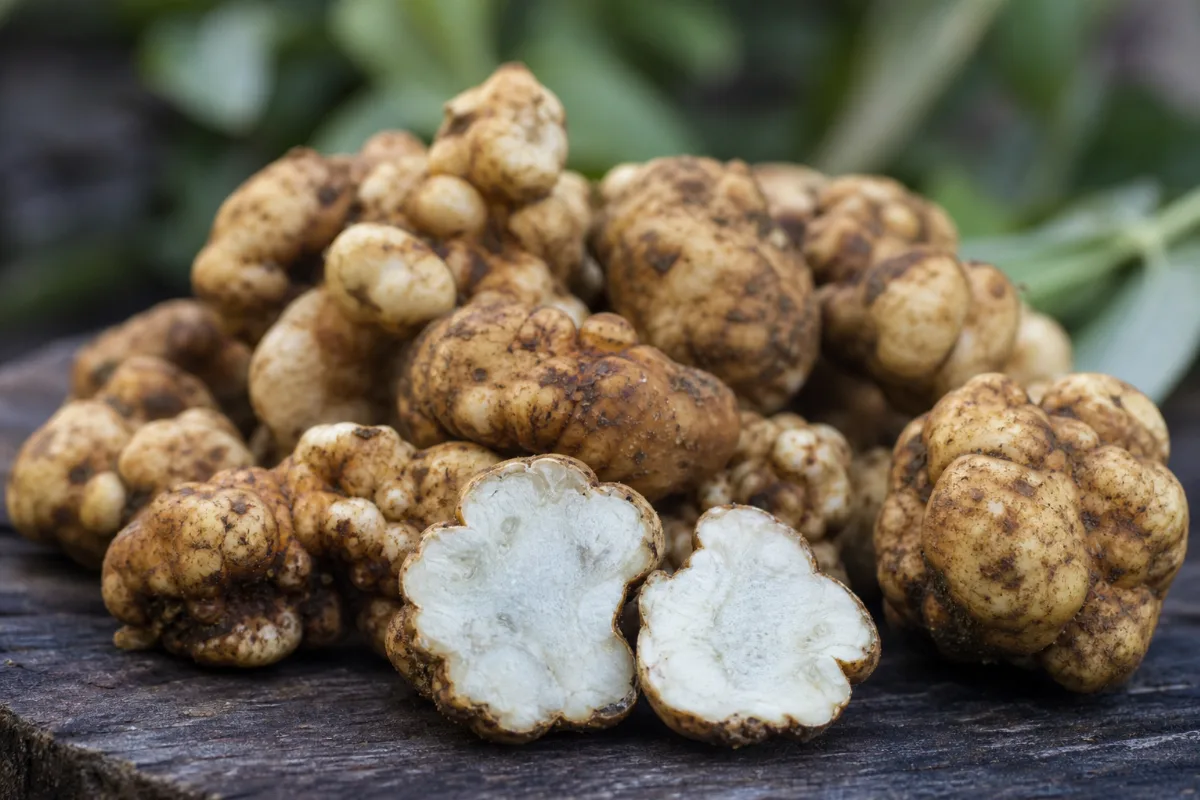
Psilocybin truffles, often called magic truffles, are the hardened storage structures (sclerotia) of some Psilocybe fungi. They are not true truffles and not mushrooms, yet they contain psilocybin, the same drug found in psilocybin mushrooms. No trial has shown truffles treat any illness. Strength varies, and legal status differs by country: in the Netherlands, mushrooms are banned but truffles are described as legal.
General information, not medical advice. Last substantive update · Not medically reviewed. A named clinician has not signed off on this page. How this page is made
About Psilocybin Truffles (Sclerotia)
Psilocybin truffles are the sclerotia of some Psilocybe fungi. They contain psilocybin but are a different structure from the mushroom. The one laboratory study read found nearly threefold variation in psilocybin between samples. Controlled trials of low-amount truffle use mostly found no benefit beyond placebo. Legal status differs by country, and the Netherlands is the best-known case.
What they are
A sclerotium is a hardened mass of fungal tissue. The Trimbos Institute describes it as a kind of tuber the fungus uses to store food, while a mushroom grows above ground to spread spores.
"Truffle" is a trade name. These are not culinary truffles. The papers read refer to Psilocybe sclerotia and do not name the species.
How they differ from mushrooms
Both contain psilocybin. In the 2013 laboratory study, only psilocybin and no psilocin was found in the sclerotia; mushrooms in other studies held several related compounds.
Psilocybin in fresh sclerotia ranged from 59.3 to 167.8 micrograms per 100 mg in that study. Different papers use different units, fresh versus dried material and different species, so numbers cannot be compared across papers.
What the studies show
Two double-blind placebo-controlled trials of low-amount truffle use found no significant effects after correction for multiple comparisons. A pooled analysis of three trials (171 people) found a narrow gain in the quality of divergent thinking.
An open-label event without a placebo found gains, but expectation could explain them. A 2026 review of 11 studies rates the evidence low and says cause cannot be inferred.
An uncontrolled study of 52 ceremony attendees found lower anxiety scores; it cannot show cause.
Why legal status differs
Laws name substances and often mushrooms, not fungal structures. The Trimbos Institute says the Netherlands has banned selling fresh and dried mushrooms since 2008 but treats truffles as legal because they are not mushrooms. A 2013 paper said sclerotia were not specifically named in some laws then.
This is guidance, not the statute, and laws change and differ by country. Not legal advice. See the Safety tab for dated entries.
At a glance
Traditional uses history, not proof
- No source read here describes traditional use of sclerotia. Traditional use is not claimed.
Studied for research
- Thinking and creativity with low-amount truffle use: controlled trials mostly null, low
- Mood and well-being with low-amount use: review says low certainty, low
- Anxiety after group ceremonies: one uncontrolled study, very low
Main compounds
- Psilocybin (became psilocin in the body)
- Psilocin (not found in sclerotia in one study)
Common forms
- Sclerotia (the form studied in the truffle trials and surveys)
- Purified synthetic psilocybin (what clinical trials of illness used)
Research links: NIDA: Psilocybin (Magic Mushrooms) · Truffle microdosing systematic review, 2026 (abstract) · Magic truffles laboratory analysis, 2013 (abstract) · DRUGSinfo (Trimbos Institute): are mushrooms banned? (Dutch) · Research Library · Genes & Biomarkers Library
What it is and its history
- Accepted scientific name
- Sclerotia of Psilocybe fungi ("magic truffles")
- Synonyms
- Magic truffles; Philosopher's stones; Psilocybe sclerotia
- Common names
- Magic truffles (English); Philosopher's stones (English); Truffels (triptruffels) (Dutch)
- Family or group
- Hymenogastraceae for the two Psilocybe species names checked in GBIF. A 2021 paper still files Psilocybe under Strophariaceae, an older placement.
- Classification
- Fungi > Basidiomycota > Agaricomycetes > Agaricales > Hymenogastraceae (GBIF, for Psilocybe tampanensis and P. mexicana) > Psilocybe > Several; sources read do not name which
- Native range
- Not verified. The papers read do not give native range for any sclerotia-forming fungus.
- Habitat
- Not verified in a source read.
- What it looks like
- Fruit: A sclerotium is a hardened mass of fungal tissue. The Trimbos Institute describes it as a kind of tuber the fungus uses to store food, while a mushroom is the above-ground structure that spreads spores. The sclerotium is not the cap-and-stalk fruiting body.
- Cultivation
- Not covered on purpose.
- Harvest and processing
- Not covered on purpose.
- Look-alikes and adulterants
- Name: Other fungi and unrelated products; Note: NIDA lists mistaking a toxic mushroom for a psilocybin one as a risk. This page does not teach identification, and no name or photo makes any fungus or product safe.
- Sustainability and conservation
- Not checked.
Traditional use and history history, not clinical proof
| Tradition or era | Documented use | Source |
|---|---|---|
| Netherlands, 2007 to 2008 | A 2011 review says the Dutch Minister of Health asked an expert body in 2007 to assess magic mushrooms, and that possession and use became illegal in December 2008. The Trimbos Institute says the ban covers fresh and dried mushrooms while truffles remain legal because they are not mushrooms. | p21256914; s-trimbos-verboden |
| Modern supply | A 2013 laboratory paper says sclerotia became a form of supply of psychoactive Psilocybe alkaloids because they were not specifically named in laws banning such substances and mushrooms containing them (laws of that time and place). | p22887928 |
| Traditional use | No source read describes traditional or Indigenous use of sclerotia. Claims that sclerotia of some Psilocybe fungi were used in Mexico were not verified in a source read and are not stated here. | NOT verified |
Traditional use shows how it was used. It does not show that it works or is safe today.
What is inside, and how it may work
What it contains and how those compounds act in cells and animals. Laboratory and animal mechanisms are not proven effects in people.
Main compounds
| Compound | Family | Where it is concentrated | Activity studied | Level of evidence |
|---|---|---|---|---|
| Psilocybin PubChem 10624 | tryptamine (prodrug) | Sclerotia (and fruiting bodies) In one laboratory: 59.3 to 167.8 micrograms per 100 mg of fresh sclerotia (only psilocybin found; no psilocin). This is one set of samples, not a typical value. | A prodrug the body turns into psilocin (human data read on another page of this site). 17 9 | Human data |
| Psilocin PubChem 4980 | tryptamine | Not found in the sclerotia examined in one study Not detected in the sclerotia of the 2013 laboratory study. | The active form after psilocybin is taken. 17 9 | Human data |
| Baeocystin | tryptamine | Reported in a truffle-like fungus extract used as test material Not quantified in the sources read. | Not read. | Lab |
Mechanisms, receptors and pathways
| Target or pathway | Gene or receptor | What was found | Level |
|---|---|---|---|
| Serotonin 2A receptor | 5-HT2A receptor (HTR2A) | Psilocybin acts through psilocin at this receptor. This was shown in human imaging studies of psilocybin, not in studies of truffles. | Human data |
Absorption, metabolism and elimination
- Absorption
- Not studied for sclerotia in the sources read.
- Distribution
- Not read.
- Metabolism
- Psilocybin is converted to psilocin in the body (see the psilocybin page).
- Elimination
- Not read for sclerotia.
- Bioavailability
- Not established for sclerotia or whole biomass; a 2026 review says dose precision is lowest for whole biomass preparations.
Isolated compounds versus whole extracts
All clinical trials of psilocybin in illness used the purified compound. Truffles are whole fungal material whose strength varies from sample to sample, so results from purified psilocybin do not automatically apply to them. The Trimbos Institute says strength can differ between packs; one laboratory found a nearly threefold range.
Nutritional composition
Not a nutrient and has no nutritional claim.
2 low certainty1 very low certainty
What was looked at
The 3 benefits and uses checked for Psilocybin Truffles (Sclerotia), each with how strong the evidence is. Tap one to open it.
- Thinking and creativity (low-amount truffle use)Low certainty
- Mood and well-being (low-amount truffle use)Low certainty
- Anxiety after supervised-style group ceremonies with trufflesVery low certainty
Lab markers tracked in the studies
Originality of divergent thinkingConvergent and divergent thinking task scoresState and trait anxiety scores
What is Psilocybin Truffles (Sclerotia) good for?
The uses people ask about and how strong the human evidence is. No trial has tested truffles as a treatment; all of this is about low-amount use in healthy people.
Benefits, one by one
Each card is a research question, not a promise. Tap a goal to filter. Open a card to see the studies, doses and limits.
Thinking and creativity (low-amount truffle use)
Low certaintyControlled trials of low-amount psilocybin truffle use found little reliable change in thinking beyond placebo. One pooled analysis of three trials (171 people) found a small gain in the quality of divergent thinking, while an earlier open-label event found gains without a placebo group.
4 studiesDoses, how much to take and how to prepare sclerotia are deliberately…
Studies, doses and limits
What the trials found
Three kinds of evidence use truffles: an open-label event run by the Dutch Psychedelic Society, two double-blind placebo-controlled trials in semi-naturalistic settings, and a pooled analysis of three such trials (171 people).
Results
The pooled analysis found a higher ratio of original responses with active truffles, but the unadjusted originality score differed only when dose relative to body weight was considered. No effect on other divergent-thinking scores or on convergent thinking. The two double-blind trials found no significant effects on cognitive control, memory, social cognition or well-being after correction for multiple comparisons. The open-label event found better convergent and divergent thinking, but it had no placebo, so expectation could explain it.
Effect sizes as reported
Small, limited to one creativity measure in the pooled data; most other measures showed no difference from placebo.
Why this rating
Several controlled trials point mostly to no benefit; the one positive signal is narrow and the open-label result cannot separate drug from expectation.
Form and dose studied
Doses, how much to take and how to prepare sclerotia are deliberately not given here.
Who was studied
Healthy adults in semi-naturalistic, non-clinical settings.
Limits
Healthy volunteers, short tasks, semi-naturalistic settings; no trial tested people with a disorder. Results for truffles may not apply to mushrooms or to different products.
Why researchers looked
Many people hope low amounts improve focus and creativity, so researchers tested truffles in semi-naturalistic settings.
Traditional use
No source read here describes traditional use of sclerotia. Sclerotia are mentioned in the reading only as a modern product.
Proposed mechanism Lab analysis
After psilocybin is taken, the body turns it into psilocin, which switches on serotonin 2A receptors (human PET imaging of psilocybin, read on another page of this site). Lab results here describe what is in the sclerotia, not how they act.
A proposed mechanism does not show that the effect happens in people.
Psilocybin raises blood pressure and heart rate and can cause intense fear, and poisoning reports exist. See the Safety tab.
Mood and well-being (low-amount truffle use)
Low certaintyA 2026 review of 11 studies (3,262 adults) says some reports show better well-being, but the certainty is low and a causal effect cannot be inferred. A double-blind truffle trial found no lasting benefit beyond placebo.
2 studiesDoses, how much to take and how to prepare sclerotia are deliberately…
Studies, doses and limits
What the trials found
A systematic review of mushroom and truffle microdosing (5 quantitative and 6 qualitative studies) and two double-blind placebo-controlled truffle trials.
Results
About 86% of motivations were non-medical. Some studies reported better well-being and mental health, but most evidence had risk-of-bias concerns or was qualitative with self-reported measures. Early signals in mood in the two double-blind trials did not survive correction for multiple comparisons, and negative bodily feelings were higher with the active product.
Effect sizes as reported
No pooled effect size; the review judged the evidence too weak to conclude cause.
Why this rating
Self-report studies and small trials; the controlled ones were mostly null.
Form and dose studied
Doses, how much to take and how to prepare sclerotia are deliberately not given here.
Who was studied
Adults, mostly healthy volunteers and self-selected users.
Limits
Extreme variety of products, protocols and measures; self-selection; expectation effects.
Why researchers looked
Most people who try low amounts say their reasons are about everyday well-being, not a diagnosed illness.
Traditional use
No source read here describes traditional use of sclerotia. Sclerotia are mentioned in the reading only as a modern product.
Proposed mechanism Lab analysis
After psilocybin is taken, the body turns it into psilocin, which switches on serotonin 2A receptors (human PET imaging of psilocybin, read on another page of this site). Lab results here describe what is in the sclerotia, not how they act.
A proposed mechanism does not show that the effect happens in people.
Psilocybin raises blood pressure and heart rate and can cause intense fear, and poisoning reports exist. See the Safety tab.
Anxiety after supervised-style group ceremonies with truffles
Very low certaintyAn uncontrolled study of 52 attendees of truffle ceremonies found lower anxiety scores the next morning and at 1 week. With no control group and many dropouts, it cannot show the truffles caused this.
1 studiesDoses, how much to take and how to prepare sclerotia are deliberately…
Studies, doses and limits
What the trials found
A naturalistic observational study: attendees of psilocybin truffle ceremonies completed questionnaires before, the morning after and 1 week after.
Results
52 attendees began, 46 completed the morning-after survey and 23 the 1-week survey. State and trait anxiety scores were lower than at baseline and neuroticism was lower at 1 week. Ego dissolution ratings were the strongest predictor of lower state anxiety.
Effect sizes as reported
Reported as medium-to-large score drops in an uncontrolled group.
Why this rating
No control group, no blinding, self-selected attendees and heavy dropout by 1 week.
Form and dose studied
Doses, how much to take and how to prepare sclerotia are deliberately not given here.
Who was studied
Self-reported healthy attendees with sub-clinical anxiety symptoms.
Limits
Cannot separate truffle effect from expectation, setting and group support; only 1 week of follow-up.
Why researchers looked
People attend group ceremonies hoping for emotional relief; researchers surveyed attendees before and after.
Traditional use
No source read here describes traditional use of sclerotia. Sclerotia are mentioned in the reading only as a modern product.
Proposed mechanism Lab analysis
After psilocybin is taken, the body turns it into psilocin, which switches on serotonin 2A receptors (human PET imaging of psilocybin, read on another page of this site). Lab results here describe what is in the sclerotia, not how they act.
A proposed mechanism does not show that the effect happens in people.
Psilocybin raises blood pressure and heart rate and can cause intense fear, and poisoning reports exist. See the Safety tab.
Connections to the rest of health
How Psilocybin Truffles (Sclerotia) connects to the rest of our health knowledge graph. Every link says what kind of connection it is. A safety link (for example to the liver) is a warning, not a benefit. A study that merely mentions a topic never creates a benefit link.
Explore every connection: goals, body systems, organs, symptoms, genes
B. Body systems
I. Biomarkers
| Connected to | Kind of connection | Evidence status | Context | Studies |
|---|---|---|---|---|
| Originality of divergent thinking | Biological association | Low certainty | Measured in trials: raised. A lab change is not the same as a health benefit. | 11 |
| Convergent and divergent thinking task scores | Biological association | Low certainty | Measured in trials: mixed. A lab change is not the same as a health benefit. | 10 12 |
| State and trait anxiety scores | Biological association | Very low certainty | Measured in trials: lowered. A lab change is not the same as a health benefit. | 6 |
J. Genes, receptors and enzymes
| Connected to | Kind of connection | Evidence status | Context | Studies |
|---|---|---|---|---|
| HTR2A (serotonin 2A receptor) | Preliminary mechanism | Human | Main receptor target of psilocin (shown for psilocybin, not truffles). |
L. Active compounds
| Connected to | Kind of connection | Evidence status | Context | Studies |
|---|---|---|---|---|
| Psilocybin | Biological association | Human | A prodrug the body turns into psilocin (human data read on another page of this site). Preparation or compound: Sclerotia (and fruiting bodies) |
17 9 |
| Psilocin | Biological association | Human | The active form after psilocybin is taken. Preparation or compound: Not found in the sclerotia examined in one study |
17 9 |
| Baeocystin | Biological association | Lab | Not read. Preparation or compound: Reported in a truffle-like fungus extract used as test material |
Each connection is stored with the ingredient, the connected record, the kind of connection, the evidence status, the supporting studies, the preparation or compound involved, and a review date (last reviewed October 25, 2026).
Evidence at a glance: what changed in 3 lab markers
Tap a number to show only those markers. Counts are markers, not people.
The evidence
The research centre for Psilocybin Truffles (Sclerotia). Every record here was checked against PubMed or the publisher's page; we never list a study we have not verified.
Evidence by outcome
Bars show how many studies we found for each outcome, not how well it works. People are added up across trials only (reviews are not added, to avoid double counting).
How we rate evidence
High certainty
Several well-run trials or reviews agree; further research is unlikely to change the picture much.
Moderate certainty
Good trials point the same way, but some doubt remains.
Low certainty
Small, short or inconsistent trials. The finding could change with better research.
Very low certainty
Very little or very weak human data. Treat as a possibility only.
Mixed findings
Trials or reviews disagree with each other.
Not enough evidence
Not enough human research to say either way.
Evidence against
Good research found no benefit, or found harm.
We take the reviewers' own risk-of-bias and GRADE statements where they exist, and otherwise judge from study size, design, consistency, directness and whether a product matches what is sold. Many publications do not make evidence high. Method note: We read the abstracts of 14 PubMed papers, read NIDA and the Trimbos DRUGSinfo pages, and checked names in GBIF and compounds in PubChem. Certainty ratings are the compiler's own reading. Legal entries are not verified against statutes or ministries.
Study library: every study we checked 21
| Study | Design | People | Product, dose, length | Result |
|---|---|---|---|---|
| Enriquez-Geppert 2026 Naturally Derived Psilocybin for Therapeutic Use: A Six-Criterion Framework for Evidence, Safety, and Benefit-Risk Considerations in Policy and Clinic. Biomolecules · PMID 42509777 · DOI |
Review |
Review of naturally derived psilocybin (biomass, extracts, purified) | Naturally derived psilocybin of several forms Not reproduced here See results · vs See results |
The review says evidence of causal efficacy is mixed, safety is favourable but context-dependent with risks in vulnerable people, and dose precision varies: purified psilocybin is most reliable, then standardised extracts, then whole biomass preparations. Controlled trials, long-term safety work and standardisation are lacking. Whole biomass is the least precise form Methods, limits and fundingOutcomes: Therapeutic potential, safety, composition, dose precision Limitations: Narrative framework, not a trial; abstract read only. Funding and conflicts: Not stated in the abstract Read: abstract |
| Goff 2024 Determination of psilocybin and psilocin content in multiple Psilocybe cubensis mushroom strains using liquid chromatography - tandem mass spectrometry. Anal Chim Acta · PMID 38220293 · DOI |
Laboratory analysis lab |
Five named strains of dried Psilocybe cubensis, three mushrooms each | Dried Psilocybe cubensis fruiting bodies Not reproduced here See results · vs See results |
Average total content ranged from 0.879% to 1.36% (weight/weight) across five strains, and content differed between mushrooms of the same strain. Differences between and within strains Methods, limits and fundingOutcomes: Total psilocybin plus psilocin Limitations: About dried mushrooms of one species; not directly comparable with fresh sclerotia measured in another laboratory. Funding and conflicts: Not stated in the abstract Read: abstract |
| Gotvaldová 2021 Stability of psilocybin and its four analogs in the biomass of the psychotropic mushroom Psilocybe cubensis. Drug Test Anal · PMID 33119971 · DOI |
Laboratory analysis lab |
Fruiting bodies and mycelium of Psilocybe cubensis grown in a laboratory | Psilocybe cubensis fruiting bodies Not reproduced here See results · vs See results |
The authors note that sclerotia of some Psilocybe fungi, known as magic truffles, are of growing interest for microdosing, and that clinical studies so far gave only the pure compound. In their own samples of fruiting bodies, no tryptamines were found in spores and concentrations in individual fruiting bodies were highly variable. They also found tryptamines broke down differently under different storage conditions. Concentrations in individual mushrooms highly variable Methods, limits and fundingOutcomes: Tryptamines (psilocybin, psilocin, baeocystin, norbaeocystin, aeruginascin) by UHPLC-MS Limitations: About mushrooms (P. cubensis), not sclerotia; the truffle comment is background. Funding and conflicts: Czech public research and Ministry of the Interior funding listed Read: abstract |
| He 2025 Dynamic myocardial injury and variable hallucination latency in Psilocybe keralensis poisoning: a molecularly confirmed case series from China. Clin Toxicol (Phila) · PMID 40948398 · DOI |
Case series |
4 Four people who ate wild mushrooms they believed were an edible species |
Wild Psilocybe keralensis mushrooms Not reproduced here See results · vs See results |
All four developed high blood pressure; one had signs of heart muscle injury (raised troponin) and brief muscle involvement. Onset of hallucinations varied widely (10 to 180 minutes). All recovered with supportive care. The authors urge screening for heart disease and avoidance of wild mushroom foraging. Hypertension in all four; heart-injury marker in one Methods, limits and fundingOutcomes: Symptoms, blood pressure, heart-injury markers Limitations: Four people, wild mushrooms (not sclerotia), misidentification. Funding and conflicts: Not stated in the abstract Read: abstract |
| Hinkle 2024 Adverse Events in Studies of Classic Psychedelics: A Systematic Review and Meta-Analysis. JAMA Psychiatry · PMID 39230883 · DOI |
Systematic review meta analysis |
3504 214 studies of classic psychedelics in clinical or research settings; 114 gave usable adverse-event data |
Classic psychedelics including psilocybin, in research settings Not reproduced here See results · vs See results |
Serious adverse events were reported for approximately 4% of participants with pre-existing neuropsychiatric disorders (worsening depression, suicidal behaviour, psychosis, convulsive episodes) and for no healthy participants. No deaths by suicide or persistent psychotic disorders were reported in contemporary research settings. About 4% serious events in people with existing conditions Methods, limits and fundingOutcomes: Serious and non-serious adverse events Limitations: Supervised research with screening; results do not transfer to unsupervised use. Abstract read in part. Funding and conflicts: Not stated in the abstract Read: abstract |
| Kiraga 2022 Decreases in State and Trait Anxiety Post-psilocybin: A Naturalistic, Observational Study Among Retreat Attendees. Front Psychiatry · PMID 35873251 · DOI |
Observational naturalistic |
52 Self-reported healthy attendees of psilocybin truffle ceremonies; 46 completed the morning-after survey and 23 the 1-week survey |
Psilocybin-containing truffles in a supportive group setting Not reproduced here See results · vs See results |
Anxiety scores were lower the morning after and at 1 week than at baseline, and neuroticism was lower at 1 week. Ego dissolution ratings were the strongest predictor of reduced state anxiety. The authors call the anxiolytic effects rapid and lasting up to 1 week in people with sub-clinical anxiety and say further experimental research is needed. Lower anxiety scores in an uncontrolled group Methods, limits and fundingOutcomes: State and trait anxiety, mindfulness, personality Limitations: No control group, no blinding, self-selected attendees, many dropouts by 1 week. Funding and conflicts: Not stated in the abstract Read: abstract |
| Leonard 2018 Does getting high hurt? J Psychopharmacol · PMID 30182795 · DOI |
Observational poison centre |
5883 |
Psilocybin-containing mushrooms (not truffles specifically) Not reproduced here See results · vs See results |
Most common effects with mushrooms were hallucinations (45.8%), agitation (24.1%) and fast heart rate (18.0%). Serious effects were infrequent but included overheating, seizures, coma and cardiac arrest. Most people were treated and released from the emergency department. The authors found mild to moderate effects overall. Serious effects infrequent but possible Methods, limits and fundingOutcomes: Clinical effects and outcomes Limitations: Self-reported exposures; mushrooms in general, not truffles; the abstract does not separate products. Funding and conflicts: Not stated in the abstract Read: abstract |
| Page 2026 The subtle science: a systematic review of psilocybin magic mushroom and truffle microdosing. Front Psychiatry · PMID 42688116 · DOI |
Systematic review |
3262 Adults microdosing psilocybin mushrooms or truffles in 11 studies (5 quantitative, 6 qualitative) |
Psilocybin magic mushrooms and truffles, microdosing Not reproduced here See results · vs See results |
Some studies reported better well-being, mental health, cognition and creativity. Most evidence had at least some risk-of-bias concerns or was qualitative with self-reported measures. About 86% of motivations were non-medical. Dosing and preparations varied extremely. Most studies did not report adverse events; those reported were mostly mild. The authors rate the certainty as low and say a causal effect cannot be inferred. Low certainty; no causal conclusion Methods, limits and fundingOutcomes: Reported effects, motivations, dosing protocols, adverse events Limitations: Small number of studies, mixed designs, self-report. Funding and conflicts: Four studies did not disclose funding; four declared conflicts (abstract) Registration: PROSPERO CRD42023428107 Read: abstract |
| Pellegrini 2013 Magic truffles or Philosopher's stones: a legal way to sell psilocybin? Drug Test Anal · PMID 22887928 · DOI |
Laboratory analysis lab |
Psilocybe sclerotia ('magic truffles') examined in one laboratory; number of samples and species not stated in the abstract | Psilocybe sclerotia Not reproduced here See results · vs See results |
Only psilocybin, not psilocin, was found in the sclerotia examined. Psilocybin ranged from 59.3 to 167.8 micrograms per 100 mg of fresh sclerotia, a nearly threefold spread. The authors say sclerotia were not specifically named in laws banning the sale, purchase and use of such substances and mushrooms containing them. Nearly threefold range in psilocybin across the samples tested Methods, limits and fundingOutcomes: Psilocybin and psilocin content (LC-MS/MS) Limitations: Sample number and species not stated in the abstract; the legal remark describes the laws of the time in the authors' setting, not today's law. Funding and conflicts: Not stated in the abstract Read: abstract |
| Prochazkova 2018 Exploring the effect of microdosing psychedelics on creativity in an open-label natural setting. Psychopharmacology (Berl) · PMID 30357434 · DOI |
Open label pragmatic |
Healthy adults at a microdosing event organised by the Dutch Psychedelic Society (number not in the abstract) | Psychedelic truffles, microdosing Not reproduced here See results · vs See results |
Both convergent and divergent thinking improved after a non-blinded microdose, while fluid intelligence was unchanged. The authors say these are preliminary and need placebo-controlled confirmation. The truffles were later analysed to measure active alkaloids. Improved thinking scores without a placebo group Methods, limits and fundingOutcomes: Convergent thinking, divergent thinking, fluid intelligence Limitations: Open label, no placebo, so expectation cannot be separated from drug effect. Funding and conflicts: European Research Council grant listed Read: abstract |
| Prochazkova 2026 Microdosing psilocybin and its effect on creativity: Lessons learned from three double-blind placebo controlled longitudinal trials. Neuropharmacology · PMID 41187880 · DOI |
Randomised controlled trial |
171 Adults pooled from three semi-naturalistic trials (mega-analysis) |
Psilocybin truffles, microdosing Not reproduced here See results · vs See results |
The ratio of original responses (originality over fluency) was higher with active microdosing, but the unadjusted originality score differed only when dose relative to body weight was considered. No effect on other divergent-thinking scores or on convergent thinking. The effect held after controlling for participants' guesses about their condition. The authors say effects were limited to quality of divergent thinking. Higher originality ratio; other creativity scores unchanged Methods, limits and fundingOutcomes: Convergent and divergent thinking Limitations: Small effects limited to one measure; healthy volunteers; short tasks. Funding and conflicts: Not stated in the abstract Read: abstract |
| Prochazkova 2026 Cognitive and subjective effects of psilocybin microdosing: Results from two double-blind placebo-controlled longitudinal trials. Neuropharmacology · PMID 41110634 · DOI |
Randomised controlled trial |
Adults in two semi-naturalistic trials (number not stated in the abstract) | Psilocybin truffles, microdosing Not reproduced here See results · vs See results |
No significant effects on behavioural or subjective measures versus placebo. Early signals in social cognition, mood and self-reported cognitive flexibility did not survive correction for multiple comparisons. Negative bodily feelings were higher in the active condition. Participants remained effectively blinded. The authors conclude the findings do not support a reliable benefit beyond placebo. No significant differences versus placebo after correction Methods, limits and fundingOutcomes: Cognitive control, memory, social cognition, well-being, subjective experience Limitations: Participant number not in the abstract; semi-naturalistic settings; healthy volunteers. Funding and conflicts: Not stated in the abstract Read: abstract |
| n/a 2024 NIDA: Psilocybin (Magic Mushrooms) (page read 2026-10-25) n/a · Source |
Authoritative guidance n/a |
n/a | n/a |
NIDA says psilocybin has low toxicity but that real health risks exist, especially unsupervised. It raises blood pressure and heart rate, which may be dangerous with heart conditions, and can cause fear, confusion, vomiting and risky behaviour. It says poison-centre exposures have increased, that misidentifying mushrooms is a risk, that there is no data on safety in pregnancy and that research suggests psilocybin does not typically lead to addiction. It describes microdosing and says research has not established it as safe or effective. Methods, limits and fundingOutcomes: NIDA says psilocybin has low toxicity but that real health risks exist, especially unsupervised. It raises blood pressure and heart rate, which may be dangerous with heart conditions, and can cause fear, confusion, vomiting and risky behaviour. It says poison-centre exposures have increased, that misidentifying mushrooms is a risk, that there is no data on safety in pregnancy and that research suggests psilocybin does not typically lead to addiction. It describes microdosing and says research has not established it as safe or effective. Limitations: Regulator-style fact page about mushrooms in general; it does not discuss truffles. Page dated January 2024 in its footer. Read: full-text |
| n/a 2026 DRUGSinfo (Trimbos Institute, Netherlands): 'Wat is het verschil tussen paddo's en truffels?' (page read 2026-10-25) n/a · Source |
Authoritative guidance n/a |
n/a | n/a |
The page (in Dutch) describes truffles as a kind of tuber the fungus uses to store food, while mushrooms grow above ground to spread spores, so both contain about the same substances, psilocybin and psilocin. It says strength can differ from one pack of truffles to the next, that the risk of an incident is much greater when the user has psychological complaints, and that truffles may legally be sold while mushrooms may not (mushrooms banned since December 2008). Methods, limits and fundingOutcomes: The page (in Dutch) describes truffles as a kind of tuber the fungus uses to store food, while mushrooms grow above ground to spread spores, so both contain about the same substances, psilocybin and psilocin. It says strength can differ from one pack of truffles to the next, that the risk of an incident is much greater when the user has psychological complaints, and that truffles may legally be sold while mushrooms may not (mushrooms banned since December 2008). Limitations: No last-updated date; plain-language guidance, not a regulator's legal text. Read: full-text |
| n/a 2026 DRUGSinfo (Trimbos Institute, Netherlands): 'Zijn paddo's verboden?' (page read 2026-10-25) n/a · Source |
Authoritative guidance n/a |
n/a | n/a |
The page (in Dutch) says selling fresh or dried magic mushrooms is prohibited under the Opium Act, with a ban since 2008, and that truffles are legal because they are not mushrooms although they contain the same active substances, psilocybin and psilocin. Methods, limits and fundingOutcomes: The page (in Dutch) says selling fresh or dried magic mushrooms is prohibited under the Opium Act, with a ban since 2008, and that truffles are legal because they are not mushrooms although they contain the same active substances, psilocybin and psilocin. Limitations: A national institute's public information site, not the statute or a ministry page; no last-updated date shown; the wording on which Opium Act list applies differs between its pages. Read: full-text |
| n/a 2026 US eCFR: 21 CFR 1308.11 Schedule I (earlier reading by this site, not re-opened for this page) n/a · Source |
Regulation n/a |
n/a | n/a |
Schedule I hallucinogenic substances list includes psilocybin (code 7437) and psilocyn (code 7438), as read on another page of this site. Methods, limits and fundingOutcomes: Schedule I hallucinogenic substances list includes psilocybin (code 7437) and psilocyn (code 7438), as read on another page of this site. Limitations: The eCFR site refused automated access when this page was built, so the text was not re-read for this page. It lists chemicals; it does not discuss truffles, and state laws are not covered. Read: not-reread |
| n/a 2026 PubChem REST: psilocybin (CID 10624) and psilocin (CID 4980), retrieved 2026-10-25 n/a · Source |
Database n/a |
n/a | n/a |
Psilocybin: C12H17N2O4P, [3-[2-(dimethylamino)ethyl]-1H-indol-4-yl] dihydrogen phosphate. Psilocin: C12H16N2O, 3-[2-(dimethylamino)ethyl]-1H-indol-4-ol. Methods, limits and fundingOutcomes: Psilocybin: C12H17N2O4P, [3-[2-(dimethylamino)ethyl]-1H-indol-4-yl] dihydrogen phosphate. Psilocin: C12H16N2O, 3-[2-(dimethylamino)ethyl]-1H-indol-4-ol. Limitations: Identity record only. Read: full-text |
| n/a 2026 GBIF Backbone Taxonomy: Psilocybe tampanensis Guzmán & S.H.Pollock (key 5242500), retrieved 2026-10-25 n/a · Source |
Database n/a |
n/a | n/a |
Accepted species in the family Hymenogastraceae (GBIF name match). Methods, limits and fundingOutcomes: Accepted species in the family Hymenogastraceae (GBIF name match). Limitations: The match confirms the name only; it says nothing about sclerotia. Read: full-text |
| n/a 2026 GBIF Backbone Taxonomy: Psilocybe mexicana R.Heim (key 5242538), retrieved 2026-10-25 n/a · Source |
Database n/a |
n/a | n/a |
Accepted species in the family Hymenogastraceae. GBIF lists Psilocybe galindoi Guzmán as a synonym of it. Methods, limits and fundingOutcomes: Accepted species in the family Hymenogastraceae. GBIF lists Psilocybe galindoi Guzmán as a synonym of it. Limitations: The match confirms names only; it says nothing about sclerotia. Read: full-text |
| van Amsterdam 2011 Harm potential of magic mushroom use: a review. Regul Toxicol Pharmacol · PMID 21256914 · DOI |
Review |
Review written to support a Dutch expert assessment of magic mushrooms | Magic mushrooms (psilocybin-containing mushrooms) Not reproduced here See results · vs See results |
In 2007 the Dutch Minister of Health asked an expert body to assess the risk of magic mushrooms. The review says use fell after 2000 and further after possession and use became illegal in December 2008. The expert body judged dependence potential low, acute toxicity moderate, chronic toxicity low, and public-health and criminal aspects negligible. The authors call use relatively safe, with mild adverse effects, but flag unpredictable panic attacks and flashbacks and the mix with alcohol. Expert body rated acute toxicity moderate Methods, limits and fundingOutcomes: Dependence, toxicity, public health, criminal aspects Limitations: 2011 review of mushrooms, not truffles; older data; written to support a government assessment. Funding and conflicts: Research support from a Dutch non-US government source (abstract) Read: abstract |
| van der Schuur-Saleem 2023 [Feeling unwell after eating a piece of chocolate] Ned Tijdschr Geneeskd · PMID 38175555 |
Case report |
1 One man who attended a Dutch emergency department |
Chocolate later found to contain psilocin Not reproduced here See results · vs See results |
The abstract says chocolate containing psilocin has circulated in the Netherlands since 2006. A man came to the emergency department agitated, dizzy, nauseated and hypertensive with wide pupils. Hospital laboratory analysis found psilocin in the chocolate. The authors note food can contain ingredients not on the label. One reported poisoning from an unlabelled product Methods, limits and fundingOutcomes: Symptoms and chemical analysis of the chocolate Limitations: Single case; the product was chocolate, not a truffle or mushroom; abstract only (article in Dutch). Funding and conflicts: Not stated Read: abstract |
What we do not know yet
- No trial of truffles or sclerotia as a treatment for any illness.
- Which species form the sclerotia sold as truffles was not verified.
- No poison-centre or emergency-department series specific to truffles was found.
- No analysis of truffle products for mislabelling or contamination was found.
- Current law was not read from statutes or ministries; only guidance.
How new research is added
New studies go to a review queue and a person reads each before any rating changes.
Lab markers
What changed in blood or saliva tests during trials. A changed number is not the same as feeling or being healthier, and we give no "normal ranges".
Other 3
Originality of divergent thinking
Raised in trials
A creativity task asks people to think of many uses for an object; originality is how unusual and good the ideas are compared with how many they give.
Low certaintyResults and what it means
Why it was measured
It is a common way to test whether a treatment changes creative thinking.
Statistical vs. clinical meaning
A narrow effect on one score; other creativity scores did not change.
Safety implication
None specific; see the Safety tab.
| Study | Result | People | Product |
|---|---|---|---|
| 11 | Higher ratio of original responses with active truffle microdosing; the unadjusted originality score differed only when dose relative to body weight was considered. | 171 healthy adults pooled from three trials | Psilocybin truffles (low amounts) vs placebo |
Convergent and divergent thinking task scores
Mixed results in trials
Short puzzles and idea-generation tasks that stand in for problem solving and creativity.
Low certaintyResults and what it means
Why it was measured
Researchers use them to see if low amounts change thinking.
Statistical vs. clinical meaning
The open-label result and the double-blind results disagree; the controlled ones are more reliable.
Safety implication
Negative bodily feelings were higher in the active condition of the double-blind trials.
| Study | Result | People | Product |
|---|---|---|---|
| 10 | Both convergent and divergent thinking improved after a non-blinded microdose; fluid intelligence unchanged (open-label, no placebo). | Healthy adults at a microdosing event | Psychedelic truffles (low amount), no placebo |
| 12 | No significant effects versus placebo after correction for multiple comparisons. | Adults in two double-blind trials | Psilocybin truffles (low amount) vs placebo |
State and trait anxiety scores
Lowered in trials
A questionnaire that scores how anxious a person feels right now and in general.
Very low certaintyResults and what it means
Why it was measured
It is the standard way to follow anxiety in studies.
Statistical vs. clinical meaning
Uncontrolled and self-reported.
Safety implication
See the Safety tab.
| Study | Result | People | Product |
|---|---|---|---|
| 6 | Lower state and trait anxiety the morning after and at 1 week than at baseline. | 52 attendees (23 at 1 week) | Psilocybin truffles in a group ceremony, no control group |
Safety
What studies and official sources say about side effects, medicines and who should check first. Each point shows what kind of evidence it comes from.
Main points to know 6
- Truffles are not a milder or safer form of psilocybin. Truffles (sclerotia) contain psilocybin, the same drug found in mushrooms. The Trimbos Institute says strength can differ from one pack to the next, and the one laboratory study read found nearly threefold variation in psilocybin between sclerotia samples. No source read shows truffles are gentler, stronger or safer than mushrooms, and no product comparison data were found. A legal sale in one country does not make a product safe. Authoritative guidance 14 9
- It can raise blood pressure and heart rate, which matters with heart disease. NIDA says psilocybin typically raises blood pressure and heart rate, which may be dangerous for people with heart conditions. A case series of four people poisoned by wild Psilocybe mushrooms found high blood pressure in all four and a heart-injury marker in one. These reports are about mushrooms, not truffles, but the drug is the same. Authoritative guidance 13 4
- Fear, confusion and risky behaviour can happen, more so outside a supervised setting. NIDA lists intense fear or panic, confusion, agitation, vomiting and risky behaviour, and says poor mental health outcomes are more likely outside clinical settings. The Trimbos Institute says the risk of an incident is much greater for people with psychological complaints. Authoritative guidance 13 14
- People with psychosis, mania or bipolar history, or pregnancy, should not assume it is safe. Research trials of psychedelics excluded many such people, and serious events (worsening depression, suicidal behaviour, psychosis, convulsions) were reported for about 4% of participants with existing neuropsychiatric conditions in supervised research. NIDA says there is no data on safety in pregnancy. Talk to a doctor. Systematic review 5 13
- Products can contain things that are not on the label. A Dutch hospital case describes a man made unwell by chocolate that contained psilocin and was not labelled as such. That case was chocolate, not truffles. No analysis of truffle products for contamination or mislabelling was found in this reading. Case report 21
- A name or a photo never makes a fungus safe. Misidentification, taking a toxic mushroom in place of a psilocybin one, is listed as a risk by NIDA. This page does not teach identification of anything. Authoritative guidance 13
Side effects 5
| Effect | How often | Severity and recovery | Evidence |
|---|---|---|---|
| Raised blood pressure and heart rate The case series involved wild mushrooms in China. | Not established | mild to moderate; risky with heart disease Usually while effects last | Authoritative guidance 13 4 |
| Hallucinations, agitation, fast heart rate, nausea About mushrooms, not truffles specifically. Serious effects (overheating, seizures, coma, cardiac arrest) were infrequent but occurred. | In US poison-centre cases for psilocybin mushrooms: hallucinations 45.8%, agitation 24.1%, fast heart rate 18.0% | mostly mild to moderate Most people were treated and released from the emergency department | Observational 7 |
| Fear, panic, confusion, risky behaviour More likely outside supervised settings. | Not established | moderate Usually resolves | Authoritative guidance 13 14 |
| Negative bodily feelings during low-amount truffle use Higher in the active condition than placebo in two double-blind trials. | Not established | not stated Not stated | Randomised trial 12 |
| Adverse events with low-amount use The review calls for mandatory adverse-event reporting. | Most of 11 studies did not report adverse events; those reported were mostly mild | mostly mild Not stated | Systematic review 8 |
Liver
No liver injury from psilocybin was found in the sources read. 5
How often. Not assessed.
Monitoring. Not assessed.
This is a safety connection. It is not evidence that Psilocybin Truffles (Sclerotia) supports liver health.
Medicines and supplements 3
| With | Why it matters | Importance | Evidence | What to do |
|---|---|---|---|---|
| Antidepressants such as SSRIs, and MAOIs prescription | Serotonin-system overlap is expected, but no interaction study was read for truffles. | Not verified. | Not read Not enough evidence | Ask a doctor or pharmacist; do not stop any medicine on your own. |
| Alcohol and other drugs recreational | Not studied for truffles. | A Dutch review of mushrooms says the mix of mushrooms and alcohol deserves attention. | Review Low certainty 20 | Mixing substances makes outcomes less predictable. |
| Lithium and anti-seizure medicines prescription | Not read for this page. | Not verified for truffles. | Not read Not enough evidence | Ask a doctor or pharmacist. |
Who should check first 4
| Situation | Advice | Evidence |
|---|---|---|
| History of psychosis, mania or bipolar disorder (or a close family history) | Excluded from most trials. Serious events occurred in research participants with existing conditions. Talk to a doctor. | Systematic review 5 |
| Heart disease or high blood pressure | NIDA says psilocybin raises blood pressure and heart rate and may be dangerous with heart conditions. Talk to a doctor. | Authoritative guidance 13 |
| Pregnancy | NIDA says there is no data on safety in pregnancy. | Authoritative guidance 13 |
| Psychological complaints such as anxiety or depression | The Trimbos Institute says the risk of an incident is much greater when the user has psychological complaints. | Authoritative guidance 14 |
Overdose, product quality and regulators
Summary. NIDA describes psilocybin as having low toxicity, meaning breathing problems or heart attack are unlikely, but says real health risks exist, particularly unsupervised. No toxicity study of sclerotia itself was found.
Animal. Not reviewed.
Human doses studied. Not given here.
High dose or long term signals. Not reviewed for truffles.
Overdose response. Not reviewed; seek emergency care for severe effects.
Genotoxicity. Not read.
Strength varies from sample to sample and products are not always what they are labelled.
Content variability. In one laboratory study, psilocybin in fresh sclerotia ranged from 59.3 to 167.8 micrograms per 100 mg, a nearly threefold spread; only psilocybin and no psilocin was found. Another laboratory found individual mushrooms of the same strain differed, and a third found concentrations in single fruiting bodies highly variable. Numbers from different papers use different units, fresh versus dried material and different species, so they cannot be compared directly. 9 2 3
Unlabelled psilocin in food. A Dutch emergency department case involved chocolate containing psilocin that was not listed on the label. It was chocolate, not truffles. 21
Whole biomass versus purified. A 2026 review says dose precision is best for purified psilocybin and worst for whole biomass preparations. 1
| Body | Action | Date |
|---|
When to get medical help
- Chest pain, a seizure, very high temperature, confusion that does not clear, trouble breathing, or loss of consciousness: call your local emergency number now (112 in the European Union, 911 in the US).
- In the US, Poison Help is 1-800-222-1222 (poison.org). Numbers elsewhere were not verified here; use your local emergency number.
- Someone who ate an unidentified wild mushroom and has vomiting, diarrhea or belly pain, even if they feel better later: call poison control or emergency services at once.
- Thoughts of suicide or self-harm after use: call your local emergency number or crisis line (988 in the US).
If someone may be poisoned or in a crisis, contact a clinician or emergency service straight away. In the US, Poison Control is 1-800-222-1222.
General information only, not medical advice. Ask a clinician or pharmacist before use, especially with medicines, in pregnancy or with a health condition. See the Natural Remedy Safety guide.
Frequently asked questions
What are psilocybin truffles?
Are they real truffles?
How do truffles differ from mushrooms?
Which species make them?
Are truffles stronger or weaker than mushrooms?
Why are truffles treated differently by law in the Netherlands?
The Trimbos Institute says selling fresh and dried magic mushrooms has been prohibited since 2008, but truffles are legal because they are not mushrooms. A 2013 paper noted sclerotia were not specifically named in some laws then. This is guidance, not the law itself, and laws change and differ by country. Not legal advice.
Is it legal where I live?
It depends on the country and can change. In the US, the federal Schedule I list names psilocybin and psilocyn. How a country treats sclerotia was not checked beyond the Netherlands. Check a current official source.
Does microdosing truffles work?
Are truffles used as a medicine?
What are the safety risks?
Have truffles caused poisonings?
What should I do in an emergency?
If someone has chest pain, a seizure, a very high temperature, ongoing confusion or trouble breathing, call your local emergency number now. In the US, Poison Help is 1-800-222-1222.
Explore by health goal
Editorial transparency
- Written by
- AlternativeMed editorial team. Research compiled with AI assistance, then checked against PubMed records.
- Medical review
- None. This page has not been reviewed by a physician or pharmacist.
- First published
- 2026-10-25
- Last substantive update
- 2026-10-25
- How we research
- We read the abstracts of 14 PubMed papers, read NIDA and the Trimbos DRUGSinfo pages, and checked names in GBIF and compounds in PubChem. Certainty ratings are the compiler's own reading. Legal entries are not verified against statutes or ministries.
- How we rate evidence
- See "How we rate evidence" in the Evidence tab.
- Independence
- No product is promoted. No affiliate links are shown. This page is information, not encouragement to use anything, and does not teach identification, growing, sourcing or preparation.
Sources 21
Each source was opened and checked. Where we read only the abstract, it says so. The small numbers in the text point here.
- Enriquez-Geppert S, Bevers L et al. Naturally Derived Psilocybin for Therapeutic Use: A Six-Criterion Framework for Evidence, Safety, and Benefit-Risk Considerations in Policy and Clinic.. Biomolecules. 2026. PMID 42509777. DOI 10.3390/biom16070983. (abstract)
- Goff R, Smith M et al. Determination of psilocybin and psilocin content in multiple Psilocybe cubensis mushroom strains using liquid chromatography - tandem mass spectrometry.. Anal Chim Acta. 2024. PMID 38220293. DOI 10.1016/j.aca.2023.342161. (abstract)
- Gotvaldová K, Hájková K et al. Stability of psilocybin and its four analogs in the biomass of the psychotropic mushroom Psilocybe cubensis.. Drug Test Anal. 2021. PMID 33119971. DOI 10.1002/dta.2950. (abstract)
- He Z, Tang R et al. Dynamic myocardial injury and variable hallucination latency in Psilocybe keralensis poisoning: a molecularly confirmed case series from China.. Clin Toxicol (Phila). 2025. PMID 40948398. DOI 10.1080/15563650.2025.2552438. (abstract)
- Hinkle JT, Graziosi M et al. Adverse Events in Studies of Classic Psychedelics: A Systematic Review and Meta-Analysis.. JAMA Psychiatry. 2024. PMID 39230883. DOI 10.1001/jamapsychiatry.2024.2546. (abstract)
- Kiraga MK, Kuypers KPC et al. Decreases in State and Trait Anxiety Post-psilocybin: A Naturalistic, Observational Study Among Retreat Attendees.. Front Psychiatry. 2022. PMID 35873251. DOI 10.3389/fpsyt.2022.883869. (abstract)
- Leonard JB, Anderson B et al. Does getting high hurt?. J Psychopharmacol. 2018. PMID 30182795. DOI 10.1177/0269881118793086. (abstract)
- Page J, Moore A et al. The subtle science: a systematic review of psilocybin magic mushroom and truffle microdosing.. Front Psychiatry. 2026. PMID 42688116. DOI 10.3389/fpsyt.2026.1866881. (abstract)
- Pellegrini M, Rotolo MC et al. Magic truffles or Philosopher's stones: a legal way to sell psilocybin?. Drug Test Anal. 2013. PMID 22887928. DOI 10.1002/dta.1400. (abstract)
- Prochazkova L, Lippelt DP et al. Exploring the effect of microdosing psychedelics on creativity in an open-label natural setting.. Psychopharmacology (Berl). 2018. PMID 30357434. DOI 10.1007/s00213-018-5049-7. (abstract)
- Prochazkova L, Marschall J et al. Microdosing psilocybin and its effect on creativity: Lessons learned from three double-blind placebo controlled longitudinal trials.. Neuropharmacology. 2026. PMID 41187880. DOI 10.1016/j.neuropharm.2025.110732. (abstract)
- Prochazkova L, Marschall J et al. Cognitive and subjective effects of psilocybin microdosing: Results from two double-blind placebo-controlled longitudinal trials.. Neuropharmacology. 2026. PMID 41110634. DOI 10.1016/j.neuropharm.2025.110722. (abstract)
- n/a. NIDA: Psilocybin (Magic Mushrooms) (page read 2026-10-25). n/a. 2024. (full-text)
- n/a. DRUGSinfo (Trimbos Institute, Netherlands): 'Wat is het verschil tussen paddo's en truffels?' (page read 2026-10-25). n/a. 2026. (full-text)
- n/a. DRUGSinfo (Trimbos Institute, Netherlands): 'Zijn paddo's verboden?' (page read 2026-10-25). n/a. 2026. (full-text)
- n/a. US eCFR: 21 CFR 1308.11 Schedule I (earlier reading by this site, not re-opened for this page). n/a. 2026. (not-reread)
- n/a. PubChem REST: psilocybin (CID 10624) and psilocin (CID 4980), retrieved 2026-10-25. n/a. 2026. (full-text)
- n/a. GBIF Backbone Taxonomy: Psilocybe tampanensis Guzmán & S.H.Pollock (key 5242500), retrieved 2026-10-25. n/a. 2026. (full-text)
- n/a. GBIF Backbone Taxonomy: Psilocybe mexicana R.Heim (key 5242538), retrieved 2026-10-25. n/a. 2026. (full-text)
- van Amsterdam J, Opperhuizen A et al. Harm potential of magic mushroom use: a review.. Regul Toxicol Pharmacol. 2011. PMID 21256914. DOI 10.1016/j.yrtph.2011.01.006. (abstract)
- van der Schuur-Saleem R, Visser E. [Feeling unwell after eating a piece of chocolate]. Ned Tijdschr Geneeskd. 2023. PMID 38175555. (abstract)


