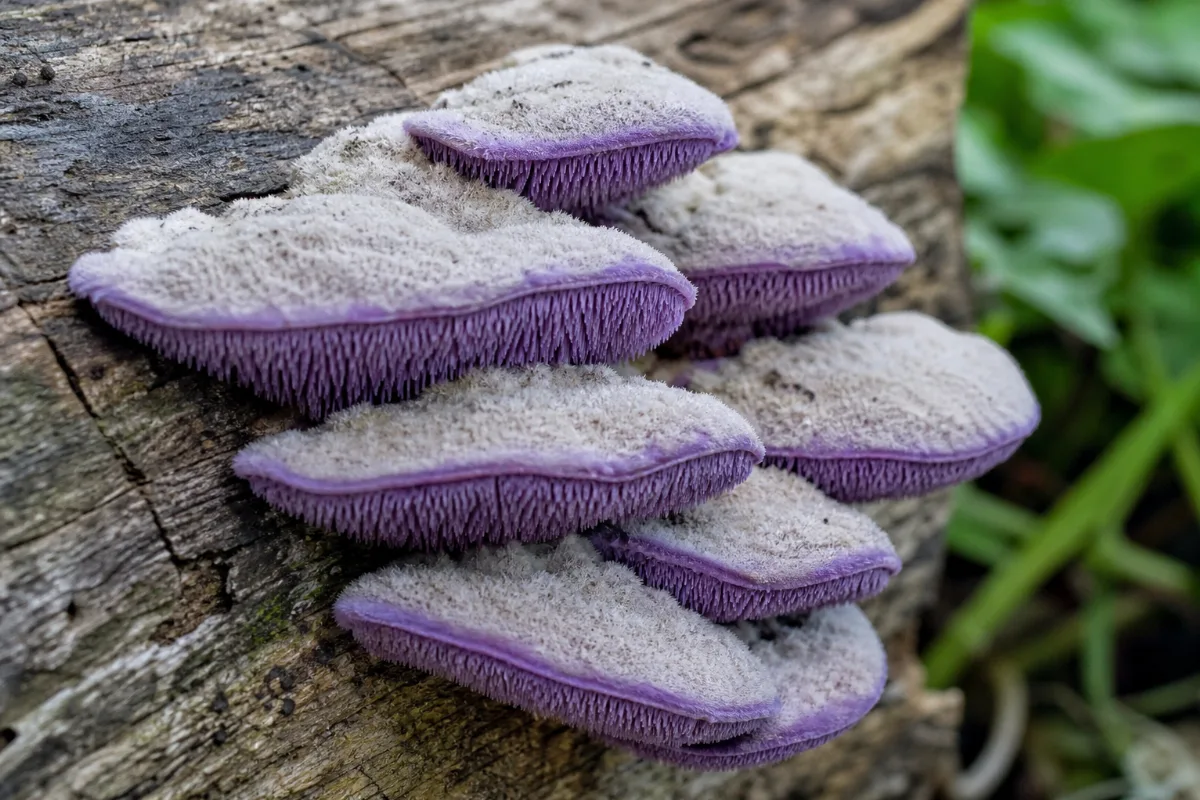
Mushrooms · Wild polypore
Violet-toothed polypore
Trichaptum biforme (Pallidohirschioporus biformis) · also called Violet-pored bracket fungus, purple tooth
Violet-toothed polypore is a leathery, purple-edged bracket fungus that rots dead hardwood. We found no source describing it as a food and no supplement made from it. The research is a handful of laboratory studies and none in people, and turkey tail results do not apply to it. Do not use a wild fungus unless an expert has identified it.
General information, not medical advice. Last substantive update · Not medically reviewed. A named clinician has not signed off on this page. How this page is made
About Violet-toothed polypore
Violet-toothed polypore is a leathery, purple-edged bracket fungus that grows on dead hardwood. Human research does not exist. The little that is known comes from test-tube and cell-dish work on extracts and isolated molecules. We found no safety data, no identification guide and no product. Do not use a wild fungus without an expert.
What it is, and the naming
It is a white-rot, wood-decay fungus in the order Hymenochaetales. A 2026 paper calls it a common annual polypore of subtropical to temperate parts of the Northern Hemisphere. Wikipedia says it grows to 1 to 7.5 cm across, starts violet, and fades to white and brown with a violet margin for a time.
The scientific name is in flux. GBIF lists Trichaptum biforme as accepted, while recent papers call it Pallidohirschioporus biformis. Its genome was sequenced in 2025 and its mitochondrial genome in 2026, to study how it breaks down wood.
It is not turkey tail. Turkey tail research (PSK, PSP, trials in cancer care) concerns Trametes versicolor and does not transfer to this fungus.
What the research shows
Nothing has been tested in people. In a 2024 cell-dish study, a hot-water polysaccharide extract (78.18% polysaccharide by a sugar assay) raised IL-1 beta and TNF-alpha release from a human monocyte cell line and, with IL-2, increased natural killer cell activity.
In a 2026 test-tube study of wild fruiting bodies, extracts blocked hyaluronidase and butyrylcholinesterase but not acetylcholinesterase, and showed no antibacterial effect on seven bacteria. Compounds from lab cultures had negligible or weak effect on cancer cell lines, and a 2018 Russian screen did not list this fungus among the active ones.
These results show interesting chemistry. They cannot show a health effect, because test-tube and cell results often fail in people.
How strong is the evidence?
Every result is rated not enough evidence. It is laboratory work, mostly read from abstracts, on different material (an extract, wild fruiting bodies, lab cultures and mycelium). Much of the chemistry comes from lab cultures rather than the wild fruiting body, and the two can differ. One 1947 paper was read by title only.
Forms and products
We found no consumer product made from this fungus, so we cannot say what one would contain. The lab work used extracts and isolated molecules, which are not tea, powder or capsules. For medicinal mushrooms in general, the US National Cancer Institute says supplement ingredients may vary considerably from lot to lot. If a turkey tail product lists Trichaptum instead of Trametes versicolor, ask the seller for a certificate of analysis.
At a glance
Traditional uses history, not proof
- No traditional medicinal or food use of violet-toothed polypore was found in the sources we read.
Studied for research
- Immune-cell tests, not enough evidence (cell dish only)
- Cancer cell-line tests, not enough evidence (mostly no effect)
- Enzyme and antioxidant tests, not enough evidence (test tube only)
- Germ-killing tests, not enough evidence (mixed lab results)
- Any use in people, not enough evidence (nothing found)
Main compounds
- Hot-water polysaccharides (long sugar chains)
- Sterols such as ergosterol peroxide
- Butenolides and betulin
Common forms
- Hot-water and solvent extracts (laboratory only)
- No consumer product was found
Research links: Phytochemical analysis and immune-modulatory potential of Trichaptum biforme polysaccharides (abstract) · Butenolides and triterpenoids from Pallidohirschioporus biformis (abstract) · Two new drimane sesquiterpenoids from Trichaptum biforme cultures (open access) · Antiproliferative activity of wood-destroying mushrooms from Russia (abstract) · NCI: Medicinal mushrooms (PDQ) · Research Library · Genes & Biomarkers Library
What it is and its history
- Accepted scientific name
- Trichaptum biforme
- Naming authority
- (Fr.) Ryvarden (GBIF)
- Synonyms
- Pallidohirschioporus biformis (the newer name used in 2025 and 2026 papers); Polyporus biformis (old name used in the 1947 paper)
- Common names
- Violet-toothed polypore (English); Violet-pored bracket fungus (English); Purple tooth (English)
- Family or group
- A fungus family, not a plant
- Classification
- Fungi > Basidiomycota > Agaricomycetes > Hymenochaetales > Trichaptaceae (per the 2026 mitochondrial genome paper title; GBIF returned no family) > Trichaptum (the 2026 paper uses Pallidohirschioporus) > Trichaptum biforme
- Native range
- Subtropical to temperate Northern Hemisphere (2026 paper); described as widely distributed (Wikipedia).
- Habitat
- White-rot wood-decay fungus on dead hardwood stumps and logs; recorded on at least 65 tree hosts and rarely on conifers (Wikipedia).
- What it looks like
- Fruiting body: Annual bracket 1 to 7.5 cm across; violet when young, fading to white and brown zones with violet kept at the margin for a time (Wikipedia). No other description was read from a source.
- Cultivation
- Not found in the sources read.
- Harvest and processing
- Not found in the sources read.
- Look-alikes and adulterants
- Name: Trichaptum abietinum, T. byssogenum, T. fuscoviolaceum, Skeletocutis lilacina; Note: Listed by Wikipedia as sometimes confused with this fungus; the first three grow mainly on conifers.; Name: Turkey tail (Trametes versicolor); Note: Sometimes compared because of a similar look; a different fungus with different chemistry and research.
Traditional use and history history, not clinical proof
| Tradition or era | Documented use | Source |
|---|---|---|
| Traditional use | No traditional medicinal or food use was found in the sources read. | p42358799 |
| 1947 laboratory screening | Cultures (as Polyporus biformis) were screened for antibiotic substances; the 2026 paper says biformin was first reported then. | p16588738 |
Traditional use shows how it was used. It does not show that it works or is safe today.
What is inside, and how it may work
What it contains and how those compounds act in cells and animals. Laboratory and animal mechanisms are not proven effects in people.
Main compounds
| Compound | Family | Where it is concentrated | Activity studied | Level of evidence |
|---|---|---|---|---|
| Hot-water polysaccharides (TBP) | polysaccharide | Fruiting bodies, hot-water extract 78.18 +/- 0.81 % of the purified extract by phenol-sulfuric assay; this describes the extract, not the mushroom. | Raised IL-1 beta, TNF-alpha, and (with IL-2) NK-cell activity in cell culture. 2 | Laboratory research |
| Ergosterol peroxide, its glucoside, and 9,11-dehydroergosterol peroxide | sterol | Fruiting bodies Not given in the abstracts. | The glucoside gave 91% hyaluronidase inhibition in a test tube. 8 2 | Laboratory research |
| Betulin | triterpene | Fruiting bodies, methanol extract Not given in the abstract. | Moderate hyaluronidase inhibition (32%) in a test tube. 8 | Laboratory research |
| Butenolides: biformolide (new), hydroxydihydrobovolide, schumannione, and a methoxy-furanone nonanoic acid | butenolide | Fruiting bodies, methanol extract Not given in the abstract. | Hydroxydihydrobovolide was the main butyrylcholinesterase blocker in a test tube. 8 | Laboratory research |
| Drimane sesquiterpenoids (two new) | sesquiterpenoid | Laboratory cultures Not given in the abstract. | Negligible cytotoxicity against five human cancer cell lines. 12 | Laboratory research |
| Biformin | polyacetylene | Laboratory cultures Not stated. | Reported antibacterial in 1947, as cited by the 2026 paper; not re-read. 6 8 | Lab analysis |
Mechanisms, receptors and pathways
| Target or pathway | Gene or receptor | What was found | Level |
|---|---|---|---|
| Immune messengers and natural killer cells | IL-1 beta, TNF-alpha, IFN-gamma | A hot-water polysaccharide extract raised release of these messengers in cell culture. The route was not shown in the abstract. 2 | Laboratory research |
| Hyaluronidase | Extracts and ergosterol peroxide glucoside inhibited the enzyme in a test tube. 8 | Laboratory research | |
| Butyrylcholinesterase | Methanol and chloroform extracts inhibited it; acetylcholinesterase was not inhibited. 8 | Laboratory research |
Absorption, metabolism and elimination
- Absorption
- Not found in the sources read.
- Distribution
- Not found in the sources read.
- Metabolism
- Not found in the sources read.
- Elimination
- Not found in the sources read.
- Bioavailability
- Not established.
Isolated compounds versus whole extracts
The activity data are for a purified hot-water polysaccharide extract, for solvent extracts and isolated molecules, and for mycelium extracts. None is a tea, powder or capsule, and no product comparison exists.
Nutritional composition
No food-composition data were found for this fungus. It is a leathery wood-decay bracket and we make no nutrition claim.
6 not enough evidence
What was looked at
The 6 benefits and uses checked for Violet-toothed polypore, each with how strong the evidence is. Tap one to open it.
- Immune-cell tests (cell dish only)Not enough evidence
- Cancer cell-line tests (mostly no effect)Not enough evidence
- Any use in peopleNot enough evidence
- Enzyme and antioxidant tests of extracts (test tube only)Not enough evidence
- Germ-killing tests (mixed lab results)Not enough evidence
- As a food (nutrition)Not enough evidence
Lab markers tracked in the studies
IL-1 beta and TNF-alpha release from THP-1 cellsNatural killer cell activity and IFN-gamma releaseGrowth of human cancer cell lines in a dishHyaluronidase inhibition in a test tubeAcetylcholinesterase and butyrylcholinesterase inhibitionBacterial growth (MIC) in a test tube
What is Violet-toothed polypore good for?
The uses people ask about and how strong the human evidence is for each. None is shown in people. Read this together with the Safety tab.
Benefits, one by one
Each card is a research question, not a promise. Tap a goal to filter. Open a card to see the studies, doses and limits.
Immune-cell tests (cell dish only)
Not enough evidenceA hot-water extract of the fungus made human immune-type cells in a dish release more inflammatory messengers, and boosted natural killer cell activity when IL-2 was added. Nothing was tested in animals or people, so this does not show an immune benefit.
1 studiesHot-water polysaccharide extract made in a laboratory. This is not a …
Studies, doses and limits
Results
In one 2024 study, a purified hot-water polysaccharide extract (78.18% polysaccharide by a sugar assay) significantly raised IL-1 beta and TNF-alpha release from a human monocyte cell line (THP-1) at 10 and 320 ug/mL (p < 0.01). Natural killer cells treated with the extract (320 ug/mL) plus IL-2 showed significantly more killing activity and IFN-gamma release than the control (p < 0.01).
Effect sizes as reported
Significant changes in cell culture; no size of effect given in the abstract
Why this rating
One abstract-only laboratory paper on one extract. Cell results often fail in animals and people. Raising inflammatory messengers is not automatically good.
Form and dose studied
Hot-water polysaccharide extract made in a laboratory. This is not a tea, powder or capsule, and no such product was found.
Who was studied
Human cell lines and cells in culture
Limits
Single paper; abstract only; repeats not stated; extract concentrations are lab concentrations, not doses.
Why researchers looked
Researchers screen fungal polysaccharides (long sugar chains) for immune effects because some other mushrooms have them.
Traditional use
No traditional medicinal or food use of violet-toothed polypore was found in the sources we read.
Proposed mechanism Laboratory research
The paper measured messenger release (IL-1 beta, TNF-alpha, IFN-gamma) and killing activity of natural killer cells in cell culture. How the extract acts on the cells was not shown in the abstract.
A proposed mechanism does not show that the effect happens in people.
No human safety data were found. See the Safety tab. Do not use a wild fungus unless an expert has identified it.
Cancer cell-line tests (mostly no effect)
Not enough evidenceCompounds grown in lab cultures of the fungus had negligible or weak effect on human cancer cells in a dish, and a screen of six wood-decay fungi did not list this one among the active ones. This does not show any anticancer use.
3 studiesCompounds isolated from lab cultures and mycelium extracts; none is a…
Studies, doses and limits
Results
Two new drimane sesquiterpenoids from cultures had negligible cytotoxicity against five human cancer cell lines (2013). The 2026 paper says earlier cadinane sesquiterpenes and 13-carbon lactones from cultures had no significant activity, and one (trichapargin A) was weakly active on one cell line. In a 2018 Russian screen of six wood-decay fungi, five species (not this one) were reported to have cytotoxic or growth-inhibiting effects; the abstract gives no separate result for this fungus.
Effect sizes as reported
No meaningful activity reported
Why this rating
Lab-only and mostly null. The 2018 result for this species is inferred from its absence in the list of active species.
Form and dose studied
Compounds isolated from lab cultures and mycelium extracts; none is a product.
Who was studied
Human cancer cell lines in culture
Limits
Cultures may differ from the wild fruiting body. The 2024 immune paper frames its work as relevant to cancer, but it did not test killing of cancer cells directly in the abstract.
Why researchers looked
Natural product chemists test new compounds on cancer cell lines as a routine first screen.
Traditional use
No traditional medicinal or food use of violet-toothed polypore was found in the sources we read.
Proposed mechanism Laboratory research
Not applicable: the tests found little or no activity.
A proposed mechanism does not show that the effect happens in people.
No human safety data were found. See the Safety tab. Do not use a wild fungus unless an expert has identified it.
Any use in people
Not enough evidenceWe found no human trial, case report, animal study of a health outcome, or safety study of violet-toothed polypore. For every health claim the honest answer is: not enough evidence. Turkey tail findings do not carry over to it.
2 studiesNo consumer product was found.
Studies, doses and limits
Results
No human results to report.
Why this rating
No human study exists in the sources we searched.
Form and dose studied
No consumer product was found.
Limits
Absence of evidence is not evidence of safety or of benefit.
Why researchers looked
Readers ask whether it is a medicinal mushroom like turkey tail because it looks similar. For this fungus the research is not there.
Traditional use
No traditional medicinal or food use of violet-toothed polypore was found in the sources we read.
Proposed mechanism None
Not applicable.
A proposed mechanism does not show that the effect happens in people.
No human safety data were found. See the Safety tab. Do not use a wild fungus unless an expert has identified it.
Enzyme and antioxidant tests of extracts (test tube only)
Not enough evidenceExtracts of wild fruiting bodies blocked the enzyme hyaluronidase in a test tube, and blocked butyrylcholinesterase but not acetylcholinesterase. These are chemistry results, not effects on skin, memory or any condition.
1 studiesSolvent extracts and isolated molecules, not a food or supplement.
Studies, doses and limits
Results
Wild fruiting body extracts (methanol, chloroform, n-hexane) were tested in 2026. Hyaluronidase looked like the main target: the chloroform extract gave 47% inhibition at 5 mg/mL, and the chloroform and methanol extracts 79 to 97% at 10 and 20 mg/mL. The methanol and chloroform extracts blocked butyrylcholinesterase (about 51% at 40 mg/mL) but showed no acetylcholinesterase inhibition. The alpha-glucosidase and tyrosinase tests and an antioxidant (ABTS) test were also run; the abstract gives no numbers for them. A figure caption says methanol and chloroform extracts generally did better than hexane in the antioxidant test, below the vitamin C reference.
Effect sizes as reported
Test-tube percentages; the concentrations are very high and are not doses
Why this rating
Single laboratory paper on one batch of wild fungus; the enzyme results do not show any effect in a body.
Form and dose studied
Solvent extracts and isolated molecules, not a food or supplement.
Who was studied
Enzymes in a test tube
Limits
One paper; some numbers come from the full text and from figure captions; bar-chart values were not extracted; the authors say comparisons with other species are limited.
Why researchers looked
Researchers run enzyme tests on many fungi to find which ones have interesting chemistry. Hyaluronidase breaks down hyaluronic acid; butyrylcholinesterase is a brain-related enzyme.
Traditional use
No traditional medicinal or food use of violet-toothed polypore was found in the sources we read.
Proposed mechanism Laboratory research
Pure compounds in the extract were the active part: ergosterol peroxide glucoside (91% hyaluronidase inhibition), betulin (32%) and hydroxydihydrobovolide (the main butyrylcholinesterase blocker).
A proposed mechanism does not show that the effect happens in people.
No human safety data were found. See the Safety tab. Do not use a wild fungus unless an expert has identified it.
Germ-killing tests (mixed lab results)
Not enough evidenceA 1947 culture study is said to have found an antibacterial compound called biformin, but a 2026 test of extracts from wild fruiting bodies found no antibacterial effect on seven bacteria. Neither shows that it treats any infection.
2 studiesLaboratory culture compound; solvent extracts. No product.
Studies, doses and limits
Results
The 2026 paper reports that the fungal extracts did not show antibacterial properties against seven bacterial strains (MIC above 400 ug/mL). It also says Robbins and colleagues first reported biformin from cultures in 1947 with antibacterial activity; we could read only the 1947 paper's title, not its content.
Effect sizes as reported
No antibacterial effect from the 2026 extracts; the 1947 effect is unquantified here
Why this rating
The two reports disagree, use different material (culture versus wild fruiting body extract), and one was only read second-hand.
Form and dose studied
Laboratory culture compound; solvent extracts. No product.
Who was studied
Bacteria in test tubes
Limits
The 1947 abstract is not available. Different material in each paper.
Why researchers looked
Antibiotic discovery programmes screened many fungi in the 1940s, and chemists still run antibacterial tests today.
Traditional use
No traditional medicinal or food use of violet-toothed polypore was found in the sources we read.
Proposed mechanism Laboratory research
Biformin is a polyacetylene (a chain-like molecule) said to come from cultures of the fungus.
A proposed mechanism does not show that the effect happens in people.
No human safety data were found. See the Safety tab. Do not use a wild fungus unless an expert has identified it.
As a food (nutrition)
Not enough evidenceWe found no source that describes violet-toothed polypore as a food and no nutrient data. A general encyclopedia calls it inedible. It is a leathery wood-decay bracket.
2 studiesNot a food product.
Studies, doses and limits
Results
No food-composition data were found. Element content of wild fruiting bodies was measured in a 2021 Turkish study that included this species, but the abstract gives only ranges across all 20 species, not a value for this one.
Why this rating
No nutrient or food-safety data for this species in the sources we read.
Form and dose studied
Not a food product.
Limits
Wikipedia's 'inedible' is a general-source statement, not a toxicology finding.
Why researchers looked
Readers ask whether it can be eaten like a mushroom.
Traditional use
No traditional medicinal or food use of violet-toothed polypore was found in the sources we read.
Proposed mechanism None
Not applicable.
A proposed mechanism does not show that the effect happens in people.
No human safety data were found. See the Safety tab. Do not use a wild fungus unless an expert has identified it.
Connections to the rest of health
How Violet-toothed polypore connects to the rest of our health knowledge graph. Every link says what kind of connection it is. A safety link (for example to the liver) is a warning, not a benefit. A study that merely mentions a topic never creates a benefit link.
Explore every connection: goals, body systems, organs, symptoms, genes
A. Wellness goals
| Connected to | Kind of connection | Evidence status | Context | Studies |
|---|---|---|---|---|
| Immune Health | Preliminary mechanism | Not enough evidence | Immune-cell tests (cell dish only): A hot-water extract of the fungus made human immune-type cells in a dish release more inflammatory messengers, and boosted natural killer cell activity when IL-2 was added. Nothing was tested in animals or people, so this does not show an immune benefit. Germ-killing tests (mixed lab results): A 1947 culture study is said to have found an antibacterial compound called biformin, but a 2026 test of extracts from wild fruiting bodies found no antibacterial effect on seven bacteria. Neither shows that it treats any infection. | 2 8 6 |
| Cancer Support | Not enough evidence | Cancer cell-line tests (mostly no effect): Compounds grown in lab cultures of the fungus had negligible or weak effect on human cancer cells in a dish, and a screen of six wood-decay fungi did not list this one among the active ones. This does not show any anticancer use. | 7 12 8 | |
| Healthy Aging | Preliminary mechanism | Not enough evidence | Enzyme and antioxidant tests of extracts (test tube only): Extracts of wild fruiting bodies blocked the enzyme hyaluronidase in a test tube, and blocked butyrylcholinesterase but not acetylcholinesterase. These are chemistry results, not effects on skin, memory or any condition. | 8 |
| Nutrition | Not enough evidence | As a food (nutrition): We found no source that describes violet-toothed polypore as a food and no nutrient data. A general encyclopedia calls it inedible. It is a leathery wood-decay bracket. | 3 10 |
B. Body systems
| Connected to | Kind of connection | Evidence status | Context | Studies |
|---|---|---|---|---|
| Immune System | Biological association | Not enough evidence | Studied for: Immune-cell tests (cell dish only) Studied for: Cancer cell-line tests (mostly no effect) | 2 7 12 8 6 |
| Cellular Protection | Biological association | Not enough evidence | Studied for: Enzyme and antioxidant tests of extracts (test tube only) | 8 |
| Digestive System | Biological association | Not enough evidence | Studied for: As a food (nutrition) | 3 10 |
E. Health conditions
| Connected to | Kind of connection | Evidence status | Context | Studies |
|---|---|---|---|---|
| Pregnancy and breastfeeding | Contraindication | Not enough evidence | No safety data found. Preparation or compound: All violet-toothed polypore products |
4 |
I. Biomarkers
| Connected to | Kind of connection | Evidence status | Context | Studies |
|---|---|---|---|---|
| IL-1 beta and TNF-alpha release from THP-1 cells | Biological association | Not enough evidence | Measured in trials: increased. A lab change is not the same as a health benefit. | 2 |
| Natural killer cell activity and IFN-gamma release | Biological association | Not enough evidence | Measured in trials: increased. A lab change is not the same as a health benefit. | 2 |
| Growth of human cancer cell lines in a dish | Biological association | Not enough evidence | Measured in trials: no change. A lab change is not the same as a health benefit. | 12 7 |
| Hyaluronidase inhibition in a test tube | Biological association | Not enough evidence | Measured in trials: inhibited. A lab change is not the same as a health benefit. | 8 |
| Acetylcholinesterase and butyrylcholinesterase inhibition | Biological association | Not enough evidence | Measured in trials: mixed. A lab change is not the same as a health benefit. | 8 |
| Bacterial growth (MIC) in a test tube | Biological association | Not enough evidence | Measured in trials: no change. A lab change is not the same as a health benefit. | 8 |
L. Active compounds
| Connected to | Kind of connection | Evidence status | Context | Studies |
|---|---|---|---|---|
| Hot-water polysaccharides (TBP) | Biological association | In vitro | Raised IL-1 beta, TNF-alpha, and (with IL-2) NK-cell activity in cell culture. Preparation or compound: Fruiting bodies, hot-water extract |
2 |
| Ergosterol peroxide, its glucoside, and 9,11-dehydroergosterol peroxide | Biological association | In vitro | The glucoside gave 91% hyaluronidase inhibition in a test tube. Preparation or compound: Fruiting bodies |
8 2 |
| Betulin | Biological association | In vitro | Moderate hyaluronidase inhibition (32%) in a test tube. Preparation or compound: Fruiting bodies, methanol extract |
8 |
| Butenolides: biformolide (new), hydroxydihydrobovolide, schumannione, and a methoxy-furanone nonanoic acid | Biological association | In vitro | Hydroxydihydrobovolide was the main butyrylcholinesterase blocker in a test tube. Preparation or compound: Fruiting bodies, methanol extract |
8 |
| Drimane sesquiterpenoids (two new) | Biological association | In vitro | Negligible cytotoxicity against five human cancer cell lines. Preparation or compound: Laboratory cultures |
12 |
| Biformin | Biological association | Lab analysis | Reported antibacterial in 1947, as cited by the 2026 paper; not re-read. Preparation or compound: Laboratory cultures |
6 8 |
Each connection is stored with the ingredient, the connected record, the kind of connection, the evidence status, the supporting studies, the preparation or compound involved, and a review date (last reviewed October 25, 2026).
Evidence at a glance: what changed in 1 lab markers
Tap a number to show only those markers. Counts are markers, not people.
The evidence
The research centre for Violet-toothed polypore. Every record here was checked against PubMed or the publisher's page; we never list a study we have not verified.
Evidence by outcome
Bars show how many studies we found for each outcome, not how well it works. People are added up across trials only (reviews are not added, to avoid double counting).
How we rate evidence
High certainty
Several well-run trials or reviews agree; further research is unlikely to change the picture much.
Moderate certainty
Good trials point the same way, but some doubt remains.
Low certainty
Small, short or inconsistent trials. The finding could change with better research.
Very low certainty
Very little or very weak human data. Treat as a possibility only.
Mixed findings
Trials or reviews disagree with each other.
Not enough evidence
Not enough human research to say either way.
Evidence against
Good research found no benefit, or found harm.
We take the reviewers' own risk-of-bias and GRADE statements where they exist, and otherwise judge from study size, design, consistency, directness and whether a product matches what is sold. Many publications do not make evidence high. Method note: We read PubMed records and abstracts for 7 papers on this fungus (immune cells, enzymes, cancer cell lines, chemistry, two genome papers) plus a 1947 record by title, parts of the open-access 2026 full text, the open-access 2013 chemistry abstract and a 2021 element study that included the species. We checked the name in GBIF, read a Wikipedia extract for description and look-alikes, read the National Cancer Institute medicinal mushrooms page, and searched NCBI Books for LiverTox and LactMed entries. Certainty ratings are the compiler's own reading.
Study library: every study we checked 12
| Study | Design | People | Product, dose, length | Result |
|---|---|---|---|---|
| GBIF 2026 GBIF Backbone Taxonomy: Trichaptum biforme GBIF · Source |
Database record n/a |
n/a | n/a |
On 2026-10-25 the GBIF match API gave Trichaptum biforme (Fr.) Ryvarden as ACCEPTED (key 5247228), kingdom Fungi, phylum Basidiomycota, class Agaricomycetes, order Hymenochaetales. The match returned no family. A search for Pallidohirschioporus biformis matched only the kingdom, so GBIF did not recognise the newer name on that date. Name check Methods, limits and fundingOutcomes: Name check Limitations: Index Fungorum was not checked, so the newer name could not be confirmed there. Funding and conflicts: Not applicable Read: database record |
| Habibi 2024 Phytochemical analysis and immune-modulatory potential of Trichaptum biforme polysaccharides: Implications for cancer. International Journal of Biological Macromolecules · PMID 39284468 · DOI |
Laboratory study Trichaptum biforme |
Cell cultures: a human monocyte cell line (THP-1) and natural killer (NK) cells; chemical assays | Hot-water polysaccharide extract (TBP) from the fungus; three sterol derivatives from the n-hexane fraction Fruiting bodies (the abstract says "T. biforme"; the part is not spelled out) |
TBP made up 78.18 +/- 0.81 % of the purified hot-water extract by the phenol-sulfuric acid assay (an extract purity figure, not a content value for the mushroom). In THP-1 cells it significantly raised IL-1 beta and TNF-alpha release at 10 and 320 ug/mL (p < 0.01). NK cells treated with the extract (320 ug/mL) plus IL-2 showed significantly higher cytotoxic activity and IFN-gamma release than the control (p < 0.01). A sterol, 9,11-dehydroergosterol peroxide, was identified in this fungus for the first time. The abstract says antioxidant activity was assessed (DPPH and FRAP) but gives no result. Immune messenger release and NK-cell activity in cell culture; chemistry of the extract Methods, limits and fundingOutcomes: Immune messenger release and NK-cell activity in cell culture; chemistry of the extract Limitations: Cell-dish work only. Abstract read, not the full text. Number of repeats is not given in the abstract. IL-1 beta and TNF-alpha are inflammatory messengers, so a rise is not automatically a benefit. The authors' conclusion that it is a candidate for "bolstering anticancer immune responses" goes beyond a cell-culture result. Funding and conflicts: The authors declare no competing financial interests (abstract). Read: abstract |
| Keskin 2021 Element concentration, daily intake of elements, and health risk indices of wild mushrooms collected from Belgrad Forest and Ilgaz Mountain National Park (Turkey). Environmental Science and Pollution Research · PMID 33982259 · DOI |
Chemical analysis 20 wild mushroom species incl. Trichaptum biforme |
Wild mushrooms from two Turkish forests; 20 species including Trichaptum biforme | Wild fruiting bodies, element analysis Fruiting bodies |
The abstract gives element ranges across all 20 species together (for example mercury 14.03 to 37.81 and cadmium 0.09 to 2.4 mg/kg dry weight) and does not give a value for T. biforme. Intake and risk indices were worked out for edible species only, and some of those (not T. biforme) exceeded legal limits. The authors say the species should be eaten in a controlled manner. Element (metal and mineral) content Methods, limits and fundingOutcomes: Element (metal and mineral) content Limitations: No T. biforme value in the abstract. It shows that wild mushrooms in general can contain metals, not what this species contains. Funding and conflicts: Not stated in the abstract Read: abstract |
| NCBI Bookshelf 2026 NCBI Books search for LiverTox and LactMed entries (Trichaptum, Pallidohirschioporus) NCBI Bookshelf · Source |
Database search n/a |
n/a | n/a |
Searches of NCBI Books on 2026-10-25 for "Trichaptum" and for "Pallidohirschioporus" each returned zero results. No LiverTox or LactMed entry for this fungus was found. No entry found Methods, limits and fundingOutcomes: No entry found Limitations: A search for a name is not a full review. EMA and NCCIH pages were not checked. Funding and conflicts: Not applicable Read: search result |
| National Cancer Institute 2024 NCI PDQ: Medicinal Mushrooms (health professional version) National Cancer Institute · Source |
Authoritative guidance n/a |
n/a | n/a |
Page text read on 2026-10-25. It says supplement ingredients may vary considerably from lot to lot with no guarantee that label ingredients are present, and that the FDA has not approved medicinal mushrooms as a treatment for cancer or any other medical condition. It has no section on violet-toothed polypore. General regulatory caution Methods, limits and fundingOutcomes: General regulatory caution Limitations: Not about this fungus; applies by analogy only. Funding and conflicts: Not applicable Read: page text |
| Robbins 1947 Antibiotics from Basidiomycetes: II. Polyporus biformis. Proceedings of the National Academy of Sciences USA · PMID 16588738 · DOI |
Laboratory study (historical) Polyporus biformis (old name for Trichaptum biforme) |
Not stated (PubMed record has no abstract) | Culture of Polyporus biformis (old name for this fungus) Laboratory culture |
The PubMed record has a title but no abstract. The 2026 paper (Suratno et al.) says this 1947 work first reported biformin, a polyacetylene from cultures with antibacterial activity. Title only: antibiotic substances from this fungus Methods, limits and fundingOutcomes: Title only: antibiotic substances from this fungus Limitations: Only the title was read. The antibacterial claim is as cited by the 2026 paper, not read in the original. A 1947 culture result says nothing about people. Funding and conflicts: Not stated Read: title only (PubMed record) |
| Shnyreva 2018 Antiproliferative Activity and Cytotoxicity of Some Medicinal Wood-Destroying Mushrooms from Russia. International Journal of Medicinal Mushrooms · PMID 29604909 · DOI |
Laboratory study Trichaptum biforme (mycelium) among six species |
Leukemia and solid-tumour cell lines in culture; six wood-decay fungi from Central Russia | Hot-water extracts and methanol-chloroform extracts of mycelial biomass Mycelium grown from wild-collected strains |
The authors screened six fungi including Trichaptum biforme. They report cytotoxic and growth-inhibiting effects of hot-water extracts for five species (Trametes versicolor, Coniophora puteana, Fomes fomentarius, Fomitopsis pinicola, Inonotus obliquus). T. biforme is not among the five named. The most effective extract was a methanol extract of T. versicolor. The abstract gives no separate result for T. biforme. Cell growth inhibition Methods, limits and fundingOutcomes: Cell growth inhibition Limitations: Cell-dish work on mycelium, not fruiting bodies. The result for T. biforme is inferred from its absence in the list of active species; the abstract does not state it directly. Funding and conflicts: Not stated in the abstract Read: abstract |
| Suratno 2026 Butenolides and triterpenoids from the fungus Pallidohirschioporus biformis (syn. Trichaptum biforme): isolation, structure determination and bioactivity profile. Frontiers in Fungal Biology · PMID 42358799 · DOI |
Laboratory study (chemistry and enzyme tests) Pallidohirschioporus biformis (Trichaptum biforme), wild fruiting bodies |
Test-tube assays (enzymes, seven bacterial strains, antioxidant test) on extracts and eight isolated compounds | Methanol, chloroform and n-hexane extracts of the fungus; eight isolated compounds Wild-growing fruiting bodies (sporocarps) |
Eight compounds were isolated from the methanol extract; biformolide is new and one other butenolide was reported from natural sources for the first time. Hyaluronidase looked like the main enzyme target of the extracts. Ergosterol peroxide glucoside gave 91% hyaluronidase inhibition and betulin 32%; the other compounds had little or none. The methanol and chloroform extracts blocked butyrylcholinesterase (about 51% at 40 mg/mL, from the full text) but showed no inhibition of acetylcholinesterase; hydroxydihydrobovolide was the main active compound. The full text states that the extracts showed no antibacterial effect on seven bacterial strains (MIC above 400 ug/mL). A figure caption says methanol and chloroform extracts generally did better than the hexane extract in the hyaluronidase and antioxidant (ABTS) tests, below the reference standards. Enzyme-inhibition and antioxidant tests; antibacterial tests; chemistry Methods, limits and fundingOutcomes: Enzyme-inhibition and antioxidant tests; antibacterial tests; chemistry Limitations: Test-tube work. Abstract and parts of the open-access full text read (introduction, methods, parts of results); the bar-chart values were not extracted. Concentrations used (mg/mL) are far above anything a person could reach, so these are not doses. The authors say direct comparisons with other species are limited. Funding and conflicts: The authors declared no commercial or financial relationships (abstract). Read: abstract and open-access full text (parts) |
| Wei 2026 The first complete mitochondrial genome of Trichaptum biforme (Fr.) Ryvarden 1972 within the family Trichaptaceae, Hymenochaetales. Mitochondrial DNA Part B · PMID 42205523 · DOI |
Genome sequencing Trichaptum biforme |
One specimen from the Qinling Mountains, Shaanxi, China | n/a |
The mitochondrial genome is 55,598 base pairs long. The paper places the fungus in the family Trichaptaceae, order Hymenochaetales. Mitochondrial genome Methods, limits and fundingOutcomes: Mitochondrial genome Limitations: Genetics only; nothing on health, food or safety. Funding and conflicts: No potential conflict of interest reported (abstract). Read: abstract |
| Wikipedia 2026 Wikipedia: Trichaptum biforme Wikipedia · Source |
Encyclopedia n/a |
n/a | n/a |
The article gives the common names violet-pored bracket fungus, purple tooth and violet-toothed polypore. It says the cap grows to 1 to 7.5 cm across, starts violet and fades to white and brown with violet kept at the margin for a time. It is a saprobe on hardwood stumps and logs, recorded on at least 65 tree hosts, rarely on conifers. It says the fungus is sometimes confused with Trichaptum abietinum (nearly always on conifers), T. byssogenum, T. fuscoviolaceum and Skeletocutis lilacina, and that it is inedible. Description and look-alikes Methods, limits and fundingOutcomes: Description and look-alikes Limitations: A general encyclopedia read on 2026-10-25; its edibility and look-alike statements were not checked against a field guide. Not an identification guide. Funding and conflicts: Not applicable Read: article text (extract) |
| Xie 2025 Trichaptum biforme (Pallidohirschioporus biformis) genome decoding provides insights into carbohydrate degradation and polysaccharide synthesis. Genomics · PMID 40349991 · DOI |
Genome sequencing Trichaptum biforme |
The fungus T. biforme (genome) | n/a |
The genome is 50.71 Mb in 13 chromosome-level pieces and encodes 15,302 predicted genes. 375 genes were predicted to make carbohydrate-active enzymes. The authors link this to its ability to break down wood (lignocellulose). The fungus is described as a white-rot fungus. Genome size and gene content Methods, limits and fundingOutcomes: Genome size and gene content Limitations: Genetics only; nothing on health, food or safety. Funding and conflicts: The authors declare no competing financial interests (abstract). Read: abstract |
| Yang 2013 Two new drimane sesquiterpenoids from cultures of the basidiomycete Trichaptum biforme. Natural Products and Bioprospecting · Source · DOI |
Laboratory study (chemistry and cell lines) Trichaptum biforme (culture) |
Five human cancer cell lines in culture | Two new drimane sesquiterpenoids and five known compounds from laboratory cultures Laboratory culture (not wild fruiting bodies) |
Two new drimane sesquiterpenoids (1 and 2) and five known compounds were isolated from the fungus. Compounds 1 and 2 had negligible cytotoxicity against five human cancer cell lines. Structures; cytotoxicity against five human cancer cell lines Methods, limits and fundingOutcomes: Structures; cytotoxicity against five human cancer cell lines Limitations: Abstract read from the open-access PMC record (PMC4131575); it is not in PubMed. Culture compounds may differ from those in the wild fruiting body. Funding and conflicts: Not stated in the abstract Read: abstract (PMC record) |
What we do not know yet
- No human trial, case report or safety study of violet-toothed polypore was found.
- No animal study of any health outcome was found.
- The immune result comes from one extract in one paper; the 1947 antibiotic paper was read by title only.
- No identification, edibility or toxicology report was read, and no metal value for this species was in the abstract we read.
- LiverTox and LactMed entries were not found; EMA, NCCIH and MSK pages were not checked.
How new research is added
New studies are found by a saved PubMed search and placed in a review queue. A person reads each one before it changes any evidence rating or safety wording. New publications never change ratings automatically.
Lab markers
What changed in blood or saliva tests during trials. A changed number is not the same as feeling or being healthier, and we give no "normal ranges".
Other 6
IL-1 beta and TNF-alpha release from THP-1 cells
Increased in trials
Amounts of two inflammatory messenger proteins released by a human immune-type cell line in a dish.
Not enough evidenceResults and what it means
Why it was measured
A first look at whether an extract activates immune cells.
Statistical vs. clinical meaning
Cell-dish result only.
Safety implication
More inflammatory messengers is not a measure of benefit or safety.
| Study | Result | People | Product |
|---|---|---|---|
| 2 | The hot-water polysaccharide extract significantly raised both messengers at 10 and 320 ug/mL (p < 0.01). | THP-1 cell line | Hot-water polysaccharide extract (TBP) |
Natural killer cell activity and IFN-gamma release
Increased in trials
How strongly natural killer cells kill target cells and release IFN-gamma in culture.
Not enough evidenceResults and what it means
Why it was measured
Natural killer cells are part of the body's first-line immune defence.
Statistical vs. clinical meaning
Cell-dish result only; combined with IL-2, so the extract alone is not shown to do this.
Safety implication
Not a measure of safety.
| Study | Result | People | Product |
|---|---|---|---|
| 2 | Extract (320 ug/mL) plus IL-2 significantly increased killing activity and IFN-gamma release versus control (p < 0.01). | NK cells in culture | Hot-water polysaccharide extract with IL-2 |
Growth of human cancer cell lines in a dish
No change in trials
Whether cancer cells grow more slowly or die when a compound or extract is added.
Not enough evidenceResults and what it means
Why it was measured
A routine first screen for new molecules.
Statistical vs. clinical meaning
Mostly null lab results.
Safety implication
Not a measure of safety or of treating cancer.
| Study | Result | People | Product |
|---|---|---|---|
| 12 | Two new drimane sesquiterpenoids had negligible cytotoxicity against five cancer cell lines. | Human cancer cell lines | Compounds from lab cultures |
| 7 | Five of six fungi tested were reported active; T. biforme was not among the five named. | Leukemia and solid-tumour cell lines | Hot-water and methanol-chloroform extracts of mycelium |
Hyaluronidase inhibition in a test tube
Inhibited in trials
How much an extract or compound slows an enzyme that breaks down hyaluronic acid.
Not enough evidenceResults and what it means
Why it was measured
A common first screen for anti-inflammatory and skin-related chemistry.
Statistical vs. clinical meaning
Lab screening result only.
Safety implication
Says nothing about safety or effects in people.
| Study | Result | People | Product |
|---|---|---|---|
| 8 | Ergosterol peroxide glucoside 91%, betulin 32%; chloroform extract 47% at 5 mg/mL and 79 to 97% for chloroform and methanol extracts at 10 and 20 mg/mL. | Enzyme assay | Extracts and isolated compounds from wild fruiting bodies |
Acetylcholinesterase and butyrylcholinesterase inhibition
Mixed results in trials
How much an extract slows two enzymes that break down acetylcholine and related esters.
Not enough evidenceResults and what it means
Why it was measured
A routine screen related to memory research chemistry.
Statistical vs. clinical meaning
Lab screening result only; not a memory or brain outcome.
Safety implication
Not a measure of safety.
| Study | Result | People | Product |
|---|---|---|---|
| 8 | Methanol and chloroform extracts blocked butyrylcholinesterase (about 51% at 40 mg/mL) but not acetylcholinesterase; hydroxydihydrobovolide was the main active compound. | Enzyme assay | Extracts of wild fruiting bodies |
Bacterial growth (MIC) in a test tube
No change in trials
The lowest amount of extract that stops visible bacterial growth.
Not enough evidenceResults and what it means
Why it was measured
A first screen for germ-killing chemistry.
Statistical vs. clinical meaning
Null lab result.
Safety implication
Not a measure of safety or of treating infection.
| Study | Result | People | Product |
|---|---|---|---|
| 8 | No antibacterial effect on seven bacterial strains (MIC above 400 ug/mL) for the three fungal extracts. | Seven bacterial strains | Methanol, chloroform and hexane extracts of wild fruiting bodies |
Safety
What studies and official sources say about side effects, medicines and who should check first. Each point shows what kind of evidence it comes from.
Main points to know 5
- Wild fungus: do not eat or use it on a guess. Violet-toothed polypore is a wild, leathery bracket on dead wood. Wikipedia lists look-alikes (Trichaptum abietinum, T. byssogenum, T. fuscoviolaceum and Skeletocutis lilacina) and calls this fungus inedible. We found no field guide or toxicology report, so this page gives no identification help and no advice to eat, brew or apply it. If someone ate a wild fungus and you are unsure what it was, call your local poison centre (in the US, Poison Help at 1-800-222-1222). Identification caution 10
- No human safety data were found. We found no clinical trial, case report or poison-centre report for this fungus. That means the risks are unknown, not that there are none. Nothing here is a safety all-clear. None 8 4
- Not a turkey tail substitute. It is sometimes compared with turkey tail (Trametes versicolor) because of the similar look and shared habitat. Turkey tail's research (PSK, PSP, trials in cancer care) concerns a different fungus and does not transfer. The only polysaccharide work on this fungus is a cell-dish study. Naming 2 7
- The name has changed. Recent papers call it Pallidohirschioporus biformis (syn. Trichaptum biforme). GBIF still lists Trichaptum biforme as the accepted name and did not match the newer one on 2026-10-25. Check the Latin name on anything you read or buy. Naming 1 8
- No known consumer product, so label quality cannot be judged. We found no supplement made from this fungus. For medicinal mushrooms in general, the US National Cancer Institute says ingredients may vary considerably from lot to lot and there is no guarantee that label ingredients are present. Authoritative guidance 5
Side effects 1
| Effect | How often | Severity and recovery | Evidence |
|---|---|---|---|
| No adverse effects have been reported, but none have been looked for in people Absence of reports in the sources we read is not proof of safety. | Unknown | unknown Not applicable | None |
Liver
We found no case report or trial linking this fungus to liver injury. NCBI Books searches on 2026-10-25 for Trichaptum and for Pallidohirschioporus returned no LiverTox entry. 4
How often. No liver reports found; this is not proof of liver safety.
Monitoring. No agency monitoring advice exists in the sources we read. People with liver disease should ask a doctor before using any medicinal fungus.
This is a safety connection. It is not evidence that Violet-toothed polypore supports liver health.
Medicines and supplements 3
| With | Why it matters | Importance | Evidence | What to do |
|---|---|---|---|---|
| Any medicine, including blood thinners and immune-suppressing medicines prescription | Unknown. No interaction study or case report was found. The only immune work is a cell-dish study. | None Not enough evidence | Ask your prescriber or pharmacist before using any medicinal fungus. | |
| Herbal products and other supplements supplement | Unknown. | None Not enough evidence | Tell your pharmacist about every product you use. | |
| Food and alcohol food | Unknown. It is not a food. | None Not enough evidence | Not applicable. |
Who should check first 4
| Situation | Advice | Evidence |
|---|---|---|
| Pregnancy and breastfeeding | No safety data were found, so it is not known whether it is safe. Ask a doctor. Our NCBI Books search found no LactMed entry. | None 4 |
| Children and babies | No safety data were found. Ask a doctor before giving any medicinal fungus to a child. | None |
| Mushroom allergy, asthma or a history of reactions to fungi or moulds | Allergy to this fungus has not been studied. Take extra care and ask a doctor. This is general caution, not from a source on this fungus. | General caution |
| Before surgery, or with immune disease or an organ transplant | Nothing is known. Ask your doctor before using any medicinal fungus. | None |
Overdose, product quality and regulators
Summary. No toxicity study in people or animals was found.
Human doses studied. No human study. This page gives no amounts and none are advised.
Overdose response. No description was found. If someone becomes unwell after eating any wild fungus, seek medical help or call poison control and keep a sample if you can.
Toxic parts. Not described in the sources read.
A 2021 Turkish study measured metals and minerals in 20 wild mushroom species that included this one, but its abstract gives only ranges across all species, not a value for this fungus. Wild fungi can take up substances from their wood and surroundings.
Metals in wild mushrooms. Across the 20 species, mercury ranged from 14.03 to 37.81 and cadmium from 0.09 to 2.4 mg/kg dry weight; some edible species (not this one) exceeded legal intake limits. The authors advise controlled consumption. No separate figure for this fungus is in the abstract. 3
| Body | Action | Date |
|---|---|---|
| US National Cancer Institute (PDQ) (United States) | States that the FDA has not approved medicinal mushrooms as a treatment for cancer or any other medical condition, and that supplement ingredients may vary considerably from lot to lot. The page has no section on this fungus. source | |
| LiverTox / LactMed (US NIH) (United States) | No entry found for Trichaptum or Pallidohirschioporus by NCBI Books search. source | 2026-10-25 |
When to get medical help
- Itching, hives, swelling of the lips, tongue or face, wheeze or trouble breathing after eating, handling or inhaling a fungus: get emergency help now (general advice, not from a source on this fungus).
- Repeated vomiting, severe stomach pain, diarrhoea, confusion or yellow skin or eyes after eating any wild fungus: get medical help now and call your local poison control number. Keep a sample of the fungus if you can.
- A wound that bleeds heavily, looks infected, or does not heal: do not rely on any fungus; get medical care.
If someone may be poisoned or in a crisis, contact a clinician or emergency service straight away. In the US, Poison Control is 1-800-222-1222.
General information only, not medical advice. Ask a clinician or pharmacist before use, especially with medicines, in pregnancy or with a health condition. See the Natural Remedy Safety guide.
Frequently asked questions
What is violet-toothed polypore?
Is violet-toothed polypore edible?
We found no source that describes it as food and no nutrition data, and Wikipedia calls it inedible. We give no advice to eat it. Never eat a wild fungus because of a description.
Is it the same as turkey tail?
Does it have proven health benefits?
No. The research is a few laboratory papers. A hot-water extract changed immune messengers in a cell dish. That does not show a benefit in people.
Does it help the immune system?
Not shown. In a cell dish, a hot-water polysaccharide extract raised some immune messengers and, with IL-2, natural killer cell activity. It was not tested in animals or people.
Does it fight cancer?
Does it fight germs or infections?
Is it safe?
Can I tell it from look-alikes myself?
No. Wikipedia lists several similar wood fungi, and wild fungi cannot be safely identified from a description, a photo or an app. Ask a trained local expert.
Has the name changed?
Does it interact with medicines?
Unknown. No interaction study or case report was found. Ask a pharmacist before using any medicinal fungus.
Can I buy a violet-toothed polypore supplement?
We found no consumer product made from it. For mushroom supplements in general the US National Cancer Institute says label contents are not guaranteed, so check the Latin name on any turkey tail label.
Explore by health goal
Editorial transparency
- Written by
- AlternativeMed editorial team. Research compiled with AI assistance, then checked against PubMed records.
- Medical review
- None. This page has not been reviewed by a physician or pharmacist.
- First published
- 2026-10-25
- Last substantive update
- 2026-10-25
- How we research
- We read PubMed records and abstracts for 7 papers on this fungus (immune cells, enzymes, cancer cell lines, chemistry, two genome papers) plus a 1947 record by title, parts of the open-access 2026 full text, the open-access 2013 chemistry abstract and a 2021 element study that included the species. We checked the name in GBIF, read a Wikipedia extract for description and look-alikes, read the National Cancer Institute medicinal mushrooms page, and searched NCBI Books for LiverTox and LactMed entries. Certainty ratings are the compiler's own reading.
- How we rate evidence
- See "How we rate evidence" in the Evidence tab.
- Independence
- No product is promoted on this page. No affiliate links are shown. This page is information, not a recommendation to use violet-toothed polypore.
Sources 12
Each source was opened and checked. Where we read only the abstract, it says so. The small numbers in the text point here.
- GBIF. GBIF Backbone Taxonomy: Trichaptum biforme. GBIF. 2026. (database record)
- Habibi E, Hemmati P, Arabnozari H, Khalili HA, Sharifianjazi F, Enderami SE, Sarker SD, Hassannia H, Nahar L. Phytochemical analysis and immune-modulatory potential of Trichaptum biforme polysaccharides: Implications for cancer.. International Journal of Biological Macromolecules. 2024. PMID 39284468. DOI 10.1016/j.ijbiomac.2024.135691. (abstract)
- Keskin F, Sarikurkcu C, Akata I, Tepe B. Element concentration, daily intake of elements, and health risk indices of wild mushrooms collected from Belgrad Forest and Ilgaz Mountain National Park (Turkey).. Environmental Science and Pollution Research. 2021. PMID 33982259. DOI 10.1007/s11356-021-14376-6. (abstract)
- NCBI Bookshelf. NCBI Books search for LiverTox and LactMed entries (Trichaptum, Pallidohirschioporus). NCBI Bookshelf. 2026. (search result)
- National Cancer Institute. NCI PDQ: Medicinal Mushrooms (health professional version). National Cancer Institute. 2024. (page text)
- Robbins WJ, Kavanagh F, Hervey A. Antibiotics from Basidiomycetes: II. Polyporus biformis.. Proceedings of the National Academy of Sciences USA. 1947. PMID 16588738. DOI 10.1073/pnas.33.6.176. (title only (PubMed record))
- Shnyreva AV, Shnyreva AA, Espinoza C, Padron JM, Trigos A. Antiproliferative Activity and Cytotoxicity of Some Medicinal Wood-Destroying Mushrooms from Russia.. International Journal of Medicinal Mushrooms. 2018. PMID 29604909. DOI 10.1615/IntJMedMushrooms.2018025250. (abstract)
- Suratno S, Felegyi-Toth CA, Studzinska-Sroka E, Papp V, Boldizsar I, Kincses A, Gati T, Zalewski P, Beni S, Vanyolos A. Butenolides and triterpenoids from the fungus Pallidohirschioporus biformis (syn. Trichaptum biforme): isolation, structure determination and bioactivity profile.. Frontiers in Fungal Biology. 2026. PMID 42358799. DOI 10.3389/ffunb.2026.1737900. (abstract and open-access full text (parts))
- Wei J, Jiang JQ, Tang D, Hu XS, Li HW, Qi J. The first complete mitochondrial genome of Trichaptum biforme (Fr.) Ryvarden 1972 within the family Trichaptaceae, Hymenochaetales.. Mitochondrial DNA Part B. 2026. PMID 42205523. DOI 10.1080/23802359.2026.2677956. (abstract)
- Wikipedia. Wikipedia: Trichaptum biforme. Wikipedia. 2026. (article text (extract))
- Xie X, Chen RX, Song Y, Lin C, Zhang M, Li M, Qi J. Trichaptum biforme (Pallidohirschioporus biformis) genome decoding provides insights into carbohydrate degradation and polysaccharide synthesis.. Genomics. 2025. PMID 40349991. DOI 10.1016/j.ygeno.2025.111057. (abstract)
- Yang XY, Feng T, Ding JH, Li ZH, Li Y, Fan QY, Liu JK. Two new drimane sesquiterpenoids from cultures of the basidiomycete Trichaptum biforme.. Natural Products and Bioprospecting. 2013. DOI 10.1007/s13659-013-0030-y. (abstract (PMC record))


