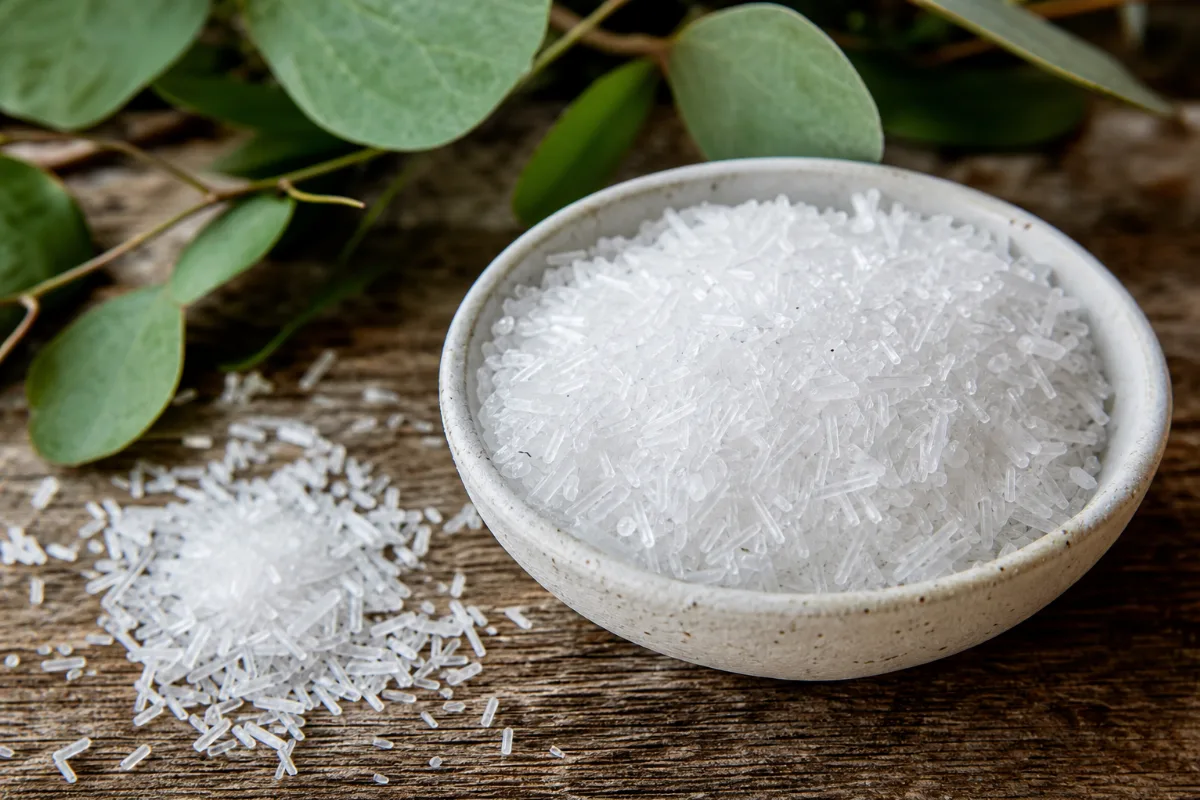
Salts & Minerals · Salt
Epsom Salt
Magnesium sulfate heptahydrate, MgSO4·7H2O (a mineral salt, not a plant) · also called Epsom salts, magnesium sulfate, magnesium sulphate
Epsom salt is magnesium sulfate, a mineral salt that dissolves in water. It is used in baths and sold as a laxative to swallow. Safety first: swallowing it can cause dangerous magnesium overload, and kidney disease and children raise the risk. A 2017 review calls skin-absorption claims unsupported, and the bath trials we found are small.
General information, not medical advice. Last substantive update · Not medically reviewed. A named clinician has not signed off on this page. How this page is made
About Epsom Salt
Epsom salt is magnesium sulfate, a mineral salt used in baths and sold to swallow as a laxative. The serious risks on record come from swallowing it, especially with kidney disease or in children. The bath research is a handful of small trials and lab studies, and a review doubts that skin absorbs the magnesium. This is not a magnesium supplement.
What it is
Epsom salt is magnesium sulfate heptahydrate, a salt of the mineral magnesium with sulfate and water. It is not a plant and not a sea salt, and it is not the same as table salt.
It is not the same as magnesium chloride flakes, magnesium oxide or Dead Sea salt, and results for one do not carry over to the others. The sources we read do not say how it is made or how pure products are.
Traditional and current uses
Magnesium sulfate has a long history as a laxative, and mineral waters rich in it have been used for centuries. Epsom salt baths are described as one of the oldest forms of topical magnesium therapy.
Today a US label sells it as a saline laxative for occasional constipation and as a soaking aid for minor sprains and bruises. Marketing also says the skin takes magnesium in better than the gut does; a 2017 review says that is scientifically unsupported. Tradition is not proof that a bath works or is safe.
What the research shows
Skin absorption: a 2026 pig-skin study using magnesium sulfate found minimal passage through intact skin and several orders of magnitude more through stripped skin. A 2016 human-skin lab study found some passage that depended on concentration and time. Neither measured a bath or levels in a person. A 25-person cream pilot saw no significant overall rise in blood magnesium.
Baths: a 2025 trial of 64 adults with knee osteoarthritis reported less pain after 7 days of baths than with standard care. A 2025 trial of 104 cancer patients reported fewer chemotherapy nerve symptoms with foot baths added to hospital care. Neither compared with a plain warm bath, so heat and rest are not separated from the salt, and we read only the abstracts. We found no trials for sore muscles, sleep or stress.
Laxative: a 2020 review of magnesium sulfate-rich mineral waters says the laxative effect is widely demonstrated. It did not study Epsom salt powder.
At a glance
Traditional uses history, not proof
- Epsom salt baths are named as one of the oldest forms of topical magnesium therapy for skin disease (Chandrasekaran 2016 abstract).
- Magnesium sulfate has a long history as a laxative, and mineral waters rich in it have been used for centuries (Dupont 2020 review).
Studied for research
- Swallowed as a laxative, low (with serious safety cautions)
- Raising magnesium through the skin, very low
- Knee osteoarthritis pain (baths), very low
- Chemotherapy nerve symptoms (foot baths), very low
- Sore muscles, sleep and stress, insufficient
Main compounds
- Magnesium sulfate heptahydrate (MgSO4·7H2O)
Common forms
- Crystals dissolved in a bath or foot soak
- Swallowed as a saline laxative (sold under a Drug Facts label in the US)
Research links: Epsom Salt Ingestion Leading to Severe Hypermagnesemia, 2020 case report (abstract) · Near-fatal hypermagnesemia after Epsom salts, 2024 case report (abstract) · Myth or Reality: Transdermal Magnesium? 2017 review (abstract) · Magnesium through pig skin, 2026 lab study (abstract) · Epsom salt bath for knee osteoarthritis, 2025 trial (abstract) · MedlinePlus: Magnesium in diet · Poison Control · Research Library · Genes & Biomarkers Library
What it is and its history
- Accepted scientific name
- Magnesium sulfate heptahydrate (Epsom salt): a mineral salt, not a plant
- Synonyms
- Epsom salts; Magnesium sulfate; Magnesium sulphate
- Common names
- Epsom salt (English); Epsom salts (English)
- Family or group
- Magnesium sulfate with seven water molecules (heptahydrate): formula H14MgO11S, molecular weight 246.48, PubChem CID 24843. The anhydrous salt is MgO4S, 120.37 (CID 24083).
- Habitat
- The sources read do not say how Epsom salt is mined, made or purified.
- What it looks like
- Sold as granules or crystals that dissolve in water (the US label read says granule).
- Harvest and processing
- Not described in the sources read.
- Look-alikes and adulterants
- Name: Magnesium chloride bath flakes; Note: A different magnesium salt. Results for one should not be assumed for the other.; Name: Magnesium oxide and other magnesium laxatives; Note: Different salts; overload has been reported with them too.; Name: Table salt and other sea salts; Note: Sodium chloride; not related in composition despite the name.
Traditional use and history history, not clinical proof
| Tradition or era | Documented use | Source |
|---|---|---|
| Traditional laxative | Magnesium sulfate has a long history in the treatment of functional constipation, and magnesium sulfate-rich mineral waters have been used for centuries as laxatives. | p32664341 |
| Traditional baths | Epsom salt baths are named as one of the oldest forms of topical magnesium therapy for skin disease. | p27624531 |
| Today | Sold as a saline laxative on US labels and as a soaking aid for minor sprains and bruises; marketed for relaxation and sore muscles, claims a 2017 review calls unsupported for skin absorption. | s-dailymed-label |
Traditional use shows how it was used. It does not show that it works or is safe today.
What is inside, and how it may work
What it contains and how those compounds act in cells and animals. Laboratory and animal mechanisms are not proven effects in people.
Main compounds
| Compound | Family | Where it is concentrated | Activity studied | Level of evidence |
|---|---|---|---|---|
| Magnesium sulfate heptahydrate PubChem 24843 | inorganic salt | US label read: magnesium sulfate USP 100%, magnesium listed per teaspoon on the label. | Dissolves in water to release magnesium and sulfate. Magnesium is an essential mineral; MedlinePlus says true deficiency is rare in people eating a normal diet. 16 14 13 | Identity (database and label) |
Mechanisms, receptors and pathways
| Target or pathway | Gene or receptor | What was found | Level |
|---|---|---|---|
| Laxative effect | None | A 2020 review says the laxative effect of magnesium and sulfate has been widely demonstrated. The abstract gives no mechanism. 7 | Narrative review |
| Passage of magnesium through skin | None | Pig skin: minimal passage through intact skin, several orders of magnitude more through skin with its top layer removed (magnesium sulfate solution). Human skin samples: passage depended on concentration and time and was helped by hair follicles. 4 5 | Laboratory |
| Magnesium status from skin | None | Blood magnesium did not rise significantly overall with a magnesium cream in 25 adults; no bath study measured it. 9 | Human pilot |
Absorption, metabolism and elimination
- Absorption
- Swallowed: a case report suggests laxative kept in the gut may keep being absorbed in people with constipation. Skin: uncertain; a review calls claims unsupported and lab work shows more passes through damaged skin.
- Distribution
- Not studied for baths.
- Elimination
- Kidneys clear extra magnesium (MedlinePlus).
- Bioavailability
- Not established through skin.
Isolated compounds versus whole extracts
Epsom salt (magnesium sulfate), magnesium chloride flakes, magnesium oxide and mixed spa products are different products. Results do not transfer between them.
Nutritional composition
Magnesium is an essential nutrient, but swallowing or bathing in Epsom salt is not a proven way to supply it. MedlinePlus says deficiency is rare with a normal diet.
1 low certainty3 very low certainty2 not enough evidence
What was looked at
The 6 benefits and uses checked for Epsom Salt, each with how strong the evidence is. Tap one to open it.
- Raising magnesium levels through the skinVery low certainty
- Sore muscles and achesNot enough evidence
- Sleep, stress and relaxationNot enough evidence
- Constipation (swallowed as a laxative)Low certainty
- Knee osteoarthritis pain (baths)Very low certainty
- Chemotherapy-related nerve symptoms (foot baths)Very low certainty
Lab markers tracked in the studies
Serum magnesium
What is Epsom Salt good for?
The uses people ask about and how strong the evidence is for each. Swallowing is listed because it is a common use, and it is also where the serious risks lie.
Benefits, one by one
Each card is a research question, not a promise. Tap a goal to filter. Open a card to see the studies, doses and limits.
Raising magnesium levels through the skin
Very low certaintySellers say magnesium from a bath soaks in through the skin and beats pills. A 2017 review calls that claim scientifically unsupported. A small human pilot of a magnesium cream did not show a clear overall rise in blood magnesium. In the lab, very little magnesium sulfate crossed intact pig skin, and much more crossed skin whose top layer had been removed.
4 studiesA cream in the pilot, not a bath; no advice here.
Studies, doses and limits
What the trials found
One 25-person pilot of a magnesium cream (not Epsom salt). No trial of an Epsom salt bath that measured magnesium in blood or urine was found.
Results
Cream: serum magnesium 0.82 to 0.89 mmol/L (p = 0.29 overall; p = 0.02 only in a non-athlete subgroup) versus 0.77 to 0.79 with placebo.
Effect sizes as reported
Cream pilot: 8.54% rise in serum magnesium versus 2.6% with placebo; not significant overall.
Why this rating
No bath study measuring body levels. The one human pilot is tiny, tested a cream, and its overall result was not significant. A review calls the idea unsupported. Lab skin studies differ in emphasis and are not human baths.
Form and dose studied
A cream in the pilot, not a bath; no advice here.
Who was studied
25 adults (cream).
Limits
Pilot, a different product, no long-term data.
Why researchers looked
Magnesium is an essential mineral, and a bath is promoted as a gentle way to supply it.
Traditional use
Epsom salt baths are named as one of the oldest forms of topical magnesium therapy (Chandrasekaran 2016 abstract).
Proposed mechanism Laboratory
The outer skin layer limits how much magnesium crosses. A 2026 pig-skin study using a magnesium sulfate solution found minimal passage through intact skin and far more through skin with the top layer removed. A 2016 human-skin lab study found some passage that depended on concentration and time, helped by hair follicles. Neither measured a bath or levels in a person.
A proposed mechanism does not show that the effect happens in people.
People with kidney disease need to ask their kidney doctor before using any magnesium product (see Safety). Damaged skin let more through in the lab.
Sore muscles and aches
Not enough evidenceAn Epsom salt soak is a popular way to ease tired muscles. We found no trial of an Epsom salt bath for muscle soreness or exercise recovery. The package of one US brand calls it a soaking aid for minor sprains and bruises, which is a label claim, not research. Warmth and rest may feel good on their own.
2 studiesNot applicable.
Studies, doses and limits
Results
No result to report.
Why this rating
No controlled trial of an Epsom salt bath for muscle soreness was found.
Limits
Absence of evidence is not proof it does not work; it means we cannot say.
Why researchers looked
Oral magnesium is studied for muscle function, so people ask whether a soak does the same.
Traditional use
Warm baths for tired muscles are a long-standing home habit; the sources read give no dated history for Epsom salt in them.
Proposed mechanism Pharmacological theory
The idea is that magnesium enters the body through the skin and relaxes muscle. The mechanism is not shown, because passage through skin is itself uncertain.
A proposed mechanism does not show that the effect happens in people.
Long hot soaks may bother people with heart or blood pressure problems; no source read covers this, so ask a doctor.
Sleep, stress and relaxation
Not enough evidenceEpsom salt baths are often sold for relaxation and sleep. We found no trial of an Epsom salt bath for sleep, stress or mood. A warm bath may feel calming by itself, which would not show anything about the magnesium.
1 studiesNot applicable.
Studies, doses and limits
Results
No result to report.
Why this rating
No trial found.
Limits
Our PubMed searches covered Epsom salt bath, magnesium sulfate bath and transdermal magnesium; other search terms may find more.
Why researchers looked
Magnesium takes part in nerve and muscle signalling, so it is a popular relaxation claim.
Traditional use
Not described in the sources read.
Proposed mechanism Pharmacological theory
No mechanism for a bath was found. Skin passage of magnesium is itself uncertain.
A proposed mechanism does not show that the effect happens in people.
See Safety.
Constipation (swallowed as a laxative)
Low certaintyMagnesium sulfate has a long history as a laxative, and US labels list it as a saline laxative for occasional constipation. A 2020 review says the laxative effect of magnesium sulfate is widely demonstrated, but it looked at mineral waters, not Epsom salt powder. We found no trial of Epsom salt powder in our searches. Swallowing it is also where the serious harms on record come from, so read Safety first.
3 studiesNo advice here. Use only as a label directs and ask a clinician or ph…
Studies, doses and limits
What the trials found
A narrative review of trials of magnesium sulfate-rich mineral waters, which the authors say began only in the 21st century. No trial of Epsom salt powder was found.
Results
The reviewers describe efficacy and safety for the mineral waters and suggest they may be a natural treatment. No numbers in the abstract.
Why this rating
The evidence we read is a narrative review of mineral waters, not of Epsom salt powder, with no numbers in the abstract. Fatal and near-fatal overload cases exist for magnesium laxatives and for swallowed Epsom salt.
Form and dose studied
No advice here. Use only as a label directs and ask a clinician or pharmacist first.
Who was studied
Adults with functional constipation (mineral-water trials).
Limits
Different product, undiluted salt not studied here, review without a method in the abstract.
Why researchers looked
It has been used for centuries for constipation.
Traditional use
The 2020 review says magnesium sulfate-rich mineral waters have been used for centuries for their laxative properties.
Proposed mechanism Narrative review
The review says the laxative effect of magnesium and sulfate is well demonstrated; the abstract does not describe how it works.
A proposed mechanism does not show that the effect happens in people.
Do not swallow Epsom salt as a laxative or cleanse without a clinician or pharmacist. Kidney disease, children and older adults are of particular concern. See Safety.
Knee osteoarthritis pain (baths)
Very low certaintyOne small 2025 trial of 64 adults with knee osteoarthritis reported less pain and better daily living after 7 days of Epsom salt baths than with standard care alone. It did not compare with a plain warm bath, so it cannot separate the salt from the warm water and rest.
1 studiesBaths for 7 days in the trial; no advice here.
Studies, doses and limits
What the trials found
One randomised trial, 64 adults (32 per group), 7 days.
Results
Better pain and daily-living scores in the bath group (P < 0.001 on WOMAC, KATZ and NPRS). No size of effect in the abstract.
Why this rating
One small short trial, compared with standard care rather than a plain warm bath, posttest-only, blinding not described, no effect sizes in the abstract.
Form and dose studied
Baths for 7 days in the trial; no advice here.
Who was studied
64 adults with knee osteoarthritis.
Limits
Short follow-up (7 days), no sham or warm-water bath, abstract only, no second trial found.
Why researchers looked
Epsom salt baths are very popular among people with knee pain, as the authors say.
Traditional use
Not described in the sources read.
Proposed mechanism None found
The abstract does not give a mechanism.
A proposed mechanism does not show that the effect happens in people.
Ask a doctor if the skin is broken or you have heart or blood pressure problems.
Chemotherapy-related nerve symptoms (foot baths)
Very low certaintyOne 2025 trial of 104 cancer patients reported fewer nerve symptoms and better quality of life when Epsom salt foot baths were added to standard hospital care. We read only the abstract, it did not use a warm-water comparison, and we found no second trial. People having chemotherapy should ask their cancer care team before trying any soak.
1 studiesNot described in the abstract; no advice here.
Studies, doses and limits
What the trials found
One randomised trial, 104 patients.
Results
Without symptoms at the start, worsening was 42.31% with foot baths versus 96.15% in controls (P < 0.05). With symptoms, the authors report a 54.35% superiority in grade improvement. Quality-of-life scores were better in the bath groups.
Why this rating
Single trial, abstract only, no placebo or warm-water comparison described, funding and blinding not stated, no replication found.
Form and dose studied
Not described in the abstract; no advice here.
Who was studied
104 cancer patients on neurotoxic drugs.
Limits
Hospital-care control only; bath details not in the abstract.
Why researchers looked
Chemotherapy drugs can damage nerves in hands and feet, and doctors look for ways to prevent it.
Traditional use
Not described in the sources read.
Proposed mechanism None found
The abstract does not give a mechanism.
A proposed mechanism does not show that the effect happens in people.
Ask the cancer care team first. No harm data for the baths were described in the abstract.
Connections to the rest of health
How Epsom Salt connects to the rest of our health knowledge graph. Every link says what kind of connection it is. A safety link (for example to the liver) is a warning, not a benefit. A study that merely mentions a topic never creates a benefit link.
Explore every connection: goals, body systems, organs, symptoms, genes
A. Wellness goals
| Connected to | Kind of connection | Evidence status | Context | Studies |
|---|---|---|---|---|
| Muscle Recovery | Not enough evidence | Sore muscles and aches: An Epsom salt soak is a popular way to ease tired muscles. We found no trial of an Epsom salt bath for muscle soreness or exercise recovery. The package of one US brand calls it a soaking aid for minor sprains and bruises, which is a label claim, not research. Warmth and rest may feel good on their own. | 8 14 | |
| Better Sleep | Not enough evidence | Sleep, stress and relaxation: Epsom salt baths are often sold for relaxation and sleep. We found no trial of an Epsom salt bath for sleep, stress or mood. A warm bath may feel calming by itself, which would not show anything about the magnesium. | 8 | |
| Stress Reduction | Not enough evidence | Sleep, stress and relaxation: Epsom salt baths are often sold for relaxation and sleep. We found no trial of an Epsom salt bath for sleep, stress or mood. A warm bath may feel calming by itself, which would not show anything about the magnesium. | 8 | |
| Digestive Support | Traditional use | Low certainty | Constipation (swallowed as a laxative): Magnesium sulfate has a long history as a laxative, and US labels list it as a saline laxative for occasional constipation. A 2020 review says the laxative effect of magnesium sulfate is widely demonstrated, but it looked at mineral waters, not Epsom salt powder. We found no trial of Epsom salt powder in our searches. Swallowing it is also where the serious harms on record come from, so read Safety first. | 7 14 13 |
| Joint Support | Very low certainty | Knee osteoarthritis pain (baths): One small 2025 trial of 64 adults with knee osteoarthritis reported less pain and better daily living after 7 days of Epsom salt baths than with standard care alone. It did not compare with a plain warm bath, so it cannot separate the salt from the warm water and rest. | 10 |
B. Body systems
| Connected to | Kind of connection | Evidence status | Context | Studies |
|---|---|---|---|---|
| Integumentary System | Biological association | Very low certainty | Studied for: Raising magnesium levels through the skin | 8 9 4 5 |
| Muscular System | Biological association | Not enough evidence | Studied for: Sore muscles and aches | 8 14 |
| Nervous System | Biological association | Not enough evidence | Studied for: Sleep, stress and relaxation Studied for: Chemotherapy-related nerve symptoms (foot baths) | 8 1 |
| Digestive System | Biological association | Low certainty | Studied for: Constipation (swallowed as a laxative) | 7 14 13 |
| Musculoskeletal System | Biological association | Very low certainty | Studied for: Knee osteoarthritis pain (baths) | 10 |
E. Health conditions
| Connected to | Kind of connection | Evidence status | Context | Studies |
|---|---|---|---|---|
| Hypermagnesemia (high magnesium) | Adverse effect or risk | Very low certainty | Three severe non-fatal cases after swallowing Epsom salt or an Epsom-containing bath product, and a fatal case with magnesium laxatives. Preparation or compound: Epsom salt swallowed (case reports) |
12 11 6 3 |
I. Biomarkers
| Connected to | Kind of connection | Evidence status | Context | Studies |
|---|---|---|---|---|
| Serum magnesium | Biological association | Very low certainty | Measured in trials: no-clear-change. A lab change is not the same as a health benefit. | 9 |
L. Active compounds
| Connected to | Kind of connection | Evidence status | Context | Studies |
|---|---|---|---|---|
| Magnesium sulfate heptahydrate | Biological association | Identity (database and label) | Dissolves in water to release magnesium and sulfate. Magnesium is an essential mineral; MedlinePlus says true deficiency is rare in people eating a normal diet. | 16 14 13 |
Each connection is stored with the ingredient, the connected record, the kind of connection, the evidence status, the supporting studies, the preparation or compound involved, and a review date (last reviewed October 30, 2026).
Evidence at a glance: what the research found for 6 outcomes
Each outcome below is one thing researchers measured. Certainty is how far the evidence can be trusted, not how well it works. The full studies are on the next tab.
The evidence
The research centre for Epsom Salt. Every record here was checked against PubMed or the publisher's page; we never list a study we have not verified.
Evidence by outcome
Bars show how many studies we found for each outcome, not how well it works. People are added up across trials only (reviews are not added, to avoid double counting).
How we rate evidence
High certainty
Several well-run trials or reviews agree; further research is unlikely to change the picture much.
Moderate certainty
Good trials point the same way, but some doubt remains.
Low certainty
Small, short or inconsistent trials. The finding could change with better research.
Very low certainty
Very little or very weak human data. Treat as a possibility only.
Mixed findings
Trials or reviews disagree with each other.
Not enough evidence
Not enough human research to say either way.
Evidence against
Good research found no benefit, or found harm.
We take the reviewers' own risk-of-bias and GRADE statements where they exist, and otherwise judge from study size, design, consistency, directness and whether a product matches what is sold. Many publications do not make evidence high. Method note: We searched PubMed, read the abstract of each cited paper, and read a US Epsom salt label on DailyMed, MedlinePlus and Poison Control. Certainty ratings are the compiler's own reading. Only one US brand label was read; regulators outside the US and the FDA monograph were not checked. No study is cited that we could not verify.
Study library: every study we checked 16
| Study | Design | People | Product, dose, length | Result |
|---|---|---|---|---|
| Ankar 2025 Assess the Efficacy of Epsom Salt Foot Bath in Preventing or Delaying the Onset of Chemotherapy-induced Neurological Manifestations in Cancer Patients. Journal of Pharmacy and Bioallied Sciences · PMID 40510964 · DOI |
Randomized controlled trial |
104 104 cancer patients on neurotoxic drugs, split into symptom-free and symptomatic groups, each with a bath arm and a control arm |
Epsom salt foot baths added to standardized hospital care Epsom salt (magnesium sulfate) · vs Standardized hospital care alone |
The authors report fewer nerve symptoms and better quality of life in the foot-bath arms. In people without symptoms at the start, worsening was 42.31% with baths versus 96.15% in controls (P < 0.05). In those with symptoms, they report a 54.35% superiority in grade improvement. Methods, limits and fundingOutcomes: Chemotherapy-induced nerve symptoms (NCI-CTCAE grade) and quality of life Limitations: Abstract only; no placebo or warm-water comparison is described, so it cannot separate Epsom salt from a foot soak or extra attention. Blinding, funding and bath details are not in the abstract. We found no second trial. Funding and conflicts: Not stated in the abstract Read: abstract |
| Araki 2021 Hypermagnesemia in a 20-month-old healthy girl caused by the use of a laxative: a case report. Journal of Medical Case Reports · PMID 33750439 · DOI |
Case report |
1 One healthy 20-month-old girl without kidney disease |
Magnesium oxide laxative given for constipation (not Epsom salt) laxative 4 days |
She had vomiting and a reduced level of consciousness, with low muscle tone and weak reflexes. Her magnesium was 11.0 mg/dL after 4 days of magnesium oxide. Calcium and fluids brought it down and she was well at 5 years of follow-up. The authors say a magnesium laxative can cause severe overload in a child even without kidney disease and that symptoms are non-specific. Methods, limits and fundingOutcomes: Magnesium level and recovery Limitations: One case; a different magnesium salt (oxide), given as a medicine. Used here only to show that children can be affected. Funding and conflicts: Not stated in the abstract Read: abstract |
| Bokhari 2018 Fatal Hypermagnesemia Due to Laxative Use. American Journal of the Medical Sciences · PMID 29661354 · DOI |
Case report |
1 One 53-year-old woman admitted with a lung disease flare, with chronic constipation treated regularly with magnesium-containing laxatives |
Magnesium-containing laxatives used regularly (type not named in the abstract) laxatives Regular use |
Her magnesium rose from 2.0 to a peak of 10.8 mg/dL despite fluids and diuresis, with normal kidney function. Kidney replacement therapy was started but she went into shock and died 2 days later. A review of the literature in the paper says severe magnesium overload frequently ends in death even with normal kidney function. The authors say that in constipation, magnesium laxative kept in the gut may keep being absorbed. Methods, limits and fundingOutcomes: Magnesium level and outcome Limitations: One case with a literature review. The abstract does not say which magnesium laxative she used, so it is not proof about Epsom salt itself. Funding and conflicts: Not stated in the abstract Read: abstract |
| Camili 2026 Does magnesium permeate the skin? An ex vivo investigation of magnesium ion delivery through intact and barrier-disrupted skin. European Journal of Pharmaceutics and Biopharmaceutics · PMID 42372834 · DOI |
Laboratory animal-ex-vivo |
Pig skin in a diffusion cell (intact and tape-stripped) | Saturated magnesium sulfate monohydrate solution (Epsom salt type) mineral salt solution Saturated solution 24 hours · vs Control samples |
Little magnesium crossed intact skin, with no significant difference from controls (8.3 ± 3.4 versus 3.9 ± 0.8 micrograms per square cm over 24 hours). With the top skin layer removed by tape-stripping, passage rose to about 13.0 ± 5.3 mg per square cm, several orders of magnitude more, with big differences between samples. The authors conclude delivery from simple water solutions is unlikely under normal skin conditions but may be much higher in damaged skin. Methods, limits and fundingOutcomes: Magnesium passing through skin Limitations: Pig skin in a lab, monohydrate solution, not human and not a bath. Not a safety study. Funding and conflicts: Not stated in the abstract Read: abstract |
| Chandrasekaran 2016 Permeation of topically applied Magnesium ions through human skin is facilitated by hair follicles. Magnesium Research · PMID 27624531 · DOI |
Laboratory human-ex-vivo |
Human skin samples in the lab | Topically applied magnesium solution mineral salt (not a plant) |
The authors say magnesium crosses human stratum corneum in a way that depends on concentration and time of exposure, and that hair follicles make a significant contribution. They also call the transport of magnesium across skin contentious, and note that Epsom salt baths are one of the oldest forms of topical magnesium therapy. Methods, limits and fundingOutcomes: Magnesium passing through human skin and the role of hair follicles Limitations: Abstract gives no amounts. Lab skin samples, not a person in a bath, and no measure of magnesium in the body. Partly differs in emphasis from the 2026 pig-skin study; both are lab work. Funding and conflicts: Not stated in the abstract Read: abstract |
| Chen 2026 Case Report: Severe acute hypermagnesemia following inadvertent bath agent ingestion rapidly resolved by emergent hemodialysis. Frontiers in Toxicology · PMID 42948529 · DOI |
Case report |
1 One previously healthy 54-year-old man with a normal creatinine |
About 100 mL of a spa hot-spring mineral preparation swallowed by mistake (nominally 30% magnesium chloride, 33% magnesium sulfate, 10% potassium sulfate) mixed mineral bath preparation (not pure Epsom salt) Approximately 100 mL (per abstract) Single ingestion |
He arrived stuporous, cold, with low blood pressure and no reflexes. His magnesium was 15.8 mg/dL. Calcium, saline and a diuretic did not help much; emergency hemodialysis brought quick recovery of consciousness and he recovered without lasting problems. The authors say a normal creatinine does not rule out life-threatening magnesium toxicity after a large single exposure. Methods, limits and fundingOutcomes: Magnesium level and recovery Limitations: One case. A mixed spa product that contained magnesium sulfate, not plain Epsom salt. Swallowed by mistake, not a bath. Funding and conflicts: Not stated in the abstract Read: abstract |
| Dupont 2020 Magnesium Sulfate-Rich Natural Mineral Waters in the Treatment of Functional Constipation-A Review. Nutrients · PMID 32664341 · DOI |
Narrative review |
Published clinical data on magnesium sulfate-rich natural mineral waters for functional constipation | Magnesium sulfate-rich natural mineral waters (not Epsom salt powder) mineral water |
The authors say magnesium sulfate has a long history in treating functional constipation, mineral waters rich in it have been used for centuries as laxatives, and the laxative effect of magnesium and sulfate has been widely demonstrated. They also say no clinical studies of the waters in constipation were done before the 21st century. Given the efficacy and safety they report, they suggest the waters may be a natural treatment. Methods, limits and fundingOutcomes: Laxative effect and efficacy in functional constipation Limitations: About mineral waters, not Epsom salt powder. Abstract gives no trial numbers. Authors are reviewing the safety data for the waters, not for undiluted salt. Possible commercial interest is not stated in the abstract. Funding and conflicts: Not stated in the abstract Read: abstract |
| Gröber 2017 Myth or Reality-Transdermal Magnesium? Nutrients · PMID 28788060 · DOI |
Narrative review |
Published literature on magnesium applied to the skin (sprays, flakes, salt baths) | Magnesium applied through the skin (sprays, flakes, salt baths) versus oral magnesium mineral salt (not a plant) |
The authors evaluated the literature and say the promotion of transdermal magnesium is scientifically unsupported. They note that marketing for sprays, flakes and salt baths claims better absorption and fewer side effects than oral use. Methods, limits and fundingOutcomes: Whether magnesium passes through the skin and works better than oral magnesium Limitations: Abstract read only. A narrative review, not a systematic one; the abstract gives no search method or numbers. Funding and conflicts: Not stated in the abstract Read: abstract |
| Kass 2017 Effect of transdermal magnesium cream on serum and urinary magnesium levels in humans: A pilot study. PLoS One · PMID 28403154 · DOI |
Randomized controlled trial |
25 25 adults (mean age 34.3) randomised to magnesium cream or placebo cream |
Magnesium cream (not Epsom salt, not a bath) mineral salt in a cream 56 mg magnesium a day (per abstract) 2 weeks · vs Placebo cream |
Serum magnesium went from 0.82 to 0.89 mmol/L with the cream (p = 0.29) and from 0.77 to 0.79 with placebo. The rise was statistically significant (p = 0.02) only in a subgroup of non-athletes. Urinary magnesium rose slightly with no significance (p = 0.48). The authors call it a pilot and say future studies should test higher amounts for longer. Methods, limits and fundingOutcomes: Serum and 24-hour urine magnesium Limitations: Small single-blind pilot. A cream, not a bath. The overall serum change was not significant. Funding and conflicts: No funding or conflict statement in the abstract. Registration: ISRCTN15136969 Read: abstract |
| Kumar 2025 Exploring the therapeutic potential of epsom salt bath on pain and intensity of knee osteoarthritis: Randomized controlled trial. Journal of Education and Health Promotion · PMID 41334264 · DOI |
Randomized controlled trial |
64 64 adults with knee osteoarthritis, 32 per group, posttest-only design |
Epsom salt baths Epsom salt (magnesium sulfate) 7 days · vs Standard care (no placebo bath) |
The authors report less pain and better daily living in the bath group than in the control group (P < 0.001 on WOMAC, KATZ and NPRS). They conclude Epsom salt reduces pain. Registered with the Clinical Trials Registry-India. Methods, limits and fundingOutcomes: Knee pain (NPRS), WOMAC score, daily-living score (KATZ) on day 7 Limitations: Only 7 days, posttest only (no baseline comparison), comparison with standard care rather than a plain warm bath, so heat and rest are not separated from Epsom salt. Blinding is not described in the abstract. No size of effect is given in the abstract. Funding and conflicts: Not stated in the abstract Registration: Clinical Trials Registry-India (number not in the abstract) Read: abstract |
| Si 2024 Case report: Near-fatal hypermagnesemia resulting from the use of Epsom salts in a patient with normal renal function. Frontiers in Medicine · PMID 39021819 · DOI |
Case report |
1 One 60-year-old woman with an earlier stomach operation and a stable history of nephrotic syndrome |
Epsom salts taken by mouth before an endoscopy mineral salt (not a plant) Single ingestion |
She lost consciousness 30 minutes after taking it. Her magnesium level was 8.71 mmol/L. She needed a breathing tube, calcium and continuous kidney replacement therapy; the level fell to 1.35 mmol/L and she recovered. The authors say few people survive a level above 7 mmol/L, that this can happen with normal kidney function, and that doctors should take care prescribing Epsom salts to people with gut conditions. Methods, limits and fundingOutcomes: Magnesium level and recovery Limitations: One case; swallowed, not a bath. The abstract says normal renal function though she had a nephrotic syndrome history. Funding and conflicts: Not stated in the abstract Read: abstract |
| Walker 2020 Epsom Salt Ingestion Leading to Severe Hypermagnesemia Necessitating Dialysis. Journal of Emergency Medicine · PMID 32389435 · DOI |
Case report |
1 One 56-year-old man in an emergency department |
Epsom salt (magnesium sulfate) swallowed as a laxative mineral salt (not a plant) Single ingestion |
He had weakness, a slow heart rate and low blood pressure, then confusion and breathing failure needing a breathing tube. His magnesium level was above 3.91 mmol/L. It fell quickly with dialysis and he went home in good condition after 3 days. Methods, limits and fundingOutcomes: Magnesium level and organ effects Limitations: One case; swallowed, not a bath. Funding and conflicts: Not stated in the abstract Read: abstract |
| n/a 2025 MedlinePlus: Magnesium in diet (review date 1/21/2025; read 2026-10-30) n/a · Source |
Authoritative guidance n/a |
n/a | n/a |
Says side effects from high magnesium intake are not common except in people with significantly reduced kidney function, and that magnesium excess most often occurs with too much of the mineral in supplement form or with laxatives that contain magnesium. Methods, limits and fundingOutcomes: Safety of high magnesium intake Limitations: About dietary magnesium and swallowed products; not about baths. Read: full-text |
| n/a 2026 DailyMed: Epsom Salt (magnesium sulfate) granule drug label, Whole Foods Market (record dated Oct 09, 2026; read 2026-10-30) n/a · Source |
Authoritative guidance n/a |
n/a | n/a |
The Drug Facts panel names magnesium sulfate as a saline laxative for occasional constipation. It says to ask a doctor before use if you have kidney disease, are on a magnesium-restricted diet, or have stomach pain, nausea or vomiting, and to ask a doctor or pharmacist if you take a prescription drug. It says to stop use and ask a doctor if there is rectal bleeding or no bowel movement after use, or if a laxative is needed for more than 1 week, and to ask a health professional if pregnant or breast-feeding. It says it is not recommended under 6 years, to keep out of reach of children, and to get medical help or call Poison Control (1-800-222-1222) after an overdose. The package also calls it a soaking aid for minor sprains and bruises. Methods, limits and fundingOutcomes: What a US Epsom salt label says it is for and who should ask first Limitations: One brand label read; other brands were not compared. A label is not research and gives no evidence that the soak claim works. Dose figures on the label are not repeated here. Read: full-text |
| n/a 2026 Poison Control (National Capital Poison Center): home page, read 2026-10-30 n/a · Source |
Authoritative guidance n/a |
n/a | n/a |
Says help is free, expert and confidential online and by phone at 1-800-222-1222 (US), and to call 911 if the person collapses, has a seizure, has trouble breathing or cannot be awakened. Methods, limits and fundingOutcomes: What to do after a poisoning Limitations: Service information, not research. US numbers only. Read: full-text |
| n/a 2026 PubChem: Magnesium sulfate heptahydrate (CID 24843) and magnesium sulfate (CID 24083), read 2026-10-30 n/a · Source |
Reference database n/a |
n/a | n/a |
Lists magnesium sulfate heptahydrate as H14MgO11S, molecular weight 246.48 (CID 24843) and magnesium sulfate as MgO4S, 120.37 (CID 24083). Methods, limits and fundingOutcomes: Identity of the compound Limitations: Chemical identity only. Read: database-record |
What we do not know yet
- No trial of an Epsom salt bath that measured magnesium in blood or urine.
- No trial of Epsom salt baths for muscle soreness, sleep or stress.
- No trial of Epsom salt powder as a laxative was found; the laxative review is about mineral waters.
- No data on pregnancy, breastfeeding or older adults, and no interaction studies.
- No tests for impurities in Epsom salt products.
How new research is added
New studies are found by a saved PubMed search and are placed in a review queue. A person reads each one before it changes any evidence rating or safety wording.
Lab markers
What changed in blood or saliva tests during trials. A changed number is not the same as feeling or being healthier, and we give no "normal ranges".
Other 1
Serum magnesium
No-clear-change in trials
The amount of magnesium in a blood sample, measured in millimoles per litre. It is a rough check of magnesium status.
Very low certaintyResults and what it means
Why it was measured
If magnesium passes through the skin from a bath, blood levels should rise.
Statistical vs. clinical meaning
No clear rise in the one pilot, and it did not test a bath.
Safety implication
Swallowed Epsom salt can push this level dangerously high (see Safety). No source read shows baths do.
| Study | Result | People | Product |
|---|---|---|---|
| 9 | Cream: 0.82 to 0.89 mmol/L versus placebo 0.77 to 0.79 (p = 0.29); significant (p = 0.02) only in non-athletes. | 25 adults | Magnesium cream versus placebo cream, 2 weeks |
Safety
What studies and official sources say about side effects, medicines and who should check first. Each point shows what kind of evidence it comes from.
Main points to know 5
- Do not swallow it as a laxative or "cleanse" without a clinician or pharmacist. Case reports describe life-threatening magnesium overload after Epsom salt was swallowed: weakness, a slow heartbeat, low blood pressure, confusion, loss of consciousness and breathing failure that needed a breathing tube and kidney dialysis. One woman lost consciousness 30 minutes after swallowing it. A man with a normal creatinine needed emergency dialysis after a large accidental swallow of a spa mineral product. A fatal case occurred in a woman with normal kidney function who used magnesium laxatives regularly. Case reports show harm can happen, not how often. Case report 12 11 6 3
- Kidney disease raises the risk, but normal kidneys are not a guarantee. MedlinePlus says side effects from high magnesium are not common except in people with significantly reduced kidney function, and that excess most often occurs with supplements or laxatives that contain magnesium. US Epsom salt labels tell people with kidney disease to ask a doctor before use. Three case reports (2018, 2024 and 2026) involved people whose kidney function or creatinine was reported as normal. Authoritative guidance 13 14 11 3 6
- Children and older adults. A US Epsom salt label says it is not recommended for children under 6 and must be kept out of children's reach. A case report describes a healthy 20-month-old who developed severe magnesium overload after a magnesium oxide laxative (a different magnesium salt), with symptoms that are easy to miss. Keep bath and laxative salts where children cannot reach them. We found no source on Epsom salt in older adults, so we make no claim. Case report 14 2
- Magnesium can add up. MedlinePlus says magnesium excess most often follows too much magnesium in supplement form or magnesium-containing laxatives. If you also take other magnesium products, a pharmacist can help you think about the total. A fatal case involved regular use of magnesium laxatives by a woman with chronic constipation; the authors suggest laxative kept in the gut may keep being absorbed. Authoritative guidance 13 3
- Skin absorption: what the evidence says, and broken skin. A 2017 review calls the promotion of transdermal magnesium scientifically unsupported. A 2026 lab study found little magnesium sulfate crossed intact pig skin but far more crossed skin with its top layer removed. That is not a human safety study. It is a reason to avoid soaking cuts, sores or raw skin and to ask a clinician. We found no report of magnesium overload from an ordinary bath. Laboratory 8 4
Side effects 4
| Effect | How often | Severity and recovery | Evidence |
|---|---|---|---|
| Magnesium overload (hypermagnesemia) after swallowing Epsom salt or magnesium laxatives Case reports; they show it can happen, not how often. | Not established | life-threatening Three Epsom-type cases recovered after intensive treatment including dialysis; one laxative case died | Case report 12 11 6 3 |
| Skin irritation or stinging from soaks The two bath trials read did not report rates in their abstracts. | Not established | unknown Not stated | Gap |
| More magnesium passing through broken skin Pig skin, magnesium sulfate solution; a lab signal, not an injury report. | Not established | unknown Not stated | Laboratory 4 |
| Laxative effects: stomach pain, nausea, vomiting The label says to ask a doctor before use if you already have stomach pain, nausea or vomiting, and to stop and ask a doctor if there is rectal bleeding or no bowel movement after use. | Not established | unknown Not stated | Authoritative guidance 14 |
Liver
No report of liver injury from Epsom salt was found in the sources read. LiverTox was not searched.
How often. No rate in people.
Monitoring. No monitoring advice was found.
This is a safety connection. It is not evidence that Epsom Salt supports liver health.
Medicines and supplements 5
| With | Why it matters | Importance | Evidence | What to do |
|---|---|---|---|---|
| Kidney disease or reduced kidney function condition | Kidneys clear extra magnesium; when they work poorly, magnesium can build up. | MedlinePlus names significantly reduced kidney function as the main group at risk from high magnesium intake; the US label says to ask a doctor first if you have kidney disease. | Authoritative guidance Moderate certainty 13 14 | Ask a kidney doctor before swallowing or soaking with any magnesium product. |
| Prescription medicines (any) prescription | Not described by the label. | The US label tells people taking any prescription drug to ask a doctor or pharmacist before use. It names no specific medicines. No interaction study was found. | Authoritative guidance Not enough evidence 14 | Ask a pharmacist before swallowing Epsom salt if you take any prescription medicine. |
| Other magnesium products (supplements, antacids, other laxatives) supplement | Total magnesium intake adds up. | MedlinePlus says excess most often comes from supplements or magnesium laxatives. No study of combinations with Epsom salt was found. | Authoritative guidance Low certainty 13 3 | Tell your pharmacist about every magnesium product you take before swallowing Epsom salt. |
| Skin treatments and prescription skin creams topical | Not described in the sources read. | No study found. | Gap Not enough evidence | Ask a doctor or pharmacist before soaking while using prescription skin products. |
| Medicines that affect heart rhythm or blood pressure prescription | Swallowed magnesium overload slows the heart and lowers blood pressure; whether a bath could add to a medicine's effect was not described in any source read. | No interaction study found. | Gap Not enough evidence 12 | Ask a pharmacist or doctor if you take such medicines. |
Who should check first 7
| Situation | Advice | Evidence |
|---|---|---|
| Kidney disease (swallowing) | Ask your kidney doctor first. The US label says to ask a doctor before use with kidney disease. | Authoritative guidance 13 14 |
| Stomach pain, nausea or vomiting, or a sudden change in bowel habits (swallowing) | The label says to ask a doctor first. These can be signs of a condition that a laxative can make worse; one near-fatal case involved a person with a stomach ulcer and bleeding. | Authoritative guidance 14 11 |
| Children | Not recommended under 6 on a US label. Keep it out of reach so it is not swallowed by mistake, and ask a doctor before giving a laxative of any kind to a child. | Authoritative guidance 14 2 |
| Pregnancy and breastfeeding | The label says to ask a health professional before use. We found no study of Epsom salt in pregnancy or breastfeeding, so we make no further claim. | Authoritative guidance 14 |
| Open wounds, sores or raw skin (soaking) | Avoid soaking. A pig-skin lab study found far more magnesium passes through skin with a damaged top layer. | Laboratory 4 |
| Chemotherapy or cancer treatment (foot baths) | Ask your cancer care team first. One trial reported benefit, but it was one trial and abstract only. | Controlled trial 1 |
| Heart or blood pressure problems (hot baths) | No source read covers this. Ask a doctor, especially if you feel faint in hot water. | Gap |
Overdose, product quality and regulators
Summary. Epsom salt is a mineral salt, not a plant, so there are no toxic plant parts. The main danger is swallowing it, which can cause magnesium overload that can stop breathing and slow the heart. Cases involved a laxative use, a pre-procedure use and an accidental swallow of a bath product.
Animal. Not searched.
Human doses studied. No safety studies of bath use were found. We do not give amounts here.
High dose or long term signals. Case reports of severe overload after a single swallow (two Epsom salt cases and one mixed spa product) and one fatal case with regular magnesium laxative use. Recovery in the three non-fatal cases needed intensive care and dialysis or kidney replacement therapy.
Overdose response. If someone has swallowed Epsom salt and feels unwell, call Poison Control (US 1-800-222-1222) or use the online tool, or your local poison centre. Call 911 or your local emergency number if the person collapses, has a seizure, has trouble breathing or cannot be awakened.
Genotoxicity. Not read.
We found no source describing how Epsom salt is sourced or graded, or what impurities it may hold. Not described is not proof of none.
Heavy metals and other impurities. No test of Epsom salt products was found in the sources read.
Mixed bath products. A 2026 case report involved a spa hot-spring product whose stated recipe mixed magnesium chloride, magnesium sulfate and potassium sulfate. It was swallowed by mistake. Products sold for baths can hold more than one salt, so a label should be read. 6
| Body | Action | Date |
|---|---|---|
| US labels (DailyMed, National Library of Medicine) (United States) | A US Epsom salt label read (Whole Foods Market brand) carries a Drug Facts panel naming magnesium sulfate as a saline laxative for occasional constipation, lists kidney disease, stomach pain, nausea or vomiting, prescription drugs, pregnancy and breastfeeding, and children under 6 in its warnings, and calls the product a soaking aid for minor sprains and bruises. source | 2026-10-09 |
| Poison Control (US) (United States) | Service for poisoning help: 1-800-222-1222 and an online tool; call 911 for collapse, seizure, trouble breathing or inability to wake. source | 2026-10-30 |
When to get medical help
- Collapse, a seizure, trouble breathing or being impossible to wake after swallowing Epsom salt: call 911 or your local emergency number.
- Swallowed Epsom salt and feel weak, faint, very sleepy, confused, or have a slow pulse, or a child has swallowed any bath salts: call Poison Control (US 1-800-222-1222) or your local poison centre now.
- Rectal bleeding, severe stomach pain, vomiting, or no bowel movement after taking it as a laxative: stop and contact a clinician.
- Spreading redness, blistering, pus or worsening pain where a soak touched the skin: stop and contact a clinician.
Stop using the product and contact a clinician or emergency service. In the US, Poison Control is 1-800-222-1222.
General information only, not medical advice. Ask a clinician or pharmacist before use, especially with medicines, in pregnancy or with a health condition. See the Natural Remedy Safety guide.
Frequently asked questions
What is Epsom salt?
Is it safe to swallow Epsom salt for constipation?
Who is most at risk from too much magnesium?
What if someone swallowed Epsom salt or a bath product by mistake?
Does Epsom salt give you magnesium through your skin?
Does an Epsom salt bath help sore muscles, sleep or stress?
We found no trial that tested it. A warm bath may feel relaxing by itself, which would not show anything about the magnesium.
Do Epsom salt baths help knee osteoarthritis?
One 2025 trial of 64 adults reported less pain after 7 days of baths than with standard care. It did not use a warm-water comparison and we read only the abstract, so the certainty is very low.
Can Epsom salt foot baths help with chemotherapy nerve symptoms?
One 2025 trial of 104 cancer patients reported benefit when foot baths were added to hospital care. It was one trial, abstract only. Ask your cancer care team before trying any soak.
Is it safe for children?
Is it safe in pregnancy or while breastfeeding?
The US label says to ask a health professional before use. We found no study of Epsom salt in pregnancy or breastfeeding, so we make no further claim.
Is it safe to soak with broken skin?
It is wise to avoid it. In a pig-skin lab study, far more magnesium passed through skin with its top layer removed. Ask a clinician if you have cuts, sores or an active skin flare.
Explore by health goal
Muscle RecoveryBetter SleepStress ReductionDigestive SupportJoint Support
Editorial transparency
- Written by
- AlternativeMed editorial team. Research compiled with AI assistance, then checked against PubMed records.
- Medical review
- None. This page has not been reviewed by a physician or pharmacist.
- First published
- 2026-10-30
- Last substantive update
- 2026-10-30
- How we research
- We searched PubMed, read the abstract of each cited paper, and read a US Epsom salt label on DailyMed, MedlinePlus and Poison Control. Certainty ratings are the compiler's own reading. Only one US brand label was read; regulators outside the US and the FDA monograph were not checked. No study is cited that we could not verify.
- How we rate evidence
- See "How we rate evidence" in the Evidence tab.
- Independence
- No product is promoted on this page. No affiliate links are shown.
Sources 16
Each source was opened and checked. Where we read only the abstract, it says so. The small numbers in the text point here.
- Ankar R, Singh S, Wanjari M, Ankar S, Umate L. Assess the Efficacy of Epsom Salt Foot Bath in Preventing or Delaying the Onset of Chemotherapy-induced Neurological Manifestations in Cancer Patients.. Journal of Pharmacy and Bioallied Sciences. 2025. PMID 40510964. DOI 10.4103/jpbs.jpbs_1732_24. (abstract)
- Araki K, Kawashima Y, Magota M, Shishida N. Hypermagnesemia in a 20-month-old healthy girl caused by the use of a laxative: a case report.. Journal of Medical Case Reports. 2021. PMID 33750439. DOI 10.1186/s13256-021-02686-9. (abstract)
- Bokhari SR, Siriki R, Teran FJ, Batuman V. Fatal Hypermagnesemia Due to Laxative Use.. American Journal of the Medical Sciences. 2018. PMID 29661354. DOI 10.1016/j.amjms.2017.08.013. (abstract)
- Camili V, Stürup S, Heinz A. Does magnesium permeate the skin? An ex vivo investigation of magnesium ion delivery through intact and barrier-disrupted skin.. European Journal of Pharmaceutics and Biopharmaceutics. 2026. PMID 42372834. DOI 10.1016/j.ejpb.2026.115173. (abstract)
- Chandrasekaran NC, Sanchez WY, Mohammed YH, Grice JE, Roberts MS, Barnard RT. Permeation of topically applied Magnesium ions through human skin is facilitated by hair follicles.. Magnesium Research. 2016. PMID 27624531. DOI 10.1684/mrh.2016.0402. (abstract)
- Chen CC, Chen JN, Yang TH, Lin SH. Case Report: Severe acute hypermagnesemia following inadvertent bath agent ingestion rapidly resolved by emergent hemodialysis.. Frontiers in Toxicology. 2026. PMID 42948529. DOI 10.3389/ftox.2026.1961156. (abstract)
- Dupont C, Hébert G. Magnesium Sulfate-Rich Natural Mineral Waters in the Treatment of Functional Constipation-A Review.. Nutrients. 2020. PMID 32664341. DOI 10.3390/nu12072052. (abstract)
- Gröber U, Werner T, Vormann J, Kisters K. Myth or Reality-Transdermal Magnesium?. Nutrients. 2017. PMID 28788060. DOI 10.3390/nu9080813. (abstract)
- Kass L, Rosanoff A, Tanner A, Sullivan K, McAuley W, Plesset M. Effect of transdermal magnesium cream on serum and urinary magnesium levels in humans: A pilot study.. PLoS One. 2017. PMID 28403154. DOI 10.1371/journal.pone.0174817. (abstract)
- Kumar V, Shyoran R, Pareek B, Pathania R, Ranaut R, Ravi RK. Exploring the therapeutic potential of epsom salt bath on pain and intensity of knee osteoarthritis: Randomized controlled trial.. Journal of Education and Health Promotion. 2025. PMID 41334264. DOI 10.4103/jehp.jehp_2165_24. (abstract)
- Si GF, Ge YX, Lv XP, Li YQ, Chen XM, Yuan XM. Case report: Near-fatal hypermagnesemia resulting from the use of Epsom salts in a patient with normal renal function.. Frontiers in Medicine. 2024. PMID 39021819. DOI 10.3389/fmed.2024.1416956. (abstract)
- Walker P, Parnell S, Dillon RC. Epsom Salt Ingestion Leading to Severe Hypermagnesemia Necessitating Dialysis.. Journal of Emergency Medicine. 2020. PMID 32389435. DOI 10.1016/j.jemermed.2020.04.023. (abstract)
- n/a. MedlinePlus: Magnesium in diet (review date 1/21/2025; read 2026-10-30). n/a. 2025. (full-text)
- n/a. DailyMed: Epsom Salt (magnesium sulfate) granule drug label, Whole Foods Market (record dated Oct 09, 2026; read 2026-10-30). n/a. 2026. (full-text)
- n/a. Poison Control (National Capital Poison Center): home page, read 2026-10-30. n/a. 2026. (full-text)
- n/a. PubChem: Magnesium sulfate heptahydrate (CID 24843) and magnesium sulfate (CID 24083), read 2026-10-30. n/a. 2026. (database-record)
Where to buy
Check the label first. Whatever you buy, look for these:
- Whether it is iodized if you rely on salt for iodine
- The origin and purity statement
- Food grade versus bath or cosmetic grade
- Sodium amount, which matters for blood pressure
Talk to a pharmacist or doctor before you start any supplement, especially if you take medicines. See the Safety tab for interactions.
Support our free guides: as an Amazon Associate we earn from qualifying purchases. Full disclosure.


