Nuts & Seeds · Seed
Safflower Seeds
Carthamus tinctorius · also called Safflower kernels, false saffron (the plant), semillas de cartamo (Spanish)
Safflower seeds come from a daisy-family plant that is grown mainly for its oil. Whole seeds are sold mostly as bird and pet food, so the kernel is a little-eaten food for people. The dried kernels supply copper, manganese, magnesium and thiamin, but we found no human trial of eating them. Most health research is on safflower oil, which is a different product. The main cautions are allergy, choking in young children and whether bird-food seed is made for people.
General information, not medical advice. Last substantive update · Not medically reviewed. A named clinician has not signed off on this page. How this page is made
About Safflower Seeds
Safflower seeds are mainly an oil crop. The kernels contain several minerals and thiamin, but they are rarely eaten as food and have not been tested in people. Most health research is on safflower oil, and it does not tell us about the seeds.
What it is
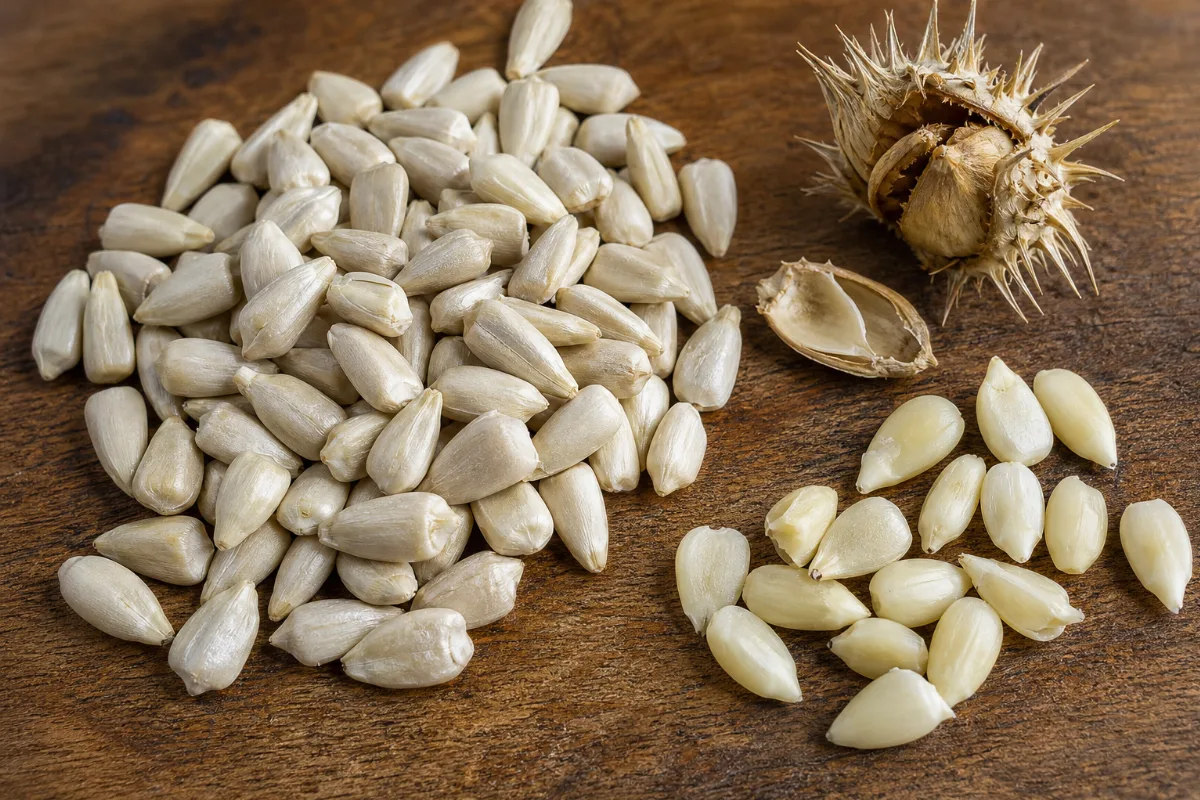
Safflower seeds (Carthamus tinctorius) come from a plant in the daisy family. Each seed is a small fruit, an achene, with a thick fibrous hull around the kernel. The hull makes up about a third to six-tenths of the weight. Whole seeds are mainly used as bird and pet food, and the plant is mainly grown for oil. It was first grown for its flowers, which gave red and yellow dyes.
USDA data for dried kernels: 517 kcal per 100 g. One ounce (28.35 g, our arithmetic) has about 147 kcal, 4.6 g protein, 10.9 g fat (mostly polyunsaturated), 100 mg magnesium, 0.50 mg copper, 0.57 mg manganese, 0.33 mg thiamin, 1.4 mg zinc and 1.4 mg iron. USDA lists no value for fibre, vitamin E or selenium, which means no number, not zero. Values are for the kernel without its hull.
What the research shows
The firmest fact is about content: the dried kernels are a source of copper, manganese, magnesium and thiamin. That is not a trial of the seeds.
Research on safflower is mostly about oil and omega-6 fats. A Cochrane review of 19 trials found omega-6 fats lowered total cholesterol a little but made little or no difference to deaths or heart events. A review of 54 trials ranked safflower oil highest for lowering LDL and total cholesterol, and oils like it lowered LDL more than butter did. One small trial found that safflower oil lowered waist size, blood pressure and blood sugar in people with metabolic syndrome.
We found no study of people eating safflower seeds or kernels.
Seeds, oil and flower are different
Safflower oil is pressed from the seeds and comes in a high-linoleic type (about 70 to 80% linoleic acid, an omega-6 fat) and a high-oleic type (about 80% oleic acid). The flower is a separate product used in Chinese medicine and teas, with its own cautions. Results for the oil or the flower do not carry over to eating the kernels. Safflower is also not saffron, which comes from a different plant.
Amounts
This page gives no amounts to eat. The Nutrition Facts label on a food-grade pack shows a serving. Ask a doctor, pharmacist or dietitian what is right for you, especially if you have an allergy, take a blood thinner or are pregnant.
At a glance
Traditional uses history, not proof
- The plant was first grown for its flowers, used to make red and yellow dyes, and today is grown mainly for oil
- Whole seeds are used mostly as bird and pet food
- Long use for dye, oil or feed is not proof that the kernels are good for any condition
Studied for research
- Copper, manganese, magnesium and thiamin in the kernels, high certainty for the content, no seed trial
- Total cholesterol (omega-6 fats and oils), insufficient for the seeds
- LDL cholesterol when safflower oil replaces butter, low certainty, oil not seeds
- Heart events and deaths (omega-6 fats, safflower oil and margarine), mixed
- Waist, blood pressure and blood sugar in metabolic syndrome (safflower oil), very low certainty
- Body weight (omega-6 fats), insufficient for the seeds
- Eating the kernels for any health goal, insufficient: no trial found
Main compounds
- Polyunsaturated fat (linoleic acid in linoleic types)
- Copper
- Manganese
- Magnesium
- Thiamin (vitamin B1)
- Phosphorus
- Zinc
Common forms
- Dried hulled kernels (the item USDA describes)
- Whole seed with its hull (sold mostly as bird and pet food)
- Safflower oil (a different product, pressed from the seeds)
- Safflower meal (the leftover after oil pressing, mostly animal feed)
- Safflower flower (a different plant part, used in Chinese medicine)
Research links: Omega-6 fats for the primary and secondary prevention of cardiovascular disease (Cochrane review, 2018) · Sydney Diet Heart Study: safflower oil and margarine (BMJ, 2013) · Safflower oil in metabolic syndrome: randomised trial (2022) · American Academy of Pediatrics: Choking Prevention · Research Library · Genes & Biomarkers Library
What it is and its history
- Accepted scientific name
- Carthamus tinctorius
- Naming authority
- L. (GBIF accepted)
- Common names
- Safflower seed (English); Safflower kernel (English); False saffron (the plant, not true saffron) (English); Semillas de cartamo (Spanish); Semillas de alazor (Spanish)
- Family or group
- Asteraceae (the daisy family), as given by GBIF and Feedipedia.
- Classification
- Plantae > Tracheophyta > Magnoliopsida > Asterales > Asteraceae > Carthamus > Carthamus tinctorius
- Native range
- Not verified from a source read.
- Habitat
- Not verified from a source read.
- What it looks like
- Roots: Not verified.; Stems: Not verified.; Leaves: Not verified.; Flowers: Not verified.; Fruit: Feedipedia: the seeds are achenes (fruits) surrounded by a thick fibrous hull. They are smooth, shiny and angular, about 6 to 9 mm long, white or brownish and white with grey, brown or black stripes. They contain 33 to 60% hull and 40 to 67% kernel.
- Cultivation
- Not verified beyond Feedipedia's statement that safflower is mainly grown for oil and is a minor crop.
- Harvest and processing
- Whole seeds are sold mostly as pet and bird food (Feedipedia). Seeds are pressed for oil, and the leftover meal is used in animal feed and studied as a protein ingredient. Hulled kernels are the item USDA lists. Roasting, sprouting and seed-butter products: no source read.
- Look-alikes and adulterants
- Name: True saffron (Crocus sativus); Note: A different plant, grown for its spice. Safflower is sometimes called false saffron.; Name: Sunflower seeds; Note: Another daisy-family seed with different nutrients and a documented allergy record. This page covers safflower kernels only.
- Sustainability and conservation
- Not assessed.
Photographs
Traditional use and history history, not clinical proof
| Tradition or era | Documented use | Source |
|---|---|---|
| Dye plant, now oil crop | Safflower was originally grown for its flowers, which were used to make red and yellow dyes for clothing and food preparation. Today it is mainly grown for its oil. No source read describes the seed kernels as a traditional food. | s-feedipedia-safflower |
Traditional use shows how it was used. It does not show that it works or is safe today.
What is inside, and how it may work
What it contains and how those compounds act in cells and animals. Laboratory and animal mechanisms are not proven effects in people.
Main compounds
| Compound | Family | Where it is concentrated | Activity studied | Level of evidence |
|---|---|---|---|---|
| Linoleic acid (omega-6 fat) PubChem 5280450 | fatty acid | Seed oil (linoleic varieties) Feedipedia: oil of linoleic varieties holds about 70 to 80% linoleic acid. USDA lists 28.2 g of polyunsaturated fat per 100 g of kernels but no breakdown. | The Cochrane review of omega-6 fats found a small total cholesterol drop and no clear change in deaths or heart events. This is about omega-6 fats in general, not safflower seeds. 10 13 2 12 | Human data |
| Oleic acid (omega-9 fat) PubChem 445639 | fatty acid | Seed oil (oleic varieties) Feedipedia: oil of oleic varieties holds about 80% oleic acid. USDA lists 4.8 g of monounsaturated fat per 100 g of kernels, which suggests the USDA kernels are of a high-linoleic type (our inference, not a source statement). | No human study of oleic-type safflower seeds was read. 10 13 12 | Content only |
| Matairesinol-beta-glucoside and 2-hydroxyarctiin-beta-glucoside | phenolic glucosides (lignans) | Seed meal (protein fraction after oil pressing) | Feedipedia describes one as bitter and the other as purgative (laxative-type) and says processing can remove them. A 2026 review names them as antinutritional compounds lowered by alkali extraction. Not measured in kernels as food. 10 1 | Content only |
Mechanisms, receptors and pathways
| Target or pathway | Gene or receptor | What was found | Level |
|---|---|---|---|
| Omega-6 fat and blood cholesterol | Not specified | Reviewers found that more omega-6 fat lowered total cholesterol a little. The abstract does not state a mechanism, and this was not tested in safflower seeds. 2 | Human data |
Absorption, metabolism and elimination
- Absorption
- Not found for safflower seed nutrients.
- Distribution
- Not found.
- Metabolism
- Not found.
- Elimination
- Not found.
- Bioavailability
- Not established.
Isolated compounds versus whole extracts
The oil trials (a Sydney diet trial with oil and margarine, a metabolic syndrome trial of 8 g oil a day, and a 54-trial oil comparison) and the Cochrane omega-6 review do not carry over to eating the kernel, which also supplies protein and minerals. The flower and its extracts are a separate product again.
Nutritional composition
Nutrition from USDA FoodData Central (Seeds, safflower seed kernels, dried, FDC 170558, SR Legacy April 2018; values read from the USDA data feed on 2026-10-23 and held in our project data file, checked against that stored copy on 2026-10-26, not re-downloaded today). Per 100 g of dried kernels: 517 kcal, 16.2 g protein, 38.5 g fat (3.7 g saturated, 4.8 g monounsaturated, 28.2 g polyunsaturated), 34.3 g carbohydrate, about 5.6 g water, 3 mg sodium, 687 mg potassium, 78 mg calcium, 4.9 mg iron, 353 mg magnesium, 644 mg phosphorus, 5.05 mg zinc, 2.01 mg manganese, 1.75 mg copper, 1.16 mg thiamin (B1), 0.42 mg riboflavin (B2), 2.28 mg niacin (B3), 1.17 mg vitamin B6, 160 micrograms folate (DFE) and 3 micrograms vitamin A (RAE). One ounce (28.35 g, USDA's household portion; per-ounce figures are our arithmetic): about 147 kcal, 4.6 g protein, 10.9 g fat, 9.7 g carbohydrate, 195 mg potassium, 100 mg magnesium, 183 mg phosphorus, 0.50 mg copper (55% of the FDA Daily Value), 0.57 mg manganese (25%), 0.33 mg thiamin (27%), 1.4 mg zinc (13%), 45 micrograms folate (11%) and 1.4 mg iron (8%). USDA lists no value for fibre, vitamin E, selenium, vitamin K or omega-3 in this item, which means no number, not zero. Values are for the kernel, not the whole seed with its hull, and vary with variety, growing place and storage. No amount to eat is suggested.
1 high certainty1 mixed findings1 low certainty1 very low certainty3 not enough evidence
What was looked at
The 7 benefits and uses checked for Safflower Seeds, each with how strong the evidence is. Tap one to open it.
- Copper, manganese, magnesium and thiamin in the kernelsHigh certainty
- Total cholesterol (omega-6 fats, mainly from oils)Not enough evidence
- LDL cholesterol when safflower oil replaces butterLow certainty
- Heart events and deaths (omega-6 fats and safflower oil)Mixed findings
- Waist, blood pressure and blood sugar in metabolic syndrome (safflower oil)Very low certainty
- Body weight (omega-6 fats)Not enough evidence
- Eating safflower kernels for any health goalNot enough evidence
Lab markers tracked in the studies
Total cholesterolLDL cholesterolHeart events and deathsWaist circumferenceBlood pressureFasting blood sugar
What is Safflower Seeds good for?
The main studied uses and how strong the human evidence is for each. No study tested people eating safflower seeds. Everything below except the nutrient content is about safflower oil or omega-6 fats.
Benefits, one by one
Each card is a research question, not a promise. Tap a goal to filter. Open a card to see the studies, doses and limits.
Copper, manganese, magnesium and thiamin in the kernels
High certaintyDried safflower kernels supply copper, manganese, magnesium and thiamin (vitamin B1) in notable amounts. One ounce gives about 55%, 25%, 24% and 27% of the FDA Daily Values. This is a food-content fact, not a trial of safflower seeds.
3 studiesDried kernels. The whole seed has a thick fibrous hull (33 to 60% of …
Studies, doses and limits
What the trials found
USDA FoodData Central lists these amounts per 100 g of dried kernels: copper 1.75 mg, manganese 2.01 mg, magnesium 353 mg, thiamin 1.16 mg, phosphorus 644 mg, zinc 5.05 mg and iron 4.9 mg. The Daily Values are copper 0.9 mg, manganese 2.3 mg, magnesium 420 mg, thiamin 1.2 mg (FDA). USDA lists no value for fibre, vitamin E or selenium, which means no number, not zero.
Results
The kernels are a good source of several minerals and thiamin on paper. No trial of eating safflower kernels was found, so no health effect of these nutrients from this food is shown.
Effect sizes as reported
Per ounce (28.35 g, our arithmetic from USDA): copper 0.50 mg (55% of the Daily Value), manganese 0.57 mg (25%), magnesium 100 mg (24%), thiamin 0.33 mg (27%), phosphorus 183 mg (15%), zinc 1.4 mg (13%), iron 1.4 mg (8%), folate 45 micrograms DFE (11%).
Why this rating
High for the nutrient content (USDA data, FDA Daily Values). This says nothing about disease. Values are for the dried kernel only and vary with variety, growing place and storage.
Form and dose studied
Dried kernels. The whole seed has a thick fibrous hull (33 to 60% of its weight) that USDA's kernel values do not include.
Who was studied
General adult diet.
Limits
A food containing a nutrient does not show that it treats a shortage or prevents disease. The values come from a single USDA entry that we checked against our stored copy, not re-downloaded today.
Why researchers looked
People ask what is in a seed that is better known as a source of oil.
Traditional use
Whole safflower seeds are sold mostly as bird and pet food. The plant was first grown for its flowers (dyes), and today mainly for its oil. Little is known about people eating the kernels as a traditional food.
Proposed mechanism Authoritative guidance
Copper, manganese, magnesium and thiamin are essential nutrients. The USDA table lists them in the dried kernel.
A proposed mechanism does not show that the effect happens in people.
See the Safety tab: allergy, children and choking, and which safflower products these facts do not cover.
Total cholesterol (omega-6 fats, mainly from oils)
Not enough evidenceA large Cochrane review found that eating more omega-6 fats lowered total cholesterol a little. Safflower seeds are mostly polyunsaturated fat, but the trials tested oils, spreads and supplements, not safflower kernels.
2 studiesOmega-6 fats from oils, spreads and supplements (linoleic acid, gamma…
Studies, doses and limits
What the trials found
The Cochrane review of 19 randomised trials (6,461 adults followed one to eight years) found that raising omega-6 fats reduced total serum cholesterol a little (mean difference -0.33 mmol/L, 95% CI -0.50 to -0.16, high-quality evidence, but results varied a lot between trials). The omega-6 fats usually replaced saturated or monounsaturated fats. LDL showed no clear change (low-quality evidence).
Results
Omega-6 fats lowered total cholesterol, not clearly LDL. These were fats and oils, not safflower seeds.
Effect sizes as reported
Total cholesterol MD -0.33 mmol/L (95% CI -0.50 to -0.16; 10 trials, 4,280 people; I2 81%). LDL MD -0.04 mmol/L (95% CI -0.21 to 0.14; 2 trials, 244 people).
Why this rating
The reviewers graded the omega-6 cholesterol result as high quality, but that is for omega-6 fats in general. No trial tested safflower kernels, so for eating the seeds the evidence is insufficient.
Form and dose studied
Omega-6 fats from oils, spreads and supplements (linoleic acid, gamma-linolenic acid). Not seeds.
Who was studied
Adults with or without heart disease.
Limits
Not a trial of safflower seeds. High variability between trials. Only three of the 19 trials had low risk of bias. The World Health Organization funded part of the review team's work.
Why researchers looked
Safflower is grown mainly for an oil that is rich in either linoleic acid (an omega-6 fat) or oleic acid, and omega-6 fats have been tested for heart health for decades.
Proposed mechanism Human mechanistic
The seed fat is mostly polyunsaturated (28.2 g of 38.45 g fat per 100 g, USDA). The Cochrane review looked at omega-6 fats replacing other fats. How this lowers cholesterol is not explained in the abstract.
A proposed mechanism does not show that the effect happens in people.
One older trial of safflower oil and margarine in men found more deaths (see the next result).
LDL cholesterol when safflower oil replaces butter
Low certaintyIn a review of 54 trials that compared cooking oils and fats, safflower oil ranked best for lowering LDL and total cholesterol, and oils like it lowered LDL more than butter did. This is about the oil, not the seeds.
1 studiesSafflower oil compared with other oils and fats. Not kernels or whole…
Studies, doses and limits
What the trials found
A network meta-analysis of 54 randomised trials (3 weeks or longer) ranked safflower oil first for lowering LDL (82% on the SUCRA ranking score) and total cholesterol (90%). Safflower and several other oils lowered LDL by about 0.23 to 0.42 mmol/L more than butter did. The abstract does not give a figure for safflower oil alone.
Results
Replacing butter with an unsaturated oil such as safflower oil lowers LDL. Safflower oil ranked at the top, but a ranking score is not the size of the benefit.
Effect sizes as reported
LDL 0.23 to 0.42 mmol/L lower than with butter across the oils named (not given for safflower oil alone). SUCRA for safflower oil: LDL 82%, total cholesterol 90%.
Why this rating
Our rating. The abstract gives no certainty grade, mentions limitations in the data, and covers oils, not seeds.
Form and dose studied
Safflower oil compared with other oils and fats. Not kernels or whole seeds.
Who was studied
Adults in randomised trials.
Limits
Oils, not seeds. A single abstract was read. No safflower-seed trial was found.
Why researchers looked
People compare oils for heart health, and safflower oil is rich in unsaturated fat.
Proposed mechanism Human mechanistic
The abstract says its findings fit advice to replace high saturated-fat foods with unsaturated oils. It does not explain a mechanism.
A proposed mechanism does not show that the effect happens in people.
None specific to this result.
Heart events and deaths (omega-6 fats and safflower oil)
Mixed findingsResults are mixed and do not support a heart benefit. The Cochrane review found little or no change in deaths or heart events from more omega-6 fat. One older trial that used safflower oil and safflower margarine in men with heart disease was followed by more deaths.
2 studiesSafflower oil and margarine (Sydney trial); omega-6 fats in general (…
Studies, doses and limits
What the trials found
Cochrane: more omega-6 fat made little or no difference to all-cause death (RR 1.00, 95% CI 0.88 to 1.12) or cardiovascular events (RR 0.97, 95% CI 0.81 to 1.15), both low-quality evidence; a possible lower heart attack risk was borderline (RR 0.88, 95% CI 0.76 to 1.02, low quality). Sydney Diet Heart Study (458 men aged 30-59 with a recent coronary event, 1966-73): the group given safflower oil and safflower oil margarine had higher all-cause death (17.6% vs 11.8%; HR 1.62, 95% CI 1.00 to 2.64). In an updated pooled analysis, the trends toward more coronary heart disease and cardiovascular deaths were not statistically significant.
Results
No clear benefit, and one older trial pointed the other way. The diets were oil and margarine, not safflower seeds.
Effect sizes as reported
Cochrane: all-cause death RR 1.00; cardiovascular events RR 0.97; heart attack RR 0.88. Sydney: all-cause death HR 1.62 (1.00 to 2.64); updated meta-analysis coronary heart disease death HR 1.33 (0.99 to 1.79).
Why this rating
The Cochrane evidence is low quality and shows no clear effect. The Sydney trial is a single old trial in men, at the edge of statistical significance, using oil and margarine. Neither tested safflower seeds.
Form and dose studied
Safflower oil and margarine (Sydney trial); omega-6 fats in general (Cochrane). Not seeds.
Who was studied
Men with recent heart disease (Sydney); adults with or without heart disease (Cochrane).
Limits
Not a test of the seeds. The Sydney data were recovered and re-analysed decades later. The Cochrane abstract does not say who funded each included trial.
Why researchers looked
Replacing saturated fat with polyunsaturated fat is standard dietary advice, so trials tested whether it prevents heart events.
Proposed mechanism Human mechanistic
The Sydney Diet Heart Study authors say the clinical benefit of omega-6 linoleic acid has not been established. The abstract does not give a mechanism.
A proposed mechanism does not show that the effect happens in people.
See the Safety tab for how to read this evidence.
Waist, blood pressure and blood sugar in metabolic syndrome (safflower oil)
Very low certaintyOne small trial in people with metabolic syndrome found that 8 g a day of safflower oil for 12 weeks lowered waist size, blood pressure, fasting blood sugar and insulin resistance compared with placebo. It was an oil, not seeds, and a single trial.
1 studiesSafflower oil. Not kernels or whole seeds.
Studies, doses and limits
What the trials found
A randomised, double-blind, placebo-controlled trial of 67 patients with metabolic syndrome gave a divided 8 g of safflower oil a day or placebo for 12 weeks; everyone was told to keep their usual diet and activity. Compared with placebo, the oil group had larger falls in waist circumference (-2.42 vs +0.97, P<0.001), systolic blood pressure (-8.80 vs -2.26, P=0.021), diastolic blood pressure (-3.53 vs -0.70, P=0.041), fasting blood sugar (-5.03 vs +2.94, P=0.003) and insulin resistance (-0.59 vs +0.50, P=0.012), and a rise in adiponectin (P=0.042). Blood lipids, leptin and creatinine did not differ.
Results
Small improvements in several measures, with no change in blood lipids. One trial, oil only.
Effect sizes as reported
Oil vs placebo change: waist -2.42 vs +0.97; systolic blood pressure -8.80 vs -2.26; diastolic -3.53 vs -0.70; fasting blood sugar -5.03 vs +2.94; insulin resistance -0.59 vs +0.50 (units not stated in the abstract; confidence intervals not given).
Why this rating
A single small trial (67 people, 12 weeks) of the oil, from one region, with many outcomes tested, no funding statement in the abstract and no repeat found. It says nothing about seeds.
Form and dose studied
Safflower oil. Not kernels or whole seeds.
Who was studied
Adults with metabolic syndrome.
Limits
Small, single trial, units and confidence intervals not in the abstract. Oil is not the seed.
Why researchers looked
Safflower has long been used in Persian and East Asian traditional medicine for metabolic problems, according to the trial's authors.
Traditional use
The trial authors say safflower has been widely recommended for metabolic disorders in traditional herbal medicine in Persia, China, Korea and Japan. Long use is not proof of benefit.
Proposed mechanism Human mechanistic
The abstract does not test a mechanism. It reports a rise in adiponectin, a hormone made by fat tissue, in the oil group.
A proposed mechanism does not show that the effect happens in people.
The abstract does not report side effects. See the Safety tab.
Body weight (omega-6 fats)
Not enough evidenceThe Cochrane review found that more omega-6 fat probably made little or no difference to body mass index. Safflower seeds are energy-dense (about 147 kcal an ounce), and no trial tested them for weight.
2 studiesOmega-6 fats, not seeds.
Studies, doses and limits
What the trials found
In the Cochrane review, increasing omega-6 fats probably made little or no difference to BMI (mean difference -0.20 kg/m2, 95% CI -0.56 to 0.16), from one trial of 371 people (moderate-quality evidence). USDA lists 517 kcal per 100 g of dried kernels, about 147 kcal per ounce (our arithmetic).
Results
No effect on BMI for omega-6 fats in one trial. Nothing specific to safflower seeds.
Effect sizes as reported
BMI MD -0.20 kg/m2 (95% CI -0.56 to 0.16), 1 trial, 371 people.
Why this rating
Moderate quality for omega-6 fats overall, but from one trial and not about safflower seeds. For the seeds, insufficient.
Form and dose studied
Omega-6 fats, not seeds.
Who was studied
Adults.
Limits
One trial. Not a seed study.
Why researchers looked
Seeds are high in fat and calories, so people ask whether they affect weight.
Proposed mechanism Unknown
Not described in the abstract.
A proposed mechanism does not show that the effect happens in people.
None specific.
Eating safflower kernels for any health goal
Not enough evidenceWe found no human trial of people eating safflower seeds or kernels. Whole safflower seeds are sold mostly as bird and pet food, so the kernel is a little-eaten food for people.
1 studiesNot applicable.
Studies, doses and limits
What the trials found
No trial was found. PubMed searches for safflower seed with human, trial and allergy terms returned oil trials, flower and injection studies, and animal studies, but no study of eating the seeds. Feedipedia (an animal-feed resource) says whole seeds are used mainly for pet food and the plant is mainly grown for oil.
Results
Proper evidence not found.
Why this rating
No human study of eating the seeds was found.
Limits
Absence of studies is not proof of no effect or no harm.
Why researchers looked
The name "safflower" covers an oil, a flower and a seed, and most research is on the first two.
Traditional use
Safflower was first grown for its flowers (dyes for clothing and food), and today mainly for oil. Whole seeds are used mostly as pet food, according to Feedipedia.
Proposed mechanism Unknown
Not applicable. No study to describe.
A proposed mechanism does not show that the effect happens in people.
See the Safety tab.
Connections to the rest of health
How Safflower Seeds connects to the rest of our health knowledge graph. Every link says what kind of connection it is. A safety link (for example to the liver) is a warning, not a benefit. A study that merely mentions a topic never creates a benefit link.
Explore every connection: goals, body systems, organs, symptoms, genes
A. Wellness goals
| Connected to | Kind of connection | Evidence status | Context | Studies |
|---|---|---|---|---|
| Heart Health | Not enough evidence | Total cholesterol (omega-6 fats, mainly from oils): A large Cochrane review found that eating more omega-6 fats lowered total cholesterol a little. Safflower seeds are mostly polyunsaturated fat, but the trials tested oils, spreads and supplements, not safflower kernels. LDL cholesterol when safflower oil replaces butter: In a review of 54 trials that compared cooking oils and fats, safflower oil ranked best for lowering LDL and total cholesterol, and oils like it lowered LDL more than butter did. This is about the oil, not the seeds. | 2 13 5 4 | |
| Cholesterol Balance | Not enough evidence | Total cholesterol (omega-6 fats, mainly from oils): A large Cochrane review found that eating more omega-6 fats lowered total cholesterol a little. Safflower seeds are mostly polyunsaturated fat, but the trials tested oils, spreads and supplements, not safflower kernels. LDL cholesterol when safflower oil replaces butter: In a review of 54 trials that compared cooking oils and fats, safflower oil ranked best for lowering LDL and total cholesterol, and oils like it lowered LDL more than butter did. This is about the oil, not the seeds. | 2 13 5 | |
| Heart Health | Mixed findings | Heart events and deaths (omega-6 fats and safflower oil): Results are mixed and do not support a heart benefit. The Cochrane review found little or no change in deaths or heart events from more omega-6 fat. One older trial that used safflower oil and safflower margarine in men with heart disease was followed by more deaths. | 2 3 | |
| Blood Pressure Support | Very low certainty | Waist, blood pressure and blood sugar in metabolic syndrome (safflower oil): One small trial in people with metabolic syndrome found that 8 g a day of safflower oil for 12 weeks lowered waist size, blood pressure, fasting blood sugar and insulin resistance compared with placebo. It was an oil, not seeds, and a single trial. | 4 | |
| Blood Sugar Balance | Very low certainty | Waist, blood pressure and blood sugar in metabolic syndrome (safflower oil): One small trial in people with metabolic syndrome found that 8 g a day of safflower oil for 12 weeks lowered waist size, blood pressure, fasting blood sugar and insulin resistance compared with placebo. It was an oil, not seeds, and a single trial. | 4 | |
| Weight Management | Very low certainty | Waist, blood pressure and blood sugar in metabolic syndrome (safflower oil): One small trial in people with metabolic syndrome found that 8 g a day of safflower oil for 12 weeks lowered waist size, blood pressure, fasting blood sugar and insulin resistance compared with placebo. It was an oil, not seeds, and a single trial. Body weight (omega-6 fats): The Cochrane review found that more omega-6 fat probably made little or no difference to body mass index. Safflower seeds are energy-dense (about 147 kcal an ounce), and no trial tested them for weight. | 4 2 13 |
B. Body systems
| Connected to | Kind of connection | Evidence status | Context | Studies |
|---|---|---|---|---|
| Nutrition | Biological association | High certainty | Studied for: Copper, manganese, magnesium and thiamin in the kernels Studied for: Eating safflower kernels for any health goal | 13 8 10 |
| Cardiovascular System | Biological association | Not enough evidence | Studied for: Total cholesterol (omega-6 fats, mainly from oils) Studied for: LDL cholesterol when safflower oil replaces butter | 2 13 5 3 4 |
| Metabolism Weight | Biological association | Very low certainty | Studied for: Waist, blood pressure and blood sugar in metabolic syndrome (safflower oil) Studied for: Body weight (omega-6 fats) | 4 2 13 |
E. Health conditions
| Connected to | Kind of connection | Evidence status | Context | Studies |
|---|---|---|---|---|
| Food allergy | Adverse effect or risk | Documented risk | No case of seed allergy was found; any food can cause a reaction and safflower is in the daisy family. No case of safflower seed allergy was found; any food can cause a reaction. Preparation or compound: Safflower seed kernels as food |
9 |
| Choking | Adverse effect or risk | Documented risk | The AAP lists nuts and seeds as a choking hazard for young children. Nuts and seeds are listed as a choking hazard for young children. Preparation or compound: Safflower seed kernels as food |
6 |
I. Biomarkers
| Connected to | Kind of connection | Evidence status | Context | Studies |
|---|---|---|---|---|
| Total cholesterol | Biological association | Not enough evidence | Measured in trials: lowered. A lab change is not the same as a health benefit. | 2 |
| LDL cholesterol | Biological association | Low certainty | Measured in trials: lowered. A lab change is not the same as a health benefit. | 5 2 |
| Heart events and deaths | Biological association | Mixed findings | Measured in trials: no-change. A lab change is not the same as a health benefit. | 2 3 |
| Waist circumference | Biological association | Very low certainty | Measured in trials: lowered. A lab change is not the same as a health benefit. | 4 |
| Blood pressure | Biological association | Very low certainty | Measured in trials: lowered. A lab change is not the same as a health benefit. | 4 |
| Fasting blood sugar | Biological association | Very low certainty | Measured in trials: lowered. A lab change is not the same as a health benefit. | 4 |
L. Active compounds
| Connected to | Kind of connection | Evidence status | Context | Studies |
|---|---|---|---|---|
| Linoleic acid (omega-6 fat) | Biological association | Human | The Cochrane review of omega-6 fats found a small total cholesterol drop and no clear change in deaths or heart events. This is about omega-6 fats in general, not safflower seeds. Preparation or compound: Seed oil (linoleic varieties) |
10 13 2 12 |
| Oleic acid (omega-9 fat) | Biological association | Content only | No human study of oleic-type safflower seeds was read. Preparation or compound: Seed oil (oleic varieties) |
10 13 12 |
| Matairesinol-beta-glucoside and 2-hydroxyarctiin-beta-glucoside | Biological association | Content only | Feedipedia describes one as bitter and the other as purgative (laxative-type) and says processing can remove them. A 2026 review names them as antinutritional compounds lowered by alkali extraction. Not measured in kernels as food. Preparation or compound: Seed meal (protein fraction after oil pressing) |
10 1 |
Each connection is stored with the ingredient, the connected record, the kind of connection, the evidence status, the supporting studies, the preparation or compound involved, and a review date (last reviewed October 26, 2026).
The evidence
The research centre for Safflower Seeds. Every record here was checked against PubMed or the publisher's page; we never list a study we have not verified.
Evidence by outcome
Bars show how many studies we found for each outcome, not how well it works. People are added up across trials only (reviews are not added, to avoid double counting).
How we rate evidence
High certainty
Several well-run trials or reviews agree; further research is unlikely to change the picture much.
Moderate certainty
Good trials point the same way, but some doubt remains.
Low certainty
Small, short or inconsistent trials. The finding could change with better research.
Very low certainty
Very little or very weak human data. Treat as a possibility only.
Mixed findings
Trials or reviews disagree with each other.
Not enough evidence
Not enough human research to say either way.
Evidence against
Good research found no benefit, or found harm.
We take the reviewers' own risk-of-bias and GRADE statements where they exist, and otherwise judge from study size, design, consistency, directness and whether a product matches what is sold. Many publications do not make evidence high. Method note: We started from our existing safflower seed summary, checked nutrition against our stored copy of the USDA FoodData Central entry, read the Feedipedia, FDA and American Academy of Pediatrics pages, and searched PubMed for trials, reviews and allergy reports. Only abstracts were read for studies. Items we could not verify are flagged in the research gaps.
Study library: every study we checked 13
| Study | Design | People | Product, dose, length | Result |
|---|---|---|---|---|
| Escobedo 2026 Safflower protein: extraction, nutritional quality, and techno-functional properties. Crit Rev Food Sci Nutr · PMID 41964478 · DOI |
Narrative review n/a |
Not applicable (food science review) | Protein extracted from safflower meal (the leftover after oil pressing); not whole kernels Seed meal protein |
The review says safflower meal is underused despite its high protein content. Alkali extraction lowers antinutritional compounds (matairesinol monoglucoside and 2-hydroxyarctiin). Safflower protein has more leucine, valine and methionine than other plant proteins, 'has also not been identified as a potential allergen', and its digestibility and nutritional quality have not been adequately characterised. Not applicable (Not applicable) Methods, limits and fundingOutcomes: Extraction, amino acids, allergen status, food-use properties Limitations: A food-science review of an extracted protein ingredient, not of kernels as eaten. 'Not identified as a potential allergen' is not the same as tested and proven non-allergenic. Abstract only. Funding and conflicts: Not stated in the abstract. Read: abstract |
| Hooper 2018 Omega-6 fats for the primary and secondary prevention of cardiovascular disease. Cochrane Database Syst Rev · PMID 30488422 · DOI |
Systematic review meta analysis |
6461 19 randomised trials, 6,461 adults followed one to eight years (12 trials of linoleic acid, 7 of gamma-linolenic acid) |
Higher omega-6 fat intake (linoleic acid or gamma-linolenic acid), usually displacing saturated or monounsaturated fat; not safflower seeds Fats and oils (various) Not given in the abstract One to eight years · vs Lower omega-6 intake |
Higher omega-6 intake made little or no difference to all-cause death or cardiovascular events (low-quality evidence). It lowered total cholesterol a little (high-quality evidence) and made little or no difference to LDL, HDL, triglycerides or BMI. A possible lower risk of heart attack was borderline. All-cause death RR 1.00; cardiovascular events RR 0.97; heart attack RR 0.88; total cholesterol MD -0.33 mmol/L; LDL MD -0.04 mmol/L; BMI MD -0.20 kg/m2 (All-cause death 0.88 to 1.12; cardiovascular events 0.81 to 1.15; heart attack 0.76 to 1.02 (low quality); total cholesterol -0.50 to -0.16 (high quality, I2 81%); LDL -0.21 to 0.14 (low quality, 2 trials); BMI -0.56 to 0.16 (moderate quality, 1 trial)) Methods, limits and fundingOutcomes: Deaths, cardiovascular events, blood lipids, body mass index, blood pressure Limitations: Reviews omega-6 fats in general, not safflower seeds. Only three trials were at low risk of bias. Total cholesterol results varied a lot between trials (I2 81%). Funding and conflicts: The World Health Organization funded part of the review team's work and some authors' meeting attendance; no other conflicts were declared. Read: abstract |
| Ramsden 2013 Use of dietary linoleic acid for secondary prevention of coronary heart disease and death: evaluation of recovered data from the Sydney Diet Heart Study and updated meta-analysis. BMJ · PMID 23386268 · DOI |
Randomized trial plus meta analysis |
458 458 men aged 30-59 years with a recent coronary event, Sydney, 1966-73 (221 intervention, 237 control) |
Safflower oil and safflower oil polyunsaturated margarine replacing saturated fat (not seeds) Seed oil (pressed oil and margarine) Not given in the abstract 1966 to 1973 · vs No specific dietary instruction or study foods |
The intervention group had higher death rates than controls. In an updated meta-analysis of linoleic acid trials, trends toward more coronary heart disease and cardiovascular deaths were not statistically significant. The authors conclude that benefits of linoleic acid have not been established. All-cause death 17.6% vs 11.8% (HR 1.62); cardiovascular death 17.2% vs 11.0% (HR 1.70); coronary heart disease death 16.3% vs 10.1% (HR 1.74). Updated meta-analysis: coronary heart disease death HR 1.33; cardiovascular death HR 1.27 (both not significant). (All-cause HR 1.62 (95% CI 1.00 to 2.64, P=0.05); cardiovascular 1.70 (1.03 to 2.80); coronary 1.74 (1.04 to 2.92); meta-analysis coronary 1.33 (0.99 to 1.79, P=0.06); cardiovascular 1.27 (0.98 to 1.65, P=0.07)) Methods, limits and fundingOutcomes: All-cause death (primary), cardiovascular death, coronary heart disease death; updated meta-analysis of linoleic acid trials Limitations: One trial from 1966-73, men only, single-blinded, recovered data. The diet was safflower oil and margarine, not seeds, and the margarine of that era may differ from today's products (the abstract does not say). The all-cause result sits at the edge of statistical significance (confidence interval starts at 1.00). Funding and conflicts: Support from the Life Insurance Medical Research Fund of Australia and New Zealand and the NIAAA Intramural Program; authors declared no financial relationships with organisations that might have an interest in the work. PubMed lists NIH extramural and intramural support. Registration: NCT01621087 Read: abstract |
| Ruyvaran 2022 Safflower (Carthamus tinctorius L.) oil could improve abdominal obesity, blood pressure, and insulin resistance in patients with metabolic syndrome: A randomized, double-blind, placebo-controlled clinical trial. J Ethnopharmacol · PMID 34487844 · DOI |
Randomized double blind placebo controlled |
67 67 patients with metabolic syndrome (Iran) |
Safflower oil (a divided daily amount of 8 g) versus placebo; not seeds Seed oil 8 g a day, divided (given as in the abstract) 12 weeks · vs Placebo; all patients told to keep their usual diet and activity |
Compared with placebo, the oil group had a bigger fall in waist circumference, systolic and diastolic blood pressure, fasting blood sugar and insulin resistance, and a rise in adiponectin. Blood lipids, leptin and creatinine did not differ. Change (oil vs placebo): waist circumference -2.42 vs +0.97 (units not stated in the abstract); systolic blood pressure -8.80 vs -2.26; diastolic -3.53 vs -0.70; fasting blood sugar -5.03 vs +2.94; insulin resistance -0.59 vs +0.50 (P values from the abstract: waist <0.001; systolic 0.021; diastolic 0.041; fasting blood sugar 0.003; insulin resistance 0.012; adiponectin 0.042. Confidence intervals not given.) Methods, limits and fundingOutcomes: Waist circumference, blood pressure, fasting blood sugar, insulin resistance, adiponectin, lipids, leptin, creatinine Limitations: One small trial from one region. The abstract gives no funding statement or trial registration. Units are not stated for most changes. Several outcomes were tested, which raises the chance of a lucky result. It tested the oil, not seeds. Funding and conflicts: Not stated in the abstract. Read: abstract |
| Schwingshackl 2018 Effects of oils and solid fats on blood lipids: a systematic review and network meta-analysis. J Lipid Res · PMID 30006369 · DOI |
Systematic review network meta analysis |
54 randomised trials (3 weeks or longer) comparing oils and solid fats | Oils and solid fats (safflower, sunflower, rapeseed, hempseed, flaxseed, corn, olive, soybean, palm, coconut oil, lard, beef fat, butter); not seeds Oils Analysed per 10 percent isocaloric exchange 3 weeks or longer · vs Other oils and fats, mainly butter |
Safflower oil had the highest ranking for lowering LDL and total cholesterol (SUCRA 82% and 90%). Safflower, sunflower, rapeseed, flaxseed, corn, olive, soybean and palm oil, coconut oil and beef fat were more effective than butter at lowering LDL. The authors say the findings fit advice to replace high saturated-fat foods with unsaturated oils. LDL lower than with butter by 0.23 to 0.42 mmol/L across the oils named (not given for safflower alone in the abstract) (Not given in the abstract) Methods, limits and fundingOutcomes: LDL cholesterol, total cholesterol, HDL cholesterol, triglycerides Limitations: Oils, not seeds. A ranking (SUCRA) is not a size of benefit. The abstract notes limitations in the data and gives no certainty rating. Funding and conflicts: Authors declared no competing interests. Read: abstract |
| s-aap-choking American Academy of Pediatrics (HealthyChildren.org): Choking Prevention · Source |
Health agency n/a |
Methods, limits and fundingRead: full-text | ||
| s-am-safflower-herb-page AlternativeMed: Safflower (the herb: flower and extracts), our own page · Source |
Internal summary n/a |
Methods, limits and fundingRead: summary-only | ||
| s-fda-daily-value FDA: Daily Value on the Nutrition and Supplement Facts Labels · Source |
Health agency n/a |
Methods, limits and fundingRead: full-text | ||
| s-fda-food-allergies U.S. FDA: Food Allergies · Source |
Health agency n/a |
Methods, limits and fundingRead: full-text | ||
| s-feedipedia-safflower Feedipedia (INRAE, CIRAD, AFZ and FAO): Safflower (Carthamus tinctorius) seeds and oil meal · Source |
Reference database n/a |
Methods, limits and fundingRead: full-text | ||
| s-gbif-carthamus-tinctorius GBIF Backbone: Carthamus tinctorius L. (usageKey 3138327) · Source |
Reference database n/a |
Methods, limits and fundingRead: full-text | ||
| s-pubchem-fatty-acids PubChem: linoleic acid (CID 5280450) and oleic acid (CID 445639) · Source |
Reference database n/a |
Methods, limits and fundingRead: full-text | ||
| s-usda-fdc-170558 USDA FoodData Central: Seeds, safflower seed kernels, dried (FDC 170558) · Source |
Reference database n/a |
Methods, limits and fundingRead: summary-only |
What we do not know yet
- No trial of eating safflower seeds or kernels was found for any health goal.
- Heart, cholesterol and metabolic results come from omega-6 fats and from safflower oil and margarine, not from the seeds.
- The only metabolic trial is small, from one region, and has not been repeated.
- Allergy to safflower seeds, pregnancy and breastfeeding, mould and aflatoxin, rancidity, and whether bird-food seed is fit for people were not found or researched.
- USDA lists no fibre, vitamin E or selenium value for the kernels.
How new research is added
New studies are found by a saved PubMed search and placed in a review queue before the page changes.
Lab markers
What changed in blood or saliva tests during trials. A changed number is not the same as feeling or being healthier, and we give no "normal ranges".
Metabolic 3
Total cholesterol
Lowered in trials
A blood measure of all the cholesterol carried in the blood.
Not enough evidenceResults and what it means
Why it was measured
High total cholesterol goes with higher risk of heart disease, so it is a common target in diet studies.
Statistical vs. clinical meaning
A small drop shown for omega-6 fats in general. Not shown for safflower seeds.
Safety implication
None specific.
| Study | Result | People | Product |
|---|---|---|---|
| 2 | Higher omega-6 fat intake lowered total cholesterol by 0.33 mmol/L (95% CI -0.50 to -0.16), high-quality evidence but varied between trials (I2 81%) | Adults in 10 randomised trials (4,280 people) of one to eight years | Omega-6 fats (mostly oils and spreads), not safflower seeds |
LDL cholesterol
Lowered in trials
A blood measure of the cholesterol carried in LDL particles, often called "bad" cholesterol because high levels go with more heart disease.
Low certaintyResults and what it means
Why it was measured
Lowering LDL cholesterol is one way doctors try to lower heart disease risk.
Statistical vs. clinical meaning
Oil swapped for butter lowers LDL. Omega-6 fats added without a swap show no clear change. Nothing is shown for the seeds.
Safety implication
None specific.
| Study | Result | People | Product |
|---|---|---|---|
| 5 | Safflower oil ranked first for LDL lowering (SUCRA 82%); oils including safflower lowered LDL by 0.23 to 0.42 mmol/L more than butter | Adults in 54 randomised trials | Safflower and other oils compared with butter and other fats; not seeds |
| 2 | Omega-6 fats made little or no difference to LDL (MD -0.04 mmol/L, 95% CI -0.21 to 0.14), low-quality evidence | Adults in 2 trials (244 people) | Omega-6 fats, not safflower seeds |
Fasting blood sugar
Lowered in trials
The level of sugar in the blood after not eating overnight.
Very low certaintyResults and what it means
Why it was measured
High fasting blood sugar is a sign of diabetes or pre-diabetes.
Statistical vs. clinical meaning
A single small trial of the oil.
Safety implication
People who take diabetes medicine should ask their clinician before changing anything.
| Study | Result | People | Product |
|---|---|---|---|
| 4 | Change of -5.03 with oil vs +2.94 with placebo (P=0.003); insulin resistance -0.59 vs +0.50 (P=0.012) | 67 patients with metabolic syndrome, 12 weeks | Safflower oil (divided 8 g a day), not seeds |
Other 3
Heart events and deaths
No clear change in trials
How many people have a heart attack, stroke or other cardiovascular event, or die, during a study.
Mixed findingsResults and what it means
Why it was measured
These are the outcomes people care about most, unlike blood tests that only hint at risk.
Statistical vs. clinical meaning
No clear benefit, with one trial pointing the other way. Not a test of the seeds.
Safety implication
See the Safety tab.
| Study | Result | People | Product |
|---|---|---|---|
| 2 | All-cause death RR 1.00 (95% CI 0.88 to 1.12); cardiovascular events RR 0.97 (95% CI 0.81 to 1.15); both low-quality | Adults in 10 and 7 randomised trials | Omega-6 fats, not safflower seeds |
| 3 | Men given safflower oil and safflower margarine had more deaths: 17.6% vs 11.8% (HR 1.62, 95% CI 1.00 to 2.64) | 458 men with a recent coronary event, Sydney, 1966-73 | Safflower oil and margarine replacing saturated fat, not seeds |
Waist circumference
Lowered in trials
The distance around the waist, used as a simple measure of belly fat.
Very low certaintyResults and what it means
Why it was measured
A larger waist goes with higher risk of diabetes and heart disease.
Statistical vs. clinical meaning
A single small trial of the oil.
Safety implication
None reported in the abstract.
| Study | Result | People | Product |
|---|---|---|---|
| 4 | Change of -2.42 with safflower oil vs +0.97 with placebo (P<0.001); units not stated in the abstract | 67 patients with metabolic syndrome, 12 weeks | Safflower oil (divided 8 g a day), not seeds |
Blood pressure
Lowered in trials
The force of blood on artery walls, reported as a top (systolic) and bottom (diastolic) number.
Very low certaintyResults and what it means
Why it was measured
High blood pressure raises the risk of stroke and heart disease.
Statistical vs. clinical meaning
A single small trial of the oil.
Safety implication
People who take blood pressure medicine should not change it on their own.
| Study | Result | People | Product |
|---|---|---|---|
| 4 | Systolic -8.80 vs -2.26 (P=0.021); diastolic -3.53 vs -0.70 (P=0.041), oil vs placebo | 67 patients with metabolic syndrome, 12 weeks | Safflower oil (divided 8 g a day), not seeds |
Safety
What studies and official sources say about side effects, medicines and who should check first. Each point shows what kind of evidence it comes from.
Main points to know 6
- Three products share one name: seed, oil and flower. Safflower oil is pressed from the seeds. Safflower flower is used in Chinese medicine and teas. Whole safflower seeds are sold mostly as bird and pet food. A warning or a trial for one does not describe the others. Safflower is also not saffron, which comes from a different plant. Authoritative guidance 10 11
- Little is known about people eating the kernels. We found no trial, case report or official statement about eating safflower kernels. That means we cannot say they are safe or unsafe, and the lack of reports is not proof of safety. Most of what is known concerns the oil or the flower. Authoritative guidance 10
- Allergy: no report found, but any food can cause a reaction. Safflower is not one of the nine major food allergens listed by the US FDA (milk, eggs, fish, crustacean shellfish, tree nuts, peanuts, wheat, soybeans and sesame). We found no case report of food allergy to the seeds. A 2026 food-science review of protein extracted from the oil-pressing leftovers says it has not been identified as a potential allergen, which is not the same as tested and proven safe. Safflower is a daisy-family plant (Asteraceae), and our own flower page says allergic reactions to the flower are possible, mainly in people allergic to daisy-family plants. We did not re-open its sources. Authoritative guidance 9 1 7 11
- Young children: seeds can be a choking hazard. The American Academy of Pediatrics lists nuts and seeds among foods to avoid or modify for young children, and says to keep high-risk foods from children until 4 years or older, depending on development. Safflower seeds are not named on that page. The whole seed has a thick fibrous hull. Authoritative guidance 6 10
- Bird-food seed may not be made for people. Feedipedia says whole safflower seeds are mainly sold as bird and pet food. We found no source saying whether bagged birdseed meets human-food standards. Read the label and buy food-grade seed for eating. Authoritative guidance 10
- Safflower oil and margarine trial: more deaths in one old study. In the Sydney Diet Heart Study (458 men with a recent heart event, 1966 to 1973), replacing saturated fat with safflower oil and safflower oil margarine was followed by more deaths (17.6% vs 11.8%; hazard ratio 1.62, 95% CI 1.00 to 2.64). In a later pooled analysis the trends were not statistically significant, and a Cochrane review found no clear change in deaths from more omega-6 fat. These were an oil and a margarine, not seeds. Controlled trial 3 2
Side effects 5
| Effect | How often | Severity and recovery | Evidence |
|---|---|---|---|
| Allergic reaction to safflower seed No case report was found. Safflower is not on the FDA list of major food allergens. Absence of reports is not proof of no risk, and safflower is in the daisy family. | Not established | Unknown Not applicable | Unknown 9 1 |
| More deaths in men with heart disease after a safflower oil and margarine diet (one old trial) An oil and margarine trial, men only, edge of statistical significance. A pooled analysis showed non-significant trends and the Cochrane review found no clear change. Not seeds. | All-cause death 17.6% vs 11.8% (HR 1.62, 95% CI 1.00 to 2.64) in 458 men, 1966-73 | Death Not applicable | Controlled trial 3 |
| Choking in young children The AAP lists nuts and seeds among choking hazards for young children. Safflower is not named. | Not established | Can be life-threatening Not applicable | Authoritative guidance 6 |
| Possible extra bleeding with blood thinners (flower products only) Our flower page reports slower clotting in animal and small human studies of safflower flower extracts and lists blood thinners as medicines to check. We did not re-open those sources. No such source was found for the seeds as food. | Not established | Not established Not applicable | Animal research 7 |
| Bitter taste and a laxative-type effect from the oil-pressing leftovers (meal) in animal feed Feedipedia says the meal holds a bitter compound and a purgative one that processing can remove. This is about farm-animal feed. We do not know whether it applies to kernels eaten by people. | Not established | Not applicable Not applicable | Expert opinion 10 |
Liver
No liver injury from eating safflower seeds was found. A liver-safety source (such as LiverTox) was not searched for this food page.
How often. No frequency was found.
Monitoring. No agency monitoring advice was found.
This is a safety connection. It is not evidence that Safflower Seeds supports liver health.
Medicines and supplements 3
| With | Why it matters | Importance | Evidence | What to do |
|---|---|---|---|---|
| Blood thinners and antiplatelet drugs (for safflower flower products) prescription | Our flower page reports slower clotting and platelet clumping with safflower flower extracts in animal and small human studies and lists these medicines to check. The sources were not re-opened. | About the flower, not the seeds. No source describes this problem for the seeds eaten as food. | Animal research Not enough evidence 7 | If you take a blood thinner, ask your doctor or pharmacist before using any safflower flower product. Do not change your medicine on your own. |
| Any specific medicine, for safflower seeds as food prescription | Not studied. | No interaction study between eating safflower seeds and a medicine was found. | Unknown Not enough evidence | Ask a pharmacist if you take regular medicines and plan to eat large amounts of any unfamiliar food. |
| Cholesterol medicines prescription | Not studied. The cholesterol results on this page are for omega-6 fats and oils. | Unknown for the seeds. | Unknown Not enough evidence 2 | Do not use safflower seeds or oil in place of prescribed cholesterol medicine. Ask your clinician. |
Who should check first 5
| Situation | Advice | Evidence |
|---|---|---|
| Known allergy to safflower or to daisy-family plants (ragweed, chamomile, sunflower and similar) | No seed-specific case was found, but the flower page reports reactions mainly in people allergic to daisy-family plants. Ask an allergist before trying safflower seeds. | Authoritative guidance 7 11 |
| Children under 4 years (choking) | The American Academy of Pediatrics lists nuts and seeds as a choking hazard for young children and says to keep high-risk foods away until 4 or older, depending on development. Ask a paediatrician about safe ways to serve seeds. | Authoritative guidance 6 |
| Pregnancy and breastfeeding | We found no source on safflower seeds as food in pregnancy or breastfeeding. Our flower page says safety of flower products in pregnancy is not established and that Chinese medicine traditionally avoids the flower in pregnancy. Ask a midwife or doctor before eating them. | Traditional use 7 |
| Taking a blood thinner and thinking of safflower flower products | The flower, not the seed, is the product flagged. Ask your doctor or pharmacist first. | Animal research 7 |
| Advice to limit calories or fat | The kernels are energy dense: about 147 kcal per ounce (USDA, our arithmetic). Ask a dietitian about your own plan. | Authoritative guidance 13 |
Overdose, product quality and regulators
Summary. No toxicity from safflower kernels as food was found, but they have barely been studied as human food. The cautions are allergy, choking, and the unknown status of bird-food seed.
Animal. Not reviewed, apart from Feedipedia's note on the meal used in animal feed.
Human doses studied. The only human trial found used safflower oil (8 g a day for 12 weeks); the abstract reports no side effects either way.
Overdose response. Not found.
Genotoxicity. Not researched.
Mould, aflatoxin, pesticide residues, heavy metals and rancidity of safflower seeds were not researched for this page. The seeds are about 38% fat, which can go rancid in poor storage.
Human-grade or bird-food seed. Whole safflower seeds are mainly sold as pet and bird food. We found no source on whether that product meets human-food standards. 10
| Body | Action | Date |
|---|---|---|
| U.S. Food and Drug Administration (FDA) (United States) | Lists nine major food allergens identified by law: milk, eggs, fish, crustacean shellfish, tree nuts, peanuts, wheat, soybeans and sesame. Safflower is not on the list. source | 2026-03-11 |
| American Academy of Pediatrics (US) (United States) | Choking prevention: nuts and seeds (especially sunflower seeds) are foods to avoid or modify for young children; keep high-risk foods from children until 4 years or older, depending on development source | 2026-02-27 |
| FDA (US) (United States) | Daily Values used on food labels (for example copper 0.9 mg, magnesium 420 mg, thiamin 1.2 mg) source | 2024-03-05 |
When to get medical help
- Trouble breathing, swelling of the face or throat, or widespread hives after eating safflower seeds: call emergency services (911 in the US)
- A child choking on a seed: follow first-aid choking steps and call emergency services
- Unusual bleeding or bruising if you take a blood thinner and have started a safflower flower product: contact your doctor
Stop using the product and contact a clinician or emergency service. In the US, Poison Control is 1-800-222-1222.
General information only, not medical advice. Ask a clinician or pharmacist before use, especially with medicines, in pregnancy or with a health condition. See the Natural Remedy Safety guide.
Frequently asked questions
Can you eat safflower seeds?
What nutrients are in safflower seeds?
Is safflower oil the same as eating the seeds?
Are safflower seeds good for the heart?
Do safflower seeds or oil lower cholesterol?
Will safflower seeds help with blood pressure or blood sugar?
Seeds were not tested. One small 12-week trial of safflower oil in 67 people with metabolic syndrome found bigger falls in blood pressure and fasting blood sugar than placebo. It is a single trial of an oil, so the evidence is very low.
Can you be allergic to safflower seeds?
Are safflower seeds a choking risk for children?
The American Academy of Pediatrics lists nuts and seeds among foods to avoid or modify for young children and says to keep high-risk foods away until 4 years or older, depending on development. Safflower is not named.
Is safflower bird seed safe for people?
We found no source saying so. Feedipedia says whole safflower seeds are sold mostly as bird and pet food. Buy food-grade seed for eating and read the label.
Are safflower seeds safe in pregnancy?
We found no source on safflower seeds as food in pregnancy or breastfeeding. Our flower page says safety of flower products in pregnancy is not established. Ask a midwife or doctor.
Do safflower seeds interact with blood thinners?
No source describes this for the seeds. Blood thinners are flagged for safflower flower products, not seeds, based on animal and small human studies and a consumer drug reference. Ask a pharmacist.
Are safflower seeds the same as saffron?
No. Safflower is sometimes called false saffron but is a different plant from true saffron (Crocus sativus).
Explore by health goal
Heart HealthCholesterol BalanceWeight ManagementBlood Pressure SupportBlood Sugar Balance
Editorial transparency
- Written by
- AlternativeMed editorial team. Research compiled with AI assistance, then checked against the sources listed.
- Medical review
- None. This page has not been reviewed by a physician or pharmacist.
- First published
- 2026-10-26
- Last substantive update
- 2026-10-26
- How we research
- We started from our existing safflower seed summary, checked nutrition against our stored copy of the USDA FoodData Central entry, read the Feedipedia, FDA and American Academy of Pediatrics pages, and searched PubMed for trials, reviews and allergy reports. Only abstracts were read for studies. Items we could not verify are flagged in the research gaps.
- How we rate evidence
- See "How we rate evidence" in the Evidence tab.
- Independence
- No product is promoted on this page. No affiliate links are shown. The Cochrane review team was partly funded by the World Health Organization; the abstract of the oil trial states no funding.
Sources 13
Each source was opened and checked. Where we read only the abstract, it says so. The small numbers in the text point here.
- Escobedo A, Gutierrez-Uribe JA, Luzardo-Ocampo I. Safflower protein: extraction, nutritional quality, and techno-functional properties.. Crit Rev Food Sci Nutr. 2026. PMID 41964478. DOI 10.1080/10408398.2026.2654709. (abstract)
- Hooper L, Al-Khudairy L, Abdelhamid AS, et al.. Omega-6 fats for the primary and secondary prevention of cardiovascular disease.. Cochrane Database Syst Rev. 2018. PMID 30488422. DOI 10.1002/14651858.CD011094.pub4. (abstract)
- Ramsden CE, Zamora D, Leelarthaepin B, et al.. Use of dietary linoleic acid for secondary prevention of coronary heart disease and death: evaluation of recovered data from the Sydney Diet Heart Study and updated meta-analysis.. BMJ. 2013. PMID 23386268. DOI 10.1136/bmj.e8707. (abstract)
- Ruyvaran M, Zamani A, Mohamadian A, et al.. Safflower (Carthamus tinctorius L.) oil could improve abdominal obesity, blood pressure, and insulin resistance in patients with metabolic syndrome: A randomized, double-blind, placebo-controlled clinical trial.. J Ethnopharmacol. 2022. PMID 34487844. DOI 10.1016/j.jep.2021.114590. (abstract)
- Schwingshackl L, Bogensberger B, Bencic A, et al.. Effects of oils and solid fats on blood lipids: a systematic review and network meta-analysis.. J Lipid Res. 2018. PMID 30006369. DOI 10.1194/jlr.P085522. (abstract)
- . American Academy of Pediatrics (HealthyChildren.org): Choking Prevention. . . (full-text)
- . AlternativeMed: Safflower (the herb: flower and extracts), our own page. . . (summary-only)
- . FDA: Daily Value on the Nutrition and Supplement Facts Labels. . . (full-text)
- . U.S. FDA: Food Allergies. . . (full-text)
- . Feedipedia (INRAE, CIRAD, AFZ and FAO): Safflower (Carthamus tinctorius) seeds and oil meal. . . (full-text)
- . GBIF Backbone: Carthamus tinctorius L. (usageKey 3138327). . . (full-text)
- . PubChem: linoleic acid (CID 5280450) and oleic acid (CID 445639). . . (full-text)
- . USDA FoodData Central: Seeds, safflower seed kernels, dried (FDC 170558). . . (summary-only)
Where to buy
Check the label first. Whatever you buy, look for these:
- Raw or roasted, and salted or unsalted
- A best-by date, since nuts and seeds turn rancid
- Tree nut and peanut allergy warnings
- A resealable bag, and cool storage once opened
Talk to a pharmacist or doctor before you start any supplement, especially if you take medicines. See the Safety tab for interactions.
Support our free guides: as an Amazon Associate we earn from qualifying purchases. Full disclosure.


