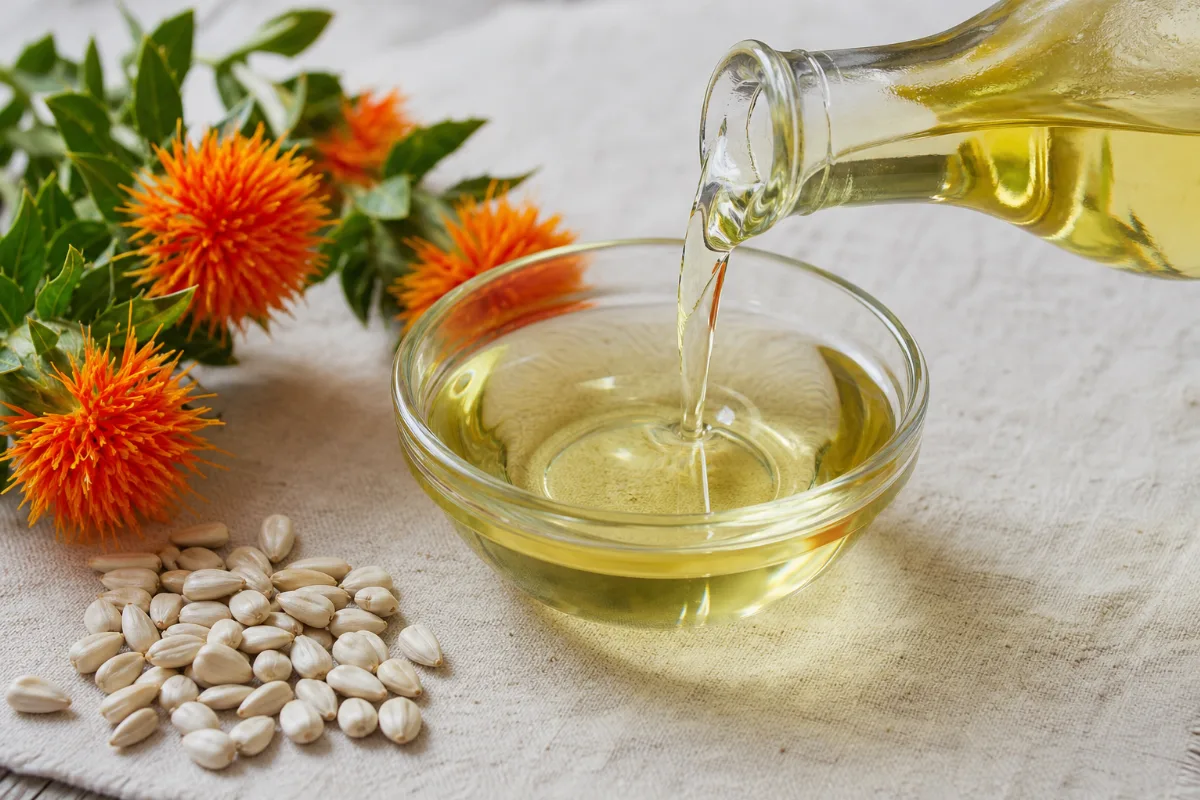
Oils & Fats · Cooking oil
Safflower Oil
Carthamus tinctorius (seed oil) · also called Aceite de cártamo, safflower seed oil
Safflower oil is a light oil pressed from safflower seeds, used for cooking and dressings. It is sold in two very different types: high-oleic (mostly monounsaturated fat) and linoleic (mostly polyunsaturated fat). The strongest evidence is about swapping saturated fat for unsaturated oils, which lowers LDL cholesterol; safflower oil on its own has only a few small trials. It is pure fat, about 120 kcal a tablespoon, and the main cautions are oil that has gone off and, as with any food, allergy.
General information, not medical advice. Last substantive update · Not medically reviewed. A named clinician has not signed off on this page. How this page is made
About Safflower Oil
Safflower oil is a light, mild oil pressed from the seeds of Carthamus tinctorius. It is nearly all fat, with no protein, carbohydrate or cholesterol, and it is a good source of vitamin E. The evidence supports swapping saturated fat for unsaturated oils like this one. Beyond that, safflower oil has only a few small trials, mostly of a daily oil supplement. The main cautions are oil that has gone rancid, partially hydrogenated products and, as with any food, allergy.
What it is
Safflower oil is pressed from the seeds of Carthamus tinctorius L., an annual plant in the daisy family (Asteraceae). GBIF lists the name as accepted. The flower is used as an herb and has its own page; this page covers the oil only.
Two types are sold. High-oleic safflower oil is mostly monounsaturated fat; USDA calls it the primary safflower oil of commerce. Linoleic safflower oil is mostly polyunsaturated omega-6 fat. The label should say which one you have.
What is in it (USDA values)
USDA FoodData Central lists these values for high-oleic safflower oil (FDC 171027) per 100 g: 884 kcal, 100 g fat (7.5 g saturated, 75.2 g monounsaturated, 12.8 g polyunsaturated), 34.1 mg vitamin E, 7.1 mcg vitamin K, 444 mg phytosterols, no cholesterol.
A typical USDA portion is 1 tablespoon (13.6 g): about 120 kcal, 13.6 g fat (1.0 g saturated, 10.2 g monounsaturated, 1.7 g polyunsaturated), 4.6 mg vitamin E and 60 mg phytosterols. The linoleic type (FDC 171026) has about 6.2 g saturated, 14.4 g monounsaturated and 74.6 g polyunsaturated fat per 100 g, with the same vitamin E and calories.
These values come from the project's saved copy of the USDA data, because the live USDA service was rate-limited when we tried to re-check them.
What the research shows
On the heart: the best evidence is for the swap of saturated for unsaturated fat. Cochrane found 21% fewer cardiovascular events when saturated fat was cut, and a pooled analysis found 19% fewer coronary events with more polyunsaturated fat. A 54-trial comparison ranked safflower oil first for lowering LDL, but ranking is not the same as measured benefit.
On blood sugar and weight: one 16-week crossover trial (35 completers) and one 12-week placebo trial (67 adults) found improvements at a supplement dose of 8 g a day. Each is a single study.
On inflammation: pooled trials of linoleic acid found no significant effect on blood markers, though a subgroup result and a small trial leave some doubt.
Food versus daily supplement
The diabetes, metabolic syndrome and fish-oil trials gave safflower oil in set daily amounts, as a supplement. Cooking with the oil is a different thing, and these results do not carry over to a salad dressing. The fat-swap evidence is the one that applies to everyday food.
The FDA letter about heart-disease wording applies to the high-oleic type only (at least 70% oleic acid).
Choosing and storing
Read the label for the type: high-oleic and linoleic oils are very different in fat make-up. The source of an oil has to be part of its name on the ingredient list under US rules.
Keep oil away from heat and light and use it up. We did not read a source on shelf life or smoke point for safflower oil.
At a glance
Traditional uses history, not proof
- The sources read describe traditional use of the safflower plant in Persian and East Asian medicine, but not of the culinary oil specifically, so no traditional use of the oil is claimed here.
Studied for research
- Heart health when it replaces saturated fat, moderate (for the swap in general)
- LDL cholesterol compared with other oils and butter, low
- FDA qualified heart claim for high-oleic oils, low
- Compared with coconut oil on cholesterol, very-low
- Blood sugar in type 2 diabetes, very-low
- Waist, blood pressure and insulin resistance in metabolic syndrome, low
- Inflammation markers, mixed
- Omega-6 fats and heart events, low
Main compounds
- Oleic acid (omega-9), main fat of the high-oleic type
- Linoleic acid (omega-6), main fat of the linoleic type
- Vitamin E (alpha-tocopherol)
- Plant sterols (phytosterols)
Common forms
- High-oleic safflower oil
- Linoleic safflower oil
- Cold-pressed and refined oils
- Capsules of safflower oil (a supplement, not the same as cooking oil)
Research links: Trials of replacing saturated fat (Cochrane, abstract) · Oils and fats compared on blood lipids (abstract) · Safflower oil in type 2 diabetes (abstract) · Safflower oil in metabolic syndrome (abstract) · Linoleic acid and inflammation markers (abstract) · FDA letter on oleic acid in edible oils · Research Library · Genes & Biomarkers Library
What it is and its history
- Accepted scientific name
- Carthamus tinctorius
- Naming authority
- L.
- Common names
- Safflower oil (English); Aceite de cártamo (Spanish); Safflower seed oil (English)
- Family or group
- Asteraceae (the daisy family)
- Classification
- Plantae > Tracheophyta > Magnoliopsida > Asterales > Asteraceae > Carthamus > Carthamus tinctorius
- Native range
- Not checked.
- Habitat
- Not checked.
- What it looks like
- Roots: Not checked.; Stems: Not checked.; Leaves: Not checked.; Flowers: Not checked.; Fruit: The oil is pressed from the seeds (achenes). The flower is used as an herb and has its own page.
- Cultivation
- Not checked. A 2026 study compared safflower seed oils from two regions of Morocco.
- Harvest and processing
- A 2026 lab study compared three ways of getting the oil out: Soxhlet (solvent), cold pressing and maceration. Solvent extraction gave the highest yield. Refined, cold-pressed and other commercial grades were not compared here.
- Look-alikes and adulterants
- Name: Safflower flower (the herb); Note: A different part of the same plant, used in traditional medicine. It has its own page and is not the oil.; Name: Sunflower oil; Note: A similar light oil (high-oleic and linoleic types also exist) from a different plant in the same family.
- Sustainability and conservation
- Not checked.
Traditional use and history history, not clinical proof
| Tradition or era | Documented use | Source |
|---|---|---|
| Traditional medicine of Persia, China, Korea, Japan and other East Asian countries (the plant) | A 2022 trial paper says safflower has been widely recommended in traditional herbal medicine of those regions for metabolic disorders. That statement is about the plant, not specifically the culinary oil. | p34487844 |
Traditional use shows how it was used. It does not show that it works or is safe today.
What is inside, and how it may work
What it contains and how those compounds act in cells and animals. Laboratory and animal mechanisms are not proven effects in people.
Main compounds
| Compound | Family | Where it is concentrated | Activity studied | Level of evidence |
|---|---|---|---|---|
| Oleic acid PubChem 445639 | omega-9 monounsaturated fatty acid | Seed oil High-oleic type: about 75 g monounsaturated fat per 100 g (USDA). | Main fat of the high-oleic type. 20 | Chemistry |
| Linoleic acid PubChem 5280450 | omega-6 polyunsaturated fatty acid | Seed oil Linoleic type: about 75 g polyunsaturated fat per 100 g (USDA); 40% to 80% of the oil in the Moroccan samples depending on cultivar and method. | Essential fatty acid; main fat of the linoleic type. 19 2 | Chemistry |
| Alpha-tocopherol (vitamin E) PubChem 14985 | fat-soluble vitamin E | Seed oil 34.1 mg per 100 g (USDA); about 581 to 838 mg/kg in the Moroccan samples. | Vitamin E; also helps protect the oil from going rancid. 20 2 | Chemistry |
| Phytosterols | plant sterols | Seed oil 444 mg per 100 g in both types (USDA). | Plant sterols; no trial showing they act at the amount in cooking oil was read. 20 | Chemistry |
Mechanisms, receptors and pathways
| Target or pathway | Gene or receptor | What was found | Level |
|---|---|---|---|
| Replacing saturated fat with unsaturated fat | LDL cholesterol (blood marker) | The American Heart Association says replacing saturated fat with unsaturated fat lowers LDL cholesterol, a cause of atherosclerosis. This is a general statement about fats. 9 | Human data |
| Linoleic acid build-up in the blood and fat tissue | Not specified | In the diabetes trial, linoleic acid in serum rose within four weeks of safflower oil, and the authors link the metabolic changes to this (their hypothesis). In the 2025 trial, linoleic acid in fat tissue rose with safflower oil. 1 3 | Human data |
Absorption, metabolism and elimination
- Absorption
- Not described in the sources read.
- Distribution
- Linoleic acid rose in serum and fat tissue after supplements (trials).
- Metabolism
- Not described.
- Elimination
- Not described.
- Bioavailability
- Not described.
Isolated compounds versus whole extracts
The food oil, the seed, the flower herb and safflower supplements are different things. High-oleic and linoleic oils differ a lot in fat make-up. Trials of an oil taken daily in set amounts (8 g, or 15 to 20 g of linoleic acid) do not show what cooking with it does.
Nutritional composition
Nutrition from USDA FoodData Central (SR Legacy, April 2018 release; values read 2026-10-26 from the project's saved copy of the data, because the public USDA key was rate-limited when we tried to re-fetch). High-oleic safflower oil (FDC 171027), per 100 g: 884 kcal, 100 g fat (7.5 g saturated, 75.2 g monounsaturated, 12.8 g polyunsaturated, of which 12.7 g linoleic acid and 0.096 g alpha-linolenic acid), 0.096 g trans fat, 34.1 mg vitamin E (alpha-tocopherol), 7.1 mcg vitamin K, 444 mg phytosterols, no cholesterol, protein, carbohydrate or fibre. One USDA household portion of 1 tablespoon (13.6 g, the 100 g values multiplied by 0.136): about 120 kcal, 13.6 g fat (1.0 g saturated, 10.2 g monounsaturated, 1.7 g polyunsaturated), 4.6 mg vitamin E, about 1 mcg vitamin K and 60 mg phytosterols. Linoleic safflower oil (FDC 171026), per 100 g: 884 kcal, 6.2 g saturated, 14.4 g monounsaturated and 74.6 g polyunsaturated fat, 34.1 mg vitamin E, 7.1 mcg vitamin K and 444 mg phytosterols; a tablespoon has about 120 kcal, 0.8 g saturated, 2.0 g monounsaturated and 10.1 g polyunsaturated fat. USDA also lists a vitamin D value that looks like a database artifact for a plant oil, so it is not reported. Refined, cold-pressed, organic and blended oils were not compared.
1 moderate certainty1 mixed findings4 low certainty2 very low certainty
What was looked at
The 8 benefits and uses checked for Safflower Oil, each with how strong the evidence is. Tap one to open it.
- Heart health when unsaturated oil replaces saturated fatModerate certainty
- LDL cholesterol compared with other oils and butterLow certainty
- High-oleic safflower oil and the FDA qualified heart-disease claimLow certainty
- High-oleic safflower oil compared with coconut oilVery low certainty
- Blood sugar in women with type 2 diabetesVery low certainty
- Waist, blood pressure and insulin resistance in metabolic syndromeLow certainty
- Inflammation markersMixed findings
- Omega-6 fats and heart eventsLow certainty
Lab markers tracked in the studies
LDL cholesterolTotal cholesterolHeart attacks and cardiac deathsHbA1c (average blood sugar over 2 to 3 months)Fasting blood sugar and insulin resistanceBlood pressureC-reactive protein (inflammation marker)
What is Safflower Oil good for?
What the research shows for each use, and how strong it is. Most of it is about swapping fats in general, or about small trials of oil taken in set daily amounts. Read the Safety tab too.
Benefits, one by one
Each card is a research question, not a promise. Tap a goal to filter. Open a card to see the studies, doses and limits.
Heart health when unsaturated oil replaces saturated fat
Moderate certaintyLarge reviews find that swapping saturated fat (butter, fatty meat) for unsaturated vegetable oils lowers LDL cholesterol and probably heart events. This is about vegetable oils in general; safflower oil on its own was not tested for heart events.
3 studiesFood oils used as part of the diet in place of saturated fat. Amounts…
Studies, doses and limits
What the trials found
A Cochrane review of 15 trials (about 59,000 people), a pooled analysis of 8 trials (13,614 people) and an American Heart Association advisory. None is about safflower oil alone.
Results
Cutting saturated fat lowered combined cardiovascular events by 21% (risk ratio 0.79, moderate-quality evidence). Eating more polyunsaturated fat in place of saturated fat lowered coronary events by 19% (risk ratio 0.81). The advisory says trials of this swap with polyunsaturated vegetable oil reduced cardiovascular disease by about 30%.
Effect sizes as reported
RR 0.79 (95% CI 0.66 to 0.93) for cardiovascular events; RR 0.81 (95% CI 0.70 to 0.95) for coronary events.
Why this rating
Moderate for the fat swap in general (Cochrane GRADE moderate). For safflower oil itself it is lower, because the trials used mixed oils and diets.
Form and dose studied
Food oils used as part of the diet in place of saturated fat. Amounts are not given here.
Who was studied
Adults with and without heart disease.
Why researchers looked
Safflower oil is a plant oil with little saturated fat, so it is one way to make the swap.
Proposed mechanism Composition only
The American Heart Association links replacing saturated fat with unsaturated fat to lower LDL cholesterol. This is general fat advice, not a test of safflower oil.
A proposed mechanism does not show that the effect happens in people.
Safflower oil is pure fat with about 120 kcal in a tablespoon. The evidence is for swapping fats, not for adding oil on top of your diet.
LDL cholesterol compared with other oils and butter
Low certaintyA pooled comparison of 54 trials ranked safflower oil first for lowering LDL and total cholesterol among 13 oils and fats, and all the plant oils beat butter. The ranking says little about how big the gap is between safflower and, for example, olive oil.
2 studiesOils exchanged for other fats (per 10% of energy in the model). The a…
Studies, doses and limits
What the trials found
One network meta-analysis of 54 randomized trials of 3 weeks or longer.
Results
Safflower oil had the highest ranking for LDL (82%) and total cholesterol (90%), followed by rapeseed oil. Safflower, sunflower, rapeseed, flaxseed, corn, olive, soybean, palm and coconut oil, and beef fat, lowered LDL more than butter by 0.23 to 0.42 mmol/L.
Effect sizes as reported
LDL 0.23 to 0.42 mmol/L lower than with butter (range across oils).
Why this rating
A ranking of short trials with limitations the authors name; it does not say safflower oil is better than the other plant oils by a meaningful amount.
Form and dose studied
Oils exchanged for other fats (per 10% of energy in the model). The abstract does not give the safflower type.
Who was studied
Adults in 54 trials (mixed health status).
Limits
Short trials, indirect comparisons, safflower type not stated in the abstract.
Why researchers looked
To compare which cooking oils and fats change blood fats most when they swap with each other.
Proposed mechanism Not shown
Not shown. The review compared the fats' effects on blood lipids; it did not test why.
A proposed mechanism does not show that the effect happens in people.
A ranking of oils is not advice to pour extra oil on food. The weight of the evidence is for swapping fats.
High-oleic safflower oil and the FDA qualified heart-disease claim
Low certaintyThe US FDA named high-oleic safflower oil among oils with at least 70% oleic acid that may carry a cautious label statement about heart disease when the oil replaces saturated fat. The FDA called the evidence supportive but not conclusive.
1 studiesEdible oils with at least 70% oleic acid (high-oleic types). Linoleic…
Studies, doses and limits
What the trials found
A regulator letter that reviewed the petition's evidence. It is not a trial.
Results
FDA says it concludes there is supportive but not conclusive evidence that edible oils with at least 70% oleic acid per serving reduce the risk of coronary heart disease when they replace saturated fat, and it will exercise enforcement discretion for a qualified claim. The petition was submitted on behalf of an industry company.
Why this rating
FDA itself calls the evidence supportive but not conclusive; the petition came from industry.
Form and dose studied
Edible oils with at least 70% oleic acid (high-oleic types). Linoleic safflower oil is a different type and does not meet this.
Who was studied
General adult population.
Limits
A labelling decision, not new research on safflower oil. Read as a PDF letter.
Why researchers looked
A food-industry petition asked for a heart-health claim for oleic-acid-rich oils.
Proposed mechanism Not shown
Not tested for safflower oil here. The FDA letter reviews evidence on oleic acid and blood fats in general.
A proposed mechanism does not show that the effect happens in people.
The wording is a labelling matter. It does not mean the oil treats high cholesterol.
High-oleic safflower oil compared with coconut oil
Very low certaintyIn 12 postmenopausal women, coconut oil raised total and LDL cholesterol over 28 days, while high-oleic safflower oil did not change cholesterol significantly.
1 studiesHigh-oleic safflower oil at a trial amount of 30 mL a day (not advice…
Studies, doses and limits
What the trials found
One randomized crossover trial, 12 women.
Results
Virgin coconut oil raised total cholesterol by 18.2 mg/dL, LDL by 13.5 mg/dL and HDL by 6.6 mg/dL. Safflower oil did not significantly change any lipid value. Total cholesterol and HDL differed between the two oils.
Effect sizes as reported
Coconut oil: total +18.2, LDL +13.5, HDL +6.6 mg/dL. Safflower oil: no significant change.
Why this rating
12 people, 28 days, no non-oil control.
Form and dose studied
High-oleic safflower oil at a trial amount of 30 mL a day (not advice).
Who was studied
12 postmenopausal women in the United States, average age 58.8.
Limits
Very small crossover trial. Funding not stated in the abstract.
Why researchers looked
Coconut oil is high in saturated fat. The study asked how it compares with an unsaturated oil.
Proposed mechanism Not shown
Not shown in this trial.
A proposed mechanism does not show that the effect happens in people.
A 28-day trial in 12 women is too small to rule out smaller effects.
Blood sugar in women with type 2 diabetes
Very low certaintyIn one small crossover trial, obese postmenopausal women with type 2 diabetes who took safflower oil each day for 16 weeks had lower HbA1c than on a comparison oil. Only 35 of 55 women finished, and it is a single study.
1 studiesSafflower oil as a daily supplement, 8 g a day for 16 weeks (a trial …
Studies, doses and limits
What the trials found
One randomized, double-masked crossover trial.
Results
Safflower oil lowered HbA1c by 0.64 points and C-reactive protein, raised an insulin sensitivity index and raised HDL by 0.12 mmol/L. The comparison conjugated linoleic acid oil changed none of these.
Effect sizes as reported
HbA1c -0.64 percentage points (p = 0.0007).
Why this rating
One small trial, 35 completers, one group, a supplement amount.
Form and dose studied
Safflower oil as a daily supplement, 8 g a day for 16 weeks (a trial amount, not advice). Cooking use is not tested.
Who was studied
Obese postmenopausal women with type 2 diabetes.
Limits
Dropouts (20 of 55), one group, and supplement-style dosing. Not shown in men or in people without diabetes.
Why researchers looked
To test whether the quality of fat changes blood sugar control.
Proposed mechanism Hypothesis
Not shown. The authors link the effect to linoleic acid building up in the blood over time, which is a hypothesis.
A proposed mechanism does not show that the effect happens in people.
If you have diabetes, talk to your care team before changing the fats in your diet or taking oil as a supplement.
Waist, blood pressure and insulin resistance in metabolic syndrome
Low certaintyIn a 12-week placebo-controlled trial of 67 adults with metabolic syndrome, safflower oil was followed by a smaller waist, lower blood pressure and lower fasting blood sugar than placebo. Blood fats did not differ. It is one trial from one group.
1 studiesSafflower oil as a daily supplement, 8 g a day divided, for 12 weeks …
Studies, doses and limits
What the trials found
One randomized, double-blind, placebo-controlled trial, 67 adults.
Results
Compared with placebo: waist -2.42 versus +0.97, systolic blood pressure -8.80 versus -2.26, diastolic -3.53 versus -0.70, fasting blood sugar -5.03 versus +2.94, insulin resistance -0.59 versus +0.50. Lipids, leptin and creatinine did not differ.
Effect sizes as reported
Differences between groups were significant (p from 0.003 to 0.041); units are in the paper.
Why this rating
A single double-blind trial from one research group; small; details of the placebo and dropouts are not in the abstract.
Form and dose studied
Safflower oil as a daily supplement, 8 g a day divided, for 12 weeks (a trial amount, not advice).
Who was studied
Adults with metabolic syndrome.
Limits
One trial; 12 weeks; the abstract does not give oil type, placebo or funding.
Why researchers looked
Safflower has been used in Persian, Chinese and other East Asian traditional medicine for metabolic problems, and researchers wanted to test the oil.
Proposed mechanism Not shown
Not shown. The abstract reports a higher adiponectin level but does not test why the other measures changed.
A proposed mechanism does not show that the effect happens in people.
Metabolic syndrome needs medical care. An oil is not a replacement for treatment.
Inflammation markers
Mixed findingsA common worry is that the omega-6 fat in safflower oil causes inflammation. Pooled trials found no significant effect on blood markers. A small trial found the same markers as fish oil, but blood pressure rose a little on safflower oil.
2 studiesLinoleic acid from various sources (meta-analysis); safflower oil giv…
Studies, doses and limits
What the trials found
A meta-analysis of 30 trials (1,377 adults) of linoleic acid and one crossover trial of safflower oil in 39 adults.
Results
Meta-analysis: no significant effect of more linoleic acid on TNF, interleukin-6, adiponectin, MCP-1 or CRP, although a subgroup analysis suggested that a bigger rise in intake might raise CRP. Trial: no difference between safflower and fish oil in circulating markers; systolic blood pressure +2.61% with safflower versus -1.81% with fish oil.
Effect sizes as reported
CRP standardized difference 0.09 (95% CI -0.05 to 0.24).
Why this rating
No overall effect in the pooled analysis, but a subgroup signal and a tissue-level finding keep the question open.
Form and dose studied
Linoleic acid from various sources (meta-analysis); safflower oil giving 15 to 20 g a day of linoleic acid (trial; a supplement-scale amount, not advice).
Who was studied
Adults; the trial was in people with abdominal obesity.
Limits
The meta-analysis was not about safflower oil specifically. The trial had no placebo without oil and is small.
Why researchers looked
Safflower oil is mostly omega-6 linoleic acid, and some people argue that omega-6 raises inflammation.
Proposed mechanism Human observation
The 2025 trial reported that gene activity linked to inflammation in fat tissue went up with safflower oil, even though blood markers did not differ from fish oil. This is a small-trial observation.
A proposed mechanism does not show that the effect happens in people.
The doses in the fish-oil comparison were supplement scale, so the result does not carry over to cooking.
Omega-6 fats and heart events
Low certaintyA Cochrane review found low-quality evidence that eating more omega-6 fat (mostly linoleic acid, the main fat in linoleic safflower oil) makes little or no difference to deaths or heart events.
1 studiesLinoleic acid and gamma-linolenic acid from various sources.
Studies, doses and limits
What the trials found
One Cochrane meta-analysis of 19 trials, 6,461 adults.
Results
All-cause deaths: risk ratio 1.00. Cardiovascular events: 0.97. Cardiovascular deaths (1.09) and coronary events (0.88) were uncertain. The omega-6 fats usually took the place of saturated or monounsaturated fats.
Effect sizes as reported
RR 1.00 (0.88 to 1.12) for deaths; RR 0.97 (0.81 to 1.15) for events.
Why this rating
The review itself calls the evidence low quality; only three trials had a low risk of bias.
Form and dose studied
Linoleic acid and gamma-linolenic acid from various sources.
Who was studied
Adults with and without cardiovascular disease.
Limits
Not safflower oil alone. Wide confidence intervals include benefit and harm.
Why researchers looked
To check whether more omega-6 fat helps or harms the heart.
Proposed mechanism Not shown
Not shown.
A proposed mechanism does not show that the effect happens in people.
This result is about adding omega-6 fat, not about the swap from saturated fat.
Connections to the rest of health
How Safflower Oil connects to the rest of our health knowledge graph. Every link says what kind of connection it is. A safety link (for example to the liver) is a warning, not a benefit. A study that merely mentions a topic never creates a benefit link.
Explore every connection: goals, body systems, organs, symptoms, genes
A. Wellness goals
| Connected to | Kind of connection | Evidence status | Context | Studies |
|---|---|---|---|---|
| Heart Health | Moderate certainty | Heart health when unsaturated oil replaces saturated fat: Large reviews find that swapping saturated fat (butter, fatty meat) for unsaturated vegetable oils lowers LDL cholesterol and probably heart events. This is about vegetable oils in general; safflower oil on its own was not tested for heart events. LDL cholesterol compared with other oils and butter: A pooled comparison of 54 trials ranked safflower oil first for lowering LDL and total cholesterol among 13 oils and fats, and all the plant oils beat butter. The ranking says little about how big the gap is between safflower and, for example, olive oil. | 6 7 9 10 18 13 5 | |
| Cholesterol Balance | Low certainty | LDL cholesterol compared with other oils and butter: A pooled comparison of 54 trials ranked safflower oil first for lowering LDL and total cholesterol among 13 oils and fats, and all the plant oils beat butter. The ranking says little about how big the gap is between safflower and, for example, olive oil. High-oleic safflower oil and the FDA qualified heart-disease claim: The US FDA named high-oleic safflower oil among oils with at least 70% oleic acid that may carry a cautious label statement about heart disease when the oil replaces saturated fat. The FDA called the evidence supportive but not conclusive. | 10 18 13 4 | |
| Blood Sugar Balance | Very low certainty | Blood sugar in women with type 2 diabetes: In one small crossover trial, obese postmenopausal women with type 2 diabetes who took safflower oil each day for 16 weeks had lower HbA1c than on a comparison oil. Only 35 of 55 women finished, and it is a single study. | 1 | |
| Healthy Weight | Low certainty | Waist, blood pressure and insulin resistance in metabolic syndrome: In a 12-week placebo-controlled trial of 67 adults with metabolic syndrome, safflower oil was followed by a smaller waist, lower blood pressure and lower fasting blood sugar than placebo. Blood fats did not differ. It is one trial from one group. | 8 | |
| Blood Pressure | Low certainty | Waist, blood pressure and insulin resistance in metabolic syndrome: In a 12-week placebo-controlled trial of 67 adults with metabolic syndrome, safflower oil was followed by a smaller waist, lower blood pressure and lower fasting blood sugar than placebo. Blood fats did not differ. It is one trial from one group. | 8 | |
| Inflammation Balance | Mixed findings | Inflammation markers: A common worry is that the omega-6 fat in safflower oil causes inflammation. Pooled trials found no significant effect on blood markers. A small trial found the same markers as fish oil, but blood pressure rose a little on safflower oil. | 11 3 |
B. Body systems
| Connected to | Kind of connection | Evidence status | Context | Studies |
|---|---|---|---|---|
| Cardiovascular System | Biological association | Moderate certainty | Studied for: Heart health when unsaturated oil replaces saturated fat Studied for: LDL cholesterol compared with other oils and butter | 6 7 9 10 18 13 4 8 5 |
| Endocrine System | Biological association | Very low certainty | Studied for: Blood sugar in women with type 2 diabetes Studied for: Waist, blood pressure and insulin resistance in metabolic syndrome | 1 8 |
| Immune System | Biological association | Mixed findings | Studied for: Inflammation markers | 11 3 |
C. Body parts and organs
| Connected to | Kind of connection | Evidence status | Context | Studies |
|---|---|---|---|---|
| Immune system | Adverse effect or risk | Not enough evidence | No reports of allergy to safflower oil were found; safflower is not a major allergen. Preparation or compound: Safflower oil as food |
12 15 |
| Heart | Biological association | Moderate certainty | Cochrane, pooled-trial and American Heart Association evidence for the fat swap; not safflower oil alone. Preparation or compound: Unsaturated oils in place of saturated fat |
6 7 9 |
I. Biomarkers
| Connected to | Kind of connection | Evidence status | Context | Studies |
|---|---|---|---|---|
| LDL cholesterol | Biological association | Low certainty | Measured in trials: lowered when unsaturated oils replace saturated fat; no significant change in a 12-woman trial. A lab change is not the same as a health benefit. | 10 4 |
| Total cholesterol | Biological association | Low certainty | Measured in trials: lowered versus butter and coconut oil. A lab change is not the same as a health benefit. | 10 4 |
| Heart attacks and cardiac deaths | Biological association | Moderate certainty | Measured in trials: lowered when polyunsaturated fat replaces saturated fat (mixed oils). A lab change is not the same as a health benefit. | 7 6 |
| HbA1c (average blood sugar over 2 to 3 months) | Biological association | Very low certainty | Measured in trials: lowered (one small trial). A lab change is not the same as a health benefit. | 1 |
| Fasting blood sugar and insulin resistance | Biological association | Low certainty | Measured in trials: lowered versus placebo (one trial). A lab change is not the same as a health benefit. | 8 |
| Blood pressure | Biological association | Mixed findings | Measured in trials: mixed: lowered versus placebo in one trial, higher than with fish oil in another. A lab change is not the same as a health benefit. | 8 3 |
| C-reactive protein (inflammation marker) | Biological association | Mixed findings | Measured in trials: no significant overall change in pooled trials. A lab change is not the same as a health benefit. | 11 1 |
L. Active compounds
| Connected to | Kind of connection | Evidence status | Context | Studies |
|---|---|---|---|---|
| Oleic acid | Biological association | Chemistry | Main fat of the high-oleic type. Preparation or compound: Seed oil |
20 |
| Linoleic acid | Biological association | Chemistry | Essential fatty acid; main fat of the linoleic type. Preparation or compound: Seed oil |
19 2 |
| Alpha-tocopherol (vitamin E) | Biological association | Chemistry | Vitamin E; also helps protect the oil from going rancid. Preparation or compound: Seed oil |
20 2 |
| Phytosterols | Biological association | Chemistry | Plant sterols; no trial showing they act at the amount in cooking oil was read. Preparation or compound: Seed oil |
20 |
Each connection is stored with the ingredient, the connected record, the kind of connection, the evidence status, the supporting studies, the preparation or compound involved, and a review date (last reviewed October 26, 2026).
Evidence at a glance: what the research found for 8 outcomes
Each outcome below is one thing researchers measured. Certainty is how far the evidence can be trusted, not how well it works. The full studies are on the next tab.
The evidence
The research centre for Safflower Oil. Every record here was checked against PubMed or the publisher's page; we never list a study we have not verified.
Evidence by outcome
Bars show how many studies we found for each outcome, not how well it works. People are added up across trials only (reviews are not added, to avoid double counting).
How we rate evidence
High certainty
Several well-run trials or reviews agree; further research is unlikely to change the picture much.
Moderate certainty
Good trials point the same way, but some doubt remains.
Low certainty
Small, short or inconsistent trials. The finding could change with better research.
Very low certainty
Very little or very weak human data. Treat as a possibility only.
Mixed findings
Trials or reviews disagree with each other.
Not enough evidence
Not enough human research to say either way.
Evidence against
Good research found no benefit, or found harm.
We take the reviewers' own risk-of-bias and GRADE statements where they exist, and otherwise judge from study size, design, consistency, directness and whether a product matches what is sold. Many publications do not make evidence high. Method note: We checked the PubMed record (summary and abstract) of 11 papers, read 5 regulator or health-body pages and the FDA letter, matched the plant name in GBIF and took nutrition values from USDA FoodData Central (saved copy). Certainty ratings are the compiler's own reading. Funding is not stated in most abstracts. One regulator source (the FDA oleic acid letter) answered an industry petition. No study is cited that we could not verify.
Study library: every study we checked 20
| Study | Design | People | Product, dose, length | Result |
|---|---|---|---|---|
| Asp 2011 Time-dependent effects of safflower oil to improve glycemia, inflammation and blood lipids in obese, post-menopausal women with type 2 diabetes: a randomized, double-masked, crossover study. Clin Nutr · PMID 21295383 |
Randomized crossover trial |
35 55 obese postmenopausal women with type 2 diabetes enrolled; 35 finished |
Safflower oil (type not stated in the abstract) compared with conjugated linoleic acid (CLA) oil seed oil 8 g a day (a trial amount, not advice) 16 weeks per oil · vs CLA oil |
Safflower oil lowered HbA1c by 0.64 points (p = 0.0007) and C-reactive protein, raised an insulin sensitivity index (QUICKI) and raised HDL cholesterol by 0.12 mmol/L. CLA oil did not change these measures. The first significant change in HbA1c was seen at 16 weeks. HbA1c -0.64 percentage points with safflower oil. Methods, limits and fundingOutcomes: HbA1c, C-reactive protein, insulin sensitivity (QUICKI), HDL cholesterol Limitations: Only 35 of 55 women finished. One group (obese postmenopausal women with diabetes). The oil was a daily supplement amount, so cooking use is not tested. Funded in part by US National Institutes of Health programmes (publication type list); the abstract does not name who made the oils. Funding and conflicts: Research support from the US National Institutes of Health is listed in the PubMed record; other conflicts are not stated in the abstract. Read: abstract |
| El Kourchi 2026 Safflower (Carthamus tinctorius L.) Seed Oils: Effect of Extraction Process and Cultivars on Chemical Composition, Physicochemical Parameters and Nutritional Quality Index. Food Sci Nutr · PMID 42255700 |
Laboratory analysis lab |
Safflower seed oils from two regions of Morocco, three extraction methods | Safflower seed oil (Soxhlet, cold pressing, maceration) seed oil |
Linoleic acid made up 40.45% to 80.25% of the oil depending on cultivar and method. The authors say the high polyunsaturated fat content raises concerns about oxidative stability, but the two solvent-free oils had peroxide values (9.62 and 9.45 meq O2/kg) below the recommended limits for cold-pressed oils, with high alpha-tocopherol (about 581 to 838 mg/kg). Laboratory composition data; no health outcome. Methods, limits and fundingOutcomes: Oil yield, fatty acids, peroxide value, tocopherols, nutrition indices Limitations: Two Moroccan cultivars only, lab measurements, no heating or storage test. Only the abstract was read. Funding and conflicts: Funding and conflicts of interest are not stated in the abstract. Read: abstract |
| Grytten 2025 Inflammatory markers after supplementation with marine n-3 or plant n-6 PUFAs: A randomized double-blind crossover study. J Lipid Res · PMID 40058591 |
Randomized crossover trial |
39 16 women and 23 men aged 30 to 70 with abdominal obesity |
Linoleic acid from safflower oil compared with fish oil (EPA and DHA) seed oil 15 to 20 g a day of linoleic acid (a supplement-scale amount, not advice) 7 weeks, 9-week washout · vs Fish oil, 3 to 4 g a day EPA and DHA |
No difference between the safflower and fish-oil periods in any circulating inflammatory marker. Systolic blood pressure changed differently (fish oil -1.81%, safflower oil +2.61%, p = 0.003). Within the safflower period, some markers (TNF, MCP-1, MIP-1 beta, RANTES) fell compared with baseline, while fat-tissue gene activity linked to inflammation went up. The authors write of tissue-specific pro-inflammatory effects of high omega-6 intake but a net systemic effect that was anti-inflammatory, as for omega-3. No difference in circulating inflammation markers between safflower oil and fish oil; blood pressure rose by 2.61% on safflower oil versus a 1.81% fall on fish oil. Methods, limits and fundingOutcomes: Inflammatory markers, blood pressure, fat composition, fat-tissue gene activity Limitations: Small trial in people with abdominal obesity, large supplement-scale amounts of linoleic acid, no placebo without oil. Funding is not stated in the abstract. Funding and conflicts: Funding and conflicts of interest are not stated in the abstract. Read: abstract |
| Harris 2017 The Impact of Virgin Coconut Oil and High-Oleic Safflower Oil on Body Composition, Lipids, and Inflammatory Markers in Postmenopausal Women. J Med Food · PMID 28277823 |
Randomized crossover trial |
12 12 postmenopausal women, average age 58.8 |
High-oleic safflower oil (food oil) compared with virgin coconut oil seed oil 30 mL a day (a trial amount, not advice) 28 days, 28-day washout · vs Virgin coconut oil |
Virgin coconut oil raised total cholesterol (+18.2 mg/dL), LDL (+13.5 mg/dL) and HDL (+6.6 mg/dL). Safflower oil did not significantly change any lipid value. Total cholesterol and HDL differed between the two oils. Safflower oil: no significant change in lipids; coconut oil raised total and LDL cholesterol. Methods, limits and fundingOutcomes: Body composition, cholesterol, inflammation markers Limitations: Only 12 women, 28 days, a crossover with no non-oil control. Funding is not stated in the abstract. Funding and conflicts: Funding and conflicts of interest are not stated in the abstract. Read: abstract |
| Hooper 2018 Omega-6 fats for the primary and secondary prevention of cardiovascular disease. Cochrane Database Syst Rev · PMID 30488422 |
Meta-analysis review |
6461 19 randomized trials, 6,461 adults with or without cardiovascular disease, followed for 1 to 8 years |
Higher omega-6 fat intake (12 trials of linoleic acid, 7 of gamma-linolenic acid) at least 12 months · vs Lower omega-6 intake |
The review found low-quality evidence that more omega-6 fats may make little or no difference to deaths from any cause (risk ratio 1.00) or to cardiovascular events (risk ratio 0.97). It is uncertain about cardiovascular deaths (1.09) and coronary events (0.88). The omega-6 fats usually displaced saturated or monounsaturated fats. Only three trials had a low risk of bias. Little or no difference in deaths (RR 1.00) or cardiovascular events (RR 0.97). (deaths 0.88 to 1.12; events 0.81 to 1.15) Methods, limits and fundingOutcomes: Deaths, cardiovascular events Limitations: Mostly mixed omega-6 sources, not safflower oil alone. Low-quality evidence. Only part of the abstract was read. Funding and conflicts: Funding and conflicts of interest are not stated in the abstract. Read: abstract |
| Hooper 2020 Reduction in saturated fat intake for cardiovascular disease. Cochrane Database Syst Rev · PMID 32428300 |
Meta-analysis review |
15 randomized trials (16 comparisons), about 59,000 adults with or without cardiovascular disease | Lower saturated fat intake, replaced with polyunsaturated fat, monounsaturated fat, carbohydrate or protein at least 24 months · vs Higher saturated fat or usual diet |
Long-term trials suggest that cutting saturated fat lowered the risk of combined cardiovascular events by 21% (risk ratio 0.79, 11 trials, moderate-quality evidence). Larger cuts in saturated fat, which meant larger falls in blood cholesterol, went with larger drops in risk. Risk ratio 0.79 for combined cardiovascular events. (0.66 to 0.93) Methods, limits and fundingOutcomes: Deaths and cardiovascular events Limitations: The trials changed the whole diet or gave advice; none tested safflower oil alone. Results varied between trials (I2 = 65%). Only the first part of the abstract was read. Funding and conflicts: Funding and conflicts of interest are not stated in the abstract. Read: abstract |
| Mozaffarian 2010 Effects on coronary heart disease of increasing polyunsaturated fat in place of saturated fat: a systematic review and meta-analysis of randomized controlled trials. PLoS Med · PMID 20351774 |
Meta-analysis review |
13614 8 randomized trials, 13,614 adults, 1,042 coronary heart disease events |
More polyunsaturated fat in place of saturated fat average 14.9% of energy versus 5.0% in controls at least 1 year · vs Control diets |
The pooled risk of coronary heart disease events was 19% lower with more polyunsaturated fat (risk ratio 0.81). The authors estimate about 10% lower risk for each 5% of energy swapped. Risk ratio 0.81 (19% lower) for coronary events. (0.70 to 0.95) Methods, limits and fundingOutcomes: Heart attack and cardiac death Limitations: Trials used mixed polyunsaturated fats and oils, not safflower oil alone. Only eight trials. Only the abstract was read. Funding and conflicts: Funding and conflicts of interest are not stated in the abstract. Read: abstract |
| Ruyvaran 2022 Safflower (Carthamus tinctorius L.) oil could improve abdominal obesity, blood pressure, and insulin resistance in patients with metabolic syndrome: A randomized, double-blind, placebo-controlled clinical trial. J Ethnopharmacol · PMID 34487844 |
Randomized placebo controlled trial |
67 67 adults with metabolic syndrome |
Safflower oil compared with placebo seed oil 8 g a day, divided (a trial amount, not advice) 12 weeks · vs Placebo (type not stated in the abstract) |
Compared with placebo, safflower oil reduced waist size (-2.42 versus +0.97), systolic blood pressure (-8.80 versus -2.26 mmHg), diastolic blood pressure (-3.53 versus -0.70), fasting blood sugar (-5.03 versus +2.94) and insulin resistance (-0.59 versus +0.50), and raised adiponectin. Blood lipids, leptin and creatinine did not differ between groups. Lower waist, blood pressure, fasting sugar and insulin resistance than placebo; no difference in blood lipids. Methods, limits and fundingOutcomes: Waist, blood pressure, fasting blood sugar, insulin resistance, adiponectin, lipids Limitations: A single trial from one research group, 12 weeks. Participants were told to keep their usual diet, so the trial is an add-on supplement test. The abstract does not give the oil type, the placebo, the number lost to follow-up or who paid. Only the abstract was read. Funding and conflicts: Funding and conflicts of interest are not stated in the abstract. Read: abstract |
| Sacks 2017 Dietary Fats and Cardiovascular Disease: A Presidential Advisory From the American Heart Association. Circulation · PMID 28620111 |
Expert advisory review review |
Review of trials and cohort studies of dietary fats and cardiovascular disease | Replacing saturated fat with unsaturated (mainly polyunsaturated) fat |
The advisory says trials that lowered saturated fat and replaced it with polyunsaturated vegetable oil reduced cardiovascular disease by about 30%, similar to a statin. It says replacing saturated fat with unsaturated fat lowers LDL cholesterol, and it recommends the shift within an overall healthy eating pattern such as DASH or Mediterranean. About 30% fewer cardiovascular events in the trials it reviewed (mixed vegetable oils, not safflower oil alone). Methods, limits and fundingOutcomes: Cardiovascular disease, LDL cholesterol Limitations: An expert advisory, not a new pooled analysis. It does not single out safflower oil. Only the abstract was read. Funding and conflicts: An American Heart Association advisory; funding is not stated in the abstract. Read: abstract |
| Schwingshackl 2018 Effects of oils and solid fats on blood lipids: a systematic review and network meta-analysis. J Lipid Res · PMID 30006369 |
Network meta analysis review |
54 randomized trials (3 weeks or longer) that compared at least two oils or solid fats | Safflower, sunflower, rapeseed, hempseed, flaxseed, corn, olive, soybean, palm and coconut oil; lard, beef fat and butter oil or fat per 10% of energy swapped 3 weeks or longer · vs Other oils and fats |
Safflower oil had the highest ranking (SUCRA) for lowering LDL cholesterol (82%) and total cholesterol (90%), followed by rapeseed oil. Safflower, sunflower, rapeseed, flaxseed, corn, olive, soybean, palm and coconut oil and beef fat all lowered LDL more than butter (by 0.23 to 0.42 mmol/L). Coconut oil ranked best for raising HDL. The authors note limitations in the data and say the findings support swapping high-saturated-fat foods for unsaturated oils. LDL fell 0.23 to 0.42 mmol/L with these oils compared with butter (safflower ranked first for LDL). (not given in the abstract) Methods, limits and fundingOutcomes: LDL cholesterol, total cholesterol, HDL cholesterol, triglycerides Limitations: A ranking is not a measured difference between safflower oil and other oils, and the trials were short. The abstract does not say which safflower type was used. Only the abstract was read. Funding and conflicts: Funding and conflicts of interest are not stated in the abstract. Read: abstract |
| Su 2017 Dietary linoleic acid intake and blood inflammatory markers: a systematic review and meta-analysis of randomized controlled trials. Food Funct · PMID 28752873 |
Meta-analysis review |
1377 30 randomized controlled studies, 1,377 adults |
Higher dietary linoleic acid (the main omega-6 fat in safflower oil) various various various · vs Lower linoleic acid intake |
Higher linoleic acid intake had no significant effect on TNF, interleukin-6, adiponectin, MCP-1 or C-reactive protein (CRP standardized difference 0.09). A subgroup and meta-regression analysis suggested that a larger rise in linoleic acid intake might raise CRP. No significant effect overall (CRP SMD 0.09). (CRP: -0.05 to 0.24) Methods, limits and fundingOutcomes: Blood inflammatory markers (cytokines, C-reactive protein, adhesion molecules) Limitations: Linoleic acid from many sources, not safflower oil alone. For some markers few studies were available. The CRP signal came from a subgroup analysis. Only the abstract was read. Funding and conflicts: Funding and conflicts of interest are not stated in the abstract. Read: abstract |
| s-fda-allergens U.S. Food and Drug Administration: The FASTER Act: Sesame Is the Ninth Major Food Allergen · Source |
Regulator page n/a |
Methods, limits and fundingRead: full-text | ||
| s-fda-oleic U.S. Food and Drug Administration: letter responding to the health claim petition on oleic acid in edible oils and coronary heart disease (Docket FDA-2017-Q-0807) · Source |
Regulator letter n/a |
Methods, limits and fundingRead: full-text | ||
| s-fda-pho U.S. Food and Drug Administration: Final Determination Regarding Partially Hydrogenated Oils (Removing Trans Fat) · Source |
Regulator page n/a |
Methods, limits and fundingRead: full-text | ||
| s-fda-qa U.S. Food and Drug Administration: Questions and Answers Regarding Food Allergens (guidance for industry, Edition 5), questions B.8 and D.9 · Source |
Regulator guidance n/a |
Methods, limits and fundingRead: full-text | ||
| s-gbif-carthamus GBIF Backbone Taxonomy: Carthamus tinctorius L. (species) · Source |
Database record n/a |
Methods, limits and fundingRead: full-text | ||
| s-medlineplus-vite MedlinePlus: Vitamin E in diet · Source |
Regulator page n/a |
Methods, limits and fundingRead: full-text | ||
| s-nhs-fats NHS: Facts about fat (different fats in our diet) · Source |
Regulator guidance n/a |
Methods, limits and fundingRead: full-text | ||
| s-usda-fdc-171026 USDA FoodData Central: Oil, safflower, salad or cooking, linoleic (over 70%) (FDC 171026, SR Legacy, April 2018) · Source |
Reference database n/a |
Methods, limits and fundingRead: saved-copy | ||
| s-usda-fdc-171027 USDA FoodData Central: Oil, safflower, salad or cooking, high oleic (primary safflower oil of commerce) (FDC 171027, SR Legacy, April 2018) · Source |
Reference database n/a |
Methods, limits and fundingRead: saved-copy |
What we do not know yet
- What the evidence supports: moderate for swapping saturated fat for unsaturated oil in general; low for the LDL ranking, the FDA statement, metabolic syndrome and omega-6 and heart events; very-low for the diabetes trial and the coconut oil comparison; mixed for inflammation.
- No trial tested safflower oil alone for heart attacks, stroke or death.
- The diabetes and metabolic syndrome results are single trials of a daily 8 g supplement, not of cooking use.
- No data on how often safflower oil causes allergy, and no study of heated safflower oil or its smoke point.
- No official advice on culinary use in pregnancy, breastfeeding or children; no interaction studies with medicines.
- EFSA, EMA and LiverTox were not read. Only abstracts were read for the studies.
How new research is added
New studies are found by a saved PubMed search and placed in a review queue. A person reads each one before it changes any rating or safety wording.
Lab markers
What changed in blood or saliva tests during trials. A changed number is not the same as feeling or being healthier, and we give no "normal ranges".
Metabolic 3
LDL cholesterol
Lowered when unsaturated oils replace saturated fat; no significant change in a 12-woman trial in trials
The 'bad' cholesterol carried in the blood. Higher levels raise the risk of clogged arteries.
Low certaintyResults and what it means
Why it was measured
A standard marker of heart risk.
Statistical vs. clinical meaning
A lab marker, not a heart event.
Safety implication
None reported in the abstracts.
| Study | Result | People | Product |
|---|---|---|---|
| 10 | Safflower oil ranked first for lowering LDL (82%); plant oils lowered LDL 0.23 to 0.42 mmol/L more than butter. | Adults in 54 trials | Oils and fats swapped for each other |
| 4 | High-oleic safflower oil: no significant change; coconut oil raised LDL by 13.5 mg/dL. | 12 postmenopausal women | High-oleic safflower oil versus virgin coconut oil, 28 days |
Total cholesterol
Lowered versus butter and coconut oil in trials
All the cholesterol in the blood, including LDL and HDL.
Low certaintyResults and what it means
Why it was measured
A standard blood-fat test.
Statistical vs. clinical meaning
A lab marker.
Safety implication
None reported in the abstracts.
HbA1c (average blood sugar over 2 to 3 months)
Lowered (one small trial) in trials
A blood test that shows average blood sugar over the past few months.
Very low certaintyResults and what it means
Why it was measured
A standard marker of diabetes control.
Statistical vs. clinical meaning
Lab marker in one small trial.
Safety implication
None reported in the abstract.
| Study | Result | People | Product |
|---|---|---|---|
| 1 | -0.64 percentage points with safflower oil; no change with the comparison oil. | 35 women with type 2 diabetes who finished | Safflower oil, 8 g a day for 16 weeks |
Other 4
Heart attacks and cardiac deaths
Lowered when polyunsaturated fat replaces saturated fat (mixed oils) in trials
Heart attacks and deaths from heart disease counted in trials.
Moderate certaintyResults and what it means
Why it was measured
The outcome that matters most to patients.
Statistical vs. clinical meaning
A true clinical outcome, but for the fat swap in general, not safflower oil alone.
Safety implication
None reported in the abstracts.
Fasting blood sugar and insulin resistance
Lowered versus placebo (one trial) in trials
Blood sugar after fasting, and a calculated score of how well the body responds to insulin.
Low certaintyResults and what it means
Why it was measured
Early markers of blood sugar trouble.
Statistical vs. clinical meaning
Lab markers in one trial.
Safety implication
None reported in the abstract.
| Study | Result | People | Product |
|---|---|---|---|
| 8 | Fasting blood sugar -5.03 versus +2.94 and insulin resistance -0.59 versus +0.50 with placebo. | 67 adults with metabolic syndrome | Safflower oil, 8 g a day for 12 weeks |
Blood pressure
Mixed: lowered versus placebo in one trial, higher than with fish oil in another in trials
The pressure of blood in the arteries.
Mixed findingsResults and what it means
Why it was measured
A main risk factor for stroke and heart disease.
Statistical vs. clinical meaning
Two trials that point in different directions depending on the comparison.
Safety implication
The second trial hints at a small blood pressure rise relative to fish oil.
| Study | Result | People | Product |
|---|---|---|---|
| 8 | Systolic -8.80 versus -2.26 and diastolic -3.53 versus -0.70 with placebo. | 67 adults with metabolic syndrome | Safflower oil, 8 g a day for 12 weeks |
| 3 | Systolic +2.61% with safflower oil versus -1.81% with fish oil (p = 0.003). | 39 adults with abdominal obesity | Safflower oil (linoleic acid) versus fish oil, 7 weeks |
C-reactive protein (inflammation marker)
No significant overall change in pooled trials in trials
A blood protein that rises with inflammation.
Mixed findingsResults and what it means
Why it was measured
A common marker of general inflammation.
Statistical vs. clinical meaning
Lab marker; results differ by study.
Safety implication
A subgroup analysis hints at a higher CRP with a large rise in linoleic acid intake.
Safety
What studies and official sources say about side effects, medicines and who should check first. Each point shows what kind of evidence it comes from.
Main points to know 6
- Allergy: safflower is not a major allergen, but data are missing. Safflower is not one of the nine major food allergens the US FDA lists (milk, eggs, fish, shellfish, tree nuts, peanuts, wheat, soybeans, sesame). Highly refined oils are exempt from the major-allergen labelling rules in any case, and the plant source must still appear in the name of the oil on the ingredient list. We found no source on how often safflower oil causes a reaction. If you have a known seed allergy or have reacted to this oil before, ask an allergist. Regulator statement 12 15
- Oil is dense in energy. USDA lists about 120 kcal in one tablespoon (13.6 g). The heart evidence on this page is for swapping fats, not for adding oil on top of what you already eat. Reference database 20
- High in omega-6 fat and easy to spoil when heated or kept a long time. The linoleic type is mostly polyunsaturated fat (about 75 g per 100 g). A 2026 lab study of safflower oils from Morocco says high polyunsaturated fat raises concerns about oxidative stability, though solvent-free oils had peroxide values below recommended limits when tested. We found no study of heated or fried safflower oil and no sourced smoke point, so none is given. If an oil smells off or like paint, throw it away. Laboratory analysis 2 19
- Avoid partially hydrogenated oils. The FDA has determined that partially hydrogenated oils (the main source of artificial trans fat) are not Generally Recognized as Safe. USDA lists only a trace of trans fat (0.096 g per 100 g) in the high-oleic safflower oil item. Check the ingredient list of foods and spreads made with safflower oil for 'partially hydrogenated'. Regulator statement 14 20
- Food versus high-dose supplements. MedlinePlus says eating vitamin E in foods is not risky or harmful, but high-dose vitamin E supplements might raise the risk of bleeding in the brain. Safflower oil is a good food source of vitamin E (4.6 mg in a tablespoon, USDA). The diabetes and metabolic syndrome trials used oil as a daily supplement; their results should not be read as proof for a cooking oil. Regulator statement 17 20 1 8
- Pregnancy, breastfeeding and children. We did not find an official statement on culinary safflower oil in pregnancy, breastfeeding or children. That is not the same as proven safe. Ask a doctor or midwife if you are unsure. The safflower flower used as a herb is a different product with its own page. None found
Side effects 2
| Effect | How often | Severity and recovery | Evidence |
|---|---|---|---|
| Allergic reaction to safflower oil Absence of reports in our search is not proof that it never happens. | Not known; no case report or study was found. | Not known Not known | None found |
| Small rise in systolic blood pressure compared with fish oil Supplement-scale linoleic acid (15 to 20 g a day). The comparison was fish oil, not no oil. A different trial (67 adults) found blood pressure fell versus placebo, so the finding is mixed. | Measured as an average change of +2.61% in one trial of 39 adults with abdominal obesity | Not stated Not stated | Randomized trial 3 |
Liver
No liver injury linked to safflower oil was found in the abstracts read. LiverTox was not searched.
How often. Not known.
This is a safety connection. It is not evidence that Safflower Oil supports liver health.
Medicines and supplements 3
| With | Why it matters | Importance | Evidence | What to do |
|---|---|---|---|---|
| High-dose vitamin E supplements supplement | Safflower oil is a source of vitamin E, which is safe from food. MedlinePlus says high-dose vitamin E supplements might raise the risk of bleeding in the brain. | Applies to supplements, not to the oil. This page did not compare cooking amounts with supplement doses. | Regulator statement Moderate certainty 17 | Tell your doctor about vitamin E supplements, especially if you take blood thinners. |
| Blood thinners (for example warfarin) drug | No source read describes an interaction between safflower oil as a food and blood thinners. | Not known. | None found Not enough evidence | If you take a blood thinner, ask your pharmacist before taking safflower oil as a supplement. |
| Diabetes medicines drug | No source read describes an interaction. In one small trial, a daily 8 g oil supplement lowered HbA1c, so in theory blood sugar medicines may need review if the diet changes a lot. | Not known; the interaction is a theory, not a finding. | None found Not enough evidence 1 | If you have diabetes, talk to your care team before changing the fats in your diet or taking oil as a supplement. |
Who should check first 1
| Situation | Advice | Evidence |
|---|---|---|
| A known allergy or past reaction to safflower oil | Avoid it and ask an allergist. | Common sense |
Overdose, product quality and regulators
Summary. No poisoning from safflower oil as a food was found in the sources read.
Animal. Not reviewed.
Human doses studied. Trials gave 8 g a day for 12 to 16 weeks and 15 to 20 g a day of linoleic acid for 7 weeks. The abstracts do not report serious harms, but the trials were not designed to measure safety.
High dose or long term signals. A subgroup analysis suggested a large rise in linoleic acid intake might raise CRP; evidence is weak.
Genotoxicity. Not read.
Toxic or hazardous parts. Not covered. This page is about the seed oil only.
Quality depends on the seed variety, how the oil is made and how it is stored and heated. Pesticide, solvent and contaminant levels in safflower oil were not looked up.
Oxidation (going rancid). A 2026 lab study of safflower oils from two Moroccan regions found peroxide values of 9.62 and 9.45 meq O2/kg for the solvent-free oils, below the recommended limit for cold-pressed oils, and high alpha-tocopherol (about 581 to 838 mg/kg). The authors still flag oxidative stability as a concern because of the high polyunsaturated fat. 2
Artificial trans fat. FDA has determined that partially hydrogenated oils are not Generally Recognized as Safe. USDA lists 0.096 g of total trans fat per 100 g in the high-oleic safflower oil item. 14 20
Two types sold as 'safflower oil'. High-oleic safflower oil has about 75 g monounsaturated and 13 g polyunsaturated fat per 100 g. Linoleic safflower oil has about 14 g monounsaturated and 75 g polyunsaturated fat. They behave differently in the kitchen and in the studies. 20 19
| Body | Action | Date |
|---|---|---|
| U.S. Food and Drug Administration (allergens) (US) | Safflower is not among the nine major food allergens. Highly refined oils are exempt from major-allergen labelling, but the source of any oil must appear in its name in the ingredient list. source | 2026-10-26 (read) |
| U.S. Food and Drug Administration (oleic acid in edible oils) (US) | Named high-oleic safflower oil among oils with at least 70% oleic acid; concluded evidence for a heart-disease relationship is supportive but not conclusive when the oil replaces saturated fat; allows a qualified claim under enforcement discretion. source | 2026-10-26 (read) |
| U.S. Food and Drug Administration (partially hydrogenated oils) (US) | Final determination that partially hydrogenated oils are not Generally Recognized as Safe. source | 2026-10-26 (read) |
| MedlinePlus (US National Library of Medicine) (US) | Vitamin E from food is not risky; high-dose vitamin E supplements might raise the risk of bleeding in the brain. source | 2026-10-26 (read) |
When to get medical help
- Hives, swelling of the lips, face or throat, wheeze or trouble breathing after eating or using any oil: call 911 (or your local emergency number).
- Vomiting, belly pain or a rash that does not settle after a food containing the oil: contact a doctor.
- Swallowed a large amount of oil, or a child or pet did: call a poison centre or a vet.
Stop using the product and contact a clinician or emergency service. In the US, Poison Control is 1-800-222-1222.
General information only, not medical advice. Ask a clinician or pharmacist before use, especially with medicines, in pregnancy or with a health condition. See the Natural Remedy Safety guide.
Frequently asked questions
Is safflower oil healthy?
What is the difference between high-oleic and linoleic safflower oil?
Does safflower oil lower cholesterol?
Does safflower oil help with diabetes?
One small crossover trial found lower HbA1c with 8 g a day in women with obesity and type 2 diabetes (35 completers). One trial is not enough to recommend it. Talk to your care team before changing your diet.
Can safflower oil reduce belly fat or blood pressure?
Does the omega-6 in safflower oil cause inflammation?
Is safflower oil the same as the safflower herb?
No. The oil comes from the seeds; the herb is the flower, with its own traditional uses and its own page.
Is safflower oil an allergen?
Does safflower oil interact with medicines?
We found no source describing an interaction with blood thinners or diabetes medicines, which is not the same as none. High-dose vitamin E supplements are a separate matter. Ask your pharmacist.
Is safflower oil good for frying?
We did not find a study of heated safflower oil or a sourced smoke point. A 2026 lab study says the high polyunsaturated fat of the oil raises concerns about oxidative stability. Throw away oil that smells off.
Does safflower oil have trans fat?
Is safflower oil safe in pregnancy or for children?
We did not find official advice on culinary safflower oil in pregnancy, breastfeeding or children. That is not the same as proven safe. Ask a doctor or midwife.
Explore by health goal
Heart HealthCholesterol BalanceBlood Sugar BalanceHealthy WeightBlood PressureInflammation Balance
Editorial transparency
- Written by
- AlternativeMed editorial team. Research compiled with AI assistance, then checked against PubMed records.
- Medical review
- None. This page has not been reviewed by a physician or pharmacist.
- First published
- 2026-10-26
- Last substantive update
- 2026-10-26
- How we research
- We checked the PubMed record (summary and abstract) of 11 papers, read 5 regulator or health-body pages and the FDA letter, matched the plant name in GBIF and took nutrition values from USDA FoodData Central (saved copy). Certainty ratings are the compiler's own reading. Funding is not stated in most abstracts. One regulator source (the FDA oleic acid letter) answered an industry petition. No study is cited that we could not verify.
- How we rate evidence
- See "How we rate evidence" in the Evidence tab.
- Independence
- No product is promoted on this page. No affiliate links are shown.
Sources 20
Each source was opened and checked. Where we read only the abstract, it says so. The small numbers in the text point here.
- Asp ML, Collene AL, Norris LE et al. Time-dependent effects of safflower oil to improve glycemia, inflammation and blood lipids in obese, post-menopausal women with type 2 diabetes: a randomized, double-masked, crossover study.. Clin Nutr. 2011. PMID 21295383. (abstract)
- El Kourchi C, Belhoussaine O, Ali RM et al. Safflower (Carthamus tinctorius L.) Seed Oils: Effect of Extraction Process and Cultivars on Chemical Composition, Physicochemical Parameters and Nutritional Quality Index.. Food Sci Nutr. 2026. PMID 42255700. (abstract)
- Grytten E, Laupsa-Borge J, Cetin K et al. Inflammatory markers after supplementation with marine n-3 or plant n-6 PUFAs: A randomized double-blind crossover study.. J Lipid Res. 2025. PMID 40058591. (abstract)
- Harris M, Hutchins A, Fryda L. The Impact of Virgin Coconut Oil and High-Oleic Safflower Oil on Body Composition, Lipids, and Inflammatory Markers in Postmenopausal Women.. J Med Food. 2017. PMID 28277823. (abstract)
- Hooper L, Al-Khudairy L, Abdelhamid AS et al. Omega-6 fats for the primary and secondary prevention of cardiovascular disease.. Cochrane Database Syst Rev. 2018. PMID 30488422. (abstract)
- Hooper L, Martin N, Jimoh OF et al. Reduction in saturated fat intake for cardiovascular disease.. Cochrane Database Syst Rev. 2020. PMID 32428300. (abstract)
- Mozaffarian D, Micha R, Wallace S. Effects on coronary heart disease of increasing polyunsaturated fat in place of saturated fat: a systematic review and meta-analysis of randomized controlled trials.. PLoS Med. 2010. PMID 20351774. (abstract)
- Ruyvaran M, Zamani A, Mohamadian A et al. Safflower (Carthamus tinctorius L.) oil could improve abdominal obesity, blood pressure, and insulin resistance in patients with metabolic syndrome: A randomized, double-blind, placebo-controlled clinical trial.. J Ethnopharmacol. 2022. PMID 34487844. (abstract)
- Sacks FM, Lichtenstein AH, Wu JHY et al. Dietary Fats and Cardiovascular Disease: A Presidential Advisory From the American Heart Association.. Circulation. 2017. PMID 28620111. (abstract)
- Schwingshackl L, Bogensberger B, Benčič A et al. Effects of oils and solid fats on blood lipids: a systematic review and network meta-analysis.. J Lipid Res. 2018. PMID 30006369. (abstract)
- Su H, Liu R, Chang M et al. Dietary linoleic acid intake and blood inflammatory markers: a systematic review and meta-analysis of randomized controlled trials.. Food Funct. 2017. PMID 28752873. (abstract)
- . U.S. Food and Drug Administration: The FASTER Act: Sesame Is the Ninth Major Food Allergen. . . (full-text)
- . U.S. Food and Drug Administration: letter responding to the health claim petition on oleic acid in edible oils and coronary heart disease (Docket FDA-2017-Q-0807). . . (full-text)
- . U.S. Food and Drug Administration: Final Determination Regarding Partially Hydrogenated Oils (Removing Trans Fat). . . (full-text)
- . U.S. Food and Drug Administration: Questions and Answers Regarding Food Allergens (guidance for industry, Edition 5), questions B.8 and D.9. . . (full-text)
- . GBIF Backbone Taxonomy: Carthamus tinctorius L. (species). . . (full-text)
- . MedlinePlus: Vitamin E in diet. . . (full-text)
- . NHS: Facts about fat (different fats in our diet). . . (full-text)
- . USDA FoodData Central: Oil, safflower, salad or cooking, linoleic (over 70%) (FDC 171026, SR Legacy, April 2018). . . (saved-copy)
- . USDA FoodData Central: Oil, safflower, salad or cooking, high oleic (primary safflower oil of commerce) (FDC 171027, SR Legacy, April 2018). . . (saved-copy)
Where to buy
Check the label first. Whatever you buy, look for these:
- Cold-pressed or refined, to match how you cook
- A harvest or best-by date and a dark glass or tin container
- The oil's origin and any testing statement
- Smoke point for the way you cook
Talk to a pharmacist or doctor before you start any supplement, especially if you take medicines. See the Safety tab for interactions.
Support our free guides: as an Amazon Associate we earn from qualifying purchases. Full disclosure.


