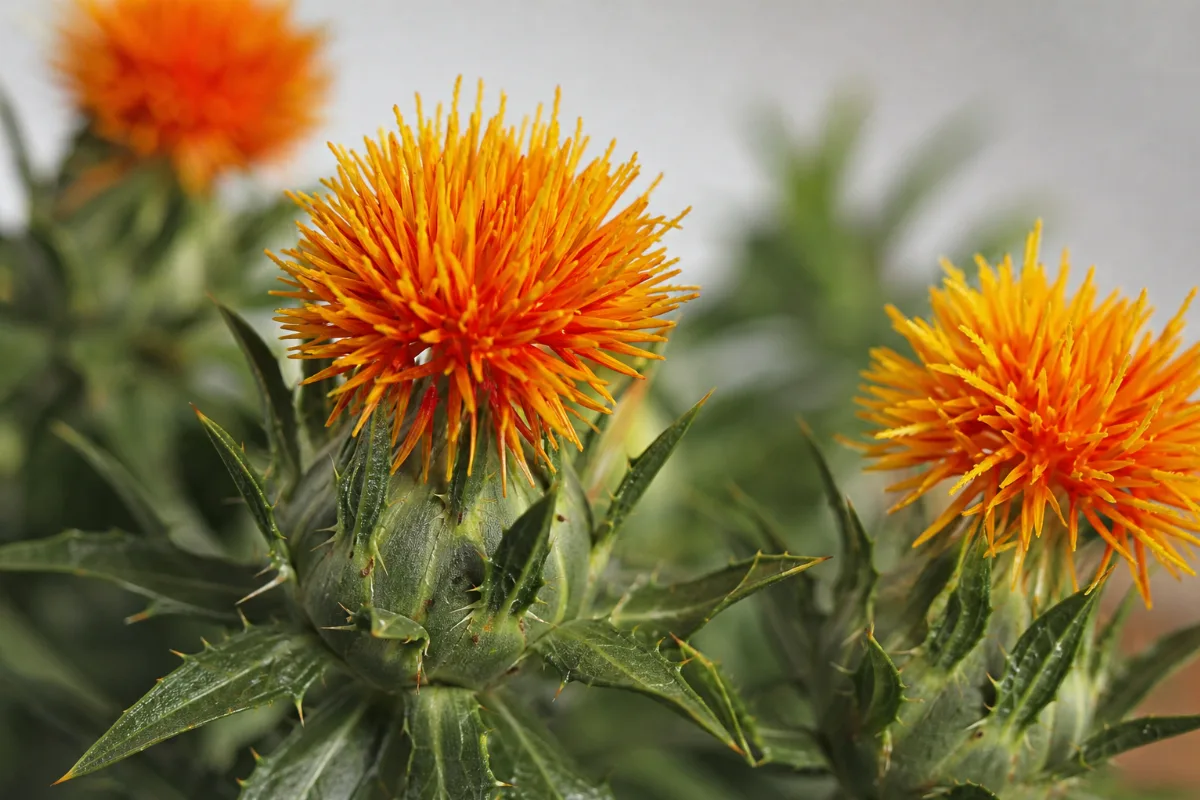
Herbs & Botanicals · Chinese blood-moving flower
Safflower
Carthamus tinctorius · also called Honghua, hong hua, false saffron, bastard saffron
Safflower is a thistle-like plant whose dried orange petals are used in Chinese medicine to move the blood and ease period pain. Most human research is on hospital injections made from it in China, and those trials are mostly low quality. The petals may slow clotting, so people on blood thinners, those who are pregnant, and anyone facing surgery should ask a clinician first. It is not true saffron, and the seed oil is a separate food product.
General information, not medical advice. Last substantive update · Not medically reviewed. A named clinician has not signed off on this page. How this page is made
About Safflower
Safflower flower is a traditional Chinese blood-moving herb. Modern human research is mostly of injections and the seed oil, with a bleeding caution that matters more than any proven benefit.
Safety first
Bleeding: safflower extracts slowed clotting and platelet clumping in animal tests and small human studies. In rats, Honghua made clopidogrel's effect on bleeding time longer. Ask a pharmacist before combining it with blood thinners or antiplatelet drugs, and tell your surgeon and dentist before any operation. We found no authoritative stop-before-surgery rule.
Pregnancy and breastfeeding: avoid medicinal amounts. Chinese medicine traditionally avoids it in pregnancy, which we did not verify in a source we read, and no human pregnancy or breastfeeding data exist. A food-colour concentrate caused no harm in rats.
Injections: these are hospital products in China. A mouse study found safflower yellow behind an immediate non-allergic reaction to one multi-herb injection, while another screen found none; most stroke trials did not track side effects.
What it is
Safflower is Carthamus tinctorius, a daisy-family plant. Its dried petals (Honghua) are used as a spice, a tea ingredient, a food colour and a Chinese medicine. The main yellow pigment is hydroxysafflor yellow A (HSYA); the red pigment is carthamin.
It is not true saffron (Crocus sativus), though petals are sold as cheap false saffron. The seed oil is a separate food, and injections and purified pigments are not the same as tea or petals.
What the research shows
Injections: low-quality Chinese trials of safflower yellow, HSYA, Honghua and Danhong (with danshen) suggest benefit for angina and stroke recovery. They are added to standard care and are not supplements.
Period pain: a multi-herb formula beat painkillers in some trials, but safflower alone was not tested. Seed oil: small trials found changes in waist, blood sugar and HDL, and a review ranked it first for lowering LDL. An old trial of a safflower-oil diet in men with heart disease found more heart deaths.
For the petals as tea or capsules, trial evidence is close to none.
At a glance
Traditional uses history, not proof
- Moving the blood and clearing blood stasis
- Period pain and menstrual problems
- Pain and bruising
- Food colour and tea ingredient
Studied for research
- Angina (injections): low
- Stroke recovery (injections): low
- Period pain (multi-herb formula): low
- Blood-sugar and waist size (seed oil): low
- Cholesterol (seed oil): moderate
- Heart deaths with a high-safflower-oil diet: against
Main compounds
- Hydroxysafflor yellow A (HSYA)
- Carthamin
- Safflower yellow
- Flavonoids
- Linoleic acid (seed oil)
Common forms
- Dried petals or tea
- Extract or capsule
- Chinese patent medicine
- Hospital injections (China)
- Seed oil (separate product)
Research links: Kan 2025: Danhong injection and unstable angina (PubMed) · Fan 2014: safflower yellow for stroke (PubMed) · Li 2010: Honghua, Danggui and clopidogrel in rats (PubMed) · Bai 2025: safflower review (PubMed) · Research Library · Genes & Biomarkers Library
The plant and its history
- Accepted scientific name
- Carthamus tinctorius L.
- Naming authority
- GBIF species match API, read 2026-10-25: ACCEPTED, usage key 3138327, family Asteraceae, exact match, confidence 99. NCBI Taxonomy search returned taxid 4222.
- Common names
- Safflower, false saffron, bastard saffron (English); Hong hua (Honghua), Flos Carthami (Chinese / Latin)
- Botanical family
- Asteraceae (daisy family)
- Classification
- Plantae > Asteraceae > Carthamus > Carthamus tinctorius
- Native range
- Not verified in the sources read.
- Habitat
- Not covered.
- What the plant looks like
- Roots: Not verified.; Stems: Not verified.; Leaves: Not verified.; Flowers: Orange to red-yellow flower heads; the dried petals are Honghua (colour per common knowledge; not verified in a source read).; Fruit: Seeds give safflower oil (a separate product).
- Cultivation
- Not covered.
- Harvest and processing
- Petals are dried for use; aqueous extracts are used as food colour (Lewin 2021).
- Look-alikes and adulterants
- Name: True saffron (Crocus sativus); Note: A different plant in the iris family; safflower petals are used to adulterate it. See the saffron page.; Name: Safflower seed oil; Note: Same plant, different product (cooking oil, mostly linoleic acid in the trials read).; Name: Purified pigments (safflower yellow, HSYA, carthamin) and injections; Note: Concentrated or purified products used in hospitals in China, not the same as tea or petals.
- Sustainability and conservation
- Not covered.
The plant and the parts used
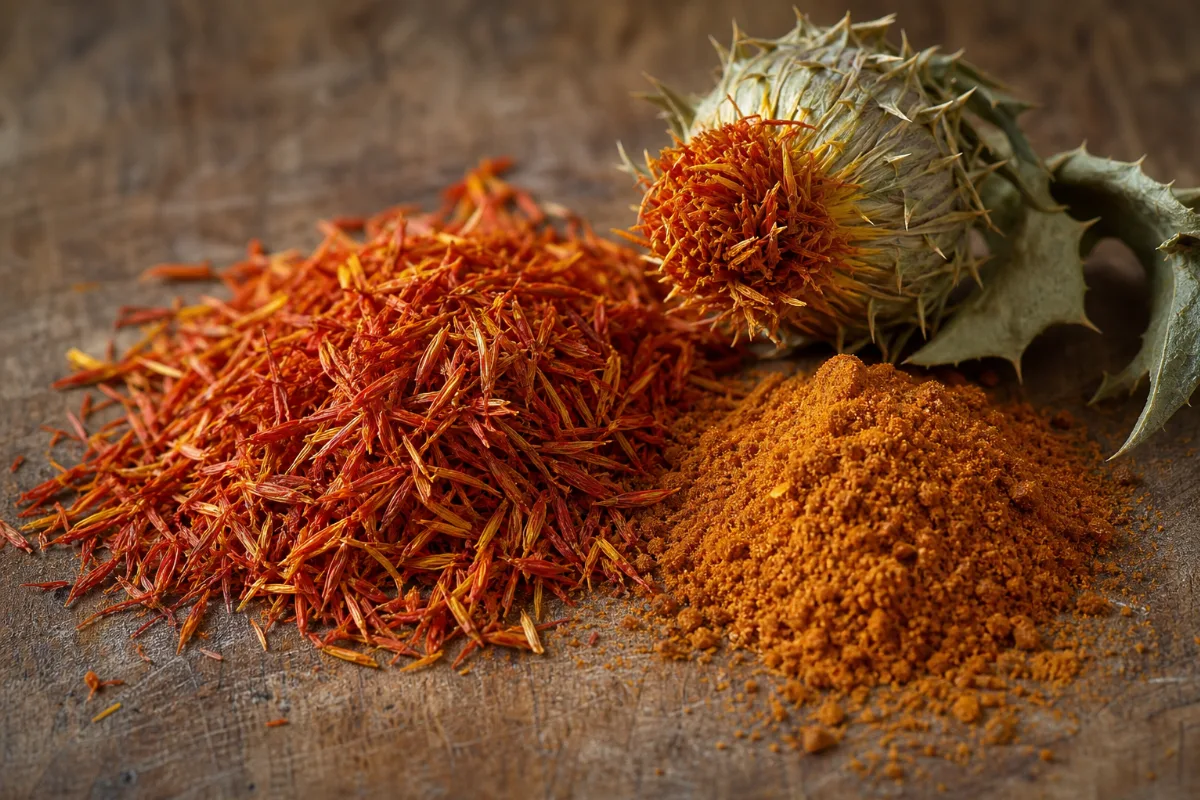
Traditional use and history history, not clinical proof
| Tradition or era | Documented use | Source |
|---|---|---|
| Traditional Chinese medicine | Honghua to move the blood, clear blood stasis and ease pain, including menstrual problems and wounds | p40918514 |
| Persian, Chinese, Korean and Japanese traditional medicine | Safflower recommended for metabolic disorders (per the 2022 trial authors) | p34487844 |
| Food and colour use | Petals used for centuries as a spice and in tea blends; aqueous extracts used as a food colouring for about 30 years | p33515695 |
| Modern China | Injections of safflower extracts, safflower yellow and HSYA for heart and brain vessel conditions | p40918514 |
| EMA/HMPC | No herbal monograph found | s-ema-safflower-notfound |
Traditional use shows how a plant was used. It does not show that a supplement works or is safe today.
What is inside, and how it may work
What the plant contains and how those compounds act in cells and animals. Laboratory and animal mechanisms are not proven effects in people.
Main compounds
| Compound | Family | Where it is concentrated | Activity studied | Level of evidence |
|---|---|---|---|---|
| Hydroxysafflor yellow A (HSYA) PubChem 6443665 | chalcone glycoside (flavonoid) | Flower | Candidate main active pigment; heart and brain effects in animals; injected in China. 19 15 7 | Animal research |
| Carthamin PubChem 135565560 | quinochalcone pigment (red) | Flower | Red pigment used as a dye (synonym Carthamus red); not studied for health in the sources read. 19 | Unknown |
| Safflower yellow (mixed pigments) | yellow pigment mixture | Flower | Used in injections; caused a non-allergic injection reaction in mice (multi-herb injection). 13 5 | Animal research |
| Flavonoids, polyacetylenes, alkaloids | groups | Flower | Flavonoids dominate; many compounds are not fully studied. 2 | Laboratory research |
| Linoleic acid PubChem 5280450 | omega-6 fatty acid | Seed oil | Main fat of the seed oil in the diet trials (a separate product). 19 20 22 | Controlled trial |
Mechanisms, receptors and pathways
| Target or pathway | Gene or receptor | What was found | Level |
|---|---|---|---|
| Platelet aggregation and clotting | Platelet glycoprotein IIb/IIIa (CD41); prothrombin and thrombin times | A Honghua injection lowered the platelet marker in a small human trial; Honghua flower extract lengthened clotting tests in rats. 26 11 | Human data |
| Complement and histamine (injection reaction) | Complement C3, histamine receptors | Safflower yellow triggered a non-allergic reaction in mice and activated C3 in human serum, as part of a multi-herb injection. 13 | Animal research |
| Heart-injury protection | Inflammation, antioxidant, cell-death pathways | HSYA reduced infarct size in rodents. 15 | Animal research |
| Inflammation and endothelium in angina | TNF-alpha, IL-6, endothelin-1, nitric oxide | Danhong injection changed blood markers in people with unstable angina. 9 | Human data |
Absorption, metabolism and elimination
- Absorption
- Intravenous HSYA reached blood quickly (median Tmax 1.1 hours) in healthy volunteers.
- Distribution
- Not covered.
- Metabolism
- Not covered.
- Elimination
- Half-life about 4.0 to 4.7 hours; clearance about 1.7 and 1.6 L/h (day 1 and day 14).
- Bioavailability
- Not covered for swallowed petals; the study used intravenous infusion only.
Isolated compounds versus whole extracts
Almost all human trials use injected extracts or the purified pigment HSYA, not petals or tea. The Danhong injection also contains danshen. The seed oil is another product again. Findings from one cannot be applied to the others.
Nutritional composition
The petals are not a nutrient source. Safflower seed oil is a high-linoleic cooking oil; in trials it replaced other fats and lowered LDL. Its evidence is kept separate from the petals.
1 moderate certainty7 low certainty3 not enough evidence1 evidence against
What was looked at
The 12 benefits and uses checked for Safflower, each with how strong the evidence is. Tap one to open it.
- Angina (hospital injections, China)Low certainty
- Stroke recovery (hospital injections, China)Low certainty
- Preventing blood clots in legs after bone surgery (with heparin)Low certainty
- 'Moving the blood' and blood stasis (traditional, oral petals)Not enough evidence
- Heart-injury protection by HSYA in animalsNot enough evidence
- Painful periods (multi-herb formula; traditional petals)Low certainty
- Waist size, blood pressure and insulin resistance (seed oil)Low certainty
- Blood sugar, inflammation and HDL in type 2 diabetes (seed oil)Low certainty
- Body fat and weight (seed oil)Low certainty
- LDL and total cholesterol when replacing saturated fat (seed oil)Moderate certainty
- Heart disease and death after a heart event (seed oil diet)Evidence against
- Antioxidant, liver-protective, anti-inflammatory and anti-cancer findings (lab and animal)Not enough evidence
Lab markers tracked in the studies
High-sensitivity C-reactive protein (hs-CRP)HomocysteinePlatelet GPIIb/IIIa (CD41) expressionClotting tests (APTT and PT)Endothelin-1 and nitric oxideWaist circumferenceHbA1cHDL cholesterolLDL and total cholesterolFasting blood glucoseInsulin resistanceC-reactive protein (CRP)
What is Safflower good for?
The studied uses and how strong the evidence is. Most are injections or the seed oil, not tea or capsules of the petals.
Benefits, one by one
Each card is a research question, not a promise. Tap a goal to filter. Open a card to see the studies, doses and limits.
Angina (hospital injections, China)
Low certaintyIn China, injections made from safflower (alone as safflower yellow, or with danshen as Danhong) are added to standard care for angina. Trials report better results, but they are mostly low quality and are not about tea, capsules or petals.
3 studiesInjections given in hospital in China (Danhong, safflower yellow, Hon…
Studies, doses and limits
What the trials found
A 2025 meta-analysis of 46 trials (4,601 people with unstable angina) of Danhong injection (safflower plus danshen) found lower inflammation and blood-vessel-stress markers. A 2022 network meta-analysis favoured conventional treatment plus safflower yellow injection for angina, with no numbers in its abstract. A small trial of Honghua injection in acute coronary syndrome found a lower platelet marker and better symptoms after 14 days.
Results
Danhong injection lowered hs-CRP, TNF-alpha, IL-6, endothelin and homocysteine and raised nitric oxide. The safflower yellow network meta-analysis and the Honghua trial give direction only.
Effect sizes as reported
Danhong injection: hs-CRP interval -1.77 to -0.90; endothelin SMD -2.01 (-2.57 to -1.46); nitric oxide SMD 1.51 (1.04 to 1.97).
Why this rating
Low: the reviewers of the Danhong trials call the original trials low quality; the product has two herbs; the outcomes are blood markers and symptoms, not fewer heart attacks.
Form and dose studied
Injections given in hospital in China (Danhong, safflower yellow, Honghua). Not oral products. Amounts are for a doctor to decide.
Who was studied
Adults with unstable or stable angina or acute coronary syndrome in China.
Limits
Two-herb product, low-quality trials, blood markers rather than heart-attack counts, Chinese trial populations only, and no trial of petals, tea or capsules.
Why researchers looked
Safflower injections are widely used for chest pain from heart disease in China.
Traditional use
In Chinese medicine the flower is used to move the blood and clear blood stasis.
Proposed mechanism Preliminary mechanism
Lab and animal work suggests anti-inflammatory, antioxidant and blood-vessel effects; this is not shown for the injections in people.
A proposed mechanism does not show that the effect happens in people.
Injection reactions and bleeding effects are covered in the safety file. Do not use it in place of heart medicines.
Stroke recovery (hospital injections, China)
Low certaintySafflower yellow and purified HSYA injections are given with standard care after a stroke caused by a blocked artery in China. Trials report better recovery, but quality is limited and the products are not supplements.
3 studiesInjections in hospital. Not applicable to tea, capsules or petals.
Studies, doses and limits
What the trials found
A 2014 systematic review of 7 trials (762 people) found more neurological improvement with safflower yellow than control; none of the trials was high quality, and skin rash occurred in one. A 2022 network meta-analysis of 120 trials (12,658 people) ranked Danhong and safflower yellow added to Western medicine best, but said most trials did not monitor adverse reactions. A 2020 phase II trial of 266 people compared three groups of HSYA injection with another herbal injection: medium and high groups did better at day 90.
Results
Odds ratio 3.11 for neurological improvement with safflower yellow. In the HSYA trial, medium and high doses reached the main outcome (disability score 1 or less at day 90) more often than the control (P<0.05).
Effect sizes as reported
Safflower yellow OR 3.11 (95% CI 2.06 to 4.68); HSYA phase II: medium and high groups better than control, P<0.05.
Why this rating
Low: trials were not high quality (reviewer statement), the control in the best trial was another herbal injection rather than placebo, and rankings rest on Chinese hospital trials.
Form and dose studied
Injections in hospital. Not applicable to tea, capsules or petals.
Who was studied
Adults with acute ischemic stroke in China.
Limits
No placebo-controlled phase III trial found; adverse reactions poorly monitored in most trials; results from one country.
Why researchers looked
Injected safflower products are used for acute ischemic stroke in China, with an early-stage trial of purified HSYA.
Traditional use
'Blood stasis' (poor blood movement) is a traditional Chinese diagnosis that these injections target.
Proposed mechanism Preliminary mechanism
Animal work suggests protection of brain tissue after blocked blood flow; not established in people.
A proposed mechanism does not show that the effect happens in people.
Injection reactions are discussed in the safety file. A stroke is an emergency; call emergency services.
Preventing blood clots in legs after bone surgery (with heparin)
Low certaintySafflower yellow added to a standard blood thinner (low molecular weight heparin) lowered clot rates after orthopaedic surgery in Chinese trials. It also lengthened clotting tests, which is a bleeding caution.
1 studiesInjected safflower yellow added to heparin.
Studies, doses and limits
What the trials found
A 2024 meta-analysis of 8 trials (624 patients) found fewer leg clots with safflower yellow plus heparin than heparin alone, longer APTT and PT, and no significant difference in adverse effects.
Results
Lower DVT rate and longer clotting tests; no numbers in the abstract.
Effect sizes as reported
Direction only.
Why this rating
Low: abstract only, combination with a blood thinner, trials not appraised for bias in what we read.
Form and dose studied
Injected safflower yellow added to heparin.
Who was studied
Orthopaedic surgery patients in China.
Limits
Combination product, no numbers seen, Chinese hospital trials.
Why researchers looked
Safflower extracts are used in China for clot prevention after operations.
Traditional use
Used to 'activate blood' after injury in Chinese medicine.
Proposed mechanism Pharmacological theory
Prolonged clotting tests suggest the extract acts on blood clotting.
A proposed mechanism does not show that the effect happens in people.
Longer clotting tests mean this is also a bleeding interaction signal; see safety file.
'Moving the blood' and blood stasis (traditional, oral petals)
Not enough evidenceChinese medicine uses safflower petals to move the blood and ease pain from blood stasis. We found no good human trial of the petals, tea or capsules for this.
1 studiesNot studied.
Studies, doses and limits
What the trials found
A 2025 review of the literature describes clinical use of safflower components for heart and brain blood-vessel disease, poor circulation and sudden deafness, but gives no controlled trial of oral petals in the abstract.
Why this rating
Traditional use only for the flower taken by mouth; the human trials are of injections.
Form and dose studied
Not studied.
Limits
Traditional use does not show that it works.
Why researchers looked
The best-known traditional use of Honghua.
Traditional use
Honghua (Carthami flos) is a long-standing Chinese medicine herb for blood stasis, pain and menstrual problems.
Proposed mechanism Laboratory research
Lab studies report effects on clotting and blood vessels; the review says how it works is poorly understood.
A proposed mechanism does not show that the effect happens in people.
Bleeding cautions apply; see safety file.
Heart-injury protection by HSYA in animals
Not enough evidenceIn rodents, the pigment HSYA made heart-attack damage smaller. This is lab and animal work only; no human trial of the purified compound for this was found.
1 studiesPurified compound given to rodents.
Studies, doses and limits
What the trials found
A 2025 meta-analysis of 28 rodent studies (686 animals) found smaller infarcts, lower heart-injury enzymes and better heart function. None of the studies assessed safety.
Results
Infarct size SMD -2.82; cTnI SMD -3.82; CK-MB SMD -2.74 (rodents).
Effect sizes as reported
Infarct -3.56 to -2.08.
Why this rating
Animal data only; the authors point out missing safety assessment and mismatch between animal timing and clinical practice.
Form and dose studied
Purified compound given to rodents.
Who was studied
Rodents.
Limits
Not human; mean study quality moderate (score 5.04, range 4 to 7).
Why researchers looked
The main yellow pigment, HSYA, is the leading candidate for the heart effects.
Proposed mechanism Animal research
Anti-inflammatory, antioxidant and anti-cell-death actions in rodents.
A proposed mechanism does not show that the effect happens in people.
No safety assessments in these studies.
Painful periods (multi-herb formula; traditional petals)
Low certaintyA famous Chinese formula with safflower and peach kernel did better than painkillers in some trials of period pain. Because it has several herbs, this does not show safflower alone works.
2 studiesA decoction of several herbs, not safflower alone.
Studies, doses and limits
What the trials found
A 2020 meta-analysis of 5 trials (486 women in the main comparison) of Taohong Siwu Tang found the modified formula better than NSAIDs; one trial also found fewer recurrences; the formula plus the contraceptive pill beat the pill alone in 60 women. The reviewers call the evidence moderate quality.
Results
Modified formula versus NSAIDs: risk ratio 1.53; recurrence risk ratio 0.31; with contraceptive pill risk ratio 1.35.
Effect sizes as reported
RR 1.53 (95% CI 1.37 to 1.72); recurrence RR 0.31 (0.15 to 0.63); RR 1.35 (1.02 to 1.79).
Why this rating
Low for safflower itself: reviewers rate moderate quality for the whole formula, but the formula has several herbs and only 5 trials.
Form and dose studied
A decoction of several herbs, not safflower alone.
Who was studied
Women with primary dysmenorrhea (period pain with no other cause), mostly Asian trials.
Limits
Multi-herb formula; no trial of safflower alone for period pain was found.
Why researchers looked
Safflower is a classic Chinese herb for menstrual problems.
Traditional use
Honghua is traditionally used to move blood and ease menstrual pain, and in China is traditionally cautioned in pregnancy (not verified in a source we read).
Proposed mechanism Pharmacological theory
Unknown; the formula acts through several herbs.
A proposed mechanism does not show that the effect happens in people.
Traditionally avoided in pregnancy; see safety file.
Waist size, blood pressure and insulin resistance (seed oil)
Low certaintyIn one 12-week trial in Iran, safflower seed oil (a cooking oil, not the petals) reduced waist size and other measures compared with placebo in people with metabolic syndrome. It is a single small trial.
1 studiesSeed oil, a food oil; not the flower.
Studies, doses and limits
What the trials found
A 2022 randomised double-blind placebo-controlled trial of 67 adults with metabolic syndrome found safflower oil reduced waist circumference, systolic blood pressure and insulin resistance and raised adiponectin compared with placebo. No significant difference for lipids, leptin or creatinine.
Results
Waist -2.42 versus +0.97 (P<0.001); insulin resistance -0.59 versus +0.50 (P=0.012); adiponectin +0.38 versus -0.09 (P=0.042); systolic blood pressure difference P=0.003.
Why this rating
Low: one small trial of 67 people; no repeat trial.
Form and dose studied
Seed oil, a food oil; not the flower.
Who was studied
Adults with metabolic syndrome in Iran.
Limits
Single small trial; diet and exercise not changed; funding not stated in abstract.
Why researchers looked
Safflower seed oil is rich in linoleic acid and is used in Persian and East Asian traditional medicine.
Traditional use
Traditional Persian and Asian medicines recommend safflower for metabolic disorders (per the trial authors).
Proposed mechanism Preliminary mechanism
Unclear; possibly linked to the oil's unsaturated fats.
A proposed mechanism does not show that the effect happens in people.
No safety concern stated in the abstract.
Blood sugar, inflammation and HDL in type 2 diabetes (seed oil)
Low certaintyIn obese post-menopausal women with type 2 diabetes, safflower seed oil lowered HbA1c and CRP and raised HDL in a small crossover study. The comparison was another oil, not placebo.
2 studiesSeed oil, a food oil.
Studies, doses and limits
What the trials found
A 2011 randomised double-masked crossover study (55 enrolled, 35 completed) found safflower oil lowered HbA1c and CRP and raised QUICKI and HDL, while conjugated linoleic acid oil did not. A companion 2009 report found safflower oil lowered fasting glucose and raised adiponectin.
Results
HbA1c -0.64% (P=0.0007); CRP -13.6 mg/L (P=0.0472); HDL +0.12 mmol/L (P=0.0228); fasting glucose P=0.0343.
Why this rating
Low: a small crossover study with 20 dropouts, compared with another oil.
Form and dose studied
Seed oil, a food oil.
Who was studied
Obese post-menopausal women with type 2 diabetes in the USA.
Limits
Small, one group, not a placebo comparator.
Why researchers looked
Dietary fat quality is studied in diabetes.
Proposed mechanism Preliminary mechanism
Possibly via linoleic acid raising insulin sensitivity.
A proposed mechanism does not show that the effect happens in people.
Could add to the effect of diabetes medicines; ask a clinician.
Body fat and weight (seed oil)
Low certaintySafflower seed oil did not change weight or total body fat in women with diabetes, though it reduced belly (trunk) fat and raised lean mass in one study. It is not shown to be a weight-loss product.
2 studiesSeed oil.
Studies, doses and limits
What the trials found
In the 2009 crossover trial (35 completed), safflower oil had no effect on BMI or total fat but reduced trunk fat and increased lean mass compared with the conjugated linoleic acid period. In the Iranian metabolic syndrome trial waist circumference fell.
Results
No BMI or total-fat change; trunk fat P=0.0422; lean mass P=0.0432.
Why this rating
Low and mixed: little change in weight or total fat, some change in belly fat and waist.
Form and dose studied
Seed oil.
Who was studied
Women with type 2 diabetes; adults with metabolic syndrome.
Limits
Small trials; mixed outcomes.
Why researchers looked
Oil trials looked at body composition.
Proposed mechanism Preliminary mechanism
Unknown.
A proposed mechanism does not show that the effect happens in people.
None noted.
LDL and total cholesterol when replacing saturated fat (seed oil)
Moderate certaintySafflower oil ranked best among 13 oils and fats for lowering LDL and total cholesterol in a large review. This is about swapping animal fat for plant oil, not about the petals.
2 studiesSeed oil as a diet change.
Studies, doses and limits
What the trials found
A 2018 network meta-analysis of 54 randomised trials found safflower oil had the highest ranking score for lowering LDL (82%) and total cholesterol (90%). In the Iranian trial, though, lipids did not differ from placebo.
Results
Ranking scores 82% (LDL) and 90% (total cholesterol).
Why this rating
Moderate for the cholesterol blood test when swapped for saturated fat; this is a ranking in a published network analysis (the reviewers' own GRADE was not seen).
Form and dose studied
Seed oil as a diet change.
Who was studied
Adults in trials of at least 3 weeks.
Limits
A ranking is not an effect size; lipids are not heart attacks.
Why researchers looked
High-linoleic oils lower LDL when they replace saturated fat.
Proposed mechanism Pharmacological theory
Replacing saturated fat with unsaturated fat lowers LDL.
A proposed mechanism does not show that the effect happens in people.
See the next entry on heart outcomes.
Heart disease and death after a heart event (seed oil diet)
Evidence againstCholesterol falls with safflower oil, but the one old trial that tested a safflower-oil diet in men with heart disease found more deaths, not fewer. A later meta-analysis found no heart benefit. Not about the petals.
1 studiesSafflower oil and margarine as diet.
Studies, doses and limits
What the trials found
The Sydney Diet Heart Study (recovered data, 458 men with a recent coronary event, 1966-73) replaced saturated fat with safflower oil and safflower oil margarine. More men in the intervention group died of heart disease than in controls. An updated meta-analysis of linoleic acid trials showed no heart benefit and non-significant trends toward harm.
Results
Cardiovascular death HR 1.70; coronary heart disease death HR 1.74; updated meta-analysis coronary death HR 1.33 (P=0.06).
Effect sizes as reported
CV 1.03 to 2.80; CHD 1.04 to 2.92; meta-analysis 0.99 to 1.79.
Why this rating
Against for a safflower oil diet preventing heart deaths in this one trial; the trial design has limits (single-blind, only men, one place, margarine of that era).
Form and dose studied
Safflower oil and margarine as diet.
Who was studied
Men aged 30 to 59 with a recent coronary event.
Limits
Old single trial with an erratum; not tested in a modern setting.
Why researchers looked
Checks whether the cholesterol change leads to fewer deaths.
Proposed mechanism Pharmacological theory
Not applicable.
A proposed mechanism does not show that the effect happens in people.
A reason not to assume seed oil protects the heart.
Antioxidant, liver-protective, anti-inflammatory and anti-cancer findings (lab and animal)
Not enough evidenceLab and animal studies of safflower extracts and compounds report antioxidant, liver-protective, anti-inflammatory and anti-cancer effects. None of this is shown in people.
1 studiesExtracts and compounds in cells and animals.
Studies, doses and limits
What the trials found
A 2025 review reports these effects from lab work and says how they work is poorly understood.
Why this rating
Lab and animal only.
Form and dose studied
Extracts and compounds in cells and animals.
Who was studied
Cells and animals.
Limits
Not human data.
Why researchers looked
Many compounds in the petals show activity in cells.
Proposed mechanism Laboratory research
Poorly understood.
A proposed mechanism does not show that the effect happens in people.
None.
Connections to the rest of health
How Safflower connects to the rest of our health knowledge graph. Every link says what kind of connection it is. A safety link (for example to the liver) is a warning, not a benefit. A study that merely mentions a topic never creates a benefit link.
Explore every connection: goals, body systems, organs, symptoms, genes
A. Wellness goals
| Connected to | Kind of connection | Evidence status | Context | Studies |
|---|---|---|---|---|
| Women's wellness | Traditional use | Not enough evidence | Period pain evidence is for a formula; pregnancy is a caution. Preparation or compound: Taohong Siwu formula (multi-herb) |
8 |
| Heart Health | Potential benefit | Low certainty | Angina (hospital injections, China): In China, injections made from safflower (alone as safflower yellow, or with danshen as Danhong) are added to standard care for angina. Trials report better results, but they are mostly low quality and are not about tea, capsules or petals. Stroke recovery (hospital injections, China): Safflower yellow and purified HSYA injections are given with standard care after a stroke caused by a blocked artery in China. Trials report better recovery, but quality is limited and the products are not supplements. | 9 14 26 5 12 7 23 |
| Inflammation Balance | Potential benefit | Low certainty | Angina (hospital injections, China): In China, injections made from safflower (alone as safflower yellow, or with danshen as Danhong) are added to standard care for angina. Trials report better results, but they are mostly low quality and are not about tea, capsules or petals. Blood sugar, inflammation and HDL in type 2 diabetes (seed oil): In obese post-menopausal women with type 2 diabetes, safflower seed oil lowered HbA1c and CRP and raised HDL in a small crossover study. The comparison was another oil, not placebo. | 9 14 26 1 18 |
| Brain Health | Potential benefit | Low certainty | Stroke recovery (hospital injections, China): Safflower yellow and purified HSYA injections are given with standard care after a stroke caused by a blocked artery in China. Trials report better recovery, but quality is limited and the products are not supplements. | 5 12 7 |
| Heart Health | Traditional use | Not enough evidence | 'Moving the blood' and blood stasis (traditional, oral petals): Chinese medicine uses safflower petals to move the blood and ease pain from blood stasis. We found no good human trial of the petals, tea or capsules for this. | 2 |
| Heart Health | Preliminary mechanism | Not enough evidence | Heart-injury protection by HSYA in animals: In rodents, the pigment HSYA made heart-attack damage smaller. This is lab and animal work only; no human trial of the purified compound for this was found. | 15 |
| Womens Wellness | Traditional use | Low certainty | Painful periods (multi-herb formula; traditional petals): A famous Chinese formula with safflower and peach kernel did better than painkillers in some trials of period pain. Because it has several herbs, this does not show safflower alone works. | 8 2 |
| Metabolic Health | Potential benefit | Low certainty | Waist size, blood pressure and insulin resistance (seed oil): In one 12-week trial in Iran, safflower seed oil (a cooking oil, not the petals) reduced waist size and other measures compared with placebo in people with metabolic syndrome. It is a single small trial. | 21 |
| Weight Management | Potential benefit | Low certainty | Waist size, blood pressure and insulin resistance (seed oil): In one 12-week trial in Iran, safflower seed oil (a cooking oil, not the petals) reduced waist size and other measures compared with placebo in people with metabolic syndrome. It is a single small trial. Body fat and weight (seed oil): Safflower seed oil did not change weight or total body fat in women with diabetes, though it reduced belly (trunk) fat and raised lean mass in one study. It is not shown to be a weight-loss product. | 21 18 |
| Blood Pressure Support | Potential benefit | Low certainty | Waist size, blood pressure and insulin resistance (seed oil): In one 12-week trial in Iran, safflower seed oil (a cooking oil, not the petals) reduced waist size and other measures compared with placebo in people with metabolic syndrome. It is a single small trial. | 21 |
| Blood Sugar Balance | Potential benefit | Low certainty | Blood sugar, inflammation and HDL in type 2 diabetes (seed oil): In obese post-menopausal women with type 2 diabetes, safflower seed oil lowered HbA1c and CRP and raised HDL in a small crossover study. The comparison was another oil, not placebo. | 1 18 |
| Cholesterol Balance | Potential benefit | Low certainty | Blood sugar, inflammation and HDL in type 2 diabetes (seed oil): In obese post-menopausal women with type 2 diabetes, safflower seed oil lowered HbA1c and CRP and raised HDL in a small crossover study. The comparison was another oil, not placebo. | 1 18 |
| Cholesterol Balance | Demonstrated clinical effect | Moderate certainty | LDL and total cholesterol when replacing saturated fat (seed oil): Safflower oil ranked best among 13 oils and fats for lowering LDL and total cholesterol in a large review. This is about swapping animal fat for plant oil, not about the petals. | 22 21 |
| Heart Health | Demonstrated clinical effect | Moderate certainty | LDL and total cholesterol when replacing saturated fat (seed oil): Safflower oil ranked best among 13 oils and fats for lowering LDL and total cholesterol in a large review. This is about swapping animal fat for plant oil, not about the petals. Heart disease and death after a heart event (seed oil diet): Cholesterol falls with safflower oil, but the one old trial that tested a safflower-oil diet in men with heart disease found more deaths, not fewer. A later meta-analysis found no heart benefit. Not about the petals. | 22 21 20 |
| Inflammation Balance | Preliminary mechanism | Not enough evidence | Antioxidant, liver-protective, anti-inflammatory and anti-cancer findings (lab and animal): Lab and animal studies of safflower extracts and compounds report antioxidant, liver-protective, anti-inflammatory and anti-cancer effects. None of this is shown in people. | 2 |
B. Body systems
| Connected to | Kind of connection | Evidence status | Context | Studies |
|---|---|---|---|---|
| Heart and blood vessels | Traditional use | Mixed findings | Low-quality trials of injections; traditional blood-moving use of the petals. Preparation or compound: Injected safflower extracts, HSYA, safflower yellow |
9 12 |
| Cardiovascular System | Biological association | Low certainty | Studied for: Angina (hospital injections, China) Studied for: Stroke recovery (hospital injections, China) | 9 14 26 5 12 7 23 2 15 21 22 20 |
| Nervous System | Biological association | Low certainty | Studied for: Stroke recovery (hospital injections, China) | 5 12 7 |
| Reproductive System | Biological association | Low certainty | Studied for: Painful periods (multi-herb formula; traditional petals) | 8 2 |
| Metabolism Weight | Biological association | Low certainty | Studied for: Waist size, blood pressure and insulin resistance (seed oil) Studied for: Blood sugar, inflammation and HDL in type 2 diabetes (seed oil) | 21 1 18 |
| Endocrine System | Biological association | Low certainty | Studied for: Blood sugar, inflammation and HDL in type 2 diabetes (seed oil) | 1 18 |
| Immune System | Biological association | Not enough evidence | Studied for: Antioxidant, liver-protective, anti-inflammatory and anti-cancer findings (lab and animal) | 2 |
C. Body parts and organs
| Connected to | Kind of connection | Evidence status | Context | Studies |
|---|---|---|---|---|
| Blood vessels | Adverse effect or risk | Theoretical | Longer clotting tests. Preparation or compound: Safflower yellow |
23 |
G. Root causes and contributing factors
| Connected to | Kind of connection | Evidence status | Context | Studies |
|---|---|---|---|---|
| Herb-drug interaction | Drug or supplement interaction | Documented | Animal and test-level evidence of extra effect on bleeding. Preparation or compound: Flower extracts with antiplatelet and blood-thinning drugs |
11 |
I. Biomarkers
| Connected to | Kind of connection | Evidence status | Context | Studies |
|---|---|---|---|---|
| High-sensitivity C-reactive protein (hs-CRP) | Biological association | Low certainty | Measured in trials: lowered. A lab change is not the same as a health benefit. | 9 |
| Homocysteine | Biological association | Low certainty | Measured in trials: lowered. A lab change is not the same as a health benefit. | 9 |
| Platelet GPIIb/IIIa (CD41) expression | Biological association | Low certainty | Measured in trials: lowered. A lab change is not the same as a health benefit. | 26 |
| Clotting tests (APTT and PT) | Biological association | Low certainty | Measured in trials: raised. A lab change is not the same as a health benefit. | 23 |
| Endothelin-1 and nitric oxide | Biological association | Low certainty | Measured in trials: mixed. A lab change is not the same as a health benefit. | 9 |
| Waist circumference | Biological association | Low certainty | Measured in trials: lowered. A lab change is not the same as a health benefit. | 21 |
| HbA1c | Biological association | Low certainty | Measured in trials: lowered. A lab change is not the same as a health benefit. | 1 |
| HDL cholesterol | Biological association | Low certainty | Measured in trials: raised. A lab change is not the same as a health benefit. | 1 |
| LDL and total cholesterol | Biological association | Mixed findings | Measured in trials: lowered. A lab change is not the same as a health benefit. | 22 21 |
| Fasting blood glucose | Biological association | Low certainty | Measured in trials: lowered. A lab change is not the same as a health benefit. | 18 |
| Insulin resistance | Biological association | Low certainty | Measured in trials: lowered. A lab change is not the same as a health benefit. | 21 |
| C-reactive protein (CRP) | Biological association | Low certainty | Measured in trials: lowered. A lab change is not the same as a health benefit. | 1 |
K. Biological pathways
L. Active compounds
| Connected to | Kind of connection | Evidence status | Context | Studies |
|---|---|---|---|---|
| Hydroxysafflor yellow A (HSYA) | Biological association | Animal | Candidate main active pigment; heart and brain effects in animals; injected in China. Preparation or compound: Flower |
19 15 7 |
| Carthamin | Biological association | Unknown | Red pigment used as a dye (synonym Carthamus red); not studied for health in the sources read. Preparation or compound: Flower |
19 |
| Safflower yellow (mixed pigments) | Biological association | Animal | Used in injections; caused a non-allergic injection reaction in mice (multi-herb injection). Preparation or compound: Flower |
13 5 |
| Flavonoids, polyacetylenes, alkaloids | Biological association | In vitro | Flavonoids dominate; many compounds are not fully studied. Preparation or compound: Flower |
2 |
| Linoleic acid | Biological association | Rct | Main fat of the seed oil in the diet trials (a separate product). Preparation or compound: Seed oil |
19 20 22 |
Each connection is stored with the ingredient, the connected record, the kind of connection, the evidence status, the supporting studies, the preparation or compound involved, and a review date (last reviewed October 25, 2026).
Evidence at a glance: what changed in 12 lab markers
Tap a number to show only those markers. Counts are markers, not people.
The evidence
The research centre for Safflower. Every record here was checked against PubMed or the publisher's page; we never list a study we have not verified.
Evidence by outcome
Bars show how many studies we found for each outcome, not how well it works. People are added up across trials only (reviews are not added, to avoid double counting).
How we rate evidence
High certainty
Several well-run trials or reviews agree; further research is unlikely to change the picture much.
Moderate certainty
Good trials point the same way, but some doubt remains.
Low certainty
Small, short or inconsistent trials. The finding could change with better research.
Very low certainty
Very little or very weak human data. Treat as a possibility only.
Mixed findings
Trials or reviews disagree with each other.
Not enough evidence
Not enough human research to say either way.
Evidence against
Good research found no benefit, or found harm.
We take the reviewers' own risk-of-bias and GRADE statements where they exist, and otherwise judge from study size, design, consistency, directness and whether a product matches what is sold. Many publications do not make evidence high. Method note: We read our existing herb summary, searched PubMed, read the abstract of each PubMed record cited, and checked names in GBIF and compounds in PubChem. Regulator pages that could not be opened are marked not found or not verified.
Study library: every study we checked 26
| Study | Design | People | Product, dose, length | Result |
|---|---|---|---|---|
| Asp 2011 Time-dependent effects of safflower oil to improve glycemia, inflammation and blood lipids in obese, post-menopausal women with type 2 diabetes: a randomized, double-masked, crossover study. Clin Nutr · PMID 21295383 · DOI |
Controlled trial |
55 Obese post-menopausal women with type 2 diabetes (35 completed) |
Safflower seed oil versus conjugated linoleic acid (CLA) oil seed (oil) 8 g a day 16 weeks per period (crossover) · vs CLA oil |
Safflower oil lowered HbA1c and CRP, raised QUICKI and raised HDL cholesterol. CLA did not change these measures. HbA1c -0.64% (P=0.0007); CRP -13.6 mg/L (P=0.0472); QUICKI +0.0077 (P=0.0146); HDL +0.12 mmol/L (P=0.0228) (None) Methods, limits and fundingOutcomes: HbA1c, CRP, QUICKI (insulin sensitivity), HDL cholesterol. Limitations: Small crossover study; the comparison oil (CLA) was not a placebo; 20 of 55 did not finish. Seed oil, not petals. Funding and conflicts: No conflicts declared. Read: abstract |
| Bai 2025 Carthamus tinctorius L.: a comprehensive review of its ethnomedicine, phytochemistry, pharmacology, and clinical applications. Front Pharmacol · PMID 40918514 · DOI |
Narrative review |
Literature to April 2025 (English and Chinese) | Safflower extracts and metabolites (flowers mainly) flower |
Flavonoids are the main compounds. Lab work reports antioxidant, liver-protective, anti-inflammatory and anticancer effects. Clinically, safflower components are used in China for heart and brain blood-vessel disease, diabetes, liver and bile conditions, poor circulation and sudden deafness. The authors say research is limited and the ways it works are poorly understood. Narrative review; no pooled effect (None) Methods, limits and fundingOutcomes: Botany, traditional use, chemistry, lab activity and clinical use of safflower. Limitations: Not a systematic review; trial quality not appraised in the abstract. Funding and conflicts: No conflicts declared. Read: abstract |
| Chen 2019 [Study on safflower yellow for injection based on cell degranulation and acute anaphylactoid model]. Zhongguo Zhong Yao Za Zhi · PMID 31602955 · DOI |
Animal study animal |
Cell model and mice | Safflower yellow for injection (several batches) flower (injected extract) · vs Positive control C48/80 |
Safflower yellow for injection caused no significant cell degranulation and no significant rise in mouse plasma histamine. Batches differed from the positive control. Not applicable (None) Methods, limits and fundingOutcomes: Cell degranulation; plasma histamine. Limitations: Lab and mouse screen in Chinese; disagrees with the 2026 Xuebijing report, so injection reactions remain unsettled. Funding and conflicts: Not stated. Read: abstract |
| European Medicines Agency 2026 EMA herbal medicines: safflower European Medicines Agency · Source |
Authoritative guidance |
unspecified |
No EMA/HMPC herbal monograph for Carthami flos found: two guessed monograph addresses returned page-not-found on 2026-10-25. Methods, limits and fundingLimitations: Not found is not proof none exists; the EMA search page was not searched in full. Read: not-found | |
| Fan 2014 Safflower yellow for acute ischemic stroke: A systematic review of randomized controlled trials. Complement Ther Med · PMID 24731908 · DOI |
Systematic review |
762 People with acute ischemic stroke (7 trials) |
Safflower yellow (injection) flower (injected extract) · vs Placebo or no intervention |
More people improved neurologically with safflower yellow. No deaths were reported. Only four trials reported adverse events; a skin rash occurred in the treatment group of one. Odds ratio 3.11 for neurological improvement (2.06 to 4.68) Methods, limits and fundingOutcomes: Neurological improvement rate; deaths; adverse events. Limitations: None of the trials had high methodological quality. Search ended January 2013. Funding and conflicts: Not stated in abstract. Read: abstract |
| GBIF 2026 GBIF species match: Carthamus tinctorius GBIF · Source |
Authoritative guidance |
unspecified |
ACCEPTED name Carthamus tinctorius L., usage key 3138327, family Asteraceae, genus Carthamus, exact match, confidence 99. Read 2026-10-25. Methods, limits and fundingLimitations: Name and family only. Read: full-text | |
| Hu 2020 Effect and Safety of Hydroxysafflor Yellow A for Injection in Patients with Acute Ischemic Stroke of Blood Stasis Syndrome: A Phase II, Multicenter, Randomized, Double-Blind, Multiple-Dose, Active-Controlled Clinical Trial. Chin J Integr Med · PMID 32361934 · DOI |
Controlled trial |
266 People with moderate or severe acute ischemic stroke and blood stasis syndrome (9 centres, China) |
Hydroxysafflor yellow A (HSYA) for injection, three dose groups flower (purified compound, injected) three intravenous doses (see paper) 14 days of treatment; 90 days follow-up · vs Dengzhan Xixin injection (another herbal injection) |
At day 90 more people in the medium- and high-dose groups reached the main outcome than in the control group (P<0.05). No significant difference between groups in specific adverse events. Medium and high dose better than control (P<0.05); exact proportions not in abstract (None) Methods, limits and fundingOutcomes: Modified Rankin Scale 1 or less at day 90; NIHSS, Barthel Index; adverse events. Limitations: Phase II trial; control was another herbal injection, not placebo; registered ChiCTR-2000029608 in 2020, after the trial (2013-2015). Abstract doses are inconsistent (70 mg versus 75 mg), so doses are not repeated here. Funding and conflicts: Funding not stated in abstract. Read: abstract |
| Ji 2020 Herbal medicine (Taohong Siwu Tang) for the treatment of primary dysmenorrhea: A systematic review and meta-analysis. Explore (NY) · PMID 32723605 · DOI |
Meta-analysis |
486 Women with primary dysmenorrhea (5 trials) |
Taohong Siwu Tang (a decoction of several herbs including peach kernel and safflower flower), original or modified multi-herb formula · vs NSAIDs, or oral contraceptives alone |
The modified formula was better than NSAIDs for overall effect and recurrence in one trial. A formula plus oral contraceptives beat oral contraceptives alone in 60 women. Modified formula versus NSAIDs RR 1.53 (n=486); recurrence RR 0.31 (n=246); plus contraceptives RR 1.35 (n=60) (RR 1.53: 1.37 to 1.72; recurrence 0.15 to 0.63; RR 1.35: 1.02 to 1.79) Methods, limits and fundingOutcomes: Overall effectiveness; recurrence. Limitations: Multi-herb formula, so safflower cannot be credited alone. Few trials. The reviewers rated the evidence moderate quality. Funding and conflicts: No conflicts declared. Read: abstract |
| Kan 2025 Efficacy and safety of Danhong injection on inflammatory factors and vascular endothelial function in patients with unstable angina pectoris: a systematic review and meta-analysis of randomized clinical trials. Front Pharmacol · PMID 40584629 · DOI |
Meta-analysis |
4601 People with unstable angina (46 trials) |
Danhong injection (Salvia miltiorrhiza plus Carthamus tinctorius extracts) flower plus danshen root (injected) · vs Standard treatment |
Danhong injection lowered hs-CRP, TNF-alpha, IL-6, endothelin and homocysteine and raised nitric oxide. Twenty-one trials described adverse events. hs-CRP SMD printed as 1.34 (a lowering effect, as the interval is negative); TNF-alpha -0.84; IL-6 -1.05; endothelin -2.01; homocysteine -0.55; nitric oxide +1.51 (hs-CRP -1.77 to -0.90; TNF-alpha -1.54 to -0.15; IL-6 -1.86 to -0.25; endothelin -2.57 to -1.46; homocysteine -0.71 to -0.39; nitric oxide 1.04 to 1.97) Methods, limits and fundingOutcomes: hs-CRP, TNF-alpha, IL-6, endothelin-1, homocysteine, nitric oxide. Limitations: Two-herb injection, so safflower cannot be credited alone. The authors call the overall quality of the original trials low. Blood markers are not heart attacks or deaths. Funding and conflicts: No conflicts declared. Read: abstract |
| Lewin 2021 Food grade safflower concentrate: No evidence for reproduction and early developmental toxicity. Reprod Toxicol · PMID 33515695 · DOI |
Animal study animal |
Rats; plus bacterial and mouse-cell tests | Well-characterised aqueous safflower petal concentrate (food colouring grade) flower (aqueous concentrate) up to 1000 mg per kg body weight a day by gavage reproductive screening protocol · vs Control |
No sign of general toxicity, fertility harm or effect on development. Earlier reports of harm in rodents used poorly described extracts. Gene-damage tests were negative. No-effect level at least 1000 mg per kg a day (rats) (None) Methods, limits and fundingOutcomes: Fertility, reproduction, prenatal development, pup growth, hormones. Limitations: Rats, food colour concentrate, not a medicinal extract; nothing in pregnant women. Author affiliations were not checked; a possible industry link is not verified. Funding and conflicts: Not stated in abstract; possible industry link not verified. Read: abstract |
| Li 2010 Antithrombotic effects of Danggui, Honghua and potential drug interaction with clopidogrel. J Ethnopharmacol · PMID 20176099 · DOI |
Animal study animal |
Rats (three experimental clot models) | Honghua (safflower flower) extract and Danggui, alone or with clopidogrel flower · vs Clopidogrel alone; control |
Honghua reduced clots and tended to lengthen bleeding and clotting time (prothrombin time and thrombin time significantly longer). With clopidogrel it did not add clot protection but significantly lengthened bleeding time and prothrombin time further. Not given in abstract (None) Methods, limits and fundingOutcomes: Clot formation, bleeding time, clotting tests. Limitations: Animal study; not shown in people. Funding and conflicts: Not stated. Read: abstract |
| Li 2022 Comparative efficacy of Honghua class injections for treating acute ischemic stroke: A Bayesian network meta-analysis of randomized controlled trials. Front Pharmacol · PMID 36249799 · DOI |
Network meta analysis |
12658 People with acute ischemic stroke (120 trials, China) |
Honghua, safflower yellow, Guhong and Danhong injections, each added to Western medicine flower (injected extracts) · vs Western medicine alone |
Danhong plus Western medicine ranked best for clinical effectiveness; safflower yellow plus Western medicine also ranked well. Most trials did not monitor adverse reactions, so safety is unclear. Rankings only in abstract (None) Methods, limits and fundingOutcomes: Clinical effectiveness rate, activities of daily living, blood-flow measures, adverse reactions. Limitations: The authors say the conclusion may be biased. Hospital injections, not supplements. Registered PROSPERO CRD42021229599. Funding and conflicts: No conflicts declared. Read: abstract |
| Li 2026 Safflower yellow in Carthami Flos is responsible for Xuebijing Injection-induced immediate hypersensitivity reaction through activating complement C3. Chin Herb Med · PMID 41584707 · DOI |
Animal study animal |
Mice and human cells and serum | Xuebijing injection (five herbs including safflower) and its parts flower (safflower yellow pigment) · vs Antagonists and controls |
Of the five herbs, only safflower yellow caused the immediate reaction. The reaction was non-allergic (complement and histamine, not IgE). Removing the colour stopped the reaction but kept the anti-inflammatory effect. Not applicable (None) Methods, limits and fundingOutcomes: Immediate hypersensitivity reactions. Limitations: Mice and cells; no human reaction data in the abstract. One multi-herb injection. Funding and conflicts: No conflicts declared. Read: abstract |
| Lu 2022 Safflor yellow treating angina pectoris: A pharmacoeconomic evaluation and network meta-analysis. Medicine (Baltimore) · PMID 36253977 · DOI |
Network meta analysis |
People with angina pectoris (China) | Safflower yellow injection plus conventional treatment flower (injected extract) · vs Conventional treatment and other add-on options |
The authors conclude conventional treatment plus safflower yellow injection is a better choice for angina. Numbers are not given in the abstract. Direction only; no numbers in abstract (None) Methods, limits and fundingOutcomes: Cure or recovery rate and cost-effectiveness. Limitations: Abstract only; number of trials, quality ratings and effect sizes not seen. Cost analysis included. Funding and conflicts: No funding or conflicts declared. Read: abstract |
| Mao 2025 Hydroxysafflor yellow A for ischemic heart diseases: a systematic review and meta-analysis of animal experiments. Front Pharmacol · PMID 40271057 · DOI |
Meta-analysis animal |
686 28 rodent studies of heart injury |
Hydroxysafflor yellow A (purified compound) flower (purified compound) · vs Control animals |
HSYA reduced infarct size and heart-injury markers and improved heart function in rodents. No study assessed safety. Infarct size SMD -2.82; troponin I SMD -3.82; CK-MB SMD -2.74 (Infarct -3.56 to -2.08; cTnI -5.20 to -2.44; CK-MB -3.58 to -1.91) Methods, limits and fundingOutcomes: Heart-attack size, heart enzymes, heart function. Limitations: Rodents only; mean methodology quality score 5.04 (range 4 to 7); no safety assessment. Funding and conflicts: No conflicts declared. Read: summary-only |
| NCBI Bookshelf 2026 LiverTox and LactMed searches for safflower NCBI Bookshelf · Source |
Authoritative guidance |
unspecified |
A Bookshelf search for safflower with LiverTox returned only a general overview of Herbalife products; no safflower entry found. A search with LactMed returned nothing. Our earlier graph summary could not open LiverTox. Methods, limits and fundingLimitations: Not found is not proof none exists; the overview page mentioning safflower was not opened. Read: not-found | |
| NCCIH 2026 NCCIH herb page: safflower NCCIH · Source |
Authoritative guidance |
unspecified |
No NCCIH safflower page found (page-not-found on 2026-10-25). Our earlier graph summary also found none. Methods, limits and fundingLimitations: Not found is not proof none exists. Read: not-found | |
| Norris 2009 Comparison of dietary conjugated linoleic acid with safflower oil on body composition in obese postmenopausal women with type 2 diabetes mellitus. Am J Clin Nutr · PMID 19535429 · DOI |
Controlled trial |
55 Obese post-menopausal women with type 2 diabetes (35 completed) |
Safflower seed oil versus CLA oil seed (oil) 8 g a day 16 weeks per period (crossover) · vs CLA oil |
Safflower oil did not change BMI or total fat but reduced trunk fat, increased lean mass, lowered fasting glucose and raised adiponectin. CLA lowered BMI and total fat. Trunk fat P=0.0422; lean mass P=0.0432; fasting glucose P=0.0343; adiponectin P=0.0051 (None) Methods, limits and fundingOutcomes: Body mass index, fat mass, trunk fat, lean mass, glucose. Limitations: Same small crossover study group as the 2011 report; 35 of 55 finished. Seed oil. Funding and conflicts: No conflicts stated in abstract. Read: abstract |
| PubChem 2026 PubChem compound records: HSYA, carthamin, linoleic acid PubChem · Source |
Authoritative guidance |
unspecified |
HSYA CID 6443665 (C27H32O16; synonyms include Safflomin A); carthamin CID 135565560 (C43H42O22; Carthamus red); linoleic acid CID 5280450 (C18H32O2). Read 2026-10-25. Methods, limits and fundingLimitations: Identity of compounds only. Read: full-text | |
| Ramsden 2013 Use of dietary linoleic acid for secondary prevention of coronary heart disease and death: evaluation of recovered data from the Sydney Diet Heart Study and updated meta-analysis. BMJ · PMID 23386268 · DOI |
Controlled trial |
458 Men aged 30 to 59 with a recent coronary event (Sydney, 1966-73) |
Safflower oil and safflower oil margarine replacing saturated fat seed (oil and margarine) diet change about 4 years (trial 1966-73) · vs No specific dietary instruction |
The safflower-oil group had more deaths than controls. An updated meta-analysis of linoleic acid trials showed no evidence of heart benefit, with trends toward harm that were not statistically significant. Cardiovascular death HR 1.70; coronary heart disease death HR 1.74; updated meta-analysis coronary death HR 1.33 (P=0.06) (CV death 1.03 to 2.80; CHD death 1.04 to 2.92; meta-analysis 0.99 to 1.79) Methods, limits and fundingOutcomes: Death from any cause, cardiovascular death, coronary heart disease death. Limitations: Single-blind, single trial, men with existing heart disease, margarine of that era may have contained trans fat (not stated in abstract); an erratum was published. Seed oil diet, not petals. Funding and conflicts: Supported by Australian and NIH intramural funds; no relationships with interested organisations declared. Read: abstract |
| Ruyvaran 2022 Safflower (Carthamus tinctorius L.) oil could improve abdominal obesity, blood pressure, and insulin resistance in patients with metabolic syndrome: A randomized, double-blind, placebo-controlled clinical trial. J Ethnopharmacol · PMID 34487844 · DOI |
Controlled trial |
67 Adults with metabolic syndrome (Iran) |
Safflower seed oil (a food oil, not the petals) seed (oil) 8 g a day in divided portions (as reported) 12 weeks · vs Placebo |
Waist fell more with safflower oil than placebo. Systolic blood pressure, insulin resistance and adiponectin also moved in the favourable direction. No significant difference in lipids, leptin or creatinine. Waist -2.42 versus +0.97 (P<0.001); insulin resistance -0.59 versus +0.50 (P=0.012); adiponectin +0.38 versus -0.09 (P=0.042); systolic blood pressure P=0.003 (None) Methods, limits and fundingOutcomes: Waist circumference, blood pressure, insulin resistance, adiponectin, lipids. Limitations: Small single trial; diet and exercise were not changed, so effects may be partly chance or habit. Seed oil, not flower petals. Funding and conflicts: Funding not stated in abstract. Read: abstract |
| Schwingshackl 2018 Effects of oils and solid fats on blood lipids: a systematic review and network meta-analysis. J Lipid Res · PMID 30006369 · DOI |
Network meta analysis |
Adults in 54 randomised trials comparing fats and oils | Safflower oil among 13 oils and fats seed (oil) at least 3 weeks · vs Other oils and fats |
Safflower oil had the highest ranking for lowering LDL and total cholesterol (rank scores 82% and 90%), ahead of rapeseed oil. The findings support swapping saturated fat for unsaturated oils. Ranking score (SUCRA) 82% LDL, 90% total cholesterol (None) Methods, limits and fundingOutcomes: LDL cholesterol and total cholesterol ranking. Limitations: A ranking, not a size of effect in this abstract; the reviewers' certainty rating was not seen. Seed oil, not petals. Funding and conflicts: No competing interests declared. Read: abstract |
| Sun 2024 Safflower Yellow Combined with Low Molecular Weight Heparin in Preventing Deep Vein Thrombosis After Orthopaedic Surgery: A Meta-Analysis and Literature Review. Altern Ther Health Med · PMID 38687854 |
Meta-analysis |
624 Orthopaedic surgery patients (8 trials, China) |
Safflower yellow plus low molecular weight heparin flower (injected extract) · vs Low molecular weight heparin alone |
Combination lowered DVT rate versus control, lengthened APTT and PT, and showed no significant difference in adverse effects. The authors say it gave better results for postoperative bleeding tendency. Direction only in abstract (None) Methods, limits and fundingOutcomes: Deep vein thrombosis, APTT, PT, adverse effects. Limitations: Abstract only; combination with a blood thinner; no numbers seen. It shows the extract changes clotting tests. Funding and conflicts: Not stated. Read: abstract |
| WebMD 2026 Safflower (consumer drug reference) WebMD · Source |
Authoritative guidance |
unspecified |
Per our existing herb summary: lists blood thinners and antiplatelet drugs and bleeding problems as things to check with safflower flower, and says interactions are poorly understood. Methods, limits and fundingLimitations: Consumer reference, not a regulator. Page not re-opened on 2026-10-25 (the site returned a redirect to a script); statements are taken from our own summary file and marked summary-only. Read: summary-only | |
| Zhao 2025 The Safety, Tolerability, and Pharmacokinetics of Active Ingredients From Hydroxysafflor Yellow A in Healthy Chinese Volunteers. Clin Pharmacol Drug Dev · PMID 39551721 · DOI |
Phase I trial |
80 Healthy Chinese volunteers (52 single-dose, 16 multi-dose, 12 pharmacokinetic) |
Pure HSYA powder given by intravenous infusion flower (purified compound, injected) single and repeated intravenous doses single dose, or 14 days · vs Placebo (part A) |
No adverse event led to stopping treatment; all reported events were mild and needed no treatment. HSYA was absorbed (reached blood) quickly and cleared fast. Median Tmax 1.1 hours; half-life 4.0 and 4.7 hours; clearance 1.7 and 1.6 L/h (None) Methods, limits and fundingOutcomes: Safety, tolerability and blood levels. Limitations: Healthy volunteers, intravenous only; says nothing about swallowed flower or tea. Funding and conflicts: Not stated in abstract. Read: abstract |
| Zhu 2012 Effects of the Chinese patent medicine, Honghua Injection, on platelet glycoprotein IIb/III a receptors in patients with acute coronary syndrome: a randomized controlled trial. Zhong Xi Yi Jie He Xue Bao · PMID 22409922 · DOI |
Controlled trial |
64 People with acute coronary syndrome (China) |
Honghua Injection (safflower extract) plus routine Western medicine flower (injected extract) 14 days · vs Routine Western medicine alone |
CD41 platelet marker was lower after Honghua injection than in controls. No deaths, heart attacks or strokes in 14 days. Angina symptoms and ECG improved more in the injection group. P<0.05 for markers and symptoms; values not in abstract (None) Methods, limits and fundingOutcomes: Platelet GPIIb/IIIa (CD41) and related markers; angina symptoms; short-term events. Limitations: Small, 14 days, article in Chinese; 4 control patients dropped out early. Funding and conflicts: Not stated. Read: abstract |
What we do not know yet
- No trial of petals, tea or capsules for any use.
- No human pregnancy or breastfeeding data; the traditional pregnancy caution is not verified.
- No authoritative guidance on timing before surgery.
- Injection reactions are disputed in lab studies.
- EMA, NCCIH, LiverTox and LactMed: no entry found; other regulators not checked.
How new research is added
New studies are found by a saved PubMed search and placed in a review queue. A person reads each one before it changes any rating or safety wording.
Lab markers
What changed in blood or saliva tests during trials. A changed number is not the same as feeling or being healthier, and we give no "normal ranges".
Metabolic 5
HbA1c
Lowered in trials
Average blood sugar over about three months.
Low certaintyResults and what it means
Why it was measured
Used to follow diabetes control.
Statistical vs. clinical meaning
Statistically significant, but a small crossover study.
Safety implication
May add to diabetes medicines; ask the prescriber.
| Study | Result | People | Product |
|---|---|---|---|
| 1 | -0.64 ± 0.18% (P=0.0007) with safflower oil | 35 women with type 2 diabetes who finished | Safflower seed oil, 16 weeks, crossover versus CLA oil |
HDL cholesterol
Raised in trials
The cholesterol carried by HDL particles.
Low certaintyLDL and total cholesterol
Lowered in trials
LDL is the 'bad' cholesterol particle; total cholesterol is the sum of all.
Mixed findingsResults and what it means
Why it was measured
Used to estimate heart risk.
Statistical vs. clinical meaning
Ranking in a network analysis versus no change against placebo in one trial; a lab value is not fewer heart attacks.
Safety implication
See heart-outcomes entry.
Fasting blood glucose
Lowered in trials
Blood sugar after not eating overnight.
Low certaintyInsulin resistance
Lowered in trials
How poorly the body responds to insulin.
Low certaintyInflammatory 2
High-sensitivity C-reactive protein (hs-CRP)
Lowered in trials
A blood marker of inflammation.
Low certaintyResults and what it means
Why it was measured
Used to follow inflammation in heart disease.
Statistical vs. clinical meaning
Statistically significant in pooled trials; authors call the original trials low quality; a blood marker is not a clinical outcome.
Safety implication
Not a safety issue by itself.
| Study | Result | People | Product |
|---|---|---|---|
| 9 | Lower with Danhong injection; SMD printed as 1.34 with 95% CI -1.77 to -0.90 (sign as printed; the interval shows a reduction) | 46 trials, 4,601 people with unstable angina | Danhong injection (safflower flower plus danshen root extract), added to standard care |
C-reactive protein (CRP)
Lowered in trials
A blood marker of inflammation.
Low certaintyResults and what it means
Other 5
Homocysteine
Lowered in trials
A blood amino acid linked to blood-vessel health.
Low certaintyResults and what it means
Why it was measured
Followed in heart disease studies.
Statistical vs. clinical meaning
Significant in pooled trials but low-quality originals; marker only.
Safety implication
None noted.
| Study | Result | People | Product |
|---|---|---|---|
| 9 | SMD -0.55 (95% CI -0.71 to -0.39) | People with unstable angina | Danhong injection plus standard care |
Platelet GPIIb/IIIa (CD41) expression
Lowered in trials
A receptor on blood platelets that helps them clump.
Low certaintyResults and what it means
Why it was measured
Shows how sticky platelets are; relevant to bleeding risk.
Statistical vs. clinical meaning
Small 14-day trial; suggests the extract reduces platelet stickiness, which is also a reason for bleeding caution.
Safety implication
Lower platelet stickiness can add to the effect of antiplatelet drugs.
| Study | Result | People | Product |
|---|---|---|---|
| 26 | Lower than the control group (P<0.05); values not in abstract | 64 people with acute coronary syndrome | Honghua injection plus routine Western medicine, 14 days |
Clotting tests (APTT and PT)
Raised in trials
Blood tests of how fast blood clots.
Low certaintyResults and what it means
Why it was measured
Longer times mean slower clotting.
Statistical vs. clinical meaning
Direction only; combined with heparin, so the effect of safflower yellow alone is not separated.
Safety implication
Slower clotting is a bleeding caution; tell the surgical team.
| Study | Result | People | Product |
|---|---|---|---|
| 23 | APTT and PT improved (lengthened) with safflower yellow plus heparin versus heparin alone; values not in abstract | 624 orthopaedic surgery patients | Safflower yellow injection plus low molecular weight heparin |
Endothelin-1 and nitric oxide
Mixed results in trials
Blood markers of blood-vessel lining function: endothelin narrows vessels, nitric oxide relaxes them.
Low certaintyResults and what it means
Why it was measured
Used to describe vessel-lining stress in angina.
Statistical vs. clinical meaning
Markers moved in the helpful direction; low-quality trials.
Safety implication
None noted.
| Study | Result | People | Product |
|---|---|---|---|
| 9 | Endothelin SMD -2.01 (95% CI -2.57 to -1.46); nitric oxide SMD 1.51 (95% CI 1.04 to 1.97) | People with unstable angina | Danhong injection plus standard care |
Waist circumference
Lowered in trials
Distance around the waist, a marker of belly fat.
Low certaintyResults and what it means
Safety
What studies and official sources say about side effects, medicines and who should check first. Each point shows what kind of evidence it comes from.
Main points to know 5
- Possible extra bleeding with blood thinners, antiplatelet drugs and before surgery. Safflower extracts slowed clotting and platelet clumping in animal and small human studies. In rats, Honghua lengthened clotting tests and, with clopidogrel, lengthened bleeding time more than clopidogrel alone. A consumer drug reference lists blood thinners, antiplatelet drugs and bleeding disorders as things to check. We found no human case report of serious bleeding from the petals. Animal research 11 26 23 24
- Pregnancy: avoid; safety is not established. Chinese medicine traditionally avoids safflower in pregnancy because it is a 'blood-moving' herb. We did not read a source that proves this, and we found no human pregnancy study. A well-characterised food-colour concentrate caused no fertility or development harm in rats, but earlier rodent reports raised concerns about poorly described extracts. Traditional use 10 2
- Breastfeeding: no information found. LactMed has no safflower entry that we could find. The petals have no breastfeeding data, so avoid medicinal amounts unless a clinician agrees. Authoritative guidance 16
- Injections can cause reactions; they are hospital products. The injections used in China (safflower yellow, HSYA, Honghua, Danhong, Xuebijing) are given by clinicians. A 2026 mouse and cell study found safflower yellow caused the immediate non-allergic reaction to a multi-herb injection (Xuebijing), while a 2019 screen of safflower yellow injection found no histamine rise. Most stroke trials did not monitor adverse reactions. Animal research 13 3 12
- Not saffron, and the seed oil is a different product. Safflower (false or bastard saffron) is a different plant from true saffron (Crocus sativus). Safflower seed oil is a food oil with its own evidence; one old trial in men with heart disease linked a high-safflower-oil diet to more deaths. Controlled trial 6 20
Side effects 5
| Effect | How often | Severity and recovery | Evidence |
|---|---|---|---|
| Skin rash after safflower yellow injection (one trial) Only four of seven trials reported adverse events; no deaths reported. | Not established | mild Not stated | Controlled trial 5 |
| Mild adverse events with intravenous HSYA in healthy volunteers No event led to stopping; intravenous pure compound, 80 volunteers across parts; swallowed products not tested. | Not established | mild Needed no treatment | Controlled trial 25 |
| Immediate hypersensitivity (injection) Mouse and cell work only; the two studies disagree. | Not established | not stated Not stated | Animal research 13 3 |
| Longer clotting tests and possible bleeding tendency Shown in animals; in a human meta-analysis with heparin, the combination did not raise adverse effects significantly. | Not established | not stated Not stated | Animal research 11 23 |
| Digestive or other effects of oral petals No frequency data on oral petals found in the sources read. | Not established | not found Not found | Authoritative guidance 24 |
Liver
We found no case report or regulator note linking safflower flower to liver injury. LiverTox has no safflower entry that we could find. Lab and animal papers describe liver-protective effects, which are not evidence for people. Absence of reports is not proof of safety. 16 2
How often. No data.
Monitoring. No agency monitoring advice found. LiverTox: no safflower entry found in a Bookshelf search (NOT verified; the page could not be opened in an earlier check).
This is a safety connection. It is not evidence that Safflower supports liver health.
Medicines and supplements 5
| With | Why it matters | Importance | Evidence | What to do |
|---|---|---|---|---|
| Clopidogrel and other antiplatelet drugs drug | Honghua lengthened bleeding time and prothrombin time further when given with clopidogrel in rats; safflower extracts also reduce platelet clumping. | Possible extra bleeding. Not shown in people. | Animal research Low certainty 11 26 | Ask a pharmacist before using any safflower flower product with an antiplatelet drug. |
| Warfarin, heparin and other anticoagulants drug | Safflower yellow lengthened APTT and PT in trials where it was added to heparin; the drug reference lists blood thinners as a caution. | Possible additive blood-thinning. No trial of oral petals with warfarin was found. | Pharmacological theory Low certainty 23 24 | Do not combine without the prescriber. Hospital use with heparin is supervised. |
| Aspirin, NSAIDs, fish oil, ginkgo, garlic and other herbs that affect clotting herb | Added effects on platelets or clotting are plausible but untested. | Unknown. | Pharmacological theory Very low certainty 24 | Tell a clinician about all supplements. |
| Diabetes medicines drug | Safflower seed oil lowered HbA1c and fasting glucose in small trials. | Could add to the effect of diabetes medicine; applies to seed oil, not shown for petals. | Controlled trial Low certainty 1 18 | Check glucose with the prescriber. |
| Other herbal injections (e.g., Xuebijing, Danhong) given in hospital herb | Safflower yellow is the part of Xuebijing that triggered a non-allergic reaction in mice. | Reactions to injections; hospital-supervised. | Animal research Very low certainty 13 | Only given by clinicians. |
Who should check first 6
| Situation | Advice | Evidence |
|---|---|---|
| Pregnancy and trying to conceive | Avoid medicinal safflower flower. Traditional teaching avoids it; safety is not established. | Traditional use 10 2 |
| Breastfeeding | No data found. Avoid medicinal amounts unless advised by a clinician. | Authoritative guidance 16 |
| Bleeding disorders, easy bruising, stomach ulcer bleeding, or taking blood thinners or antiplatelets | Check with a doctor first. | Pharmacological theory 24 11 |
| Before surgery and dental work | No authoritative stop-before-surgery statement was found. Because of the clotting findings, tell the surgeon and pharmacist and follow their advice on timing. | Pharmacological theory 23 11 |
| Children | No data found. Do not give medicinal safflower to children without advice. | Authoritative guidance 16 |
| Allergy to daisy-family plants or past reaction to herbal injections | Allergy is listed as a caution in the drug reference summary; we could not re-read the page. | Authoritative guidance 24 |
Overdose, product quality and regulators
Summary. Safflower petals are a food colour, spice and tea ingredient and have been used for centuries. Intravenous pure HSYA caused only mild events in healthy volunteers. Poisoning case reports of the petals were not found.
Animal. A well-characterised aqueous safflower petal concentrate showed no general toxicity, fertility or development effect in rats at up to 1000 mg per kg a day, and negative gene-damage tests. Earlier rodent reports of fertility and fetal harm used poorly described extracts and were not guideline studies.
Human doses studied. Not reported here. No safe oral amount of the petals is established.
High dose or long term signals. Not found for oral petals.
Overdose response. Not found. Call a poison centre or doctor for a large dose or any severe symptom.
Genotoxicity. Negative in the concentrate tests (bacteria and mouse cells; rat study).
The main real-world problem is mix-ups: safflower petals are sold or used as a cheap look-alike of true saffron, and Chinese injections vary by maker. Regional differences in how petals are grown and graded are likely but were not tested in any paper we read.
Adulteration of saffron. Safflower is the false 'saffron' used to bulk or replace Crocus sativus; our saffron page lists it as an adulterant. A buyer who wants true saffron should check the Latin name. 6
Batch variation in injections. A 2019 screen tested several batches of safflower yellow injection for degranulation and found the batches differed from a control that triggers cells. 3
Regional quality of petals. No paper we read compared petals from different regions or tested for pesticides or metals. 2
| Body | Action | Date |
|---|
When to get medical help
- Black or bloody stools, vomiting blood, a nosebleed that will not stop, or heavy bleeding: get urgent care.
- Swelling of the face or lips, trouble breathing, hives or wheeze after any injection: emergency care.
- Sudden face droop, arm weakness or speech trouble (possible stroke): call emergency services; do not treat with herbs.
- Chest pain: call emergency services.
Stop the supplement and contact a clinician or emergency service. In the US, Poison Control is 1-800-222-1222.
General information only, not medical advice. Ask a clinician or pharmacist before use, especially with medicines, in pregnancy or with a health condition. See the Natural Remedy Safety guide.
Frequently asked questions
What is safflower?
Is safflower the same as saffron?
No. True saffron comes from Crocus sativus. Safflower is a different plant often sold as false or bastard saffron and used to adulterate saffron.
Does safflower thin the blood?
Can I take safflower with clopidogrel or warfarin?
Is safflower safe in pregnancy?
Is it safe while breastfeeding?
No information was found, so avoid medicinal amounts unless a clinician agrees.
Should I stop it before surgery?
Does safflower help angina or stroke?
Do the injections cause reactions?
Does safflower help period pain?
A multi-herb formula containing safflower beat painkillers in some trials, but safflower alone has not been tested. Avoid it if pregnant.
Is safflower oil good for cholesterol?
Explore by health goal
Heart HealthInflammation BalanceWeight ManagementCholesterol BalanceBrain HealthWomens WellnessMetabolic HealthBlood Pressure SupportBlood Sugar Balance
Editorial transparency
- Written by
- AlternativeMed editorial team. Research compiled with AI assistance, then checked against PubMed records.
- Medical review
- None. This page has not been reviewed by a physician or pharmacist.
- First published
- 2026-10-25
- Last substantive update
- 2026-10-25
- How we research
- We read our existing herb summary, searched PubMed, read the abstract of each PubMed record cited, and checked names in GBIF and compounds in PubChem. Regulator pages that could not be opened are marked not found or not verified.
- How we rate evidence
- See "How we rate evidence" in the Evidence tab.
- Independence
- No product is promoted on this page. No affiliate links are shown.
Sources 26
Each source was opened and checked. Where we read only the abstract, it says so. The small numbers in the text point here.
- Asp ML, Collene AL, Norris LE. Time-dependent effects of safflower oil to improve glycemia, inflammation and blood lipids in obese, post-menopausal women with type 2 diabetes: a randomized, double-masked, crossover study.. Clin Nutr. 2011. PMID 21295383. DOI 10.1016/j.clnu.2011.01.001. (abstract)
- Bai H, Yang J, Wang R. Carthamus tinctorius L.: a comprehensive review of its ethnomedicine, phytochemistry, pharmacology, and clinical applications.. Front Pharmacol. 2025. PMID 40918514. DOI 10.3389/fphar.2025.1609299. (abstract)
- Chen YL, Cai B, Zhang W. [Study on safflower yellow for injection based on cell degranulation and acute anaphylactoid model].. Zhongguo Zhong Yao Za Zhi. 2019. PMID 31602955. DOI 10.19540/j.cnki.cjcmm.20190522.401. (abstract)
- European Medicines Agency. EMA herbal medicines: safflower. European Medicines Agency. 2026. (not-found)
- Fan S, Lin N, Shan G. Safflower yellow for acute ischemic stroke: A systematic review of randomized controlled trials.. Complement Ther Med. 2014. PMID 24731908. DOI 10.1016/j.ctim.2014.01.001. (abstract)
- GBIF. GBIF species match: Carthamus tinctorius. GBIF. 2026. (full-text)
- Hu MZ, Zhou ZY, Zhou ZY. Effect and Safety of Hydroxysafflor Yellow A for Injection in Patients with Acute Ischemic Stroke of Blood Stasis Syndrome: A Phase II, Multicenter, Randomized, Double-Blind, Multiple-Dose, Active-Controlled Clinical Trial.. Chin J Integr Med. 2020. PMID 32361934. DOI 10.1007/s11655-020-3094-7. (abstract)
- Ji HR, Park KS, Woo HL. Herbal medicine (Taohong Siwu Tang) for the treatment of primary dysmenorrhea: A systematic review and meta-analysis.. Explore (NY). 2020. PMID 32723605. DOI 10.1016/j.explore.2020.05.013. (abstract)
- Kan Z, Yan W, Chen C. Efficacy and safety of Danhong injection on inflammatory factors and vascular endothelial function in patients with unstable angina pectoris: a systematic review and meta-analysis of randomized clinical trials.. Front Pharmacol. 2025. PMID 40584629. DOI 10.3389/fphar.2025.1389746. (abstract)
- Lewin G, Joel M, Peter B. Food grade safflower concentrate: No evidence for reproduction and early developmental toxicity.. Reprod Toxicol. 2021. PMID 33515695. DOI 10.1016/j.reprotox.2021.01.009. (abstract)
- Li Y, Wang N. Antithrombotic effects of Danggui, Honghua and potential drug interaction with clopidogrel.. J Ethnopharmacol. 2010. PMID 20176099. DOI 10.1016/j.jep.2010.02.003. (abstract)
- Li L, Shao C, Liu Z. Comparative efficacy of Honghua class injections for treating acute ischemic stroke: A Bayesian network meta-analysis of randomized controlled trials.. Front Pharmacol. 2022. PMID 36249799. DOI 10.3389/fphar.2022.1010533. (abstract)
- Li W, Gao Y, Yan J. Safflower yellow in Carthami Flos is responsible for Xuebijing Injection-induced immediate hypersensitivity reaction through activating complement C3.. Chin Herb Med. 2026. PMID 41584707. DOI 10.1016/j.chmed.2024.06.003. (abstract)
- Lu L, Li Y, Jin Q. Safflor yellow treating angina pectoris: A pharmacoeconomic evaluation and network meta-analysis.. Medicine (Baltimore). 2022. PMID 36253977. DOI 10.1097/MD.0000000000031036. (abstract)
- Mao T, Jiang K, Pang Y. Hydroxysafflor yellow A for ischemic heart diseases: a systematic review and meta-analysis of animal experiments.. Front Pharmacol. 2025. PMID 40271057. DOI 10.3389/fphar.2025.1510657. (summary-only)
- NCBI Bookshelf. LiverTox and LactMed searches for safflower. NCBI Bookshelf. 2026. (not-found)
- NCCIH. NCCIH herb page: safflower. NCCIH. 2026. (not-found)
- Norris LE, Collene AL, Asp ML. Comparison of dietary conjugated linoleic acid with safflower oil on body composition in obese postmenopausal women with type 2 diabetes mellitus.. Am J Clin Nutr. 2009. PMID 19535429. DOI 10.3945/ajcn.2008.27371. (abstract)
- PubChem. PubChem compound records: HSYA, carthamin, linoleic acid. PubChem. 2026. (full-text)
- Ramsden CE, Zamora D, Leelarthaepin B. Use of dietary linoleic acid for secondary prevention of coronary heart disease and death: evaluation of recovered data from the Sydney Diet Heart Study and updated meta-analysis.. BMJ. 2013. PMID 23386268. DOI 10.1136/bmj.e8707. (abstract)
- Ruyvaran M, Zamani A, Mohamadian A. Safflower (Carthamus tinctorius L.) oil could improve abdominal obesity, blood pressure, and insulin resistance in patients with metabolic syndrome: A randomized, double-blind, placebo-controlled clinical trial.. J Ethnopharmacol. 2022. PMID 34487844. DOI 10.1016/j.jep.2021.114590. (abstract)
- Schwingshackl L, Bogensberger B, Benčič A. Effects of oils and solid fats on blood lipids: a systematic review and network meta-analysis.. J Lipid Res. 2018. PMID 30006369. DOI 10.1194/jlr.P085522. (abstract)
- Sun Y, Zhao H, Gao Z. Safflower Yellow Combined with Low Molecular Weight Heparin in Preventing Deep Vein Thrombosis After Orthopaedic Surgery: A Meta-Analysis and Literature Review.. Altern Ther Health Med. 2024. PMID 38687854. (abstract)
- WebMD. Safflower (consumer drug reference). WebMD. 2026. (summary-only)
- Zhao X, Gu S, Wang X. The Safety, Tolerability, and Pharmacokinetics of Active Ingredients From Hydroxysafflor Yellow A in Healthy Chinese Volunteers.. Clin Pharmacol Drug Dev. 2025. PMID 39551721. DOI 10.1002/cpdd.1487. (abstract)
- Zhu YF, Luo HM, Deng ZL. Effects of the Chinese patent medicine, Honghua Injection, on platelet glycoprotein IIb/III a receptors in patients with acute coronary syndrome: a randomized controlled trial.. Zhong Xi Yi Jie He Xue Bao. 2012. PMID 22409922. DOI 10.3736/jcim20120311. (abstract)
Where to buy
Check the label first. Whatever you buy, look for these:
- The plant part and the extract type or ratio on the label
- A standardized amount of the active compounds, where relevant
- A third-party testing mark (USP, NSF or ConsumerLab)
- Interactions: ask a pharmacist if you take medicines, are pregnant or have a medical condition
Talk to a pharmacist or doctor before you start any supplement, especially if you take medicines. See the Safety tab for interactions.
Support our free guides: as an Amazon Associate we earn from qualifying purchases. Full disclosure.


