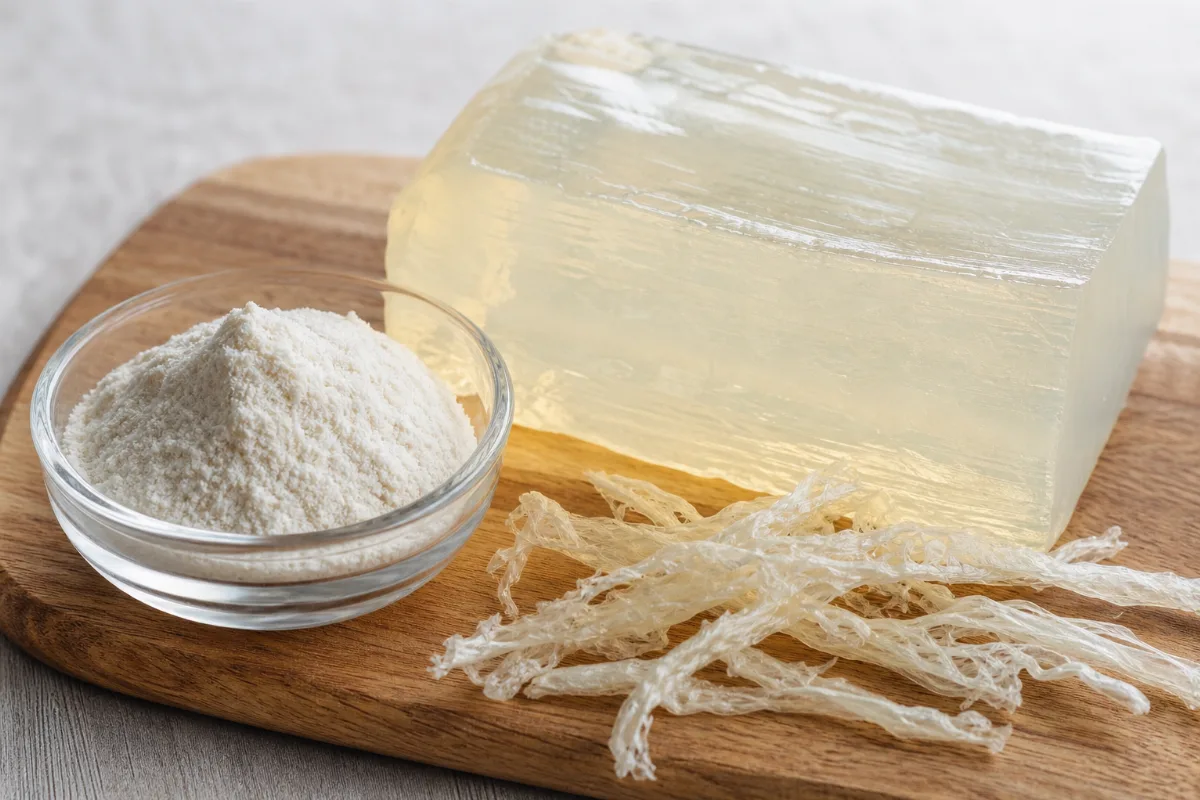
Seaweed & Algae · Seaweed extract
Agar (Agar-Agar)
Gelidium and Gracilaria red seaweeds (extract) · also called Agar-agar, kanten, E 406, vegetable gelatin
Agar is a gelling extract of red seaweed, used to set jellies and desserts in place of animal gelatin. The human research is thin: one 12-week trial of an agar jelly found a little more weight loss than diet alone. EFSA saw no safety concern at the additive uses it reviewed. The main caution is a few case reports of bowel or stomach blockage after strong agar solutions or an agar dessert in a person with gastric bypass.
General information, not medical advice. Last substantive update · Not medically reviewed. A named clinician has not signed off on this page. How this page is made
About Agar (Agar-Agar)
Agar is a gelling extract of red seaweed, used in cooking to set jellies and desserts and in processed foods as the additive E 406. It is a food ingredient, not a proven remedy: the only human trial was small, and the main safety concern is rare gut blockage with strong agar solutions or after stomach surgery.
What it is
Agar comes from red seaweeds, mainly of the Gelidium and Gracilaria groups. EFSA, the European Union's food safety agency, describes it as a mix of sugar chains made mostly of galactose, with a small share carrying sulfate. It is sold as a powder, flakes or bars and dissolved by heating, and it is also called agar-agar or kanten.
The US rule for agar-agar (21 CFR 184.1115) describes it as a dried, water-loving gel-forming carbohydrate from red algae, and sets a maximum amount for each food category. EFSA says agar is unlikely to be absorbed unchanged and is slightly fermented by gut bacteria.
What is in it
USDA lists two different agar items, so check which one you mean. Dried agar has 306 kcal, 80.88 g carbohydrate, 625 mg calcium and 21.4 mg iron per 100 g. Raw agar has 26 kcal, 54 mg calcium and 1.86 mg iron per 100 g, and USDA's household portion is 2 tablespoons, about 10 g, which gives only a few calories and about 5 mg of calcium.
Because agar is used in tiny amounts, it is not a practical source of minerals. These USDA numbers come from a summary we held and were not re-checked against the USDA database this time, because its service refused requests.
What the research shows
We found one human trial of agar for health. In 76 Japanese adults with obesity and impaired glucose tolerance or type 2 diabetes, half added an agar jelly before the evening meal to a Japanese diet for 12 weeks. They lost 2.8 kg versus 1.3 kg, and their total cholesterol fell 7.6 mg/dl while the comparison group's rose 2.4 mg/dl. Weight, fasting glucose and blood pressure fell in both groups.
The abstract does not say whether anyone was blinded or who paid for the trial, and we found no repeat of it.
Older pharmacy books call agar a mild laxative, but we found no trial for constipation. A lab model of the gut shows agar is partly fermented to short-chain fatty acids, with no health effect shown in people.
Food versus extracts and diet products
The trial used a seasoned agar jelly, a food. We found no trial of agar capsules, tablets or powders for weight or any other use. Agar is a refined extract, so results for whole seaweeds such as kombu or nori do not apply to it, and its results do not apply to them. Carrageenan and alginate are different gelling extracts.
At a glance
Traditional uses history, not proof
- Kanten is a long-standing Japanese food, and the kanten diet plan is popular in Japan
- Older pharmacy texts describe agar as a mild laxative; these are historical statements, not trials
Studied for research
- Weight, blood sugar and total cholesterol, low certainty (one trial)
- Constipation and bowel regularity, insufficient evidence
- Gut bacteria and fatty acids, very low certainty (lab model only)
- Minerals and vitamins as nutrients, insufficient evidence as a practical source
Main compounds
- Agar polysaccharide (galactan with repeating agarobiose units)
- Agarose (gelling fraction)
- Agaropectin (sulfated, non-gelling fraction)
Common forms
- Agar powder, flakes and bars dissolved in hot liquid to set a gel (kanten)
- Agar as the food additive E 406 in processed foods
- Capsules and diet products are different products and are not covered; no trial of them was found
Research links: 2005 trial: agar (kanten) diet in obese adults with glucose problems · 2008 case report: small bowel bezoars from concentrated agar · 2016 EFSA re-evaluation of agar (E 406) · Research Library · Genes & Biomarkers Library
What it is and its history
- Accepted scientific name
- Agar (E 406): a gelling extract of red seaweeds, mainly Gelidium and Gracilaria
- Naming authority
- Not a single species. EFSA, quoting EU Regulation 231/2012, says agar is extracted from strains of marine algae of the families Gelidiaceae and Gracilariaceae and relevant red algae of the class Rhodophyceae. The US regulation describes it as extracted from one of a number of related species of red algae (class Rhodophyceae).
- Common names
- Agar (English); Agar-agar (English); Kanten (Japanese); E 406 (English); Vegetable gelatin (English)
- Family or group
- Gelidiaceae and Gracilariaceae, the red seaweed families named by EFSA. Agar itself is a refined seaweed extract, not a whole seaweed.
- Classification
- Not stated by the sources read > Red algae (Rhodophyta) > Rhodophyceae (as written in the regulation) > Not stated > Gelidiaceae and Gracilariaceae (per EFSA) > Gelidium, Gracilaria > Several. EFSA lists 12 species of main commercial value, among them Gelidium amansii, Gelidium corneum, Gelidium pacificum, Gelidium cartilagineum and Gracilaria confervoides, and says 32 species are reported in commercial production worldwide.
- Habitat
- Marine red algae (EFSA: agarophytes).
- What it looks like
- As sold, EFSA's specification describes agar as odourless or slightly scented, light yellowish orange to colourless in strips or bundles, or white to pale yellow when powdered; tough when damp and brittle when dry.
- Cultivation
- Not researched for this page beyond EFSA's list of source species.
- Harvest and processing
- EFSA describes extraction by heating the seaweed in water, with or without alkali treatment (2% to 5% sodium hydroxide at 85 to 90 degrees C for an hour is described), then recovering the agar from the gelled extract by freezing and thawing. Yield and gel strength vary with extraction method and harvest season.
- Look-alikes and adulterants
- Name: Carrageenan; Difference: Another gelling extract of red seaweed, but from different species and with different chemistry; its safety record is debated, while agar's is not in the sources read. See the carrageenan page.; Name: Gelatin; Difference: Gelatin comes from animal collagen; agar comes from seaweed. Agar is used as a vegetarian substitute in cooking.; Name: Alginate; Difference: A gelling extract of brown seaweed, a different substance.
- Sustainability and conservation
- Not researched.
Photographs
Traditional use and history history, not clinical proof
| Tradition or era | Documented use | Source |
|---|---|---|
| Japan: kanten as food and as a modern diet plan | EFSA says agar, also known as kanten, is popular for dieting in the form of the 'kanten plan' in Japan, and that it can be used in homemade foods. How old kanten is was not found in a source read. | EFSA 2016 full text; verified |
| Medical reference texts, 1950s to 1960s | EFSA cites the British Pharmaceutical Codex (1954) and the US Pharmacopeia XVI (1960), and later German textbooks, as describing agar as a mild laxative because it swells in fluid. These are historical statements, not trials. | EFSA 2016 full text; verified as quoted, the books themselves were not read |
| Regulatory history (EFSA's account) | JECFA considered agar in 1974 and concluded a not limited acceptable daily intake. The EU Scientific Committee for Food gave a not specified intake in 1989. EFSA re-evaluated it in 2016 as E 406. | EFSA 2016 full text; verified |
| Origin story and other early history | Claims about when and where agar was first made were not found in a source read. NOT verified. | NOT verified (no source read) |
Traditional use shows how it was used. It does not show that it works or is safe today.
What is inside, and how it may work
What it contains and how those compounds act in cells and animals. Laboratory and animal mechanisms are not proven effects in people.
Main compounds
| Compound | Family | Where it is concentrated | Activity studied | Level of evidence |
|---|---|---|---|---|
| Agar polysaccharide (agarobiose repeating units) | galactan, sulfated polysaccharide | Red seaweed cell wall (extracted) EFSA: galactose units with a regular alternation of L- and D- forms, linked alpha-1,3 and beta-1,4. On about every tenth D-galactopyranose unit one hydroxyl group is esterified with sulfuric acid, neutralised by calcium, magnesium, potassium or sodium. | Gives gelling and thickening in foods. Largely not absorbed; slightly fermented by gut bacteria (EFSA). 6 | Regulation |
| Agarose and agaropectin | agar fractions | EFSA: older work splits agar into agarose, a neutral gelling fraction (over 100,000 Da, sulfate usually below 0.15%) and agaropectin, a sulfated non-gelling fraction (about 14,000 Da, sulfate 5% to 8%). Newer work suggests agar is a complex mixture, depending on the seaweed and the manufacturing method. | Structure only; no health effect assigned to either fraction in the sources read. 6 | Regulation |
Mechanisms, receptors and pathways
| Target or pathway | Gene or receptor | What was found | Level |
|---|---|---|---|
| Swelling and bulk in the gut | Not applicable | EFSA describes agar as swelling in the stomach and bowel, adding bulk, which is thought to give a feeling of fullness and stimulate bowel movement. This is the stated idea in reference texts, not a measured result in the trial we read. The same swelling is the stated reason blockage is a concern in a few case reports. 6 | Proposed |
| Fermentation by gut bacteria | Not applicable | In a laboratory model of the human gut, agar was partly fermented in the large intestine, giving short-chain fatty acids. EFSA considered these normal fibre end-products and saw no concern. Lab model only. 6 1 | Lab |
Absorption, metabolism and elimination
- Absorption
- Unlikely to be absorbed unchanged (EFSA).
- Metabolism
- Slightly fermented by gut bacteria in a lab model, giving short-chain fatty acids. The rate of breakdown in people's gut is unknown (EFSA).
- Elimination
- Not found in the sources read.
- Bioavailability
- Not established in people.
Isolated compounds versus whole extracts
Agar is a refined extract, not whole seaweed. Results for whole seaweeds such as kombu, nori or wakame do not apply to it, and agar results do not apply to them. The one human trial used a seasoned agar jelly, not capsules or whole seaweed. The earlier page also mentioned a brown seaweed blood sugar review; that was a different food and is not used here.
Nutritional composition
Agar is a gelling carbohydrate used in small amounts, not a nutrient source. USDA lists two different agar items. Per 100 g, dried agar (item 170090) has 306 kcal, 80.88 g carbohydrate, 7.7 g fibre, 6.21 g protein, 625 mg calcium, 21.4 mg iron and 770 mg magnesium. Raw agar (item 169280) has 26 kcal, 6.75 g carbohydrate, 54 mg calcium and 1.86 mg iron per 100 g, and USDA's household portion is 2 tablespoons, about 10 g, which comes to about 2.6 kcal and under 6 mg of calcium. These USDA numbers were carried over from the earlier agar page and were not re-opened this session because the USDA service refused requests. Dried and raw values must not be mixed, and values vary with species and processing. EFSA's 'no numerical limit needed' is a regulator's safety conclusion, and the 4.5 g a day in the human trial is a study detail. Neither is advice on how much to eat.
1 low certainty1 very low certainty2 not enough evidence
What was looked at
The 4 benefits and uses checked for Agar (Agar-Agar), each with how strong the evidence is. Tap one to open it.
- Body weight, blood sugar and cholesterol (one trial of an agar jelly diet)Low certainty
- Constipation and bowel regularityNot enough evidence
- Gut bacteria and short-chain fatty acids (lab evidence only)Very low certainty
- Minerals and vitamins (nutrient content)Not enough evidence
Lab markers tracked in the studies
Body weight and BMITotal cholesterolHbA1c and fasting glucose
What is Agar (Agar-Agar) good for?
The main studied uses and how strong the human evidence is for each. There is only one human trial, so every certainty rating is low or lower.
Benefits, one by one
Each card is a research question, not a promise. Tap a goal to filter. Open a card to see the studies, doses and limits.
Body weight, blood sugar and cholesterol (one trial of an agar jelly diet)
Low certaintyOne 12-week trial in 76 Japanese adults with obesity and impaired glucose tolerance or type 2 diabetes gave half of them an agar jelly before the evening meal as well as their usual Japanese diet. Weight, BMI and total cholesterol fell more in the agar group. Everyone, including the comparison group, lost some weight and had lower fasting glucose. It is one small trial, so this is a hint, not proof.
2 studiesA jelly made with agar, seasoned with condiments, eaten before the ev…
Studies, doses and limits
What the trials found
One randomised controlled trial: 76 patients, a 4-week run-in, then 12 weeks of the usual Japanese diet with or without agar jelly. EFSA reports the agar group received a 180 g jelly with 4.5 g of agar each day, 15 minutes before the evening meal, and that 38 people in the agar group completed the 12 weeks.
Results
After 12 weeks, mean weight change was -2.8 kg in the agar group versus -1.3 kg in the comparison group (p = 0.008). BMI change was -1.1 versus -0.5 kg/m2 (p = 0.009). Total cholesterol changed by -7.6 mg/dl versus +2.4 mg/dl (p = 0.036). In both groups, weight, BMI, fasting glucose, insulin resistance (HOMA-IR) and blood pressure fell significantly from the start. HbA1c, visceral fat, subcutaneous fat, total body fat, the insulin response to a glucose drink and total cholesterol fell significantly within the agar group; the abstract does not give a between-group test for HbA1c, so we cannot say agar beat the usual diet for HbA1c.
Effect sizes as reported
Between groups: weight -2.8 +/- 2.7 vs -1.3 +/- 2.3 kg (p = 0.008); BMI -1.1 +/- 1.1 vs -0.5 +/- 0.9 kg/m2 (p = 0.009); total cholesterol -7.6 +/- 27.5 vs +2.4 +/- 23.4 mg/dl (p = 0.036).
Why this rating
Low: one randomised trial of 76 people over 12 weeks, in Japanese adults only, with no second trial found. The abstract does not say whether anyone was blinded, and the comparison group also improved.
Form and dose studied
A jelly made with agar, seasoned with condiments, eaten before the evening meal (as EFSA describes the trial). This is a study design, not advice on how much to eat.
Who was studied
Japanese adults with obesity and impaired glucose tolerance or type 2 diabetes.
Limits
One trial. 12 weeks. The comparison group also lost weight. Blinding and funding are not stated in the abstract. Not tested in people without obesity or diabetes, or outside Japan.
Why researchers looked
Agar swells in fluid and is thought to make people feel fuller. In Japan agar (kanten) is used in a popular diet plan, and EFSA describes it as used in slimming products.
Traditional use
Kanten is a long-standing Japanese food. The kanten diet plan is a modern diet use, and EFSA notes it as popular in Japan.
Proposed mechanism Proposed mechanism regulatory summary
Agar is thought to swell in the stomach and add bulk, which may give a feeling of fullness and lead to eating less. The authors of the trial linked the weight loss to keeping calorie intake lower. This is the proposed explanation, not a measured one in the abstract.
A proposed mechanism does not show that the effect happens in people.
The authors and EFSA report no noticeable side effects in the 38 agar-group completers. See the Safety tab for bowel blockage case reports with concentrated agar.
Constipation and bowel regularity
Not enough evidenceOlder pharmacy books describe agar as a mild laxative because it swells in fluid. We did not find a modern trial that tested it for constipation, so there is no good evidence either way.
1 studiesNot applicable. No amount advice is given here.
Studies, doses and limits
What the trials found
No randomised trial of agar for constipation was found in our searches. EFSA lists only the textbook descriptions, and notes that a few combination medicines containing small amounts of agar exist, where it acts mainly as an emulsion stabiliser.
Results
Not tested in a trial we could find.
Why this rating
Insufficient: textbook description only, no trial found.
Limits
Old reference texts are not evidence of benefit. EFSA lists intestinal narrowing (stenosis) as a contraindication for the medicinal use.
Why researchers looked
Agar adds bulk when it swells. Older pharmacopoeias and textbooks list it as a mild laxative.
Traditional use
EFSA cites older British and US pharmacopoeias (1954 to 1960) and German textbooks that describe agar as a mild laxative. These are historical statements, not trials.
Proposed mechanism Textbook and regulatory summary
EFSA describes the idea that agar increases the bulk of what is in the bowel, which stimulates the bowel muscles and helps movement. This is the stated explanation from reference texts, not a result measured in a trial we read.
A proposed mechanism does not show that the effect happens in people.
If you have a narrowed bowel or past bowel surgery, ask a clinician first. See the Safety tab.
Gut bacteria and short-chain fatty acids (lab evidence only)
Very low certaintyA laboratory model of the human gut found that gut bacteria partly break agar down. EFSA says this would give short-chain fatty acids, which are normal products of fibre fermentation, and it raised no concern. No health benefit has been shown in people.
2 studiesNot applicable.
Studies, doses and limits
What the trials found
No human trial of gut bacteria or fatty acids with agar was found.
Results
Lab model and reviews only. EFSA concludes agar is unlikely to be absorbed unchanged and is slightly fermented.
Effect sizes as reported
No numbers in the sources read.
Why this rating
Very low: a laboratory model and review statements, with no people measured.
Limits
The 2025 review says the way different seaweed polysaccharides are digested depends on species, place and processing, and calls for a standard digestion model. Its abstract was read; the full text was not.
Why researchers looked
Researchers asked what happens to agar after it is eaten, since it is largely not absorbed.
Proposed mechanism In vitro and review
EFSA reports an in vitro human model in which agar was partly fermented in the large intestine by gut bacteria, producing short-chain fatty acids. A 2025 review of agar, carrageenan and alginate says these polysaccharides are mostly only partly absorbed in the upper gut, and are fermented into metabolites with varying effects.
A proposed mechanism does not show that the effect happens in people.
None specific.
Minerals and vitamins (nutrient content)
Not enough evidenceDried agar looks rich in minerals per 100 g in USDA tables, but agar is used in very small amounts, so a normal serving adds almost nothing. It is a gelling carbohydrate, not a nutrient source.
3 studiesDried agar and raw agar are different USDA items and must not be mixe…
Studies, doses and limits
What the trials found
No study of people getting minerals from agar was found.
Results
See the nutrition note: USDA lists dried agar per 100 g as 306 kcal, 80.88 g carbohydrate, 625 mg calcium, 21.4 mg iron and 770 mg magnesium, while the raw agar entry (about 10 g in a USDA household portion of 2 tablespoons) gives 54 mg calcium and 1.86 mg iron per 100 g. These USDA values were taken from the earlier summary and were not re-opened for this page.
Why this rating
Insufficient as a practical source: the values are per 100 g of a food used in tiny amounts, and absorption from agar was not studied in people. The USDA numbers themselves were not re-checked this session.
Form and dose studied
Dried agar and raw agar are different USDA items and must not be mixed up.
Limits
Values vary with species, harvest and processing. In rats, agar in the diet reduced absorption of several minerals (see the Safety tab), so table values may overstate what the body takes up.
Why researchers looked
Food tables list large per-100 g mineral values for dried agar.
Proposed mechanism Food composition table
Not applicable. This is a composition fact, not a trial.
A proposed mechanism does not show that the effect happens in people.
None specific.
Connections to the rest of health
How Agar (Agar-Agar) connects to the rest of our health knowledge graph. Every link says what kind of connection it is. A safety link (for example to the liver) is a warning, not a benefit. A study that merely mentions a topic never creates a benefit link.
Explore every connection: goals, body systems, organs, symptoms, genes
A. Wellness goals
| Connected to | Kind of connection | Evidence status | Context | Studies |
|---|---|---|---|---|
| Weight Management | Low certainty | Body weight, blood sugar and cholesterol (one trial of an agar jelly diet): One 12-week trial in 76 Japanese adults with obesity and impaired glucose tolerance or type 2 diabetes gave half of them an agar jelly before the evening meal as well as their usual Japanese diet. Weight, BMI and total cholesterol fell more in the agar group. Everyone, including the comparison group, lost some weight and had lower fasting glucose. It is one small trial, so this is a hint, not proof. | 4 6 | |
| Blood Sugar Balance | Low certainty | Body weight, blood sugar and cholesterol (one trial of an agar jelly diet): One 12-week trial in 76 Japanese adults with obesity and impaired glucose tolerance or type 2 diabetes gave half of them an agar jelly before the evening meal as well as their usual Japanese diet. Weight, BMI and total cholesterol fell more in the agar group. Everyone, including the comparison group, lost some weight and had lower fasting glucose. It is one small trial, so this is a hint, not proof. | 4 6 | |
| Cholesterol Balance | Low certainty | Body weight, blood sugar and cholesterol (one trial of an agar jelly diet): One 12-week trial in 76 Japanese adults with obesity and impaired glucose tolerance or type 2 diabetes gave half of them an agar jelly before the evening meal as well as their usual Japanese diet. Weight, BMI and total cholesterol fell more in the agar group. Everyone, including the comparison group, lost some weight and had lower fasting glucose. It is one small trial, so this is a hint, not proof. | 4 6 | |
| Digestive Support | Not enough evidence | Constipation and bowel regularity: Older pharmacy books describe agar as a mild laxative because it swells in fluid. We did not find a modern trial that tested it for constipation, so there is no good evidence either way. | 6 | |
| Gut Health | Not enough evidence | Constipation and bowel regularity: Older pharmacy books describe agar as a mild laxative because it swells in fluid. We did not find a modern trial that tested it for constipation, so there is no good evidence either way. | 6 | |
| Gut Health | Very low certainty | Gut bacteria and short-chain fatty acids (lab evidence only): A laboratory model of the human gut found that gut bacteria partly break agar down. EFSA says this would give short-chain fatty acids, which are normal products of fibre fermentation, and it raised no concern. No health benefit has been shown in people. | 6 1 | |
| Preventive Wellness | Not enough evidence | Minerals and vitamins (nutrient content): Dried agar looks rich in minerals per 100 g in USDA tables, but agar is used in very small amounts, so a normal serving adds almost nothing. It is a gelling carbohydrate, not a nutrient source. | 9 8 6 |
B. Body systems
| Connected to | Kind of connection | Evidence status | Context | Studies |
|---|---|---|---|---|
| Digestive system | Adverse effect or risk | Case reports | Agar swells in fluid and is not absorbed; blockage reported in a few cases. Preparation or compound: Concentrated agar |
6 5 |
| Endocrine System | Biological association | Low certainty | Studied for: Body weight, blood sugar and cholesterol (one trial of an agar jelly diet) | 4 6 |
| Digestive System | Biological association | Not enough evidence | Studied for: Constipation and bowel regularity Studied for: Gut bacteria and short-chain fatty acids (lab evidence only) | 6 1 9 8 |
C. Body parts and organs
E. Health conditions
| Connected to | Kind of connection | Evidence status | Context | Studies |
|---|---|---|---|---|
| Bowel obstruction | Adverse effect or risk | Case reports | Two published bezoar case reports and two more cited by EFSA; frequency unknown. Bezoars after concentrated agar solutions and after an agar dessert following gastric bypass; frequency unknown. Preparation or compound: Concentrated agar solution; agar dessert after gastric bypass |
5 3 6 |
| Type 2 diabetes | Preliminary | One small trial of an agar jelly diet saw more weight loss and a larger cholesterol fall than diet alone; fasting glucose fell in both groups. Preparation or compound: Agar jelly |
4 |
I. Biomarkers
| Connected to | Kind of connection | Evidence status | Context | Studies |
|---|---|---|---|---|
| Body weight and BMI | Biological association | Low certainty | Measured in trials: lower, by more than the usual diet alone. A lab change is not the same as a health benefit. | 4 |
| Total cholesterol | Biological association | Low certainty | Measured in trials: lower with agar, slightly higher without. A lab change is not the same as a health benefit. | 4 |
| HbA1c and fasting glucose | Biological association | Low certainty | Measured in trials: lower in both groups; HbA1c lower within the agar group. A lab change is not the same as a health benefit. | 4 |
K. Biological pathways
| Connected to | Kind of connection | Evidence status | Context | Studies |
|---|---|---|---|---|
| Type 2 diabetes and obesity | Preliminary mechanism | Human | One small randomised trial of an agar jelly diet saw more weight loss and a fall in total cholesterol than diet alone. | 4 |
| Bowel obstruction (bezoar) | Preliminary mechanism | Human | Case reports with concentrated agar solutions and with an agar dessert after gastric bypass. | 5 3 6 |
L. Active compounds
| Connected to | Kind of connection | Evidence status | Context | Studies |
|---|---|---|---|---|
| Agar polysaccharide (agarobiose repeating units) | Biological association | Regulation | Gives gelling and thickening in foods. Largely not absorbed; slightly fermented by gut bacteria (EFSA). Preparation or compound: Red seaweed cell wall (extracted) |
6 |
| Agarose and agaropectin | Biological association | Regulation | Structure only; no health effect assigned to either fraction in the sources read. | 6 |
Each connection is stored with the ingredient, the connected record, the kind of connection, the evidence status, the supporting studies, the preparation or compound involved, and a review date (last reviewed October 26, 2026).
Evidence at a glance: what the research found for 4 outcomes
Each outcome below is one thing researchers measured. Certainty is how far the evidence can be trusted, not how well it works. The full studies are on the next tab.
The evidence
The research centre for Agar (Agar-Agar). Every record here was checked against PubMed or the publisher's page; we never list a study we have not verified.
Evidence by outcome
Bars show how many studies we found for each outcome, not how well it works. People are added up across trials only (reviews are not added, to avoid double counting).
How we rate evidence
High certainty
Several well-run trials or reviews agree; further research is unlikely to change the picture much.
Moderate certainty
Good trials point the same way, but some doubt remains.
Low certainty
Small, short or inconsistent trials. The finding could change with better research.
Very low certainty
Very little or very weak human data. Treat as a possibility only.
Mixed findings
Trials or reviews disagree with each other.
Not enough evidence
Not enough human research to say either way.
Evidence against
Good research found no benefit, or found harm.
We take the reviewers' own risk-of-bias and GRADE statements where they exist, and otherwise judge from study size, design, consistency, directness and whether a product matches what is sold. Many publications do not make evidence high. Method note: We started from an existing agar summary, read the full EFSA 2016 re-evaluation of agar through Europe PMC and the US regulation text, and re-read PubMed abstracts for the trial, a case report and two reviews or reports. One case report has no abstract and is described through EFSA. Items we could not verify are flagged in the research gaps.
Study library: every study we checked 9
| Study | Design | People | Product, dose, length | Result |
|---|---|---|---|---|
| Cotas 2025 Seaweed Polysaccharides: A Rational Approach for Food Safety Studies. Mar Drugs · PMID 41295380 · DOI |
Narrative review n/a |
Review of agar, carrageenan and alginate and how they are digested and judged for safety | Seaweed polysaccharides (agar, carrageenan, alginate) |
The authors say the safety of these compounds is generally accepted but gaps remain. They note the compounds are structurally varied, mostly only partly absorbed in the upper gut, and fermented into metabolites with varying effects. They call for a standard digestion model and say the safety of carrageenan remains debated. No numbers in the abstract (Not applicable) Methods, limits and fundingOutcomes: Food safety, digestion, fermentation Limitations: A review; only the abstract was read. Funding is not stated in the abstract. Funding and conflicts: Funding is not stated in the abstract. Read: abstract |
| European Food Safety Authority (EFSA) 2023 Dietary exposure to heavy metals and iodine intake via consumption of seaweeds and halophytes in the European population. EFSA J · PMID 36742462 · DOI |
Regulatory exposure assessment n/a |
European consumers of seaweeds and halophytes (697 eating occasions, 468 subjects, 19 countries) | Seaweeds and seaweed-based foods (agar not singled out in the abstract) |
Seaweeds are important sources of total arsenic, mostly organic. Cadmium exposure in adult consumers was within earlier whole-diet estimates; inorganic arsenic and lead were 10% to 30% of earlier whole-diet exposure. Mean iodine intakes above 20 micrograms per kg of body weight a day were found among consumers of kombu and laver. No agar-specific figure (Not applicable) Methods, limits and fundingOutcomes: Dietary exposure to arsenic, cadmium, lead, mercury, and iodine intake Limitations: Abstract read. Covers seaweeds in general, not agar. Funding and conflicts: An EU agency report; no industry funding is stated in the abstract. Read: abstract |
| Gero 2015 An unusual cause of solid food intolerance and gastric pouch dilation 5 years after Roux-en-Y gastric bypass: agar-agar bezoar. Surg Obes Relat Dis · PMID 26077699 · DOI |
Case report |
1 A 64-year-old woman, 5 years after Roux-en-Y gastric bypass (as described by EFSA) |
An agar-based dessert (as described by EFSA) Agar (red seaweed extract) Symptoms over 72 hours |
EFSA reports nausea, vomiting and trouble swallowing for 72 hours after an agar dessert; an agar bezoar was found 2 weeks later and removed. One case (Not applicable) Methods, limits and fundingOutcomes: Solid food intolerance and stomach pouch enlargement Limitations: PubMed shows no abstract. Details come from the EFSA opinion, not from the paper. A single case in a person with altered anatomy. Funding and conflicts: Not available. Read: title-only |
| Maeda 2005 Effects of agar (kanten) diet on obese patients with impaired glucose tolerance and type 2 diabetes. Diabetes Obes Metab · PMID 15642074 · DOI |
Randomised controlled trial |
76 76 obese Japanese patients with impaired glucose tolerance or type 2 diabetes |
Agar jelly (kanten) added to a conventional traditional Japanese diet Agar (extract of red seaweed), eaten as a seasoned jelly 180 g jelly containing 4.5 g agar daily, 15 minutes before the evening meal (as described by EFSA, not in the abstract) 12 weeks after a 4-week run-in · vs Conventional diet alone |
Both groups had lower weight, BMI, fasting glucose, HOMA-IR and blood pressure. Weight change was -2.8 +/- 2.7 kg with agar versus -1.3 +/- 2.3 kg without (p = 0.008); BMI -1.1 +/- 1.1 versus -0.5 +/- 0.9 kg/m2 (p = 0.009); total cholesterol -7.6 +/- 27.5 versus +2.4 +/- 23.4 mg/dl (p = 0.036). HbA1c, visceral and subcutaneous fat, total body fat and insulin area under the curve fell significantly in the agar group. Weight 1.5 kg greater loss, BMI 0.6 kg/m2 greater fall, total cholesterol about 10 mg/dl greater fall with agar (differences of the means) (Not given in the abstract) Methods, limits and fundingOutcomes: Body weight, BMI, glycaemic control, blood pressure, insulin resistance, body fat, fat distribution, lipids Limitations: One trial. Blinding and funding are not stated in the abstract. The comparison group also improved. Only Japanese adults with obesity and impaired glucose tolerance or type 2 diabetes. Funding and conflicts: Funding is not stated in the abstract. Read: abstract |
| Osada 2008 Obstructing small bowel bezoars due to an agar diet: diagnosis using double balloon enteroscopy. Intern Med · PMID 18379147 · DOI |
Case report |
1 A 70-year-old Japanese woman with abdominal pain, nausea and vomiting |
Highly concentrated agar dissolved in boiling water Agar (red seaweed extract) A large amount (not quantified in the abstract) Two days before she came to hospital |
Hard white bezoars were clogged in the jejunum, found by balloon enteroscopy; at surgery many were impacted in the distal jejunum and were removed. The authors considered they formed from the highly concentrated, dissolvable agar. One case (Not applicable) Methods, limits and fundingOutcomes: Small bowel obstruction Limitations: A single case report. EFSA adds she had type 2 diabetes and took dietary agar sometimes. Funding is not stated in the abstract. Funding and conflicts: Funding is not stated in the abstract. Read: abstract |
| s-efsa-2016 EFSA ANS Panel (2016). Re-evaluation of agar (E 406) as a food additive. EFSA Journal 14(12):4645 · Source |
Regulatory opinion n/a |
Methods, limits and fundingRead: full-text | ||
| s-fda-21cfr184-1115 US FDA (eCFR) 21 CFR 184.1115 Agar-agar · Source |
Regulation n/a |
Methods, limits and fundingRead: full-text | ||
| s-usda-fdc-169280 USDA FoodData Central: Seaweed, agar, raw (SR Legacy, FDC 169280) · Source |
Food composition database n/a |
Methods, limits and fundingRead: summary-only | ||
| s-usda-fdc-170090 USDA FoodData Central: Seaweed, agar, dried (SR Legacy, FDC 170090) · Source |
Food composition database n/a |
Methods, limits and fundingRead: summary-only |
What we do not know yet
- Only one human trial of agar for health (weight, blood sugar, cholesterol) was found, with no repeat, and none for constipation.
- How common bowel blockage from agar is was not found; only case reports exist, and no source on swallowing dry agar was read.
- No agar-specific iodine or metal figure, and no official pregnancy, breastfeeding or child statement, was found.
- The USDA numbers for dried and raw agar come from a summary we held and were not re-checked against the USDA database, because its service refused requests.
- Liver safety, medicine interactions beyond EFSA's text, and agar capsules or diet products were not researched.
How new research is added
New studies are found by a saved PubMed search and placed in a review queue before the page changes.
Lab markers
What changed in blood or saliva tests during trials. A changed number is not the same as feeling or being healthier, and we give no "normal ranges".
Metabolic 1
Total cholesterol
Lower with agar, slightly higher without in trials
The total amount of cholesterol in the blood.
Low certaintyResults and what it means
Why it was measured
Lipids were one of the outcomes the trial tracked.
Statistical vs. clinical meaning
The spread of individual results is much larger than the average change, and the p value is close to the usual cut-off.
Safety implication
None reported.
| Study | Result | People | Product |
|---|---|---|---|
| 4 | Total cholesterol -7.6 +/- 27.5 mg/dl with agar versus +2.4 +/- 23.4 mg/dl without (p = 0.036) | 76 adults with obesity and impaired glucose tolerance or type 2 diabetes | Agar jelly plus a traditional Japanese diet versus the diet alone, 12 weeks |
Other 2
Body weight and BMI
Lower, by more than the usual diet alone in trials
Body weight in kilograms, and body mass index (weight relative to height).
Low certaintyResults and what it means
Why it was measured
To see whether an agar jelly diet changed body size in adults with obesity.
Statistical vs. clinical meaning
A modest extra loss of about 1.5 kg over the comparison group in one small trial.
Safety implication
None reported in the trial.
| Study | Result | People | Product |
|---|---|---|---|
| 4 | Weight -2.8 +/- 2.7 kg with agar versus -1.3 +/- 2.3 kg without (p = 0.008); BMI -1.1 +/- 1.1 versus -0.5 +/- 0.9 kg/m2 (p = 0.009) | 76 adults with obesity and impaired glucose tolerance or type 2 diabetes | Agar jelly plus a traditional Japanese diet versus the diet alone, 12 weeks |
HbA1c and fasting glucose
Lower in both groups; HbA1c lower within the agar group in trials
HbA1c is the average blood sugar over about three months. Fasting glucose is blood sugar after not eating overnight.
Low certaintyResults and what it means
Why it was measured
The trial enrolled people with impaired glucose tolerance or type 2 diabetes.
Statistical vs. clinical meaning
Because fasting glucose fell in both groups, the fall cannot be put down to agar.
Safety implication
People who take diabetes medicine should talk to their prescriber before changing their diet.
| Study | Result | People | Product |
|---|---|---|---|
| 4 | Fasting glucose fell significantly in both groups. HbA1c fell significantly in the agar group; the abstract does not give a test of agar versus the usual diet for HbA1c. | 76 adults with obesity and impaired glucose tolerance or type 2 diabetes | Agar jelly plus a traditional Japanese diet versus the diet alone, 12 weeks |
Safety
What studies and official sources say about side effects, medicines and who should check first. Each point shows what kind of evidence it comes from.
Main points to know 4
- Bowel or stomach blockage has been reported with strong agar solutions and with an agar dessert after gastric bypass. Two published case reports describe lumps of agar (bezoars) blocking the gut. A 70-year-old woman with type 2 diabetes ate a large amount of highly concentrated agar dissolved in boiling water and had bezoars stuck in her small bowel, which needed surgery. A 64-year-old woman with a gastric bypass had nausea, vomiting and trouble swallowing after an agar-based dessert, and a bezoar was found in her stomach pouch. EFSA also lists two further cases after drinking agar solutions. EFSA judged these cases not relevant to the additive use of agar for the general population, because agar was taken in large amounts for dieting or by a patient with gastric bypass. Case reports cannot tell us how common this is. Case report 5 3 6
- EFSA saw no safety concern for the general population at the uses it reviewed. EFSA's 2016 re-evaluation of agar as a food additive (E 406) found no concern about genetic damage and no cancer effect in mice or rats at the highest doses tested. It said no numerical acceptable daily intake was needed. This applies to the reported additive uses in 7 of 70 food categories, not to every way of eating agar. In one human study (Maeda 2005), people tolerated 4.5 g of agar a day for 12 weeks without noticeable side effects. Authoritative guidance 6 4
- Agar is not absorbed and swells in fluid. EFSA says agar is unlikely to be absorbed unchanged and is slightly fermented by gut bacteria. Its older medical use as a mild laxative relies on that swelling. People with a narrowed bowel (intestinal stenosis) are listed as a group who should not use it as a medicine. Authoritative guidance 6
- Metals in the seaweed source. EFSA recommended that the EU limits for lead, mercury, cadmium and arsenic in agar be revised so that agar is not a significant source of these metals, in particular for infants and children. Manufacturers gave EFSA no data on metal levels. The current EU limits are arsenic 3, cadmium 1, lead 5 and mercury 1 mg per kg. Authoritative guidance 6
Side effects 3
| Effect | How often | Severity and recovery | Evidence |
|---|---|---|---|
| Bowel or stomach blockage (bezoar): abdominal pain, nausea, vomiting, trouble swallowing These were concentrated agar in boiling water and an agar dessert in a person with gastric bypass. We did not find a report about dry agar swallowed by itself. | Two case reports in the papers we read, and two more mentioned by EFSA. A rate is not known. | Serious: surgery was needed in the small bowel case; the stomach pouch bezoar was found and removed 2 weeks after symptoms began. Both cases were treated by removing the lumps. | Case report 5 3 6 |
| Side effects in the one human trial A small trial cannot rule out uncommon effects. | None noticed by the authors among the 38 agar-group completers over 12 weeks (as reported by EFSA). | Not applicable. Not applicable. | Randomised trial small 4 6 |
| Less absorption of minerals (calcium, iron, zinc, copper, chromium, cobalt) in young rats In that study the extra mineral loss was not reflected in the animals' total body mineral content after 21 weeks. Whether this matters for people is unknown. | One rat study cited by EFSA at 10% agar in the diet; not tested in people in the sources we read. | Animal finding only. Not described. | Animal research 6 |
Liver
No liver injury from agar was found in the sources read. A liver-safety source such as LiverTox was not searched for agar.
How often. No frequency was found.
Monitoring. No agency monitoring advice was found.
This is a safety connection. It is not evidence that Agar (Agar-Agar) supports liver health.
Medicines and supplements 2
| With | Why it matters | Importance | Evidence | What to do |
|---|---|---|---|---|
| Minerals (calcium, iron, zinc, copper) supplement | In young rats, agar in the diet reduced absorption of several minerals. | Unknown in people. No human study was read. | Animal research Very low certainty 6 | A pharmacist or doctor can advise on timing if you take mineral supplements. |
| Prescription and over-the-counter medicines taken by mouth, including diabetes medicines prescription | No source read describes a medicine interaction with agar. | None found Not enough evidence 4 | A pharmacist can check your own medicines, especially if you take diabetes medicine and plan to eat agar often. |
Who should check first 6
| Situation | Advice | Evidence |
|---|---|---|
| A narrowed bowel (intestinal stenosis) or a past bowel blockage | Ask a clinician before using agar as more than an ordinary cooking ingredient. EFSA lists intestinal stenosis as a contraindication for medicinal use. | Authoritative guidance 6 |
| Gastric bypass or other stomach or bowel surgery, or trouble swallowing | Ask your surgeon or dietitian first. One of the case reports was a stomach pouch blocked by an agar dessert after gastric bypass. | Case report 3 6 |
| Large amounts of concentrated agar for dieting | The small bowel blockage case followed a large amount of highly concentrated agar in boiling water. Ask a clinician before using agar as a diet aid. | Case report 5 6 |
| Pregnancy and breastfeeding | No official pregnancy or breastfeeding statement about agar was read. EFSA reports that prenatal studies in rats and hamsters saw no harm to mother or young at the highest doses tested, and also says no reproductive toxicity data were available. Ask your midwife or doctor about your own diet. | Animal research 6 |
| Babies and young children | No child-specific limit for agar was read. EFSA estimated a high toddler intake of up to 26 mg per kg of body weight a day from the reported additive uses and saw no concern; it stressed that metal limits matter most for infants and children. The medicinal combination products EFSA reviewed are not intended for children. Ask a paediatrician. | Authoritative guidance 6 |
| Allergy | The human data EFSA lists under hypersensitivity are the bezoar case reports and one trial; no allergy reports are listed, and we found none in PubMed. Agar is from seaweed, not fish or shellfish. For trouble breathing or swelling of the face or throat after any food, call 911 or your local emergency number. | None found 6 |
Overdose, product quality and regulators
Summary. Agar had low toxicity in animal studies reviewed by EFSA. The safety questions that remain are blockage in people with gut problems or when taken in large concentrated amounts, and metal impurities.
Animal. EFSA: acute toxicity in mice, rats and rabbits is low. No adverse effects up to 10,000 mg per kg of body weight a day in mice and 4,500 in rats (highest doses tested) in two short National Toxicology Program studies from 1982. No cancer effect at up to 4,500 mg per kg in mice and 2,500 in rats. No harm to mothers or young in prenatal studies in rats and hamsters up to 1,140 and 650 mg per kg.
Human doses studied. One human study of an agar jelly with 4.5 g of agar daily for 12 weeks, and older textbook laxative doses described by EFSA. These are study details and historical statements, not advice.
High dose or long term signals. No chronic toxicity study meeting standard guidelines was found by EFSA. The case reports of bezoars involve large amounts of concentrated agar.
Overdose response. Not found beyond the blockage case reports.
Genotoxicity. EFSA: no concern for genetic damage, though the set of studies was limited.
Agar is a seaweed extract, so quality depends on the source seaweed and on processing. EFSA asked for better data on metals.
Toxic metals in agar. EFSA says EU limits allow arsenic up to 3, cadmium 1, lead 5 and mercury 1 mg per kg of agar, that this could noticeably add to intakes already close to health-based limits, and that no metal data were supplied by manufacturers. It recommended tightening the limits, particularly for infants and children. 6
Seaweeds in general: arsenic, cadmium, lead, iodine. A 2023 EFSA report on seaweeds and halophytes (not agar specifically) found seaweeds are important sources of total arsenic, mostly the organic form, that cadmium exposure from seaweed was within earlier whole-diet estimates, and that mean iodine intakes above 20 micrograms per kg of body weight a day were found among people who ate kombu or laver. It did not give an agar-specific figure. 2
Formaldehyde and mould toxins. EFSA asked for information on possible formaldehyde use, which it did not receive, and noted that gums can be a base for microbial contamination in storage (it cited mycotoxins in gums). 6
| Body | Action | Date |
|---|---|---|
| EFSA (European Union) (European Union) | 2016 re-evaluation of agar (E 406) as a food additive: no safety concern for the general population at the reported uses; no numerical acceptable daily intake needed. Recommended revising the limits for lead, mercury, cadmium and arsenic in the specification and asked for information on formaldehyde and on usage data. source | 2016-12-21 |
| US FDA (21 CFR 184.1115) (United States) | Agar-agar is listed in 21 CFR 184.1115 as a dried, hydrophilic, colloidal polysaccharide from red algae (class Rhodophyceae), with maximum usage levels by food category (for example 0.8% in baked goods, 2.0% in confections and frostings, 0.25% in all other categories). source | 2026-10-01 |
| SCF and JECFA (as reported by EFSA) (European Union and international) | The EU Scientific Committee for Food (1989) gave agar a not specified acceptable daily intake. JECFA (1974) considered very few data (two animal studies, one human study) and concluded a not limited intake. source | 1989 and 1974 |
When to get medical help
- Strong or lasting belly pain, repeated vomiting, a swollen belly or being unable to pass wind or stool after eating agar, especially with a bowel narrowing or past surgery: possible blockage. Get urgent medical care.
- Trouble swallowing, food sticking, or vomiting soon after meals in someone with a gastric bypass: contact your surgical team.
- Trouble breathing, wheezing, swelling of the lips, face, tongue or throat, widespread hives or collapse after any food: call 911 or your local emergency number.
Stop using the product and contact a clinician or emergency service. In the US, Poison Control is 1-800-222-1222.
General information only, not medical advice. Ask a clinician or pharmacist before use, especially with medicines, in pregnancy or with a health condition. See the Natural Remedy Safety guide.
Frequently asked questions
What is agar?
Is agar the same as gelatin?
No. Gelatin comes from animal collagen. Agar comes from seaweed and is used as a vegetarian substitute in cooking.
Is agar safe to eat?
EFSA's 2016 review saw no safety concern for the general population at the reported additive uses and needed no numerical limit. It covers 7 of the 70 food categories where agar is allowed. Rare blockage has been reported with strong solutions or after stomach surgery.
Does agar help with weight loss or blood sugar?
Possibly a little, but the evidence is low. One 12-week trial in 76 Japanese adults with obesity and glucose problems found 2.8 kg weight loss with an agar jelly versus 1.3 kg with diet alone, but fasting glucose fell in both groups. We found no repeat of it.
Does agar lower cholesterol?
In the same trial total cholesterol fell 7.6 mg/dl with agar and rose 2.4 mg/dl without (p = 0.036). It is one small trial, so treat it as a hint.
Does agar help with constipation?
Older pharmacy texts call it a mild laxative because it swells in fluid, but we found no trial of agar for constipation, so the evidence is insufficient.
Can agar block the bowel?
There are case reports. One woman needed surgery for bezoars in her small bowel after eating a large amount of highly concentrated agar in boiling water, and another had a stomach bezoar after an agar dessert following gastric bypass. EFSA judged them not relevant to ordinary additive use. If you have a narrowed bowel or past surgery, ask a clinician first.
Does agar contain iodine or heavy metals?
We found no agar-specific iodine figure. EFSA recommended tighter EU limits for lead, mercury, cadmium and arsenic in agar, especially for infants and children, and said it received no metal data from manufacturers. If you have thyroid disease, ask your clinician about seaweed products in general.
Is agar a good source of calcium or iron?
Is agar safe in pregnancy or for children?
We found no official pregnancy or child-specific statement about agar. EFSA estimated high toddler intakes of up to 26 mg per kg of body weight a day from reported additive uses and saw no concern, and noted animal studies showed no harm to young. Ask your midwife, doctor or paediatrician.
Does agar interact with medicines?
Explore by health goal
Gut HealthWeight ManagementBlood Sugar BalanceCholesterol BalanceDigestive SupportPreventive Wellness
Editorial transparency
- Written by
- AlternativeMed editorial team. Research compiled with AI assistance, then checked against the sources listed.
- Medical review
- None. This page has not been reviewed by a physician or pharmacist.
- First published
- 2026-10-26
- Last substantive update
- 2026-10-26
- How we research
- We started from an existing agar summary, read the full EFSA 2016 re-evaluation of agar through Europe PMC and the US regulation text, and re-read PubMed abstracts for the trial, a case report and two reviews or reports. One case report has no abstract and is described through EFSA. Items we could not verify are flagged in the research gaps.
- How we rate evidence
- See "How we rate evidence" in the Evidence tab.
- Independence
- No product is promoted on this page. No affiliate links are shown. Funding for the agar trial is not stated in its abstract.
Sources 9
Each source was opened and checked. Where we read only the abstract, it says so. The small numbers in the text point here.
- Cotas J, Lourenco M, Figueirinha A, et al.. Seaweed Polysaccharides: A Rational Approach for Food Safety Studies.. Mar Drugs. 2025. PMID 41295380. DOI 10.3390/md23110412. (abstract)
- European Food Safety Authority (EFSA). Dietary exposure to heavy metals and iodine intake via consumption of seaweeds and halophytes in the European population.. EFSA J. 2023. PMID 36742462. DOI 10.2903/j.efsa.2023.7798. (abstract)
- Gero D, Chosidow D, Marmuse JP. An unusual cause of solid food intolerance and gastric pouch dilation 5 years after Roux-en-Y gastric bypass: agar-agar bezoar.. Surg Obes Relat Dis. 2015. PMID 26077699. DOI 10.1016/j.soard.2015.05.010. (title-only)
- Maeda H, Yamamoto R, Hirao K, Tochikubo O. Effects of agar (kanten) diet on obese patients with impaired glucose tolerance and type 2 diabetes.. Diabetes Obes Metab. 2005. PMID 15642074. DOI 10.1111/j.1463-1326.2004.00370.x. (abstract)
- Osada T, Shibuya T, Kodani T, Beppu K, et al.. Obstructing small bowel bezoars due to an agar diet: diagnosis using double balloon enteroscopy.. Intern Med. 2008. PMID 18379147. DOI 10.2169/internalmedicine.47.0520. (abstract)
- . EFSA ANS Panel (2016). Re-evaluation of agar (E 406) as a food additive. EFSA Journal 14(12):4645. . . (full-text)
- . US FDA (eCFR) 21 CFR 184.1115 Agar-agar. . . (full-text)
- . USDA FoodData Central: Seaweed, agar, raw (SR Legacy, FDC 169280). . . (summary-only)
- . USDA FoodData Central: Seaweed, agar, dried (SR Legacy, FDC 170090). . . (summary-only)
Where to buy
Check the label first. Whatever you buy, look for these:
- The iodine amount: seaweed can be very high in iodine, which matters for thyroid conditions
- Heavy metal testing information from the maker
- Origin and harvest area
- Organic or tested labeling
Talk to a pharmacist or doctor before you start any supplement, especially if you take medicines. See the Safety tab for interactions.
Support our free guides: as an Amazon Associate we earn from qualifying purchases. Full disclosure.


