Seaweed & Algae · Seaweed product
Kelp Noodles
Kelp (Laminaria or Saccharina) with sodium alginate · also called Seaweed noodles, sea tangle noodles
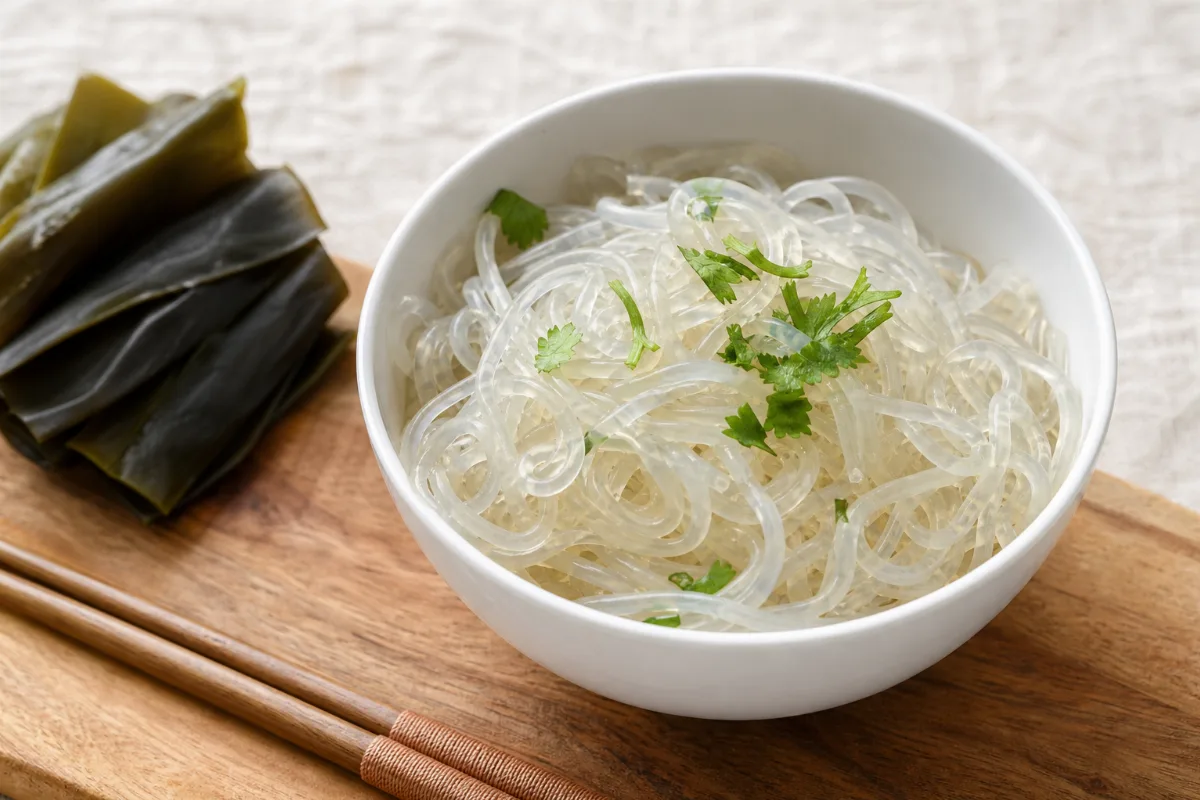
Kelp noodles are clear, slightly crunchy noodles sold ready to eat in a bag. The labels we saw list kelp, sodium alginate and water. One brand's label shows 6 calories and 3 g of carbohydrate per serving. No study has tested kelp noodles themselves. The main caution is iodine: kelp can hold a lot, and the amount in any brand is not standard.
General information, not medical advice. Last substantive update · Not medically reviewed. A named clinician has not signed off on this page. How this page is made
About Kelp Noodles
Kelp noodles are a low-calorie, low-carbohydrate packaged food made from kelp and alginate gel. They are best seen as a food, not a remedy. Almost nothing is known about their effects on health, and the main caution is iodine.
What it is
Kelp noodles are clear, slightly crunchy noodles sold ready to eat in a bag. The labels we saw list kelp, sodium alginate (a gel made from brown seaweed) and water. Recipes differ by brand, so check your ingredient list.
We found no analysis of kelp noodles in a food database or a journal. The numbers here come from one brand's label, seen second-hand. Per 4 ounce (about 113 g) serving: 6 kcal, 3 g carbohydrate, 1 g fiber, calcium 195 mg and iodine 54.8 microg. The two sodium figures we saw disagree (35 mg per 113 g, 65 mg per 4 oz). These are label claims for one product, not independent measurements.
Iodine comes first
Kelp takes up a lot of iodine from seawater. The amount in a bag of noodles depends on the kelp and the processing, and we could not find an independent test. The American Thyroid Association says more than 1,100 microg of iodine a day is not recommended and may cause thyroid dysfunction.
In 49 regular seaweed eaters in Norway, estimated iodine intake fell from 658 to 189 microg a day after six weeks without seaweed, and TSH fell. A lab study found that blanching kelp in seawater cut iodine to 5-8% of the start, but we do not know how noodle makers treat their kelp. Kelp supplements are a different matter: a 2026 review describes them as supplying iodine far above recommended intake.
What the research shows
No study of kelp noodles was found. Nearby studies used other products. In a 12-week trial in Japanese adults, cookies made with kombu powder lowered body fat in men, lowered systolic blood pressure, and raised some gut bacteria, while thyroid hormones did not rise at 420 microg a day of iodine. Kombu is a whole kelp, not a noodle.
An alginate drink taken three times a day by 96 obese adults on a diet gave no difference in weight loss in the main analysis, and more weight loss only among the 80 who finished. A review of 18 brown seaweed trials found lower blood glucose on average but no high-quality trial. These results do not carry over to a bag of noodles.
At a glance
Traditional uses history, not proof
- A modern packaged food, often eaten in place of pasta
- Long use of seaweed as food is not proof that kelp noodles treat any condition
Studied for research
- Low calories and carbohydrate as a pasta swap, label facts only
- Iodine content, low certainty, and also the main caution
- Weight and body fat, low certainty (kombu cookies and an alginate drink, not noodles)
- Blood sugar, blood pressure and gut bacteria, very low certainty (other seaweed products)
- Any human health benefit of kelp noodles, no trial found
Main compounds
- Alginate (a gel fiber from brown seaweed)
- Iodine (54.8 microg per 4 oz on one label)
- Calcium (195 mg per 4 oz on one label)
Common forms
- Ready-to-eat noodles in a bag (the form the label describes)
- Soaked, rinsed or cooked noodles (not measured)
- Kelp supplements (a different product with far more iodine)
Research links: American Thyroid Association: excess iodine statement · NHS: iodine · Habitual seaweed eaters and thyroid (Eur J Nutr, 2026) · EFSA: heavy metals and iodine in seaweeds (2023) · EFSA: alginates as food additives (2017) · Research Library · Genes & Biomarkers Library
What it is and its history
- Common names
- Kelp noodles (English); Seaweed noodles (English); Fideos de alga kelp (Spanish (general knowledge, not a source read))
- Look-alikes and adulterants
- Name: Kelp or seaweed supplements; Note: Supplements can supply far more iodine than food. EFSA and ATA cautions about them do not describe noodles.; Name: Kombu; Note: A whole dried kelp with very high iodine. Kombu trials are cited here only as related evidence.; Name: Alginate; Note: The gel fiber. Studied as a drink or additive, not as noodles.
Photographs
Traditional use and history history, not clinical proof
| Tradition or era | Documented use | Source |
|---|---|---|
| Modern packaged food | Sold as a low-carb pasta swap. | NOT verified (no history source read) |
Traditional use shows how it was used. It does not show that it works or is safe today.
What is inside, and how it may work
What it contains and how those compounds act in cells and animals. Laboratory and animal mechanisms are not proven effects in people.
Main compounds
| Compound | Family | Where it is concentrated | Activity studied | Level of evidence |
|---|---|---|---|---|
| Alginate | seaweed fiber (gel) | Brown seaweed cell walls Not measured for noodles | Forms a gel. Studied for fullness. EFSA saw no safety concern as a food additive at estimated exposures. 6 4 | Human trials of other products |
| Iodine | mineral (halogen) | Whole kelp 54.8 mcg per 4 oz serving on one brand label (second-hand) | Needed for thyroid hormones. Too much may disturb the thyroid. 11 10 | Label claim |
Mechanisms, receptors and pathways
| Target or pathway | Gene or receptor | What was found | Level |
|---|---|---|---|
| Gel formation and fullness | Alginate is a gel-forming fiber proposed to slow digestion. Not tested for noodles. 6 | Proposed |
Absorption, metabolism and elimination
- Absorption
- In rats, iodine from sugar kelp was less well absorbed than from potassium iodide (73-81% versus 94-95% in urine).
- Distribution
- Not found.
- Metabolism
- Not found.
- Elimination
- Not found.
- Bioavailability
- Not established for noodles.
Isolated compounds versus whole extracts
The weight and glucose studies used kombu cookies, alginate drinks or mixed brown seaweed products. None used kelp noodles, so none shows a result for them.
Nutritional composition
USDA FoodData Central: no entry for kelp noodles was found in an earlier check, but that was not re-verified for this build (the USDA service was rate-limited on 2026-10-26). The figures below come from one brand's label as seen second-hand, so they are approximate and brand specific. Per label serving of 4 ounces (about 113 g): energy 6 kcal, total carbohydrate 3 g, dietary fiber 1 g, calcium 195 mg, iodine 54.8 microg. Sodium appears as 35 mg per 113 g in one place and 65 mg per 4 oz in another, so the labels disagree. No peer-reviewed analysis of kelp noodles was found. Protein and fat were not listed in what we read.
2 low certainty3 very low certainty1 not enough evidence
What was looked at
The 6 benefits and uses checked for Kelp Noodles, each with how strong the evidence is. Tap one to open it.
- Low-calorie, low-carb pasta swap (label facts)Not enough evidence
- Iodine supply (a nutrient and the main caution)Low certainty
- Weight and body fat (kombu cookies and an alginate drink, not noodles)Low certainty
- Blood sugar (brown seaweed review and an alginate drink trial, not noodles)Very low certainty
- Blood pressure (kombu cookies, not noodles)Very low certainty
- Gut bacteria (kombu cookies, not noodles)Very low certainty
Lab markers tracked in the studies
TSH (thyroid-stimulating hormone)Body fat percentage
What is Kelp Noodles good for?
The main studied uses and how strong the evidence is for each. For kelp noodles there is no trial, so most rows describe a label or a related seaweed product. None of this shows that eating kelp noodles treats or prevents a disease.
Benefits, one by one
Each card is a research question, not a promise. Tap a goal to filter. Open a card to see the studies, doses and limits.
Low-calorie, low-carb pasta swap (label facts)
Not enough evidenceOne brand's label lists 6 calories and 3 g of carbohydrate (1 g of fiber) for a 4 ounce serving. That is a label fact for one product. No study tested kelp noodles for weight, blood sugar or any health result.
2 studiesReady-to-eat noodles from a bag. Recipes differ by brand.
Studies, doses and limits
What the trials found
No human study of kelp noodles was found.
Results
The figures describe the product on the label. They say nothing on their own about weight or blood sugar.
Effect sizes as reported
One brand label (second-hand): 6 kcal, 3 g carbohydrate, 1 g fiber, per 4 oz (about 113 g).
Why this rating
Label numbers for one brand, read second-hand, and no outcome trial.
Form and dose studied
Ready-to-eat noodles from a bag. Recipes differ by brand.
Limits
We could not re-read the label ourselves. Ingredient lists differ by brand, and some recipes may add flour or starch.
Why researchers looked
People eat kelp noodles in place of pasta because they are very low in calories and carbohydrate.
Traditional use
Not a traditional food in the usual sense; it is a modern packaged product.
Proposed mechanism Label claim
These are label figures, not a health effect.
A proposed mechanism does not show that the effect happens in people.
See the iodine card: the iodine content is the main thing to check.
Iodine supply (a nutrient and the main caution)
Low certaintyKelp takes up a lot of iodine from seawater. How much ends up in a bag of noodles depends on the kelp and how it is processed. One brand lists 54.8 microg per 4 ounce serving on its label. Iodine is needed by the thyroid, and too much can disturb it.
6 studiesKelp noodles as eaten; noodle processing is not described in any sour…
Studies, doses and limits
What the trials found
No study measured iodine in kelp noodles. In 49 regular seaweed eaters in Norway, estimated iodine intake fell from 658 to 189 microg a day after six weeks without seaweed and median TSH fell. In a 12-week trial in Japanese adults, kombu cookies gave 420 microg a day of iodine and thyroid hormones did not rise. A lab study found that blanching kelp in seawater cut iodine to 5% (sugar kelp) or 8% (winged kelp) of the start. In rats, iodine from sugar kelp was less well absorbed than from potassium iodide (73-81% versus 94-95% excreted in urine).
Results
The seaweed findings are about other seaweeds or kelp, not noodles. The label figure for noodles is one brand's claim.
Effect sizes as reported
Norway: iodine 658 to 189 microg a day; TSH fell. Japan kombu trial: 420 microg a day, thyroid hormones did not rise. Lab: iodine left 5% and 8% after blanching.
Why this rating
Small non-randomised study without a control group, one trial of a different kelp, lab and animal work, and one second-hand label figure.
Form and dose studied
Kelp noodles as eaten; noodle processing is not described in any source we read.
Who was studied
Norwegian habitual seaweed eaters; healthy Japanese adults; rats.
Why researchers looked
Brown seaweeds can hold very large amounts of iodine, so researchers measure intake and thyroid tests in seaweed eaters.
Traditional use
Seaweed is a regular food in East Asian and some Nordic diets, but kelp noodles are a recent product.
Proposed mechanism Human observational and laboratory
Iodine is needed to make thyroid hormones. These findings are measurements, not effects of kelp noodles.
A proposed mechanism does not show that the effect happens in people.
Ask a clinician before eating kelp foods often if you have a thyroid condition, take thyroid medicine, are pregnant or breastfeeding, or are feeding young children.
Weight and body fat (kombu cookies and an alginate drink, not noodles)
Low certaintyKelp noodles themselves were never tested. Two related studies exist. Kombu cookies cut body fat in men over 12 weeks. An alginate drink did not change weight loss in the main analysis, only among people who finished.
2 studiesKombu powder in cookies; an alginate preload drink.
Studies, doses and limits
What the trials found
A 12-week double-blind trial in Japanese adults found lower body fat content and percentage in the kombu group than in placebo among men, (the abstract reports this for men only). A separate 12-week trial of 96 obese adults on a reduced-calorie diet gave an alginate drink (15 g fiber) three times a day: no difference in weight or fat loss in the intention-to-treat analysis; among 80 completers, 6.78 kg versus 5.04 kg lost with placebo (P = 0.03).
Results
Different products from kelp noodles. One main analysis was null.
Effect sizes as reported
Completers: 6.78 kg alginate versus 5.04 kg placebo. Kombu trial: body fat lower in men; numbers not in the abstract.
Why this rating
Two small-to-moderate trials of other products, one with a null main analysis. Authors of the kombu trial work at food companies.
Form and dose studied
Kombu powder in cookies; an alginate preload drink.
Who was studied
Healthy Japanese adults; obese adults on a diet.
Limits
Neither trial used noodles. The alginate dose was taken as a drink three times a day.
Why researchers looked
Kelp noodles are made with alginate gel, a seaweed fiber that is studied for feeling full.
Proposed mechanism Proposed human
Alginate is a gel-forming fiber that may slow digestion. This is a proposed explanation, not shown for noodles.
A proposed mechanism does not show that the effect happens in people.
No safety issue was reported in either abstract.
Blood sugar (brown seaweed review and an alginate drink trial, not noodles)
Very low certaintyA review of 18 trials of brown seaweed and its extracts found lower blood glucose on average, but the authors say no high-quality trial exists. The alginate drink trial found no glucose or insulin difference. Kelp noodles were not tested.
2 studiesBrown seaweed and extracts; alginate drink.
Studies, doses and limits
What the trials found
A systematic review and meta-analysis of 18 randomised trials in healthy, at-risk and type 2 diabetic adults found lower fasting (mean difference -4.6, 95% CI -7.88 to -1.33) and postprandial (-7.1, 95% CI -7.4 to -6.9) glucose with brown seaweed. In the 96-person alginate drink trial, glucose, insulin and HOMA-IR did not differ.
Results
Mixed seaweeds and extracts; results varied across populations.
Effect sizes as reported
See human evidence.
Why this rating
Mixed products, no high-quality trial identified by the reviewers, and none on noodles.
Form and dose studied
Brown seaweed and extracts; alginate drink.
Who was studied
Adults with and without type 2 diabetes.
Limits
The reviewers call for species-specific research. The result cannot be assigned to noodles.
Why researchers looked
Brown seaweed fibers may slow sugar absorption.
Proposed mechanism Proposed human
Gel-forming fibers may slow digestion. A proposed explanation only.
A proposed mechanism does not show that the effect happens in people.
People who take diabetes medicine should ask a clinician before changing food habits.
Blood pressure (kombu cookies, not noodles)
Very low certaintyIn one 12-week trial, systolic blood pressure was lower with kombu cookies than with placebo cookies in men and women. In the alginate drink trial, blood pressure fell more in the placebo group. Neither tested noodles.
2 studiesKombu cookies; alginate drink.
Studies, doses and limits
What the trials found
Systolic blood pressure was significantly lower in the kombu group in men and women (Aoe 2025). In the alginate trial's intention-to-treat analysis, blood pressure fell more in the placebo group.
Results
One small kombu trial points one way and the alginate trial points the other.
Effect sizes as reported
Numbers are not in the abstracts read.
Why this rating
Two trials of different products pointing in opposite directions.
Form and dose studied
Kombu cookies; alginate drink.
Who was studied
Healthy Japanese adults; obese adults.
Limits
Cannot be applied to kelp noodles.
Why researchers looked
Seaweed is studied for blood pressure.
Proposed mechanism Unknown
Not established.
A proposed mechanism does not show that the effect happens in people.
None reported in the abstracts.
Gut bacteria (kombu cookies, not noodles)
Very low certaintyIn the kombu cookie trial, several gut bacteria groups increased compared with placebo. This was a lab measure from stool samples, not a symptom, and it was not tested with noodles.
1 studiesKombu powder in cookies.
Studies, doses and limits
What the trials found
Abundances of Faecalibacterium, Bacteroides, Alistipes and Agathobacter rose in the kombu group compared with placebo. In men, body-fat change correlated with Agathobacter.
Results
A change in bacteria counts, not a clinical result.
Effect sizes as reported
Not given in the abstract.
Why this rating
One trial, a laboratory marker, and a different product.
Form and dose studied
Kombu powder in cookies.
Who was studied
Healthy Japanese adults.
Limits
Sample size not in abstract. Not about kelp noodles.
Why researchers looked
Seaweed fibers feed gut bacteria.
Proposed mechanism Proposed human
The authors link the change to the alginate in kombu. A proposed explanation only.
A proposed mechanism does not show that the effect happens in people.
None reported.
Connections to the rest of health
How Kelp Noodles connects to the rest of our health knowledge graph. Every link says what kind of connection it is. A safety link (for example to the liver) is a warning, not a benefit. A study that merely mentions a topic never creates a benefit link.
Explore every connection: goals, body systems, organs, symptoms, genes
A. Wellness goals
| Connected to | Kind of connection | Evidence status | Context | Studies |
|---|---|---|---|---|
| Healthy Weight Metabolism | Not enough evidence | Low-calorie, low-carb pasta swap (label facts): One brand's label lists 6 calories and 3 g of carbohydrate (1 g of fiber) for a 4 ounce serving. That is a label fact for one product. No study tested kelp noodles for weight, blood sugar or any health result. | 11 14 | |
| Thyroid Support | Low certainty | Iodine supply (a nutrient and the main caution): Kelp takes up a lot of iodine from seawater. How much ends up in a bag of noodles depends on the kelp and how it is processed. One brand lists 54.8 microg per 4 ounce serving on its label. Iodine is needed by the thyroid, and too much can disturb it. | 11 1 2 7 5 10 | |
| Healthy Weight Metabolism | Low certainty | Weight and body fat (kombu cookies and an alginate drink, not noodles): Kelp noodles themselves were never tested. Two related studies exist. Kombu cookies cut body fat in men over 12 weeks. An alginate drink did not change weight loss in the main analysis, only among people who finished. | 2 6 | |
| Blood Sugar Support | Very low certainty | Blood sugar (brown seaweed review and an alginate drink trial, not noodles): A review of 18 trials of brown seaweed and its extracts found lower blood glucose on average, but the authors say no high-quality trial exists. The alginate drink trial found no glucose or insulin difference. Kelp noodles were not tested. | 9 6 | |
| Heart Health | Very low certainty | Blood pressure (kombu cookies, not noodles): In one 12-week trial, systolic blood pressure was lower with kombu cookies than with placebo cookies in men and women. In the alginate drink trial, blood pressure fell more in the placebo group. Neither tested noodles. | 2 6 | |
| Gut Digestive Health | Very low certainty | Gut bacteria (kombu cookies, not noodles): In the kombu cookie trial, several gut bacteria groups increased compared with placebo. This was a lab measure from stool samples, not a symptom, and it was not tested with noodles. | 2 |
B. Body systems
| Connected to | Kind of connection | Evidence status | Context | Studies |
|---|---|---|---|---|
| Digestive System | Biological association | Not enough evidence | Studied for: Low-calorie, low-carb pasta swap (label facts) Studied for: Gut bacteria (kombu cookies, not noodles) | 11 14 2 |
| Endocrine System | Biological association | Low certainty | Studied for: Iodine supply (a nutrient and the main caution) Studied for: Weight and body fat (kombu cookies and an alginate drink, not noodles) | 11 1 2 7 5 10 6 9 |
| Cardiovascular System | Biological association | Very low certainty | Studied for: Blood pressure (kombu cookies, not noodles) | 2 6 |
C. Body parts and organs
| Connected to | Kind of connection | Evidence status | Context | Studies |
|---|---|---|---|---|
| Thyroid | Adverse effect or risk | Documented risk | Kelp iodine can push intake above the 1,100 microg adult upper limit; the amount in kelp noodles varies by product and was not independently measured. Preparation or compound: Iodine in kelp foods |
10 1 |
G. Root causes and contributing factors
| Connected to | Kind of connection | Evidence status | Context | Studies |
|---|---|---|---|---|
| Heavy metal exposure | Adverse effect or risk | Documented risk | EFSA found seaweed adds to arsenic and lead exposure. No kelp noodle test was found. Preparation or compound: Seaweed as food |
3 |
I. Biomarkers
| Connected to | Kind of connection | Evidence status | Context | Studies |
|---|---|---|---|---|
| TSH (thyroid-stimulating hormone) | Biological association | Low certainty | Measured in trials: lowered after stopping seaweed. A lab change is not the same as a health benefit. | 1 |
| Body fat percentage | Biological association | Low certainty | Measured in trials: lower in men with kombu cookies. A lab change is not the same as a health benefit. | 2 |
K. Biological pathways
L. Active compounds
| Connected to | Kind of connection | Evidence status | Context | Studies |
|---|---|---|---|---|
| Alginate | Biological association | Human trials of other products | Forms a gel. Studied for fullness. EFSA saw no safety concern as a food additive at estimated exposures. Preparation or compound: Brown seaweed cell walls |
6 4 |
| Iodine | Biological association | Label claim | Needed for thyroid hormones. Too much may disturb the thyroid. Preparation or compound: Whole kelp |
11 10 |
Each connection is stored with the ingredient, the connected record, the kind of connection, the evidence status, the supporting studies, the preparation or compound involved, and a review date (last reviewed October 26, 2026).
Evidence at a glance: what the research found for 6 outcomes
Each outcome below is one thing researchers measured. Certainty is how far the evidence can be trusted, not how well it works. The full studies are on the next tab.
The evidence
The research centre for Kelp Noodles. Every record here was checked against PubMed or the publisher's page; we never list a study we have not verified.
Evidence by outcome
Bars show how many studies we found for each outcome, not how well it works. People are added up across trials only (reviews are not added, to avoid double counting).
How we rate evidence
High certainty
Several well-run trials or reviews agree; further research is unlikely to change the picture much.
Moderate certainty
Good trials point the same way, but some doubt remains.
Low certainty
Small, short or inconsistent trials. The finding could change with better research.
Very low certainty
Very little or very weak human data. Treat as a possibility only.
Mixed findings
Trials or reviews disagree with each other.
Not enough evidence
Not enough human research to say either way.
Evidence against
Good research found no benefit, or found harm.
We take the reviewers' own risk-of-bias and GRADE statements where they exist, and otherwise judge from study size, design, consistency, directness and whether a product matches what is sold. Many publications do not make evidence high. Method note: We started from our existing kelp noodles summary, re-read the PubMed abstracts and the American Thyroid Association and NHS pages, and flagged label figures we could not re-read. Items we could not verify are listed in the research gaps.
Study library: every study we checked 14
| Study | Design | People | Product, dose, length | Result |
|---|---|---|---|---|
| Aakre I et al. 2026 Impact of habitual seaweed consumption on iodine nutrition and thyroid function: a non-randomized pre-post clinical study. Eur J Nutr · PMID 41543576 · DOI |
Non randomised pre post Mixed seaweeds |
49 49 habitual seaweed consumers recruited from the two largest cities in Norway |
Stopping seaweed for six weeks Seaweeds in the everyday diet (types not named in the abstract) 6 weeks without seaweed · vs Their own earlier values |
Median estimated iodine intake fell from 658 microg a day to 189 microg a day after six weeks without seaweed. Median TSH fell significantly, most in those with the highest earlier iodine intake. The authors note that high-iodine seaweed could push intake above the tolerable upper level. Estimated iodine intake 658 (p25-p75 330 to 1516) to 189 (142 to 264) microg a day; TSH lower after stopping seaweed. Methods, limits and fundingOutcomes: Urinary iodine, estimated iodine intake, TSH, fT3, fT4, TPO antibodies Limitations: No control group; convenience sample; seaweed types not named, so it says nothing about kelp noodles in particular. Funding and conflicts: Authors declare none. Read: abstract |
| Aoe S et al. 2025 Effects of Daily Kombu (Laminaria japonica) Intake on Body Composition, Blood Pressure, and Fecal Microbiota in Healthy Adult Japanese: A Randomized, Double-Blind Study. Food Sci Nutr · PMID 40390848 · DOI |
Randomised double blind placebo controlled Laminaria japonica (kombu) |
Not stated in abstract Healthy adult Japanese men and women |
Cookies containing boiled kombu powder (Laminaria japonica), versus cookies containing cellulose Whole kombu seaweed, boiled and powdered 12 weeks · vs Cellulose cookies |
Body fat content and percentage were lower in the kombu group than placebo in men. Systolic blood pressure was lower in men and women. Serum adiponectin was higher in men. Thyroid hormones did not rise at 420 microg a day of iodine from the kombu. Some gut bacteria genera increased. See results. Effect sizes are not in the abstract. Methods, limits and fundingOutcomes: Visceral fat area and other body measures, blood pressure, serum adiponectin, thyroid hormones, gut bacteria Limitations: Whole kombu in cookies, not kelp noodles. Sample size is not in the abstract. Authors work at food companies, though they declare no conflict of interest. Funding and conflicts: Authors declare no conflicts of interest; two authors list food-company addresses. Read: abstract |
| EFSA 2023 Dietary exposure to heavy metals and iodine intake via consumption of seaweeds and halophytes in the European population. EFSA J · PMID 36742462 · DOI |
Exposure assessment Seaweeds (mixed) |
468 subjects, 697 eating occasions European consumers of seaweed and halophytes |
Seaweeds eaten as food Various |
For adult seaweed eaters, cadmium exposure was within earlier whole-diet estimates; inorganic arsenic and lead were 10-30% of earlier whole-diet exposure. Seaweed is an important source of total arsenic, mostly organic. Mean iodine intakes above 20 microg per kg body weight a day were found for consumers of kombu and laver. As in the abstract. Methods, limits and fundingOutcomes: Dietary exposure to cadmium, lead, arsenic, mercury and iodine Limitations: Kelp noodles are not named in the abstract. Funding and conflicts: EFSA is the regulator. Read: abstract |
| EFSA ANS Panel 2017 Re-evaluation of alginic acid and its sodium, potassium, ammonium and calcium salts (E 400-E 404) as food additives. EFSA J · PMID 32625343 · DOI |
Regulatory risk assessment Alginate |
Not applicable General population including infants and young children |
Alginic acid and salts as food additives Alginate |
No numerical ADI needed and no safety concern at the refined exposure assessment for reported uses. Exposure of infants and young children should stay below therapeutic doses at which side effects could occur. Data were not enough to judge use in special infant and young-child medical foods. As in the abstract. Methods, limits and fundingOutcomes: Safety as food additives Limitations: Covers alginate used as an additive, not the amount in a bag of noodles. Funding and conflicts: EFSA is the regulator. Read: abstract |
| Fjaere E et al. 2022 Iodine Bioavailability and Accumulation of Arsenic and Cadmium in Rats Fed Sugar Kelp (Saccharina latissima). Foods · PMID 36553687 · DOI |
Animal study Saccharina latissima |
Not stated in abstract Female Wistar rats |
Diets with sugar kelp or potassium iodide Farmed sugar kelp 13 weeks · vs Potassium iodide |
Urinary iodine excretion was 94-95% with potassium iodide and 73-81% with kelp. The highest iodine dose lowered fT4 and total T4 but not TSH or fT3. Body weight and liver and kidney markers showed no effect. Iodine absorbed less from kelp than from potassium iodide. Methods, limits and fundingOutcomes: Urinary iodine, thyroid hormones, arsenic, cadmium, liver and kidney markers Limitations: Rats, not people, and sugar kelp, not noodles. Funding and conflicts: Authors declare no conflict. Read: abstract |
| Georg Jensen M et al. 2012 Effect of alginate supplementation on weight loss in obese subjects completing a 12-wk energy-restricted diet: a randomized controlled trial. Am J Clin Nutr · PMID 22648709 · DOI |
Randomised double blind placebo controlled Alginate (not kelp noodles) |
96 Obese adults on an energy-restricted diet |
Alginate-based preload drink (15 g fiber) versus placebo drink Alginate (seaweed fiber) 12 weeks · vs Placebo preload |
No difference in weight or fat loss in the intention-to-treat analysis. In the 80 completers, weight loss was 6.78 kg with alginate versus 5.04 kg with placebo (P = 0.03). Blood pressure fell more in the placebo group in the intention-to-treat analysis. Glucose, insulin, CRP, ghrelin and lipids did not differ. Completers: 6.78 +/- 3.67 kg versus 5.04 +/- 3.40 kg (P = 0.03). Intention-to-treat: P > 0.1. Methods, limits and fundingOutcomes: Body weight, body fat, blood pressure, glucose, insulin, lipids Limitations: The drink was a medical alginate product taken three times a day, not noodles. The main analysis was null. The funding statement was not in the record read. Funding and conflicts: Funding not stated in the record read. Read: abstract |
| Sletta MS et al. 2025 Blanching of Two Commercial Norwegian Brown Algae for Reduction of Iodine and Other Compounds of Importance for Food Safety and Quality. Foods · PMID 41376050 · DOI |
Laboratory processing study Saccharina latissima; Alaria esculenta |
Not applicable Winged kelp (Alaria esculenta) and sugar kelp (Saccharina latissima) |
Water blanching of kelp Whole kelp Optimal condition: 2 minutes at 80 C · vs Unblanched kelp |
Blanching in seawater at 80 C for 2 minutes cut iodine to 5% of the starting level in sugar kelp and 8% in winged kelp (tap water: 7% and 11%). Arsenic in blanched winged kelp fell below the feed limit; in sugar kelp it stayed above it. Iodine left: 5% (sugar kelp), 8% (winged kelp). Methods, limits and fundingOutcomes: Iodine, arsenic and other compounds after blanching Limitations: Lab study of two other kelp species for industry use. It is not an analysis of kelp noodles, and the way noodle makers treat kelp was not described. Funding and conflicts: One author works for a seaweed company; the others declare no conflict. Read: abstract |
| Taylor PN et al. 2026 What Endocrinologists Should Know About Iodine: Population Deficiency, Individual Excess and Misinformation in the United Kingdom. Clin Endocrinol (Oxf) · PMID 42144726 · DOI |
Narrative review Kelp supplements |
Not applicable UK populations |
Iodine, including kelp supplements Kelp supplements |
Reports mild-to-moderate iodine deficiency re-emerging in the UK, and a growing minority of patients with iodine-induced thyroid dysfunction after kelp-based supplements that supply iodine far above recommended intake. Narrative review; no pooled numbers. Methods, limits and fundingOutcomes: Iodine status and iodine-induced thyroid problems Limitations: About kelp supplements, not kelp noodles. Narrative review. Funding and conflicts: Not stated in the abstract. Read: abstract |
| Vaughan K et al. 2022 Effect of brown seaweed on plasma glucose in healthy, at-risk, and type 2 diabetic individuals: systematic review and meta-analysis. Nutr Rev · PMID 34549293 · DOI |
Systematic review meta analysis Brown seaweeds (mixed) |
18 RCTs Healthy, at-risk and type 2 diabetic adults |
Brown seaweed and its extracts Various brown seaweeds Varied · vs Control |
Eighteen RCTs. Results varied. Pooled fasting glucose mean difference -4.6 (95% CI -7.88 to -1.33) and postprandial -7.1 (95% CI -7.4 to -6.9) favouring seaweed. The authors say no high-quality RCT was identified. Fasting -4.6 (-7.88 to -1.33); postprandial -7.1 (-7.4 to -6.9). Units not given in the abstract. Methods, limits and fundingOutcomes: Fasting and postprandial plasma glucose Limitations: Mixed seaweeds and extracts, so it cannot be applied to kelp noodles. No high-quality RCT. Funding and conflicts: PROSPERO CRD42020187849. Funding not in the abstract. Read: abstract |
| s-ata-2013 American Thyroid Association: statement on the potential risks of excess iodine ingestion and exposure (5 June 2013) · Source |
Regulator statement n/a |
Methods, limits and fundingRead: full-text | ||
| s-label-seatangle Sea Tangle Noodle Company kelp noodles: manufacturer label figures as shown on a retailer listing (iHerb) · Source |
Manufacturer label second hand n/a |
Methods, limits and fundingRead: search-summary-only | ||
| s-medlineplus-food-allergy MedlinePlus: Food Allergy · Source |
Regulator statement n/a |
Methods, limits and fundingRead: full-text | ||
| s-nhs-iodine NHS: Vitamins and minerals: Iodine · Source |
Regulator statement n/a |
Methods, limits and fundingRead: full-text | ||
| s-usda-none USDA FoodData Central: no kelp noodle entry found (not re-verified) · Source |
Reference database n/a |
Methods, limits and fundingRead: not-re-verified |
What we do not know yet
- No human study of kelp noodles was found.
- No independent analysis of iodine, arsenic or sodium in kelp noodles was found.
- The label figures come from one brand and were read second-hand; the USDA lookup was not re-verified.
- No kelp-noodle-specific advice for pregnancy, children, thyroid medicines or warfarin was found.
- How noodle makers process or rinse the kelp is not described in any source we read.
How new research is added
New studies are found by a saved PubMed search and placed in a review queue before the page changes.
Lab markers
What changed in blood or saliva tests during trials. A changed number is not the same as feeling or being healthier, and we give no "normal ranges".
Hormonal 1
TSH (thyroid-stimulating hormone)
Lowered after stopping seaweed in trials
A hormone measured in blood to check how the thyroid is working.
Low certaintyResults and what it means
Why it was measured
A rising TSH can be an early sign that iodine is affecting the thyroid.
Statistical vs. clinical meaning
Shows seaweed affected a thyroid test in regular eaters. It does not show harm in any one person and is not about kelp noodles.
Safety implication
People with thyroid disease should ask a clinician before eating kelp foods often.
| Study | Result | People | Product |
|---|---|---|---|
| 1 | Median TSH fell significantly after six weeks without seaweed, most in people with the highest iodine intake | 49 habitual seaweed consumers in Norway | Stopping seaweed for six weeks (types not named) |
Other 1
Body fat percentage
Lower in men with kombu cookies in trials
The share of body weight that is fat, measured with a body-composition test.
Low certaintyResults and what it means
Why it was measured
Used to see whether a food or fiber changes fat mass, not just scale weight.
Statistical vs. clinical meaning
A small signal for kombu, not for kelp noodles.
Safety implication
None reported.
| Study | Result | People | Product |
|---|---|---|---|
| 2 | Body fat content and percentage were significantly lower in the male kombu group than in placebo after 12 weeks | Healthy adult Japanese | Kombu powder cookies versus cellulose cookies |
Safety
What studies and official sources say about side effects, medicines and who should check first. Each point shows what kind of evidence it comes from.
Main points to know 2
- Iodine comes first. Kelp can hold a lot of iodine, and the amount in kelp noodles depends on the kelp and how it is processed. One brand's label lists 54.8 microg per 4 ounce serving (second-hand, not independently measured). The American Thyroid Association says more than 1,100 microg a day is not recommended and may cause thyroid dysfunction. Authoritative guidance 10 11
- Kelp noodles are not a kelp supplement. Kelp supplements can supply iodine far above recommended intake. Noodles are a food, but the iodine comes from the same kind of seaweed. Narrative review 8
Side effects 2
| Effect | How often | Severity and recovery | Evidence |
|---|---|---|---|
| Too much iodine can disturb the thyroid No case reports about kelp noodles were found. NHS says high iodine doses for long periods could change how the thyroid works. | Not established | can be serious over time In regular seaweed eaters in Norway, TSH fell after seaweed was stopped for six weeks. | Authoritative guidance 10 1 13 |
| Fewer calories and carbohydrate on the label say nothing about safety Included to avoid confusion: low calories are a label fact, not a safety result. | Not established | not applicable Not applicable | Label claim 11 |
Liver
No liver injury from kelp noodles was found. In the rat study of sugar kelp, liver and kidney damage markers showed no effect. 5
How often. No frequency found.
Monitoring. No agency monitoring advice was found.
This is a safety connection. It is not evidence that Kelp Noodles supports liver health.
Medicines and supplements 2
| With | Why it matters | Importance | Evidence | What to do |
|---|---|---|---|---|
| Thyroid medicines (levothyroxine, antithyroid drugs) and thyroid conditions prescription | Iodine affects thyroid hormone production. | No source on kelp noodles with thyroid medicines was read. ATA and NHS give general iodine cautions. | Authoritative guidance Not enough evidence 10 13 | Ask your clinician before eating kelp foods often. |
| Warfarin and other medicines prescription | Not established for kelp noodles | No source on kelp noodle medicine interactions was read. | None found Not enough evidence | Ask a pharmacist if you take regular medicines. |
Who should check first 3
| Situation | Advice | Evidence |
|---|---|---|
| Thyroid disease, or taking thyroid medicine | Ask a clinician before eating kelp foods often. | Authoritative guidance 10 |
| Pregnancy and breastfeeding | Iodine needs are higher at these times, and so is the risk from too much. The ATA lists US recommended intakes of 220-250 microg (pregnancy) and 250-290 microg (breastfeeding) a day. No kelp-noodle-specific advice was found; ask a clinician. | Authoritative guidance 10 |
| Infants and young children | EFSA says exposure to alginates from food additives should stay below therapeutic dosages for infants and young children, and data were insufficient for special infant and young-child medical foods. Ask a clinician about kelp noodles for young children. | Regulator statement 4 |
Overdose, product quality and regulators
Summary. The safety points for kelp noodles as a food are iodine, and metals such as arsenic found in seaweed. No kelp-noodle-specific toxicity was found.
Animal. In rats, the highest iodine dose from sugar kelp lowered T4 hormones; liver and kidney markers showed no effect.
High dose or long term signals. NHS says high iodine doses for long periods could change how the thyroid works.
Overdose response. Not found.
Genotoxicity. Not researched.
Seaweeds take up minerals and metals from seawater, and no test of kelp noodles was found.
Metals and arsenic in seaweed foods. EFSA's 2023 assessment found that for adult seaweed eaters cadmium exposure was within earlier whole-diet estimates, while inorganic arsenic and lead were 10-30% of earlier whole-diet exposures. Seaweeds are an important source of total arsenic, mostly organic. Kelp noodles are not named. 3
Processing can lower iodine and some arsenic. Blanching kelp in seawater at 80 C for 2 minutes cut iodine to 5-8% of the start in two kelp species. Arsenic in blanched winged kelp fell below the feed limit; in sugar kelp it stayed above it. How noodle makers process kelp was not found. 7
Ingredients and quality. Labels we saw list kelp, sodium alginate and water. We could not confirm other recipes; check the ingredient list and the iodine and sodium lines on your package. 11
| Body | Action | Date |
|---|---|---|
| American Thyroid Association (United States) | More than 1,100 mcg of iodine a day is not recommended and may cause thyroid dysfunction; advises against iodine and kelp supplements above 500 mcg a day. source | 2013-06-05 |
| NHS (United Kingdom) | High doses of iodine for long periods could change how the thyroid works; 0.5 mg or less a day of iodine supplements is unlikely to cause harm. source | 2020-08-03 |
| EFSA (European Union) | Alginic acid and its salts (E 400-E 404) as food additives: no numerical ADI needed, no safety concern at estimated exposures; infants and young children should stay below therapeutic dosages; data insufficient for special infant medical foods. source | 2017-11-10 |
| EFSA (European Union) | 2023 exposure assessment of heavy metals and iodine from seaweeds and halophytes. source | 2023-01-31 |
When to get medical help
Stop using the product and contact a clinician or emergency service. In the US, Poison Control is 1-800-222-1222.
General information only, not medical advice. Ask a clinician or pharmacist before use, especially with medicines, in pregnancy or with a health condition. See the Natural Remedy Safety guide.
Frequently asked questions
What are kelp noodles?
Clear, slightly crunchy noodles sold ready to eat in a bag. The labels we saw list kelp, sodium alginate and water.
Are kelp noodles good for weight loss?
Do kelp noodles have a lot of iodine?
Are kelp noodles safe with a thyroid condition?
Are kelp noodles keto or low-carb?
The label we saw shows 3 g of carbohydrate and 1 g of fiber per serving. That is a label fact and says nothing on its own about blood sugar or health.
Do kelp noodles help blood sugar?
No trial of kelp noodles was found. A review of brown seaweed found lower glucose on average but no high-quality trial.
Does rinsing or cooking reduce the iodine?
In a lab study, blanching two kelp species in hot water cut iodine to a small share of the start. How noodles are made, rinsed or cooked was not measured.
Are kelp noodles the same as kelp supplements?
Is the alginate in kelp noodles safe?
EFSA saw no safety concern for alginates as food additives at estimated exposures, and says infants and young children should stay below therapeutic dosages.
Do kelp noodles contain arsenic or heavy metals?
EFSA says seaweeds add to arsenic and lead exposure, mostly organic arsenic. We did not find a test of kelp noodles.
Are kelp noodles safe in pregnancy or for children?
What if I have a reaction after eating kelp noodles?
For swelling of the throat, severe trouble breathing or fainting, call 911 or your local emergency number.
Explore by health goal
Healthy Weight MetabolismThyroid SupportBlood Sugar SupportHeart HealthGut Digestive Health
Editorial transparency
- Written by
- AlternativeMed editorial team. Research compiled with AI assistance, then checked against the sources listed.
- Medical review
- None. This page has not been reviewed by a physician or pharmacist.
- First published
- 2026-10-26
- Last substantive update
- 2026-10-26
- How we research
- We started from our existing kelp noodles summary, re-read the PubMed abstracts and the American Thyroid Association and NHS pages, and flagged label figures we could not re-read. Items we could not verify are listed in the research gaps.
- How we rate evidence
- See "How we rate evidence" in the Evidence tab.
- Independence
- No product is promoted on this page. No affiliate links are shown. The kombu trial authors work at food companies, which is flagged where used.
Sources 14
Each source was opened and checked. Where we read only the abstract, it says so. The small numbers in the text point here.
- Aakre I et al.. Impact of habitual seaweed consumption on iodine nutrition and thyroid function: a non-randomized pre-post clinical study.. Eur J Nutr. 2026. PMID 41543576. DOI 10.1007/s00394-025-03813-8. (abstract)
- Aoe S et al.. Effects of Daily Kombu (Laminaria japonica) Intake on Body Composition, Blood Pressure, and Fecal Microbiota in Healthy Adult Japanese: A Randomized, Double-Blind Study.. Food Sci Nutr. 2025. PMID 40390848. DOI 10.1002/fsn3.70298. (abstract)
- EFSA. Dietary exposure to heavy metals and iodine intake via consumption of seaweeds and halophytes in the European population.. EFSA J. 2023. PMID 36742462. DOI 10.2903/j.efsa.2023.7798. (abstract)
- EFSA ANS Panel. Re-evaluation of alginic acid and its sodium, potassium, ammonium and calcium salts (E 400-E 404) as food additives.. EFSA J. 2017. PMID 32625343. DOI 10.2903/j.efsa.2017.5049. (abstract)
- Fjaere E et al.. Iodine Bioavailability and Accumulation of Arsenic and Cadmium in Rats Fed Sugar Kelp (Saccharina latissima).. Foods. 2022. PMID 36553687. DOI 10.3390/foods11243943. (abstract)
- Georg Jensen M et al.. Effect of alginate supplementation on weight loss in obese subjects completing a 12-wk energy-restricted diet: a randomized controlled trial.. Am J Clin Nutr. 2012. PMID 22648709. DOI 10.3945/ajcn.111.025312. (abstract)
- Sletta MS et al.. Blanching of Two Commercial Norwegian Brown Algae for Reduction of Iodine and Other Compounds of Importance for Food Safety and Quality.. Foods. 2025. PMID 41376050. DOI 10.3390/foods14234113. (abstract)
- Taylor PN et al.. What Endocrinologists Should Know About Iodine: Population Deficiency, Individual Excess and Misinformation in the United Kingdom.. Clin Endocrinol (Oxf). 2026. PMID 42144726. DOI 10.1111/cen.70162. (abstract)
- Vaughan K et al.. Effect of brown seaweed on plasma glucose in healthy, at-risk, and type 2 diabetic individuals: systematic review and meta-analysis.. Nutr Rev. 2022. PMID 34549293. DOI 10.1093/nutrit/nuab069. (abstract)
- . American Thyroid Association: statement on the potential risks of excess iodine ingestion and exposure (5 June 2013). . . (full-text)
- . Sea Tangle Noodle Company kelp noodles: manufacturer label figures as shown on a retailer listing (iHerb). . . (search-summary-only)
- . MedlinePlus: Food Allergy. . . (full-text)
- . NHS: Vitamins and minerals: Iodine. . . (full-text)
- . USDA FoodData Central: no kelp noodle entry found (not re-verified). . . (not-re-verified)
Where to buy
Check the label first. Whatever you buy, look for these:
- The iodine amount: seaweed can be very high in iodine, which matters for thyroid conditions
- Heavy metal testing information from the maker
- Origin and harvest area
- Organic or tested labeling
Talk to a pharmacist or doctor before you start any supplement, especially if you take medicines. See the Safety tab for interactions.
Support our free guides: as an Amazon Associate we earn from qualifying purchases. Full disclosure.


