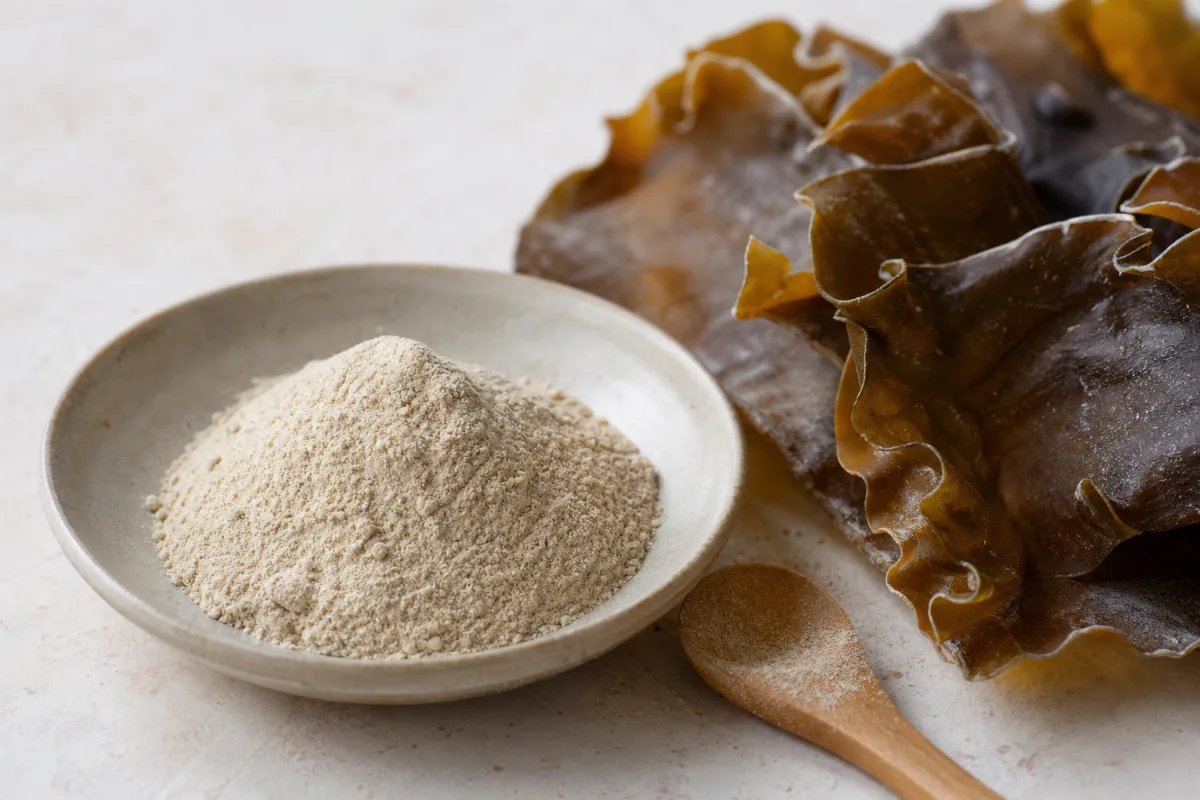
Seaweed & Algae · Seaweed extract
Alginate
Alginic acid and its salts, from brown seaweeds · also called Alginic acid, sodium alginate, algin, E 400 to E 404
Alginate is a gelling fibre taken from brown seaweed. It thickens foods and is used in some heartburn medicines and wound dressings. Alginate medicines eased reflux symptoms better than placebo or antacids in pooled trials, but the NHS says they are for short-term use. Evidence for weight loss and blood sugar is weak or mixed. The main cautions are long-term use, babies and children, and spacing from some medicines.
General information, not medical advice. Last substantive update · Not medically reviewed. A named clinician has not signed off on this page. How this page is made
About Alginate
Alginate is a gelling fibre taken from brown seaweed. It is an authorised food additive, an ingredient in some heartburn medicines and a wound dressing material. It is not a proven health food: the clearest benefit is short-term relief of heartburn with alginate medicines, and the weight loss and blood sugar evidence is weak.
What it is
Alginate is alginic acid and its salts (E 400 to E 404), a gelling fibre from brown seaweeds. In water it forms a gel. It is used to thicken and set foods, in some heartburn medicines and in wound dressings.
The brown seaweeds named as sources in our summary include giant kelp (Macrocystis pyrifera) and knotted wrack (Ascophyllum nodosum), whose accepted names were checked in GBIF. We could not confirm a USDA nutrient entry for alginate, and it is not eaten in servings, so no nutrient table is given.
Food, medicine, supplement and dressing: four different things
As a food additive, alginate is used in small amounts to thicken or set. As a medicine, it is taken for heartburn. As a supplement, alginate drinks and capsules have been tested in small trials for weight and blood fats. As a dressing, it is placed on wounds and not eaten.
Results for one form should not be carried to another. The heartburn trials used medicines, the weight loss trial used a fibre drink, and the glucose analysis used whole brown seaweed and extracts.
What the research shows
The firmest finding is for heartburn. A 2017 analysis of 14 trials found alginates raised the odds of symptom relief over placebo or antacids (OR 4.42), with noticeable differences between trials. They were not clearly better than PPIs or H2 blockers. The NHS says alginates and antacids help symptoms in the short term but will not cure the problem.
For weight loss, one 12-week trial was null in its main analysis. For blood sugar, the alginate trial was null, and the brown seaweed analysis is not about alginate alone. The fullness hormone and after-meal triglyceride studies are tiny. Wound dressing results are from clinics.
Alginate versus whole seaweed
Alginate is one compound from brown seaweed. Whole seaweeds such as kombu bring other compounds and nutrients, so their research does not describe alginate. A 2026 review of brown seaweed compounds in type 2 diabetes discusses mechanisms, but its abstract does not show that alginate on its own lowers blood sugar.
At a glance
Traditional uses history, not proof
- Used to thicken and set foods (E 400 to E 404)
- Long use in products is not proof that it treats any condition
Studied for research
- Heartburn and reflux symptoms in adults, moderate certainty (alginate medicines)
- Reflux in babies and children, low certainty
- Weight loss, mixed (one trial)
- Fullness hormones, very low certainty
- Blood sugar, insufficient evidence for alginate
- Blood fats after a fatty meal, very low certainty
- Wound care, low certainty (dressings, not food)
Main compounds
- Alginic acid
- Sodium alginate and other alginate salts
Common forms
- Food additive (E 400 to E 404), as used in foods and read in EFSA's opinion
- Alginate heartburn medicines, as studied in trials
- Alginate drinks and capsules tested in trials (supplements, not food)
- Alginate wound dressings (medical products, not eaten)
- Whole seaweeds are different foods and are not covered
Research links: 2017 review: alginates for reflux symptoms (14 trials) · 2017 EFSA opinion: alginates as food additives · 2012 trial: alginate and weight loss (96 people) · Research Library · Genes & Biomarkers Library
What it is and its history
- Accepted scientific name
- Alginic acid and its salts (alginate; E 400 to E 404)
- Naming authority
- Not a plant: a gelling fibre extracted from brown seaweeds. EFSA lists alginic acid and its sodium, potassium, ammonium and calcium salts as E 400 to E 404.
- Common names
- Alginate (English); Alginic acid (English); Sodium alginate (English); Algin (English)
- Family or group
- A polysaccharide (a long-chain carbohydrate or fibre) from brown seaweed cell walls, per the existing summary. Source seaweeds: kelp and rockweed types.
- Classification
- Chromista (source seaweeds) > Ochrophyta > Phaeophyceae (brown algae) > Laminariales and Fucales > Laminariaceae and Fucaceae > Macrocystis, Ascophyllum, Laminaria > Macrocystis pyrifera and Ascophyllum nodosum (named in the existing summary as sources)
- Native range
- Not verified from a source read.
- Habitat
- Not verified from a source read.
- Cultivation
- Not verified from a source read.
- Harvest and processing
- Not verified from a source read. The sources read describe alginate as a food additive, medicine ingredient and wound-dressing material.
- Look-alikes and adulterants
- Name: Agar and carrageenan; Note: Other seaweed gelling agents, from red seaweeds. They have their own pages.; Name: Fucoidan; Note: A different compound from brown seaweed, sold as a supplement.; Name: Kelp noodles and whole kelp; Note: Whole seaweed foods. A whole seaweed is not the same as alginate.
- Sustainability and conservation
- Not assessed.
Photographs
What is inside, and how it may work
What it contains and how those compounds act in cells and animals. Laboratory and animal mechanisms are not proven effects in people.
Main compounds
| Compound | Family | Where it is concentrated | Activity studied | Level of evidence |
|---|---|---|---|---|
| Alginic acid and alginate salts | polysaccharide (gelling fibre) | Brown seaweed (extract) Not found; no USDA entry was confirmed. | Forms a gel. Medicines containing it eased reflux symptoms in pooled trials; EFSA found no concern as a food additive at current uses. 8 3 | Human data |
Mechanisms, receptors and pathways
| Target or pathway | Gene or receptor | What was found | Level |
|---|---|---|---|
| Displacing the acid pocket in the stomach | Not applicable | The meta-analysis authors describe alginates as working by displacing the postprandial gastric acid pocket, an alternative to lowering acid. 8 | Human data |
| Gel in the gut and fullness | Not specified | The weight trial authors say strong gelling fibres may raise fullness and cut how much people eat, based on short earlier studies. The 12-week trial did not show this in its main result. 5 | Human data |
| Blood sugar handling (proposed) | Not specified | A 2026 review proposes several routes by which brown seaweed compounds, alginate among them, may affect glucose, including through the gut. These are proposed mechanisms. 7 | Review |
Absorption, metabolism and elimination
- Absorption
- Not found.
- Distribution
- Not found.
- Metabolism
- Not found.
- Elimination
- Not found.
- Bioavailability
- Not established.
Isolated compounds versus whole extracts
The reflux, weight and blood fat results are for alginate medicines or supplements. The glucose result comes from whole brown seaweeds and extracts. EFSA's safety opinion is for alginate as a food additive. Wound dressings are a medical product. None of these tells you what eating a whole seaweed does.
Nutritional composition
No nutrient table is given. USDA FoodData Central was queried 2026-10-26, but the public key was rate-limited, so a USDA entry for alginate could not be checked directly; the existing seaweed summary states USDA SR Legacy has no entry. Alginate is described in the trials as a strong gelling fibre. It is used as a thickener and gelling additive (E 400 to E 404), in heartburn medicines and in wound dressings, not as a food with a serving size. Source: EFSA abstract and trial abstracts as read; no amounts or advice on how much to eat are given.
1 moderate certainty1 mixed findings2 low certainty2 very low certainty1 not enough evidence
What was looked at
The 7 benefits and uses checked for Alginate, each with how strong the evidence is. Tap one to open it.
- Heartburn and reflux symptoms (alginate medicines)Moderate certainty
- Reflux in babies and children (alginate products)Low certainty
- Weight lossMixed findings
- Fullness hormones (CCK and PYY)Very low certainty
- Blood sugarNot enough evidence
- Blood fats after a fatty mealVery low certainty
- Wound care (alginate dressings)Low certainty
Lab markers tracked in the studies
Reflux (GERD) symptom resolutionBody weight and body fatBlood pressureCCK and PYY (gut fullness hormones)Blood glucoseTriglycerides after a fatty mealWound healing rate
What is Alginate good for?
The main studied uses and how strong the human evidence is for each. Most results are for alginate medicines or supplements, not for the small amounts used in foods.
Benefits, one by one
Each card is a research question, not a promise. Tap a goal to filter. Open a card to see the studies, doses and limits.
Heartburn and reflux symptoms (alginate medicines)
Moderate certaintyAcross 14 trials, alginate medicines made reflux symptoms go away more often than placebo or antacids. They did not clearly beat acid-lowering medicines.
3 studiesAlginate-containing medicines from the trials. The abstracts do not s…
Studies, doses and limits
What the trials found
A 2017 meta-analysis of 14 randomised trials (2,095 people, children excluded) found alginates beat placebo or antacids. The NHS says alginates and antacids help symptoms in the short term but will not cure the problem. A 2025 expert consensus suggested adding an alginate or an antacid for people whose symptoms continue on a PPI.
Results
Alginate medicines eased reflux symptoms more than placebo or antacids. Compared with PPIs or H2 blockers they looked less effective, though that gap was not statistically significant.
Effect sizes as reported
Symptom resolution vs placebo or antacids: OR 4.42 (95% CI 2.45 to 7.97, I2 71%). Vs PPIs or H2 blockers: OR 0.58 (0.27 to 1.22).
Why this rating
Moderate: pooled randomised trials, but with noticeable differences between trials (I2 71%). The abstract gives no GRADE rating, and the trials are of medicines, not food.
Form and dose studied
Alginate-containing medicines from the trials. The abstracts do not say which products were used.
Who was studied
Adults with reflux (GERD) symptoms. Children were left out of the pooled analysis.
Limits
Symptom relief only. Trials ended in 2015. These are medicines, not food. Alginate medicines and supplements are not the same as the small amounts of alginate used to thicken foods.
Why researchers looked
Alginate forms a gel layer that sits on stomach contents. Researchers asked whether that eases heartburn.
Traditional use
Alginate is mostly used as a food thickener and in medicines. Long use in products is not proof that it treats any condition.
Proposed mechanism Human review
The meta-analysis authors describe alginates as working by displacing the acid pocket that forms in the stomach after a meal.
A proposed mechanism does not show that the effect happens in people.
See the Safety tab: the NHS says do not take them regularly for long periods.
Reflux in babies and children (alginate products)
Low certaintyFour alginate studies in a 2026 review showed less regurgitation, but the evidence quality was low to moderate.
2 studiesAlginate products for infants. The abstract does not say which produc…
Studies, doses and limits
What the trials found
A 2026 systematic review of 40 studies (mostly in infants) included four alginate studies. Thickened feeds and alginates showed the most consistent improvement in symptoms.
Results
Alginates were linked with less regurgitation in infants with reflux. The review says most trials had a high risk of bias and the certainty of the evidence ran from very low to moderate.
Effect sizes as reported
No pooled numbers; the trials were too different to combine.
Why this rating
Low: the review authors call the evidence quality low to moderate overall, with frequent high risk of bias, and there are only four alginate studies.
Form and dose studied
Alginate products for infants. The abstract does not say which products or amounts.
Who was studied
Mostly infants with uncomplicated reflux or GERD.
Limits
Few studies. Use in babies should be directed by a doctor. EFSA says infants' and young children's exposure from food additives should stay below the amounts used as medicine.
Why researchers looked
Reflux is common in babies, and parents and doctors look for options beyond drugs.
Traditional use
Alginate is mostly used as a food thickener and in medicines. Long use in products is not proof that it treats any condition.
Proposed mechanism Not stated
Not described in the abstract.
A proposed mechanism does not show that the effect happens in people.
See Safety: EFSA notes about infants and young children.
Weight loss
Mixed findingsOne 12-week trial of an alginate drink found no difference in weight loss in the main analysis. Only people who finished the trial lost more.
1 studiesAn alginate-based drink with fibre, taken before main meals for 12 we…
Studies, doses and limits
What the trials found
In 96 obese adults on a reduced-calorie diet, an alginate drink before meals did not change weight or fat loss in the main (intention-to-treat) analysis. In the 80 who completed it, the alginate group lost more.
Results
A mixed result that depends on how the numbers are counted. Blood pressure fell more in the placebo group in the main analysis.
Effect sizes as reported
Completers: 6.78 kg lost on alginate vs 5.04 kg on placebo (P = 0.03). Intention-to-treat: no difference (P > 0.1).
Why this rating
Mixed: one trial, a null main result and a positive completer result.
Form and dose studied
An alginate-based drink with fibre, taken before main meals for 12 weeks. A supplement, not a food.
Who was studied
Obese adults (n = 96) on a calorie-restricted diet.
Limits
One trial only. The completer analysis can overstate benefit. Funding not stated in the abstract.
Why researchers looked
Alginate is a strong gelling fibre. Short studies suggested it might make people feel fuller, so researchers tested it over 12 weeks.
Traditional use
Alginate is mostly used as a food thickener and in medicines. Long use in products is not proof that it treats any condition.
Proposed mechanism Hypothesis
The trial authors say short studies suggested gelling fibres may increase fullness and lower energy intake. The 12-week trial did not settle whether this helps weight loss.
A proposed mechanism does not show that the effect happens in people.
Not found to cause harm in the abstract, but it reports lower blood pressure fall than with placebo.
Fullness hormones (CCK and PYY)
Very low certaintyIn a small 8-week study of men with metabolic syndrome, fullness hormones rose more when sodium alginate was added to high-intensity exercise.
1 studiesSodium alginate solution before main meals, 3 days a week, plus exerc…
Studies, doses and limits
What the trials found
40 men with metabolic syndrome were split into five groups. CCK and PYY rose in all groups, and most in the high-intensity exercise plus alginate group.
Results
Hormone changes only. Exercise alone also raised both hormones, so the extra from alginate is the open question.
Effect sizes as reported
No numbers in the abstract.
Why this rating
Very low: small groups of eight, 8 weeks, no placebo, and hormone levels are not hunger or weight.
Form and dose studied
Sodium alginate solution before main meals, 3 days a week, plus exercise.
Who was studied
Men with metabolic syndrome.
Limits
Small and short. Not weight loss. No placebo control.
Why researchers looked
CCK and PYY are gut hormones linked to feeling full, so they are used as a stand-in for appetite.
Traditional use
Alginate is mostly used as a food thickener and in medicines. Long use in products is not proof that it treats any condition.
Proposed mechanism Not stated
The authors tested whether alginate would add to the rise in these hormones. The abstract does not explain how.
A proposed mechanism does not show that the effect happens in people.
None reported in the abstract.
Blood sugar
Not enough evidenceNo difference in glucose or insulin was found in the main alginate trial. Trials of whole brown seaweed or extracts look more promising, but they are not alginate.
3 studiesAlginate preload drink in the one trial. The pooled analysis used bro…
Studies, doses and limits
What the trials found
In the 12-week alginate trial, glucose and insulin did not differ from placebo. A pooled analysis of 18 trials of brown seaweed and brown seaweed extracts (not alginate alone) found lower fasting and after-meal glucose, but the authors say no high-quality trial was found.
Results
No sign of a glucose benefit for alginate itself. The brown seaweed findings cannot be credited to alginate.
Effect sizes as reported
Brown seaweed pooled: fasting mean difference -4.6 (95% CI -7.88 to -1.33); after-meal -7.1 (-7.4 to -6.9); units not given in the abstract.
Why this rating
Insufficient for alginate: the only alginate trial found no difference, and the larger analysis is of whole brown seaweed and mixed extracts.
Form and dose studied
Alginate preload drink in the one trial. The pooled analysis used brown seaweed and extracts.
Who was studied
Obese adults (alginate trial); healthy, at-risk and type 2 diabetes (brown seaweed analysis).
Limits
Do not read the brown seaweed result as an alginate result. A mechanism review does not prove an effect in people.
Why researchers looked
Gelling fibres may slow digestion, so researchers looked at glucose.
Traditional use
Alginate is mostly used as a food thickener and in medicines. Long use in products is not proof that it treats any condition.
Proposed mechanism Review of mechanisms
A 2026 review describes how compounds from brown seaweed, including alginate, might influence glucose, partly through the gut. It is a review of ideas for how it might work.
A proposed mechanism does not show that the effect happens in people.
If you take medicine for diabetes, ask your doctor or pharmacist before changing your diet or adding supplements.
Blood fats after a fatty meal
Very low certaintyIn 8 healthy adults, calcium alginate capsules with a fatty meal lowered triglycerides over the next 6 hours.
1 studiesCalcium alginate capsules (a supplement) with a single fat-loaded mea…
Studies, doses and limits
What the trials found
In a crossover study, the same 8 healthy adults had a fat-loaded meal with placebo and with calcium alginate. Triglycerides and remnant-like lipoprotein cholesterol were lower from 2 hours with calcium alginate. Blood calcium rose and blood sodium fell.
Results
A single-meal effect in a tiny group. It is not a long-term cholesterol result.
Effect sizes as reported
Lower at all time points from 2 hours; area under the curve and peak also lower; no numbers in the abstract.
Why this rating
Very low: 8 people, one meal, and the effect was not tested over time.
Form and dose studied
Calcium alginate capsules (a supplement) with a single fat-loaded meal.
Who was studied
Healthy adults (n = 8).
Limits
Tiny and short. A supplement, not a food. The shifts in blood calcium and sodium are noted in the abstract and not explained.
Why researchers looked
Triglycerides rise after a fatty meal. Researchers tested whether alginate gel could blunt that rise.
Traditional use
Alginate is mostly used as a food thickener and in medicines. Long use in products is not proof that it treats any condition.
Proposed mechanism Not stated
Not described in the abstract.
A proposed mechanism does not show that the effect happens in people.
Blood calcium rose and sodium fell compared with placebo in this study.
Wound care (alginate dressings)
Low certaintySeaweed-alginate dressings used on wounds, together with a suction treatment, healed wounds better than the suction treatment alone or ordinary dressings in 11 trials. This is not something you eat.
1 studiesAlginate dressings applied to wounds, used with negative pressure the…
Studies, doses and limits
What the trials found
A 2026 meta-analysis of 11 randomised trials (902 people) of negative pressure wound therapy (NPWT) combined with alginate dressings found better healing than NPWT alone or routine dressings, mainly in hospital settings.
Results
Better healing rate, shorter healing time and fewer dressing changes for the combination. The effect of alginate alone cannot be separated.
Effect sizes as reported
Healing rate OR 2.64 (95% CI 1.60 to 4.36); Grade-A healing OR 4.69 (2.56 to 8.57); healing time MD -9.00 days (-9.41 to -8.58); dressing changes MD -2.54 (-2.92 to -2.17).
Why this rating
Low: pooled randomised trials, but the combination is compared, not alginate alone, and differences between trials were high for time and dressing changes (I2 83% and 77%).
Form and dose studied
Alginate dressings applied to wounds, used with negative pressure therapy. A medical product, not a food.
Who was studied
People with wounds, mostly in hospital settings.
Limits
Specialist wound care. Not for treating wounds at home without a clinician.
Why researchers looked
Alginate dressings absorb wound fluid and form a gel, and are used in clinics.
Traditional use
Alginate is mostly used as a food thickener and in medicines. Long use in products is not proof that it treats any condition.
Proposed mechanism Not stated
Not described in the abstract beyond a lower wound pH with the combination.
A proposed mechanism does not show that the effect happens in people.
The authors ask for careful monitoring at higher negative pressures and for better safety reporting.
Connections to the rest of health
How Alginate connects to the rest of our health knowledge graph. Every link says what kind of connection it is. A safety link (for example to the liver) is a warning, not a benefit. A study that merely mentions a topic never creates a benefit link.
Explore every connection: goals, body systems, organs, symptoms, genes
A. Wellness goals
| Connected to | Kind of connection | Evidence status | Context | Studies |
|---|---|---|---|---|
| Digestive Support | Moderate certainty | Heartburn and reflux symptoms (alginate medicines): Across 14 trials, alginate medicines made reflux symptoms go away more often than placebo or antacids. They did not clearly beat acid-lowering medicines. | 8 1 14 | |
| Digestive Support | Low certainty | Reflux in babies and children (alginate products): Four alginate studies in a 2026 review showed less regurgitation, but the evidence quality was low to moderate. | 2 3 | |
| Weight Management | Mixed findings | Weight loss: One 12-week trial of an alginate drink found no difference in weight loss in the main analysis. Only people who finished the trial lost more. Fullness hormones (CCK and PYY): In a small 8-week study of men with metabolic syndrome, fullness hormones rose more when sodium alginate was added to high-intensity exercise. | 5 4 | |
| Blood Sugar Balance | Not enough evidence | Blood sugar: No difference in glucose or insulin was found in the main alginate trial. Trials of whole brown seaweed or extracts look more promising, but they are not alginate. | 5 10 7 | |
| Cholesterol Balance | Very low certainty | Blood fats after a fatty meal: In 8 healthy adults, calcium alginate capsules with a fatty meal lowered triglycerides over the next 6 hours. | 9 | |
| Preventive Wellness | Low certainty | Wound care (alginate dressings): Seaweed-alginate dressings used on wounds, together with a suction treatment, healed wounds better than the suction treatment alone or ordinary dressings in 11 trials. This is not something you eat. | 6 |
B. Body systems
| Connected to | Kind of connection | Evidence status | Context | Studies |
|---|---|---|---|---|
| Digestive System | Biological association | Moderate certainty | Studied for: Heartburn and reflux symptoms (alginate medicines) Studied for: Reflux in babies and children (alginate products) | 8 1 14 2 3 |
| Metabolism Weight | Biological association | Mixed findings | Studied for: Weight loss Studied for: Fullness hormones (CCK and PYY) | 5 4 10 7 |
| Cardiovascular System | Biological association | Very low certainty | Studied for: Blood fats after a fatty meal | 9 |
| Integumentary System | Biological association | Low certainty | Studied for: Wound care (alginate dressings) | 6 |
E. Health conditions
| Connected to | Kind of connection | Evidence status | Context | Studies |
|---|---|---|---|---|
| Heartburn and acid reflux | Short term symptom relief | Alginate medicines eased reflux symptoms better than placebo or antacids in a pooled analysis; the NHS says short-term use only. Alginate medicines eased reflux symptoms better than placebo or antacids in a pooled analysis; the NHS says short-term only. Preparation or compound: Alginate heartburn medicines |
8 14 |
I. Biomarkers
| Connected to | Kind of connection | Evidence status | Context | Studies |
|---|---|---|---|---|
| Reflux (GERD) symptom resolution | Biological association | Moderate certainty | Measured in trials: improved. A lab change is not the same as a health benefit. | 8 14 |
| Body weight and body fat | Biological association | Mixed findings | Measured in trials: mixed. A lab change is not the same as a health benefit. | 5 |
| Blood pressure | Biological association | Low certainty | Measured in trials: larger fall with placebo. A lab change is not the same as a health benefit. | 5 |
| CCK and PYY (gut fullness hormones) | Biological association | Very low certainty | Measured in trials: raised. A lab change is not the same as a health benefit. | 4 |
| Blood glucose | Biological association | Not enough evidence | Measured in trials: no difference for alginate. A lab change is not the same as a health benefit. | 5 10 |
| Triglycerides after a fatty meal | Biological association | Very low certainty | Measured in trials: lowered. A lab change is not the same as a health benefit. | 9 |
| Wound healing rate | Biological association | Low certainty | Measured in trials: improved. A lab change is not the same as a health benefit. | 6 |
K. Biological pathways
L. Active compounds
| Connected to | Kind of connection | Evidence status | Context | Studies |
|---|---|---|---|---|
| Alginic acid and alginate salts | Biological association | Human | Forms a gel. Medicines containing it eased reflux symptoms in pooled trials; EFSA found no concern as a food additive at current uses. Preparation or compound: Brown seaweed (extract) |
8 3 |
Each connection is stored with the ingredient, the connected record, the kind of connection, the evidence status, the supporting studies, the preparation or compound involved, and a review date (last reviewed October 26, 2026).
The evidence
The research centre for Alginate. Every record here was checked against PubMed or the publisher's page; we never list a study we have not verified.
Evidence by outcome
Bars show how many studies we found for each outcome, not how well it works. People are added up across trials only (reviews are not added, to avoid double counting).
How we rate evidence
High certainty
Several well-run trials or reviews agree; further research is unlikely to change the picture much.
Moderate certainty
Good trials point the same way, but some doubt remains.
Low certainty
Small, short or inconsistent trials. The finding could change with better research.
Very low certainty
Very little or very weak human data. Treat as a possibility only.
Mixed findings
Trials or reviews disagree with each other.
Not enough evidence
Not enough human research to say either way.
Evidence against
Good research found no benefit, or found harm.
We take the reviewers' own risk-of-bias and GRADE statements where they exist, and otherwise judge from study size, design, consistency, directness and whether a product matches what is sold. Many publications do not make evidence high. Method note: We started from our existing alginate summary, then read PubMed abstracts, the EFSA opinion abstract, the NHS heartburn and Gaviscon pages, and GBIF. Only abstracts were read for studies. Items we could not verify are flagged in the research gaps.
Study library: every study we checked 14
| Study | Design | People | Product, dose, length | Result |
|---|---|---|---|---|
| Armstrong 2025 Management of Patients With Refractory Reflux-Like Symptoms Despite Proton Pump Inhibitor Therapy: Evidence-Based Consensus Statements. Aliment Pharmacol Ther · PMID 39740235 · DOI |
Consensus statement n/a |
Expert group statements for people whose reflux-like symptoms continue despite PPI treatment | Adjunctive alginate or antacid therapy Alginate medicine (not a food) |
Consensus was reached on 13 of 17 statements. For people still symptomatic on a PPI, the group suggested adding an alginate or an antacid. No numbers in the abstract (Not applicable) Methods, limits and fundingOutcomes: Consensus statements on diagnosis and management Limitations: A consensus statement based on GRADE-rated reviews, not a new trial. The abstract does not say how strong the alginate-specific evidence was. Funding and conflicts: Funding is not stated in the abstract. Read: abstract |
| Banderali 2026 Efficacy and safety of non-pharmacological interventions for gastroesophageal reflux and gastroesophageal reflux disease in children: a systematic review. Ital J Pediatr · PMID 42098776 · DOI |
Systematic review |
40 studies (39 randomised trials and one systematic review) in babies, children and teens, mostly infants; 4 studies were of alginates | Alginate products among many non-drug approaches Alginate medicine or product (not a food) Not given in the abstract Varied by trial · vs Varied |
Thickened feeds, probiotics, alginates and left-side positioning were linked with less regurgitation. Thickened formulas and alginates gave the most consistent improvement, but overall evidence quality was low to moderate. Risk of bias was often high. No pooled numbers (meta-analysis was not done because the trials differed too much) (Not applicable) Methods, limits and fundingOutcomes: Regurgitation frequency and reflux questionnaire scores Limitations: Only four alginate studies. The certainty of the evidence ranged from very low to moderate depending on outcome and approach. Not a food. Funding and conflicts: Funding is not stated in the abstract. Registration: PROSPERO CRD420251041380 Read: abstract |
| EFSA Panel on Food Additives and Nutrient Sources added to Food (ANS) 2017 Re-evaluation of alginic acid and its sodium, potassium, ammonium and calcium salts (E 400-E 404) as food additives. EFSA J · PMID 32625343 · DOI |
Regulatory opinion n/a |
Safety re-evaluation of alginic acid and its salts as authorised EU food additives | Alginic acid and its sodium, potassium, ammonium and calcium salts (E 400 to E 404) Food additive |
The panel decided no numerical Acceptable Daily Intake was needed and saw no safety concern at the refined exposure estimates for the reported uses. Infants' and young children's exposure from these additives should stay below the amounts used as medicine, at which side effects could occur. For foods for special medical purposes and special infant formulas, the data were not enough to judge safety in infants and young children. No numbers in the abstract (Not applicable) Methods, limits and fundingOutcomes: Safety of use as a food additive Limitations: Read as an abstract only. Covers the additive in food, not alginate medicines or supplements. Funding and conflicts: Regulatory opinion by EFSA's own expert panel. Read: abstract |
| Ebrahimi 2025 Combined effects of sodium alginate supplementation with HIIT and MICT on CCK and PYY levels in men with metabolic syndrome. J Diabetes Metab Disord · PMID 40534635 · DOI |
Randomised controlled trial |
40 40 men with metabolic syndrome in five groups of 8: two exercise styles with or without sodium alginate, and a no-intervention control |
Sodium alginate solution (supplement) Sodium alginate (a Sigma-brand chemical) Taken 30 minutes before main meals on 3 days a week 8 weeks · vs Exercise without alginate; no-intervention control |
CCK and PYY rose in all studied groups. The high-intensity exercise plus alginate group rose more than the others, and its metabolic syndrome score fell more. No numbers in the abstract (Not given in the abstract) Methods, limits and fundingOutcomes: Fullness hormones CCK and PYY; metabolic syndrome Z score Limitations: Small (eight men per group) and short (8 weeks). Hormone levels are not weight loss. The abstract notes exercise alone also raised both hormones. The control group had no placebo. Funding and conflicts: Funding is not stated in the abstract. Ethics approval and trial registration IRCT20190916044788N1 are given. Registration: IRCT20190916044788N1 Read: abstract |
| Georg Jensen 2012 Effect of alginate supplementation on weight loss in obese subjects completing a 12-wk energy-restricted diet: a randomized controlled trial. Am J Clin Nutr · PMID 22648709 · DOI |
Randomised controlled trial |
96 96 obese adults on a 300 kcal a day energy-restricted diet; 80 completed |
Alginate-based preload drink (alginate supplement) Alginate supplement (not a food) Drink with 15 g of fibre, three times a day before main meals 12 weeks · vs Placebo preload drink |
In the main (intention-to-treat) analysis, weight and fat loss did not differ between groups. Among the 80 who completed the trial, the alginate group lost more weight. In the main analysis blood pressure fell more in the placebo group. Glucose, insulin, CRP, ghrelin and blood fats did not differ. Completers: weight loss 6.78 kg (alginate) vs 5.04 kg (placebo), P = 0.03. Intention-to-treat: no difference (P > 0.1). (Not given in the abstract) Methods, limits and fundingOutcomes: Body weight and fat; blood pressure, glucose, insulin, CRP, ghrelin, HOMA-IR, blood fats Limitations: Result depends on which analysis you use. One trial of 12 weeks. A supplement drink, not a food. Funding and conflicts: Funding is not stated in the abstract (PubMed lists the trial as non-US government supported research). Read: abstract |
| He 2026 Efficacy and safety of negative pressure wound therapy combined with alginate dressings for wound management: a meta-analysis. Front Med (Lausanne) · PMID 41994425 · DOI |
Systematic review meta analysis |
902 11 randomised trials with 902 people with wounds, mostly in hospital settings |
Alginate wound dressings with negative pressure wound therapy (NPWT) Alginate dressing placed on a wound (not eaten) Varied · vs NPWT alone or routine dressings |
The combination gave better healing than NPWT alone or routine dressings, with benefits mostly in hospital settings. The authors ask for careful monitoring at higher negative pressures and for better safety reporting. Healing rate OR 2.64; Grade-A healing OR 4.69; healing time MD -9.00 days; dressing changes MD -2.54 (Healing rate 1.60 to 4.36 (I2 30%); Grade-A 2.56 to 8.57 (I2 0%); healing time -9.41 to -8.58 (I2 83%); dressing changes -2.92 to -2.17 (I2 77%)) Methods, limits and fundingOutcomes: Wound healing rate, Grade-A healing, healing time, dressing change frequency, wound pH Limitations: Medical dressings, not food. The effect is of the combination, so alginate alone cannot be separated. Large differences between trials for some outcomes. Funding and conflicts: Funding is not stated in the abstract. Read: abstract |
| Jung 2026 Brown Seaweeds and Their Bioactive Compounds in Type 2 Diabetes: Mechanisms Underlying Metabolic Regulation. Int J Mol Sci · PMID 42278284 · DOI |
Narrative review mixed |
Review of how brown seaweed compounds (fucoidan, alginate, phlorotannins, fucoxanthin) may act on blood sugar | Brown seaweed compounds including alginate Brown seaweeds and their compounds |
The review describes several possible ways these compounds may influence glucose handling, including through the gut. It is about ideas for how it might work. No numbers in the abstract (Not applicable) Methods, limits and fundingOutcomes: Proposed mechanisms of blood sugar control Limitations: A mechanism review. The abstract does not separate lab, animal and human findings, and does not give results for alginate alone. Funding and conflicts: Funding is not stated in the abstract. Read: abstract |
| Leiman 2017 Alginate therapy is effective treatment for GERD symptoms: a systematic review and meta-analysis. Dis Esophagus · PMID 28375448 · DOI |
Systematic review meta analysis |
2095 14 randomised trials in the meta-analysis (2,095 people with reflux symptoms); children excluded; trials searched to October 2015 |
Alginate-containing medicines Alginate medicine (not a food) Not given in the abstract Varied by trial · vs Placebo, antacids, H2 blockers or proton pump inhibitors (PPIs) |
Alginates raised the odds that symptoms went away compared with placebo or antacids. Against PPIs or H2 blockers they looked less effective, but that difference was not statistically significant. Alginate vs placebo or antacids: OR 4.42 for symptom resolution. Alginate vs PPIs or H2 blockers: OR 0.58. (Placebo or antacids 95% CI 2.45 to 7.97 (I2 71%); PPIs or H2 blockers 95% CI 0.27 to 1.22) Methods, limits and fundingOutcomes: Resolution of reflux (GERD) symptoms Limitations: Fairly large differences between trials (I2 71%). Trials ended before 2016. Children and non-English trials were left out. These are medicines, not a food. Funding and conflicts: Funding is not stated in the abstract. Read: abstract |
| Namiki 2025 Effect of Calcium Alginate on the Suppression of Postprandial Elevation of Serum Triglyceride Level in Humans-A Placebo-Controlled, Randomized, Double-Blind, Crossover Study. J Nutr Sci Vitaminol (Tokyo) · PMID 41183974 · DOI |
Randomised crossover trial |
8 8 healthy adults, each tried placebo and calcium alginate after a fat-loaded meal |
Calcium alginate capsules Calcium alginate supplement (not a food) Five 300 mg capsules with the fat-loaded meal A single meal, measured over 6 hours · vs Placebo |
Triglycerides and RLP-C were lower from 2 hours onward in the calcium alginate group. The area under the curve and the peak level were also lower. Serum calcium rose and serum sodium fell compared with placebo. Significantly lower at every time point from 2 hours; no numbers in the abstract (Not given in the abstract) Methods, limits and fundingOutcomes: Blood triglycerides and remnant-like lipoprotein cholesterol (RLP-C) for 6 hours after a fat meal Limitations: Only 8 people and a single meal. This shows an after-meal effect, not a lasting cholesterol change. A supplement, not a food. Funding and conflicts: Funding is not stated in the abstract. Read: abstract |
| Vaughan 2022 Effect of brown seaweed on plasma glucose in healthy, at-risk, and type 2 diabetic individuals: systematic review and meta-analysis. Nutr Rev · PMID 34549293 · DOI |
Systematic review meta analysis |
18 randomised trials of brown seaweed or brown seaweed extracts in healthy people, people at risk and people with type 2 diabetes | Brown seaweed and its extracts (not alginate alone) Whole brown seaweed or extracts Varied Varied · vs Control |
Pooled results favoured brown seaweed for both fasting and after-meal glucose, with the after-meal effect looking most promising. Results varied between populations. The authors say no high-quality trial was found and more species-specific and dose-response research is needed. Fasting mean difference -4.6; after-meal mean difference -7.1 (units not given in the abstract) (Fasting -7.88 to -1.33; after-meal -7.4 to -6.9) Methods, limits and fundingOutcomes: Fasting and after-meal plasma glucose Limitations: Covers whole brown seaweeds and extracts, so it cannot isolate alginate. No high-quality trial was identified. Funding and conflicts: Funding is not stated in the abstract (PubMed lists non-US government research support). Registration: PROSPERO CRD42020187849 Read: abstract |
| s-gbif-ascophyllum GBIF species match: Ascophyllum nodosum (L.) Le Jol. · Source |
Taxonomy database n/a |
Methods, limits and fundingRead: full-text | ||
| s-gbif-macrocystis GBIF species match: Macrocystis pyrifera (L.) C.Agardh · Source |
Taxonomy database n/a |
Methods, limits and fundingRead: full-text | ||
| s-nhs-gaviscon NHS: Gaviscon (about, who can take it, side effects, pregnancy and breastfeeding, other medicines) · Source |
Health agency n/a |
Methods, limits and fundingRead: full-text | ||
| s-nhs-heartburn NHS: Heartburn and acid reflux · Source |
Health agency n/a |
Methods, limits and fundingRead: full-text |
What we do not know yet
- No trial of alginate as eaten in ordinary foods was found for any health outcome.
- The adult reflux analysis ended in 2015 and the abstract does not say which products or amounts were used.
- Only one 12-week weight loss trial was read, and its main result was null.
- The blood sugar findings come from whole brown seaweed and extracts, not alginate alone.
- No alginate-specific official statement on pregnancy, breastfeeding or kidney disease was read; the NHS pages are for Gaviscon and do not list ingredients.
- Contaminants (arsenic, heavy metals, iodine), history and how alginate is made were not researched.
How new research is added
New studies are found by a saved PubMed search and placed in a review queue before the page changes.
Lab markers
What changed in blood or saliva tests during trials. A changed number is not the same as feeling or being healthier, and we give no "normal ranges".
Metabolic 3
Body weight and body fat
Mixed results in trials
Total body weight and the share that is fat.
Mixed findingsResults and what it means
Why it was measured
To see whether an alginate drink helps people lose weight on a calorie-restricted diet.
Statistical vs. clinical meaning
Depends on whether the 16 people who dropped out are counted.
Safety implication
None found in the abstract.
| Study | Result | People | Product |
|---|---|---|---|
| 5 | No difference in the main analysis; among completers 6.78 kg lost vs 5.04 kg on placebo (P = 0.03), mainly body fat. | 96 obese adults, 12 weeks | Alginate preload drink, three times a day before meals |
Blood glucose
No difference for alginate in trials
The sugar level in the blood, measured fasting or after a meal.
Not enough evidenceResults and what it means
Why it was measured
A common marker in diabetes and prevention trials.
Statistical vs. clinical meaning
The alginate result is null. The brown seaweed result cannot be credited to alginate.
Safety implication
People on diabetes medicines should ask their doctor first.
| Study | Result | People | Product |
|---|---|---|---|
| 5 | Glucose and insulin did not differ between alginate and placebo in the main analysis. | 96 obese adults, 12 weeks | Alginate preload drink |
| 10 | Pooled brown seaweed and extract trials: fasting mean difference -4.6, after-meal -7.1 (units not given in the abstract). Not alginate alone. | 18 trials, healthy, at-risk and type 2 diabetes | Brown seaweed or extracts |
Triglycerides after a fatty meal
Lowered in trials
A type of blood fat that rises for some hours after eating fat.
Very low certaintyResults and what it means
Why it was measured
After-meal blood fat is one marker used to study heart risk.
Statistical vs. clinical meaning
A one-meal effect in 8 people, not a lasting cholesterol change.
Safety implication
Blood calcium rose and sodium fell in this study.
| Study | Result | People | Product |
|---|---|---|---|
| 9 | Triglycerides and RLP-C were significantly lower from 2 hours, and the area under the curve and peak were lower, with calcium alginate than placebo. | 8 healthy adults, one fat-loaded meal | Calcium alginate capsules vs placebo |
Other 4
Reflux (GERD) symptom resolution
Improved in trials
Whether heartburn and other reflux symptoms went away during treatment, as reported by the person.
Moderate certaintyResults and what it means
Why it was measured
It is the usual outcome in trials of heartburn medicines.
Statistical vs. clinical meaning
A symptom report, not a measure of healing. Help with symptoms, not a cure.
Safety implication
NHS: not for regular long-term use.
| Study | Result | People | Product |
|---|---|---|---|
| 8 | Alginates raised the odds of symptom resolution vs placebo or antacids (OR 4.42, 95% CI 2.45 to 7.97). | Adults with reflux symptoms, 14 trials | Alginate-containing medicines |
| 8 | Against PPIs or H2 blockers the odds were OR 0.58 (0.27 to 1.22), not statistically significant. | Adults with reflux symptoms | Alginate-containing medicines |
Blood pressure
Larger fall with placebo in trials
The force of blood on artery walls, measured as systolic and diastolic.
Low certaintyResults and what it means
Why it was measured
A secondary safety and risk marker in the weight loss trial.
Statistical vs. clinical meaning
Unexpected in the direction of placebo. One trial.
Safety implication
No harm claim; the abstract does not explain it.
| Study | Result | People | Product |
|---|---|---|---|
| 5 | In the intention-to-treat analysis, systolic and diastolic blood pressure fell more in the placebo group than in the alginate group (P < 0.05). | 96 obese adults, 12 weeks | Alginate preload drink vs placebo |
CCK and PYY (gut fullness hormones)
Raised in trials
Hormones released by the gut after eating that are linked to feeling full.
Very low certaintyResults and what it means
Why it was measured
Used as a stand-in for appetite in the small trial.
Statistical vs. clinical meaning
A hormone change, not proof of feeling less hungry or losing weight.
Safety implication
None reported.
| Study | Result | People | Product |
|---|---|---|---|
| 4 | Both rose in all groups; the rise was greatest in the high-intensity exercise plus sodium alginate group. | 40 men with metabolic syndrome, 8 weeks | Sodium alginate before meals, with exercise |
Wound healing rate
Improved in trials
The share of wounds judged healed or healing well.
Low certaintyResults and what it means
Why it was measured
The main outcome in wound dressing trials.
Statistical vs. clinical meaning
A clinic treatment effect of a combination.
Safety implication
Authors ask for better safety reporting.
| Study | Result | People | Product |
|---|---|---|---|
| 6 | Healing rate OR 2.64 (1.60 to 4.36) and healing time MD -9.00 days with NPWT plus alginate dressings versus controls. | 11 trials, 902 people | NPWT plus alginate dressing |
Safety
What studies and official sources say about side effects, medicines and who should check first. Each point shows what kind of evidence it comes from.
Main points to know 3
- As a food additive, EFSA saw no safety concern at current uses. EFSA's 2017 re-evaluation of alginic acid and its salts (E 400 to E 404) said no numerical daily limit was needed and no safety concern at the estimated exposure for reported uses. Infants and young children should stay below the amounts used as medicine, and the data were too thin to judge use in special medical foods and special infant formulas. Regulatory opinion 3
- Alginate heartburn medicines are for short-term use. The NHS says alginates help symptoms in the short term, will not cure the problem, and should not be taken regularly for long periods. See a GP if heartburn is most days, if pharmacy medicines are not helping, or if you also have food getting stuck, frequent vomiting or weight loss for no reason. Authoritative guidance 14
- Some medicines need a two-hour gap from Gaviscon. For Gaviscon, the NHS says not to take it within 2 hours before or after levothyroxine, iron tablets, some antibiotics, bisphosphonates and several other medicines. The NHS pages do not list ingredients, so check your product's leaflet to see whether it applies to yours. Authoritative guidance 13
Side effects 4
| Effect | How often | Severity and recovery | Evidence |
|---|---|---|---|
| Feeling sick, vomiting, constipation or diarrhoea NHS describes Gaviscon, a heartburn product; the pages read do not name alginate as the cause. | NHS: rare, and likely to be mild (for some types of Gaviscon) | mild NHS: usually goes away when you stop taking it. | Authoritative guidance 13 |
| Serious allergic reaction (anaphylaxis) Described for Gaviscon in general. | NHS: rare | can be severe Needs emergency treatment. | Authoritative guidance 13 |
| Changes in blood calcium and sodium after calcium alginate capsules A single-meal study with a calcium alginate supplement. The abstract does not call it an adverse effect. | One crossover study of 8 healthy adults: blood calcium rose and blood sodium fell vs placebo | not described Not described. | Small human trial 9 |
| Lower fall in blood pressure than with placebo in a weight loss trial Reported as a difference between groups, not as harm. | In the main analysis of a 96-person trial, blood pressure fell more on placebo than on alginate | not described Not described. | Randomised trial 5 |
Liver
No liver injury linked to alginate was found in the sources read. A liver injury database (LiverTox) was not searched for this page.
How often. No frequency was found.
Monitoring. No agency monitoring advice was found.
This is a safety connection. It is not evidence that Alginate supports liver health.
Medicines and supplements 3
| With | Why it matters | Importance | Evidence | What to do |
|---|---|---|---|---|
| Levothyroxine, iron tablets, some antibiotics (quinolones, tetracyclines), bisphosphonates and other listed medicines prescription | The NHS says some medicines can affect the way Gaviscon works and should be taken at least 2 hours apart. The pages read do not explain the mechanism. | Spacing advice from the NHS for Gaviscon. Not shown for alginate on its own. | Authoritative guidance Low certainty 13 | If you take any of these medicines, ask your doctor or pharmacist how to space heartburn products from them. |
| Ibuprofen and aspirin over-the-counter | The NHS says these painkillers can make heartburn symptoms worse. | NHS advice for people using Gaviscon. Paracetamol is fine with it. | Authoritative guidance Low certainty 13 | Ask a doctor or pharmacist before using them with a heartburn medicine. |
| Herbal remedies and supplements supplement | The NHS says there are no known problems with taking herbal remedies and supplements alongside Gaviscon, but they are not tested the same way. | Authoritative guidance Low certainty 13 | Tell your doctor or pharmacist about everything you take. |
Who should check first 4
| Situation | Advice | Evidence |
|---|---|---|
| Low calcium or low salt (low sodium) diet; kidney, liver or heart disease; phenylketonuria; low blood phosphate; past allergic reaction to Gaviscon or another medicine | The NHS says to check with a doctor or pharmacist before starting Gaviscon if any of these apply. It is guidance for that product, so check your label if you use a different alginate medicine. | Authoritative guidance 13 |
| Children under 12 and babies | The NHS says children under 12 should only have Gaviscon if a doctor prescribes or recommends it. EFSA says exposure to the additive in infants and young children should stay below the amounts used as medicine. | Authoritative guidance 13 3 |
| Pregnancy and breastfeeding | The NHS says Gaviscon can be taken in pregnancy and while breastfeeding, following the instructions and not taking more than recommended, and that it should not cause side effects in a baby. If it is not working, ask a pharmacist or doctor. An alginate-specific official statement was not read. | Authoritative guidance 13 14 |
| Heartburn on most days or with warning signs | Heartburn most days, food sticking in the throat, frequent vomiting or weight loss for no reason: the NHS says see a GP to rule out more serious causes. | Authoritative guidance 14 |
Overdose, product quality and regulators
Summary. EFSA found no safety concern for alginic acid and its salts as food additives at the exposure estimated for their reported uses, and said no numerical daily limit was needed. No toxicity from alginate in ordinary food was found in the other sources read.
Animal. Not reviewed.
High dose or long term signals. EFSA says infants and young children should not go over the amounts used therapeutically, at which side effects could occur. The NHS says not to take alginate heartburn medicines regularly for long periods.
Overdose response. Not found.
Genotoxicity. Not researched.
Heavy metals, arsenic and iodine in alginate products made from brown seaweed were not researched for this page, so no statement about them is made. Whole seaweeds differ from this purified extract.
Seaweed-derived products. No source was read on contaminants in alginate. Not researched.
| Body | Action | Date |
|---|---|---|
| EFSA (European Food Safety Authority) (European Union) | Re-evaluation of alginic acid and its sodium, potassium, ammonium and calcium salts (E 400 to E 404) as food additives: no numerical ADI needed, no safety concern at refined exposure for reported uses; infant and young child exposure should stay below therapeutic amounts; data insufficient for special medical and infant formula food categories. source | 2017-11 |
| NHS (UK) (United Kingdom) | Heartburn and acid reflux: alginates and antacids can ease symptoms in the short term, will not cure the problem, and should not be taken regularly for long periods. source | 2023-11-20 |
| NHS (UK) (United Kingdom) | Gaviscon pages: use, who should check first, side effects, pregnancy and breastfeeding, and medicine spacing. Not longer than 7 days from a shop without checking with a doctor. source | 2025-04-23 |
When to get medical help
- Call 999 for a serious allergic reaction: sudden swelling of the lips, mouth, throat or tongue, very fast or difficult breathing, a tight throat or trouble swallowing, blue, grey or pale skin, sudden confusion or drowsiness, or fainting (NHS).
- See a GP if heartburn is most days, if food gets stuck in your throat, if you are often sick, or if you are losing weight for no reason (NHS).
Stop using the product and contact a clinician or emergency service. In the US, Poison Control is 1-800-222-1222.
General information only, not medical advice. Ask a clinician or pharmacist before use, especially with medicines, in pregnancy or with a health condition. See the Natural Remedy Safety guide.
Frequently asked questions
What is alginate?
Alginate (alginic acid and its salts, E 400 to E 404) is a gelling fibre taken from brown seaweeds. It is used to thicken and set foods, in some heartburn medicines and in wound dressings. EFSA lists it as an authorised food additive in the EU.
Is alginate safe to eat in food?
In 2017 EFSA saw no safety concern at the estimated exposure for the reported uses of alginic acid and its salts as food additives, and said no numerical daily limit was needed. It added that the data were too thin to judge use in special medical foods and special infant formulas.
Does alginate help heartburn?
Can I take an alginate heartburn medicine every day?
Is alginate safe for babies and children?
A 2026 review found low to moderate evidence that alginates reduced regurgitation in babies. The NHS says children under 12 should only have Gaviscon if a doctor prescribes or recommends it, and EFSA says exposure to the additive in infants and young children should stay below the amounts used as medicine.
Is alginate safe in pregnancy and while breastfeeding?
Does alginate help with weight loss?
The evidence is mixed. In one 12-week trial of 96 obese adults on a reduced-calorie diet, an alginate drink made no difference in the main analysis. People who finished the trial lost 6.78 kg on alginate versus 5.04 kg on placebo. Blood pressure fell more on placebo.
Does alginate lower blood sugar or cholesterol?
Not shown. The alginate weight trial found no difference in glucose, insulin or blood fats. A pooled analysis found lower glucose with brown seaweed and its extracts, but that is not alginate alone and no high-quality trial was found. One tiny study of 8 people saw lower triglycerides after a single fatty meal.
Does alginate interact with medicines?
For Gaviscon, the NHS says not to take it within 2 hours before or after medicines such as levothyroxine, iron tablets, some antibiotics and bisphosphonates. The NHS pages do not say which Gaviscon products contain alginate, so check your leaflet and ask a pharmacist.
Is alginate the same as the seaweed itself?
Is alginate used for wounds?
Yes. Alginate dressings are medical products placed on wounds. A 2026 analysis of 11 trials found better healing when they were used with negative pressure therapy than with that therapy alone or routine dressings, mostly in hospital. This is not something you eat.
When should I see a doctor?
The NHS says to see a GP if heartburn is most days, if pharmacy medicines are not helping, or if you have food sticking in your throat, are often sick or are losing weight for no reason. Call 999 for signs of a serious allergic reaction such as swelling of the lips, mouth or throat or trouble breathing.
Explore by health goal
Digestive SupportWeight ManagementBlood Sugar BalanceCholesterol BalancePreventive Wellness
Editorial transparency
- Written by
- AlternativeMed editorial team. Research compiled with AI assistance, then checked against the sources listed.
- Medical review
- None. This page has not been reviewed by a physician or pharmacist.
- First published
- 2026-10-26
- Last substantive update
- 2026-10-26
- How we research
- We started from our existing alginate summary, then read PubMed abstracts, the EFSA opinion abstract, the NHS heartburn and Gaviscon pages, and GBIF. Only abstracts were read for studies. Items we could not verify are flagged in the research gaps.
- How we rate evidence
- See "How we rate evidence" in the Evidence tab.
- Independence
- No product is promoted on this page. No affiliate links are shown.
Sources 14
Each source was opened and checked. Where we read only the abstract, it says so. The small numbers in the text point here.
- Armstrong D, Hungin AP, Kahrilas PJ, Sifrim D. Management of Patients With Refractory Reflux-Like Symptoms Despite Proton Pump Inhibitor Therapy: Evidence-Based Consensus Statements.. Aliment Pharmacol Ther. 2025. PMID 39740235. DOI 10.1111/apt.18420. (abstract)
- Banderali G, Mameli C, Bozzola E, Di Stefano VA. Efficacy and safety of non-pharmacological interventions for gastroesophageal reflux and gastroesophageal reflux disease in children: a systematic review.. Ital J Pediatr. 2026. PMID 42098776. DOI 10.1186/s13052-026-02264-z. (abstract)
- EFSA Panel on Food Additives and Nutrient Sources added to Food (ANS), Younes M, Aggett P, Aguilar F, et al.. Re-evaluation of alginic acid and its sodium, potassium, ammonium and calcium salts (E 400-E 404) as food additives.. EFSA J. 2017. PMID 32625343. DOI 10.2903/j.efsa.2017.5049. (abstract)
- Ebrahimi A, Azizi M, Tahmasebi W, Hoseini R. Combined effects of sodium alginate supplementation with HIIT and MICT on CCK and PYY levels in men with metabolic syndrome.. J Diabetes Metab Disord. 2025. PMID 40534635. DOI 10.1007/s40200-025-01664-y. (abstract)
- Georg Jensen M, Kristensen M, Astrup A. Effect of alginate supplementation on weight loss in obese subjects completing a 12-wk energy-restricted diet: a randomized controlled trial.. Am J Clin Nutr. 2012. PMID 22648709. DOI 10.3945/ajcn.111.025312. (abstract)
- He Z, Yang H. Efficacy and safety of negative pressure wound therapy combined with alginate dressings for wound management: a meta-analysis.. Front Med (Lausanne). 2026. PMID 41994425. DOI 10.3389/fmed.2026.1772888. (abstract)
- Jung UJ, Kim SR. Brown Seaweeds and Their Bioactive Compounds in Type 2 Diabetes: Mechanisms Underlying Metabolic Regulation.. Int J Mol Sci. 2026. PMID 42278284. DOI 10.3390/ijms27114753. (abstract)
- Leiman DA, Riff BP, Morgan S, Metz DC. Alginate therapy is effective treatment for GERD symptoms: a systematic review and meta-analysis.. Dis Esophagus. 2017. PMID 28375448. DOI 10.1093/dote/dow020. (abstract)
- Namiki Y, Kimura S, Sasaki R, et al.. Effect of Calcium Alginate on the Suppression of Postprandial Elevation of Serum Triglyceride Level in Humans-A Placebo-Controlled, Randomized, Double-Blind, Crossover Study.. J Nutr Sci Vitaminol (Tokyo). 2025. PMID 41183974. DOI 10.3177/jnsv.71.467. (abstract)
- Vaughan K, Ranawana V, Cooper D, Aceves-Martins M. Effect of brown seaweed on plasma glucose in healthy, at-risk, and type 2 diabetic individuals: systematic review and meta-analysis.. Nutr Rev. 2022. PMID 34549293. DOI 10.1093/nutrit/nuab069. (abstract)
- . GBIF species match: Ascophyllum nodosum (L.) Le Jol.. . . (full-text)
- . GBIF species match: Macrocystis pyrifera (L.) C.Agardh. . . (full-text)
- . NHS: Gaviscon (about, who can take it, side effects, pregnancy and breastfeeding, other medicines). . . (full-text)
- . NHS: Heartburn and acid reflux. . . (full-text)
Where to buy
Check the label first. Whatever you buy, look for these:
- The iodine amount: seaweed can be very high in iodine, which matters for thyroid conditions
- Heavy metal testing information from the maker
- Origin and harvest area
- Organic or tested labeling
Talk to a pharmacist or doctor before you start any supplement, especially if you take medicines. See the Safety tab for interactions.
Support our free guides: as an Amazon Associate we earn from qualifying purchases. Full disclosure.


