Seaweed & Algae · Seaweed
Seaweed Salt
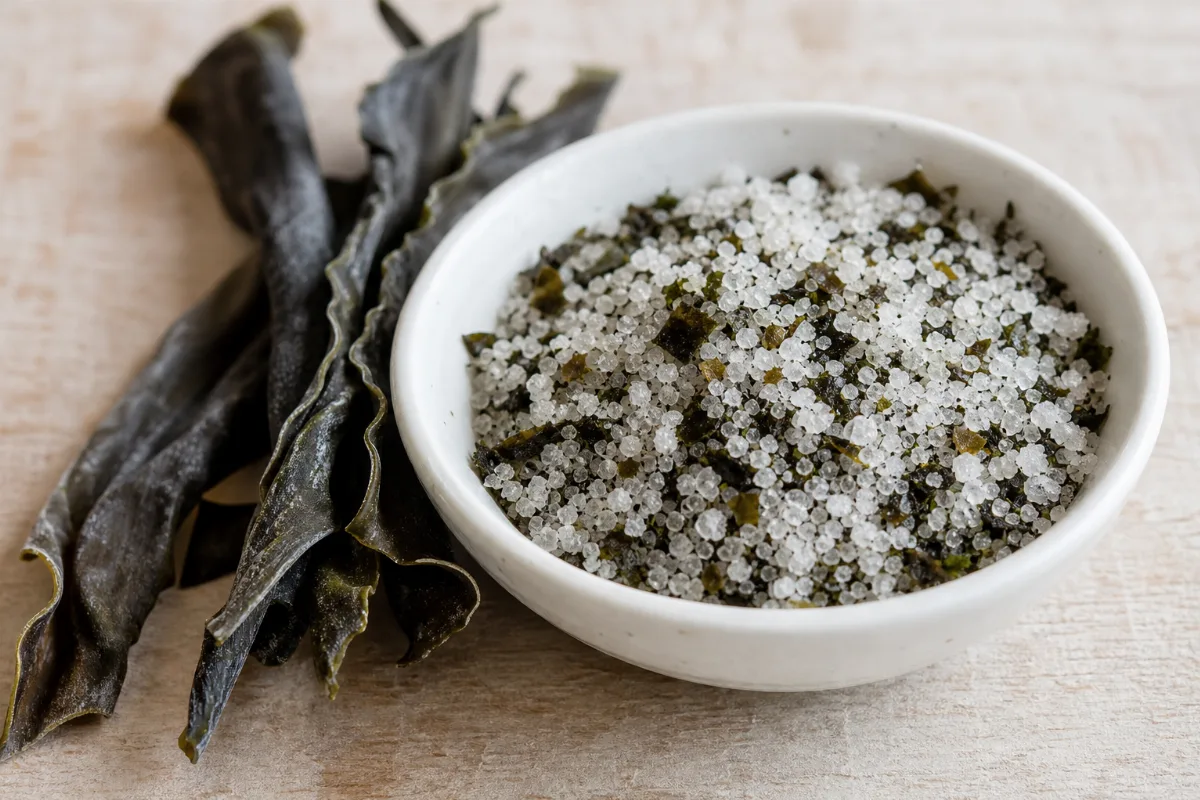
Salt blended or made with seaweed (not a single species) · also called Kelp salt, sal de algas
Seaweed salt is salt that is blended or made with seaweed. There is no official definition, so the label matters. It is still salt, so the sodium limit applies. Kelp-type seaweed can hold a lot of iodine, but nobody has measured the iodine in seaweed salts. Ask a clinician first if you have thyroid disease, are pregnant or feed a baby.
General information, not medical advice. Last substantive update · Not medically reviewed. A named clinician has not signed off on this page. How this page is made
About Seaweed Salt
Seaweed salt is a seasoning, not a standard product. It is salt first. Any seaweed in it may add iodine, but how much has not been measured. Research on seaweed and less salt is early and is mostly about taste.
What it is
'Seaweed salt' has no official definition that we could find. Sellers use the name for salt that is blended with ground dried seaweed or made or flavoured with seaweed. An existing summary of the food describes those two forms. The name has also been used as an ingredient in food-science work, for example in low-fat processed cheese, where its abstract does not say what the seaweed salt was.
There is no USDA FoodData Central (SR Legacy) entry for seaweed salt in a saved lookup from 2026-10-24, so no per-portion nutrition values can be given. A live re-check was blocked by the database's rate limit. We also found no published analysis of commercial seaweed salts. Sodium, potassium and iodine are unknown, so the label is the only guide.
It is still salt
WHO recommends adults eat under 2,000 mg of sodium a day, which is under 5 g of salt (1 g of salt is 400 mg of sodium). The main health effect of high sodium is raised blood pressure, says WHO. A seaweed label does not change that. For children aged 2 to 15 years, WHO adjusts the adult limit downward for their energy needs.
WHO also says all salt eaten should be iodised, which matters for brain development in the foetus and young child. No source shows that seaweed salt gives a reliable iodine amount. If you use iodised salt for iodine, do not swap it out unless a clinician says so.
Iodine: what the seaweed ingredient shows
Seaweed is among the richest iodine foods, and kelp is the extreme. Dried Laminaria japonica held 4.6 to 10.0 mg of iodine per gram in a lab study. Korean sea tangle averaged 2,432 mg per kg dry weight across 348 samples of five seaweeds, the highest of the five. In 49 Norwegians who ate seaweed often, median estimated iodine was 658 micrograms a day, above the tolerable upper level, and fell to 189 after six weeks without seaweed.
These are seaweeds, not salts. A small amount of seaweed in a lot of salt will carry less, but no source gives how much less. Seaweed salt could be low or high. Look for the species of seaweed and an iodine amount on the label.
Soaking and washing dry kelp over 30 minutes removed most soluble iodide in a lab study, and blanching cut iodine by up to about 90% in three Scottish seaweeds. Those steps apply to whole seaweed, not to salt.
What the research shows about less salt
Two taste tests used seaweed pieces in food. In bread with 4% brown seaweed, salt cuts of 10% and 20% were acceptable to about 100 tasters, while bigger cuts were not. The words 'salt-reduced' on the label lowered liking. In beef patties, 1% sea spaghetti could replace NaCl without lowering liking among 105 consumers, but 2.5% lowered liking and purchase intent.
A lab design called hollow salt, made with seaweed-derived alginate, allowed a 36% sodium cut at equal saltiness in taste tests. In mice on a high-salt diet it lowered sodium build-up and eased kidney injury. That is mouse work on a lab product, not a seaweed salt and not a human blood pressure trial.
We found no trial of seaweed salt on blood pressure.
Food versus supplement
Seaweed salt is a seasoning. A kelp tablet is a supplement, and a 2026 review says kelp supplements can give iodine far above recommended intake. Alginate in the lab hollow salt is a gel from brown seaweed, not the same as a seaweed salt. Results for each should not be mixed.
At a glance
Traditional uses history, not proof
- No traditional use of seaweed salt was found in the sources read
- Whole seaweed is eaten in many cuisines; that is not proof that seaweed salt is good for any condition
Studied for research
- Using seaweed to cut salt in foods, low certainty (taste tests of bread and burgers)
- Alginate hollow salt, very low certainty (lab and mice)
- Blood pressure from seaweed salt, insufficient evidence (no study found)
- Iodine from seaweed, low certainty (whole seaweed, not salt)
- Minerals and vitamin B12 in seaweed, insufficient evidence for the salt
Main compounds
- Sodium (from the salt)
- Iodine (amount in seaweed salt not measured)
- Alginate (from brown seaweed, in a lab salt design)
- Potassium, magnesium, calcium and iron (measured in seaweed, not in the salt)
Common forms
- Salt mixed with ground dried seaweed (described in an existing summary)
- Salt made or flavoured with seaweed (same source)
- No sodium or iodine analysis of any seaweed salt was found
- Kelp tablets and iodine supplements are different products and are not covered
Research links: 2026 study: habitual seaweed eating, iodine and thyroid · 2026 lab study: alginate hollow salt · WHO: salt reduction fact sheet · Research Library · Genes & Biomarkers Library
What it is and its history
- Accepted scientific name
- Not a single species. 'Seaweed salt' is a food product: salt blended with, or made with, seaweed.
- Naming authority
- No official definition was found.
- Common names
- Seaweed salt (English); Kelp salt (English); Sal de algas (Spanish)
- Family or group
- A seasoning made with seaweed, not a plant. The seaweed in it could be a brown seaweed such as kelp.
- Cultivation
- Not verified from a source read.
- Harvest and processing
- Not verified. No source describing how commercial seaweed salts are made was read.
- Look-alikes and adulterants
- Name: Plain sea salt, Himalayan salt and mineral salts; Note: Salts with no seaweed; see the claims-checked page.; Name: Iodised salt; Note: Salt fortified with iodine on purpose, which WHO recommends for all salt eaten.; Name: Potassium-based salt substitutes; Note: Lower-sodium products that contain potassium; WHO mentions them, and seaweed salt is not described as one.; Name: Kelp tablets and powders; Note: Supplements with different risks, not covered here.
- Sustainability and conservation
- Not assessed.
Photographs
What is inside, and how it may work
What it contains and how those compounds act in cells and animals. Laboratory and animal mechanisms are not proven effects in people.
Main compounds
| Compound | Family | Where it is concentrated | Activity studied | Level of evidence |
|---|---|---|---|---|
| Sodium | mineral (salt) | Added salt Not found for any seaweed salt product | Sodium in the diet is linked with raised blood pressure, per WHO. One gram of salt is equivalent to 400 mg of sodium. 16 | Human data |
| Iodine (as iodide) | mineral | Seaweed (kelp highest) Dried Laminaria japonica 4.6 to 10.0 mg per g (lab); Korean sea tangle mean 2,432 mg per kg dry weight (348 samples across five seaweeds). Seaweed salt: not found. | Needed for thyroid hormones; too much for long may change thyroid function (NHS). 12 6 14 | Lab |
| Alginate | seaweed polysaccharide | Brown seaweed Not found | In a lab design, low-viscosity alginate was used to make a hollow salt with 36% less sodium at equal saltiness in taste tests. Not a seaweed salt blend. 7 | Lab and animal |
| Potassium, magnesium, calcium and iron | minerals | Whole seaweed For a 5 g portion of Scottish seaweeds, estimated up to 18% of the potassium reference intake, about 10% of magnesium and calcium, up to 83% of iron. Seaweed salt: not found. | Composition only. 2 | Lab |
Mechanisms, receptors and pathways
| Target or pathway | Gene or receptor | What was found | Level |
|---|---|---|---|
| Saltiness perception | Not specified in the sources read | In a lab study, a hollow salt made with alginate was said by the authors to taste saltier because of faster sodium dissolving and longer contact with the tongue. This is the authors' interpretation of their own tests. 7 | Lab and animal |
| Iodine and the thyroid | Not specified in the sources read | NHS says high iodine for a long time could change thyroid function. In 49 seaweed eaters TSH fell after stopping seaweed. No mechanism is proposed in the abstract. 14 1 | Human data |
Absorption, metabolism and elimination
- Absorption
- Not found for seaweed salt. The Norwegian study found that urinary iodine and estimated intake fell sharply after stopping seaweed.
- Distribution
- Not found.
- Metabolism
- Not found.
- Elimination
- Not found.
- Bioavailability
- Not established for iodine or minerals in seaweed salt. B12 absorption from seaweed was not assessed in the Scottish study.
Isolated compounds versus whole extracts
Seaweed salt as a seasoning, whole dried seaweed, kelp supplements and alginate gel are different things. Most data in this file are for whole seaweed or food-science uses. The two taste tests used seaweed as an ingredient, not a seasoning salt. Kelp supplements can deliver far more iodine than food, per a 2026 review.
Nutritional composition
There is no USDA FoodData Central (SR Legacy) entry for seaweed salt in a saved lookup made 2026-10-24, so no per-portion values can be given; a live re-check on 2026-10-26 was blocked by the API's rate limit. No published analysis of commercial seaweed salts was found either, so sodium, potassium and iodine are unknown and the label is the only guide. For comparison, WHO says 1 g of salt is equivalent to 400 mg of sodium. The only iodine and mineral figures read are for the seaweed ingredient itself: dried Laminaria japonica 4.6 to 10.0 mg iodine per g (lab), Korean sea tangle mean 2,432 mg per kg dry weight, and in Scottish seaweeds a 5 g portion estimated to give up to 18% of the potassium, about 10% of magnesium and calcium, and up to 83% of the iron reference intakes. A small amount of seaweed in a lot of salt will carry less than these, but no source gives how much less.
2 low certainty1 very low certainty3 not enough evidence
What was looked at
The 6 benefits and uses checked for Seaweed Salt, each with how strong the evidence is. Tap one to open it.
- Using seaweed to cut salt in foods (taste tests)Low certainty
- Alginate hollow salt for cutting sodium (lab and mice)Very low certainty
- Blood pressure from choosing seaweed saltNot enough evidence
- Iodine intake from seaweed (a nutrient and a risk)Low certainty
- Minerals and vitamin B12 in seaweed (not in the salt)Not enough evidence
- Iodine while cutting salt (public health policy)Not enough evidence
Lab markers tracked in the studies
Perceived saltiness (taste rating)TSH (thyroid-stimulating hormone)Estimated iodine intake and urinary iodine
What is Seaweed Salt good for?
The main studied uses and how strong the evidence is. None of it is about a seaweed salt as sold: the studies used seaweed pieces, alginate or whole seaweed.
Benefits, one by one
Each card is a research question, not a promise. Tap a goal to filter. Open a card to see the studies, doses and limits.
Using seaweed to cut salt in foods (taste tests)
Low certaintyIn two taste tests, foods made with a little dried seaweed and less salt were still liked. This is about taste, not health, and the seaweed was a food ingredient, not a seaweed salt.
3 studiesBrown seaweed pieces in bread; sea spaghetti (Himanthalia elongata) i…
Studies, doses and limits
What the trials found
In bread made with brown seaweed (4% of the flour), a 10% or 20% cut in salt was acceptable to about 100 tasters, while bigger cuts were not. In beef patties, 1% sea spaghetti could stand in for NaCl without lowering liking among 105 consumers, but 2.5% lowered liking and purchase intent.
Results
Small salt cuts were accepted when a little seaweed was added. The label 'salt-reduced' lowered liking in the bread study. One cheese study used 'seaweed salt' as an ingredient but its abstract does not say what that was.
Effect sizes as reported
Bread: acceptable at 10% and 20% less salt. Patties: 1% seaweed acceptable; 5% seaweed raised perceived saltiness; 2.5% lowered liking. No sodium intake or blood pressure was measured.
Why this rating
Low: two single-tasting consumer studies that measured acceptability only. Not tests of a seaweed salt as sold, and no health outcome.
Form and dose studied
Brown seaweed pieces in bread; sea spaghetti (Himanthalia elongata) in beef patties. Neither is a seaweed salt blend.
Who was studied
About 100 adult consumers in each study.
Limits
Taste only. Seaweed pieces, not a salt. Funding was not stated in the abstracts.
Why researchers looked
Many people eat more sodium than is advised, and seaweed has been tried as a way to keep food tasty with less salt.
Traditional use
No traditional claim about seaweed salt was read.
Proposed mechanism Human sensory test
Not shown. In the patty study, adding 5% seaweed raised saltiness perception; the abstract does not say why.
A proposed mechanism does not show that the effect happens in people.
Seaweed can carry a lot of iodine and some metals. See the Safety tab.
Alginate hollow salt for cutting sodium (lab and mice)
Very low certaintyResearchers made salt particles with alginate, a gel from brown seaweed. Tasters could cut sodium by 36% and still taste the same saltiness. Mice on a high-salt diet had less kidney injury. This is lab work, not a seaweed salt you can buy.
1 studiesHollow salt particles (about 4.87 micrometres) made with low-viscosit…
Studies, doses and limits
What the trials found
Only a taste panel: a 36% cut in sodium at equal saltiness. The health findings (less sodium build-up, less kidney injury, better gut bacteria) are from mice.
Results
A lab design for a lower-sodium salt. Not tested on blood pressure in people.
Effect sizes as reported
36% sodium reduction at equal saltiness in sensory tests (as stated in the abstract).
Why this rating
Very low: a lab design plus a mouse study. Not a seaweed blend and not on sale as seaweed salt.
Form and dose studied
Hollow salt particles (about 4.87 micrometres) made with low-viscosity alginate.
Who was studied
Taste panel (size not given) and mice.
Limits
Mouse data do not show the same effects in people. Funding not stated in the abstract.
Why researchers looked
A hollow shape dissolves faster on the tongue, so less salt can taste as salty.
Proposed mechanism Lab and animal
The authors say the hollow shape speeds sodium dissolving and the sticky alginate keeps salt on the tongue longer. In mice, alginate raised sodium loss in urine. This is the authors' account.
A proposed mechanism does not show that the effect happens in people.
None reported in the abstract.
Blood pressure from choosing seaweed salt
Not enough evidenceWe found no trial of seaweed salt on blood pressure. The firm advice about blood pressure and salt is about how much sodium you eat.
1 studiesNot applicable.
Studies, doses and limits
Results
Not studied that we found.
Why this rating
No study of seaweed salt and blood pressure was found, so nothing can be said.
Limits
Only PubMed and Europe PMC searches for 'seaweed salt' and seaweed with salt reduction were run for this page.
Why researchers looked
Sodium is the main dietary link to raised blood pressure, so any salt product raises the question.
Proposed mechanism Authoritative guidance
WHO says the main health effect of high sodium is raised blood pressure.
A proposed mechanism does not show that the effect happens in people.
Check the sodium line on the label.
Iodine intake from seaweed (a nutrient and a risk)
Low certaintyKelp-type seaweed can hold a lot of iodine. In Norwegians who ate seaweed often, estimated iodine was above the upper level, and a thyroid test value fell after they stopped for six weeks. Nobody measured iodine in seaweed salt.
5 studiesWhole dried seaweed in the diet, and lab measures of dried kelp and o…
Studies, doses and limits
What the trials found
49 habitual seaweed eaters in Norway had a median estimated iodine intake of 658 micrograms a day, above the tolerable upper level, which fell to 189 after six weeks without seaweed. Median TSH fell significantly after stopping. Dried Laminaria japonica held 4.6 to 10.0 mg iodine per gram in a lab study, and Korean sea tangle averaged 2,432 mg per kg dry weight across samples. Of 13 Scottish seaweeds, most had high iodine.
Results
The seaweed ingredient can carry far more iodine than the day's needs. A seaweed salt could be low or high; no measurement was found.
Effect sizes as reported
Intake 658 to 189 micrograms a day; urinary iodine 270 to 87 micrograms/L; TSH fell significantly (size not given in the abstract).
Why this rating
Low: a small non-randomised study with no control group, plus lab measures of seaweed. None of it is about seaweed salt, so for the salt itself the certainty is insufficient.
Form and dose studied
Whole dried seaweed in the diet, and lab measures of dried kelp and other seaweeds. No seaweed salt was measured.
Who was studied
49 adults in Norway; food samples from Korea and Scotland.
Limits
Convenience sample, questionnaire-based intake, no control group. Seaweed, not salt.
Why researchers looked
Iodine is needed for thyroid hormones, and seaweed is one of the richest food sources, but too much can upset the thyroid.
Traditional use
Seaweed soup is eaten daily in Korean pregnancy and after birth, per one case report.
Proposed mechanism Authoritative guidance
Iodine is a part of thyroid hormones (NHS). Too much iodine for a long time could change how the thyroid works (NHS).
A proposed mechanism does not show that the effect happens in people.
See the Safety tab for thyroid, pregnancy and children.
Minerals and vitamin B12 in seaweed (not in the salt)
Not enough evidenceIn a lab study of Scottish seaweeds, a 5 g portion could give part of the day's potassium, iron, magnesium, calcium and B12. This is about seaweed. No source shows a seaweed salt gives meaningful amounts.
1 studiesDried whole seaweed, not salt.
Studies, doses and limits
Results
For a 5 g portion of seaweed: up to 18% of the potassium reference intake, around 10% of magnesium and calcium, up to 83% of iron, and for Fucus serratus 148.0 micrograms/kg dry weight of B12 (about 49% of the B12 reference intake per 5 g, as estimated by the authors). Amounts depend on species.
Effect sizes as reported
Estimated shares of reference intakes, not trial effects.
Why this rating
Insufficient for seaweed salt: a small amount of seaweed in a lot of salt will carry less than a seaweed portion, and no source gives how much less.
Form and dose studied
Dried whole seaweed, not salt.
Limits
Estimates; B12 absorption unknown; heavy metals also present.
Why researchers looked
Seaweeds are of interest as mineral and B12 sources for people who eat few animal foods.
Proposed mechanism Composition only
Not applicable; this is a composition measurement.
A proposed mechanism does not show that the effect happens in people.
The same study found most seaweeds had high iodine, and blanching cut iodine by up to about 90%.
Iodine while cutting salt (public health policy)
Not enough evidenceWHO says all salt eaten should be iodised. A 2024 review says salt reduction and iodised salt can be done together. Nothing shows seaweed salt can do the iodine job.
2 studiesIodised salt, not seaweed salt.
Studies, doses and limits
What the trials found
Policy review and WHO statement only. No study of seaweed salt as an iodine source was found.
Results
Not tested for seaweed salt.
Why this rating
No source on seaweed salt and iodine status. The policy points are about iodised table salt.
Form and dose studied
Iodised salt, not seaweed salt.
Who was studied
Populations.
Limits
A review of policy, not a trial.
Why researchers looked
In many countries salt carries iodine to the whole population, so cutting salt could cut iodine too.
Proposed mechanism Narrative review
Iodised salt is the usual way iodine reaches the population in countries with an iodisation policy, per the 2024 review.
A proposed mechanism does not show that the effect happens in people.
Do not assume a seaweed salt is iodised or provides a set amount; check the label.
Connections to the rest of health
How Seaweed Salt connects to the rest of our health knowledge graph. Every link says what kind of connection it is. A safety link (for example to the liver) is a warning, not a benefit. A study that merely mentions a topic never creates a benefit link.
Explore every connection: goals, body systems, organs, symptoms, genes
A. Wellness goals
| Connected to | Kind of connection | Evidence status | Context | Studies |
|---|---|---|---|---|
| Blood Pressure Support | Low certainty | Using seaweed to cut salt in foods (taste tests): In two taste tests, foods made with a little dried seaweed and less salt were still liked. This is about taste, not health, and the seaweed was a food ingredient, not a seaweed salt. | 3 4 8 | |
| Heart Health | Low certainty | Using seaweed to cut salt in foods (taste tests): In two taste tests, foods made with a little dried seaweed and less salt were still liked. This is about taste, not health, and the seaweed was a food ingredient, not a seaweed salt. | 3 4 8 | |
| Blood Pressure Support | Very low certainty | Alginate hollow salt for cutting sodium (lab and mice): Researchers made salt particles with alginate, a gel from brown seaweed. Tasters could cut sodium by 36% and still taste the same saltiness. Mice on a high-salt diet had less kidney injury. This is lab work, not a seaweed salt you can buy. | 7 | |
| Blood Pressure Support | Not enough evidence | Blood pressure from choosing seaweed salt: We found no trial of seaweed salt on blood pressure. The firm advice about blood pressure and salt is about how much sodium you eat. | 16 | |
| Heart Health | Not enough evidence | Blood pressure from choosing seaweed salt: We found no trial of seaweed salt on blood pressure. The firm advice about blood pressure and salt is about how much sodium you eat. | 16 | |
| Metabolic Health | Low certainty | Iodine intake from seaweed (a nutrient and a risk): Kelp-type seaweed can hold a lot of iodine. In Norwegians who ate seaweed often, estimated iodine was above the upper level, and a thyroid test value fell after they stopped for six weeks. Nobody measured iodine in seaweed salt. | 1 6 12 2 14 | |
| Preventive Wellness | Not enough evidence | Minerals and vitamin B12 in seaweed (not in the salt): In a lab study of Scottish seaweeds, a 5 g portion could give part of the day's potassium, iron, magnesium, calcium and B12. This is about seaweed. No source shows a seaweed salt gives meaningful amounts. | 2 | |
| Preventive Wellness | Not enough evidence | Iodine while cutting salt (public health policy): WHO says all salt eaten should be iodised. A 2024 review says salt reduction and iodised salt can be done together. Nothing shows seaweed salt can do the iodine job. | 16 9 |
B. Body systems
| Connected to | Kind of connection | Evidence status | Context | Studies |
|---|---|---|---|---|
| Cardiovascular System | Biological association | Low certainty | Studied for: Using seaweed to cut salt in foods (taste tests) Studied for: Alginate hollow salt for cutting sodium (lab and mice) | 3 4 8 7 16 |
| Urinary System | Biological association | Very low certainty | Studied for: Alginate hollow salt for cutting sodium (lab and mice) | 7 |
| Endocrine System | Biological association | Low certainty | Studied for: Iodine intake from seaweed (a nutrient and a risk) Studied for: Iodine while cutting salt (public health policy) | 1 6 12 2 14 16 9 |
| Whole Body | Biological association | Not enough evidence | Studied for: Minerals and vitamin B12 in seaweed (not in the salt) | 2 |
C. Body parts and organs
| Connected to | Kind of connection | Evidence status | Context | Studies |
|---|---|---|---|---|
| Thyroid | Adverse effect or risk | Documented risk | Estimated iodine in habitual seaweed eaters was above the upper level and TSH fell after stopping. High iodine from whole seaweed changed TSH in 49 habitual seaweed eaters; seaweed salt iodine was not measured. Preparation or compound: Iodine from whole seaweed (not measured in seaweed salt) |
1 14 |
E. Health conditions
| Connected to | Kind of connection | Evidence status | Context | Studies |
|---|---|---|---|---|
| Hypothyroidism | Adverse effect or risk | Case reports | Three infants had temporary low thyroid function after maternal seaweed soup. Preparation or compound: Maternal seaweed soup |
5 |
| High blood pressure | Adverse effect or risk | Documented risk | WHO names raised blood pressure as the main health effect of high sodium. WHO names raised blood pressure as the main health effect of high sodium; seaweed salt is still salt. Preparation or compound: Sodium in any salt |
16 |
I. Biomarkers
| Connected to | Kind of connection | Evidence status | Context | Studies |
|---|---|---|---|---|
| Perceived saltiness (taste rating) | Biological association | Low certainty | Measured in trials: mixed. A lab change is not the same as a health benefit. | 4 3 |
| TSH (thyroid-stimulating hormone) | Biological association | Low certainty | Measured in trials: lowered after stopping seaweed. A lab change is not the same as a health benefit. | 1 |
| Estimated iodine intake and urinary iodine | Biological association | Low certainty | Measured in trials: lowered after stopping seaweed. A lab change is not the same as a health benefit. | 1 |
K. Biological pathways
| Connected to | Kind of connection | Evidence status | Context | Studies |
|---|---|---|---|---|
| Sodium | Preliminary mechanism | Human | Seaweed salt is still salt; the sodium on the label is what counts. | 16 |
| Iodine | Preliminary mechanism | Lab | Seaweed can carry very high iodine; amount in seaweed salt unknown. | 12 6 1 |
| Thyroid | Preliminary mechanism | Human | High seaweed iodine changed TSH in one small study. | 1 |
L. Active compounds
| Connected to | Kind of connection | Evidence status | Context | Studies |
|---|---|---|---|---|
| Sodium | Biological association | Human | Sodium in the diet is linked with raised blood pressure, per WHO. One gram of salt is equivalent to 400 mg of sodium. Preparation or compound: Added salt |
16 |
| Iodine (as iodide) | Biological association | Lab | Needed for thyroid hormones; too much for long may change thyroid function (NHS). Preparation or compound: Seaweed (kelp highest) |
12 6 14 |
| Alginate | Biological association | Lab and animal | In a lab design, low-viscosity alginate was used to make a hollow salt with 36% less sodium at equal saltiness in taste tests. Not a seaweed salt blend. Preparation or compound: Brown seaweed |
7 |
| Potassium, magnesium, calcium and iron | Biological association | Lab | Composition only. Preparation or compound: Whole seaweed |
2 |
Each connection is stored with the ingredient, the connected record, the kind of connection, the evidence status, the supporting studies, the preparation or compound involved, and a review date (last reviewed October 26, 2026).
Evidence at a glance: what changed in 1 lab markers
Tap a number to show only those markers. Counts are markers, not people.
The evidence
The research centre for Seaweed Salt. Every record here was checked against PubMed or the publisher's page; we never list a study we have not verified.
Evidence by outcome
Bars show how many studies we found for each outcome, not how well it works. People are added up across trials only (reviews are not added, to avoid double counting).
How we rate evidence
High certainty
Several well-run trials or reviews agree; further research is unlikely to change the picture much.
Moderate certainty
Good trials point the same way, but some doubt remains.
Low certainty
Small, short or inconsistent trials. The finding could change with better research.
Very low certainty
Very little or very weak human data. Treat as a possibility only.
Mixed findings
Trials or reviews disagree with each other.
Not enough evidence
Not enough human research to say either way.
Evidence against
Good research found no benefit, or found harm.
We take the reviewers' own risk-of-bias and GRADE statements where they exist, and otherwise judge from study size, design, consistency, directness and whether a product matches what is sold. Many publications do not make evidence high. Method note: We started from our existing seaweed salt summary, re-read the WHO and NHS pages and re-read PubMed abstracts (plus one agricultural database record). We added two taste-test studies. A saved USDA lookup found no entry. Items we could not verify are flagged in the research gaps.
Study library: every study we checked 16
| Study | Design | People | Product, dose, length | Result |
|---|---|---|---|---|
| Aakre 2026 Impact of habitual seaweed consumption on iodine nutrition and thyroid function: a non-randomized pre-post clinical study. Eur J Nutr · PMID 41543576 · DOI |
Non randomised pre post |
49 49 habitual seaweed consumers in Norway |
Habitual seaweed eating, then six weeks without seaweed Whole edible seaweed as part of the usual diet Estimated from a seaweed food-frequency questionnaire Six weeks without seaweed · vs Same people before and after stopping |
Median estimated iodine intake was 658 micrograms a day (25th to 75th percentile 330 to 1516) with seaweed and 189 (142 to 264) after stopping. Median intake with seaweed was above the tolerable upper level. Median TSH fell significantly after stopping, most in those with the highest intakes. Urinary iodine 270 to 87 micrograms/L; intake 658 to 189 micrograms/day (Ranges given are interquartile ranges) Methods, limits and fundingOutcomes: Urinary iodine, estimated iodine intake, TSH, fT3, fT4, TPO antibodies Limitations: Convenience sample, no control group, intake from a questionnaire. It is about whole seaweed, not seaweed salt. Funding and conflicts: Funding is not stated in the abstract. Read: abstract |
| Almosa 2026 Scottish Seaweeds as Sustainable Sources of Micronutrients: Mineral Composition, Vitamin B12 Content, and Iodine and Heavy Metal Risk Assessment. Food Sci Nutr · PMID 42255698 · DOI |
Laboratory analysis n/a (food analysis) |
11 wild Scottish seaweed species and 2 farmed species | Dried seaweeds, some blanched in hot water Whole seaweed (ICP-MS and ELISA analysis) A 5 g portion used for estimates Blanching 5 minutes at 80 C · vs Unblanched seaweed |
A 5 g portion was estimated to give up to 18% of the potassium reference intake, about 10% of magnesium and calcium and up to 83% of iron, depending on species. Fucus serratus had 148.0 micrograms/kg dry weight of B12. Most seaweeds had high iodine estimated to pose a health risk. Blanching cut iodine by up to about 90% in three species and arsenic by 39% and 52% in two. Iodine cut by up to about 90% with blanching (Not reported in the abstract) Methods, limits and fundingOutcomes: Minerals, vitamin B12, iodine and heavy metals Limitations: Estimates only. Vitamin B12 absorption was not assessed. About seaweed, not salt. Funding and conflicts: Funding is not stated in the abstract. Read: abstract |
| Gorman 2023 Consumer perception of salt-reduced bread with the addition of brown seaweed evaluated under blinded and informed conditions. J Sci Food Agric · PMID 36700538 · DOI |
Consumer sensory trial |
102 and 98 Adult consumers in two taste trials (n = 102 and n = 98) |
Bread with brown seaweed replacing 4% of the flour, with salt cut by 10% to 50% Brown seaweed (species not given in the abstract), as a bread ingredient Salt cut by 10, 20, 30, 40 and 50% Single tastings · vs Control bread (second trial: blinded versus informed labelling) |
The 10% and 20% salt-reduced breads were acceptable and linked with being soft and chewy with no aftertaste. The other breads were described as dense and dry with a strong aftertaste and not salty enough. When the label said salt-reduced, liking fell. Not reported as a number in the abstract (Not reported in the abstract) Methods, limits and fundingOutcomes: Liking, saltiness and texture ratings Limitations: A taste test of acceptability. No blood pressure or sodium intake was measured. Seaweed was a flour replacement in bread, not a seaweed salt. Funding and conflicts: Funding is not stated in the abstract. Read: abstract |
| Głuchowski 2024 Incorporation of Sea Spaghetti (Himanthalia elongata) in Low-Salt Beef Patties: Effect on Sensory Profile and Consumer Hedonic and Emotional Response. Foods · PMID 38672870 · DOI |
Consumer sensory trial |
105 consumers Trained panel (n = 8) and 105 Irish consumers |
Beef patties with 0 to 1% salt and 0 to 5% sea spaghetti Sea spaghetti (Himanthalia elongata) as a food ingredient Seaweed 0 to 5% and salt 0 to 1% of the patty Single tastings · vs Patties with different salt and seaweed levels |
Adding 5% seaweed significantly raised saltiness perception in low-salt burgers. Burgers with 1% seaweed were seen as less salty but could replace NaCl without lowering liking. At 2.5% seaweed, liking and purchase intent were lower. Not reported as a number in the abstract (Not reported in the abstract) Methods, limits and fundingOutcomes: Saltiness, liking, emotional response and purchase intent Limitations: A taste test of acceptability in beef patties. No health outcome was measured. Seaweed was an added ingredient, not a seaweed salt. Funding and conflicts: Funding is not stated in the abstract. Read: abstract |
| Ilmer 2026 Transient neonatal hypothyroidism due to maternal seaweed soup ingestion: a report of 3 cases. JCEM Case Rep · PMID 42729606 · DOI |
Case series |
3 3 infants of Korean descent whose mothers ate seaweed soup |
Seaweed soup (miyeok-guk) eaten daily in pregnancy and after birth Whole seaweed in soup Often above 2,000 micrograms of iodine a day (as stated in the abstract) Daily |
All three infants had temporary low thyroid function linked with maternal seaweed soup. One case was severe and settled after the mother stopped the soup. In another, thyroid hormone treatment for 6 years was later found unnecessary. Not applicable (Not applicable) Methods, limits and fundingOutcomes: Newborn thyroid function Limitations: Three case reports, so it shows a link in individual cases and cannot give a rate. It is about soup, not salt. Funding and conflicts: Funding is not stated in the abstract. Read: abstract |
| Lee 2025 Analysis and Risk Assessment of Total Iodine Content in Edible Seaweeds in South Korea. Foods · PMID 40870777 · DOI |
Laboratory analysis n/a (food analysis) |
348 348 seaweed samples from 12 coastal regions of South Korea, 2020 to 2024 |
Five edible seaweeds: laver, sea mustard, sea tangle, green laver and hijiki Dried edible seaweed (ICP-MS analysis) · vs Reference values from Korean MFDS, EFSA and JECFA |
Iodine varied widely between species. Sea tangle (Saccharina japonica) was highest, with a mean of 2,432 mg/kg dry weight. Hazard index was below 1.0 by Korean standards but above 1.0 for sea tangle using EFSA and JECFA values. Sea tangle mean 2,432 mg iodine per kg dry weight (Not reported in the abstract) Methods, limits and fundingOutcomes: Total iodine content and a hazard index Limitations: Measures seaweed, not salt. Funding not stated in the abstract. Funding and conflicts: Funding is not stated in the abstract. Read: abstract |
| Li 2026 Low-viscosity alginate-based hollow salt: A strategy for salty taste intensification and high-salt adverse effect reduction in vivo. Food Res Int · PMID 42169266 · DOI |
Laboratory and animal human (taste panel) and mouse |
Taste panel (size not given in the abstract) and mice fed a high-salt diet | Hollow salt particles made with low-viscosity alginate Alginate, a hydrocolloid from seaweed, mixed with salt (not a seaweed salt blend) · vs Ordinary salt / high-salt diet |
Taste testing showed the hollow salt enabled a 36% cut in sodium at equal saltiness. In mice, alginate lowered sodium build-up, eased kidney injury by raising sodium loss in urine and improved high-salt gut bacteria changes. Sodium reduction 36% at equal saltiness (taste test) (Not reported in the abstract) Methods, limits and fundingOutcomes: Saltiness perception; sodium accumulation, kidney injury and gut bacteria in mice Limitations: Particles of about 4.87 micrometres were made in a lab. The health findings are from mice. It is not a seaweed blend and is not sold as seaweed salt. Funding and conflicts: Funding is not stated in the abstract. Read: abstract |
| Nasiri 2022 Exploring the potential of modified potato starch and seaweed salt as structuring agents to design processed cheeses with desirable properties Int Dairy J · Source |
Laboratory analysis n/a (food science) |
Modified potato starch lowered fat and sodium in low-fat processed cheese. Both the starch and seaweed salt had no impact on microbial counts. The abstract does not describe what the seaweed salt was or how much was used. Methods, limits and fundingRead: abstract | ||
| Rigutto-Farebrother 2024 Salt Reduction and Iodine Fortification Policies Are Compatible: Perspectives for Public Health. Nutrients · PMID 39125397 · DOI |
Narrative review |
Population-level policy review | Salt reduction together with salt iodisation Iodised salt (not seaweed salt) |
The authors say that where salt is the main way iodine reaches the population, salt reduction should be paired with iodised-salt policy so iodine deficiency does not return, and that both can be done together. Not applicable (Not applicable) Methods, limits and fundingOutcomes: Feasibility of combining salt reduction with iodine fortification Limitations: A policy review. It does not study seaweed salt. Funding and conflicts: Funding is not stated in the abstract. Read: abstract |
| Suroto 2026 Assessment of chemical, heavy metal, and microbiological contamination of Indonesian seaweed-based food products. Ital J Food Saf · PMID 42028837 · DOI |
Laboratory analysis n/a (food analysis) |
Indonesian seaweed-based food products (number of products not given in the abstract) | Seaweed-based foods Processed seaweed foods · vs National limits |
20% of samples contained aflatoxin B1 (0.14 to 2.12 micrograms/kg). Lead was found in 50% of samples, arsenic in 35%, cadmium in 25% and mercury in 5%. Only 25% of the metal-contaminated samples exceeded the Indonesian national limits. E. coli and S. aureus were below 10 CFU/g and Salmonella and Vibrio were not found. Most products were judged safe. Lead 50%, arsenic 35%, cadmium 25%, mercury 5% of samples (Not reported in the abstract) Methods, limits and fundingOutcomes: Aflatoxin B1, heavy metals and microbes Limitations: Seaweed foods, not salts. Percentages are of samples, not amounts. Funding and conflicts: Funding is not stated in the abstract. Read: abstract |
| Taylor 2026 What Endocrinologists Should Know About Iodine: Population Deficiency, Individual Excess and Misinformation in the United Kingdom. Clin Endocrinol (Oxf) · PMID 42144726 · DOI |
Narrative review |
UK population, review | Iodine intake, kelp supplements and wellness trends Kelp-based supplements and diet |
The authors say iodine deficiency has re-emerged in the UK, especially in women of reproductive age, while social-media trends such as thyroid detoxes or iodine resets and kelp supplements deliver very high iodine doses, and a minority of patients have iodine-induced thyroid dysfunction. Not applicable (Not applicable) Methods, limits and fundingOutcomes: Iodine status and iodine-induced thyroid problems Limitations: A narrative review, not a trial. About kelp supplements and diet in general, not seaweed salt. Funding and conflicts: Funding is not stated in the abstract. Read: abstract |
| Wu 2022 Insights into the formation and mitigation of iodinated disinfection by-products during household cooking with Laminaria japonica (Haidai). Water Res · PMID 36206687 · DOI |
Laboratory analysis n/a (lab) |
Laboratory cooking simulation | Dried Laminaria japonica (haidai) cooked in water with a disinfectant Dried kelp Simulated cooking · vs Cooking with and without disinfectant |
Total iodine in haidai ranged from 4.6 to 10.0 mg per g, with more than 90% as soluble iodide. In simulated cooking with disinfectant, by-products formed in the soup. Soaking and washing dry haidai for over 30 minutes removed most soluble iodide. The abstract says earlier work from the same group found that cooking with seaweed salt could increase formation of these by-products. Iodine 4.6 to 10.0 mg per g dried haidai (Not reported in the abstract) Methods, limits and fundingOutcomes: Iodine content of haidai; iodinated disinfection by-products in the soup Limitations: Simulated cooking with a disinfectant. Not a study of people. The seaweed salt statement refers to earlier work not read. Funding and conflicts: Funding is not stated in the abstract. Read: abstract |
| s-hc-dri Health Canada: Dietary reference intakes tables, reference values for elements · Source |
Health agency n/a |
Methods, limits and fundingRead: not re-opened | ||
| s-nhs-iodine NHS: Iodine (vitamins and minerals) · Source |
Health agency n/a |
Methods, limits and fundingRead: full-text | ||
| s-usda-none USDA FoodData Central (SR Legacy): no entry for seaweed salt · Source |
Reference database n/a |
Methods, limits and fundingRead: saved search result | ||
| s-who-salt WHO: Salt reduction (fact sheet) · Source |
Health agency n/a |
Methods, limits and fundingRead: full-text |
What we do not know yet
- No trial of seaweed salt on blood pressure or health was found; the evidence is taste tests, a lab design and studies of whole seaweed.
- No analysis of sodium, potassium, iodine or metals in commercial seaweed salts was found.
- 'Seaweed salt' has no official definition we could find, and the cheese study's abstract does not say what its seaweed salt was.
- No source on how seaweed salts are made or how much seaweed they contain was read.
- The Health Canada upper levels for iodine could not be re-opened for this check, so no exact upper level is stated here.
- Seaweed allergy, kidney disease, gout and storage were not researched. Only abstracts were read for studies.
How new research is added
New studies are found by a saved PubMed search and placed in a review queue before the page changes.
Lab markers
What changed in blood or saliva tests during trials. A changed number is not the same as feeling or being healthier, and we give no "normal ranges".
Hormonal 1
TSH (thyroid-stimulating hormone)
Lowered after stopping seaweed in trials
A blood test value used to check how the thyroid is working.
Low certaintyResults and what it means
Why it was measured
To see if a change in iodine intake changes thyroid function.
Statistical vs. clinical meaning
Shows that high seaweed iodine can change a thyroid test value. It does not say whether the change was harmful.
Safety implication
People with thyroid conditions should ask their clinician about seaweed.
| Study | Result | People | Product |
|---|---|---|---|
| 1 | Median TSH decreased significantly after six weeks without seaweed; the largest decrease was in those with the highest estimated iodine intake | 49 habitual seaweed consumers, Norway | Stopping habitual seaweed eating for six weeks |
Other 2
Perceived saltiness (taste rating)
Mixed results in trials
How salty tasters say a food is. It is a taste rating, not a blood or body measure.
Low certaintyResults and what it means
Why it was measured
To see if less salt can still taste right when a seaweed ingredient is used.
Statistical vs. clinical meaning
Shows what people accept at the table, not what happens to their health.
Safety implication
None specific.
| Study | Result | People | Product |
|---|---|---|---|
| 4 | 5% sea spaghetti significantly raised saltiness perception in low-salt burgers; 1% seaweed was seen as less salty but liked as much | Trained panel (n = 8) and 105 consumers | Beef patties with 0 to 1% salt and 0 to 5% sea spaghetti |
| 3 | Bread with 4% brown seaweed was acceptable at 10% and 20% less salt; larger cuts were seen as not salty enough | 102 and 98 consumers | Bread with salt cut by 10 to 50% |
Estimated iodine intake and urinary iodine
Lowered after stopping seaweed in trials
Urinary iodine is a urine test that reflects recent iodine intake. Estimated intake comes from a food questionnaire.
Low certaintyResults and what it means
Why it was measured
To compare iodine intake with the tolerable upper level.
Statistical vs. clinical meaning
Seaweed was the main reason for high intake in this group.
Safety implication
Median intake with seaweed was above the tolerable upper level.
| Study | Result | People | Product |
|---|---|---|---|
| 1 | Urinary iodine 270 to 87 micrograms/L; estimated intake 658 to 189 micrograms a day (medians) | 49 habitual seaweed consumers, Norway | Stopping habitual seaweed eating for six weeks |
Safety
What studies and official sources say about side effects, medicines and who should check first. Each point shows what kind of evidence it comes from.
Main points to know 4
- It is still salt. WHO advises adults to eat under 2,000 mg of sodium a day (under 5 g of salt). A seaweed label does not change that. No sodium value for any seaweed salt was found, so use the sodium line on the pack. People with high blood pressure, kidney disease or heart failure should follow their clinician's advice on all salt. Authoritative guidance 16
- Iodine can be high or unknown. Kelp-type seaweed can hold very large amounts of iodine, and in 49 Norwegians who ate seaweed often, estimated intake was above the tolerable upper level and TSH fell after they stopped. Nobody has measured iodine in seaweed salts, so a label may be the only guide. Long-term high iodine can change how the thyroid works (NHS). Observational and lab 1 6 14
- Not a stand-in for iodised salt. WHO says all salt eaten should be iodised. No source shows that seaweed salt gives a reliable iodine amount, so keep using iodised salt unless a clinician tells you otherwise. Authoritative guidance 16
- Ask first if you have thyroid disease, are pregnant or feeding a baby. Three infants had temporary low thyroid function after their mothers ate seaweed soup, often above 2,000 micrograms of iodine a day. That was soup, not salt, but it shows why seaweed products need care in pregnancy and with babies. Case reports 5
Side effects 3
| Effect | How often | Severity and recovery | Evidence |
|---|---|---|---|
| Excess iodine affecting thyroid function (raised or lowered thyroid activity in some people) Evidence is for whole seaweed and kelp supplements, not seaweed salt. | Not found for seaweed salt. In 49 habitual seaweed eaters, median estimated iodine was 658 micrograms a day and median TSH fell significantly after stopping. | varies; not graded in the sources read TSH changed after six weeks without seaweed in one study; infants in the case series recovered or were found not to need long-term treatment. | Observational 1 11 14 |
| Temporary low thyroid function in newborns after the mother's heavy seaweed soup intake Seaweed soup, not salt. | 3 case reports; no rate | one case was severe at birth Transient in all three cases | Case reports 5 |
| Raised sodium intake and blood pressure if used freely like any salt WHO names raised blood pressure as the main health effect of high sodium. | Not measured for seaweed salt | not applicable Not described | Authoritative guidance 16 |
Liver
No liver injury from seaweed salt was found in the sources read. A liver-safety database was not searched.
How often. No frequency was found.
Monitoring. No agency monitoring advice was found.
This is a safety connection. It is not evidence that Seaweed Salt supports liver health.
Medicines and supplements 2
| With | Why it matters | Importance | Evidence | What to do |
|---|---|---|---|---|
| Thyroid medicines and anti-thyroid medicines prescription | Iodine from seaweed can change thyroid function (NHS, and the Norwegian study). No source on seaweed salt and a specific thyroid drug was read. | Unknown for seaweed salt. Whole seaweed changed TSH in one small study. | Theoretical from nutrient effect Very low certainty 1 14 | Ask your prescriber or pharmacist before using any kelp-based seasoning often if you take thyroid medicine. |
| Blood pressure, kidney or heart medicines and low-sodium plans prescription | Any salt adds sodium. WHO also notes some lower-sodium salt substitutes contain potassium; a seaweed salt is not described as one. | Follow your clinician's sodium advice. No seaweed salt potassium value was read, so do not treat it as a potassium salt substitute. | Authoritative guidance Low certainty 16 | Check sodium and potassium on the label and ask your clinician if you have been given a limit. |
Who should check first 4
| Situation | Advice | Evidence |
|---|---|---|
| Thyroid disease or taking thyroid medicine | Ask a clinician before using a kelp-based seasoning regularly. Proper evidence not found on seaweed salt in particular. | Authoritative guidance 14 11 |
| Pregnancy or breastfeeding | Iodine matters in pregnancy and in infancy, in too little and in too much. A 2026 case series linked heavy maternal seaweed soup with newborn low thyroid function. Ask a midwife or doctor. An upper level of 1,100 micrograms a day is given for adults and in pregnancy in a Health Canada table that could not be re-opened for this check, so treat that number as unconfirmed. | Case reports 5 13 |
| Babies and young children | Children's sodium limits are lower than adults' (WHO adjusts the adult limit downward for energy needs). Upper iodine levels for children are lower too (Health Canada, not re-opened). Check the label and ask a clinician. | Authoritative guidance 16 13 |
| High blood pressure, kidney disease or heart failure | Follow your clinician's advice about all salt, including seaweed salt. | Authoritative guidance 16 |
Overdose, product quality and regulators
Summary. No toxicity study of seaweed salt was found. The concerns come from the seaweed ingredient (iodine, metals) and from salt itself (sodium).
Animal. Not reviewed for seaweed salt. A mouse study of an alginate hollow salt reported less kidney injury on a high-salt diet; it is not a seaweed salt.
High dose or long term signals. A 2026 review warns that kelp supplements and 'iodine reset' trends can deliver doses far above recommended intake.
Overdose response. Not found.
Genotoxicity. A lab study (not people) found that cooking dried kelp in water with a disinfectant formed iodinated by-products; the authors advise soaking and washing dry kelp first. It concerns cooking kelp, not using seaweed salt; the abstract refers to earlier work, not read, on seaweed salt in cooking.
No analysis of metals or other contaminants in seaweed salts was found. Data exist for seaweed foods.
Heavy metals in seaweed foods. In an Indonesian survey of seaweed foods, lead was found in 50% of samples, arsenic in 35%, cadmium in 25% and mercury in 5%. Only 25% of the metal-contaminated samples exceeded Indonesian national limits. Most products were judged safe. Aflatoxin B1 was found in 20% of samples. These were foods, not salts. 10
Iodine and arsenic can be lowered by soaking or blanching. In Scottish seaweeds, blanching 5 minutes at 80 C cut iodine by up to about 90%, and cut arsenic by 39% and 52% in two species. This applies to whole seaweed, not salt. 2
Iodine varies by species. Korean sea tangle averaged 2,432 mg iodine per kg dry weight, the highest of five seaweeds in 348 samples; the hazard index was above 1.0 for sea tangle by EFSA and JECFA values. 6
| Body | Action | Date |
|---|---|---|
| WHO (International) | Salt reduction fact sheet: adults under 2,000 mg sodium (under 5 g salt) a day; all salt consumed should be iodised. source | 2026-05-11 |
| NHS (UK) (United Kingdom) | Iodine: adults need 140 micrograms a day; high doses for long periods could change how the thyroid works; supplements of 0.5 mg a day or less are unlikely to cause harm. source | 2020-08-03 |
When to get medical help
- Trouble breathing, wheezing, or swelling of the lips, face, tongue or throat after eating a seaweed seasoning (possible allergy to another ingredient such as wheat, soy, sesame or fish): use epinephrine if prescribed, then call 911 or your local emergency number
- If you have thyroid symptoms, or a newborn has feeding or other health concerns after the mother ate a lot of seaweed, contact a clinician.
Stop using the product and contact a clinician or emergency service. In the US, Poison Control is 1-800-222-1222.
General information only, not medical advice. Ask a clinician or pharmacist before use, especially with medicines, in pregnancy or with a health condition. See the Natural Remedy Safety guide.
Frequently asked questions
What is seaweed salt?
Is seaweed salt lower in sodium than table salt?
Does seaweed salt give me iodine?
Can too much iodine from seaweed be a problem?
Is seaweed salt safe with thyroid problems or thyroid medicine?
Is seaweed salt safe in pregnancy or for babies?
Does seaweed salt lower blood pressure?
No study of seaweed salt on blood pressure was found. WHO says the main health effect of high sodium is raised blood pressure, so total sodium is what matters most.
Does adding seaweed make food taste salty with less salt?
Is seaweed salt a replacement for iodised salt?
Is seaweed salt a potassium salt substitute?
No source says so. WHO mentions lower-sodium salt substitutes that contain potassium as a different product. Check potassium and sodium on the label, and ask your clinician if you have a limit.
Can seaweed salt contain metals or other contaminants?
No analysis of seaweed salts was found. In an Indonesian survey of seaweed foods, lead was found in 50% of samples, arsenic in 35%, cadmium in 25% and mercury in 5%, and only a quarter of the contaminated samples exceeded national limits.
Does seaweed salt give minerals or vitamin B12?
No source shows that. A study of whole Scottish seaweeds estimated that a 5 g portion could give up to 18% of the potassium and up to 83% of the iron reference intake, and B12 was found in all of them. A small amount of seaweed in a lot of salt will give less, and how much less is not known.
Explore by health goal
Blood Pressure SupportHeart HealthPreventive WellnessMetabolic Health
Editorial transparency
- Written by
- AlternativeMed editorial team. Research compiled with AI assistance, then checked against the sources listed.
- Medical review
- None. This page has not been reviewed by a physician or pharmacist.
- First published
- 2026-10-26
- Last substantive update
- 2026-10-26
- How we research
- We started from our existing seaweed salt summary, re-read the WHO and NHS pages and re-read PubMed abstracts (plus one agricultural database record). We added two taste-test studies. A saved USDA lookup found no entry. Items we could not verify are flagged in the research gaps.
- How we rate evidence
- See "How we rate evidence" in the Evidence tab.
- Independence
- No product is promoted on this page. No affiliate links are shown. Funding is not stated in the abstracts read.
Sources 16
Each source was opened and checked. Where we read only the abstract, it says so. The small numbers in the text point here.
- Aakre I, Vogt EC, Myrmel LS, et al.. Impact of habitual seaweed consumption on iodine nutrition and thyroid function: a non-randomized pre-post clinical study.. Eur J Nutr. 2026. PMID 41543576. DOI 10.1007/s00394-025-03813-8. (abstract)
- Almosa I, Bashir S, Sneddon AA. Scottish Seaweeds as Sustainable Sources of Micronutrients: Mineral Composition, Vitamin B12 Content, and Iodine and Heavy Metal Risk Assessment.. Food Sci Nutr. 2026. PMID 42255698. DOI 10.1002/fsn3.71988. (abstract)
- Gorman M, Moss R, Barker S, et al.. Consumer perception of salt-reduced bread with the addition of brown seaweed evaluated under blinded and informed conditions.. J Sci Food Agric. 2023. PMID 36700538. DOI 10.1002/jsfa.12473. (abstract)
- Głuchowski A, Crofton E, Inguglia ES, et al.. Incorporation of Sea Spaghetti (Himanthalia elongata) in Low-Salt Beef Patties: Effect on Sensory Profile and Consumer Hedonic and Emotional Response.. Foods. 2024. PMID 38672870. DOI 10.3390/foods13081197. (abstract)
- Ilmer S, Lopez-Cabreza V, Salemi P. Transient neonatal hypothyroidism due to maternal seaweed soup ingestion: a report of 3 cases.. JCEM Case Rep. 2026. PMID 42729606. DOI 10.1210/jcemcr/luag263. (abstract)
- Lee Y, Park HJ, Jo M, et al.. Analysis and Risk Assessment of Total Iodine Content in Edible Seaweeds in South Korea.. Foods. 2025. PMID 40870777. DOI 10.3390/foods14162865. (abstract)
- Li J, Jiang Q, Jin X, et al.. Low-viscosity alginate-based hollow salt: A strategy for salty taste intensification and high-salt adverse effect reduction in vivo.. Food Res Int. 2026. PMID 42169266. DOI 10.1016/j.foodres.2026.119291. (abstract)
- Nasiri M, Tavakolipour H, Safaeian S, Mousavi Nadushan R.. Exploring the potential of modified potato starch and seaweed salt as structuring agents to design processed cheeses with desirable properties. Int Dairy J. 2022. (abstract)
- Rigutto-Farebrother J, Zimmermann MB. Salt Reduction and Iodine Fortification Policies Are Compatible: Perspectives for Public Health.. Nutrients. 2024. PMID 39125397. DOI 10.3390/nu16152517. (abstract)
- Suroto DA, Nurkholifah R, Arkan A, et al.. Assessment of chemical, heavy metal, and microbiological contamination of Indonesian seaweed-based food products.. Ital J Food Saf. 2026. PMID 42028837. DOI 10.4081/ijfs.2026.13812. (abstract)
- Taylor PN, Prentice M, Bath S, et al.. What Endocrinologists Should Know About Iodine: Population Deficiency, Individual Excess and Misinformation in the United Kingdom.. Clin Endocrinol (Oxf). 2026. PMID 42144726. DOI 10.1111/cen.70162. (abstract)
- Wu M, Ding S, Cao Z, et al.. Insights into the formation and mitigation of iodinated disinfection by-products during household cooking with Laminaria japonica (Haidai).. Water Res. 2022. PMID 36206687. DOI 10.1016/j.watres.2022.119177. (abstract)
- . Health Canada: Dietary reference intakes tables, reference values for elements. . . (not re-opened)
- . NHS: Iodine (vitamins and minerals). . . (full-text)
- . USDA FoodData Central (SR Legacy): no entry for seaweed salt. . . (saved search result)
- . WHO: Salt reduction (fact sheet). . . (full-text)
Where to buy
Check the label first. Whatever you buy, look for these:
- The iodine amount: seaweed can be very high in iodine, which matters for thyroid conditions
- Heavy metal testing information from the maker
- Origin and harvest area
- Organic or tested labeling
Talk to a pharmacist or doctor before you start any supplement, especially if you take medicines. See the Safety tab for interactions.
Support our free guides: as an Amazon Associate we earn from qualifying purchases. Full disclosure.


