Seaweed & Algae · Seaweed
Furikake
Japanese rice seasoning (nori and sesame blend) · also called Rice seasoning, nori komi furikake
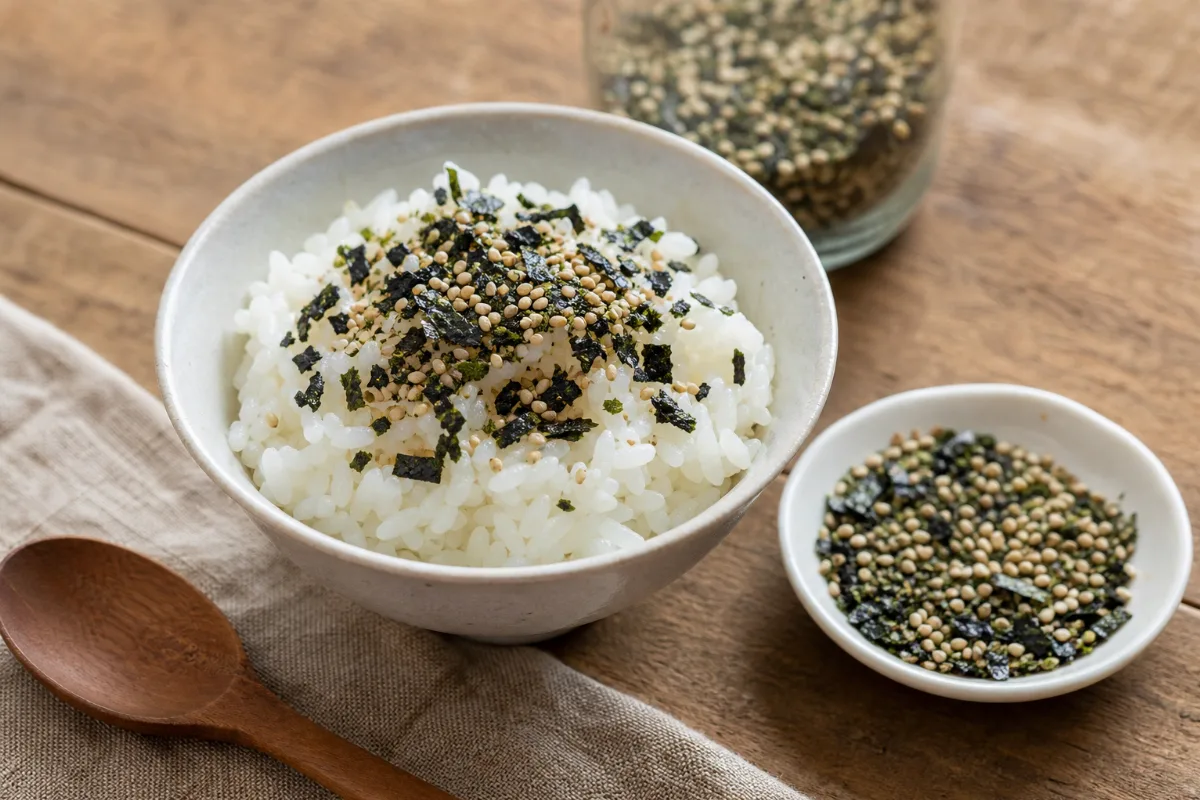
Furikake is a dry Japanese seasoning sprinkled on rice, usually sesame seeds, salt, sugar and bits of nori seaweed. No study of furikake itself was found, so there is no evidence of health benefit or harm beyond its ingredients. The main cautions are sesame and other allergens, and salt. Seaweed is a small share of the mix, so it is probably a minor iodine source unless a blend uses kelp.
General information, not medical advice. Last substantive update · Not medically reviewed. A named clinician has not signed off on this page. How this page is made
About Furikake
Furikake is a dry seasoning, usually sesame, salt, sugar and a little seaweed, sprinkled over rice. It is a flavouring, not a remedy. This page is shorter than most because no study of furikake itself was found: what follows comes from one product label and from general health-agency pages.
What it is
Furikake is a Japanese rice seasoning. The label we read lists sesame seed, salt, sugar and seaweed, and the product database estimates their shares at about 64, 20, 10 and 6 percent. Other blends may add fish flakes, egg, soy or wheat; we did not verify specific products, so read the label.
USDA FoodData Central has no furikake entry, so there is no official table. These figures come from one volunteer-edited Open Food Facts record, an example and not an average. Per 6 g tablespoon: about 30 kcal, 1.5 g fat, 2 g sugar (listed as added), 1 g protein, 0.625 g salt and 250 mg sodium. Per 100 g: about 500 kcal, 25 g fat, 33 g sugar, 17 g protein, 10.4 g salt. Brands differ.
Salt and sugar
WHO advises adults to have less than 2,000 mg of sodium (under 5 g of salt) a day and says high sodium is the main diet cause of raised blood pressure, which raises the risk of cardiovascular disease. NHS advises adults no more than 6 g of salt a day, with lower limits for children. By our arithmetic, one spoon on the label we read is about 12.5 percent of WHO's sodium figure. That depends on the brand and on how much is used.
The same label lists 2 g of sugar per spoon, all listed as added. No study has tested furikake and blood pressure or blood sugar.
Iodine from the seaweed
Seaweed iodine varies hugely. A 2004 US survey of 12 seaweeds found nori the lowest at 16 microg per gram, and up to 8165 microg per gram in one sample of processed kelp granules. A 2025 Dutch study of seaweed products found a range from under 0.1 to 7910 microg per gram, and 25 percent of 80 regular seaweed consumers above the 600 microg a day limit the authors used. It did not say whether any product was a seasoning.
Furikake's seaweed is a small share. Our rough illustration: about 0.36 g of seaweed in a 6 g spoon at the plain-nori value is about 6 microg of iodine. That rests on an estimated ingredient share and a 2004 value for plain nori, and it was not measured. A blend with kelp could be very different. The American Thyroid Association says more than 1,100 microg of iodine a day is not recommended.
What the research shows
Nothing, directly. A PubMed search for the word furikake returned no records on 2026-10-26, and none of the agency pages mention it. Claims online usually come from studies of whole seaweeds, sesame or lab extracts, which cannot be assumed to apply to a salty seasoning eaten in small amounts. So there is no evidence of benefit, and no evidence of harm beyond the salt, sugar and allergen points.
Furikake versus plain nori, seaweed snacks and supplements
Plain nori, roasted seaweed snacks, seaweed salt and kelp tablets are different products with different salt and iodine. Facts about one cannot be moved to another. ATA advises against iodine and kelp supplements with more than 500 microg of iodine a day.
At a glance
Traditional uses history, not proof
- Sprinkled over steamed rice as a seasoning
- Long use as a seasoning is not proof that it treats any condition
Studied for research
- Salt (sodium) in a spoonful, low certainty that the label is typical; the sodium and blood pressure link in general is well established
- Energy, sugar, fat and protein in a spoonful, low certainty (one label)
- Iodine from the seaweed, very low certainty (an estimate, not a measurement)
- Any health benefit of furikake itself, insufficient (no study found)
Main compounds
- Sodium (salt)
- Added sugar
- Sesame seed (fat, protein and a major allergen)
- Iodine from the seaweed (not measured)
Common forms
- Nori and sesame furikake (the example label)
- Blends with fish flakes, egg, soy or wheat (not verified for specific products)
- Kelp tablets and iodine supplements are different products and are not covered
Research links: Example furikake product label (Open Food Facts) · WHO: Sodium reduction · FDA: Food Allergies · NHS: Food allergy · Research Library · Genes & Biomarkers Library
What it is and its history
- Accepted scientific name
- Furikake (Japanese rice seasoning)
- Synonyms
- Rice seasoning; Nori komi furikake (a nori-and-sesame type; the name on the example label)
- Common names
- Furikake (Japanese (as used in English)); Japanese rice seasoning (English); Nori komi furikake (As printed on the example label); Condimento japonés para arroz (Spanish)
- Family or group
- Seaweed product (a dry seasoning blend with seaweed as one ingredient).
- Native range
- Not verified from a source read.
- Harvest and processing
- On the example label the blend is sesame seed, salt, sugar and seaweed. How furikake is made, which seaweed species is used and how the seaweed is processed were not read from a source.
- Look-alikes and adulterants
- Name: Plain nori; Note: The seaweed alone. Plain nori measured 16 microg/g iodine in a 2004 survey; a seasoning that is mostly sesame and salt is a different food.; Name: Seaweed snacks; Note: Roasted seaweed sheets eaten as a snack; seaweed is the main ingredient, unlike furikake.; Name: Seaweed salt; Note: Salt blended with seaweed; a different product.; Name: Kelp-containing seasonings; Note: Kelp can carry far more iodine than nori (up to 8165 microg/g in one 2004 sample of processed kelp granules).
Photographs
What is inside, and how it may work
What it contains and how those compounds act in cells and animals. Laboratory and animal mechanisms are not proven effects in people.
Main compounds
| Compound | Family | Where it is concentrated | Activity studied | Level of evidence |
|---|---|---|---|---|
| Sodium (from salt) | mineral | Added salt 4.17 g per 100 g (250 mg per 6 g spoon) on one label | High sodium intake raises blood pressure (WHO). 9 11 | Human population |
| Sugar | carbohydrate | Added sugar 33.3 g per 100 g (2 g per 6 g spoon) on one label | Adds energy; amount depends on the brand. 9 | Label only |
| Sesame seed (fat, protein, allergen proteins) | food ingredient | Seed About 64 percent of the example label (database estimate); fat 25 g and protein 16.7 g per 100 g of the blend | Sesame is a recognised major allergen in US law. 9 5 | Label and agency |
| Iodine (from the seaweed) | mineral (halogen) | Seaweed Not measured for furikake. Plain nori: 16 microg/g (2004 survey). | Needed for thyroid hormones; too much may cause thyroid problems (ATA). 2 4 | Laboratory |
Mechanisms, receptors and pathways
| Target or pathway | Gene or receptor | What was found | Level |
|---|---|---|---|
| Blood pressure and sodium | Not specified in the sources read | WHO says diets high in sodium raise blood pressure and cardiovascular risk. Not tested for furikake. 11 | Human population |
| Thyroid hormone production | Not specified in the sources read | Iodine is needed to make thyroid hormones; ATA says more than 1,100 microg a day may cause thyroid dysfunction. 4 | Human data |
Absorption, metabolism and elimination
- Absorption
- In a lab digestion model, 24 to 56 percent of iodine in seaweed products was bio-accessible, higher in more processed products (Dutch 2025 abstract). Not tested for furikake or in people.
- Distribution
- Not found.
- Metabolism
- Not found.
- Elimination
- Not found.
- Bioavailability
- Not established for furikake.
Isolated compounds versus whole extracts
All the research read is about other things: plain seaweeds, seaweed foods in general, salt in general. None tested furikake. Kelp tablets and iodine supplements are different products and are not covered.
Nutritional composition
No USDA FoodData Central entry for furikake was read, so there is no official table. The figures below come from one volunteer-edited Open Food Facts product record, read through its API on 2026-10-26, for a nori-and-sesame furikake. Serving on the label: 1 tablespoon (6 g). Per 6 g: about 30 kcal, fat 1.5 g, carbohydrate 2 g, sugar 2 g (listed as added), protein 1 g, salt 0.625 g, sodium 250 mg. Per 100 g: about 500 kcal, fat 25 g, sugar 33.3 g, protein 16.7 g, salt 10.4 g, sodium 4.17 g. Ingredients: sesame seed, salt, sugar and seaweed, with shares estimated by the database at about 64, 20, 10 and 6 percent. Other brands and blends differ. This page gives no how-much-to-eat advice.
2 low certainty1 very low certainty1 not enough evidence
What was looked at
The 4 benefits and uses checked for Furikake, each with how strong the evidence is. Tap one to open it.
What is Furikake good for?
The main points people ask about and how strong the evidence is for each. None of these studies tested furikake; most of it is label information and general guidance.
Benefits, one by one
Each card is a research question, not a promise. Tap a goal to filter. Open a card to see the studies, doses and limits.
Salt (sodium) in a spoonful (nutrient content, and a caution)
Low certaintyOne furikake label we read lists 250 mg of sodium in a 6 g tablespoon, which is 4.17 g of sodium per 100 g. WHO says adults should have less than 2,000 mg of sodium a day. So one spoon on that label is about an eighth of that figure. This is a salty topping, and no study has tested furikake itself.
4 studiesOne furikake product label (a sesame, salt, sugar and seaweed blend).
Studies, doses and limits
What the trials found
No trial or cohort study of furikake was found (a PubMed search for the word on 2026-10-26 returned no records). The figures are from one community-edited Open Food Facts label: sodium 250 mg and salt 0.625 g per 6 g spoon; salt 10.4 g per 100 g. WHO advises adults to have less than 2,000 mg of sodium (under 5 g of salt) a day and calls high sodium the main diet cause of raised blood pressure. NHS advises no more than 6 g of salt a day for adults. Our arithmetic: 250 mg is 12.5 percent of 2,000 mg, and 0.625 g is about 10 percent of 6 g.
Results
Furikake can add a noticeable share of a day's salt, even in a small spoon. This is a nutrient fact and a caution, not a health benefit.
Effect sizes as reported
Label example: sodium 250 mg per 6 g (4.17 g per 100 g); salt 0.625 g per 6 g (10.4 g per 100 g). WHO: under 2,000 mg sodium a day for adults. NHS: no more than 6 g salt a day for adults.
Why this rating
Low for the amount in furikake in general, because it rests on one volunteer-edited label and brands differ. The link between high sodium and raised blood pressure is well established (WHO), but it was not tested for furikake.
Form and dose studied
One furikake product label (a sesame, salt, sugar and seaweed blend).
Who was studied
General adult diet.
Limits
One label, not an average. Real servings vary. Nothing here says how much to eat. Other sodium sources in the day, including soy sauce and stock, change the total.
Why researchers looked
Furikake is mostly sesame and salt, and salt is the best-known diet risk for blood pressure.
Traditional use
Furikake is a Japanese dry seasoning sprinkled over rice. It is eaten as a flavouring. Long use as a seasoning is not proof that it treats any condition.
Proposed mechanism Authoritative guidance
Not tested for furikake. WHO links diets high in sodium to raised blood pressure and a higher risk of cardiovascular disease.
A proposed mechanism does not show that the effect happens in people.
Sodium comes first; see the Safety tab.
Energy, sugar, fat and protein in a spoonful (nutrient content)
Low certaintyThe same label lists 30 kcal, 2 g of sugar (all added), 1.5 g of fat and 1 g of protein in a 6 g spoon. Per 100 g that is about 500 kcal, 33 g of sugar, 25 g of fat and 17 g of protein, which mostly reflects the sesame and the sugar. A spoon is small, so these are small amounts per serving.
1 studiesOne furikake product label.
Studies, doses and limits
What the trials found
No USDA FoodData Central entry for furikake was read, and no study of furikake was found. The numbers come from one Open Food Facts product page (volunteer-edited). That page lists energy 500 kcal, fat 25 g, sugars 33.3 g (listed as added sugars), protein 16.7 g and carbohydrate 33.3 g per 100 g; per 6 g serving 30 kcal, fat 1.5 g, sugars 2 g, protein 1 g.
Results
Furikake is a small, energy-dense, salty and sometimes sweet topping. It is not a meaningful source of protein at the size of a spoon.
Effect sizes as reported
Per 6 g spoon on the example label: 30 kcal, 1.5 g fat, 2 g sugar, 1 g protein. Per 100 g: 500 kcal, 25 g fat, 33.3 g sugar, 16.7 g protein.
Why this rating
Low: one volunteer-edited label for one brand. Other blends use different ingredients and amounts.
Form and dose studied
One furikake product label.
Who was studied
General adult diet.
Limits
The database page is community-edited and may contain errors. We did not read a manufacturer page. The 'added sugar' wording is the database's, not a regulator's finding. Nothing here is advice on how much to eat.
Why researchers looked
People ask what a pinch of seasoning adds to a meal.
Traditional use
Furikake is a Japanese dry seasoning sprinkled over rice. It is eaten as a flavouring. Long use as a seasoning is not proof that it treats any condition.
Proposed mechanism Nutrient database
These are amounts printed on a product label. No mechanism applies.
A proposed mechanism does not show that the effect happens in people.
Added sugar and sesame allergy; see the Safety tab.
Iodine from the seaweed in the mix (nutrient content)
Very low certaintySeaweed is only a small share of furikake: about 6 percent of the example label, which the database estimates. Plain nori had the lowest iodine of 12 seaweeds in a 2004 survey (16 microg per gram). On those two numbers a spoon would carry only a few microg of iodine, but this is our estimate, not a measurement. Blends with other seaweeds, such as kelp, could differ a lot.
4 studiesNori-containing furikake. Blends with kelp or other seaweeds were not…
Studies, doses and limits
What the trials found
No study measured the iodine in furikake. Teas and colleagues (2004) measured 12 species of dietary seaweed: nori 16 microg/g (+/-2), up to 8165 microg/g in one sample of processed kelp granules. A 2025 Dutch study of seaweed-containing products found iodine from under 0.1 to 7910 microg/g fresh weight, and 25 percent of 80 regular seaweed consumers above the 600 microg/day upper limit the authors used; it did not say whether any product was a seasoning. Our arithmetic: 6.08 percent of a 6 g spoon is about 0.36 g of seaweed, and 0.36 g at 16 microg/g is about 6 microg. That assumes the seaweed is plain nori at the 2004 value, and the 6.08 percent is a database estimate. The American Thyroid Association says more than 1,100 microg of iodine a day is not recommended.
Results
For a nori-based furikake the seaweed share is small, so iodine from one spoon is probably small, but this was not measured. Blends that use kelp could be very different.
Effect sizes as reported
Nori 16 microg/g (Teas 2004). Example label: seaweed about 6 percent by estimate. Our rough illustration: about 6 microg per spoon for plain nori. ATA upper limit for adults: 1,100 microg a day.
Why this rating
Very low: an estimate stacked on two assumptions (an estimated seaweed share and a plain-nori iodine value), with no measurement of furikake. The general point, that iodine varies hugely between seaweeds, is well supported.
Form and dose studied
Nori-containing furikake. Blends with kelp or other seaweeds were not found in the sources read.
Who was studied
General diet; people with thyroid disease are the group that should ask.
Limits
Teas measured plain seaweed in 2004. The Dutch abstract does not name a seasoning. Iodine can be lost in cooking or storage (Teas). The ingredient share is a volunteer database estimate. Not a health benefit.
Why researchers looked
Seaweed is a rich and very variable iodine source, and iodine matters for the thyroid.
Traditional use
Furikake is a Japanese dry seasoning sprinkled over rice. Long use as a seasoning is not proof that it treats any condition.
Proposed mechanism Laboratory measurement
Iodine is needed to make thyroid hormones. These are measured amounts of iodine in seaweed foods, not an effect.
A proposed mechanism does not show that the effect happens in people.
Iodine and the thyroid: see the Safety tab.
Any health benefit of furikake itself
Not enough evidenceWe found no trial or other study of furikake and health. Claims online usually come from studies of whole seaweeds, sesame seeds or lab extracts, not this seasoning. So there is no evidence either way that furikake helps or harms any health condition beyond the salt, sugar and allergen facts on the Safety tab.
1 studiesNot applicable; no health study of furikake was found.
Studies, doses and limits
What the trials found
A PubMed search for the word furikake returned no records on 2026-10-26. No trial, cohort or review of furikake was found in the other sources read.
Results
No evidence of benefit was found, and no study was found that tested it.
Why this rating
Insufficient: no study of furikake was found.
Limits
The search covered PubMed only plus the agency pages listed. A study in Japanese or in a database we did not search may exist.
Why researchers looked
People ask whether the seaweed and sesame in a seasoning add health benefits.
Traditional use
Furikake is a Japanese dry seasoning sprinkled over rice. Long use as a seasoning is not proof that it treats any condition.
Proposed mechanism Not stated
Not shown. Studies of other seaweed or sesame products cannot be assumed to apply to a salty seasoning eaten in small amounts.
A proposed mechanism does not show that the effect happens in people.
See the Safety tab for salt, sugar, sesame and iodine.
Connections to the rest of health
How Furikake connects to the rest of our health knowledge graph. Every link says what kind of connection it is. A safety link (for example to the liver) is a warning, not a benefit. A study that merely mentions a topic never creates a benefit link.
Explore every connection: goals, body systems, organs, symptoms, genes
A. Wellness goals
| Connected to | Kind of connection | Evidence status | Context | Studies |
|---|---|---|---|---|
| Blood Pressure Support | Low certainty | Salt (sodium) in a spoonful (nutrient content, and a caution): One furikake label we read lists 250 mg of sodium in a 6 g tablespoon, which is 4.17 g of sodium per 100 g. WHO says adults should have less than 2,000 mg of sodium a day. So one spoon on that label is about an eighth of that figure. This is a salty topping, and no study has tested furikake itself. | 9 11 8 10 | |
| Heart Health | Low certainty | Salt (sodium) in a spoonful (nutrient content, and a caution): One furikake label we read lists 250 mg of sodium in a 6 g tablespoon, which is 4.17 g of sodium per 100 g. WHO says adults should have less than 2,000 mg of sodium a day. So one spoon on that label is about an eighth of that figure. This is a salty topping, and no study has tested furikake itself. | 9 11 8 10 | |
| Preventive Wellness | Low certainty | Energy, sugar, fat and protein in a spoonful (nutrient content): The same label lists 30 kcal, 2 g of sugar (all added), 1.5 g of fat and 1 g of protein in a 6 g spoon. Per 100 g that is about 500 kcal, 33 g of sugar, 25 g of fat and 17 g of protein, which mostly reflects the sesame and the sugar. A spoon is small, so these are small amounts per serving. | 9 | |
| Thyroid Support | Very low certainty | Iodine from the seaweed in the mix (nutrient content): Seaweed is only a small share of furikake: about 6 percent of the example label, which the database estimates. Plain nori had the lowest iodine of 12 seaweeds in a 2004 survey (16 microg per gram). On those two numbers a spoon would carry only a few microg of iodine, but this is our estimate, not a measurement. Blends with other seaweeds, such as kelp, could differ a lot. | 9 2 1 4 | |
| Preventive Wellness | Not enough evidence | Any health benefit of furikake itself: We found no trial or other study of furikake and health. Claims online usually come from studies of whole seaweeds, sesame seeds or lab extracts, not this seasoning. So there is no evidence either way that furikake helps or harms any health condition beyond the salt, sugar and allergen facts on the Safety tab. | 10 |
B. Body systems
| Connected to | Kind of connection | Evidence status | Context | Studies |
|---|---|---|---|---|
| Cardiovascular System | Biological association | Low certainty | Studied for: Salt (sodium) in a spoonful (nutrient content, and a caution) | 9 11 8 10 |
| Metabolism Weight | Biological association | Low certainty | Studied for: Energy, sugar, fat and protein in a spoonful (nutrient content) | 9 |
| Endocrine System | Biological association | Very low certainty | Studied for: Iodine from the seaweed in the mix (nutrient content) | 9 2 1 4 |
| Whole Body Balance | Biological association | Not enough evidence | Studied for: Any health benefit of furikake itself | 10 |
G. Root causes and contributing factors
| Connected to | Kind of connection | Evidence status | Context | Studies |
|---|---|---|---|---|
| High sodium intake | Adverse effect or risk | Documented risk | One label lists 250 mg of sodium per 6 g spoon; WHO links high sodium to raised blood pressure. Preparation or compound: Salt in furikake |
9 11 |
K. Biological pathways
L. Active compounds
| Connected to | Kind of connection | Evidence status | Context | Studies |
|---|---|---|---|---|
| Sodium (from salt) | Biological association | Human population | High sodium intake raises blood pressure (WHO). Preparation or compound: Added salt |
9 11 |
| Sugar | Biological association | Label only | Adds energy; amount depends on the brand. Preparation or compound: Added sugar |
9 |
| Sesame seed (fat, protein, allergen proteins) | Biological association | Label and agency | Sesame is a recognised major allergen in US law. Preparation or compound: Seed |
9 5 |
| Iodine (from the seaweed) | Biological association | Laboratory | Needed for thyroid hormones; too much may cause thyroid problems (ATA). Preparation or compound: Seaweed |
2 4 |
Each connection is stored with the ingredient, the connected record, the kind of connection, the evidence status, the supporting studies, the preparation or compound involved, and a review date (last reviewed October 26, 2026).
Evidence at a glance: what the research found for 4 outcomes
Each outcome below is one thing researchers measured. Certainty is how far the evidence can be trusted, not how well it works. The full studies are on the next tab.
The evidence
The research centre for Furikake. Every record here was checked against PubMed or the publisher's page; we never list a study we have not verified.
Evidence by outcome
Bars show how many studies we found for each outcome, not how well it works. People are added up across trials only (reviews are not added, to avoid double counting).
How we rate evidence
High certainty
Several well-run trials or reviews agree; further research is unlikely to change the picture much.
Moderate certainty
Good trials point the same way, but some doubt remains.
Low certainty
Small, short or inconsistent trials. The finding could change with better research.
Very low certainty
Very little or very weak human data. Treat as a possibility only.
Mixed findings
Trials or reviews disagree with each other.
Not enough evidence
Not enough human research to say either way.
Evidence against
Good research found no benefit, or found harm.
We take the reviewers' own risk-of-bias and GRADE statements where they exist, and otherwise judge from study size, design, consistency, directness and whether a product matches what is sold. Many publications do not make evidence high. Method note: We started from our earlier furikake summary, re-read the product record through its public API, re-read the WHO, NHS, FDA, AAAAI and American Thyroid Association pages, and re-read the PubMed abstracts for the two iodine papers. Items we could not verify are flagged in the research gaps.
Study library: every study we checked 11
| Study | Design | People | Product, dose, length | Result |
|---|---|---|---|---|
| Melse-Boonstra 2025 Content, bio-accessibility and intake of iodine from seaweed-containing food products available in The Netherlands. Eur J Nutr · PMID 41351699 · DOI |
Laboratory analysis and survey Mixed seaweed products |
80 Seaweed products bought in The Netherlands (number not in the abstract) and 80 regular consumers of seaweed products who completed a one-month food-frequency questionnaire |
Seaweed-containing food products measured for iodine (ICP-MS) and digested in a lab model Seaweed products |
Iodine in the products ranged from under 0.1 to 7910 microg/g fresh weight (3.5 to 36,975 microg per serving). Bio-accessibility (solubility in the lab digestion model) was 24 to 56 percent and higher in more processed products. Median daily iodine intake of the 80 consumers was 270 microg a day (range 68 to 16,544), and 25 percent exceeded the upper limit of 600 microg a day used by the authors. The authors say lab results suggest lowish bioavailability, still to be confirmed in people. 25 percent of 80 seaweed consumers above a 600 microg/day upper limit (Not applicable) Methods, limits and fundingOutcomes: Iodine content, bio-accessibility and daily iodine intake Limitations: Abstract only was read. Dutch products and regular seaweed consumers, not a general population. The abstract does not say whether any product was a seasoning like furikake. Funding and conflicts: No conflict of interest declared. Read: abstract |
| Teas 2004 Variability of iodine content in common commercially available edible seaweeds. Thyroid · PMID 15588380 · DOI |
Laboratory analysis Porphyra tenera (nori) and other seaweeds |
12 species of dietary seaweed from US commercial sources plus samples from Canada, Tasmania and Namibia | Edible seaweeds measured for iodine Whole seaweed |
Iodine ranged from 16 microg/g (+/-2) in nori (Porphyra tenera) to over 8165 microg/g in one sample of processed kelp granules (a salt substitute) made from Laminaria digitata. Iodine is water-soluble in cooking and may vaporize in humid storage, so the iodine of prepared foods is hard to estimate. Some Asian seaweed dishes may exceed the tolerable upper iodine intake level of 1100 microg/d. Nori 16 microg/g (lowest of 12 species) (Not stated in the part read) Methods, limits and fundingOutcomes: Iodine content per gram Limitations: Plain seaweeds from 2004, not a seasoning blend. Number of nori samples not in the abstract. Funding and conflicts: Research support, non-industry, as listed in the PubMed record. Read: abstract |
| s-aaaai-seafood AAAAI: Radiocontrast and Seafood Allergy: The Myths and Facts · Source |
Health agency n/a |
Methods, limits and fundingRead: full-text | ||
| s-ata-2013 American Thyroid Association: ATA statement on the potential risks of excess iodine ingestion and exposure (5 June 2013) · Source |
Health agency n/a |
Methods, limits and fundingRead: full-text | ||
| s-fda-allergens FDA: Food Allergies · Source |
Health agency n/a |
Methods, limits and fundingRead: full-text | ||
| s-nhs-food-allergy NHS: Food allergy · Source |
Health agency n/a |
Methods, limits and fundingRead: full-text | ||
| s-nhs-iodine NHS: Vitamins and minerals: Iodine · Source |
Health agency n/a |
Methods, limits and fundingRead: full-text | ||
| s-nhs-salt NHS: Salt in your diet · Source |
Health agency n/a |
Methods, limits and fundingRead: full-text | ||
| s-off-nori-komi Open Food Facts: Rice seasoning, Nori Komi Furikake, 6 g (community-edited product page) · Source |
Product label database Sesame, salt, sugar and seaweed blend |
Methods, limits and fundingRead: full-text | ||
| s-pubmed-furikake-search PubMed search for the word furikake (run 2026-10-26) · Source |
Database search n/a |
Methods, limits and fundingRead: full-text | ||
| s-who-sodium WHO: Sodium reduction (fact sheet, 11 May 2026) · Source |
Health agency n/a |
Methods, limits and fundingRead: full-text |
What we do not know yet
- No trial, cohort study or review of furikake was found; a PubMed search for the word returned no records.
- Only one product label (volunteer-edited) was read, so the nutrition figures are an example and not an average. USDA FoodData Central has no furikake entry.
- The iodine from a spoon of furikake was not measured; the figure here is our own illustration from plain nori and an estimated ingredient share.
- Fish, egg, soy and wheat in specific products, MSG, heavy metals, choking risk for young children, storage and warfarin were not researched.
- Furikake's history and how it is made were not read from a source.
How new research is added
New studies are found by a saved PubMed search and placed in a review queue before the page changes.
Lab markers
What changed in blood or saliva tests during trials. A changed number is not the same as feeling or being healthier, and we give no "normal ranges".
Safety
What studies and official sources say about side effects, medicines and who should check first. Each point shows what kind of evidence it comes from.
Main points to know 3
- Sesame is the main allergen, and other blends may add more. On the label we read, sesame seed was the first ingredient (about 64 percent by the database's estimate), and the record tags sesame as an allergen. In US law sesame became the 9th major food allergen on 1 January 2023, and FDA says some products already on shelves before then may not carry a sesame label. Other furikake blends may add fish flakes, egg, soy or wheat; we did not verify specific products, so the label is the only source. Authoritative guidance and product label 9 5 6
- It is a salty topping. One label lists 250 mg of sodium (0.625 g of salt) in a 6 g spoon. WHO says adults should have less than 2,000 mg of sodium a day and links high sodium to raised blood pressure and cardiovascular disease. NHS says no more than 6 g of salt a day for adults, and less for children: 2 g for ages 1 to 3, 3 g for 4 to 6. Authoritative guidance and product label 9 11 8
- Sugar is added in some blends. The same label lists 2 g of sugar per 6 g, all listed as added sugar. Other brands differ, so check the label. Product label 9
Side effects 2
| Effect | How often | Severity and recovery | Evidence |
|---|---|---|---|
| Allergic reaction to sesame (and to any other allergen in the blend) NHS lists swelling of the lips, mouth, throat or tongue, fast or difficult breathing, a tight throat, and faintness or confusion as emergency signs. | Not found for furikake. | from mild to life-threatening Not applicable | Authoritative guidance 5 6 |
| Extra salt and sugar from a seasoning that is easy to sprinkle on repeatedly WHO and NHS give general salt limits; neither mentions furikake. | Not studied for furikake. | depends on the total diet Not applicable | Authoritative guidance 11 8 9 |
Liver
No liver injury linked to furikake was found in the sources read. A liver-safety source such as LiverTox was not searched.
How often. No frequency was found.
Monitoring. No agency monitoring advice was found.
This is a safety connection. It is not evidence that Furikake supports liver health.
Medicines and supplements 2
| With | Why it matters | Importance | Evidence | What to do |
|---|---|---|---|---|
| Thyroid medicines (levothyroxine, antithyroid drugs) and thyroid disease prescription | Iodine acts on the thyroid itself. How much iodine a spoon of furikake adds was not measured, and no source on furikake with thyroid medicine was found. | No evidence of an interaction was found, and none was ruled out. Taken with the iodine facts on the Benefits tab, this is a question for a clinician. | None found Not enough evidence 4 7 | If you have thyroid disease or take thyroid medicine, ask your clinician or pharmacist about seaweed seasonings. |
| Blood pressure medicines, and heart, kidney or low-salt diet advice condition | Sodium raises blood pressure (WHO). This is about the salt in the food, not a drug interaction found in a source. | No study of furikake with blood pressure medicine was found. People told to limit salt can use the sodium figure on the label. | Authoritative guidance Not enough evidence 11 8 | If your clinician has told you to limit salt, ask them how a salty seasoning fits. |
Who should check first 5
| Situation | Advice | Evidence |
|---|---|---|
| Sesame allergy, or an allergy to any ingredient on the label | Do not eat a furikake whose label lists an ingredient you are allergic to. Check the allergen statement every time, because blends differ. | Authoritative guidance 5 6 |
| Thyroid disease or taking thyroid medicine | Ask your clinician. The iodine in furikake was not measured, and this page does not tell anyone to eat or avoid it for a thyroid problem. | Expert guidance 4 7 |
| High blood pressure, heart or kidney disease, or advice to limit salt | Salt is the main point. Ask your clinician about seasonings. | Authoritative guidance 11 8 |
| Pregnancy or breastfeeding | The American Thyroid Association lists higher recommended iodine intakes in pregnancy (220 to 250 microg a day) and breastfeeding (250 to 290 microg), while the 1,100 microg adult upper limit still applies. No advice on furikake was found. Ask your midwife or doctor, and check the label for allergens and salt. | Authoritative guidance 4 |
| Babies and young children | NHS says babies should not have much salt because their kidneys are not fully developed (under 1 year: less than 1 g of salt a day; ages 1 to 3: no more than 2 g). Our arithmetic: the example label's 0.625 g of salt in one spoon is about 31 percent of 2 g. Sesame is also a recognised allergen. Choking risk of small seeds was not researched. Ask your child's doctor. | Authoritative guidance 8 5 9 |
Overdose, product quality and regulators
Summary. For furikake as a food, the points are salt, sugar, allergens and (possibly) iodine. No other toxicity was found in the sources read.
Animal. Not reviewed.
High dose or long term signals. WHO links long-term high sodium intake to raised blood pressure and cardiovascular disease. NHS and ATA say high iodine over time can affect the thyroid.
Overdose response. Not found.
Genotoxicity. Not researched.
Seaweed takes up minerals and metals from sea water, but no test of heavy metals in furikake was found.
Iodine variability in seaweed foods. Iodine in seaweed-containing products ranged from under 0.1 to 7910 microg/g in a Dutch study, and from 16 microg/g in nori to over 8165 microg/g in kelp granules in a US survey. The Dutch abstract does not say whether a seasoning was included. 1 2
Heavy metals, MSG, mould and shelf life. Not researched for furikake.
| Body | Action | Date |
|---|---|---|
| FDA (United States) | Sesame became the 9th major food allergen under the FASTER Act, effective 1 January 2023. Products on shelves before that date did not need relabelling, so some may not carry a sesame label. source | 2023-01-01 |
| WHO (International) | Adults should have less than 2,000 mg of sodium a day (less than 5 g of salt). High sodium is the main diet cause of raised blood pressure. source | 2026-05-11 |
| NHS (United Kingdom) | Adults and children 11 and over: no more than 6 g of salt a day. Lower limits for younger children; babies should not have much salt. source | |
| American Thyroid Association (United States) | More than 1,100 microg of iodine a day is not recommended and may cause thyroid dysfunction; advises against iodine and kelp supplements with more than 500 microg a day. source | 2013-06-05 |
When to get medical help
Stop using the product and contact a clinician or emergency service. In the US, Poison Control is 1-800-222-1222.
General information only, not medical advice. Ask a clinician or pharmacist before use, especially with medicines, in pregnancy or with a health condition. See the Natural Remedy Safety guide.
Frequently asked questions
What is furikake?
A dry Japanese seasoning sprinkled on rice. The example label lists sesame seed, salt, sugar and seaweed. Other blends may add fish flakes, egg, soy or wheat, so read the label.
Is furikake high in salt?
Does furikake contain sugar?
Some blends do. The example label lists 2 g of sugar per 6 g spoon, all listed as added sugar. Other brands differ.
Is furikake a sesame allergen?
Does furikake contain fish, egg, soy or wheat?
Is furikake high in iodine?
Can I eat furikake if I am allergic to seafood?
Allergy societies say seafood allergy is caused by proteins in fish and shellfish, not by iodine. Seaweed is not fish or shellfish. But some blends may contain fish flakes, so read the label and ask your allergist.
Does furikake have any health benefits?
No study of furikake was found, so there is no evidence of benefit. Claims online are usually about whole seaweeds, sesame or extracts, not this seasoning.
Is furikake good or bad for blood pressure?
Is furikake safe in pregnancy?
No advice on furikake was found. The ATA notes higher iodine needs in pregnancy while the adult upper limit still applies. Check the label for allergens and salt, and ask your midwife or doctor.
Is furikake suitable for babies and young children?
Explore by health goal
Preventive WellnessBlood Pressure SupportHeart HealthThyroid Support
Editorial transparency
- Written by
- AlternativeMed editorial team. Research compiled with AI assistance, then checked against the sources listed.
- Medical review
- None. This page has not been reviewed by a physician or pharmacist.
- First published
- 2026-10-26
- Last substantive update
- 2026-10-26
- How we research
- We started from our earlier furikake summary, re-read the product record through its public API, re-read the WHO, NHS, FDA, AAAAI and American Thyroid Association pages, and re-read the PubMed abstracts for the two iodine papers. Items we could not verify are flagged in the research gaps.
- How we rate evidence
- See "How we rate evidence" in the Evidence tab.
- Independence
- No product is promoted on this page. No affiliate links are shown. The product label used is an example from a volunteer-edited database, not an endorsement of a brand.
Sources 11
Each source was opened and checked. Where we read only the abstract, it says so. The small numbers in the text point here.
- Melse-Boonstra A, Bossink R, Sollie V, den Berg KB, Verhagen N. Content, bio-accessibility and intake of iodine from seaweed-containing food products available in The Netherlands.. Eur J Nutr. 2025. PMID 41351699. DOI 10.1007/s00394-025-03835-2. (abstract)
- Teas J, Pino S, Critchley A, Braverman LE. Variability of iodine content in common commercially available edible seaweeds.. Thyroid. 2004. PMID 15588380. DOI 10.1089/thy.2004.14.836. (abstract)
- . AAAAI: Radiocontrast and Seafood Allergy: The Myths and Facts. . . (full-text)
- . American Thyroid Association: ATA statement on the potential risks of excess iodine ingestion and exposure (5 June 2013). . . (full-text)
- . FDA: Food Allergies. . . (full-text)
- . NHS: Food allergy. . . (full-text)
- . NHS: Vitamins and minerals: Iodine. . . (full-text)
- . NHS: Salt in your diet. . . (full-text)
- . Open Food Facts: Rice seasoning, Nori Komi Furikake, 6 g (community-edited product page). . . (full-text)
- . PubMed search for the word furikake (run 2026-10-26). . . (full-text)
- . WHO: Sodium reduction (fact sheet, 11 May 2026). . . (full-text)
Where to buy
Check the label first. Whatever you buy, look for these:
- The iodine amount: seaweed can be very high in iodine, which matters for thyroid conditions
- Heavy metal testing information from the maker
- Origin and harvest area
- Organic or tested labeling
Talk to a pharmacist or doctor before you start any supplement, especially if you take medicines. See the Safety tab for interactions.
Support our free guides: as an Amazon Associate we earn from qualifying purchases. Full disclosure.


