Seaweed & Algae · Seaweed
Dashi
Saccharina japonica (kombu kelp) · also called Kombu dashi, kelp stock, awase dashi, Japanese soup stock
Dashi is a Japanese stock. Kombu dashi is made by soaking or simmering kombu, a kelp, in water. It gives a savoury taste, and it can carry a lot of iodine. Very little research exists on dashi itself. The main cautions are iodine and the thyroid, young children, and fish allergy when bonito is added.
General information, not medical advice. Last substantive update · Not medically reviewed. A named clinician has not signed off on this page. How this page is made
About Dashi
Dashi is a Japanese stock, often made from kombu kelp and sometimes bonito flakes. It is a food and a flavour base, not a proven remedy. It has almost no research of its own, so this page is short. The main points are the iodine in kombu stock and fish allergy when fish is added.
What it is
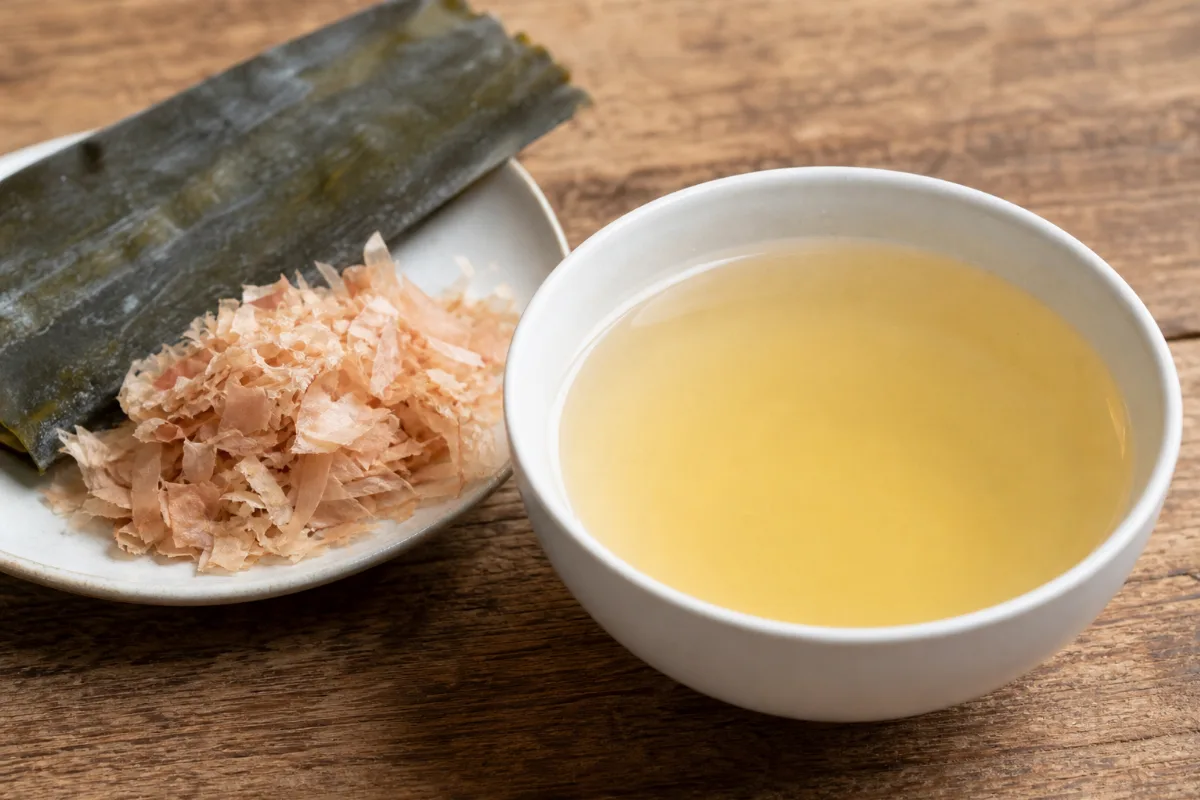
Dashi is a family of Japanese stocks. Kombu dashi is made by soaking or gently simmering kombu, an edible kelp, in water and straining it. Many dashi also include shavings of bonito (preserved skipjack tuna), and instant powders and liquids are common. Wikipedia is the only source for these descriptions, and we did not verify them further.
Kombu is rich in glutamate, which gives the savoury umami taste. The US FDA says glutamate was first taken from a seaweed broth by a Japanese professor in 1908.
What is in it
No USDA entry for dashi was found, so we do not give calories, protein or sodium. The one measured value read is iodine: 5,400 micrograms per 100 g for a stock made with 3% kombu in water and left about an hour. This comes from a Japanese food composition table quoted by a dietitian column; we did not read the table itself.
Home stocks will differ. A 2004 lab survey found iodine in dry seaweeds ranging from 16 micrograms per gram in nori to over 8165 in one kelp product, and noted that iodine dissolves in water, so prepared foods are hard to estimate. No measured sodium, MSG or iodine values were found for instant dashi.
What the research shows
Taste study: in 35 older people with dry mouth in Japan, repeated sipping of a kelp dashi liquid went with more saliva and better taste scores. It was not randomised and had no control group, and one author works for a seasoning company. It is a first signal only.
Thyroid studies are about seaweed in general. In 49 regular seaweed eaters in Norway, estimated iodine intake fell from 658 to 189 micrograms a day and TSH fell significantly when they stopped for six weeks. In 2,845 Japanese adults, median urinary iodine was 295 micrograms per litre and TSH, FT4 and FT3 stayed in the reference ranges.
A lab model found that boiling kelp cut the iodine and arsenic that would reach the blood by up to 94.4% and 74.7%. This was kelp, not stock, and not people. We found nothing on dashi for blood pressure, blood sugar, cholesterol, digestion or weight.
Stock versus the seaweed itself
The thyroid findings are for seaweed eaten in general, and the cooking study is for whole kelp. The taste study used a kelp dashi liquid. None of these tested homemade or instant dashi. Dried kombu itself is a far more concentrated iodine source than the stock.
At a glance
Traditional uses history, not proof
- Used as the savoury base for miso soup, noodle broths and simmered dishes in Japanese cooking
- Long use as food is not proof that it treats any condition
Studied for research
- Iodine content of kombu stock, low certainty (one table value quoted second-hand)
- Taste and saliva in older adults with dry mouth, very-low certainty (one small study)
- Thyroid changes with regular seaweed eating, low certainty (not tested with dashi)
- Cooking and kelp iodine and arsenic, very-low certainty (lab model)
Main compounds
- Iodine
- Glutamate (savoury umami taste)
- Arsenic (a contaminant in kelp)
Common forms
- Kombu-only dashi, kombu soaked or gently simmered in water (the figure read is for 3% kombu in water, left about an hour)
- Kombu and bonito dashi, which adds fish (described by Wikipedia; not verified further)
- Instant dashi powders and liquids: no measured values were found
- Kelp dashi liquid used in one taste study
Research links: 2026 study: stopping regular seaweed and thyroid TSH · 2004 survey: iodine in common seaweeds · 2024 study: kelp dashi, taste and saliva in older adults · Research Library · Genes & Biomarkers Library
What it is and its history
- Accepted scientific name
- Saccharina japonica (kombu, the kelp used in kombu dashi; name taken from the nutrient summary, not checked)
- Naming authority
- Not verified here: the taxonomy of kombu was not looked up in GBIF or AlgaeBase for this page. The nutrient summary lists Laminaria japonica and Saccharina japonica as names for the kelp. Dashi itself is a prepared stock, not a species.
- Synonyms
- Name: Laminaria japonica; Status: older name listed in the nutrient summary; not checked against a taxonomy database
- Common names
- Dashi (Japanese (romanised)); Kombu dashi (English); Kelp stock (English); Awase dashi (Japanese (romanised)); Japanese soup stock (English)
- Classification
- Not verified
- Native range
- Not verified from a source read.
- Habitat
- Not verified from a source read.
- What it looks like
- Roots: Not verified.; Stems: Not verified.; Leaves: Not verified.
- Cultivation
- Not verified from a source read.
- Harvest and processing
- Dashi is a stock. Wikipedia describes the most common form as a broth made by heating water with kombu (edible kelp) and shavings of katsuobushi (preserved, fermented skipjack tuna) to near-boiling, then straining; kombu dashi alone is made by soaking or gently simmering kelp in water. Instant granules or liquids largely replaced homemade stock in the second half of the 20th century. Wikipedia only: NOT verified against a primary source. The Japanese food composition table value quoted by the dietitian column is for a stock made with 3% kombu in water, left about 60 minutes and strained.
- Look-alikes and adulterants
- Name: Bonito or fish dashi; Note: Contains fish. Different allergens from a kombu-only stock.; Name: Instant dashi powder or liquid; Note: Ingredients vary (may include fish, MSG, yeast extract, salt); no measured values were found.; Name: Kombu (the seaweed itself); Note: Has its own page; dried kombu is a much more concentrated iodine source than the stock.
- Sustainability and conservation
- Not assessed.
Photographs
Traditional use and history history, not clinical proof
| Tradition or era | Documented use | Source |
|---|---|---|
| US FDA MSG page, read 2026-10-26 |
Traditional use shows how it was used. It does not show that it works or is safe today.
What is inside, and how it may work
What it contains and how those compounds act in cells and animals. Laboratory and animal mechanisms are not proven effects in people.
Main compounds
| Compound | Family | Where it is concentrated | Activity studied | Level of evidence |
|---|---|---|---|---|
| Iodine | mineral | Kelp (leaves) Kombu stock 5,400 ug per 100 g (Japanese table value quoted by a column); dried kombu 200,000 ug per 100 g (same column); seaweeds 16 to over 8165 ug/g dry weight (Teas 2004) | Needed for thyroid hormones; too much may cause thyroid dysfunction (ATA). 8 6 7 | Human data |
| Glutamate (glutamic acid) | amino acid | Kelp Not found for dashi | Gives the savoury (umami) taste. The FDA says glutamate was first extracted from a seaweed broth in 1908. Wikipedia says kombu is especially high in glutamic acid (NOT verified beyond Wikipedia). 10 11 | Reference |
| Arsenic | trace element (contaminant) | Kelp Not found for dashi | Present in kelp; boiling lowered what would reach the blood in a lab digestion model. 3 | Lab |
Mechanisms, receptors and pathways
| Target or pathway | Gene or receptor | What was found | Level |
|---|---|---|---|
| Umami-taste salivary reflex | Not specified in the abstract | The authors propose that umami taste raises saliva flow through a reflex and that repeated kelp dashi stimulation improved taste. This is their interpretation from a small non-randomised study, not a tested mechanism. 5 | Human data |
| Iodine and the thyroid axis (TSH) | Not specified | In 49 habitual seaweed eaters, TSH fell after stopping seaweed, most in those with the highest iodine intake; the authors link it to iodine. Not tested for dashi. 1 | Human data |
| Iodine and arsenic uptake from cooked kelp | Not specified | In a cell model, iodine from kelp crossed the cell layer less as the iodine level rose, whereas iodine from potassium iodate stayed steady at around 35%. Lab model only. 3 | Lab |
Absorption, metabolism and elimination
- Absorption
- Not found for dashi in people. A cell model suggested iodine from kelp crossed the cell layer less at high iodine levels.
- Distribution
- Not found.
- Metabolism
- Not found.
- Elimination
- Not found. Urinary iodine reflects recent intake in groups of people.
- Bioavailability
- Not established for dashi in people.
Isolated compounds versus whole extracts
The iodine facts apply to kombu stock as a food. The taste study used a kelp dashi liquid that may not match homemade or instant dashi. The thyroid studies are of seaweed eating in general, and the cooking study is of whole kelp in a lab model. None of these are of instant dashi.
Nutritional composition
No USDA FoodData Central entry for dashi was found (the nutrient summary says none exists, and a direct search could not be run because the public key was rate-limited), so no calories, protein, sodium or other nutrients per typical portion are stated. The only measured value read is iodine: 5,400 micrograms per 100 g for a kombu stock made with 3% kombu in water, left about 60 minutes (Japanese food composition table value, 2015 edition, quoted second-hand by a dietitian column; the table itself was not read). Home stocks will differ with the kombu, soaking time and temperature. Instant dashi powders and liquids vary and were not measured in any source read.
2 low certainty2 very low certainty
What was looked at
The 4 benefits and uses checked for Dashi, each with how strong the evidence is. Tap one to open it.
- Iodine in kombu stock (nutrient content, mainly a caution)Low certainty
- Taste and saliva in older adults with dry mouthVery low certainty
- Cooking, iodine and arsenic in kelp (lab model)Very low certainty
- Thyroid function with habitual seaweed eating (not dashi)Low certainty
Lab markers tracked in the studies
Saliva flow rateTaste recognition thresholdsTSH (thyroid-stimulating hormone)Urinary iodine concentration
What is Dashi good for?
The studied uses and how strong the human evidence is for each. Dashi has been studied very little; most findings are about kombu or seaweed in general.
Benefits, one by one
Each card is a research question, not a promise. Tap a goal to filter. Open a card to see the studies, doses and limits.
Iodine in kombu stock (nutrient content, mainly a caution)
Low certaintyKombu is among the richest iodine foods and iodine dissolves into water. A Japanese food table, quoted by a dietitian column, gives 5,400 micrograms of iodine per 100 g for a kombu stock. That is a lot of iodine, which matters for the thyroid.
3 studiesKombu-only stock. Bonito stock, instant powders and liquids were not …
Studies, doses and limits
What the trials found
No study measured iodine in dashi in people. The one number read is a table value for a kombu stock made with 3% kombu in water, left about an hour: 5,400 ug per 100 g, quoted by a dietitian column. A 2004 lab survey found dried seaweeds range from 16 ug/g (nori) to over 8165 ug/g (a kelp granule product), and that cooked-food values are hard to estimate.
Results
Kombu stock can carry a large amount of iodine, but the exact amount in a home or restaurant stock is not known and will vary with the kombu, the time and the water.
Effect sizes as reported
Kombu stock 5,400 ug per 100 g (table value via a column); dried kombu 200,000 ug per 100 g (same column); seaweeds range 16 to over 8165 ug/g dry weight (Teas 2004).
Why this rating
Low: the stock figure comes from one table quoted second-hand and the primary table was not read. High that kelp as a food varies enormously in iodine.
Form and dose studied
Kombu-only stock. Bonito stock, instant powders and liquids were not measured in any source read.
Who was studied
General population; the concern is higher for young children, people with thyroid disease and pregnancy.
Limits
Secondary source for the stock figure; no measured data for instant dashi; one steeping method only.
Why researchers looked
Iodine is needed for thyroid hormones, and kelp is a very strong source, so how much ends up in the stock is a food safety question as much as a nutrition one.
Traditional use
Dashi is the base of many Japanese soups and simmered dishes. Long use as a food is not proof that it treats any condition.
Proposed mechanism Laboratory analysis
Iodine in kelp is water-soluble, so soaking or heating kombu moves some iodine into the liquid (Teas 2004). How much depends on how the stock is made.
A proposed mechanism does not show that the effect happens in people.
See the Safety tab for the thyroid, children, pregnancy and fish allergy.
Taste and saliva in older adults with dry mouth
Very low certaintyIn one small Japanese study of 35 older people with dry mouth, sipping a kelp dashi liquid again and again went with more saliva and better taste sensitivity. There was no randomised control group, so it is only a first signal.
1 studiesA kelp dashi liquid used in the trial. Not shown for homemade dashi o…
Studies, doses and limits
What the trials found
A non-randomised trial in 35 older people with dry mouth found that repeated kelp dashi stimulation raised saliva flow (whole and minor gland), lowered taste thresholds including umami, and eased reported taste problems, eating and swallowing difficulty and mouth burning.
Results
Better saliva and taste scores after repeated sipping, in a small before-and-after study.
Effect sizes as reported
No effect sizes in the abstract.
Why this rating
Very low: 35 people, no randomised control, before-and-after only, one group, and one author works for a seasoning company (Ajinomoto).
Form and dose studied
A kelp dashi liquid used in the trial. Not shown for homemade dashi or instant dashi.
Who was studied
Older adults with dry mouth in Japan.
Limits
Not randomised; duration of effect not stated in the abstract; industry-linked author; only one study.
Why researchers looked
Umami (savoury) taste can trigger saliva, and taste loss in older adults can lead to poor eating.
Traditional use
Dashi is valued for its savoury umami taste. That is a flavour role, not proof of a health effect.
Proposed mechanism Human small study
The authors propose an umami-taste salivary reflex: umami taste on the tongue raises saliva flow. This is their explanation, tested only in this kind of small study.
A proposed mechanism does not show that the effect happens in people.
The iodine in a strong kombu stock is a separate concern; see the Safety tab. This is not a treatment claim.
Cooking, iodine and arsenic in kelp (lab model)
Very low certaintyA lab study found that boiling kelp for 10 minutes cut the iodine and arsenic that would reach the blood in a digestion model. It tested kelp, not dashi, and not people.
1 studiesRaw and cooked whole kelp (Saccharina japonica, the kombu species), n…
Studies, doses and limits
Results
Boiling for 10 minutes gave the largest reductions: iodine 94.4% and arsenic 74.7% in what would reach the blood in the model. The authors say the risk of too much iodine or arsenic from kelp is very low; that is their conclusion from a lab model and two authors work for a company.
Effect sizes as reported
Iodine reduced by up to 94.4% and arsenic by up to 74.7%; gastric-phase iodine bioaccessibility fell from 3188.2 to 317.0 ug/L after boiling.
Why this rating
Very low: lab and cell model only, one kelp species, no people, company-linked authors.
Form and dose studied
Raw and cooked whole kelp (Saccharina japonica, the kombu species), not a stock.
Limits
Not dashi; where the iodine goes (kelp or water) was not reported in the abstract; stock-making by soaking was not tested.
Why researchers looked
Kelp has a lot of iodine and some arsenic, so researchers asked whether cooking changes how much the body could take up.
Proposed mechanism Laboratory model
Iodine is water-soluble, so cooking can move it out of the kelp. The abstract does not say how much ends up in the water.
A proposed mechanism does not show that the effect happens in people.
Do not take this as proof a stock is low in iodine. The only stock figure read is high; see Iodine content.
Thyroid function with habitual seaweed eating (not dashi)
Low certaintyIn a small Norwegian study, people who ate seaweed regularly had high iodine intake, and their thyroid hormone TSH fell after they stopped for six weeks. This was seaweed in general, not dashi.
2 studiesSeaweed of unspecified types (Norway); usual Japanese diet (Japan).
Studies, doses and limits
What the trials found
A non-randomised pre-post study in 49 habitual seaweed eaters in Norway found estimated iodine intake of 658 ug/day (median) while eating seaweed and 189 ug/day after six weeks off; TSH fell significantly. A survey of 2,845 Japanese adults found median urinary iodine of 295 ug/L, estimated intake about 400 ug/day, and a positive link between urinary iodine and TSH across regions, with TSH, FT4 and FT3 within reference ranges.
Results
High seaweed intake raises iodine and shifts TSH. Neither study looked at dashi.
Effect sizes as reported
Intake 658 to 189 ug/day; urinary iodine 270 to 87 ug/L; Japan survey median urinary iodine 295 ug/L, about 400 ug/day estimated.
Why this rating
Low: one non-randomised study and one cross-sectional survey, neither about dashi; intake estimated by questionnaire.
Form and dose studied
Seaweed of unspecified types (Norway); usual Japanese diet (Japan).
Who was studied
Adult habitual seaweed eaters in Norway; healthy adults in Japan.
Limits
Not dashi; no cause shown in the survey; no thyroid outcome beyond blood tests.
Why researchers looked
Some seaweeds have very high iodine, and too much iodine can upset the thyroid.
Traditional use
Japan has a long seaweed tradition, with high average iodine intake.
Proposed mechanism Human observational
Not tested. The authors link the change to iodine intake: the largest TSH fall was in people with the highest intake.
A proposed mechanism does not show that the effect happens in people.
See the Safety tab.
Connections to the rest of health
How Dashi connects to the rest of our health knowledge graph. Every link says what kind of connection it is. A safety link (for example to the liver) is a warning, not a benefit. A study that merely mentions a topic never creates a benefit link.
Explore every connection: goals, body systems, organs, symptoms, genes
A. Wellness goals
| Connected to | Kind of connection | Evidence status | Context | Studies |
|---|---|---|---|---|
| Thyroid Support | Low certainty | Iodine in kombu stock (nutrient content, mainly a caution): Kombu is among the richest iodine foods and iodine dissolves into water. A Japanese food table, quoted by a dietitian column, gives 5,400 micrograms of iodine per 100 g for a kombu stock. That is a lot of iodine, which matters for the thyroid. | 8 6 7 | |
| Thyroid Support | Low certainty | Thyroid function with habitual seaweed eating (not dashi): In a small Norwegian study, people who ate seaweed regularly had high iodine intake, and their thyroid hormone TSH fell after they stopped for six weeks. This was seaweed in general, not dashi. | 1 2 |
B. Body systems
| Connected to | Kind of connection | Evidence status | Context | Studies |
|---|---|---|---|---|
| Endocrine System | Biological association | Low certainty | Studied for: Iodine in kombu stock (nutrient content, mainly a caution) Studied for: Cooking, iodine and arsenic in kelp (lab model) | 8 6 7 3 1 2 |
| Digestive System | Biological association | Very low certainty | Studied for: Taste and saliva in older adults with dry mouth | 5 |
C. Body parts and organs
| Connected to | Kind of connection | Evidence status | Context | Studies |
|---|---|---|---|---|
| Thyroid | Adverse effect or risk | Documented risk | Kombu is very high in iodine and iodine dissolves into the stock; ATA says more than 1,100 mcg a day may cause thyroid dysfunction. Kombu stock can be very high in iodine; the ATA says more than 1,100 mcg of iodine a day may cause thyroid dysfunction. Preparation or compound: Kombu stock (iodine) |
7 8 1 |
E. Health conditions
| Connected to | Kind of connection | Evidence status | Context | Studies |
|---|---|---|---|---|
| Fish allergy | Adverse effect or risk | Documented risk | Fish is a major allergen and bonito dashi contains fish. Dashi made with bonito flakes contains fish, a major allergen. Preparation or compound: Dashi made with bonito flakes |
4 9 |
I. Biomarkers
| Connected to | Kind of connection | Evidence status | Context | Studies |
|---|---|---|---|---|
| Saliva flow rate | Biological association | Very low certainty | Measured in trials: raised. A lab change is not the same as a health benefit. | 5 |
| Taste recognition thresholds | Biological association | Very low certainty | Measured in trials: lowered. A lab change is not the same as a health benefit. | 5 |
| TSH (thyroid-stimulating hormone) | Biological association | Low certainty | Measured in trials: lowered. A lab change is not the same as a health benefit. | 1 2 |
| Urinary iodine concentration | Biological association | Low certainty | Measured in trials: lowered. A lab change is not the same as a health benefit. | 1 2 |
K. Biological pathways
| Connected to | Kind of connection | Evidence status | Context | Studies |
|---|---|---|---|---|
| Iodine | Preliminary mechanism | Human | The nutrient to watch in kombu stock. | 7 1 |
| Thyroid | Preliminary mechanism | Human | Iodine from kelp can affect TSH in high-intake groups. | 1 2 |
| Urinary iodine concentration | Preliminary mechanism | Human | Used in the seaweed iodine studies. | 1 2 |
L. Active compounds
| Connected to | Kind of connection | Evidence status | Context | Studies |
|---|---|---|---|---|
| Iodine | Biological association | Human | Needed for thyroid hormones; too much may cause thyroid dysfunction (ATA). Preparation or compound: Kelp (leaves) |
8 6 7 |
| Glutamate (glutamic acid) | Biological association | Reference | Gives the savoury (umami) taste. The FDA says glutamate was first extracted from a seaweed broth in 1908. Wikipedia says kombu is especially high in glutamic acid (NOT verified beyond Wikipedia). Preparation or compound: Kelp |
10 11 |
| Arsenic | Biological association | Lab | Present in kelp; boiling lowered what would reach the blood in a lab digestion model. Preparation or compound: Kelp |
3 |
Each connection is stored with the ingredient, the connected record, the kind of connection, the evidence status, the supporting studies, the preparation or compound involved, and a review date (last reviewed October 26, 2026).
The evidence
The research centre for Dashi. Every record here was checked against PubMed or the publisher's page; we never list a study we have not verified.
Evidence by outcome
Bars show how many studies we found for each outcome, not how well it works. People are added up across trials only (reviews are not added, to avoid double counting).
How we rate evidence
High certainty
Several well-run trials or reviews agree; further research is unlikely to change the picture much.
Moderate certainty
Good trials point the same way, but some doubt remains.
Low certainty
Small, short or inconsistent trials. The finding could change with better research.
Very low certainty
Very little or very weak human data. Treat as a possibility only.
Mixed findings
Trials or reviews disagree with each other.
Not enough evidence
Not enough human research to say either way.
Evidence against
Good research found no benefit, or found harm.
We take the reviewers' own risk-of-bias and GRADE statements where they exist, and otherwise judge from study size, design, consistency, directness and whether a product matches what is sold. Many publications do not make evidence high. Method note: We started from our existing dashi summary, then re-read PubMed abstracts, the American Thyroid Association and US FDA pages and a Japanese dietitian column. Only abstracts were read for studies. Items we could not verify are flagged in the research gaps.
Study library: every study we checked 11
| Study | Design | People | Product, dose, length | Result |
|---|---|---|---|---|
| Aakre 2026 Impact of habitual seaweed consumption on iodine nutrition and thyroid function: a non-randomized pre-post clinical study. Eur J Nutr · PMID 41543576 · DOI |
Non randomized pre post trial |
49 49 habitual seaweed eaters recruited in the two largest cities in Norway |
Habitual seaweed eating (types not named in the abstract), then six weeks of stopping Seaweed in the normal diet 6 weeks without seaweed · vs The same people before and after stopping |
Median estimated iodine intake was 658 ug/day while eating seaweed and fell to 189 ug/day after stopping; urinary iodine fell from 270 to 87 ug/L. TSH fell significantly after stopping, most in people with the highest intakes. Iodine intake 658 to 189 ug/day; urinary iodine 270 to 87 ug/L; TSH decreased significantly (no number in the abstract) (Not given in the abstract) Methods, limits and fundingOutcomes: Urinary iodine, estimated iodine intake, TSH, fT3, fT4, thyroid antibodies Limitations: Not randomised, convenience sample, intake estimated by questionnaire. It is about seaweed in general, not dashi. Funding and conflicts: The authors declare no conflict of interest. Read: abstract |
| Fuse 2026 Nationwide survey on iodine nutritional status and thyroid function in Japanese adults. Endocr J · PMID 41905952 · DOI |
Cross sectional survey |
2845 2,845 healthy adults (mean age 45.6) from 20 regions of Japan, surveyed 2016 to 2023 |
Usual Japanese diet (iodine-replete, no iodine fortification) Whole diet · vs Regions compared |
Median urinary iodine was 295 ug/L, within the WHO adequate range. Average iodine intake was estimated at about 400 ug/day. Urinary iodine was positively correlated with TSH across regions, and TSH, FT4 and FT3 stayed within reference ranges. Median urinary iodine 295 ug/L (169 to 943 ug/L across regions); thyroid antibody positivity 12.6% (Not given in the abstract) Methods, limits and fundingOutcomes: Urinary iodine, thyroid hormones, thyroid antibodies, estimated iodine intake Limitations: A one-time survey, not a trial. It does not name dashi or kombu and cannot show cause. Funding and conflicts: The authors declare no conflict of interest. Read: abstract |
| Li 2024 Evaluation of the Bioavailability of Iodine and Arsenic in Raw and Cooked Saccharina japonica Based on Simulated Digestion/Caco-2 Cell Model. Foods · PMID 39335793 · DOI |
Laboratory model n/a |
Raw and cooked kelp (Saccharina japonica) in a simulated digestion and Caco-2 cell model | Kelp (Saccharina japonica), raw and cooked Whole kelp, cooked in water Boiling for 10 minutes was the strongest treatment · vs Raw kelp; potassium iodate (KIO3) for the cell transport test |
Cooking cut the iodine and arsenic that would reach the blood in the model, by up to 94.4% (iodine) and 74.7% (arsenic) after boiling for 10 minutes. In the cell model, iodine from kelp crossed the cell layer less as the iodine level rose. Highest reductions: iodine 94.4%, arsenic 74.7%; gastric-phase iodine 3188.2 to 317.0 ug/L after boiling (Not given in the abstract) Methods, limits and fundingOutcomes: Iodine and arsenic content, bioaccessibility and bioavailability Limitations: A lab model on kelp, not on a stock and not in people. The abstract does not say how much iodine ends up in the cooking water. The authors conclude the risk is very low, which is their interpretation. Funding and conflicts: Two authors work for Shandong Meijia Group Co. Ltd., a company; the abstract says the company role was project management and product inspection. Read: abstract |
| Mastrorilli 2023 IgE-Mediated and Non-IgE-Mediated Fish Allergy in Pediatric Age: A Holistic Approach-A Consensus by Diagnostic Commission of the Italian Society of Pediatric Allergy and Immunology. Medicina (Kaunas) · PMID 37763770 · DOI |
Consensus review |
Children with fish allergy (a consensus by the Italian Society of Pediatric Allergy and Immunology) | Fish (as an allergen) Fish muscle |
Fish is one of the "big nine" allergenic foods and fish allergens must be named on labels. Fish allergy affects under 1% of the world population and up to 7% in children. Parvalbumin is the main fish allergen. Under 1% of people worldwide; up to 7% in children (Not applicable) Methods, limits and fundingOutcomes: Fish allergy: how common, causes, diagnosis, management Limitations: A children-focused consensus review. It does not mention dashi or bonito flakes. Funding and conflicts: The authors declare no conflict of interest. Read: abstract |
| Satoh-Kuriwada 2024 Contribution of kelp dashi liquid to sustainable maintenance of taste sensation and promotion of healthy eating in older adults throughout the umami-taste salivary reflex. Front Nutr · PMID 39257609 · DOI |
Non randomized controlled trial |
35 35 older patients with dry mouth at a university dental hospital in Japan (2017 to 2021) |
Umami-rich kelp dashi liquid Kelp dashi liquid as a taste stimulus Repeated stimulation; length not stated in the abstract · vs Before-and-after comparison in the same people |
Repeated kelp dashi stimulation raised both saliva flow measures, lowered taste thresholds (including umami) and eased reported taste problems, eating and swallowing difficulty and mouth burning. No effect sizes or numbers in the abstract (Not given in the abstract) Methods, limits and fundingOutcomes: Saliva flow (whole and minor gland), taste recognition thresholds for five tastes, eating and swallowing difficulty Limitations: Not randomised, no separate control group (before-and-after only), small, people with dry mouth only. The abstract does not say how long the effect lasts. Funding and conflicts: One author works for Ajinomoto Co., Inc. (a food and seasoning company); the others declare no conflict. Read: abstract |
| Teas 2004 Variability of iodine content in common commercially available edible seaweeds. Thyroid · PMID 15588380 · DOI |
Laboratory analysis n/a |
12 types of commercially available edible seaweeds (US shops, plus samples from Canada, Tasmania and Namibia) | Dried edible seaweeds including kelp Whole dried seaweeds |
Iodine ranged from 16 ug/g in nori to over 8165 ug/g in one kelp granule product. Iodine is water-soluble in cooking, so the iodine in prepared foods is hard to estimate. Some Asian seaweed dishes may exceed the tolerable upper intake level of 1100 ug/day. Range 16 ug/g (nori) to 8165 +/- 373 ug/g (kelp granules); freshly cut juvenile Namibian kelp blades 6571 +/- 715 ug/g (Not applicable) Methods, limits and fundingOutcomes: Iodine content of each seaweed Limitations: A 2004 lab survey of dry seaweeds, not of dashi or any stock. The authors say prepared foods are hard to estimate. Funding and conflicts: Funding is not stated in the abstract (research support listed as non-industry). Read: abstract |
| s-ata-iodine-2013 American Thyroid Association: statement on the potential risks of excess iodine ingestion and exposure (news release, 5 June 2013) · Source |
Authoritative guidance n/a |
Methods, limits and fundingRead: full-text | ||
| s-eatreat-kombu-dashi Eatreat (Japanese dietitian column, 2016, rewritten 2020): kombu dashi in nursery-school meals (in Japanese) · Source |
Secondary source column n/a |
Methods, limits and fundingRead: full-text | ||
| s-fda-allergens US FDA: Food Allergies · Source |
Authoritative guidance n/a |
Methods, limits and fundingRead: full-text | ||
| s-fda-msg US FDA: Questions and Answers on Monosodium glutamate (MSG) · Source |
Authoritative guidance n/a |
Methods, limits and fundingRead: full-text | ||
| s-wikipedia-dashi Wikipedia: Dashi (background only, not a clinical source) · Source |
Encyclopedia n/a |
Methods, limits and fundingRead: full-text |
What we do not know yet
- Dashi has almost no research. No measured iodine, sodium, arsenic or MSG values for home or instant dashi were found; the one iodine figure is a table value quoted by a column.
- The taste and saliva finding comes from one small non-randomised study with a company-linked author.
- The thyroid studies are about seaweed in general, not dashi, and the cooking study is a lab model on kelp.
- Pregnancy, breastfeeding and child advice rests on general iodine statements and a column; the Japanese child limits were not checked against the ministry tables.
- Liver, kidney, gout, blood thinner and blood pressure questions were not researched for dashi.
How new research is added
New studies are found by a saved PubMed search and placed in a review queue before the page changes.
Lab markers
What changed in blood or saliva tests during trials. A changed number is not the same as feeling or being healthier, and we give no "normal ranges".
Hormonal 1
TSH (thyroid-stimulating hormone)
Lowered in trials
A hormone from the brain that tells the thyroid how hard to work. It is the usual first blood test for thyroid function.
Low certaintyResults and what it means
Why it was measured
It moves when the thyroid has too much or too little iodine.
Statistical vs. clinical meaning
Shows seaweed-level iodine can move TSH. Not tested with dashi.
Safety implication
People with thyroid disease should ask their clinician.
| Study | Result | People | Product |
|---|---|---|---|
| 1 | TSH decreased significantly after six weeks without seaweed (no number in the abstract); the largest fall was in people with the highest estimated iodine intake | 49 habitual seaweed eaters in Norway | Stopping seaweed for six weeks |
| 2 | Across 20 regions of Japan, median urinary iodine and median TSH were positively correlated; median TSH, FT4 and FT3 were within reference ranges | 2,845 Japanese adults | Usual diet (survey) |
Other 3
Saliva flow rate
Raised in trials
How much saliva the mouth makes, measured from the whole mouth or from the small glands in the lips and cheeks.
Very low certaintyResults and what it means
Why it was measured
Low saliva makes tasting, chewing and swallowing harder.
Statistical vs. clinical meaning
A signal from a small non-randomised study; no effect size given.
Safety implication
The iodine in a strong kombu stock; see Safety.
| Study | Result | People | Product |
|---|---|---|---|
| 5 | Repeated kelp dashi stimulation increased both whole-mouth and minor gland saliva flow (no numbers in the abstract) | 35 older patients with dry mouth | Kelp dashi liquid, repeated stimulation |
Taste recognition thresholds
Lowered in trials
The weakest taste a person can recognise. A lower threshold means a better sense of taste.
Very low certaintyResults and what it means
Why it was measured
Taste loss in older adults is linked by the authors to poor nutrition.
Statistical vs. clinical meaning
Small, uncontrolled study.
Safety implication
None specific.
| Study | Result | People | Product |
|---|---|---|---|
| 5 | Thresholds for umami and the other tastes fell (improved) after repeated kelp dashi stimulation (no numbers in the abstract) | 35 older patients with dry mouth | Kelp dashi liquid, repeated stimulation |
Urinary iodine concentration
Lowered in trials
The amount of iodine in urine, used as a measure of recent iodine intake in groups of people.
Low certaintyResults and what it means
Why it was measured
It shows whether a group is getting too little, enough or too much iodine.
Statistical vs. clinical meaning
Describes iodine intake, not a health outcome.
Safety implication
None specific.
Safety
What studies and official sources say about side effects, medicines and who should check first. Each point shows what kind of evidence it comes from.
Main points to know 4
- Iodine and the thyroid. Kombu is very high in iodine, and iodine dissolves into the stock. A Japanese food table, quoted by a dietitian column, gives 5,400 micrograms per 100 g for a kombu stock. The American Thyroid Association says more than 1,100 micrograms of iodine a day is not recommended and may cause thyroid problems. A Norwegian study found regular seaweed eaters often had iodine intake above their upper limit, and their TSH fell when they stopped. If you have a thyroid condition or take thyroid medicine, ask your clinician about kombu stock. Authoritative guidance and observational 8 6 7 1
- Young children. Children have much lower upper limits for iodine. The dietitian column quotes Japanese limits of 250 micrograms a day at age 0, 300 at ages 1 to 2 and 400 at ages 3 to 5, and calculates that a few grams of strong kombu stock would reach those limits. That is the column writer's arithmetic from a table value, not a measured case. Ask a paediatrician or dietitian before using kombu stock often for a baby or young child. Secondary source and arithmetic 8
- Fish allergy (when the stock has fish). Many dashi stocks add bonito flakes, which are fish. Fish is one of the major food allergens and must be named on labels. Kombu-only stock has no fish, but instant dashi products vary; read the label. A fish allergy can be severe. Authoritative guidance 9 4 11
- Pregnancy and breastfeeding. No source read gives advice about dashi in pregnancy or breastfeeding. The American Thyroid Association says iodine needs are higher in pregnancy (220 to 250 micrograms a day) and breastfeeding (250 to 290), and still advises against more than 1,100 micrograms a day. Because kombu stock can carry a lot of iodine, ask your midwife or doctor about it. Authoritative guidance 7
Side effects 3
| Effect | How often | Severity and recovery | Evidence |
|---|---|---|---|
| Too much iodine: possible thyroid problems The evidence is about iodine and seaweed in general. No case of harm from dashi was found in the sources read. | No frequency found for dashi. In 49 habitual seaweed eaters in Norway, median estimated iodine intake of 658 ug/day was above the upper limit the authors used, and TSH fell significantly after they stopped. | varies; thyroid dysfunction is described by the ATA TSH fell after stopping seaweed for six weeks in one study. | Authoritative guidance and observational 7 1 2 |
| Allergic reactions to fish (when bonito or other fish is in the stock) Applies only to stocks that contain fish. | Fish allergy affects under 1% of people worldwide and up to 7% in children (consensus review). | can be severe Not described. | Authoritative guidance 4 9 |
| Headache, flushing or similar after MSG Applies only to instant products with added MSG, which no source read measured. | Not found for dashi. FDA says studies have not consistently triggered reactions in people who report being sensitive; FASEB reported short, mild symptoms in some sensitive people who had 3 g or more of MSG without food. | mild and short Short-term | Authoritative guidance 10 |
Liver
No liver injury from dashi was found in the sources read. A liver-safety source (such as LiverTox) was not searched.
How often. No frequency was found.
Monitoring. No agency monitoring advice was found.
This is a safety connection. It is not evidence that Dashi supports liver health.
Medicines and supplements 2
| With | Why it matters | Importance | Evidence | What to do |
|---|---|---|---|---|
| Thyroid medicines (levothyroxine, antithyroid medicines) and thyroid conditions prescription | Iodine from kombu stock adds to total iodine, which can change thyroid function. No dashi-specific interaction study was found. | The ATA warns that more than 1,100 micrograms of iodine a day may cause thyroid dysfunction. No trial tested dashi with thyroid medicine. | Authoritative guidance and observational Low certainty 7 1 | Ask your prescriber or pharmacist whether kombu stock or other high-iodine seaweed fits your treatment. Do not change a medicine on your own. |
| Low-sodium or MSG-limited diets (instant dashi) dietary | Instant dashi can contain salt and added glutamate; no sodium or MSG values for instant dashi were found. | FDA considers added MSG generally recognized as safe and requires it to be listed on labels. No measured sodium for dashi was read. | Authoritative guidance Not enough evidence 10 | Read the label, and ask your doctor or dietitian if you limit salt. |
Who should check first 4
| Situation | Advice | Evidence |
|---|---|---|
| Fish allergy (stock made with bonito or other fish) | Avoid fish-based dashi and check labels on instant dashi. For trouble breathing or swelling of the face, lips or throat, call 911 or your local emergency number. | Authoritative guidance 9 4 |
| Thyroid disease, or taking thyroid medicine | Ask your clinician before using kombu stock regularly. | Authoritative guidance 7 |
| Babies and young children | Ask a paediatrician or dietitian before regular use of strong kombu stock. | Secondary source 8 |
| Pregnancy or breastfeeding | No dashi-specific advice was read. Ask your midwife or doctor about kombu and iodine. | Authoritative guidance 7 |
Overdose, product quality and regulators
Summary. No toxicity from dashi as an ordinary food was found in the sources read. The main concern is iodine; arsenic in kelp was also raised by a lab study.
Animal. Not reviewed.
High dose or long term signals. ATA says more than 1,100 micrograms of iodine a day may cause thyroid dysfunction and warns against kelp supplements with more than 500 micrograms. These are about total iodine and supplements, not dashi itself.
Overdose response. Not found.
Genotoxicity. Not researched.
Kelp contains arsenic and very variable iodine. A lab study of kelp (not stock) found boiling cut the arsenic and iodine that would reach the blood in a model. Heavy-metal levels in real dashi, instant dashi and bonito flakes were not found.
Arsenic and iodine in cooked kelp. In a simulated digestion model, boiling kelp for 10 minutes reduced iodine by up to 94.4% and arsenic by up to 74.7% in what would reach the blood. Not tested in people or in a stock; two authors work for a company. 3
Iodine varies widely between seaweeds. A 2004 survey found iodine from 16 ug/g in nori to over 8165 ug/g in a kelp granule product, and iodine is water-soluble in cooking so prepared food is hard to estimate. 6
| Body | Action | Date |
|---|---|---|
| American Thyroid Association (United States) | Statement on the risks of excess iodine: advises against iodine and kelp supplements with more than 500 mcg iodine daily; more than 1,100 mcg a day (Tolerable Upper Limit) is not recommended and may cause thyroid dysfunction. source | 2013-06-05 |
| US FDA (United States) | MSG: added MSG is generally recognized as safe (GRAS) and must be listed on the label as monosodium glutamate. source | 2026-07-17 |
| US FDA (United States) | Food Allergies: fish, wheat, soybeans and sesame are among nine major food allergens and must be named on packaged food labels. source | 2026-03-11 |
When to get medical help
- Trouble breathing, wheezing, swelling of the lips, face, tongue or throat, widespread hives, repeated vomiting, dizziness or collapse after eating a stock that contains fish (possible anaphylaxis): use epinephrine if prescribed, then call 911 or your local emergency number
- Signs of an overactive or underactive thyroid (for example a racing heart, tremor, weight change, feeling very cold or very tired) after regular high-iodine seaweed: see a doctor
Stop using the product and contact a clinician or emergency service. In the US, Poison Control is 1-800-222-1222.
General information only, not medical advice. Ask a clinician or pharmacist before use, especially with medicines, in pregnancy or with a health condition. See the Natural Remedy Safety guide.
Frequently asked questions
What is dashi?
Dashi is a Japanese stock used as the base for soups and simmered dishes. Kombu dashi is made from kombu kelp soaked or simmered in water. Many dashi also add bonito flakes, which are fish.
Is dashi high in iodine?
Can the iodine in dashi affect the thyroid?
Is kombu dashi safe for babies and young children?
Ask a paediatrician or dietitian. Young children have lower iodine limits (as quoted by a Japanese dietitian column), and strong kombu stock is high in iodine. The column's own arithmetic suggests a small amount could reach a toddler's limit; it is not a measured case.
Is dashi safe in pregnancy or breastfeeding?
No source read gives dashi-specific advice. The American Thyroid Association gives higher iodine needs in pregnancy and breastfeeding but still advises against more than 1,100 micrograms a day. Ask your midwife or doctor.
Does dashi contain fish?
Does dashi help dry mouth or taste loss?
One small study of 35 older people with dry mouth found more saliva and better taste scores after repeated sipping of a kelp dashi liquid. It had no randomised control group and one author works for a seasoning company, so it is only a first signal.
Does cooking remove iodine from kombu?
In a lab digestion model, boiling kelp for 10 minutes cut the iodine reaching the blood by up to 94.4%. That was kelp, not a stock, and not people. The abstract does not say how much goes into the water.
Is the MSG in instant dashi harmful?
The US FDA considers added MSG generally recognized as safe, and says studies have not consistently triggered reactions in people who think they are sensitive. It must be listed on the label. No measured MSG values for instant dashi were found.
Where does the savoury taste of dashi come from?
Does dashi have nutrition facts or health benefits?
What about arsenic in kelp?
Kelp contains arsenic. A lab model found boiling reduced what would reach the blood by up to 74.7%, but it was not tested in a stock or in people. Heavy-metal levels in real dashi were not found.
Explore by health goal
Editorial transparency
- Written by
- AlternativeMed editorial team. Research compiled with AI assistance, then checked against the sources listed.
- Medical review
- None. This page has not been reviewed by a physician or pharmacist.
- First published
- 2026-10-26
- Last substantive update
- 2026-10-26
- How we research
- We started from our existing dashi summary, then re-read PubMed abstracts, the American Thyroid Association and US FDA pages and a Japanese dietitian column. Only abstracts were read for studies. Items we could not verify are flagged in the research gaps.
- How we rate evidence
- See "How we rate evidence" in the Evidence tab.
- Independence
- No product is promoted on this page. No affiliate links are shown. One author of the taste study works for a seasoning company (Ajinomoto Co.) and two authors of the cooking study work for a seaweed company; this is stated where each is used.
Sources 11
Each source was opened and checked. Where we read only the abstract, it says so. The small numbers in the text point here.
- Aakre I, Vogt EC, Myrmel LS, Lundebye AK, Helland OB, et al.. Impact of habitual seaweed consumption on iodine nutrition and thyroid function: a non-randomized pre-post clinical study.. Eur J Nutr. 2026. PMID 41543576. DOI 10.1007/s00394-025-03813-8. (abstract)
- Fuse Y, Kunii Y, Tsukada N, Ito Y, Shishiba Y.. Nationwide survey on iodine nutritional status and thyroid function in Japanese adults.. Endocr J. 2026. PMID 41905952. DOI 10.1507/endocrj.EJ25-0603. (abstract)
- Li N, Geng Z, Guo Y, Dai X, Zhu W, et al.. Evaluation of the Bioavailability of Iodine and Arsenic in Raw and Cooked Saccharina japonica Based on Simulated Digestion/Caco-2 Cell Model.. Foods. 2024. PMID 39335793. DOI 10.3390/foods13182864. (abstract)
- Mastrorilli C, Arasi S, Barni S, Caimmi D, Chiera F, et al.. IgE-Mediated and Non-IgE-Mediated Fish Allergy in Pediatric Age: A Holistic Approach-A Consensus by Diagnostic Commission of the Italian Society of Pediatric Allergy and Immunology.. Medicina (Kaunas). 2023. PMID 37763770. DOI 10.3390/medicina59091651. (abstract)
- Satoh-Kuriwada S, Gotoh S, Shoji N, Uneyama H, Komai M.. Contribution of kelp dashi liquid to sustainable maintenance of taste sensation and promotion of healthy eating in older adults throughout the umami-taste salivary reflex.. Front Nutr. 2024. PMID 39257609. DOI 10.3389/fnut.2024.1406633. (abstract)
- Teas J, Pino S, Critchley A, Braverman LE.. Variability of iodine content in common commercially available edible seaweeds.. Thyroid. 2004. PMID 15588380. DOI 10.1089/thy.2004.14.836. (abstract)
- . American Thyroid Association: statement on the potential risks of excess iodine ingestion and exposure (news release, 5 June 2013). . . (full-text)
- . Eatreat (Japanese dietitian column, 2016, rewritten 2020): kombu dashi in nursery-school meals (in Japanese). . . (full-text)
- . US FDA: Food Allergies. . . (full-text)
- . US FDA: Questions and Answers on Monosodium glutamate (MSG). . . (full-text)
- . Wikipedia: Dashi (background only, not a clinical source). . . (full-text)
Where to buy
Check the label first. Whatever you buy, look for these:
- The iodine amount: seaweed can be very high in iodine, which matters for thyroid conditions
- Heavy metal testing information from the maker
- Origin and harvest area
- Organic or tested labeling
Talk to a pharmacist or doctor before you start any supplement, especially if you take medicines. See the Safety tab for interactions.
Support our free guides: as an Amazon Associate we earn from qualifying purchases. Full disclosure.


