Specialty Topics · Light therapy topic
Device-Specific Evidence for Light Therapy Products
Device-specific evidence for light therapy products (how to match a study or a regulatory record to one particular device and use) · also called Light therapy device evidence, red light therapy evidence, photobiomodulation devices, bright light therapy lamps, FDA-cleared light devices, LED masks, blue-light blocking glasses, evidencia de dispositivos de terapia de luz
Light therapy is a field of many different products: bright light boxes, red and near-infrared LED panels and masks, laser combs, head-worn bands, blue-light blocking glasses and clinic ultraviolet treatments. Evidence and regulatory status belong to a particular device used for a particular purpose, not to the whole field. Bright light for seasonal and non-seasonal depression has the best-supported evidence on this page, though still rated low quality by its own reviewers. Red and near-infrared light has strong support in a few narrow, protocol-specific settings and thin support elsewhere. A "cleared" device is not proven to work for every claim made for it.
General information, not medical advice. Last substantive update · Not medically reviewed. A named clinician has not signed off on this page. How this page is made
About Device-Specific Evidence for Light Therapy Products
Device-specific evidence for light therapy products means matching a study, a guideline or a regulatory record to one particular device used for one particular purpose. A trial of a bright light box does not support a red-light mask, and an FDA clearance for one laser comb does not support an LED cap. Bright light for depression has the best-supported evidence on this page, though still low quality by its reviewers' own rating; red and near-infrared light is strong in a few protocol-specific settings and weak elsewhere. Safety includes eye protection, medicines that make skin sensitive to light, and extra care in bipolar disorder.
Device-specific evidence for light therapy products: the rule
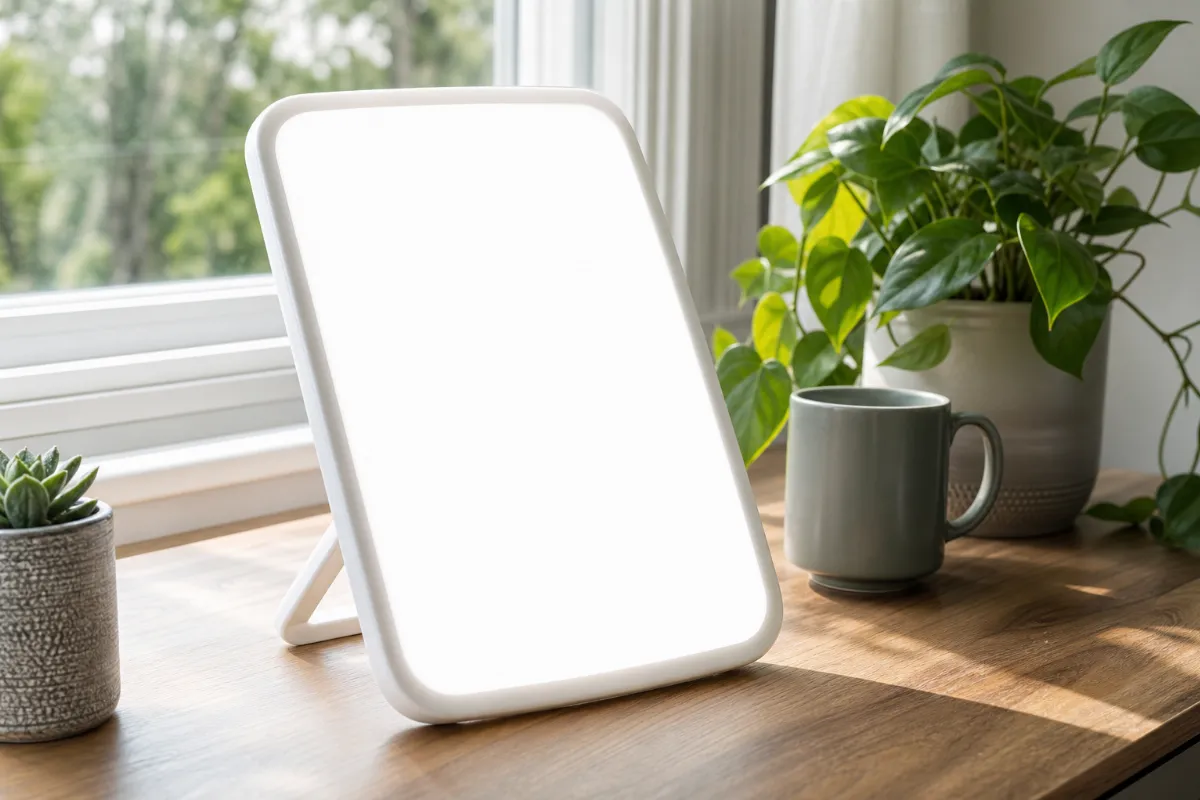
"Light therapy" is not one thing. A bright white light box, a red LED mask, a laser comb, a head-worn near-infrared band, blue-light blocking glasses and a clinic ultraviolet cabinet differ in wavelength, power, how long you use them and where the light lands. Studies and regulators judge a particular device used in a particular way, in a particular group of people.
So a useful question is always the same: which device, for which use, tested in whom? The rest of this page shows how that question works for each kind of light product, and where the answers are strong or weak.
Separating one device's evidence and regulatory status from the field's general evidence
The field-level evidence can be positive while a single product has no evidence at all. A 2026 systematic review pooled eight studies of at-home LED devices with wavelengths from 440 to 1072 nm and different schedules and reported improvement in facial aging. Its authors themselves say comparative data are limited and diverse skin types were underrepresented, so the review does not rank or validate any one mask.
The reverse can be true too. A near-infrared head-worn band in 48 people with depression showed no benefit on depression scores, and the authors said the low dose probably explained it. That result belongs to that device and dose, not to every headset or to near-infrared light in general.
Laser and LED are separate categories. The pooled trials of low-level laser for knee osteoarthritis and tendon problems used laser devices; they do not show the same effect for LED panels. The FDA says LEDs are different from laser diodes and are not subject to the federal laser product performance standard.
U.S. examples of device categories and their indications
Some light devices do have a defined U.S. category. The FDA product classification pages show: a laser comb (code OAP), Class 2 with a 510(k), defined to promote hair growth in males with androgenic alopecia of Norwood-Hamilton IIa to V, used three times a week for at least 26 weeks; an over-the-counter red and blue light laser (code OLP), Class 2 with a 510(k), for mild to moderate acne vulgaris; and a laser-based non-heating instrument (code NHN), Class 2 with a 510(k), for adjunctive use in pain therapy.
Each entry names a device type and an indication. None of them says anything about women with hair loss, severe acne, other kinds of pain, or LED caps and masks, and none shows that a particular model on a shop shelf is the one that was cleared. Check the actual product record, not the colour of the light.
Other products may be sold as "general wellness" with no premarket review, and some, like tanning beds and cabinet UV phototherapy, sit in very different risk and care categories.
What FDA clearance means and what clearance does not mean
Under FDA terms, "cleared" and "approved" are not interchangeable. A 510(k) clearance means the FDA found a device substantially equivalent to a legally marketed predicate with the same intended use. The FDA says substantial equivalence does not require the devices to be identical, and that the supporting data can include clinical data or bench testing. A premarket approval (PMA) is a separate, stricter review of safety and effectiveness for Class III devices.
What clearance does not mean: it does not mean every claim on the box is supported, it does not cover other uses or other models, and it does not rank the device against others. The FDA also states that placing a product under its January 2026 general wellness policy does not establish that it is safe or effective. A "general wellness" light product has not been tested by the FDA for any health benefit.
Phrases such as "FDA registered", "clinically proven" and "medical grade" are marketing wording. This page found no FDA definition of "medical grade" among the sources read. For the wording of regulatory claims, see Claim Check: FDA registered vs FDA approved.
Evidence tiers by use: where light is strongest and weakest
Strongest, but still low quality by their reviewers' own ratings: bright light for seasonal depression (21 trials, 1,037 people) and non-seasonal depression (881 and 883 people). Bipolar depression looks encouraging in a 46-person trial and a seven-trial analysis, with caution about mood switches. For body-clock sleep disorders, a 2015 sleep-medicine guideline endorses light at a second tier of confidence for named groups; effects in pooled studies are small to medium.
Protocol-specific and moderate: red and near-infrared photobiomodulation to prevent oral mucositis in cancer care, where an international group recommends specific protocols; and low-level laser for knee and tendon pain, with a modest pain gain and no adverse events reported.
Thinner: hair devices and at-home LED masks are reported as promising by reviews that ask for larger, better trials. Blue-light blocking glasses probably do not help eye strain and have unclear effects on sleep. Tanning beds are not a treatment; UV phototherapy for psoriasis is a clinic treatment with its own guideline.
How to read a light-device claim
Ask five questions. Which exact device was tested, and is it the one you would buy? What was the use and the group (for example males with hair loss at Norwood-Hamilton IIa to V, or adults with SAD)? Was it compared with a sham or placebo light, or only before and after? Is the FDA record about this model and this indication? Is the output (wavelength and power) measured and given, rather than only a colour?
The certainty labels on this page are our own judgement from the abstracts read. Moderate means good trials or a guideline point the same way. Low means small, short or inconsistent evidence. Against means good research found no benefit. Insufficient means too little human data to say.
At a glance
Traditional uses history, not proof
- Light devices are modern products, not a traditional remedy
- Clinics use some light treatments inside medical care, such as bright light boxes for winter depression, laser photobiomodulation to prevent mouth sores in cancer care, and ultraviolet phototherapy for psoriasis
Studied for research
- Bright light therapy for seasonal affective disorder, low certainty (best-supported use on this page)
- Bright light for non-seasonal depression, low certainty
- Bright light for bipolar depression, low certainty, supervision needed
- Light for body-clock (circadian) sleep problems, low certainty, guideline-endorsed for named groups
- Photobiomodulation to prevent oral mucositis in cancer care, moderate certainty
- Low-level laser for knee and tendon pain, moderate certainty (laser, not LED)
- Low-level light for hair, at-home LED for facial aging, low certainty
- Blue-light blocking glasses for eye strain, evidence against; for sleep, not enough evidence
Main compounds
- Bright white light (light boxes)
- Red and near-infrared LED light
- Low-level laser light
- Blue-light filtering lenses
- Ultraviolet (UV) light
Common forms
- Light boxes and lamps
- LED masks and panels
- Laser combs and caps for hair
- Head-worn near-infrared bands
- Clinic lasers and UV phototherapy cabinets
- Blue-light filtering glasses
Research links: Network meta-analysis: treatments for seasonal affective disorder (21 trials) · Cochrane review: blue-light filtering spectacle lenses (17 trials) · MASCC/ISOO guideline: photobiomodulation for oral mucositis · Systematic review: at-home LED devices for facial rejuvenation (2026) · FDA: Premarket Notification 510(k) · FDA: General Wellness: Policy for Low Risk Devices (January 2026) · Research Library · Genes & Biomarkers Library
What it is and its history
- Accepted scientific name
- Device-specific evidence for light therapy products (a way of reading evidence, not a substance)
- Common names
- Device-specific evidence (English); Light therapy device evidence (English); Evidencia de dispositivos de terapia de luz (Spanish); Terapia de luz: evidencia por dispositivo (Spanish)
- Family or group
- Evidence-review topic inside the wider field of light-based wellness products: bright light therapy, photobiomodulation (red and near-infrared light), ultraviolet phototherapy and blue-light filtering lenses.
- Look-alikes and adulterants
- Name: Photobiomodulation; Note: The field-level background on red and near-infrared light; has its own page.; Name: Bright light therapy; Note: Light boxes used for seasonal and other depression and for body-clock timing; has its own clinical evidence page.; Name: Claim check: FDA registered vs FDA approved; Note: The wording of regulatory claims; has its own page.; Name: Light dose variables; Note: Wavelength, irradiance, time and dose; has its own page.
What is inside, and how it may work
What it contains and how those compounds act in cells and animals. Laboratory and animal mechanisms are not proven effects in people.
Main compounds
| Compound | Family | Where it is concentrated | Activity studied | Level of evidence |
|---|---|---|---|---|
| Bright white light (light boxes and lamps) | visible light | Mood and body-clock use (SAD, depression, circadian sleep problems) | Studied for seasonal and non-seasonal depression, bipolar depression, circadian sleep-wake disorders and insomnia. 5 15 2 | Human data |
| Red and near-infrared LED light (panels, masks, bands) | red and near-infrared light | Skin, face and head-worn consumer devices | Studied for facial aging and, with a headband, for depression and sleep. 6 9 | Human data |
| Low-level laser (combs, caps, clinic probes) | red and near-infrared laser light | Hair, pain and cancer-care (mucositis) uses | Studied for pattern hair loss, knee and tendon pain and oral mucositis prevention. 7 19 13 22 | Human data |
| Blue-light filtering lenses | filtered visible light | Spectacles worn for screens or evenings | Studied for eye strain, visual performance and sleep. 17 | Human data |
| Ultraviolet (UV) light | ultraviolet radiation | Tanning beds (consumer) and phototherapy cabinets (clinic) | Tanning raises skin cancer risk; UV phototherapy for psoriasis is a clinic treatment. 1 8 | Human data |
Mechanisms, receptors and pathways
| Target or pathway | Gene or receptor | What was found | Level |
|---|---|---|---|
| The internal (circadian) clock | A review of LED lighting says light, especially blue-rich light at night, affects the circadian clock; a sleep review reports that morning light advances and evening light delays the sleep-wake rhythm. 21 4 | Human (review) | |
| The retina and eye tissue | A review of LED lighting concludes there is so far no evidence of retinal harm from LED lighting under normal use, while a 1996 paper on treatment lamps flagged potential eye lesions where the spectrum of a lamp is not known, and a cohort of children using repeated red light found cone density changes. 21 16 12 | Human (review and cohort) |
2 moderate certainty1 mixed findings6 low certainty3 not enough evidence1 evidence against
What was looked at
The 13 benefits and uses checked for Device-Specific Evidence for Light Therapy Products, each with how strong the evidence is. Tap one to open it.
- Bright light therapy for seasonal affective disorder (SAD)Low certainty
- Bright light to prevent SAD coming backNot enough evidence
- Bright light therapy for depression that is not seasonalLow certainty
- Bright light for bipolar depressionLow certainty
- Light for body-clock (circadian) sleep problemsLow certainty
- Bright light for insomniaMixed findings
- Wearable near-infrared headband (transcranial photobiomodulation) for depression and sleepNot enough evidence
- Photobiomodulation to prevent oral mucositis in cancer careModerate certainty
- Low-level LASER therapy for knee osteoarthritis and tendon painModerate certainty
- Low-level light (laser combs, caps) for pattern hair lossLow certainty
- At-home LED devices and masks for facial agingLow certainty
- Blue-light blocking glasses for eye strain from screensEvidence against
- Blue-light blocking glasses for sleepNot enough evidence
Lab markers tracked in the studies
Depression rating scale scores (clinician-rated, such as the Hamilton scale)Sleep diary and wrist-monitor sleep measuresSwitch into mania or hypomania (mood polarity switch)Pain on a 100 mm visual analogue scaleVisual fatigue score and critical flicker-fusion frequency
What is Device-Specific Evidence for Light Therapy Products good for?
What light has been studied for, by type of device, and how strong the human evidence is for each. A result belongs to the device and the settings in the study, not to every product with a similar colour. Each certainty label is our own judgement from the abstracts read.
Benefits, one by one
Each card is a research question, not a promise. Tap a goal to filter. Open a card to see the studies, doses and limits.
Bright light therapy for seasonal affective disorder (SAD)
Low certaintyBright light therapy is the best-supported use of light on this page, and SAD is the condition it is best known for. A 2024 pooled analysis of 21 trials (1,037 people) found it worked better than comparison treatments or control. The authors still rate the quality of the evidence as low, so it is promising rather than settled.
1 studiesResults belong to the light settings used in each trial (brightness a…
Studies, doses and limits
What the trials found
Network meta-analysis of 21 randomised trials (1,037 participants) in SAD, comparing phototherapy with antidepressants, cognitive behavioural therapy, negative ion generators and control conditions.
Results
Phototherapy was reported to be more effective than the other approaches or control, with mild to moderate effects on depression scores. The authors call it a promising first-line non-drug treatment but state that the quality of evidence is low and that heterogeneity could not be explained.
Effect sizes as reported
Pooled effect reported by the authors as significant; the abstract figure is not easy to interpret on a standard scale, so it is not repeated here.
Why this rating
Low because the authors themselves rate the evidence quality as low, and the trials differ widely in lamp type, brightness and timing. It is still the best-supported use of light on this page.
Form and dose studied
Results belong to the light settings used in each trial (brightness and timing varied). They do not transfer to a different lamp or to a wellness product that makes no SAD claim.
Who was studied
Adults with SAD in clinical trials.
Limits
Low-quality evidence; unexplained differences between trials; a lamp with a different output may not behave the same way.
Why researchers looked
SAD comes back each autumn or winter when daylight is short, so researchers asked whether adding bright artificial light could stand in for it.
Proposed mechanism Hypothesis
Proposed: bright light acts on the body clock and on brain areas that regulate mood. The reviews read did not test this.
A proposed mechanism does not show that the effect happens in people.
Eye and mood safety points are on the Safety tab. People with SAD symptoms should talk to a doctor rather than self-treat alone.
Bright light to prevent SAD coming back
Not enough evidenceOnly one small trial of 46 adults has tested light used BEFORE winter to prevent SAD returning. The Cochrane authors could not draw a conclusion, so this is a gap rather than a finding.
1 studiesVisors delivering 2,500 lux were studied; the result does not apply t…
Studies, doses and limits
What the trials found
Cochrane review (search to June 2018): one randomised trial, 46 adults with a history of SAD, comparing a bright white light visor (2,500 lux), an infrared visor and no light.
Results
Fewer people developed SAD with light than with no treatment (43 percent with bright light, 33 percent with the infrared control visor, 67 percent with no treatment), but the numbers were tiny and the intervals wide. The trial was unblinded, dropouts were not explained and no adverse event information was given.
Effect sizes as reported
Bright light versus no light: risk ratio 0.64 (95% CI 0.30 to 1.38; 23 people).
Why this rating
One small trial at high risk of bias; the Cochrane authors rate the evidence very low quality and draw no conclusion.
Form and dose studied
Visors delivering 2,500 lux were studied; the result does not apply to other devices.
Who was studied
Adults with a history of winter-type SAD who were symptom free when they started.
Limits
One trial, 46 people, no adverse event data, no comparison with antidepressants or talking therapy.
Why researchers looked
Because SAD follows the seasons, starting treatment early might head off an episode.
Proposed mechanism Hypothesis
Proposed: the same body-clock effect as treatment, applied before symptoms begin. This was not tested.
A proposed mechanism does not show that the effect happens in people.
No safety information was provided in the trial, so no statement can be made.
Bright light therapy for depression that is not seasonal
Low certaintyPooled trials suggest bright light can lower depression scores in non-seasonal depression too, usually as an add-on. The reviewers say the trials are small and at high risk of bias, so the evidence is weaker than for SAD.
2 studiesSettings differ between trials; the subgroup findings on duration and…
Studies, doses and limits
What the trials found
Two meta-analyses: 20 randomised trials (881 people, search to 2015) and 15 randomised trials in major depressive disorder (883 people, 1996 to 2024).
Results
The 2016 review found lower depression scores with light therapy but high heterogeneity and a high risk of bias; its authors call the overall evidence poor. The 2024 review found a similar benefit, with larger effects in trials of two weeks or less and in trials with 60 minutes or more of daily exposure, and a higher response rate at the end of the trials.
Effect sizes as reported
2016: standardised mean difference -0.41 (95% CI -0.64 to -0.18). 2024: 0.48 (0.22 to 0.74).
Why this rating
Low: both meta-analyses show a benefit, but the first is rated poor quality, the second gives no certainty grading, and the individual trials are small and short.
Form and dose studied
Settings differ between trials; the subgroup findings on duration and exposure time are exploratory and do not give advice for any person.
Who was studied
Adults with major depressive disorder or other non-seasonal depression, usually adding light to usual care.
Limits
High risk of bias, inconsistent results, short trials.
Why researchers looked
Light acts on the body clock, which is often disturbed in depression, so researchers tested it outside the seasonal pattern.
Proposed mechanism Hypothesis
Proposed: resetting the body clock and brain mood circuits. Not tested in the reviews read.
A proposed mechanism does not show that the effect happens in people.
Light is not a substitute for assessment and treatment of depression. See the Safety tab for eye safety and for people with bipolar disorder.
Bright light for bipolar depression
Low certaintyA small trial and a pooled analysis of seven trials suggest bright light can help depressive symptoms in bipolar disorder when added to usual treatment, and they did not find more switches into mania. The numbers are small, so a clinician should supervise it.
2 studiesMidday timing and 7,000 lux were used in the trial; other timings and…
Studies, doses and limits
What the trials found
A 6-week randomised double-blind trial (46 adults, bipolar I or II, stable antimanic medicine, midday 7,000 lux light versus 50 lux dim red light) and a meta-analysis of seven trials (259 patients).
Results
In the trial, remission at weeks 4 to 6 was 68.2 percent with bright light versus 22.2 percent with placebo light and no mood switches were seen. The meta-analysis found lower depression scores and better response but not significantly better remission, with no significant difference in switches (the interval was wide).
Effect sizes as reported
Trial: remission adjusted odds ratio 12.6. Meta-analysis: depression SMD 0.43 (0.04 to 0.82); response OR 2.32 (1.12 to 4.81); switches OR 1.30 (0.38 to 4.44).
Why this rating
Low: positive in a small well-controlled trial and in a pooled analysis, but the pooled authors call the evidence positive and not conclusive and the switch interval cannot rule out a risk.
Form and dose studied
Midday timing and 7,000 lux were used in the trial; other timings and strengths were not tested. The trial excluded people with current hypomania, mania, mixed symptoms or rapid cycling.
Who was studied
Adults with bipolar depression on stable medicine, under study supervision.
Limits
Small numbers, short trials, different light settings across trials.
Why researchers looked
Bipolar depression has few treatment options, so researchers tried light as an add-on while watching for the one big worry: a switch into mania or hypomania.
Proposed mechanism Hypothesis
Proposed: body-clock effects. Not tested here.
A proposed mechanism does not show that the effect happens in people.
The Safety tab explains why bipolar disorder is a "check first" situation: a wide confidence interval means a switch risk is not excluded.
Light for body-clock (circadian) sleep problems
Low certaintyTimed light is the main non-drug approach for some body-clock sleep disorders, and a 2015 sleep-medicine guideline endorses it for specific groups. The guideline does not extend to every light device or to everyone with poor sleep.
2 studiesTiming matters more than the product: morning light moves the clock e…
Studies, doses and limits
What the trials found
The American Academy of Sleep Medicine 2015 guideline for intrinsic circadian rhythm sleep-wake disorders, and a 53-study meta-analysis (1,154 people) of light therapy for sleep problems.
Results
The guideline gives positive endorsement, at a second-tier degree of confidence, to light therapy (with or without behavioural measures) in adults with advanced sleep-wake phase disorder, in children and adolescents with delayed sleep-wake phase disorder, and in elderly people with dementia. The meta-analysis found small to medium effects, smaller in randomised trials of circadian disorders, with publication bias.
Effect sizes as reported
Meta-analysis: Hedges g 0.39 overall, 0.41 for circadian rhythm sleep disorders.
Why this rating
Low: endorsed by a guideline for named groups only at the second tier of confidence, effects are small to medium, and the meta-analysis shows publication bias.
Form and dose studied
Timing matters more than the product: morning light moves the clock earlier and evening light later. Light timing and the right schedule for you are a clinician decision.
Who was studied
Adults, children and adolescents with diagnosed circadian rhythm sleep-wake disorders, and people with dementia.
Limits
Mixed designs; effect sizes small to medium; the guideline abstract does not give numbers.
Why researchers looked
Light is the strongest signal telling the body clock when it is day, so timing light earlier or later can move sleep earlier or later.
Proposed mechanism Hypothesis
Proposed: light shifts the timing of the internal clock; morning light moves it earlier and evening light later (as reported in the insomnia review).
A proposed mechanism does not show that the effect happens in people.
Wrong-time light can push the clock the wrong way, so timing for a diagnosed disorder is best set with a sleep clinician.
Bright light for insomnia
Mixed findingsLight therapy improved how long people stayed awake after falling asleep, but not how long it took to fall asleep, total sleep time or sleep efficiency, in a 2023 pooled analysis of 13 studies. It is a partial and mixed picture.
2 studiesLight intensity and timing varied. The review notes a possible dose-r…
Studies, doses and limits
What the trials found
Systematic review of 22 studies (685 people), 13 in the meta-analysis, plus the 53-study sleep-problems meta-analysis.
Results
Time awake after sleep onset improved by about 11 minutes (wrist monitor) to 36 minutes (sleep diary). No improvement was seen in time to fall asleep, total sleep time or sleep efficiency. Morning light advanced and evening light delayed the rhythm.
Effect sizes as reported
WASO: SMD -0.61 (95% CI -1.11 to -0.11) by wrist monitor; SMD -1.09 (-1.43 to -0.74) by diary. Overall sleep problems: g 0.47 for insomnia in the earlier review.
Why this rating
Mixed: some sleep measures improved and others did not, studies differed a lot, and there was publication bias.
Form and dose studied
Light intensity and timing varied. The review notes a possible dose-response but cannot say what to use.
Who was studied
Adults with insomnia disorder.
Limits
Heterogeneity, publication bias, mostly subjective outcomes.
Why researchers looked
Insomnia is often tied to body-clock timing, so light was tested as an alternative to sleeping pills.
Proposed mechanism Hypothesis
Proposed: shifting sleep-wake timing with morning or evening light.
A proposed mechanism does not show that the effect happens in people.
Evening bright light delayed the rhythm and worsened total sleep time in one study, so timing matters. Evidence for CBT for insomnia is covered on its own page.
Wearable near-infrared headband (transcranial photobiomodulation) for depression and sleep
Not enough evidenceOne small randomised trial of a self-use near-infrared headband in 48 people with depression found no extra benefit on depression scores, but better sleep quality than a sham headband. This is one device and one dose in one small trial.
1 studiesResult belongs to the device and low dose tested.
Studies, doses and limits
What the trials found
Randomised, double-blind, sham-controlled trial: 48 outpatients with major depressive disorder using a wearable headband for at least 20 minutes a day for 8 weeks, followed to week 12.
Results
Depression scores fell in both groups with no difference between them. Sleep quality (PSQI) improved more with the active band from week 2 through week 12. Side effects were minimal and short-lived. The authors say the low-level dosimetry appeared insufficient for an antidepressant effect.
Effect sizes as reported
Sleep quality between-group difference: F(1,46) = 6.16, p = 0.017.
Why this rating
One small, short trial of one device. A "no antidepressant effect at this dose" result cannot be generalised to other headsets or doses either.
Form and dose studied
Result belongs to the device and low dose tested.
Who was studied
Adults with major depressive disorder (outpatients).
Limits
Small sample, short duration; no replication.
Why researchers looked
Near-infrared light is thought to act on brain tissue, and a wearable band could make home use simple.
Proposed mechanism Hypothesis
Proposed: near-infrared light acts on brain cells. The trial did not test mechanism.
A proposed mechanism does not show that the effect happens in people.
Minimal and transient side effects reported in this trial; long-term safety was not studied.
Photobiomodulation to prevent oral mucositis in cancer care
Moderate certaintyThis is the clearest, most protocol-specific use of red and near-infrared light. An international cancer-supportive-care group recommends it to prevent painful mouth sores in three treatment settings, using specific protocols. It says no guideline was possible for treating sores that have already formed.
1 studiesThe recommendation is protocol-specific (wavelength, dose, schedule).…
Studies, doses and limits
What the trials found
MASCC/ISOO systematic review and guideline update (2019) of photobiomodulation (laser and other light therapy) for oral mucositis.
Results
Recommended for prevention of oral mucositis and related pain in people having stem cell transplantation, head and neck radiotherapy, or head and neck radiotherapy with chemotherapy, with one or two clinically effective protocols per setting. The clinician should adhere to all parameters of the protocol chosen. No guideline was possible for established oral mucositis or for chemotherapy-related mucositis because evidence was inadequate.
Effect sizes as reported
Guideline-level recommendation; the abstract gives no numeric effect.
Why this rating
Moderate: a guideline body recommends it for named settings after a systematic review, but the abstract does not give effect sizes and says the reported clinical settings were extremely variable.
Form and dose studied
The recommendation is protocol-specific (wavelength, dose, schedule). A different device or setting is not covered.
Who was studied
People with cancer in the three named treatment settings, treated by their oncology and dental teams.
Limits
Settings varied widely; no guideline for treatment of existing sores or for chemotherapy alone; abstract only.
Why researchers looked
Cancer treatments can cause painful mouth sores (oral mucositis), and light was tested to prevent them.
Proposed mechanism Hypothesis
Proposed: low-level light acts on cells in the lining of the mouth. The guideline abstract does not test mechanism.
A proposed mechanism does not show that the effect happens in people.
This is a clinic-delivered treatment in a cancer team. It is not something to start at home.
Low-level LASER therapy for knee osteoarthritis and tendon pain
Moderate certaintyTwo pooled analyses of placebo-controlled trials found low-level laser reduced pain by roughly 13 to 14 mm on a 100 mm scale, with no adverse events reported. These trials used laser devices, so they do not show the same result for LED panels. The effect is modest.
2 studiesThe doses in the knee review (4 to 8 J at 785 to 860 nm, or 1 to 3 J …
Studies, doses and limits
What the trials found
Meta-analysis of 22 randomised placebo-controlled trials in knee osteoarthritis (1,063 people) and a meta-analysis of randomised trials in lower-limb tendinopathy and plantar fasciitis (10 placebo-controlled trials plus others).
Results
Knee osteoarthritis: pain fell more with laser than placebo at the end of therapy and at 1 to 12 weeks later, with larger effects at the recommended doses; disability improved. Tendinopathy and plantar fasciitis: pain and disability improved in the short and medium term, with no long-term data. Neither review reported adverse events. The knee review notes that low-level laser therapy is not recommended in major knee osteoarthritis guidelines.
Effect sizes as reported
Knee: pain -14.23 mm VAS (95% CI 7.31 to 21.14). Tendon: -13.15 mm (7.82 to 18.48); disability SMD 0.39 (0.09 to 0.7).
Why this rating
Moderate for the laser devices tested: the knee review judged risk of bias insignificant and the tendon review rated study quality moderate to high, but the gain is modest, intervals are wide, long-term data are missing, and the knee guidelines do not recommend it.
Form and dose studied
The doses in the knee review (4 to 8 J at 785 to 860 nm, or 1 to 3 J at 904 nm per treatment spot) are what the authors reported for the trials; they are not advice.
Who was studied
Adults with knee osteoarthritis, lower-limb tendinopathy or plantar fasciitis.
Limits
LASER devices, not LED; the effect size is small; no long-term follow-up.
Why researchers looked
Knee osteoarthritis and tendon problems are common and painful, and light was tested as a drug-free option.
Proposed mechanism Hypothesis
Proposed: low-level light acts on cells in joint and tendon tissue. Not tested in the reviews read.
A proposed mechanism does not show that the effect happens in people.
No adverse events were reported in the trials, but trials may not capture rare harms. See the Safety tab for laser eye and skin hazards.
Low-level light (laser combs, caps) for pattern hair loss
Low certaintyA systematic review of double-blind trials reports more hair growth than sham devices in adults with pattern hair loss, and calls it promising and safe for home use. It also says to read the results with caution and asks for larger, longer, independently funded trials.
1 studiesResults belong to the laser devices in the trials. A cap, comb or ban…
Studies, doses and limits
What the trials found
Systematic review and meta-analysis of double-blind randomised trials of low-level laser therapy in adults with androgenic alopecia.
Results
More hair growth than sham devices, described as promising, but the authors say larger samples, longer follow-up and independent funding are needed.
Effect sizes as reported
The abstract gives no numeric effect.
Why this rating
Low: the abstract gives no numbers and the authors themselves say the results must be interpreted with caution.
Form and dose studied
Results belong to the laser devices in the trials. A cap, comb or band with different output is a different product.
Who was studied
Adults with androgenic alopecia in double-blind trials.
Limits
No numbers in the abstract; follow-up and sample size limits; funding concerns raised by the authors.
Why researchers looked
Pattern hair loss is very common and light devices are sold for use at home.
Proposed mechanism Hypothesis
Proposed: low-level light stimulates hair follicles. The review did not test mechanism.
A proposed mechanism does not show that the effect happens in people.
No safety problems were highlighted in the abstract; long-term safety was not assessed.
At-home LED devices and masks for facial aging
Low certaintyA 2026 systematic review of eight studies (365 people) found improvements in wrinkles, texture and elasticity with at-home LED devices, mostly red and near-infrared, with infrequent mild side effects. The reviewers stress that the protocols varied, there were few head-to-head comparisons and few participants with diverse skin types, so the result does not rank any one mask.
1 studiesWavelengths and schedules differ between studies. The review cannot t…
Studies, doses and limits
What the trials found
Systematic review (PubMed search) of randomised trials and prospective cohort or split-face studies of at-home LED photobiomodulation for facial rejuvenation; eight studies, 365 participants, wavelengths 440 to 1072 nm.
Results
Statistically significant improvements in wrinkles, skin texture, elasticity and periorbital wrinkles, with high satisfaction and infrequent, mild, transient adverse events.
Effect sizes as reported
Numbers are not given in the abstract.
Why this rating
Low: the review is positive but pools different designs, devices and schedules and says comparative data are limited.
Form and dose studied
Wavelengths and schedules differ between studies. The review cannot tell you which of two masks works better.
Who was studied
Adults in the studies; people with diverse skin types were underrepresented.
Limits
Mixed designs; variable protocols; no head-to-head product comparisons; abstract only.
Why researchers looked
LED masks and panels are widely sold for skin aging and are used at home without a clinic.
Proposed mechanism Hypothesis
Proposed: red and near-infrared light acts on skin cells. The review did not test this.
A proposed mechanism does not show that the effect happens in people.
Adverse events were infrequent, mild and short-lived. Eye protection from LED masks is covered on the Safety tab.
Blue-light blocking glasses for eye strain from screens
Evidence againstThe Cochrane review of 17 trials found that blue-light filtering lenses may make no difference to eye strain from computer use over the short term, and probably make no difference to visual sharpness.
1 studiesLenses with different filtering levels were tested; the result is not…
Studies, doses and limits
What the trials found
Cochrane review (search to March 2022): 17 randomised trials in adults (5 to 156 people each, follow-up under one day to five weeks) comparing blue-light filtering lenses with non-filtering lenses.
Results
Eye strain: there may be no difference (low-certainty evidence). Flicker-fusion: little to no difference (low-certainty). Visual acuity: probably no effect (moderate-certainty). Macular health was not evaluated by any trial.
Effect sizes as reported
Visual fatigue score: mean difference 9.76 units, 95% CI -33.95 to 53.47 (120 participants; a higher number means worse symptoms).
Why this rating
Rated "against" because the best available evidence points to no benefit for eye strain, though the certainty is low and the follow-up short.
Form and dose studied
Lenses with different filtering levels were tested; the result is not a ranking of products.
Who was studied
Healthy adults and people with mental health or sleep disorders, in short trials.
Limits
Short follow-up; no trial at low risk of bias in every domain; no long-term macular outcomes.
Why researchers looked
Screens emit blue light and many people have tired eyes, so filtering lenses are marketed for comfort.
Proposed mechanism Hypothesis
Proposed: filtering part of the blue light reaching the eye. The review is about outcomes, not mechanism.
A proposed mechanism does not show that the effect happens in people.
Reported adverse effects were infrequent: headache, discomfort wearing the glasses, lower mood and increased depressive symptoms.
Blue-light blocking glasses for sleep
Not enough evidenceIt is not known whether blue-light filtering glasses help sleep: of six trials, three found better sleep scores and three found no difference, and the Cochrane authors rate the evidence very low certainty.
1 studiesLenses with different filtering levels, worn at different times; resu…
Studies, doses and limits
What the trials found
The same Cochrane review: six trials (148 participants) reported sleep scores; serum melatonin was not measured by any included trial.
Results
Inconsistent: three studies reported better sleep with filtering lenses and three reported no significant difference.
Effect sizes as reported
Sleep quality: very low-certainty evidence; no pooled number.
Why this rating
Very low certainty and inconsistent results; no melatonin or macular data.
Form and dose studied
Lenses with different filtering levels, worn at different times; result is not specific to any brand.
Who was studied
Adults, including people with sleep disorders.
Limits
Small trials; differences between populations; no quantitative pooling possible.
Why researchers looked
Blue-rich light at night is thought to affect the body clock, so people wear filtering lenses in the evening.
Proposed mechanism Hypothesis
Proposed: reducing evening blue light exposure to protect melatonin timing. Trials read did not measure melatonin.
A proposed mechanism does not show that the effect happens in people.
See the adverse effects listed above.
Connections to the rest of health
How Device-Specific Evidence for Light Therapy Products connects to the rest of our health knowledge graph. Every link says what kind of connection it is. A safety link (for example to the liver) is a warning, not a benefit. A study that merely mentions a topic never creates a benefit link.
Explore every connection: goals, body systems, organs, symptoms, genes
A. Wellness goals
| Connected to | Kind of connection | Evidence status | Context | Studies |
|---|---|---|---|---|
| Mood Balance | Low certainty | Bright light therapy for seasonal affective disorder (SAD): Bright light therapy is the best-supported use of light on this page, and SAD is the condition it is best known for. A 2024 pooled analysis of 21 trials (1,037 people) found it worked better than comparison treatments or control. The authors still rate the quality of the evidence as low, so it is promising rather than settled. Bright light therapy for depression that is not seasonal: Pooled trials suggest bright light can lower depression scores in non-seasonal depression too, usually as an add-on. The reviewers say the trials are small and at high risk of bias, so the evidence is weaker than for SAD. | 5 15 20 | |
| Better Sleep | Low certainty | Bright light therapy for seasonal affective disorder (SAD): Bright light therapy is the best-supported use of light on this page, and SAD is the condition it is best known for. A 2024 pooled analysis of 21 trials (1,037 people) found it worked better than comparison treatments or control. The authors still rate the quality of the evidence as low, so it is promising rather than settled. Bright light for insomnia: Light therapy improved how long people stayed awake after falling asleep, but not how long it took to fall asleep, total sleep time or sleep efficiency, in a 2023 pooled analysis of 13 studies. It is a partial and mixed picture. | 5 4 31 | |
| Mood Balance | Not enough evidence | Bright light to prevent SAD coming back: Only one small trial of 46 adults has tested light used BEFORE winter to prevent SAD returning. The Cochrane authors could not draw a conclusion, so this is a gap rather than a finding. | 14 | |
| Brain Health | Low certainty | Bright light therapy for depression that is not seasonal: Pooled trials suggest bright light can lower depression scores in non-seasonal depression too, usually as an add-on. The reviewers say the trials are small and at high risk of bias, so the evidence is weaker than for SAD. | 15 20 | |
| Mood Balance | Low certainty | Bright light for bipolar depression: A small trial and a pooled analysis of seven trials suggest bright light can help depressive symptoms in bipolar disorder when added to usual treatment, and they did not find more switches into mania. The numbers are small, so a clinician should supervise it. Wearable near-infrared headband (transcranial photobiomodulation) for depression and sleep: One small randomised trial of a self-use near-infrared headband in 48 people with depression found no extra benefit on depression scores, but better sleep quality than a sham headband. This is one device and one dose in one small trial. | 18 11 9 | |
| Better Sleep | Low certainty | Light for body-clock (circadian) sleep problems: Timed light is the main non-drug approach for some body-clock sleep disorders, and a 2015 sleep-medicine guideline endorses it for specific groups. The guideline does not extend to every light device or to everyone with poor sleep. Blue-light blocking glasses for sleep: It is not known whether blue-light filtering glasses help sleep: of six trials, three found better sleep scores and three found no difference, and the Cochrane authors rate the evidence very low certainty. | 2 31 17 | |
| Sleep Quality | Low certainty | Light for body-clock (circadian) sleep problems: Timed light is the main non-drug approach for some body-clock sleep disorders, and a 2015 sleep-medicine guideline endorses it for specific groups. The guideline does not extend to every light device or to everyone with poor sleep. | 2 31 | |
| Sleep Quality | Mixed findings | Bright light for insomnia: Light therapy improved how long people stayed awake after falling asleep, but not how long it took to fall asleep, total sleep time or sleep efficiency, in a 2023 pooled analysis of 13 studies. It is a partial and mixed picture. | 4 31 | |
| Better Sleep | Not enough evidence | Wearable near-infrared headband (transcranial photobiomodulation) for depression and sleep: One small randomised trial of a self-use near-infrared headband in 48 people with depression found no extra benefit on depression scores, but better sleep quality than a sham headband. This is one device and one dose in one small trial. | 9 | |
| Pain Relief | Moderate certainty | Photobiomodulation to prevent oral mucositis in cancer care: This is the clearest, most protocol-specific use of red and near-infrared light. An international cancer-supportive-care group recommends it to prevent painful mouth sores in three treatment settings, using specific protocols. It says no guideline was possible for treating sores that have already formed. | 22 | |
| Pain Relief | Moderate certainty | Low-level LASER therapy for knee osteoarthritis and tendon pain: Two pooled analyses of placebo-controlled trials found low-level laser reduced pain by roughly 13 to 14 mm on a 100 mm scale, with no adverse events reported. These trials used laser devices, so they do not show the same result for LED panels. The effect is modest. | 19 13 | |
| Joint Support | Moderate certainty | Low-level LASER therapy for knee osteoarthritis and tendon pain: Two pooled analyses of placebo-controlled trials found low-level laser reduced pain by roughly 13 to 14 mm on a 100 mm scale, with no adverse events reported. These trials used laser devices, so they do not show the same result for LED panels. The effect is modest. | 19 13 | |
| Healthy Skin | Low certainty | Low-level light (laser combs, caps) for pattern hair loss: A systematic review of double-blind trials reports more hair growth than sham devices in adults with pattern hair loss, and calls it promising and safe for home use. It also says to read the results with caution and asks for larger, longer, independently funded trials. | 7 | |
| Healthy Skin | Low certainty | At-home LED devices and masks for facial aging: A 2026 systematic review of eight studies (365 people) found improvements in wrinkles, texture and elasticity with at-home LED devices, mostly red and near-infrared, with infrequent mild side effects. The reviewers stress that the protocols varied, there were few head-to-head comparisons and few participants with diverse skin types, so the result does not rank any one mask. | 6 | |
| Healthy Aging | Low certainty | At-home LED devices and masks for facial aging: A 2026 systematic review of eight studies (365 people) found improvements in wrinkles, texture and elasticity with at-home LED devices, mostly red and near-infrared, with infrequent mild side effects. The reviewers stress that the protocols varied, there were few head-to-head comparisons and few participants with diverse skin types, so the result does not rank any one mask. | 6 |
B. Body systems
| Connected to | Kind of connection | Evidence status | Context | Studies |
|---|---|---|---|---|
| Nervous System | Biological association | Low certainty | Studied for: Bright light therapy for seasonal affective disorder (SAD) Studied for: Bright light to prevent SAD coming back | 5 14 15 20 18 11 2 31 4 9 17 |
| Stress Mood | Biological association | Low certainty | Studied for: Bright light therapy for seasonal affective disorder (SAD) Studied for: Bright light therapy for depression that is not seasonal | 5 15 20 |
| Sleep Recovery | Biological association | Low certainty | Studied for: Light for body-clock (circadian) sleep problems Studied for: Bright light for insomnia | 2 31 4 17 |
| Brain Focus | Biological association | Not enough evidence | Studied for: Wearable near-infrared headband (transcranial photobiomodulation) for depression and sleep | 9 |
| Immune System | Biological association | Moderate certainty | Studied for: Photobiomodulation to prevent oral mucositis in cancer care | 22 |
| Digestive System | Biological association | Moderate certainty | Studied for: Photobiomodulation to prevent oral mucositis in cancer care | 22 |
| Musculoskeletal System | Biological association | Moderate certainty | Studied for: Low-level LASER therapy for knee osteoarthritis and tendon pain | 19 13 |
| Pain Inflammation | Biological association | Moderate certainty | Studied for: Low-level LASER therapy for knee osteoarthritis and tendon pain | 19 13 |
| Integumentary System | Biological association | Low certainty | Studied for: Low-level light (laser combs, caps) for pattern hair loss Studied for: At-home LED devices and masks for facial aging | 7 6 |
| Skin Hair Beauty | Biological association | Low certainty | Studied for: Low-level light (laser combs, caps) for pattern hair loss Studied for: At-home LED devices and masks for facial aging | 7 6 |
E. Health conditions
| Connected to | Kind of connection | Evidence status | Context | Studies |
|---|---|---|---|---|
| Seasonal affective disorder | Potential benefit | Meta analysis, low quality | Bright light is the best-supported use of light studied, but the authors rate evidence quality low. Preparation or compound: Bright light therapy |
5 14 |
| Bipolar disorder | Contraindication | Rct and meta analysis | Light can help bipolar depression in supervised trials, but switch risk cannot be excluded; use only with a prescriber. Preparation or compound: Bright light therapy |
18 11 |
| Skin cancer | Adverse effect or risk | Meta analysis | Indoor tanning was linked with more melanoma and non-melanoma skin cancer. Preparation or compound: Indoor tanning (UV) |
1 |
| Myopia (short-sightedness) in children | Adverse effect or risk | Cohort and trial | Retinal changes were seen in one cohort; a 12-month trial found it safe on retinal tests but flagged scan changes. Preparation or compound: Repeated low-level red-light therapy |
12 23 |
I. Biomarkers
| Connected to | Kind of connection | Evidence status | Context | Studies |
|---|---|---|---|---|
| Depression rating scale scores (clinician-rated, such as the Hamilton scale) | Biological association | Low certainty | Measured in trials: lower with bright light in several pooled analyses; unchanged versus sham in the headband trial. A lab change is not the same as a health benefit. | 15 20 9 |
| Sleep diary and wrist-monitor sleep measures | Biological association | Low certainty | Measured in trials: time awake after sleep onset lower with light; no change in time to fall asleep or total sleep time. A lab change is not the same as a health benefit. | 4 31 |
| Switch into mania or hypomania (mood polarity switch) | Biological association | Low certainty | Measured in trials: no significant difference between light and control in two sources. A lab change is not the same as a health benefit. | 18 11 |
| Pain on a 100 mm visual analogue scale | Biological association | Moderate certainty | Measured in trials: about 13 to 14 mm lower with laser than placebo at the end of therapy. A lab change is not the same as a health benefit. | 19 13 |
| Visual fatigue score and critical flicker-fusion frequency | Biological association | Low certainty | Measured in trials: no clear difference with filtering lenses. A lab change is not the same as a health benefit. | 17 |
K. Biological pathways
| Connected to | Kind of connection | Evidence status | Context | Studies |
|---|---|---|---|---|
| Circadian clock regulation | Preliminary mechanism | Human (review) | Proposed route by which timed bright light affects mood and sleep timing; the trials read measured symptoms, not clock genes. | 21 |
L. Active compounds
| Connected to | Kind of connection | Evidence status | Context | Studies |
|---|---|---|---|---|
| Bright white light (light boxes and lamps) | Biological association | Human | Studied for seasonal and non-seasonal depression, bipolar depression, circadian sleep-wake disorders and insomnia. Preparation or compound: Mood and body-clock use (SAD, depression, circadian sleep problems) |
5 15 2 |
| Red and near-infrared LED light (panels, masks, bands) | Biological association | Human | Studied for facial aging and, with a headband, for depression and sleep. Preparation or compound: Skin, face and head-worn consumer devices |
6 9 |
| Low-level laser (combs, caps, clinic probes) | Biological association | Human | Studied for pattern hair loss, knee and tendon pain and oral mucositis prevention. Preparation or compound: Hair, pain and cancer-care (mucositis) uses |
7 19 13 22 |
| Blue-light filtering lenses | Biological association | Human | Studied for eye strain, visual performance and sleep. Preparation or compound: Spectacles worn for screens or evenings |
17 |
| Ultraviolet (UV) light | Biological association | Human | Tanning raises skin cancer risk; UV phototherapy for psoriasis is a clinic treatment. Preparation or compound: Tanning beds (consumer) and phototherapy cabinets (clinic) |
1 8 |
Each connection is stored with the ingredient, the connected record, the kind of connection, the evidence status, the supporting studies, the preparation or compound involved, and a review date (last reviewed October 31, 2026).
Evidence at a glance: what the research found for 13 outcomes
Each outcome below is one thing researchers measured. Certainty is how far the evidence can be trusted, not how well it works. The full studies are on the next tab.
The evidence
The research centre for Device-Specific Evidence for Light Therapy Products. Every record here was checked against PubMed or the publisher's page; we never list a study we have not verified.
Evidence by outcome
Bars show how many studies we found for each outcome, not how well it works. People are added up across trials only (reviews are not added, to avoid double counting).
How we rate evidence
High certainty
Several well-run trials or reviews agree; further research is unlikely to change the picture much.
Moderate certainty
Good trials point the same way, but some doubt remains.
Low certainty
Small, short or inconsistent trials. The finding could change with better research.
Very low certainty
Very little or very weak human data. Treat as a possibility only.
Mixed findings
Trials or reviews disagree with each other.
Not enough evidence
Not enough human research to say either way.
Evidence against
Good research found no benefit, or found harm.
We take the reviewers' own risk-of-bias and GRADE statements where they exist, and otherwise judge from study size, design, consistency, directness and whether a product matches what is sold. Many publications do not make evidence high. Method note: We searched PubMed, re-read the abstract of every review, trial and cohort study cited, and read the FDA pages and the full general wellness guidance on 2026-10-31. Numbers are copied from the abstracts. Where an abstract gave no numbers we say so. Certainty labels are our own judgement.
Study library: every study we checked 31
| Study | Design | People | Product, dose, length | Result |
|---|---|---|---|---|
| An 2021 Indoor Tanning and the Risk of Overall and Early-Onset Melanoma and Non-Melanoma Skin Cancer: Systematic Review and Meta-Analysis. Cancers (Basel) · PMID 34885049 · DOI |
Meta-analysis |
18 studies of non-melanoma skin cancer (10,406 cases) and 36 studies of melanoma (14,583 cases). | Indoor tanning (sunbed use) Higher exposure (10 or more times a year) and first use at age 20 or younger were linked with greater risk · vs People who did not use indoor tanning |
Indoor tanning was linked with more skin cancer. Early-onset (before age 50) melanoma and non-melanoma skin cancers showed even larger associations. Melanoma RR 1.27; non-melanoma RR 1.40; squamous cell RR 1.58; early-onset melanoma RR 1.75 (1.16 to 1.39; 1.18 to 1.65; 1.38 to 1.81; 1.14 to 2.69) Methods, limits and fundingOutcomes: Melanoma and non-melanoma skin cancer Limitations: Observational studies; association, not controlled trial evidence. Funding and conflicts: No funding or conflict-of-interest statement in the abstract read. Read: abstract |
| Auger 2015 Clinical Practice Guideline for the Treatment of Intrinsic Circadian Rhythm Sleep-Wake Disorders: Advanced Sleep-Wake Phase Disorder (ASWPD), Delayed Sleep-Wake Phase Disorder (DSWPD), Non-24-Hour Sleep-Wake Rhythm Disorder (N24SWD), and Irregular Sleep-Wake Rhythm Disorder (ISWRD). An Update for 2015: An American Academy of Sleep Medicine Clinical Practice Guideline. J Clin Sleep Med · PMID 26414986 · DOI |
Authoritative guidance |
Adults and children with intrinsic circadian rhythm sleep-wake disorders (advanced, delayed, non-24-hour and irregular types). | Light therapy and strategically timed melatonin, among other treatments Not given in the abstract Not given in the abstract · vs Varied |
The American Academy of Sleep Medicine guideline reports positive endorsement, at a second-tier degree of confidence, of light therapy (with or without behavioural measures) for adults with advanced sleep-wake phase disorder, children and adolescents with delayed sleep-wake phase disorder, and elderly people with dementia. No recommendations were made for the remaining treatments and groups because of insufficient data. Methods, limits and fundingOutcomes: Treatment recommendations graded with GRADE Limitations: Guideline from 2015; the abstract does not give effect sizes. Recommendations are for specific groups and do not extend to every light device. Funding and conflicts: Record lists non-US government research support. Read: abstract |
| Botanov 2013 The acute side effects of bright light therapy: a placebo-controlled investigation. PLoS One · PMID 24086658 · DOI |
Controlled trial |
Healthy young adults (non-clinical sample). | A single 30-minute session of bright white light (10,000 lux) 10,000 lux versus under 500 lux One 30-minute session · vs Dim red light |
Bright light was not linked with a higher incidence of any side effect than placebo light. Small rises in eye strain and blurred vision happened in both groups. The authors note that headache, eye strain, irritability and nausea have been reported in depressed groups. Methods, limits and fundingOutcomes: Acute side effects across a broad range of symptoms Limitations: One short session in healthy young adults; says little about repeated use or people with eye disease. Funding and conflicts: No funding or conflict-of-interest statement in the abstract read. Read: abstract |
| Chambe 2023 Light therapy in insomnia disorder: A systematic review and meta-analysis. J Sleep Res · PMID 37002704 · DOI |
Meta-analysis |
685 22 studies (13 in the meta-analysis) of light therapy in insomnia disorder. |
Light therapy Higher doses may do more (dose-response possible) Varied · vs Control conditions |
Light therapy improved time awake after falling asleep (about 11 minutes by wrist monitor and about 36 minutes by sleep diary) but not time to fall asleep, total sleep time or sleep efficiency. Morning light advanced the sleep-wake rhythm and evening light delayed it. WASO SMD -0.61 (wrist monitor); SMD -1.09 (diary) (-1.11 to -0.11; -1.43 to -0.74) Methods, limits and fundingOutcomes: Sleep measures from diaries and wrist activity monitors Limitations: Heterogeneity between studies and publication bias limit interpretation; only five studies had a high level of proof. Funding and conflicts: No funding or conflict-of-interest statement in the abstract read. Read: abstract |
| Chen 2024 Treatment measures for seasonal affective disorder: A network meta-analysis. J Affect Disord · PMID 38220102 · DOI |
Meta-analysis |
1037 21 randomised trials in people with seasonal affective disorder (SAD). |
Phototherapy (bright light) compared with other treatments or control Not reported in the abstract Not reported in the abstract · vs Antidepressants, cognitive behavioural therapy, negative ion generators and control conditions |
The authors report that phototherapy was more effective than the other treatments or control, with mild to moderate effects. They state that the quality of evidence remains low and that heterogeneity could not be explained. Methods, limits and fundingOutcomes: Depression scores Limitations: Low-quality evidence by the authors' own rating; unexplained heterogeneity; calls for larger, longer trials. Funding and conflicts: No funding or conflict-of-interest statement in the abstract read. Read: abstract |
| Das 2026 Efficacy and Safety of At-Home Light-Emitting Diode Photobiomodulation for Facial Rejuvenation: A Systematic Review. Aesthetic Plast Surg · PMID 42875609 · DOI |
Systematic review |
365 Eight studies (randomised trials, prospective cohort and split-face studies) of at-home LED devices for facial rejuvenation. |
At-home LED photobiomodulation devices, mostly red and near-infrared Wavelengths 440 to 1072 nm; regimens varied Varied · vs Varied between studies |
The review reports significant improvements in several features of facial aging and high satisfaction, with infrequent, mild and short-lived side effects. It stresses variable protocols, limited comparative data and few participants with diverse skin types. Methods, limits and fundingOutcomes: Wrinkles, skin texture, elasticity, periorbital wrinkles, satisfaction, adverse events Limitations: Mixed designs, varied devices and protocols, no head-to-head comparisons, underrepresented skin types. A positive field-level result does not rank any single product. Funding and conflicts: No funding or conflict-of-interest statement in the abstract read. Read: abstract |
| Delaney 2018 Systematic review of low-level laser therapy for adult androgenic alopecia. J Cosmet Laser Ther · PMID 29286826 · DOI |
Meta-analysis |
Adults with androgenic alopecia (pattern hair loss), in double-blind randomised trials. | Low-level laser therapy (devices such as combs, caps and helmets) Not given in the abstract Not given in the abstract · vs Sham device |
The review concludes that low-level laser therapy appears promising and safe for home use, and stimulated more hair growth than sham devices, but says results must be interpreted with caution and that larger, longer trials with independent funding are needed. Methods, limits and fundingOutcomes: Hair growth Limitations: The abstract gives no numbers. The authors ask for larger samples, longer follow-up and independent funding sources. Funding and conflicts: No funding or conflict-of-interest statement in the abstract read. Read: abstract |
| Elmets 2019 Joint American Academy of Dermatology-National Psoriasis Foundation guidelines of care for the management and treatment of psoriasis with phototherapy. J Am Acad Dermatol · PMID 31351884 · DOI |
Authoritative guidance |
Adults with psoriasis considered for phototherapy. | UV-based phototherapy: narrowband and broadband UVB, UVA with photosensitising agents, targeted UVB such as excimer laser, and related light-based therapies · vs Alone or combined with topical or systemic psoriasis treatments |
The joint American Academy of Dermatology and National Psoriasis Foundation guideline gives an in-depth, evidence-based discussion of efficacy and safety of UV light-based therapies for psoriasis and recommendations on using them alone or with other treatments. The abstract does not give efficacy numbers. Methods, limits and fundingOutcomes: Efficacy and safety of each phototherapy Limitations: Only the abstract was read, so no recommendation grades or numbers are reported here. This is clinic-supervised medical treatment, not a consumer product. Funding and conflicts: No funding or conflict-of-interest statement in the abstract read. Read: abstract |
| Guu 2025 Wearable, self-administered transcranial photobiomodulation for major depressive disorder and sleep: A randomized, double blind, sham-controlled trial. J Affect Disord · PMID 39706483 · DOI |
Controlled trial |
48 Outpatients with major depressive disorder. |
Wearable near-infrared transcranial photobiomodulation headband, self-administered Low-level dosimetry (as stated by the authors) At least 20 minutes a day for 8 weeks, follow-up to week 12 · vs Sham headband |
Depression scores fell in both groups with no difference between them. Sleep quality improved more with the active headband from week 2 to week 12. Side effects were minimal and short-lived. The authors say the low dose appeared insufficient for an antidepressant effect. Methods, limits and fundingOutcomes: Hamilton and Beck depression scores; sleep quality (Pittsburgh Sleep Quality Index) Limitations: Small sample, short treatment and follow-up; results belong to the one device and dose tested. Funding and conflicts: No funding or conflict-of-interest statement in the abstract read. Read: abstract |
| Kim 2018 Drug-induced phototoxicity: A systematic review. J Am Acad Dermatol · PMID 30003982 · DOI |
Systematic review |
2466 240 studies with 2,466 people; 1,134 cases of suspected phototoxicity linked to 129 oral drugs. |
Oral medicines suspected of causing sun-sensitive (phototoxic) skin reactions |
Most links between oral drugs and phototoxicity rest on very low or low-quality evidence (89.1 percent of studies). Stronger evidence existed for some anti-inflammatory pain relievers (NSAIDs) and for fluoroquinolone and tetracycline antibiotics. The review is about oral medicines and sun-type exposure, not about any named light device. Methods, limits and fundingOutcomes: Phototoxic skin reactions Limitations: English-language only; photobiological testing in just 23 percent of studies; does not cover herbal products or light devices. Funding and conflicts: No funding or conflict-of-interest statement in the abstract read. Read: abstract |
| Lam 2020 Light Therapy for Patients With Bipolar Depression: Systematic Review and Meta-Analysis of Randomized Controlled Trials. Can J Psychiatry · PMID 31826657 · DOI |
Meta-analysis |
259 Seven randomised, double-blind, placebo-controlled trials of adjunctive light therapy in bipolar depression. |
Light therapy added to usual treatment Settings varied Short treatment durations · vs Placebo light or control conditions |
Light therapy lowered depression scores and improved clinical response, but not remission. Switches into mania or hypomania were not significantly different between light and control, and the authors call the evidence positive but not conclusive. Depression score SMD 0.43; response OR 2.32; switches OR 1.30 (0.04 to 0.82; 1.12 to 4.81; 0.38 to 4.44) Methods, limits and fundingOutcomes: Hamilton depression score, response, remission, acceptability, mood switches Limitations: Small trials, different light settings, short durations and variable quality. The wide interval on switches means a risk cannot be ruled out. Funding and conflicts: No funding or conflict-of-interest statement in the abstract read. Read: abstract |
| Liao 2025 Cone Density Changes After Repeated Low-Level Red Light Treatment in Children With Myopia. JAMA Ophthalmol · PMID 40272813 · DOI |
Cohort study |
99 Chinese children aged 5 to 14 with myopia: 52 using repeated low-level red light (RLRL) therapy, 47 not using it. |
Repeated low-level red light therapy (a clinic-prescribed myopia device) At least 1 year of use · vs Children not using RLRL |
RLRL users had lower cone density within 0.5 mm of the fovea (at 0.3 mm temporal, a difference of about 2,100 cells per square millimetre). Abnormal bright signals near the fovea were more common in users (odds ratio 7.23). One child had small swellings that resolved 3 months after stopping. The authors say longer-term safety needs study. Cone density difference -2.1 x 10^3 cells/mm2 at 0.3 mm temporal; abnormal signals OR 7.23 (-3.68 to -0.59; 1.15 to 303.45) Methods, limits and fundingOutcomes: Cone photoreceptor density at the centre of the retina (fovea), eye scans and photographs Limitations: Retrospective, not randomised; one device type used in children; very wide interval on the odds ratio. Funding and conflicts: No funding or conflict-of-interest statement in the abstract read. Read: abstract |
| Naterstad 2022 Efficacy of low-level laser therapy in patients with lower extremity tendinopathy or plantar fasciitis: systematic review and meta-analysis of randomised controlled trials. BMJ Open · PMID 36171024 · DOI |
Meta-analysis |
Randomised trials in people with lower-limb tendinopathy or plantar fasciitis. | Low-level laser therapy Recommended doses gave larger effects than non-recommended doses Short and medium term; no long-term data · vs Placebo (10 trials), other interventions (5 trials) or added to exercise (3 trials) |
Pain fell by 13.15 mm on a 100 mm scale at the end of therapy and 12.56 mm at 4 to 12 weeks, and disability also improved. No adverse events were reported. Study quality was moderate to high. Pain: 13.15 mm VAS at end of therapy; disability SMD 0.39 (7.82 to 18.48; 0.09 to 0.7) Methods, limits and fundingOutcomes: Patient-reported pain and disability Limitations: Wide intervals, no large trials, no long-term data; laser devices, not LED panels. Funding and conflicts: No funding or conflict-of-interest statement in the abstract read. Read: abstract |
| Nussbaumer-Streit 2019 Light therapy for preventing seasonal affective disorder. Cochrane Database Syst Rev · PMID 30883670 · DOI |
Systematic review |
46 Only one randomised trial (46 adults with a history of winter-type SAD, free of symptoms at the start) met the criteria for light therapy used to PREVENT SAD. |
Bright white light (2,500 lux, by visor), infrared light visor (control light) or no light 2,500 lux as reported · vs No light treatment |
43 percent (6 of 14) developed SAD with bright light, 33 percent (5 of 15) with infrared light and 67 percent (6 of 9) with no treatment. The authors could not draw conclusions: one small trial at high risk of bias and very low-quality evidence. No adverse event information was given. Bright light versus no treatment: risk ratio 0.64 (23 people) (0.30 to 1.38) Methods, limits and fundingOutcomes: Whether a depressive episode of SAD occurred Limitations: Single small unblinded trial; self-rated outcomes; compliance not checked; no adverse event data. Funding and conflicts: Cochrane review (record lists non-US government research support). Read: abstract |
| Perera 2016 Light therapy for non-seasonal depression: systematic review and meta-analysis. BJPsych Open · PMID 27703764 · DOI |
Meta-analysis |
881 20 randomised trials of light therapy in adults with non-seasonal depression. |
Light therapy (devices and settings varied between trials) Not reported in the abstract Varied between trials · vs Control conditions in each trial |
Light therapy lowered depression scores more than control. Heterogeneity was high and the included trials were at high risk of bias, so the authors call the overall quality of evidence poor. Standardised mean difference -0.41 (-0.64 to -0.18) Methods, limits and fundingOutcomes: Depression score Limitations: High risk of bias and inconsistent results (I2 60 percent). A published conclusion that light therapy "may be effective" rests on poor-quality trials. Funding and conflicts: Declaration of interest in the record: none. Read: abstract |
| Remé 1996 Bright light therapy in focus: lamp emission spectra and ocular safety. Technol Health Care · PMID 9042691 |
Review |
Laboratory measurement of the light output of lamps used for light therapy. | Light-therapy lamps of many types |
The authors found that the spectral output of lamps used for treatment is mostly unknown to users and clinicians, which leads to a potential hazard of eye lesions. They propose safety measures: lamps without harmful wavelengths, standard fixtures, eye-specialist monitoring for people with eye disease, and optometrist checks for healthy-eyed people who use light long term. Methods, limits and fundingOutcomes: Spectral emission and calculated eye exposure doses Limitations: 1996 measurements on lamps of that era; modern lamps may differ. It is the reason to ask for measured specifications. Funding and conflicts: No funding or conflict-of-interest statement in the abstract read. Read: abstract |
| Singh 2023 Blue-light filtering spectacle lenses for visual performance, sleep, and macular health in adults. Cochrane Database Syst Rev · PMID 37593770 · DOI |
Systematic review |
17 randomised trials in adults (5 to 156 people each), healthy adults to people with mental health or sleep disorders, follow-up under one day to five weeks. | Blue-light filtering spectacle lenses compared with non-filtering lenses Varied filtering levels Under one day to five weeks · vs Non-blue-light filtering lenses |
There may be no difference in eye strain (low-certainty evidence) or flicker-fusion, probably no effect on visual acuity (moderate-certainty), and unknown effect on sleep quality (very low-certainty: three of six trials improved, three did not). Adverse effects were infrequent and not consistently reported. Macular health was not evaluated by any trial. Methods, limits and fundingOutcomes: Visual fatigue, flicker-fusion frequency, visual acuity, sleep quality, adverse effects Limitations: No trial had a low risk of bias in every domain; most had short follow-up; no meta-analysis was possible. Funding and conflicts: Cochrane review (record lists non-US government research support). Read: abstract |
| Sit 2018 Adjunctive Bright Light Therapy for Bipolar Depression: A Randomized Double-Blind Placebo-Controlled Trial. Am J Psychiatry · PMID 28969438 · DOI |
Controlled trial |
46 Adults with bipolar I or II depression on stable antimanic medicine; people with hypomania, mania, mixed symptoms or rapid cycling were excluded. |
Midday bright white light 7,000 lux compared with dim red placebo light 50 lux 7,000 lux versus 50 lux 6 weeks · vs Dim red light (23 people per group) |
Remission at weeks 4 to 6 was 68.2 percent with bright light versus 22.2 percent with placebo light, and depression scores were lower at the end. No mood switches (into mania or hypomania) were seen. Sleep quality improved in both groups with no difference between them. Remission adjusted odds ratio 12.6; endpoint depression score 9.2 versus 14.9 Methods, limits and fundingOutcomes: Remission, depression score, mood switches, sleep quality Limitations: Only 46 people, 6 weeks, midday timing, people already on medicine and screened for mania. Cannot show that switches never happen. Funding and conflicts: Record lists US National Institute of Mental Health research support. Read: abstract |
| Stausholm 2019 Efficacy of low-level laser therapy on pain and disability in knee osteoarthritis: systematic review and meta-analysis of randomised placebo-controlled trials. BMJ Open · PMID 31662383 · DOI |
Meta-analysis |
1063 22 randomised placebo-controlled trials in adults with knee osteoarthritis. |
Low-level laser therapy applied to the knee Recommended doses: 4 to 8 J at 785 to 860 nm, or 1 to 3 J at 904 nm per treatment spot (as reported by the authors) Varied · vs Placebo laser |
Pain was reduced more than with placebo (14.23 mm at the end of therapy, 15.92 mm at 1 to 12 weeks later) and the reduction was larger at the recommended doses. Disability also improved. No adverse events were reported. The abstract notes that low-level laser therapy is not recommended in major knee osteoarthritis guidelines. Pain: 14.23 mm VAS at end of therapy (7.31 to 21.14) Methods, limits and fundingOutcomes: Pain (100 mm scale) and disability Limitations: These are LASER devices; the result does not show the same effect for LED panels. The risk of bias is described as insignificant but the reduction is modest. Funding and conflicts: Record lists non-US government research support. Read: abstract |
| Tong 2024 The effect of bright light therapy on major depressive disorder: A systematic review and meta-analysis of randomised controlled trials. Asian J Psychiatr · PMID 39067131 · DOI |
Meta-analysis |
883 15 randomised trials (1996 to 2024) in people with non-seasonal major depressive disorder. |
Bright light therapy Trials with 60 minutes or more of daily exposure did better in subgroup analysis Trials lasting two weeks or less did better in subgroup analysis · vs Control treatments |
Bright light therapy was linked to lower depression scores and a higher response rate at the end of the trials. Standardised mean difference 0.48 (0.22 to 0.74) Methods, limits and fundingOutcomes: Endpoint depression score; response and remission rates Limitations: The abstract gives no certainty rating or risk-of-bias summary, and the subgroup findings were exploratory. Funding and conflicts: No funding or conflict-of-interest statement in the abstract read. Read: abstract |
| Touitou 2020 Effects and mechanisms of action of light-emitting diodes on the human retina and internal clock. Environ Res · PMID 32758719 · DOI |
Review |
Narrative review of how light-emitting diode (LED) lighting acts on the human retina and the internal body clock. | LED lighting, especially blue-rich white light |
The authors state there is so far no evidence that LED lighting is harmful to the human retina under normal use, while light at night affects the circadian clock. This is about everyday lighting, not high-output treatment devices. Methods, limits and fundingOutcomes: Retinal damage; circadian clock disruption Limitations: Narrative review, not a systematic search; about general lighting rather than therapy devices. Funding and conflicts: No funding or conflict-of-interest statement in the abstract read. Read: abstract |
| Zadik 2019 Systematic review of photobiomodulation for the management of oral mucositis in cancer patients and clinical practice guidelines. Support Care Cancer · PMID 31286228 · DOI |
Systematic review |
Cancer patients having stem cell transplantation, head and neck radiotherapy, or head and neck radiotherapy with chemotherapy. | Photobiomodulation (laser and other light therapy) for oral mucositis One or two protocols recommended per setting; the clinician should follow all parameters of the protocol chosen Varied · vs Varied |
The MASCC/ISOO guideline recommends photobiomodulation for the PREVENTION of oral mucositis and related pain in those three settings, using specific protocols. For established oral mucositis and for chemotherapy-related mucositis, no guideline was possible because evidence was inadequate. Methods, limits and fundingOutcomes: Prevention and treatment of oral mucositis and related pain Limitations: The settings reported were extremely variable. Recommendations are protocol-specific and do not cover other devices. Funding and conflicts: No funding statement in the abstract; guideline by a professional study group. Read: abstract |
| Zhu 2024 Safety of repeated low-level red-light therapy for children with myopia. Photodiagnosis Photodyn Ther · PMID 38729232 · DOI |
Clinical trial |
108 Children with myopia: 55 using repeated low-level red light, 53 controls; 108 completed. |
Repeated low-level red-light therapy 12 months · vs Control group |
Eye length was shorter and refraction less myopic in the red-light group. On retinal function and structure, the authors judged the treatment safe within 12 months, though some scan measures rose and "requires further observation". Methods, limits and fundingOutcomes: Eye length, refraction, retinal function (multifocal electroretinogram), contrast sensitivity, retinal reflectance on scans Limitations: 12 months only. The abstract says children were assigned to groups but does not say how; results belong to this device and schedule. Funding and conflicts: No funding or conflict-of-interest statement in the abstract read. Read: abstract |
| s-fda-510k FDA: Premarket Notification 510(k) (content current as of 08/22/2024) · Source |
Authoritative guidance |
Methods, limits and fundingRead: full-text | ||
| s-fda-laser FDA: Laser Products and Instruments (content current as of 11/13/2024) · Source |
Authoritative guidance |
Methods, limits and fundingRead: full-text | ||
| s-fda-nhn FDA Product Classification: powered light based laser non-thermal instrument with non-heating effect for adjunctive use in pain therapy (product code NHN) (page last updated 10/26/2026) · Source |
Authoritative guidance |
Methods, limits and fundingRead: full-text | ||
| s-fda-oap FDA Product Classification: laser, comb, hair (product code OAP) (page last updated 10/26/2026) · Source |
Authoritative guidance |
Methods, limits and fundingRead: full-text | ||
| s-fda-olp FDA Product Classification: over-the-counter powered light based laser for acne (product code OLP) (page last updated 10/26/2026) · Source |
Authoritative guidance |
Methods, limits and fundingRead: full-text | ||
| s-fda-pma FDA: Premarket Approval (PMA) (content current as of 05/16/2019) · Source |
Authoritative guidance |
Methods, limits and fundingRead: full-text | ||
| s-fda-wellness FDA: General Wellness: Policy for Low Risk Devices (guidance issued January 6, 2026) · Source |
Authoritative guidance |
Methods, limits and fundingRead: full-text | ||
| van Maanen 2016 The effects of light therapy on sleep problems: A systematic review and meta-analysis. Sleep Med Rev · PMID 26606319 · DOI |
Meta-analysis |
1154 53 studies of light therapy for sleep problems (circadian rhythm sleep disorders, insomnia, Alzheimer disease and dementia). |
Light therapy (light intensity, timing and devices varied) Larger insomnia effects with higher light intensity Varied · vs Control or comparison conditions |
Light therapy was effective for sleep problems overall (g 0.39), for circadian rhythm sleep disorders (0.41), insomnia (0.47) and dementia-related sleep problems (0.30). Effects were small to medium, smaller in randomised trials of circadian disorders, and there was an indication of publication bias. Hedges g 0.39 overall Methods, limits and fundingOutcomes: Sleep and circadian outcomes Limitations: Mixed study designs, small to medium effects, publication bias. Funding and conflicts: No funding or conflict-of-interest statement in the abstract read. Read: abstract |
What we do not know yet
- The 21 CFR 890.5500 infrared lamp regulation text was not read, so it is not described.
- No FDA page read lists consumer red-light panels or LED masks by name, so their classification depends on each product's labelling and was not checked.
- Only U.S. regulatory pages were read; other countries are not covered.
- No source read compares commercial light boxes, masks or caps with each other, so no product can be ranked.
- Only abstracts of the studies were read, not full texts.
- Pregnancy, breastfeeding and infants: no source read.
- No source read lists skin conditions that make light devices unsafe.
- The abstracts of several reviews give no funding statement.
How new research is added
New studies are found by a saved PubMed search and placed in a review queue before the page changes. FDA records are re-checked when the page is updated.
Lab markers
What changed in blood or saliva tests during trials. A changed number is not the same as feeling or being healthier, and we give no "normal ranges".
Other 5
Depression rating scale scores (clinician-rated, such as the Hamilton scale)
Lower with bright light in several pooled analyses; unchanged versus sham in the headband trial in trials
Questionnaires that a clinician or the person completes to score how severe depression symptoms are. Lower scores mean fewer symptoms.
Low certaintyResults and what it means
Why it was measured
To see whether light therapy lowers depression symptoms compared with a placebo light or other treatment.
Statistical vs. clinical meaning
A rating scale score reflects symptoms, not a lab test. A statistical difference does not always mean a change a person would notice, and open-label trials can overstate it.
Safety implication
Mood scores should also be watched for switches into mania in bipolar disorder.
| Study | Result | People | Product |
|---|---|---|---|
| 15 | Standardised mean difference -0.41 in non-seasonal depression | 881 adults, 20 trials | Light therapy |
| 20 | Standardised mean difference 0.48 in major depressive disorder | 883 adults, 15 trials | Bright light therapy |
| 9 | Hamilton and Beck scores fell in both groups with no difference | 48 adults | Near-infrared headband versus sham |
Sleep diary and wrist-monitor sleep measures
Time awake after sleep onset lower with light; no change in time to fall asleep or total sleep time in trials
Measures of when and how long people sleep, taken from a daily sleep diary or a wrist activity monitor, such as time awake after falling asleep.
Low certaintyResults and what it means
Why it was measured
To check whether light moves sleep timing or improves sleep continuity.
Statistical vs. clinical meaning
Diary results are subjective and tended to show larger gains than wrist monitors. A change of 11 to 36 minutes awake at night may or may not matter to an individual.
Safety implication
None reported in the abstracts for these measures.
Switch into mania or hypomania (mood polarity switch)
No significant difference between light and control in two sources in trials
A shift from depression into a high, overactive mood state in someone with bipolar disorder.
Low certaintyResults and what it means
Why it was measured
To check that treating bipolar depression with light does not tip someone into mania.
Statistical vs. clinical meaning
A safety outcome. The wide interval means the data cannot exclude a risk, only that none was seen in small, supervised trials.
Safety implication
This is why people with bipolar disorder are listed as "check first" on the Safety tab.
Pain on a 100 mm visual analogue scale
About 13 to 14 mm lower with laser than placebo at the end of therapy in trials
A self-rated pain score marked on a 100 mm line from "no pain" to "worst pain imaginable". A difference of about 10 mm or more is often discussed as potentially meaningful, but the reviews read do not set a threshold.
Moderate certaintyResults and what it means
Why it was measured
To measure whether laser therapy lowers pain compared with placebo.
Statistical vs. clinical meaning
Self-rated pain is subjective. The gain is modest and the intervals are wide.
Safety implication
No adverse events were reported in either review.
Visual fatigue score and critical flicker-fusion frequency
No clear difference with filtering lenses in trials
A visual fatigue questionnaire score (eye strain symptoms) and the flicker rate at which a flickering light looks steady, used as a measure of visual tiredness.
Low certaintyResults and what it means
Why it was measured
To test the claim that blue-light filtering lenses reduce eye strain from screens.
Statistical vs. clinical meaning
Short-term results only. The review says conclusions are limited by short follow-up.
Safety implication
Infrequent headaches, discomfort and lower mood were reported.
| Study | Result | People | Product |
|---|---|---|---|
| 17 | Visual fatigue: no difference (low certainty); flicker-fusion: little or no difference (low certainty) | 17 randomised trials, adults | Blue-light filtering lenses versus non-filtering lenses |
Safety
What studies and official sources say about side effects, medicines and who should check first. Each point shows what kind of evidence it comes from.
Main points to know 5
- The eyes are the main concern with bright and high-output light. Light-therapy lamps used for treatment can have output that users and clinicians do not know; measurements published in 1996 raised a potential hazard of eye lesions and recommended lamps without damaging wavelengths, eye-specialist monitoring for people with eye disease, and checks by an optometrist for healthy-eyed people who use light for long periods. The FDA says laser products carry real eye hazards at higher classes. Do not stare into any treatment light, and ask for the measured specification of the actual device. Review and official guidance 16 25
- Bright light can interact with bipolar disorder. In the two sources read, bright light for bipolar depression did not cause more switches into mania or hypomania, but the trials were small and supervised, were on stable medicine, and excluded people with current mania, and the pooled interval (odds ratio 0.38 to 4.44) cannot rule out a risk. Anyone with bipolar disorder or a history of mania should use light only with their prescriber. Rct and meta analysis 18 11
- Repeated red light aimed at a child's eyes has shown retinal changes. In a retrospective study of 99 children with myopia, those who had used repeated low-level red-light therapy for at least a year had lower cone density near the fovea and more abnormal bright signals on scans; one child had small swellings that resolved after stopping. A separate 12-month trial of 108 children judged the same kind of treatment safe by retinal function and structure but said some scan measures needed further observation. These are clinic-prescribed eye devices, not home panels, but they show that light pointed at the eye is not risk-free. Cohort and trial 12 23
- Ultraviolet tanning raises skin cancer risk, and medical UV is for clinics. Pooled studies link indoor tanning with more melanoma (relative risk 1.27) and non-melanoma skin cancer, with larger risks for people who started at 20 or younger or tanned 10 or more times a year. The FDA lists sunlamp products promoted for tanning as not low risk. UV phototherapy for psoriasis is a clinic-supervised treatment with its own guideline; it is not a home wellness product. Meta analysis and official guidance 1 8 30
- "FDA cleared" is not "FDA approved", and neither proves benefit. A 510(k) clearance means the FDA found a device substantially equivalent to a legally marketed predicate for a stated use. A premarket approval (PMA) is a different, stricter process for the highest-risk (Class III) devices. A "general wellness" light product may be sold without either, and the FDA states that being under that policy does not establish safety or effectiveness. Official guidance 24 29 30
Side effects 7
| Effect | How often | Severity and recovery | Evidence |
|---|---|---|---|
| Headache, eye strain, irritability and nausea with bright light therapy In a trial of one 30-minute session in healthy young adults, bright light was not linked to more side effects than placebo light, but eye strain and blurred vision rose a little in both groups. | Reported in depressed groups; no frequency given in the abstract | Mild, short-term as reported Not assessed | Controlled trial 3 |
| Headache, discomfort and lower mood with blue-light filtering glasses | Infrequent; adverse events were not consistently reported (9 trials, 333 participants) | Mild Not assessed | Systematic review 17 |
| Mild, short-lived effects with at-home LED devices and a near-infrared headband | Infrequent (LED review); minimal and transient (headband trial) | Mild Short-lived as reported | Systematic review 6 9 |
| Reduced cone density and abnormal retinal signals near the fovea with repeated red light (children, myopia device) A separate 12-month trial found the same kind of treatment safe on retinal function tests. | Cone density lower within 0.5 mm of the fovea in users; abnormal signals odds ratio 7.23 (wide interval) | Unknown clinical meaning One child's small swellings resolved 3 months after stopping | Human data 12 |
| More skin cancer with indoor tanning (UV) | Melanoma RR 1.27; non-melanoma RR 1.40; early-onset melanoma RR 1.75 | Serious Not reversible | Meta-analysis 1 |
| Skin burns and eye burns from laser technology The FDA gives skin and eye burns as the reason a laser product claiming to rejuvenate skin is not treated as low risk. | Not quantified | Potentially serious Not assessed | Authoritative guidance 30 25 |
| Sun-sensitive (phototoxic) skin reaction with certain oral medicines | 1,134 suspected cases linked to 129 drugs in the review; most evidence low quality | Variable Not assessed | Systematic review 10 |
Medicines and supplements 3
| With | Why it matters | Importance | Evidence | What to do |
|---|---|---|---|---|
| Oral medicines that make skin more sensitive to light medicine | Phototoxic reaction (skin reacting to light with the medicine on board). | A review of 240 studies linked 129 oral medicines to suspected phototoxicity; the stronger evidence was for some anti-inflammatory pain relievers (NSAIDs) and for fluoroquinolone and tetracycline antibiotics. Most links rested on low-quality evidence. The review is about oral medicines and sun-type exposure; it does not say whether a particular light box, red-light panel or UV device triggers it. | Systematic review Low certainty 10 | Before using any strong light or UV device, ask a pharmacist whether any medicine you take increases sun or light sensitivity. Do not stop a prescribed medicine on your own. |
| Photosensitising agents given on purpose in clinics (UVA phototherapy) medicine | The guideline abstract describes UVA used in conjunction with photosensitising agents. | The AAD and National Psoriasis Foundation guideline covers UVA with photosensitising agents as one clinic phototherapy. This is a supervised medical treatment, not a consumer device. | Authoritative guidance Low certainty 8 | Medical UV treatments are for a dermatologist's clinic and should not be copied at home. |
| Antimanic (mood-stabilising) medicine in bipolar disorder medicine | Bright light was tested as an add-on to stable antimanic medicine; the pooled analysis found no significant increase in switches but with a wide interval. | Controlled trial Low certainty 18 11 | Do not start bright light without the clinician who manages your bipolar disorder. |
Who should check first 8
| Situation | Advice | Evidence |
|---|---|---|
| Bipolar disorder, or any history of mania or hypomania | Use bright light only with the prescriber who manages the condition. The trials read had screening, supervision and stable medicine; home use does not. | Controlled trial 18 11 |
| Eye disease (for example retinal or macular conditions) | Ask an eye doctor before regular bright light, red light aimed near the eyes, or LED masks. The 1996 lamp-output paper recommends eye-specialist monitoring for people with eye disease. | Review 16 |
| Taking medicines that raise light or sun sensitivity | Ask a pharmacist before using UV or strong light devices. | Systematic review 10 |
| Children and teenagers | Light for a child's sleep or eyes is for a paediatric clinician to supervise. Indoor tanning starting at age 20 or younger was linked with higher melanoma risk (RR 1.47), and repeated red light for myopia in children has shown retinal changes in one cohort. | Meta-analysis 1 12 |
| Skin cancer history, many moles, or fair skin that burns easily | Avoid UV tanning completely and ask a dermatologist before any UV treatment. General safety guidance, not taken from a source read for this page. | Meta-analysis 1 |
| Cancer treatment with mouth sores | Photobiomodulation for mucositis is delivered by the cancer care team using a set protocol; the guideline says to follow all parameters of the protocol. | Systematic review 22 |
| Pregnancy and breastfeeding | No source read covers light devices in pregnancy. Ask a clinician before using a treatment-strength device. | General safety guidance |
| Using light instead of assessment for depression, poor sleep or hair loss | A device does not replace diagnosis. Persistent low mood, long-running sleep trouble or sudden hair loss deserves a clinician. | General safety guidance |
Overdose, product quality and regulators
Output and quality can differ between devices with similar names. The sources read give three practical pointers.
Know the real output. The 1996 measurements found the spectral output of many treatment lamps was unknown to the people using them, which is why they proposed standard fixtures and lamps without damaging wavelengths. Ask for measured wavelength and irradiance, not just a colour name. 16
Photobiological safety standards. The FDA product classification pages list recognised consensus standards for related device types, for example IEC 62471 (photobiological safety of lamps and lamp systems) on the acne device code and IEC 60601-2-57 (non-laser light source equipment) on the pain device code. Asking a maker whether a product was tested to such a standard is reasonable, but the list does not show that any given product was. 28 26
LED is not laser. The FDA says LEDs are different from laser diodes and are not subject to the federal laser product performance standard. A laser comb and an LED cap are therefore different regulatory and safety categories. 25
| Body | Action | Date |
|---|---|---|
| U.S. Food and Drug Administration (FDA) (United States) | 510(k) premarket notification: a device is "cleared" when the FDA issues an order finding it substantially equivalent to a legally marketed predicate with the same intended use. Substantial equivalence does not mean the devices are identical, and the submission can include clinical or bench-testing data. Clearance is for a named device and its stated use. source | 2024-08-22 |
| U.S. Food and Drug Administration (FDA) (United States) | Premarket approval (PMA) is a separate, stricter scientific review to evaluate the safety and effectiveness of Class III devices. FDA uses "approval" for PMA and "clearance" for 510(k). source | 2019-05-16 |
| U.S. Food and Drug Administration (FDA) (United States) | Product code OAP: laser comb cleared (Class 2, 510(k)) to promote hair growth in males with androgenic alopecia, Norwood-Hamilton IIa to V, used three times a week for at least 26 weeks. It says nothing about women, other hair-loss types or LED caps. source | 2026-10-26 |
| U.S. Food and Drug Administration (FDA) (United States) | Product code OLP: over-the-counter powered light-based laser for mild to moderate acne vulgaris using red and blue light (Class 2, 510(k)), treatment area 5 x 6 cm at a time. It says nothing about severe acne, scars or other skin claims. source | 2026-10-26 |
| U.S. Food and Drug Administration (FDA) (United States) | Product code NHN: laser-based non-heating device indicated for adjunctive use in pain therapy or a related indication (Class 2, 510(k)); it does not provide therapeutic topical heating. The code does not tell you which pain conditions a given model covers. source | 2026-10-26 |
| U.S. Food and Drug Administration (FDA) (United States) | LEDs are not subject to the federal laser product performance standard; medical laser products must also comply with the medical device regulations; laser hazard classes I to IV, with class IIIb and IV carrying skin and eye hazards. source | 2024-11-13 |
| U.S. Food and Drug Administration (FDA) (United States) | General wellness guidance (issued January 6, 2026): a compliance policy for low-risk products with only general wellness intended uses; FDA does not intend to examine whether they meet premarket review requirements. Inclusion does not establish that a product is safe or effective. Sunlamp products for tanning and a laser product claiming skin rejuvenation are given as examples that are NOT low risk. source | 2026-01-06 |
When to get medical help
- Sudden loss of vision, new flashes of light, a new dark spot or many new floaters after using a light device: see an eye doctor the same day or go to emergency care. General safety guidance, not taken from a source read for this page.
- Eye pain or lasting blurred vision after bright light or any laser or LED device: stop using it and see an eye doctor. General safety guidance, not taken from a source read for this page.
- Racing thoughts, much less need for sleep, unusual energy or reckless behaviour after starting bright light (especially with bipolar disorder): stop and contact your prescriber the same day. General safety guidance, not taken from a source read for this page.
- Thoughts of suicide or self-harm: call emergency services now. In the US you can call or text 988. General safety guidance, not taken from a source read for this page.
- Blistering, burning or a skin burn from a light device, or a mole that changes shape, colour or bleeds: see a doctor or dermatologist. General safety guidance, not taken from a source read for this page.
Stop using the product and contact a clinician or emergency service. In the US, Poison Control is 1-800-222-1222.
General information only, not medical advice. Ask a clinician or pharmacist before use, especially with medicines, in pregnancy or with a health condition. See the Natural Remedy Safety guide.
Frequently asked questions
If a light device is FDA-cleared, is every claim on the box supported?
No. A 510(k) clearance covers a named device and its stated use. The FDA says it can rest on substantial equivalence to an earlier device, and it does not mean the claim on the box has been tested in people. Check that the clearance matches the product and the claim.
What is the difference between FDA cleared and FDA approved?
Does a "general wellness" light product have to prove it works?
No. The FDA says it does not intend to examine low-risk general wellness products for premarket review, and that being under the policy does not establish that a product is safe or effective.
Does bright light therapy work for seasonal depression?
It is the best-supported use of light on this page. A pooled analysis of 21 trials (1,037 people) found it more effective than comparison treatments or control. The authors rate the evidence quality as low, and the best lamp, brightness and timing are for a clinician to set.
Is bright light safe for people with bipolar disorder?
Can light help with sleep?
Timed light is endorsed by a 2015 sleep-medicine guideline for some body-clock disorders in named groups. For insomnia, light cut the time awake after falling asleep but not the time to fall asleep or total sleep time. Timing matters, since morning light moves the clock earlier and evening light later.
Do red light and near-infrared devices work?
It depends on the device and use. The strongest case is protocol-specific photobiomodulation to prevent mouth sores in cancer care, and modest pain relief with laser devices. For LED masks, hair and skin claims the reviews are positive but ask for larger, better trials, and none ranks one product.
Are LED masks and laser combs regulated the same way?
Do blue-light blocking glasses help eye strain or sleep?
The Cochrane review found they may make no difference to eye strain and probably make no difference to visual acuity. For sleep, results were inconsistent and rated very low certainty.
Is it safe to use a tanning bed?
It is not low risk. Pooled studies link indoor tanning with more melanoma and non-melanoma skin cancer, with greater risk when starting at 20 or younger, and the FDA lists sunlamp products promoted for tanning as not low risk. UV phototherapy for psoriasis is a different thing: a clinic treatment with its own guideline.
Can light devices harm the eyes?
Which medicines make skin more sensitive to light?
A review of 240 studies linked 129 oral medicines to suspected phototoxicity, with stronger evidence for some anti-inflammatory pain relievers and for fluoroquinolone and tetracycline antibiotics. Most links were low-quality evidence. Ask a pharmacist before using strong light or UV, and do not stop a prescribed medicine on your own.
Explore by health goal
Mood BalanceBetter SleepSleep QualityPain ReliefHealthy SkinBrain HealthJoint SupportHealthy Aging
Editorial transparency
- Written by
- AlternativeMed editorial team. Research compiled with AI assistance, then checked against the sources listed.
- Medical review
- None. This page has not been reviewed by a physician or pharmacist.
- First published
- 2026-10-31
- Last substantive update
- 2026-10-31
- How we research
- We searched PubMed, re-read the abstract of every review, trial and cohort study cited, and read the FDA pages and the full general wellness guidance on 2026-10-31. Numbers are copied from the abstracts. Where an abstract gave no numbers we say so. Certainty labels are our own judgement.
- How we rate evidence
- See "How we rate evidence" in the Evidence tab.
- Independence
- No product is promoted on this page. No affiliate links are shown. Funding is stated only where the record shows it.
Sources 31
Each source was opened and checked. Where we read only the abstract, it says so. The small numbers in the text point here.
- An S, Kim K, Moon S, Ko KP, Kim I, Lee JE, et al.. Indoor Tanning and the Risk of Overall and Early-Onset Melanoma and Non-Melanoma Skin Cancer: Systematic Review and Meta-Analysis.. Cancers (Basel). 2021. PMID 34885049. DOI 10.3390/cancers13235940. (abstract)
- Auger RR, Burgess HJ, Emens JS, Deriy LV, Thomas SM, Sharkey KM. Clinical Practice Guideline for the Treatment of Intrinsic Circadian Rhythm Sleep-Wake Disorders: Advanced Sleep-Wake Phase Disorder (ASWPD), Delayed Sleep-Wake Phase Disorder (DSWPD), Non-24-Hour Sleep-Wake Rhythm Disorder (N24SWD), and Irregular Sleep-Wake Rhythm Disorder (ISWRD). An Update for 2015: An American Academy of Sleep Medicine Clinical Practice Guideline.. J Clin Sleep Med. 2015. PMID 26414986. DOI 10.5664/jcsm.5100. (abstract)
- Botanov Y, Ilardi SS. The acute side effects of bright light therapy: a placebo-controlled investigation.. PLoS One. 2013. PMID 24086658. DOI 10.1371/journal.pone.0075893. (abstract)
- Chambe J, Reynaud E, Maruani J, Fraih E, Geoffroy PA, Bourgin P. Light therapy in insomnia disorder: A systematic review and meta-analysis.. J Sleep Res. 2023. PMID 37002704. DOI 10.1111/jsr.13895. (abstract)
- Chen ZW, Zhang XF, Tu ZM. Treatment measures for seasonal affective disorder: A network meta-analysis.. J Affect Disord. 2024. PMID 38220102. DOI 10.1016/j.jad.2024.01.028. (abstract)
- Das RK, Thayer WP, Kubiak CA, Orra S, Connor LM, Perdikis G. Efficacy and Safety of At-Home Light-Emitting Diode Photobiomodulation for Facial Rejuvenation: A Systematic Review.. Aesthetic Plast Surg. 2026. PMID 42875609. DOI 10.1007/s00266-026-06333-w. (abstract)
- Delaney SW, Zhang P. Systematic review of low-level laser therapy for adult androgenic alopecia.. J Cosmet Laser Ther. 2018. PMID 29286826. DOI 10.1080/14764172.2017.1400170. (abstract)
- Elmets CA, Lim HW, Stoff B, Connor C, Cordoro KM, Lebwohl M, et al.. Joint American Academy of Dermatology-National Psoriasis Foundation guidelines of care for the management and treatment of psoriasis with phototherapy.. J Am Acad Dermatol. 2019. PMID 31351884. DOI 10.1016/j.jaad.2019.04.042. (abstract)
- Guu TW, Cassano P, Li WJ, Tseng YH, Ho WY, Lin YT, et al.. Wearable, self-administered transcranial photobiomodulation for major depressive disorder and sleep: A randomized, double blind, sham-controlled trial.. J Affect Disord. 2025. PMID 39706483. DOI 10.1016/j.jad.2024.12.065. (abstract)
- Kim WB, Shelley AJ, Novice K, Joo J, Lim HW, Glassman SJ. Drug-induced phototoxicity: A systematic review.. J Am Acad Dermatol. 2018. PMID 30003982. DOI 10.1016/j.jaad.2018.06.061. (abstract)
- Lam RW, Teng MY, Jung YE, Evans VC, Gottlieb JF, Chakrabarty T, et al.. Light Therapy for Patients With Bipolar Depression: Systematic Review and Meta-Analysis of Randomized Controlled Trials.. Can J Psychiatry. 2020. PMID 31826657. DOI 10.1177/0706743719892471. (abstract)
- Liao X, Yu J, Fan Y, Zhang Y, Li Y, Li X, et al.. Cone Density Changes After Repeated Low-Level Red Light Treatment in Children With Myopia.. JAMA Ophthalmol. 2025. PMID 40272813. DOI 10.1001/jamaophthalmol.2025.0835. (abstract)
- Naterstad IF, Joensen J, Bjordal JM, Couppé C, Lopes-Martins RAB, Stausholm MB. Efficacy of low-level laser therapy in patients with lower extremity tendinopathy or plantar fasciitis: systematic review and meta-analysis of randomised controlled trials.. BMJ Open. 2022. PMID 36171024. DOI 10.1136/bmjopen-2021-059479. (abstract)
- Nussbaumer-Streit B, Forneris CA, Morgan LC, Van Noord MG, Gaynes BN, Greenblatt A, et al.. Light therapy for preventing seasonal affective disorder.. Cochrane Database Syst Rev. 2019. PMID 30883670. DOI 10.1002/14651858.CD011269.pub3. (abstract)
- Perera S, Eisen R, Bhatt M, Bhatnagar N, de Souza R, Thabane L, et al.. Light therapy for non-seasonal depression: systematic review and meta-analysis.. BJPsych Open. 2016. PMID 27703764. DOI 10.1192/bjpo.bp.115.001610. (abstract)
- Remé CE, Rol P, Grothmann K, Kaase H, Terman M. Bright light therapy in focus: lamp emission spectra and ocular safety.. Technol Health Care. 1996. PMID 9042691. (abstract)
- Singh S, Keller PR, Busija L, McMillan P, Makrai E, Lawrenson JG, et al.. Blue-light filtering spectacle lenses for visual performance, sleep, and macular health in adults.. Cochrane Database Syst Rev. 2023. PMID 37593770. DOI 10.1002/14651858.CD013244.pub2. (abstract)
- Sit DK, McGowan J, Wiltrout C, Diler RS, Dills JJ, Luther J, et al.. Adjunctive Bright Light Therapy for Bipolar Depression: A Randomized Double-Blind Placebo-Controlled Trial.. Am J Psychiatry. 2018. PMID 28969438. DOI 10.1176/appi.ajp.2017.16101200. (abstract)
- Stausholm MB, Naterstad IF, Joensen J, Lopes-Martins RÁB, Sæbø H, Lund H, et al.. Efficacy of low-level laser therapy on pain and disability in knee osteoarthritis: systematic review and meta-analysis of randomised placebo-controlled trials.. BMJ Open. 2019. PMID 31662383. DOI 10.1136/bmjopen-2019-031142. (abstract)
- Tong H, Dong N, Lam CLM, Lee TMC. The effect of bright light therapy on major depressive disorder: A systematic review and meta-analysis of randomised controlled trials.. Asian J Psychiatr. 2024. PMID 39067131. DOI 10.1016/j.ajp.2024.104149. (abstract)
- Touitou Y, Point S. Effects and mechanisms of action of light-emitting diodes on the human retina and internal clock.. Environ Res. 2020. PMID 32758719. DOI 10.1016/j.envres.2020.109942. (abstract)
- Zadik Y, Arany PR, Fregnani ER, Bossi P, Antunes HS, Bensadoun RJ, et al.. Systematic review of photobiomodulation for the management of oral mucositis in cancer patients and clinical practice guidelines.. Support Care Cancer. 2019. PMID 31286228. DOI 10.1007/s00520-019-04890-2. (abstract)
- Zhu M, Liu Y, Fang D, Li M, Fu T, Yao K, et al.. Safety of repeated low-level red-light therapy for children with myopia.. Photodiagnosis Photodyn Ther. 2024. PMID 38729232. DOI 10.1016/j.pdpdt.2024.104198. (abstract)
- . FDA: Premarket Notification 510(k) (content current as of 08/22/2024). . . (full-text)
- . FDA: Laser Products and Instruments (content current as of 11/13/2024). . . (full-text)
- . FDA Product Classification: powered light based laser non-thermal instrument with non-heating effect for adjunctive use in pain therapy (product code NHN) (page last updated 10/26/2026). . . (full-text)
- . FDA Product Classification: laser, comb, hair (product code OAP) (page last updated 10/26/2026). . . (full-text)
- . FDA Product Classification: over-the-counter powered light based laser for acne (product code OLP) (page last updated 10/26/2026). . . (full-text)
- . FDA: Premarket Approval (PMA) (content current as of 05/16/2019). . . (full-text)
- . FDA: General Wellness: Policy for Low Risk Devices (guidance issued January 6, 2026). . . (full-text)
- van Maanen A, Meijer AM, van der Heijden KB, Oort FJ. The effects of light therapy on sleep problems: A systematic review and meta-analysis.. Sleep Med Rev. 2016. PMID 26606319. DOI 10.1016/j.smrv.2015.08.009. (abstract)


