Healthy Aging
Make Your Home Safer & Easier to Use
Many falls and household accidents happen at home, and small changes to lighting, stairs, bathrooms, kitchens and everyday routines can make daily life safer and less tiring. This page is about the home itself; strength and balance training, medicines, vision and nutrition have their own pages.
General information, not medical advice. Last updated November 1, 2026. Written by the AlternativeMed editorial team. Not medically reviewed.
Start here
- Walk through your home with fresh eyes, one room at a time: clear the floors and walkways, remove or fix loose rugs, and tuck cords against the wall.
- Make the way to the bathroom bright and secure: lights you can reach from bed, a night light, handrails on stairs, and grab bars and non-slip surfaces in the bathroom.
- Check the basics that protect everyone in the house: working smoke alarms, a carbon monoxide alarm near fuel-burning appliances, and a phone you can reach from your bed and chair.
Be careful with
- Do not stand on a chair or table to reach high shelves. Use a reach stick, a steady step stool with a handrail with someone beside you, or ask for help.
- A safer home lowers the chance of a fall but cannot remove it. Keep up strength and balance activity, and do not stop a prescribed medicine on your own because of dizziness or unsteadiness; ask your prescriber or pharmacist.
- Do not run fuel-burning appliances, barbecues, camping stoves or engines in enclosed spaces, and never ignore a carbon monoxide alarm.
Get help when
- You have fallen, nearly fallen, or are worried about your balance or mobility: the NHS advises seeing a GP, and a falls service can check your home as well as your strength, eyesight and medicines.
- A fall with a possible injury to the head, back, neck or hip, or you cannot get up: the NHS says to call 999 (the UK emergency number) or your local emergency number.
- Daily tasks such as bathing, using the stairs, getting out of a chair or opening cupboards have become difficult: ask your local council or health service for a home assessment by an occupational therapist.
- Headache, dizziness, nausea, weakness, confusion or breathlessness that eases when you leave the building: this can be carbon monoxide poisoning. Go outside and get medical help; the NHS advises calling 111 for suspected symptoms and 999 if breathing is hard, you are confused, weak, in chest or muscle pain or have lost consciousness.
- Sudden confusion, or memory and thinking changes that are making the home unsafe: see a doctor.
About Make Your Home Safer & Easier to Use
What this goal means
This goal is about shaping the place you live so it fits you: fewer trip and slip hazards, good light, support where you need it, things within easy reach, and protection from fire and carbon monoxide. NIA notes that many falls happen at home, where we spend much of our time and tend to move around without thinking about safety.
The NHS describes home adaptations as changes that make it safer and easier to move around and do everyday tasks. They can be small, such as a grab rail or a light that comes on at the front door, or larger, such as a walk-in shower.
1,2What it can feel like
Common experiences are hesitating on the stairs, steadying yourself on furniture, getting in and out of the bath with effort, reaching for things that are too high or too low, rushing to the bathroom at night in the dark, or avoiding rooms and activities because they feel risky or tiring.
Fear of falling is common even in people who have not fallen. NIA says this fear can lead people to avoid walking, shopping or social activities, while staying active actually helps prevent falls, so the aim is a home that supports activity rather than limits it.
3What can make a home harder or riskier
NIA lists safety hazards in the home or community among the causes of falls, alongside changes in eyesight, hearing and reflexes; conditions affecting balance, feet, nerves or blood vessels; rushed trips to the bathroom; mild cognitive impairment or dementia; loss of muscle mass; blood pressure that drops on standing; foot pain and unsafe footwear; and medicines that cause dizziness or confusion.
In the home, the sources read name loose rugs and carpets, clutter, cords across walkways, slippery or wet floors, poor lighting, stairs without secure handrails, and bathrooms without grab bars or non-slip surfaces. For fire and gas safety, MedlinePlus names unattended cooking and smoking in bed, and the NHS names faulty or poorly maintained gas, oil, coal and wood appliances for carbon monoxide.
3,1,4,5,6Conditions and situations that can be behind it
Arthritis, stroke and Parkinson's disease can affect balance and mobility, and the NHS also lists muscle weakness, low blood pressure, medicine side effects, eyesight or hearing problems and dementia as causes of falls. If any of these apply, the home matters even more, and the underlying issue deserves its own care.
This page does not diagnose anything. If you are unsteady, dizzy or having near-misses, see a clinician rather than adapting the home alone.
4,3Realistic expectations
A Cochrane review of 22 trials (8,463 older people living at home) found that home fall-hazard programmes probably reduce the rate of falls by about 26% overall. The benefit was clear when programmes were aimed at people at higher risk of falling (for example after a fall in the past year or needing support with daily activities): about 38% fewer falls, with high-certainty evidence. When programmes were offered to people who had not been selected for fall risk, the review found no reduction in falls.
That means a safer home is a useful part of staying independent, not a guarantee. A large English trial of occupational therapist home assessments in people at risk of falling did not find fewer falls. Expect the home to make life easier and lower your risk, and combine it with activity, eyesight and hearing checks and a medicines review.
7,8Who this applies to
Older adults, people with mobility, balance, vision or memory difficulties, people recovering from illness or surgery, and family members or carers helping someone stay at home. Many of the steps (tidy walkways, good lighting, smoke and carbon monoxide alarms) are sensible for every household, including children.
Falls prevention in general, balance training and confidence after a fall have their own pages; this page links to them rather than repeating them.
3,4Related conditions and symptoms
Frailty: what it means and what helps → Sarcopenia and muscle loss → Osteoporosis and bone health → Mild cognitive impairment and dementia →
A manageable starting plan
An educational starting point, not a personal prescription. Adjust it to your own situation and any advice from your clinician.
Your first actions
- Walk through your home room by room, tidy walkways, fix or remove loose rugs and tuck away cords.
- Light the route from bed to bathroom, and check stairs for secure handrails on both sides.
- Add grab bars and non-slip surfaces in the bathroom, and move everyday items to a comfortable height.
- Check smoke alarms and fit a carbon monoxide alarm if you have fuel-burning appliances; make sure you can reach a phone or alarm.
Optional additions
- Ask your council, GP or falls service for a home assessment by an occupational therapist.
- Look at home adaptations such as a bath seat, walk-in shower or outside lighting, and ask what help with cost exists locally.
- Check your footwear and replace slippery or backless shoes.
- Agree a daily check-in with a friend, relative or neighbour if you live alone.
What to track
- Near-misses, slips and any falls: where, when and what you were doing.
- Tasks that feel hard, such as stairs, bathing, getting up from a chair or reaching.
- Dizziness when standing, or sleepiness after a new medicine or supplement.
- Dates you test your alarms and service your appliances.
When to reassess
Review your home every few months and after any illness, fall, hospital stay or change in medicines, vision or mobility. If you are still having near-misses or finding tasks hard, ask for a professional assessment.
When to seek professional support
- See a GP or falls service if you have fallen or are worried about balance or mobility.
- Ask your council or local health service about an occupational therapist assessment and grants for adaptations.
- Involve family or carers; the NHS notes you can have a friend, relative or advocate with you at an assessment.
What helps
Ordered by how well the research supports each step. Evidence strength is shown on every card; precautions sit next to the advice.
Start here
Clear walkways, secure or remove rugs, and tame cords
Moderate certaintyAddresses: Fewer trips and slips on the floors you use every day
Why it may help: NIA advises keeping walking areas tidy, fixing carpets firmly to the floor, putting no-slip strips on tile and wooden floors, not using throw rugs or small area rugs, and keeping electrical cords near walls and away from walking paths. The NHS also advises against clutter and loose wires or rugs. In the Cochrane review, programmes that reduced fall hazards, including behavioural steps such as avoiding clutter, probably reduced the rate of falls.
How to apply it: Do a room-by-room walk-through. Remove what you can, secure what you cannot, and arrange furniture, including low coffee tables, so it is not in your path. Do not walk on newly washed slippery floors, and clean up spills straight away.
Who it may suit: Almost every household; most helpful for people at higher risk of falling.
Precautions: If you have a vision or memory difficulty, ask someone to look over the changes with you, and avoid moving furniture so often that you lose familiar routes.
1,4,7Light the way, especially for night-time trips
Low certaintyAddresses: Easier, safer movement in halls, stairs, bedrooms and bathrooms
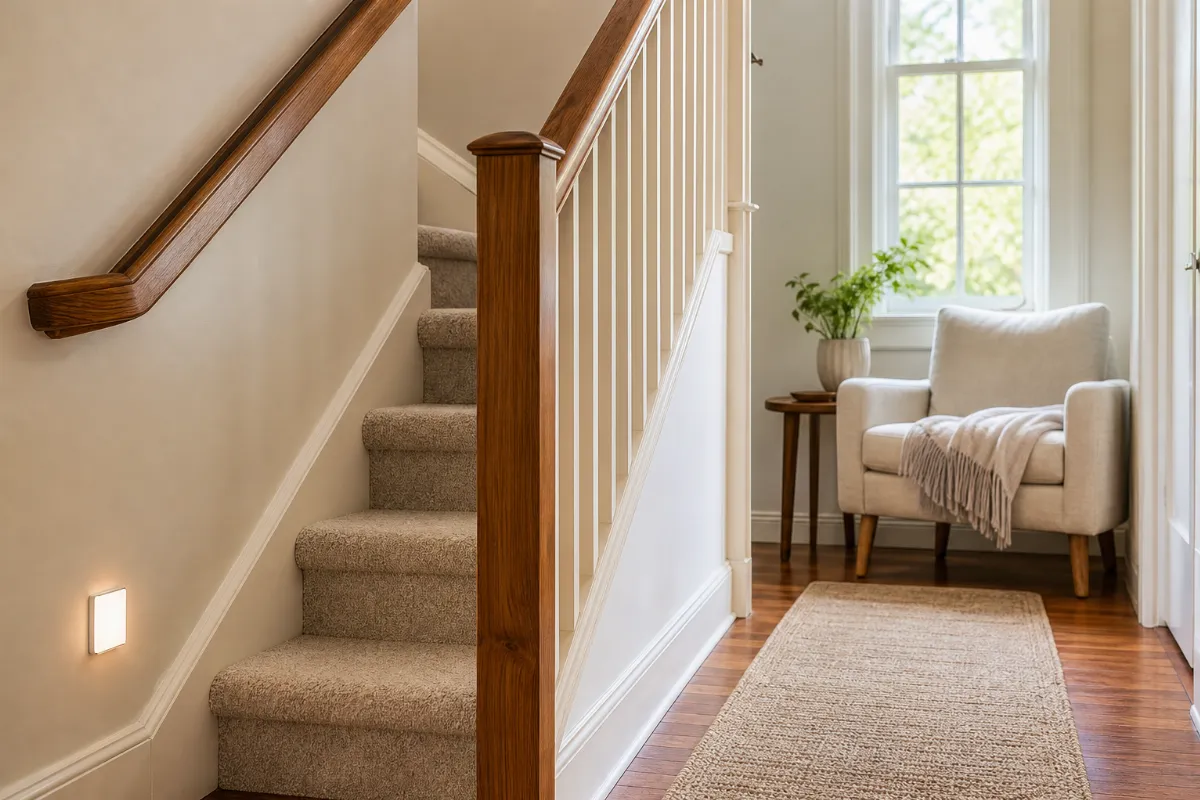
Why it may help: NIA advises good lighting with switches at the top and bottom of stairs and at each end of a long hall, motion-activated plug-in lights for stairwells and pathways, night lights and light switches close to the bed, a bathroom light left on at night or an automatic night light, and a flashlight by the bed in case of power cuts. Outside, it suggests keeping the porch light on after dark. Outside lighting was one of the changes in the New Zealand home-modification trials, but those studies tested packages rather than lighting alone.
How to apply it: Fit switches where you enter and leave a space, add automatic night lights on the route from bed to bathroom, and keep a torch (flashlight) within reach of the bed.
Who it may suit: Anyone who gets up at night or climbs stairs; older adults and people with vision difficulty.
Precautions: Have an electrician fit any new wiring.
1,9Secure handrails on both sides of stairs
Moderate certaintyAddresses: A steadier hold on steps, indoors and out
Why it may help: NIA advises secure handrails on both sides of any stairs, holding them even when carrying something, and not letting what you carry block your view of the steps. The NHS suggests considering safety rails on steps. Handrails for outside steps and internal stairs were among the modifications in the New Zealand trials.
How to apply it: Check that rails are firmly fixed and run the full length of the stairs. Keep stairs clear and well lit, carry things in a shoulder bag, belt bag or backpack so your hands are free, and repair broken or uneven outdoor steps.
Who it may suit: Anyone with stairs or steps at home or at the entrance.
Precautions: Have rails fitted by someone competent, since a rail that is not secure can fail when you rely on it. Your council may fit some rails free after an assessment.
1,3,4,9Grab bars and non-slip surfaces in the bathroom
Moderate certaintyAddresses: More stable getting in and out of the bath, shower and toilet
Why it may help: NIA advises mounting grab bars near toilets and inside and outside the tub and shower, using non-skid mats, strips or carpet on surfaces that may get wet, and leaving a light on at night. The NHS lists a non-slip mat in the bath or shower and grab rails in the bathroom, and its home-adaptations guide lists a bath lift, walk-in shower or grab rail. Grab rails and non-slip bath mats were part of the modification packages in the New Zealand trials.
How to apply it: Have bars fitted securely by someone competent, and place non-slip surfaces where water gathers. Ask an occupational therapist about bath seats, a walk-in shower or a raised toilet seat if getting up and down is hard.
Who it may suit: Older adults; anyone who feels unsteady when wet or standing on one leg.
Precautions: Equipment bought without advice may not suit your height or strength, so use a therapist where you can.
1,4,2,9,10Keep what you use within easy reach, and sit when you can
Low certaintyAddresses: Less reaching, bending and tiring, so fewer risky moves
Why it may help: NIA advises keeping often-used pots, pans and utensils within easy reach, keeping items you use often at waist level, preparing food while seated to prevent fatigue or loss of balance, and checking that sofas and chairs are the right height to get in and out of easily. It advises a reach stick instead of climbing, and a steady step stool with a top handrail and someone beside you if a stool is unavoidable.
How to apply it: Move daily items between hip and shoulder height, put heavy things low but not on the floor, and use a stool to sit while chopping or washing up. Keep a long-handled reach tool where you need it.
Who it may suit: Anyone with joint pain, tiredness, or balance difficulty; carers setting up a home for someone else.
Precautions: This is agency advice rather than something tested in trials we read. If you cannot manage a task safely, ask for help instead of working around it.
1,4Additional options
Ask for a home assessment by an occupational therapist
Moderate certaintyAddresses: A personal check of your home and recommended changes
Why it may help: The NHS says your local council offers a free service that assesses your home and recommends changes, and that an occupational therapist visits, walks around with you and works out what you need together. NIA says that after a fall, a doctor may suggest an occupational therapist, physical therapist or nurse visit to assess your home. In the Cochrane review, home fall-hazard programmes reduced falls in people at higher risk with high-certainty evidence, and an earlier Cochrane review found home safety interventions appeared more effective when delivered by an occupational therapist. A UK pilot trial supports this for high-risk people, but a larger English trial did not find fewer falls.
How to apply it: Ask your GP, your council or your local falls service. Tell the therapist about everything you find hard, even small things such as opening a cupboard, and have a friend or relative with you if that helps. The NHS notes assessments usually take at least an hour.
Who it may suit: Anyone who has fallen, feels at risk, is recovering from illness or surgery, or struggles with daily tasks.
Precautions: Evidence is strongest for people already at higher risk and absent for people not selected for risk. Rules and waiting times for assessments vary by area.
2,1,7,11,12,8Home adaptations, from small to large
Low certaintyAddresses: A home that fits how you move and what you can do
Why it may help: The NHS lists examples including a stairlift or banister, a bath lift, walk-in shower, grab rail, wider doorways, lower kitchen worktops, an outdoor ramp or step rail, and outside lights or door-entry intercoms. It says that, in England, councils should pay for each adaptation costing under 1,000 pounds, such as grab rails, and that larger works may qualify for a Disabled Facilities Grant. In the United States, NIA points to local Area Agency on Aging programmes and home-modification resources.
How to apply it: Start with an assessment, then ask what your local council, health department or Area Agency on Aging can fund or fit. Rules differ by country and area, so check with your own authority.
Who it may suit: People with long-term mobility, balance, vision or memory difficulties, and carers.
Precautions: Cost, eligibility and availability vary. Avoid paying for large works before an independent assessment.
2,1Well-fitting, grippy indoor and outdoor footwear
Low certaintyAddresses: Better grip and support on floors and stairs
Why it may help: NIA advises nonskid, rubber-soled, low-heeled shoes, and not walking on stairs or floors in socks or in shoes and slippers with smooth soles. The NHS advises shoes or slippers that fit well, do not slip off and have a good grip. NIA also lists foot pain and unsafe footwear, such as backless shoes or high heels, as risk factors. The Cochrane review did not pool footwear trials because the interventions varied, so the strength of the evidence is uncertain.
How to apply it: Wear supportive shoes or closed slippers with a grip indoors, and replace worn soles. If foot pain makes this hard, ask a clinician about foot care.
Who it may suit: Almost everyone, especially those with foot pain or unsteadiness.
Precautions: Avoid new footwear styles you are not used to when you are already unsteady, and test them at home first.
3,4,7A way to call for help
Low certaintyAddresses: Faster help if you do fall or become unwell
Why it may help: The NHS advises wearing a personal alarm or carrying a mobile phone, and describes using an alarm or phone, shouting or banging on a wall or floor, keeping warm and changing position about every 30 minutes if you cannot get up. NIA suggests a phone near the bed, large-print emergency numbers, an emergency response system with a button on a necklace or bracelet, a smart home device or a smartwatch that can call for help, and notes there is usually a fee for response systems. These tools help get help sooner; they do not prevent falls.
How to apply it: Keep a charged phone or alarm on your body as you move around the house, save emergency contacts as favourites, and agree a check-in routine with family or a neighbour.
Who it may suit: People living alone, people with a history of falls, and carers.
Precautions: Fall detection on devices is not guaranteed to pick up every fall; keep a phone or alarm within reach as well.
4,1Smoke alarms, a fire escape plan and safer cooking
Low certaintyAddresses: Earlier warning of fire and less risk in the kitchen
Why it may help: MedlinePlus says that in the United States cooking is the main cause of home fires and cigarettes the leading cause of fire deaths. It advises not leaving the stove or oven unattended when on, not smoking in bed, keeping electrical appliances and cords in good condition, working smoke detectors on every floor and in every bedroom, fire extinguishers on every floor and in the kitchen, and a practised escape plan in case the main exit is blocked.
How to apply it: Fit and regularly test alarms, keep clear routes to exits and never leave cooking unattended.
Who it may suit: Every household, especially people who cook often, smoke, or may move slowly.
Precautions: Fire services and rules differ by country; follow local guidance for alarm types and extinguishers.
5A carbon monoxide alarm and serviced heating and cooking appliances
Moderate certaintyAddresses: Protection from an invisible, odourless gas
Why it may help: The NHS says carbon monoxide is colourless and odourless and can be made by faulty or poorly maintained gas boilers, gas cookers, gas or paraffin heaters, and wood, gas and coal fires, as well as portable generators. It advises an alarm in each room containing gas, oil, coal or wood burning appliances, having appliances properly installed and regularly serviced by a qualified registered engineer, and keeping rooms ventilated and chimneys and flues clean.
How to apply it: Fit alarms, book annual servicing with a qualified engineer, keep vents clear and do not use barbecues, camping stoves or engines in enclosed spaces. If you suspect a leak from a gas appliance, the NHS gives the UK National Gas Helpline as 0800 111 999.
Who it may suit: Every home with fuel-burning appliances, including rented homes and holiday lets.
Precautions: Alarms do not replace servicing. Treat symptoms (headache, dizziness, sickness, weakness, confusion, breathlessness) that ease when you go outside as urgent.
6Still being studied
Bundled home modifications in lower-income households
Moderate certaintyAddresses: Fewer medically treated fall injuries at home
Why it may help: A cluster-randomised trial in New Zealand (842 households) added handrails, grab rails, outside lighting, step edging and slip-resistant surfaces. The crude difference in fall injuries was not statistically significant (relative rate 0.86, 95% CI 0.66 to 1.12), but an adjusted analysis estimated a 26% reduction (relative rate 0.74, 95% CI 0.58 to 0.94). A later trial in houses with Maori occupants estimated a 31% reduction after adjustment (relative rate 0.69, 95% CI 0.47 to 1.00), right at the edge of statistical significance.
How to apply it: Results come from fitted packages of low-cost changes, not from a single product.
Who it may suit: Households with older homes or limited means; useful as context for local programmes.
Precautions: Adjusted results can be less certain than the original comparison, and the trials were not blinded to the participants.
9,10Occupational therapist home assessments: trials disagree
Mixed findingsAddresses: Fewer falls in people already at risk
Why it may help: A pilot randomised trial of 238 community-dwelling adults aged 70 and over with a fall in the past year found fewer falls with an occupational therapist assessment (incidence rate ratio 0.54, 95% CI 0.36 to 0.83) but not with trained non-professional assessors, and no effect on fear of falling. A larger pragmatic English trial (1,331 people aged 65 and over at risk of falling) found weak evidence of more falls with the assessment (adjusted incidence rate ratio 1.17, 95% CI 0.99 to 1.38) and no difference in other outcomes.
How to apply it: Treat an assessment as a way to get personal advice and equipment, not as a proven fall-prevention treatment on its own.
Who it may suit: People at higher risk who want tailored advice.
Precautions: Recommendations only help if they are actually carried out; follow-up on adaptations and equipment matters.
12,8Vision improvement as a home-safety step
Low certaintyAddresses: Possibly fewer falls
Why it may help: The Cochrane review of environmental interventions found vision-improvement interventions may make little or no difference to the rate of falls (low-certainty evidence), and could not say whether advice about changing glasses helps. An earlier Cochrane review reported that one trial of an intervention to treat vision problems increased the rate of falls. NIA still advises regular eye and hearing checks and taking time to get used to new glasses or lenses.
How to apply it: Keep up eye tests and follow your eye doctor's advice about wearing new lenses; adjust slowly to new prescriptions, especially on stairs.
Who it may suit: Anyone with changing vision.
Precautions: Do not skip eye checks because of this finding; vision matters for many reasons. Sudden vision loss needs urgent care.
7,11,3Emergency response systems and fall-detecting devices
Not enough evidenceAddresses: Quicker help after a fall
Why it may help: NIA describes alarm buttons, smart speakers and smartwatches (some of which can detect fall-like movements and call for help), and the NHS recommends carrying an alarm or phone. We did not find trial evidence in the sources read showing that they prevent falls or improve outcomes after a fall.
How to apply it: Choose a system that you will actually wear and that someone will respond to.
Who it may suit: People who live alone or spend time alone at home.
Precautions: Fees apply to monitored systems and are usually not covered by insurance (per NIA). Detection is not perfect.
1,4Food & nutrition
Eating and drinking well enough to stay steady
The NHS says that not eating and drinking enough can make you feel lightheaded or faint, which raises the chance of a fall, and advises eating well and staying hydrated. It also advises looking after bone health with foods containing calcium and getting enough vitamin D.
NIA and the NHS both advise limiting alcohol, since too much can cause balance problems and falls. These are habit tips from health agencies rather than treatments for home safety, and food does not replace practical changes to the home.
4,3Making the kitchen safer and easier
Food preparation is where reach, balance, heat and fatigue meet. The sources read focus on reducing effort and risk rather than on particular foods.
Prepare food seated and keep staples within reach
Low certaintyAddresses: Less fatigue and fewer awkward reaches while cooking
Why it may help: NIA advises keeping frequently used pots, pans and utensils within easy reach and preparing food while seated to prevent fatigue or loss of balance.
How to apply it: Use a sturdy, stable stool or chair at the worktop, store daily items between hip and shoulder height, and cook in smaller batches if lifting heavy pans is hard.
Who it may suit: Anyone who tires or feels unsteady when standing to cook.
Precautions: Do not use a chair that can slide or tip. Ask an occupational therapist about kitchen height and equipment if tasks remain difficult.
1Stay with the stove, and mind pot sizes on gas hobs
Low certaintyAddresses: Lower risk of kitchen fires and gas build-up
Why it may help: MedlinePlus says to stay with a stove or oven that is on, and the NHS advises against oversized pots that cover more than one gas ring because of the carbon monoxide risk.
How to apply it: Set a timer, turn off heat before leaving the room, and choose pots that fit the ring.
Who it may suit: Everyone who cooks, especially if memory or attention is a concern.
Precautions: If forgetting the cooker is becoming a pattern, tell a doctor or see the memory page.
5,6Ask about help with shopping and meals when carrying is a problem
Low certaintyAddresses: Fewer heavy loads and icy trips
Why it may help: NIA suggests that in bad weather some community services deliver prescriptions and groceries, including by phone order.
How to apply it: Ask your council, a community group or family about delivery or meal services.
Who it may suit: People who find shopping or carrying difficult or unsafe in poor weather.
Precautions: Service availability varies by area; keep a food stock in case of delays.
3Remedies & supplements
Traditional use, laboratory findings and human trials are kept apart. "Natural" does not mean safe.
Vitamin D
Mixed findingsStudied form and route: Oral supplement; also made in the skin with sunlight and found in some foods
Intended outcome: Fewer falls
Human evidence: The 2012 Cochrane review found overall that vitamin D did not reduce the rate of falls or risk of falling, but may help people with lower vitamin D levels before treatment. In the VITAL trial of 25,871 adults aged 50 and over (mean age 67), 2,000 IU a day of vitamin D3 for a median of 5.3 years did not change the number of people with two or more falls or falls leading to a doctor or hospital visit, and the authors said it should not be used for primary prevention of falls in generally healthy adults.
Limits: These trials were not mainly in people who were deficient, housebound or in care homes. The NHS still advises getting enough vitamin D for bone health.
Interactions and precautions: Too much vitamin D can be harmful; ask a clinician or pharmacist before taking supplements, especially with kidney disease, high calcium or other medicines. Pregnancy and breastfeeding need individual advice.
11,13,4Sleep aids, sedating herbs and alcohol before bed
Not enough evidenceStudied form and route: Pharmacy or online sleep products, herbal or supplement blends, and alcohol
Intended outcome: Not used for home safety, but relevant because drowsiness raises risk when moving around at night
Human evidence: We did not find a trial in the sources read testing these for home safety. NIA says some medicines raise falls risk by causing dizziness or confusion, that the more medicines you take the more likely you are to fall, and that too much alcohol can lead to balance problems and falls.
Limits: Being sleepy or dizzy when you get up at night makes a hazard worse, whatever the cause.
Interactions and precautions: Ask a pharmacist or doctor before adding any sleep product, especially if you take medicines or have had a fall. Do not stop a prescribed medicine yourself; ask your prescriber or pharmacist to review it.
3Review medicines and supplements safely → Medicine interactions →
Calcium and bone-health nutrients
Not enough evidenceStudied form and route: Foods containing calcium, and supplements only where advised
Intended outcome: Stronger bones, so a fall is less likely to cause a fracture
Human evidence: The NHS advises eating foods containing calcium and getting enough vitamin D to look after bone health as part of preventing falls. We did not read a trial showing that these change the number of falls, and this page does not give amounts.
Limits: Bone health matters for the harm a fall can do, not for the chance of tripping.
Interactions and precautions: Calcium supplements are not right for everyone, for example with kidney stones or kidney disease. Ask a clinician; do not stop prescribed bone medicines.
4Osteoporosis and bone health → Supplements for healthy aging →
Therapies & care
Established professional help includes a falls service or GP check, an occupational therapist home assessment, physiotherapy for strength and balance, and eye, hearing and medicines reviews. This page does not recommend medicines or doses, and you should not stop a prescribed medicine on your own.
Home assessment by an occupational therapist
Moderate certaintyAssessment and equipment advice A therapist visits, asks what is difficult and recommends changes, equipment or adaptations. The NHS says councils offer this free of charge in England. In trials the results are mixed: home fall-hazard programmes reduced falls in people at higher risk (Cochrane, high-certainty), a pilot trial favoured therapists over non-professional assessors, and a larger English trial found no reduction.
Who it may suit: Anyone who has fallen, is at higher risk, is leaving hospital, or finds daily tasks hard.
Precautions: Recommendations only help if they are carried out. Rules and waiting times vary by area.
2,7,12,8Falls service and GP review
Moderate certaintyMedical assessment The NHS says a GP or falls service can check balance, muscle weakness, bone strength and eyesight, offer strength and balance training, check that your home is safe and arrange adaptations, and review medicines. You may be able to self-refer after a fall.
Who it may suit: Anyone who has fallen or is worried about balance or mobility.
Precautions: Tell the clinician about every fall, even without injury, and about all medicines and supplements you use.
4,11Strength and balance training
Moderate certaintyExercise therapy In the 2012 Cochrane review, multiple-component group and home-based exercise reduced the rate of falls, and Tai Chi reduced the risk of falling. The NHS recommends strength and balance activities at least twice a week, and NIA notes yoga, Pilates and tai chi can improve balance and strength. A safer home and stronger body work together.
Who it may suit: Most older adults, with advice if you have health conditions, a recent fall, or have been inactive.
Precautions: Start gently and near something stable; ask a clinician or physiotherapist first if you have heart disease, joint problems, osteoporosis or recent injury.
11,4,3Improve Your Balance → Strength training and protein for older adults →
Walking aids and mobility equipment
Low certaintyAssistive devices NIA says canes and walkers can help prevent falls when used correctly, must be the right size, and that a physical or occupational therapist can help you choose and learn to use them. The Cochrane review did not pool trials of footwear and self-care or assistive devices because they varied.
Who it may suit: People who feel unsteady when walking or whose clinician has recommended an aid.
Precautions: Do not use borrowed equipment without checking it, and take extra care on uneven or unfamiliar ground.
3,7Eye, hearing and medicines reviews
Moderate certaintyClinical checks NIA and the NHS advise regular eye tests, ear and hearing checks and a review of medicines that might affect balance, since small changes in sight and hearing are linked to more falls. Treat these as part of the whole-home picture rather than as a stand-alone fix for hazards.
Who it may suit: Everyone, especially older adults taking several medicines.
Precautions: Never stop or change a prescribed medicine on your own; ask the prescriber or pharmacist for a review.
3,4Hearing and vision changes → Medicines, supplements and older adults →
Care needs assessment and community support
Low certaintySocial care The NHS says anyone worried about falls can ask their local council for a free care needs assessment, which can include changes to make the home safer. NIA points to local Area Agency on Aging programmes in the United States.
Who it may suit: People who need help at home, and their carers.
Precautions: Availability, eligibility and cost vary by country and area.
4,1What to avoid
Habits, products and claims that can get in the way. Never stop a prescribed medicine without talking to the professional who prescribed it.
Risks that apply to most people
Throw rugs, loose carpets, clutter and cords across walkways
Moderate certaintyWhy: NIA advises not using throw rugs or small area rugs, fixing carpets firmly, keeping walking areas tidy and keeping cords near walls. The NHS lists clutter, loose wires and rugs as things to avoid.
Who it applies to: Everyone, especially older adults, people with vision difficulty, and anyone using a walker or cane.
Try instead: Remove the rug or fix it firmly to the floor, use no-slip strips on tile and wood, and route cords along walls.
1,4,7Standing on a chair, table or unsteady stool
Low certaintyWhy: NIA advises against standing on a chair or table to reach high items and recommends a reach stick or asking for help; if a step stool is used, it should be steady, have a top handrail, and someone should stand beside you.
Who it applies to: Anyone reaching for shelves, curtains, bulbs or smoke alarm batteries.
Try instead: Move items to waist level, use a reach stick, or ask a family member, neighbour or handyperson.
1,4Walking on stairs or smooth floors in socks or smooth-soled slippers
Low certaintyWhy: NIA advises against walking on stairs or floors in socks or in shoes and slippers with smooth soles and recommends nonskid, rubber-soled, low-heeled shoes.
Who it applies to: Anyone at home, especially at night and on stairs.
Try instead: Wear supportive footwear with a grip indoors, and keep a pair by the bed.
3,4Leaving cooking unattended, or smoking in bed
Moderate certaintyWhy: MedlinePlus says cooking is the main cause of home fires in the United States and cigarettes the leading cause of fire deaths, and advises not leaving the stove or oven unattended and not smoking in bed.
Who it applies to: Everyone who cooks or smokes; higher risk if you are easily distracted, tired, or have memory difficulties.
Try instead: Use a timer, stay in the kitchen while the hob or oven is on, and never smoke when drowsy or in bed.
5Using barbecues, camping stoves, generators or running engines in enclosed spaces
Moderate certaintyWhy: The NHS lists these as causes of carbon monoxide build-up and advises against using a barbecue or camping stove indoors or in a tent, or leaving vehicles or other engines on in enclosed spaces such as a garage.
Who it applies to: Everyone, particularly during power cuts and cold weather.
Try instead: Keep fuel-burning equipment outdoors and well away from windows and doors, and use only equipment designed for indoor use.
6Personal triggers to check
Wet and freshly washed floors, spills and wet bathroom surfaces
Low certaintyWhy: NIA advises not walking on slippery, newly washed floors, cleaning up spills immediately, and using non-skid mats, strips or carpet on surfaces that may get wet.
Who it applies to: Kitchens, bathrooms, entrances in wet weather.
Try instead: Mop in sections and let floors dry before use, wipe spills straight away, and keep non-slip surfaces in wet areas.
1Night-time trips to the bathroom in the dark
Low certaintyWhy: NIA lists rushed movement to the bathroom, such as with incontinence, as a fall risk and advises night lights, switches close to the bed and a light left on in the bathroom. If you are tired, NIA says you are more likely to fall.
Who it applies to: Anyone who wakes at night, especially older adults and those who feel urgency.
Try instead: Light the route, and ask a clinician about frequent night-time urination or urgency.
3,1Icy steps and walkways, and winter weather
Low certaintyWhy: NIA advises taking extra caution on wet or icy surfaces, using an ice melt product or sand by doors and walkways, adding non-slip material to outdoor stairs, and considering staying in when the weather is bad, perhaps using delivery services.
Who it applies to: People in cold climates, and anyone with balance difficulty.
Try instead: Clear and treat entrances early, wear shoes with grip, and ask a neighbour or service for deliveries on icy days.
1,3Carrying loads on the stairs, or going up and down with full hands
Low certaintyWhy: NIA advises holding the handrail even when carrying something, not letting what you carry block your view of the steps, and using a shoulder bag, belt bag or backpack to leave your hands free.
Who it applies to: Laundry, shopping, trays and anything bulky.
Try instead: Make smaller trips, use a bag that leaves your hands free, and keep one hand on the rail.
1,3Products that need caution
Backless shoes, high heels and smooth-soled slippers
Low certaintyWhy: NIA lists unsafe footwear such as backless shoes or high heels as a falls risk factor and recommends nonskid, rubber-soled, low-heeled shoes. The NHS advises shoes or slippers that fit well and do not slip off.
Who it applies to: Indoor and outdoor use.
Try instead: Choose supportive, closed, well-fitting footwear with a grip, even at home.
3,4Borrowed or wrongly sized walkers and canes
Low certaintyWhy: NIA says a cane or walker should be the right size for you, wheels should roll smoothly, and borrowed equipment should be checked by a health care provider; a physical or occupational therapist can help you choose and use a device.
Who it applies to: Anyone using a walking aid, particularly in unfamiliar or uneven places.
Try instead: Have a therapist or clinician fit and check the equipment and teach you to use it.
3Gas, oil, coal or wood appliances that are faulty, unserviced or badly installed
Moderate certaintyWhy: The NHS says common household appliances used for heating and cooking can produce carbon monoxide if they are not installed properly, are faulty or are poorly maintained. It also advises against oversized cooking pots that cover more than one gas ring.
Who it applies to: Homes with boilers, gas cookers, gas or paraffin heaters, wood or coal fires.
Try instead: Use a qualified, registered engineer for installation and regular servicing, and fit carbon monoxide alarms.
6Unsupported claims
"Make your home safe once and you cannot fall"
High certaintyWhy: Even in the Cochrane review, home fall-hazard programmes probably cut the rate of falls by about a quarter overall and by about 38% in people at higher risk. That is a useful reduction, not elimination, and falls have many other causes such as strength, balance, vision and medicines.
Who it applies to: Product marketing and well-meant reassurance.
Try instead: Combine home changes with activity, strength and balance work, eye and hearing checks, and a medicines review.
7,3"A checklist or leaflet is enough"
Low certaintyWhy: The Cochrane review was uncertain whether education to reduce home hazards reduces falls (very low-certainty evidence), and found no reduction in falls when hazard programmes were given to people who had not been selected for risk.
Who it applies to: Generic checklists handed out without assessment or follow-through.
Try instead: Use checklists to start a conversation, then make the actual changes and ask for a personal assessment if you are at higher risk.
7"A personal alarm or smartwatch will keep you from falling"
Not enough evidenceWhy: Alarms and devices are designed to summon help. NIA and the NHS present them as ways to get help, and we found no trial evidence in the sources read that they prevent falls.
Who it applies to: Advertising for alarms and wearable devices.
Try instead: Treat devices as a safety net alongside, not instead of, the practical home changes and fall-prevention activity.
1,4Common mistakes
Waiting for a serious fall before changing anything
Moderate certaintyWhy: The NHS advises seeing a GP if you are worried about your balance or mobility or have had a fall, and the Cochrane review found the clearest benefit of home fall-hazard programmes in people at higher risk.
Who it applies to: People who have had near-misses, increasing unsteadiness or difficulty with daily tasks.
Try instead: Act early on near-misses: ask for an assessment, tidy and light the home, and review medicines and eyesight.
4,7Planning changes without the person who lives there
Low certaintyWhy: The NHS notes that assessments work best when you tell the therapist everything you find difficult, even small things such as opening a cupboard, and that you can have a friend, relative or advocate with you. Changes that do not match how someone actually uses a home are easy to ignore.
Who it applies to: Carers, family members and builders making changes for someone else.
Try instead: Walk through the home together, ask what feels hard, and try changes before committing to larger works.
2Cutting back on activity because of fear of falling
Moderate certaintyWhy: NIA says fear of falling can lead people to avoid walking, shopping or social activities, but staying active helps to prevent falls.
Who it applies to: People who have fallen or worry about falling.
Try instead: Make the home safer so you can keep moving, and ask about confidence-building activity and support.
3Fitting a carbon monoxide alarm but skipping servicing
Moderate certaintyWhy: The NHS advises both an alarm and properly installed, regularly serviced appliances, with ventilation and clean chimneys and flues. An alarm warns after gas is present; servicing helps prevent it.
Who it applies to: Homes with gas, oil, coal or wood appliances.
Try instead: Do both: fit alarms in the right rooms and book regular servicing by a registered engineer.
6Evidence & safety
What the research shows
Health agencies agree on the basic home steps: remove tripping hazards, light the home, fit rails and grab bars, use non-slip surfaces, wear grippy footwear, keep things within reach, and have smoke and carbon monoxide protection. The best research evidence is a Cochrane review of 22 trials showing that home fall-hazard programmes probably reduce the rate of falls, with the clearest benefit in people at higher risk of falling and no benefit when offered to people not selected for risk. Trials of occupational therapist assessments disagree, and we found no trial evidence that alarms or smart devices prevent falls.
Limits of the evidence
- Most trials tested packages of changes, so we cannot say which single item (rail, light, mat) does the work.
- Several trials had a high or unclear risk of bias, and participants and staff could not be blinded to home changes.
- Most of the research is in older adults living at home in high-income countries; there is little on apartments, rented homes or care settings.
- We did not find trial evidence for lighting alone, footwear, alarms, fall-detecting devices, smoke alarms or carbon monoxide alarms in the sources read; those steps rest on agency advice.
- Some agency advice is specific to a country, for example council services in England or Area Agency on Aging programmes in the United States.
Precautions and interactions
- Do not stop or change a prescribed medicine on your own because of dizziness or unsteadiness; ask your prescriber or pharmacist.
- Vitamin D and other supplements should be discussed with a clinician or pharmacist, especially if you take medicines or have kidney problems.
- Equipment such as grab bars, walkers and stairlifts should be fitted and fitted-to-you by competent people.
- Treat burns and scalds by holding them under cool running water for 20 minutes, within 3 hours, and do not put creams, oils or butter on them; the NHS says to call 999 or go to A&E for a burn or scald that is very large or deep, on the face, genitals or bottom, or caused by chemicals or electricity.
Life-stage considerations
- Older adults: highest benefit from home changes when already at higher risk; a fall with a possible head injury needs emergency care.
- People with dementia or memory problems: get advice from a clinician or occupational therapist about safe cooking, doors and night-time routes; do not rely on checklists alone.
- Carers: involve the person living in the home and ask for professional assessment before large works.
- Pregnancy and children: tidy walkways, fire and carbon monoxide safety apply to every household; get age-specific child safety advice from your health professional.
Warning signs
- A fall with possible injury to the head, back, neck or hip, or being unable to get up: call the emergency number (999 in the UK, per the NHS).
- Headache, dizziness, nausea, weakness, confusion or breathlessness that improves when you leave the building: possible carbon monoxide poisoning. Go outside, do not return until you have advice, and call 111 or 999 as the NHS describes.
- Repeated near-falls, new unsteadiness, or difficulty with daily tasks.
- Sudden confusion, or sudden loss of vision or hearing: seek urgent medical advice.
- A burn or scald that is very large or deep, on the face, genitals or bottom, or caused by chemicals or electricity: emergency care.
Claim checks
A safer home means you will not fall
High certaintyHome fall-hazard programmes probably reduce the rate of falls by about 26% overall and about 38% in people at higher risk (Cochrane review); they do not remove the risk. Falls also depend on strength, balance, vision, medicines and health conditions.
7,3Every older person needs a full home assessment
Mixed findingsThe Cochrane review found no reduction in falls when hazard programmes were given to people not selected for fall risk, and a large English trial of therapist assessments in at-risk people found no reduction. An assessment is most useful for those who have fallen, are at higher risk, or find daily tasks hard.
7,8,12Vitamin D supplements prevent falls
Mixed findingsThe Cochrane review found no overall reduction, and the VITAL trial found none in generally healthy adults; benefit is possible only in people with low levels, which a clinician can check.
11,13A personal alarm or smart device prevents falls
Not enough evidenceAlarms and wearables are designed to call for help. We did not find trial evidence in the sources read that they prevent falls.
1,4Smoke alarms make carbon monoxide alarms unnecessary
Moderate certaintyCarbon monoxide is colourless and odourless, and the NHS advises a dedicated carbon monoxide alarm in each room with a fuel-burning appliance, plus regular servicing. Smoke detection is a separate protection recommended by MedlinePlus.
6,5Questions people ask
Where do most falls at home happen?
NIA notes that many falls happen at home, and its room-by-room guide covers stairs and halls, bathrooms, bedrooms, kitchens, outdoor spaces and living areas. The sources we read did not give an official ranking of rooms, so start where you move most and feel least steady.
Do home changes really reduce falls?
A Cochrane review of 22 trials found that home fall-hazard programmes probably reduce the rate of falls by about 26% overall, and by about 38% in people at higher risk. It found no reduction in people who had not been selected for fall risk.
What is the single most useful change?
The trials tested packages of changes, so no single item is proven to be the most useful. Clearing walkways, good lighting, secure stair rails and bathroom grab bars and non-slip surfaces are the steps most often recommended by NIA and the NHS.
How do I get a home assessment?
In England, the NHS says to ask your local council for an assessment for equipment or home adaptations, which is free and carried out by an occupational therapist. You can also ask your GP or a falls service. In the United States, NIA suggests contacting your local health department or Area Agency on Aging.
Who pays for grab rails and other adaptations?
The NHS says that in England councils should pay for each adaptation costing under 1,000 pounds, such as grab rails or lights at the front door, and that a Disabled Facilities Grant may help with larger adaptations. Rules differ elsewhere, so check with your own council or local agency.
Do I need a carbon monoxide alarm as well as a smoke alarm?
Yes if you have gas, oil, coal or wood appliances. The NHS says carbon monoxide has no colour or smell and advises one alarm in each room containing such an appliance, as well as regular servicing. MedlinePlus advises working smoke detectors on every floor and in every bedroom.
What should I do if I fall and cannot get up?
The NHS advises using a phone or alarm you can reach, otherwise calling out or banging on a wall or floor, keeping warm and changing position about every 30 minutes. It advises calling 999 if you may have injured your head, back, neck or hip or cannot get up.
Are personal alarms and smartwatches worth it?
They can help you get help sooner, and NIA lists several options, noting that monitored systems usually carry a fee. We did not find trial evidence that they prevent falls, so use them alongside, not instead of, a safer home.
Should I take vitamin D to avoid falling?
The Cochrane review found no overall effect on falls, and the VITAL trial found none in generally healthy adults, though people with low levels may benefit. Ask a clinician whether you need a test, and do not take large amounts without advice.
I am afraid of falling and have started staying in. Is that wise?
NIA says fear of falling can lead people to avoid activities, but staying active helps prevent falls. Make the home safer so that you can keep moving, and talk to your GP or a physiotherapist if fear is limiting you.
How can I help a parent make their home safer without taking over?
Walk through the home together, ask what feels difficult, and agree changes. The NHS notes that assessments work best when the person says everything they find hard, even small things, and that a friend, relative or advocate can come along.
References
- National Institute on Aging. Preventing Falls at Home: Room by Room. Read 2026-11-01. source
- NHS. Home adaptations, Social care and support guide (page last reviewed 12 December 2025). Read 2026-11-01. source
- National Institute on Aging. Falls and Fractures in Older Adults: Causes and Prevention. Read 2026-11-01. source
- NHS. Falls (page last reviewed 6 March 2025). Read 2026-11-01. source
- MedlinePlus. Fire Safety. Read 2026-11-01. source
- NHS. Carbon monoxide poisoning (page last reviewed 16 December 2025). Read 2026-11-01. source
- Clemson L, et al. Environmental interventions for preventing falls in older people living in the community. Cochrane Database Syst Rev. 2023. PMID 36893804. source
- Cockayne S, et al. Home environmental assessments and modification delivered by occupational therapists to reduce falls in people aged 65 years and over at risk of falling: the PROFET modified cohort randomised controlled trial. Health Technol Assess. 2021. PMID 34254934. source
- Keall MD, et al. Home modifications to reduce injuries from falls in the Home Injury Prevention Intervention (HIPI) study: a cluster-randomised controlled trial. Lancet. 2015. PMID 25255696. source
- Keall MD, et al. Home modifications to prevent home fall injuries in houses with Maori occupants (MHIPI): a randomised controlled trial. Lancet Public Health. 2021. PMID 34371005. source
- Gillespie LD, et al. Interventions for preventing falls in older people living in the community. Cochrane Database Syst Rev. 2012. PMID 22972103. source
- Pighills AC, et al. Environmental assessment and modification to prevent falls in older people. J Am Geriatr Soc. 2011. PMID 21226674. source
- LeBoff MS, et al. VITamin D and OmegA-3 TriaL (VITAL): Effects of Vitamin D Supplements on Risk of Falls in the US Population. J Clin Endocrinol Metab. 2020. PMID 32492153. source
Related on AlternativeMed
Related goals
Maintain Your Everyday Independence → Reduce Your Risk of Falls → Improve Your Balance → Maintain Your Vision Health → Review Medicines & Supplements Safely → Feel More Confident Moving → Walk More Comfortably → Reduce Sleep Disruption From Nighttime Urination →
Ingredients, foods and supplements
Research, safety and claim-check resources
Healthy Aging: warning signs and when to get help → Healthy Aging research and evidence → Supplements for healthy aging → Hearing and vision changes → Strength training and protein for older adults → Natural remedy safety: older adults → Medicine interactions →