Honey & Bee Products · Honey (toxic)
Mad Honey (Grayanotoxin Honey)
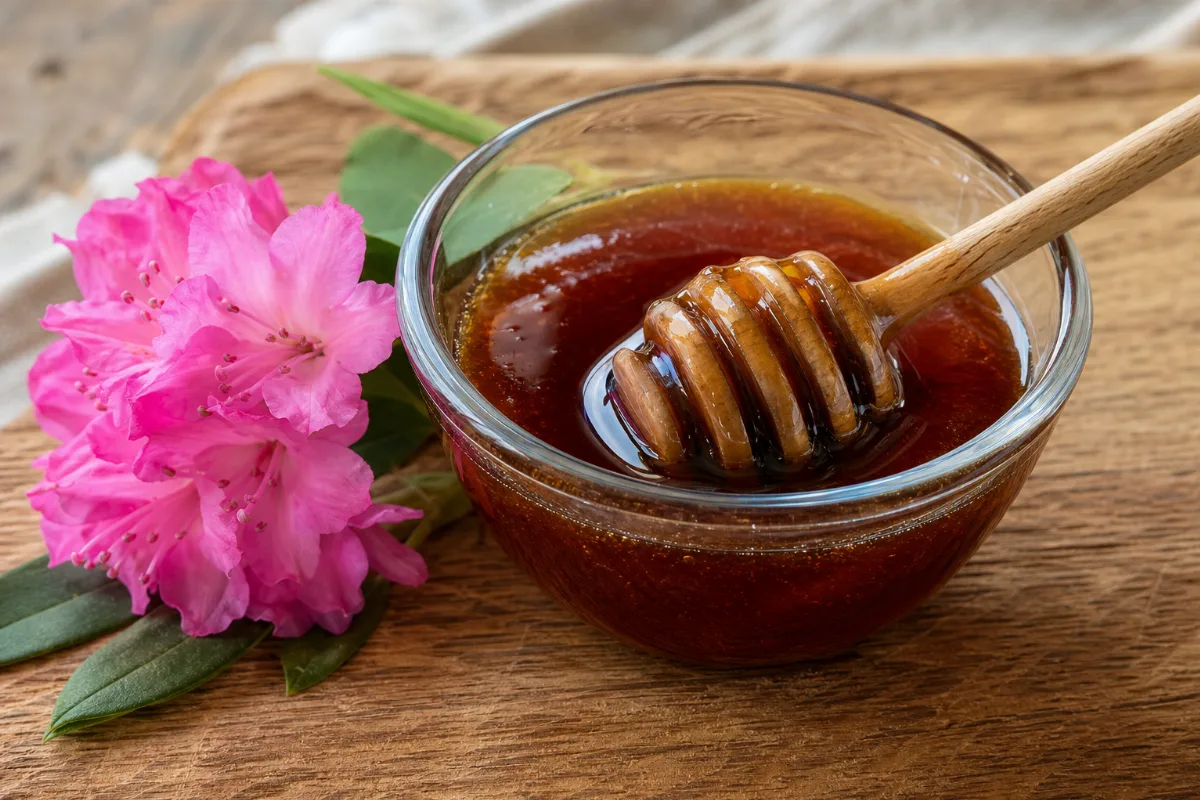
Honey from Rhododendron and other Ericaceae nectar containing grayanotoxins · also called Mad honey, grayanotoxin honey, Rhododendron honey, wild honey (Nepal)
Mad honey is honey that contains grayanotoxins, natural poisons from Rhododendron and related plants. In case series from Turkey and Nepal it caused fainting, a very slow heart rate and low blood pressure, and some people had heart block. Most recovered with hospital treatment. No trial shows it helps blood pressure or anything else. If you feel unwell after eating wild honey, get emergency help.
General information, not medical advice. Last substantive update · Not medically reviewed. A named clinician has not signed off on this page. How this page is made
About Mad Honey (Grayanotoxin Honey)
Mad honey is honey made by bees from the nectar of Rhododendron and other plants in the heath family. It can contain grayanotoxins. Poisoning causes dizziness, vomiting, fainting, very low blood pressure and a very slow heart rate, sometimes with heart block. Most people in the case series recovered with hospital treatment. No controlled study shows a benefit. We give no amounts and no advice on obtaining it.
What it is
Mad honey is honey that contains grayanotoxins, toxins made by plants in the heath family such as Rhododendron. Bees carry them into honey. The toxins keep nerve sodium channels open and raise vagal tone, which slows the heart and lowers blood pressure.
Cases are described from the eastern Black Sea region of Turkey and from Nepal, where the honey comes from Himalayan cliff bees (Apis laboriosa). Cases have also been reported in Qatar, the UK and the USA. A jar cannot show how much toxin it contains.
What the research shows
The research is about poisoning. It is case reports, case series and reviews. A Nepal review of about 68 cases found slow heart rate and low blood pressure in nearly every case and no recorded deaths.
The European Food Safety Authority judged the health risk from certain Ericaceae honey and found a concern for acute poisoning. It found chromosomal damage in mice and could not set a long-term safety level.
No trial shows mad honey helps blood pressure, diabetes, stomach problems or sexual function. A review says scientific evidence for medicinal properties is scarce and such use may even be harmful.
Quality and the market
Reviews say the honey is sold online to buyers far from where it is made, who may not know the risks. Hospitals in Nepal cannot test for the toxin, so diagnosis relies on the story and symptoms.
EU alert records have found undeclared erection drugs (sildenafil and tadalafil) in honey products. This was found for honey products in general, not shown for mad honey itself.
At a glance
Traditional uses history, not proof
- A 2025 review says mad honey has been used for centuries in Nepal and Turkey for high blood pressure, diabetes and stomach problems.
- A Nepal review says patients are mostly middle-aged men treating high blood pressure or sexual problems, and that it is eaten for perceived psychoactive effects.
Studied for research
- Poisoning: slow heart rate, low blood pressure, fainting, heart block (case series; documented harm)
- High blood pressure self-treatment: insufficient
- Sexual stimulant: insufficient
- Diabetes and stomach problems (traditional): insufficient
- Recreational use: insufficient
Main compounds
- Grayanotoxin I and III, plant toxins that act on sodium channels
- Related grayananes found with them in the honey
Common forms
- Honey from Rhododendron or other Ericaceae nectar, sold as wild or mad honey
- Honey in comb or jars, sometimes sold online (a jar cannot show its toxin level)
Research links: EFSA: grayanotoxins in certain honey (abstract) · Cardiac effects of mad honey, 42 patients (abstract) · Clinical review of mad honey poisoning (abstract) · Mad honey poisoning in Nepal (abstract) · Poison Help (US) · Research Library · Genes & Biomarkers Library
What it is and its history
- Accepted scientific name
- Mad honey (honey containing grayanotoxins)
- Naming authority
- Source plants: Rhododendron L. (GBIF accepted genus, family Ericaceae); bee in Nepal: Apis laboriosa Smith, 1871 (GBIF accepted)
- Synonyms
- Grayanotoxin honey; Rhododendron honey; Wild honey (Nepal); Deli bal (Turkish; not found in a source read)
- Common names
- Mad honey (English); Grayanotoxin honey (English); Rhododendron honey (English); Wild honey (Nepal) (English)
- Family or group
- Source plants: Ericaceae (heath family). The honey is made by bees, not a plant.
- Classification
- Plantae (source plants) > Tracheophyta > Magnoliopsida > Ericales > Ericaceae > Rhododendron > Several; a review lists Rhododendron, Pieris, Agarista and Kalmia as grayanotoxin-containing genera
- Native range
- Cases described from the eastern Black Sea region of Turkey and mid-Himalayan Nepal; reviews also mention India and Bhutan. Rhododendron species named in the abstracts are not specified.
- Habitat
- Mountain Rhododendron forests (as the Nepal review describes the ecology).
- What it looks like
- Leaves: Rhododendron leaves also contain grayanotoxins (review).; Flowers: Nectar and pollen from Ericaceae flowers are the source.
- Harvest and processing
- A Nepal review describes harvest from wild Himalayan cliff-bee (Apis laboriosa) colonies in spring; we give no how-to.
- Look-alikes and adulterants
- Name: Ordinary honey; Note: A jar cannot show whether it holds grayanotoxins; diagnosis in Nepal is clinical because no hospital there can test for the toxin.; Name: Honey products sold for sexual enhancement; Note: EU alert records found undeclared erection drugs in honey products generally.
- Sustainability and conservation
- A Nepal review says Apis laboriosa populations are declining from overharvesting and habitat loss.
Photographs
Traditional use and history history, not clinical proof
| Tradition or era | Documented use | Source |
|---|---|---|
| Nepal and Turkey, centuries | A 2025 review says mad honey has been used for centuries in traditional medicine for high blood pressure, diabetes and stomach disorders. A Nepal review says it has been eaten for perceived medicinal and psychoactive properties. | p40635392 |
| 19th century Europe and North America | A clinical review says grayanotoxin poisoning was reported in Europe and North America in the 19th century and that documented poisoning from locally produced honey there would now be reportable. | p18568799 |
Traditional use shows how it was used. It does not show that it works or is safe today.
What is inside, and how it may work
What it contains and how those compounds act in cells and animals. Laboratory and animal mechanisms are not proven effects in people.
Main compounds
| Compound | Family | Where it is concentrated | Activity studied | Level of evidence |
|---|---|---|---|---|
| Grayanotoxin III PubChem 11057730 | grayanane diterpene | Nectar of Ericaceae plants, carried into honey Varies; not given here. | Keeps nerve sodium channels from inactivating, raising vagal tone and slowing the heart. EFSA found chromosomal damage in mice. 6 10 20 | Toxicology / animal |
| Grayanotoxin I PubChem 9548612 | grayanane diterpene | Honey from Ericaceae nectar Varies; not given here. | EFSA treated its potency as similar to grayanotoxin III for acute effects. 6 21 | Toxicology / animal |
| Other grayananes (for example grayanotoxin II) PubChem 14060930 | grayanane diterpene | Occur with grayanotoxins in 'certain' honey Not given. | EFSA says related grayananes occur with grayanotoxins in the honey; the limit it calculated does not consider them. 6 | Regulatory opinion |
Mechanisms, receptors and pathways
| Target or pathway | Gene or receptor | What was found | Level |
|---|---|---|---|
| Voltage-gated sodium channels | Nerve and heart sodium channels | Grayanotoxins bind sodium channels in the open state and stop them inactivating, causing prolonged depolarisation. 4 10 | Human clinical reviews / mechanistic |
| Vagus nerve (parasympathetic tone) | Continuous raised vagal tone explains slow heart rate, low blood pressure and heart block; atropine reverses it. A review calls it a cholinergic toxidrome. 10 8 | Human clinical reviews | |
| Genotoxicity | Chromosomal damage in mice; mechanism unknown (EFSA). 6 | Animal research |
Absorption, metabolism and elimination
- Absorption
- Symptoms start 10 minutes to 2 hours after eating, which suggests fast absorption (Nepal series). Not otherwise studied in the sources read.
- Distribution
- Not studied.
- Metabolism
- Not studied.
- Elimination
- Most patients recovered within about 24 hours; one up to 72 hours.
- Bioavailability
- Not studied.
Isolated compounds versus whole extracts
The poisoning is caused by isolated grayanotoxins in the honey, and EFSA used the pure toxins in animals. The honey varies from jar to jar. Findings for ordinary honey do not apply.
Nutritional composition
Like other honey it is mostly sugar, but no source read gives a nutrition profile for mad honey, and nutrition is not the point: the toxin is.
4 not enough evidence
What was looked at
The 4 benefits and uses checked for Mad Honey (Grayanotoxin Honey), each with how strong the evidence is. Tap one to open it.
- Self-treatment of high blood pressure (traditional use)Not enough evidence
- Use as a sexual stimulant (traditional and reputed)Not enough evidence
- Diabetes and stomach problems (traditional use)Not enough evidence
- Recreational or mind-altering useNot enough evidence
Lab markers tracked in the studies
Blood pressureHeart rateHeart rhythm (ECG)
What is Mad Honey (Grayanotoxin Honey) good for?
Mad honey is a poison, so this list is not a list of benefits. It shows what people have used it for and how little evidence there is. None of it is proof, and all of it should be read with the safety section.
Benefits, one by one
Each card is a research question, not a promise. Tap a goal to filter. Open a card to see the studies, doses and limits.
Self-treatment of high blood pressure (traditional use)
Not enough evidenceSome people in Nepal and Turkey have eaten mad honey to treat high blood pressure. No trial shows that it helps. What the case reports show is that it can drop blood pressure and heart rate too far and cause fainting.
4 studiesNot given here. We give no amounts for a toxic food.
Studies, doses and limits
What the trials found
No controlled trial for any health benefit was found. Case series and reviews describe poisoning in people who ate it.
Results
A review of about 68 Nepal cases says slow heart rate and low blood pressure occur in nearly every case. Another review says scientific evidence for medicinal properties is scarce and that such use may even be harmful.
Effect sizes as reported
No benefit measured. Harm is documented.
Why this rating
No trial exists. The only human data are poisoning reports, which show harm, not benefit. We rate benefit as insufficient and want readers to understand the documented effect is dangerous.
Form and dose studied
Not given here. We give no amounts for a toxic food.
Who was studied
Mostly middle-aged men in Nepal; cases also reported in Turkey, Qatar, the UK and the USA.
Limits
Reports of poisoning cannot tell us whether anyone benefited. No comparison groups.
Why researchers looked
Reviews and case series say middle-aged men in Nepal often eat it to treat high blood pressure or sexual problems. Researchers study it mainly because of the poisonings that follow.
Traditional use
A 2025 review says mad honey has been used for centuries in traditional medicine for high blood pressure. A 2025 review of Nepal cases says most patients were middle-aged men treating themselves.
Proposed mechanism Human clinical (mechanism of toxicity)
Grayanotoxins keep nerve sodium channels open and raise vagal tone, which slows the heart and lowers blood pressure. That is the poisoning mechanism, not a proven treatment effect.
A proposed mechanism does not show that the effect happens in people.
Eating it can cause fainting, a dangerously slow heartbeat and very low blood pressure. People who take blood pressure or heart medicines should not treat this as a remedy; ask a doctor or pharmacist.
Use as a sexual stimulant (traditional and reputed)
Not enough evidenceMad honey has a reputation as an aphrodisiac or sexual stimulant. No trial shows it works. Case reports show people have ended up in hospital with a slow heartbeat and low blood pressure after eating it for this reason.
3 studiesNot given here.
Studies, doses and limits
What the trials found
No trial. Case reports and case series only.
Results
A man living in Qatar needed intensive care after eating imported mad honey. Five patients in a Nepal series all had low blood pressure and slow heart rate.
Effect sizes as reported
No benefit measured.
Why this rating
No study measured any sexual effect. The reports describe harm.
Form and dose studied
Not given here.
Who was studied
Adult men in the case reports.
Limits
No trials; reports are of patients who became ill.
Why researchers looked
Doctors see this as a motive behind poisonings. The reputation drives demand and online trade.
Traditional use
A Nepal case series says mad honey is commonly used for high blood pressure, coronary artery disease and as a sexual stimulant. A review of Nepal cases says many patients were treating sexual dysfunction. A Qatar case report links demand to its reputation as an aphrodisiac.
Proposed mechanism None described
No mechanism for a sexual effect is described in the sources read.
A proposed mechanism does not show that the effect happens in people.
Poisoning can be severe. Separately, honey products sold for sexual enhancement have been found to contain undeclared prescription erection drugs (see the Safety tab).
Diabetes and stomach problems (traditional use)
Not enough evidenceA 2025 review says mad honey has been used traditionally for diabetes and stomach disorders. We found no trial that tested it for either. The documented effects in people are poisoning.
1 studiesNot given here.
Studies, doses and limits
What the trials found
No trials. A review mentions emerging evidence of possible therapeutic uses but gives no data in its abstract.
Results
Nothing measurable for blood sugar or digestion was found.
Why this rating
No human study was read. Lab or animal findings were not read either.
Form and dose studied
Not given here.
Limits
The review abstract names the uses but no studies.
Why researchers looked
These uses are listed in reviews as part of its traditional medicine role in Nepal and Turkey.
Traditional use
The review names high blood pressure, diabetes and gastrointestinal disorders as traditional uses.
Proposed mechanism None described
None described for these uses in the abstract. The known action is on sodium channels and the vagus nerve, which causes poisoning.
A proposed mechanism does not show that the effect happens in people.
Poisoning is the documented risk. People with diabetes or heart or blood pressure problems should ask a doctor or pharmacist before eating any wild honey.
Recreational or mind-altering use
Not enough evidenceReviews mention that mad honey is also valued for perceived psychoactive effects. Reports from a music festival describe three people who ended up needing hospital care. No benefit has been shown.
2 studiesNot given here.
Studies, doses and limits
What the trials found
Three people at the Burning Man festival presented after recreational ingestion.
Results
All three had dizziness, nausea, vomiting or diarrhoea, a very slow heart rate and low blood pressure. They recovered after atropine, fluids and observation.
Why this rating
No study measured any desired effect. The reports describe poisoning.
Form and dose studied
Not given here.
Who was studied
Adults at one event.
Limits
Three people; no comparison.
Why researchers looked
It appears in poisoning reports and in a review of Nepal use.
Traditional use
A review of Nepal says the honey has been eaten for centuries for its perceived medicinal and psychoactive properties.
Proposed mechanism Human clinical (mechanism of toxicity)
Grayanotoxins act on sodium channels. A review says a smaller group of patients has nerve or mental symptoms.
A proposed mechanism does not show that the effect happens in people.
Not a safe recreational substance. It can slow the heart and cause fainting.
Connections to the rest of health
How Mad Honey (Grayanotoxin Honey) connects to the rest of our health knowledge graph. Every link says what kind of connection it is. A safety link (for example to the liver) is a warning, not a benefit. A study that merely mentions a topic never creates a benefit link.
Explore every connection: goals, body systems, organs, symptoms, genes
B. Body systems
| Connected to | Kind of connection | Evidence status | Context | Studies |
|---|---|---|---|---|
| Cardiovascular system | Adverse effect or risk | Moderate certainty | Slow heart rate, low blood pressure and heart block in case series. Preparation or compound: Mad honey (grayanotoxins) |
13 8 6 |
| Cardiovascular System | Biological association | Not enough evidence | Studied for: Self-treatment of high blood pressure (traditional use) Studied for: Use as a sexual stimulant (traditional and reputed) | 14 10 17 4 9 1 |
| Endocrine System | Biological association | Not enough evidence | Studied for: Diabetes and stomach problems (traditional use) | 4 |
| Digestive System | Biological association | Not enough evidence | Studied for: Diabetes and stomach problems (traditional use) | 4 |
| Nervous System | Biological association | Not enough evidence | Studied for: Recreational or mind-altering use | 1 14 |
C. Body parts and organs
E. Health conditions
| Connected to | Kind of connection | Evidence status | Context | Studies |
|---|---|---|---|---|
| Bradycardia | Adverse effect or risk | Moderate certainty | Very slow heart rate in nearly every reported case. Preparation or compound: Mad honey (grayanotoxins) |
13 14 |
| Hypotension | Adverse effect or risk | Moderate certainty | Low blood pressure in nearly every reported case. Preparation or compound: Mad honey (grayanotoxins) |
13 2 |
I. Biomarkers
| Connected to | Kind of connection | Evidence status | Context | Studies |
|---|---|---|---|---|
| Blood pressure | Biological association | Moderate certainty | Measured in trials: lowered. A lab change is not the same as a health benefit. | 13 14 |
| Heart rate | Biological association | Moderate certainty | Measured in trials: lowered. A lab change is not the same as a health benefit. | 13 14 |
| Heart rhythm (ECG) | Biological association | Moderate certainty | Measured in trials: disturbed. A lab change is not the same as a health benefit. | 13 |
J. Genes, receptors and enzymes
| Connected to | Kind of connection | Evidence status | Context | Studies |
|---|---|---|---|---|
| Voltage-gated sodium channel genes (not specified in sources) | Preliminary mechanism | Mechanistic review | Mechanism of toxicity only. | 4 |
L. Active compounds
| Connected to | Kind of connection | Evidence status | Context | Studies |
|---|---|---|---|---|
| Grayanotoxin III | Biological association | Toxicology / animal | Keeps nerve sodium channels from inactivating, raising vagal tone and slowing the heart. EFSA found chromosomal damage in mice. Preparation or compound: Nectar of Ericaceae plants, carried into honey |
6 10 20 |
| Grayanotoxin I | Biological association | Toxicology / animal | EFSA treated its potency as similar to grayanotoxin III for acute effects. Preparation or compound: Honey from Ericaceae nectar |
6 21 |
| Other grayananes (for example grayanotoxin II) | Biological association | Regulatory opinion | EFSA says related grayananes occur with grayanotoxins in the honey; the limit it calculated does not consider them. Preparation or compound: Occur with grayanotoxins in 'certain' honey |
6 |
Each connection is stored with the ingredient, the connected record, the kind of connection, the evidence status, the supporting studies, the preparation or compound involved, and a review date (last reviewed October 25, 2026).
Evidence at a glance: what changed in 2 lab markers
Tap a number to show only those markers. Counts are markers, not people.
The evidence
The research centre for Mad Honey (Grayanotoxin Honey). Every record here was checked against PubMed or the publisher's page; we never list a study we have not verified.
Evidence by outcome
Bars show how many studies we found for each outcome, not how well it works. People are added up across trials only (reviews are not added, to avoid double counting).
How we rate evidence
High certainty
Several well-run trials or reviews agree; further research is unlikely to change the picture much.
Moderate certainty
Good trials point the same way, but some doubt remains.
Low certainty
Small, short or inconsistent trials. The finding could change with better research.
Very low certainty
Very little or very weak human data. Treat as a possibility only.
Mixed findings
Trials or reviews disagree with each other.
Not enough evidence
Not enough human research to say either way.
Evidence against
Good research found no benefit, or found harm.
We take the reviewers' own risk-of-bias and GRADE statements where they exist, and otherwise judge from study size, design, consistency, directness and whether a product matches what is sold. Many publications do not make evidence high. Method note: We read the abstracts of 18 PubMed records (including the abstract of the EFSA opinion, not the full opinion) and the Poison Help home page, and checked the plant genus and bee names in GBIF and the toxin identities in PubChem. Certainty ratings are the compiler's own reading. Honey amounts in the abstracts were left out on purpose.
Study library: every study we checked 21
| Study | Design | People | Product, dose, length | Result |
|---|---|---|---|---|
| Ali 2024 Mad Honey Ingestion Leading to Grayanotoxin Poisoning During the Burning Man Music Festival: A Case Series. Cureus · PMID 39036130 · DOI |
Case series |
3 Three people at the Burning Man festival in Nevada who ate mad honey for recreation |
Mad honey eaten recreationally honey made from Rhododendron or other Ericaceae nectar (as the abstract describes) Not given here |
Patients had dizziness, nausea, vomiting and diarrhoea, with the severity depending on the amount eaten. Vital signs showed marked slow heart rate and low blood pressure. They were treated with atropine and intravenous fluids and went home after observation once symptoms settled. Poisoning in all 3, resolved with hospital care Methods, limits and fundingOutcomes: Symptoms and treatment Limitations: Three people at one event. Funding and conflicts: Not read in the abstract. Read: abstract |
| Alkhafaji 2026 Mad Honey Poisoning Caused by Grayanotoxin Toxicity in a 75-Year-Old Male Patient Presenting With Hypotension and Bradycardia in the United Kingdom: A Case Report. Cureus · PMID 42344828 · DOI |
Case report |
1 A 75-year-old man in the United Kingdom with high blood pressure and high cholesterol, treated with amlodipine and atorvastatin |
Wild honey brought as a gift from abroad honey made from Rhododendron or other Ericaceae nectar (as the abstract describes) Not given here |
An hour after eating it he felt faint, dizzy and lethargic with nausea and diarrhoea. His blood pressure was 65 over 41 and his heart rate 45. Atropine and fluids restored both within seconds. He was observed for 36 hours and discharged without lasting problems. The authors say symptoms typically resolve within 24 hours and that it is rare in the UK and needs a high index of suspicion. Poisoning outside a producing region; recovered Methods, limits and fundingOutcomes: Presentation and recovery Limitations: One case; the report does not assess a drug interaction. Funding and conflicts: Not read in the abstract. Read: abstract |
| Aricò 2026 Infant Botulism and Honey Exposure: Global Epidemiology, Prevention Policies, and Communication Strategies. Acta Paediatr · PMID 41964486 · DOI |
Narrative review |
Surveillance reports, agency documents and papers on infant botulism from 1976 to 2024 | Honey exposure in infants honey made from Rhododendron or other Ericaceae nectar (as the abstract describes) Not given here |
Cases were rare, but honey was the only consistently confirmed dietary source of infant botulism. Mortality was below 1% when infants received intensive care and specific therapy. Health authorities uniformly advise against honey before 12 months. Applies to every honey, mad honey included Methods, limits and fundingOutcomes: Epidemiology, prevention Limitations: Narrative review; not specific to mad honey. Funding and conflicts: Not read in the abstract. Read: abstract |
| Aryal 2025 Grayanotoxins in Mad Honey: Mechanisms of Toxicity, Clinical Management, and Therapeutic Implications. J Appl Toxicol · PMID 40635392 · DOI |
Narrative review |
Review of mad honey chemistry, toxicity and traditional use, with focus on Nepal and Turkey | Mad honey (Rhododendron nectar) and its grayanotoxins honey made from Rhododendron or other Ericaceae nectar (as the abstract describes) Not given here |
The review says mad honey has been used for centuries in traditional medicine for high blood pressure, diabetes and stomach disorders. It also lists dizziness, low blood pressure, slow heart rate and, in severe cases, life-threatening cardiac complications. Grayanotoxins act on voltage-gated sodium channels. Treatment is atropine and supportive care. The authors say emerging evidence hints at possible therapeutic uses and call for research. Traditional benefits claimed; harm well described; benefit evidence not shown in the abstract Methods, limits and fundingOutcomes: Traditional uses, toxicity, management Limitations: Narrative review; the abstract gives no trial data for any benefit. Wording on a safe or standardised use is the authors' view and is not repeated here as advice. Funding and conflicts: Not read in the abstract. Read: abstract |
| Baral 2026 Mad Honey Poisoning Presenting With Anaphylaxis and Cardiovascular Instability: A Case Series. Case Rep Med · PMID 41947866 · DOI |
Case series |
7 Seven men aged 36 to 66 at a rural hospital in Nepal, June 2024 to January 2025 |
Wild honey honey made from Rhododendron or other Ericaceae nectar (as the abstract describes) Not given here |
Five had classic symptoms: dizziness, vomiting, slow heart rate and low blood pressure. Two had signs of anaphylaxis (swelling, hives and breathing trouble) without a slow heart rate at first. All improved within 24 to 48 hours with supportive care, including atropine and, for anaphylaxis, intramuscular adrenaline. Two of seven had anaphylaxis-type reactions Methods, limits and fundingOutcomes: Presentation, treatment Limitations: Seven men at one hospital. Funding and conflicts: Not read in the abstract. Read: abstract |
| EFSA Panel on Contaminants in the Food Chain (CONTAM) 2023 Risks for human health related to the presence of grayanotoxins in certain honey. EFSA J · PMID 36875862 · DOI |
Regulatory opinion human, rat, mouse |
Risk assessment of grayanotoxins in 'certain honey' from Ericaceae plants | Grayanotoxins (GTX I and III) in honey honey made from Rhododendron or other Ericaceae nectar (as the abstract describes) Not given here |
EFSA says oral exposure is linked to acute poisoning that affects muscles, nerves and the heart and may lead to complete heart block, convulsions, confusion, agitation, fainting and breathing depression. Without chronic toxicity studies a long-term safety level could not be set. There is evidence of chromosomal damage (genotoxicity) in mice given grayanotoxin III or honey containing grayanotoxins I and III, mechanism unknown. EFSA's margin-of-exposure calculation raised health concerns for acute toxicity. Official risk assessment: health concern for acute poisoning; long-term effects unknown Methods, limits and fundingOutcomes: Acute and long-term risk Limitations: Abstract only; the full opinion was not read. The panel's concentration limit for honey is not repeated here. Funding and conflicts: Not read in the abstract. Read: abstract |
| Gunduz 2006 Mad honey poisoning. Am J Emerg Med · PMID 16938599 · DOI |
Case series |
8 Eight patients (6 women, 2 men), aged 35 to 75, seen in 2005 in the eastern Black Sea region of Turkey |
Mad honey honey made from Rhododendron or other Ericaceae nectar (as the abstract describes) Not given here |
All had low blood pressure; four had sinus bradycardia, three had nodal rhythm and one had complete atrioventricular block. Apart from the patient with heart block, heart rate and blood pressure returned to normal within 2 to 6 hours. One patient needed a temporary pacemaker and went home on day three. At the time of the report no deaths had been reported. Low blood pressure in all 8; one needed a temporary pacemaker Methods, limits and fundingOutcomes: Vital signs, ECG, recovery Limitations: Eight patients; 2006 report; the no-deaths statement was true at that time only. Funding and conflicts: Not read in the abstract. Read: abstract |
| Gunduz 2008 Clinical review of grayanotoxin/mad honey poisoning past and present. Clin Toxicol (Phila) · PMID 18568799 · DOI |
Narrative review |
69 Pooled analysis of dysrhythmias in 69 patients from 11 studies and reports, plus clinical review |
Grayanotoxin / mad honey honey made from Rhododendron or other Ericaceae nectar (as the abstract describes) Not given here |
The review calls it a cholinergic toxidrome causing incapacitating and sometimes life-threatening slow heart rate, low blood pressure and altered mental status. Complete heart block occurs in a significant fraction of patients and asystole has been reported. Treatment with saline infusion and atropine alone is almost always successful. In the nineteenth century poisoning was reported in Europe and North America. Serious but usually treatable with hospital care Methods, limits and fundingOutcomes: Clinical picture, rhythm disturbances, treatment Limitations: Narrative review with a pooled analysis of published cases. Funding and conflicts: Not read in the abstract. Read: abstract |
| Jamal 2025 Mad Honey Disease: A Rare Condition in an Unlikely Locale. Case Rep Med · PMID 40606291 · DOI |
Case report |
1 A 40-year-old man living in Qatar who ate imported mad honey from Nepal |
Imported mad honey honey made from Rhododendron or other Ericaceae nectar (as the abstract describes) Not given here |
He came in a few hours later with dizziness, low blood pressure and severe slow heart rate. The ECG showed sinus bradycardia without heart block. He was stabilised with atropine and a norepinephrine infusion in intensive care and went home symptom free after 24 hours. The authors link demand to recreational and medicinal use and to a reputation as an aphrodisiac, and note cases can occur outside producing regions. Poisoning, resolved with hospital care Methods, limits and fundingOutcomes: Presentation and recovery Limitations: Single case; the amount eaten is not repeated here. Funding and conflicts: Not read in the abstract. Read: abstract |
| Jansen 2012 Grayanotoxin poisoning: 'mad honey disease' and beyond. Cardiovasc Toxicol · PMID 22528814 · DOI |
Narrative review |
Review of grayanotoxin plants (Rhododendron, Pieris, Agarista, Kalmia) and poisonings | Grayanotoxin-containing honey and plant products honey made from Rhododendron or other Ericaceae nectar (as the abstract describes) Not given here |
Eating grayanotoxin-containing leaves, flowers or honey can cause dizziness, low blood pressure and heart block (atrioventricular block). The toxin keeps nerve sodium channels from switching off, which raises vagal tone. Products are sold online, which may add risk. Poisoning is rarely lethal in people, unlike in cattle and pets. Scientific evidence for medicinal properties is scarce and such use may even be harmful. Poisoning mechanism described; medicinal evidence scarce Methods, limits and fundingOutcomes: Mechanism, symptoms, medicinal evidence Limitations: Narrative review; no pooled numbers in the abstract. Funding and conflicts: Not read in the abstract. Read: abstract |
| Kafle 2025 Wild Honey Intoxication: A Case Series From Nepal. Clin Case Rep · PMID 40655457 · DOI |
Case series |
Patients with wild honey poisoning in Nepal (number not given in the abstract) | Wild honey honey made from Rhododendron or other Ericaceae nectar (as the abstract describes) Not given here |
The authors say wild honey poisoning can cause serious cardiovascular complications, including slow heart rate and low blood pressure, even with small amounts. Symptoms typically begin within 30 to 45 minutes. Early treatment with intravenous fluids and atropine works in most cases, but severe cases, particularly when presentation is delayed, may need vasopressors. Serious heart effects can follow small amounts; early hospital care works in most Methods, limits and fundingOutcomes: Timing, severity, treatment Limitations: The abstract gives no patient numbers. Funding and conflicts: Not read in the abstract. Read: abstract |
| Koirala 2026 Clinical spectrum of wild (mad) honey poisoning: a case series from a tertiary care center in Nepal. Ann Med Surg (Lond) · PMID 41675905 · DOI |
Case series |
10 Ten patients aged 25 to 71 (7 men, 3 women) in a tertiary hospital in Nepal |
Wild (mad) honey honey made from Rhododendron or other Ericaceae nectar (as the abstract describes) Not given here |
Symptoms started 10 minutes to 2 hours after eating. They included fainting, slow heart rate, low blood pressure, breathing trouble and a burning sensation. Some had mild itching and some life-threatening airway problems. Treatment was atropine, fluids, antihistamines, steroids and, in some, adrenaline and oxygen. All recovered fully; one had symptoms for up to 72 hours and needed intensive care monitoring. The authors say poisoning can also look like anaphylaxis. 10 of 10 recovered; one needed intensive care for up to 72 hours Methods, limits and fundingOutcomes: Presentation, onset, treatment, recovery Limitations: Small, single-centre, relies on what patients reported eating, and toxin levels were not measured. Funding and conflicts: Not read in the abstract. Read: abstract |
| Okuyan 2010 Cardiac effects of "mad honey": a case series. Clin Toxicol (Phila) · PMID 20575670 · DOI |
Case series |
42 42 patients (33 men, median age 48.5) hospitalised in Turkey with mad honey intoxication, studied prospectively |
Mad honey produced in northern Turkey honey made from Rhododendron or other Ericaceae nectar (as the abstract describes) Not given here |
All had nausea, vomiting, dizziness, fainting and sweating, and five fainted before admission. On arrival the average blood pressure was 73.1 over 52.1 mmHg and the average heart rate 38 beats a minute. ECG: 18 sinus bradycardia, 15 complete atrioventricular block, 9 nodal rhythm. All were monitored in a coronary care unit and treated with atropine, intravenous fluids and dopamine. None needed a temporary pacemaker and all were discharged without complications. Very low blood pressure and heart rate in all; complete heart block in 15 of 42 Methods, limits and fundingOutcomes: Vital signs, ECG, treatment Limitations: One state hospital; selected patients who reached hospital; no comparison group. Funding and conflicts: Not read in the abstract. Read: abstract |
| Pokharel 2026 Mad honey poisoning in Nepal: ecology, epidemiology, and clinical spectrum of grayanotoxin intoxication (2009-2026). Toxicon · PMID 42617667 · DOI |
Narrative review |
68 27 publications describing about 68 cases of grayanotoxin poisoning in Nepal over five decades |
Wild honey of the Himalayan cliff bee (Apis laboriosa) from Rhododendron nectar honey made from Rhododendron or other Ericaceae nectar (as the abstract describes) Not given here |
Middle-aged men were about 72% of patients, mostly self-treating high blood pressure or sexual dysfunction. Poisonings cluster in spring, when Rhododendron blooms and honey is harvested. Slow heart rate and low blood pressure occur in nearly every case, a smaller group has nerve or mental symptoms, and no deaths were recorded. Diagnosis is clinical because no Nepali hospital can test for grayanotoxin. The honey is traded online to buyers in North America, Europe and East Asia, and cliff-bee numbers are falling from overharvesting and habitat loss. Slow heart rate and low blood pressure in nearly every case; no recorded deaths in the cases reviewed Methods, limits and fundingOutcomes: Epidemiology and clinical spectrum Limitations: Review of published cases, so it counts reported poisonings, not all use. Cases outside hospital reports are not counted. Funding and conflicts: Not read in the abstract. Read: abstract |
| Rocha Filho 2026 Pharmacovigilance and toxicological risks associated with apitherapeutic products: a systematic overview. Arch Toxicol · PMID 41071287 · DOI |
Systematic review |
Review of the literature and pharmacovigilance databases for honey and other bee products | Honey, venom, propolis, royal jelly, pollen, beeswax honey made from Rhododendron or other Ericaceae nectar (as the abstract describes) Not given here |
Reported cases included infant botulism and grayanotoxin poisoning linked to honey, anaphylaxis with bee venom, and adulteration of pollen supplements with illicit drugs. Allergic reactions were the most common type of adverse event, particularly in atopic people. Bee products are not free of risk; grayanotoxin poisoning is among the reported honey harms Methods, limits and fundingOutcomes: Adverse events Limitations: Not specific to mad honey. Funding and conflicts: Not read in the abstract. Read: abstract |
| Sumerkan 2011 Mad-honey intoxication confirmed by pollen analysis. Clin Toxicol (Phila) · PMID 21972794 · DOI |
Case report |
1 A 48-year-old man who arrived with a heart attack after eating mad honey |
Mad honey, confirmed by pollen analysis honey made from Rhododendron or other Ericaceae nectar (as the abstract describes) Not given here |
He had an acute anterior wall heart attack with a 99% narrowing of the left anterior descending artery and a stent was placed. Pollen analysis showed the suspected honey was heavily contaminated with Rhododendron pollen. The authors say mad honey poisoning often looks like acute coronary syndrome, so it can be missed, and they advise pollen or toxin analysis to confirm. Poisoning can look like a heart attack Methods, limits and fundingOutcomes: Diagnosis Limitations: One case; a link between the honey and the heart attack is the authors' interpretation. Funding and conflicts: Not read in the abstract. Read: abstract |
| Thapa 2024 Mad honey (wild honey) poisoning: clinical case series from Nepal. Ann Med Surg (Lond) · PMID 39239017 · DOI |
Case series |
5 Five patients admitted to a tertiary hospital in Nepal after eating mad honey |
Mad (wild) honey honey made from Rhododendron or other Ericaceae nectar (as the abstract describes) Not given here |
All five had low blood pressure and slow heart rate; most had nausea, dizziness and vomiting. Two went to the ward and three to intensive care. They were treated with intravenous fluids and atropine, with vasopressors and oxygen when needed. The authors say the honey is commonly used for high blood pressure, coronary artery disease and as a sexual stimulant, and that lab tests for grayanotoxin are limited, so diagnosis is clinical. All 5 patients had low blood pressure and slow heart rate Methods, limits and fundingOutcomes: Symptoms, ECG findings, care needed Limitations: Five patients in one hospital; amounts eaten were reported by patients and are not repeated here. Funding and conflicts: Not read in the abstract. Read: abstract |
| Wojtacka 2026 Phosphodiesterase Type 5 Inhibitors as Chemical Hazards in Honey and Honey-Based Products. Molecules · PMID 42588529 · DOI |
Database analysis not applicable |
93 Analysis of EU RASFF food alert records on bee products since 2014 (93 bee-product records, 79 about honey) |
Honey and honey-based products honey made from Rhododendron or other Ericaceae nectar (as the abstract describes) Not given here |
Prescription erection drugs (sildenafil and tadalafil) were found 14 times in six years in honey and honey-based products. They were the second most common chemical hazard after veterinary medicine residues. The author says the notifications may be the tip of an iceberg and need frequent inspections. Undeclared drugs found in honey products Methods, limits and fundingOutcomes: Chemical hazards Limitations: Describes alerts for honey products in general; it does not say these were mad honey. Funding and conflicts: Not read in the abstract. Read: abstract |
| n/a 2026 National Capital Poison Center, Poison Help (poison.org, home page read 2026-10-25) n/a · Source |
Authoritative guidance n/a |
n/a | n/a |
The page says people can use the web Poison Control tool or call a poison center at 1-800-222-1222 in the US; both are free, expert and confidential. Methods, limits and fundingOutcomes: US poison help line. Limitations: A US service; it says nothing about mad honey. Readers elsewhere should use their local emergency number. Read: full-text |
| n/a 2026 PubChem: Grayanotoxin III (CID 11057730) n/a · Source |
Database n/a |
n/a | n/a |
Formula C20H34O6, CID 11057730. Methods, limits and fundingOutcomes: Compound identity. Limitations: Identity only. Read: api-record |
| n/a 2026 PubChem: Grayanotoxin I (CID 9548612) n/a · Source |
Database n/a |
n/a | n/a |
Formula C22H36O7, CID 9548612. Methods, limits and fundingOutcomes: Compound identity. Limitations: Identity only. Read: api-record |
What we do not know yet
- There is no controlled study of mad honey for any health benefit.
- All human evidence is case reports and case series, which cannot say how often poisoning happens.
- No long-term toxicity studies exist (EFSA).
- No information on pregnancy, breastfeeding, children or medicine interactions beyond one case report.
- Statements from regulators other than EFSA were not read.
How new research is added
New studies are found by a saved PubMed search and are placed in a review queue. A person reads each one before it is added.
Lab markers
What changed in blood or saliva tests during trials. A changed number is not the same as feeling or being healthier, and we give no "normal ranges".
Other 3
Blood pressure
Lowered in trials
The force of blood against artery walls, measured in the arm.
Moderate certaintyResults and what it means
Why it was measured
People use mad honey for blood pressure, and low blood pressure is the main sign of poisoning.
Statistical vs. clinical meaning
A dangerous drop, not a benefit. The finding is from case series, not a trial, and is consistent across reports.
Safety implication
Fainting and collapse. Emergency care is needed.
| Study | Result | People | Product |
|---|---|---|---|
| 13 | On arrival the average blood pressure of 42 poisoned patients was very low (about 73 over 52). | 42 patients in a Turkish hospital | Mad honey poisoning (not a treatment trial) |
Heart rate
Lowered in trials
Heartbeats per minute.
Moderate certaintyResults and what it means
Why it was measured
A slow heart rate is a defining sign of grayanotoxin poisoning.
Statistical vs. clinical meaning
A dangerous drop, not a benefit.
Safety implication
Slow heart rate and heart block can be life-threatening and need hospital monitoring.
| Study | Result | People | Product |
|---|---|---|---|
| 13 | The average heart rate of 42 poisoned patients on arrival was 38 beats a minute. | 42 patients in a Turkish hospital | Mad honey poisoning (not a treatment trial) |
Heart rhythm (ECG)
Disturbed in trials
The electrical pattern of the heartbeat on a tracing.
Moderate certaintyResults and what it means
Why it was measured
Complete heart block is a feared finding in mad honey poisoning.
Statistical vs. clinical meaning
Harm, not benefit. All 42 were treated in a coronary care unit and went home without complications.
Safety implication
Needs ECG monitoring in hospital.
| Study | Result | People | Product |
|---|---|---|---|
| 13 | In 42 poisoned patients 18 had sinus bradycardia, 15 had complete atrioventricular block and 9 had a nodal rhythm. | 42 patients in a Turkish hospital | Mad honey poisoning (not a treatment trial) |
Safety
What studies and official sources say about side effects, medicines and who should check first. Each point shows what kind of evidence it comes from.
Main points to know 6
- Mad honey is a poison, not a remedy. Honey made from Rhododendron and other Ericaceae nectar can contain grayanotoxins. In case series from Turkey and Nepal, people who ate it fainted and had very low blood pressure and a very slow heart rate, and some had complete heart block. Most recovered with hospital treatment. Anyone who eats it and feels dizzy, faint or unwell needs emergency care. Case series 13 7 11 12 6
- It can start within minutes and can be severe. A Nepal series reports symptoms starting 10 minutes to 2 hours after eating, and another says typically 30 to 45 minutes. One patient had symptoms for up to 72 hours and needed intensive care monitoring. A review says asystole (the heart stopping) has been reported, and also says it is rarely lethal in people. Case series 12 11 8 10
- EFSA says there is a health concern. The European Food Safety Authority risk assessment found that estimated exposure to grayanotoxins from 'certain honey' raised health concerns for acute poisoning. It found evidence of chromosomal damage in mice and could not set a long-term safety level. We give no amounts. Regulatory opinion 6
- Allergy-type reactions have been reported. In a Nepal case series two of seven men had signs of anaphylaxis (swelling, hives, breathing trouble) and another series describes life-threatening airway problems. Honey and other bee products can also cause allergy in general. Case series 5 12 15
- It can be mistaken for a heart attack. One man arrived with a heart attack after eating mad honey, and pollen testing found Rhododendron pollen in the honey. The authors say poisoning often looks like acute coronary syndrome. Tell clinicians what was eaten. Case report 16
- No honey for babies under 12 months. All honey, including mad honey, can carry infant botulism spores. Health authorities advise against any honey before 12 months. Narrative review 3
Side effects 7
| Effect | How often | Severity and recovery | Evidence |
|---|---|---|---|
| Dizziness, nausea, vomiting, sweating Common first symptoms. | Reported in most patients | moderate Settled within hours to a day or two with hospital care in the reports | Case series 13 17 |
| Very slow heart rate (bradycardia) Nearly every case in a Nepal review. | 42 of 42 patients had low heart rate or rhythm change in a Turkish series | severe Usually reversed with atropine and fluids in hospital | Case series 13 7 14 |
| Low blood pressure and fainting Five of 42 fainted before reaching hospital. | Present in nearly every case | severe Usually reversed with fluids and atropine | Case series 13 2 |
| Complete heart block A review says asystole has been reported. | 15 of 42 in one Turkish series | severe All 15 in one series were discharged without complications | Case series 13 7 8 |
| Confusion, convulsions, breathing depression Listed by EFSA among acute effects. | Not established | severe Not described in detail | Regulatory opinion 6 |
| Anaphylaxis-type reactions Small series only. | 2 of 7 in one series | severe Treated with adrenaline; improved in 24 to 48 hours | Case series 5 12 |
| Chromosomal damage in mice EFSA found evidence of genotoxicity in mice; mechanism unknown; not shown in people. | Not established | unclear Not applicable | Animal study 6 |
Liver
No liver injury was described in the sources read.
How often. Not reported.
This is a safety connection. It is not evidence that Mad Honey (Grayanotoxin Honey) supports liver health.
Medicines and supplements 3
| With | Why it matters | Importance | Evidence | What to do |
|---|---|---|---|---|
| Blood pressure and heart-rhythm medicines (for example calcium channel blockers, beta-blockers, digoxin) prescription | Grayanotoxin slows the heart and lowers blood pressure, so similar effects could add up. | Unknown. A 75-year-old man on amlodipine had a blood pressure of 65 over 41 after eating wild honey, but the case report does not assess an interaction. | Pharmacological theory Not enough evidence 2 | If you take these medicines, do not eat mad honey. Ask a doctor or pharmacist. |
| Other medicines that slow the heart or lower blood pressure, and alcohol prescription / other | Possible additive effect. | No source read tests this. | Pharmacological theory Not enough evidence | Ask a doctor or pharmacist. |
| Atropine (given in hospital) emergency treatment | Atropine blocks the vagus nerve effect and reverses the slow heart rate. | Atropine plus fluids is the usual hospital treatment in the case series. This is a clinician's treatment, not a home measure. | Case series Moderate certainty 13 8 2 | Call emergency services; do not try to treat it yourself. |
Who should check first 8
| Situation | Advice | Evidence |
|---|---|---|
| Anyone: no safe amount is established | Mad honey can cause poisoning. Avoid it. We give no amounts. | Regulatory opinion 6 |
| Heart rhythm problems, slow heart rate, low blood pressure or fainting | Higher risk of serious harm. Avoid it and speak to a doctor. | Case series 13 8 |
| People taking blood pressure or heart medicines | Avoid it. Ask a doctor or pharmacist. | Insufficient 2 |
| Babies under 12 months | Never give any honey. | Narrative review 3 |
| Children aged 1 to 17 | No source read describes mad honey in children. Lack of information is not proof of safety. Avoid it. | Insufficient |
| Pregnancy | No source read describes mad honey in pregnancy. Avoid it and ask a doctor or midwife. | Insufficient |
| Breastfeeding | No source read describes mad honey while breastfeeding. Avoid it and ask a doctor or pharmacist. | Insufficient |
| Allergy to honey or bee products | Avoid it; allergy-type reactions have been reported. | Case series 5 15 |
Overdose, product quality and regulators
Summary. Grayanotoxins are naturally occurring sodium channel toxins made by plants of the heath family (Ericaceae), including Rhododendron. Bees carry them into honey. They cause a poisoning marked by slow heart rate, low blood pressure and altered mental state.
Animal. EFSA derived its acute reference point from reduced heart rate in rats and found chromosomal damage in mice. A review says poisoning is rarely lethal in people but cattle and pets are poisoned too.
Human doses studied. Not given here.
High dose or long term signals. EFSA could not set a long-term level because no chronic toxicity studies exist.
Overdose response. Hospital treatment in the case series was atropine and intravenous fluids, with vasopressors, oxygen or a temporary pacemaker in some. This is for clinicians.
Genotoxicity. Chromosomal damage in mice given grayanotoxin III or honey containing grayanotoxins I and III; mechanism unknown (EFSA).
Toxic or hazardous parts. Leaves, flowers and nectar of Ericaceae plants such as Rhododendron contain grayanotoxins; leaves and flowers can poison too.
The main problem is the natural toxin itself, and a jar cannot show how much it holds. A separate concern is undeclared drugs in honey sold for sexual enhancement.
Grayanotoxin content varies and cannot be judged by looking. Hospitals in Nepal cannot test for grayanotoxin, so diagnosis is by history and symptoms. A Nepal series notes toxin levels were not measured. 14 12
Undeclared erection drugs in honey products. EU alert records show sildenafil and tadalafil found 14 times in six years in honey and honey-based products. This describes honey products in general, not mad honey specifically. 18
Sold online. Reviews say grayanotoxin-containing products are sold online to buyers abroad who do not know the traditional risks. 10 14
| Body | Action | Date |
|---|---|---|
| European Food Safety Authority (EFSA) (European Union) | Scientific opinion on grayanotoxins in 'certain honey' from Ericaceae: estimated exposure raises health concerns for acute toxicity; genotoxicity seen in mice; no long-term safety level could be set. source | 2023-03 |
| National Capital Poison Center (Poison Help) (United States) | Free, confidential help: use the online tool or call 1-800-222-1222. source | 2026-10-25 |
When to get medical help
- Dizziness, fainting, a very slow or irregular heartbeat, chest pain, confusion, convulsions or trouble breathing after eating wild or foreign honey: call emergency services now. Tell the clinicians exactly what was eaten.
- Swelling of the face or throat, hives or breathing trouble after eating honey: call emergency services.
- A baby under 12 months who has had honey and is constipated, feeding poorly, has a weak cry or is floppy: get emergency help.
- In the US, Poison Help is 1-800-222-1222; elsewhere use your local emergency or poison number.
Stop using the product and contact a clinician or emergency service. In the US, Poison Control is 1-800-222-1222.
General information only, not medical advice. Ask a clinician or pharmacist before use, especially with medicines, in pregnancy or with a health condition. See the Natural Remedy Safety guide.
Frequently asked questions
What is mad honey?
What happens if you eat mad honey?
In case series from Turkey and Nepal, people had dizziness, nausea, vomiting, sweating, fainting, very low blood pressure and a very slow heart rate. Some had complete heart block. Symptoms began within minutes to a couple of hours. Most recovered after hospital treatment with atropine and fluids.
Can mad honey kill you?
Reviews say it is rarely lethal in people. A Nepal review recorded no deaths among about 68 cases, and a 2008 clinical review says the heart stopping (asystole) has been reported. A 2006 Turkish report said no deaths had been reported at that time. Cases can still be severe and need emergency care.
What should I do if I feel unwell after eating wild honey?
Does mad honey lower blood pressure safely?
Is mad honey an aphrodisiac?
Can mad honey cause an allergic reaction?
Why can mad honey look like a heart attack?
Poisoning can cause heart symptoms with a slow heart rate and low blood pressure. In one case a man arrived with a heart attack after eating mad honey, and pollen testing found Rhododendron pollen in the honey. The authors say it can be missed, so tell clinicians what was eaten.
Is mad honey safe in pregnancy, for children or on medicines?
What do health authorities say about it?
The European Food Safety Authority found that estimated exposure to grayanotoxins from certain honey raises health concerns for acute poisoning. It also found chromosomal damage in mice and could not set a long-term safety level. We did not read statements from other regulators.
Where is mad honey a problem?
Cases are described mostly from the Black Sea region of Turkey and from Nepal, but also in Qatar, the UK and the USA. Reviews say it is sold online to buyers far from where it is produced, who may not know the risks. A Nepal review also says the cliff bees that make it are declining from overharvesting.
Does it help with diabetes or stomach problems?
Reviews list these as traditional uses, but we found no trial for either. The documented effects in people are poisoning.
Explore by health goal
Editorial transparency
- Written by
- AlternativeMed editorial team. Research compiled with AI assistance, then checked against PubMed records.
- Medical review
- None. This page has not been reviewed by a physician or pharmacist.
- First published
- 2026-10-25
- Last substantive update
- 2026-10-25
- How we research
- We read the abstracts of 18 PubMed records (including the abstract of the EFSA opinion, not the full opinion) and the Poison Help home page, and checked the plant genus and bee names in GBIF and the toxin identities in PubChem. Certainty ratings are the compiler's own reading. Honey amounts in the abstracts were left out on purpose.
- How we rate evidence
- See "How we rate evidence" in the Evidence tab.
- Independence
- No product is promoted on this page. No affiliate links are shown.
Sources 21
Each source was opened and checked. Where we read only the abstract, it says so. The small numbers in the text point here.
- Ali H, Chiu C, Woltman N, et al. Mad Honey Ingestion Leading to Grayanotoxin Poisoning During the Burning Man Music Festival: A Case Series.. Cureus. 2024. PMID 39036130. DOI 10.7759/cureus.62755. (abstract)
- Alkhafaji A. Mad Honey Poisoning Caused by Grayanotoxin Toxicity in a 75-Year-Old Male Patient Presenting With Hypotension and Bradycardia in the United Kingdom: A Case Report.. Cureus. 2026. PMID 42344828. DOI 10.7759/cureus.109538. (abstract)
- Aricò MO, Caselli D, Stefanizzi P, et al. Infant Botulism and Honey Exposure: Global Epidemiology, Prevention Policies, and Communication Strategies.. Acta Paediatr. 2026. PMID 41964486. DOI 10.1111/apa.70538. (abstract)
- Aryal M. Grayanotoxins in Mad Honey: Mechanisms of Toxicity, Clinical Management, and Therapeutic Implications.. J Appl Toxicol. 2025. PMID 40635392. DOI 10.1002/jat.4855. (abstract)
- Baral A, K C K. Mad Honey Poisoning Presenting With Anaphylaxis and Cardiovascular Instability: A Case Series.. Case Rep Med. 2026. PMID 41947866. DOI 10.1155/carm/1634503. (abstract)
- EFSA Panel on Contaminants in the Food Chain (CONTAM), Schrenk D, Bignami M, et al. Risks for human health related to the presence of grayanotoxins in certain honey.. EFSA J. 2023. PMID 36875862. DOI 10.2903/j.efsa.2023.7866. (abstract)
- Gunduz A, Turedi S, Uzun H, et al. Mad honey poisoning.. Am J Emerg Med. 2006. PMID 16938599. DOI 10.1016/j.ajem.2006.01.022. (abstract)
- Gunduz A, Turedi S, Russell RM, et al. Clinical review of grayanotoxin/mad honey poisoning past and present.. Clin Toxicol (Phila). 2008. PMID 18568799. DOI 10.1080/15563650701666306. (abstract)
- Jamal SW, Elamir E, Usman S, et al. Mad Honey Disease: A Rare Condition in an Unlikely Locale.. Case Rep Med. 2025. PMID 40606291. DOI 10.1155/carm/2632633. (abstract)
- Jansen SA, Kleerekooper I, Hofman ZL, et al. Grayanotoxin poisoning: 'mad honey disease' and beyond.. Cardiovasc Toxicol. 2012. PMID 22528814. DOI 10.1007/s12012-012-9162-2. (abstract)
- Kafle RR, Kandel RA, Chaulagain S, et al. Wild Honey Intoxication: A Case Series From Nepal.. Clin Case Rep. 2025. PMID 40655457. DOI 10.1002/ccr3.70628. (abstract)
- Koirala D, Mishra B, Sapkota R, et al. Clinical spectrum of wild (mad) honey poisoning: a case series from a tertiary care center in Nepal.. Ann Med Surg (Lond). 2026. PMID 41675905. DOI 10.1097/MS9.0000000000004626. (abstract)
- Okuyan E, Uslu A, Ozan Levent M. Cardiac effects of "mad honey": a case series.. Clin Toxicol (Phila). 2010. PMID 20575670. DOI 10.3109/15563650.2010.497150. (abstract)
- Pokharel P, Gautam A, Bhattarai U. Mad honey poisoning in Nepal: ecology, epidemiology, and clinical spectrum of grayanotoxin intoxication (2009-2026).. Toxicon. 2026. PMID 42617667. DOI 10.1016/j.toxicon.2026.109272. (abstract)
- Rocha Filho LKA, Silva GI, Silva MS. Pharmacovigilance and toxicological risks associated with apitherapeutic products: a systematic overview.. Arch Toxicol. 2026. PMID 41071287. DOI 10.1007/s00204-025-04218-6. (abstract)
- Sumerkan MC, Agirbasli M, Altundag E, et al. Mad-honey intoxication confirmed by pollen analysis.. Clin Toxicol (Phila). 2011. PMID 21972794. DOI 10.3109/15563650.2011.610801. (abstract)
- Thapa AJ, Chapagain S, Lamichhane S, et al. Mad honey (wild honey) poisoning: clinical case series from Nepal.. Ann Med Surg (Lond). 2024. PMID 39239017. DOI 10.1097/MS9.0000000000002448. (abstract)
- Wojtacka J. Phosphodiesterase Type 5 Inhibitors as Chemical Hazards in Honey and Honey-Based Products.. Molecules. 2026. PMID 42588529. DOI 10.3390/molecules31152681. (abstract)
- n/a. National Capital Poison Center, Poison Help (poison.org, home page read 2026-10-25). n/a. 2026. (full-text)
- n/a. PubChem: Grayanotoxin III (CID 11057730). n/a. 2026. (api-record)
- n/a. PubChem: Grayanotoxin I (CID 9548612). n/a. 2026. (api-record)


