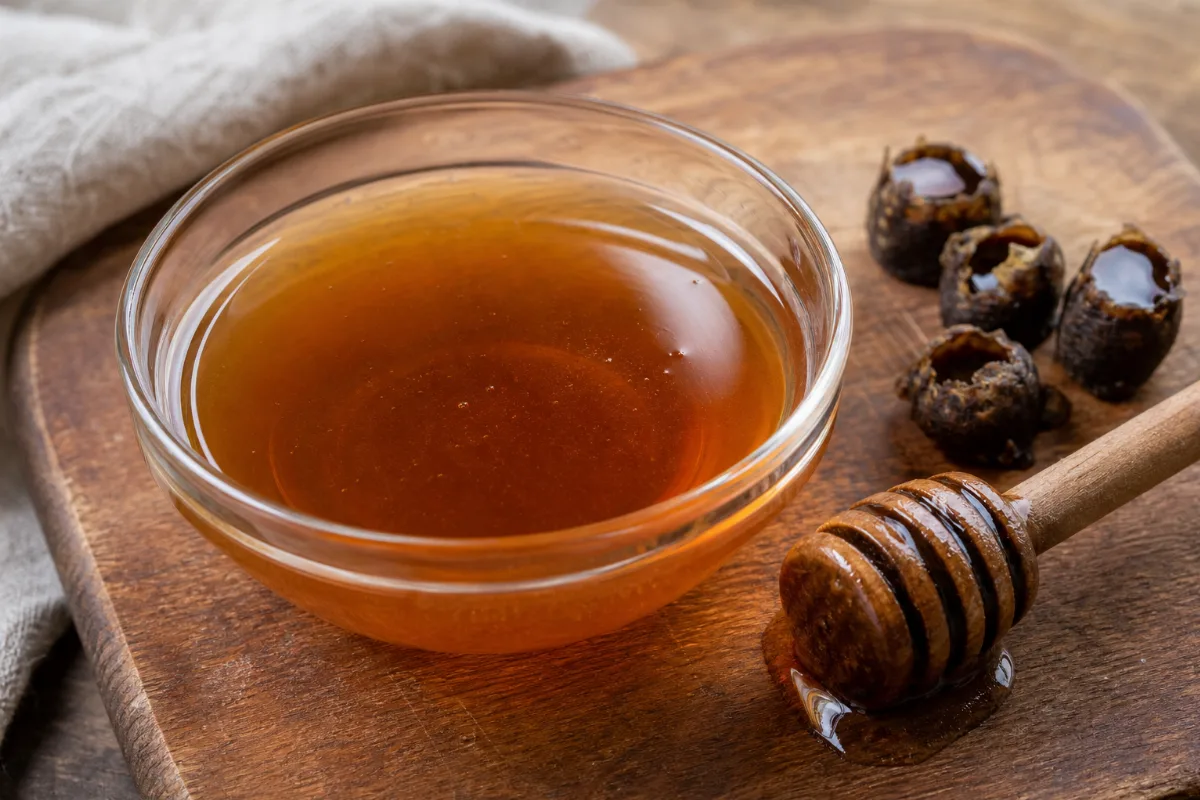
Honey & Bee Products · Honey
Stingless Bee Honey
Honey made by stingless bees (tribe Meliponini) · also called Kelulut honey, sugarbag honey, native bee honey, pot-honey, Trigona honey
Stingless bee honey is made by small stingless bees such as Tetragonula, Heterotrigona and Melipona, not by ordinary honeybees. It has more water and a different mix of sugars, so it is more liquid and ferments more easily. Never give any honey to a baby under 12 months. Honey is a sugar food. The research in people is three small trials, and most of the rest is lab work.
General information, not medical advice. Last substantive update · Not medically reviewed. A named clinician has not signed off on this page. How this page is made
About Stingless Bee Honey
Stingless bee honey is made by small stingless bees, not honeybees. Safety first: never give any honey to a baby under 12 months because of infant botulism. It is a sugar food, it holds more water than ordinary honey so it ferments more easily, and it can cause allergy in some people. In people there are three small trials, and the rest of the evidence is lab work, regulator reports and traditional use.
What it is
Stingless bees (tribe Meliponini) are small social bees found in tropical and subtropical places. Common honey-making groups include Tetragonula, Heterotrigona and Austroplebeia in Asia and Australia, and Melipona and Scaptotrigona in Latin America. The honey goes by many names: kelulut in Malaysia, sugarbag in Australia, and pot-honey because it is stored in wax pots.
It differs from honeybee honey. The Australian regulator reports more water (17 to 28%), less sugar overall and a sugar called trehalulose that is usually absent or lower in honeybee honey. A meta-analysis of lab studies found higher acidity and higher phenolic and antioxidant test scores, and large differences by species and place.
Because of the extra water, it ferments more easily. Makers may dehydrate, heat or chill it.
What the research shows
In people there are three small trials. A kelulut honey wound dressing was comparable to a standard gel in people with diabetic wounds. A small trial of Trigona honey after stroke reported better thinking-test scores, but it had no placebo. A honey mouth rinse did not reduce plaque in a 3-day pilot.
No human trial of stingless bee honey for blood sugar, cough or infections was found. The Cochrane wound review is about honeybee honey, so it does not apply directly.
Antimicrobial and antioxidant findings come from lab dishes and tests. They do not show effects in people.
Quality and buying
Stingless bee honey is made in small amounts and costs more, which the authors of a 2025 study say makes it more open to adulteration. It does not meet the international honey standard for moisture, acidity or total fructose plus glucose, so countries use their own rules. Australia approved a separate standard in 2024.
Trehalulose and mannitol have been proposed as markers to tell it from other honeys. No fraud rate was found. A label that names the bee, the country and the producer is a better sign than a general word, but it does not prove purity.
At a glance
Traditional uses history, not proof
- Aboriginal and Torres Strait Islander peoples have long used honey from native stingless bees for food and medicine, according to the Australian food regulator; the ailments are not listed.
- Interviews in Mexico describe stingless bee honey and pollen as food and medicine, and in Bhutan the honey is used for colds, cough and sore throat. Traditional use is not proof that it works.
Studied for research
- Diabetic wound dressing (kelulut honey): comparable to a standard gel in one small trial, low
- Thinking skills after stroke (Trigona honey): one small trial with no placebo, very low
- Dental plaque (honey mouth rinse): no benefit seen in a small pilot, against
- Blood sugar: no human study found, insufficient
- Antimicrobial activity (lab dishes only): very low
- Phenol and antioxidant test scores (lab only): very low
Main compounds
- Trehalulose, a sugar that marks stingless bee honey, along with fructose and glucose
- Mannitol, a sugar alcohol found in all 104 samples tested in one study
- Phenolic compounds and flavonoids, higher on average than in Apis honey in lab tests
Common forms
- Strained raw honey drained from the wax pots
- Dehydrated or dehumidified honey, with water removed to limit fermentation
- Heated or chilled honey
- Trial wound dressings and mouth rinses (separate products from jar honey)
Research links: WHO: Botulism · NHS: Botulism · WHO: Healthy diet (free sugars) · FSANZ approval report: Australian native bee honey · Kelulut honey for diabetic wounds trial (abstract) · Trigona honey after stroke trial (abstract) · Stingless bee honey mouth rinse trial (abstract) · Research Library · Genes & Biomarkers Library
What it is and its history
- Accepted scientific name
- Stingless bee honey (honey made by stingless bees of the tribe Meliponini)
- Naming authority
- Bees: tribe Meliponini Lepeletier, 1836 (family Apidae). The honey itself has no botanical authority.
- Synonyms
- Kelulut honey; Sugarbag honey; Meliponine honey; Pot-honey; Native bee honey; Trigona honey
- Common names
- Stingless bee honey (English); Kelulut honey (Malay); Sugarbag honey (English (Australia)); Native bee honey (English (Australia)); Pot-honey (English)
- Family or group
- Made by bees of the tribe Meliponini (family Apidae), not by Apis honeybees.
- Classification
- Animalia (the bees) > Arthropoda > Insecta > Hymenoptera > Apidae > Tetragonula, Heterotrigona, Geniotrigona, Austroplebeia, Melipona, Scaptotrigona and others > Many species; for example Tetragonula carbonaria, Tetragonula hockingsi, Heterotrigona itama, Geniotrigona thoracica, Austroplebeia australis
- Native range
- Tropical and subtropical regions: the studies read cover Malaysia, Indonesia, Bhutan, Australia and Mexico.
- Habitat
- Not covered in the sources read beyond the places above.
- What it looks like
- Flowers: The nectar and pollen come from local flowers and vary by place.
- Cultivation
- Kept in small hives (meliponiculture) or collected from wild nests. Bhutan interviews describe collecting wild nests in ways that destroy them. In Australia, 67% of colonies were in suburban areas in a 2010 figure the regulator cites.
- Harvest and processing
- Drained from wax pots and strained. It is often dehydrated, heated or chilled to limit fermentation (reviews and regulator report). Trial dressings and rinses are separate products.
- Look-alikes and adulterants
- Name: Honeybee (Apis mellifera) honey; Note: Looks similar but has less water, more sugar and usually little or no trehalulose; Apis honey is the product most research and rules refer to.; Name: Blends or syrup-diluted honey; Note: Stingless bee honey sells for more than honeybee honey, and the authors of a 2025 study say that makes it more open to adulteration.
- Sustainability and conservation
- Not covered in the sources read.
Photographs
Traditional use and history history, not clinical proof
| Tradition or era | Documented use | Source |
|---|---|---|
| Australia (Aboriginal and Torres Strait Islander peoples) | The food regulator says these peoples have a long history of using honey from native stingless bees for food and for medicinal purposes. The ailments are not listed. | s-fsanz-sd |
| Mexico (Nocupetaro, Michoacan) | Interviews found local people value honey from Scaptotrigona hellwegeri, Melipona fasciata, Frieseomelitta nigra and Geotrigona acapulconis as food, and honey and pollen as medicine. The illnesses are not listed in the abstract. | p24903644 |
| Bhutan | The authors say regular use of stingless bee honey for the common cold, cough and sore throat is part of Bhutan's traditions, and they documented 22 uses in food, medicine, veterinary medicine, crafts and belief. | p38600492 |
Traditional use shows how it was used. It does not show that it works or is safe today.
What is inside, and how it may work
What it contains and how those compounds act in cells and animals. Laboratory and animal mechanisms are not proven effects in people.
Main compounds
| Compound | Family | Where it is concentrated | Activity studied | Level of evidence |
|---|---|---|---|---|
| Trehalulose | disaccharide sugar (fructose bound to glucose) | Honey Averaged 18.5 g/100 g in Tetragonula honey and 4.5 g/100 g in Austroplebeia honey in work the regulator cites; up to 40.22 g/100 g in Indonesian Trigona honey in one study. | Defining sugar of stingless bee honey. The regulator says it does not appear to have adverse effects in humans. The authors of one study call it absent from Apis honey; the regulator says honeybee honey has it usually at lower levels. 3 4 13 17 | Regulatory assessment / lab analysis |
| Fructose and glucose | sugars | Honey Total sugar 62.3 to 65.5 g/100 g in Australian samples (regulator). | The other main sugars; honey is mostly sugar. 3 | Regulatory assessment |
| Mannitol | sugar alcohol | Honey 0.06 to 13.49 g/100 g across 104 samples. | Found in all samples; proposed as an authenticity marker. The authors say it supports health benefits, which was not tested in people. 14 | Lab analysis |
| Phenolic compounds and flavonoids | plant phenols | Honey Average phenolics higher than in Apis honey by +33.69 mg GAE/100 g in a meta-analysis. | Contribute to antioxidant test scores and may contribute to antimicrobial activity in the lab. 15 2 | Lab analysis |
| Hydrogen peroxide and proteins | antimicrobial agents | Honey Some samples made hydrogen peroxide for more than 6 days. | Reported contributors to antimicrobial activity in the lab. 2 | Laboratory research |
| Water (moisture) | physical property | Honey 17 to 28% in Australian honeys; about 26.5 g/100 g and water activity 0.74 in work the regulator cites. | High water allows natural fermentation. 3 7 | Regulatory assessment |
| HMF (hydroxymethylfurfural) | heat and age marker | Honey Lower than Apis honey by 11.25 mg/kg on average. | Quality marker that rises with heating and storage. 15 7 | Lab analysis |
Mechanisms, receptors and pathways
| Target or pathway | Gene or receptor | What was found | Level |
|---|---|---|---|
| Antimicrobial effect in dishes | Activity was linked by the authors to hydrogen peroxide and to phenolic and protein components. Some activity remained after heating to remove peroxide and after 18 years of storage. 2 | Laboratory research | |
| Antioxidant test scores | Higher phenolics and FRAP scores than Apis honey in a meta-analysis of lab studies. This is a test-tube measure. 15 | Laboratory research | |
| Wound healing and brain protection (suggested) | The wound and stroke trial authors suggest trehalulose and antioxidant compounds might help. Neither trial tested a mechanism. 12 16 | Pharmacological theory |
Absorption, metabolism and elimination
- Absorption
- Not studied for stingless bee honey in the sources read. The regulator cites work that trehalulose is digested to glucose and fructose in the small intestine at about one third the rate of sucrose (original not read).
- Distribution
- Not studied.
- Metabolism
- Not studied.
- Elimination
- Not studied.
- Bioavailability
- Not studied.
Isolated compounds versus whole extracts
Honey is a whole food. Lab results for honey in dishes or for single sugars such as trehalulose and mannitol do not show what eating the honey does in people. Results for a dressing made for a trial do not carry over to jar honey, and honeybee honey results (such as the Cochrane wound review) do not carry over to stingless bee honey.
Nutritional composition
Mostly sugar: about 62 to 66 g per 100 g in Australian samples against 72.8 g/100 g listed for honeybee honey. More water (17 to 28%) and higher acidity than honeybee honey, and sugar types that include trehalulose and mannitol. WHO counts sugars in honey as free sugars to be limited.
1 low certainty3 very low certainty1 not enough evidence1 evidence against
What was looked at
The 6 benefits and uses checked for Stingless Bee Honey, each with how strong the evidence is. Tap one to open it.
- Diabetic wounds (kelulut honey used as a dressing)Low certainty
- Thinking skills and independence after stroke (Trigona honey)Very low certainty
- Dental plaque (stingless bee honey mouth rinse)Evidence against
- Antimicrobial activity (lab dishes only)Very low certainty
- Phenolic content and antioxidant test scores (lab measures)Very low certainty
- Blood sugar (no human study found)Not enough evidence
Lab markers tracked in the studies
Wound epithelialization and granulation tissue (percent)Montreal Cognitive Assessment (MOCA) scoreModified Rankin Scale (disability)Dental plaque scoreMinimum inhibitory concentration (lab)Total phenolic content and FRAP antioxidant score (lab)
What is Stingless Bee Honey good for?
What people ask about, and how strong the human evidence is. Each human result rests on one small trial, and none is proof. Read all of it with the safety section.
Benefits, one by one
Each card is a research question, not a promise. Tap a goal to filter. Open a card to see the studies, doses and limits.
Diabetic wounds (kelulut honey used as a dressing)
Low certaintyOne trial in 62 people with diabetic wounds found a kelulut (stingless bee) honey dressing worked about as well as a standard gel dressing over a month. The groups did not differ in how fast they changed over time. It is one small single-blind trial, and the honey was a trial dressing, not jar honey.
2 studiesKelulut honey dressing applied every other day for a month; the amoun…
Studies, doses and limits
What the trials found
One randomised, single-blinded trial in people with diabetes and full-thickness cavity wounds: 71 randomised, 62 analysed (32 honey, 30 gel), dressings changed every other day for 1 month.
Results
Honey-treated wounds had higher percentages of epithelialization and granulation tissue at every time point, but the groups also started differently, and the test of how the groups changed over time found no significant difference between treatments (p = 0.417 and 0.431). The authors conclude the honey was comparable to the gel dressing.
Effect sizes as reported
No significant treatment-by-time interaction.
Why this rating
One small single-blinded trial, 9 of 71 people not analysed, groups unequal at the start, honey compared with a gel rather than a placebo. Honeybee honey dressings have a Cochrane review, but that is a different honey.
Form and dose studied
Kelulut honey dressing applied every other day for a month; the amount and bee species are not in the abstract.
Who was studied
People with diabetes and full-thickness cavity wounds.
Limits
Single-blinded; unequal groups; only 1 month; funding not stated in the abstract; honey dressing, not jar honey.
Why researchers looked
Honey has long been used on wounds, and kelulut honey contains trehalulose and phenols that the trial authors think may help healing.
Traditional use
Honey on wounds is described in the Cochrane review as used since ancient times, but that review is about honeybee honey. The sources read do not describe a wound use specific to stingless bee honey.
Proposed mechanism Pharmacological theory
The trial authors suggest the sugar trehalulose and the high antioxidant (phenol and flavonoid) content may help wounds heal. The trial did not test this.
A proposed mechanism does not show that the effect happens in people.
Jar honey is not a wound dressing. Wounds in people with diabetes need a clinician.
Thinking skills and independence after stroke (Trigona honey)
Very low certaintyOne small trial in 48 people after a stroke reported larger gains in a thinking test and a disability score after 3 months of daily Trigona honey than in people given nothing. There was no placebo, and the amount is not stated, so this can not be taken as proof.
1 studiesDaily Trigona honey for 3 months; the amount is not in the abstract.
Studies, doses and limits
What the trials found
One randomised controlled study in 48 people with acute ischaemic stroke: 24 given daily Trigona honey and 24 given nothing, assessed at the start and after 3 months.
Results
On the Montreal Cognitive Assessment (MOCA), the honey group rose from 20.08 to 24.33 and the control group from 18.42 to 19.67. The between-group difference was 4.25 points (95% CI 3.07 to 5.43; P < 0.001). A disability score (Modified Rankin Scale) improved by 1.29 points in the honey group.
Effect sizes as reported
MOCA difference 4.25 points (95% CI 3.07 to 5.43).
Why this rating
A single very small trial with no placebo group, different starting scores in the two groups, and an unclear blinding method. One trial cannot establish an effect.
Form and dose studied
Daily Trigona honey for 3 months; the amount is not in the abstract.
Who was studied
People with acute ischaemic stroke, mostly with mild cognitive impairment.
Limits
48 people; no placebo; unclear blinding; amount not stated; abstract-level reading only.
Why researchers looked
People can have lasting thinking problems after a stroke, and the authors of the trial describe Trigona honey as having antioxidant and neuroprotective properties that might help.
Traditional use
The sources read describe no traditional use of stingless bee honey for the brain.
Proposed mechanism Pharmacological theory
The trial authors suggest antioxidant and neuroprotective properties. The trial did not test a mechanism.
A proposed mechanism does not show that the effect happens in people.
Honey is a sugar food. People after a stroke often also have diabetes or take blood thinners; ask a doctor or pharmacist before adding it regularly.
Dental plaque (stingless bee honey mouth rinse)
Evidence againstIn a 30-person pilot, a stingless bee honey mouth rinse did not reduce plaque compared with saline over 3 days without tooth cleaning, while chlorhexidine did. People liked the honey rinse's taste and felt less burning.
1 studiesStingless bee honey mouth rinse; the amount and honey type are not in…
Studies, doses and limits
What the trials found
One randomised pilot trial: 30 volunteers with healthy gums or mild gingivitis, given stingless bee honey, chlorhexidine or saline rinse for 3 days.
Results
No significant change in plaque score for honey or saline compared with baseline. Chlorhexidine lowered plaque. The honey rinse had better taste and less burning than the other rinses.
Effect sizes as reported
Not given in the abstract.
Why this rating
A single small pilot found no plaque benefit over saline. It cannot rule out small effects, but it gives no support to a plaque claim.
Form and dose studied
Stingless bee honey mouth rinse; the amount and honey type are not in the abstract.
Who was studied
Adult volunteers with healthy gums or mild gingivitis.
Limits
About 10 people per group; 3 days; no tooth cleaning allowed; plaque only; the authors note the rinse might be patentable.
Why researchers looked
Standard mouth rinses can cause burning and a changed taste, so the authors looked for a gentler alternative.
Traditional use
The sources read describe no traditional mouth use of stingless bee honey.
Proposed mechanism Pharmacological theory
The authors point to honey's reported antibacterial, anti-inflammatory and healing properties. The trial did not show these working in the mouth.
A proposed mechanism does not show that the effect happens in people.
Honey is sugar and stays on the teeth. Ask a dentist about gum problems.
Antimicrobial activity (lab dishes only)
Very low certaintyIn the lab, honey from three Australian stingless bee species slowed the growth of some bacteria and a skin fungus. Some of the effect stayed after heating, and one honey kept it after 18 years of storage. This is test-tube work and does not show that the honey treats any infection.
2 studiesHoney diluted in lab broth; not a use in people.
Studies, doses and limits
Results
All samples had antimicrobial activity. Average minimum concentrations that stopped growth were 4 to 9% for the skin fungus Trichophyton interdigitale, 9 to 11% for Staphylococcus aureus, 10 to 13% for Escherichia coli and 24 to 34% for Cryptococcus neoformans. Tetragonula carbonaria honey was strongest and Austroplebeia australis weakest.
Effect sizes as reported
MIC figures only (lab).
Why this rating
Lab dishes only. A concentration that stops germs in a dish tells us nothing about swallowing the honey or putting it on a wound.
Form and dose studied
Honey diluted in lab broth; not a use in people.
Limits
Three Australian species; test-tube conditions; no human outcome.
Why researchers looked
Antibiotic-resistant germs are a growing problem, and researchers look for natural products that stop microbes growing.
Traditional use
Australian Aboriginal and Torres Strait Islander peoples have long used honey from native stingless bees for food and medicine (as stated by the food regulator FSANZ); the sources do not list the ailments.
Proposed mechanism Laboratory research
The authors report that hydrogen peroxide produced in the honey contributes, and that phenolic extracts (flavonoids named as likely contributors) and proteins were also active.
A proposed mechanism does not show that the effect happens in people.
Do not use honey in place of treatment for an infection.
Phenolic content and antioxidant test scores (lab measures)
Very low certaintyA meta-analysis of lab studies found stingless bee honey scored higher than Apis honey on average for phenolic content and an antioxidant test (FRAP), with large differences between studies. These are lab measurements of the honey, not health effects in people.
1 studiesNot applicable.
Studies, doses and limits
Results
Stingless bee honey had higher average phenolics (+33.69 mg GAE/100 g, p = 0.01) and higher FRAP (+63.39 umol Fe(II)/100 g, p = 0.009) than A. mellifera honey. It also had more moisture (+8.02%), less HMF (-11.25 mg/kg) and more free acidity (+34.76 meq/kg). Results varied with bee species, flower source, country and latitude.
Effect sizes as reported
Mean differences as listed; no health effect size.
Why this rating
Lab measures only, with large variation between studies. There is no human outcome.
Limits
The abstract does not say how many studies or which bee species were included.
Why researchers looked
Phenols are plant compounds often credited for honey's possible health effects, so researchers compare honeys.
Proposed mechanism Laboratory research
Antioxidant tests measure how well a food's compounds react with test chemicals in a dish. They do not show an effect in the body.
A proposed mechanism does not show that the effect happens in people.
A higher antioxidant score is not a reason to eat more honey, which is mostly sugar.
Blood sugar (no human study found)
Not enough evidenceNo human study of stingless bee honey and blood sugar was found. It is a sugar food. In Australian samples it had about 62 to 66 g of sugar per 100 g, somewhat less than the 72.8 g listed for honeybee honey, but still mostly sugar.
2 studiesNot applicable.
Studies, doses and limits
Results
Total sugar: 62.3 g/100 g (Tetragonula carbonaria honey) and 65.5 g/100 g (Austroplebeia australis honey) in the Australian regulator's assessment, against 72.8 g/100 g listed for honeybee honey.
Why this rating
No trial measured blood sugar after stingless bee honey.
Limits
Composition figures come from a regulator's report and a few Australian samples.
Why researchers looked
People ask whether it is gentler on blood sugar than ordinary honey, because it has a different mix of sugars including trehalulose.
Traditional use
The sources read describe no traditional use for blood sugar.
Proposed mechanism Regulatory assessment
Stingless bee honey contains trehalulose, a sugar made of fructose and glucose. FSANZ says trehalulose does not appear to have adverse effects in humans and cites work that it is digested more slowly than sucrose. That original work was not read here, and it is not a test of the honey in people.
A proposed mechanism does not show that the effect happens in people.
WHO counts the sugar in honey as free sugar to be limited. People who manage blood sugar should ask a doctor or pharmacist.
Connections to the rest of health
How Stingless Bee Honey connects to the rest of our health knowledge graph. Every link says what kind of connection it is. A safety link (for example to the liver) is a warning, not a benefit. A study that merely mentions a topic never creates a benefit link.
Explore every connection: goals, body systems, organs, symptoms, genes
B. Body systems
| Connected to | Kind of connection | Evidence status | Context | Studies |
|---|---|---|---|---|
| Immune system | Adverse effect or risk | Low certainty | Allergic reactions, rare but can be severe. Preparation or compound: Honey and bee products |
9 11 |
| Integumentary System | Biological association | Low certainty | Studied for: Diabetic wounds (kelulut honey used as a dressing) | 12 8 |
| Nervous System | Biological association | Very low certainty | Studied for: Thinking skills and independence after stroke (Trigona honey) | 16 |
| Digestive System | Biological association | Evidence against | Studied for: Dental plaque (stingless bee honey mouth rinse) | 10 |
| Immune System | Biological association | Very low certainty | Studied for: Antimicrobial activity (lab dishes only) | 2 3 |
| Endocrine System | Biological association | Not enough evidence | Studied for: Blood sugar (no human study found) | 3 19 |
C. Body parts and organs
I. Biomarkers
| Connected to | Kind of connection | Evidence status | Context | Studies |
|---|---|---|---|---|
| Wound epithelialization and granulation tissue (percent) | Biological association | Low certainty | Measured in trials: raised. A lab change is not the same as a health benefit. | 12 |
| Montreal Cognitive Assessment (MOCA) score | Biological association | Very low certainty | Measured in trials: raised. A lab change is not the same as a health benefit. | 16 |
| Modified Rankin Scale (disability) | Biological association | Very low certainty | Measured in trials: lowered. A lab change is not the same as a health benefit. | 16 |
| Dental plaque score | Biological association | Evidence against | Measured in trials: lowered. A lab change is not the same as a health benefit. | 10 |
| Minimum inhibitory concentration (lab) | Biological association | Very low certainty | Measured in trials: lowered. A lab change is not the same as a health benefit. | 2 |
| Total phenolic content and FRAP antioxidant score (lab) | Biological association | Very low certainty | Measured in trials: raised. A lab change is not the same as a health benefit. | 15 |
L. Active compounds
| Connected to | Kind of connection | Evidence status | Context | Studies |
|---|---|---|---|---|
| Trehalulose | Biological association | Regulatory assessment / lab analysis | Defining sugar of stingless bee honey. The regulator says it does not appear to have adverse effects in humans. The authors of one study call it absent from Apis honey; the regulator says honeybee honey has it usually at lower levels. Preparation or compound: Honey |
3 4 13 17 |
| Fructose and glucose | Biological association | Regulatory assessment | The other main sugars; honey is mostly sugar. Preparation or compound: Honey |
3 |
| Mannitol | Biological association | Lab analysis | Found in all samples; proposed as an authenticity marker. The authors say it supports health benefits, which was not tested in people. Preparation or compound: Honey |
14 |
| Phenolic compounds and flavonoids | Biological association | Lab analysis | Contribute to antioxidant test scores and may contribute to antimicrobial activity in the lab. Preparation or compound: Honey |
15 2 |
| Hydrogen peroxide and proteins | Biological association | In vitro | Reported contributors to antimicrobial activity in the lab. Preparation or compound: Honey |
2 |
| Water (moisture) | Biological association | Regulatory assessment | High water allows natural fermentation. Preparation or compound: Honey |
3 7 |
| HMF (hydroxymethylfurfural) | Biological association | Lab analysis | Quality marker that rises with heating and storage. Preparation or compound: Honey |
15 7 |
Each connection is stored with the ingredient, the connected record, the kind of connection, the evidence status, the supporting studies, the preparation or compound involved, and a review date (last reviewed October 25, 2026).
Evidence at a glance: what changed in 6 lab markers
Tap a number to show only those markers. Counts are markers, not people.
The evidence
The research centre for Stingless Bee Honey. Every record here was checked against PubMed or the publisher's page; we never list a study we have not verified.
Evidence by outcome
Bars show how many studies we found for each outcome, not how well it works. People are added up across trials only (reviews are not added, to avoid double counting).
How we rate evidence
High certainty
Several well-run trials or reviews agree; further research is unlikely to change the picture much.
Moderate certainty
Good trials point the same way, but some doubt remains.
Low certainty
Small, short or inconsistent trials. The finding could change with better research.
Very low certainty
Very little or very weak human data. Treat as a possibility only.
Mixed findings
Trials or reviews disagree with each other.
Not enough evidence
Not enough human research to say either way.
Evidence against
Good research found no benefit, or found harm.
We take the reviewers' own risk-of-bias and GRADE statements where they exist, and otherwise judge from study size, design, consistency, directness and whether a product matches what is sold. Many publications do not make evidence high. Method note: We read the abstracts of 16 PubMed papers, the WHO botulism and healthy-diet fact sheets and the NHS botulism page in full, and the Australian food regulator's approval report and risk assessment, and checked the bee names in GBIF. Certainty ratings are the compiler's own reading unless a review gives its own. The regulator's own citations were not checked against the original papers.
Study library: every study we checked 20
| Study | Design | People | Product, dose, length | Result |
|---|---|---|---|---|
| Aricò 2026 Infant Botulism and Honey Exposure: Global Epidemiology, Prevention Policies, and Communication Strategies. Acta Paediatr · PMID 41964486 · DOI |
Review human (review) |
Narrative review of surveillance reports, health agency documents and papers, 1976 to 2024 | Honey (all types) honey |
Cases were rare, but honey was the only consistently confirmed dietary source of infant botulism. Median age at onset was 3 to 4 months. Mortality was below 1% with intensive care and specific therapy. The USA had about 130 cases a year in a 2007 to 2021 review. Health authorities uniformly advised against honey before 12 months, but warning labels were voluntary in many regions. Honey the only consistently confirmed food source Methods, limits and fundingOutcomes: Cases and prevention policies for infant botulism Limitations: Narrative review; honey types are not separated in the abstract. Funding and conflicts: No conflict declared in the abstract text read. Read: abstract |
| Fernandes 2025 Strong antimicrobial activity and unique physicochemical characteristics in honey from Australian stingless bees. Appl Environ Microbiol · PMID 40397496 · DOI |
Laboratory research in vitro |
Honey samples from Tetragonula carbonaria, Tetragonula hockingsi and Austroplebeia australis tested against human disease-causing microbes in the lab | Honey from three Australian stingless bee species honey Test-tube dilutions (percent weight/weight) Lab test |
All honey samples had antimicrobial activity. Average MICs were 4% to 9% (w/w) for the skin fungus Trichophyton interdigitale, 9% to 11% for Staphylococcus aureus, 10% to 13% for Escherichia coli and 24% to 34% for Cryptococcus neoformans. T. carbonaria honey was strongest and A. australis honey weakest. After heating to remove hydrogen peroxide activity, T. carbonaria and T. hockingsi honey kept activity against E. coli and S. aureus but less against the fungi. T. carbonaria honey tested again after 18 years of storage kept substantial non-peroxide activity. Lab antimicrobial activity only Methods, limits and fundingOutcomes: Minimum concentration of honey that stops growth (MIC) of selected bacteria and fungi Limitations: Lab dishes only. Honey was mixed into the test liquid; this does not show an effect in the body or on an infection. Funding and conflicts: No conflict of interest declared; grants from a New South Wales bushfire recovery programme and a university infectious diseases institute. Read: abstract |
| Food Standards Australia New Zealand 2023 FSANZ Application A1257 - Australian native bee honey: Supporting document, risk and technical assessment (22 November 2023) n/a · Source |
Authoritative guidance n/a |
n/a | Honey of Australian stingless bees (Tetragonula and Austroplebeia) honey · vs Honeybee honey |
See outcomes. Methods, limits and fundingOutcomes: Risk and technical assessment of native stingless bee honey. Total sugar reported lower than honeybee honey (62.3 g/100 g for Tetragonula carbonaria honey and 65.5 g/100 g for Austroplebeia australis honey, against 72.8 g/100 g listed for honeybee honey in the Australian food composition database). Moisture 17 to 28% and reducing sugars 55 to 62 g/100 g in Australian native bee honeys. Fermentation is a natural occurrence, self-limiting, with pressure building in sealed containers; water activity 0.74. No convincing evidence of a health risk to the general population if beekeepers apply good hygienic practice. Infants are at risk from Clostridium botulinum spores whatever the source of the honey. Some people are allergic to pollen, propolis or royal jelly in honeybee honey, and native bee honey most likely poses similar risks. Trehalulose does not appear to have adverse effects in humans. Aboriginal and Torres Strait Islander peoples have a long history of using honey from native bees for food and medicinal purposes. Limitations: A regulator's assessment of Australian stingless bees, written to decide on a food standard. It cites other papers that were not read here. Not a clinical study. Funding and conflicts: Application made by the Australian Native Bee Association; assessment by FSANZ. Read: full-text |
| Food Standards Australia New Zealand 2024 FSANZ Approval report - Application A1257: Australian native bee honey (8 May 2024) n/a · Source |
Authoritative guidance n/a |
n/a | Honey of Australian stingless bees honey |
See outcomes. Methods, limits and fundingOutcomes: FSANZ approved a new standard (2.8.3 Native bee honey) so that honey from Australian native stingless bees can be sold as a standardised food in Australia and New Zealand. The approved standard sets at least 50% reducing sugars, no more than 28% moisture and at least 2% trehalulose. Food for infants may not contain honey unless it has been treated to inactivate C. botulinum spores, and the same applies to native bee honey. The report says infants are at risk from honey with C. botulinum spores whether it is made by honeybees or native bees, and that some people are allergic to pollen, propolis or royal jelly in honey. Limitations: Covers Australian native stingless bees only. Whether and when the standard was gazetted was not checked. Read: full-text |
| GBIF Secretariat 2026 GBIF species record: Meliponini (tribe of stingless bees), checked 2026-10-25 n/a · Source |
Registry or database n/a |
n/a | n/a |
Meliponini Lepeletier, 1836 - ACCEPTED, tribe, family Apidae, order Hymenoptera Methods, limits and fundingOutcomes: Taxonomic name check. Limitations: Taxonomy only. Read: api-response |
| Gajda 2026 Immature Honey as a Quality Challenge in Global Apicultural Production. Foods · PMID 42354105 · DOI |
Review lab (review) |
Narrative critical review of honey maturity, yeasts and water activity (about honey generally, not stingless bees specifically) | Honey (general) honey |
Osmophilic yeasts are natural components of honey, and their presence should not be treated as non-compliance on its own in the absence of active fermentation. Honey standards require the absence of fermentation or effervescence. Yeasts are natural; active fermentation is a quality problem Methods, limits and fundingOutcomes: Honey maturity and fermentation Limitations: Does not mention stingless bee honey in the abstract. Funding and conflicts: No conflicts of interest declared. Read: abstract |
| Ikhsan 2022 Methods of the Dehydration Process and Its Effect on the Physicochemical Properties of Stingless Bee Honey: A Review. Molecules · PMID 36364068 · DOI |
Review lab (review) |
Review of methods that remove water from stingless bee honey after harvest | Stingless bee honey, dehydrated honey |
Stingless bee honey has a high moisture content, so it is more prone to fermentation and spoilage. Vacuum drying, freeze-drying or a food dehydrator could remove more than 80% of the water, reducing moisture below 17% and water activity below 0.6. HMF stayed within the permissible standard of under 40 mg/kg and total phenolics rose. Dehydration limits fermentation Methods, limits and fundingOutcomes: Moisture, water activity, HMF and phenolics after dehydration Limitations: A review of processing studies; no human outcomes. Funding and conflicts: No conflict of interest declared; a Malaysian university grant is noted. Read: abstract |
| Jull 2015 Honey as a topical treatment for wounds. Cochrane Database Syst Rev · PMID 25742878 · DOI |
Systematic review human (review) |
3011 26 trials (3,011 people) of honey on acute and chronic wounds; the review describes honey from the honeybee Apis mellifera |
Honey dressings (honeybee honey) versus other dressings or treatments honey Varied · vs Conventional dressings, silver sulfadiazine and others |
High-quality evidence from 2 trials (n=992) that honey dressings healed partial-thickness burns faster than conventional dressings (about 4.7 days; WMD -4.68, 95% CI -5.09 to -4.28). For venous leg ulcers, diabetic foot ulcers and minor acute wounds the effects were unclear (low or very low quality evidence). The authors say it is difficult to draw overall conclusions because of mixed populations and mostly low-quality evidence. Faster healing of partial-thickness burns; unclear for most other wounds Methods, limits and fundingOutcomes: Wound healing time and rates Limitations: Honeybee honey, not stingless bee honey. Several of the included trials used honey dressings made as medical products. Funding and conflicts: Some authors worked on a trial that received a small unconditional contribution from a honey dressing maker (declared in the review). Read: abstract |
| Matuszewska-Mach 2025 Ensuring the Safe Use of Bee Products: A Review of Allergic Risks and Management. Int J Mol Sci · PMID 41465502 · DOI |
Review human (review) |
Narrative review of allergy to honeybee products (honey, bee pollen, bee bread, royal jelly, propolis, beeswax, bee brood) | Honeybee products honey |
Honeybee products can provoke allergic reactions from localised dermatitis to life-threatening anaphylaxis, although relatively rarely. Both type I (IgE-mediated) and type IV (T-cell-mediated) reactions are described. People with atopy and beekeepers are at higher risk. Management centres on avoiding the products and clearer labelling. Allergy is rare but can be severe Methods, limits and fundingOutcomes: Allergic reactions Limitations: About honeybee products, not stingless bee honey. A narrative review. Funding and conflicts: The authors declare no conflicts of interest. Read: abstract |
| Reduan 2025 Effects of a Stingless Bee Honey Mouth Rinse on Dental Plaque Accumulation: A Randomised Clinical Trial. Cureus · PMID 40688909 · DOI |
Controlled trial |
30 30 volunteers with healthy gums or mild gingivitis, randomly given a stingless bee honey, chlorhexidine or saline mouth rinse and told not to clean their teeth for 3 days |
Stingless bee honey mouth rinse honey 3 days · vs Chlorhexidine rinse and normal saline rinse |
After 3 days there was no significant difference in plaque score for the honey and saline groups compared with baseline. The chlorhexidine group had a significant drop. The honey group reported better taste and less burning than the other rinses. No plaque benefit seen for honey; chlorhexidine reduced plaque Methods, limits and fundingOutcomes: Plaque score and patient-rated taste and burning feeling (visual analogue scale) Limitations: A pilot with about 10 people per group; 3 days; no tooth cleaning; plaque only, not gum disease. A stingless bee honey mouth rinse was described by the authors as possibly worth patenting. Funding and conflicts: No outside funding declared; an internal university grant is noted. The authors say a honey mouth rinse might be a relevant idea to patent. Read: abstract |
| Rocha Filho 2026 Pharmacovigilance and toxicological risks associated with apitherapeutic products: a systematic overview. Arch Toxicol · PMID 41071287 · DOI |
Systematic review human (review) |
Review of the literature and official pharmacovigilance databases for honey, bee venom, propolis, royal jelly, bee pollen and beeswax | Honey and other bee products honey |
Reported cases included infant botulism and grayanotoxin poisoning linked to honey; anaphylaxis and deaths after therapeutic bee venom; contact dermatitis and systemic reactions from propolis; severe asthma attacks after royal jelly; adulteration of pollen supplements with illicit drugs; and allergy to beeswax in cosmetics. Allergic responses were the most common adverse event, particularly in atopic people. Allergy the most frequent adverse event Methods, limits and fundingOutcomes: Adverse effects and toxicology Limitations: Overview of reports; honeybee products mainly; no rates in the abstract. Funding and conflicts: The authors declare no relevant competing interests. Read: abstract |
| Rosli 2024 Effectiveness of stingless bee (Kelulut) honey versus conventional gel dressing in diabetic wound bed preparation: A randomized controlled trial. J Taibah Univ Med Sci · PMID 38124990 · DOI |
Controlled trial |
71 71 people with diabetes and full-thickness cavity wounds were randomised; 62 were analysed (30 gel, 32 honey) |
Kelulut (stingless bee) honey dressing versus Intrasite gel dressing honey Amount not stated in the abstract Dressed every other day for 1 month · vs Conventional gel dressing (Intrasite gel) |
Both groups improved over time. Percentages of epithelialization and granulation tissue were significantly higher in the honey group at every time point (p < 0.05). The analyses of how the groups changed over time found no significant difference between treatments (F 0.88, p = 0.417; F 0.79, p = 0.431). The control group had more granulation tissue at the start and more wounds on the lower limb and back of the trunk. Comparable to gel; no significant difference in change over time Methods, limits and fundingOutcomes: Wound size reduction and granulation tissue percentage every 6 days for 1 month Limitations: Single-blinded; 9 of 71 people not analysed; groups differed at the start; the honey was used as a wound dressing, not as food; bee species and amount not given in the abstract; funding not stated in the abstract. Funding and conflicts: Not stated in the abstract. Read: abstract |
| Sahlan 2026 Trehalulose serves as a distinctive marker for Indonesian stingless bee honey under raw and dehumidified conditions. Sci Rep · PMID 41851320 · DOI |
Laboratory research lab analysis |
Raw and dehumidified Trigona stingless bee honey from Indonesia stored at four temperatures for eight weeks | Stingless bee honey (Trigona sp.) honey 8 weeks of storage · vs Raw versus dehumidified honey |
Trehalulose, a disaccharide absent in Apis mellifera honey according to the authors, varied by region from 0.00 to 40.22 g/100 g but was generally present. Dehumidifying below 20% moisture raised it from 40.22 to 47.56 g/100 g. During storage it fell faster in raw honey (40% to 29% at 35 C) than in dehumidified honey (49% to 38%). Hot storage darkened honey, and dehumidifying with cold storage kept quality best. Trehalulose is a marker of stingless bee honey Methods, limits and fundingOutcomes: Trehalulose, colour, acidity and moisture Limitations: Lab study of storage; a single bee genus from Indonesia. Funding and conflicts: No competing interests declared. Read: abstract |
| Xu 2025 Mannitol: A novel chemical marker in stingless bee honey. Food Chem · PMID 39884032 · DOI |
Laboratory research lab analysis |
104 104 stingless bee honey samples from various stingless bee species |
Stingless bee honey honey Lab analysis |
Mannitol was found in all 104 samples, from 0.06 to 13.49 g/100 g. The authors say stingless bee honey is lower in yearly production but higher in market value than honeybee honey, so it is more open to adulteration, and propose mannitol as a marker. Mannitol present in all samples Methods, limits and fundingOutcomes: Mannitol content as a marker of authenticity Limitations: Lab study; the authors' statement that the mannitol finding supports health benefits is not tested in people. Funding and conflicts: The authors declare no competing financial interests. Read: abstract |
| Zaldivar-Ortega 2024 The Physicochemical Parameters, Phenolic Content, and Antioxidant Activity of Honey from Stingless Bees and Apis mellifera: A Systematic Review and Meta-Analysis. Antioxidants (Basel) · PMID 39765867 · DOI |
Meta-analysis lab (review of laboratory studies) |
Published lab studies of honey from stingless bees and from Apis mellifera (study count and bee species are not given in the abstract) | Stingless bee honey versus Apis mellifera honey (lab measurements) honey · vs Apis mellifera honey |
Mean phenolic content in A. mellifera honey was 61.21 (SD 28.3) mg GAE/100 g, and stingless bee honey was +33.69 mg GAE/100 g higher (p = 0.01). FRAP antioxidant activity in A. mellifera honey was 97.34 (SD 7.84) umol Fe(II)/100 g, with stingless bee honey +63.39 higher (p = 0.009). Moisture was higher in stingless bee honey (+8.02%, p = 0.0001), HMF lower (-11.25 mg/kg, p = 0.001) and free acidity higher (+34.76 meq/kg, p = 0.01). The authors say variation between studies was large and depended on bee species, flower source, country and latitude. Higher phenolic and antioxidant test scores, higher moisture and acidity, lower HMF Methods, limits and fundingOutcomes: Total phenolic content, antioxidant activity (FRAP), moisture, HMF and free acidity Limitations: Lab measures of a food, not health outcomes. Large differences between studies. Funding and conflicts: No conflicts of interest declared. Read: abstract |
| Zarim 2025 The Potential of Trigona Honey as a Supplementary Therapy for Vascular Cognitive Impairment in Patients with Acute Ischaemic Stroke. Malays J Med Sci · PMID 42077250 · DOI |
Controlled trial |
48 48 patients with acute ischaemic stroke, mostly with mild cognitive impairment; 66.7% male |
Daily Trigona (stingless bee) honey supplement honey Amount not stated in the abstract 3 months · vs No supplementation (no placebo) |
MOCA rose from 20.08 (SD 4.53) to 24.33 (SD 3.64) with honey and from 18.42 (SD 5.12) to 19.67 (SD 6.31) without. The between-group difference was 4.25 (95% CI 3.07 to 5.43; P < 0.001). MRS changed by -1.29 in the honey group (95% CI -1.71 to -0.87; P < 0.001). MOCA difference 4.25 points between groups (95% CI 3.07 to 5.43) Methods, limits and fundingOutcomes: Montreal Cognitive Assessment (MOCA) and Modified Rankin Scale (MRS, a disability score) at the start and after 3 months Limitations: Very small; the control group got nothing, so there was no placebo; the two groups started at different MOCA scores; the abstract does not say who knew which group people were in; amount not stated; a single trial. Funding and conflicts: The authors declare no conflict of interest. The funders had no role in the design, analysis or writing. Read: abstract |
| Zawawi 2022 Unique physicochemical properties and rare reducing sugar trehalulose mandate new international regulation for stingless bee honey. Food Chem · PMID 34823933 · DOI |
Laboratory research lab analysis |
36 36 stingless bee honey samples from four species (Heterotrigona itama, Geniotrigona thoracica, Tetragonula carbonaria, Tetragonula hockingsi) from Malaysia and Australia |
Stingless bee honey honey Lab analysis · vs CODEX honey standard |
Trehalulose was the prominent sugar in all samples. All samples failed the CODEX standard for honey moisture, free acidity and total fructose plus glucose. Toxic elements were much lower than the CODEX limit. Australian honey had higher pH, total phenolics, total minerals and conductivity than Malaysian honey. Geniotrigona thoracica honey had the highest trehalulose. Does not meet the honey standard; toxic elements low Methods, limits and fundingOutcomes: Sugars including trehalulose, phenolics, minerals, toxic elements, and comparison with the CODEX honey standard Limitations: 36 samples from two regions; lab measures only; the abstract does not give the toxic element values. Funding and conflicts: Not stated in the abstract. Read: abstract |
| n/a 2023 WHO: Botulism (fact sheet, 25 September 2023) n/a · Source |
Authoritative guidance n/a |
n/a | n/a |
Do not feed honey to infants before the age of 1 year. Methods, limits and fundingOutcomes: Describes infant botulism: spores swallowed by an infant can grow in the gut and release toxin; spore-contaminated honey has been associated with a number of cases; parents and caregivers are warned not to feed honey to infants before 1 year. Symptoms listed: constipation, loss of appetite, weakness, an altered cry and a striking loss of head control. The fact sheet also says spores of the bacterium are heat-resistant. Limitations: A fact sheet, not a trial. It does not mention stingless bee honey. Read: full-text |
| n/a 2026 WHO: Healthy diet (fact sheet) n/a · Source |
Authoritative guidance n/a |
n/a | n/a |
Honey sugars count as free sugars. Methods, limits and fundingOutcomes: Says intake of free sugars should be limited throughout life, and that free sugars include sugars naturally present in honey, syrups, fruit juices and fruit juice concentrates. Limitations: General diet guidance; it does not mention stingless bee honey. Read: full-text |
| n/a 2026 NHS: Botulism (page last reviewed 4 March 2026) n/a · Source |
Authoritative guidance n/a |
n/a | n/a |
No honey for babies under 12 months. Methods, limits and fundingOutcomes: Says not to give honey to babies younger than 12 months old because honey can contain the bacteria that cause botulism. Limitations: A health service page, not a trial. It does not mention stingless bee honey. Read: full-text |
What we do not know yet
- Three small human trials exist (a wound dressing, stroke recovery and a mouth rinse), and none had both a placebo and a large sample.
- No human trial of stingless bee honey for blood sugar, cough, infections or gut health was found.
- The abstracts of the wound and stroke trials do not name the bee species or the amount used.
- No allergy study of stingless bee honey itself, and no information on pregnancy, breastfeeding or medicines, was found.
- No fraud rate was found, and most regulator work covers Australian species only.
How new research is added
New studies are found by a saved PubMed search and are placed in a review queue. A person reads each one before it is added.
Lab markers
What changed in blood or saliva tests during trials. A changed number is not the same as feeling or being healthier, and we give no "normal ranges".
Other 6
Wound epithelialization and granulation tissue (percent)
Raised in trials
Measures of how much of a wound has new skin covering and new healing tissue, tracked every 6 days.
Low certaintyResults and what it means
Why it was measured
To see whether a dressing helps a wound heal.
Statistical vs. clinical meaning
Comparable to a standard gel in one trial.
Safety implication
Wounds in people with diabetes need clinical care.
| Study | Result | People | Product |
|---|---|---|---|
| 12 | Both groups rose over time. Honey values were higher at each time point, but the change over time did not differ significantly between honey and gel (p = 0.417 and 0.431). | 62 people with diabetic wounds | Kelulut honey dressing vs Intrasite gel, every other day for 1 month |
Montreal Cognitive Assessment (MOCA) score
Raised in trials
A 30-point paper test of memory, attention and thinking skills.
Very low certaintyResults and what it means
Why it was measured
To see whether thinking skills improved after a stroke.
Statistical vs. clinical meaning
A large difference in a very small trial without a placebo.
Safety implication
None reported in the abstract.
| Study | Result | People | Product |
|---|---|---|---|
| 16 | Honey group 20.08 to 24.33; control group 18.42 to 19.67; between-group difference 4.25 (95% CI 3.07 to 5.43). | 48 people after acute ischaemic stroke | Daily Trigona honey vs no supplement, 3 months |
Modified Rankin Scale (disability)
Lowered in trials
A scale of how independent a person is after a stroke; lower scores mean more independence.
Very low certaintyResults and what it means
Why it was measured
To see whether everyday independence improved.
Statistical vs. clinical meaning
Reported improvement; a single small unblinded-type comparison.
Safety implication
None reported in the abstract.
| Study | Result | People | Product |
|---|---|---|---|
| 16 | Mean change of -1.29 in the honey group (95% CI -1.71 to -0.87; P < 0.001), described by the authors as better independence than the control group. | 48 people after acute ischaemic stroke | Daily Trigona honey vs no supplement, 3 months |
Dental plaque score
Lowered in trials
A dentist's score of how much plaque has built up on the teeth.
Evidence againstResults and what it means
Why it was measured
To see whether a mouth rinse reduces plaque.
Statistical vs. clinical meaning
No plaque benefit seen for the honey rinse.
Safety implication
Honey rinse caused less burning than chlorhexidine.
| Study | Result | People | Product |
|---|---|---|---|
| 10 | No significant change from baseline for honey or saline rinse at 3 days; chlorhexidine lowered the score significantly. | 30 volunteers | Stingless bee honey, chlorhexidine or saline rinse for 3 days |
Minimum inhibitory concentration (lab)
Lowered in trials
The smallest amount of honey in a test liquid that stops a microbe growing.
Very low certaintyResults and what it means
Why it was measured
To compare how strongly different honeys slow microbes in the lab.
Statistical vs. clinical meaning
Lab activity only.
Safety implication
Not a treatment for infection.
| Study | Result | People | Product |
|---|---|---|---|
| 2 | Average MICs of 4 to 9% (T. interdigitale), 9 to 11% (S. aureus), 10 to 13% (E. coli) and 24 to 34% (C. neoformans). | Lab cultures (no people) | Honey from three Australian stingless bee species |
Total phenolic content and FRAP antioxidant score (lab)
Raised in trials
Lab measures of plant phenol content and of how strongly a sample reacts in an antioxidant test.
Very low certaintyResults and what it means
Why it was measured
To compare honeys by compounds thought to matter for health.
Statistical vs. clinical meaning
A lab difference, not a health effect.
Safety implication
None.
| Study | Result | People | Product |
|---|---|---|---|
| 15 | Stingless bee honey was higher than A. mellifera honey by +33.69 mg GAE/100 g (phenolics, p = 0.01) and +63.39 umol Fe(II)/100 g (FRAP, p = 0.009). | Lab samples (no people) | Stingless bee honey vs Apis honey |
Safety
What studies and official sources say about side effects, medicines and who should check first. Each point shows what kind of evidence it comes from.
Main points to know 7
- Never give honey to a baby under 12 months (infant botulism). WHO and the NHS say not to give honey to babies before 12 months. Honey can carry spores of the bacterium that causes botulism, and in a baby the spores can grow in the gut and release a toxin that weakens the muscles. It is rare but serious. A 2026 review found honey was the only consistently confirmed food source of infant botulism, with deaths below 1% when babies got intensive care and specific treatment. This applies to stingless bee honey too: the Australian food regulator says infants are at risk from honey with these spores whether it is made by honeybees or by native stingless bees, and its standard keeps honey out of infant foods unless it has been treated to inactivate the spores. WHO says the spores are heat-resistant, so raw or dehydrated honey is not a safe choice for babies. Authoritative guidance 18 20 4 1
- It is a sugar food. WHO counts sugars naturally present in honey as free sugars, which it says should be limited throughout life. The Australian regulator reports that stingless bee honey is about 62 to 66 g sugar per 100 g in the samples it reviewed, a little less than the 72.8 g listed for honeybee honey, but still mostly sugar. No human study of its effect on blood sugar was found. People who manage blood sugar should ask a doctor or pharmacist. Authoritative guidance 19 3
- It ferments more easily than ordinary honey. Stingless bee honey has more water than honeybee honey. The Australian regulator reports a moisture of about 26.5 g per 100 g and a water activity of 0.74 in the work it reviewed, against a 21% cap for ordinary honey, so natural yeasts and bacteria can ferment it. It judged this unlikely to cause illness in the general population and said the process is self-limiting, but that pressure can build in sealed containers. A review of drying methods says removing water can limit fermentation and spoilage. Makers also heat or chill it. Hygienic harvesting matters. Authoritative guidance 3 4 7 6
- Allergic reactions are rare but can be severe. Bee products, honey included, can trigger reactions from rashes to life-threatening anaphylaxis. People with an allergic tendency and beekeepers are at higher risk, and allergy was the most common adverse event in a 2026 safety overview. The Australian regulator says stingless bee honey may contain pollen, propolis and a secretion that does the same job as royal jelly, and that it most likely carries risks similar to honeybee honey for allergic people. No study of allergy to stingless bee honey itself was found. Review 9 11 3 4
- Jar honey is not a wound dressing. The one wound trial used a kelulut honey dressing made for the trial and found it comparable to a gel dressing, not better. The wider wound evidence is about honeybee honey dressings. Do not use food honey in place of medical care for a wound or burn, especially if you have diabetes. See a clinician. Controlled trial 12 8
- The label may not tell you what is in the jar. Stingless bee honey is made in small amounts and sells for more than honeybee honey, which the authors of a 2025 study say makes it more open to adulteration. It does not meet the international honey standard (Codex) for moisture, acidity or total fructose plus glucose in a study of 36 samples, so countries use different rules. Trehalulose and mannitol have been proposed as markers that help tell it from other honeys. No rate of fraud was found. Look for a label that names the bee, the country and the producer, though that does not prove purity. Laboratory research 14 17 13
- Evidence of benefit is thin. In people there is one small wound-dressing trial (comparable to a gel), one small stroke trial with no placebo, and one mouth rinse pilot that found no plaque benefit. The rest is lab, regulator or traditional-use information. It is a food with a long history in many places, not a proven remedy. Controlled trial 12 16 10
Side effects 4
| Effect | How often | Severity and recovery | Evidence |
|---|---|---|---|
| Infant botulism (babies under 12 months) Honey is the only consistently confirmed food source. The Australian regulator says this applies to native bee honey. | Rare; about 130 cases a year in the USA in one global review (all honeys) | severe Mortality below 1% with intensive care and specific treatment; hospital care is needed | Review 18 20 4 1 |
| Allergic reactions (rash, swelling, wheeze, anaphylaxis) Higher risk in people with atopy and in beekeepers. Stingless bee honey may contain pollen, propolis and a royal-jelly-like secretion. | Relatively rare; no rate in the abstracts | mild to severe Varies; anaphylaxis is an emergency | Review 9 11 3 |
| Fizz, sour taste and pressure in sealed jars from fermentation The regulator judged fermentation unlikely to cause illness. A Brazilian study it cites reported alcohol of 0.2% to 0.6% after 180 days of storage (original not read). | Common in untreated honey with high water content (regulator's description) | mild Not applicable | Authoritative guidance 3 7 |
| Side effects in the three human trials The mouth rinse trial reported less burning than chlorhexidine. The abstracts of the wound and stroke trials do not report side effects. | Not stated in the abstracts | unknown unknown | Controlled trial 12 16 10 |
Liver
No report of liver injury from stingless bee honey was found in the sources read.
How often. No rate could be found.
Monitoring. No agency monitoring advice was read.
This is a safety connection. It is not evidence that Stingless Bee Honey supports liver health.
Medicines and supplements 3
| With | Why it matters | Importance | Evidence | What to do |
|---|---|---|---|---|
| Glucose-lowering medicines and insulin prescription | Honey is a sugar food and may change blood sugar. | No study of stingless bee honey with diabetes medicines was found. | Pharmacological theory Not enough evidence 19 3 | Ask a doctor or pharmacist before adding honey regularly if you take glucose-lowering medicines. |
| Other sources of free sugar in the diet food | Honey adds to total free sugars. | WHO says free sugars include honey and should be limited. | Authoritative guidance High certainty 19 | Count it as sugar. |
| Wound care prescribed by a clinician other | Using honey on a wound alongside or instead of prescribed dressings has not been studied for jar honey. | The only trial used a dressing made for the trial and compared it with a standard gel. | Controlled trial Not enough evidence 12 | Tell the clinician before putting any honey on a wound. |
Who should check first 6
| Situation | Advice | Evidence |
|---|---|---|
| Babies under 12 months | Do not give honey in any form, including stingless bee honey. | Authoritative guidance 18 20 4 1 |
| Known allergy to honey, bee products, pollen or propolis, or an allergic tendency with severe past reactions | Avoid unless an allergy specialist advises otherwise. Seek urgent care for breathing trouble or swelling. | Review 9 11 3 |
| Diabetes or other blood sugar problems | Ask a doctor or pharmacist first. Honey is a free sugar and no blood sugar study was found for this honey. | Authoritative guidance 19 3 |
| Pregnancy | No source read describes stingless bee honey in pregnancy. The regulator says risks to vulnerable groups are comparable to honeybee honey, but that is not a safety check for pregnancy. Ask a doctor or midwife. | Insufficient 4 |
| Breastfeeding | No source read describes it while breastfeeding. Ask a doctor or pharmacist. Never give honey to the baby. | Insufficient 18 |
| Wounds and burns | See a clinician; do not use jar honey in place of medical care. | Controlled trial 12 8 |
Overdose, product quality and regulators
Summary. Honey is a food. The Australian regulator found no convincing evidence of a health risk to the general population if beekeepers use good hygiene, and said the sugar trehalulose does not appear to have adverse effects in humans. It notes that honey from any bee can contain plant toxins such as pyrrolizidine alkaloids, and found no evidence that the risk is higher for native bee honey. Grayanotoxin poisoning from honey is described for honey in general in one safety overview; nothing links it to stingless bee honey.
Animal. Not covered in the sources read.
Human doses studied. Not given as advice here.
Overdose response. Not described in the sources read.
Genotoxicity. Not covered in the sources read.
Documented quality issues are fermentation from high water content and possible adulteration. A study of 36 Malaysian and Australian samples found toxic elements much lower than the Codex limit. The regulator reports another study (not read here) with low or negligible pesticides, herbicides and PAHs in stingless bee honey.
Toxic elements. Toxic elements were much lower than the Codex limit in 36 honey samples from four stingless bee species (the abstract does not give the values). 17
Does not meet the honey standard. All 36 samples failed the Codex honey standard for moisture, free acidity and total fructose plus glucose. Several countries have separate rules for it, and Australia approved its own standard. 17 4
Adulteration and markers. Mannitol was found in all 104 samples and trehalulose is generally present, and both have been proposed as authenticity markers. No rate of adulteration was given. 14 13
Spores of Clostridium botulinum. Spores are heat-resistant (WHO) and can be in honey from any bee. 18 4
Pesticides, antibiotics and plant toxins. The regulator found no evidence that exposure is greater for native bee honey than for honeybee honey, and noted limited information. Colonies kept in suburbs or farm areas could meet chemicals. 3
| Body | Action | Date |
|---|---|---|
| World Health Organization (International) | Botulism fact sheet: parents and caregivers are warned not to feed honey to infants before 1 year; spores are heat-resistant. source | 2023-09-25 |
| NHS (England) (United Kingdom) | Do not give honey to babies younger than 12 months. source | 2026-03-04 |
| World Health Organization (International) | Healthy diet fact sheet: free sugars include sugars naturally present in honey and should be limited throughout life. source | |
| Food Standards Australia New Zealand (FSANZ) (Australia and New Zealand) | Application A1257: approved a standard (2.8.3 Native bee honey) for honey from Australian stingless bees: at least 50% reducing sugars, at most 28% moisture, at least 2% trehalulose. The assessment says infants are at risk from the honey whichever bee made it, and some people allergic to pollen, propolis or royal jelly have similar risks. Honey stays out of infant foods unless treated to inactivate the spores. source | 2024-05-08 |
When to get medical help
- A baby under 12 months who has had honey and has constipation, a weak cry, poor feeding, unusual sleepiness, or a floppy head, neck, arms or legs: get emergency medical help now.
- Anyone with trouble breathing, swelling of the face or throat, hives or fainting after eating honey: call emergency services.
- A wound or burn with spreading redness, heat, swelling, pus or fever: see a clinician and do not rely on honey.
Stop using the product and contact a clinician or emergency service. In the US, Poison Control is 1-800-222-1222.
General information only, not medical advice. Ask a clinician or pharmacist before use, especially with medicines, in pregnancy or with a health condition. See the Natural Remedy Safety guide.
Frequently asked questions
Is stingless bee honey safe for babies?
No. Do not give any honey, stingless bee honey included, to a baby under 12 months. Honey can carry spores that cause infant botulism, a rare but serious illness. WHO and the NHS give this advice, and the Australian food regulator says the risk applies to native stingless bee honey as it does to honeybee honey.
What is stingless bee honey?
How is it different from regular honey?
Is stingless bee honey healthier than ordinary honey?
Is it good for people with diabetes?
Can I put it on a wound or burn?
Does it help the brain or memory?
One small trial in 48 people after a stroke reported better thinking-test scores with Trigona honey than with no supplement. There was no placebo, so this is very low certainty. Nothing shows it helps healthy memory.
Is it antibacterial?
In lab dishes, honey from three Australian stingless bee species slowed some bacteria and a skin fungus. That is lab work only. No human trial of this honey for infection was found.
Why does it taste sour or fizz?
Can it cause an allergic reaction?
Is the stingless bee honey in the shop real?
Explore by health goal
Editorial transparency
- Written by
- AlternativeMed editorial team. Research compiled with AI assistance, then checked against PubMed records.
- Medical review
- None. This page has not been reviewed by a physician or pharmacist.
- First published
- 2026-10-25
- Last substantive update
- 2026-10-25
- How we research
- We read the abstracts of 16 PubMed papers, the WHO botulism and healthy-diet fact sheets and the NHS botulism page in full, and the Australian food regulator's approval report and risk assessment, and checked the bee names in GBIF. Certainty ratings are the compiler's own reading unless a review gives its own. The regulator's own citations were not checked against the original papers.
- How we rate evidence
- See "How we rate evidence" in the Evidence tab.
- Independence
- No product is promoted on this page. No affiliate links are shown.
Sources 20
Each source was opened and checked. Where we read only the abstract, it says so. The small numbers in the text point here.
- Aricò MO, et al. Infant Botulism and Honey Exposure: Global Epidemiology, Prevention Policies, and Communication Strategies.. Acta Paediatr. 2026. PMID 41964486. DOI 10.1111/apa.70538. (abstract)
- Fernandes KE, et al. Strong antimicrobial activity and unique physicochemical characteristics in honey from Australian stingless bees.. Appl Environ Microbiol. 2025. PMID 40397496. DOI 10.1128/aem.02523-24. (abstract)
- Food Standards Australia New Zealand. FSANZ Application A1257 - Australian native bee honey: Supporting document, risk and technical assessment (22 November 2023). n/a. 2023. (full-text)
- Food Standards Australia New Zealand. FSANZ Approval report - Application A1257: Australian native bee honey (8 May 2024). n/a. 2024. (full-text)
- GBIF Secretariat. GBIF species record: Meliponini (tribe of stingless bees), checked 2026-10-25. n/a. 2026. (api-response)
- Gajda A, et al. Immature Honey as a Quality Challenge in Global Apicultural Production.. Foods. 2026. PMID 42354105. DOI 10.3390/foods15122136. (abstract)
- Ikhsan LN, et al. Methods of the Dehydration Process and Its Effect on the Physicochemical Properties of Stingless Bee Honey: A Review.. Molecules. 2022. PMID 36364068. DOI 10.3390/molecules27217243. (abstract)
- Jull AB, et al. Honey as a topical treatment for wounds.. Cochrane Database Syst Rev. 2015. PMID 25742878. DOI 10.1002/14651858.CD005083.pub4. (abstract)
- Matuszewska-Mach E, et al. Ensuring the Safe Use of Bee Products: A Review of Allergic Risks and Management.. Int J Mol Sci. 2025. PMID 41465502. DOI 10.3390/ijms262412074. (abstract)
- Reduan MH, et al. Effects of a Stingless Bee Honey Mouth Rinse on Dental Plaque Accumulation: A Randomised Clinical Trial.. Cureus. 2025. PMID 40688909. DOI 10.7759/cureus.86307. (abstract)
- Rocha Filho LKA, et al. Pharmacovigilance and toxicological risks associated with apitherapeutic products: a systematic overview.. Arch Toxicol. 2026. PMID 41071287. DOI 10.1007/s00204-025-04218-6. (abstract)
- Rosli MA, et al. Effectiveness of stingless bee (Kelulut) honey versus conventional gel dressing in diabetic wound bed preparation: A randomized controlled trial.. J Taibah Univ Med Sci. 2024. PMID 38124990. DOI 10.1016/j.jtumed.2023.11.003. (abstract)
- Sahlan M, et al. Trehalulose serves as a distinctive marker for Indonesian stingless bee honey under raw and dehumidified conditions.. Sci Rep. 2026. PMID 41851320. DOI 10.1038/s41598-026-44148-6. (abstract)
- Xu Y, et al. Mannitol: A novel chemical marker in stingless bee honey.. Food Chem. 2025. PMID 39884032. DOI 10.1016/j.foodchem.2025.142967. (abstract)
- Zaldivar-Ortega AK, et al. The Physicochemical Parameters, Phenolic Content, and Antioxidant Activity of Honey from Stingless Bees and Apis mellifera: A Systematic Review and Meta-Analysis.. Antioxidants (Basel). 2024. PMID 39765867. DOI 10.3390/antiox13121539. (abstract)
- Zarim MHA, et al. The Potential of Trigona Honey as a Supplementary Therapy for Vascular Cognitive Impairment in Patients with Acute Ischaemic Stroke.. Malays J Med Sci. 2025. PMID 42077250. DOI 10.21315/mjms-05-2025-359. (abstract)
- Zawawi N, et al. Unique physicochemical properties and rare reducing sugar trehalulose mandate new international regulation for stingless bee honey.. Food Chem. 2022. PMID 34823933. DOI 10.1016/j.foodchem.2021.131566. (abstract)
- n/a. WHO: Botulism (fact sheet, 25 September 2023). n/a. 2023. (full-text)
- n/a. WHO: Healthy diet (fact sheet). n/a. 2026. (full-text)
- n/a. NHS: Botulism (page last reviewed 4 March 2026). n/a. 2026. (full-text)
Where to buy
Check the label first. Whatever you buy, look for these:
- Raw or pasteurized, and the single flower source if stated
- Origin and any lab testing the seller shares
- Not for infants under 12 months
- A sealed jar with a packed-on date
Talk to a pharmacist or doctor before you start any supplement, especially if you take medicines. See the Safety tab for interactions.
Support our free guides: as an Amazon Associate we earn from qualifying purchases. Full disclosure.


