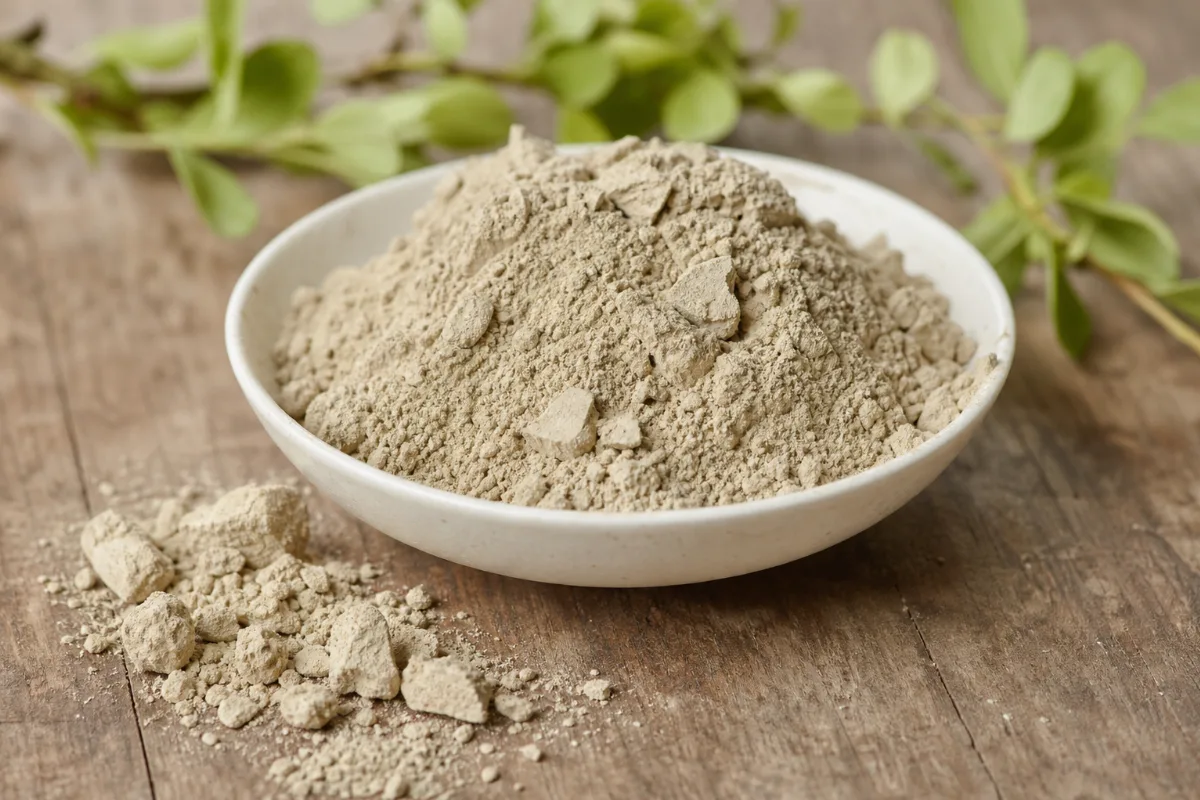
Clays & Charcoal · Clay
Fuller's Earth
Mixed clay minerals, variable (calcium montmorillonite or attapulgite types; a mineral, not a plant) · also called Fuller's earth, fullers earth, absorbent clay
Fuller's earth is a name for absorbent clays, not one exact mineral. Its best-tested use is emergency skin decontamination after chemical exposure, shown in pigs and in the lab. Doctors also use it in hospital poisoning care, for example after paraquat weed killer is swallowed. No human trial shows face-mask or detox benefits. Breathing the dust and metals in some clays are the main cautions.
General information, not medical advice. Last substantive update · Not medically reviewed. A named clinician has not signed off on this page. How this page is made
About Fuller's Earth
Fuller's earth is a variable absorbent clay. In pigs and lab tests it helped remove chemicals from skin, and doctors give it in hospital after paraquat poisoning. No human study supports face masks or detox. Do not swallow it as a remedy, avoid breathing the dust, and remember metals vary by deposit.
The main safety points
Do not swallow fuller's earth as a remedy. The only swallowed use we found is in hospital poisoning care, given by clinicians. If someone has swallowed a clay or any chemical and is unwell, call Poison Help in the US at 1-800-222-1222, or your local emergency number, and 911 for collapse, a seizure, trouble breathing or if they cannot be woken.
Avoid breathing the dry powder. Workers who mine and process fuller's earth have developed lung scarring (pneumoconiosis) after prolonged heavy exposure, and the Cosmetic Ingredient Review panel advises that sprays containing these solids be made to limit inhalation.
Fuller's earth is a mixed, variable mineral. A 2022 lab paper says it contains heavy-metal particles, and mercury was found in every cosmetic clay tested in a 2025 Polish survey. Labels cannot tell you what is in a powder.
What fuller's earth is
Fuller's earth is a name for a group of absorbent clays, not one exact mineral. A worker's lung report found calcium montmorillonite. A water-treatment paper uses the name for attapulgite. The Cosmetic Ingredient Review lists it as its own ingredient next to bentonite, attapulgite, kaolin and montmorillonite.
Its clay surfaces bind chemicals. That property is behind every use below: skin decontamination research, hospital use against a swallowed poison, and cosmetic powders. Hospital, military and skin-care products are different grades.
Emergency skin decontamination (animals and lab)
A 2021 pig study found fuller's earth and a reactive skin lotion were both highly effective against sulfur mustard and the nerve agent VX, and decontamination was still worthwhile if delayed up to 30 minutes (mustard) or 2 hours (VX). A 2007 swine study found both worked at 5 minutes, with the lotion statistically better against mustard skin injury and the two similar against VX.
Lab work on removed pig skin found a fuller's earth suspension recovered about 90% of a tracer chemical, against 54% for water alone and roughly 60 to 70% for dry powder. A second study found suspension and powder equal against paraoxon, with weak toxicity only at the strongest suspension. All of this used special formulations in pigs, cells and skin samples. No trial in people was found.
Hospital use against paraquat poisoning
Paraquat is a weed killer with a very high death rate when swallowed and no antidote. A 2011 review says activated charcoal and fuller's earth are routinely given to minimise further absorption, that gastric lavage should not be performed, and that the death rate is very high in all centres despite large variations in treatment. In rabbits either adsorbent lowered blood paraquat when given early.
This is hospital medicine given by clinicians. No result from a human trial of fuller's earth was read, and nothing here is advice for home use. If paraquat or any weed killer may have been swallowed, go to hospital at once.
Face masks and detox claims
Fuller's earth is sold as a mask for oily skin and as a detox. We found no human study of either. Safety panels list clays as cosmetic absorbents, which is a product job, not a proven benefit. NCCIH says a 2015 review found no compelling research that detox diets eliminate toxins, and a clay review warns that clays can also take up and release toxic elements.
Who should be extra careful
We found no data for pregnancy, breastfeeding, children, allergy or medicines. A review says the safety of eating clay is not fully established. People with asthma or lung disease should avoid dust. Ask a doctor or pharmacist before swallowing any clay, and keep powders away from children.
At a glance
Traditional uses history, not proof
- No traditional use is described in the sources we read.
- Used as a powder for household or skin decontamination because it adsorbs chemicals (2022 lab paper).
- Sold in cosmetics as an absorbent (Cosmetic Ingredient Review).
Studied for research
- Skin decontamination after chemical exposure: very-low (pig and lab work only)
- Water suspension versus dry powder: very-low (lab work)
- Swallowed-poison adsorbent in hospital (paraquat): insufficient evidence, clinicians only
- Face masks for oily skin and acne: insufficient, no human study
- Detox claims: insufficient, no human study
Main compounds
- Calcium montmorillonite (clay mineral)
- Attapulgite (fibrous clay mineral, sometimes called fuller's earth)
- Heavy-metal particles (reported as part of the mix)
Common forms
- Dry powder
- Water suspension (studied in the lab)
- Cosmetic mask powder (no human study found)
- Hospital adsorbent (clinicians only)
Research links: Poison Control (US): call 1-800-222-1222 · Skin decontamination in pigs, 2021 (abstract) · Medical management of paraquat ingestion, 2011 (abstract) · Fuller's earth pneumoconiosis, 1994 (abstract) · NCCIH: Detoxes and cleanses · Research Library · Genes & Biomarkers Library
What it is and its history
- Accepted scientific name
- Fuller's earth (a name for absorbent clays, not one exact mineral)
- Common names
- Fuller's earth (English); Absorbent clay (English)
- Family or group
- Layered clay minerals (phyllosilicates). Sources describe it as calcium montmorillonite (1994 report of a worker's lung) and, in a water-treatment paper, as attapulgite.
- Native range
- Not described in the sources we read.
- Habitat
- Mined from the ground; not described further.
- Harvest and processing
- Not covered in the sources we read. A 2024 paper heat-treated attapulgite at 500 degrees C for water treatment.
- Look-alikes and adulterants
- Name: Bentonite, attapulgite, kaolin, montmorillonite; Note: The 2003 CIR report lists fuller's earth as its own ingredient next to attapulgite, bentonite, kaolin and montmorillonite, and the products differ in mineral makeup.
Traditional use and history history, not clinical proof
| Tradition or era | Documented use | Source |
|---|---|---|
| Not described | No source we read describes the history or the origin of the name, so none is given here. | n/a |
| Modern | Used as a powder for household or skin decontamination because of its adsorbent properties (2022 lab paper). Studied by defence laboratories for chemical-agent skin decontamination (2007, 2021). | p34896712 |
Traditional use shows how it was used. It does not show that it works or is safe today.
What is inside, and how it may work
What it contains and how those compounds act in cells and animals. Laboratory and animal mechanisms are not proven effects in people.
Main compounds
| Compound | Family | Where it is concentrated | Activity studied | Level of evidence |
|---|---|---|---|---|
| Calcium montmorillonite (smectite clay) | clay mineral | High content in the lungs of a fuller's earth worker (1994 mineral analysis). | Layered, swelling clay; the surface binds chemicals. No drug-like activity described. 8 4 | Laboratory |
| Attapulgite (palygorskite, fibrous clay) | clay mineral | Some authors call attapulgite 'Fullers earth'. CIR relays an IARC ruling that fibres over 5 micrometres are possibly carcinogenic to humans. 13 5 | Authoritative guidance | |
| Heavy-metal particles | contaminants | Amounts not given in the abstract. | Described as part of why fuller's earth is non-uniform. 4 | Laboratory |
Mechanisms, receptors and pathways
| Target or pathway | Gene or receptor | What was found | Level |
|---|---|---|---|
| Adsorption of chemicals onto clay surfaces | Not applicable | Fuller's earth powder binds chemicals; in tests more tracer chemical was lifted off pig skin by a water suspension (about 90%) than by dry powder (about 60 to 70%) or water (54%). 15 | Laboratory |
| Swelling in water | Not applicable | The authors suggest water intercalates between clay lamellae, causing swelling and new adsorption zones. A suggestion, not proven. 4 | Laboratory hypothesis |
| Binding of swallowed poison in the gut | Not applicable | In rabbits given paraquat by mouth, fuller's earth or activated charcoal lowered blood paraquat. 10 | Animal research |
Absorption, metabolism and elimination
- Absorption
- Not studied as a substance taken in; clay is not expected to be a drug that enters the body, but this was not tested in the sources read.
- Distribution
- Not studied.
- Metabolism
- Not studied.
- Elimination
- Not studied.
- Bioavailability
- Not studied.
Isolated compounds versus whole extracts
Fuller's earth is a mixed, variable mineral. Results for one deposit, one formulation or one related clay (bentonite, attapulgite, kaolin) cannot be assumed for another.
Nutritional composition
Fuller's earth is not a food or nutrient source.
2 very low certainty3 not enough evidence
What was looked at
The 5 benefits and uses checked for Fuller's Earth, each with how strong the evidence is. Tap one to open it.
- Skin decontamination after chemical exposure (animal and lab work)Very low certainty
- Water suspension versus dry powder (lab work)Very low certainty
- Swallowed poison adsorbent in hospital (paraquat), clinicians onlyNot enough evidence
- Face masks for oily skin and acne (seller claim)Not enough evidence
- 'Detox' and 'pulls toxins out of the body' (seller claim)Not enough evidence
What is Fuller's Earth good for?
The uses people ask about and how strong the evidence is for each. None is proven in people. Read every row together with the Safety tab.
Benefits, one by one
Each card is a research question, not a promise. Tap a goal to filter. Open a card to see the studies, doses and limits.
Skin decontamination after chemical exposure (animal and lab work)
Very low certaintyIn pigs, fuller's earth removed or blocked a nerve agent (VX) and a blistering agent (sulfur mustard) from the skin about as well as a reactive skin lotion, and was still worthwhile when applied late.
2 studiesNot covered. This page gives no amounts or how-to for decontamination.
Studies, doses and limits
Results
A 2021 pig study (Israel) found fuller's earth and a reactive skin lotion were both highly effective against sulfur mustard and VX, and decontamination was still worthwhile if delayed up to 30 minutes (mustard) or 2 hours (VX). A 2007 swine study (France) found both worked at 5 minutes, with the lotion statistically better against mustard skin injury and the two similar against VX.
Effect sizes as reported
No effect sizes in the abstracts.
Why this rating
Animal evidence only, from government defence laboratories, with special formulations. Human use is not tested. Labelled very-low for people.
Form and dose studied
Not covered. This page gives no amounts or how-to for decontamination.
Who was studied
Pigs.
Limits
Pigs are a model for human skin, not people. The agents are military chemicals. The powders are special formulations, not shop products.
Why researchers looked
Military and emergency teams want a cheap, stable powder that can decontaminate many people quickly.
Proposed mechanism Pharmacological theory
Fuller's earth is an adsorbent: chemicals stick to the surface of the clay particles and are lifted off the skin. This is the usual explanation, not tested in the pig studies.
A proposed mechanism does not show that the effect happens in people.
This is emergency decontamination work in pigs with special formulations. It is not a reason to put craft or industrial powder on skin. After a chemical exposure, get emergency help.
Water suspension versus dry powder (lab work)
Very low certaintyIn lab tests on removed pig and human skin, fuller's earth mixed with water worked as well as dry powder against one poison, and removed more of a tracer chemical than water alone or dry powder.
2 studiesNot covered. This page gives no amounts or recipes.
Studies, doses and limits
Results
A 2017 French test on removed pig skin recovered a tracer chemical: about 54% with water, roughly 60 to 70% with dry fuller's earth and about 90% with a fuller's earth suspension. A 2022 study on skin cells, zebrafish embryos and removed pig and human skin found no difference in paraoxon passing through skin between powder and suspension, and only the strongest suspension showed weak toxicity.
Effect sizes as reported
54% (water) vs about 60-70% (dry powder) vs about 90% (suspension) tracer recovery in the 2017 study.
Why this rating
Lab and removed-skin work only. A harmless tracer and one organophosphate stand in for real exposures.
Form and dose studied
Not covered. This page gives no amounts or recipes.
Limits
Not living people. The 'safe tool' wording in the 2022 abstract is the authors' view for decontamination.
Why researchers looked
A wet slurry may be easier to apply than a dust and may be safer to handle, so researchers compared forms.
Proposed mechanism Laboratory hypothesis
The authors suggest water makes the clay swell and opens new surfaces between clay layers that can hold more chemical. Their suggestion, not proven.
A proposed mechanism does not show that the effect happens in people.
Lab work with a tracer chemical and removed skin. It does not show that a home paste cleans a chemical off a person.
Swallowed poison adsorbent in hospital (paraquat), clinicians only
Not enough evidenceParaquat is a weed killer with a very high death rate when swallowed. A 2011 review says activated charcoal and fuller's earth are routinely given in hospital to limit further absorption. No result from a trial of fuller's earth in people was found.
3 studiesNot covered. Doctors decide this; no amounts are given here.
Studies, doses and limits
What the trials found
A 2011 systematic review of human studies (a clinical pharmacology paper) and a 2017 case report. The review's abstract says the adsorbents are routinely given and that the death rate stays very high in all centres despite large variations in treatment. It does not report a trial showing that fuller's earth saves lives.
Results
A 1996 rabbit study found either adsorbent brought down blood paraquat, with no significant difference between them, and that giving one as early as possible helps. The 2017 case report lists fuller's earth and activated charcoal as adsorbents to start early; its own patient got lavage and charcoal and survived with kidney and gullet injury.
Why this rating
Routine hospital practice supported by an animal study and expert statements; no controlled human result was read. The 2011 review also says gastric lavage should not be performed, so older case reports may differ from current advice.
Form and dose studied
Not covered. Doctors decide this; no amounts are given here.
Who was studied
Rabbits; one human case report; a review of human poisoning studies.
Limits
Paraquat poisoning is rare in many countries and the death rate is very high whatever is given. A 2013 Spanish letter about fuller's earth being 'banished' from herbicide poisoning care has no abstract and could not be read.
Why researchers looked
Paraquat has no antidote, so doctors try to stop it being absorbed from the gut.
Proposed mechanism Animal and theory
Adsorbents bind the poison in the gut so less is absorbed. In rabbits either fuller's earth or activated charcoal lowered blood paraquat when given early.
A proposed mechanism does not show that the effect happens in people.
Hospital medicine only. Never a home treatment. Anyone who has swallowed paraquat needs emergency care at once; call poison help or emergency services.
Face masks for oily skin and acne (seller claim)
Not enough evidenceFuller's earth is sold as a mask for oily skin and acne. We found no trial in people for it. What is documented is that clay silicates work in cosmetics as absorbents, which is a product function, not a skin benefit.
2 studiesNot covered.
Studies, doses and limits
Results
No result to report. The 2003 and 2026 Cosmetic Ingredient Review assessments cover safety of clays in cosmetics, not whether they improve skin.
Why this rating
No human study of fuller's earth on oily or acne skin.
Form and dose studied
Not covered.
Limits
Safety panel opinions say nothing about benefit.
Why researchers looked
It soaks up oils, so sellers claim it helps oily skin. The research found is about decontamination, industry and safety.
Traditional use
No traditional use is described in the sources we read.
Proposed mechanism Pharmacological theory
The cosmetic safety panels list these clays as absorbents. Soaking up oil from a surface is a property of the powder, not shown to improve acne.
A proposed mechanism does not show that the effect happens in people.
Masks are made of a dry powder that is a lung and metal-contamination concern. See the Safety tab.
'Detox' and 'pulls toxins out of the body' (seller claim)
Not enough evidenceSellers say clay detoxes the body. No human study of fuller's earth for detox was found. NCCIH says a 2015 review found no compelling research that detox diets eliminate toxins.
3 studiesNot covered.
Studies, doses and limits
Results
A 2021 lab study of commercial and natural clays found their leachates did not contain enough ions to kill bacteria and that the authors warn of unsubstantiated clay claims.
Why this rating
No human study of fuller's earth for this use; general detox evidence is weak.
Form and dose studied
Not covered.
Limits
The NCCIH page and the clay reviews are general; none tests fuller's earth in people.
Why researchers looked
Because clay sticks to chemicals in a dish or a gut, people assume it can clean the body.
Traditional use
Clay eating has been seen in all parts of the world since antiquity, for cultural, nutritional or remedy reasons (Gomes 2018).
Proposed mechanism Narrative review
A 2018 review says clay particles could adsorb toxins for removal, but could also adsorb and release toxic elements such as heavy metals into the body. Theory, not a measured effect of fuller's earth.
A proposed mechanism does not show that the effect happens in people.
Do not swallow clay as a home detox. See the Safety tab.
Connections to the rest of health
How Fuller's Earth connects to the rest of our health knowledge graph. Every link says what kind of connection it is. A safety link (for example to the liver) is a warning, not a benefit. A study that merely mentions a topic never creates a benefit link.
Explore every connection: goals, body systems, organs, symptoms, genes
A. Wellness goals
| Connected to | Kind of connection | Evidence status | Context | Studies |
|---|---|---|---|---|
| Healthy Skin | Not enough evidence | Face masks for oily skin and acne (seller claim): Fuller's earth is sold as a mask for oily skin and acne. We found no trial in people for it. What is documented is that clay silicates work in cosmetics as absorbents, which is a product function, not a skin benefit. | 5 2 |
B. Body systems
| Connected to | Kind of connection | Evidence status | Context | Studies |
|---|---|---|---|---|
| Digestive system | Not enough evidence | Routinely given by clinicians as an adsorbent; no human outcome result read. Preparation or compound: Fuller's earth by mouth in hospital paraquat care |
7 10 | |
| Integumentary system | Very low certainty | Skin decontamination after chemical exposure; animal and lab work only. Preparation or compound: Fuller's earth powder or suspension on skin (pigs and removed skin) |
3 15 | |
| Integumentary System | Biological association | Very low certainty | Studied for: Skin decontamination after chemical exposure (animal and lab work) Studied for: Water suspension versus dry powder (lab work) | 3 16 15 4 5 2 |
| Digestive System | Biological association | Not enough evidence | Studied for: Swallowed poison adsorbent in hospital (paraquat), clinicians only Studied for: 'Detox' and 'pulls toxins out of the body' (seller claim) | 7 10 12 17 9 11 |
C. Body parts and organs
L. Active compounds
| Connected to | Kind of connection | Evidence status | Context | Studies |
|---|---|---|---|---|
| Calcium montmorillonite (smectite clay) | Biological association | Laboratory | Layered, swelling clay; the surface binds chemicals. No drug-like activity described. | 8 4 |
| Attapulgite (palygorskite, fibrous clay) | Biological association | Authoritative guidance | Some authors call attapulgite 'Fullers earth'. CIR relays an IARC ruling that fibres over 5 micrometres are possibly carcinogenic to humans. | 13 5 |
| Heavy-metal particles | Biological association | Laboratory | Described as part of why fuller's earth is non-uniform. | 4 |
Each connection is stored with the ingredient, the connected record, the kind of connection, the evidence status, the supporting studies, the preparation or compound involved, and a review date (last reviewed October 25, 2026).
Evidence at a glance: what the research found for 5 outcomes
Each outcome below is one thing researchers measured. Certainty is how far the evidence can be trusted, not how well it works. The full studies are on the next tab.
The evidence
The research centre for Fuller's Earth. Every record here was checked against PubMed or the publisher's page; we never list a study we have not verified.
Evidence by outcome
Bars show how many studies we found for each outcome, not how well it works. People are added up across trials only (reviews are not added, to avoid double counting).
How we rate evidence
High certainty
Several well-run trials or reviews agree; further research is unlikely to change the picture much.
Moderate certainty
Good trials point the same way, but some doubt remains.
Low certainty
Small, short or inconsistent trials. The finding could change with better research.
Very low certainty
Very little or very weak human data. Treat as a possibility only.
Mixed findings
Trials or reviews disagree with each other.
Not enough evidence
Not enough human research to say either way.
Evidence against
Good research found no benefit, or found harm.
We take the reviewers' own risk-of-bias and GRADE statements where they exist, and otherwise judge from study size, design, consistency, directness and whether a product matches what is sold. Many publications do not make evidence high. Method note: We read the PubMed abstracts of 16 papers (and the full text of one case report passage), plus the Poison Control and NCCIH pages. Where a statement could not be checked it is marked as such.
Study library: every study we checked 18
| Study | Design | People | Product, dose, length | Result |
|---|---|---|---|---|
| Bonglaisin 2022 Geophagia: Benefits and potential toxicity to human-A review. Front Public Health · PMID 35958861 · DOI |
Narrative review n/a |
Review of the habit of eating clay soil such as chalk or kaolin | n/a |
Says the safety of people who eat clay is yet to be fully established, that clay content varies between regions, that studies have found some minerals that are toxic if ingested, and that more metabolic studies are needed. Methods, limits and fundingOutcomes: Benefits and potential toxicity of clay eating Limitations: General review of clay eating, not of fuller's earth. Funding and conflicts: No conflicts declared. Read: abstract |
| Burnett 2026 Amended Safety Assessment of Naturally-Sourced Clays as Used in Cosmetics. Int J Toxicol · PMID 42313106 · DOI |
Authoritative guidance n/a |
Expert-panel safety assessment of 8 naturally sourced clay ingredients | n/a |
The panel concluded kaolin is safe in cosmetics as used. It concluded the other 7 clays are safe as used, except that data are insufficient to say they are safe in products that may be incidentally inhaled. They work in cosmetics as absorbents and bulking agents. Methods, limits and fundingOutcomes: Safety as used in cosmetics Limitations: The abstract does not list the 8 clays, so we cannot tell whether fuller's earth is one of them. Funding and conflicts: The authors declared no conflicts of interest. Read: abstract |
| Dachir 2021 Skin decontamination efficacy of sulfur mustard and VX in the pig model: A comparison between Fuller's earth and RSDL. Chem Biol Interact · PMID 33508307 · DOI |
Animal study animal |
Pigs exposed on the skin to sulfur mustard or the nerve agent VX, then decontaminated with fuller's earth or a reactive skin lotion (RSDL) | Fuller's earth (decontamination powder) Not given in abstract Delays of up to 30 min (mustard) and 2 h (VX) tested · vs Reactive Skin Decontaminant Lotion (RSDL) |
Fuller's earth and the lotion were both highly effective against both agents. Lesions were smaller the sooner decontamination happened. After VX, either product cut clinical symptoms and prevented death. Decontamination was still worthwhile if delayed up to 30 minutes (mustard) or 2 hours (VX). The authors prefer fuller's earth for a mass-casualty plan because of its safety, ease of use and shelf life. Methods, limits and fundingOutcomes: Lesion area and redness (mustard); cholinesterase inhibition, clinical symptoms and death (VX) Limitations: Pigs, not people; military-type agents and a decontamination formulation, not a skin-care powder. Number of pigs not given in the abstract. Funding and conflicts: Israel Institute for Biological Research (government defence research). No conflict statement in the abstract. Read: abstract |
| Danoy 2022 Aqueous suspensions of Fuller's earth potentiate the adsorption capacities of paraoxon and improve skin decontamination properties. J Hazard Mater · PMID 34896712 · DOI |
Lab study laboratory |
Skin cells in a dish, zebrafish embryos, and removed pig-ear and human abdominal skin in diffusion cells, using paraoxon (an organophosphate) | Fuller's earth powder and water suspensions (5%, 9.1%, 15%) Concentrations as stated 24 h diffusion · vs Powder vs suspension |
Of the suspensions tested (5%, 9.1% and 15% by weight), only the strongest showed weak toxicity. After 24 hours, paraoxon passing through the skin was no different with powder or suspension. The authors describe fuller's earth as non-uniform, made of clay aggregates and heavy-metal particles, and suggest water makes the clay swell and open new adsorbing surfaces. Methods, limits and fundingOutcomes: Toxicity of fuller's earth suspensions; paraoxon passing through skin after powder or suspension decontamination Limitations: Cells, embryos and removed skin only. The 'safe tool' conclusion is the authors' and applies to decontamination, not to everyday use. Funding and conflicts: Not stated in the abstract. One author is linked to a French civil-security ministry. Read: abstract |
| Elmore AR; Cosmetic Ingredient Review Expert Panel 2003 Final report on the safety assessment of aluminum silicate, calcium silicate, magnesium aluminum silicate, magnesium silicate, magnesium trisilicate, sodium magnesium silicate, zirconium silicate, attapulgite, bentonite, Fuller's earth, hectorite, kaolin, lithium magnesium silicate, lithium magnesium sodium silicate, montmorillonite, pyrophyllite, and zeolite. Int J Toxicol · PMID 12851164 |
Authoritative guidance n/a |
Expert-panel review of 17 clay-like cosmetic ingredients including fuller's earth | n/a |
The panel says clay silicates mainly work in cosmetics as adsorbents, opacifiers and thickeners. These ingredients were not significantly toxic in oral acute or short-term animal studies, but inhalation toxicity is readily shown in animals. Fibrosis and pneumoconiosis have been documented in workers mining and processing fuller's earth and several other minerals. The panel said sprays containing these solids should be made to minimise inhalation, and concluded the ingredients are safe as currently used in cosmetic formulations. It also reports that the IARC ruled attapulgite fibres longer than 5 micrometres possibly carcinogenic to humans. Methods, limits and fundingOutcomes: Safety of the ingredients as used in cosmetics Limitations: Covers 17 ingredients together, mostly animal and occupational data. Cosmetic use only; says nothing about swallowing. The IARC statement is relayed by the CIR abstract; the IARC page was not read. Funding and conflicts: Cosmetic Ingredient Review is an industry-supported panel; funding not stated in the abstract. Read: abstract |
| Fischer 2025 Analysis of Mercury Concentration in Cosmetic Clays. Toxics · PMID 40559980 · DOI |
Product analysis n/a |
Cosmetic clays of different colours and makers sold in Poland | n/a |
Mercury was found in every sample. The mean was 28.91 micrograms per kilogram (range 1.87 to 200.81). Green and white clays had the highest averages. The authors say these products likely need testing for metals. Methods, limits and fundingOutcomes: Mercury content Limitations: The abstract does not say whether any sample was fuller's earth. Applies to cosmetic clays in general. Funding and conflicts: No conflicts of interest declared. Read: abstract |
| Gawarammana 2011 Medical management of paraquat ingestion. Br J Clin Pharmacol · PMID 21615775 · DOI |
Narrative review |
Systematic search of human studies on paraquat herbicide poisoning (kinetics, features, prognosis, treatment) | n/a |
Paraquat poisoning has a very high death rate because of the poison itself and a lack of effective treatments. The abstract says activated charcoal and fuller's earth are routinely given to minimise further absorption, that gastric lavage should not be performed, and that haemodialysis and haemoperfusion are unlikely to change the course. For several other treatments it says there are no published human trials. The death rate is very high in all centres despite large differences in treatment. Methods, limits and fundingOutcomes: What is known about paraquat poisoning and how it is treated Limitations: The abstract does not say that fuller's earth was proven to save lives; it says it is routinely given. Hospital practice, not a wellness use. Funding and conflicts: Not stated in the abstract. Read: abstract |
| Gibbs 1994 Fuller's earth (montmorillonite) pneumoconiosis. Occup Environ Med · PMID 7951799 · DOI |
Case report |
1 One fuller's earth worker with signs of pneumoconiosis (dust disease of the lung) |
n/a |
Lung tissue showed dust-laden cells with mild fibrosis. Analysis showed a high content of montmorillonite. The authors conclude pneumoconiosis can result from prolonged heavy exposure to calcium montmorillonite (fuller's earth) without quartz, that the disease was relatively mild and caused little disability. Methods, limits and fundingOutcomes: Lung pathology and mineral analysis Limitations: A single worker with heavy long-term workplace exposure. Not a measure of risk from home use. Read: abstract |
| Gomes 2018 Healing and edible clays: a review of basic concepts, benefits and risks. Environ Geochem Health · PMID 28150053 · DOI |
Narrative review n/a |
Review of healing and edible clays in general | n/a |
Says clay particles could adsorb and carry away toxins, but could also adsorb and make available toxic elements such as heavy metals through swallowing or skin absorption. Clay eating has been seen all over the world since antiquity. Methods, limits and fundingOutcomes: Benefits and risks of clays used for treatment, skin care and eating Limitations: A general review of clays, not of fuller's earth. Funding and conflicts: Not stated in the abstract. Read: abstract |
| Idid 1996 Effects of Fuller's Earth and activated charcoal on oral absorption of paraquat in rabbits. Clin Exp Pharmacol Physiol · PMID 8886489 · DOI |
Animal study animal |
30 30 male rabbits given paraquat by mouth, then fuller's earth or activated charcoal 0.5 or 2 hours later, or nothing (control) |
Fuller's earth slurry by mouth (animal study) Not repeated here Given 0.5 or 2 h after paraquat · vs Activated charcoal; untreated control |
Either adsorbent brought down the blood paraquat level. There was no significant difference between them. The authors conclude that giving an adsorbent as early as possible helps reduce absorption from the gut. Methods, limits and fundingOutcomes: Blood paraquat levels over 24 hours Limitations: Rabbits, a single poison, small groups. Not a human outcome study. Funding and conflicts: Not stated in the abstract. Read: abstract |
| Incledion 2021 A New Look at the Purported Health Benefits of Commercial and Natural Clays. Biomolecules · PMID 33466399 · DOI |
Lab study laboratory |
Commercial and natural clays tested on two kinds of human cells in a dish and on wound bacteria | n/a |
Clay leachates did not contain enough ions to kill bacteria. All leachates were toxic to one white-blood-cell type, while suspensions were less so. A green clay killed bacteria only in suspension. The authors stress the dangers of unregulated marketing and unsubstantiated clay claims. Methods, limits and fundingOutcomes: Cell toxicity, wound-healing response and antibacterial effects of clays Limitations: Cell and bacteria work. It does not name fuller's earth in the abstract. Funding and conflicts: No conflict of interest declared. Read: abstract |
| Janeela 2017 Paraquat poisoning: Case report of a survivor. J Family Med Prim Care · PMID 29417032 · DOI |
Case report |
1 One 28-year-old man in India who swallowed paraquat herbicide and survived with kidney injury and gullet erosions |
n/a |
The report says there is no known antidote and treatment is mainly supportive. Its discussion lists fuller's earth and activated charcoal among adsorbents to start as early as possible, and cites another paper for that, not a trial. The patient in this report was given gastric lavage and activated charcoal at a local hospital and recovered. Methods, limits and fundingOutcomes: Clinical course; discussion of treatment Limitations: One case. The fuller's earth mention comes from the full text of the discussion; the abstract does not mention it. A 2011 review says lavage should not be performed. Funding and conflicts: No conflicts declared. Read: full-text |
| Mahmoud 2024 Enhanced removing of phosphate ions from agricultural drainage wastewater by using microwave-assisted synthesized attapulgite (Fullers earth)@carboxymethylcellulose nanocomposite. Int J Biol Macromol · PMID 37977453 · DOI |
Lab study laboratory |
Water-treatment chemistry using heat-treated attapulgite clay | n/a |
The title and abstract use 'attapulgite (Fullers earth)', showing that some authors use the name fuller's earth for attapulgite clay. It is a water-clean-up study with no health outcome. Methods, limits and fundingOutcomes: Removal of phosphate from farm drainage water Limitations: Used only to show how the name is used. Nothing about health. Funding and conflicts: No competing interests declared. Read: abstract |
| Maxim 2016 Bentonite toxicology and epidemiology - a review. Inhal Toxicol · PMID 27809675 · DOI |
Narrative review n/a |
Review of studies on bentonite, a related clay | n/a |
Concludes the main exposure of concern is breathing respirable dust at work. Bentonite is probably not more toxic than other dusts not otherwise regulated and is not classed as a carcinogen by any regulator, but some bentonite may contain variable amounts of respirable crystalline silica, a recognised human carcinogen. Methods, limits and fundingOutcomes: Toxicity and epidemiology of bentonite Limitations: About bentonite, not fuller's earth. Fuller's earth is sometimes a bentonite-type clay and the silica point is relevant only where that is so. Funding and conflicts: Not stated in the abstract. Read: abstract |
| Roul 2017 Comparison of four different fuller's earth formulations in skin decontamination. J Appl Toxicol · PMID 28745436 · DOI |
Lab study laboratory |
Test-tube adsorption and pig skin taken from animals (ex vivo), using a harmless tracer chemical (4-cyanophenol) | Fuller's earth: free powder, on tape, on a glove, or as a suspension Not given in abstract Short exposure · vs Water decontamination |
Water alone recovered 54% of the tracer. Dry fuller's earth recovered roughly 60 to 70%. A fuller's earth suspension in water reached about 90%. More fuller's earth and longer contact removed more tracer in the test tube. The authors suggest a ready-to-use device for self-application. Methods, limits and fundingOutcomes: How much tracer was removed from the skin by water, dry fuller's earth, or fuller's earth in a glove, tape or suspension Limitations: Tracer chemical on removed pig skin, not a poison on living skin or people. Funding and conflicts: Not stated in the abstract. One author works for a French civil-security ministry. Read: abstract |
| Taysse 2007 Skin decontamination of mustards and organophosphates: comparative efficiency of RSDL and Fuller's earth in domestic swine. Hum Exp Toxicol · PMID 17370872 · DOI |
Animal study animal |
Domestic swine exposed to sulfur mustard or VX, decontaminated 5 minutes later | Fuller's earth Not given in abstract Applied 5 minutes after exposure · vs RSDL lotion with sponge |
Both products worked when used 5 minutes after contamination. Against mustard skin injury three days later the lotion was statistically better than fuller's earth. Against VX, which cut blood cholinesterase by 67%, the two products were similar, and both completely prevented cholinesterase inhibition. Methods, limits and fundingOutcomes: Skin injury and inflammation (mustard); blood cholinesterase (VX) Limitations: Pigs, not people; one early time point; military agents. Funding and conflicts: French defence research centre (author affiliation). Funding not stated in the abstract. Read: abstract |
| n/a 2026 NCCIH (US National Institutes of Health): Detoxes and Cleanses: What You Need To Know (page read 25 October 2026) n/a · Source |
Authoritative guidance n/a |
n/a | n/a |
Says only a small number of studies of detox programs in people exist and they were low quality. A 2015 review found no compelling research that detox diets eliminate toxins from the body. The FDA and FTC have acted against companies selling detox products that hid ingredients. Methods, limits and fundingOutcomes: What research says about detox programs Limitations: A general page about detoxes. It does not mention fuller's earth. Read: full-text |
| n/a 2026 Poison Control (US): Need immediate assistance? (page read 25 October 2026) n/a · Source |
Authoritative guidance n/a |
n/a | n/a |
Call 1-800-222-1222 for free, confidential help from a poison expert, 24 hours a day. An online tool is also offered. Call 911 immediately if the person collapses, has a seizure, has trouble breathing or cannot be awakened. Call the poison centre rather than use the tool for babies under 6 months, adults over 79, pregnancy or self-harm. Methods, limits and fundingOutcomes: What to do in a suspected poisoning in the US Limitations: A general help page, not about clay. Read: full-text |
What we do not know yet
- No trial in people of fuller's earth for skin decontamination.
- No human outcome result for fuller's earth in paraquat poisoning was read.
- No study of fuller's earth face masks or detox.
- No metal or silica testing of retail skin-care products.
- No data on pregnancy, breastfeeding, children, allergy or medicines.
- No regulator statement specific to fuller's earth was read besides cosmetic expert panels.
How new research is added
New studies are found by a saved PubMed search and placed in a review queue. A person reads each one before it changes this page.
Lab markers
What changed in blood or saliva tests during trials. A changed number is not the same as feeling or being healthier, and we give no "normal ranges".
Safety
What studies and official sources say about side effects, medicines and who should check first. Each point shows what kind of evidence it comes from.
Main points to know 5
- Do not swallow it. Hospital use against paraquat is clinicians only. The only swallowed use we found is in hospital poisoning care, where doctors give fuller's earth or activated charcoal after paraquat poisoning. No home use is suggested. If someone has swallowed a clay or other product and is unwell, call Poison Help in the US at 1-800-222-1222, and 911 for collapse, a seizure, trouble breathing or if they cannot be woken. In other countries call your local emergency number. Authoritative guidance 18 7
- Dust can scar the lungs with heavy long-term exposure. Workers who mine and process fuller's earth have developed pneumoconiosis (a dust disease of the lung). A 1994 report of one worker found mild fibrosis, and said the disease was relatively mild with little disability. CIR says inhalation toxicity of these silicates is readily shown in animals and advises sprays be made to limit inhalation. Avoid breathing the dry powder. Case report and authoritative guidance 8 5
- Metals are a quality concern. A 2022 lab paper describes fuller's earth as non-uniform, made of clay aggregates and heavy-metal particles. A 2025 Polish survey found mercury in every cosmetic clay tested, although it does not say whether any was fuller's earth. A label cannot tell you the metal content. Laboratory and product analysis 4 6
- It is not a detox. No human study shows fuller's earth detoxes the body. A clay review warns clay can also take up and release toxic elements such as heavy metals. NCCIH reports no compelling research that detox diets remove toxins. Narrative review 9 17
- Cosmetic safety opinions cover cosmetics only. The Cosmetic Ingredient Review panel found fuller's earth and related silicates safe as currently used in cosmetics in 2003, with a warning about inhalable sprays. Its 2026 update on eight clays found them safe as used except for products that may be incidentally inhaled, and we cannot tell whether fuller's earth is one of the eight. Neither covers swallowing. Authoritative guidance 5 2
Side effects 4
| Effect | How often | Severity and recovery | Evidence |
|---|---|---|---|
| Lung scarring (pneumoconiosis) after prolonged heavy dust exposure at work Mining and processing workers. Home users breathe far less, but CIR still advises limiting inhalation of powders and sprays. | Not established | moderate Not stated; the 1994 report called the disease relatively mild | Case report and authoritative guidance 8 5 |
| Lung irritation from breathing fine dust (animal data) CIR says inhalation toxicity is readily demonstrated in animals, depending on particle size, concentration and mineral makeup. | Not established | unknown Not stated | Animal study via review 5 |
| Weak toxicity to skin cells and zebrafish embryos at the strongest suspension (15%) The 5% and 9.1% suspensions did not show toxicity in the abstract. Cells and embryos, not people. | Not established | unknown Not applicable | Laboratory 4 |
| No human skin-reaction rates, allergy reports or swallowing case series for fuller's earth were found Not described is not proof of safety. | Not established | unknown n/a | Gap |
Liver
No liver injury from fuller's earth was found in the sources we read. LiverTox was not searched.
How often. No data.
This is a safety connection. It is not evidence that Fuller's Earth supports liver health.
Medicines and supplements 2
| With | Why it matters | Importance | Evidence | What to do |
|---|---|---|---|---|
| Medicines, supplements and nutrients taken by mouth all | Adsorbents are given in hospital to bind swallowed poisons so less is absorbed, so in theory a swallowed clay could bind other things in the gut too. | No interaction study with fuller's earth was found. This is theory from how adsorbents are used, not a measured drug interaction. | Pharmacological theory Not enough evidence 7 9 | Do not swallow clay without asking a pharmacist, especially if you take medicines that must be absorbed. |
| Skin medicines and acne treatments topical | Not described in the sources we read. | No study was found. | None found Not enough evidence | Ask a pharmacist or doctor if you use prescription skin treatments. |
Who should check first 6
| Situation | Advice | Evidence |
|---|---|---|
| Anyone: swallowing it as a remedy | Not advised. No benefit shown and the safety of eating clay is not established. Hospital use in poisoning is clinicians only. | Narrative review 1 7 |
| Pregnancy and breastfeeding | No data on fuller's earth were found. A review says the safety of clay eating, which is thought common in pregnancy, is not fully established. Ask a clinician; do not swallow clay. | Gap 1 |
| Babies and children | No data were found. Keep powder out of reach so it is not swallowed or breathed in. | Gap |
| Asthma, lung disease or anyone who breathes dust at work | Avoid breathing the dry powder; workers should follow workplace dust rules. Silicates have caused lung disease in mine and plant workers. | Case report and authoritative guidance 8 5 |
| Open wounds, burns or chemical injuries | Do not treat a chemical burn or serious injury with a clay. Seek emergency care. Pig studies used special decontamination formulations. | Animal study 3 15 |
| Allergy or sensitive skin | No allergy rates for fuller's earth were found. Test a small patch of skin first and stop if it reacts. | Gap |
Overdose, product quality and regulators
Summary. Fuller's earth is a mineral, so there are no toxic plant parts. The documented concerns are breathing the dust at work, metal particles in a non-uniform mineral, and the unproven safety of swallowing clay.
Amounts. No safe or harmful amount has been set in the sources we read.
Onset and course. Lung disease in workers followed prolonged heavy exposure (1994 report). No acute poisoning course for swallowed fuller's earth was found.
Repeated use. No data for repeated home use.
Animal data. CIR reports these silicates were not significantly toxic in oral acute or short-term oral animal studies, but inhalation toxicity is readily demonstrated.
Not read. Original toxicology reports behind the CIR summary were not read. IARC and workplace exposure-limit pages were not read.
Fuller's earth is dug from the ground and varies by deposit. Metals can come with it.
Heavy-metal particles. A 2022 lab paper describes fuller's earth as heterogeneous, made of elementary clay aggregates and heavy-metal particles. It does not name the metals in the abstract. 4
Mercury in cosmetic clays. Mercury was found in every cosmetic clay sold in Poland that was tested (mean 28.91, range 1.87 to 200.81 micrograms per kilogram). The abstract does not say whether fuller's earth was one of them. 6
Crystalline silica in related clays. A review of bentonite says some bentonite may contain variable amounts of respirable crystalline silica, a recognised human carcinogen. That review is about bentonite, and some fuller's earths are bentonite-type clays. 14
Attapulgite fibres. CIR relays that IARC ruled attapulgite fibres longer than 5 micrometres possibly carcinogenic to humans. Some fuller's earth is attapulgite. 5 13
| Body | Action | Date |
|---|---|---|
| Poison Control (US, National Capital Poison Center) (United States) | Call 1-800-222-1222 for free, confidential help, 24 hours a day. Call 911 if the person collapses, has a seizure, has trouble breathing or cannot be awakened. source | |
| Cosmetic Ingredient Review Expert Panel (United States (industry-supported panel)) | 2003: fuller's earth and related silicates safe as currently used in cosmetic formulations; sprays should be formulated to minimise inhalation. source | 2003 |
| Cosmetic Ingredient Review Expert Panel (amended assessment) (United States (industry-supported panel)) | 2026: eight naturally sourced clays safe as used in cosmetics except that data are insufficient for products that may be incidentally inhaled. source | 2026 |
| NCCIH (US National Institutes of Health) (United States) | Says a 2015 review found no compelling research that detox diets eliminate toxins. source | 2026-10 |
When to get medical help
- Someone has swallowed a clay, powder or any chemical and feels unwell, or a child has swallowed it: call Poison Help (US 1-800-222-1222) or your local emergency number.
- Collapse, a seizure, trouble breathing or being impossible to wake: call emergency services (911 in the US) now.
- Suspected swallowing of a weed killer such as paraquat: this is an emergency. Go to hospital at once; do not wait for symptoms.
- A chemical has splashed on the skin or eyes: follow the product's emergency instructions, rinse and call poison help or emergency services.
- Cough, wheeze or chest tightness after breathing in dry powder: stop and get medical advice.
Stop using the product and contact a clinician or emergency service. In the US, Poison Control is 1-800-222-1222.
General information only, not medical advice. Ask a clinician or pharmacist before use, especially with medicines, in pregnancy or with a health condition. See the Natural Remedy Safety guide.
Frequently asked questions
What is fuller's earth?
It is the name for a group of absorbent clays, not one exact mineral. In the sources we read it is described as calcium montmorillonite in one workplace report and as attapulgite in a water-treatment paper. A 2022 lab paper calls it a layered clay (phyllosilicate) that is non-uniform and contains heavy-metal particles.
Does fuller's earth detox the body?
Is it safe to swallow?
We do not advise it. The only swallowed use we found is in hospital poisoning care given by clinicians, and the safety of eating clay is not fully established. If someone has swallowed a clay or other product and is unwell, call Poison Help in the US at 1-800-222-1222, or your local emergency number, and 911 for collapse, a seizure or trouble breathing.
Why do hospitals use fuller's earth for paraquat poisoning?
Paraquat has no antidote and a very high death rate, so doctors try to limit how much is absorbed from the gut. A 2011 review says activated charcoal and fuller's earth are routinely given for this. In rabbits either one lowered blood paraquat. It is hospital care only, and the review says treatment results stay poor in all centres.
Does it work for skin decontamination after a chemical exposure?
In pigs it worked well against a nerve agent (VX) and sulfur mustard, about as well as a reactive skin lotion in a 2021 study, though the lotion was statistically better against mustard skin injury in a 2007 study. These are special formulations tested in animals, not people. After a chemical exposure, follow emergency instructions and call for help.
Does it help oily skin or acne as a face mask?
Is the dust dangerous?
Does it contain heavy metals?
Is it the same as bentonite or attapulgite?
Do cosmetic regulators say it is safe?
The Cosmetic Ingredient Review panel (an industry-supported expert group, not a government approval) found fuller's earth and related silicates safe as currently used in cosmetics in 2003, with a caution on inhalable sprays. A 2026 update on eight clays found them safe as used except for products that may be incidentally inhaled; we cannot tell whether fuller's earth is among the eight.
Can I use it in pregnancy or on children?
We found no data. A review says the safety of clay eating, which is thought to be common in pregnancy, is not fully established. Ask a doctor or pharmacist, do not swallow clay, and keep powders away from children.
Explore by health goal
Editorial transparency
- Written by
- AlternativeMed editorial team. Research compiled with AI assistance, then checked against PubMed records.
- Medical review
- None. This page has not been reviewed by a physician or pharmacist.
- First published
- 2026-10-25
- Last substantive update
- 2026-10-25
- How we research
- We read the PubMed abstracts of 16 papers (and the full text of one case report passage), plus the Poison Control and NCCIH pages. Where a statement could not be checked it is marked as such.
- How we rate evidence
- See "How we rate evidence" in the Evidence tab.
- Independence
- No product is promoted on this page. No affiliate links are shown. This page gives no dose, preparation, decontamination or poisoning-treatment instructions.
Sources 18
Each source was opened and checked. Where we read only the abstract, it says so. The small numbers in the text point here.
- Bonglaisin JN, Kunsoan NB, Bonny P, Matchawe C, Tata BN, Nkeunen G, Mbofung CM. Geophagia: Benefits and potential toxicity to human-A review.. Front Public Health. 2022. PMID 35958861. DOI 10.3389/fpubh.2022.893831. (abstract)
- Burnett CL, Bergfeld WF, Belsito DV, Cohen DE, Klaassen CD, Liebler DC, Rettie AE, Ross D, Shank RC, Slaga TJ, Snyder PW, Tilton SC, Fiume MM, Heldreth B. Amended Safety Assessment of Naturally-Sourced Clays as Used in Cosmetics.. Int J Toxicol. 2026. PMID 42313106. DOI 10.1177/10915818261455355. (abstract)
- Dachir S, Cohen M, Buch H, Kadar T. Skin decontamination efficacy of sulfur mustard and VX in the pig model: A comparison between Fuller's earth and RSDL.. Chem Biol Interact. 2021. PMID 33508307. DOI 10.1016/j.cbi.2021.109393. (abstract)
- Danoy A, Durmaz K, Paoletti M, Vachez L, Roul A, Sohier J, Verrier B. Aqueous suspensions of Fuller's earth potentiate the adsorption capacities of paraoxon and improve skin decontamination properties.. J Hazard Mater. 2022. PMID 34896712. DOI 10.1016/j.jhazmat.2021.127714. (abstract)
- Elmore AR; Cosmetic Ingredient Review Expert Panel. Final report on the safety assessment of aluminum silicate, calcium silicate, magnesium aluminum silicate, magnesium silicate, magnesium trisilicate, sodium magnesium silicate, zirconium silicate, attapulgite, bentonite, Fuller's earth, hectorite, kaolin, lithium magnesium silicate, lithium magnesium sodium silicate, montmorillonite, pyrophyllite, and zeolite.. Int J Toxicol. 2003. PMID 12851164. (abstract)
- Fischer A, Brodziak-Dopierala B, Janska W, Jeyranyan L, Malara B. Analysis of Mercury Concentration in Cosmetic Clays.. Toxics. 2025. PMID 40559980. DOI 10.3390/toxics13060507. (abstract)
- Gawarammana IB, Buckley NA. Medical management of paraquat ingestion.. Br J Clin Pharmacol. 2011. PMID 21615775. DOI 10.1111/j.1365-2125.2011.04026.x. (abstract)
- Gibbs AR, Pooley FD. Fuller's earth (montmorillonite) pneumoconiosis.. Occup Environ Med. 1994. PMID 7951799. DOI 10.1136/oem.51.9.644. (abstract)
- Gomes CSF. Healing and edible clays: a review of basic concepts, benefits and risks.. Environ Geochem Health. 2018. PMID 28150053. DOI 10.1007/s10653-016-9903-4. (abstract)
- Idid SZ, Lee CY. Effects of Fuller's Earth and activated charcoal on oral absorption of paraquat in rabbits.. Clin Exp Pharmacol Physiol. 1996. PMID 8886489. DOI 10.1111/j.1440-1681.1996.tb01757.x. (abstract)
- Incledion A, Boseley M, Moses RL, Moseley R, Hill KE, Thomas DW, Adams RA, Jones TP, BeruBe KA. A New Look at the Purported Health Benefits of Commercial and Natural Clays.. Biomolecules. 2021. PMID 33466399. DOI 10.3390/biom11010058. (abstract)
- Janeela MA, Oommen A, Misra AK, Ramya I. Paraquat poisoning: Case report of a survivor.. J Family Med Prim Care. 2017. PMID 29417032. DOI 10.4103/2249-4863.222042. (full-text)
- Mahmoud ME, Obada MK, Nabil GM. Enhanced removing of phosphate ions from agricultural drainage wastewater by using microwave-assisted synthesized attapulgite (Fullers earth)@carboxymethylcellulose nanocomposite.. Int J Biol Macromol. 2024. PMID 37977453. DOI 10.1016/j.ijbiomac.2023.128081. (abstract)
- Maxim LD, Niebo R, McConnell EE. Bentonite toxicology and epidemiology - a review.. Inhal Toxicol. 2016. PMID 27809675. DOI 10.1080/08958378.2016.1240727. (abstract)
- Roul A, Le CA, Gustin MP, Clavaud E, Verrier B, Pirot F, Falson F. Comparison of four different fuller's earth formulations in skin decontamination.. J Appl Toxicol. 2017. PMID 28745436. DOI 10.1002/jat.3506. (abstract)
- Taysse L, Daulon S, Delamanche S, Bellier B, Breton P. Skin decontamination of mustards and organophosphates: comparative efficiency of RSDL and Fuller's earth in domestic swine.. Hum Exp Toxicol. 2007. PMID 17370872. DOI 10.1177/0960327107071866. (abstract)
- n/a. NCCIH (US National Institutes of Health): Detoxes and Cleanses: What You Need To Know (page read 25 October 2026). n/a. 2026. (full-text)
- n/a. Poison Control (US): Need immediate assistance? (page read 25 October 2026). n/a. 2026. (full-text)


