Clays & Charcoal · Clay
Attapulgite (Palygorskite)
Palygorskite (a fibrous clay mineral, hydrated magnesium aluminium silicate; not a plant) · also called Attapulgite, palygorskite, activated attapulgite (medicine grade)
Attapulgite is a fibrous clay that was once an ingredient in over-the-counter diarrhea medicines. Small trials in adults and children gave mixed, mostly older results. In the US, activated attapulgite sits on the FDA list of antidiarrheal ingredients with inadequate data. The main caution is breathing the dust: IARC rates long fibers as possibly carcinogenic to humans. We found no human study that supports detox claims.
General information, not medical advice. Last substantive update · Not medically reviewed. A named clinician has not signed off on this page. How this page is made
About Attapulgite (Palygorskite)
Attapulgite is the same mineral as palygorskite, a fibrous clay. It was an ingredient in over-the-counter diarrhea medicines, and the human trials are small and mostly from the 1990s. The US FDA lists activated attapulgite among antidiarrheal ingredients with inadequate data. IARC warns about long fibers breathed as dust. No source supports detox.
What it is
Attapulgite is another name for palygorskite, a hydrated magnesium aluminium silicate that forms needle-like crystals in clay deposits. It has been mined since the 1930s and is used mainly in pet waste absorbers, oil and grease absorbers and drilling muds.
Pharmaceutical products used a purified, activated form. It is a different clay from bentonite and kaolin, so results do not carry across.
Traditional and current uses
The sources we read describe industrial use and use in some anti-diarrhoeal preparations. Today attapulgite is mainly an industrial and pet-litter mineral; we did not find a current US over-the-counter diarrhea product we could verify.
Traditional use is not proof that it works or is safe.
What the research shows
Adults: a 1995 double-blind trial of 30 people found attapulgite beat placebo on stool frequency and consistency. A 1990 open-label trial found loperamide cut stool frequency more and ended unformed stools sooner (14.2 against 19.5 hours), with similar overall relief.
Children: a 1992 trial of 113 children found normal stools one day sooner than with placebo. A 1993 review pooled 7,616 infants and children in open and placebo-controlled trials.
Lab and animals: attapulgite bound cholera and E. coli toxins in a dish. A Nevada palygorskite sample did not cause mesothelioma in mice, while asbestos did. These do not show benefit or safety in people.
Limits: the trials are small, mostly old and about specific medicine products. We read abstracts, not full papers.
At a glance
Traditional uses history, not proof
- Mined since the 1930s, mainly for pet-waste and oil absorbers and drilling muds (IARC).
- Used in some anti-diarrhoeal preparations (IARC).
Studied for research
- Acute diarrhea in adults (medicine tablets), low and mixed
- Acute diarrhea in infants and children (medicine, older studies), low
- Detox or heavy-metal removal, very low (lab only)
- Skin and anti-inflammatory effects, insufficient (mouse and cell work)
Main compounds
- Palygorskite (hydrated magnesium aluminium silicate)
Common forms
- Purified, activated form used in diarrhea medicines (older trials)
- Industrial and pet-litter grades are different products
Research links: IARC Monograph 68: palygorskite (attapulgite) · US 21 CFR 310.545 (eCFR) · Adult placebo-controlled trial, 1995 (abstract) · Children's placebo-controlled trial, 1992 (abstract) · NCCIH: Detoxes and cleanses · Poison Control · Research Library · Genes & Biomarkers Library
What it is and its history
- Accepted scientific name
- Attapulgite, also called palygorskite: a fibrous clay mineral (hydrated magnesium aluminium silicate)
- Synonyms
- Palygorskite; Attapulgite; Activated attapulgite (purified medicine grade)
- Common names
- Attapulgite (English); Palygorskite (English)
- Family or group
- Fibrous chain-structure clay mineral; palygorskite is a hydrated magnesium aluminium silicate (IARC).
- Native range
- Clay deposits in several areas of the world, with a major commercially important deposit in the United States (IARC).
- Habitat
- Mined from clay deposits.
- What it looks like
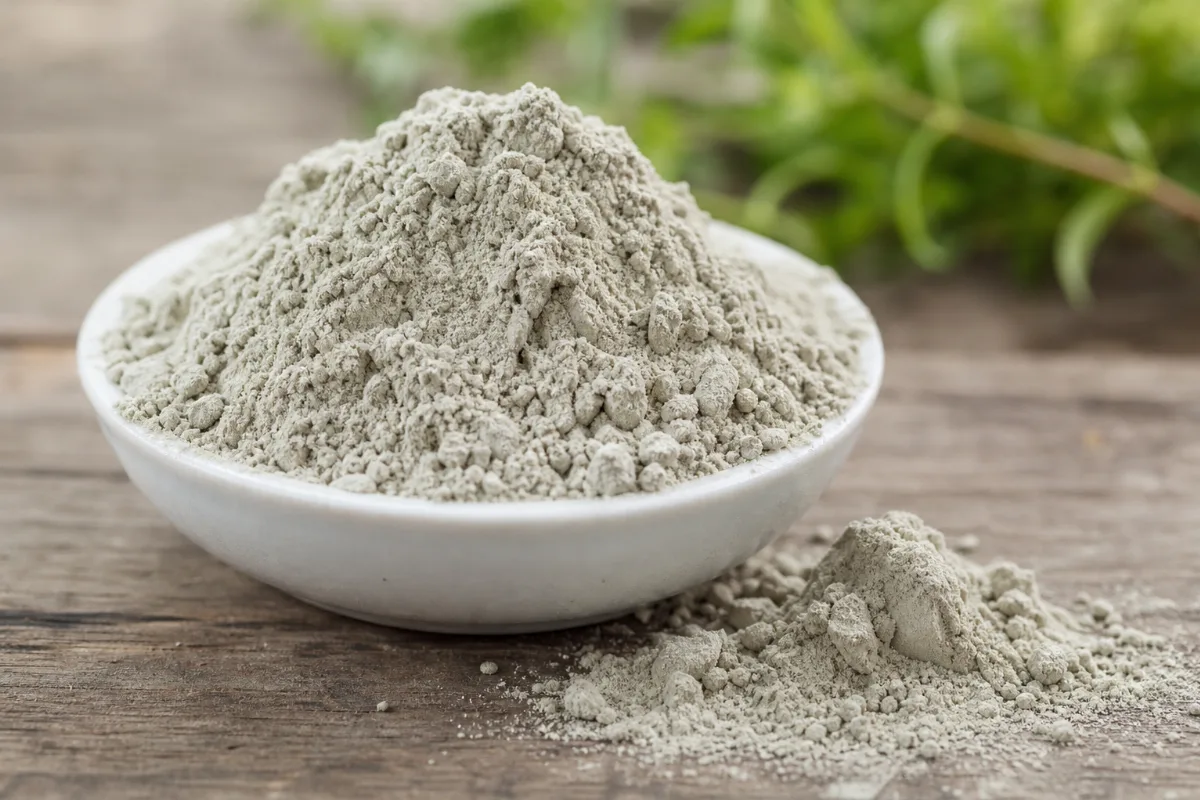
- Needle-like (fibrous) crystals.
- Harvest and processing
- Mined since the 1930s. Pharmaceutical products used a purified, activated form (trial abstracts). Processing details were not checked.
- Look-alikes and adulterants
- Name: Bentonite, kaolin, diosmectite; Note: Different clay minerals. One clay's results should not be applied to another. Attapulgite is fibrous, which is the reason for its separate fiber-dust warning.
Traditional use and history history, not clinical proof
| Tradition or era | Documented use | Source |
|---|---|---|
| Industrial and medicine use, 20th century | Mined since the 1930s and used mainly as an absorbent for pet waste, oils and greases, and in drilling muds. Used also in anti-diarrhoeal preparations. | s-iarc68 |
| 1990s diarrhea trials | Tested in adults and children as a medicine for acute diarrhea in the studies listed in this profile. | p7657965 |
Traditional use shows how it was used. It does not show that it works or is safe today.
What is inside, and how it may work
What it contains and how those compounds act in cells and animals. Laboratory and animal mechanisms are not proven effects in people.
Main compounds
| Compound | Family | Where it is concentrated | Activity studied | Level of evidence |
|---|---|---|---|---|
| Palygorskite | clay mineral (fibrous silicate) | Bound cholera and E. coli toxins in a dish; fibre length varies with the deposit and is linked to the cancer hazard class. 13 8 7 | Laboratory |
Mechanisms, receptors and pathways
| Target or pathway | Gene or receptor | What was found | Level |
|---|---|---|---|
| Adsorption of toxins | None | Attapulgite and sodium bentonite bound cholera toxin and E. coli heat-labile toxin in a dish; most toxin activity was lost after binding. The authors say the gut conditions were not modelled. 8 | Laboratory |
| Fiber length and cell damage | None | The longest or thickest fibers were most toxic to rat pleural cells across fibre types, and chromosome mis-sorting matched animal tumor results. 10 | Laboratory |
| Inflammation (mouse skin) | None | Palygorskite reduced ear swelling and neutrophil movement in a mouse model. 2 | Animal research |
Absorption, metabolism and elimination
- Absorption
- Not described in the sources read.
- Distribution
- Not described.
- Elimination
- Not described.
- Bioavailability
- Not described.
Isolated compounds versus whole extracts
Pharmaceutical (purified, activated), cosmetic and industrial grades are different products, and copper-treated palygorskite is another. Results for one do not carry over to the others.
Nutritional composition
Attapulgite is not a food or nutrient. It is not a source of minerals for the body.
2 low certainty2 very low certainty1 not enough evidence
What was looked at
The 5 benefits and uses checked for Attapulgite (Palygorskite), each with how strong the evidence is. Tap one to open it.
- Acute diarrhea in adults (activated attapulgite tablets)Low certainty
- Acute diarrhea in infants and children (medicine, older studies)Low certainty
- Detox and heavy-metal removal (claim check)Very low certainty
- Skin use and anti-inflammatory effects (lab and mouse)Not enough evidence
- Modified palygorskite for diarrhea in farm animalsVery low certainty
What is Attapulgite (Palygorskite) good for?
The uses people ask about and how strong the evidence is for each. The diarrhea findings are about specific medicine products from the 1990s, not clay in general.
Benefits, one by one
Each card is a research question, not a promise. Tap a goal to filter. Open a card to see the studies, doses and limits.
Acute diarrhea in adults (activated attapulgite tablets)
Low certaintyAttapulgite was once an ingredient in nonprescription diarrhea medicines. Two small trials in adults gave mixed results. A 1995 placebo-controlled trial of 30 adults found it helped when added to oral rehydration. A 1990 open-label trial found loperamide worked faster than activated attapulgite.
3 studiesTablets of purified activated attapulgite were used in the trials. No…
Studies, doses and limits
What the trials found
Two randomised trials in adults: 30 adults, double-blind versus placebo, with oral rehydration (1995); and an open-label comparison with loperamide (1990, number not in the abstract).
Results
1995: attapulgite beat placebo for stool frequency and consistency (p < 0.01), dehydration severity (p < 0.01) and use of rehydration solution (p < 0.05) over 72 hours. 1990: loperamide cut stool frequency more and ended unformed stools sooner (14.2 against 19.5 hours); overall relief ratings were equal; side effects did not differ.
Effect sizes as reported
No effect sizes beyond p-values and the hours stated.
Why this rating
Small and old trials. One placebo-controlled trial of only 30 people; the larger trial had no placebo and found the comparison medicine faster. Results are mixed.
Form and dose studied
Tablets of purified activated attapulgite were used in the trials. No advice on amounts is given here.
Who was studied
Adults with mild to moderate acute diarrhea. Not studied in long-lasting diarrhea.
Limits
Old and small; no recent trial found; specific medicine products, not clay in general.
Why researchers looked
Purified (activated) attapulgite was sold in diarrhea medicines and tested in short trials in the 1990s.
Traditional use
The IARC record lists medicine brand names (such as Kaopectate and Donnagel) as synonyms of attapulgite. Our sources give no earlier dated history.
Proposed mechanism Laboratory
In the lab, attapulgite and sodium bentonite bound cholera and E. coli toxins in a dish. The authors say this is not yet shown to work in the gut.
A proposed mechanism does not show that the effect happens in people.
Diarrhea with blood, high fever, severe pain, or signs of dehydration needs a clinician. A person with diarrhea should ask a doctor or pharmacist first.
Acute diarrhea in infants and children (medicine, older studies)
Low certaintyA 1992 placebo-controlled trial in 113 infants and children in France found normal stools came about a day sooner with attapulgite. A 1993 review pooled trials in 7,616 young patients and says it supports effectiveness and safety. These were a branded medicine given under medical care, mostly in the 1990s.
2 studiesA branded medicine given under medical care. No advice on amounts is …
Studies, doses and limits
What the trials found
One placebo-controlled multicentre trial (113 children, mean age 28 months) and one review of 7,616 infants and children in open or placebo-controlled trials in France and Africa.
Results
First and second normal stools came one day earlier with attapulgite (p = 0.01 and p = 0.002). A normal diet resumed at 4.4 days against 5.1 days. The review says efficacy and safety were confirmed, without figures in the abstract.
Effect sizes as reported
About one day sooner for normal stools in the 113-child trial; no figures for the review.
Why this rating
One moderate-sized placebo-controlled trial plus a narrative review mixing open and placebo-controlled studies. Old, from a branded medicine, funding not stated.
Form and dose studied
A branded medicine given under medical care. No advice on amounts is given here, and clay should not be given to a child at home.
Who was studied
Infants and children with acute diarrhea, mostly under two years.
Limits
No recent trial found. The review's abstract has no numbers and mixes study types.
Why researchers looked
Pediatricians studied attapulgite for children's diarrhea, where rotavirus is a common cause.
Traditional use
Our sources give no earlier dated history of use in children.
Proposed mechanism Pharmacological theory
The abstracts do not give a tested mechanism in children.
A proposed mechanism does not show that the effect happens in people.
Diarrhea in a baby can cause dehydration quickly. This page is not advice on treating it; see a clinician.
Detox and heavy-metal removal (claim check)
Very low certaintySellers say clays remove toxins. We found no human study of attapulgite for detox. NCCIH reports a 2015 review that found no compelling research that detox diets remove toxins.
2 studiesNot applicable.
Studies, doses and limits
What the trials found
No human detox study of attapulgite was found.
Results
Lab only: several adsorbents, including attapulgite and sodium bentonite, bound enterotoxins.
Effect sizes as reported
No effect sizes for people.
Why this rating
Test-tube binding only; no human study. A general detox review found no compelling research.
Who was studied
Not studied in people.
Limits
Laboratory binding does not show benefit in a body.
Why researchers looked
Clays hold charged particles on their surfaces, so sellers say they detox.
Traditional use
Not described in the sources read.
Proposed mechanism Laboratory
In a dish, attapulgite bound cholera and E. coli toxins. That is not the same as clearing toxins from a person.
A proposed mechanism does not show that the effect happens in people.
Do not treat attapulgite clay as a detox. We do not advise swallowing clay.
Skin use and anti-inflammatory effects (lab and mouse)
Not enough evidenceA Spanish lab study found palygorskite reduced swelling in a mouse ear model. Nothing in people was found. Cosmetic safety panels cover clays used in cosmetics, but they do not show benefit.
2 studiesNot applicable.
Studies, doses and limits
What the trials found
No human study of attapulgite on skin was found.
Results
Mouse ear swelling fell by about 69% and neutrophil movement by 80% with palygorskite in the model. In dishes it slowed some human cancer cell lines.
Effect sizes as reported
Animal percentages only.
Why this rating
Mouse and cell work only; no human data.
Who was studied
Not studied in people.
Limits
Animal and cell results do not carry over to people.
Why researchers looked
Fibrous clays are used in cosmetics and many industries, and their possible effects on health are little studied.
Traditional use
Not described in the sources read.
Proposed mechanism Laboratory
The authors link the effect to surface chemistry of the fibres; this is a lab explanation, not proven.
A proposed mechanism does not show that the effect happens in people.
Skin or wound use should be discussed with a clinician; the sources read do not describe attapulgite skin safety in people.
Modified palygorskite for diarrhea in farm animals
Very low certaintyA chemically changed (copper-treated) palygorskite treated Salmonella diarrhea in mice. It is a farm-animal research product and not the same as attapulgite medicine, so it says little about people.
1 studiesNot applicable.
Studies, doses and limits
Results
In mice, no diarrhea by 24 hours with copper-treated palygorskite, against 48 hours for plain palygorskite and montmorillonite and 96 hours for gentamicin.
Effect sizes as reported
Animal figures only.
Why this rating
Mouse and dish work with a modified product.
Who was studied
Mice.
Limits
Not plain attapulgite; not a human medicine.
Why researchers looked
Researchers look for alternatives to antibiotics in animal farming.
Proposed mechanism Laboratory
Copper-treated palygorskite killed Salmonella in a dish and mice recovered sooner.
A proposed mechanism does not show that the effect happens in people.
No safety conclusion for people can be drawn.
Connections to the rest of health
How Attapulgite (Palygorskite) connects to the rest of our health knowledge graph. Every link says what kind of connection it is. A safety link (for example to the liver) is a warning, not a benefit. A study that merely mentions a topic never creates a benefit link.
Explore every connection: goals, body systems, organs, symptoms, genes
A. Wellness goals
| Connected to | Kind of connection | Evidence status | Context | Studies |
|---|---|---|---|---|
| Digestive Support | Potential benefit | Low certainty | Acute diarrhea in adults (activated attapulgite tablets): Attapulgite was once an ingredient in nonprescription diarrhea medicines. Two small trials in adults gave mixed results. A 1995 placebo-controlled trial of 30 adults found it helped when added to oral rehydration. A 1990 open-label trial found loperamide worked faster than activated attapulgite. Acute diarrhea in infants and children (medicine, older studies): A 1992 placebo-controlled trial in 113 infants and children in France found normal stools came about a day sooner with attapulgite. A 1993 review pooled trials in 7,616 young patients and says it supports effectiveness and safety. These were a branded medicine given under medical care, mostly in the 1990s. | 11 4 8 3 12 |
| Healthy Skin | Not enough evidence | Skin use and anti-inflammatory effects (lab and mouse): A Spanish lab study found palygorskite reduced swelling in a mouse ear model. Nothing in people was found. Cosmetic safety panels cover clays used in cosmetics, but they do not show benefit. | 2 1 |
B. Body systems
E. Health conditions
L. Active compounds
Each connection is stored with the ingredient, the connected record, the kind of connection, the evidence status, the supporting studies, the preparation or compound involved, and a review date (last reviewed October 25, 2026).
Evidence at a glance: what the research found for 5 outcomes
Each outcome below is one thing researchers measured. Certainty is how far the evidence can be trusted, not how well it works. The full studies are on the next tab.
The evidence
The research centre for Attapulgite (Palygorskite). Every record here was checked against PubMed or the publisher's page; we never list a study we have not verified.
Evidence by outcome
Bars show how many studies we found for each outcome, not how well it works. People are added up across trials only (reviews are not added, to avoid double counting).
How we rate evidence
High certainty
Several well-run trials or reviews agree; further research is unlikely to change the picture much.
Moderate certainty
Good trials point the same way, but some doubt remains.
Low certainty
Small, short or inconsistent trials. The finding could change with better research.
Very low certainty
Very little or very weak human data. Treat as a possibility only.
Mixed findings
Trials or reviews disagree with each other.
Not enough evidence
Not enough human research to say either way.
Evidence against
Good research found no benefit, or found harm.
We take the reviewers' own risk-of-bias and GRADE statements where they exist, and otherwise judge from study size, design, consistency, directness and whether a product matches what is sold. Many publications do not make evidence high. Method note: We searched PubMed, read the abstract of each cited paper, and read the eCFR text, the IARC summary, NCCIH and Poison Control pages. Certainty ratings are the compiler's own reading. Regulators outside the US were not checked. No study is cited that we could not verify.
Study library: every study we checked 16
| Study | Design | People | Product, dose, length | Result |
|---|---|---|---|---|
| Burnett 2026 Amended Safety Assessment of Naturally-Sourced Clays as Used in Cosmetics International Journal of Toxicology · PMID 42313106 · DOI |
Expert panel review review |
Eight naturally sourced clay ingredients used in cosmetics (the abstract does not name them; the paper's keywords include attapulgite) | Naturally sourced clays as cosmetic ingredients mineral clay (not a plant) Not repeated here |
The panel found kaolin safe as used. It found the other seven clays safe as used, except that the data are insufficient to decide whether they are safe in products that may be incidentally inhaled. Methods, limits and fundingOutcomes: Safety in cosmetics as used Limitations: Cosmetic use only; says nothing on swallowing as a medicine. The abstract does not say which clays it covers, so the link to attapulgite rests on the paper's keywords. Funding and conflicts: Cosmetic Ingredient Review expert panel; funding is not described in the abstract and was not checked. Read: abstract |
| Cervini-Silva 2015 Anti-inflammatory, anti-bacterial, and cytotoxic activity of fibrous clays Colloids and Surfaces B: Biointerfaces · PMID 25819359 · DOI |
Laboratory and animal study animal |
Sepiolite and palygorskite (Spanish deposits) tested in a mouse ear swelling model and on human cancer cell lines | Palygorskite (Torrejon El Rubio, Spain) applied to mouse skin mineral clay (not a plant) Not repeated here |
Palygorskite reduced mouse ear swelling by about 69% and neutrophil movement by 80% in the model. In dishes, it slowed the growth of some human cancer cell lines, varying by cell line. The authors call this an anti-inflammatory effect. Methods, limits and fundingOutcomes: Ear swelling, neutrophil movement, enzyme levels, and cancer cell growth in culture Limitations: Animal skin and cell dishes only. It says nothing about people or about swallowing the clay. Funding and conflicts: No funding statement in the abstract. Read: abstract |
| Charritat 1992 Therapeutic evaluation of Mormoiron attapulgite in acute diarrheas of infants and children: a multicenter study in controlled liberal practice versus placebo in 113 patients (in French; English abstract) Annales de Pediatrie (Paris) · PMID 1616253 |
Randomized controlled trial |
113 113 infants and children (mean age 28 months) with acute diarrhea, seen by pediatricians in their offices (France) |
Mormoiron attapulgite (a medicine brand named in the abstract) mineral clay (not a plant) Not repeated here Several days of treatment · vs Placebo |
The first and second normal stools came about one day earlier with attapulgite than with placebo (p = 0.01 and p = 0.002). A normal diet resumed at 4.4 days with attapulgite and 5.1 days with placebo. The authors call it well tolerated. Methods, limits and fundingOutcomes: Time to the first and second normally formed stools and return to a normal diet Limitations: One trial, a few days gained, in children under medical supervision. The abstract does not state who funded it. The authors' own wording about the study being 'especially valuable' is theirs, not an independent judgement. Funding and conflicts: Not stated in the abstract. The product is a branded medicine, so the maker may have had an interest; this was not checked. Read: abstract |
| DuPont 1990 A randomized, open-label comparison of nonprescription loperamide and attapulgite in the symptomatic treatment of acute diarrhea American Journal of Medicine · PMID 2192554 · DOI |
Randomized open label trial |
Adults with acute diarrhea (number not given in the abstract) | Nonfibrous activated attapulgite (a nonprescription diarrhea medicine, brand named in the abstract) versus loperamide mineral clay (not a plant) Not repeated here Acute illness; length not given in the abstract · vs Loperamide |
Loperamide was more effective than attapulgite in controlling diarrhea. It cut stool frequency more, especially in the first 12 hours, and shortened the mean time to the last unformed stool (loperamide 14.2 hours, attapulgite 19.5 hours). Ratings of symptom severity, overall relief and relief after 48 hours were equivalent. Both were well tolerated, with no difference in the share of people reporting side effects. Methods, limits and fundingOutcomes: Stool frequency, time to last unformed stool, symptom severity and overall relief Limitations: Open label (no blinding) and no placebo group, so it compares two medicines and cannot show attapulgite beats nothing. The abstract does not give the number of patients. Adults only. A 1990 product, not today's. Funding and conflicts: Research support from US public health service and non-US government sources is listed in the PubMed record; no industry funding is stated in the abstract. Read: abstract |
| Elmore AR; Cosmetic Ingredient Review Expert Panel 2003 Final report on the safety assessment of aluminum silicate, calcium silicate, magnesium aluminum silicate, magnesium silicate, magnesium trisilicate, sodium magnesium silicate, zirconium silicate, attapulgite, bentonite, Fuller's earth, hectorite, kaolin, lithium magnesium silicate, lithium magnesium sodium silicate, montmorillonite, pyrophyllite, and zeolite International Journal of Toxicology · PMID 12851164 |
Expert panel review review |
Clay and silicate cosmetic ingredients, including attapulgite, reviewed from animal, lab and other data | Attapulgite and related clay silicates as cosmetic ingredients mineral clay (not a plant) Not repeated here |
The panel notes that IARC rated attapulgite fibres longer than 5 micrometres as possibly carcinogenic to humans and shorter fibres as not classifiable. It says these ingredients are not significantly toxic in oral acute or short-term animal studies, but inhalation toxicity is readily shown in animals, and longer, wider fibres cause more harm. In liver cell cultures attapulgite caused no significant unscheduled DNA synthesis, but it did in rat pleural cells; sister chromatid exchange was not increased. Methods, limits and fundingOutcomes: Safety in cosmetics Limitations: Covers cosmetic use and a group of 17 ingredients; the abstract is partly about other silicates. It does not cover swallowing as a diarrhea medicine. 2003. Funding and conflicts: Cosmetic Ingredient Review expert panel; funding is not described in the abstract and was not checked. Read: abstract |
| Larson 2016 Investigating palygorskite's role in the development of mesothelioma in southern Nevada: Insights into fiber-induced carcinogenicity Journal of Toxicology and Environmental Health, Part B · PMID 27705545 · DOI |
Animal and laboratory study animal |
Human mesothelial cells in culture and mice (Balb/c and MexTAg) given palygorskite or crocidolite asbestos by injection | Palygorskite from southern Nevada (an environmental sample, not a medicine) mineral clay (not a plant) Not repeated here |
In cells, palygorskite was somewhat toxic to human mesothelial cells, about half the effect of the same amount of crocidolite asbestos. No mouse given palygorskite developed mesothelioma (0 of 19 Balb/c, 0 of 18 MexTAg), while 3 of 16 Balb/c and 13 of 14 MexTAg mice given crocidolite did. The authors conclude the Nevada palygorskite is not a likely contributor to the mesothelioma cases there. Methods, limits and fundingOutcomes: Cell toxicity, mesothelioma in mice, inflammation Limitations: Mice and cells, one local sample. Fiber length differs between deposits, so it cannot be applied to every palygorskite. Funding and conflicts: No funding statement in the abstract. Read: abstract |
| Nolan 1991 Characterisation of palygorskite specimens from different geological locales for health hazard evaluation British Journal of Industrial Medicine · PMID 1649620 · DOI |
Laboratory study lab |
9 Nine palygorskite specimens from different places, compared with three chrysotile asbestos specimens |
Palygorskite specimens (raw mineral) mineral clay (not a plant) Not repeated here |
The nine specimens showed a range of physical and chemical properties. The authors say several specimens must be tested for a health hazard evaluation, and that the current carcinogenic classification may be limited by the small number of specimens used. Methods, limits and fundingOutcomes: Purity, composition, fibre size and membrane-damaging activity (red blood cell model) Limitations: Laboratory only, no numbers in the abstract. It tells us the mineral varies by source. Funding and conflicts: No funding statement in the abstract. Read: abstract |
| Ramu 1997 Adsorption of cholera and heat-labile Escherichia coli enterotoxins by various adsorbents: an in vitro study Journal of Food Protection · PMID 31195549 · DOI |
Laboratory study lab |
Cholera toxin and E. coli heat-labile toxin mixed with aluminas, zeolites, clays, silica and charcoal in the lab | Attapulgite as one of the clay adsorbents mineral clay (not a plant) Not repeated here |
Charcoal bound the most. Several other materials, particularly attapulgite and sodium bentonite, also bound the toxins well. Most toxin activity was lost once bound. One percent casein (a milk protein) blocked adsorption by sodium bentonite. Methods, limits and fundingOutcomes: How well each material bound the toxins Limitations: Test tube only. The authors say further studies are needed to model the stomach and gut. Binding in a dish is not the same as stopping diarrhea in a person. Funding and conflicts: No funding statement in the abstract. Read: abstract |
| Yao 2017 Copper-modified palygorskite is effective in preventing and treating diarrhea caused by Salmonella typhimurium Journal of Zhejiang University Science B · PMID 28585423 · DOI |
Animal and laboratory study animal |
70 70 mice infected with Salmonella by injection, plus bacteria in a dish |
Palygorskite and copper-treated palygorskite (a lab-made product, not a medicine) mineral clay (not a plant) Not repeated here |
Copper-treated palygorskite killed Salmonella in the dish and led to recovery from diarrhea in mice sooner than plain palygorskite, montmorillonite or gentamicin (24 hours against 48 hours for plain palygorskite and montmorillonite and 96 hours for gentamicin). Methods, limits and fundingOutcomes: Diarrhea signs, recovery time, gut villus height Limitations: Mice, and the main product was chemically changed with copper, so it is not plain attapulgite. It is aimed at farm animals. Funding and conflicts: No funding statement in the abstract. Read: abstract |
| Yegles 1995 Role of fibre characteristics on cytotoxicity and induction of anaphase/telophase aberrations in rat pleural mesothelial cells in vitro: correlations with in vivo animal findings Carcinogenesis · PMID 7586195 · DOI |
Laboratory study lab |
18 Eighteen fibre samples (including attapulgite, asbestos types and man-made fibres) tested on rat pleural cells |
Attapulgite as one of 13 natural fibre samples mineral clay (not a plant) Not repeated here |
Across the samples, the longest or thickest fibres were the most toxic to cells. Chromosome mis-sorting depended on fibres of certain size (longer than 8 micrometres and 0.25 micrometres across or thinner). Mis-sorting in cells matched which samples caused mesothelioma in animals. The abstract does not give a separate result for attapulgite. Methods, limits and fundingOutcomes: Cell toxicity and chromosome mis-sorting, compared with earlier rat tumour results Limitations: Rat cells in a dish. The abstract does not report attapulgite on its own, so the finding is about fibres in general. Funding and conflicts: No funding statement in the abstract. Read: abstract |
| Zaid 1995 Attapulgite in the treatment of acute diarrhoea: a double-blind placebo-controlled study Journal of Diarrhoeal Disease Research · PMID 7657965 |
Randomized controlled trial |
30 30 adults with mild-to-moderate acute diarrhoea and no bacterial or protozoal cause found |
Attapulgite (purified hydrated aluminium magnesium silicate) tablets added to oral rehydration solution mineral clay (not a plant) Not repeated here 72 hours · vs Placebo, with oral rehydration solution in both groups |
Attapulgite was significantly better than placebo for stool frequency and consistency (p < 0.01) and severity of dehydration (p < 0.01), and people used less rehydration solution (p < 0.05). It was reported as well tolerated. Followed for 72 hours. Methods, limits and fundingOutcomes: Stool frequency and consistency, dehydration severity, amount of rehydration solution used Limitations: Only 30 people, so small. The abstract gives no group sizes, no effect sizes, and no method of randomisation. One short study, not repeated in the sources we read. Funding and conflicts: No funding or conflict statement in the abstract; PubMed lists non-US government research support. Read: abstract |
| Zeller 1993 The use of actapulgite for the treatment of acute diarrhea in infants and children: review of pediatric studies (in French; English abstract) Annales de Pediatrie (Paris) · PMID 8323203 |
Narrative review |
7616 7,616 infants and children, mostly under two years old, in open or placebo-controlled trials in France and Africa |
Actapulgite (a medicine brand of attapulgite) mineral clay (not a plant) Not repeated here · vs Mixed (open or placebo) |
The authors pooled the trials and say the analysis confirmed antidiarrheal efficacy and safety. The abstract gives no figures. Methods, limits and fundingOutcomes: Antidiarrheal efficacy and safety Limitations: A narrative pooling of mixed open and placebo-controlled studies, with no numbers in the abstract. It cannot separate the placebo-controlled results from the open ones. Old, and about a branded medicine. Funding and conflicts: Not stated in the abstract; the product is a brand, so possible maker interest was not ruled out. Read: abstract |
| n/a 1997 IARC Monographs Volume 68 (1997): Palygorskite (attapulgite) summary and evaluation n/a · Source |
Authoritative guidance n/a |
n/a | n/a |
Palygorskite is a hydrated magnesium aluminium silicate in clay deposits, mined since the 1930s, mainly used for pet waste and oil absorbers and drilling muds; people may also be exposed by taking anti-diarrhoeal preparations. A single cohort of miners and millers showed small excesses of lung and stomach cancer deaths with no exposure-response. Evidence is inadequate in humans, sufficient in animals for long fibres (over 5 micrometres) and inadequate for short fibres. Long fibres: Group 2B (possibly carcinogenic to humans). Short fibres: Group 3 (not classifiable). Commercial fibre lengths are generally under 5 micrometres. Methods, limits and fundingOutcomes: Cancer hazard classification Limitations: A 1997 evaluation. IARC has not re-assessed this since in the page read, and the classification is about breathing fibres or injecting them, not about swallowing a medicine. Read: full-text |
| n/a 2025 NCCIH: Detoxes and Cleanses: What You Need To Know (last updated March 2025) n/a · Source |
Authoritative guidance n/a |
n/a | n/a |
Says a 2015 review concluded there was no compelling research to support the use of detox diets for weight management or eliminating toxins from the body. Methods, limits and fundingOutcomes: Evidence for detox claims Limitations: About detox diets in general, not clay. It does not mention attapulgite. Read: full-text |
| n/a 2025 US Code of Federal Regulations, 21 CFR 310.545: OTC drug products containing certain active ingredients (eCFR, version 2025-10-01) n/a · Source |
Authoritative guidance n/a |
n/a | n/a |
Section 310.545(a) lists active ingredients for which there are inadequate data to establish general recognition of safety and effectiveness for the specified uses. Under antidiarrheal drug products, 'Attapulgite, activated' appears in the list carrying the dates April 19, 2004 and April 18, 2005 (for products with annual sales under $25,000), alongside bismuth subnitrate, activated charcoal and others. The text itself does not describe trials. Methods, limits and fundingOutcomes: US status of attapulgite as an OTC antidiarrheal ingredient Limitations: Legal text read on 2026-10-25. The list label wording is dense; it says inadequate data, not that the product was shown unsafe. Other countries not checked. Read: full-text |
| n/a 2026 Poison Control (National Capital Poison Center): home page, read 2026-10-25 n/a · Source |
Authoritative guidance n/a |
n/a | n/a |
Says help is free, expert and confidential online and by phone at 1-800-222-1222 (US), and to call 911 if the person collapses, has a seizure, has trouble breathing or cannot be awakened. Methods, limits and fundingOutcomes: What to do after a poisoning Limitations: Service information, not research. US numbers only. Read: full-text |
What we do not know yet
- No recent large placebo-controlled trial for diarrhea.
- No human study for detox, skin or wounds.
- No metal or germ testing of attapulgite products found.
- No data on pregnancy, breastfeeding, kidney disease or medicines.
- Regulators outside the US were not checked.
How new research is added
New studies are found by a saved PubMed search and are placed in a review queue. A person reads each one before it changes any evidence rating or safety wording.
Lab markers
What changed in blood or saliva tests during trials. A changed number is not the same as feeling or being healthier, and we give no "normal ranges".
Safety
What studies and official sources say about side effects, medicines and who should check first. Each point shows what kind of evidence it comes from.
Main points to know 4
- .
- .
- .
- .
Side effects 4
| Effect | How often | Severity and recovery | Evidence |
|---|---|---|---|
| Possible cancer risk from breathing long fibers (hazard classification) IARC Group 2B for fibers longer than 5 micrometers; Group 3 for short fibers. Human evidence inadequate; sufficient in animals for long fibers. | Not a rate: one miner cohort showed small excesses of lung and stomach cancer deaths with no exposure-response | serious Not stated | Authoritative guidance 13 |
| Mesothelioma in mice after palygorskite One local sample. Other deposits have longer fibers. | None in 37 mice given Nevada palygorskite; 16 of 30 given crocidolite asbestos | serious Not stated | Animal research 6 |
| Side effects in the diarrhea trials Short trials of branded medicines; the abstracts name no specific side effect and are too small to detect rare harms. | No difference from loperamide in the 1990 trial; described as well tolerated in 1992 and 1995 trials | mild or not described Not stated | Randomized trial 4 11 3 |
| Breathing the dry powder in cosmetics The cosmetic panel found data insufficient to judge safety in products that may be incidentally inhaled. | Not established | unknown Not stated | Expert panel review 1 |
Liver
No report of liver injury from attapulgite was found in the sources read. LiverTox was not searched.
How often. No rate in people.
Monitoring. No monitoring advice was found.
This is a safety connection. It is not evidence that Attapulgite (Palygorskite) supports liver health.
Medicines and supplements 1
| With | Why it matters | Importance | Evidence | What to do |
|---|---|---|---|---|
| Medicines taken by mouth (in general) prescription and over-the-counter | Clays can bind other substances. In the lab, attapulgite bound bacterial toxins, so it could in theory also bind other substances in the gut. | No interaction study with attapulgite was found. | Pharmacological theory Not enough evidence 8 | Ask a pharmacist before swallowing any clay if you take medicines. |
Who should check first 3
| Situation | Advice | Evidence |
|---|---|---|
| Infants and young children with diarrhea | The trials were of a medicine given under medical care. Diarrhea in a baby can lead to dehydration, so call a clinician. Do not give a clay product at home. | Randomized trial 3 12 |
| Pregnancy and breastfeeding | No data on attapulgite were found in the sources read. Ask a clinician. | None |
| Breathing dust (mining, milling, loose clay powder) | The hazard classification and the animal findings concern fibers breathed in. Avoid breathing dry clay dust; fiber length varies by source and cannot be judged from a package. | Authoritative guidance 13 7 |
Overdose, product quality and regulators
Summary. Attapulgite is a mineral, not a plant, so there are no toxic plant parts. The main toxicity concern is fiber length. The 2003 cosmetic panel notes that oral acute and short-term animal studies showed no significant toxicity for these clay ingredients, but inhalation toxicity is readily shown in animals, with longer, wider fibers doing more harm.
Animal. Rats given long-fiber samples developed mesotheliomas and other tumors; samples with mostly short fibers did not significantly raise tumor rates (IARC). Mice given a Nevada sample did not develop mesothelioma (2016).
Human doses studied. Short courses of medicine tablets or sachets in diarrhea trials; no advice on amounts is given here.
Overdose response. If someone has swallowed a clay product and feels unwell, call poison control (US 1-800-222-1222) or your local emergency number. Call 911 for collapse, seizure, trouble breathing or inability to wake.
Genotoxicity. In the 2003 cosmetic review, attapulgite did not raise unscheduled DNA synthesis in liver cell cultures but did in rat pleural cells, without more sister chromatid exchange. Cell work only.
Clay is dug from the ground, and a label cannot tell you the fiber length or the metal and germ content. We found no metal or germ test of attapulgite products.
Fibre length varies by deposit. Nine palygorskite specimens from different places showed a range of physical and chemical properties; the authors say several specimens must be tested for a hazard evaluation. IARC notes commercial fibers are generally under 5 micrometers. 7 13
Grade. Pharmaceutical products used a purified, activated form; pet-litter, drilling-mud and cosmetic grades are different products. 13
Metals. The sources read do not describe testing attapulgite products for lead, arsenic or aluminum. Not described is not proof that none are present.
| Body | Action | Date |
|---|---|---|
| US FDA (21 CFR 310.545) (United States) | 'Attapulgite, activated' is listed among OTC antidiarrheal ingredients for which there are inadequate data to establish general recognition of safety and effectiveness, with the dates April 19, 2004 and April 18, 2005 (small sellers) attached to the list entry. source | 2025-10-01 |
| IARC (International) | Long palygorskite (attapulgite) fibers (over 5 micrometers): Group 2B, possibly carcinogenic to humans. Short fibers: Group 3, not classifiable. source | 1997 |
| Cosmetic Ingredient Review (expert panel) (United States) | 2003 report on attapulgite and related clays; 2026 amended report on naturally sourced clays finds data insufficient for safety in products that may be incidentally inhaled. source | 2026 |
When to get medical help
Stop using the product and contact a clinician or emergency service. In the US, Poison Control is 1-800-222-1222.
General information only, not medical advice. Ask a clinician or pharmacist before use, especially with medicines, in pregnancy or with a health condition. See the Natural Remedy Safety guide.
Frequently asked questions
What is attapulgite?
It is another name for palygorskite, a fibrous clay made of hydrated magnesium aluminium silicate. It is mined and used mostly in pet litter, oil absorbers and drilling muds, and a purified form was used in diarrhea medicines. It is a mineral, not a plant.
Does attapulgite work for diarrhea?
Is attapulgite still approved in the US?
The FDA list in 21 CFR 310.545 includes 'Attapulgite, activated' among antidiarrheal ingredients with inadequate data to establish general recognition of safety and effectiveness. We did not verify any current US over-the-counter product.
Does attapulgite detox the body?
Is attapulgite dust dangerous?
Does attapulgite cause cancer?
Is it safe for children or in pregnancy?
What if someone swallowed a clay product and feels unwell?
Call Poison Help at 1-800-222-1222 (US) or use the online tool. Call 911 for collapse, a seizure, trouble breathing or if the person cannot be awakened.
Can attapulgite affect my medicines?
No interaction study was found. Clays can bind other substances in the gut in theory, so ask a pharmacist.
Is attapulgite the same as bentonite or kaolin?
Is it safe in cosmetics?
Explore by health goal
Editorial transparency
- Written by
- AlternativeMed editorial team. Research compiled with AI assistance, then checked against PubMed records.
- Medical review
- None. This page has not been reviewed by a physician or pharmacist.
- First published
- 2026-10-25
- Last substantive update
- 2026-10-25
- How we research
- We searched PubMed, read the abstract of each cited paper, and read the eCFR text, the IARC summary, NCCIH and Poison Control pages. Certainty ratings are the compiler's own reading. Regulators outside the US were not checked. No study is cited that we could not verify.
- How we rate evidence
- See "How we rate evidence" in the Evidence tab.
- Independence
- No product is promoted on this page. No affiliate links are shown.
Sources 16
Each source was opened and checked. Where we read only the abstract, it says so. The small numbers in the text point here.
- Burnett CL, Bergfeld WF, Belsito DV, et al. Amended Safety Assessment of Naturally-Sourced Clays as Used in Cosmetics. International Journal of Toxicology. 2026. PMID 42313106. DOI 10.1177/10915818261455355. (abstract)
- Cervini-Silva J, Nieto-Camacho A, Ramirez-Apan MT, et al. Anti-inflammatory, anti-bacterial, and cytotoxic activity of fibrous clays. Colloids and Surfaces B: Biointerfaces. 2015. PMID 25819359. DOI 10.1016/j.colsurfb.2015.03.019. (abstract)
- Charritat JL, Corbineau D, Guth S, et al. Therapeutic evaluation of Mormoiron attapulgite in acute diarrheas of infants and children: a multicenter study in controlled liberal practice versus placebo in 113 patients (in French; English abstract). Annales de Pediatrie (Paris). 1992. PMID 1616253. (abstract)
- DuPont HL, Ericsson CD, DuPont MW, et al. A randomized, open-label comparison of nonprescription loperamide and attapulgite in the symptomatic treatment of acute diarrhea. American Journal of Medicine. 1990. PMID 2192554. DOI 10.1016/0002-9343(90)90271-e. (abstract)
- Elmore AR; Cosmetic Ingredient Review Expert Panel. Final report on the safety assessment of aluminum silicate, calcium silicate, magnesium aluminum silicate, magnesium silicate, magnesium trisilicate, sodium magnesium silicate, zirconium silicate, attapulgite, bentonite, Fuller's earth, hectorite, kaolin, lithium magnesium silicate, lithium magnesium sodium silicate, montmorillonite, pyrophyllite, and zeolite. International Journal of Toxicology. 2003. PMID 12851164. (abstract)
- Larson D, Powers A, Ambrosi JP, et al. Investigating palygorskite's role in the development of mesothelioma in southern Nevada: Insights into fiber-induced carcinogenicity. Journal of Toxicology and Environmental Health, Part B. 2016. PMID 27705545. DOI 10.1080/10937404.2016.1195321. (abstract)
- Nolan RP, Langer AM, Herson GB. Characterisation of palygorskite specimens from different geological locales for health hazard evaluation. British Journal of Industrial Medicine. 1991. PMID 1649620. DOI 10.1136/oem.48.7.463. (abstract)
- Ramu J, Clark K, Woode GN, et al. Adsorption of cholera and heat-labile Escherichia coli enterotoxins by various adsorbents: an in vitro study. Journal of Food Protection. 1997. PMID 31195549. DOI 10.4315/0362-028X-60.4.358. (abstract)
- Yao DW, Yu ZZ, Li N, et al. Copper-modified palygorskite is effective in preventing and treating diarrhea caused by Salmonella typhimurium. Journal of Zhejiang University Science B. 2017. PMID 28585423. DOI 10.1631/jzus.B1600133. (abstract)
- Yegles M, Janson X, Dong HY, et al. Role of fibre characteristics on cytotoxicity and induction of anaphase/telophase aberrations in rat pleural mesothelial cells in vitro: correlations with in vivo animal findings. Carcinogenesis. 1995. PMID 7586195. DOI 10.1093/carcin/16.11.2751. (abstract)
- Zaid MR, Hasan M, Khan AA. Attapulgite in the treatment of acute diarrhoea: a double-blind placebo-controlled study. Journal of Diarrhoeal Disease Research. 1995. PMID 7657965. (abstract)
- Zeller J, Bougneres PF. The use of actapulgite for the treatment of acute diarrhea in infants and children: review of pediatric studies (in French; English abstract). Annales de Pediatrie (Paris). 1993. PMID 8323203. (abstract)
- n/a. IARC Monographs Volume 68 (1997): Palygorskite (attapulgite) summary and evaluation. n/a. 1997. (full-text)
- n/a. NCCIH: Detoxes and Cleanses: What You Need To Know (last updated March 2025). n/a. 2025. (full-text)
- n/a. US Code of Federal Regulations, 21 CFR 310.545: OTC drug products containing certain active ingredients (eCFR, version 2025-10-01). n/a. 2025. (full-text)
- n/a. Poison Control (National Capital Poison Center): home page, read 2026-10-25. n/a. 2026. (full-text)


