Essential Oils & Aromatherapy · Essential oil
Cardamom Oil
Elettaria cardamomum (L.) Maton · also called Green cardamom oil, true cardamom oil, cardamom seed oil
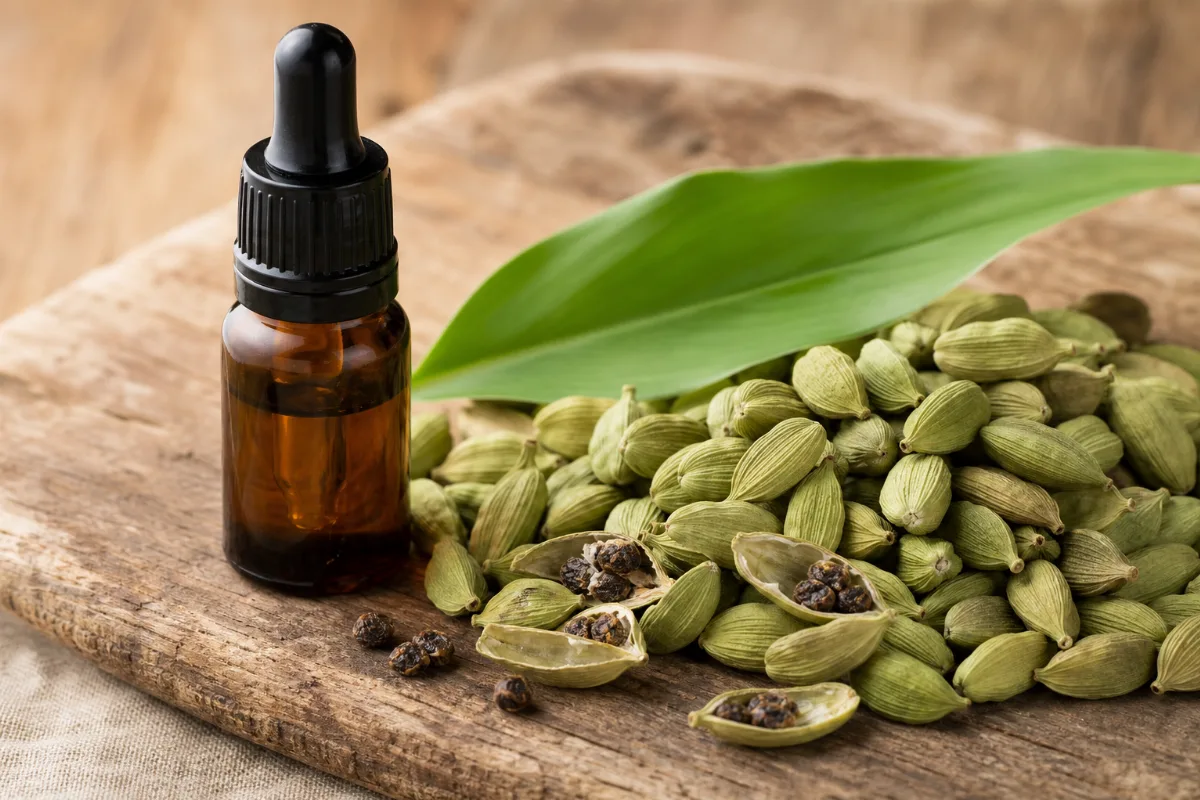
Cardamom oil is the sweet, spicy, slightly cool-smelling oil taken from the seeds of green cardamom. People use it in aromatherapy. In people, the research is two small nausea studies where the oil was breathed from a pad, one of them a four-oil blend. Everything else is lab or animal work. The main caution: never swallow the oil, never use it undiluted, and keep it away from the faces of young children and from pets.
General information, not medical advice. Last substantive update · Not medically reviewed. A named clinician has not signed off on this page. How this page is made
About Cardamom Oil
Cardamom oil is a sweet, spicy aromatherapy oil. In people, the research is one small trial of the oil alone (nausea around a cesarean section) and one trial of a four-oil blend (nausea after surgery); the rest is lab or animal work. Safety comes first: do not swallow it, do not use it undiluted, keep it away from young children's faces and from pets, and ask a doctor about pregnancy.
What cardamom oil is
Cardamom oil is the essential oil from the seeds of green cardamom, Elettaria cardamomum, a plant in the ginger family. GBIF lists the name as accepted.
The main compounds are 1,8-cineole and alpha-terpinyl acetate. In one oil, 1,8-cineole was 45.6% and alpha-terpinyl acetate 33.7%; in a CO2 extract, they were 21.4% and 42.3%. Another sample made with a new method had geranyl oleate and oleic acid among its main compounds. Oils differ with the method, and Poison Control says it can be hard to know what is in a bottle.
Black cardamom is a different plant, and the spice, tea and herb have their own pages.
What the human evidence shows
In a trial of 70 mothers having a cesarean section under spinal anesthesia, those who breathed cardamom oil from a gauze pad had fewer nausea episodes (37.1% against 65.7%), less retching (20% against 45.7%) and needed less anti-nausea medicine (37.1% against 65.7%) than those who breathed saline. Nausea scores fell in both groups.
In a trial of 301 adults with nausea after day surgery, a blend of ginger, spearmint, peppermint and cardamom oils reduced nausea more than saline, and so did ginger oil alone. That does not show what cardamom does by itself.
A review of inhaled aromatherapy for chemotherapy nausea included three studies that reduced nausea only, using chamomile, ginger or cardamom oil. The authors say small samples and many different methods mean the results cannot be generalised. A study of oil vapours for blood pressure tested cardamom among 23 oils, but its abstract gives no cardamom result.
We rate this low at best. The trials are small, the scent cannot be hidden well, and funding is not stated in the abstracts.
Lab and animal findings
In a 2026 dish test, cardamom oil was the strongest of twelve oils against a tooth-decay bacterium. It stopped growth at 2.5% oil and killed the bacteria at 5.0%. The bacteria's harm genes were turned up, which the authors read as a stress response. A second 2026 study tested water and ethanol extracts, not the oil, and found strong anti-inflammatory test results; the authors call it preliminary.
In mice, the oil gave negligible protection against seizures and caused movement problems at higher amounts. In rats, the highest single amount swallowed killed one of three, while lower amounts for 28 days caused no significant changes. Neither study gives a safe amount for people. None of this shows a benefit in people.
Oil, spice and extracts are different
A review of eight trials of cardamom eaten as food or supplement reports lower inflammation markers and lower blood pressure, with the authors urging caution because there are few studies. That is the spice, not the oil, and it does not support using the oil. Our pages on cardamom as a spice, herb and tea cover those.
At a glance
Traditional uses history, not proof
- Cardamom is one of the world's best-known spices and is used in the traditional medicine of many cultures, as the authors of a 2026 lab paper say.
- The oil itself has no traditional-use status that we could verify from the sources read.
Studied for research
- Nausea during a cesarean section, oil breathed from a pad, low
- Nausea after day surgery, four-oil blend including cardamom, low
- Nausea with chemotherapy, inhaled aromatherapy review, insufficient
- Blood pressure, inhaled vapours, no cardamom result, insufficient
- Tooth-decay bacteria, lab dish only, very-low
Main compounds
- 1,8-Cineole, a main component
- alpha-Terpinyl acetate, a main component
- Linalyl acetate, limonene, linalool and sabinene in smaller amounts
Common forms
- Essential oil from the seeds (steam, water or CO2 extraction)
- Gauze pad inhaled in nausea trials
- Seed, powder and extracts (different products)
Research links: Poison Control: Essential oils · FDA: Aromatherapy · Cesarean nausea trial, abstract · Four-oil blend nausea trial, abstract · Tooth-bacteria lab study, abstract · EMA: Eucalyptus oil (a similar cineole-rich oil) · Research Library · Genes & Biomarkers Library
What it is and its history
- Accepted scientific name
- Elettaria cardamomum
- Naming authority
- (L.) Maton
- Common names
- Green cardamom (English); True cardamom (English); Cardamom (English)
- Family or group
- Zingiberaceae (ginger family), per GBIF.
- Classification
- Plantae > Tracheophyta > Liliopsida > Zingiberales > Zingiberaceae > Elettaria > Elettaria cardamomum
- Native range
- Not checked in a source we read.
- Habitat
- Not checked.
- What it looks like
- Part used: The oil is made from the seeds inside the pods (the seed oil in the 2026 studies). This page does not describe how to recognise the plant.
- Look-alikes and adulterants
- Name: Black cardamom; Note: A different plant sold as a spice, with its own page. Results for green cardamom oil do not carry over. We did not verify its species name for this page.
- Sustainability and conservation
- Not checked.
Traditional use and history history, not clinical proof
| Tradition or era | Documented use | Source |
|---|---|---|
| Spice and traditional medicine | The authors of a 2026 lab paper call cardamom one of the world's most famous spices and say it is also applied in the traditional medicine of many cultures. This is the authors' statement; we did not check the history ourselves. | Hitl 2026 |
Traditional use shows how it was used. It does not show that it works or is safe today.
What is inside, and how it may work
What it contains and how those compounds act in cells and animals. Laboratory and animal mechanisms are not proven effects in people.
Main compounds
| Compound | Family | Where it is concentrated | Activity studied | Level of evidence |
|---|---|---|---|---|
| 1,8-Cineole (eucalyptol) PubChem 2758 | monoterpene oxide | Seed oil 45.6% in an oil used in a mouse study; 21.4% in a CO2 extract. Varies by sample. | Also the main compound of eucalyptus oil. The EU rule for young children and seizures is for eucalyptus oil; we apply it by caution only. 18 12 11 3 | Lab / regulatory (other oil) |
| alpha-Terpinyl acetate PubChem 111037 | monoterpene ester | Seed oil 33.7% (mouse study oil); 42.3% (CO2 extract). | Main compound in several samples; no activity claimed here. 19 12 11 7 | Laboratory |
| Linalyl acetate PubChem 8294 | monoterpene ester | Seed oil 8.2% of a CO2 extract. | No activity claimed. 20 11 | Laboratory |
| Sabinene PubChem 18818 | monoterpene | Seed oil 3.8% (mouse study oil). | No activity claimed. 21 12 | Laboratory |
| Limonene and linalool | monoterpenes | Seed oil Limonene 5.6% and linalool 5.4% of a CO2 extract; linalool is also named among the compounds in the 2026 tooth-bacteria study. | No activity claimed here. PubChem CIDs not looked up. 11 22 | Laboratory |
Mechanisms, receptors and pathways
| Target or pathway | Gene or receptor | What was found | Level |
|---|---|---|---|
| Streptococcus mutans growth and biofilm | Virulence genes gtfB, gtfC, gtfD, ldh, gbpB, vicR measured | The oil reduced growth, biofilm and viability in a dish; virulence genes were turned up, read by the authors as a stress response. 22 | Laboratory research |
| Seizure models | None named | Negligible protection in two mouse seizure models; movement toxicity at higher amounts. 12 | Animal research |
| How inhaled oil might ease nausea | None named | Not explained in the trials read. 10 | Not assessed |
Absorption, metabolism and elimination
- Absorption
- Not established in the sources read.
- Distribution
- Not established.
- Metabolism
- Not established.
- Elimination
- Not established.
- Bioavailability
- Not established.
Isolated compounds versus whole extracts
Cardamom essential oil (volatile terpenes), cardamom seed or powder eaten as food, and water or ethanol extracts are different products. The nausea trials used the oil on a gauze pad; the blood pressure and inflammation meta-analysis (8 trials) is about cardamom eaten as food or supplement; the 2026 lab activity tests were on extracts. Results for one product do not carry over to another.
Nutritional composition
Cardamom oil is not a nutrient and has no nutritional role.
2 low certainty2 very low certainty2 not enough evidence1 evidence against
What is Cardamom Oil good for?
The uses people ask about and how strong the evidence is for each. Read the certainty label first: only two small trials in people involve cardamom oil, and one of them used a blend.
Benefits, one by one
Each card is a research question, not a promise. Tap a goal to filter. Open a card to see the studies, doses and limits.
Nausea during and after cesarean section (breathing cardamom oil)
Low certaintyIn one small Iranian trial of 70 mothers, those who breathed cardamom oil from a gauze pad had fewer nausea episodes, less retching and needed less anti-nausea medicine than mothers who breathed plain saline.
1 studiesNot covered. This page gives no amounts and no ways of using the oil.
Studies, doses and limits
What the trials found
One single-blind randomized placebo-controlled trial, 70 mothers, spinal anesthesia, elective cesarean section.
Results
Nausea episodes 37.1% vs 65.7%, retching 20% vs 45.7%, anti-nausea medicine 37.1% vs 65.7%, cardamom oil vs saline placebo. Nausea scores fell in both groups, and fell more with cardamom after allowing for starting level.
Effect sizes as reported
Episodes P = .006, retching P = .028, medicine P = .009. No confidence intervals in the abstract.
Why this rating
One small trial at one site. A scent is hard to hide, so participants may have known which pad they had. Funding is not stated in the abstract and nobody has repeated it.
Form and dose studied
Not covered. This page gives no amounts and no ways of using the oil.
Who was studied
Mothers having a planned cesarean under spinal anesthesia in Iran.
Limits
Small; one centre; blinding limits; only the surgery period.
Why researchers looked
Nausea after surgery is common, and some people want a non-drug extra.
Traditional use
Not covered by the sources read.
Proposed mechanism Preliminary mechanism
Not established in the study read.
A proposed mechanism does not show that the effect happens in people.
The oil is breathed from a pad, not swallowed. Never swallow essential oil. See the Safety tab.
Nausea in the recovery room (a four-oil blend that included cardamom)
Low certaintyIn a trial of 301 adults who felt sick after day surgery, breathing a blend of ginger, spearmint, peppermint and cardamom oils reduced nausea more than a saline pad. Cardamom was one of four oils, so this does not show that cardamom oil alone helps.
1 studiesNot covered.
Studies, doses and limits
What the trials found
One randomized trial with several groups, 303 enrolled and 301 analysed, one US surgery centre.
Results
Nausea fell more with the blend (P < 0.001) and with ginger oil alone (P = 0.002) than with saline. Alcohol did not help. Fewer anti-nausea medicines were requested after the blend or ginger.
Effect sizes as reported
P values only in the abstract.
Why this rating
A fairly large trial, but cardamom is one of four oils, ginger alone also worked, so cardamom's own part is unknown. One centre; funding not stated in the abstract.
Form and dose studied
Not covered.
Who was studied
Adults with nausea after ambulatory surgery in the US.
Limits
Blend, not cardamom alone; scent cannot be well hidden.
Why researchers looked
Anti-nausea drugs do not always prevent nausea after surgery.
Traditional use
Not covered by the sources read.
Proposed mechanism Preliminary mechanism
Not established in the study read.
A proposed mechanism does not show that the effect happens in people.
The trial used a blend of four oils. See the Safety tab.
Nausea with chemotherapy (inhaled aromatherapy review)
Not enough evidenceA review of 11 studies found promising results for breathing oils directly from a pad. Three studies reduced nausea only, using chamomile, ginger or cardamom oil. Filling a room with the scent, and use in children, did not help.
1 studiesNot covered.
Studies, doses and limits
What the trials found
A systematic review of 11 studies (9 adult, 2 child). The abstract does not say which study used cardamom or how big it was.
Results
Seven of nine adult studies were statistically significant. The authors say small samples and many different oils and methods mean the results cannot be generalised.
Effect sizes as reported
Not given in the abstract.
Why this rating
Cardamom is one of several oils in a few small studies that we could not identify from the abstract. The authors urge larger, better studies.
Form and dose studied
Not covered.
Who was studied
People having chemotherapy, mostly women with gynecologic cancers.
Limits
Mixed oils and methods; small samples; cardamom study not identified here.
Why researchers looked
Chemotherapy nausea affects many people despite modern drugs.
Traditional use
Not covered.
Proposed mechanism Preliminary mechanism
Not established.
A proposed mechanism does not show that the effect happens in people.
See the Safety tab.
Blood pressure (breathing oil vapours)
Not enough evidenceA large Russian study tested vapours of 23 essential oils, including cardamom, on women with high blood pressure. The abstract names oils that lowered it, and oils that did not. Cardamom is on neither list.
1 studiesNot covered.
Studies, doses and limits
What the trials found
849 women aged 55 to 89 with hypertension; vapours with a relaxation session against relaxation alone.
Results
No cardamom result is given in the abstract. Clove and coriander oils were among those that lowered pressure, and fennel was among those that did not.
Effect sizes as reported
Not given in the abstract.
Why this rating
The abstract does not report a cardamom result, and describes the study design only briefly. We do not claim any effect.
Form and dose studied
Not covered.
Who was studied
Older women with hypertension, Russia.
Limits
No cardamom result; design details thin; Russian-language paper.
Why researchers looked
People look for gentle ways to lower blood pressure.
Traditional use
Not covered.
Proposed mechanism Preliminary mechanism
Not established.
A proposed mechanism does not show that the effect happens in people.
See the Safety tab.
Slowing tooth-decay bacteria (lab dish only)
Very low certaintyIn a 2026 lab study, cardamom oil was the strongest of twelve oils at stopping Streptococcus mutans, a main cavity bacterium, in a dish. It has not been tried in a mouth.
1 studiesNot covered. Essential oils are not safe to rinse with or swallow.
Studies, doses and limits
What the trials found
None.
Results
Growth stopped at 2.5% oil and bacteria were killed at 5.0% in the dish; biofilm and live cells fell by more than 75% at 5.0%.
Effect sizes as reported
Dish concentrations only. They are not a guide to use.
Why this rating
A dish test with one bacterium; no animal or human study. Dish strengths are not a safe guide for a mouth.
Form and dose studied
Not covered. Essential oils are not safe to rinse with or swallow.
Who was studied
None (bacteria).
Limits
Single species; no polymicrobial or living test.
Why researchers looked
Researchers look for cheap natural ways to prevent cavities.
Traditional use
Not covered.
Proposed mechanism Preliminary mechanism
The oil reduced growth and biofilm in the dish; genes linked to harm were turned up, which the authors read as a stress response.
A proposed mechanism does not show that the effect happens in people.
Bacteria in a dish; not a mouthwash. See the Safety tab.
Antioxidant and anti-inflammatory tests (lab; extracts, not the oil)
Very low certaintyA 2026 lab study analysed the chemistry of cardamom oil but ran its activity tests on water and ethanol extracts of the seeds. Those showed strong results in anti-inflammatory tests and moderate antioxidant activity. This is not a test of the oil.
1 studiesNot covered.
Studies, doses and limits
What the trials found
None.
Results
Oil: mostly monoterpenes, alpha-terpinyl acetate the main one. Extracts: low phenolic content, moderate antioxidant activity, strong anti-inflammatory test results, and effects on one starch-digesting enzyme.
Effect sizes as reported
Not given in the abstract.
Why this rating
Test tubes only, extracts rather than oil, and the authors call it preliminary.
Form and dose studied
Not covered.
Who was studied
None.
Limits
Not the oil; no living test.
Why researchers looked
Cardamom is a famous spice used in traditional medicine.
Traditional use
The authors describe cardamom as a spice also used in the traditional medicine of many cultures.
Proposed mechanism Preliminary mechanism
Test-tube assays only.
A proposed mechanism does not show that the effect happens in people.
Lab only.
Protection against seizures (mouse test)
Evidence againstIn mice, cardamom oil gave only a negligible protection against induced seizures, and the oil and an extract both caused movement problems at higher amounts.
1 studiesNot covered.
Studies, doses and limits
What the trials found
None.
Results
The authors call the anticonvulsant effect negligible and note movement toxicity.
Effect sizes as reported
Not given in the abstract.
Why this rating
Animal study only; the effect was negligible and the oil caused movement problems.
Form and dose studied
Not covered.
Who was studied
Mice.
Limits
Animal study.
Why researchers looked
Compounds in cardamom were thought to have possible anticonvulsant activity.
Traditional use
Not covered.
Proposed mechanism Preliminary mechanism
Not established.
A proposed mechanism does not show that the effect happens in people.
The oil also caused movement problems in mice. See the Safety tab.
Connections to the rest of health
How Cardamom Oil connects to the rest of our health knowledge graph. Every link says what kind of connection it is. A safety link (for example to the liver) is a warning, not a benefit. A study that merely mentions a topic never creates a benefit link.
Explore every connection: goals, body systems, organs, symptoms, genes
A. Wellness goals
| Connected to | Kind of connection | Evidence status | Context | Studies |
|---|---|---|---|---|
| Digestive Support | Low certainty | Nausea during and after cesarean section (breathing cardamom oil): In one small Iranian trial of 70 mothers, those who breathed cardamom oil from a gauze pad had fewer nausea episodes, less retching and needed less anti-nausea medicine than mothers who breathed plain saline. Nausea in the recovery room (a four-oil blend that included cardamom): In a trial of 301 adults who felt sick after day surgery, breathing a blend of ginger, spearmint, peppermint and cardamom oils reduced nausea more than a saline pad. Cardamom was one of four oils, so this does not show that cardamom oil alone helps. | 10 8 | |
| Digestive Support | Not enough evidence | Nausea with chemotherapy (inhaled aromatherapy review): A review of 11 studies found promising results for breathing oils directly from a pad. Three studies reduced nausea only, using chamomile, ginger or cardamom oil. Filling a room with the scent, and use in children, did not help. | 23 | |
| Blood Pressure Support | Not enough evidence | Blood pressure (breathing oil vapours): A large Russian study tested vapours of 23 essential oils, including cardamom, on women with high blood pressure. The abstract names oils that lowered it, and oils that did not. Cardamom is on neither list. | 25 | |
| Healthy Skin | Very low certainty | Slowing tooth-decay bacteria (lab dish only): In a 2026 lab study, cardamom oil was the strongest of twelve oils at stopping Streptococcus mutans, a main cavity bacterium, in a dish. It has not been tried in a mouth. | 22 | |
| Inflammation Balance | Very low certainty | Antioxidant and anti-inflammatory tests (lab; extracts, not the oil): A 2026 lab study analysed the chemistry of cardamom oil but ran its activity tests on water and ethanol extracts of the seeds. Those showed strong results in anti-inflammatory tests and moderate antioxidant activity. This is not a test of the oil. | 7 | |
| Calm Relaxation | Evidence against | Protection against seizures (mouse test): In mice, cardamom oil gave only a negligible protection against induced seizures, and the oil and an extract both caused movement problems at higher amounts. | 12 |
B. Body systems
| Connected to | Kind of connection | Evidence status | Context | Studies |
|---|---|---|---|---|
| Digestive System | Biological association | Low certainty | Studied for: Nausea during and after cesarean section (breathing cardamom oil) Studied for: Nausea in the recovery room (a four-oil blend that included cardamom) | 10 8 23 |
| Cardiovascular System | Biological association | Not enough evidence | Studied for: Blood pressure (breathing oil vapours) | 25 |
| Immune System | Biological association | Very low certainty | Studied for: Slowing tooth-decay bacteria (lab dish only) | 22 |
| Pain Inflammation | Biological association | Very low certainty | Studied for: Antioxidant and anti-inflammatory tests (lab; extracts, not the oil) | 7 |
| Nervous System | Biological association | Evidence against | Studied for: Protection against seizures (mouse test) | 12 |
E. Health conditions
| Connected to | Kind of connection | Evidence status | Context | Studies |
|---|---|---|---|---|
| Contact dermatitis | Adverse effect or risk | Case report | One allergy case and irritant powder reactions. Preparation or compound: Cardamom seeds and powder (case report and patch tests); oil untested |
14 13 |
| Nausea | Potential benefit | Preliminary | One small cesarean trial and one blend trial. Preparation or compound: Cardamom oil inhaled; also in a four-oil blend |
10 8 |
| Childhood essential oil poisoning | Documented risk | Shows the risk with cineole-rich oils. Preparation or compound: Eucalyptus and camphor oils (not cardamom) |
4 |
I. Biomarkers
| Connected to | Kind of connection | Evidence status | Context | Studies |
|---|---|---|---|---|
| Nausea score (self-rated) | Biological association | Low certainty | Measured in trials: decrease. A lab change is not the same as a health benefit. | 10 8 |
| Anti-nausea medicine used | Biological association | Low certainty | Measured in trials: decrease. A lab change is not the same as a health benefit. | 10 8 |
| Blood pressure | Biological association | Not enough evidence | Measured in trials: decrease. A lab change is not the same as a health benefit. | 25 |
K. Biological pathways
| Connected to | Kind of connection | Evidence status | Context | Studies |
|---|---|---|---|---|
| Streptococcus mutans | Preliminary mechanism | In vitro | Growth and biofilm reduced by the oil in a dish. | 22 |
L. Active compounds
| Connected to | Kind of connection | Evidence status | Context | Studies |
|---|---|---|---|---|
| 1,8-Cineole (eucalyptol) | Biological association | Lab / regulatory (other oil) | Also the main compound of eucalyptus oil. The EU rule for young children and seizures is for eucalyptus oil; we apply it by caution only. Preparation or compound: Seed oil |
18 12 11 3 |
| alpha-Terpinyl acetate | Biological association | Laboratory | Main compound in several samples; no activity claimed here. Preparation or compound: Seed oil |
19 12 11 7 |
| Linalyl acetate | Biological association | Laboratory | No activity claimed. Preparation or compound: Seed oil |
20 11 |
| Sabinene | Biological association | Laboratory | No activity claimed. Preparation or compound: Seed oil |
21 12 |
| Limonene and linalool | Biological association | Laboratory | No activity claimed here. PubChem CIDs not looked up. Preparation or compound: Seed oil |
11 22 |
Each connection is stored with the ingredient, the connected record, the kind of connection, the evidence status, the supporting studies, the preparation or compound involved, and a review date (last reviewed October 25, 2026).
The evidence
The research centre for Cardamom Oil. Every record here was checked against PubMed or the publisher's page; we never list a study we have not verified.
Evidence by outcome
Bars show how many studies we found for each outcome, not how well it works. People are added up across trials only (reviews are not added, to avoid double counting).
How we rate evidence
High certainty
Several well-run trials or reviews agree; further research is unlikely to change the picture much.
Moderate certainty
Good trials point the same way, but some doubt remains.
Low certainty
Small, short or inconsistent trials. The finding could change with better research.
Very low certainty
Very little or very weak human data. Treat as a possibility only.
Mixed findings
Trials or reviews disagree with each other.
Not enough evidence
Not enough human research to say either way.
Evidence against
Good research found no benefit, or found harm.
We take the reviewers' own risk-of-bias and GRADE statements where they exist, and otherwise judge from study size, design, consistency, directness and whether a product matches what is sold. Many publications do not make evidence high. Method note: We read the abstracts of 15 PubMed papers and the Poison Control, Pet Poison Helpline, FDA, NCCIH and EMA pages, and checked the plant name in GBIF and compound names in PubChem. We did not find or read a LiverTox, LactMed or cardamom-oil regulator statement.
Study library: every study we checked 25
| Study | Design | People | Product, dose, length | Result |
|---|---|---|---|---|
| Auti 2025 Effect of Cardamom Oil After Acute and Repeated Administration in Albino Wistar Rats. Cureus · PMID 41487820 · DOI |
Animal toxicity study (rats, OECD style) rat |
Female Wistar rats | Cardamom oil given by mouth essential oil Three amounts for 28 days and two single amounts (not repeated here) Single dose with 14 days of watching; 28 days repeated · vs Control group |
At the highest single amount one animal died and two showed mild signs of toxicity, so the lethal dose was above that amount. In the 28-day test at three lower amounts there were no significant changes in weight, blood, kidney tests or organ tissue. No harm seen in rats at the lower repeated amounts; one death at the highest single amount Methods, limits and fundingOutcomes: Deaths, behaviour, body weight, blood and organ tests Limitations: Rats given the oil by mouth; this does not tell us any safe amount for people. Funding and conflicts: Not stated in the abstract. Read: abstract |
| Castillo 2023 Antioxidant Activity and GC-MS Profile of Cardamom (Elettaria cardamomum) Essential Oil Obtained by a Combined Extraction Method-Instant Controlled Pressure Drop Technology Coupled with Sonication. Molecules · PMID 36770758 · DOI |
Laboratory chemistry none (chemistry) |
Cardamom seeds | Cardamom essential oil made with different pressure-drop and ultrasound treatments seed n/a n/a · vs Untreated seeds |
Yield rose with the new method. GC-MS found 28 compounds, with alpha-terpinyl acetate, geranyl oleate and oleic acid the most abundant in this sample, a different profile from other studies. Profile depends on the method Methods, limits and fundingOutcomes: Oil yield, antioxidant test, GC-MS profile Limitations: Lab chemistry; shows how much oils differ by method. Funding and conflicts: Not stated in the abstract. Read: abstract |
| European Medicines Agency 2025 EMA: Eucalypti aetheroleum - herbal medicinal product (public summary) n/a · Source |
Regulator or reference page n/a |
n/a | n/a n/a n/a n/a · vs n/a |
Page read 2026-10-25. This is about eucalyptus oil, a different oil that is rich in 1,8-cineole (the main compound of cardamom oil too). The EU herbal committee says these medicines must not be given to children under 30 months of age because of a risk of spasm of the larynx, and not to children with a history of seizures. Oral forms are for adults and adolescents from 12; inhaled, skin and bath forms from 4. Current monograph first published 28/02/2025. Not about cardamom. Methods, limits and fundingOutcomes: Cineole-rich oil, children Read: full-text |
| Flaman 2001 Unintentional exposure of young children to camphor and eucalyptus oils. Paediatr Child Health · PMID 20084213 · DOI |
Poison centre chart review and literature search |
251 Children reported to a Toronto poison centre, Dec 1995 to Mar 1997 |
Swallowing of eucalyptus oil, camphorated oil and vapour products eucalyptus and camphor (not cardamom) n/a n/a · vs n/a |
251 children swallowed an essential oil product (50 eucalyptus oil). Common symptoms were cough and vomiting; two children had seizures and recovered. The literature search found 18 reports with vomiting, lethargy, coma and seizures, and one death. The authors say essential oils can be harmful, even life-threatening, if children swallow them. Child poisonings with cineole-rich eucalyptus oil and camphor oils Methods, limits and fundingOutcomes: Symptoms after swallowing Limitations: About eucalyptus and camphor oils, not cardamom; shows what swallowing cineole-rich oils can do; older data. Funding and conflicts: Not stated in the abstract. Read: abstract |
| GBIF 2026 GBIF match: Elettaria cardamomum (L.) Maton n/a · Source |
Regulator or reference page n/a |
n/a | n/a n/a n/a n/a · vs n/a |
API read 2026-10-25: exact match, status ACCEPTED, species key 2759871, family Zingiberaceae, order Zingiberales, kingdom Plantae. Methods, limits and fundingOutcomes: Accepted name Read: full-text |
| Heydarian 2024 Effect of cardamom consumption on inflammation and blood pressure in adults: A systematic review and meta-analysis of randomized clinical trials. Food Sci Nutr · PMID 38268891 · DOI |
Systematic review and meta analysis |
Adults in 8 randomized trials of cardamom consumption | Cardamom eaten as a food or supplement (not the essential oil) spice/seed (not the oil) Varied Varied · vs Control |
The authors report lower inflammation markers and lower blood pressure with cardamom, and say that because the number of studies is limited the results need cautious reading. This is about cardamom taken as food or supplement, not the essential oil. Small average changes reported; does not apply to the oil Methods, limits and fundingOutcomes: Inflammation markers and blood pressure Limitations: Eight studies; findings between trials inconsistent per the authors; some units in the abstract look misprinted, so no figures are repeated here. Funding and conflicts: Not stated in the abstract. Read: abstract |
| Hitl 2026 Queen of Spices, Cardamom (Elettaria cardamomum (L.) Maton, Zingiberaceae)-In Vitro Assessment of Biological Potential. Molecules · PMID 42513114 · DOI |
Laboratory study (in vitro) in vitro |
Cardamom seed oil and extracts in test tubes | GC-MS of the essential oil; water and ethanol extracts for activity tests seed n/a Lab assays · vs n/a |
The oil was rich in monoterpenes with alpha-terpinyl acetate the main compound. Activity tests were done on the water and ethanol extracts, not the oil: moderate antioxidant activity, strong activity in anti-inflammatory tests, and effects on one starch-digesting enzyme. Microbe growth was reduced only at high concentrations. The authors call it preliminary. Extract lab results; oil only analysed for chemistry Methods, limits and fundingOutcomes: Oil chemistry; extract antioxidant, anti-inflammatory, sugar-enzyme and microbe tests Limitations: Extracts, not oil, were tested for activity; test tubes only. Funding and conflicts: Provincial research funding (Vojvodina) named in the record; not industry. Read: abstract |
| Hunt 2013 Aromatherapy as treatment for postoperative nausea: a randomized trial. Anesth Analg · PMID 22392970 · DOI |
Randomized trial |
301 Adults with nausea in the recovery room after ambulatory surgery at one US centre (303 enrolled, 301 analysed) |
Inhaled gauze pad with (1) ginger oil, (2) a blend of ginger, spearmint, peppermint and cardamom oils, (3) isopropyl alcohol, or (4) saline placebo essential oils (plant parts not stated in abstract) Not reported here Three deep breaths; nausea re-checked after 5 minutes · vs Saline gauze |
Nausea fell more with the four-oil blend (P < 0.001) and with ginger (P = 0.002) than with saline, but not with alcohol. Fewer anti-nausea medicines were requested after ginger (P = 0.002) or the blend (P < 0.001) than saline. Blend and ginger beat saline; alcohol did not Methods, limits and fundingOutcomes: Nausea (0-3 scale) and anti-nausea medicines requested Limitations: Cardamom was one of four oils in the blend, so its own effect cannot be separated; one centre; a scent is hard to hide; funding not stated in the abstract. Funding and conflicts: Not stated in the abstract. Read: abstract |
| Khan 2014 Concentrated tea tree oil toxicosis in dogs and cats: 443 cases (2002-2012). J Am Vet Med Assoc · PMID 24344857 · DOI |
Retrospective case series dog and cat |
443 337 dogs and 106 cats exposed to 100% tea tree oil, US and Canada |
100% tea tree oil on skin and/or by mouth essential oil (tea tree, not cardamom) 0.1 to 85 mL used Signs within 2-12 hours, up to 72 hours · vs n/a |
Serious signs (drooling, depression, weakness, wobbling, tremors) within hours and lasting up to 3 days; younger and lighter cats had a higher chance of major illness. Shows cats can be badly affected by concentrated oil Methods, limits and fundingOutcomes: Clinical signs and severity Limitations: About tea tree oil, not cardamom; cited only to show the risk to cats from concentrated oils in general. Funding and conflicts: Not stated in the abstract. Read: abstract |
| Khatiban 2022 Effect of Cardamom Inhalation Therapy on Intra-and Postoperative Nausea and Vomiting of Mothers Undergoing Spinal Anesthesia for Elective Cesarean Section. J Perianesth Nurs · PMID 35581106 · DOI |
Single blind randomized placebo controlled trial |
70 Mothers having an elective cesarean section under spinal anesthesia, Hamadan, Iran (35 per group) |
Cardamom essential oil on gauze in saline, inhaled from a plastic bag essential oil (plant part not stated in abstract) Not reported here Inhaled at the first episode of nausea · vs Gauze in normal saline without oil |
Nausea scores fell in both groups (placebo 25.28 +/- 32.38 and cardamom 13.14 +/- 19.96, P < .001); after allowing for starting nausea the fall was larger with cardamom. Nausea episodes 37.1% vs 65.7% (P = .006), retching 20% vs 45.7% (P = .028), anti-nausea medicine given 37.1% vs 65.7% (P = .009), cardamom vs placebo. Fewer nausea episodes, less retching and less anti-nausea medicine with cardamom oil than saline Methods, limits and fundingOutcomes: Nausea (100 mm visual scale), retching and nausea episodes, anti-nausea medicine use Limitations: Small single-centre trial; the scent is hard to hide from participants; who was blinded is not detailed in the abstract; funding not stated in the abstract; the abstract gives no follow-up beyond the surgery period. Funding and conflicts: Not stated in the abstract. Read: abstract |
| Marongiu 2004 Comparative analysis of the oil and supercritical CO2 extract of Elettaria cardamomum (L.) Maton. J Agric Food Chem · PMID 15453700 · DOI |
Laboratory chemistry none (chemistry) |
Cardamom seeds | Cardamom seed oil by supercritical CO2 extraction, compared with steam-distilled oil and a hexane extract seed n/a n/a · vs Hydrodistilled oil, hexane extract |
CO2 oil: alpha-terpinyl acetate 42.3%, 1,8-cineole 21.4%, linalyl acetate 8.2%, limonene 5.6%, linalool 5.4%. The hydrodistilled oil showed no consistent difference; the hexane extract was very different (limonene 36.4%, 1,8-cineole 23.5%). Composition depends on method Methods, limits and fundingOutcomes: Oil yield and composition Limitations: One sample set; shop oils may differ. Funding and conflicts: Not stated in the abstract. Read: abstract |
| Masoumi-Ardakani 2016 Chemical Composition, Anticonvulsant Activity, and Toxicity of Essential Oil and Methanolic Extract of Elettaria cardamomum. Planta Med · PMID 27433883 · DOI |
Animal study (mice) mouse |
Mice with induced seizures | Elettaria cardamomum essential oil and a methanol extract essential oil Injected amounts (not repeated here) Single dose · vs Untreated |
The oil contained 1,8-cineole (45.6%), alpha-terpinyl acetate (33.7%), sabinene (3.8%), terpinen-4-ol (2.4%) and myrcene (2.2%). The oil protected against seizures in two mouse models but the authors call the effect negligible. The oil and the extract both caused movement problems (rotarod) at the higher doses; no deaths at the doses tested. Negligible anticonvulsant effect; movement toxicity in mice Methods, limits and fundingOutcomes: Seizure protection, movement (rotarod) toxicity, deaths, oil composition Limitations: Mouse study only; route and exact doses not stated in the abstract. Funding and conflicts: Not stated in the abstract. Read: abstract |
| Meding 1993 Skin symptoms among workers in a spice factory. Contact Dermatitis · PMID 8281784 · DOI |
Survey and patch/prick testing |
93 70 spice factory workers and 23 office workers, Sweden |
Powders of spices including cardamom, paprika and white pepper (patch tests) spice powders (not the oil) n/a Occupational · vs Office workers (questionnaire) |
Half of factory workers reported skin symptoms, mostly with cinnamon. Irritant patch test reactions were seen to powders of cardamom, paprika and white pepper. The author says patch testing spices is difficult. Irritant reactions to cardamom powder Methods, limits and fundingOutcomes: Skin symptoms; patch and prick tests Limitations: Powder, not oil; 1993; difficult to interpret. Funding and conflicts: Not stated in the abstract. Read: abstract |
| Mobacken 1975 Allergic contact dermatitis from cardamom. Contact Dermatitis · PMID 138507 · DOI |
Case report |
1 A confectioner with chronic hand dermatitis |
Skin contact with dried cardamom seeds; patch tests with cardamom and terpene compounds from the seeds seed (not the oil) n/a Occupational · vs n/a |
Positive patch tests to cardamom and to certain terpenoid compounds in the seeds; the authors say it was the first such report they knew of and attribute it to terpenes in the seeds. One allergic case Methods, limits and fundingOutcomes: Patch test reactions Limitations: One case, 1975; seeds, not oil. Funding and conflicts: Not stated. Read: abstract |
| National Center for Complementary and Integrative Health (NIH) 2020 NCCIH: Aromatherapy n/a · Source |
Regulator or reference page n/a |
n/a | n/a n/a n/a n/a · vs n/a |
Page read 2026-10-25 (last updated January 2020). Essential oils are most often used by inhaling them or by applying a diluted form to the skin. The page says evidence for insomnia is lacking. It gives no cardamom-specific statement and no detailed safety section. Methods, limits and fundingOutcomes: Aromatherapy overview Read: full-text |
| Pet Poison Helpline 2026 Pet Poison Helpline: Essential Oils n/a · Source |
Regulator or reference page n/a |
n/a | n/a n/a n/a n/a · vs n/a |
Page read 2026-10-25. Essential oil toxicosis can affect all species, but cats and birds are at the greatest risk. Swallowing carries the highest risk, then skin contact, then breathing the vapour. The page lists named oils (for example citrus, clove, eucalyptus, tea tree, pine, sage) and does not mention cardamom, which does not mean cardamom oil is safe for pets. Methods, limits and fundingOutcomes: Pets and essential oils Read: full-text |
| Poison Control (America's Poison Centers) 2026 Poison Control: Essential oils: Poisonous when misused n/a · Source |
Regulator or reference page n/a |
n/a | n/a n/a n/a n/a · vs n/a |
Page read 2026-10-25. Pure oils are potent; diluting in a carrier oil is the best way to avoid a bad skin reaction; not all oils suit skin; do not use on damaged skin; stop and wash off if a rash appears. Many oils can cause rashes and some are poisonous if absorbed through the skin or swallowed. Breathing an oil into the lungs (for example while choking) can cause pneumonia. Children have thinner skin and may be more vulnerable. Sage oil and eucalyptus oil have caused seizures when swallowed. Oils may interact with medicines. Allergy is possible; any allergic reaction with trouble breathing is a medical emergency. Keep oils locked up, out of reach of children and pets. If someone swallows an essential oil, call the poison center (US 1-800-222-1222). The page does not mention cardamom and does not address pregnancy. Methods, limits and fundingOutcomes: General essential-oil safety Read: full-text |
| PubChem 2026 PubChem: 1,8-Cineole (CID 2758) n/a · Source |
Regulator or reference page n/a |
n/a | n/a n/a n/a n/a · vs n/a |
API read 2026-10-25: name 1,8-Cineole, formula C10H18O, CID 2758. Methods, limits and fundingOutcomes: Compound identity Read: full-text |
| PubChem 2026 PubChem: alpha-Terpinyl acetate (CID 111037) n/a · Source |
Regulator or reference page n/a |
n/a | n/a n/a n/a n/a · vs n/a |
API read 2026-10-25: alpha-Terpinyl acetate, formula C12H20O2, CID 111037. Methods, limits and fundingOutcomes: Compound identity Read: full-text |
| PubChem 2026 PubChem: Linalyl acetate (CID 8294) n/a · Source |
Regulator or reference page n/a |
n/a | n/a n/a n/a n/a · vs n/a |
API read 2026-10-25: Linalyl Acetate, formula C12H20O2, CID 8294. Methods, limits and fundingOutcomes: Compound identity Read: full-text |
| PubChem 2026 PubChem: Sabinene (CID 18818) n/a · Source |
Regulator or reference page n/a |
n/a | n/a n/a n/a n/a · vs n/a |
API read 2026-10-25: Sabinene, formula C10H16, CID 18818. Methods, limits and fundingOutcomes: Compound identity Read: full-text |
| Singh 2026 In vitro inhibition of Streptococcus mutans by cardamom essential oil. Front Oral Health · PMID 42199993 · DOI |
Laboratory study (in vitro) bacteria |
Streptococcus mutans bacteria in a dish | Cardamom essential oil essential oil MIC 2.5% and MBC 5.0% (v/v) in the dish Lab assays · vs Twelve other essential oils |
The lowest strength that stopped growth was 2.5% and killed the bacteria 5.0%. At 5.0%, biofilm and cell viability fell by more than 75% while virulence genes were turned up, which the authors read as a stress response. Of twelve oils tested, cardamom oil was the strongest. The authors call for tests in living models. Strongest of 12 oils in a dish Methods, limits and fundingOutcomes: Growth, biofilm, cell viability, virulence genes Limitations: Bacteria in a dish only; not a mouthwash and not tested in people. Funding and conflicts: Not stated in the abstract. Read: abstract |
| Toniolo 2021 Effectiveness of Inhaled Aromatherapy on Chemotherapy-Induced Nausea and Vomiting: A Systematic Review. J Altern Complement Med · PMID 34283916 · DOI |
Systematic review |
11 studies (9 in adults, 2 in children) of inhaled aromatherapy for chemotherapy nausea | Inhaled aromatherapy (peppermint, ginger, chamomile or cardamom oils, among others) essential oils Varied Varied · vs Standard care |
Seven of nine adult studies showed significant results. Three reduced nausea only, with chamomile, ginger or cardamom oil. Diffusing into the room and use in children showed no benefit. The authors say small samples and the wide variety of oils and methods make it impossible to generalise. Promising but not generalisable, per the authors Methods, limits and fundingOutcomes: Nausea and vomiting with chemotherapy Limitations: The abstract does not say which study used cardamom or how large it was; mostly women with gynecologic cancers; methodological limits and small samples, per the authors. Funding and conflicts: Not stated in the abstract. Read: abstract |
| U.S. Food and Drug Administration 2023 FDA: Aromatherapy n/a · Source |
Regulator or reference page n/a |
n/a | n/a n/a n/a n/a · vs n/a |
Page read 2026-10-25 (content current as of 09/08/2023). Whether an aromatherapy product is a cosmetic or a drug depends on its intended use and claims. Products with therapeutic claims (for example relieving pain, treating anxiety, aiding sleep) are drugs and need approval. 'Natural' does not mean safe: plant materials can be toxic, irritating or allergenic on skin; the page gives cumin oil (can blister skin) and some citrus oils (harm on sun-exposed skin) as examples. The page does not mention cardamom. Methods, limits and fundingOutcomes: Regulatory status of aromatherapy Read: full-text |
| Yarosh 2023 [Impact of essential oil vapors inhalation on blood pressure in patients with hypertension]. Vopr Kurortol Fizioter Lech Fiz Kult · PMID 37141519 · DOI |
Comparative study with control group (design details limited in abstract) |
849 Women aged 55-89 with hypertension, Russia |
Inhaled vapours of 23 essential oils, including cardamom, with a relaxation procedure essential oils 1 mg/m3 in air 10- or 20-minute sessions · vs Relaxation procedure alone |
The abstract names 11 oils with a blood-pressure-lowering effect and a second list of 10 with none. Cardamom was among the oils tested but is in neither list, so the abstract gives no cardamom result. No cardamom-specific result stated Methods, limits and fundingOutcomes: Blood pressure, heart rate Limitations: Abstract does not report cardamom; design (randomization, blinding) not described in the abstract; Russian-language paper, English abstract read. Funding and conflicts: Not stated in the abstract. Read: abstract |
What we do not know yet
- What the evidence supports: the human results are low or insufficient, from two small nausea trials and a review; lab findings are very-low.
- Only one trial tested cardamom oil alone, and it was small.
- No poisoning, patch-test, pet, asthma or seizure source for cardamom oil itself.
- The child and seizure cautions come from a similar oil (eucalyptus), not from cardamom oil.
- No study of the oil in pregnancy, breastfeeding or children.
- No verified dilution figure; we give none.
How new research is added
New studies are found by a saved PubMed search and are placed in a review queue. A person reads each one before it is added.
Lab markers
What changed in blood or saliva tests during trials. A changed number is not the same as feeling or being healthier, and we give no "normal ranges".
Other 3
Nausea score (self-rated)
Decrease in trials
A rating of how sick the person feels, on a 100 mm line or a 0 to 3 scale.
Low certaintyResults and what it means
Why it was measured
The main outcome in both surgery trials.
Statistical vs. clinical meaning
A feeling score, not a lab test; a scent is hard to hide from participants.
Safety implication
A lower score does not show the oil is safe for everyone.
Anti-nausea medicine used
Decrease in trials
How many people needed or asked for an anti-nausea drug.
Low certaintyResults and what it means
Why it was measured
A practical sign that nausea was still a problem.
Statistical vs. clinical meaning
Staff may have known what the patient was given, which can affect when drugs are offered.
Safety implication
None found in the abstracts.
Blood pressure
Decrease in trials
Pressure of blood in the arteries, measured in mmHg.
Not enough evidenceResults and what it means
Why it was measured
The outcome of the inhaled-vapour study.
Statistical vs. clinical meaning
We make no claim for cardamom oil.
Safety implication
Anyone on blood pressure medicine should ask a doctor before using essential oils.
| Study | Result | People | Product |
|---|---|---|---|
| 25 | No cardamom-specific result is stated in the abstract. |
Safety
What studies and official sources say about side effects, medicines and who should check first. Each point shows what kind of evidence it comes from.
Main points to know 5
- Do not swallow cardamom essential oil.. Poison Control says many essential oils are poisonous if swallowed, that breathing an oil into the lungs while choking can cause pneumonia, and that sage and eucalyptus oils have caused seizures when swallowed. A Toronto poison-centre review of eucalyptus and camphor oils, which are also rich in 1,8-cineole, found cough, vomiting, seizures in two children and, in the literature, one death. We found no poisoning report for cardamom oil itself, so its risk is unmeasured, not shown to be small. Keep bottles locked away from children and pets. Regulatory 17 4
- Do not put it on skin undiluted.. Poison Control says pure oils are potent and that diluting in a carrier oil is the best way to avoid a bad skin reaction, and not to use oils on damaged skin. Cardamom itself has caused allergic contact dermatitis in a case report (seeds) and irritant patch-test reactions to the powder in a spice factory study. No skin study of cardamom oil was found. We give no dilution figure because we could not verify one. Regulatory 17 14 13
- Keep it off the faces of babies and young children.. Cardamom oil is about a fifth to a half 1,8-cineole in the samples tested. For a cineole-rich oil, eucalyptus, the EU herbal committee says medicines must not be given to children under 30 months because of a risk of spasm of the larynx, and not to children with a history of seizures. That is a different oil and a medicine rule, not a cardamom-oil rule, but the main compound is shared. We advise keeping cardamom oil away from young children's faces and noses and from children who have had seizures. Regulatory 3 12 11
- Pets, especially cats and birds, are at risk.. Pet Poison Helpline says essential oil poisoning can affect all species, but cats and birds are at the greatest risk, and swallowing is the riskiest route. Cardamom is not named on its list, which does not make it safe. A US case series of concentrated tea tree oil, a different oil, found serious signs in dogs and cats within hours. Regulatory 16 9
- Pregnancy: no cardamom-oil study was found.. We found no study of cardamom oil in pregnancy or breastfeeding, and Poison Control does not address pregnancy. We advise asking a midwife or doctor before using it. The nausea trial in mothers was done at a cesarean section, not in pregnancy. Theoretical 17 10
Side effects 6
| Effect | How often | Severity and recovery | Evidence |
|---|---|---|---|
| Allergic contact dermatitis from cardamom One 1975 case in a confectioner, patch tests positive to cardamom and its terpenes. Seeds, not oil. | Not established | Hand eczema in one worker Not stated | Case_report 14 |
| Skin irritation from cardamom powder Swedish spice-factory study; powder not oil; the author says spice patch tests are hard to interpret. | Not established | Irritant patch-test reactions Not stated | Observational 13 |
| Poisoning if swallowed Evidence is for other cineole-rich and camphor oils, not cardamom. | Not established | Cough, vomiting, seizures reported with eucalyptus and camphor oils in children Most recovered; one death in the literature (other oils) | Observational 4 17 |
| Movement problems and sedation-like effects in mice Mouse study; no deaths at the doses tested. | Not established | Movement toxicity (rotarod) at higher amounts Not stated | Animal research 12 |
| Deaths at a very high swallowed amount in rats In rats, no harm seen at lower repeated amounts for 28 days. This is not a safe amount for people. | Not established | One of three rats died at the highest single amount tested n/a | Animal research 1 |
| Nausea trial side effects Neither abstract reports adverse effects. | Not established | Not described in the abstracts Not stated | Controlled trial 10 8 |
Liver
We found no liver injury report for cardamom essential oil and no LiverTox record was read, so none is claimed. In the rat toxicity study, liver tests did not change at the lower amounts given for 28 days. 1
How often. Not established.
Monitoring. Not applicable.
This is a safety connection. It is not evidence that Cardamom Oil supports liver health.
Medicines and supplements 3
| With | Why it matters | Importance | Evidence | What to do |
|---|---|---|---|---|
| Prescription and over-the-counter medicines medicines in general | Poison Control says essential oils may interact with medications. No cardamom-oil interaction was found in the sources read. | Unknown for cardamom oil. | Theoretical Not enough evidence 17 | If you take regular medicines, ask a pharmacist before using any essential oil product. |
| Medicines for epilepsy anti-seizure and nerve-active medicines | 1,8-cineole-rich oils have been linked to seizures in children when swallowed, and cardamom oil caused movement problems in mice. No human interaction study was found. | Not known; caution only. | Theoretical Not enough evidence 17 12 | People with epilepsy should ask their doctor before using any essential oil. |
| Blood pressure medicines blood pressure medicines | A study of inhaled vapours looked at blood pressure, but the abstract gives no cardamom result. | No interaction shown. | Theoretical Not enough evidence 25 | Mention essential oil use to your doctor if you are treated for high blood pressure. |
Who should check first 6
| Situation | Advice | Evidence |
|---|---|---|
| Swallowing the oil, especially by or near children | Do not swallow. If a child or pet may have swallowed any essential oil, call poison control (US: 1-800-222-1222) or your emergency number. | Regulatory 17 4 |
| Babies and young children (face and nose) | Avoid. A cineole-rich oil carries an EU warning for children under 30 months because of laryngeal spasm risk. | Regulatory 3 |
| A history of seizures | Avoid unless a doctor says otherwise: cineole-rich oils carry an EU warning for children with seizure history, and the mouse study showed movement toxicity. | Regulatory 3 12 |
| Known allergy to cardamom or to essential oils | Avoid. Stop and wash off if a rash appears. | Case_report 14 17 |
| Damaged or broken skin | Do not use essential oils on damaged skin (Poison Control). | Regulatory 17 |
| Pets in the home, especially cats and birds | Keep oils locked up and do not use them on pets. | Regulatory 16 |
Overdose, product quality and regulators
Summary. No poisoning case and no lethal amount for people were found. In rats, the highest single amount killed one of three animals and the lower repeated amounts for 28 days caused no significant changes. In mice, the oil caused movement problems.
Amounts. No safe amount is established, and this page gives none.
Onset and course. Not described for cardamom oil.
Repeated use. Rat study of 28 days showed no significant changes at three lower amounts. Not studied in people.
Animal data. Rat: one death at the highest single oral amount and mild signs in the other two; no significant change in weight, blood, kidney tests or organ tissue after 28 days at lower amounts. Mouse: movement toxicity at higher amounts; no deaths at the doses tested.
Toxic parts. The oil is the concentrated volatile part of the seed. Main compounds were 1,8-cineole and alpha-terpinyl acetate; neither was tested alone here.
Not read. No LiverTox, LactMed, patch-test rate for the oil, pet case, asthma or sun-sensitivity source was found for cardamom oil. Absence is not proof of safety.
Essential oils are not tightly regulated, and what is in the bottle can differ from the label. Cardamom oil also differs by how it is made.
Unknown species, strength and contaminants. Poison Control says it can be hard to know what species, concentration or contaminants are in an essential oil bottle. 17
Composition varies by method and sample. 1,8-cineole was 45.6% of the oil in a mouse study but 21.4% in a CO2 extract; alpha-terpinyl acetate was 33.7% and 42.3%. A 2023 sample made with a new method had geranyl oleate and oleic acid among its main compounds. A result for one oil does not carry over to another. 12 11 2
Not a drug claim. FDA says aromatherapy products with therapeutic claims are drugs and that natural does not mean safe. 24
| Body | Action | Date |
|---|---|---|
| FDA (US) (United States) | Aromatherapy products are regulated as cosmetics or drugs depending on intended use; products making therapeutic claims are drugs. Natural does not mean safe; plant oils can be toxic, irritating or allergenic. No cardamom-specific statement on that page. source | 2023-09-08 |
| Poison Control (America's Poison Centers) (United States) | Misused essential oils can cause serious poisoning; dilute for skin, do not use on damaged skin, keep locked away; call 1-800-222-1222 if swallowed. source | 2026 |
| EMA Committee on Herbal Medicinal Products (HMPC), eucalyptus oil monograph (a different, cineole-rich oil) (European Union) | Medicines must not be given to children under 30 months (laryngeal spasm risk) or to children with a seizure history. Not a cardamom statement. source | 2025-02-28 |
| NCCIH (NIH) (United States) | Aromatherapy overview; says oils are most often inhaled or applied diluted to skin. No cardamom statement. source | 2020-01 |
When to get medical help
- If a child or pet may have swallowed any essential oil, call poison control straight away (US: 1-800-222-1222) or your local emergency number. Do not wait for symptoms.
- Trouble breathing, a swollen face or throat, or hives after using any essential oil: treat as an emergency (Poison Control).
- A rash or burning on the skin: stop, and gently wash the oil off with soap and water (Poison Control).
- A seizure, or a child struggling to breathe after contact with an essential oil: get emergency help.
- Pregnant and unwell after using an oil: contact your midwife or doctor.
Stop using the product and contact a clinician or emergency service. In the US, Poison Control is 1-800-222-1222.
General information only, not medical advice. Ask a clinician or pharmacist before use, especially with medicines, in pregnancy or with a health condition. See the Natural Remedy Safety guide.
Frequently asked questions
Is cardamom oil safe to swallow?
No. We do not advise swallowing essential oil. Poison Control says many essential oils are poisonous if swallowed and that sage and eucalyptus oils have caused seizures that way. We found no poisoning report for cardamom oil, so the risk is unmeasured, not shown to be small. If a child or pet may have swallowed any essential oil, call poison control (US: 1-800-222-1222) or your emergency number.
Can cardamom oil go on the skin?
Be careful. Poison Control says pure oils are potent, diluting in a carrier oil is the best way to avoid a bad reaction, and oils should not go on damaged skin. Cardamom seeds caused allergic hand eczema in a case report. We give no dilution figure because we could not verify one. If you get a rash, stop and wash the oil off.
Is cardamom oil safe for babies and young children?
Keep it away. Cardamom oil is rich in 1,8-cineole, also the main part of eucalyptus oil. For eucalyptus medicines, the EU herbal committee says not under 30 months because of a risk of throat spasm, and not for children with seizures. This is a rule for another oil, so we apply it as a caution. We found no safety study of cardamom oil in children.
Is cardamom oil safe in pregnancy?
Is cardamom oil safe for cats and dogs?
Does cardamom oil help with nausea?
Maybe a little, but the evidence is low. One small trial of 70 mothers found less nausea and retching with cardamom oil than with saline. A larger trial used a four-oil blend that included cardamom, so cardamom's own part is unknown. A review calls results promising but says they cannot be generalised.
Does cardamom oil lower blood pressure?
Can cardamom oil fight tooth decay?
Only in a dish so far. In a 2026 lab study it was the strongest of twelve oils against a cavity bacterium. It has not been tested in a mouth, and essential oils are not safe to swallow, so this is not a mouthwash.
Is cardamom oil the same as cardamom spice?
What is in cardamom oil?
Does cardamom oil interact with medicines?
Explore by health goal
Digestive SupportBlood Pressure SupportHealthy SkinInflammation BalanceCalm Relaxation
Editorial transparency
- Written by
- AlternativeMed editorial team. Research compiled with AI assistance, then checked against PubMed records.
- Medical review
- None. This page has not been reviewed by a physician or pharmacist.
- First published
- 2026-10-25
- Last substantive update
- 2026-10-25
- How we research
- We read the abstracts of 15 PubMed papers and the Poison Control, Pet Poison Helpline, FDA, NCCIH and EMA pages, and checked the plant name in GBIF and compound names in PubChem. We did not find or read a LiverTox, LactMed or cardamom-oil regulator statement.
- How we rate evidence
- See "How we rate evidence" in the Evidence tab.
- Independence
- No product is promoted on this page. No affiliate links are shown.
Sources 25
Each source was opened and checked. Where we read only the abstract, it says so. The small numbers in the text point here.
- Auti S, Kulkarni YA. Effect of Cardamom Oil After Acute and Repeated Administration in Albino Wistar Rats.. Cureus. 2025. PMID 41487820. DOI 10.7759/cureus.98295. (abstract)
- Castillo NE, Torres NET, Teresa-Martinez GD, Alonzo-Macias M, Tellez-Perez C, Rodriguez-Rodriguez J, Sosa-Hernandez JE, Parra-Saldivar R, Melchor-Martinez EM, Cardador-Martinez A. Antioxidant Activity and GC-MS Profile of Cardamom (Elettaria cardamomum) Essential Oil Obtained by a Combined Extraction Method-Instant Controlled Pressure Drop Technology Coupled with Sonication.. Molecules. 2023. PMID 36770758. DOI 10.3390/molecules28031093. (abstract)
- European Medicines Agency. EMA: Eucalypti aetheroleum - herbal medicinal product (public summary). n/a. 2025. (full-text)
- Flaman Z, Pellechia-Clarke S, Bailey B, McGuigan M. Unintentional exposure of young children to camphor and eucalyptus oils.. Paediatr Child Health. 2001. PMID 20084213. DOI 10.1093/pch/6.2.80. (abstract)
- GBIF. GBIF match: Elettaria cardamomum (L.) Maton. n/a. 2026. (full-text)
- Heydarian A, Tahvilian N, Shahinfar H, Abbas-Hashemi SA, Daryabeygi-Khotbehsara R, Aryaeian N. Effect of cardamom consumption on inflammation and blood pressure in adults: A systematic review and meta-analysis of randomized clinical trials.. Food Sci Nutr. 2024. PMID 38268891. DOI 10.1002/fsn3.3738. (abstract)
- Hitl M, Radovanovic K, Urumovic K, Prpa B, Kladar N. Queen of Spices, Cardamom (Elettaria cardamomum (L.) Maton, Zingiberaceae)-In Vitro Assessment of Biological Potential.. Molecules. 2026. PMID 42513114. DOI 10.3390/molecules31142430. (abstract)
- Hunt R, Dienemann J, Norton HJ, Hartley W, Hudgens A, Stern T, Divine G. Aromatherapy as treatment for postoperative nausea: a randomized trial.. Anesth Analg. 2013. PMID 22392970. DOI 10.1213/ANE.0b013e31824a0b1c. (abstract)
- Khan SA, McLean MK, Slater MR. Concentrated tea tree oil toxicosis in dogs and cats: 443 cases (2002-2012).. J Am Vet Med Assoc. 2014. PMID 24344857. DOI 10.2460/javma.244.1.95. (abstract)
- Khatiban M, Mirzaie M, Fazeli A, Tapak L, Khalili Z. Effect of Cardamom Inhalation Therapy on Intra-and Postoperative Nausea and Vomiting of Mothers Undergoing Spinal Anesthesia for Elective Cesarean Section.. J Perianesth Nurs. 2022. PMID 35581106. DOI 10.1016/j.jopan.2021.09.008. (abstract)
- Marongiu B, Piras A, Porcedda S. Comparative analysis of the oil and supercritical CO2 extract of Elettaria cardamomum (L.) Maton.. J Agric Food Chem. 2004. PMID 15453700. DOI 10.1021/jf034819i. (abstract)
- Masoumi-Ardakani Y, Mandegary A, Esmaeilpour K, Najafipour H, Sharififar F, Pakravanan M, Ghazvini H. Chemical Composition, Anticonvulsant Activity, and Toxicity of Essential Oil and Methanolic Extract of Elettaria cardamomum.. Planta Med. 2016. PMID 27433883. DOI 10.1055/s-0042-106971. (abstract)
- Meding B. Skin symptoms among workers in a spice factory.. Contact Dermatitis. 1993. PMID 8281784. DOI 10.1111/j.1600-0536.1993.tb03538.x. (abstract)
- Mobacken H, Fregert S. Allergic contact dermatitis from cardamom.. Contact Dermatitis. 1975. PMID 138507. DOI 10.1111/j.1600-0536.1975.tb05361.x. (abstract)
- National Center for Complementary and Integrative Health (NIH). NCCIH: Aromatherapy. n/a. 2020. (full-text)
- Pet Poison Helpline. Pet Poison Helpline: Essential Oils. n/a. 2026. (full-text)
- Poison Control (America's Poison Centers). Poison Control: Essential oils: Poisonous when misused. n/a. 2026. (full-text)
- PubChem. PubChem: 1,8-Cineole (CID 2758). n/a. 2026. (full-text)
- PubChem. PubChem: alpha-Terpinyl acetate (CID 111037). n/a. 2026. (full-text)
- PubChem. PubChem: Linalyl acetate (CID 8294). n/a. 2026. (full-text)
- PubChem. PubChem: Sabinene (CID 18818). n/a. 2026. (full-text)
- Singh NJ, Kezer G, Horn MA, Hillebrand S, Esatbeyoglu T. In vitro inhibition of Streptococcus mutans by cardamom essential oil.. Front Oral Health. 2026. PMID 42199993. DOI 10.3389/froh.2026.1796712. (abstract)
- Toniolo J, Delaide V, Beloni P. Effectiveness of Inhaled Aromatherapy on Chemotherapy-Induced Nausea and Vomiting: A Systematic Review.. J Altern Complement Med. 2021. PMID 34283916. DOI 10.1089/acm.2021.0067. (abstract)
- U.S. Food and Drug Administration. FDA: Aromatherapy. n/a. 2023. (full-text)
- Yarosh AM, Tonkovtseva VV, Grigoriev PE, Batura IA. [Impact of essential oil vapors inhalation on blood pressure in patients with hypertension].. Vopr Kurortol Fizioter Lech Fiz Kult. 2023. PMID 37141519. DOI 10.17116/kurort202310002122. (abstract)