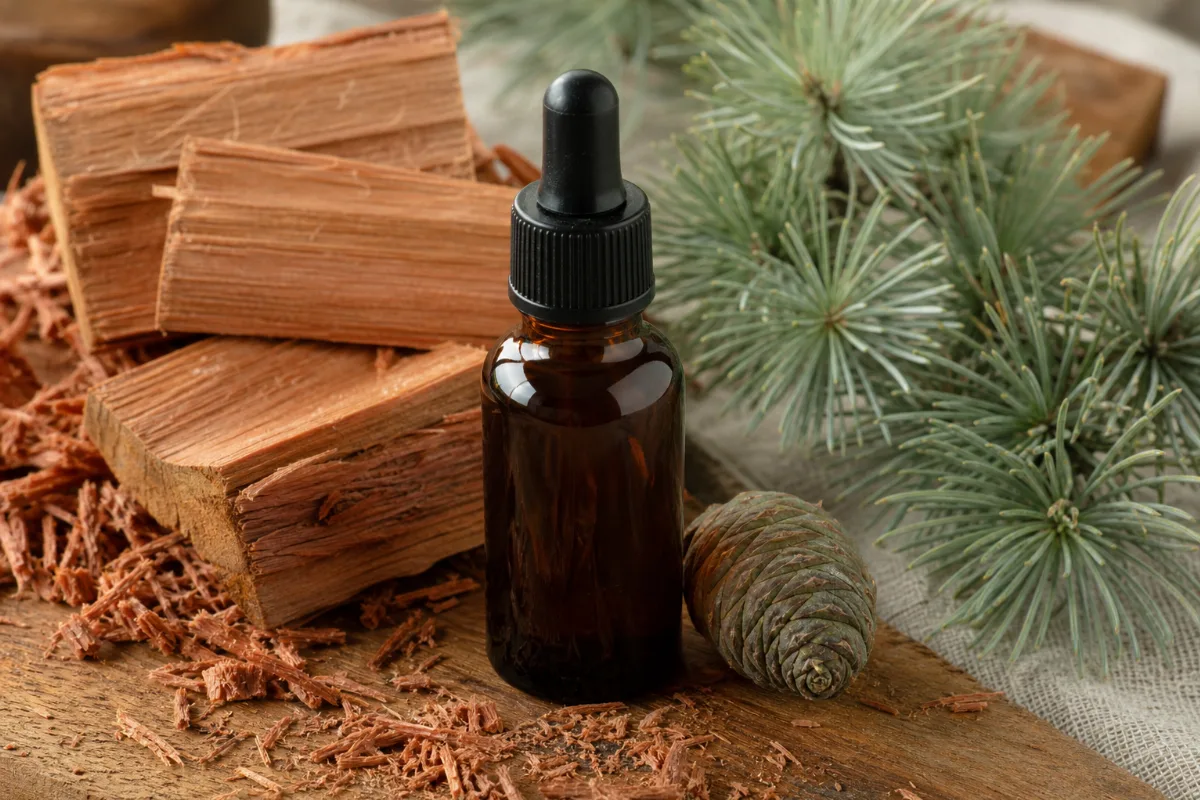
Essential Oils & Aromatherapy · Essential oil
Cedarwood Oil
Cedrus atlantica; Juniperus virginiana; J. ashei (and other trees sold as 'cedar') · also called Cedar oil, cedarwood oil, oil of cedarwood, red cedarwood oil, Virginia cedarwood oil
Cedarwood oil is a strong woody-smelling oil made from the wood of several different trees, not one: Atlas cedar and some junipers such as eastern red cedar. It is used in cosmetics, household products and pest products, and sold for hair, calm and insects. Research is thin: one small hair-loss trial of a four-oil blend, one small dementia scent trial, and animal and lab work. Do not swallow it, it can cause skin allergy, and strong oil harmed rodent skin.
General information, not medical advice. Last substantive update · Not medically reviewed. A named clinician has not signed off on this page. How this page is made
About Cedarwood Oil
Cedarwood oil is a woody-smelling oil from several trees. It is mostly known as a fragrance and a pest-control ingredient. The research on health uses is small, and the safety side is clearer than the benefit side.
What 'cedarwood oil' is
The name covers several trees. Atlas cedar (Cedrus atlantica) is a true cedar in the pine family. Eastern red cedar (Juniperus virginiana) and Ashe juniper (J. ashei) are junipers in the cypress family. A 2026 review lists many more trees sold as cedar.
Cedrus wood oils are mostly himachalenes and atlantones. Red cedarwood and Ashe juniper oils are rich in cedrene, cedrol and thujopsene. In one red cedarwood sample, cedrol was 24.58% and alpha-cedrene 28.11%.
Because the oils differ, a result for one cedarwood does not carry over to another. Many of the papers below do not name the species.
What the research shows
Hair: one 1998 trial of 86 people with alopecia areata tested a scalp massage with thyme, rosemary, lavender and cedarwood oils. 44% improved vs 15% with carrier oils alone. It was a blend, and no later trial was found.
Dementia: a small trial (36 people) found a cedar scent improved behaviour and carer-burden scores but not thinking scores. The cedar was not identified.
Calm: cedrol alone lowered heart rate and blood pressure in 26 healthy adults. Rat and mouse studies show sedation and mixed anxiety results. No human anxiety or sleep trial was found.
Insects: against for mosquitoes in a laboratory test on human skin. A lab study on ticks found repellency and killing on treated paper and in vials, nothing on people.
Wounds and pain: animal studies only.
Quality of the evidence
Most studies are small, old, animal, lab, or use a single compound or a blend. None can be called strong. The trials do not name who paid for them in their abstracts.
Essential oil products are not well regulated, and the species, strength and contaminants can be unknown (Poison Control).
At a glance
Traditional uses history, not proof
- Fragrance in cosmetic products, as a pesticide, and as a source of other cedar-smelling fragrance materials (US National Toxicology Program).
- Flavour, fragrance and medicinal applications of cedarwood oils in general (2026 review).
- Atlas cedar oil said to be used for therapeutic purposes since ancient times (a mouse-study abstract; no specific tradition given).
Studied for research
- Behaviour symptoms in dementia (cedar scent), low
- Hair regrowth in alopecia areata (four-oil blend), low
- Body-relaxation signs (cedrol alone), very-low
- Sedation and anxiety (animals), insufficient
- Mosquito repellency, against
- Tick repellency (lab only), insufficient
- Wound healing and inflammation (animals), insufficient
- Pain after incision (mice), insufficient
Main compounds
- Cedrol (about a quarter of one red cedarwood sample)
- Alpha-cedrene and beta-cedrene
- Thujopsene
- Himachalenes and atlantones (typical of Cedrus wood oils)
Common forms
- Essential oil (steam-distilled wood)
- Carbon-dioxide-extracted wood oil
- Single compounds such as cedrol (research only)
- Scented products and pest products (not reviewed)
Research links: Poison Control: Essential oils · US National Toxicology Program: TOX-86 cedarwood oil (Virginia) · PubMed: hair-loss aromatherapy trial · PubMed: mosquito repellency test · PubMed: cedarwood oils review (2026) · Research Library · Genes & Biomarkers Library
What it is and its history
- Accepted scientific name
- Several species are sold as 'cedarwood': Cedrus atlantica (Atlas cedar, Pinaceae) and Juniperus virginiana (eastern red cedar) and Juniperus ashei (Ashe juniper), both Cupressaceae.
- Naming authority
- C. atlantica (Endl.) Manetti ex Carriere; J. virginiana L.; J. ashei J.T.Buchholz
- Common names
- Cedar oil (English); Cedarwood oil (English); Oil of cedarwood (English); Red cedarwood oil (English)
- Family or group
- Cedrus atlantica is in the pine family (Pinaceae). Juniperus virginiana and J. ashei are in the cypress family (Cupressaceae) and are junipers, not true cedars (GBIF).
- Classification
- Plantae
- Native range
- Not checked.
- Habitat
- Not checked.
- What it looks like
- Part used: The wood is steam-distilled or extracted (NTP; the tick paper used a carbon-dioxide-derived oil; Tumen 2013 used heartwood and supercritical CO2).
- Look-alikes and adulterants
- Name: Other 'cedar' oils; Note: The 2026 review lists many genera sold as cedar (Cedrus, Callitropsis, Calocedrus, Cedrela, Chamaecyparis, Cryptomeria, Cupressus, Juniperus, Thuja, Widdringtonia). Their oils differ in make-up, so a 'cedarwood' label alone does not say which oil you have.; Name: Cedar leaf oil (Thuja); Note: Different plant part and different species; not covered by the studies on this page.
- Sustainability and conservation
- Not checked (no IUCN or CITES source read).
Traditional use and history history, not clinical proof
| Tradition or era | Documented use | Source |
|---|---|---|
| Fragrance, pesticide and perfumery material | The NTP says Virginia cedarwood oil is used as a fragrance in cosmetic products, as a pesticide, and as a source material for other fragrance materials with cedarwood odours. | US National Toxicology Program, TOX-86 (2016) |
| Flavour, fragrance and medicinal applications of cedarwood oils | A 2026 review says cedarwood oils have been used as flavour and fragrance materials and in medicinal applications. | Setzer and Satyal 2026 |
| Atlas cedar essential oil | A mouse paper states that Cedrus atlantica essential oil has been used for therapeutic purposes since ancient times; the abstract gives no specific tradition or source. | Emer et al 2018 |
Traditional use shows how it was used. It does not show that it works or is safe today.
What is inside, and how it may work
What it contains and how those compounds act in cells and animals. Laboratory and animal mechanisms are not proven effects in people.
Main compounds
| Compound | Family | Where it is concentrated | Activity studied | Level of evidence |
|---|---|---|---|---|
| Cedrol PubChem 65575 | sesquiterpene alcohol | Wood oil of Juniperus virginiana (24.58% in one analysed sample) 24.58% in one J. virginiana oil sample (Zhang 2018); varies by oil. | Lowered movement and extended drug-induced sleep in rats (inhaled); anti-anxiety signs in mice; lowered heart rate and blood pressure in healthy adults (inhaled, single compound). 16 23 12 3 | Human surrogate and animal |
| alpha-Cedrene (listed by PubChem as (-)-cedrene) PubChem 6431015 | sesquiterpene hydrocarbon | Wood oil of Juniperus virginiana (28.11% in one sample) 28.11% (alpha-cedrene) and 7.81% (beta-cedrene) in one J. virginiana oil sample. | In mice, cedrene did not show anti-anxiety effect and instead increased anxiety-like behaviour and lowered movement. 17 23 | Animal research |
| Thujopsene PubChem 442402 | sesquiterpene hydrocarbon | Wood oil of Juniperus virginiana (17.71% in one sample) 17.71% in one J. virginiana oil sample. | Not tested alone in the sources read. 18 23 | Composition only |
| Himachalenes and atlantones | sesquiterpenes / sesquiterpene ketones | Cedrus wood oils Described as the generally dominant compounds of Cedrus wood oils (Setzer 2026). | Not tested alone in the sources read. 19 | Composition only |
Mechanisms, receptors and pathways
| Target or pathway | Gene or receptor | What was found | Level |
|---|---|---|---|
| Serotonin and dopamine in brain | 5-HT and dopamine pathways | In mice, the J. virginiana oil raised brain serotonin at the highest amount; cedrol changed dopamine and serotonin at different amounts. The authors suggest the anti-anxiety effect may act through these pathways. 23 | Animal research |
| Autonomic nervous system | Parasympathetic / sympathetic balance | In healthy adults, inhaled cedrol lowered heart rate and blood pressure and shifted heart-rate variability in a way the authors read as more parasympathetic activity. 3 22 | Human surrogate |
| Endocannabinoid system | CB1 and CB2 receptors; FAAH and MAGL enzymes | In mice, the pain-lowering effect of inhaled Cedrus atlantica oil was blocked by CB1/CB2 blockers and prolonged by drugs that slow endocannabinoid breakdown. 4 | Animal research |
| Sedation not via smell | Not identified | In rats, cedrol's sedative effect stayed even when the sense of smell was reduced, suggesting a route other than the olfactory system. 12 | Animal research |
Absorption, metabolism and elimination
- Absorption
- Not established in the sources read.
- Distribution
- Not established.
- Metabolism
- Not established. Cats have a gap in a liver enzyme (UGT1A6) that clears some chemicals (Court 2000), a general point not shown for cedarwood.
- Elimination
- Not established.
- Bioavailability
- Not established.
Isolated compounds versus whole extracts
The cedrol studies used one pure compound; the red cedarwood mouse study found that cedrol and cedrene pull in opposite directions. The hair-loss trial used a four-oil blend, and the dementia trial used an unidentified cedar aroma. None of these results can be assumed to apply to bottled Atlas cedarwood or Virginia cedarwood oil.
Nutritional composition
Cedarwood oil is not a food or a nutrient and has no recommended intake.
2 low certainty1 very low certainty4 not enough evidence1 evidence against
What was looked at
The 8 benefits and uses checked for Cedarwood Oil, each with how strong the evidence is. Tap one to open it.
- Behavioural symptoms of Alzheimer-type dementia (cedar scent)Low certainty
- Body-relaxation signs while breathing in cedrol (one compound)Very low certainty
- Sedation and anxiety-like behaviour (animal studies)Not enough evidence
- Hair regrowth in alopecia areata (four-oil blend with cedarwood)Low certainty
- Repelling mosquitoes (oil on skin)Evidence against
- Repelling or killing ticks (lab test, not on people)Not enough evidence
- Wound healing and inflammation (animal tests)Not enough evidence
- Pain after surgery-like injury (mice, breathing in Atlas cedar oil)Not enough evidence
Lab markers tracked in the studies
Neuropsychiatric Inventory (NPI) scoreHeart rate and blood pressure during cedrol inhalationPupil light-reflex (miosis) rateHair regrowth on photographs (alopecia areata)Time protected from mosquito bites
What is Cedarwood Oil good for?
The uses people ask about and how strong the evidence is for each. Read the certainty label first: nothing here is better than low, and one use is against.
Benefits, one by one
Each card is a research question, not a promise. Tap a goal to filter. Open a card to see the studies, doses and limits.
Behavioural symptoms of Alzheimer-type dementia (cedar scent)
Low certaintyOne small trial of 36 people with Alzheimer-type dementia found that an 8-week cedar scent improved behaviour scores and caregiver burden compared with a scent-free control. Thinking scores did not change. The abstract does not say which tree the cedar came from.
1 studiesNot covered. This page gives no amounts and no ways of using the oil.
Studies, doses and limits
What the trials found
One randomized controlled trial, 19 people in the cedar group and 17 in the control group.
Results
NPI (behaviour) and J-ZBI (caregiver burden) scores were significantly better with the cedar scent than with the control at 4 and 8 weeks. The ADAS-cog thinking test did not differ between the groups.
Effect sizes as reported
No effect sizes in the abstract.
Why this rating
One small trial, 36 people, 8 weeks. The cedar was not identified and the product was an aroma-added disinfectant, so it cannot be assumed to match Atlas or red cedarwood oil. No second trial was found.
Form and dose studied
Not covered. This page gives no amounts and no ways of using the oil.
Who was studied
Adults with Alzheimer-type dementia who could still smell.
Limits
Single small trial; unnamed cedar; no thinking benefit; funding not stated in the abstract.
Why researchers looked
Dementia care is hard and scents are a low-risk add-on that nurses and families can try.
Proposed mechanism Preliminary mechanism
Not studied in this trial. A separate lab review says cedar oils contain sesquiterpenes, which give the woody smell (Setzer 2026).
A proposed mechanism does not show that the effect happens in people.
A care-setting scent trial, not a treatment. Dementia symptoms need medical care. Do not swallow essential oil.
Body-relaxation signs while breathing in cedrol (one compound)
Very low certaintyIn 26 healthy adults, breathing in pure cedrol (a compound taken from cedar wood oil) lowered heart rate, blood pressure and breathing rate compared with blank air. In women in three countries, the pupil reflex moved the same direction. These are body measurements, not proof that anyone feels less anxious or sleeps better.
2 studiesNot covered. This page gives no amounts and no ways of using the oil.
Studies, doses and limits
What the trials found
Two small human studies of a single compound (26 healthy adults; women in three countries, group sizes not in the abstract).
Results
Heart rate, systolic and diastolic blood pressure and breathing rate were lower during cedrol than during blank air. The pupil's miosis rate rose after cedrol in Norwegian, Thai and Japanese women.
Effect sizes as reported
Direction of change only; numbers not quoted here.
Why this rating
Short exposure, healthy people, indirect body measures, one compound rather than the oil, and the pupil study describes no control group.
Form and dose studied
Not covered. This page gives no amounts and no ways of using the oil.
Who was studied
Healthy adult volunteers.
Limits
No test of anxiety, sleep or mood after cedrol; the whole oil was not tested; funding not stated.
Why researchers looked
Cedarwood is described as a calming scent in aromatherapy, so researchers measured body signs of relaxation.
Proposed mechanism Preliminary mechanism
Authors read the changes as more parasympathetic and less sympathetic nervous activity. This is their interpretation of surrogate measures.
A proposed mechanism does not show that the effect happens in people.
This is about cedrol alone, in healthy people, over a short time. It is not about swallowing or skin use.
Sedation and anxiety-like behaviour (animal studies)
Not enough evidenceIn rats and mice, inhaled cedrol lowered movement and prolonged drug-induced sleep. Eastern red cedarwood oil injected into mice looked anti-anxiety in one test and not in another. No trial in people with anxiety or poor sleep was found.
2 studiesNot covered. This page gives no amounts and no ways of using the oil.
Studies, doses and limits
What the trials found
No human trials of anxiety or sleep with cedarwood oil were found. Evidence is from rats and mice.
Results
Cedrol reduced movement and lengthened pentobarbital sleep in rats. The red cedarwood oil improved open-arm time in one of two mouse tests; cedrol worked in both and cedrene worked against it.
Why this rating
Animal-only evidence, injected or inhaled in lab conditions, with mixed results between tests. It cannot support a human claim.
Form and dose studied
Not covered. This page gives no amounts and no ways of using the oil.
Who was studied
Rats, mice.
Limits
No human data; high amounts per kilogram; mixed tests.
Why researchers looked
Cedarwood oil is traditionally described as calming, so animal labs tested it.
Proposed mechanism Preliminary mechanism
Serotonin and dopamine changes in mouse brain were reported for the oil and cedrol (Zhang 2018). Sedation in rats did not depend on the sense of smell (Kagawa 2003).
A proposed mechanism does not show that the effect happens in people.
Animal results, often at very large amounts. They give no guide to safe human use.
Hair regrowth in alopecia areata (four-oil blend with cedarwood)
Low certaintyIn a 1998 trial of 86 people with alopecia areata, daily scalp massage with a blend of thyme, rosemary, lavender and cedarwood oils in carrier oils helped more people than carrier oils alone: 44% vs 15%. Because it was a four-oil blend, the result cannot be credited to cedarwood. We found no later trial.
1 studiesNot covered. This page gives no amounts and no ways of using the oil.
Studies, doses and limits
What the trials found
One randomized double-blind trial, 86 people, 7 months. Photos were judged by two dermatologists.
Results
19 of 43 people (44%) in the oil group improved vs 6 of 41 (15%) with carrier oils only (P = .008).
Effect sizes as reported
44% vs 15% improved; P = .008
Why this rating
Only one trial, from 1998, with a blend; carrier oils may have helped too; improvement judged on photos; funding not stated in the abstract.
Form and dose studied
Not covered. This page gives no amounts and no ways of using the oil.
Who was studied
People with alopecia areata attending a skin clinic (ages not in the abstract).
Limits
Not a test of cedarwood alone; no trial for other kinds of hair loss; no follow-up trial found.
Why researchers looked
Aromatherapists have used oil blends on the scalp for hair loss, and this one trial tested it.
Proposed mechanism Preliminary mechanism
Not established.
A proposed mechanism does not show that the effect happens in people.
Scalp use of essential oils can cause allergic reactions. Alopecia areata should be seen by a doctor. This page gives no directions for skin use.
Repelling mosquitoes (oil on skin)
Evidence againstAgainst. In a laboratory test on human skin, cedarwood oil failed to repel two mosquito species. Thyme and clove did better, though not at low strengths.
1 studiesNot covered. This page gives no amounts and no ways of using the oil.
Studies, doses and limits
What the trials found
One 1999 laboratory test with two volunteers.
Results
Cedarwood oil failed to repel Aedes aegypti and Anopheles albimanus when applied to human skin.
Effect sizes as reported
No repellency
Why this rating
A small, old test, but it is the only human-skin test we found and it points one way. The cedarwood species was not named.
Form and dose studied
Not covered. This page gives no amounts and no ways of using the oil.
Who was studied
Two human volunteers.
Limits
Not a test of other insects, products or modern formulations.
Why researchers looked
Cedar wood is traditionally kept to deter insects, so cedarwood oil is often sold as a repellent.
Proposed mechanism Preliminary mechanism
Not studied.
A proposed mechanism does not show that the effect happens in people.
Do not rely on cedarwood oil against mosquito-borne illness.
Repelling or killing ticks (lab test, not on people)
Not enough evidenceIn lab dishes, a carbon-dioxide-extracted cedarwood oil made young ticks of four species avoid treated paper, and killed them in treated vials. The effect faded over time. Nothing was tested on people.
1 studiesNot covered. This page gives no amounts and no ways of using the oil.
Studies, doses and limits
What the trials found
One laboratory bioassay on unfed tick nymphs.
Results
Ixodes scapularis nymphs were the most sensitive in the repellency test. The oil also killed ticks in vials after 24 and 48 hours.
Effect sizes as reported
Repellency RC50 19.8 ug/cm2 (I. scapularis), 30.8, 83.8 and 89.6 for three other species
Why this rating
Lab bioassay only; treated paper and vials, not skin; repellency decreased with time.
Form and dose studied
Not covered. This page gives no amounts and no ways of using the oil.
Who was studied
Tick nymphs in the lab.
Limits
No test on animals or people; the authors themselves say 'potential'.
Why researchers looked
Cedarwood is commonly marketed against ticks and other pests.
Proposed mechanism Preliminary mechanism
Not established.
A proposed mechanism does not show that the effect happens in people.
Lab results on filter paper do not show protection on skin or clothes. Ticks carry disease: use proven protection and check for ticks.
Wound healing and inflammation (animal tests)
Not enough evidenceIn animal models, heartwood oils from three North American juniper species were tested on wounds. J. occidentalis was strongest. J. virginiana (red cedarwood) was strongly anti-inflammatory in one test. Nothing was tested in people.
1 studiesNot covered. This page gives no amounts and no ways of using the oil.
Studies, doses and limits
What the trials found
One animal study (species not given in the abstract).
Results
J. occidentalis oil showed significant wound-healing and anti-inflammatory activity; J. virginiana oil was highly effective in the anti-inflammatory test.
Effect sizes as reported
Not in the abstract
Why this rating
Animal only, one study, species of animal and strength not in the abstract.
Form and dose studied
Not covered. This page gives no amounts and no ways of using the oil.
Who was studied
Laboratory animals.
Limits
No human wound trials found.
Why researchers looked
Juniperus species are used traditionally for wound healing in several places (the paper's introduction).
Traditional use
Surveys cited in the paper list wound-healing uses for Juniperus species in general.
Proposed mechanism Preliminary mechanism
Not established.
A proposed mechanism does not show that the effect happens in people.
Do not put essential oil on open wounds. Animal work only.
Pain after surgery-like injury (mice, breathing in Atlas cedar oil)
Not enough evidenceIn mice with a paw incision, breathing Atlas cedar (Cedrus atlantica) oil reduced pain sensitivity. The effect depended on the body's endocannabinoid system. Nobody has shown this in people.
1 studiesNot covered. This page gives no amounts and no ways of using the oil.
Studies, doses and limits
What the trials found
No human trial found; one mouse study (and an earlier mouse study the authors mention but we did not read).
Results
Inhaled Cedrus atlantica oil reduced pain sensitivity in mice after incision.
Effect sizes as reported
Not in the abstract
Why this rating
Animal only; mechanism is the authors' possible explanation.
Form and dose studied
Not covered. This page gives no amounts and no ways of using the oil.
Who was studied
Mice.
Limits
No human data.
Why researchers looked
Cedar oil has been used for therapeutic purposes since ancient times, the paper says.
Traditional use
The paper makes a general statement and cites no specific tradition.
Proposed mechanism Preliminary mechanism
Blocking CB1 or CB2 receptors stopped the effect; drugs slowing endocannabinoid breakdown prolonged it (mouse).
A proposed mechanism does not show that the effect happens in people.
Animal study only. Follow your care team's advice for pain after surgery.
Connections to the rest of health
How Cedarwood Oil connects to the rest of our health knowledge graph. Every link says what kind of connection it is. A safety link (for example to the liver) is a warning, not a benefit. A study that merely mentions a topic never creates a benefit link.
Explore every connection: goals, body systems, organs, symptoms, genes
A. Wellness goals
| Connected to | Kind of connection | Evidence status | Context | Studies |
|---|---|---|---|---|
| Calm Relaxation | Low certainty | Behavioural symptoms of Alzheimer-type dementia (cedar scent): One small trial of 36 people with Alzheimer-type dementia found that an 8-week cedar scent improved behaviour scores and caregiver burden compared with a scent-free control. Thinking scores did not change. The abstract does not say which tree the cedar came from. | 20 | |
| Healthy Aging | Low certainty | Behavioural symptoms of Alzheimer-type dementia (cedar scent): One small trial of 36 people with Alzheimer-type dementia found that an 8-week cedar scent improved behaviour scores and caregiver burden compared with a scent-free control. Thinking scores did not change. The abstract does not say which tree the cedar came from. | 20 | |
| Calm Relaxation | Very low certainty | Body-relaxation signs while breathing in cedrol (one compound): In 26 healthy adults, breathing in pure cedrol (a compound taken from cedar wood oil) lowered heart rate, blood pressure and breathing rate compared with blank air. In women in three countries, the pupil reflex moved the same direction. These are body measurements, not proof that anyone feels less anxious or sleeps better. | 3 22 | |
| Stress Reduction | Very low certainty | Body-relaxation signs while breathing in cedrol (one compound): In 26 healthy adults, breathing in pure cedrol (a compound taken from cedar wood oil) lowered heart rate, blood pressure and breathing rate compared with blank air. In women in three countries, the pupil reflex moved the same direction. These are body measurements, not proof that anyone feels less anxious or sleeps better. | 3 22 | |
| Calm Relaxation | Not enough evidence | Sedation and anxiety-like behaviour (animal studies): In rats and mice, inhaled cedrol lowered movement and prolonged drug-induced sleep. Eastern red cedarwood oil injected into mice looked anti-anxiety in one test and not in another. No trial in people with anxiety or poor sleep was found. | 12 23 | |
| Anxiety Support | Not enough evidence | Sedation and anxiety-like behaviour (animal studies): In rats and mice, inhaled cedrol lowered movement and prolonged drug-induced sleep. Eastern red cedarwood oil injected into mice looked anti-anxiety in one test and not in another. No trial in people with anxiety or poor sleep was found. | 12 23 | |
| Healthy Skin | Low certainty | Hair regrowth in alopecia areata (four-oil blend with cedarwood): In a 1998 trial of 86 people with alopecia areata, daily scalp massage with a blend of thyme, rosemary, lavender and cedarwood oils in carrier oils helped more people than carrier oils alone: 44% vs 15%. Because it was a four-oil blend, the result cannot be credited to cedarwood. We found no later trial. | 11 | |
| Preventive Wellness | Evidence against | Repelling mosquitoes (oil on skin): Against. In a laboratory test on human skin, cedarwood oil failed to repel two mosquito species. Thyme and clove did better, though not at low strengths. | 1 | |
| Preventive Wellness | Not enough evidence | Repelling or killing ticks (lab test, not on people): In lab dishes, a carbon-dioxide-extracted cedarwood oil made young ticks of four species avoid treated paper, and killed them in treated vials. The effect faded over time. Nothing was tested on people. | 5 | |
| Healthy Skin | Not enough evidence | Wound healing and inflammation (animal tests): In animal models, heartwood oils from three North American juniper species were tested on wounds. J. occidentalis was strongest. J. virginiana (red cedarwood) was strongly anti-inflammatory in one test. Nothing was tested in people. | 21 | |
| Inflammation Balance | Not enough evidence | Wound healing and inflammation (animal tests): In animal models, heartwood oils from three North American juniper species were tested on wounds. J. occidentalis was strongest. J. virginiana (red cedarwood) was strongly anti-inflammatory in one test. Nothing was tested in people. Pain after surgery-like injury (mice, breathing in Atlas cedar oil): In mice with a paw incision, breathing Atlas cedar (Cedrus atlantica) oil reduced pain sensitivity. The effect depended on the body's endocannabinoid system. Nobody has shown this in people. | 21 4 |
B. Body systems
| Connected to | Kind of connection | Evidence status | Context | Studies |
|---|---|---|---|---|
| Nervous System | Biological association | Low certainty | Studied for: Behavioural symptoms of Alzheimer-type dementia (cedar scent) Studied for: Body-relaxation signs while breathing in cedrol (one compound) | 20 3 22 12 23 4 |
| Stress Mood | Biological association | Very low certainty | Studied for: Body-relaxation signs while breathing in cedrol (one compound) | 3 22 |
| Skin Hair Beauty | Biological association | Low certainty | Studied for: Hair regrowth in alopecia areata (four-oil blend with cedarwood) | 11 |
| Integumentary System | Biological association | Low certainty | Studied for: Hair regrowth in alopecia areata (four-oil blend with cedarwood) Studied for: Repelling mosquitoes (oil on skin) | 11 1 5 21 |
| Pain Inflammation | Biological association | Not enough evidence | Studied for: Wound healing and inflammation (animal tests) Studied for: Pain after surgery-like injury (mice, breathing in Atlas cedar oil) | 21 4 |
E. Health conditions
| Connected to | Kind of connection | Evidence status | Context | Studies |
|---|---|---|---|---|
| Contact dermatitis | Adverse effect or risk | Documented risk | Case report and patch-test review. Preparation or compound: Cedarwood oil |
6 10 |
| Alopecia areata | Potential benefit | Low certainty | One 1998 randomized trial; cannot be credited to cedarwood alone. Preparation or compound: Four-oil blend containing cedarwood |
11 |
I. Biomarkers
| Connected to | Kind of connection | Evidence status | Context | Studies |
|---|---|---|---|---|
| Neuropsychiatric Inventory (NPI) score | Biological association | Low certainty | Measured in trials: decrease. A lab change is not the same as a health benefit. | 20 |
| Heart rate and blood pressure during cedrol inhalation | Biological association | Very low certainty | Measured in trials: decrease. A lab change is not the same as a health benefit. | 3 |
| Pupil light-reflex (miosis) rate | Biological association | Very low certainty | Measured in trials: increase. A lab change is not the same as a health benefit. | 22 |
| Hair regrowth on photographs (alopecia areata) | Biological association | Low certainty | Measured in trials: increase. A lab change is not the same as a health benefit. | 11 |
| Time protected from mosquito bites | Biological association | Evidence against | Measured in trials: increase. A lab change is not the same as a health benefit. | 1 |
J. Genes, receptors and enzymes
| Connected to | Kind of connection | Evidence status | Context | Studies |
|---|---|---|---|---|
| CB1 and CB2 cannabinoid receptors | Preliminary mechanism | Animal | Involved in the pain effect of inhaled Atlas cedar oil in mice. | 4 |
K. Biological pathways
| Connected to | Kind of connection | Evidence status | Context | Studies |
|---|---|---|---|---|
| Serotonin and dopamine | Preliminary mechanism | Animal | Mouse brain changes after cedarwood oil or cedrol. | 23 |
L. Active compounds
| Connected to | Kind of connection | Evidence status | Context | Studies |
|---|---|---|---|---|
| Cedrol | Biological association | Human surrogate and animal | Lowered movement and extended drug-induced sleep in rats (inhaled); anti-anxiety signs in mice; lowered heart rate and blood pressure in healthy adults (inhaled, single compound). Preparation or compound: Wood oil of Juniperus virginiana (24.58% in one analysed sample) |
16 23 12 3 |
| alpha-Cedrene (listed by PubChem as (-)-cedrene) | Biological association | Animal | In mice, cedrene did not show anti-anxiety effect and instead increased anxiety-like behaviour and lowered movement. Preparation or compound: Wood oil of Juniperus virginiana (28.11% in one sample) |
17 23 |
| Thujopsene | Biological association | Composition only | Not tested alone in the sources read. Preparation or compound: Wood oil of Juniperus virginiana (17.71% in one sample) |
18 23 |
| Himachalenes and atlantones | Biological association | Composition only | Not tested alone in the sources read. Preparation or compound: Cedrus wood oils |
19 |
Each connection is stored with the ingredient, the connected record, the kind of connection, the evidence status, the supporting studies, the preparation or compound involved, and a review date (last reviewed October 25, 2026).
Evidence at a glance: what the research found for 8 outcomes
Each outcome below is one thing researchers measured. Certainty is how far the evidence can be trusted, not how well it works. The full studies are on the next tab.
The evidence
The research centre for Cedarwood Oil. Every record here was checked against PubMed or the publisher's page; we never list a study we have not verified.
Evidence by outcome
Bars show how many studies we found for each outcome, not how well it works. People are added up across trials only (reviews are not added, to avoid double counting).
How we rate evidence
High certainty
Several well-run trials or reviews agree; further research is unlikely to change the picture much.
Moderate certainty
Good trials point the same way, but some doubt remains.
Low certainty
Small, short or inconsistent trials. The finding could change with better research.
Very low certainty
Very little or very weak human data. Treat as a possibility only.
Mixed findings
Trials or reviews disagree with each other.
Not enough evidence
Not enough human research to say either way.
Evidence against
Good research found no benefit, or found harm.
We take the reviewers' own risk-of-bias and GRADE statements where they exist, and otherwise judge from study size, design, consistency, directness and whether a product matches what is sold. Many publications do not make evidence high. Method note: We read the abstracts of 16 PubMed records (and the title of one case report that has no abstract) and the Poison Control and US National Toxicology Program pages, and checked tree names against GBIF and compound records against PubChem. We did not re-check each claim against full texts.
Study library: every study we checked 23
| Study | Design | People | Product, dose, length | Result |
|---|---|---|---|---|
| Barnard 1999 Repellency of essential oils to mosquitoes (Diptera: Culicidae). J Med Entomol · PMID 10534958 · DOI |
Laboratory repellency test on human skin human (2 volunteers) |
2 Two human volunteers; Aedes aegypti and Anopheles albimanus mosquitoes |
Five essential oils applied to skin, including cedarwood (species not named in the abstract) oil Not reported here time to first bite across tests · vs untreated skin |
Cedarwood oil failed to repel mosquitoes. Thyme and clove oils were the most effective of the five oils tested, giving about 1.5 to 3.5 hours of protection depending on strength, and none of the oils prevented bites at the 5% or 10% strength. Cedarwood: no repellency Methods, limits and fundingOutcomes: Time protected from mosquito bites Limitations: Two volunteers; 1999; species of cedarwood not named; clove, thyme and peppermint were skin-irritating in the author's words. Funding and conflicts: Not stated in the abstract. Read: abstract |
| Court 2000 Molecular genetic basis for deficient acetaminophen glucuronidation by cats: UGT1A6 is a pseudogene, and evidence for reduced diversity of expressed hepatic UGT1A isoforms. Pharmacogenetics · PMID 10862526 · DOI |
Laboratory genetics study animal (cat) |
Cats and one related species | n/a (genes for a liver enzyme) Not reported here |
Cats have a much lower ability than most mammals to glucuronidate planar phenolic chemicals, because one liver enzyme gene (UGT1A6) is a pseudogene and the range of liver enzymes is smaller. Methods, limits and fundingOutcomes: Why cats clear some chemicals slowly Limitations: Not a study of cedarwood oil; it explains a general cat weakness only. Read: abstract |
| Dayawansa 2003 Autonomic responses during inhalation of natural fragrance of Cedrol in humans. Auton Neurosci · PMID 14614968 · DOI |
Controlled crossover comparison (cedrol vs blank air) |
26 26 healthy adults |
Cedrol vapour (a single compound extracted from cedar wood oil), via face mask compound from wood oil Not reported here short exposure while monitored · vs blank air |
During cedrol, heart rate, blood pressure and breathing rate fell compared with blank air, and heart-rate variability changed in a pattern the authors read as more parasympathetic and less sympathetic activity. Reductions in HR, SBP, DBP and respiratory rate vs blank air (numbers not quoted here) Methods, limits and fundingOutcomes: Heart rate, blood pressure, breathing rate, heart-rate variability Limitations: One compound, not the whole oil; healthy people only; body measurements, not symptoms; no information on funding in the abstract. Funding and conflicts: Not stated in the abstract. Read: abstract |
| Emer 2018 The role of the endocannabinoid system in the antihyperalgesic effect of Cedrus atlantica essential oil inhalation in a mouse model of postoperative pain. J Ethnopharmacol · PMID 28917977 · DOI |
Animal study (mice) animal (mouse) |
Male Swiss mice with a cut in the paw | Inhaled Atlas cedar (Cedrus atlantica) essential oil oil Not reported here · vs drug blockers and no-oil controls |
Inhaling the oil reduced pain sensitivity in the mice. Blocking endocannabinoid receptors removed the effect, and drugs that slow endocannabinoid breakdown made it last longer. Not given in the abstract Methods, limits and fundingOutcomes: Pain sensitivity after surgery-like incision Limitations: Mice only; the authors call it a 'possible' mechanism; no human data. Funding and conflicts: Not stated in the abstract. Read: abstract |
| Flor-Weiler 2022 Repellency and toxicity of a CO2-derived cedarwood oil on hard tick species (Ixodidae). Exp Appl Acarol · PMID 35076809 · DOI |
Laboratory bioassay lab (ticks) |
Unfed tick nymphs of four species (Amblyomma americanum, Dermacentor variabilis, Ixodes scapularis, Rhipicephalus sanguineus) | A cedarwood oil made by carbon-dioxide extraction (species not named in the abstract), on filter paper or in vials oil Not reported here 60 minutes for repellency; 24 and 48 hours for deaths · vs untreated surfaces |
Ticks avoided oil-treated paper in proportion to strength, and repellency fell over time. The oil killed ticks in vials. Ixodes scapularis nymphs were the most sensitive in the repellency test. Repellency 50% concentration 19.8 ug/cm2 for I. scapularis; 30.8, 83.8 and 89.6 for the other three Methods, limits and fundingOutcomes: Share of ticks avoiding the treated paper; deaths Limitations: Lab test on filter paper and glass vials, not on skin or clothes; ticks not on people; the abstract does not state funding. Funding and conflicts: Not stated in the abstract. Read: abstract |
| Franz 1998 Allergic contact dermatitis due to cedarwood oil after dermatoscopy. Contact Dermatitis · PMID 9536426 · DOI |
Case report |
1 A patient (details not available: no abstract on PubMed) |
Cedarwood oil, as the title says oil Not reported here |
Only the title was read: it reports a case of allergic skin reaction to cedarwood oil after a dermatoscopy (a skin examination that uses an oil). Methods, limits and fundingOutcomes: Allergic contact dermatitis Limitations: Title only: no abstract was available, so no details are stated. Read: title-only |
| GBIF 2026 GBIF Backbone Taxonomy: Cedrus atlantica (Endl.) Manetti ex Carriere, species key 5284702 gbif.org · Source |
Registry or database n/a |
n/a | n/a Not reported here |
Accepted species name Cedrus atlantica (Endl.) Manetti ex Carriere, family Pinaceae, matched exactly through the GBIF match API on 2026-10-25. Methods, limits and fundingOutcomes: Accepted name and family Read: full-text |
| GBIF 2026 GBIF Backbone Taxonomy: Juniperus virginiana L., species key 2684391 gbif.org · Source |
Registry or database n/a |
n/a | n/a Not reported here |
Accepted species name Juniperus virginiana L., family Cupressaceae, matched exactly through the GBIF match API on 2026-10-25. Methods, limits and fundingOutcomes: Accepted name and family Read: full-text |
| GBIF 2026 GBIF Backbone Taxonomy: Juniperus ashei J.T.Buchholz, species key 2684487 gbif.org · Source |
Registry or database n/a |
n/a | n/a Not reported here |
Accepted species name Juniperus ashei J.T.Buchholz, family Cupressaceae, matched exactly through the GBIF match API on 2026-10-25. Methods, limits and fundingOutcomes: Accepted name and family Read: full-text |
| Geier 2015 [Diagnostic workup of fragrance allergy]. Hautarzt · PMID 26253114 · DOI |
Review (in German; English abstract) |
Patch-tested fragrance-allergy patients (review) | Fragrance materials Not reported here |
Lists cedarwood oil (Cedrus atlantica/deodara, Juniperus virginiana) among the less frequent sensitizing fragrance materials, behind the fragrance-mix components and others such as ylang ylang, lemongrass and sandalwood. Methods, limits and fundingOutcomes: Which fragrance materials commonly cause contact allergy Limitations: Review; frequency figures not in the abstract. Read: abstract |
| Hay 1998 Randomized trial of aromatherapy. Successful treatment for alopecia areata. Arch Dermatol · PMID 9828867 · DOI |
Randomized double blind controlled trial |
86 86 outpatients with alopecia areata; results reported for 43 in the active group and 41 in the control group |
Scalp massage with a mixture of thyme, rosemary, lavender and cedarwood essential oils in jojoba and grapeseed carrier oils (the abstract does not name the cedarwood species) oil blend Not reported here 7 months (follow-up at 3 and 7 months) · vs carrier oils only, same massage |
19 of 43 (44%) in the oil-blend group improved compared with 6 of 41 (15%) in the carrier-oil group (P = .008). Photo-based improvement scores were also higher (P = .05). 44% vs 15% improved; P = .008 Methods, limits and fundingOutcomes: Improvement judged by two dermatologists on sequential photographs; 6-point scale; computer-traced areas of alopecia Limitations: The oils were a four-oil blend, so no part of the result can be given to cedarwood alone. One trial from 1998; we found no later trial. The abstract does not state funding. Funding and conflicts: Not stated in the abstract. Read: abstract |
| Kagawa 2003 The sedative effects and mechanism of action of cedrol inhalation with behavioral pharmacological evaluation. Planta Med · PMID 12898420 · DOI |
Animal study animal (rat, mouse) |
Wistar rats, spontaneously hypertensive rats and ddY mice | Inhaled cedrol (a compound from cedarwood oil) compound from wood oil Not reported here · vs air or untreated animals |
Inhaled cedrol lowered spontaneous movement in all the animal types tested and lengthened pentobarbital-induced sleep in rats. Blocking the sense of smell did not remove the effect. Reduced movement; longer sleeping time (numbers not in the abstract) Methods, limits and fundingOutcomes: Spontaneous movement; pentobarbital sleeping time Limitations: Animals only; not the whole oil; says nothing about human anxiety or sleep. Funding and conflicts: Not stated in the abstract. Read: abstract |
| Khan 2014 Concentrated tea tree oil toxicosis in dogs and cats: 443 cases (2002-2012). J Am Vet Med Assoc · PMID 24344857 · DOI |
Retrospective case series animal (dog, cat) |
443 337 dogs and 106 cats exposed to 100% tea tree oil |
Tea tree oil (not cedarwood) oil Not reported here signs within 2 to 12 hours, up to 72 hours |
100% tea tree oil on skin or swallowed caused drooling, depression or lethargy, weakness, loss of coordination and tremors in dogs and cats; younger and lighter cats were at greater risk of major illness. Methods, limits and fundingOutcomes: Signs and severity Limitations: A different oil. It shows what concentrated essential oil can do to pets but says nothing about cedarwood. Read: abstract |
| National Toxicology Program (NTP) 2016 Toxicity studies of cedarwood oil (Virginia) administered dermally to F344/N rats and B6C3F1/N mice. Toxic Rep Ser · PMID 33535721 · DOI |
Animal toxicology study (3 months, skin) animal (rat, mouse) |
Male and female F344/N rats and B6C3F1/N mice, 10 per group | Virginia cedarwood oil (Juniperus virginiana, steam-distilled) on the skin, from 6.25% in ethanol up to neat oil oil Not reported here 14 weeks, 5 days a week · vs vehicle (95% ethanol) and untreated controls |
Skin irritation, thickening and ulceration at the site in most animals at higher strengths; in rats the 50% and 100% groups gained less weight and had heavier liver and kidney, and male kidney damage at 50% and 100%. All mice in the 100% groups, and a few others, had to be euthanized early because of skin lesions. Blood counts changed (more white cells, fewer red cells). Skin and kidney were named as the main targets. The oil was not mutagenic in Salmonella, and the micronucleus test was negative in male mice and equivocal in female mice. Methods, limits and fundingOutcomes: Survival, weight, skin changes, organ weights, blood counts, tissue changes, mutation tests Limitations: Animals; the skin route; rodents are not people; cedarwood from J. virginiana only. Funding and conflicts: US government research programme (NTP). Read: abstract (PubMed and NTP abstract page) |
| Poison Control (National Capital Poison Center) 2026 Poison Control: Essential oils: Poisonous when misused poison.org · Source |
Poison centre public guidance page n/a |
General public | Essential oils in general (cedarwood not named) oils Not reported here |
Says misuse of essential oils can cause serious poisoning; some can be poisonous if absorbed through the skin or swallowed; aspirating an oil can cause pneumonia; rashes are the most common allergic reaction; products are not well regulated, so species, strength and contaminants can be unknown; oils should be kept out of sight and reach of children and pets. It describes a toddler who swallowed lavender extract and became very drowsy, and another who had a seizure after camphor. Methods, limits and fundingOutcomes: Poisoning, allergy and storage advice Limitations: General page on essential oils, not about cedarwood. Does not mention cats by name. Read: full-text |
| PubChem 2026 PubChem: Cedrol (CID 65575) pubchem.ncbi.nlm.nih.gov · Source |
Registry or database n/a |
n/a | n/a Not reported here |
PubChem record 65575: Cedrol, formula C15H26O. Methods, limits and fundingOutcomes: Compound identity Read: full-text |
| PubChem 2026 PubChem: (-)-Cedrene (CID 6431015) pubchem.ncbi.nlm.nih.gov · Source |
Registry or database n/a |
n/a | n/a Not reported here |
PubChem record 6431015: (-)-Cedrene, formula C15H24. Methods, limits and fundingOutcomes: Compound identity Read: full-text |
| PubChem 2026 PubChem: Thujopsene (CID 442402) pubchem.ncbi.nlm.nih.gov · Source |
Registry or database n/a |
n/a | n/a Not reported here |
PubChem record 442402: Thujopsene, formula C15H24. Methods, limits and fundingOutcomes: Compound identity Read: full-text |
| Setzer 2026 Cedarwood Oils: The Wood Essential Oil Compositions from Trees Known as "Cedar". Plants (Basel) · PMID 41754364 · DOI |
Literature review plus commercial oil analysis review |
Wood essential oils from many trees called 'cedar' | Cedarwood oils wood Not reported here |
Besides true cedars (Cedrus), other genera including Callitropsis, Calocedrus, Cedrela, Chamaecyparis, Cryptomeria, Cupressus, Juniperus, Thuja and Widdringtonia are called cedar. Cedrus wood oils are generally dominated by himachalenes and atlantones. Cedrenes, cedrol and thujopsene are abundant in Cupressus funebris, Juniperus ashei and Juniperus virginiana oils. Sesquiterpenoids give the woody smell. Methods, limits and fundingOutcomes: Which compounds dominate each cedarwood oil Limitations: Review; composition varies by sample. Funding and conflicts: Not stated in the abstract. Read: abstract |
| Takahashi 2020 Examination of the influence of cedar fragrance on cognitive function and behavioral and psychological symptoms of dementia in Alzheimer type dementia. Neuropsychopharmacol Rep · PMID 32037737 · DOI |
Randomized controlled trial |
36 People with Alzheimer-type dementia and a working sense of smell (19 in the cedar group, 17 in the control group) |
Disinfecting ethanol with aroma extracts from 'cedar' added (the abstract does not name the tree or say whether it was a wood oil); control was the ethanol alone aroma extract Not reported here 8 weeks · vs ethanol without the aroma extract |
NPI and caregiver-burden scores improved more in the cedar group than in the control group at 4 and 8 weeks. There was no significant difference on the ADAS-cog thinking test. Significant NPI and J-ZBI improvement vs control at 4 and 8 weeks; no difference on ADAS-cog (numbers not in the abstract) Methods, limits and fundingOutcomes: Neuropsychiatric Inventory (NPI), Zarit caregiver burden interview (J-ZBI), ADAS-cog Limitations: Small trial (36 people); the cedar was not identified in the abstract, so it may not be Atlas or red cedarwood; the product was a disinfectant-style aroma, not bottled oil; the abstract does not say who paid. Funding and conflicts: Not stated in the abstract. Read: abstract |
| Tumen 2013 Topical wound-healing effects and phytochemical composition of heartwood essential oils of Juniperus virginiana L., Juniperus occidentalis Hook., and Juniperus ashei J. Buchholz. J Med Food · PMID 23297713 · DOI |
Animal study (wound models) animal |
Laboratory animals (species not given in the abstract) | Heartwood oils of Juniperus virginiana, J. occidentalis and J. ashei, made by supercritical carbon dioxide extraction, on skin oil Not reported here |
J. occidentalis oil showed the strongest wound-healing and anti-inflammatory activity. J. virginiana oil was highly effective in the anti-inflammatory test. Not given in the abstract Methods, limits and fundingOutcomes: Wound healing; anti-inflammatory effect on capillary permeability Limitations: Animals only; J. ashei was not the standout; no human data. Funding and conflicts: Not stated in the abstract. Read: abstract |
| Yada 2007 Overseas survey of the effect of cedrol on the autonomic nervous system in three countries. J Physiol Anthropol · PMID 17641454 · DOI |
Before and after study in three countries |
Women in their 20s to 40s in Norway, Thailand and Japan (group sizes not in the abstract) | Cedrol inhalation (a compound from cedar wood oil) compound from wood oil Not reported here · vs before exposure (same people) |
The pupil's miosis rate rose after cedrol in all three countries, which the authors read as a shift towards parasympathetic activity. Stress was highest and sleep shortest in the Japanese women. Miosis rate significantly higher after cedrol than before in all three countries Methods, limits and fundingOutcomes: Pupil light reflex (miosis rate) as a sign of autonomic activity; stress and sleep questionnaire Limitations: No control group is described in the abstract; pupil change is an indirect marker; one compound; no stress or sleep outcome was tested after cedrol. Funding and conflicts: Not stated in the abstract. Read: abstract |
| Zhang 2018 The anxiolytic effect of Juniperus virginiana L. essential oil and determination of its active constituents. Physiol Behav · PMID 29326032 · DOI |
Animal study (mice) animal (mouse) |
Mice | Eastern red cedarwood essential oil (Juniperus virginiana) injected into the abdomen; also its parts cedrene and cedrol oil Not reported here single injections · vs untreated or vehicle mice |
The oil raised open-arm time in one test (elevated plus maze) but not in the other (light-dark box). Cedrol showed an anti-anxiety effect in both tests; cedrene did the opposite. The oil raised brain serotonin at the highest amount tested. Positive in one of two tests for the oil; cedrol positive in both Methods, limits and fundingOutcomes: Elevated plus maze and light-dark box anxiety tests; brain serotonin and dopamine Limitations: Mice; injected into the abdomen, not breathed in; mixed result between tests; very high amounts per kilogram; no human relevance shown. Funding and conflicts: Not stated in the abstract. Read: abstract |
What we do not know yet
- What the evidence supports: low for hair (a blend) and dementia behaviour (one scent trial); against for mosquitoes; everything else is animal, lab, or single-compound work.
- No human trial of cedarwood oil alone for hair loss, anxiety or sleep was found.
- No safety data for swallowed oil, pregnancy, breastfeeding, children or pets specific to cedarwood.
- No regulator statement (EMA, FDA, EPA) was read.
- Differences between Atlas, Virginia and Ashe juniper cedarwood oils are not studied in the sources read.
How new research is added
New studies are found by a saved PubMed search and are placed in a review queue. A person reads each one before it is added.
Lab markers
What changed in blood or saliva tests during trials. A changed number is not the same as feeling or being healthier, and we give no "normal ranges".
Other 5
Neuropsychiatric Inventory (NPI) score
Decrease in trials
A carer-rated score of behavioural and mood symptoms in dementia; lower means fewer or milder symptoms.
Low certaintyResults and what it means
Why it was measured
Main outcome of the cedar scent trial.
Statistical vs. clinical meaning
A symptom score rated by others, not a lab marker.
Safety implication
A better score does not show the scent is safe for every person or every home.
| Study | Result | People | Product |
|---|---|---|---|
| 20 | NPI improved more in the cedar-scent group than in the control group at 4 and 8 weeks (numbers not in the abstract). |
Heart rate and blood pressure during cedrol inhalation
Decrease in trials
Pulse and blood pressure measured through the exposure.
Very low certaintyResults and what it means
Why it was measured
Used as signs of calm or stress.
Statistical vs. clinical meaning
Short-term change in healthy people, with one compound.
Safety implication
Not a test of blood pressure treatment; it should not be used that way.
| Study | Result | People | Product |
|---|---|---|---|
| 3 | Heart rate, systolic and diastolic blood pressure and breathing rate fell during cedrol compared with blank air in 26 healthy adults. |
Pupil light-reflex (miosis) rate
Increase in trials
How much the pupil narrows after a light flash, used as an indirect sign of autonomic balance.
Very low certaintyResults and what it means
Why it was measured
Marker of parasympathetic activity used in the three-country study.
Statistical vs. clinical meaning
Indirect marker; no control group described in the abstract.
Safety implication
None specific.
| Study | Result | People | Product |
|---|---|---|---|
| 22 | Miosis rate rose after cedrol inhalation in women in Norway, Thailand and Japan. |
Hair regrowth on photographs (alopecia areata)
Increase in trials
Whether the bald patches improved, judged by two dermatologists on photographs, plus computer-traced areas.
Low certaintyResults and what it means
Why it was measured
Main outcome of the aromatherapy trial.
Statistical vs. clinical meaning
Visible regrowth is meaningful, but the trial was small and the oils were a blend.
Safety implication
Skin allergy to the oils was not described in the abstract.
| Study | Result | People | Product |
|---|---|---|---|
| 11 | 19 of 43 improved with the oil blend vs 6 of 41 with carrier oil (P = .008). |
Time protected from mosquito bites
Increase in trials
How long skin stays free of bites after the oil is applied.
Evidence againstSafety
What studies and official sources say about side effects, medicines and who should check first. Each point shows what kind of evidence it comes from.
Main points to know 5
- Do not swallow cedarwood essential oil, and keep it away from children and pets.. Poison Control says essential oils can cause serious poisoning if swallowed and that children's thin skin and immature livers may make them more susceptible. No cedarwood-specific swallowing case was found, so how toxic any given cedarwood oil is when swallowed is unknown. There is no safe amount we can state. Regulatory 15
- Cedarwood oil can cause allergic skin reactions.. A case report describes allergic contact dermatitis from cedarwood oil, and a review of fragrance allergy lists cedarwood oils (Cedrus atlantica or deodara, and Juniperus virginiana) among the less common sensitizing fragrance materials. Poison Control says rashes are the most common allergic reaction to essential oils. Case report 6 10 15
- Strong or neat oil damaged skin in rodents.. In a 3-month US National Toxicology Program study, Virginia cedarwood oil on rat and mouse skin caused irritation, thickening and ulceration at higher strengths, and some mice given neat oil had to be euthanized early. Skin and kidney were the main targets. This is animal work, but it is the main reason we give no directions for putting the oil on skin. Animal research 14
- Cats and other pets can be hurt by concentrated essential oils.. Poison Control says oils should be kept out of reach of pets. Cats have a genetic gap in a liver enzyme that clears some chemicals, and a veterinary series of 443 cases found concentrated tea tree oil caused serious nerve signs in dogs and cats. We did not find a cedarwood-specific cat or dog report, so the size of the risk for cedarwood is not known. Animal research 15 2 13
- Pregnancy, breastfeeding and young children: no safety data found.. No pregnancy, breastfeeding or child safety study or regulator statement for cedarwood oil was found. Ask a doctor or pharmacist first. Gap
Side effects 4
| Effect | How often | Severity and recovery | Evidence |
|---|---|---|---|
| Allergic skin reaction (contact dermatitis) Case report (title only), a patch-test review that lists cedarwood oils as less frequent allergens, and general Poison Control advice. No rate for cedarwood was found. | Not established | not stated in the sources read Not stated; Poison Control advises stopping use and washing off. | Case report 6 10 15 |
| Skin irritation, thickening and ulceration with strong or neat oil (rats and mice) Animal data on Virginia cedarwood oil; human skin rates not found. | Most animals at the higher strengths in the NTP 3-month study | mild to severe; some mice euthanized early Not stated in the abstract | Animal research 14 |
| Kidney and liver changes at high skin exposure (rats, mice) Animal high-exposure data; not a statement about normal human scent use. | Dose-related in the NTP study | organ weight rises and kidney damage in male rats at higher strengths Not stated | Animal research 14 |
| Poisoning if swallowed (essential oils in general) General essential-oil guidance; the cases cited by Poison Control involved lavender and camphor, not cedarwood. | Not established | serious in children for some oils Not stated | Regulatory 15 |
Liver
No liver injury case for cedarwood oil was found in the sources read. In the NTP rodent study, liver weight rose and glycogen fell in the liver at higher skin exposures (mice), which is a laboratory finding at high exposure. LiverTox was not checked. 14
How often. Not established.
This is a safety connection. It is not evidence that Cedarwood Oil supports liver health.
Medicines and supplements 3
| With | Why it matters | Importance | Evidence | What to do |
|---|---|---|---|---|
| Sedative medicines, sleep aids and alcohol sedatives | Theoretical: cedrol lengthened drug-induced sleep in rats. | Unknown in people. The rat result is from inhaled cedrol, not the whole oil. | Animal research Not enough evidence 12 | Tell your pharmacist about any aromatherapy product you use with sedative medicine. |
| People who react to other fragrances other-fragrance-allergy | Fragrance allergy may involve several materials; the review lists cedarwood among the sensitizers found in patch tests. | Not quantified. | Case series Low certainty 10 | If you have had a fragrance allergy, tell your doctor or pharmacist before using any essential oil product. |
| Prescription medicines drug-interactions | No drug interaction study or case for cedarwood oil was found. | Not established. | Gap Not enough evidence | Ask a pharmacist. |
Who should check first 5
| Situation | Advice | Evidence |
|---|---|---|
| Swallowing essential oil, especially by or near children | Do not swallow. If a child or pet may have swallowed any essential oil, call poison control (US: 1-800-222-1222) or a vet. | Regulatory 15 |
| Known fragrance or essential oil allergy | Do not use the oil. Stop if a rash develops. | Regulatory 15 10 |
| Broken or damaged skin, or the skin of babies and young children | Poison Control says not to use essential oils on damaged skin. We give no use directions for babies or children. | Regulatory 15 |
| Homes with cats or other pets | Keep oils and any diffuser liquid out of pets' reach, and ask a vet before using oils around them. | Regulatory 15 2 |
| Pregnancy or breastfeeding | No data found. Ask a doctor first. | Gap |
Overdose, product quality and regulators
Summary. The best toxicity data for a cedarwood oil are the US National Toxicology Program rodent studies of Virginia cedarwood oil on the skin. Swallowed-oil toxicity for cedarwood was not found.
Amounts. No safe amount is established, and this page gives none.
Repeated use. In rats and mice, repeated skin exposure for 14 weeks caused dose-related skin damage, organ weight changes and blood-count changes, with skin and kidney the main targets.
Animal data. NTP: rats and mice, skin, 14 weeks; not mutagenic in Salmonella; micronucleus test negative in male mice and equivocal in female mice. Pets: cat-liver enzyme gap (Court 2000) and tea tree oil in dogs and cats (Khan 2014) are indirect.
Not read. Full NTP report PDF, RIFM/IFRA safety assessments, SCCS opinions, any cedarwood-specific vet report, EPA pesticide documents.
Essential oil products are not well regulated, and 'cedarwood' can be several different oils.
Unknown species, strength and contaminants. Poison Control says it can be hard to know the species, strength or contaminants in an essential oil bottle. 15
Several trees sold as cedarwood. A 2026 review notes that many different trees (Cedrus, Juniperus, Cupressus, Thuja and others) are called 'cedar' and that their wood oils differ in make-up. A label that says only 'cedarwood' may not tell you which one. 19
Blended or perfumed products. Poison Control notes that products often contain other oils or alcohol, which add their own risks. 15
| Body | Action | Date |
|---|---|---|
| Poison Control (US) (United States) | Essential oils can cause serious poisoning if misused; can cause rashes; can be poisonous if absorbed or swallowed; keep away from children and pets; products are not well regulated. source | |
| US National Toxicology Program (NTP) (United States) | Toxicity report TOX-86 on Virginia cedarwood oil on the skin of rats and mice (report date November 2016). It names skin and kidney as the main targets. source | 2016-11 |
When to get medical help
- If a child or pet may have swallowed any essential oil, call poison control (US: 1-800-222-1222) or a vet straight away.
- Drowsiness, confusion, vomiting, trouble breathing, or a fit after swallowing or breathing in an oil is an emergency.
- A spreading rash, swelling of the face, or any breathing difficulty after skin contact needs urgent care.
- In pets: drooling, weakness, tremors or loss of coordination after contact with a concentrated oil needs a vet at once (seen with tea tree oil in dogs and cats).
Stop using the product and contact a clinician or emergency service. In the US, Poison Control is 1-800-222-1222.
General information only, not medical advice. Ask a clinician or pharmacist before use, especially with medicines, in pregnancy or with a health condition. See the Natural Remedy Safety guide.
Frequently asked questions
Is cedarwood oil safe to swallow?
No. We do not advise swallowing essential oil. Poison Control says some essential oils can be poisonous if swallowed and that children may be more susceptible. We found no study of swallowed cedarwood oil, so no safe amount is known. If a child or pet may have swallowed any essential oil, call poison control or a vet straight away.
Which tree does cedarwood oil come from?
Several. Atlas cedar (Cedrus atlantica) is a true cedar. Eastern red cedar (Juniperus virginiana) and Ashe juniper (J. ashei) are junipers. A 2026 review lists many other trees also called cedar. Their oils differ in make-up, so a label that says only 'cedarwood' does not tell you which one is in the bottle.
Can cedarwood oil cause an allergic skin reaction?
Yes, it can. A case report describes allergic contact dermatitis from cedarwood oil, and a fragrance-allergy review lists cedarwood oils among the less common sensitizing materials. Poison Control says a rash is the most common allergic reaction to essential oils. We found no rate for cedarwood.
Is cedarwood oil safe to put on skin neat?
We give no advice on using it on skin. In a 3-month US National Toxicology Program study, Virginia cedarwood oil on rat and mouse skin caused irritation, thickening and ulceration at higher strengths, and some mice given neat oil had to be euthanized early. That is animal data, but it is why we do not describe skin use.
Is cedarwood oil safe around cats and dogs?
Not enough is known to call it safe. Poison Control says to keep essential oils out of reach of pets. Cats have a genetic gap in a liver enzyme that clears some chemicals, and a veterinary series found concentrated tea tree oil caused serious nerve signs in dogs and cats. We found no cedarwood-specific pet report. Ask a vet before using oils or diffusers around pets.
Does cedarwood oil help hair loss?
One 1998 trial of 86 people with alopecia areata found that a four-oil scalp massage (thyme, rosemary, lavender and cedarwood in carrier oils) helped more people than carrier oils alone: 44% vs 15%. Because it was a blend, no result can be credited to cedarwood. We found no later trial. Alopecia areata and other hair loss should be checked by a doctor.
Does cedarwood oil repel mosquitoes or ticks?
For mosquitoes, no: a laboratory test on human skin found cedarwood oil failed to repel two species. For ticks, a lab study found a cedarwood oil repelled and killed young ticks on treated paper and in vials, but nothing was tested on people. Use proven protection against bites and check for ticks.
Does cedarwood oil help with anxiety or sleep?
Not shown in people. Studies are of one compound (cedrol) in healthy adults, which lowered heart rate and blood pressure, and of animals. One small trial found a cedar scent improved behaviour symptoms in dementia, but the cedar was not identified. Nothing here is a treatment for anxiety, sleep problems or dementia.
Is cedarwood oil safe in pregnancy or for children?
We found no pregnancy, breastfeeding or child safety data for cedarwood oil. Poison Control says children's thin skin and immature livers may make them more susceptible to essential oil toxicity. Ask a doctor or pharmacist first.
Are 'cedarwood' products all the same?
What is cedrol?
Explore by health goal
Calm RelaxationHealthy SkinPreventive WellnessInflammation BalanceHealthy AgingStress ReductionAnxiety Support
Editorial transparency
- Written by
- AlternativeMed editorial team. Research compiled with AI assistance, then checked against PubMed records.
- Medical review
- None. This page has not been reviewed by a physician or pharmacist.
- First published
- 2026-10-25
- Last substantive update
- 2026-10-25
- How we research
- We read the abstracts of 16 PubMed records (and the title of one case report that has no abstract) and the Poison Control and US National Toxicology Program pages, and checked tree names against GBIF and compound records against PubChem. We did not re-check each claim against full texts.
- How we rate evidence
- See "How we rate evidence" in the Evidence tab.
- Independence
- No product is promoted on this page. No affiliate links are shown. Funding is not stated in most of the abstracts read.
Sources 23
Each source was opened and checked. Where we read only the abstract, it says so. The small numbers in the text point here.
- Barnard DR. Repellency of essential oils to mosquitoes (Diptera: Culicidae).. J Med Entomol. 1999. PMID 10534958. DOI 10.1093/jmedent/36.5.625. (abstract)
- Court MH, Greenblatt DJ. Molecular genetic basis for deficient acetaminophen glucuronidation by cats: UGT1A6 is a pseudogene, and evidence for reduced diversity of expressed hepatic UGT1A isoforms.. Pharmacogenetics. 2000. PMID 10862526. DOI 10.1097/00008571-200006000-00009. (abstract)
- Dayawansa S, Umeno K, Takakura H, et al. Autonomic responses during inhalation of natural fragrance of Cedrol in humans.. Auton Neurosci. 2003. PMID 14614968. DOI 10.1016/j.autneu.2003.08.002. (abstract)
- Emer AA, Donatello NN, Batisti AP, et al. The role of the endocannabinoid system in the antihyperalgesic effect of Cedrus atlantica essential oil inhalation in a mouse model of postoperative pain.. J Ethnopharmacol. 2018. PMID 28917977. DOI 10.1016/j.jep.2017.09.011. (abstract)
- Flor-Weiler LB, Behle RW, Eller FJ, Muturi EJ, Rooney AP. Repellency and toxicity of a CO2-derived cedarwood oil on hard tick species (Ixodidae).. Exp Appl Acarol. 2022. PMID 35076809. DOI 10.1007/s10493-022-00692-0. (abstract)
- Franz H, Frank R, Rytter M, Haustein UF. Allergic contact dermatitis due to cedarwood oil after dermatoscopy.. Contact Dermatitis. 1998. PMID 9536426. DOI 10.1111/j.1600-0536.1998.tb05701.x. (title-only)
- GBIF. GBIF Backbone Taxonomy: Cedrus atlantica (Endl.) Manetti ex Carriere, species key 5284702. gbif.org. 2026. (full-text)
- GBIF. GBIF Backbone Taxonomy: Juniperus virginiana L., species key 2684391. gbif.org. 2026. (full-text)
- GBIF. GBIF Backbone Taxonomy: Juniperus ashei J.T.Buchholz, species key 2684487. gbif.org. 2026. (full-text)
- Geier J, Uter W. [Diagnostic workup of fragrance allergy].. Hautarzt. 2015. PMID 26253114. DOI 10.1007/s00105-015-3658-1. (abstract)
- Hay IC, Jamieson M, Ormerod AD. Randomized trial of aromatherapy. Successful treatment for alopecia areata.. Arch Dermatol. 1998. PMID 9828867. DOI 10.1001/archderm.134.11.1349. (abstract)
- Kagawa D, Jokura H, Ochiai R, Tokimitsu I, Tsubone H. The sedative effects and mechanism of action of cedrol inhalation with behavioral pharmacological evaluation.. Planta Med. 2003. PMID 12898420. DOI 10.1055/s-2003-41114. (abstract)
- Khan SA, McLean MK, Slater MR. Concentrated tea tree oil toxicosis in dogs and cats: 443 cases (2002-2012).. J Am Vet Med Assoc. 2014. PMID 24344857. DOI 10.2460/javma.244.1.95. (abstract)
- National Toxicology Program (NTP). Toxicity studies of cedarwood oil (Virginia) administered dermally to F344/N rats and B6C3F1/N mice.. Toxic Rep Ser. 2016. PMID 33535721. DOI 10.22427/NTP-TOX-86. (abstract (PubMed and NTP abstract page))
- Poison Control (National Capital Poison Center). Poison Control: Essential oils: Poisonous when misused. poison.org. 2026. (full-text)
- PubChem. PubChem: Cedrol (CID 65575). pubchem.ncbi.nlm.nih.gov. 2026. (full-text)
- PubChem. PubChem: (-)-Cedrene (CID 6431015). pubchem.ncbi.nlm.nih.gov. 2026. (full-text)
- PubChem. PubChem: Thujopsene (CID 442402). pubchem.ncbi.nlm.nih.gov. 2026. (full-text)
- Setzer WN, Satyal P. Cedarwood Oils: The Wood Essential Oil Compositions from Trees Known as "Cedar".. Plants (Basel). 2026. PMID 41754364. DOI 10.3390/plants15040659. (abstract)
- Takahashi Y, Shindo S, Kanbayashi T, et al. Examination of the influence of cedar fragrance on cognitive function and behavioral and psychological symptoms of dementia in Alzheimer type dementia.. Neuropsychopharmacol Rep. 2020. PMID 32037737. DOI 10.1002/npr2.12096. (abstract)
- Tumen I, Suntar I, Eller FJ, Keles H, Akkol EK. Topical wound-healing effects and phytochemical composition of heartwood essential oils of Juniperus virginiana L., Juniperus occidentalis Hook., and Juniperus ashei J. Buchholz.. J Med Food. 2013. PMID 23297713. DOI 10.1089/jmf.2012.2472. (abstract)
- Yada Y, Sadachi H, Nagashima Y, Suzuki T. Overseas survey of the effect of cedrol on the autonomic nervous system in three countries.. J Physiol Anthropol. 2007. PMID 17641454. DOI 10.2114/jpa2.26.349. (abstract)
- Zhang K, Yao L. The anxiolytic effect of Juniperus virginiana L. essential oil and determination of its active constituents.. Physiol Behav. 2018. PMID 29326032. DOI 10.1016/j.physbeh.2018.01.004. (abstract)
Where to buy
Check the label first. Whatever you buy, look for these:
- The botanical (Latin) name on the label and 100% pure oil
- A dark glass bottle and a batch number
- Essential oils are strong: dilute for skin, and do not swallow unless a qualified professional directs it
- Keep away from children and pets
Talk to a pharmacist or doctor before you start any supplement, especially if you take medicines. See the Safety tab for interactions.
Support our free guides: as an Amazon Associate we earn from qualifying purchases. Full disclosure.


