Essential Oils & Aromatherapy · Essential oil
Cypress Oil
Cupressus sempervirens L. · also called Mediterranean cypress, Italian cypress, cypress essential oil
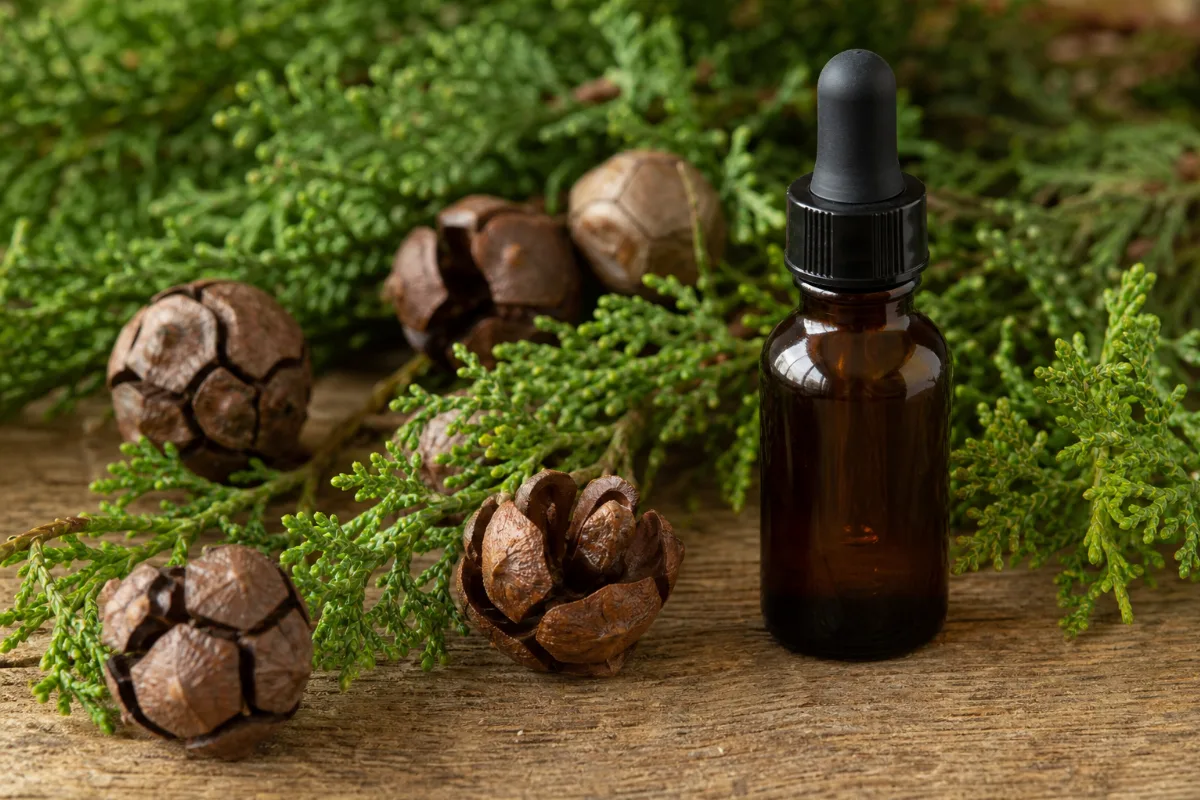
Cypress oil is the woody, fresh-smelling oil distilled from the leaves of the Mediterranean cypress tree. It is sold for calm, leg circulation, cough and skin care. We found no human trial of the oil on its own for any of these, only tiny blend studies, lab work and trials of a different tree. The main caution: do not swallow it, and watch for skin allergy.
General information, not medical advice. Last substantive update · Not medically reviewed. A named clinician has not signed off on this page. How this page is made
About Cypress Oil
Cypress oil is a woody, fresh scent from the leaves of the Mediterranean cypress. It is promoted for veins, cough, stretch marks and calm, but we found no human trial of the oil on its own for any of them. The few human studies used blends or a different tree. Safety comes first: do not swallow it, skin allergy is possible, and nothing is known about pregnancy, children or pets.
What cypress oil is
The oil is distilled from the leaf of Cupressus sempervirens, a tall evergreen tree in the cypress family (Cupressaceae, per GBIF). Alpha-pinene and delta-3-carene are its main compounds; one tested oil had 38.47% and 25.14%.
It is a mixture, and bottles differ. Hinoki cypress (Chamaecyparis obtusa) and other Cupressus species are different trees. Cypress pollen allergy is a separate matter: it is caused by pollen proteins and affects 0.6 to 3% of people in the general population, according to one review. Whether the oil affects people with pollen allergy was not found.
The oil is not a food or a nutrient.
What people use it for, and how strong the evidence is
For varicose veins and leg circulation, cough and stretch marks, we found no human trial of cypress oil. A review notes traditional uses of the tree, including for respiratory problems, but traditions are not tests.
For anxiety, one 11-person trial of a four-oil massage blend found anxiety scores fell as much with plain carrier-oil massage, and cypress oil had no effect in a mouse anxiety test. For sleep, an 8-person pilot of lavender or cypress scent in people with sleep apnea had no comparison group.
A Korean trial of a five-oil massage blend found less belly fat than with grapeseed oil, but cypress cannot be credited. Trials of swallowing in older adults used hinoki cypress, a different tree. Mouse and dish studies do not show an effect in people.
The research in one view
Every human study here is small and short, uses a scent that is hard to hide from a comparison group, and either mixes cypress with other oils or uses a different tree. No large trial and no review of cypress oil alone in people was found.
Searches on 2026-10-25 for venous, cough, stretch mark and cream studies of Cupressus sempervirens found nothing in people.
Blends, other cypress trees and bottles are different things
Cypress was one of four oils in the massage trial and one of five in the Korean trial, and the sleep pilot used lavender or cypress. Their results do not describe cypress alone.
Hinoki cypress oil and the other Cupressus species behave differently from Cupressus sempervirens: in mice, oil from C. lusitanica eased psoriasis-like skin and C. arizonica did not. Poison Control says it is hard to know the species, strength and contaminants in a bottle.
What regulators say
The US FDA says that how an aromatherapy product is regulated depends on its intended use, and that claims to treat anxiety, ease pain or help you sleep are drug claims that need approval for safety and effectiveness. It says nothing about cypress oil in particular.
We did not find or read a statement from EFSA, IFRA, the EU cosmetics regulator, NCCIH or EMA about this oil.
At a glance
Traditional uses history, not proof
- Parts of the tree used traditionally for urinary, digestive, nervous, respiratory and skin problems (2020 review of Iranian conifers).
- Sold as an aromatherapy oil and fragrance.
Studied for research
- Anxiety and stress, insufficient
- Sleep with CPAP, blend of lavender or cypress, very-low
- Varicose veins, no human trial
- Cough, no human trial
- Stretch marks, no human trial
- Belly fat, five-oil blend, very-low
- Swallowing (hinoki, a different tree), low
- Lab and animal work, insufficient
Main compounds
- Alpha-pinene, a main constituent (38.47% in one oil)
- Delta-3-carene, a main constituent (25.14% in one oil)
- Borneol, a minor constituent
Common forms
- Essential oil distilled from leaves
- Scent from a diffuser, cotton or paper
- Massage and skin products with other oils
Research links: Poison Control: Essential oils · FDA: Aromatherapy · Cypress leaf oil in the lab (abstract) · Sleep apnea and CPAP pilot (abstract) · Turpentine allergy review (abstract) · GBIF: Cupressus sempervirens · Research Library · Genes & Biomarkers Library
What it is and its history
- Accepted scientific name
- Cupressus sempervirens
- Naming authority
- L.
- Common names
- Mediterranean cypress (English); Italian cypress (English); Cypress (English)
- Family or group
- Cupressaceae (the cypress family), per GBIF.
- Classification
- Plantae > Tracheophyta > Pinopsida > Pinales > Cupressaceae > Cupressus > Cupressus sempervirens
- Native range
- Not checked in a source read for this page.
- Habitat
- A tall evergreen conifer. The pollen review calls it the most common pollinating cypress in the Mediterranean.
- What it looks like
- Part used: The studies describe oil from the leaf. A review lists cones, berries, leaves, bark, wood and resin of conifers used traditionally. This page does not describe how to recognise the tree.
- Look-alikes and adulterants
- Name: Hinoki cypress (Chamaecyparis obtusa); Note: A different tree, in a different genus. The swallowing and phytoncide trials used its oil, not Cupressus sempervirens oil.; Name: Other Cupressus species (C. arizonica, C. lusitanica); Note: Tested in a mouse psoriasis study with different results; not the same oil.
- Sustainability and conservation
- Not checked (no IUCN or CITES source read).
Traditional use and history history, not clinical proof
| Tradition or era | Documented use | Source |
|---|---|---|
| Traditional medicine (Iran and Islamic traditional texts) | A 2020 review says parts of Cupressus sempervirens and some other conifers have been used traditionally for urinary, digestive, nervous, respiratory and skin problems, and that some of these uses are supported by modern medicine and some remain untested. | Akaberi et al. 2020 (abstract) |
| Fragrance and aromatherapy | Cypress oil is sold as an aromatherapy oil and is used as a scent. The FDA page explains that aromatherapy health claims are drug claims. | FDA aromatherapy page |
Traditional use shows how it was used. It does not show that it works or is safe today.
What is inside, and how it may work
What it contains and how those compounds act in cells and animals. Laboratory and animal mechanisms are not proven effects in people.
Main compounds
| Compound | Family | Where it is concentrated | Activity studied | Level of evidence |
|---|---|---|---|---|
| Alpha-pinene PubChem 6654 | monoterpene hydrocarbon | Leaf essential oil | Major component of the tested leaf oils (38.47% in one oil). Predicted by computer to block bacterial pumps. Named as a phytoncide in the hinoki room air in one trial. 20 2 5 14 | Laboratory |
| Delta-3-carene (3-carene) PubChem 26049 | monoterpene hydrocarbon | Leaf essential oil | Major component (25.14% in one oil). Reduced allergic airway cytokines in mice as a pure compound; reduced lung function in isolated guinea pig lungs; its hydroperoxides are a named turpentine allergen. 20 2 10 13 8 | Animal research |
| Borneol PubChem 64685 | monoterpene alcohol | Leaf essential oil | A minor component in the tested oil; predicted by computer to block bacterial pumps. 20 2 | Laboratory |
Mechanisms, receptors and pathways
| Target or pathway | Gene or receptor | What was found | Level |
|---|---|---|---|
| Bacterial pumps and DNA/RNA polymerases (computer prediction) | AcrB-TolC and MepR pumps | Computer docking predicted alpha-pinene, delta-3-carene and borneol could block bacterial efflux pumps and bind polymerases. 2 | In silico |
| Allergic airway cytokines (mice) | IL-4, IL-5, IL-13 | Pure 3-carene suppressed these genes in a mouse asthma model. 10 | In vivo animal |
| Lung function (isolated guinea pig lungs) | Not specified | 3-carene reduced lung function, more so in skin-sensitised animals. 13 | In vivo animal |
| Cancer cell growth (cell lines) | Not specified | Cypress leaf oil reduced growth of four cancer cell lines and spared a normal lung cell line. 5 | Laboratory research |
Absorption, metabolism and elimination
- Absorption
- Not established in the sources read.
- Distribution
- Not established.
- Metabolism
- Not established.
- Elimination
- Not established.
- Bioavailability
- Not established.
Isolated compounds versus whole extracts
The oil is a mixture. Studies of pure 3-carene in mice do not describe cypress oil, and studies of hinoki or other Cupressus species do not describe Cupressus sempervirens oil. Blends with lavender, marjoram, grapefruit and others do not describe cypress alone.
Nutritional composition
Cypress oil is not a nutrient and is not a food or supplement to take for health.
1 low certainty3 very low certainty9 not enough evidence
What was looked at
The 13 benefits and uses checked for Cypress Oil, each with how strong the evidence is. Tap one to open it.
- Anxiety, low mood and stress (cypress smelled or in a massage blend)Not enough evidence
- Sleep quality and CPAP use in sleep apnea (lavender or cypress scent)Very low certainty
- Stress hormones and immune cells (hinoki cypress vapour, a different tree)Very low certainty
- Varicose veins and leg circulation (oil in a cream or massage)Not enough evidence
- Cough and chest congestion (scent or steam)Not enough evidence
- Stretch marks and skin tone (cream or massage)Not enough evidence
- Belly fat and body image in post-menopausal women (a five-oil massage blend)Very low certainty
- Swallowing and saliva in older adults (hinoki cypress scent, a different tree)Low certainty
- Psoriasis-like skin in mice (other Cupressus species)Not enough evidence
- Germs, free radicals and insects in the labNot enough evidence
- Cancer cell lines in dishesNot enough evidence
- Allergic airway inflammation in mice (3-carene alone)Not enough evidence
- Traditional uses of the tree (cones, leaves, bark, wood)Not enough evidence
Lab markers tracked in the studies
Anxiety and depression questionnaire scores (STAI, SDS)Sleep quality (PSQI) and daytime sleepiness (ESS) scoresUrinary adrenaline and noradrenalineRepetitive saliva swallowing test (RSST)Abdominal subcutaneous fat on CT and waist circumference
What is Cypress Oil good for?
The uses people ask about and how strong the evidence is. Read the certainty label first: none is better than very-low, and for the best-known claims there is no human trial at all.
Benefits, one by one
Each card is a research question, not a promise. Tap a goal to filter. Open a card to see the studies, doses and limits.
Anxiety, low mood and stress (cypress smelled or in a massage blend)
Not enough evidenceWe found no trial of cypress oil on its own for anxiety. One 11-person trial of a four-oil massage blend found anxiety and depression scores fell as much with plain carrier-oil massage. In mice, cypress oil had no calming effect in an anxiety test.
2 studiesNot covered. This page gives no amounts and no way to use the oil.
Studies, doses and limits
What the trials found
One small trial of a blend containing cypress (11 people) and one old mouse test. No trial of cypress oil alone.
Results
Blend trial: anxiety (STAI) and depression (SDS) scores fell significantly after both the blend massage and the plain carrier-oil massage, with no difference between them. Mouse test: cypress oil did not produce any effect, while lavender did.
Effect sizes as reported
No between-group difference for anxiety or depression scores.
Why this rating
The only human data are a four-oil blend in 11 people, and it showed no extra benefit over plain massage. The mouse result is a null. Nothing supports cypress oil for anxiety.
Form and dose studied
Not covered. This page gives no amounts and no way to use the oil.
Who was studied
Adults receiving massage (blend trial); mice (animal test).
Limits
Blend, so nothing can be credited to cypress. Massage itself calms people, which the fall in both groups shows.
Why researchers looked
Cypress oil is sold for calm and relaxation, and many aromatherapy books list it for stress.
Proposed mechanism Preliminary mechanism
Not established. A mouse test found no anxiety-reducing effect for cypress oil (animal work only).
A proposed mechanism does not show that the effect happens in people.
Skin allergy is possible with any essential oil in a massage (see Safety).
Sleep quality and CPAP use in sleep apnea (lavender or cypress scent)
Very low certaintyIn one observational pilot of 8 people with sleep apnea who used their CPAP machine too little, sleep scores improved and CPAP use went up after about two months of lavender or cypress scent at night. There was no comparison group.
1 studiesNot covered. This page gives no amounts and no way to use the oil.
Studies, doses and limits
What the trials found
One prospective observational pilot, 8 adults, both lavender and cypress used (the abstract does not say who had which), 67 days.
Results
Median PSQI sleep-quality score improved from 9.0 to 6.5 (p = 0.006); Epworth Sleepiness Scale from 9.0 to 6.5 (p = 0.034). CPAP use over 4 hours rose from 5.0% to 25.7% and median use from 149 to 231 minutes. Apnea-hypopnea index did not change significantly.
Effect sizes as reported
Before-and-after medians only; no between-group comparison.
Why this rating
Eight people, no comparison group, two different oils, and the cypress species is not named. Any change could come from other causes. This does not show that cypress oil helps sleep.
Form and dose studied
Not covered. This page gives no amounts and no way to use the oil.
Who was studied
Adults with obstructive sleep apnea and poor CPAP use.
Limits
A pilot. The authors call for more work. Cypress cannot be separated from lavender.
Why researchers looked
People with sleep apnea often stop using their CPAP machine, and a pleasant scent is a low-cost thing to try.
Proposed mechanism Preliminary mechanism
Not established.
A proposed mechanism does not show that the effect happens in people.
Do not use a scent in place of CPAP or treatment for sleep apnea. Ask a sleep doctor.
Stress hormones and immune cells (hinoki cypress vapour, a different tree)
Very low certaintyThis trial used hinoki cypress (Chamaecyparis obtusa), not the Mediterranean cypress. In 12 healthy men, three nights with hinoki vapour in a hotel room were followed by lower stress hormones in urine and higher natural killer cell activity. There was no placebo group.
1 studiesNot covered. This page gives no amounts and no way to use the oil.
Studies, doses and limits
What the trials found
One before-and-after study, 12 men aged 37 to 60.
Results
NK activity and NK-cell percentage rose; T-cell percentage fell; urinary adrenaline and noradrenaline fell. The abstract gives no numbers.
Effect sizes as reported
No numbers in the abstract.
Why this rating
12 men, no placebo group and no blinding. A hotel stay itself changes stress. It is a different tree from the one this page is about, so it does not describe Cupressus sempervirens oil.
Form and dose studied
Not covered. This page gives no amounts and no way to use the oil.
Who was studied
Healthy adult men.
Limits
Different species; no control group.
Why researchers looked
Researchers wanted to know whether forest scents explain why forest trips raise immune cell activity.
Proposed mechanism Preliminary mechanism
The authors suggest lower stress hormones may partly explain the immune change. Alpha-pinene and beta-pinene were found in the room air.
A proposed mechanism does not show that the effect happens in people.
None reported in the abstract.
Varicose veins and leg circulation (oil in a cream or massage)
Not enough evidenceA popular claim, but we found no human trial of cypress oil, in a venous cream or any other form, for varicose veins or leg circulation.
0 studiesNot covered. This page gives no amounts and no way to use the oil.
Studies, doses and limits
What the trials found
We searched PubMed on 2026-10-25 and found no trial of cypress oil (or any Cupressus sempervirens preparation) in people for this use. Searches also covered venous, vasoconstrictor and cone terms.
Results
No results exist to report.
Why this rating
No human study was found, so there is nothing to rate.
Form and dose studied
Not covered. This page gives no amounts and no way to use the oil.
Limits
No trial. A skin cream with essential oil can also cause allergy (see Safety). See a doctor for leg swelling, pain or skin changes.
Why researchers looked
Cypress oil is often listed in aromatherapy books for leg veins.
Traditional use
No source we read lists this use.
Proposed mechanism Preliminary mechanism
None known.
A proposed mechanism does not show that the effect happens in people.
Leg swelling, pain, a hot red area or an open sore need a doctor. Do not put essential oil on broken skin.
Cough and chest congestion (scent or steam)
Not enough evidenceCypress is traditionally linked with respiratory complaints, but we found no human trial of the oil for cough. Nothing here shows it helps.
1 studiesNot covered. This page gives no amounts and no way to use the oil.
Studies, doses and limits
What the trials found
We searched PubMed on 2026-10-25 and found no trial of cypress oil (or any Cupressus sempervirens preparation) in people for this use.
Results
No results exist to report.
Why this rating
Only a traditional-use statement exists, and no human study.
Form and dose studied
Not covered. This page gives no amounts and no way to use the oil.
Limits
A tradition is not a test. The review abstract does not say which use belongs to which plant.
Why researchers looked
Conifer oils are often sold for chest and breathing comfort.
Traditional use
A review of Iranian conifers says Cupressus sempervirens and others have been used traditionally for respiratory problems, among others.
Proposed mechanism Preliminary mechanism
None known.
A proposed mechanism does not show that the effect happens in people.
Oils can irritate the airways and are not safe to swallow (see Safety). A cough lasting weeks, with blood, or with breathlessness needs a doctor.
Stretch marks and skin tone (cream or massage)
Not enough evidenceA common claim, but we found no human trial of cypress oil for stretch marks. Pregnancy adds extra caution (see Safety).
0 studiesNot covered. This page gives no amounts and no way to use the oil.
Studies, doses and limits
What the trials found
We searched PubMed on 2026-10-25 and found no trial of cypress oil (or any Cupressus sempervirens preparation) in people for this use.
Results
No results exist to report.
Why this rating
No human study, so nothing to rate.
Form and dose studied
Not covered. This page gives no amounts and no way to use the oil.
Limits
No trial. Many people who want this are pregnant, and safety of essential oils in pregnancy is not shown for cypress.
Why researchers looked
Stretch-mark creams and oils often list cypress.
Traditional use
No source we read lists this use.
Proposed mechanism Preliminary mechanism
None known.
A proposed mechanism does not show that the effect happens in people.
Skin allergy is the best-documented risk with essential oils. Ask a midwife or doctor in pregnancy.
Belly fat and body image in post-menopausal women (a five-oil massage blend)
Very low certaintyA Korean trial found abdominal fat and waist size fell more with a blend massage (grapefruit, cypress and three other oils) than with grapeseed oil massage for 6 weeks. The abstract gives no numbers or group sizes, and cypress cannot be credited.
1 studiesNot covered. This page gives no amounts and no way to use the oil.
Studies, doses and limits
What the trials found
One quasi-randomized trial in post-menopausal women, 6 weeks of researcher massage plus self-massage.
Results
Abdominal subcutaneous fat on CT and waist circumference fell more in the blend group than the control, and body image was better. No numbers in the abstract.
Effect sizes as reported
No numbers in the abstract.
Why this rating
Number of women not stated; a blend of five oils; the massage itself may do the work; blinding is doubtful. Cypress cannot be separated from the others.
Form and dose studied
Not covered. This page gives no amounts and no way to use the oil.
Who was studied
Post-menopausal women in Korea.
Limits
English abstract only; no group sizes.
Why researchers looked
Women in menopause often gain belly fat and want non-drug options.
Proposed mechanism Preliminary mechanism
Not established.
A proposed mechanism does not show that the effect happens in people.
Citrus-type oils in the blend can make skin sensitive to sun; this trial's abstract does not discuss it.
Swallowing and saliva in older adults (hinoki cypress scent, a different tree)
Low certaintyTwo 2026 trials used hinoki cypress (Chamaecyparis obtusa), not the Mediterranean cypress. In 34 older adults with swallowing difficulty, 5 minutes of smelling hinoki oil improved swallowing tests and saliva compared with placebo oil.
2 studiesNot covered. This page gives no amounts and no way to use the oil.
Studies, doses and limits
What the trials found
A single-blind placebo-controlled crossover trial (34 people) and a brain-scan crossover trial.
Results
RSST median difference 0.5 (95% CI 0.0 to 1.0, p = 0.004); water swallowing test 0.5 (p = 0.003); saliva +1.0 mL (95% CI 0.5 to 2.0; p = 0.002). Placebo no significant change. The scan study found better mood ratings and a larger swallowing-test gain with hinoki.
Effect sizes as reported
Median changes of 0.5 points and 1.0 mL; no numbers in the scan abstract.
Why this rating
Two small, short, single-session crossover studies with a placebo, but single-blind and a scent is hard to hide. It is a different tree and says nothing about cypress oil from Cupressus sempervirens.
Form and dose studied
Not covered. This page gives no amounts and no way to use the oil.
Who was studied
Older adults with swallowing difficulty; participants in a brain-scan study.
Limits
Hinoki cypress only; authors call for larger and longer trials.
Why researchers looked
Swallowing difficulty is common in older age and a scent is a low-risk idea to test.
Proposed mechanism Preliminary mechanism
Authors suggest calming of the autonomic nervous system and lower activity in brain areas for movement and stress (brain scan study; an interpretation).
A proposed mechanism does not show that the effect happens in people.
Do not swallow essential oil. This is smelling only. A person with swallowing trouble needs a doctor.
Psoriasis-like skin in mice (other Cupressus species)
Not enough evidenceIn mice, oil from Cupressus lusitanica eased drug-induced psoriasis-like skin, and oil from Cupressus arizonica did not. Neither is Cupressus sempervirens. This is animal work.
1 studiesNot covered. This page gives no amounts and no way to use the oil.
Studies, doses and limits
What the trials found
Mouse study only.
Results
Pine oil and C. lusitanica oil reduced the psoriasis score; C. arizonica oil failed.
Effect sizes as reported
No effect sizes in the abstract.
Why this rating
Mice, other Cupressus species, mixed result. Not Cupressus sempervirens.
Form and dose studied
Not covered. This page gives no amounts and no way to use the oil.
Who was studied
Mice.
Limits
No test of C. sempervirens; skin-allergy risk in people is separate.
Why researchers looked
Conifers are used traditionally for skin conditions.
Traditional use
The authors say conifers have traditionally been used for burns, skin infections and psoriasis.
Proposed mechanism Preliminary mechanism
Lower interleukin 23 and 17A in mice treated with C. lusitanica oil.
A proposed mechanism does not show that the effect happens in people.
Do not treat psoriasis with essential oil on your own.
Germs, free radicals and insects in the lab
Not enough evidenceIn test tubes, cypress leaf oil slowed some bacteria and fungi, scavenged free radicals and killed insects. It also made a fish-embryo test lethal at low concentrations. None of this shows an effect in people.
2 studiesNot covered. This page gives no amounts and no way to use the oil.
Studies, doses and limits
What the trials found
Laboratory studies only.
Results
Antioxidant activity strong in two tests; antifungal activity moderate; anti-biofilm effect on Salmonella; insecticidal LC50 21.07%; zebrafish embryos LC50 6.6 micrograms per mL.
Effect sizes as reported
Lab values only.
Why this rating
Dishes, insects and fish embryos do not show what happens in a person.
Form and dose studied
Not covered. This page gives no amounts and no way to use the oil.
Limits
Alpha-pinene 38.47% and delta-3-carene 25.14% in one tested oil.
Why researchers looked
Researchers look for natural food preservatives and farm-pest controls.
Proposed mechanism Preliminary mechanism
Computer models predicted that alpha-pinene, delta-3-carene and borneol could block bacterial pumps (prediction only).
A proposed mechanism does not show that the effect happens in people.
The fish-embryo harm at low concentration is a reason for caution, not a measure for people.
Cancer cell lines in dishes
Not enough evidenceIn dishes, cypress leaf oil slowed the growth of several cancer cell lines (K562 most) without affecting a normal lung cell line. This is not a treatment and has not been tested in animals or people.
1 studiesNot covered. This page gives no amounts and no way to use the oil.
Studies, doses and limits
What the trials found
Cell lines only.
Results
Growth of MDA-MB-231, HCT-116, JEG-3 and K562 lines was reduced; normal MRC-5 cells were not affected.
Effect sizes as reported
Lab values only.
Why this rating
A dish result is a first screen; most do not hold up in people.
Form and dose studied
Not covered. This page gives no amounts and no way to use the oil.
Limits
One study.
Why researchers looked
Labs routinely test plant oils on cancer cells.
Proposed mechanism Preliminary mechanism
Not established.
A proposed mechanism does not show that the effect happens in people.
Do not use essential oil as a cancer treatment.
Allergic airway inflammation in mice (3-carene alone)
Not enough evidenceIn allergic mice, pure 3-carene (a main component of cypress oil) lowered several inflammation signals in the lungs. It is one compound, in mice, and cypress oil was not tested.
1 studiesNot covered. This page gives no amounts and no way to use the oil.
Studies, doses and limits
What the trials found
Mouse study with a single compound.
Results
Cytokine genes were suppressed and lung epithelial thickness was lower.
Effect sizes as reported
No numbers in the abstract.
Why this rating
Animal work on one compound; not the oil.
Form and dose studied
Not covered. This page gives no amounts and no way to use the oil.
Who was studied
Mice.
Limits
Another animal study shows 3-carene can make the lungs of skin-sensitised guinea pigs react more (see Safety).
Why researchers looked
3-carene is a main component of the oil.
Proposed mechanism Preliminary mechanism
Lower IL-4, IL-5 and IL-13 gene expression in mouse lungs.
A proposed mechanism does not show that the effect happens in people.
Do not use essential oil in place of asthma medicine.
Traditional uses of the tree (cones, leaves, bark, wood)
Not enough evidenceA review says parts of Cupressus sempervirens and other conifers have been used in traditional medicine for urinary, digestive, nervous, respiratory and skin problems. These are traditions, not tested treatments.
1 studiesNot covered. This page gives no amounts and no way to use the oil.
Studies, doses and limits
What the trials found
A narrative review of traditional use.
Results
Traditional uses are listed; some are supported by modern medicine and some are untested, the authors say.
Why this rating
A tradition is not evidence. The abstract does not link each use to a species.
Form and dose studied
Not covered. This page gives no amounts and no way to use the oil.
Limits
Review of several conifers.
Why researchers looked
Folk medicine uses many conifers.
Traditional use
As the review describes (Iranian and Islamic traditional medicine).
Proposed mechanism Preliminary mechanism
Not established.
A proposed mechanism does not show that the effect happens in people.
Traditional use of the tree is not the same as using the concentrated oil.
Connections to the rest of health
How Cypress Oil connects to the rest of our health knowledge graph. Every link says what kind of connection it is. A safety link (for example to the liver) is a warning, not a benefit. A study that merely mentions a topic never creates a benefit link.
Explore every connection: goals, body systems, organs, symptoms, genes
A. Wellness goals
| Connected to | Kind of connection | Evidence status | Context | Studies |
|---|---|---|---|---|
| Anxiety Support | Not enough evidence | Anxiety, low mood and stress (cypress smelled or in a massage blend): We found no trial of cypress oil on its own for anxiety. One 11-person trial of a four-oil massage blend found anxiety and depression scores fell as much with plain carrier-oil massage. In mice, cypress oil had no calming effect in an anxiety test. | 12 15 | |
| Stress Reduction | Not enough evidence | Anxiety, low mood and stress (cypress smelled or in a massage blend): We found no trial of cypress oil on its own for anxiety. One 11-person trial of a four-oil massage blend found anxiety and depression scores fell as much with plain carrier-oil massage. In mice, cypress oil had no calming effect in an anxiety test. | 12 15 | |
| Better Sleep | Very low certainty | Sleep quality and CPAP use in sleep apnea (lavender or cypress scent): In one observational pilot of 8 people with sleep apnea who used their CPAP machine too little, sleep scores improved and CPAP use went up after about two months of lavender or cypress scent at night. There was no comparison group. | 6 | |
| Sleep Quality | Very low certainty | Sleep quality and CPAP use in sleep apnea (lavender or cypress scent): In one observational pilot of 8 people with sleep apnea who used their CPAP machine too little, sleep scores improved and CPAP use went up after about two months of lavender or cypress scent at night. There was no comparison group. | 6 | |
| Stress Reduction | Very low certainty | Stress hormones and immune cells (hinoki cypress vapour, a different tree): This trial used hinoki cypress (Chamaecyparis obtusa), not the Mediterranean cypress. In 12 healthy men, three nights with hinoki vapour in a hotel room were followed by lower stress hormones in urine and higher natural killer cell activity. There was no placebo group. | 14 | |
| Immune Support | Very low certainty | Stress hormones and immune cells (hinoki cypress vapour, a different tree): This trial used hinoki cypress (Chamaecyparis obtusa), not the Mediterranean cypress. In 12 healthy men, three nights with hinoki vapour in a hotel room were followed by lower stress hormones in urine and higher natural killer cell activity. There was no placebo group. | 14 | |
| Healthy Circulation | Not enough evidence | Varicose veins and leg circulation (oil in a cream or massage): A popular claim, but we found no human trial of cypress oil, in a venous cream or any other form, for varicose veins or leg circulation. | ||
| Cough Relief | Traditional use | Not enough evidence | Cough and chest congestion (scent or steam): Cypress is traditionally linked with respiratory complaints, but we found no human trial of the oil for cough. Nothing here shows it helps. | 1 |
| Respiratory System | Traditional use | Not enough evidence | Cough and chest congestion (scent or steam): Cypress is traditionally linked with respiratory complaints, but we found no human trial of the oil for cough. Nothing here shows it helps. | 1 |
| Healthy Skin | Not enough evidence | Stretch marks and skin tone (cream or massage): A common claim, but we found no human trial of cypress oil for stretch marks. Pregnancy adds extra caution (see Safety). | ||
| Weight Management | Very low certainty | Belly fat and body image in post-menopausal women (a five-oil massage blend): A Korean trial found abdominal fat and waist size fell more with a blend massage (grapefruit, cypress and three other oils) than with grapeseed oil massage for 6 weeks. The abstract gives no numbers or group sizes, and cypress cannot be credited. | 9 | |
| Oral Health | Low certainty | Swallowing and saliva in older adults (hinoki cypress scent, a different tree): Two 2026 trials used hinoki cypress (Chamaecyparis obtusa), not the Mediterranean cypress. In 34 older adults with swallowing difficulty, 5 minutes of smelling hinoki oil improved swallowing tests and saliva compared with placebo oil. | 3 11 | |
| Healthy Skin | Not enough evidence | Psoriasis-like skin in mice (other Cupressus species): In mice, oil from Cupressus lusitanica eased drug-induced psoriasis-like skin, and oil from Cupressus arizonica did not. Neither is Cupressus sempervirens. This is animal work. | 7 | |
| Immune Support | Not enough evidence | Germs, free radicals and insects in the lab: In test tubes, cypress leaf oil slowed some bacteria and fungi, scavenged free radicals and killed insects. It also made a fish-embryo test lethal at low concentrations. None of this shows an effect in people. | 5 2 | |
| Cellular Protection | Not enough evidence | Cancer cell lines in dishes: In dishes, cypress leaf oil slowed the growth of several cancer cell lines (K562 most) without affecting a normal lung cell line. This is not a treatment and has not been tested in animals or people. | 5 | |
| Respiratory System | Not enough evidence | Allergic airway inflammation in mice (3-carene alone): In allergic mice, pure 3-carene (a main component of cypress oil) lowered several inflammation signals in the lungs. It is one compound, in mice, and cypress oil was not tested. | 10 | |
| Holistic Balance | Traditional use | Not enough evidence | Traditional uses of the tree (cones, leaves, bark, wood): A review says parts of Cupressus sempervirens and other conifers have been used in traditional medicine for urinary, digestive, nervous, respiratory and skin problems. These are traditions, not tested treatments. | 1 |
B. Body systems
| Connected to | Kind of connection | Evidence status | Context | Studies |
|---|---|---|---|---|
| Nervous System | Biological association | Not enough evidence | Studied for: Anxiety, low mood and stress (cypress smelled or in a massage blend) Studied for: Sleep quality and CPAP use in sleep apnea (lavender or cypress scent) | 12 15 6 14 3 11 |
| Respiratory System | Biological association | Very low certainty | Studied for: Sleep quality and CPAP use in sleep apnea (lavender or cypress scent) Studied for: Cough and chest congestion (scent or steam) | 6 1 10 |
| Immune System | Biological association | Very low certainty | Studied for: Stress hormones and immune cells (hinoki cypress vapour, a different tree) Studied for: Germs, free radicals and insects in the lab | 14 5 2 |
| Cardiovascular System | Biological association | Not enough evidence | Studied for: Varicose veins and leg circulation (oil in a cream or massage) | |
| Integumentary System | Biological association | Not enough evidence | Studied for: Stretch marks and skin tone (cream or massage) Studied for: Psoriasis-like skin in mice (other Cupressus species) | 7 |
| Metabolic System | Biological association | Very low certainty | Studied for: Belly fat and body image in post-menopausal women (a five-oil massage blend) | 9 |
| Digestive System | Biological association | Low certainty | Studied for: Swallowing and saliva in older adults (hinoki cypress scent, a different tree) | 3 11 |
| Cells | Biological association | Not enough evidence | Studied for: Cancer cell lines in dishes | 5 |
| Whole Body | Biological association | Not enough evidence | Studied for: Traditional uses of the tree (cones, leaves, bark, wood) | 1 |
E. Health conditions
| Connected to | Kind of connection | Evidence status | Context | Studies |
|---|---|---|---|---|
| Contact dermatitis | Adverse effect or risk | Theoretical risk | No patch-test data for cypress oil; delta-3-carene hydroperoxides are a known allergen in turpentine. Preparation or compound: Cypress oil on the skin; delta-3-carene |
8 17 |
I. Biomarkers
| Connected to | Kind of connection | Evidence status | Context | Studies |
|---|---|---|---|---|
| Anxiety and depression questionnaire scores (STAI, SDS) | Biological association | Not enough evidence | Measured in trials: decrease. A lab change is not the same as a health benefit. | 12 |
| Sleep quality (PSQI) and daytime sleepiness (ESS) scores | Biological association | Very low certainty | Measured in trials: decrease. A lab change is not the same as a health benefit. | 6 |
| Urinary adrenaline and noradrenaline | Biological association | Very low certainty | Measured in trials: decrease. A lab change is not the same as a health benefit. | 14 |
| Repetitive saliva swallowing test (RSST) | Biological association | Low certainty | Measured in trials: increase. A lab change is not the same as a health benefit. | 3 11 |
| Abdominal subcutaneous fat on CT and waist circumference | Biological association | Very low certainty | Measured in trials: decrease. A lab change is not the same as a health benefit. | 9 |
K. Biological pathways
| Connected to | Kind of connection | Evidence status | Context | Studies |
|---|---|---|---|---|
| IL-4, IL-5, IL-13 | Preliminary mechanism | In vivo animal | Mouse lung changes with pure 3-carene. | 10 |
L. Active compounds
| Connected to | Kind of connection | Evidence status | Context | Studies |
|---|---|---|---|---|
| Alpha-pinene | Biological association | Laboratory | Major component of the tested leaf oils (38.47% in one oil). Predicted by computer to block bacterial pumps. Named as a phytoncide in the hinoki room air in one trial. Preparation or compound: Leaf essential oil |
20 2 5 14 |
| Delta-3-carene (3-carene) | Biological association | Animal | Major component (25.14% in one oil). Reduced allergic airway cytokines in mice as a pure compound; reduced lung function in isolated guinea pig lungs; its hydroperoxides are a named turpentine allergen. Preparation or compound: Leaf essential oil |
20 2 10 13 8 |
| Borneol | Biological association | Laboratory | A minor component in the tested oil; predicted by computer to block bacterial pumps. Preparation or compound: Leaf essential oil |
20 2 |
Each connection is stored with the ingredient, the connected record, the kind of connection, the evidence status, the supporting studies, the preparation or compound involved, and a review date (last reviewed October 25, 2026).
Evidence at a glance: what the research found for 13 outcomes
Each outcome below is one thing researchers measured. Certainty is how far the evidence can be trusted, not how well it works. The full studies are on the next tab.
The evidence
The research centre for Cypress Oil. Every record here was checked against PubMed or the publisher's page; we never list a study we have not verified.
Evidence by outcome
Bars show how many studies we found for each outcome, not how well it works. People are added up across trials only (reviews are not added, to avoid double counting).
How we rate evidence
High certainty
Several well-run trials or reviews agree; further research is unlikely to change the picture much.
Moderate certainty
Good trials point the same way, but some doubt remains.
Low certainty
Small, short or inconsistent trials. The finding could change with better research.
Very low certainty
Very little or very weak human data. Treat as a possibility only.
Mixed findings
Trials or reviews disagree with each other.
Not enough evidence
Not enough human research to say either way.
Evidence against
Good research found no benefit, or found harm.
We take the reviewers' own risk-of-bias and GRADE statements where they exist, and otherwise judge from study size, design, consistency, directness and whether a product matches what is sold. Many publications do not make evidence high. Method note: We read the abstracts of 16 PubMed papers and the Poison Control and FDA pages, checked the plant name in GBIF and the compounds in PubChem. We did not find or read EFSA, IFRA, NCCIH, LiverTox or LactMed statements.
Study library: every study we checked 20
| Study | Design | People | Product, dose, length | Result |
|---|---|---|---|---|
| Akaberi 2020 A Review of Conifers in Iran: Chemistry, Biology and their Importance in Traditional and Modern Medicine Curr Pharm Des · PMID 32003665 · DOI |
Narrative review review |
Conifers of Iran including Cupressus sempervirens | Cones, berries, leaves, bark, wood and resin of several conifers various Not reported here |
Cones, leaves, bark and other parts of these conifers have been used in traditional medicine. C. sempervirens, J. sabina, J. communis and T. baccata have been used for urinary, digestive, nervous, respiratory and skin problems. The authors say some traditional uses are supported by modern medicine and some have not been tested. Traditional use only Methods, limits and fundingOutcomes: Traditional uses, chemistry, pharmacology Limitations: An abstract of a review of several conifers, not of the oil alone. It does not say which use belongs to which species. Funding and conflicts: Not stated in the abstract. Read: abstract |
| Akermi 2022 Cupressus sempervirens Essential Oil: Exploring the Antibacterial Multitarget Mechanisms, Chemcomputational Toxicity Prediction, and Safety Assessment in Zebrafish Embryos Molecules · PMID 35565980 · DOI |
Laboratory and computer study with zebrafish embryos lab |
Salmonella enterica Typhimurium, Staphylococcus aureus; zebrafish embryos | Cupressus sempervirens essential oil Not reported here |
Alpha-pinene (38.47%) and delta-3-carene (25.14%) were the major components. Computer models predicted many components were not toxic. Alpha-pinene, delta-3-carene and borneol were predicted to block bacterial pumps. In zebrafish embryos the oil was harmful in a concentration-dependent way, with LC50 6.6 micrograms per mL. LC50 6.6 micrograms/mL (zebrafish embryos) Methods, limits and fundingOutcomes: Oil composition, computer predictions of toxicity and bacterial targets, zebrafish embryo toxicity Limitations: A computer prediction and a fish-embryo test do not transfer to people. The aim was food preservation. Funding and conflicts: Not stated in the abstract. Read: abstract |
| Aoyagi 2026 Inhaled hinoki cypress essential oil improves saliva secretion and swallowing function in older adults with dysphagia: a randomized crossover study Environ Health Prev Med · PMID 41548911 · DOI |
Randomized, placebo controlled, single blind crossover |
34 Older adults with swallowing difficulty (mean age 80) |
Hinoki cypress essential oil, 5 minutes of smelling it hinoki cypress oil (a DIFFERENT tree from Cupressus sempervirens) Not reported here two sessions one week apart · vs Rice oil (placebo) |
With hinoki oil the RSST improved (median difference 0.5, 95% CI 0.0 to 1.0; p = 0.004), as did the 3 mL water test (0.5; p = 0.003) and saliva secretion (1.0 mL, 95% CI 0.5 to 2.0; p = 0.002). The placebo changed nothing significant. Gains in swallowing were larger with hinoki than placebo, and the saliva rise was not linked to the swallowing gains. RSST median +0.5; saliva +1.0 mL; placebo no significant change Methods, limits and fundingOutcomes: Repetitive saliva swallowing test (RSST), water swallowing tests, saliva secretion over 5 minutes, blood pressure, heart rate Limitations: 34 people, single-blind, one short exposure, and a scent is hard to hide. Lower confidence limits sit at 0.0. The authors say larger and longer trials are needed. Funding and conflicts: Registered UMIN000053271. Funding not stated in the abstract. Registration: UMIN000053271 Read: abstract |
| Charpin 2019 Cypress Pollinosis: from Tree to Clinic Clin Rev Allergy Immunol · PMID 28401436 · DOI |
Review review |
People with pollen allergy | Cypress pollen (not the oil) pollen Not reported here |
Cupressus sempervirens is the most common pollinating cypress in the Mediterranean and makes up half of the total pollination. The prevalence of cypress allergy in the general population is 0.6 to 3%, and 9 to 65% of outpatients seeing an allergist may be sensitised to cypress pollen. The main allergens are proteins. Cypress pollen allergy 0.6 to 3% of the general population Methods, limits and fundingOutcomes: Allergens and how common the allergy is Limitations: About pollen, not the distilled oil. Whether the oil affects people with cypress pollen allergy was not found. Funding and conflicts: Not stated in the abstract. Read: abstract |
| Galovicova 2023 Biological Activity of Cupressus sempervirens Essential Oil Plants (Basel) · PMID 36903957 · DOI |
Laboratory study (test tube, cell lines, insects) lab |
Oil from the leaf; bacteria, fungi, insects and cell lines | Cupressus sempervirens leaf essential oil leaf Not reported here |
Dominated by alpha-pinene and delta-3-carene. Strong free-radical scavenging in two tests. Moderate antifungal activity. Anti-biofilm effect against Salmonella enterica. Insecticidal LC50 21.07%. No effect on the normal MRC-5 cell line; growth of MDA-MB-231, HCT-116, JEG-3 and K562 cancer cell lines was reduced, K562 most. Lab effects only Methods, limits and fundingOutcomes: Chemical makeup, antioxidant, antibiofilm, antimicrobial, insecticidal and anti-growth effects on cells Limitations: Test tubes and cell lines. None of this shows any effect in people. The authors suggest uses for food, biofilms and farm pests, not for human treatment. Funding and conflicts: Not stated in the abstract. Read: abstract |
| Ishimizu 2026 Effect of aromatic stimulation on CPAP adherence and sleep quality in patients with obstructive sleep apnea: a pilot study BMC Complement Med Ther · PMID 41514226 · DOI |
Prospective observational pilot (no comparison group) |
8 Adults with obstructive sleep apnea and poor CPAP use (mean age 53.5; 4 men, 4 women) |
Lavender or cypress aroma oil during sleep Not reported here 67 days |
Median PSQI improved from 9.0 to 6.5 (p = 0.006) and ESS from 9.0 to 6.5 (p = 0.034). CPAP use for more than 4 hours rose from 5.0% to 25.7% (p = 0.028); median use rose from 149 to 231 minutes (p = 0.018). No significant change in apnea-hypopnea index (3.2 to 1.3 events/h, p = 0.226). PSQI 9.0 to 6.5; ESS 9.0 to 6.5; CPAP use 149 to 231 min Methods, limits and fundingOutcomes: Pittsburgh Sleep Quality Index (PSQI), Epworth Sleepiness Scale (ESS), CPAP usage records, apnea-hypopnea index Limitations: Eight people, no comparison group, two oils used (lavender or cypress; the abstract does not say who had which). Any change could come from many things besides the scent. The abstract gives no species name for the cypress oil. Funding and conflicts: Not stated in the abstract. Read: abstract |
| Kamal 2024 GC-MS analysis and the effect of topical application of essential oils of Pinus canariensis C.Sm., Cupressus lusitanica Mill. and Cupressus arizonica Greene aerial parts in Imiquimod-Induced Psoriasis in Mice J Ethnopharmacol · PMID 37482262 · DOI |
Animal study (mice) mouse |
Mice with induced psoriasis-like skin | Essential oils of Pinus canariensis, Cupressus lusitanica and Cupressus arizonica applied to the skin (NOT Cupressus sempervirens) aerial parts Not reported here · vs Mometasone cream |
Pine oil and Cupressus lusitanica oil reduced the induced psoriasis signs; the pine result was comparable to mometasone. Cupressus arizonica oil failed to reduce them. C. lusitanica improved; C. arizonica did not Methods, limits and fundingOutcomes: Psoriasis severity score, skin tissue, spleen, interleukins 23 and 17A Limitations: Mice with a drug-induced skin condition. Different Cupressus species, not C. sempervirens, and one of the two failed. Funding and conflicts: Not stated in the abstract. Read: abstract |
| Karlberg 2021 One hundred years of allergic contact dermatitis due to oxidized terpenes: What we can learn from old research on turpentine allergy Contact Dermatitis · PMID 34453446 · DOI |
Historical review review |
Painters and the general population (turpentine allergy) | Turpentine and its oxidised terpenes Not reported here |
The main cause in Scandinavian turpentine was delta-3-carene hydroperoxides, which explains its high sensitising effect compared with French turpentine that has little or none. Ending industrial exposure stopped occupational sensitisation. Patch-test studies show monoterpene hydroperoxides are a common cause of contact allergy in the population. Delta-3-carene hydroperoxides named as main culprit in turpentine Methods, limits and fundingOutcomes: Which compounds caused allergy Limitations: About turpentine, not cypress oil. Cypress oil has not been patch-tested in anything we read. The link to cypress oil is an inference from its delta-3-carene content. Funding and conflicts: Not stated in the abstract. Read: abstract |
| Kim 2007 [Effect of aromatherapy massage on abdominal fat and body image in post-menopausal women] Taehan Kanho Hakhoe Chi · PMID 17615482 · DOI |
Randomized, non equivalent control group, pre post design |
Post-menopausal women (Korea) | Whole-body massage by a researcher plus self-massage of the abdomen with a blend: 3% grapefruit oil, cypress and three other oils Not reported here 6 weeks · vs Grapeseed oil, same massage |
Abdominal subcutaneous fat and waist circumference fell more in the blend group than in the grapeseed group, and body image was better. The abstract gives no numbers. Greater fall in abdominal subcutaneous fat and waist than control; no numbers in the abstract Methods, limits and fundingOutcomes: Abdominal subcutaneous fat on CT scan, waist circumference, body image questionnaire (MBSRQ) Limitations: Number of women not stated in the abstract. Five-oil blend with grapefruit, so nothing can be credited to cypress. Massage was done by the researcher, so blinding is doubtful. Korean-language paper; English abstract only. Funding and conflicts: Not stated in the abstract. Read: abstract |
| Kim 2024 3-carene suppresses inflammatory cytokine interleukin-4, interleukin-5 and interleukin-13 in a murine model of asthma J Physiol Pharmacol · PMID 38736266 · DOI |
Animal study (mice) mouse |
BALB/c mice made allergic to ovalbumin | 3-carene (one pure compound), compared with budesonide Not reported here challenge on days 21 to 23 · vs Budesonide |
3-carene suppressed IL-4, IL-5 and IL-13 gene expression and reduced lung epithelial thickness in the asthma model. Lower cytokines in mice Methods, limits and fundingOutcomes: Cytokine gene expression, lung tissue Limitations: Mice and one pure compound, not the whole oil. Cypress oil was not tested. Funding and conflicts: Not stated in the abstract. Read: abstract |
| Koeda 2026 Hinoki Cypress Aroma Facilitates Swallowing via Premotor and Hypothalamic Down-modulation: A Randomized Within-subject Crossover fMRI Study Dysphagia · PMID 41874651 · DOI |
Randomized within subject crossover brain scan study |
Participants in a brain-scan study (not further described in the abstract) | Hinoki essential oil smelled hinoki oil (a DIFFERENT tree from Cupressus sempervirens) Not reported here two visits one week apart · vs Odourless rice oil |
Hinoki improved mood ratings and increased the saliva swallowing difference compared with control. Activity in two premotor areas and the hypothalamus was lower with hinoki. Better ratings and swallowing count than control; no numbers in the abstract Methods, limits and fundingOutcomes: Mood and comfort ratings, saliva swallowing test, brain activity (fMRI) Limitations: The abstract gives no number of participants and no figures. Brain-scan findings are an interpretation, not proof of how it works. Funding and conflicts: Not stated in the abstract. Read: abstract |
| Kuriyama 2005 Immunological and Psychological Benefits of Aromatherapy Massage Evid Based Complement Alternat Med · PMID 15937558 · DOI |
Preliminary comparison of two massages |
11 Recipients of massage (n = 11) |
Massage with a blend: sweet almond oil, lavender oil, cypress oil and sweet marjoram oil Not reported here · vs Carrier-oil massage (no essential oils) |
STAI and depression scores fell significantly (P < 0.01) after both massages, with no difference between the blend and the plain carrier oil. The blend massage was followed by a rise in lymphocytes, with CD8 and CD16 cells up and the CD4/CD8 ratio down; the plain-oil massage did not do this. The abstract gives one p-value (P > 0.05) that contradicts its own text. No difference between blend and plain massage for anxiety or depression scores; immune cell changes only after the blend Methods, limits and fundingOutcomes: Blood cell counts, interferon-gamma, interleukin-6, salivary IgA, STAI anxiety, Self-rating Depression Scale Limitations: Only 11 people. A four-oil blend, so nothing can be credited to cypress. Massage itself is calming, as the fall in both groups shows. The authors call it preliminary. One p-value in the abstract is inconsistent. Funding and conflicts: Not stated in the abstract. Read: abstract |
| Lastbom 2003 Increased airway responsiveness of a common fragrance component, 3-carene, after skin sensitisation - a study in isolated guinea pig lungs Toxicol Lett · PMID 14581172 · DOI |
Animal study (isolated guinea pig lungs) guinea pig |
Lungs from skin-sensitised and non-sensitised guinea pigs | 3-carene breathed in at 1900 mg/m3 (one pure compound) Not reported here · vs Non-sensitised lungs |
Lung function fell in all lungs during exposure. When plasma was in the perfusion fluid the response was stronger in lungs from skin-sensitised animals. Stronger lung response in skin-sensitised animals Methods, limits and fundingOutcomes: Lung function during 3-carene exposure Limitations: Isolated animal lungs and a very high air level of one compound. It does not show what happens in people breathing cypress oil. Funding and conflicts: Not stated in the abstract. Read: abstract |
| Li 2009 Effect of phytoncide from trees on human natural killer cell function Int J Immunopathol Pharmacol · PMID 20074458 |
Before and after study, no placebo group |
12 Healthy men aged 37 to 60, three nights in an urban hotel |
Hinoki cypress (Chamaecyparis obtusa) stem oil vaporised with a humidifier in the hotel room at night stem oil (a DIFFERENT tree from Cupressus sempervirens) Not reported here 3 nights · vs Measurements taken on a normal working day before the stay |
NK activity and the percentage of NK cells rose, T-cell percentage fell, and urinary adrenaline and noradrenaline fell. Alpha-pinene and beta-pinene were detected in the room air. The authors say lower stress hormones may partly explain the NK change. NK activity higher; adrenaline and noradrenaline lower; no numbers in the abstract Methods, limits and fundingOutcomes: Natural killer (NK) cell activity and counts, T cells, urinary adrenaline and noradrenaline Limitations: 12 healthy men, no placebo group, no blinding, and a hotel stay itself changes stress and sleep. Hinoki cypress, not Cupressus sempervirens. Funding and conflicts: Not stated in the abstract. Read: abstract |
| Umezu 2000 Behavioral effects of plant-derived essential oils in the Geller type conflict test in mice Jpn J Pharmacol · PMID 10928328 · DOI |
Animal behaviour test (mice) mouse |
ICR mice | Essential oils of juniper, cypress, geranium, jasmine, frankincense, lavender and rose (the abstract does not name the cypress species) Not reported here · vs Diazepam and buspirone as reference drugs |
Oils of juniper, cypress, geranium and jasmine did not produce any effect in this test. Lavender oil acted like diazepam; rose oil also showed an effect. No effect of cypress oil Methods, limits and fundingOutcomes: Response rate in the Geller conflict test (an anxiety test) Limitations: Mice, not people. A null result for cypress in one test. The abstract gives no number of animals and does not name the cypress species. Funding and conflicts: Not stated in the abstract. Read: abstract |
| Wolkoff 2017 Effects by inhalation of abundant fragrances in indoor air - An overview Environ Int · PMID 28126407 · DOI |
Review review |
Indoor air; human and animal studies | Alpha-pinene, limonene, linalool and eugenol in air Not reported here |
Measured indoor levels of alpha-pinene, limonene and linalool were close to or above odour thresholds but far below thresholds for eye and upper-airway irritation. Human studies with mixtures of alpha-pinene and limonene did not support airway sensitisation at indoor levels. Lung-function effects in human studies were likely due to the perception of the smell rather than toxic effects. No irritation at typical indoor levels Methods, limits and fundingOutcomes: Odour annoyance, airway irritation and sensitisation, lung function Limitations: About background indoor air, not a diffuser running in a small room. It says nothing about people with asthma using a concentrated oil. Funding and conflicts: Not stated in the abstract. Read: abstract |
| n/a 2026 Poison Control (National Capital Poison Center): Essential oils: Poisonous when misused (page read 2026-10-25) n/a · Source |
Poison centre education page n/a |
n/a | n/a |
General essential-oil page (not about cypress). Says misuse can cause serious poisoning; many oils can cause rashes and some are poisonous if absorbed through the skin or swallowed; aspirating an oil into the lungs can cause pneumonia; children have thin skin and immature livers and may be more susceptible; oils may interact with medicines; bottles must be locked up out of sight and reach of children and pets (or discarded if young children are in the home); it can be hard to know the species, concentration or contaminants in a bottle; pure oils are potent and not all are appropriate for skin; do not use on damaged skin; the most common allergic reaction is a skin rash, and use should stop if one occurs; difficulty breathing is a medical emergency. Describes a toddler who swallowed a small amount of lavender extract and became extremely drowsy and confused for several hours. Gives no cypress case. Methods, limits and fundingOutcomes: Safety statements for essential oils in general Limitations: Not specific to cypress oil. Read: full-text |
| n/a 2026 US FDA: Aromatherapy (page read 2026-10-25) n/a · Source |
Regulator page n/a |
n/a | n/a |
Says how a product is regulated depends on its intended use. Claims such as easing pain, treating depression or anxiety, or helping you sleep are drug claims, and drugs need FDA approval for safety and effectiveness before sale. The fact that an ingredient comes from a plant does not keep it from being regulated as a drug. Cosmetics do not need approval before sale. Says nothing about cypress oil. Methods, limits and fundingOutcomes: How aromatherapy products are regulated Limitations: General page, not about cypress oil. Read: full-text |
| n/a 2026 GBIF Backbone Taxonomy: Cupressus sempervirens L. (match API read 2026-10-25) n/a · Source |
Registry or database n/a |
n/a | n/a |
Accepted species name Cupressus sempervirens L., rank species, status ACCEPTED, family Cupressaceae, order Pinales, species key 2684030, match confidence 99 (exact match). Methods, limits and fundingOutcomes: Accepted name and family Read: full-text |
| n/a 2026 PubChem compound records: alpha-pinene (CID 6654), 3-carene (CID 26049), borneol (CID 64685) (PUG REST read 2026-10-25) n/a · Source |
Registry or database n/a |
n/a | n/a |
Confirms names, CIDs and formulas: alpha-pinene C10H16, 3-carene C10H16, borneol C10H18O. Methods, limits and fundingOutcomes: Compound identity Read: full-text |
What we do not know yet
- What the evidence supports: nothing better than very-low certainty; for varicose veins, cough and stretch marks there is no human trial.
- No patch-test, case or poison-centre data for cypress oil.
- No cypress-specific source for pregnancy, breastfeeding, children, pets or asthma.
- Hinoki cypress and other Cupressus results cannot be applied to this oil.
- No EFSA, IFRA, SCCS, NCCIH, LiverTox or LactMed statement was read.
How new research is added
New studies are found by a saved PubMed search and are placed in a review queue. A person reads each one before it is added.
Lab markers
What changed in blood or saliva tests during trials. A changed number is not the same as feeling or being healthier, and we give no "normal ranges".
Other 5
Anxiety and depression questionnaire scores (STAI, SDS)
Decrease in trials
Self-rated numbers for how anxious or low someone feels; lower is better.
Not enough evidenceResults and what it means
Why it was measured
Main outcome in the one human blend trial.
Statistical vs. clinical meaning
Self-rated, and a fall in both groups means the oils added nothing measurable.
Safety implication
A lower score does not show cypress oil is safe or effective for anxiety.
| Study | Result | People | Product |
|---|---|---|---|
| 12 | Both scores fell after the blend massage and after plain carrier-oil massage, with no difference between them. |
Sleep quality (PSQI) and daytime sleepiness (ESS) scores
Decrease in trials
Questionnaires on sleep quality and how sleepy someone feels in the day; lower is better.
Very low certaintyResults and what it means
Why it was measured
Main outcomes in the sleep apnea pilot.
Statistical vs. clinical meaning
Eight people, before and after, no control.
Safety implication
A better score does not replace sleep apnea treatment.
| Study | Result | People | Product |
|---|---|---|---|
| 6 | PSQI median 9.0 to 6.5; ESS median 9.0 to 6.5 after about 67 days; no comparison group. |
Urinary adrenaline and noradrenaline
Decrease in trials
Stress hormones measured in urine.
Very low certaintyResults and what it means
Why it was measured
Used to look for a calming effect of hinoki vapour.
Statistical vs. clinical meaning
Not blinded or controlled.
Safety implication
Does not show an effect of Cupressus sempervirens oil.
| Study | Result | People | Product |
|---|---|---|---|
| 14 | Both fell during three nights with hinoki cypress vapour (a different tree); no placebo group. |
Repetitive saliva swallowing test (RSST)
Increase in trials
How many times a person can swallow saliva in 30 seconds; higher is better.
Low certaintyResults and what it means
Why it was measured
Main swallowing outcome in the hinoki trials.
Statistical vs. clinical meaning
Small changes in a short test; hinoki, not Cupressus sempervirens.
Safety implication
Does not show a treatment for swallowing disorders.
Abdominal subcutaneous fat on CT and waist circumference
Decrease in trials
Fat under the skin of the belly measured on a scan, and waist size.
Very low certaintyResults and what it means
Why it was measured
Main outcomes in the massage blend trial.
Statistical vs. clinical meaning
Group sizes not given; blend of five oils.
Safety implication
Not a weight-loss method.
| Study | Result | People | Product |
|---|---|---|---|
| 9 | Fell more in the five-oil blend group than the grapeseed oil group; no numbers in the abstract. |
Safety
What studies and official sources say about side effects, medicines and who should check first. Each point shows what kind of evidence it comes from.
Main points to know 7
- Do not swallow cypress oil or any essential oil. No cypress case was found, but poison centres warn about all oils.. Poison Control says some essential oils are poisonous if swallowed or absorbed through the skin, and oil that enters the lungs can cause pneumonia. It describes a toddler who became extremely drowsy and confused after swallowing a small amount of lavender extract. We found no case report, no toxic amount and no safe amount for cypress oil, and this page gives none. In a fish-embryo test the oil was harmful at very low concentrations (lab only). Authoritative guidance 17 2
- Skin allergy is possible. Cypress oil has not been patch-tested in anything we read, but its main components can form allergens when they age.. The most common allergic reaction to essential oils is a skin rash, says Poison Control. Cypress oil is rich in delta-3-carene (25% of one oil tested). A review of turpentine allergy names delta-3-carene hydroperoxides, which form when the compound reacts with air, as the main cause of allergy in Scandinavian turpentine, and says monoterpene hydroperoxides are a common cause of contact allergy in the population. That review is about turpentine, not cypress oil, so a link to old or air-exposed cypress oil is an inference we could not confirm. Stop at once and wash off if a rash appears. Narrative review 8 2 17
- Breathing and asthma: a caution, not a finding.. A review of indoor air found that typical indoor levels of alpha-pinene were far below levels that irritate the eyes and upper airways, and that lung-function effects in people were likely due to how the smell is perceived. That is about background air, not a concentrated oil in a small room. In isolated guinea pig lungs, 3-carene at a high air level reduced lung function in all lungs, and more so in skin-sensitised animals. We found no study of cypress oil in people with asthma, and no case report. If a scent makes you cough or wheeze, stop and get fresh air. Laboratory 16 13
- Keep the oil away from children and pets, especially cats.. Poison Control says children have thin skin and immature livers and may be more susceptible, and that bottles should be locked away from children and pets (or thrown out if young children are in the home). We found no study of cypress oil in cats or dogs, so we cannot say how risky it is for them. Do not assume a natural oil is safe for a pet. Authoritative guidance 17
- Pregnancy and breastfeeding: no cypress-specific safety information was found.. We found no study or guideline statement about cypress oil in pregnancy or breastfeeding. Because safety is unknown, the careful position is to ask a midwife or doctor before using it, and not to use it to treat stretch marks or any other problem on your own. Insufficient
- Bottles can differ and the species is not always stated.. Poison Control says it can be hard to know the species, concentration or contaminants in an essential oil bottle. 'Cypress' is also the name of other trees. Hinoki cypress (Chamaecyparis obtusa) and other Cupressus species such as C. arizonica and C. lusitanica were tested in some studies, and their results did not all match. Results from one oil do not carry over to another bottle. Authoritative guidance 17 7 3
- Not a treatment for medical problems.. The US FDA says claims that a product eases pain, treats depression or anxiety or helps you sleep are drug claims, and that drugs need FDA approval for safety and effectiveness. Leg swelling, a long cough, sleep apnea or an open sore need a doctor. Authoritative guidance 18
Side effects 4
| Effect | How often | Severity and recovery | Evidence |
|---|---|---|---|
| Allergic skin reaction (contact dermatitis) Poison Control calls skin rash the most common allergic reaction to essential oils. The turpentine review links delta-3-carene hydroperoxides to allergy; this is an inference for cypress oil. | Not known for cypress oil; no patch-test data for it were found | Not graded Usually settles when exposure stops; the allergy itself can persist (inference from how contact allergy works; not stated in the abstracts) | Authoritative guidance 17 8 |
| Poisoning if swallowed; pneumonia if oil enters the lungs General warning for all essential oils. | No cypress case found | Can be serious (poison-centre guidance for essential oils in general) Not described for cypress | Authoritative guidance 17 |
| Airway irritation or reduced lung function Animal lung data for 3-carene and a human indoor-air overview; neither tests cypress oil. | Not known for cypress oil | Not stated Not stated | Laboratory 13 16 |
| Headache, nausea, dizziness, sun sensitivity Absence of a report is not proof of absence. The sleep and massage trial abstracts do not mention side effects either way. | Not described for cypress oil in the sources read | n/a n/a | Insufficient |
Liver
No liver injury linked to cypress oil was found in the sources we read. LiverTox was not checked for this oil. Poison Control says children's livers are immature and may make them more susceptible to oils. 17
How often. Not established.
This is a safety connection. It is not evidence that Cypress Oil supports liver health.
Medicines and supplements 4
| With | Why it matters | Importance | Evidence | What to do |
|---|---|---|---|---|
| Other conifer oils, turpentine, pine products and fragrances allergy | Theoretical: related terpenes such as delta-3-carene and alpha-pinene appear in many oils and in turpentine. | No cross-reaction study for cypress oil was found; the link comes only from the turpentine review. | Theoretical Not enough evidence 8 | If you have reacted to turpentine, pine products or perfumes, tell a pharmacist or dermatologist before using a new oil. |
| Sleep aids, sedatives, alcohol sedatives | Theoretical only: some people use scents at night. | No interaction was found. The only cypress mouse test showed no calming effect. | Theoretical Not enough evidence 15 | Tell a pharmacist about any sedative medicine. |
| CPAP and other sleep apnea treatment sleep-apnea-treatment | The single pilot suggested more CPAP use with lavender or cypress scent, but it had no control group. A scent should not replace treatment. | Observational Very low certainty 6 | Keep using prescribed treatment and ask your sleep doctor. | |
| Prescription and over-the-counter medicines in general unknown | Poison Control says essential oils may interact with medications. | General statement; no cypress-specific interaction found. | Authoritative guidance Not enough evidence 17 | Ask a pharmacist. |
Who should check first 5
| Situation | Advice | Evidence |
|---|---|---|
| Known allergy to essential oils, turpentine, pine or fragrances | Avoid until a doctor or pharmacist says otherwise. | Authoritative guidance 17 8 |
| Swallowing essential oil, especially by or near children | Do not swallow. If a child or pet may have swallowed any essential oil, call poison control (US: 1-800-222-1222) or your emergency number. | Authoritative guidance 17 |
| Pregnancy or breastfeeding | Safety is not established for cypress oil. Ask a midwife or doctor. | Insufficient |
| Asthma, or lungs that react to strong smells | No cypress data were found. Be cautious; stop and get fresh air if you cough or wheeze, and ask your doctor. | Laboratory 13 16 |
| Broken or damaged skin | Poison Control says do not use essential oils on damaged skin. | Authoritative guidance 17 |
Overdose, product quality and regulators
Summary. No lethal or toxic amount for cypress oil in people is described in the sources we read, and none is stated here. Poison centres warn about essential oils in general.
Amounts. No safe amount is established, and this page gives none.
Onset and course. Not described for cypress.
Repeated use. Repeated skin exposure is the route usually linked to allergy for essential oils in general; no cypress data.
Animal data. In zebrafish embryos the oil was harmful with a lethal concentration (LC50) of 6.6 micrograms per mL, while computer models predicted many components not toxic. In guinea pig lungs, 3-carene reduced lung function. These are lab and animal results. No study in cats or dogs was found.
Toxic parts. The oil is the concentrated leaf distillate. Main components in one tested oil were alpha-pinene (38.47%) and delta-3-carene (25.14%).
Not read. Full toxicology monographs, IFRA, EU cosmetic allergen rules and veterinary reports were not read.
The species, strength and purity of a bottle are not always clear, and 'cypress' can mean different trees.
Unknown species, strength and contaminants. Poison Control says it can be hard to know what species, concentration or contaminants are in an essential oil bottle. 17
Different cypress oils behave differently. In mice, oil from Cupressus lusitanica eased induced psoriasis signs and oil from Cupressus arizonica did not. Hinoki cypress (Chamaecyparis obtusa) is another tree and is the one used in the swallowing trials. 7 3
Aging in air. The turpentine review links allergy to delta-3-carene that has reacted with air (hydroperoxides). Whether bottles of cypress oil change this way over time was not read. 8
| Body | Action | Date |
|---|---|---|
| Poison Control (National Capital Poison Center) (United States) | General warnings on essential oils: poisoning if swallowed or absorbed, pneumonia if aspirated, allergy, children and pets. source | |
| US Food and Drug Administration (FDA) (United States) | Aromatherapy page: how a product is regulated depends on its intended use; claims to treat anxiety, ease pain or help sleep are drug claims. Nothing about cypress oil. source |
When to get medical help
- If a child or pet may have swallowed any essential oil, call poison control (US: 1-800-222-1222) or your local emergency number right away.
- Swelling of the face or throat, trouble breathing, or a spreading rash after contact with an oil needs urgent medical care.
- Choking or coughing after oil is swallowed can mean it has entered the lungs: seek emergency care.
- A rash after use: stop and wash the oil off, and see a doctor if it does not clear.
- Painful, hot, red, swollen legs, or a leg ulcer, are not for aromatherapy: see a doctor.
Stop using the product and contact a clinician or emergency service. In the US, Poison Control is 1-800-222-1222.
General information only, not medical advice. Ask a clinician or pharmacist before use, especially with medicines, in pregnancy or with a health condition. See the Natural Remedy Safety guide.
Frequently asked questions
Is cypress oil safe to swallow?
No. Do not swallow essential oil. Poison Control warns that some oils are poisonous if swallowed and that oil entering the lungs can cause pneumonia. We found no cypress case and no safe amount. If a child or pet may have swallowed any essential oil, call poison control (US: 1-800-222-1222) or your emergency number.
Can cypress oil cause an allergic reaction?
Yes, any essential oil can. Skin rash is the most common allergic reaction, says Poison Control. Cypress oil has not been patch-tested in anything we read. It is rich in delta-3-carene, and a review of turpentine allergy names air-aged delta-3-carene as a main allergen there. Whether that applies to cypress oil is an inference. Stop and wash off if a rash appears.
Does cypress oil help varicose veins?
We found no human trial of cypress oil, in a cream or any other form, for varicose veins or leg circulation. The claim is not tested. Leg pain, swelling or sores need a doctor.
Does cypress oil help a cough?
We found no human trial for cough. A review says Cupressus sempervirens and other conifers have traditionally been used for respiratory problems, but that is a tradition, not a test. A cough that lasts weeks, brings up blood or comes with breathlessness needs a doctor.
Does cypress oil help stretch marks?
We found no human trial of cypress oil for stretch marks. Many people who want this are pregnant, and safety of cypress oil in pregnancy is unknown. Ask a midwife or doctor.
Does cypress oil help anxiety or sleep?
Not shown. There is no trial of cypress oil alone. A massage blend with cypress did no better than plain carrier-oil massage for anxiety in 11 people, and cypress oil had no effect in a mouse anxiety test. A pilot of 8 people with sleep apnea used lavender or cypress, with no comparison group, so it cannot show that cypress helps.
Is cypress oil safe in pregnancy or breastfeeding?
Not shown to be safe. We found no study or guideline statement on cypress oil in pregnancy or breastfeeding. Ask a midwife or doctor.
Is cypress oil safe for children?
Ask a children's doctor first. Poison Control says children have thin skin and immature livers and may be more susceptible. No trial of cypress oil in children was found. Keep bottles locked away.
Is cypress oil safe for cats and dogs?
Unknown. We found no study of cypress oil in pets. Poison Control says to keep oils out of the reach of pets. Ask a vet before using any essential oil around cats or dogs.
Can cypress oil affect breathing or asthma?
We found no study in people with asthma. A review found typical indoor levels of alpha-pinene far below levels that irritate the airways, but that is background air, not a concentrated oil in a small room. In guinea pig lungs, 3-carene reduced lung function. If a scent makes you cough or wheeze, stop and get fresh air, and ask your doctor.
Is hinoki cypress oil the same as cypress oil?
Explore by health goal
Stress ReductionImmune SupportRespiratory SystemHealthy SkinAnxiety SupportBetter SleepSleep QualityHealthy CirculationCough ReliefWeight ManagementOral HealthCellular ProtectionHolistic Balance
Editorial transparency
- Written by
- AlternativeMed editorial team. Research compiled with AI assistance, then checked against PubMed records.
- Medical review
- None. This page has not been reviewed by a physician or pharmacist.
- First published
- 2026-10-25
- Last substantive update
- 2026-10-25
- How we research
- We read the abstracts of 16 PubMed papers and the Poison Control and FDA pages, checked the plant name in GBIF and the compounds in PubChem. We did not find or read EFSA, IFRA, NCCIH, LiverTox or LactMed statements.
- How we rate evidence
- See "How we rate evidence" in the Evidence tab.
- Independence
- No product is promoted on this page. No affiliate links are shown. Funding was not stated in the abstracts read.
Sources 20
Each source was opened and checked. Where we read only the abstract, it says so. The small numbers in the text point here.
- Akaberi M, Boghrati Z, Amiri MS, et al. A Review of Conifers in Iran: Chemistry, Biology and their Importance in Traditional and Modern Medicine. Curr Pharm Des. 2020. PMID 32003665. DOI 10.2174/1381612826666200128100023. (abstract)
- Akermi S, Smaoui S, Elhadef K, et al. Cupressus sempervirens Essential Oil: Exploring the Antibacterial Multitarget Mechanisms, Chemcomputational Toxicity Prediction, and Safety Assessment in Zebrafish Embryos. Molecules. 2022. PMID 35565980. DOI 10.3390/molecules27092630. (abstract)
- Aoyagi Y, Furuya R, Kawasaki M, et al. Inhaled hinoki cypress essential oil improves saliva secretion and swallowing function in older adults with dysphagia: a randomized crossover study. Environ Health Prev Med. 2026. PMID 41548911. DOI 10.1265/ehpm.25-00319. (abstract)
- Charpin D, Pichot C, Belmonte J, et al. Cypress Pollinosis: from Tree to Clinic. Clin Rev Allergy Immunol. 2019. PMID 28401436. DOI 10.1007/s12016-017-8602-y. (abstract)
- Galovicova L, Cmikova N, Schwarzova M, et al. Biological Activity of Cupressus sempervirens Essential Oil. Plants (Basel). 2023. PMID 36903957. DOI 10.3390/plants12051097. (abstract)
- Ishimizu E, Inoshita A, Suzuki Y, et al. Effect of aromatic stimulation on CPAP adherence and sleep quality in patients with obstructive sleep apnea: a pilot study. BMC Complement Med Ther. 2026. PMID 41514226. DOI 10.1186/s12906-025-05243-9. (abstract)
- Kamal RM, Sabry MM, El-Halawany AM, et al. GC-MS analysis and the effect of topical application of essential oils of Pinus canariensis C.Sm., Cupressus lusitanica Mill. and Cupressus arizonica Greene aerial parts in Imiquimod-Induced Psoriasis in Mice. J Ethnopharmacol. 2024. PMID 37482262. DOI 10.1016/j.jep.2023.116947. (abstract)
- Karlberg AT, Lepoittevin JP. One hundred years of allergic contact dermatitis due to oxidized terpenes: What we can learn from old research on turpentine allergy. Contact Dermatitis. 2021. PMID 34453446. DOI 10.1111/cod.13962. (abstract)
- Kim HJ. [Effect of aromatherapy massage on abdominal fat and body image in post-menopausal women]. Taehan Kanho Hakhoe Chi. 2007. PMID 17615482. DOI 10.4040/jkan.2007.37.4.603. (abstract)
- Kim K, Kim Y, Lee J, et al. 3-carene suppresses inflammatory cytokine interleukin-4, interleukin-5 and interleukin-13 in a murine model of asthma. J Physiol Pharmacol. 2024. PMID 38736266. DOI 10.26402/jpp.2024.2.08. (abstract)
- Koeda M, Ikeda Y, Aoyagi Y, et al. Hinoki Cypress Aroma Facilitates Swallowing via Premotor and Hypothalamic Down-modulation: A Randomized Within-subject Crossover fMRI Study. Dysphagia. 2026. PMID 41874651. DOI 10.1007/s00455-026-10947-2. (abstract)
- Kuriyama H, Watanabe S, Nakaya T, et al. Immunological and Psychological Benefits of Aromatherapy Massage. Evid Based Complement Alternat Med. 2005. PMID 15937558. DOI 10.1093/ecam/neh087. (abstract)
- Lastbom L, Boman A, Johnsson S, et al. Increased airway responsiveness of a common fragrance component, 3-carene, after skin sensitisation - a study in isolated guinea pig lungs. Toxicol Lett. 2003. PMID 14581172. DOI 10.1016/s0378-4274(03)00306-0. (abstract)
- Li Q, Kobayashi M, Wakayama Y, et al. Effect of phytoncide from trees on human natural killer cell function. Int J Immunopathol Pharmacol. 2009. PMID 20074458. (abstract)
- Umezu T. Behavioral effects of plant-derived essential oils in the Geller type conflict test in mice. Jpn J Pharmacol. 2000. PMID 10928328. DOI 10.1254/jjp.83.150. (abstract)
- Wolkoff P, Nielsen GD. Effects by inhalation of abundant fragrances in indoor air - An overview. Environ Int. 2017. PMID 28126407. DOI 10.1016/j.envint.2017.01.013. (abstract)
- n/a. Poison Control (National Capital Poison Center): Essential oils: Poisonous when misused (page read 2026-10-25). n/a. 2026. (full-text)
- n/a. US FDA: Aromatherapy (page read 2026-10-25). n/a. 2026. (full-text)
- n/a. GBIF Backbone Taxonomy: Cupressus sempervirens L. (match API read 2026-10-25). n/a. 2026. (full-text)
- n/a. PubChem compound records: alpha-pinene (CID 6654), 3-carene (CID 26049), borneol (CID 64685) (PUG REST read 2026-10-25). n/a. 2026. (full-text)
Where to buy
Check the label first. Whatever you buy, look for these:
- The botanical (Latin) name on the label and 100% pure oil
- A dark glass bottle and a batch number
- Essential oils are strong: dilute for skin, and do not swallow unless a qualified professional directs it
- Keep away from children and pets
Talk to a pharmacist or doctor before you start any supplement, especially if you take medicines. See the Safety tab for interactions.
Support our free guides: as an Amazon Associate we earn from qualifying purchases. Full disclosure.


