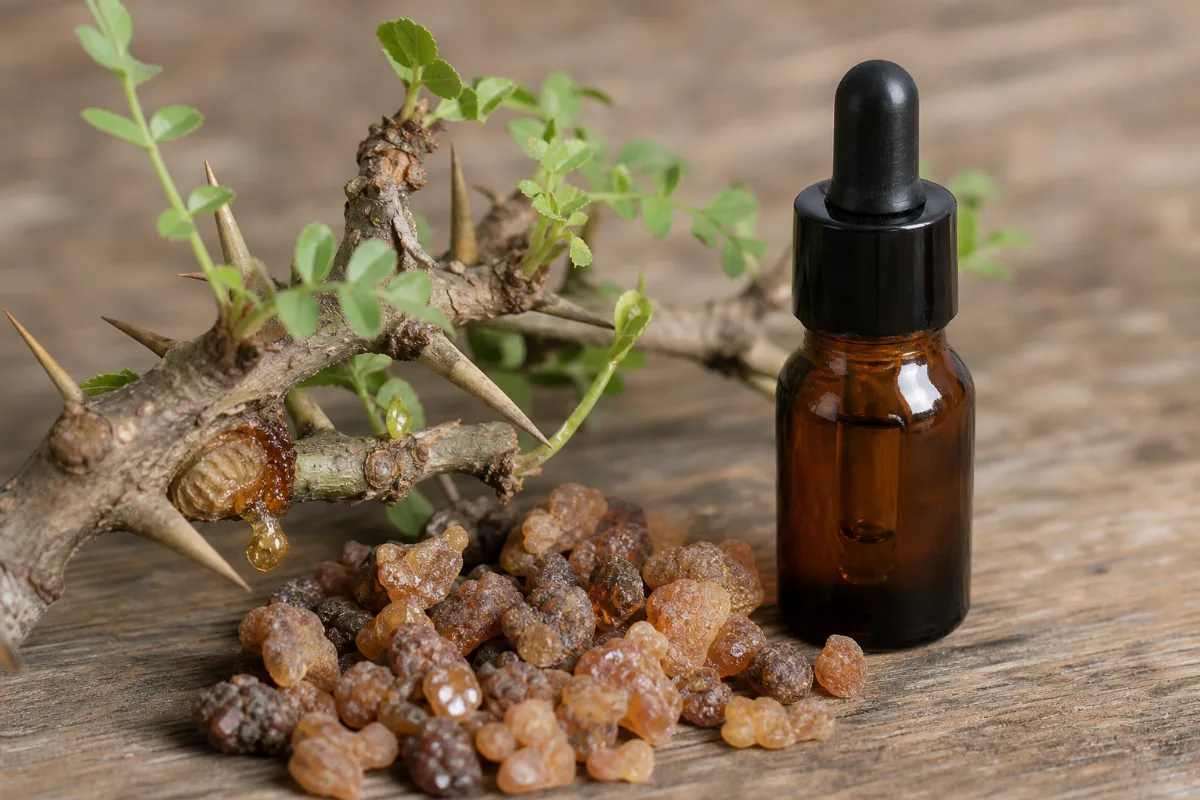
Essential Oils & Aromatherapy · Essential oil
Myrrh Oil
Commiphora myrrha (T.Nees) Engl. · also called Myrrh, gum myrrh, Commiphora molmol
Myrrh oil is the warm, resinous oil distilled from the hardened sap of the myrrh tree. It is used in perfumery, aromatherapy and massage blends, often with frankincense. Two small massage trials used a frankincense and myrrh blend, with mixed results, and most other findings come from lab and animal tests. The main caution: never swallow the bottled oil, the oil irritated skin strongly in a mouse test, and pregnancy needs particular care.
General information, not medical advice. Last substantive update · Not medically reviewed. A named clinician has not signed off on this page. How this page is made
About Myrrh Oil
Myrrh oil is a warm, resinous aromatherapy oil. In people, only two small massage trials exist, both with a frankincense and myrrh blend, and their results were mixed. Everything else is lab or animal work. Safety comes first: do not swallow it, it irritated skin strongly in a mouse test, and pregnancy needs particular care.
What myrrh oil is
Myrrh oil is the essential oil distilled from the oleo-gum resin of Commiphora myrrha, a thorny tree of north-east Africa and Arabia. GBIF lists Commiphora molmol as a synonym, although the EMA still uses that name.
The oil is rich in furanosesquiterpenes. In one analysis, furanoeudesma-1,3-diene made up 34.9% of a CO2-extracted oil; in another, a hydrodistilled oil had 17.65%. Curzerene and germacrone were other main components. Percentages vary with the sample and the method.
Bottles sold as myrrh can differ in species and make-up, and Poison Control says it can be hard to know what is in an essential oil bottle.
What the human evidence shows
In a 91-person Turkish trial, massage with a frankincense and myrrh blend lowered low back pain and disability more than jojoba-oil massage or no massage. In a 90-person trial before a heart test, the same kind of blend did not change pain, but people reported more comfort. Both are small, single-site trials of a two-oil blend, and a scent is hard to hide from participants. Neither tested myrrh alone.
No trial of myrrh oil for infections, mouth sores, wounds or skin was found.
Lab and animal findings
In test plates, myrrh oil stopped the growth of several bacteria, a yeast and moulds, and worked well with frankincense oil. In a lab test on collected skin oil, myrrh oil in a cosmetic formula protected squalene from UV oxidation better than two other antioxidants. A review lists many other lab and animal activities.
None of this shows a benefit in people. In one lab study only the highest strength raised DNA-damage markers in human blood cells; another found the oil toxic to a human kidney cell line and to water fleas.
Oil, resin and extracts are different
The EU's accepted myrrh product is a liquid extract made with a solvent such as alcohol, used on the lining of the mouth, minor wounds and small boils, on traditional use. The EMA says trial evidence is insufficient. Do not read that as support for the essential oil. Our page on myrrh the herb covers the resin and extracts.
At a glance
Traditional uses history, not proof
- Wounds, mouth ulcers, aches and stomach complaints, as listed in a 2023 review of myrrh resin and its products.
- Incense, perfume and balms since ancient times, as described by the authors of a 2018 study.
- A myrrh liquid extract is accepted in the EU for minor mouth ulcers, minor wounds and small boils on long-standing use (EMA); this is not the essential oil.
Studied for research
- Low back pain, massage with frankincense and myrrh blend, very-low
- Comfort before a heart test, same blend, mixed
- Mouth ulcers and minor wounds, liquid extract (not oil), insufficient
- Germ killing in test plates, lab only, very-low
- Protecting skin oil from UV in a lab test, very-low
Main compounds
- Furanoeudesma-1,3-diene, a main component
- Curzerene
- Germacrone
Common forms
- Essential oil (distilled from the resin)
- Frankincense and myrrh oil blends in carrier-oil massage
- Resin, tinctures and liquid extracts (different products)
Research links: EMA: Myrrh herbal summary · Poison Control: Essential oils · Back-pain massage trial, abstract · Heart-test massage trial, abstract · Cell-damage lab study, abstract · Myrrh review 2023, abstract · Research Library · Genes & Biomarkers Library
What it is and its history
- Accepted scientific name
- Commiphora myrrha
- Naming authority
- (T.Nees) Engl.
- Synonyms
- Commiphora molmol (Engl.) Engl. ex Tschirch
- Common names
- Myrrh (English); Gum myrrh (English)
- Family or group
- Burseraceae, per GBIF.
- Classification
- Plantae > not recorded > not recorded > Sapindales > Burseraceae > Commiphora > Commiphora myrrha
- Native range
- A 2023 review says myrrh is common in the southern Arabian peninsula and north-east Africa, including Somalia and Kenya.
- Habitat
- Not checked.
- What it looks like
- Part used: The oil is made from the oleo-gum resin, the hardened sap of the tree. Studies describe hydrodistillation, steam distillation and CO2 extraction. This page does not describe how to recognise the plant.
- Look-alikes and adulterants
- Name: Other Commiphora species and blends sold as myrrh oil; Note: One study tested oils from Commiphora myrrha and Commiphora guidotti as separate samples. Frankincense (Boswellia) is a different plant, often sold alongside myrrh and used with it in both massage trials.
- Sustainability and conservation
- Not checked (no IUCN or CITES source read).
Traditional use and history history, not clinical proof
| Tradition or era | Documented use | Source |
|---|---|---|
| Ancient and traditional medicine | Authors of a 2018 study say essential oils from frankincense and myrrh resins have been used since 2800 BCE for skin sores, wounds, teeth, inflammation and urinary tract problems, for mummification balms and as incense and perfume. This is the authors' statement; we did not check the history independently. | Ljaljevic Grbic 2018 |
| Traditional medicine, review summary | A 2023 review lists traditional use for wounds, mouth ulcers, aches, fractures, stomach disorders, infections and inflammation, and as an antiseptic, astringent, carminative, emmenagogue and expectorant. It says the essential oil is used in cosmetics, aromatherapy and perfumery. | Batiha 2023 |
| European herbal medicine | The EU herbal committee accepts a myrrh liquid extract for minor mouth ulcers and for minor wounds and small boils on the basis of at least 30 years of use, 15 of them in the EU. This does not cover the essential oil. | EMA HMPC public summary |
Traditional use shows how it was used. It does not show that it works or is safe today.
What is inside, and how it may work
What it contains and how those compounds act in cells and animals. Laboratory and animal mechanisms are not proven effects in people.
Main compounds
| Compound | Family | Where it is concentrated | Activity studied | Level of evidence |
|---|---|---|---|---|
| Furanoeudesma-1,3-diene | furanosesquiterpene | Oil from the oleo-gum resin 34.9% of a CO2-extracted myrrh oil (2005); 17.65% of a hydrodistilled oil (2018). Varies by sample. | Named as an irritant in a mouse-ear test and, with other furanosesquiterpenes, as a larvicide in a 2025 lab study. PubChem CID not looked up. 9 8 15 16 | Animal / lab |
| Curzerene PubChem 165365640 | furanosesquiterpene | Oil from the oleo-gum resin 8.5% (CO2 extract, 2005); 12.97% (hydrodistilled oil, 2018). Varies by sample. | A main component of the oil. A related compound, curzerenone, was an irritant in the mouse test. Curzerene itself was not named there. 12 9 8 15 | Laboratory |
| Germacrone PubChem 6436348 | sesquiterpene ketone | Oil from the oleo-gum resin 5.8% of a CO2-extracted oil (2005). | Listed as a main component in one analysis; no activity claimed here. 13 9 | Laboratory |
| Furanodiene PubChem 9601230 | furanosesquiterpene | Related to the oil's furan compounds Not stated in the sources read; mentioned only because a related compound (furanodiene-6-one) was an irritant. | No activity claimed. 14 15 | Laboratory |
Mechanisms, receptors and pathways
| Target or pathway | Gene or receptor | What was found | Level |
|---|---|---|---|
| Singlet oxygen quenching | None named | In lab and ex vivo tests, myrrh oil quenched singlet oxygen and protected collected sebum squalene from UV oxidation. 4 | Laboratory research |
| DNA damage markers in human cells | None named | Only the highest concentration tested raised micronucleus and comet-assay markers in human lymphocytes; no mutations in the Ames test; the oil protected plasmid DNA from hydrogen peroxide and UV. 1 | Laboratory research |
| Microbial growth | None named | Oil liquid and vapour stopped growth of several bacteria and fungi in test plates; combined with frankincense oil effects were mostly additive or synergistic. 17 8 | Laboratory research |
Absorption, metabolism and elimination
- Absorption
- Not established in the sources read.
- Distribution
- Not established.
- Metabolism
- Not established.
- Elimination
- Not established.
- Bioavailability
- Not established.
Isolated compounds versus whole extracts
Myrrh essential oil (volatile terpenes), myrrh resin, and alcohol extracts or tinctures are different products. The EMA conclusion is for a liquid extract, not the oil. The back-pain trials used a frankincense and myrrh oil blend in a carrier oil. Results for one product do not carry over to another.
Nutritional composition
Myrrh oil is not a nutrient and has no nutritional role.
1 mixed findings3 very low certainty2 not enough evidence
What was looked at
The 6 benefits and uses checked for Myrrh Oil, each with how strong the evidence is. Tap one to open it.
- Chronic low back pain (massage with a frankincense and myrrh oil blend)Very low certainty
- Back pain and comfort before a heart test (massage with the same blend)Mixed findings
- Minor mouth ulcers, small wounds and boils (traditional use of a myrrh extract, not the oil)Not enough evidence
- Killing germs in the lab (bacteria, yeast and fungi)Very low certainty
- Protecting skin oil from UV damage (lab test in a cosmetic formula)Very low certainty
- Other lab and animal findings (inflammation, antioxidant, pain, anti-parasite)Not enough evidence
Lab markers tracked in the studies
Back pain on a visual analogue scale (VAS)General Comfort Questionnaire scoreMinimum inhibitory concentration (MIC) against microbesSqualene monohydroperoxide formed after UV
What is Myrrh Oil good for?
The uses people ask about and how strong the evidence is for each. Read the certainty label first: nothing here is shown for myrrh oil alone, and the human results come from a two-oil blend.
Benefits, one by one
Each card is a research question, not a promise. Tap a goal to filter. Open a card to see the studies, doses and limits.
Chronic low back pain (massage with a frankincense and myrrh oil blend)
Very low certaintyIn one small Turkish trial, people who had massage with a blend of frankincense and myrrh oils had less back pain and disability than people who had massage with plain jojoba oil or no massage. Two oils were mixed, so this does not show that myrrh oil alone helps.
1 studiesNot covered. This page gives no amounts and no ways of using the oil.
Studies, doses and limits
What the trials found
One three-arm randomized trial (30 control, 31 jojoba-oil massage, 30 blend massage) in adults with chronic low back pain, with two massage sessions a week.
Results
Pain, back-pain and disability scores fell more in the blend group than in both other groups (p < 0.001 on all three scales). The authors conclude the massage could be added to medical care.
Effect sizes as reported
p < 0.001 against both comparison groups on each scale; no effect sizes in the abstract.
Why this rating
One small trial at one clinic. The oil was a two-oil blend, a scent is hard to hide from participants, and the abstract does not state follow-up length or funding. Myrrh alone has not been tested.
Form and dose studied
Not covered. This page gives no amounts and no ways of using the oil.
Who was studied
Adults with chronic low back pain in Turkey.
Limits
Blend of two oils; one site; no myrrh-only group; scent cannot be blinded well.
Why researchers looked
Massage is a common non-drug choice for long-lasting back pain, and aromatherapy is often added to it.
Traditional use
Myrrh has long been used for aches (a 2023 review of the resin and its oil lists traditional use for aches and fractures).
Proposed mechanism Preliminary mechanism
Not established in the studies read.
A proposed mechanism does not show that the effect happens in people.
The trials used a blend of frankincense and myrrh oils in a carrier oil massage. Essential oils can cause skin allergy. See the Safety tab.
Back pain and comfort before a heart test (massage with the same blend)
Mixed findingsIn a 90-person trial of people waiting for a heart rhythm test, back massage with the frankincense and myrrh blend did not change back pain scores compared with jojoba-oil massage or no massage. People in the blend group did report more comfort. The authors say better-designed research is needed on pain.
1 studiesNot covered. This page gives no amounts and no ways of using the oil.
Studies, doses and limits
What the trials found
One single-blind randomized trial in 90 people (30 per group): blend massage, jojoba-oil massage, or no intervention.
Results
No statistically significant difference between groups in pain after the procedure. Total comfort, physical comfort and psychospiritual comfort were significantly higher with the blend massage (the sociocultural part was not different).
Effect sizes as reported
Pain: no significant difference. Comfort: significant differences in the abstract; no effect sizes given.
Why this rating
The pain result was null and the comfort result was positive, in one trial of a two-oil blend. Comfort is self-reported and a scent is hard to hide.
Form and dose studied
Not covered. This page gives no amounts and no ways of using the oil.
Who was studied
Adults having a cardiac electrophysiological study in Turkey.
Limits
Blend of two oils; one hospital; pain did not change; comfort is self-rated.
Why researchers looked
Lying still before and after a heart procedure often causes back pain, and nurses look for simple comfort measures.
Proposed mechanism Preliminary mechanism
Not established in the studies read.
A proposed mechanism does not show that the effect happens in people.
A blend, not myrrh alone. Essential oils can cause skin allergy. See the Safety tab.
Minor mouth ulcers, small wounds and boils (traditional use of a myrrh extract, not the oil)
Not enough evidenceThe European medicines agency accepts one kind of myrrh product, a liquid extract made with a solvent such as alcohol, for minor mouth ulcers, minor wounds and small boils. This rests on long-standing use, not on clinical trials. It does not cover the essential oil.
1 studiesNot covered. This page gives no amounts and no ways of using the oil.
Studies, doses and limits
What the trials found
The EMA says there is insufficient evidence from clinical trials; the conclusion is for traditional use.
Results
Regulatory conclusion for a liquid extract applied to skin or the lining of the mouth; nothing is said about the essential oil.
Why this rating
For the essential oil there is no evidence at all in this use. For the extract the agency itself says trial evidence is insufficient.
Form and dose studied
Not covered. This page gives no amounts and no ways of using the oil.
Who was studied
Adults and adolescents over 12 (EMA).
Limits
Different product from the oil. Do not apply this conclusion to bottled essential oil, which is much stronger and is not used in the mouth.
Why researchers looked
Myrrh resin has a long history as a mouth and wound remedy.
Traditional use
EMA: at least 30 years of use, including 15 years in the EU, for adults and adolescents over 12.
Proposed mechanism Preliminary mechanism
The EMA weighed lab studies that showed antibacterial, local anaesthetic and anti-inflammatory effects of myrrh preparations.
A proposed mechanism does not show that the effect happens in people.
This is about a liquid extract made with alcohol, not the essential oil. The alcohol can sting and allergy is reported. See the Safety tab.
Killing germs in the lab (bacteria, yeast and fungi)
Very low certaintyIn test plates, myrrh oil stopped the growth of several bacteria, a yeast and moulds. Mixed with frankincense oil it often worked better. This is lab work only and does not show it treats any infection in people.
3 studiesNot covered. This page gives no amounts and no ways of using the oil.
Studies, doses and limits
Results
In a 2012 test of five Ethiopian oils, the most sensitive microbes were Cryptococcus neoformans (MIC 0.8 to 1.4 mg/ml) and Pseudomonas aeruginosa (MIC 0.5 to 1.3 mg/ml). Combining frankincense and myrrh oils was mostly additive or synergistic, with no antagonism. A 2018 study found bacteria and fungi were sensitive to myrrh and frankincense oil liquid and vapour in the lab.
Effect sizes as reported
MIC ranges above (lab strength needed to stop growth).
Why this rating
Test-plate work only. Strengths that stop growth in a dish are not safe or tested strengths for skin or body. One oil sample composition differs from the next.
Form and dose studied
Not covered. This page gives no amounts and no ways of using the oil.
Limits
Lab only; oils from a few samples; no human infection trial.
Why researchers looked
Myrrh and frankincense have long been burned and rubbed on as cleansing remedies, so researchers tested their oils against germs.
Traditional use
Authors of a 2018 study say frankincense and myrrh have been used since 2800 BCE for skin sores, wounds, teeth and other problems, and burned as incense.
Proposed mechanism Preliminary mechanism
Not studied beyond showing growth stopped in test plates.
A proposed mechanism does not show that the effect happens in people.
Test-plate strengths say nothing about safe use on skin or in the body.
Protecting skin oil from UV damage (lab test in a cosmetic formula)
Very low certaintyIn one lab study, myrrh oil in a cosmetic formula protected squalene, a natural skin oil, from UV-driven oxidation better than two other antioxidants. This was done on sebum collected from people and irradiated in the lab. It is not a test of sun protection on skin.
1 studiesNot covered. This page gives no amounts and no ways of using the oil.
Studies, doses and limits
Results
Of the three antioxidants tested at 0.6% in a cosmetic formulation, myrrh oil gave the best protection of squalene against UV-driven oxidation.
Effect sizes as reported
Not given in the abstract.
Why this rating
One 2007 lab and ex vivo study with a cosmetic aim; funding not stated; no trial on skin.
Form and dose studied
Not covered. This page gives no amounts and no ways of using the oil.
Limits
Does not show protection from sunburn or skin damage; not a sunscreen.
Why researchers looked
Squalene in skin oil is easily damaged by sun, and a cosmetics researcher looked for ingredients that calm the damaging oxygen form involved.
Proposed mechanism Preliminary mechanism
The paper says myrrh oil quenches singlet oxygen, a reactive oxygen form made by sunlight.
A proposed mechanism does not show that the effect happens in people.
Not a sunscreen. The oil is also a skin irritant in animal tests. See the Safety tab.
Other lab and animal findings (inflammation, antioxidant, pain, anti-parasite)
Not enough evidenceA 2023 review lists many activities of myrrh in lab and animal work, from reducing inflammation to killing parasites. It covers the resin, extracts and oil together, so it cannot tell us what the essential oil does in people.
2 studiesNot covered. This page gives no amounts and no ways of using the oil.
Studies, doses and limits
What the trials found
The review abstract does not describe human trials of the oil.
Results
The review abstract lists anti-inflammatory, antioxidant, antimicrobial, neuroprotective, anti-diabetic, anti-cancer, analgesic and anti-parasitic activities, and says drug interactions still need to be worked out. Separately, the oil killed mosquito larvae in a 2025 lab study (and was toxic to water fleas and a human kidney cell line in a dish).
Why this rating
Lab and animal findings only; the review does not rate certainty or separate oil from resin.
Form and dose studied
Not covered. This page gives no amounts and no ways of using the oil.
Limits
Narrative review; mixed products; no human data for the oil.
Why researchers looked
Myrrh contains many terpenes, so researchers screen it for many effects.
Traditional use
Used for wounds, mouth ulcers, aches, stomach disorders and, as an emmenagogue, for periods (review). Pregnancy cautions are on the Safety tab.
Proposed mechanism Preliminary mechanism
Many proposed; the review mixes resin, extract and oil, so none is tied to the oil in particular.
A proposed mechanism does not show that the effect happens in people.
Lab and animal findings do not show effects in people.
Connections to the rest of health
How Myrrh Oil connects to the rest of our health knowledge graph. Every link says what kind of connection it is. A safety link (for example to the liver) is a warning, not a benefit. A study that merely mentions a topic never creates a benefit link.
Explore every connection: goals, body systems, organs, symptoms, genes
A. Wellness goals
| Connected to | Kind of connection | Evidence status | Context | Studies |
|---|---|---|---|---|
| Mobility Support | Very low certainty | Chronic low back pain (massage with a frankincense and myrrh oil blend): In one small Turkish trial, people who had massage with a blend of frankincense and myrrh oils had less back pain and disability than people who had massage with plain jojoba oil or no massage. Two oils were mixed, so this does not show that myrrh oil alone helps. | 3 | |
| Muscle Recovery | Very low certainty | Chronic low back pain (massage with a frankincense and myrrh oil blend): In one small Turkish trial, people who had massage with a blend of frankincense and myrrh oils had less back pain and disability than people who had massage with plain jojoba oil or no massage. Two oils were mixed, so this does not show that myrrh oil alone helps. | 3 | |
| Calm Relaxation | Mixed findings | Back pain and comfort before a heart test (massage with the same blend): In a 90-person trial of people waiting for a heart rhythm test, back massage with the frankincense and myrrh blend did not change back pain scores compared with jojoba-oil massage or no massage. People in the blend group did report more comfort. The authors say better-designed research is needed on pain. | 10 | |
| Mobility Support | Mixed findings | Back pain and comfort before a heart test (massage with the same blend): In a 90-person trial of people waiting for a heart rhythm test, back massage with the frankincense and myrrh blend did not change back pain scores compared with jojoba-oil massage or no massage. People in the blend group did report more comfort. The authors say better-designed research is needed on pain. | 10 | |
| Healthy Skin | Preliminary mechanism | Very low certainty | Protecting skin oil from UV damage (lab test in a cosmetic formula): In one lab study, myrrh oil in a cosmetic formula protected squalene, a natural skin oil, from UV-driven oxidation better than two other antioxidants. This was done on sebum collected from people and irradiated in the lab. It is not a test of sun protection on skin. | 4 |
B. Body systems
| Connected to | Kind of connection | Evidence status | Context | Studies |
|---|---|---|---|---|
| Musculoskeletal System | Biological association | Very low certainty | Studied for: Chronic low back pain (massage with a frankincense and myrrh oil blend) Studied for: Back pain and comfort before a heart test (massage with the same blend) | 3 10 |
| Pain Inflammation | Biological association | Very low certainty | Studied for: Chronic low back pain (massage with a frankincense and myrrh oil blend) Studied for: Back pain and comfort before a heart test (massage with the same blend) | 3 10 |
| Integumentary System | Biological association | Not enough evidence | Studied for: Minor mouth ulcers, small wounds and boils (traditional use of a myrrh extract, not the oil) Studied for: Protecting skin oil from UV damage (lab test in a cosmetic formula) | 6 4 |
| Immune System | Biological association | Very low certainty | Studied for: Killing germs in the lab (bacteria, yeast and fungi) | 17 8 5 |
E. Health conditions
| Connected to | Kind of connection | Evidence status | Context | Studies |
|---|---|---|---|---|
| Contact dermatitis | Adverse effect or risk | Documented risk | EMA reports allergic skin reactions with myrrh medicines; a mouse test showed the oil irritates. EMA reports allergic skin reactions; mouse test shows irritation. Preparation or compound: Myrrh medicines (resin); the oil is a strong irritant in mouse ears |
6 15 |
| Pregnancy | Contraindication | Case report | One case of abdominal pain in pregnancy; traditional emmenagogue use. One case of abdominal pain; traditional emmenagogue use. Preparation or compound: Myrrh herbs by mouth (case report); oil untested |
2 5 |
| Essential oil poisoning | Adverse effect or risk | Documented risk | Poison Control describes serious poisoning from misused essential oils; myrrh is not named. Preparation or compound: Essential oils in general |
11 |
| Chronic low back pain | Potential benefit | Preliminary | One small trial favoured the blend; a second trial showed no pain difference. Preparation or compound: Frankincense and myrrh oil blend in massage |
3 10 |
I. Biomarkers
| Connected to | Kind of connection | Evidence status | Context | Studies |
|---|---|---|---|---|
| Back pain on a visual analogue scale (VAS) | Biological association | Very low certainty | Measured in trials: decrease. A lab change is not the same as a health benefit. | 3 10 |
| General Comfort Questionnaire score | Biological association | Low certainty | Measured in trials: increase. A lab change is not the same as a health benefit. | 10 |
| Minimum inhibitory concentration (MIC) against microbes | Biological association | Very low certainty | Measured in trials: decrease. A lab change is not the same as a health benefit. | 17 |
| Squalene monohydroperoxide formed after UV | Biological association | Very low certainty | Measured in trials: decrease. A lab change is not the same as a health benefit. | 4 |
K. Biological pathways
L. Active compounds
| Connected to | Kind of connection | Evidence status | Context | Studies |
|---|---|---|---|---|
| Furanoeudesma-1,3-diene | Biological association | Animal / lab | Named as an irritant in a mouse-ear test and, with other furanosesquiterpenes, as a larvicide in a 2025 lab study. PubChem CID not looked up. Preparation or compound: Oil from the oleo-gum resin |
9 8 15 16 |
| Curzerene | Biological association | Laboratory | A main component of the oil. A related compound, curzerenone, was an irritant in the mouse test. Curzerene itself was not named there. Preparation or compound: Oil from the oleo-gum resin |
12 9 8 15 |
| Germacrone | Biological association | Laboratory | Listed as a main component in one analysis; no activity claimed here. Preparation or compound: Oil from the oleo-gum resin |
13 9 |
| Furanodiene | Biological association | Laboratory | No activity claimed. Preparation or compound: Related to the oil's furan compounds |
14 15 |
Each connection is stored with the ingredient, the connected record, the kind of connection, the evidence status, the supporting studies, the preparation or compound involved, and a review date (last reviewed October 25, 2026).
Evidence at a glance: what the research found for 6 outcomes
Each outcome below is one thing researchers measured. Certainty is how far the evidence can be trusted, not how well it works. The full studies are on the next tab.
The evidence
The research centre for Myrrh Oil. Every record here was checked against PubMed or the publisher's page; we never list a study we have not verified.
Evidence by outcome
Bars show how many studies we found for each outcome, not how well it works. People are added up across trials only (reviews are not added, to avoid double counting).
How we rate evidence
High certainty
Several well-run trials or reviews agree; further research is unlikely to change the picture much.
Moderate certainty
Good trials point the same way, but some doubt remains.
Low certainty
Small, short or inconsistent trials. The finding could change with better research.
Very low certainty
Very little or very weak human data. Treat as a possibility only.
Mixed findings
Trials or reviews disagree with each other.
Not enough evidence
Not enough human research to say either way.
Evidence against
Good research found no benefit, or found harm.
We take the reviewers' own risk-of-bias and GRADE statements where they exist, and otherwise judge from study size, design, consistency, directness and whether a product matches what is sold. Many publications do not make evidence high. Method note: We read the abstracts of 11 PubMed papers and the EMA and Poison Control pages, and checked the plant name in GBIF and compound names in PubChem. We did not find or read a LiverTox, LactMed or FDA statement for the oil.
Study library: every study we checked 17
| Study | Design | People | Product, dose, length | Result |
|---|---|---|---|---|
| Abdelsalam 2022 In vitro cytogenotoxic and mutagenic effects of Commiphora myrrha essential oil. Drug Chem Toxicol · PMID 34607480 · DOI |
Laboratory study (cells in a dish, plasmid DNA, bacteria) in vitro (human cells, bacteria) |
Human peripheral blood lymphocytes in culture; plasmid DNA; Salmonella typhimurium strains TA98 and TA100 | Commercially available Commiphora myrrha essential oil oil Not reported here 24 or 48 hours of cell exposure · vs Untreated control |
The highest concentration tested (0.125 microlitres per millilitre) caused significantly more micronuclei at both 24 and 48 hours, lowered the nuclear division index, and in the comet test raised the share of damaged cells. The oil did not cause mutations in the bacterial test and did not damage plasmid DNA directly; it protected the plasmid DNA against hydrogen peroxide and UV. No significant change in oxidant or antioxidant status. The authors conclude the oil carries a cytogenotoxic risk only at higher concentrations. Genetic damage markers rose only at the highest concentration Methods, limits and fundingOutcomes: Micronucleus formation, comet (DNA damage) assay, nuclear division index, oxidant and antioxidant status, Ames mutation test, plasmid DNA damage Limitations: Cells in a dish, not people; a commercial oil of unstated composition; says nothing about how much reaches cells during skin use or scent use. Funding and conflicts: Not stated in the abstract. Read: abstract |
| Al-Jaroudi 2016 Risks of Myrrh usage in pregnancy. JBRA Assist Reprod · PMID 28050964 · DOI |
Case report human case |
1 A 32-year-old pregnant woman with infertility and recurrent miscarriage history in Saudi Arabia |
Large amounts of myrrh herbs taken for two months (not essential oil) myrrh herb (resin) Not reported here 2 months |
She developed acute abdominal pain that eased as soon as she stopped taking myrrh. The authors assume myrrh acted as a uterine stimulant and call for studies of myrrh safety in pregnancy. Methods, limits and fundingOutcomes: Pregnancy course Limitations: One case; the product was the herb taken by mouth, not the essential oil; the authors' uterine-stimulant explanation is an assumption. Funding and conflicts: No conflict of interest declared. Read: abstract |
| Alkanat 2023 The effects of massage with frankincense and myrrh oil in chronic low back pain: A three-arm randomised controlled trial. Explore (NY) · PMID 37121835 · DOI |
Randomized controlled trial, three arms |
91 Adults with chronic low back pain at a university physical therapy clinic in Turkey (30 control, 31 massage with jojoba oil, 30 aromatherapy massage) |
Massage with a blend of frankincense and myrrh essential oils (not myrrh alone) oil (resin-derived) Not reported here Two massage sessions per week (total length not stated in the abstract) · vs Massage with jojoba oil; no-massage control |
Scores on all three scales fell more in the aromatherapy massage group than in both other groups (p < 0.001 for each). The authors conclude the blend massage can be added to medical treatment. Larger fall on all three scales than jojoba massage or no massage (p < 0.001) Methods, limits and fundingOutcomes: Pain (visual analogue scale), Aberdeen Low Back Pain Scale, Roland-Morris Disability Scale Limitations: Blend of two oils, so myrrh alone cannot be judged; small single-site trial; a scent is hard to hide from participants; follow-up length not stated in the abstract. Funding and conflicts: Not stated in the abstract. Registration: NCT04494165 Read: abstract |
| Auffray 2007 Protection against singlet oxygen, the main actor of sebum squalene peroxidation during sun exposure, using Commiphora myrrha essential oil. Int J Cosmet Sci · PMID 18489308 · DOI |
Laboratory and ex vivo study ex vivo (human sebum) |
Sebum collected from people and then irradiated with UV in the lab | Commiphora myrrha essential oil in a cosmetic formulation, compared with two other antioxidants oil Not reported here · vs Two other antioxidants (butylated hydroxytoluene; an olive extract) |
Among the three antioxidants tested at 0.6% in a cosmetic formulation, myrrh oil gave the best protection of squalene against UV-driven oxidation in collected sebum. The author says this suggests sun-care cosmetics should include singlet oxygen quenchers. Best protection among the three tested Methods, limits and fundingOutcomes: Protection of sebum squalene from UV-driven oxidation (squalene monohydroperoxide) Limitations: Sebum in a dish, not skin on people; not a test of sunburn or sun protection; funding not stated in the abstract. Funding and conflicts: Not stated in the abstract. Read: abstract |
| Batiha 2023 Commiphora myrrh: a phytochemical and pharmacological update. Naunyn Schmiedebergs Arch Pharmacol · PMID 36399185 · DOI |
Narrative review mixed |
Literature on Commiphora myrrh (resin, extracts and essential oil) | Myrrh resin, extracts and essential oil (all discussed together) oleo-gum resin and its oil Not reported here |
The abstract lists traditional uses for wounds, mouth ulcers, aches, fractures, stomach disorders, infections and inflammation, and describes use as an antiseptic, astringent, carminative, emmenagogue and expectorant. It lists anti-inflammatory, antioxidant, antimicrobial, neuroprotective, anti-diabetic, anti-cancer, analgesic and anti-parasitic activities from research, and says drug interactions still need to be fully worked out. It notes the essential oil is used in cosmetics, aromatherapy and perfumery. Methods, limits and fundingOutcomes: Traditional uses, constituents and reported biological activities Limitations: A narrative review: it does not rate certainty, and the abstract does not separate lab, animal and human findings. Funding and conflicts: The authors declare no competing interests. Read: abstract |
| European Medicines Agency 2019 EMA: Myrrha - herbal medicinal product (public summary, Commiphora molmol Engler) n/a · Source |
Regulator or reference page n/a |
n/a | n/a |
Page read 2026-10-25. The HMPC covers only a liquid extract made with a solvent such as ethanol, applied to skin or the lining of the mouth. It concluded that, on long-standing use, this preparation can be used for minor mouth ulcers and inflammation, and for minor wounds and small boils, in adults and adolescents over 12. Basis is traditional use: there is insufficient clinical-trial evidence but effectiveness is plausible, and there is evidence of safe use for at least 30 years (15 in the EU). Lab studies showed antibacterial, local anaesthetic and anti-inflammatory effects. Risks: allergic skin reactions have been reported (frequency not known); the liquid extract contains alcohol, which may cause short-lived pain and irritation. First published 23/08/2019; status C, ongoing call for scientific data; revision consultation 01/04/2024 to 30/06/2024. The summary does not mention the essential oil or pregnancy. Methods, limits and fundingOutcomes: Scope, traditional-use conclusion, risks Read: full-text |
| GBIF 2026 GBIF Backbone Taxonomy: Commiphora myrrha (T.Nees) Engl., key 3994082; Commiphora molmol key 3994212 (GBIF match API, read 2026-10-25) n/a · Source |
Regulator or reference page n/a |
n/a | n/a |
Commiphora myrrha (T.Nees) Engl. is the ACCEPTED name (exact match, family Burseraceae, order Sapindales). Commiphora molmol (Engl.) Engl. ex Tschirch is listed as a SYNONYM that points to Commiphora myrrha (another GBIF record lists Commiphora molmol Engl. ex Tschirch as accepted). Methods, limits and fundingOutcomes: Accepted name and family Read: full-text |
| Ljaljevic Grbic 2018 Frankincense and myrrh essential oils and burn incense fume against micro-inhabitants of sacral ambients. Wisdom of the ancients? J Ethnopharmacol · PMID 29530608 · DOI |
Laboratory study with a room test in vitro |
Bacteria and fungi in the lab; air in a 17th-century church (tested with frankincense oil vapour and incense fume) | Commiphora myrrha essential oil (hydrodistilled from resin) and Boswellia carteri essential oil oil Not reported here |
Myrrh oil was high in furanoeudesma-1,3-diene (17.65%), curzerene (12.97%), beta-elemene (12.70%) and germacrene B (12.15%). In the lab, bacteria and fungi were sensitive to the liquid and vapour phases of the oils and to incense fume. The church-air test, as far as the abstract reads, was described for frankincense oil vapour and incense fume, not myrrh. Composition percentages above Methods, limits and fundingOutcomes: Antimicrobial activity of liquid and vapour phases; chemical composition Limitations: Lab and room test, not human health; the church-air result is not about myrrh oil. Funding and conflicts: Not stated in the abstract. Read: abstract |
| Marongiu 2005 Chemical composition of the essential oil and supercritical CO2 extract of Commiphora myrrha (Nees) Engl. and of Acorus calamus L. J Agric Food Chem · PMID 16190653 · DOI |
Chemical analysis n/a (chemistry) |
Myrrh oleo-gum resin | Oil from Commiphora myrrha resin made by CO2 extraction, hydrodistillation and steam distillation oleo-gum resin Not reported here |
Oil from hydrodistillation (yield 2.8%) and steam distillation (yield 0.4%) was quite similar to the CO2 extract. In the CO2 extract the main components were furanoeudesma-1,3-diene (34.9%), lindestrene (12.9%), curzerene (8.5%) and germacrone (5.8%). Main components by percentage Methods, limits and fundingOutcomes: Yield and main components by gas chromatography-mass spectrometry Limitations: One batch of resin; composition in shop oils will differ. Funding and conflicts: Not stated in the abstract. Read: abstract |
| Ozdemir 2024 The effect of back massage with frankincense and myrrh oil before the cardiac electrophysiological procedure on back pain intensity and comfort: A single-blind randomized controlled trial. Explore (NY) · PMID 37783585 · DOI |
Single blind randomized controlled trial |
90 Patients waiting for a cardiac electrophysiological study at a heart hospital in Turkey (30 per group) |
Back massage with frankincense and myrrh essential oils (a blend) oil (resin-derived) Not reported here · vs Back massage with jojoba oil; no-intervention control |
After the procedure there was no statistically significant difference in pain scores between groups. Overall comfort, physical comfort and psychospiritual comfort were higher with the blend massage. The authors say more rigorous research is needed on its effect on pain. Pain: no significant group difference. Comfort: significant differences, except for the sociocultural subscale Methods, limits and fundingOutcomes: Back pain (visual analogue scale), General Comfort Questionnaire Limitations: Blend of two oils; one hospital; scent is hard to blind; comfort is self-reported. Funding and conflicts: Not stated in the abstract. Read: abstract |
| Poison Control (America's Poison Centers) 2026 Poison Control: Essential oils: Poisonous when misused n/a · Source |
Regulator or reference page n/a |
n/a | n/a |
Page read 2026-10-25. Misuse of essential oils can cause serious poisoning. Pure oils are potent; diluting in a carrier oil is the best way to avoid a bad reaction from skin contact; not all oils suit skin; do not use on damaged skin. Many oils can cause rashes and some are poisonous if absorbed through the skin or swallowed. Aspirating an oil can cause pneumonia. Children have thin skin and immature livers, which may make them more susceptible. Oils may interact with medicines. It can be hard to know the species, concentration or contaminants in a bottle. Allergy is a real possibility; stop if a rash appears and wash off gently; any reaction with trouble breathing is an emergency. Keep oils locked up, out of reach of children and pets. If someone swallows an essential oil call a poison center (US 1-800-222-1222). The page does not mention myrrh by name. Methods, limits and fundingOutcomes: General essential-oil safety Read: full-text |
| PubChem 2026 PubChem: Curzerene, CID 165365640 (PUG REST, read 2026-10-25) n/a · Source |
Regulator or reference page n/a |
n/a | n/a |
PubChem name lookup returns CID 165365640, formula C15H22O. Methods, limits and fundingOutcomes: Compound identity Read: full-text |
| PubChem 2026 PubChem: Germacrone, CID 6436348 (PUG REST, read 2026-10-25) n/a · Source |
Regulator or reference page n/a |
n/a | n/a |
PubChem name lookup returns CID 6436348, formula C15H22O. Methods, limits and fundingOutcomes: Compound identity Read: full-text |
| PubChem 2026 PubChem: Furanodiene, CID 9601230 (PUG REST, read 2026-10-25) n/a · Source |
Regulator or reference page n/a |
n/a | n/a |
PubChem name lookup returns CID 9601230, formula C15H20O. Methods, limits and fundingOutcomes: Compound identity Read: full-text |
| Saeed 2004 Irritant potential of some constituents from oleo-gum-resin of Commiphora myrrha. Fitoterapia · PMID 14693226 · DOI |
Animal test (open mouse ear assay) animal (mouse) |
Mouse ears | Commiphora myrrha essential oil and seven sesquiterpenoid compounds isolated from the resin oil and isolated compounds Not reported here |
The essential oil, curzerenone, furanodiene-6-one and furanoeudesma-1,3-diene showed potent and persistent irritant effects; the other compounds were least irritant. Potent, persistent irritation Methods, limits and fundingOutcomes: Irritation of the mouse ear Limitations: Mice, not people; strength used is not given in the abstract; does not give a human skin rate. Funding and conflicts: Not stated in the abstract. Read: abstract |
| Spinozzi 2025 Essential oil and furanosesquiterpenes from myrrh oleo-gum resin: a breakthrough in mosquito vector management. Nat Prod Bioprospect · PMID 39832119 · DOI |
Laboratory study (insects, water fleas, human cell line) in vitro / insects |
Mosquito larvae of four species; Daphnia magna (water flea); human kidney cell line HEK293 | Commiphora myrrha essential oil and its furanosesquiterpene fractions oil Not reported here |
The oil killed mosquito larvae (LC50 4.42 to 16.80 micrograms per millilitre) and the furanosesquiterpenes were identified as the main larvicidal compounds. It was also toxic to Daphnia magna (LC50 4.51 microlitres per litre) and to a human kidney cell line (IC50 14.38 micrograms per millilitre). LC50 and IC50 values above Methods, limits and fundingOutcomes: Larvicidal activity, non-target toxicity, cytotoxicity Limitations: Not about human use; shows the oil is toxic to small water animals and to human cells in a dish at these strengths. Funding and conflicts: The authors declare no conflict of interest. Read: abstract |
| de Rapper 2012 The additive and synergistic antimicrobial effects of select frankincense and myrrh oils--a combination from the pharaonic pharmacopoeia. Lett Appl Microbiol · PMID 22288378 · DOI |
Laboratory study (broth microdilution) in vitro |
Microbes in test plates; oils collected from regions of Ethiopia (three frankincense oils, two myrrh oils from Commiphora guidotti and C. myrrha) | Essential oils of Commiphora (myrrh) and Boswellia (frankincense), alone and combined oil Not reported here |
The most susceptible microbes were Cryptococcus neoformans (MIC 0.8 to 1.4 mg/ml) and Pseudomonas aeruginosa (MIC 0.5 to 1.3 mg/ml). In combinations the oils were mostly synergistic or additive, with no antagonism; the strongest synergy was between a Boswellia papyrifera oil and the Commiphora myrrha oil. MIC ranges above Methods, limits and fundingOutcomes: Minimum inhibitory concentration against bacteria and yeast; combination effects Limitations: Test-plate work only; these are not safe or effective strengths for skin or body. Funding and conflicts: Not stated in the abstract. Read: abstract |
What we do not know yet
- What the evidence supports: the human results are very-low or mixed, from two blend trials; lab findings are very-low.
- No trial of myrrh oil alone in people.
- No poisoning, patch-test, pet, asthma or seizure source for the oil.
- No study of the oil in pregnancy, breastfeeding or children.
- No verified dilution figure; we give none.
How new research is added
New studies are found by a saved PubMed search and are placed in a review queue. A person reads each one before it is added.
Lab markers
What changed in blood or saliva tests during trials. A changed number is not the same as feeling or being healthier, and we give no "normal ranges".
Other 4
Back pain on a visual analogue scale (VAS)
Decrease in trials
A self-rated pain score on a line from no pain to worst pain.
Very low certaintyResults and what it means
Why it was measured
Main pain outcome in both massage trials.
Statistical vs. clinical meaning
A symptom score, not a lab marker; results differed between the two trials.
Safety implication
A lower score does not show the oil is safe for everyone.
General Comfort Questionnaire score
Increase in trials
A questionnaire in which people rate their physical, psychospiritual, social and environmental comfort.
Low certaintyResults and what it means
Why it was measured
Used to see whether the massage helped how people felt, beyond pain.
Statistical vs. clinical meaning
Self-rated; one trial; a scent is hard to hide from people.
Safety implication
Not applicable.
| Study | Result | People | Product |
|---|---|---|---|
| 10 | Total, physical and psychospiritual comfort were higher with the blend massage; the sociocultural part was not different. |
Minimum inhibitory concentration (MIC) against microbes
Decrease in trials
The lowest strength of a substance that stops visible microbe growth in a test plate.
Very low certaintyResults and what it means
Why it was measured
The standard lab measure of antimicrobial strength.
Statistical vs. clinical meaning
Lab measure only; a lower MIC means stronger action in the dish.
Safety implication
Strengths that stop microbes in a dish may be irritating or toxic to skin.
| Study | Result | People | Product |
|---|---|---|---|
| 17 | Myrrh and frankincense oils stopped Cryptococcus neoformans at 0.8 to 1.4 mg/ml and Pseudomonas aeruginosa at 0.5 to 1.3 mg/ml in test plates. |
Squalene monohydroperoxide formed after UV
Decrease in trials
A product made when squalene in skin oil is oxidized by UV light.
Very low certaintyResults and what it means
Why it was measured
Used as a marker of sunlight damage to skin oil.
Statistical vs. clinical meaning
Lab marker in collected sebum; not a measure of sun protection.
Safety implication
Not applicable.
| Study | Result | People | Product |
|---|---|---|---|
| 4 | Myrrh oil in a cosmetic formula gave the best protection of squalene from UV-driven oxidation among three antioxidants tested. |
Safety
What studies and official sources say about side effects, medicines and who should check first. Each point shows what kind of evidence it comes from.
Main points to know 4
- Do not swallow myrrh essential oil, and do not put it on skin undiluted.. Poison Control says misused essential oils can cause serious poisoning. Pure oils are potent, and diluting them in a carrier oil is the best way to avoid a bad reaction from skin contact. Some oils are poisonous if swallowed or absorbed through the skin, and breathing an oil into the lungs while swallowing can cause pneumonia. Poison Control's page does not name myrrh, and we found no myrrh-oil poisoning report, so the risk of swallowing myrrh oil is unmeasured, not shown to be small. Keep bottles locked away from children and pets. Regulatory 11
- Myrrh oil was a strong, long-lasting skin irritant in a mouse test.. In an open mouse-ear test, the essential oil from myrrh resin and three of its sesquiterpene compounds (curzerenone, furanodiene-6-one, furanoeudesma-1,3-diene) caused potent, persistent irritation. This is animal work and gives no human rate, but it is a reason to expect that the undiluted oil can irritate skin. For myrrh medicines the EMA says allergic skin reactions have been reported (frequency unknown) and the alcohol in liquid extracts can sting. Animal research 15 6
- Pregnancy: avoid, and ask a clinician. Sources describe myrrh as a possible uterine stimulant, but the evidence is thin.. A 2023 review lists myrrh's traditional use as an emmenagogue (a remedy to bring on periods). One case report describes a pregnant woman who took large amounts of myrrh herbs for two months and had acute abdominal pain that eased when she stopped; the authors assume it acted as a uterine stimulant. That was the herb, not the oil, and it is one case. The EMA summary we read does not cover pregnancy. No study of the essential oil in pregnancy was found. Case report 2 5 6
- The oil harmed human cells in a dish only at the highest strength tested, and was toxic to small water animals.. In human blood cells in culture, only the highest concentration of myrrh oil caused more chromosome-fragment (micronucleus) and DNA-damage markers, and it caused no mutations in a bacterial test. In another lab study the oil killed mosquito larvae, was toxic to water fleas and to a human kidney cell line. These are lab results, not human harm, but they are another reason not to treat the oil as harmless. Laboratory research 1 16
Side effects 5
| Effect | How often | Severity and recovery | Evidence |
|---|---|---|---|
| Skin irritation Mouse test of the oil and some of its compounds. No human irritation rate for myrrh oil was found. | Not established | potent and persistent in mouse ears; human severity unknown Not stated in the abstract. | Animal research 15 |
| Allergic skin reaction EMA wording is about myrrh medicines made from the resin, not the essential oil. Poison Control says allergy to essential oils is a real possibility; the most common sign is a skin rash. | Reported with myrrh medicines; the EMA says the frequency is not known | Not stated Not stated | Regulatory 6 11 |
| Alcohol sting or irritation (liquid extracts) Applies to alcohol extracts, not to the oil. | Not established | short-lived pain and irritation (EMA) Short-lived (EMA) | Regulatory 6 |
| Abdominal pain in pregnancy (after myrrh herbs by mouth) Herb taken by mouth in large amounts, not the oil. The cause is the authors' assumption. | One reported case | acute pain Eased when she stopped (case report) | Case report 2 |
| Adverse events in the two massage trials Not reported in the abstracts we read; absence of mention is not proof of none. | Not reported in the abstracts | Not stated Not stated | Controlled trial 3 10 |
Liver
We did not find liver injury described for myrrh essential oil in the sources we read. No LiverTox record was read, so none is claimed. Poison Control notes that children have immature livers, which may make them more sensitive to essential oils in general. 11
How often. Not established.
This is a safety connection. It is not evidence that Myrrh Oil supports liver health.
Medicines and supplements 2
| With | Why it matters | Importance | Evidence | What to do |
|---|---|---|---|---|
| Prescription and over-the-counter medicines medicines in general | Poison Control says essential oils may interact with medications; a 2023 review says myrrh's drug interactions still need to be fully worked out. | No specific interaction with myrrh oil was found in the sources read. | Theoretical Not enough evidence 11 5 | If you take regular medicines, ask a pharmacist before using any essential oil product. |
| Blood thinners, diabetes medicines, thyroid medicines anticoagulants / diabetes medicines / thyroid medicines | Not established for myrrh oil in the sources read. | We did not read a source that links myrrh oil to these medicines. Do not read this as safe. | None found Not enough evidence 5 | Ask a pharmacist. |
Who should check first 5
| Situation | Advice | Evidence |
|---|---|---|
| Swallowing essential oil, especially by or near children | Do not swallow. If a child or pet may have swallowed any essential oil, call poison control (US: 1-800-222-1222) or your emergency number. | Regulatory 11 |
| Pregnancy | Avoid, and ask your midwife or doctor first. Sources describe myrrh as a traditional emmenagogue and one case report links myrrh herbs to abdominal pain in pregnancy; nothing has been tested for the oil. | Case report 2 5 |
| Damaged or broken skin | Poison Control says not to use essential oils on damaged skin. | Regulatory 11 |
| Previous rash or allergy to an essential oil or to myrrh products | Stop at once if a rash appears and gently wash the oil off with soap and water (Poison Control). Do not use again without a doctor's advice. | Regulatory 11 6 |
| Children | The EMA limits its myrrh medicines to adults and adolescents over 12, and Poison Control notes children have thin skin and immature livers. Do not use myrrh oil on young children without advice from a doctor. | Regulatory 6 11 |
Overdose, product quality and regulators
Summary. No poisoning case for myrrh essential oil and no lethal amount were found. What exists: a mouse-ear test showing strong persistent irritation, and lab studies showing the oil damaged DNA-markers in human blood cells at the highest strength tested and was toxic to a human kidney cell line and to water fleas.
Amounts. No safe amount is established, and this page gives none.
Onset and course. Not described for myrrh oil.
Repeated use. Not studied for the oil.
Animal data. Mouse ear: the oil and three furanosesquiterpene-type compounds were potent, persistent irritants. Water flea (Daphnia magna) LC50 4.51 microlitres per litre in a lab study.
Toxic parts. The oil is the concentrated, volatile part of the resin. Furanoeudesma-1,3-diene, curzerenone and furanodiene-6-one were the irritant compounds named in the mouse test.
Not read. We found no pet or cat source for myrrh oil, no asthma or seizure source, and no human patch-test study of the oil. Absence is not proof of safety.
Essential oil products are not well regulated, so what is in the bottle can differ from the label.
Unknown species, strength and contaminants. Poison Control says it can be hard to know what species of plant, what concentration of active ingredient, or whether contaminants are in an essential oil bottle. 11
Different oils sold as myrrh. Studies tested oils from Commiphora myrrha and from a related species (Commiphora guidotti) as separate samples, and composition varies with how the oil is made (steam distillation gave a much lower yield than hydrodistillation or CO2 extraction, with a similar profile). A result for one oil does not carry over to another. 17 9
Blends and carrier oils. The two massage trials used a frankincense and myrrh blend in a carrier oil massage, so skin reactions or benefits cannot be assigned to myrrh alone. 3 10
| Body | Action | Date |
|---|---|---|
| EMA Committee on Herbal Medicinal Products (HMPC) (European Union) | Myrrh (Commiphora molmol Engler) as a solvent-made liquid extract for skin or the lining of the mouth can be used, on the basis of long-standing use, for minor mouth ulcers and inflammation and for minor wounds and small boils, in adults and adolescents over 12. Traditional-use basis: clinical-trial evidence is insufficient. Allergic skin reactions reported (frequency unknown); alcohol may irritate. Does not cover the essential oil. source | 2019-08-23 |
| Poison Control (America's Poison Centers) (United States) | General essential-oil guidance: serious poisoning is possible; dilute pure oils for skin; do not use on damaged skin; keep away from children and pets; call poison center if swallowed. Myrrh is not named. source |
When to get medical help
- If a child or pet may have swallowed any essential oil, call poison control straight away (US: Poison Help 1-800-222-1222) or your local emergency number. Do not wait for symptoms.
- Trouble breathing, a swollen face or throat, or hives after using any essential oil: treat as an emergency (Poison Control).
- A rash or burning on the skin: stop, and gently wash the oil off with soap and water (Poison Control).
- Pregnant and having abdominal pain after using any myrrh product: contact your midwife or doctor.
Stop using the product and contact a clinician or emergency service. In the US, Poison Control is 1-800-222-1222.
General information only, not medical advice. Ask a clinician or pharmacist before use, especially with medicines, in pregnancy or with a health condition. See the Natural Remedy Safety guide.
Frequently asked questions
Is myrrh oil safe to swallow?
No. We do not advise swallowing essential oil from a bottle. Poison Control says misused essential oils can cause serious poisoning and that breathing an oil into the lungs while swallowing can cause pneumonia. Its page does not name myrrh, and we found no myrrh-oil poisoning report, so the risk is unmeasured. If a child or pet may have swallowed any essential oil, call poison control (US: 1-800-222-1222) or your emergency number.
Can myrrh oil go on the skin?
Be careful. In a mouse-ear test the oil caused strong, lasting irritation. Poison Control says pure essential oils are potent, that diluting in a carrier oil is the best way to avoid a bad reaction, and that oils should not go on damaged skin. We give no dilution figure because we could not verify one for myrrh oil. If you get a rash, stop and wash the oil off.
Can myrrh oil cause an allergic reaction?
Is myrrh oil safe in pregnancy?
We advise avoiding it and asking your midwife or doctor. A review lists myrrh as a traditional emmenagogue (a remedy to bring on periods), and one case report describes abdominal pain in a pregnant woman who took large amounts of myrrh herbs by mouth; the authors assume it stimulated the womb. That was the herb, not the oil, and it is one case. No study of the oil in pregnancy was found.
Is myrrh oil safe for children?
Is myrrh oil safe for cats and dogs?
We could not find a source on myrrh oil and pets. Poison Control advises keeping essential oils locked up, out of reach of children and pets. If a pet may have swallowed or licked any essential oil, call your vet or a pet poison line.
Does myrrh oil relieve back pain?
Maybe a little, but not shown for myrrh alone. One small trial found less low back pain after massage with a frankincense and myrrh blend than after jojoba-oil massage or no massage. A second trial in people waiting for a heart test found no pain difference, though the blend group felt more comfortable. Our certainty is very low.
Does myrrh oil kill germs?
Is myrrh oil the same as myrrh resin or the mouth products?
No. The oil is the volatile part made by distilling the resin. The EU's accepted myrrh product is a liquid extract made with a solvent such as alcohol, used on the mouth lining, minor wounds and small boils, on traditional use. Do not use that conclusion for the oil. Trials of resin products do not apply to the oil either.
Can myrrh oil damage cells or DNA?
In one lab study, only the highest strength of myrrh oil raised DNA-damage markers in human blood cells, and it caused no mutations in a bacterial test. Another lab study found it toxic to a human kidney cell line and to water fleas. These are dish results, not harm shown in people, but they are another reason not to treat the oil as harmless.
Is Commiphora molmol the same plant as myrrh?
Explore by health goal
Editorial transparency
- Written by
- AlternativeMed editorial team. Research compiled with AI assistance, then checked against PubMed records.
- Medical review
- None. This page has not been reviewed by a physician or pharmacist.
- First published
- 2026-10-25
- Last substantive update
- 2026-10-25
- How we research
- We read the abstracts of 11 PubMed papers and the EMA and Poison Control pages, and checked the plant name in GBIF and compound names in PubChem. We did not find or read a LiverTox, LactMed or FDA statement for the oil.
- How we rate evidence
- See "How we rate evidence" in the Evidence tab.
- Independence
- No product is promoted on this page. No affiliate links are shown.
Sources 17
Each source was opened and checked. Where we read only the abstract, it says so. The small numbers in the text point here.
- Abdelsalam AH, Ila HB. In vitro cytogenotoxic and mutagenic effects of Commiphora myrrha essential oil.. Drug Chem Toxicol. 2022. PMID 34607480. DOI 10.1080/01480545.2021.1984518. (abstract)
- Al-Jaroudi D, Kaddour O, Al-Amin N. Risks of Myrrh usage in pregnancy.. JBRA Assist Reprod. 2016. PMID 28050964. DOI 10.5935/1518-0557.20160050. (abstract)
- Alkanat HO, Ozdemir U, Kulakli F. The effects of massage with frankincense and myrrh oil in chronic low back pain: A three-arm randomised controlled trial.. Explore (NY). 2023. PMID 37121835. DOI 10.1016/j.explore.2023.04.004. (abstract)
- Auffray B. Protection against singlet oxygen, the main actor of sebum squalene peroxidation during sun exposure, using Commiphora myrrha essential oil.. Int J Cosmet Sci. 2007. PMID 18489308. DOI 10.1111/j.1467-2494.2007.00360.x. (abstract)
- Batiha GE, Wasef L, Teibo JO, et al. Commiphora myrrh: a phytochemical and pharmacological update.. Naunyn Schmiedebergs Arch Pharmacol. 2023. PMID 36399185. DOI 10.1007/s00210-022-02325-0. (abstract)
- European Medicines Agency. EMA: Myrrha - herbal medicinal product (public summary, Commiphora molmol Engler). n/a. 2019. (full-text)
- GBIF. GBIF Backbone Taxonomy: Commiphora myrrha (T.Nees) Engl., key 3994082; Commiphora molmol key 3994212 (GBIF match API, read 2026-10-25). n/a. 2026. (full-text)
- Ljaljevic Grbic M, Unkovic N, Dimkic I, et al. Frankincense and myrrh essential oils and burn incense fume against micro-inhabitants of sacral ambients. Wisdom of the ancients?. J Ethnopharmacol. 2018. PMID 29530608. DOI 10.1016/j.jep.2018.03.003. (abstract)
- Marongiu B, Piras A, Porcedda S, Scorciapino A. Chemical composition of the essential oil and supercritical CO2 extract of Commiphora myrrha (Nees) Engl. and of Acorus calamus L.. J Agric Food Chem. 2005. PMID 16190653. DOI 10.1021/jf051100x. (abstract)
- Ozdemir U, Tasci S, Doner A, et al. The effect of back massage with frankincense and myrrh oil before the cardiac electrophysiological procedure on back pain intensity and comfort: A single-blind randomized controlled trial.. Explore (NY). 2024. PMID 37783585. DOI 10.1016/j.explore.2023.09.007. (abstract)
- Poison Control (America's Poison Centers). Poison Control: Essential oils: Poisonous when misused. n/a. 2026. (full-text)
- PubChem. PubChem: Curzerene, CID 165365640 (PUG REST, read 2026-10-25). n/a. 2026. (full-text)
- PubChem. PubChem: Germacrone, CID 6436348 (PUG REST, read 2026-10-25). n/a. 2026. (full-text)
- PubChem. PubChem: Furanodiene, CID 9601230 (PUG REST, read 2026-10-25). n/a. 2026. (full-text)
- Saeed MA, Sabir AW. Irritant potential of some constituents from oleo-gum-resin of Commiphora myrrha.. Fitoterapia. 2004. PMID 14693226. DOI 10.1016/j.fitote.2003.08.010. (abstract)
- Spinozzi E, Ferrati M, Baldassarri C, et al. Essential oil and furanosesquiterpenes from myrrh oleo-gum resin: a breakthrough in mosquito vector management.. Nat Prod Bioprospect. 2025. PMID 39832119. DOI 10.1007/s13659-024-00492-6. (abstract)
- de Rapper S, Van Vuuren SF, Kamatou GP, et al. The additive and synergistic antimicrobial effects of select frankincense and myrrh oils--a combination from the pharaonic pharmacopoeia.. Lett Appl Microbiol. 2012. PMID 22288378. DOI 10.1111/j.1472-765X.2012.03216.x. (abstract)
Where to buy
Check the label first. Whatever you buy, look for these:
- The botanical (Latin) name on the label and 100% pure oil
- A dark glass bottle and a batch number
- Essential oils are strong: dilute for skin, and do not swallow unless a qualified professional directs it
- Keep away from children and pets
Talk to a pharmacist or doctor before you start any supplement, especially if you take medicines. See the Safety tab for interactions.
Support our free guides: as an Amazon Associate we earn from qualifying purchases. Full disclosure.


