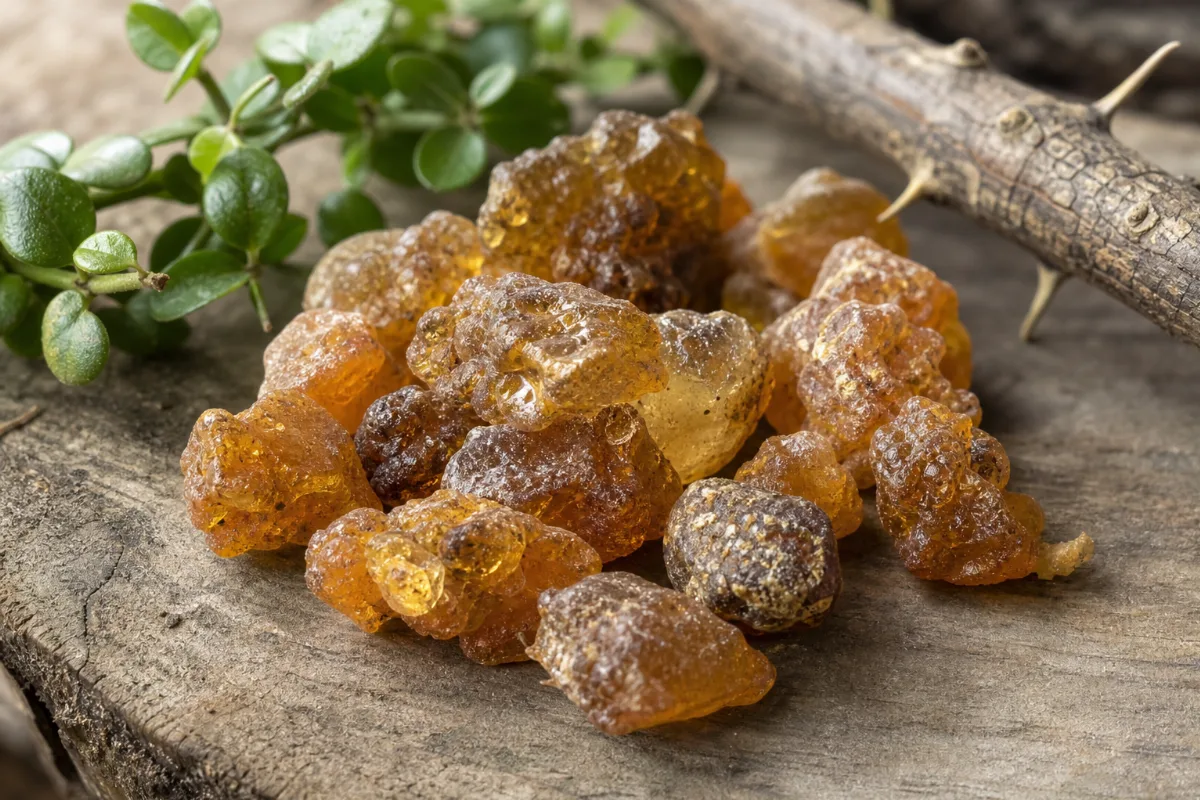
Herbs & Botanicals · Herbs · Ayurvedic resin sold for cholesterol, where the best Western trial found no benefit
Guggul
Commiphora wightii (Arn.) Bhandari (synonym Commiphora mukul) · also called Guggul, guggulu, gugul, guggulipid (the extract), Indian bdellium-tree, गुग्गुल (Hindi), 印度没药树 (Chinese)
Guggul is the gum resin of a thorny tree from India and Pakistan, used for thousands of years in Ayurveda. Today a standardised extract called guggulipid is sold as a supplement, mainly for cholesterol. The research is mixed: older Indian trials report lower cholesterol, but the largest Western trial found LDL cholesterol went up. Other uses, such as weight, thyroid, joints and acne, have little human evidence. Rash, medicine interactions and the tree's endangered status are the main cautions.
General information, not medical advice. Last substantive update · Not medically reviewed. A named clinician has not signed off on this page. How this page is made
About Guggul
Guggul is the gum resin of Commiphora wightii, used in Ayurveda and sold as a cholesterol supplement. Older and smaller Indian trials report lower cholesterol, but the largest Western trial found LDL rose and later trials found no clear benefit. Weight, thyroid, joint pain and acne have little human evidence. Rash, interactions with medicines such as propranolol and diltiazem, and over-harvesting of the tree are the main cautions.
What it is
Guggul is the gum resin from the stem of a thorny shrub or small tree, Commiphora wightii (also called Commiphora mukul), from India and Pakistan. It belongs to the same plant family as frankincense and myrrh. The resin is used in Ayurveda and other traditional medicines, and a standardised extract called guggulipid is sold as a supplement.
Its best-known compounds are two steroid-like substances, E- and Z-guggulsterone. Many Ayurvedic formulas have 'guggulu' in the name but contain many other plants, so results from them do not apply to guggul alone.
Traditional and current uses
Reviews say guggul has been used for thousands of years in Ayurveda, and also in Unani, Siddha, Tibetan, Chinese and other traditions, for arthritis, inflammation, obesity, heart problems, piles, skin disease and high blood fats. These statements come from reviews and were not checked against the old texts.
Today it is sold in the US and Europe mainly as a cholesterol supplement. The EU herbal committee's monograph list had no guggul entry in the search we ran, and the US National Center for Complementary and Integrative Health has no guggul page at the address we tried.
What is in it and how it works
Lab and mouse work found that guggulsterone blocks a bile-acid receptor called FXR, which was proposed as the way it lowers cholesterol. Later cell studies showed it also binds many other hormone receptors (oestrogen, progesterone, androgen, mineralocorticoid and glucocorticoid), and that it can switch on the liver enzyme system that breaks down many medicines (CYP3A).
These are lab results. No human study has tested whether any of these routes explains an effect in people, and the largest human trial found no cholesterol benefit.
What the research shows
Nothing is rated better than mixed. For cholesterol, older and smaller Indian trials report falls, while the best-designed Western trial (JAMA 2003, 103 adults) found LDL went up by about 9% to 10% compared with placebo. A Norwegian trial and an Italian guggulu-Triphala trial found no clear benefit. Reviewers say the effect is unclear and that no trial has looked at heart attacks or deaths.
Weight, thyroid, joint pain, acne, blood clotting and piles each have little or no usable human evidence: single small studies with no comparison group, mixtures of ingredients, animal work, or papers with no abstract.
At a glance
Traditional uses history, not proof
- Ayurveda, Siddha and Unani: resin used for arthritis, inflammation, obesity and fat disorders (reviews; not checked against the old texts).
- Chinese, Tibetan and Mongolian medicine: the same plant is described as used for rheumatism, heart disease and skin disease (2023 review).
- Ayurvedic formulas such as Kanchnar Guggulu combine guggulu with many other plants.
- Modern use: an over-the-counter cholesterol supplement in the US and Europe.
Studied for research
- Cholesterol (LDL, total, HDL), mixed; triglycerides, low
- Body weight, BMI and waist, very low
- Thyroid function (animal studies only), insufficient
- Knee osteoarthritis and acne, very low; rheumatoid arthritis, insufficient
- Oxidative stress marker and cholesterol mixes with red yeast rice, very low
- Heart attacks and strokes, blood clotting and piles, insufficient
Main compounds
- Z-guggulsterone and E-guggulsterone: steroid-like compounds, the main studied ones
- Guggulipid: the ethyl acetate extract of the resin used in most trials
- About 150 compounds isolated from the resin in total
Common forms
- Guggulipid extract tablets and capsules
- Raw or purified resin (guggulu) in Ayurvedic practice
- Multi-plant Ayurvedic formulas named for guggulu
- Mixed supplements and creams that contain guggul
Research links: US trial of guggulipid for high cholesterol (JAMA, 2003) · Natural Standard review of guggul for high cholesterol (2005) · Review of the guggul trade and wild populations (2018) · Research Library · Genes & Biomarkers Library
The plant and its history
- Accepted scientific name
- Commiphora wightii (Arn.) Bhandari
- Naming authority
- (Arn.) Bhandari; GBIF lists it as accepted (usageKey 3992808, matched 'Commiphora wightii (Arn.) Bhandari').
- Synonyms
- Commiphora mukul (Hook. ex Stocks) Engl. (GBIF synonym); Balsamodendrum wightii Arn.; Balsamodendrum mukul Hook. ex Stocks; Balsamea mukul Baill.; Commiphora roxburghii Engl.
- Common names
- Guggul (English / Hindi); Gugul (Hindi); Guggulu (Sanskrit / Ayurvedic usage); Indian bdellium-tree (English); गुग्गुल (Hindi); 印度没药树 (Chinese)
- Botanical family
- Burseraceae (the frankincense and myrrh family, order Sapindales). Boswellia (frankincense) and the true myrrh trees are relatives, not the same plant.
- Classification
- Plantae > Tracheophyta > Magnoliopsida > Sapindales > Burseraceae > Commiphora > Commiphora wightii
- Native range
- The resin is gathered in India and Pakistan (Cunningham 2018). A detailed native range was not verified from a flora.
- Habitat
- Not verified in a source read.
- What the plant looks like
- Roots: Not verified.; Stems: The resin ('oleo-gum resin') is tapped from the stem and branches; Cunningham 2018 describes cutting and lopping trees to extract it. A 2024 review calls it 'from the bark', not checked against a flora.; Leaves: Not verified.; Flowers: Not verified.; Fruit: Not verified.; Cultivation: Cunningham 2018 reviewed studies of cultivation and says cultivation is a practical conservation action to consider.; Harvest processing: Destructive tapping (cutting and lopping) is described as the major threat. Ayurvedic purification and extraction (ethyl acetate extract = guggulipid) are described in reviews; details were not verified.
- Cultivation
- Reviews say cultivation is needed to reduce pressure on wild trees (Cunningham 2018).
- Harvest and processing
- Not verified in a source read beyond the points above.
- Look-alikes and adulterants
- Name: Commiphora myrrha / molmol (myrrh); Note: A different species of the same genus, with its own use in medicine and incense. An HMPC meeting report lists a draft monograph on Commiphora molmol (read through a search result only). Products labelled 'myrrh' or 'bdellium' are not guggul.; Name: Other 'guggulu' formulas (Kanchnar Guggulu, Triphala Guggulu, Abha Guggulu and others); Note: Ayurvedic formulas named for guggulu that combine many plants. They are not pure guggul and results from them do not apply to guggul alone.
- Sustainability and conservation
- Cunningham 2018: destructive harvest is the major threat; Gujarat output fell from 30 t in 1963 to 1.6 t in 2013; wild stocks are in decline; about 505 t a year is imported into India from Pakistan. Web sources describe the IUCN Red List status as Critically Endangered (not verified at the IUCN page). A CITES Appendix II listing was proposed in 2025; reports disagree on whether it was adopted (see the safety file).
Traditional use and history history, not clinical proof
| Tradition or era | Documented use | Source |
|---|---|---|
| Ayurveda, Siddha and Unani | Garang 2023 says the plant is among the oldest and most prominent herbs in Ayurveda, used for arthritis, inflammation, diabetes, obesity and high blood fats, and that varieties are described consistently in Unani, Ayurvedic, Chinese, Tibetan, Mongolian and Uygur medicine. Cunningham 2018 names Ayurvedic, Siddha and Unani use for the oleo-resin. | p37301302 |
| Ayurveda (long history) | Ahmad 2020 says guggul has been used 'for thousands of years' for arthritis, inflammation, obesity, heart problems and fat disorders. The claim is taken from the review and not checked against the old texts. | p32110820 |
| Combination use | Garang 2023 counts the most common pairings across traditional preparations: guggulu with Terminalia chebula (101 times), with musk (55), with Aucklandia lappa (52) and with Acorus calamus (27). | p37301302 |
| 1960s onward | Over-harvesting of wild trees for the resin has been a problem since the 1960s (Cunningham 2018). | p29746995 |
| Modern dietary supplement | Marketed as an over-the-counter dietary supplement in the US and Western countries, mainly for cholesterol (Garang 2023; NTP abstract). | p37301302 |
Traditional use shows how a plant was used. It does not show that a supplement works or is safe today.
What is inside, and how it may work
What the plant contains and how those compounds act in cells and animals. Laboratory and animal mechanisms are not proven effects in people.
Main compounds
| Compound | Family | Where it is concentrated | Activity studied | Level of evidence |
|---|---|---|---|---|
| Z-guggulsterone PubChem 6450278 | pregnadienedione steroid (plant sterol) | oleo-gum resin 2.5% guggulsterones in the extract used by Szapary 2003 (E and Z together) | Main studied compound. Blocks the bile-acid receptor FXR in lab and mouse work (Urizar 2002) and binds many other steroid receptors in cells (Burris 2005); it raised the pregnane X receptor and CYP3A genes (Brobst 2004); broken down by CYP3A4 (Yang 2012). Raised thyroid activity in rats (Tripathi 1984). 38 4 3 39 36 28 | Laboratory research |
| E-guggulsterone PubChem 6439929 | pregnadienedione steroid (plant sterol) | oleo-gum resin Part of the guggulsterone content above | The other main isomer; bound steroid receptors in the same cell tests as the Z form. 4 3 28 | Laboratory research |
| Guggulipid (ethyl acetate extract) | standardised extract | oleo-gum resin Szapary 2003: 2.5% guggulsterones; Thappa 1994: tablet equal to 25 mg guggulsterone | The extract used in most cholesterol and acne trials. Ahmad 2020 defines it as the ethyl acetate extract of the resin. 1 34 35 | Controlled trial |
| Other compounds of the resin | mixed (terpenes, sterols and others) | oleo-gum resin Garang 2023: about 150 compounds isolated | Mostly not studied for human effects in the sources read. 12 | Laboratory research |
Mechanisms, receptors and pathways
| Target or pathway | Gene or receptor | What was found | Level |
|---|---|---|---|
| Bile-acid signalling and cholesterol | FXR (NR1H4) | Guggulsterone blocked FXR in cell tests and lowered liver cholesterol in normal mice but not in mice lacking FXR. This was the proposed explanation for cholesterol-lowering. The 2003 human trial did not show LDL lowering. 38 34 | Animal research |
| Other steroid hormone receptors | MR, AR, GR, PR, ER-alpha | Both guggulsterone forms bound the mineralocorticoid receptor tightly (Ki about 35 nM) and androgen, glucocorticoid and progesterone receptors (Ki 224 to 315 nM); they blocked AR, GR and MR, and acted as an agonist at the progesterone receptor; ER-alpha activation was weak (EC50 over 5000 nM). 4 | Laboratory research |
| Drug-metabolising enzymes | PXR (NR1I2), CYP3A | Guggulsterones activated PXR and raised CYP3A gene activity in rodent and human liver cells. 3 | Laboratory research |
| Bile-salt transport and cholesterol esters | CES1, BSEP (ABCB11), CYP7A1 | Z-guggulsterone did not raise CYP7A1 (as assumed) but raised CES1 and BSEP in human liver cells; metabolites made by CYP3A4 raised BSEP more. 39 | Laboratory research |
| Thyroid activity | Thyroid peroxidase, 5'-deiodinase | In rats, Z-guggulsterone raised thyroid iodine uptake and enzyme activity; in mice, guggulu reversed drug-induced low thyroid hormone. 36 26 | Animal research |
| Inflammation signalling | COX-2, NF-kB, JAK/STAT, PI3K/AKT | A 2024 review lists effects on these pathways in lab and animal studies (details not in abstract). 29 | Laboratory research |
| Human trials of mechanism | none | No human study of FXR or any other target was found. The idea that the FXR route explains a clinical effect is unproven. 34 38 | Insufficient |
Absorption, metabolism and elimination
- Absorption
- No human blood-level data for guggulsterone were found in the sources read.
- Distribution
- Not established.
- Metabolism
- Z-guggulsterone is broken down by CYP3A4 in human liver cell tests (Yang 2012).
- Elimination
- Not established in humans.
- Bioavailability
- Not established.
Isolated compounds versus whole extracts
Guggulsterones are called the main active compounds (Ahmad 2020), and most trials used a guggulipid extract standardised to them. Trials have not compared the whole resin with isolated guggulsterone. Doses and extract strengths differ a great deal: the US trial used 1 g or 2 g of a 2.5% guggulsterone extract three times a day; the 1994 Indian trial used 50 mg of guggulipid twice a day; so trial results do not carry over from one product to another.
Nutritional composition
A nutrient table is not meaningful for a resin taken as a medicine.
3 mixed findings1 low certainty5 very low certainty5 not enough evidence
What was looked at
The 14 benefits and uses checked for Guggul, each with how strong the evidence is. Tap one to open it.
- LDL ('bad') cholesterolMixed findings
- Total cholesterolMixed findings
- Triglycerides (blood fats)Low certainty
- HDL ('good') cholesterolMixed findings
- Oxidative stress (lipid peroxides)Very low certainty
- Cholesterol products that include guggulipid with red yeast riceVery low certainty
- Heart attacks, strokes and deathsNot enough evidence
- Body weight, BMI and waistVery low certainty
- Thyroid functionNot enough evidence
- Knee osteoarthritisVery low certainty
- Rheumatoid arthritis and general inflammationNot enough evidence
- AcneVery low certainty
- Blood clotting and plateletsNot enough evidence
- Hemorrhoids (piles)Not enough evidence
Lab markers tracked in the studies
LDL cholesterolTotal cholesterolTriglyceridesHDL cholesterolLipid peroxidesBMI and waist circumferenceThyroid hormones and thyroid activity (animal)WOMAC osteoarthritis scoreAcne lesion counts
What is Guggul good for?
The main proposed uses and how strong the human evidence is for each. 'Mixed' means trials disagree, 'low' and 'very low' mean small or inconsistent studies, and 'insufficient' means there is not enough to judge. Results come from specific guggulipid extracts and may not apply to other products or to traditional Ayurvedic formulas.
Benefits, one by one
Each card is a research question, not a promise. Tap a goal to filter. Open a card to see the studies, doses and limits.
LDL ('bad') cholesterol
Mixed findingsResults are mixed. A US trial of 103 adults found guggulipid raised LDL by 9% to 10% compared with placebo. A small 1994 Indian trial found a 12.5% fall. A Norwegian trial and an Italian combination trial found no LDL difference. One pooled analysis reports a fall, which the best-designed trials do not support.
9 studiesDifferent extracts were used: 2.5% guggulsterone extract (US), 25 to …
Studies, doses and limits
What the trials found
The 2003 JAMA trial (Szapary, 103 adults, 8 weeks, 2.5% guggulsterone extract, 1 g or 2 g three times a day) found LDL rose 4% to 5% on guggulipid while it fell 5% on placebo (net +9% to +10%, P = 0.01 and 0.006). The 1994 Singh trial (61 adults, 50 mg guggulipid twice a day for 24 weeks, with a healthy diet) found LDL 12.5% lower than after-diet levels, with no change on placebo; the effect reversed after stopping. The Norwegian trial (Nohr 2009, 43 randomised, 34 finished, 2160 mg a day, 12 weeks) found no significant LDL difference. The 2021 Italian trial (Donato, 90 adults, guggulu plus Triphala for 3 months) found LDL fell about 5% in both groups. A 2021 meta-analysis (Gyawali) reports an 18.78 mg/dL LDL fall, but its abstract prints confidence intervals inconsistently and the pooled trials differ widely. Reviewers (Ulbricht 2005, Mirzai 2023) call the effect unclear or inconsistent.
Results
One large Western trial found LDL went up; small older trials found a fall; later trials found no difference.
Effect sizes as reported
Szapary: +4% (standard dose) and +5% (high dose) vs -5% on placebo. Singh: -12.5%. Donato: -4.8% vs -4.9% placebo. Gyawali: -18.78 mg/dL, P = 0.02 (abstract).
Why this rating
Trials of similar size point in opposite directions. The older positive trials are small and flawed according to the Natural Standard review; the best-designed trial found a rise.
Form and dose studied
Different extracts were used: 2.5% guggulsterone extract (US), 25 to 50 mg guggulipid (India), a formulation not described in the abstract (Norway). Results cannot be moved from one product to another.
Who was studied
Adults with high cholesterol, mostly healthy volunteers; no trial in people with heart disease.
Limits
Short trials (8 to 24 weeks). Several older trials have no placebo group. The 1994 positive trial has not been repeated.
Why researchers looked
Guggul is best known as a cholesterol remedy in India and was sold as one in the US.
Traditional use
Guggul (the gum resin of the guggul tree) has been used in Ayurveda, and in Unani, Tibetan and Chinese medicine, for fat disorders, obesity and joint problems (reviews: Garang 2023, Ahmad 2020).
Proposed mechanism Preliminary mechanism
Lab and animal work found that guggulsterone blocks a bile-acid receptor called FXR, which was proposed as the way it lowers cholesterol (Urizar 2002, mice). It also binds many other hormone receptors (Burris 2005, lab).
A proposed mechanism does not show that the effect happens in people.
Rash in 6 of 67 guggulipid users in the US trial (none on placebo).
Total cholesterol
Mixed findingsTotal cholesterol fell in the older Indian trials and in one Norwegian trial, but not in the US trial or the Italian combination trial.
6 studiesGuggulipid extracts and one resin formulation; doses and guggulsteron…
Studies, doses and limits
What the trials found
Singh 1994: total cholesterol 11.7% lower (24 weeks). Nityanand 1989: in a 205-patient open trial without placebo, cholesterol fell 23.6% on average; in a double-blind crossover against the drug clofibrate it fell 11%. Nohr 2009: total cholesterol was lower than on placebo after 12 weeks, but the authors say the clinical meaning is unclear. Szapary 2003: no significant change. Donato 2021: no difference from placebo. Gyawali 2021 meta-analysis: 16.78 mg/dL lower (P = 0.02, abstract).
Results
Falls in older and Norwegian trials; no change in the US and Italian trials.
Effect sizes as reported
Singh -11.7%; Nityanand -11% (crossover) to -23.6% (open); Nohr: lower than placebo (size not given in abstract); Gyawali -16.78 mg/dL.
Why this rating
Positive results come from small, older or open trials; two better-controlled trials found nothing.
Form and dose studied
Guggulipid extracts and one resin formulation; doses and guggulsterone content differ.
Who was studied
Adults with moderately to clearly raised cholesterol.
Limits
The Norwegian trial lost nine of 43 people to dropouts or missing labs.
Why researchers looked
Total cholesterol is the simplest blood-fat number and was the main outcome of the older trials.
Traditional use
Guggul (the gum resin of the guggul tree) has been used in Ayurveda, and in Unani, Tibetan and Chinese medicine, for fat disorders, obesity and joint problems (reviews: Garang 2023, Ahmad 2020).
Proposed mechanism Preliminary mechanism
Lab and animal work found that guggulsterone blocks a bile-acid receptor called FXR, which was proposed as the way it lowers cholesterol (Urizar 2002, mice). It also binds many other hormone receptors (Burris 2005, lab).
A proposed mechanism does not show that the effect happens in people.
Mild stomach discomfort and rash reported (see safety).
Triglycerides (blood fats)
Low certaintyOlder Indian trials report a fall; the US and Norwegian trials found no change. Evidence is low.
5 studiesAs above.
Studies, doses and limits
What the trials found
Singh 1994: triglycerides 12.0% lower. Nityanand 1989: 22.6% lower in the open trial and 16.8% lower in the crossover trial. Szapary 2003 and Nohr 2009: no significant change. A combination trial with red yeast rice (Nafrialdi 2019) also saw no triglyceride change.
Results
A fall in older trials; none in more recent controlled trials.
Effect sizes as reported
Singh -12.0%; Nityanand -16.8% (crossover); no significant change in Szapary, Nohr or Nafrialdi.
Why this rating
Few trials, mostly old, with conflicting results.
Form and dose studied
As above.
Who was studied
Adults with raised blood fats.
Limits
As above.
Why researchers looked
High triglycerides often come with high cholesterol, and old guggulipid trials measured both.
Traditional use
Guggul (the gum resin of the guggul tree) has been used in Ayurveda, and in Unani, Tibetan and Chinese medicine, for fat disorders, obesity and joint problems (reviews: Garang 2023, Ahmad 2020).
Proposed mechanism Preliminary mechanism
Lab and animal work found that guggulsterone blocks a bile-acid receptor called FXR, which was proposed as the way it lowers cholesterol (Urizar 2002, mice). It also binds many other hormone receptors (Burris 2005, lab).
A proposed mechanism does not show that the effect happens in people.
Nothing specific to triglycerides.
HDL ('good') cholesterol
Mixed findingsNo clear effect. HDL rose in some older Indian patients, stayed unchanged in two trials, and was lower than placebo in the Norwegian trial.
4 studiesAs above.
Studies, doses and limits
What the trials found
Nityanand 1989: HDL rose in 60% of those whose cholesterol fell (open and crossover results, no placebo). Singh 1994 and Szapary 2003: no change in HDL. Nohr 2009: HDL was lower than on placebo after 12 weeks.
Results
No dependable effect on HDL.
Effect sizes as reported
Nityanand: HDL up in 60% of responders; Singh: unchanged; Szapary: unchanged; Nohr: lower than placebo.
Why this rating
Results go in three directions.
Form and dose studied
As above.
Who was studied
Adults with raised cholesterol.
Limits
Mostly small trials; a lower HDL is not a benefit.
Why researchers looked
Early reports said guggul might raise HDL.
Traditional use
Guggul (the gum resin of the guggul tree) has been used in Ayurveda, and in Unani, Tibetan and Chinese medicine, for fat disorders, obesity and joint problems (reviews: Garang 2023, Ahmad 2020).
Proposed mechanism Pharmacological theory
No reliable mechanism for an HDL change was found in the sources read.
A proposed mechanism does not show that the effect happens in people.
A lower HDL (Nohr) is not a good sign for heart health, but its meaning is not known from the abstract.
Oxidative stress (lipid peroxides)
Very low certaintyOne small trial found a drop in a blood marker of oxidative damage. It has not been repeated.
2 studiesGuggulipid 50 mg twice a day for 24 weeks.
Studies, doses and limits
What the trials found
Singh 1994 measured lipid peroxides and found a 33.3% fall on guggulipid with no change on placebo. The Patti 2015 combination (turmeric, silymarin, guggul and others) found no change in oxidative stress. No other human trial of this marker was found.
Results
A fall in one small trial; no change in a combination study.
Effect sizes as reported
Singh -33.3%.
Why this rating
One small 1994 trial; a lower marker does not show a health benefit.
Form and dose studied
Guggulipid 50 mg twice a day for 24 weeks.
Who was studied
Adults with raised cholesterol.
Limits
No replication; marker only.
Why researchers looked
Guggul extracts are said to have antioxidant effects.
Traditional use
Guggul (the gum resin of the guggul tree) has been used in Ayurveda, and in Unani, Tibetan and Chinese medicine, for fat disorders, obesity and joint problems (reviews: Garang 2023, Ahmad 2020).
Proposed mechanism Laboratory research
Lab studies describe antioxidant effects in reviews (Garang 2023); the sources read give no human mechanism.
A proposed mechanism does not show that the effect happens in people.
None specific.
Cholesterol products that include guggulipid with red yeast rice
Very low certaintyTwo short trials of mixes of red yeast rice, guggulipid and chromium found lower cholesterol. Red yeast rice can lower LDL on its own, so guggulipid cannot be given credit.
2 studiesBranded mixes (NutraforChol, NC120); amounts not in the abstracts.
Studies, doses and limits
What the trials found
Iskandar 2020 (Jakarta, 8 weeks after a 4-week run-in): total cholesterol 173.5 vs 204.5 mg/dL and LDL 115.5 vs 145.1 mg/dL on the product vs placebo (P < 0.05); no change in kidney or liver tests. Nafrialdi 2019 (49 adults, 28 days, same type of mix): total and LDL cholesterol lower, triglycerides not. Neither trial tested guggulipid alone.
Results
Lower cholesterol with the mix; the cause cannot be assigned to guggul.
Effect sizes as reported
Iskandar: total cholesterol 31 mg/dL lower than placebo at week 8 and LDL 29.6 mg/dL lower (both calculated from the group means in the abstract).
Why this rating
The red yeast rice in the mixes can lower LDL; the trials are short and small, and the maker may be linked to the product (not stated in the abstracts).
Form and dose studied
Branded mixes (NutraforChol, NC120); amounts not in the abstracts.
Who was studied
Adults with mild to moderate high cholesterol.
Limits
Cannot separate the ingredients; short.
Why researchers looked
Guggulipid is sold in mixed products aimed at people who do not want a statin.
Traditional use
Not traditional: modern mixed supplements.
Proposed mechanism Pharmacological theory
None established for the mix.
A proposed mechanism does not show that the effect happens in people.
Red yeast rice products vary in quality; not covered here.
Heart attacks, strokes and deaths
Not enough evidenceNo trial of guggul on heart attacks, strokes or deaths was found, so it is not known whether it protects the heart.
2 studiesn/a
Studies, doses and limits
What the trials found
No outcome trial was found in the PubMed searches or in the reviews read. Mirzai 2023 advises that patients be told supplements are not the same as medicines proven to improve heart outcomes. The Natural Standard review found not enough evidence to support guggul for any medical condition.
Results
No data on heart outcomes.
Why this rating
No study measured these outcomes.
Why researchers looked
The reason people take cholesterol remedies is to prevent heart disease.
Traditional use
Guggul (the gum resin of the guggul tree) has been used in Ayurveda, and in Unani, Tibetan and Chinese medicine, for fat disorders, obesity and joint problems (reviews: Garang 2023, Ahmad 2020).
Proposed mechanism Pharmacological theory
None.
A proposed mechanism does not show that the effect happens in people.
The one large US trial saw LDL rise, which would not be expected to help.
Body weight, BMI and waist
Very low certaintyNo good evidence. The one placebo-controlled trial that measured BMI and waist (guggulu plus Triphala) found no better result than placebo. An uncontrolled study of a mixed supplement saw small drops.
4 studiesCombination products only.
Studies, doses and limits
What the trials found
Donato 2021 (90 adults, guggulu plus Triphala, 3 months): the authors found no better result than placebo for BMI or waist. Patti 2015 (78 adults with metabolic syndrome, Kepar mix with turmeric, silymarin, guggul, chlorogenic acid and inulin, 4 months, no control group): weight fell 1.7 kg, waist 3 cm. That mix cannot be credited to guggul and there was no comparison group. Garang 2023 says clinical studies have only identified a role in piles and blood fats, not weight.
Results
No benefit shown for weight in the controlled trial; small changes in an uncontrolled mix.
Effect sizes as reported
Patti: weight 81.1 to 79.4 kg (P < 0.0001), waist 105 to 102 cm (P = 0.0004); Donato: no difference from placebo (numbers not in abstract).
Why this rating
One controlled null trial and one uncontrolled combination study; other old trials were not found with abstracts.
Form and dose studied
Combination products only.
Who was studied
Adults with high cholesterol (Donato) and metabolic syndrome (Patti).
Limits
The combination trial had no control group.
Why researchers looked
Guggul has long been used in Ayurveda for obesity, and old trials of a 'Fraction A' were cited for weight (Ulbricht 2005, not read in detail).
Traditional use
Guggul (the gum resin of the guggul tree) has been used in Ayurveda, and in Unani, Tibetan and Chinese medicine, for fat disorders, obesity and joint problems (reviews: Garang 2023, Ahmad 2020).
Proposed mechanism Laboratory research
No human mechanism was found in the sources read.
A proposed mechanism does not show that the effect happens in people.
Rash in 2 of 46 (Donato).
Thyroid function
Not enough evidenceOnly rat and mouse studies suggest guggul can stimulate the thyroid. No human trial measured thyroid hormones. Two Norwegian trial participants reported possible thyroid problems.
3 studiesAnimals got the pure compound or a resin dose scaled to body weight.
Studies, doses and limits
What the trials found
Tripathi 1984 (rats, Z-guggulsterone 1 mg per 100 g): thyroid iodine uptake and thyroid peroxidase and protease activity went up. Panda 2005 (mice, guggulu 200 mg/kg for 30 days): reversed the fall in thyroid hormone caused by a thyroid-blocking drug. In people, the Nohr 2009 trial reported 'possible thyroid problems' in two guggul users (no tests described in the abstract). No human trial with TSH, T3 or T4 results was found.
Results
Animal studies suggest stimulation; no human measurement.
Effect sizes as reported
Animal studies only; no human numbers.
Why this rating
Animal studies only; a treatment that raises thyroid activity could be unwanted in people who already have an overactive thyroid.
Form and dose studied
Animals got the pure compound or a resin dose scaled to body weight.
Who was studied
Rats and mice; two human participants with self-reported problems.
Limits
Not tested in people with thyroid disease.
Why researchers looked
A 1984 rat study isolated a compound, Z-guggulsterone, that raised thyroid activity, and Ayurvedic texts pair guggul with thyroid problems.
Traditional use
Thyroid-related uses appear in later Ayurvedic reviews (not verified here).
Proposed mechanism Animal research
Rat and mouse work reports more iodine uptake by the thyroid and higher thyroid enzyme activity (Tripathi 1984), and higher thyroid hormone in mice made underactive (Panda 2005). Human relevance is unknown.
A proposed mechanism does not show that the effect happens in people.
Possible thyroid problems were reported by 2 guggul users in the Nohr trial (denominator not in the abstract). See safety file.
Knee osteoarthritis
Very low certaintyOne small uncontrolled study of 30 people found better scores; there was no comparison group.
1 studiesConcentrated extract capsules.
Studies, doses and limits
What the trials found
Singh 2003 (30 adults, extract 500 mg three times a day, about 2 months): WOMAC total score improved significantly from baseline (P < 0.0001) at 1 month and kept improving; pain scores improved; no side effects were reported. There was no placebo group.
Results
Better scores over time without a comparison group.
Effect sizes as reported
WOMAC total P < 0.0001 vs baseline (no group difference possible).
Why this rating
Single group of 30, no placebo, so natural change and expectation are not ruled out.
Form and dose studied
Concentrated extract capsules.
Who was studied
Older adults with knee osteoarthritis.
Limits
No control group.
Why researchers looked
Guggul is in many Ayurvedic joint formulas.
Traditional use
Guggul (the gum resin of the guggul tree) has been used in Ayurveda, and in Unani, Tibetan and Chinese medicine, for fat disorders, obesity and joint problems (reviews: Garang 2023, Ahmad 2020).
Proposed mechanism Preliminary mechanism
Lab studies describe effects on inflammation signals (Sahu 2024 review, lab and animal).
A proposed mechanism does not show that the effect happens in people.
No side effects reported in this study.
Rheumatoid arthritis and general inflammation
Not enough evidenceA 2024 review is enthusiastic, but its abstract names no human trial. Treat the human evidence as not found.
2 studiesn/a
Studies, doses and limits
What the trials found
Sahu 2024 says lab, animal and clinical work 'strongly support' guggulipid for rheumatoid arthritis, but the abstract gives no trial, number or quality rating. No randomised trial of guggul alone for rheumatoid arthritis was found in the searches.
Results
Lab and animal findings; no human trial found.
Why this rating
The review's claim could not be checked.
Limits
Review is narrative.
Why researchers looked
Rheumatism and arthritis are among the oldest named uses (Garang 2023).
Traditional use
Guggul (the gum resin of the guggul tree) has been used in Ayurveda, and in Unani, Tibetan and Chinese medicine, for fat disorders, obesity and joint problems (reviews: Garang 2023, Ahmad 2020).
Proposed mechanism Laboratory research
Reviews list effects on COX-2, NF-kB, JAK/STAT and other inflammation signals in lab and animal work (Sahu 2024).
A proposed mechanism does not show that the effect happens in people.
No safety data specific to this use.
Acne
Very low certaintyTwo small trials found acne improved. One had 20 people and compared guggulipid with an antibiotic. The other tested a branded mix by its maker. Evidence is very low.
2 studiesGugulipid tablets; a branded 450 mg combination capsule.
Studies, doses and limits
What the trials found
Thappa 1994 (20 people, nodulocystic acne, gugulipid equal to 25 mg guggulsterone twice a day vs tetracycline 500 mg twice a day, 3 months): inflamed lesions fell 68% on gugulipid and 65.2% on tetracycline (not significantly different); relapse in 2 vs 4; people with oily skin did better on gugulipid. Sudeep 2025 (100 people, branded guggul plus konjac tuber extract, 450 mg once a day, 12 weeks, placebo-controlled): success on the investigator score was far more likely (odds ratio 7.88) and lesion counts were lower; no side effects were reported. Two authors work for the maker.
Results
Similar fall to an antibiotic in 20 people; better than placebo for a maker-run combination trial.
Effect sizes as reported
Thappa: -68% vs -65.2% (P > 0.05). Sudeep: OR 7.88 for success (P < 0.0001).
Why this rating
Tiny comparison trial with no placebo; the placebo trial is industry-linked and tests a combination.
Form and dose studied
Gugulipid tablets; a branded 450 mg combination capsule.
Who was studied
Young adults with acne (Sudeep aged 18 to 40).
Limits
No independent replication.
Why researchers looked
Guggul is traditionally used for skin disease and has been tried for deep inflamed acne.
Traditional use
Guggul (the gum resin of the guggul tree) has been used in Ayurveda, and in Unani, Tibetan and Chinese medicine, for fat disorders, obesity and joint problems (reviews: Garang 2023, Ahmad 2020).
Proposed mechanism Pharmacological theory
Anti-inflammatory and oil-reducing effects are suggested in reviews; not shown here.
A proposed mechanism does not show that the effect happens in people.
Rash is a known effect of oral guggul in other trials (see safety); the acne trials reported none.
Blood clotting and platelets
Not enough evidenceTwo 1979 papers studied platelet effects, but only their titles were available. It is not known whether guggul changes bleeding risk in people.
2 studiesn/a
Studies, doses and limits
What the trials found
Mester 1979 (title: inhibition of platelet aggregation by guggulu steroids) and Bordia 1979 (title: effect of gum guggulu on fibrinolysis and platelet adhesiveness in coronary heart disease; indexed as a randomised trial). PubMed has no abstract for either, so nothing about their results is stated here.
Results
Unknown (title only).
Why this rating
Abstracts were not available; no modern study was found.
Why researchers looked
Early Indian work looked at whether guggulu steroids affect blood clotting.
Traditional use
Guggul (the gum resin of the guggul tree) has been used in Ayurveda, and in Unani, Tibetan and Chinese medicine, for fat disorders, obesity and joint problems (reviews: Garang 2023, Ahmad 2020).
Proposed mechanism Pharmacological theory
The 1979 titles suggest guggulu steroids inhibit platelet clumping; details not read.
A proposed mechanism does not show that the effect happens in people.
A possible bleeding-risk question is covered in the safety file as theory only.
Hemorrhoids (piles)
Not enough evidenceA 2023 review says clinical studies have only identified piles and blood fats as areas of benefit, but the abstract gives no trial details. Evidence could not be checked.
1 studiesn/a
Studies, doses and limits
What the trials found
Garang 2023 says the clinical research found a role in treating hemorrhoids. The abstract names no trial, number or product, and most Ayurvedic piles formulas contain many other ingredients. One trial of a herbal cream for piles was found in PubMed (Hemoheal), but its ingredients were not confirmed to include guggul and it is not used.
Results
Not checkable from the abstract.
Why this rating
No trial details were read.
Why researchers looked
Guggulu formulas are traditional for piles.
Traditional use
Guggul (the gum resin of the guggul tree) has been used in Ayurveda, and in Unani, Tibetan and Chinese medicine, for fat disorders, obesity and joint problems (reviews: Garang 2023, Ahmad 2020).
Proposed mechanism Pharmacological theory
None given.
A proposed mechanism does not show that the effect happens in people.
No safety data specific to this use.
Connections to the rest of health
How Guggul connects to the rest of our health knowledge graph. Every link says what kind of connection it is. A safety link (for example to the liver) is a warning, not a benefit. A study that merely mentions a topic never creates a benefit link.
Explore every connection: goals, body systems, organs, symptoms, genes
A. Wellness goals
| Connected to | Kind of connection | Evidence status | Context | Studies |
|---|---|---|---|---|
| Cholesterol Balance | Potential benefit | Mixed findings | LDL ('bad') cholesterol: Results are mixed. A US trial of 103 adults found guggulipid raised LDL by 9% to 10% compared with placebo. A small 1994 Indian trial found a 12.5% fall. A Norwegian trial and an Italian combination trial found no LDL difference. One pooled analysis reports a fall, which the best-designed trials do not support. Total cholesterol: Total cholesterol fell in the older Indian trials and in one Norwegian trial, but not in the US trial or the Italian combination trial. | 34 31 25 9 13 37 18 38 4 24 22 |
| Heart Health | Potential benefit | Mixed findings | LDL ('bad') cholesterol: Results are mixed. A US trial of 103 adults found guggulipid raised LDL by 9% to 10% compared with placebo. A small 1994 Indian trial found a 12.5% fall. A Norwegian trial and an Italian combination trial found no LDL difference. One pooled analysis reports a fall, which the best-designed trials do not support. Total cholesterol: Total cholesterol fell in the older Indian trials and in one Norwegian trial, but not in the US trial or the Italian combination trial. | 34 31 25 9 13 37 18 38 4 24 27 |
| Metabolic Health | Potential benefit | Low certainty | Triglycerides (blood fats): Older Indian trials report a fall; the US and Norwegian trials found no change. Evidence is low. | 31 24 34 25 22 |
| Healthy Aging | Potential benefit | Very low certainty | Oxidative stress (lipid peroxides): One small trial found a drop in a blood marker of oxidative damage. It has not been repeated. | 31 27 |
| Cholesterol Balance | Biological association | Very low certainty | Cholesterol products that include guggulipid with red yeast rice: Two short trials of mixes of red yeast rice, guggulipid and chromium found lower cholesterol. Red yeast rice can lower LDL on its own, so guggulipid cannot be given credit. | 14 22 |
| Heart Health | Traditional use | Not enough evidence | Heart attacks, strokes and deaths: No trial of guggul on heart attacks, strokes or deaths was found, so it is not known whether it protects the heart. | 18 37 |
| Weight Management | Traditional use | Very low certainty | Body weight, BMI and waist: No good evidence. The one placebo-controlled trial that measured BMI and waist (guggulu plus Triphala) found no better result than placebo. An uncontrolled study of a mixed supplement saw small drops. | 9 27 12 37 |
| Metabolic Health | Traditional use | Very low certainty | Body weight, BMI and waist: No good evidence. The one placebo-controlled trial that measured BMI and waist (guggulu plus Triphala) found no better result than placebo. An uncontrolled study of a mixed supplement saw small drops. | 9 27 12 37 |
| Thyroid Support | Preliminary mechanism | Not enough evidence | Thyroid function: Only rat and mouse studies suggest guggul can stimulate the thyroid. No human trial measured thyroid hormones. Two Norwegian trial participants reported possible thyroid problems. | 36 26 25 |
| Hormone Balance | Preliminary mechanism | Not enough evidence | Thyroid function: Only rat and mouse studies suggest guggul can stimulate the thyroid. No human trial measured thyroid hormones. Two Norwegian trial participants reported possible thyroid problems. | 36 26 25 |
| Joint Support | Potential benefit | Very low certainty | Knee osteoarthritis: One small uncontrolled study of 30 people found better scores; there was no comparison group. | 32 |
| Inflammation Balance | Potential benefit | Very low certainty | Knee osteoarthritis: One small uncontrolled study of 30 people found better scores; there was no comparison group. | 32 |
| Inflammation Balance | Preliminary mechanism | Not enough evidence | Rheumatoid arthritis and general inflammation: A 2024 review is enthusiastic, but its abstract names no human trial. Treat the human evidence as not found. | 29 12 |
| Joint Support | Preliminary mechanism | Not enough evidence | Rheumatoid arthritis and general inflammation: A 2024 review is enthusiastic, but its abstract names no human trial. Treat the human evidence as not found. | 29 12 |
| Healthy Skin | Potential benefit | Very low certainty | Acne: Two small trials found acne improved. One had 20 people and compared guggulipid with an antibiotic. The other tested a branded mix by its maker. Evidence is very low. | 35 33 |
| Heart Health | Preliminary mechanism | Not enough evidence | Blood clotting and platelets: Two 1979 papers studied platelet effects, but only their titles were available. It is not known whether guggul changes bleeding risk in people. | 17 2 |
| Digestive Support | Traditional use | Not enough evidence | Hemorrhoids (piles): A 2023 review says clinical studies have only identified piles and blood fats as areas of benefit, but the abstract gives no trial details. Evidence could not be checked. | 12 |
B. Body systems
| Connected to | Kind of connection | Evidence status | Context | Studies |
|---|---|---|---|---|
| Cardiovascular system | Adverse effect or risk | Low certainty | LDL rose in the largest Western trial. Preparation or compound: Guggulipid |
34 |
| Cardiovascular System | Biological association | Mixed findings | Studied for: LDL ('bad') cholesterol Studied for: Total cholesterol | 34 31 25 9 13 37 18 38 4 24 22 27 14 17 2 |
| Metabolism Weight | Biological association | Mixed findings | Studied for: LDL ('bad') cholesterol Studied for: Total cholesterol | 34 31 25 9 13 37 18 38 4 24 22 27 12 |
| Endocrine System | Biological association | Not enough evidence | Studied for: Thyroid function | 36 26 25 |
| Musculoskeletal System | Biological association | Very low certainty | Studied for: Knee osteoarthritis Studied for: Rheumatoid arthritis and general inflammation | 32 29 12 |
| Immune System | Biological association | Not enough evidence | Studied for: Rheumatoid arthritis and general inflammation | 29 12 |
| Integumentary System | Biological association | Very low certainty | Studied for: Acne | 35 33 |
| Digestive System | Biological association | Not enough evidence | Studied for: Hemorrhoids (piles) | 12 |
C. Body parts and organs
| Connected to | Kind of connection | Evidence status | Context | Studies |
|---|---|---|---|---|
| Thyroid | Adverse effect or risk | Very low certainty | Stimulation in rats and mice; two self-reported problems in a trial. Stimulation in rats and mice; no human thyroid tests found. Preparation or compound: Z-guggulsterone / resin |
36 26 25 |
| Liver | Adverse effect or risk | Very low certainty | Case reports; cause not separated from other ingredients. Preparation or compound: Guggulu-containing formulas and mixes |
15 7 40 |
| Skin | Adverse effect or risk | Moderate certainty | Rash in several trials; contact dermatitis case reports. Rash in several trials; contact dermatitis from creams. Preparation or compound: Oral guggulipid; guggul creams |
34 9 25 30 16 |
D. Symptoms
E. Health conditions
I. Biomarkers
| Connected to | Kind of connection | Evidence status | Context | Studies |
|---|---|---|---|---|
| LDL cholesterol | Biological association | Mixed findings | Measured in trials: mixed. A lab change is not the same as a health benefit. | 34 31 25 9 13 |
| Total cholesterol | Biological association | Mixed findings | Measured in trials: mixed. A lab change is not the same as a health benefit. | 31 24 25 34 9 |
| Triglycerides | Biological association | Low certainty | Measured in trials: mixed. A lab change is not the same as a health benefit. | 31 24 34 25 |
| HDL cholesterol | Biological association | Mixed findings | Measured in trials: mixed. A lab change is not the same as a health benefit. | 24 31 34 25 |
| Lipid peroxides | Biological association | Very low certainty | Measured in trials: lowered. A lab change is not the same as a health benefit. | 31 |
| BMI and waist circumference | Biological association | Very low certainty | Measured in trials: no-change. A lab change is not the same as a health benefit. | 9 27 |
| Thyroid hormones and thyroid activity (animal) | Biological association | Not enough evidence | Measured in trials: raised. A lab change is not the same as a health benefit. | 36 26 |
| WOMAC osteoarthritis score | Biological association | Very low certainty | Measured in trials: lowered. A lab change is not the same as a health benefit. | 32 |
| Acne lesion counts | Biological association | Very low certainty | Measured in trials: lowered. A lab change is not the same as a health benefit. | 35 33 |
J. Genes, receptors and enzymes
| Connected to | Kind of connection | Evidence status | Context | Studies |
|---|---|---|---|---|
| FXR (farnesoid X receptor, NR1H4) | Preliminary mechanism | Animal | Blocked by guggulsterone in cell and mouse tests; the proposed route for cholesterol-lowering. | 38 |
| PXR (pregnane X receptor, NR1I2) | Preliminary mechanism | In vitro | Activated by guggulsterone; raises CYP3A genes. | 3 |
| CYP3A4 / CYP3A | Preliminary mechanism | In vitro | Induced (gene activity) and also breaks down Z-guggulsterone. | 3 39 |
| Progesterone receptor | Preliminary mechanism | In vitro | Activated by guggulsterone in cells. | 4 3 |
| Oestrogen receptor alpha | Preliminary mechanism | In vitro | Weakly activated in cells. | 4 3 |
| Androgen, glucocorticoid and mineralocorticoid receptors | Preliminary mechanism | In vitro | Blocked by guggulsterone in cells; mineralocorticoid receptor bound most tightly. | 4 |
| CES1 and BSEP (ABCB11) | Preliminary mechanism | In vitro | Raised by Z-guggulsterone in human liver cells. | 39 |
K. Biological pathways
L. Active compounds
| Connected to | Kind of connection | Evidence status | Context | Studies |
|---|---|---|---|---|
| Z-guggulsterone | Biological association | In vitro | Main studied compound. Blocks the bile-acid receptor FXR in lab and mouse work (Urizar 2002) and binds many other steroid receptors in cells (Burris 2005); it raised the pregnane X receptor and CYP3A genes (Brobst 2004); broken down by CYP3A4 (Yang 2012). Raised thyroid activity in rats (Tripathi 1984). Preparation or compound: oleo-gum resin |
38 4 3 39 36 28 |
| E-guggulsterone | Biological association | In vitro | The other main isomer; bound steroid receptors in the same cell tests as the Z form. Preparation or compound: oleo-gum resin |
4 3 28 |
| Guggulipid (ethyl acetate extract) | Biological association | Rct | The extract used in most cholesterol and acne trials. Ahmad 2020 defines it as the ethyl acetate extract of the resin. Preparation or compound: oleo-gum resin |
1 34 35 |
| Other compounds of the resin | Biological association | In vitro | Mostly not studied for human effects in the sources read. Preparation or compound: oleo-gum resin |
12 |
Each connection is stored with the ingredient, the connected record, the kind of connection, the evidence status, the supporting studies, the preparation or compound involved, and a review date (last reviewed October 25, 2026).
The evidence
The research centre for Guggul. Every record here was checked against PubMed or the publisher's page; we never list a study we have not verified.
Evidence by outcome
Bars show how many studies we found for each outcome, not how well it works. People are added up across trials only (reviews are not added, to avoid double counting).
How we rate evidence
High certainty
Several well-run trials or reviews agree; further research is unlikely to change the picture much.
Moderate certainty
Good trials point the same way, but some doubt remains.
Low certainty
Small, short or inconsistent trials. The finding could change with better research.
Very low certainty
Very little or very weak human data. Treat as a possibility only.
Mixed findings
Trials or reviews disagree with each other.
Not enough evidence
Not enough human research to say either way.
Evidence against
Good research found no benefit, or found harm.
We take the reviewers' own risk-of-bias and GRADE statements where they exist, and otherwise judge from study size, design, consistency, directness and whether a product matches what is sold. Many publications do not make evidence high. Method note: We searched PubMed, read the abstract of each cited study, and checked plant names in GBIF and the NCBI taxonomy and compound records in PubChem. Only abstracts were read for nearly all studies; five records had no abstract and only titles were used. We tried to read the NCCIH, LiverTox, EMA, LactMed, FDA, WHO and Commission E entries: NCCIH has no guggul page at the address tried, and the others were not opened or not found, so they are marked not verified. The CITES and IUCN statements come from secondary sources. Certainty ratings are the compiler's own reading, not formal grades. No study is cited that we could not verify.
Study library: every study we checked 40
| Study | Design | People | Product, dose, length | Result |
|---|---|---|---|---|
| Ahmad 2020 Guggulipid: A Promising Multi-Purpose Herbal Medicinal Agent. Drug Res (Stuttg) · PMID 32110820 · DOI |
Review |
Narrative review | Guggulipid (ethyl acetate extract of the resin of Commiphora wightii / mukul) oleo-gum resin |
Describes guggulipid as an ethyl acetate extract of the resin; E- and Z-guggulsterone as the compounds behind the major activities; use for thousands of years for arthritis, inflammation, obesity, heart protection and fat disorders. Suggests it could suit inflammation, pain, wounds, liver disorders and acne. Methods, limits and fundingOutcomes: Chemistry, pharmacology, toxicology Limitations: The review's wording is promotional ('promising'); only the abstract was read. Funding and conflicts: No conflicts declared. Read: abstract |
| Bordia 1979 Effect of gum guggulu on fibrinolysis and platelet adhesiveness in coronary heart disease. Indian J Med Res · PMID 396237 |
Controlled trial |
People with coronary heart disease (per title) | Gum guggulu oleo-gum resin Not known Not known · vs Not known |
Title only: effect of gum guggulu on fibrinolysis and platelet adhesiveness in coronary heart disease. PubMed indexes it as a randomised trial; results were not read. Methods, limits and fundingOutcomes: Fibrinolysis and platelet stickiness Limitations: PubMed has no abstract; results not read. Read: title-only |
| Brobst 2004 Guggulsterone activates multiple nuclear receptors and induces CYP3A gene expression through the pregnane X receptor. J Pharmacol Exp Ther · PMID 15075359 · DOI |
Laboratory research in-vitro |
Cell reporter assays and rodent and human liver cells | Guggulsterones (E and Z) Low micromolar concentrations |
Guggulsterones activated oestrogen receptor alpha, progesterone receptor and pregnane X receptor (EC50 in the low micromolar range) and, through pregnane X receptor, raised CYP3A gene expression in rodent and human liver cells. The authors advise caution in people taking medicines that CYP3A enzymes break down. Methods, limits and fundingOutcomes: Receptor activation and CYP3A gene expression Limitations: Cell studies; blood levels of guggulsterone needed to do this in people are not known. Funding and conflicts: Not stated in the abstract. Read: abstract |
| Burris 2005 The hypolipidemic natural product guggulsterone is a promiscuous steroid receptor ligand. Mol Pharmacol · PMID 15602004 · DOI |
Laboratory research in-vitro |
Binding and cell assays | E- and Z-guggulsterone |
Both forms bound the mineralocorticoid receptor (Ki about 35 nM, over 100 times tighter than FXR) and androgen, glucocorticoid and progesterone receptors (Ki 224-315 nM). They blocked AR, GR and MR but acted as an agonist at the progesterone receptor; oestrogen receptor alpha activation was very weak (EC50 over 5000 nM). Methods, limits and fundingOutcomes: Binding to steroid receptors Limitations: Lab study; authors are from a drug company (Lilly Research Laboratories, first author's address). Funding and conflicts: Lilly Research Laboratories address on first author; no statement in the abstract. Read: abstract |
| CITES; reports by Down To Earth and the American Herbal Products Association 2025 CITES CoP20 (2025): proposal to list Commiphora wightii in Appendix II News and trade reports · Source |
News report |
Trade rules | n/a oleo-gum resin |
Sources read through a search tool disagree. A Down To Earth report of 9 December 2025 says the EU proposal (CoP20 Prop. 43) was not adopted after India opposed it. The American Herbal Products Association says it was rejected in committee, reopened at the final plenary and adopted, with exemptions for some retail-packaged finished products, taking effect 90 days after 5 December 2025. The official CITES records were not opened. Methods, limits and fundingLimitations: Conflicting secondary reports; official CITES record not read, so status is unconfirmed. Read: summary-only |
| Cunningham 2018 Rising trade, declining stocks: The global gugul (Commiphora wightii) trade. J Ethnopharmacol · PMID 29746995 · DOI |
Review |
Review of the oleo-resin trade and wild populations in India and Pakistan | Commiphora wightii oleo-resin (trade) oleo-gum resin |
Destructive tapping (cutting and lopping trees) is the major threat, with habitat loss and grazing. Gujarat resin output fell from 30 t in 1963 to 2.42 t in 1999 and 1.6 t in 2013. About 505 t a year is imported into India from Pakistan; about 193 t a year of crude-gum equivalent leaves India as processed products. Products go to 42 countries, including EU states. The authors say policy options such as a CITES Appendix II listing and cultivation should be considered. Methods, limits and fundingOutcomes: Sustainability of wild harvest and trade Limitations: Only the abstract was read. One author works for a herbal tea company (Traditional Medicinals), which is a buyer of herbs. Funding and conflicts: Not stated in the abstract; one author's employer is a herbal products company. Read: abstract |
| Dalal 2017 Ayurvedic drug induced liver injury. World J Hepatol · PMID 29152040 · DOI |
Case report |
1 One patient with drug-induced liver injury |
Punarnava mandur and Kanchnar guggulu (Ayurvedic products) oleo-gum resin in a formula |
The authors call it the first documented case of drug-induced liver injury linked to Punarnava mandur and Kanchnar guggulu. They stress that diagnosing such injury needs several tools. Methods, limits and fundingOutcomes: Liver injury Limitations: One case; two products taken together; guggul alone cannot be blamed; abstract gives few details. Funding and conflicts: No conflicts declared. Read: abstract |
| Dalvi 1994 Effect of gugulipid on bioavailability of diltiazem and propranolol. J Assoc Physicians India · PMID 7852226 |
Controlled trial |
17 Healthy men (10 for propranolol, 7 for diltiazem), Mumbai |
Gugulipid with single doses of propranolol or diltiazem oleo-gum resin 1 g gugulipid once Single doses; blood samples for 8 hours · vs Same volunteers without gugulipid (crossover) |
Gugulipid significantly lowered Cmax and AUC of both propranolol and diltiazem (P < 0.01). The authors say patients taking these drugs with gugulipid could have reduced effect. Lower Cmax and AUC (numbers not in abstract) Methods, limits and fundingOutcomes: Peak level (Cmax) and exposure (AUC 0-8 h) of each drug Limitations: Single doses in 17 healthy men; effect in people taking the medicine every day was not tested; numbers not in the abstract. Funding and conflicts: Not stated in the abstract. Read: abstract |
| Donato 2021 Guggulu and Triphala for the Treatment of Hypercholesterolaemia: A Placebo-Controlled, Double-Blind, Randomised Trial. Complement Med Res · PMID 33242870 · DOI |
Controlled trial |
90 Adults at low to moderate heart risk with high cholesterol, Brescia, Italy (44 placebo, 46 treatment) |
Guggulu (Commiphora mukul) plus Triphala (Terminalia chebula, T. belerica, Phyllanthus emblica): a COMBINATION oleo-gum resin plus three fruits Three times a day (amount not in abstract) 3 months (then 3 months follow-up) · vs Placebo |
Total cholesterol fell 1.9% on placebo and 3.3% on treatment; LDL fell 4.9% on placebo and 4.8% on treatment. The authors found no difference between groups, and no better effect on BMI or waist. Two people on treatment (4.3%) had a hypersensitivity rash; none on placebo. No difference from placebo in cholesterol, BMI or waist; rash in 2 of 46 Methods, limits and fundingOutcomes: Total, LDL and HDL cholesterol; BMI; waist; side effects Limitations: A combination product, so guggul alone is not tested; short; abstract gives no confidence intervals. Funding and conflicts: Not stated in the abstract. Read: abstract |
| European Medicines Agency 2026 EMA / HMPC: no guggul monograph found Web search · Source |
Regulatory check |
n/a | n/a oleo-gum resin |
A web search found no HMPC community herbal monograph for Commiphora wightii or mukul (a monograph for the myrrh species Commiphora molmol appears in an HMPC 2011 meeting report). The EMA herbal database itself was not opened, so this is 'not found', not 'does not exist'. Methods, limits and fundingLimitations: Search only. Read: summary-only |
| GBIF Secretariat 2026 GBIF Backbone Taxonomy: Commiphora wightii (Arn.) Bhandari GBIF API · Source |
Database |
Plant taxonomy | n/a oleo-gum resin |
API match (usageKey 3992808): Commiphora wightii (Arn.) Bhandari, accepted, family Burseraceae, order Sapindales. 'Commiphora mukul (Hook. ex Stocks) Engl.' (key 3994129) is a synonym. Synonyms include Balsamodendrum wightii, Balsamodendrum mukul, Balsamea mukul, Commiphora roxburghii. Vernacular names: Indian bdellium-tree, guggul, gugul. Methods, limits and fundingLimitations: Taxonomy only. Read: full-text |
| Garang 2023 Commiphora mukul (Hook. ex Stocks) Engl.: Historical records, application rules, phytochemistry, pharmacology, clinical research, and adverse reactions. J Ethnopharmacol · PMID 37301302 · DOI |
Review |
Review of historical records, chemistry, pharmacology, clinical research and adverse reactions | Commiphora mukul oleo-gum resin |
Says the resin is used in Ayurvedic, Unani, Chinese, Tibetan, Mongolian and Uygur medicine, mainly for rheumatoid arthritis, heart disease, obesity, hemorrhoids, urinary and skin disease, inflammation, diabetes and high blood fats. 150 compounds have been isolated; Z- and E-guggulsterone are the main isomers. Clinical studies have only identified a role in hemorrhoids and lowering blood fats. Research on quality control, plant identification, pharmacokinetics and toxicology is relatively weak. Methods, limits and fundingOutcomes: Traditional uses, chemistry, clinical research, adverse reactions Limitations: Narrative review; only the abstract was read, so its adverse-reaction section was not seen. Funding and conflicts: No conflicts declared. Read: abstract |
| Gyawali 2021 A Systematic Review and Meta-Analysis of Ayurvedic Herbal Preparations for Hypercholesterolemia. Medicina (Kaunas) · PMID 34071454 · DOI |
Meta-analysis |
1386 Adults with high cholesterol; 32 studies (1,386 people) across garlic, guggulu and black cumin, average 12 weeks |
Commiphora mukul (guggulu) trials, alone or in combination oleo-gum resin Varied Average 12 weeks · vs Placebo or control |
The authors report that guggulu lowered total cholesterol by 16.78 mg/dL (P = 0.02) and LDL by 18.78 mg/dL (P = 0.02). They call the evidence moderate to high and say side effects were minimal. TC -16.78 mg/dL, LDL -18.78 mg/dL (P = 0.02 each, as printed) (Printed inconsistently in the abstract; not quoted) Methods, limits and fundingOutcomes: Total cholesterol, LDL and adverse events Limitations: The abstract's confidence intervals are printed inconsistently (for example '13.96 to 2.61'), so intervals are not quoted here. The pooling mixes trials of different quality and age, and the abstract does not say whether the 2003 US trial was weighed in. The group that wrote it is linked to Maharishi International University. The review's own 'moderate to high' rating sits oddly beside the null 2003 and 2021 trials. Funding and conflicts: The authors declare no conflict of interest. Read: abstract |
| Iskandar 2020 Efficacy and tolerability of a nutraceutical combination of red yeast rice, guggulipid, and chromium picolinate evaluated in a randomized, placebo-controlled, double-blind study. Complement Ther Med · PMID 31987238 · DOI |
Controlled trial |
Adults with total cholesterol 200-239 mg/dL and LDL 100-159 mg/dL, Jakarta | NutraforChol: red yeast rice extract + guggulipid extract + chromium picolinate (COMBINATION) oleo-gum resin extract in a mix 8 weeks after a 4-week run-in · vs Placebo |
At week 8 total cholesterol was 173.5 mg/dL on the product vs 204.5 on placebo and LDL 115.5 vs 145.1 (both P < 0.05); no significant change in kidney or liver tests. The authors credit the combination; red yeast rice itself can lower cholesterol. TC 173.5 vs 204.5 mg/dL; LDL 115.5 vs 145.1 mg/dL Methods, limits and fundingOutcomes: Total cholesterol, LDL, kidney and liver tests Limitations: Red yeast rice can lower LDL on its own, so the result cannot be credited to guggulipid. Number of participants not in the abstract. Product-maker link not stated in the abstract. Funding and conflicts: Not stated in the abstract. Read: abstract |
| Karousatos 2021 Case series and review of Ayurvedic medication induced liver injury. BMC Complement Med Ther · PMID 33714265 · DOI |
Case series |
3 Three patients in Southern California with liver injury after Ayurvedic products for 90-120 days |
One patient took Kanchnar Guggulu, a 10-plant Ayurvedic formula that contains guggulu oleo-gum resin in a 10-plant formula 90-120 days |
All three had acute liver-cell injury with jaundice. Liver enzymes fell by half in under 30 days and all recovered fully. Causality scores (RUCAM) were 7-8, 'probable'. Only one patient took a product containing guggulu, and it had nine other plants. Methods, limits and fundingOutcomes: Liver enzymes and jaundice Limitations: The guggulu product is a multi-plant formula; the cause cannot be pinned on guggul. Three patients. Funding and conflicts: No conflicts declared. Read: abstract |
| Kölönte 2006 Allergic contact dermatitis to guggul extract contained in an anticellulite gel-cream. Contact Dermatitis · PMID 16650108 · DOI |
Case report |
Case report, Montpellier, France | Anticellulite gel-cream containing guggul extract (topical) oleo-gum resin Topical |
Title only: a case of allergic contact dermatitis to guggul extract in an anticellulite gel-cream. Methods, limits and fundingOutcomes: Skin allergy Limitations: PubMed has no abstract; only the title was read. Read: title-only |
| Mester 1979 Inhibition of platelet aggregation by "guggulu" steroids. Planta Med · PMID 538109 · DOI |
Unknown unknown |
Not known (title only) | Guggulu steroids oleo-gum resin Not known Not known · vs Not known |
Title only: the paper reports that guggulu steroids inhibit platelet aggregation. Methods, limits and fundingOutcomes: Platelet aggregation Limitations: PubMed has no abstract; only the title was read; species and design unknown. Read: title-only |
| Mirzai 2023 Supplements for Lipid Lowering: What Does the Evidence Show? Curr Cardiol Rep · PMID 37300664 · DOI |
Review |
Review of dietary supplements marketed for cholesterol | Guggul among many supplements unspecified |
Reports 'modest but inconsistent' lipid-lowering effects for supplements including guggul, and says patients should be told these are not the same as medicines shown to improve heart outcomes. Methods, limits and fundingOutcomes: Evidence for lipid-lowering supplements Limitations: Narrative review; guggul is one of many items; only the abstract was read. Funding and conflicts: Not stated in the abstract. Read: abstract |
| NCBI 2026 NCBI Taxonomy: Commiphora wightii (TaxId 246360) NCBI Taxonomy (efetch) · Source |
Database |
Plant taxonomy | n/a oleo-gum resin |
TaxId 246360, species Commiphora wightii, Plants and Fungi, synonym Balsamodendrum wightii. 'Commiphora mukul' has its own entry (TaxId 2067815); how it relates to 246360 was not checked. Methods, limits and fundingLimitations: Taxonomy only. Read: full-text |
| NCCIH 2026 NCCIH: no guggul page found nccih.nih.gov · Source |
Regulatory check |
n/a | n/a oleo-gum resin |
The address https://www.nccih.nih.gov/health/guggul returned 'not found' when fetched on 2026-10-25. No NCCIH guggul fact sheet was found, so no NCCIH statement is quoted. Methods, limits and fundingLimitations: A missing page at one address does not prove NCCIH says nothing elsewhere. Read: full-text |
| NIH / NCBI Bookshelf 2026 LiverTox (NIH): no dedicated guggul chapter found NCBI Bookshelf search · Source |
Regulatory check |
n/a | n/a oleo-gum resin |
A search of NCBI Bookshelf for LiverTox and guggul returned only a Boswellia chapter, which mentions the word guggul. The LiverTox website itself could not be opened from the tools used, so absence of a guggul chapter is not proven. Methods, limits and fundingLimitations: Search only. Read: summary-only |
| Nafrialdi 2019 Safety and Efficacy of NC120 for Improving Lipid Profile: A Double Blind Randomized Controlled Trial. Acta Med Indones · PMID 31073102 |
Controlled trial |
49 Adults with high cholesterol, Jakarta (25 treatment, 24 placebo) |
NC120: red yeast rice extract + guggulipid + chromium picolinate (COMBINATION) oleo-gum resin extract in a mix Two capsules twice a day 28 days · vs Placebo |
Total and LDL cholesterol fell significantly in the product group from day 7; triglycerides did not. Side effects were minor and similar in both groups. Lower total and LDL cholesterol; no triglyceride change Methods, limits and fundingOutcomes: Total cholesterol, LDL, triglycerides Limitations: Same combination problem as above: red yeast rice can lower LDL by itself. Short (28 days). Funding and conflicts: Not stated in the abstract. Read: abstract |
| National Toxicology Program 2020 Toxicity studies of a gum guggul extract formulation administered by gavage to Sprague Dawley (Hsd:Sprague Dawley SD) rats and B6C3F1/N mice. Toxic Rep Ser (NTP-TOX-99) · PMID 33534783 · DOI |
Animal research animal |
Male and female rats and mice | Gum guggul extract formulation in corn oil oleo-gum resin extract Not in the abridged abstract 28 days or 3 months · vs Corn oil |
The US National Toxicology Program tested the extract in rats and mice by mouth for 28 days or 3 months because of wide supplement use, 'demonstrated metabolic and hormone-altering effects' and too little information to judge safe use in people. The abridged abstract gives no findings. Methods, limits and fundingOutcomes: Toxicity Limitations: Abstract is abridged: the results were not read. Funding and conflicts: US government (National Toxicology Program). Read: abstract |
| Nityanand 1989 Clinical trials with gugulipid. A new hypolipidaemic agent. J Assoc Physicians India · PMID 2693440 |
Controlled trial |
Patients with raised blood fats at seven Indian centres (205 in the 12-week open trial; 125 on gugulipid and 108 on clofibrate in the crossover study) | Gugulipid (ethyl acetate extract) oleo-gum resin 500 mg three times a day (open trial) 12 weeks (open trial) |
Open trial: cholesterol fell on average 23.6% and triglycerides 22.6%, in 70% to 80% of patients. In the double-blind crossover, average fall in cholesterol was 11% and in triglycerides 16.8% with gugulipid, and 10% and 21.6% with clofibrate. HDL rose in 60% of gugulipid responders. One patient had stomach symptoms. Cholesterol -11% and triglycerides -16.8% in the crossover; -23.6% and -22.6% in the open trial Methods, limits and fundingOutcomes: Serum cholesterol, triglycerides, HDL Limitations: 1989 report; the large open trial had no placebo; sponsor and funding are not given in the abstract; later controlled trials did not repeat the effect. Funding and conflicts: Not stated in the abstract. Read: abstract |
| Nohr 2009 Resin from the mukul myrrh tree, guggul, can it be used for treating hypercholesterolemia? A randomized, controlled study. Complement Ther Med · PMID 19114224 · DOI |
Controlled trial |
43 Adults aged 27-70 with moderately raised cholesterol, Norwegian general practice (43 randomised, 34 with complete lab data) |
Guggul-based formulation (product details not in abstract) oleo-gum resin 2160 mg a day (4 capsules) 12 weeks · vs Placebo |
After 12 weeks total cholesterol and HDL were lower than on placebo. LDL, triglycerides and the total/HDL ratio did not change significantly between groups. Ten guggul users vs four on placebo reported side effects: mild stomach discomfort (7), possible thyroid problems (2), generalised skin rash (1, who left the trial). Total cholesterol and HDL lower than placebo; LDL not different Methods, limits and fundingOutcomes: Change in total cholesterol, LDL, triglycerides, HDL and total/HDL ratio; side effects Limitations: Small; only 34 people finished with full labs; the authors say the clinical size of the change is unclear; thyroid problems were reported by participants, not measured in the abstract. Funding and conflicts: Not stated in the abstract. Read: abstract |
| Panda 2005 Guggulu (Commiphora mukul) potentially ameliorates hypothyroidism in female mice. Phytother Res · PMID 15798994 · DOI |
Animal research animal |
Female mice made underactive-thyroid with propylthiouracil | Guggulu (resin) oleo-gum resin 200 mg/kg a day 30 days · vs Mice given the thyroid-blocking drug alone |
Guggulu reversed the drop in thyroid hormone and in liver 5'-deiodinase caused by the drug, suggesting it may stimulate thyroid function. Methods, limits and fundingOutcomes: Thyroid hormones, liver enzymes, oxidative markers Limitations: Mouse study with a drug-induced model; human relevance unknown. Funding and conflicts: Not stated in the abstract. Read: abstract |
| Patti 2015 Effect of a Natural Supplement Containing Curcuma Longa, Guggul, and Chlorogenic Acid in Patients With Metabolic Syndrome. Angiology · PMID 25632052 · DOI |
Uncontrolled trial |
78 Adults with metabolic syndrome, Palermo, Italy (mean age 62) |
Kepar: turmeric, silymarin, guggul, chlorogenic acid and inulin (COMBINATION) oleo-gum resin in a mix 2 pills a day 4 months |
Body weight fell from 81.1 to 79.4 kg (P < 0.0001), BMI from 29.6 to 29.3, waist from 105 to 102 cm, fasting glucose from 6.5 to 6.4 mmol/L and total cholesterol from 4.8 to 4.5 mmol/L. Oxidative stress did not change. Weight -1.7 kg; waist -3 cm Methods, limits and fundingOutcomes: Body weight, BMI, waist, glucose, lipids Limitations: No control group; many ingredients; small changes that may come from the underlying treatment or diet; guggul cannot be credited. Funding and conflicts: Not stated in the abstract. Read: abstract |
| PubChem 2026 PubChem: Z-guggulsterone (CID 6450278) and E-guggulsterone (CID 6439929) PubChem PUG REST · Source |
Database |
Compound records | n/a oleo-gum resin |
Z-guggulsterone CID 6450278 (named 'Guggulsterone'), E-guggulsterone CID 6439929; both C21H28O2. Methods, limits and fundingLimitations: Records only. Read: full-text |
| Sahu 2024 Exploring the Promising Role of Guggulipid in Rheumatoid Arthritis Management: An In-depth Analysis. Curr Rheumatol Rev · PMID 38284718 · DOI |
Review |
Review of lab, animal and clinical work on guggulipid and arthritis | Guggulipid oleo-gum resin |
Says guggulipid acts on inflammation pathways (COX-2, VEGF, PI3K/AKT, JAK/STAT, iNOS, NF-kB) and that lab, animal and clinical work 'strongly support' it. The abstract gives no trial names, numbers or quality ratings. Methods, limits and fundingOutcomes: Mechanisms and findings in arthritis and inflammation Limitations: Narrative review with strong wording and no trial data in the abstract; only the abstract was read, so the human evidence behind its conclusion is not known. Funding and conflicts: Not stated in the abstract. Read: abstract |
| Salavert 2007 Allergic contact dermatitis to guggul in a slimming cream. Contact Dermatitis · PMID 17441853 · DOI |
Case report |
Case report, France | Slimming cream containing guggul (topical) oleo-gum resin Topical |
Title only: a case of allergic contact dermatitis to guggul in a slimming cream. Methods, limits and fundingOutcomes: Skin allergy Limitations: PubMed has no abstract; only the title was read. Read: title-only |
| Singh 1994 Hypolipidemic and antioxidant effects of Commiphora mukul as an adjunct to dietary therapy in patients with hypercholesterolemia. Cardiovasc Drugs Ther · PMID 7848901 · DOI |
Controlled trial |
61 Adults with high cholesterol, Moradabad, India (31 guggulipid, 30 placebo) |
Guggulipid (Commiphora mukul) oleo-gum resin 50 mg twice a day 24 weeks (then 12-week washout) · vs Placebo, both with a fruit and vegetable diet |
From post-diet levels guggulipid lowered total cholesterol 11.7%, LDL 12.5%, triglycerides 12.0%, total/HDL ratio 11.1%; HDL unchanged; lipid peroxides fell 33.3%. Levels were unchanged on placebo. After the 12-week washout the changes reversed. Side effects in a few people: headache, mild nausea, belching, hiccups. TC -11.7%, LDL -12.5%, TG -12.0%, lipid peroxides -33.3% vs unchanged placebo Methods, limits and fundingOutcomes: Total cholesterol, LDL, triglycerides, HDL, lipid peroxides Limitations: Small, single centre, 1994 report; dose is much smaller than in the US and Norwegian trials; the other trials did not repeat this size of result. Funding and conflicts: Not stated in the abstract. Read: abstract |
| Singh 2003 The effectiveness of Commiphora mukul for osteoarthritis of the knee: an outcomes study. Altern Ther Health Med · PMID 12776478 |
Uncontrolled trial |
30 Thirty men and women with knee osteoarthritis (Kellgren-Lawrence 2 or more in at least one knee) |
Commiphora mukul concentrated extract capsules oleo-gum resin 500 mg three times a day with food About 2 months with follow-up |
WOMAC total score improved significantly from baseline (P < 0.0001) at 1 month and kept improving at 2 months and follow-up; pain scores improved. No side effects reported. WOMAC total P < 0.0001 versus baseline Methods, limits and fundingOutcomes: WOMAC total score, pain scale, 6-minute walk Limitations: No placebo or comparison group, only 30 people, so improvement may be due to time, expectation or other factors. Funding and conflicts: Not stated in the abstract. Read: abstract |
| Sudeep 2025 Safety and Clinical Efficacy of Kularis, an Herbal Supplement for Mild to Severe Acne Vulgaris - A 12-Week Randomized, Double Blind, Placebo-Controlled Study. Clin Cosmet Investig Dermatol · PMID 41041465 · DOI |
Controlled trial |
100 Men and women aged 18-40 with mild to severe acne, India |
Kularis: Commiphora wightii (guggul) plus Amorphophallus konjac tuber extract (COMBINATION, proprietary) oleo-gum resin extract plus konjac tuber 450 mg capsule once a day 12 weeks · vs Placebo |
More people reached success on the investigator score (odds ratio 7.88, P < 0.0001); inflamed and non-inflamed lesion counts were lower (P < 0.0001 vs placebo); quality-of-life score improved. General skin quality, colour, wrinkles and hydration did not change. No adverse effects were reported. OR 7.88 for success; lesion counts lower than placebo Methods, limits and fundingOutcomes: Investigator Global Assessment, lesion counts, Cardiff Acne Disability Index Limitations: Industry trial: two authors work for the company that makes the extract. A combination, so guggul alone is not tested. Funding and conflicts: Product from Vidya Herbs Pvt. Ltd.; two authors are its employees (stated in the paper). Read: abstract |
| Szapary 2003 Guggulipid for the treatment of hypercholesterolemia: a randomized controlled trial. JAMA · PMID 12915429 · DOI |
Controlled trial |
103 Healthy adults with high cholesterol, Philadelphia, USA (103 randomised: 36 placebo, 33 standard dose, 34 high dose) |
Standardised guggulipid extract of Commiphora mukul (2.5% guggulsterones) oleo-gum resin 1000 mg or 2000 mg, three times a day 8 weeks · vs Placebo |
LDL fell 5% on placebo but ROSE 4% on standard dose (P = 0.01 vs placebo) and 5% on high dose (P = 0.006 vs placebo), a net rise of 9% to 10%. No significant change in total cholesterol, HDL, triglycerides or VLDL. Six people on guggulipid developed a hypersensitivity rash; none on placebo. LDL higher than placebo by 9% to 10%; rash in 6 guggulipid users vs 0 Methods, limits and fundingOutcomes: Percent change in LDL cholesterol at 8 weeks; total cholesterol, HDL, triglycerides, VLDL; side effects and safety labs Limitations: Short (8 weeks), one extract, Western diet, healthy adults with high cholesterol. Funding and conflicts: PubMed lists US government (PHS) research support; no industry link stated in the abstract. Read: abstract |
| Thappa 1994 Nodulocystic acne: oral gugulipid versus tetracycline. J Dermatol · PMID 7798429 · DOI |
Controlled trial |
20 Twenty people with nodulocystic (deep, inflamed) acne, Jaipur, India |
Gugulipid tablet (25 mg guggulsterone equivalent) oleo-gum resin Twice a day 3 months (3-month follow-up) · vs Tetracycline 500 mg twice a day |
Inflammatory lesions fell 68% with gugulipid and 65.2% with tetracycline (difference not significant, P > 0.05). Relapse in 2 gugulipid and 4 tetracycline patients. People with oily faces did better on gugulipid. 68% vs 65.2% fall in inflamed lesions, no significant difference Methods, limits and fundingOutcomes: Reduction in inflammatory lesions; relapse Limitations: Only 20 people; no placebo group; a head-to-head with an antibiotic only shows the two were similar. Funding and conflicts: Not stated in the abstract. Read: abstract |
| Tripathi 1984 Thyroid Stimulating Action of Z-Guggulsterone Obtained from Commiphora mukul. Planta Med · PMID 17340256 · DOI |
Animal research animal |
Albino rats | Z-guggulsterone isolated from the oleo-resin oleo-gum resin 1 mg per 100 g body weight |
In rats Z-guggulsterone raised thyroid iodine uptake and the activity of thyroid peroxidase and protease, and raised oxygen use by liver and muscle slices. Methods, limits and fundingOutcomes: Thyroid iodine uptake and enzymes Limitations: Rat study from 1984 with a pure compound at a dose not comparable to supplements. Funding and conflicts: Not stated in the abstract. Read: abstract |
| Ulbricht 2005 Guggul for hyperlipidemia: a review by the Natural Standard Research Collaboration. Complement Ther Med · PMID 16338199 · DOI |
Systematic review |
Review of guggul research for high cholesterol | Guggul / guggulipid oleo-gum resin |
Before 2003 most small trials suggested lower cholesterol, but they were small and flawed. The 2003 JAMA trial found a small LDL increase. The reviewers conclude effects on cholesterol are unclear and there is not enough evidence to support guggul for any medical condition. They say it may cause stomach discomfort, allergic rash, other serious effects and interactions, should be avoided in pregnancy, breastfeeding and children, and has not been studied well beyond 4 months. Methods, limits and fundingOutcomes: Evidence on cholesterol, safety, pregnancy, interactions Limitations: Only the abstract was read. One author (Szapary) led the 2003 trial. Funding and conflicts: Natural Standard Research Collaboration (a commercial evidence database); no conflicts stated in the abstract. Read: abstract |
| Urizar 2002 A natural product that lowers cholesterol as an antagonist ligand for FXR. Science · PMID 11988537 · DOI |
Animal research animal |
Cell assays and mice | Guggulsterone |
Guggulsterone blocked the bile-acid receptor FXR. In wild-type mice fed a high-cholesterol diet it lowered liver cholesterol; it did not in mice lacking FXR. The authors proposed FXR blocking as the basis for the cholesterol-lowering. Methods, limits and fundingOutcomes: FXR antagonism; liver cholesterol in mice Limitations: Mouse and cell study; the human trial of 2003 found no LDL fall. Funding and conflicts: Not stated in the abstract. Read: abstract |
| Yang 2012 Hypolipidemic agent Z-guggulsterone: metabolism interplays with induction of carboxylesterase and bile salt export pump. J Lipid Res · PMID 22246918 · DOI |
Laboratory research in-vitro |
Human liver cell tests | Z-guggulsterone |
Z-guggulsterone did not raise human CYP7A1 (as had been assumed) but raised CES1 and BSEP. It was broken down by CYP3A4, and the breakdown products raised BSEP more. The authors suggest better results may come at lower doses. Methods, limits and fundingOutcomes: CYP7A1, CES1 and BSEP induction; metabolism Limitations: Cell work; the abstract's last lines suggest dose effects that are predictions, not trial results. Funding and conflicts: Not stated in the abstract. Read: abstract |
| Yellapu 2011 Acute liver failure caused by 'fat burners' and dietary supplements: a case report and literature review. Can J Gastroenterol · PMID 21499580 · DOI |
Case report |
1 One young woman who needed an emergency liver transplant |
Weight-loss supplement containing usnic acid, green tea and guggul extracts (COMBINATION) unspecified |
Fulminant liver failure needing emergency liver transplant after the supplement. No other cause was found. The authors place most of the concern on usnic acid but say green tea and guggul extracts 'may not be free of adverse effects'. Methods, limits and fundingOutcomes: Liver failure Limitations: One case; three active ingredients; usnic acid is the best-known liver toxin among them. Funding and conflicts: Not stated in the abstract. Read: abstract |
What we do not know yet
- What the evidence supports: cholesterol effects are mixed, triglycerides low, and weight, osteoarthritis, acne and the oxidative-stress marker are very low; thyroid, rheumatoid arthritis, clotting, piles and heart outcomes are insufficient.
- What is uncertain: why the older Indian trials and the 2003 US trial disagree; whether any benefit depends on the extract; and what the pooled analysis would show with the full text.
- What has not been studied: heart attacks and deaths, thyroid blood tests, hormone effects in people, daily use with propranolol or diltiazem, and safety in pregnancy and children.
- Sources not read: the LiverTox, LactMed, EMA, FDA, WHO and Commission E pages; NCCIH has no guggul page at the address tried. The CITES outcome and IUCN status are from secondary or search sources and are unconfirmed.
- Several old papers (1979 platelet studies, 1986-1988 Indian lipid trials) have no abstract on PubMed and are not used for findings.
How new research is added
New studies are found by a saved PubMed search and are placed in a review queue. A person reads each one before it changes any evidence rating or safety wording. New publications never change ratings automatically.
Lab markers
What changed in blood or saliva tests during trials. A changed number is not the same as feeling or being healthier, and we give no "normal ranges".
Metabolic 4
LDL cholesterol
Mixed results in trials
The cholesterol carried in low-density particles, often called 'bad' cholesterol.
Mixed findingsResults and what it means
Why it was measured
It is a main target of heart-prevention treatment.
Statistical vs. clinical meaning
A lab number that moved in opposite directions in different trials. A change in LDL is not the same as fewer heart attacks.
Safety implication
A rise in LDL (US trial) is a safety signal, not just a null result.
| Study | Result | People | Product |
|---|---|---|---|
| 34 | LDL fell 5% on placebo and rose 4% (standard dose, P = 0.01) and 5% (high dose, P = 0.006) on guggulipid | 103 adults with high cholesterol | Guggulipid 1 g or 2 g three times a day, 8 weeks |
| 31 | LDL 12.5% lower from post-diet levels; unchanged on placebo | 61 adults with high cholesterol | Guggulipid 50 mg twice a day, 24 weeks |
| 25 | Not significantly different from placebo | 34 adults who finished | 2160 mg guggul formulation a day, 12 weeks |
| 9 | Fell 4.8% on treatment and 4.9% on placebo | 90 adults | Guggulu plus Triphala three times a day, 3 months |
| 13 | Pooled: 18.78 mg/dL lower (P = 0.02) | Pooled guggulu trials | Various |
Total cholesterol
Mixed results in trials
All the cholesterol in the blood, including LDL, HDL and part of the triglycerides.
Mixed findingsResults and what it means
Why it was measured
It is the simplest cholesterol blood test.
Statistical vs. clinical meaning
Falls in smaller or older trials; none in the US or Italian trials.
Safety implication
None specific.
| Study | Result | People | Product |
|---|---|---|---|
| 31 | 11.7% lower; unchanged on placebo | 61 adults | Guggulipid 50 mg twice a day, 24 weeks |
| 24 | Average 23.6% lower (open trial, no placebo); 11% lower (crossover vs clofibrate) | Hundreds of patients at seven Indian centres | Gugulipid 500 mg three times a day |
| 25 | Lower than placebo after 12 weeks (size not in abstract) | 34 adults who finished | 2160 mg guggul formulation a day |
| 34 | No significant change | 103 adults | Guggulipid 1 g or 2 g three times a day, 8 weeks |
| 9 | Fell 3.3% on treatment, 1.9% on placebo; authors found no difference | 90 adults | Guggulu plus Triphala, 3 months |
Triglycerides
Mixed results in trials
A type of fat in the blood that rises with sugar, alcohol and extra calories.
Low certaintyResults and what it means
Why it was measured
High levels add to heart risk.
Statistical vs. clinical meaning
Mostly older trials.
Safety implication
None specific.
| Study | Result | People | Product |
|---|---|---|---|
| 31 | 12.0% lower; unchanged on placebo | 61 adults | Guggulipid 50 mg twice a day, 24 weeks |
| 24 | 22.6% lower (open); 16.8% lower (crossover) | Hundreds of patients | Gugulipid |
| 34 | No significant change | 103 adults | Guggulipid 1 g or 2 g three times a day |
| 25 | No significant difference | 34 adults | 2160 mg guggul formulation a day |
HDL cholesterol
Mixed results in trials
The cholesterol carried in high-density particles, often called 'good' cholesterol.
Mixed findingsResults and what it means
Why it was measured
Higher HDL is linked with lower heart risk in population studies.
Statistical vs. clinical meaning
No consistent direction.
Safety implication
A lower HDL would not be a benefit.
Other 5
Lipid peroxides
Lowered in trials
Markers of damage to fats by oxidation (oxidative stress).
Very low certaintyResults and what it means
BMI and waist circumference
No clear change in trials
BMI compares weight to height; waist size is a simple measure of belly fat.
Very low certaintyResults and what it means
Why it was measured
Used for the obesity claim.
Statistical vs. clinical meaning
Tiny changes; one study had no control group.
Safety implication
None specific.
| Study | Result | People | Product |
|---|---|---|---|
| 9 | No better than placebo for BMI or waist (numbers not in abstract) | 90 adults with high cholesterol | Guggulu plus Triphala, 3 months |
| 27 | Weight 81.1 to 79.4 kg, BMI 29.6 to 29.3, waist 105 to 102 cm (before and after, no control group) | 78 adults with metabolic syndrome | Kepar mix including guggul, 2 pills a day, 4 months |
Thyroid hormones and thyroid activity (animal)
Raised in trials
Thyroid hormones (T3 and T4) set the body's energy use; TSH is the brain's signal to the thyroid.
Not enough evidenceResults and what it means
Why it was measured
Animal work suggested a thyroid-stimulating effect.
Statistical vs. clinical meaning
Animal data only; no TSH, T3 or T4 measured in any human trial found.
Safety implication
A thyroid-stimulating effect could matter for people with an overactive thyroid or on thyroid medicine.
WOMAC osteoarthritis score
Lowered in trials
A questionnaire scoring knee pain, stiffness and difficulty with daily tasks.
Very low certaintyResults and what it means
Why it was measured
Main outcome of the knee study.
Statistical vs. clinical meaning
Improvement over time without a control group.
Safety implication
None.
| Study | Result | People | Product |
|---|---|---|---|
| 32 | Total score significantly better than baseline at 1 and 2 months (P < 0.0001) | 30 adults with knee osteoarthritis | Extract 500 mg three times a day |
Acne lesion counts
Lowered in trials
Counts of inflamed and non-inflamed pimples.
Very low certaintyResults and what it means
Why it was measured
Direct measure of acne.
Statistical vs. clinical meaning
Small, no placebo in one; industry-run in the other.
Safety implication
None.
| Study | Result | People | Product |
|---|---|---|---|
| 35 | Inflamed lesions -68% (gugulipid) vs -65.2% (tetracycline) | 20 people with nodulocystic acne | Gugulipid 25 mg guggulsterone twice a day, 3 months |
| 33 | Inflamed and non-inflamed lesion counts lower than placebo (P < 0.0001) | 100 people with acne | Branded guggul + konjac extract 450 mg a day, 12 weeks |
Safety
What studies and official sources say about side effects, medicines and who should check first. Each point shows what kind of evidence it comes from.
Main points to know 9
- The biggest Western trial found guggulipid did not lower cholesterol and raised LDL by about 9% to 10% compared with placebo.. In 103 adults, LDL rose 4% to 5% on guggulipid while it fell 5% on placebo over 8 weeks. This means taking guggul in place of a proven cholesterol treatment could leave cholesterol higher than doing nothing. Talk to your doctor before replacing any prescribed medicine. Controlled trial 34
- Skin rash is the clearest side effect in trials.. Six of 67 people on guggulipid developed a hypersensitivity rash in the US trial (none on placebo); 2 of 46 in the Italian guggulu-Triphala trial (4.3%; none on placebo); and one person left the Norwegian trial with a generalised rash. Two case reports describe allergic contact dermatitis from creams containing guggul. Controlled trial 34 9 25 30 16
- It can lower the blood levels of two heart medicines, propranolol and diltiazem.. In 17 healthy men, a single 1 g dose of gugulipid significantly lowered the peak level and total exposure of single doses of propranolol (10 men) and diltiazem (7 men). The authors warn the medicines could work less well. Not tested in people taking those medicines every day. Tell your doctor or pharmacist if you take either. Controlled trial 8
- Lab work says it may speed up the liver enzyme that breaks down many medicines (CYP3A).. Guggulsterones switched on the pregnane X receptor and raised CYP3A gene activity in rodent and human liver cells, and the authors advised caution with CYP3A-metabolised medicines. This is a cell result; no human study measured the effect on other drugs. Laboratory research 3 39
- It acts on hormone receptors in the lab, including oestrogen, progesterone, androgen, mineralocorticoid and glucocorticoid receptors.. Guggulsterone activated the oestrogen receptor alpha (weakly) and progesterone receptor and blocked androgen, glucocorticoid and mineralocorticoid receptors in cell tests. No human study checked hormone levels or effects. Anyone with a hormone-sensitive condition should ask a doctor first. This is a precaution based on lab work, not proof of harm. Laboratory research 4 3 23
- The thyroid may be affected, shown in animals only.. Rat and mouse studies found guggul compounds raised thyroid activity. No human thyroid blood tests were found. Two Norwegian participants reported possible thyroid problems. Tell your doctor if you have a thyroid condition or take thyroid medicine. Animal research 36 26 25
- Liver injury has been reported with Ayurvedic formulas that contain guggulu and with one weight-loss mix containing guggul, but guggul alone has not been shown to be the cause.. Cases involved multi-plant formulas (Kanchnar Guggulu) or a mix with usnic acid and green tea that led to a liver transplant. All three people in one case series recovered. Frequency is unknown. Case report 15 7 40
- Avoid in pregnancy, breastfeeding and in children.. A Natural Standard review advises avoiding guggul in pregnancy, breastfeeding and children. Safety beyond about 4 months has not been well studied. Authoritative guidance 37
- Wild guggul trees are critically threatened; where the resin comes from matters.. Destructive tapping and habitat loss have cut wild supplies sharply (Cunningham 2018). Some sources report a critically endangered status and a CITES listing; the reports disagree on whether the listing was adopted (see regulatory). Review 6 5
Side effects 7
| Effect | How often | Severity and recovery | Evidence |
|---|---|---|---|
| Skin rash (hypersensitivity) Rates are from three different trials with different products. The Italian product also contained Triphala. | 6 of 67 guggulipid users (9%) vs 0 of 36 placebo in the US trial; 2 of 46 (4.3%) vs 0 in the Italian trial; 1 person in the Norwegian trial, who left the trial | moderate Not stated | Controlled trial 34 9 25 |
| Stomach and gut discomfort (mild) The 1994 Indian trial reported mild nausea and belching; the 1989 report noted gut symptoms in one patient. | 7 guggul users in the Norwegian trial reported mild stomach discomfort (exact denominator not in the abstract) | mild Not stated | Controlled trial 25 31 24 |
| Headache and hiccups Numbers not given in the abstract. | 'A few patients' in the 1994 Indian trial; no number given | mild Not stated | Controlled trial 31 |
| Possible thyroid problems (self-reported) No thyroid tests are described in the abstract. See key points: animal studies show thyroid stimulation. | 2 guggul users in the Norwegian trial (denominator not in the abstract) | unknown Not stated | Controlled trial 25 |
| Higher LDL cholesterol (lab finding) Single trial; later trials did not repeat the rise but they did not find a fall either. | LDL rose 4% to 5% on guggulipid vs a 5% fall on placebo | not a symptom Not studied | Controlled trial 34 |
| Allergic contact dermatitis from guggul creams Title-only records; no detail beyond what the titles say. | Two case reports | moderate Not stated | Case report 30 16 |
| Liver injury (in formulas or mixes containing guggul) Cause cannot be pinned on guggul because other ingredients were present. | Not known | serious Recovery reported in 3 of 3 patients in one series; not reported for the transplant case | Case series 15 7 40 |
Liver
No dedicated LiverTox chapter for guggul was found in an NCBI Bookshelf search (the LiverTox site itself could not be opened, so this is not proven). Published reports are of liver injury linked to multi-ingredient products. In 2021 a US case series of three patients with liver-cell injury and jaundice after Ayurvedic products for 90 to 120 days included one patient on Kanchnar Guggulu, a 10-plant formula; all recovered and causality scores were 'probable' (RUCAM 7 to 8), but guggul could not be separated from the other plants. A 2017 case describes liver injury with Punarnava mandur and Kanchnar guggulu. A 2011 case describes liver failure needing a transplant after a fat-burner supplement with usnic acid, green tea and guggul extracts; the authors attribute most concern to usnic acid but say guggul and green tea 'may not be free of adverse effects'. In trials, a combination product with guggulipid did not change liver tests over 8 weeks (Iskandar 2020). The US National Toxicology Program studied a gum guggul extract in rats and mice for up to 3 months; its abridged abstract gives no results. 15 7 40 14 23 21
How often. No frequency was found. Case reports show it can happen, not how often. Guggul alone has not been proven to cause liver injury in the sources read.
Monitoring. No agency monitoring advice was found. Stop and seek care for yellow skin or eyes, dark urine, pale stools, severe tiredness or pain in the upper right belly. Tell your doctor if you have liver disease before using it.
- .
- .
- .
This is a safety connection. It is not evidence that Guggul supports liver health.
Medicines and supplements 8
| With | Why it matters | Importance | Evidence | What to do |
|---|---|---|---|---|
| Propranolol (beta-blocker) prescription | Not explained in the abstract; possible effect on absorption or breakdown. | In 10 healthy men a single 1 g gugulipid dose significantly lowered propranolol peak level and exposure over 8 hours (P < 0.01). Effect in regular use is unknown. | Controlled trial Low certainty 8 | If you take propranolol, ask your doctor or pharmacist before using guggul; do not stop or change the medicine on your own. |
| Diltiazem (calcium-channel blocker) prescription | Not explained in the abstract; diltiazem is broken down by CYP3A4. | In 7 healthy men a single 1 g gugulipid dose significantly lowered diltiazem peak level and exposure (P < 0.01). | Controlled trial Low certainty 8 | As above. Watch with your doctor for blood pressure or heart rate changes if you do combine them. |
| Medicines broken down by CYP3A enzymes (many common drugs) prescription | Guggulsterones activated the pregnane X receptor and raised CYP3A genes in rodent and human liver cells; Z-guggulsterone itself is broken down by CYP3A4. | Could lower the level of such medicines. No human study measured this beyond the two drugs above. | Laboratory research Very low certainty 3 39 | Ask a pharmacist whether any medicine you take is a CYP3A substrate before using guggul. |
| Estrogen- or progesterone-containing medicines and hormone-sensitive conditions prescription | Guggulsterone activated oestrogen receptor alpha (weakly) and the progesterone receptor in cells, and blocked androgen, glucocorticoid and mineralocorticoid receptors. | Unknown in people. The effect in cells needed low micromolar amounts; blood levels in people are not known. | Laboratory research Very low certainty 4 3 | Avoid unless a doctor agrees if you have a hormone-sensitive cancer, endometriosis, fibroids or take hormone medicines; this is caution, not proof. |
| Thyroid medicines (for example levothyroxine) and thyroid conditions prescription | Rat and mouse studies show guggul compounds can stimulate the thyroid. | No human study of thyroid tests or of guggul with thyroid medicine was found. | Animal research Very low certainty 36 26 25 | Tell the doctor who manages your thyroid before using it; thyroid tests may need checking. |
| Blood thinners and antiplatelet medicines (for example warfarin, aspirin) prescription | Two 1979 papers suggest guggulu steroids affect platelets; abstracts not available. | No study of guggul with blood thinners was found. This is a precaution from titles and theory, not an observed interaction. | Pharmacological theory Not enough evidence 17 2 | Ask your doctor before using it with blood thinners or before planned surgery. |
| Cholesterol medicines (statins and others) prescription | No interaction study was found. Some trial products also contained red yeast rice, which acts like a statin. The 2003 US trial found LDL rose on guggulipid. | Pharmacological theory Not enough evidence 34 14 | Do not replace a prescribed cholesterol medicine with guggul. Tell your doctor if you take both. | |
| Other supplements with usnic acid or green tea extract supplement | Case report of liver failure with a mix. | Single case; usnic acid is a recognised liver risk in the report. | Case report Very low certainty 40 | Avoid fat-burner mixes with unclear ingredients. |
Who should check first 9
| Situation | Advice | Evidence |
|---|---|---|
| Allergy to guggul, or earlier rash with guggul products | Do not use. Rash was the clearest side effect in trials. | Controlled trial 34 9 |
| Pregnancy and breastfeeding | Avoid. No safety data in these groups; reviewers advise avoiding. | Authoritative guidance 37 |
| Children | Avoid; reviewers advise against and no trials in children were found. | Authoritative guidance 37 |
| Thyroid disease or thyroid medicine | Ask your doctor first. Animal studies show thyroid stimulation. | Animal research 36 26 |
| Hormone-sensitive cancer or condition, or hormone medicines | Ask your doctor first. Lab work shows binding to oestrogen, progesterone and other hormone receptors. | Laboratory research 4 3 |
| Liver disease | Ask your doctor first; liver injury has been reported with products containing guggulu. | Case report 15 7 40 |
| Taking propranolol, diltiazem or other CYP3A-processed medicines | Ask a pharmacist first. | Controlled trial 8 3 |
| Bleeding problems, blood thinners, or surgery coming up | Ask your doctor; no human studies, but platelet effects were reported in 1979 papers (titles only). | Pharmacological theory 17 2 |
| Using it instead of treatment for high cholesterol | Do not. The biggest US trial found LDL rose. | Controlled trial 34 |
Overdose, product quality and regulators
Summary. Human data are limited to trials of 8 to 24 weeks. The US National Toxicology Program tested a gum guggul extract in rats and mice for up to 3 months because of wide supplement use, 'demonstrated metabolic and hormone-altering effects' and too little information on safe use. Its abridged abstract gives no findings, so no animal result is stated here.
Animal. NTP-TOX-99 (28-day and 3-month gavage studies in rats and mice) exists; findings not read (abridged abstract).
Human doses studied. Trials ran 8 to 24 weeks; the largest tested amounts were 2 g three times a day for 8 weeks of a 2.5% guggulsterone extract (Szapary 2003). Safety beyond about 4 months has not been well studied (Natural Standard).
High dose or long term signals. In the US trial the standard-dose and high-dose arms both showed a raised LDL (4% and 5%); the abstract gives no clear dose trend. A 2012 cell study suggested lower dosing might work better, which is a prediction only (Yang 2012).
Overdose response. No overdose report was found in the sources read.
Genotoxicity. Not found in the sources read.
Toxic plant parts. No toxic plant part was identified in the sources read. Raw or crude resin is sometimes said to cause rash, irregular periods, gut upset and liver problems in a web summary that could not be opened; this was not verified.
Quality and plant-identification research for guggul is described as relatively weak (Garang 2023). Several liver cases involved multi-ingredient products, so the contents of what was actually taken matter.
Weak quality control and plant identification. A 2023 review says research on quality control, identification of the original plant, pharmacokinetics and toxicology is relatively weak. 12
Mixed products. Guggulu appears in many multi-plant Ayurvedic formulas and in weight-loss mixes (with usnic acid and green tea in one liver-failure case). A label showing the exact extract and its guggulsterone content is the only way to compare products. 15 40
Different extracts in trials. Trials used a 2.5% guggulsterone extract, a 25 to 50 mg guggulipid product and a formulation that is not described in the abstract. Their results cannot be swapped. 34 31 25
| Body | Action | Date |
|---|---|---|
| US National Center for Complementary and Integrative Health (NCCIH) (United States) | No guggul fact sheet was found: the address nccih.nih.gov/health/guggul returned 'not found'. source | 2026-10-25 |
| US National Toxicology Program (United States) | Toxicity studies of a gum guggul extract in rats and mice (NTP-TOX-99), published 2020; marketed in the US as a dietary supplement according to the report abstract. source | 2020 |
When to get medical help
- Yellow skin or eyes, dark urine, pale stools, severe tiredness or belly pain on the upper right: stop it and see a doctor urgently (possible liver problem).
- Rash that spreads, with swelling of the face, lips or tongue, or trouble breathing: stop it and call emergency services.
- A new rash, itching or blistering: stop it and talk to a doctor or pharmacist.
- Signs your heart or blood-pressure medicine is not working as well (racing or irregular heartbeat, chest pain, higher blood pressure readings) while taking guggul: contact your doctor; do not stop prescribed medicine yourself.
- Unusual bleeding or bruising: stop it and contact your doctor.
- Signs of overactive thyroid (racing heart, sweating, trembling, unexplained weight loss): tell your doctor.
Stop the supplement and contact a clinician or emergency service. In the US, Poison Control is 1-800-222-1222.
General information only, not medical advice. Ask a clinician or pharmacist before use, especially with medicines, in pregnancy or with a health condition. See the Natural Remedy Safety guide.
Frequently asked questions
What is guggul?
Guggul is the gum resin of the thorny tree Commiphora wightii (also called Commiphora mukul), from India and Pakistan. It is used in Ayurveda, and a standardised extract called guggulipid is sold as a supplement, mainly for cholesterol. Its main compounds are E- and Z-guggulsterone. It is not myrrh, although myrrh is a close relative in the same genus.
Does guggul lower cholesterol?
The evidence is mixed. Small older Indian trials reported lower cholesterol. The largest Western trial (JAMA 2003, 103 adults, 8 weeks) found LDL went up by about 9% to 10% compared with placebo and no benefit for total cholesterol, HDL or triglycerides. A Norwegian trial found lower total cholesterol and HDL but no LDL change, and an Italian trial of guggulu with Triphala found no benefit over placebo. Reviewers call the effect unclear. No trial has tested heart attacks or strokes.
Why do the guggul trials disagree?
Nobody knows for sure. The positive results come mostly from older, smaller trials, some without placebo groups. The negative ones are more recent and better controlled, but used different extracts and Western diets. Differences in product, diet, patients and chance are all possible. The review that says guggulu works pooled trials of varying quality, and its abstract prints its intervals inconsistently.
Can guggul help with weight loss?
There is no good evidence. A placebo-controlled trial of guggulu with Triphala found no better BMI or waist result than placebo. A small uncontrolled study of a mixed supplement saw a 1.7 kg drop, which cannot be credited to guggul. Guggul is also found in fat-burner mixes, and one such mix was linked to liver failure.
Does guggul affect the thyroid?
Rat and mouse studies suggest guggul compounds can stimulate the thyroid. No human trial reported thyroid blood tests, and two people in a Norwegian trial reported possible thyroid problems without details. If you have a thyroid condition or take thyroid medicine, ask your doctor before using it.
Is guggul good for arthritis or joint pain?
The evidence is very weak. One uncontrolled study of 30 people with knee osteoarthritis found improving scores over two months, but with no placebo group it cannot show guggul was the cause. A 2024 review is positive about rheumatoid arthritis but names no human trial in its abstract, and the lab work it describes is not proof for people.
Can guggul treat acne?
Possibly, but the evidence is very low. A 20-person trial found guggulipid cut inflamed acne lesions about as much as an antibiotic, with no placebo group. A 100-person placebo-controlled trial of a branded mix of guggul and konjac extract reported fewer lesions; two authors work for its maker, and guggul alone was not tested.
What are the side effects?
Skin rash is the clearest one: 6 of 67 people on guggulipid in the US trial, 2 of 46 in the Italian trial, and one person who left the Norwegian trial. Mild stomach discomfort, headache and nausea were also reported. Two case reports describe allergic skin reactions to guggul creams. Liver injury has been reported with Ayurvedic formulas and one fat-burner mix containing guggul, but guggul alone has not been proven to be the cause. Stop and get medical help for a spreading rash, swelling or yellow skin or eyes.
Does guggul interact with medicines?
Yes, possibly. In a small crossover study of healthy men, a single dose of gugulipid lowered the blood levels of propranolol and diltiazem. Cell tests show guggulsterones switch on the liver enzyme system CYP3A that breaks down many medicines, so other medicines may be affected, though this has not been measured in people. Ask a pharmacist before combining guggul with any prescription medicine, and do not change prescribed medicine on your own.
Is guggul safe for people with hormone-sensitive conditions or on thyroid or blood-thinning medicines?
This is not known. In cells guggulsterone binds oestrogen, progesterone and other hormone receptors. No human study checked this. Two 1979 papers suggest an effect on platelets, but only their titles were available, so the effect on bleeding is not known. If you have a hormone-sensitive condition, take thyroid or blood-thinning medicine, or have surgery planned, ask your doctor first.
Is guggul safe in pregnancy, breastfeeding or for children?
Avoid it. A review by the Natural Standard Research Collaboration advises avoiding guggul in pregnancy, breastfeeding and in children, and says safety beyond about four months has not been well studied. No trials in these groups were found.
Is the guggul tree endangered?
Wild populations have declined sharply because the resin is taken by cutting and lopping the trees. A 2018 review says output in one major Indian state fell from 30 tonnes in 1963 to 1.6 tonnes in 2013 and called for cultivation and policy action. Web sources describe the species as critically endangered. A trade listing under CITES was proposed in 2025, and reports disagree on whether it was adopted. Ask suppliers where the resin comes from, and for amounts, ask a doctor or pharmacist.
Explore by health goal
Heart HealthCholesterol BalanceMetabolic HealthJoint SupportInflammation BalanceHealthy AgingWeight ManagementThyroid SupportHormone BalanceHealthy SkinDigestive Support
Editorial transparency
- Written by
- AlternativeMed editorial team. Research compiled with AI assistance, then checked against PubMed records.
- Medical review
- None. This page has not been reviewed by a physician or pharmacist.
- First published
- 2026-10-25
- Last substantive update
- 2026-10-25
- How we research
- We searched PubMed, read the abstract of each cited study, and checked plant names in GBIF and the NCBI taxonomy and compound records in PubChem. Only abstracts were read for nearly all studies; five records had no abstract and only titles were used. We tried to read the NCCIH, LiverTox, EMA, LactMed, FDA, WHO and Commission E entries: NCCIH has no guggul page at the address tried, and the others were not opened or not found, so they are marked not verified. The CITES and IUCN statements come from secondary sources. Certainty ratings are the compiler's own reading, not formal grades. No study is cited that we could not verify.
- How we rate evidence
- See "How we rate evidence" in the Evidence tab.
- Independence
- No product is promoted on this page. No affiliate links are shown. If one is added later it will be labelled and kept apart from the evidence.
Sources 40
Each source was opened and checked. Where we read only the abstract, it says so. The small numbers in the text point here.
- Ahmad MA, Mujeeb M, Akhtar M et al.. Guggulipid: A Promising Multi-Purpose Herbal Medicinal Agent.. Drug Res (Stuttg). 2020. PMID 32110820. DOI 10.1055/a-1115-4669. (abstract)
- Bordia A, Chuttani SK. Effect of gum guggulu on fibrinolysis and platelet adhesiveness in coronary heart disease.. Indian J Med Res. 1979. PMID 396237. (title-only)
- Brobst DE, Ding X, Creech KL et al.. Guggulsterone activates multiple nuclear receptors and induces CYP3A gene expression through the pregnane X receptor.. J Pharmacol Exp Ther. 2004. PMID 15075359. DOI 10.1124/jpet.103.064329. (abstract)
- Burris TP, Montrose C, Houck KA et al.. The hypolipidemic natural product guggulsterone is a promiscuous steroid receptor ligand.. Mol Pharmacol. 2005. PMID 15602004. DOI 10.1124/mol.104.007054. (abstract)
- CITES; reports by Down To Earth and the American Herbal Products Association. CITES CoP20 (2025): proposal to list Commiphora wightii in Appendix II. News and trade reports. 2025. (summary-only)
- Cunningham AB, Brinckmann JA, Kulloli RN et al.. Rising trade, declining stocks: The global gugul (Commiphora wightii) trade.. J Ethnopharmacol. 2018. PMID 29746995. DOI 10.1016/j.jep.2018.04.040. (abstract)
- Dalal KK, Holdbrook T, Peikin SR. Ayurvedic drug induced liver injury.. World J Hepatol. 2017. PMID 29152040. DOI 10.4254/wjh.v9.i31.1205. (abstract)
- Dalvi SS, Nayak VK, Pohujani SM et al.. Effect of gugulipid on bioavailability of diltiazem and propranolol.. J Assoc Physicians India. 1994. PMID 7852226. (abstract)
- Donato F, Raffetti E, Toninelli G et al.. Guggulu and Triphala for the Treatment of Hypercholesterolaemia: A Placebo-Controlled, Double-Blind, Randomised Trial.. Complement Med Res. 2021. PMID 33242870. DOI 10.1159/000510985. (abstract)
- European Medicines Agency. EMA / HMPC: no guggul monograph found. Web search. 2026. (summary-only)
- GBIF Secretariat. GBIF Backbone Taxonomy: Commiphora wightii (Arn.) Bhandari. GBIF API. 2026. (full-text)
- Garang Z, Feng Q, Luo R et al.. Commiphora mukul (Hook. ex Stocks) Engl.: Historical records, application rules, phytochemistry, pharmacology, clinical research, and adverse reactions.. J Ethnopharmacol. 2023. PMID 37301302. DOI 10.1016/j.jep.2023.116717. (abstract)
- Gyawali D, Vohra R, Orme-Johnson D et al.. A Systematic Review and Meta-Analysis of Ayurvedic Herbal Preparations for Hypercholesterolemia.. Medicina (Kaunas). 2021. PMID 34071454. DOI 10.3390/medicina57060546. (abstract)
- Iskandar I, Harahap Y, Wijayanti TR et al.. Efficacy and tolerability of a nutraceutical combination of red yeast rice, guggulipid, and chromium picolinate evaluated in a randomized, placebo-controlled, double-blind study.. Complement Ther Med. 2020. PMID 31987238. DOI 10.1016/j.ctim.2019.102282. (abstract)
- Karousatos CM, Lee JK, Braxton DR et al.. Case series and review of Ayurvedic medication induced liver injury.. BMC Complement Med Ther. 2021. PMID 33714265. DOI 10.1186/s12906-021-03251-z. (abstract)
- Kölönte A, Guillot B, Raison-Peyron N. Allergic contact dermatitis to guggul extract contained in an anticellulite gel-cream.. Contact Dermatitis. 2006. PMID 16650108. DOI 10.1111/j.0105-1873.2006.0775m.x. (title-only)
- Mester L, Mester M, Nityanand S. Inhibition of platelet aggregation by "guggulu" steroids.. Planta Med. 1979. PMID 538109. DOI 10.1055/s-0028-1097351. (title-only)
- Mirzai S, Laffin LJ. Supplements for Lipid Lowering: What Does the Evidence Show?. Curr Cardiol Rep. 2023. PMID 37300664. DOI 10.1007/s11886-023-01903-9. (abstract)
- NCBI. NCBI Taxonomy: Commiphora wightii (TaxId 246360). NCBI Taxonomy (efetch). 2026. (full-text)
- NCCIH. NCCIH: no guggul page found. nccih.nih.gov. 2026. (full-text)
- NIH / NCBI Bookshelf. LiverTox (NIH): no dedicated guggul chapter found. NCBI Bookshelf search. 2026. (summary-only)
- Nafrialdi N, Hudyono J, Suyatna FD et al.. Safety and Efficacy of NC120 for Improving Lipid Profile: A Double Blind Randomized Controlled Trial.. Acta Med Indones. 2019. PMID 31073102. (abstract)
- National Toxicology Program. Toxicity studies of a gum guggul extract formulation administered by gavage to Sprague Dawley (Hsd:Sprague Dawley SD) rats and B6C3F1/N mice.. Toxic Rep Ser (NTP-TOX-99). 2020. PMID 33534783. DOI 10.22427/NTP-TOX-99. (abstract)
- Nityanand S, Srivastava JS, Asthana OP. Clinical trials with gugulipid. A new hypolipidaemic agent.. J Assoc Physicians India. 1989. PMID 2693440. (abstract)
- Nohr LA, Rasmussen LB, Straand J. Resin from the mukul myrrh tree, guggul, can it be used for treating hypercholesterolemia? A randomized, controlled study.. Complement Ther Med. 2009. PMID 19114224. DOI 10.1016/j.ctim.2008.07.001. (abstract)
- Panda S, Kar A. Guggulu (Commiphora mukul) potentially ameliorates hypothyroidism in female mice.. Phytother Res. 2005. PMID 15798994. DOI 10.1002/ptr.1602. (abstract)
- Patti AM, Al-Rasadi K, Katsiki N et al.. Effect of a Natural Supplement Containing Curcuma Longa, Guggul, and Chlorogenic Acid in Patients With Metabolic Syndrome.. Angiology. 2015. PMID 25632052. DOI 10.1177/0003319714568792. (abstract)
- PubChem. PubChem: Z-guggulsterone (CID 6450278) and E-guggulsterone (CID 6439929). PubChem PUG REST. 2026. (full-text)
- Sahu A, Rathee S, Jain SK et al.. Exploring the Promising Role of Guggulipid in Rheumatoid Arthritis Management: An In-depth Analysis.. Curr Rheumatol Rev. 2024. PMID 38284718. DOI 10.2174/0115733971280984240101115203. (abstract)
- Salavert M, Amarger S, Le Bouedec MC et al.. Allergic contact dermatitis to guggul in a slimming cream.. Contact Dermatitis. 2007. PMID 17441853. DOI 10.1111/j.0105-1873.2006.00885.x. (title-only)
- Singh RB, Niaz MA, Ghosh S. Hypolipidemic and antioxidant effects of Commiphora mukul as an adjunct to dietary therapy in patients with hypercholesterolemia.. Cardiovasc Drugs Ther. 1994. PMID 7848901. DOI 10.1007/BF00877420. (abstract)
- Singh BB, Mishra LC, Vinjamury SP et al.. The effectiveness of Commiphora mukul for osteoarthritis of the knee: an outcomes study.. Altern Ther Health Med. 2003. PMID 12776478. (abstract)
- Sudeep HV, Chandradhara D, Shyamprasad K. Safety and Clinical Efficacy of Kularis, an Herbal Supplement for Mild to Severe Acne Vulgaris - A 12-Week Randomized, Double Blind, Placebo-Controlled Study.. Clin Cosmet Investig Dermatol. 2025. PMID 41041465. DOI 10.2147/CCID.S539004. (abstract)
- Szapary PO, Wolfe ML, Bloedon LT et al.. Guggulipid for the treatment of hypercholesterolemia: a randomized controlled trial.. JAMA. 2003. PMID 12915429. DOI 10.1001/jama.290.6.765. (abstract)
- Thappa DM, Dogra J. Nodulocystic acne: oral gugulipid versus tetracycline.. J Dermatol. 1994. PMID 7798429. DOI 10.1111/j.1346-8138.1994.tb03277.x. (abstract)
- Tripathi YB, Malhotra OP, Tripathi SN. Thyroid Stimulating Action of Z-Guggulsterone Obtained from Commiphora mukul.. Planta Med. 1984. PMID 17340256. DOI 10.1055/s-2007-969626. (abstract)
- Ulbricht C, Basch E, Szapary P et al.. Guggul for hyperlipidemia: a review by the Natural Standard Research Collaboration.. Complement Ther Med. 2005. PMID 16338199. DOI 10.1016/j.ctim.2005.08.003. (abstract)
- Urizar NL, Liverman AB, Dodds DT et al.. A natural product that lowers cholesterol as an antagonist ligand for FXR.. Science. 2002. PMID 11988537. DOI 10.1126/science.1072891. (abstract)
- Yang D, Yang J, Shi D et al.. Hypolipidemic agent Z-guggulsterone: metabolism interplays with induction of carboxylesterase and bile salt export pump.. J Lipid Res. 2012. PMID 22246918. DOI 10.1194/jlr.M014688. (abstract)
- Yellapu RK, Mittal V, Grewal P et al.. Acute liver failure caused by 'fat burners' and dietary supplements: a case report and literature review.. Can J Gastroenterol. 2011. PMID 21499580. DOI 10.1155/2011/174978. (abstract)
Where to buy
Check the label first. Whatever you buy, look for these:
- The plant part and the extract type or ratio on the label
- A standardized amount of the active compounds, where relevant
- A third-party testing mark (USP, NSF or ConsumerLab)
- Interactions: ask a pharmacist if you take medicines, are pregnant or have a medical condition
Talk to a pharmacist or doctor before you start any supplement, especially if you take medicines. See the Safety tab for interactions.
Support our free guides: as an Amazon Associate we earn from qualifying purchases. Full disclosure.


