Essential Oils & Aromatherapy · Essential oil
Copaiba Oil (Balsam)
Copaifera spp. · also called Copaiba balsam, copaiba oleoresin, copaiba oil-resin
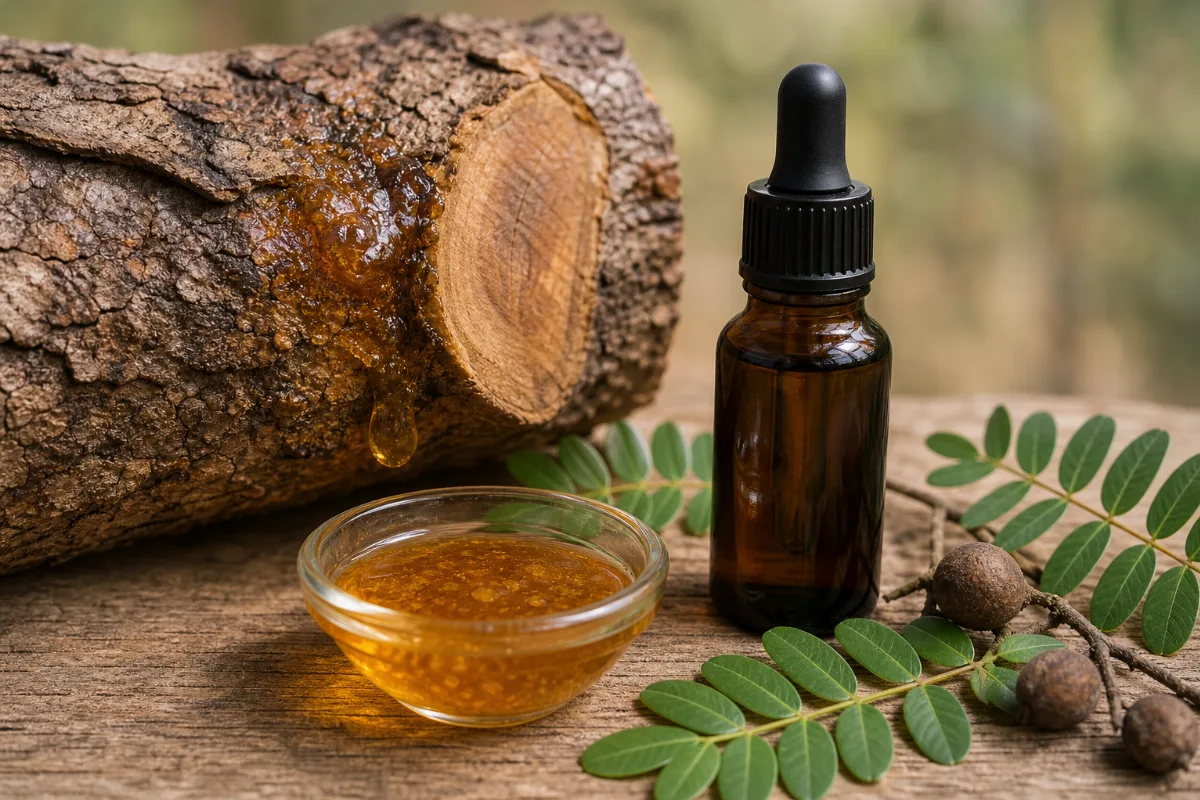
Copaiba oil is a golden sap tapped from Copaifera trees in the Amazon and a distilled oil made from it. Amazonian folk medicine has long used the sap, and a few small trials of gels on skin and teeth have been done. The evidence is thin, and copaiba should not be swallowed or put on skin undiluted. Adulteration with cheaper oils is common.
General information, not medical advice. Last substantive update · Not medically reviewed. A named clinician has not signed off on this page. How this page is made
About Copaiba Oil (Balsam)
Copaiba is a sap from Amazonian trees, long used in folk medicine. The sap and the oil distilled from it are different products. Human research is limited to a few small trials, and safety information for swallowing, pregnancy, children and pets is missing.
Oleoresin or essential oil?
Copaiba oleoresin is the sap-like liquid from the trunk of Copaifera trees. Reviews describe it as made of lighter, volatile sesquiterpenes (such as beta-caryophyllene) and heavier resin acids (such as copalic acid). In one study of a Copaifera langsdorffii sample, the volatile part was about 22.5% of the weight and the resin about 77.5%.
A steam-distilled 'essential oil' keeps the volatile part. The acne trial used a distilled oil whose main compound was cis-thujopsene, not beta-caryophyllene. In other oleoresins beta-caryophyllene was the main compound, and amounts vary by species and origin. Products sold as 'copaiba oil' may be either, and the sources we read do not settle which. Several species are used: Copaifera reticulata is the most studied, then C. langsdorffii and C. multijuga.
Quality and the forest
Lab papers say copaiba oil-resin has not been standardized by industry or regulators and has often been adulterated with cheaper oils such as soybean oil, normally above 50%. A new screening method can catch gross adulteration but not low levels. In a study of 40 samples, two commercial samples lacked most of the characteristic compounds.
Two papers describe oleoresin tapping as a forest product that brings income to local communities and supports forest conservation. We found no study of how tapping affects the trees, so this page does not rate the sustainability of any product.
What the research shows
There are four small human studies and they do not agree on a preparation: an oleoresin hydrogel on skin tears (84 patients), a distilled oil gel on acne (2012, size not in the abstract), a dental gel after tooth bleaching (75 volunteers) and a report of three people with psoriasis. None is large, and none tested a scent or massage use.
Most copaiba research is in dishes and animals. A review of 232 records found in vitro work most common, mostly from Brazil, with germ-killing and anti-inflammatory activity studied most. These results do not show what the oil does in a person.
At a glance
Traditional uses history, not proof
- Papers call copaiba oleoresin one of the most important traditional resources of Amazonia, used on the skin and by mouth in folk medicine. The knowledge comes from the peoples who first used it.
- A 2026 review says it has been used in Brazil since the 16th century as an anti-inflammatory and healing agent. Traditional use is not proof that it works.
Studied for research
- Skin tear healing, oleoresin hydrogel, very low certainty (one trial)
- Acne, distilled oil gel, very low certainty (one small trial, 2012)
- Tooth sensitivity after bleaching, copaiba gel, low certainty (one trial)
- Psoriasis, three patients, insufficient evidence
- Lab and animal studies: inflammation and germs, very low certainty
Main compounds
- Beta-caryophyllene, the main compound in some oleoresins
- Copalic acid and other resin acids (in the oleoresin, not in a distilled oil)
- Alpha-bergamotene
- Cis-thujopsene, the main compound of one distilled oil
Common forms
- Oleoresin (raw sap)
- Steam-distilled essential oil
- Gels and hydrogels used in trials (not a product recommendation)
Research links: Poison Control: Essential oils · Tisserand Institute safety guidelines · FDA: Aromatherapy · Research Library · Genes & Biomarkers Library
What it is and its history
- Accepted scientific name
- Copaifera (genus); commonly C. reticulata, C. langsdorffii and C. multijuga
- Naming authority
- L. (genus)
- Synonyms
- Copaifera reticulata Ducke is listed by GBIF as a synonym of Copaifera copaibo Doweld (checked 2026-10-25); research papers still use the name C. reticulata.
- Common names
- Copaiba (English); Copaiba balsam (English); Copaiba oil-resin / oleoresin (English (used in papers)); Copaiba (copaiba) (Portuguese / Spanish)
- Family or group
- Fabaceae (the legume family), per GBIF.
- Classification
- Plantae > Tracheophyta > Magnoliopsida > Fabales > Fabaceae > Copaifera > Copaifera spp.
- Native range
- The papers read describe Amazonian and Brazilian trees; the full range was not checked.
- Habitat
- Not checked.
- What it looks like
- Part used: The oleoresin is a sap-like liquid obtained from the trunk. A distilled essential oil is made from the oleoresin by steam distillation (acne trial). How retail 'copaiba essential oil' is made was not settled by the sources read.
- Look-alikes and adulterants
- Name: African copaiba balsam tree (Daniellia oliveri) and Eperua oleifera; Note: Different trees. A 2023 paper on Daniellia oliveri uses 'African copaiba balsam' as a name; an Amazonian paper compared Eperua oleifera oleoresin with Copaifera. Results do not carry across.; Name: Other Copaifera species; Note: Compositions differ between species and even between samples, so a result for one does not apply to every bottle.
- Sustainability and conservation
- Not checked beyond two papers that describe oleoresin extraction as a non-timber forest product that supports local income and forest conservation.
Photographs
Traditional use and history history, not clinical proof
| Tradition or era | Documented use | Source |
|---|---|---|
| Amazonian folk medicine | Papers describe copaiba oleoresin as one of the most important traditional resources of Amazonia, used for medicinal purposes on the skin and by mouth, and widely used in Amazon folk medicine. The knowledge belongs to the peoples and communities who developed it; the papers do not name specific nations, and this page does not claim to. | Cardinelli et al. 2023; Almeida Junior et al. 2026 |
| Brazil, since the 16th century | A 2026 review says copaiba has been used in Brazil since the 16th century as an anti-inflammatory and curative agent, and for esoteric purposes. | Passos et al. 2026 (scoping review) |
Traditional use shows how it was used. It does not show that it works or is safe today.
What is inside, and how it may work
What it contains and how those compounds act in cells and animals. Laboratory and animal mechanisms are not proven effects in people.
Main compounds
| Compound | Family | Where it is concentrated | Activity studied | Level of evidence |
|---|---|---|---|---|
| Beta-caryophyllene PubChem 5281515 | sesquiterpene | Oleoresin volatile fraction 39.7% of one Copaifera epunctata oleoresin; 5.47% of the volatile fraction of one C. langsdorffii oleoresin; not the main compound of every oil | One of six characteristic compounds in non-commercial samples; one 2026 paper calls it 'the cannabinoid beta-caryophyllene'. Its separate effects were not read here. 16 2 10 12 18 | Laboratory (composition) |
| Copalic acid and other diterpene acids PubChem 11162521 | diterpene acids (resin part) | Resin (non-volatile) part Copalic, abietic, daniellic, lambertinic and other acids were the main constituents of the resin residue (77.49% of weight) of one C. langsdorffii oleoresin | These are in the resin part, not in a steam-distilled oil; papers credit them with pharmacological potential, but this is not shown in people. 17 10 18 | Laboratory (composition) |
| Alpha-bergamotene | sesquiterpene | Oleoresin volatile fraction 48.38% of the volatile fraction of one C. langsdorffii oleoresin | Not studied separately. 10 12 | Laboratory (composition) |
| Cis-thujopsene | sesquiterpene | Steam-distilled essential oil 46.96% of the distilled oil in the acne trial (48 compounds found) | Not studied separately. 20 | Laboratory (composition) |
| Beta-bisabolene | sesquiterpene | Oleoresin volatile fraction 7.1% of one C. epunctata oleoresin | Not studied separately. 2 12 | Laboratory (composition) |
Mechanisms, receptors and pathways
| Target or pathway | Gene or receptor | What was found | Level |
|---|---|---|---|
| Inflammatory messengers (IL-1 beta, IL-6, TNF alpha) and NF-kB | NF-kB | A purified fraction of C. langsdorffii oleoresin lowered release of these messengers from human monocytes and blocked NF-kB entering the nucleus in cells. Lab only. 10 | Laboratory research |
| Overall biological activity | Not specified | A review of 232 records found antimicrobial and anti-inflammatory activity studied most, with antioxidant and healing properties also reported, mostly in vitro. 8 | In vitro and animal |
| How it might help skin tears, acne or tooth sensitivity | Not established | No mechanism was shown in the human trials read. 6 20 11 | Not assessed |
Absorption, metabolism and elimination
- Absorption
- Not established in the sources read.
- Distribution
- Not established.
- Metabolism
- Not established.
- Elimination
- Not established.
- Bioavailability
- Not established.
Isolated compounds versus whole extracts
Oleoresin and distilled oil are different products. The oleoresin is the whole sap-like liquid from the trunk: a volatile part (sesquiterpenes such as beta-caryophyllene, 22.51% of the weight in one C. langsdorffii sample) and a non-volatile resin part (diterpene acids such as copalic acid, 77.49%). Steam distillation collects the volatile part, so a distilled essential oil should lack the resin acids (our reasoning from the papers, not a statement they make). The acne trial used a distilled oil whose main compound was cis-thujopsene, not beta-caryophyllene. The skin tear and psoriasis papers used the oleoresin. Retail products labelled 'copaiba oil' may be either, and the sources read do not settle which.
Nutritional composition
Copaiba oil is not a food source of any vitamin or mineral.
1 low certainty3 very low certainty1 not enough evidence
What is Copaiba Oil (Balsam) good for?
The uses researchers have tested and how strong the evidence is for each. Read the certainty label first. Each human study used a different copaiba preparation, mostly a gel made for the study, so results cannot be carried over to a bottle of oil.
Benefits, one by one
Each card is a research question, not a promise. Tap a goal to filter. Open a card to see the studies, doses and limits.
Skin tear healing (oleoresin in a hydrogel)
Very low certaintyOne trial in 84 older hospital patients compared a copaiba oleoresin gel (2% and 10%) with plain gel on skin tears. The 2% gel healed faster than the 10% gel, but the abstract does not clearly show a difference from plain gel. No side effects were reported.
1 studiesNot covered. This page gives no amounts and no ways of using the oil.
Studies, doses and limits
What the trials found
A double-blind randomized trial at a university hospital in Rio de Janeiro: 84 patients with a mean age of 67 (29 on 10% oleoresin gel, 28 on 2% gel, 27 on plain hydrogel). Copaifera multijuga oleoresin.
Results
The 2% gel healed faster than the 10% gel (p < 0.05); healing time across all three groups did not clearly differ (p > 0.05); wound size reduction could not be shown to differ. All wounds healed by the end of the study. No local or serious adverse effects.
Effect sizes as reported
p-values only in the abstract.
Why this rating
One small trial. The main comparison with plain gel was not clearly better, people who dropped out were left out of the analysis, and the 2% beating 10% only compares two strengths of the same gel.
Form and dose studied
Not covered. This page gives no amounts and no ways of using the oil.
Who was studied
Mostly men, mean age 67, with skin tears treated in one hospital.
Limits
Single trial; one hospital; completers only; a hospital wound gel is not a retail oil.
Why researchers looked
Copaiba oleoresin has long been used on wounds, so researchers tested it in a gel on a common wound in older people.
Traditional use
Sources describe copaiba oleoresin as a traditional resource of Amazonia, used on the skin and by mouth in folk medicine, and used in Brazil since the 16th century as an anti-inflammatory and healing agent.
Proposed mechanism Preliminary mechanism
Not shown in this trial. Lab work (see the science tab) points to antimicrobial and anti-inflammatory activity, but that is not proof of how a wound heals.
A proposed mechanism does not show that the effect happens in people.
The gel was a medical wound product used in hospital. See the Safety tab: this page does not advise swallowing copaiba oil or using it undiluted on skin. Contact dermatitis from copaiba balsam has been reported in a child.
Acne (steam-distilled oil in a gel)
Very low certaintyA small placebo-controlled trial from 2012 reports that acne-affected skin area fell more with a gel containing 1.0% steam-distilled copaiba oil than with placebo gel. The abstract gives no group sizes and no direct statistical comparison, and the placebo group also improved.
1 studiesNot covered. This page gives no amounts and no ways of using the oil.
Studies, doses and limits
What the trials found
A double-blind, placebo-controlled trial in volunteers with acne (number not given in the abstract) using Copaifera langsdorffii essential oil, steam-distilled from the oleoresin, in a gel.
Results
Acne area fell with placebo (p = 0.001) and fell more with 1.0% oil (p < 0.001). The linear model explained 26.8% of variation for placebo and 69.5% for the oil. The distilled oil's main compound was cis-thujopsene (46.96%), not beta-caryophyllene.
Effect sizes as reported
Model fit (r2) only; no difference between groups stated in the abstract.
Why this rating
Size, length and funding are missing from the abstract, the placebo group improved, and no repeat trial was found.
Form and dose studied
Not covered. This page gives no amounts and no ways of using the oil.
Who was studied
Volunteers with acne vulgaris.
Limits
Details not in the abstract; 2012; not repeated; one species and one preparation.
Why researchers looked
Copaiba is traditionally described as anti-inflammatory and antiseptic, so researchers tried a gel on acne.
Traditional use
The authors describe copaiba oleoresin as widely used in traditional medicine for anti-inflammatory, healing and antiseptic purposes.
Proposed mechanism Preliminary mechanism
Not shown.
A proposed mechanism does not show that the effect happens in people.
See the Safety tab: this page does not advise swallowing copaiba oil or using it undiluted on skin. The trial tested a 1.0% oil in a gel, not oil on its own.
Psoriasis (three patients, oleoresin by mouth or on skin)
Not enough evidenceIn a very small report, three people with long-term psoriasis got better in redness, thickness and scaling after taking or applying copaiba oleoresin. There was no comparison group, so this cannot show that the oleoresin works.
1 studiesNot covered. This page gives no amounts and no ways of using the oil.
Studies, doses and limits
What the trials found
A preliminary report of three patients with chronic psoriasis, no control group.
Results
The authors report significant improvement in erythema, skin thickness and scaliness in all three; no numbers are given in the abstract.
Effect sizes as reported
None given in the abstract.
Why this rating
Three people, no control, no blinding, no numbers. It is an idea to test, not evidence.
Form and dose studied
Not covered. This page gives no amounts and no ways of using the oil.
Who was studied
Three adults with chronic psoriasis.
Limits
No control group; tiny; route of use (mouth or skin) varied; not repeated.
Why researchers looked
Lab work showed an extract calming inflammatory signals in cells, so the authors tried it in a few patients.
Traditional use
Described by the authors as a folk remedy for several inflammatory diseases.
Proposed mechanism Preliminary mechanism
In human monocyte cells in dishes, a purified fraction lowered release of IL-1 beta, IL-6 and TNF alpha and blocked NF-kB entering the nucleus. This is lab evidence only.
A proposed mechanism does not show that the effect happens in people.
Taking oleoresin by mouth is not advised on this page. Psoriasis needs a doctor, not a home oil.
Tooth sensitivity after bleaching (copaiba gel applied by a dentist)
Low certaintyIn one trial of 75 volunteers having teeth bleached, a copaiba oil gel kept sensitivity low, about the same as a standard desensitizing gel, while sensitivity rose in the placebo group. Bleaching worked equally well in all groups.
1 studiesNot covered. This page gives no amounts and no ways of using the oil.
Studies, doses and limits
What the trials found
A randomized clinical trial in Brazil: 75 volunteers in three groups of 25 (placebo gel, 5% potassium nitrate with 2% sodium fluoride gel, copaiba oil gel), three bleaching sessions with 35% hydrogen peroxide, sensitivity scored on a visual scale for 21 days.
Results
The copaiba and potassium nitrate plus fluoride groups had the lowest sensitivity with no significant difference between them. Placebo sensitivity rose after the last session (p = 0.035). Tooth colour change was the same in all groups (p = 0.725).
Effect sizes as reported
p-values only in the abstract.
Why this rating
A randomized, placebo- and active-controlled trial, but a single small trial of one experimental gel; the abstract gives no score values.
Form and dose studied
Not covered. This page gives no amounts and no ways of using the oil.
Who was studied
Healthy volunteers having in-office tooth bleaching.
Limits
One trial; short; one gel; results do not apply to other copaiba products.
Why researchers looked
Copaiba is traditionally described as anti-inflammatory, so dental researchers tried it for the sensitivity that bleaching can cause.
Traditional use
Not applicable. No traditional use for tooth sensitivity was found in the papers read.
Proposed mechanism Preliminary mechanism
Not established in the paper.
A proposed mechanism does not show that the effect happens in people.
This was an experimental dental gel used in a clinic, not a retail oil. See the Safety tab: this page does not advise swallowing copaiba oil or using it undiluted on skin.
Anti-inflammatory, germ-killing and healing effects in dishes and animals
Very low certaintyMost copaiba research is done in dishes and animals. Reviews say antimicrobial and anti-inflammatory activity is studied most, with antioxidant and healing effects also reported. Reviewers call for human studies.
3 studiesNot covered. This page gives no amounts and no ways of using the oil.
Studies, doses and limits
What the trials found
No human trial of these lab effects was found beyond the small trials on the other tab.
Results
A review of 232 research records found in vitro (dish) work the most common study type, mainly from Brazil, with Copaifera reticulata the most studied species followed by C. langsdorffii and C. multijuga. A scoping review of 22 topical studies found nine kinds of product and six kinds of therapeutic effect studied, antimicrobial action most often.
Effect sizes as reported
Not applicable (reviews of mostly lab work).
Why this rating
Lab and animal work, and reviews that only map what has been studied. Neither reviewer rates the effect in people.
Form and dose studied
Not covered. This page gives no amounts and no ways of using the oil.
Who was studied
Cells, animals and a few small human studies.
Limits
Reviews do not appraise study quality in the abstracts read; most work is by Brazilian groups; findings vary by species and sample.
Why researchers looked
Copaiba oleoresin is a traditional remedy, so scientists have tested it widely in the lab.
Traditional use
Copaiba oleoresin is a traditional resource of Amazonia; a 2026 review says it has been used since the 16th century as an anti-inflammatory and healing agent in Brazil.
Proposed mechanism Preliminary mechanism
Terpenes in the oleoresin, including beta-caryophyllene and diterpene acids such as copalic acid, are credited in the papers read. In cells, one purified fraction reduced inflammatory messengers and blocked NF-kB (see the psoriasis report). This is laboratory evidence.
A proposed mechanism does not show that the effect happens in people.
Lab and animal results do not show that any copaiba product is safe or works in people.
Connections to the rest of health
How Copaiba Oil (Balsam) connects to the rest of our health knowledge graph. Every link says what kind of connection it is. A safety link (for example to the liver) is a warning, not a benefit. A study that merely mentions a topic never creates a benefit link.
Explore every connection: goals, body systems, organs, symptoms, genes
A. Wellness goals
| Connected to | Kind of connection | Evidence status | Context | Studies |
|---|---|---|---|---|
| Healthy Skin | Very low certainty | Skin tear healing (oleoresin in a hydrogel): One trial in 84 older hospital patients compared a copaiba oleoresin gel (2% and 10%) with plain gel on skin tears. The 2% gel healed faster than the 10% gel, but the abstract does not clearly show a difference from plain gel. No side effects were reported. Acne (steam-distilled oil in a gel): A small placebo-controlled trial from 2012 reports that acne-affected skin area fell more with a gel containing 1.0% steam-distilled copaiba oil than with placebo gel. The abstract gives no group sizes and no direct statistical comparison, and the placebo group also improved. | 6 20 | |
| Healthy Skin | Not enough evidence | Psoriasis (three patients, oleoresin by mouth or on skin): In a very small report, three people with long-term psoriasis got better in redness, thickness and scaling after taking or applying copaiba oleoresin. There was no comparison group, so this cannot show that the oleoresin works. | 10 | |
| Inflammation Balance | Not enough evidence | Psoriasis (three patients, oleoresin by mouth or on skin): In a very small report, three people with long-term psoriasis got better in redness, thickness and scaling after taking or applying copaiba oleoresin. There was no comparison group, so this cannot show that the oleoresin works. | 10 | |
| Inflammation Balance | Very low certainty | Anti-inflammatory, germ-killing and healing effects in dishes and animals: Most copaiba research is done in dishes and animals. Reviews say antimicrobial and anti-inflammatory activity is studied most, with antioxidant and healing effects also reported. Reviewers call for human studies. | 8 14 10 |
B. Body systems
| Connected to | Kind of connection | Evidence status | Context | Studies |
|---|---|---|---|---|
| Skin Hair Beauty | Biological association | Very low certainty | Studied for: Skin tear healing (oleoresin in a hydrogel) Studied for: Acne (steam-distilled oil in a gel) | 6 20 10 |
| Pain Inflammation | Biological association | Very low certainty | Studied for: Anti-inflammatory, germ-killing and healing effects in dishes and animals | 8 14 10 |
E. Health conditions
| Connected to | Kind of connection | Evidence status | Context | Studies |
|---|---|---|---|---|
| Contact dermatitis | Adverse effect or risk | Case report | One 2026 case report in a child (title only); general warnings from Poison Control and Tisserand. Preparation or compound: Copaiba balsam |
3 15 |
I. Biomarkers
| Connected to | Kind of connection | Evidence status | Context | Studies |
|---|---|---|---|---|
| Skin tear healing time | Biological association | Very low certainty | Measured in trials: decrease. A lab change is not the same as a health benefit. | 6 |
| Skin area affected by acne | Biological association | Very low certainty | Measured in trials: decrease. A lab change is not the same as a health benefit. | 20 |
| Psoriasis signs (redness, thickness, scaling) | Biological association | Not enough evidence | Measured in trials: improve. A lab change is not the same as a health benefit. | 10 |
| Tooth sensitivity score (visual analog scale) | Biological association | Low certainty | Measured in trials: decrease. A lab change is not the same as a health benefit. | 11 |
| Tooth colour change (CIEDE2000) | Biological association | Low certainty | Measured in trials: no difference. A lab change is not the same as a health benefit. | 11 |
L. Active compounds
| Connected to | Kind of connection | Evidence status | Context | Studies |
|---|---|---|---|---|
| Beta-caryophyllene | Biological association | Laboratory (composition) | One of six characteristic compounds in non-commercial samples; one 2026 paper calls it 'the cannabinoid beta-caryophyllene'. Its separate effects were not read here. Preparation or compound: Oleoresin volatile fraction |
16 2 10 12 18 |
| Copalic acid and other diterpene acids | Biological association | Laboratory (composition) | These are in the resin part, not in a steam-distilled oil; papers credit them with pharmacological potential, but this is not shown in people. Preparation or compound: Resin (non-volatile) part |
17 10 18 |
| Alpha-bergamotene | Biological association | Laboratory (composition) | Not studied separately. Preparation or compound: Oleoresin volatile fraction |
10 12 |
| Cis-thujopsene | Biological association | Laboratory (composition) | Not studied separately. Preparation or compound: Steam-distilled essential oil |
20 |
| Beta-bisabolene | Biological association | Laboratory (composition) | Not studied separately. Preparation or compound: Oleoresin volatile fraction |
2 12 |
Each connection is stored with the ingredient, the connected record, the kind of connection, the evidence status, the supporting studies, the preparation or compound involved, and a review date (last reviewed October 25, 2026).
The evidence
The research centre for Copaiba Oil (Balsam). Every record here was checked against PubMed or the publisher's page; we never list a study we have not verified.
Evidence by outcome
Bars show how many studies we found for each outcome, not how well it works. People are added up across trials only (reviews are not added, to avoid double counting).
How we rate evidence
High certainty
Several well-run trials or reviews agree; further research is unlikely to change the picture much.
Moderate certainty
Good trials point the same way, but some doubt remains.
Low certainty
Small, short or inconsistent trials. The finding could change with better research.
Very low certainty
Very little or very weak human data. Treat as a possibility only.
Mixed findings
Trials or reviews disagree with each other.
Not enough evidence
Not enough human research to say either way.
Evidence against
Good research found no benefit, or found harm.
We take the reviewers' own risk-of-bias and GRADE statements where they exist, and otherwise judge from study size, design, consistency, directness and whether a product matches what is sold. Many publications do not make evidence high. Method note: We read the abstracts of 14 PubMed papers and records, plus the FDA, Poison Control and Tisserand Institute pages; we checked plant names in GBIF and compounds in PubChem. We did not check LiverTox, EMA, NCCIH, LactMed or IFRA.
Study library: every study we checked 20
| Study | Design | People | Product, dose, length | Result |
|---|---|---|---|---|
| Agollo 2014 Hypericum perforatum-induced hepatotoxicity with possible association with copaiba (Copaifera langsdorffii Desf): case report. Einstein (Sao Paulo) · PMID 25167337 · DOI |
Case report |
1 One elderly woman with liver damage |
Herbal products of St John's wort (Hypericum perforatum) and copaiba (Copaifera langsdorffii) herbal products (form not given in the abstract) Not reported here n/a · vs n/a |
Liver damage in an elderly patient after use of herbal products of both St John's wort and copaiba, who recovered after stopping them. The authors say liver toxicity of St John's wort is anecdotally known while for copaiba only experimental data existed in the national literature, and raise a possible toxic effect of the combination. Methods, limits and fundingOutcomes: Liver injury and recovery Limitations: One case with two products used together; the abstract does not say how copaiba was taken; cannot say copaiba caused it. Funding and conflicts: Not stated. Read: abstract |
| Almeida Junior 2026 Preclinical safety and antimicrobial evaluation of copaifera epunctata amshoff oleo-resin from the Amazon region. Nat Prod Res · PMID 41543213 · DOI |
Animal toxicity tests (acute oral, acute dermal, repeated dermal, eye) animal |
Laboratory animals (species not given in the abstract) | Copaifera epunctata oleoresin, by mouth, on skin and in the eye oleoresin Not reported here acute and repeated tests · vs n/a |
No signs of toxicity in any test except the repeated-dose skin test, which changed behaviour and blood (haematological) measures in animals at the highest strength used. No change in body weight, organ weight, feed and water intake or biochemistry. No signs of eye damage. Beta-caryophyllene was 39.7% and beta-bisabolene 7.1% of this oleoresin. The authors conclude low risk of toxicity. Methods, limits and fundingOutcomes: Signs of toxicity, blood tests, organ weights Limitations: Animals, one species of Copaifera that is not the one most studied; abstract does not give the animal species; it is not proof of safety in people. Funding and conflicts: Not stated in the abstract. Read: abstract |
| Bellon 2026 Copaiba Balsam-Induced Contact Dermatitis Mimicking Wells' Cellulitis in a Child. Contact Dermatitis · PMID 42184962 · DOI |
Case report |
1 One child (France; Necker-Enfants Malades Hospital) |
Copaiba balsam, contact with skin balsam Not reported here n/a · vs n/a |
Only the title was available to us: it reports a contact dermatitis (skin allergy or irritation) from copaiba balsam in a child that looked like a deep skin infection (Wells' cellulitis). PubMed shows no abstract, so details such as how the balsam was used were not read. Methods, limits and fundingOutcomes: Skin reaction Limitations: Title and record only; no abstract was available, so nothing beyond the title is claimed. Funding and conflicts: Not stated. Read: title-only |
| Borges 2025 First Results for the Elemental Composition of Copaiba Oil Resin (Copaifera Spp.) from Flona Carajas By ICP-OES. ACS Omega · PMID 41552510 · DOI |
Laboratory analysis of 10 samples laboratory |
10 Ten oil-resin samples from the Carajas National Forest, Brazil |
Copaiba oil resin oleoresin Not reported here n/a · vs n/a |
Measured 16 elements (Al, As, Ca, Cd, Cr, Cu, Fe, K, Mg, Na, Ni, Pb, Sb, Se, Ti, Zn) by ICP-OES, from 0.055 mg/kg (Cd) to 2355.9 mg/kg (Ca); darker samples had higher levels of certain elements. The authors say extraction brings income to local communities and contributes to forest conservation, and that elemental data support sustainable extraction. Methods, limits and fundingOutcomes: Metal and mineral content Limitations: Abstract gives no safety limits or comparison for the toxic metals (As, Cd, Pb) so we draw no conclusion on whether they matter; one forest, ten samples. Funding and conflicts: Not stated in the abstract. Read: abstract |
| Cardinelli 2023 Toxicological Effects of Copaiba Oil (Copaifera spp.) and Its Active Components. Plants (Basel) · PMID 36903915 · DOI |
Narrative review of toxicology studies review of lab and animal studies |
Lab and animal toxicology papers | Copaiba oils and their terpenes oleoresin Not reported here n/a · vs n/a |
Describes copaiba oils (oleoresins from Copaifera trunks) as made of sesquiterpenes (volatile) and diterpenes (resinous) in amounts that vary between species and with factors such as soil. Notes they are used medicinally by skin and by mouth, yet their toxic effects and those of their constituents are little known. Reviews in vitro and in vivo studies, including cytotoxic effects against microbes and tumour cells. Methods, limits and fundingOutcomes: Toxicity Limitations: Abstract only; the numbers inside the review were not read. Funding and conflicts: No conflict of interest declared. Read: abstract |
| Cardinelli 2024 Skin Tear Treatment with Copaifera multijuga Hayne in Polymeric Hydrogel: A Randomized Clinical Trial. Pharmaceuticals (Basel) · PMID 39770533 · DOI |
Double blind randomized controlled trial (three groups) |
84 84 hospital patients with skin tears, mean age 67 years (29 on 10% oleoresin gel, 28 on 2% oleoresin gel, 27 on plain hydrogel) |
Copaifera multijuga oleoresin in a carboxypolymethylene hydrogel, on the wound oleoresin Not reported here weekly follow-up until healed · vs Plain hydrogel (standard treatment) |
The abstract says average healing time across the three groups differed with p > 0.05, that the 2% gel healed faster than the 10% gel (p < 0.05), and that wound size reduction could not be shown to differ. All wounds healed by the end of the study; 47.6% healed by week 2. No local or serious adverse effects were reported. The authors conclude the 2% gel gives faster healing, but the abstract does not clearly show a difference from the plain hydrogel. p-values only; no effect sizes in the abstract Methods, limits and fundingOutcomes: Healing time, wound tissue, adverse effects Limitations: Only patients who finished treatment were analysed (losses excluded); the overall comparison with plain hydrogel was not significant; a wound gel, not a scent or retail oil. Funding and conflicts: Conflict of interest: none declared. Read: abstract |
| FDA (US) 2023 Aromatherapy (FDA cosmetics page, read 2026-10-25) FDA (US) · Source |
Regulator statement n/a |
n/a | n/a n/a Not reported here |
Says that products marketed with claims such as easing pain or treating anxiety are drug claims, whatever their plant origin. Plant-derived does not mean safe: many plants contain materials that are toxic, irritating or likely to cause allergic reactions on skin. FDA has no regulations defining 'natural' or 'organic' for cosmetics. Page content marked current as of 09/08/2023. Methods, limits and fundingOutcomes: Safety statements Limitations: A general page; it does not name copaiba. Funding and conflicts: Not applicable Read: full-text |
| Frazao 2023 Evaluation of the biological activities of Copaiba (Copaifera spp): a comprehensive review based on scientometric analysis. Front Pharmacol · PMID 37719866 · DOI |
Scientometric (mapping) review mixed (mostly lab) |
232 232 research records, Web of Science, 2010 to 2020 mostly |
Copaiba oil-resin (Copaifera spp.) oleoresin Not reported here |
Searched 822 references; 232 records analysed. In vitro was the most published study type, mainly Brazilian, 2010 to 2020. Antimicrobial and anti-inflammatory activity were studied most, with antioxidant and healing properties also reported. Copaifera reticulata was the most investigated species, then C. langsdorffii and C. multijuga. The authors say human reports are needed. Methods, limits and fundingOutcomes: Which activities were studied Limitations: Maps research output; does not rate study quality or compare effect sizes. Funding and conflicts: Authors declare no commercial or financial relationships. Read: abstract |
| GBIF 2026 GBIF Backbone Taxonomy: Copaifera and three species matches (GBIF match API, read 2026-10-25) GBIF · Source |
Registry or database n/a |
n/a | n/a n/a Not reported here |
Genus Copaifera L. (key 2978115): ACCEPTED, family Fabaceae, order Fabales. Copaifera langsdorffii Desf. (key 2978171): ACCEPTED. Copaifera multijuga Hayne (key 2978132): ACCEPTED. Copaifera reticulata Ducke (key 2978143): returned as a SYNONYM of Copaifera copaibo Doweld (key 12260954). Methods, limits and fundingOutcomes: Safety statements Limitations: A name registry; it does not say which species a bottle contains. Funding and conflicts: Not applicable Read: full-text |
| Gelmini 2013 GC-MS profiling of the phytochemical constituents of the oleoresin from Copaifera langsdorffii Desf. and a preliminary in vivo evaluation of its antipsoriatic effect. Int J Pharm · PMID 22939967 · DOI |
Lab analysis plus a preliminary 3 patient report human and in vitro |
3 Three patients with chronic psoriasis (plus human monocyte cells in dishes) |
Copaifera langsdorffii oleoresin, taken by mouth or put on skin (as reported) oleoresin Not reported here not stated in the abstract · vs None (no control group) |
In dishes, a purified fraction reduced release of inflammatory messengers (IL-1 beta, IL-6, TNF alpha) from human monocytes and blocked NF-kB movement into the nucleus. Three patients with chronic psoriasis, treated by mouth or on the skin, showed improvement in redness, thickness and scaling. The oleoresin's volatile fraction was 22.51% of the weight; the rest was resin. Methods, limits and fundingOutcomes: Psoriasis signs (redness, skin thickness, scaling); cytokine release in cells Limitations: Three patients, no comparison group, no blinding; the abstract does not say who funded it. It cannot show that the oleoresin works. Funding and conflicts: Not stated in the abstract. Read: abstract |
| Gil 2025 Effect of copaiba oil-resin on dental sensitivity control and color change after bleaching: A randomized clinical trial. Clin Oral Investig · PMID 40358772 · DOI |
Randomized clinical trial (three groups) |
75 75 volunteers having tooth bleaching with 35% hydrogen peroxide (25 per group) |
Copaiba oil gel applied to the teeth (an experimental gel) oil-resin gel Not reported here 3 bleaching sessions 7 days apart; sensitivity followed for 21 days · vs Placebo gel; and a gel of potassium nitrate plus sodium fluoride |
The copaiba gel group and the potassium nitrate plus fluoride group had the lowest sensitivity scores, with no significant difference between them. Sensitivity in the placebo group rose after the last session (p = 0.035). Colour change did not differ between groups (p = 0.725). p-values only in the abstract Methods, limits and fundingOutcomes: Tooth sensitivity (visual analog scale) and tooth colour change Limitations: Single trial; an experimental gel applied by dentists, not a retail oil; the abstract gives no score values and does not say whether assessors were blinded. Funding and conflicts: Competing interests: none declared. Read: abstract |
| Lee 2023 Chemical Characterization and Quality Assessment of Copaiba Oil-Resin Using GC/MS and SFC/MS. Plants (Basel) · PMID 37111842 · DOI |
Laboratory analysis of 40 samples laboratory |
40 Forty copaiba oil-resin samples, including commercial samples |
Copaiba oil-resin oleoresin Not reported here n/a · vs n/a |
The oil has not been standardized by industry or regulatory agencies, and adulteration to maximise profit has become a problem. Except for commercial samples, all groups contained six characteristic compounds (beta-caryophyllene, alpha-copaene, trans-alpha-bergamotene, alpha-humulene, gamma-muurolene, beta-bisabolene) in varying amounts, grouping by origin. Two commercial samples had none or only one of these compounds, and soybean oil adulteration was clearly detected in the commercial samples that were further tested. Methods, limits and fundingOutcomes: Chemical makeup and adulteration Limitations: Small number of commercial samples (the abstract does not give how many); lab study. Funding and conflicts: Authors declare no conflict of interest. Read: abstract |
| Marinho 2026 Development and validation of a time domain NMR relaxometric method for rapid screening of soybean oil adulteration in copaiba oil-resin. J Pharm Biomed Anal · PMID 42284919 · DOI |
Laboratory method validation laboratory |
Copaiba oil-resin mixed with soybean oil | Copaiba oil-resin oleoresin Not reported here n/a · vs n/a |
Says adulteration of copaiba oil-resin with cheaper vegetable oils such as soybean oil has been common. The screening method measured soybean oil with limits of quantification around 36% on average (29.3% to 48.3%), lower than the adulteration level normally above 50% but unable to monitor low-level contamination, and is described as suited to gross adulteration seen in Brazilian markets. The paper calls copaiba oil-resin a valuable non-timber forest product that contributes to preservation of the Amazon rainforest. Methods, limits and fundingOutcomes: Screening for soybean oil Limitations: A lab method paper, not a market survey; it does not say how many products are adulterated. Funding and conflicts: Authors declare no competing interests. Read: abstract |
| Passos 2026 Pharmaceutical Formulations for Topical Use Containing Copaiba Oil: A Scoping Review. Curr Pharm Des · PMID 41919420 · DOI |
Scoping review (Joanna Briggs Institute method) mixed |
22 22 studies of topical copaiba formulations |
Topical products containing copaiba oil oleoresin / oil Not reported here |
22 studies met the criteria; nine different forms and six therapeutic effects were studied, antimicrobial action most often. The authors say copaiba has been used since the 16th century as an anti-inflammatory and curative agent, as well as for esoteric purposes, and conclude it has potential for different topical effects. Methods, limits and fundingOutcomes: Kinds of product and therapeutic effects studied Limitations: A scoping review maps studies and does not judge whether treatments work; the abstract does not say how many studies were in people. Funding and conflicts: Not stated in the abstract. Read: abstract |
| Poison Control (National Capital Poison Center) Essential oils: Poisonous when misused (Poison Control, read 2026-10-25) Poison Control · Source |
Expert statement page n/a |
n/a | n/a n/a Not reported here |
Says misuse of essential oils can cause serious poisoning. Pure essential oils are potent, and diluting them in a carrier oil is the best way to avoid a bad reaction from direct skin contact. Stop use and gently wash off if a rash or other skin reaction occurs. Do not use essential oils on damaged skin. Aspirating (breathing into the lungs) a swallowed oil can cause pneumonia. Children have thin skin and immature livers, which may make them more susceptible. Essential oils may interact with medications. Products are not well regulated, so species, concentration and contaminants can be hard to know, and products often contain other oils or alcohol. Allergy is a real possibility; rash is the most common sign, and breathing difficulty is a medical emergency. If you have bottles at home with young children, lock them up out of sight and reach of children and pets. If someone swallows an essential oil, call 1-800-222-1222 (US). Methods, limits and fundingOutcomes: Safety statements Limitations: A general page on essential oils; it does not name copaiba. The page has no printed date in the text we read. Funding and conflicts: Not applicable Read: full-text |
| PubChem (NCBI) 2026 PubChem: (-)-caryophyllene (read 2026-10-25) PubChem · Source |
Registry or database n/a |
n/a | n/a n/a Not reported here |
CID 5281515, C15H24, (-)-caryophyllene (beta-caryophyllene), a sesquiterpene. Methods, limits and fundingOutcomes: Safety statements Limitations: Identity record only. Funding and conflicts: Not applicable Read: full-text |
| PubChem (NCBI) 2026 PubChem: copalic acid (read 2026-10-25) PubChem · Source |
Registry or database n/a |
n/a | n/a n/a Not reported here |
CID 11162521, C20H32O2, copalic acid, a diterpene acid. Methods, limits and fundingOutcomes: Safety statements Limitations: Identity record only. Funding and conflicts: Not applicable Read: full-text |
| Ribeiro 2026 Medicinal Amazonian Oleoresins: An Eco-Friendly Chemical Fingerprinting Method. Plants (Basel) · PMID 42280688 · DOI |
Laboratory method paper (proof of concept) laboratory |
Copaifera multijuga and Eperua oleifera oleoresins | Amazonian oleoresins oleoresin Not reported here n/a · vs n/a |
Oleoresins from Copaifera and Eperua are described as valuable bioresources whose pharmacological potential is largely attributed to diterpenoids such as copalic and hardwickiic acids and to sesquiterpenes including the cannabinoid beta-caryophyllene. The method detected diterpenic acids and free fatty acids in both oleoresins and could tell their profiles apart. Methods, limits and fundingOutcomes: Chemical fingerprint Limitations: A lab method; it does not test any health effect. Funding and conflicts: No conflicts of interest declared. Read: abstract |
| Tisserand Institute How to Use Essential Oils Safely (Tisserand Institute safety guidelines, read 2026-10-25) Tisserand Institute · Source |
Expert guideline page n/a |
n/a | n/a n/a Not reported here |
Says not to apply undiluted essential oils to skin (the most common adverse reaction is a skin reaction, most often from using the oil undiluted); an allergic reaction means the immune system has been primed, usually for life; do not drip undiluted oil into eyes (chemical burn); do not ingest essential oils unless advised by a practitioner qualified and licensed to prescribe them; keep out of reach of young children; people with a skin condition, who are pregnant, have epilepsy or asthma, or take prescribed medicines should ask a doctor or suitable practitioner first. Methods, limits and fundingOutcomes: Safety statements Limitations: A general page; it does not name copaiba. Its dilution table and the figure it gives for swallowing are not repeated here. Funding and conflicts: Not applicable Read: full-text |
| da Silva 2012 Application of the essential oil from copaiba (Copaifera langsdori Desf.) for acne vulgaris: a double-blind, placebo-controlled clinical trial. Altern Med Rev · PMID 22502624 |
Double blind placebo controlled clinical trial |
Volunteers with acne (number not given in the abstract) | Steam-distilled copaiba essential oil (Copaifera langsdorffii), 1.0% in a gel, applied to skin distilled essential oil from the oleoresin Not reported here not stated in the abstract · vs Placebo gel |
The area affected by acne fell with placebo (p = 0.001) and fell more in the areas treated with the 1.0% copaiba essential oil gel (p < 0.001; the model explained 69.5% of variance versus 26.8% for placebo). The main compound in this distilled oil was cis-thujopsene (46.96%). Model fit only (r2 0.695 vs 0.268); no direct comparison in the abstract Methods, limits and fundingOutcomes: Skin area affected by acne Limitations: Abstract does not give the number of people, length, who funded it, or a direct statistical test between gel and placebo; placebo also improved; 2012 and not repeated in our searches. Funding and conflicts: Not stated in the abstract. Read: abstract |
What we do not know yet
- What the evidence supports: the few human results are very low, low or insufficient certainty, and each used a different preparation.
- No trial of copaiba as a scent, in massage or swallowed was found.
- No study of copaiba in pregnancy, breastfeeding, children or pets.
- No verified copaiba dilution limit or sun-sensitivity statement.
- Which species and form (oleoresin or distilled oil) a retail product contains is often unclear, and adulteration is documented.
- No study of how oleoresin tapping affects the trees.
How new research is added
New studies are found by a saved PubMed search and are placed in a review queue. A person reads each one before it is added.
Lab markers
What changed in blood or saliva tests during trials. A changed number is not the same as feeling or being healthier, and we give no "normal ranges".
Other 5
Skin tear healing time
Decrease in trials
How many days a skin tear takes to close completely.
Very low certaintyResults and what it means
Why it was measured
Main outcome of the skin tear trial.
Statistical vs. clinical meaning
A practical outcome in hospital care, but the comparison with plain gel was not clearly better.
Safety implication
No local adverse effects were reported in the trial.
| Study | Result | People | Product |
|---|---|---|---|
| 6 | 2% oleoresin gel healed faster than 10% gel (p < 0.05); across all three groups the difference was not significant (p > 0.05). |
Skin area affected by acne
Decrease in trials
How much of the treated skin showed acne.
Very low certaintyResults and what it means
Why it was measured
Main outcome of the acne trial.
Statistical vs. clinical meaning
The abstract gives no head-to-head test between oil and placebo.
Safety implication
Skin reactions to copaiba balsam have been reported, so a gel is not risk-free.
| Study | Result | People | Product |
|---|---|---|---|
| 20 | Fell with placebo and fell more with 1.0% copaiba essential oil gel (model r2 0.695 versus 0.268). |
Psoriasis signs (redness, thickness, scaling)
Improve in trials
The three skin features doctors look at when scoring psoriasis.
Not enough evidenceTooth sensitivity score (visual analog scale)
Decrease in trials
A line scale on which the person marks how much their teeth hurt.
Low certaintyResults and what it means
Why it was measured
Main outcome of the bleaching trial.
Statistical vs. clinical meaning
A self-reported score, over 21 days.
Safety implication
None reported in the abstract.
| Study | Result | People | Product |
|---|---|---|---|
| 11 | Copaiba gel and a potassium nitrate plus fluoride gel stayed lowest, with no difference between them; placebo rose after the last session (p = 0.035). |
Tooth colour change (CIEDE2000)
No difference in trials
A machine measure of how much whiter teeth became.
Low certaintyResults and what it means
Safety
What studies and official sources say about side effects, medicines and who should check first. Each point shows what kind of evidence it comes from.
Main points to know 5
- Do not swallow it, and keep it away from children and pets.. Poison Control says misuse of essential oils can cause serious poisoning, and that a swallowed oil breathed into the lungs can cause pneumonia. The Tisserand Institute says not to swallow essential oils unless a qualified practitioner licensed to prescribe them says so. Copaiba oleoresin is used by mouth in Amazonian folk medicine, and a 2023 review says its toxic effects are little known. No human trial of swallowed copaiba was found. If anyone may have swallowed an essential oil, call poison control (US 1-800-222-1222). Expert statement 15 19 5
- Skin reactions are possible; never put it on skin undiluted.. A 2026 case report describes contact dermatitis from copaiba balsam in a child that looked like a deep skin infection. Only the title was available to read. The Tisserand Institute says the most common adverse reaction is a skin reaction, mostly from undiluted oil, and that an allergic reaction may mean avoiding that oil for life. Poison Control says to stop use and wash off if a rash appears and not to use essential oils on damaged skin. One hospital trial of an oleoresin hydrogel on wounds reported no local adverse effects. Case report and expert statement 3 19 15 6
- Liver: one case report with another herb, and little else known.. A 2014 case report describes liver damage in an elderly woman who used herbal products of St John's wort and copaiba, and who recovered after stopping. The authors suspect the combination; copaiba alone was not shown to be the cause. Animal tests of one oleoresin found no toxicity in single-dose and eye tests, but repeated high-strength skin doses changed behaviour and blood measures. A LiverTox entry was not checked. Case report and animal 1 2 5
- What is in the bottle may not be copaiba: adulteration is common.. Lab papers say copaiba oil-resin has commonly been adulterated with cheaper oils such as soybean oil, often above 50%, and that the oil has not been standardized by industry or regulatory agencies. Poison Control adds that essential oil products are not well regulated, so the species, strength and contaminants can be hard to know. A trial result is only about the oil that was tested. Laboratory and expert statement 13 12 15
- Pregnancy, breastfeeding, babies, children, pets: no copaiba data.. No study of copaiba in pregnancy, breastfeeding, babies, children, cats or dogs was found in the sources read. Not described is not proof of safety. The Tisserand Institute advises people who are pregnant, or have epilepsy, asthma, a skin condition or take prescribed medicines, to ask a doctor or suitable practitioner before using essential oils. Poison Control says children have thin skin and immature livers. Expert statement 19 15
Side effects 4
| Effect | How often | Severity and recovery | Evidence |
|---|---|---|---|
| Contact dermatitis (skin allergy or irritation) from copaiba balsam A single child. How often this happens is unknown. | Not established | Not described (title only); in this case it mimicked a deep skin infection and was seen in a hospital Not described in the title | Case report 3 |
| Rash or irritation from any essential oil, especially undiluted General statements about essential oils; copaiba is not named. | Not established | mild to moderate (general oil warnings) Poison Control advises washing the oil off and stopping use if a rash appears | Expert statement 15 19 |
| No local or serious adverse effects reported with a 2% or 10% oleoresin hydrogel on skin tears A medical gel, 84 patients, hospital care; patients who did not finish were not analysed. | 0 of 57 patients on oleoresin gel | none reported n/a | Randomized trial 6 |
| Behaviour and blood-count changes in animals after repeated skin doses of the highest strength of one oleoresin Copaifera epunctata oleoresin; does not show what happens in people. | Not established | Not described beyond 'changes' Not described | Animal research 2 |
Liver
One case report (2014) describes liver damage after St John's wort and copaiba products together, with recovery after stopping both. For copaiba alone, the authors say only experimental data existed. In animals, one oleoresin showed no changes in biochemical tests in acute and repeated tests. A LiverTox record was not checked. 1 2
How often. Not established.
Monitoring. Not applicable. Tell a doctor about yellow skin or eyes, dark urine or belly pain.
- . 1
This is a safety connection. It is not evidence that Copaiba Oil (Balsam) supports liver health.
Medicines and supplements 3
| With | Why it matters | Importance | Evidence | What to do |
|---|---|---|---|---|
| Prescription and over-the-counter medicines medicines-general | Poison Control says essential oils may interact with medications. No copaiba-specific mechanism was found. | Unknown for copaiba. | Expert statement Not enough evidence 15 19 | Ask a doctor or pharmacist before using any essential oil product if you take medicine. |
| St John's wort (Hypericum perforatum) st-johns-wort | Not established. The case report authors suggest a possible toxic effect of the combination. | One liver case; cause not shown. | Case report Not enough evidence 1 | Tell a doctor about all herbal products if you ever have liver symptoms. |
| Sunlight or tanning beds sun-and-light | No source read says copaiba oil makes skin sensitive to light. | Not found either way. | Not found Not enough evidence | Not assessed; unlike citrus oils, no copaiba statement was found. |
Who should check first 4
| Situation | Advice | Evidence |
|---|---|---|
| Undiluted oil on skin, in the eyes or ears | Do not. The Tisserand Institute warns against undiluted oils on skin and says undiluted oil in the eyes can cause a chemical burn. | Expert statement 19 |
| Swallowing the oil, especially by or near children or pets | Do not swallow. If anyone may have swallowed an essential oil, call a poison center (US: 1-800-222-1222) or emergency services. | Expert statement 15 19 |
| Damaged or broken skin | Poison Control says not to use essential oils on damaged skin. The wound trial used a medical hydrogel in hospital care, which is different. | Expert statement 15 6 |
| A known allergy to copaiba or balsam products, or a past rash from it | Avoid it and ask a doctor. The Tisserand Institute says allergic reactions may last for life. | Expert statement and case report 19 3 |
Overdose, product quality and regulators
Summary. The documented harms are skin reactions (one case report) and the class warnings about swallowing essential oils. A 2023 review says the toxicity of copaiba oils is little known. In one animal study of a different Copaifera species, most acute tests showed no toxicity.
Amounts. No safe amount is established, and this page gives none.
Onset and course. Not described for copaiba.
Repeated use. Human trials read were short; in animals, repeated skin doses of the highest strength changed behaviour and blood measures.
Animal data. Copaifera epunctata oleoresin: acute oral, acute dermal and eye tests showed no toxicity; the repeated-dose skin test at the highest strength changed behaviour and blood measures; the authors conclude low toxicity risk.
Toxic parts. The oleoresin or its distilled oil. The paper read lists beta-caryophyllene as its main compound.
Not read. Tisserand and Young 'Essential Oil Safety', IFRA standards, EU fragrance allergen lists, LiverTox, LactMed, EMA/HMPC, NCCIH, any cat or dog study of copaiba, asthma, epilepsy and hormone studies.
Adulteration with soybean oil has been common. The oil is not standardized by industry or regulators, and products are not well regulated. Copaiba from forest sources contains trace metals and minerals; what the levels mean for users is not stated in the abstract read.
Adulteration with cheaper oils. Two lab papers say copaiba oil-resin has commonly been adulterated with soybean oil, normally above 50%; a screening method could detect gross adulteration but not low levels. Two commercial samples in a 40-sample study lacked most of the characteristic compounds. 13 12
Composition varies by species and origin. Samples grouped by origin, and the main compound differed between studied oils (beta-caryophyllene in one oleoresin, alpha-bergamotene in another volatile fraction, cis-thujopsene in a distilled oil). 12 10 20 2
Metals in the oleoresin. Ten forest samples were tested for 16 elements, including arsenic, cadmium and lead. The abstract gives only an overall range (0.055 mg/kg cadmium to 2355.9 mg/kg calcium) and no safety limits, so no conclusion is drawn. 4
Unregulated products. Species, strength and contaminants are not always known; products may contain other oils or alcohol. 15
| Body | Action | Date |
|---|---|---|
| FDA (US) (United States) | Aromatherapy page: plant-derived does not mean safe; products with therapeutic claims such as easing pain are regulated as drugs; FDA has no regulations defining 'natural' or 'organic' for cosmetics. Copaiba is not named. source | 2023 |
| Poison Control (National Capital Poison Center) (United States) | Essential oils page: misuse can cause serious poisoning; dilute, never use on damaged skin, keep out of reach of children and pets; call 1-800-222-1222 if swallowed. source | |
| Tisserand Institute (International (educator)) | Safety guidelines: do not use undiluted on skin, do not ingest unless advised by a qualified licensed practitioner, extra care in pregnancy, epilepsy, asthma and with medicines. source |
When to get medical help
- If anyone may have swallowed any essential oil, call poison control straight away (US: Poison Help 1-800-222-1222) or your local emergency number.
- Trouble breathing, swelling of the face or throat, collapse or hives after any contact or breathing in the oil: call emergency services at once.
- A child or pet that has swallowed oil or is drooling, vomiting, very sleepy or struggling to breathe: call poison control or a vet at once.
- A spreading red, hot or blistered rash after the oil touched the skin: stop contact, wash the skin and see a doctor.
- Oil in the eyes: rinse with plenty of water and get medical help.
- Yellow skin or eyes, dark urine or belly pain after using herbal products: see a doctor.
Stop using the product and contact a clinician or emergency service. In the US, Poison Control is 1-800-222-1222.
General information only, not medical advice. Ask a clinician or pharmacist before use, especially with medicines, in pregnancy or with a health condition. See the Natural Remedy Safety guide.
Frequently asked questions
Is copaiba oil safe to swallow?
This page does not advise it. Poison Control warns that misuse of essential oils can cause serious poisoning, and the Tisserand Institute says not to swallow them unless advised by a qualified, licensed practitioner. Copaiba oleoresin is used by mouth in Amazonian folk medicine, but a 2023 review says its toxic effects are little known. No human trial of swallowed copaiba was found. If anyone swallows an essential oil, call poison control (US 1-800-222-1222).
Can I put copaiba oil on my skin?
Not undiluted. The Tisserand Institute and Poison Control both warn against undiluted essential oils on skin, and a 2026 case report describes contact dermatitis from copaiba balsam in a child. Stop and wash it off if a rash appears. Ask a pharmacist or dermatologist before using any essential oil product.
What is the difference between copaiba oleoresin and copaiba essential oil?
The oleoresin is the whole sap from the tree: a volatile part plus a heavier resin part with acids such as copalic acid. A steam-distilled essential oil keeps only the volatile part, so its makeup differs. The acne trial used a distilled oil; the skin tear and psoriasis papers used the oleoresin. Retail products can be either, so check the label and ask the seller.
Does copaiba oil help wounds or skin tears?
The evidence is thin. In one trial of 84 older hospital patients, a 2% oleoresin hydrogel healed faster than a 10% one, but the abstract does not clearly show a difference from plain hydrogel. No side effects were reported. That was a medical gel, and it does not show that a bottle of oil heals wounds.
Does copaiba oil help acne?
One small placebo-controlled trial from 2012 reports a larger fall in acne area with a 1.0% steam-distilled copaiba oil gel than with placebo gel. The abstract gives no group sizes, and the placebo group improved too. It has not been repeated in our searches, so certainty is very low.
Does copaiba help tooth sensitivity?
One trial of 75 volunteers found a copaiba oil gel, applied in a dental clinic after bleaching, kept sensitivity low, about the same as a standard desensitizing gel, while placebo sensitivity rose. It is a single trial of an experimental gel, so certainty is low.
Is copaiba oil anti-inflammatory or a pain reliever?
Is copaiba oil safe in pregnancy, while breastfeeding, or around children and pets?
Unknown. No copaiba-specific data were found. The Tisserand Institute advises people who are pregnant, or have epilepsy, asthma or skin conditions, to ask a doctor first, and Poison Control says children have thin skin and immature livers. Keep oils locked away from children and pets, and call poison control or a vet if one is swallowed.
Can copaiba cause liver problems?
One 2014 case report describes liver damage in an elderly woman who used St John's wort and copaiba products together; she recovered after stopping. Copaiba alone was not shown to be the cause. A 2023 review says toxicity of copaiba oils is little known. Tell a doctor about yellow skin or eyes, dark urine or belly pain.
Is the copaiba oil I buy pure?
It may not be. Lab papers say copaiba oil-resin has not been standardized by industry or regulators and has often been adulterated with cheaper oils such as soybean oil, normally above 50%. Poison Control says essential oil products are not well regulated. A trial result applies only to the preparation that was tested.
Which compounds are in copaiba?
Beta-caryophyllene is a main compound in some oleoresins (39.7% in one Copaifera epunctata sample), while one C. langsdorffii volatile fraction was mostly alpha-bergamotene, and a distilled oil in the acne trial was mostly cis-thujopsene. Resin acids such as copalic acid are in the oleoresin. Amounts vary by species and origin, and the research does not show that any single compound causes a benefit or harm.
Is copaiba harvesting good for the forest?
Explore by health goal
Editorial transparency
- Written by
- AlternativeMed editorial team. Research compiled with AI assistance, then checked against PubMed records.
- Medical review
- None. This page has not been reviewed by a physician or pharmacist.
- First published
- 2026-10-25
- Last substantive update
- 2026-10-25
- How we research
- We read the abstracts of 14 PubMed papers and records, plus the FDA, Poison Control and Tisserand Institute pages; we checked plant names in GBIF and compounds in PubChem. We did not check LiverTox, EMA, NCCIH, LactMed or IFRA.
- How we rate evidence
- See "How we rate evidence" in the Evidence tab.
- Independence
- No product is promoted on this page. No affiliate links are shown.
Sources 20
Each source was opened and checked. Where we read only the abstract, it says so. The small numbers in the text point here.
- Agollo MC, Miszputen SJ, Diament J. Hypericum perforatum-induced hepatotoxicity with possible association with copaiba (Copaifera langsdorffii Desf): case report.. Einstein (Sao Paulo). 2014. PMID 25167337. DOI 10.1590/s1679-45082014rc2953. (abstract)
- Almeida Junior JS, Macambira DVC, Gomes AM, Assis FFV, Sarrazin SLF, Veiga Junior VF, Oliveira ECP, Moraes TMP, Minervino AHH, Moraes WP, Barata LES. Preclinical safety and antimicrobial evaluation of copaifera epunctata amshoff oleo-resin from the Amazon region.. Nat Prod Res. 2026. PMID 41543213. DOI 10.1080/14786419.2026.2613763. (abstract)
- Bellon N, Girault A, Seyler M, Frassati-Biaggi A, Welfringer A, Bodemer C. Copaiba Balsam-Induced Contact Dermatitis Mimicking Wells' Cellulitis in a Child.. Contact Dermatitis. 2026. PMID 42184962. DOI 10.1111/cod.70189. (title-only)
- Borges CMS, Nunes PO, Souza JBO, Benathar ISC, Goulart SL, Carvalho FIM, Rodrigues M, Filho HAD, Dantas KGF. First Results for the Elemental Composition of Copaiba Oil Resin (Copaifera Spp.) from Flona Carajas By ICP-OES.. ACS Omega. 2025. PMID 41552510. DOI 10.1021/acsomega.5c08791. (abstract)
- Cardinelli CC, Silva JEAE, Ribeiro R, Veiga-Junior VF, Santos EPD, de Freitas ZMF. Toxicological Effects of Copaiba Oil (Copaifera spp.) and Its Active Components.. Plants (Basel). 2023. PMID 36903915. DOI 10.3390/plants12051054. (abstract)
- Cardinelli CC, Passos JTG, Veiga-Junior VF, de Oliveira BGRB, Santos EPD, Neto GG, Di Piero KC, de Freitas ZMF. Skin Tear Treatment with Copaifera multijuga Hayne in Polymeric Hydrogel: A Randomized Clinical Trial.. Pharmaceuticals (Basel). 2024. PMID 39770533. DOI 10.3390/ph17121691. (abstract)
- FDA (US). Aromatherapy (FDA cosmetics page, read 2026-10-25). FDA (US). 2023. (full-text)
- Frazao DR, Cruz JN, Santana de Oliveira M, Baia-da-Silva DC, Nazario RMF, Rodrigues MFL, Saito MT, Souza-Rodrigues RD, Lima RR. Evaluation of the biological activities of Copaiba (Copaifera spp): a comprehensive review based on scientometric analysis.. Front Pharmacol. 2023. PMID 37719866. DOI 10.3389/fphar.2023.1215437. (abstract)
- GBIF. GBIF Backbone Taxonomy: Copaifera and three species matches (GBIF match API, read 2026-10-25). GBIF. 2026. (full-text)
- Gelmini F, Beretta G, Anselmi C, Centini M, Magni P, Ruscica M, Cavalchini A, Maffei Facino R. GC-MS profiling of the phytochemical constituents of the oleoresin from Copaifera langsdorffii Desf. and a preliminary in vivo evaluation of its antipsoriatic effect.. Int J Pharm. 2013. PMID 22939967. DOI 10.1016/j.ijpharm.2012.08.021. (abstract)
- Gil GS, Xavier GMB, de Almeida Canelas CA, Lima RR, Rodrigues APD, Araujo JLN, Passos MF, Silva CM. Effect of copaiba oil-resin on dental sensitivity control and color change after bleaching: A randomized clinical trial.. Clin Oral Investig. 2025. PMID 40358772. DOI 10.1007/s00784-025-06375-5. (abstract)
- Lee J, Wang M, Zhao J, Ali Z, Hawwal MF, Khan IA. Chemical Characterization and Quality Assessment of Copaiba Oil-Resin Using GC/MS and SFC/MS.. Plants (Basel). 2023. PMID 37111842. DOI 10.3390/plants12081619. (abstract)
- Marinho MO, Vitolano LES, Santos YF, Oliveira AJG, Xavier LA, Costa LAMA, Colnago LA, Machado MB. Development and validation of a time domain NMR relaxometric method for rapid screening of soybean oil adulteration in copaiba oil-resin.. J Pharm Biomed Anal. 2026. PMID 42284919. DOI 10.1016/j.jpba.2026.117606. (abstract)
- Passos JTG, Ricci-Junior E, Maciel de Matos CA, da Veiga-Junior VF, Faria de Freitas ZM, Pereira Dos Santos E. Pharmaceutical Formulations for Topical Use Containing Copaiba Oil: A Scoping Review.. Curr Pharm Des. 2026. PMID 41919420. DOI 10.2174/0113816128432291260122113401. (abstract)
- Poison Control (National Capital Poison Center). Essential oils: Poisonous when misused (Poison Control, read 2026-10-25). Poison Control. . (full-text)
- PubChem (NCBI). PubChem: (-)-caryophyllene (read 2026-10-25). PubChem. 2026. (full-text)
- PubChem (NCBI). PubChem: copalic acid (read 2026-10-25). PubChem. 2026. (full-text)
- Ribeiro R, Carneiro GRA, Pereira HMG, Padilha MC, Veiga-Junior VF. Medicinal Amazonian Oleoresins: An Eco-Friendly Chemical Fingerprinting Method.. Plants (Basel). 2026. PMID 42280688. DOI 10.3390/plants15111651. (abstract)
- Tisserand Institute. How to Use Essential Oils Safely (Tisserand Institute safety guidelines, read 2026-10-25). Tisserand Institute. . (full-text)
- da Silva AG, Puziol Pde F, Leitao RN, Gomes TR, Scherer R, Martins ML, Cavalcanti AS, Cavalcanti LC. Application of the essential oil from copaiba (Copaifera langsdori Desf.) for acne vulgaris: a double-blind, placebo-controlled clinical trial.. Altern Med Rev. 2012. PMID 22502624. (abstract)