Fermented Foods · Fermented food
Koji and Amazake
Aspergillus oryzae on rice (Oryza sativa) · also called Rice koji, koji amazake, sake-lees amazake, Japanese fermented rice drink
Koji is steamed rice grown with the food mould Aspergillus oryzae. Amazake is the sweet Japanese drink made from it, or from sake lees. Small trials found more bowel movements and some skin changes, but the evidence is low certainty. The main cautions are the sugar, the unknown alcohol in sake-lees versions, and mould safety.
General information, not medical advice. Last substantive update · Not medically reviewed. A named clinician has not signed off on this page. How this page is made
About Koji and Amazake
Koji is steamed rice grown with the mould Aspergillus oryzae. Amazake is a sweet Japanese rice drink made from koji, or from the solids left from sake. It is a food, not a proven remedy: the best human findings are two small trials on bowel movements and skin, and no source read gave a sugar or alcohol amount per serving.
What it is
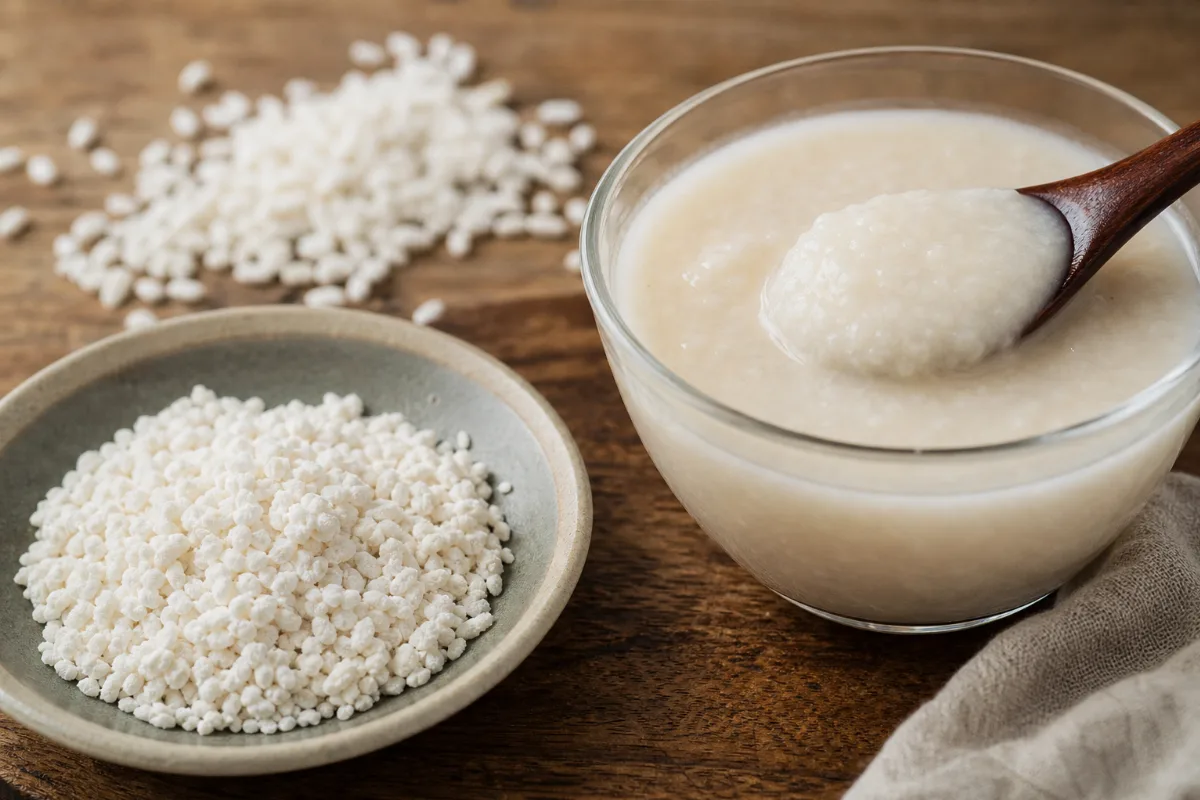
Koji is steamed rice that has been grown with the mould Aspergillus oryzae, a mould used for a long time in traditional Asian fermented foods and drinks. Amazake is a sweet drink. A 2021 review describes two types: koji amazake, made from rice and koji, and sake-lees (sakekasu) amazake, made from the solids left from sake making. Milk amazake, made with milk and koji, was used in one skin trial.
Koji amazake is sweet because enzymes from the mould break rice starch into glucose. A lab study found the temperature of that step changes the amount of glucose and of other sugars. Sake-lees amazake depends on added sugar, mainly glucose and sucrose, according to the review.
What is in it
No USDA FoodData Central entry with nutrient values was found for koji or amazake, and no table of calories, sugar, protein or alcohol per serving was read. So no nutrient numbers are given here. Recipes differ in water, how long the rice is broken down and added sugar, so the label is the guide.
What the papers say: glucose is the main sugar of koji amazake, and it also has oligosaccharides such as isomaltose. A trial paper says amazakes are rich in B vitamins, minerals and essential amino acids, without giving amounts. The review says the substances behind the reported effects are not yet identified.
What the research shows
Bowel movements: in a randomized, double-blind trial in healthy adults, koji amazake gave more days with a bowel movement per week than placebo at 2, 3 and 4 weeks, and a higher weekly fecal weight at 4 weeks. A 6-week pilot in 10 people with severe disabilities saw lower constipation scores without a comparison group. A review calls this the best studied effect, for both kinds of amazake.
Skin: a 60-person trial found koji amazake kept cheek skin water content steady, on the left cheek only, and did not change skin water loss. A 40-person trial found that milk amazake improved skin elasticity compared with the start. Milk amazake is a different product.
Gut bacteria and sugar: a lab-made amazake changed gut bacteria in mice. A review says about 100 mL a day had no effect on blood glucose or weight gain in trials. No source read shows that amazake helps with blood sugar, weight, fatigue, immunity or ageing.
About the mould
In a lab rice test, aflatoxin was found only with a wild Aspergillus flavus strain, not with the food-grade A. oryzae strain tested. A review says wild A. oryzae strains can carry the genes for three mycotoxins, and that industrial strains have been bred without them. A genome study of 639 isolates says the line between A. oryzae and A. flavus is blurry, with signs of several separate domestications.
No report of illness from drinking amazake was found. One case report describes a fungal ball in the sinus of a sake brewery worker, matched to koji at work. It was rare and she recovered with surgery. This is about breathing koji at work.
At a glance
Traditional uses history, not proof
- A 2025 lab paper says the mould has been used for thousands of years in traditional Asian fermented foods and drinks
- Amazake is a traditional sweet drink in Japan
- Long use as food is not proof that it treats any condition
Studied for research
- Bowel movements and constipation, low certainty (small trials of koji and malted rice amazake)
- Skin water content and elasticity, low certainty (small trials; one used milk amazake)
- Gut bacteria, very low certainty (mouse study and bacteria counts)
- Blood sugar and weight, low certainty of no effect at about 100 mL a day (review statement)
- Fatigue, immunity and ageing, insufficient evidence
Main compounds
- Glucose (main sugar of koji amazake)
- Isomaltose and other oligosaccharides
- Glucosylceramide
- Aspergillus oryzae cells and enzymes
- Ergothioneine
Common forms
- Koji amazake: rice and rice koji, described as non-alcoholic
- Sake-lees (sakekasu) amazake: made from sake solids; sugar added; alcohol not read
- Milk amazake: milk and koji; a different product from rice amazake
- Koji supplements and extracts are different products and are not covered
Research links: 2021 trial: koji amazake and bowel movements · 2022 trial: koji amazake and skin water content · 2021 review: amazake ingredients, functions and safety · Research Library · Genes & Biomarkers Library
What it is and its history
- Accepted scientific name
- Aspergillus oryzae (Ahlb.) Cohn (koji mould); Oryza sativa L. (rice)
- Naming authority
- GBIF: A. oryzae matched exactly but is marked as a SYNONYM of Aspergillus flavus; Oryza sativa L. ACCEPTED.
- Synonyms
- Aspergillus flavus (GBIF's accepted name for the group that includes A. oryzae)
- Common names
- Koji (Japanese); Rice koji (English); Amazake (Japanese); Koji amazake (English); Sake-lees amazake (sakekasu amazake) (English); Malted rice amazake (English)
- Family or group
- Aspergillaceae (the mould) and Poaceae (rice), per GBIF. Koji is a food made of both: steamed rice grown with the mould.
- Classification
- Fungi (the mould) and Plantae (the rice) > Ascomycota (mould); Tracheophyta (rice) > Eurotiomycetes (mould); Liliopsida (rice) > Eurotiales (mould); Poales (rice) > Aspergillaceae (mould); Poaceae (rice) > Aspergillus; Oryza > Aspergillus oryzae; Oryza sativa
- Native range
- Not verified from a source read.
- Habitat
- Not verified from a source read.
- What it looks like
- Fruit: Koji is steamed rice grown with Aspergillus oryzae; amazake is the sweet drink made when koji enzymes break rice starch into sugar (two types: from koji, or from sake lees).
- Cultivation
- Not verified from a source read.
- Harvest and processing
- Koji amazake is made by letting rice koji enzymes break down rice starch into glucose (a lab study found the temperature of this step, best near 50 C for glucose, changes the sugar mix). Sake-lees amazake is made from solids left over from sake and depends on added sugar. Milk amazake is made with milk and koji. Step-by-step home methods were not read.
- Look-alikes and adulterants
- Name: Aspergillus flavus; Note: A close relative that can make aflatoxin; in a lab rice test only the wild A. flavus strain made it.; Name: Shio-koji, miso, soy sauce and sake; Note: Other foods made with koji; they have their own composition and are not covered here.; Name: Rice milk and other rice drinks; Note: Not fermented with koji.
- Sustainability and conservation
- Not assessed.
Photographs
What is inside, and how it may work
What it contains and how those compounds act in cells and animals. Laboratory and animal mechanisms are not proven effects in people.
Main compounds
| Compound | Family | Where it is concentrated | Activity studied | Level of evidence |
|---|---|---|---|---|
| Glucose | sugar | Drink (made from rice starch) Not read as an amount. Described as the main component and main source of sweetness in koji amazake. | Provides the sweetness; relevant to blood sugar. 9 5 | Lab |
| Isomaltose and other oligosaccharides | oligosaccharide | Drink A double-saccharified lab version had 20 times more isomaltose than commercial products; twelve oligosaccharides are reported in koji amazake and their amounts depend on the temperature of saccharification. | Linked to gut health in lab and mouse work; not shown in people. 8 9 | Animal research |
| Glucosylceramide | lipid | Drink 1.35 mg per 118 g in the koji amazake of one trial (placebo 0.30 mg). | The skin trial authors suggest it may explain the effect on skin water; not tested on its own. 1 | Human data |
| Aspergillus oryzae cells | fungal biomass | Drink About 302 mg per 118 g in the koji amazake of one trial; none in the placebo. | The bowel trial authors suggest these cells may be an important ingredient. 4 | Human data |
| Ergothioneine | amino acid derivative | Drink Amount not read. | Named in a review as characteristic of koji amazake; its effect was not read. 5 | Lab |
| Beta-glucans and chitin | fungal polysaccharide | Fungal part Not read for amazake. | A 2026 review calls them likely drivers of gut effects in mould foods in general. 3 | Review |
Mechanisms, receptors and pathways
| Target or pathway | Gene or receptor | What was found | Level |
|---|---|---|---|
| Starch to glucose by koji enzymes | Alpha-amylase from A. oryzae | A. oryzae enzymes break rice starch into glucose, which makes koji amazake sweet; the food-grade strain RIB40 showed higher alpha-amylase activity than wild A. flavus strains in rice. 9 7 5 | Lab |
| Gut bacteria | Not specified | Double-saccharified amazake changed mouse gut bacteria. In a human trial, Blautia fell and Bacteroides rose at 3 weeks. The mechanism is not established. 8 4 | Animal research |
| Skin water | Not specified | The trial authors suggest glucosylceramide in the drink may support skin water content. This is their idea, not a tested mechanism. 1 | Human data |
Absorption, metabolism and elimination
- Absorption
- Not found for amazake compounds in people.
- Distribution
- Not found.
- Metabolism
- Not found.
- Elimination
- Not found.
- Bioavailability
- Not established.
Isolated compounds versus whole extracts
All the human trials read used amazake drinks, one of them milk amazake. No trial of a koji supplement, extract or isolated compound was read here, and an extract would be a different product. Koji is also an ingredient in other foods such as soy sauce and miso, which have separate pages.
Nutritional composition
No USDA FoodData Central entry with nutrient values was found for koji or amazake (the saved USDA file for this food is empty), and no peer-reviewed table of calories, sugar, protein or alcohol per serving was read, so no nutrient numbers are given here and no per-portion figures are made up. What the papers do say: koji amazake is sweet mainly from glucose made from rice starch; sake-lees amazake depends on added sugar, mainly glucose and sucrose; a review says amazakes contain oligosaccharides and more than 300 other ingredients; a trial paper says amazakes from rice and koji are rich in B vitamins, minerals and essential amino acids, without amounts. Recipes differ in water, saccharification time and added sugar, so the label is the guide.
3 low certainty1 very low certainty1 not enough evidence
What was looked at
The 5 benefits and uses checked for Koji and Amazake, each with how strong the evidence is. Tap one to open it.
- Bowel movements and constipation (koji amazake drink)Low certainty
- Skin dryness, hydration and elasticity (amazake drinks)Low certainty
- Gut bacteria (changes seen, health benefit not shown)Very low certainty
- Blood sugar and body weight (safety tests, not a benefit)Low certainty
- Fatigue, immunity, anti-ageing, weight loss and other claimsNot enough evidence
Lab markers tracked in the studies
Days with a bowel movement per weekSkin water content (cheek)Skin elasticity (R2 and R5)Blood glucose
What is Koji and Amazake good for?
The main studied uses and how strong the human evidence is for each. The trials are small, short and use amazake drinks, not supplements.
Benefits, one by one
Each card is a research question, not a promise. Tap a goal to filter. Open a card to see the studies, doses and limits.
Bowel movements and constipation (koji amazake drink)
Low certaintyIn one placebo-controlled trial of healthy adults, people who drank koji amazake had more days with a bowel movement each week than those on placebo, for example 5.09 versus 3.95 days at 4 weeks. A tiny pilot in 10 people with severe disabilities saw lower constipation scores. The trials are small and short.
3 studiesKoji amazake (rice fermented by Aspergillus oryzae) as a drink in the…
Studies, doses and limits
What the trials found
A randomized, double-blind, placebo-controlled trial in healthy adults (group size not given in the abstract) found more days with a bowel movement per week at 2, 3 and 4 weeks and a higher weekly fecal weight at 4 weeks with koji amazake. A 6-week pilot of malted rice amazake in 10 people with severe motor and intellectual disabilities saw lower constipation scores, without a comparison group.
Results
A modest increase in how often healthy adults went in a 4-week trial, and a possible easing of constipation in a very small group. Both results need larger, longer trials.
Effect sizes as reported
Days with a bowel movement per week, koji amazake vs placebo: 5.09 vs 4.14 (week 2), 5.41 vs 4.18 (week 3), 5.09 vs 3.95 (week 4). Fecal weight at week 4: 724 g vs 501 g. Pilot: constipation score fell significantly (no numbers in the abstract).
Why this rating
Low: one small randomized trial in healthy people for 4 weeks (funding not stated; several authors also wrote a review of the same drink) and one uncontrolled pilot of 10 people. A review calls the evidence well studied, but only its abstract was read.
Form and dose studied
Koji amazake (rice fermented by Aspergillus oryzae) as a drink in the main trial; malted rice amazake in the pilot. Sake-lees amazake was not tested in the trials read.
Who was studied
Healthy adults; 10 children and adults with severe motor and intellectual disabilities.
Limits
Small, short, group sizes not all given, healthy people may not have constipation. No trial in people with diagnosed constipation was read.
Why researchers looked
A review says the bowel movement effect of amazake has been studied the most, for both koji amazake and sake-lees amazake.
Traditional use
Amazake is a traditional Japanese sweet drink. Long use as a drink is not proof that it treats any condition.
Proposed mechanism Authors hypothesis
Not established. The trial authors suggest the A. oryzae cells in the drink may be an important ingredient. Fecal short-chain fatty acids did not differ from placebo in the trial.
A proposed mechanism does not show that the effect happens in people.
Koji amazake contains sugar, mainly glucose; see the Safety tab.
Skin dryness, hydration and elasticity (amazake drinks)
Low certaintyIn a 60-person trial, koji amazake kept cheek skin water content steady while placebo fell, but only on the left cheek and with no difference in skin water loss. A separate 40-person trial of milk amazake, a different product, found better skin elasticity than at the start.
3 studiesKoji amazake drink; milk amazake (made with milk and koji). Rice-only…
Studies, doses and limits
What the trials found
Koji amazake (118 g a day for 8 weeks, 30 versus 30 healthy adults concerned about dry skin) kept cheek water content steady versus a fall with placebo (+0.19 versus -3.98), only on the left cheek; water loss through the skin did not differ. Milk amazake once a day for 8 weeks in 40 healthy adults raised skin elasticity (R5 change higher than placebo) and lowered water loss compared with baseline.
Results
A small, partial benefit on skin water content for koji amazake and a possible benefit on elasticity for milk amazake. Neither is strong or consistent.
Effect sizes as reported
Koji amazake: change in water content from baseline to 8 weeks +0.19 vs placebo -3.98. Milk amazake: R5 change significantly higher than placebo; R2, R5 and water loss improved from baseline.
Why this rating
Low: two small 8-week randomized trials, a result on only one cheek, no effect on water loss in one trial, and the second trial is of milk amazake (a different product). Funding is not stated in either abstract.
Form and dose studied
Koji amazake drink; milk amazake (made with milk and koji). Rice-only commercial products and sake-lees amazake were not tested.
Who was studied
Healthy adults, one group concerned about dry skin.
Limits
Only 8 weeks; instrument measurements, not how skin looks or feels; one trial compares with baseline rather than only with placebo.
Why researchers looked
Amazake contains glucosylceramide and other compounds that are also studied in skin products, and the drink is traditionally said to help skin.
Traditional use
Amazake is a traditional Japanese sweet drink. Long use as a drink is not proof that it treats any condition.
Proposed mechanism Authors hypothesis
Not established. The authors of the 60-person trial suggest glucosylceramide in the drink may be responsible (1.35 mg per 118 g versus 0.30 mg in placebo). This is their idea, not a tested mechanism.
A proposed mechanism does not show that the effect happens in people.
Milk amazake contains milk; see the Safety tab.
Gut bacteria (changes seen, health benefit not shown)
Very low certaintyMice fed a lab-made amazake with extra isomaltose had changed gut bacteria, and the human bowel trials saw some bacteria shifts. A review of mould foods found all four human trials reported microbiome changes, but a change in bacteria is not a proven benefit.
4 studiesLab-made double-saccharified koji amazake in mice; koji and malted ri…
Studies, doses and limits
What the trials found
The 4-week bowel trial found less Blautia and more Bacteroides at 3 weeks. The 10-person pilot found more Lactobacillales and less Escherichia-Shigella. The mould-foods review says all four human trials on such foods saw a measurable microbiome effect, and does not name amazake in its abstract.
Results
Changes in bacteria are reported, but what they mean for health was not shown.
Effect sizes as reported
Double-step amazake: isomaltose about 20 times higher than commercial products (lab analysis). No human effect sizes in the abstracts.
Why this rating
Very low: mouse study of a lab-made drink, plus bacteria counts in two small human studies that were not designed to show a health benefit.
Form and dose studied
Lab-made double-saccharified koji amazake in mice; koji and malted rice amazake in people.
Who was studied
Mice; healthy adults; 10 people with severe disabilities.
Limits
Microbiome change is a measurement, not an outcome people feel. Mouse results often do not carry over to people.
Why researchers looked
Isomaltose and other carbohydrates in amazake reach gut bacteria, and mould-fermented foods contain beta-glucans and chitin.
Traditional use
Amazake is a traditional Japanese sweet drink. Long use as a drink is not proof that it treats any condition.
Proposed mechanism Animal and review
A double-saccharified amazake had about 20 times more isomaltose than commercial products and changed mouse gut bacteria. A 2026 review names beta-glucans and chitin as likely drivers in mould foods in general. Neither is shown for ordinary amazake in people.
A proposed mechanism does not show that the effect happens in people.
None specific.
Blood sugar and body weight (safety tests, not a benefit)
Low certaintyA review says human trials of about 100 mL a day found no effect on blood glucose or weight gain. That is a no-effect finding, not a sign the drink helps with either, and the drink is sweet.
2 studiesAmazake drinks at about 100 mL a day, per the review.
Studies, doses and limits
What the trials found
The 2021 review abstract states that human clinical trials show about 100 mL a day has no effect on blood glucose levels and weight gain. The trials behind this statement were not read.
Results
No effect on blood glucose or weight gain was reported at that amount in the trials the review covered. No effect of larger amounts or in people with diabetes was read.
Effect sizes as reported
No numbers in the abstract.
Why this rating
Low: a statement in a narrative review abstract; the underlying trials were not read and the review's funding is not stated.
Form and dose studied
Amazake drinks at about 100 mL a day, per the review.
Who was studied
Not described in the abstract.
Limits
A finding of no effect in the trials reviewed, not proof the drink is safe for people with diabetes. No sugar amount per serving was found.
Why researchers looked
Koji amazake is sweet because koji enzymes turn rice starch into glucose, so researchers checked whether it raises blood sugar or weight.
Traditional use
Amazake is a traditional Japanese sweet drink. Long use as a drink is not proof that it treats any condition.
Proposed mechanism Composition
Glucose is the main sugar of koji amazake. Sake-lees amazake depends on added sugar, mainly glucose and sucrose.
A proposed mechanism does not show that the effect happens in people.
See the Safety tab for diabetes.
Fatigue, immunity, anti-ageing, weight loss and other claims
Not enough evidenceA review lists anti-fatigue among amazake's known functions, but no trial of it was read. No source read showed benefit for immunity, ageing or weight loss.
1 studiesNot applicable.
Studies, doses and limits
What the trials found
The 2021 review abstract mentions anti-fatigue effects among the functions, without detail. No trial on fatigue, immunity or ageing was read.
Results
Not enough evidence.
Why this rating
Insufficient: no trial was read for these claims.
Limits
Only a one-line mention in a review abstract.
Why researchers looked
These are common marketing claims for amazake.
Traditional use
Amazake is a traditional Japanese sweet drink. Long use as a drink is not proof that it treats any condition.
Proposed mechanism None
Not established.
A proposed mechanism does not show that the effect happens in people.
None specific.
Connections to the rest of health
How Koji and Amazake connects to the rest of our health knowledge graph. Every link says what kind of connection it is. A safety link (for example to the liver) is a warning, not a benefit. A study that merely mentions a topic never creates a benefit link.
Explore every connection: goals, body systems, organs, symptoms, genes
A. Wellness goals
| Connected to | Kind of connection | Evidence status | Context | Studies |
|---|---|---|---|---|
| Gut Digestive Health | Low certainty | Bowel movements and constipation (koji amazake drink): In one placebo-controlled trial of healthy adults, people who drank koji amazake had more days with a bowel movement each week than those on placebo, for example 5.09 versus 3.95 days at 4 weeks. A tiny pilot in 10 people with severe disabilities saw lower constipation scores. The trials are small and short. | 4 2 5 | |
| Skin Health | Low certainty | Skin dryness, hydration and elasticity (amazake drinks): In a 60-person trial, koji amazake kept cheek skin water content steady while placebo fell, but only on the left cheek and with no difference in skin water loss. A separate 40-person trial of milk amazake, a different product, found better skin elasticity than at the start. | 1 11 5 | |
| Gut Digestive Health | Very low certainty | Gut bacteria (changes seen, health benefit not shown): Mice fed a lab-made amazake with extra isomaltose had changed gut bacteria, and the human bowel trials saw some bacteria shifts. A review of mould foods found all four human trials reported microbiome changes, but a change in bacteria is not a proven benefit. | 8 4 2 3 | |
| Blood Sugar Balance | Low certainty | Blood sugar and body weight (safety tests, not a benefit): A review says human trials of about 100 mL a day found no effect on blood glucose or weight gain. That is a no-effect finding, not a sign the drink helps with either, and the drink is sweet. | 5 9 | |
| Healthy Weight | Low certainty | Blood sugar and body weight (safety tests, not a benefit): A review says human trials of about 100 mL a day found no effect on blood glucose or weight gain. That is a no-effect finding, not a sign the drink helps with either, and the drink is sweet. | 5 9 | |
| Energy Vitality | Not enough evidence | Fatigue, immunity, anti-ageing, weight loss and other claims: A review lists anti-fatigue among amazake's known functions, but no trial of it was read. No source read showed benefit for immunity, ageing or weight loss. | 5 | |
| Immune Wellness | Not enough evidence | Fatigue, immunity, anti-ageing, weight loss and other claims: A review lists anti-fatigue among amazake's known functions, but no trial of it was read. No source read showed benefit for immunity, ageing or weight loss. | 5 |
B. Body systems
| Connected to | Kind of connection | Evidence status | Context | Studies |
|---|---|---|---|---|
| Digestive System | Biological association | Low certainty | Studied for: Bowel movements and constipation (koji amazake drink) Studied for: Gut bacteria (changes seen, health benefit not shown) | 4 2 5 8 3 |
| Integumentary System | Biological association | Low certainty | Studied for: Skin dryness, hydration and elasticity (amazake drinks) | 1 11 5 |
| Endocrine System | Biological association | Low certainty | Studied for: Blood sugar and body weight (safety tests, not a benefit) | 5 9 |
| General | Biological association | Not enough evidence | Studied for: Fatigue, immunity, anti-ageing, weight loss and other claims | 5 |
E. Health conditions
| Connected to | Kind of connection | Evidence status | Context | Studies |
|---|---|---|---|---|
| Food allergy | Adverse effect or risk | Label caution | Rice is not a major US allergen; milk amazake contains milk. Preparation or compound: Milk and other ingredients in some amazake |
14 11 |
| Aspergilloma (fungal ball) | Adverse effect or risk | Case report | One brewery worker; not linked to drinking amazake. One brewery worker; breathing koji at work, not drinking amazake. Preparation or compound: Breathing koji spores at work |
12 |
| Diabetes | Composition | Glucose is the main sugar; ask your care team. Preparation or compound: Glucose in koji amazake |
5 9 | |
| Constipation | Small trials | One small placebo-controlled trial and one 10-person pilot. Preparation or compound: Koji or malted rice amazake drink |
4 2 |
I. Biomarkers
| Connected to | Kind of connection | Evidence status | Context | Studies |
|---|---|---|---|---|
| Days with a bowel movement per week | Biological association | Low certainty | Measured in trials: raised. A lab change is not the same as a health benefit. | 4 |
| Skin water content (cheek) | Biological association | Low certainty | Measured in trials: maintained. A lab change is not the same as a health benefit. | 1 |
| Skin elasticity (R2 and R5) | Biological association | Low certainty | Measured in trials: raised. A lab change is not the same as a health benefit. | 11 |
| Blood glucose | Biological association | Low certainty | Measured in trials: no change reported. A lab change is not the same as a health benefit. | 5 |
K. Biological pathways
| Connected to | Kind of connection | Evidence status | Context | Studies |
|---|---|---|---|---|
| Glucose | Preliminary mechanism | Lab | Main sugar of koji amazake. | 9 5 |
| Isomaltose | Preliminary mechanism | Animal | An oligosaccharide linked to gut health in lab and mouse work. | 8 |
| Skin | Preliminary mechanism | Human | Two small trials measured skin water and elasticity. | 1 11 |
L. Active compounds
| Connected to | Kind of connection | Evidence status | Context | Studies |
|---|---|---|---|---|
| Glucose | Biological association | Lab | Provides the sweetness; relevant to blood sugar. Preparation or compound: Drink (made from rice starch) |
9 5 |
| Isomaltose and other oligosaccharides | Biological association | Animal | Linked to gut health in lab and mouse work; not shown in people. Preparation or compound: Drink |
8 9 |
| Glucosylceramide | Biological association | Human | The skin trial authors suggest it may explain the effect on skin water; not tested on its own. Preparation or compound: Drink |
1 |
| Aspergillus oryzae cells | Biological association | Human | The bowel trial authors suggest these cells may be an important ingredient. Preparation or compound: Drink |
4 |
| Ergothioneine | Biological association | Lab | Named in a review as characteristic of koji amazake; its effect was not read. Preparation or compound: Drink |
5 |
| Beta-glucans and chitin | Biological association | Review | A 2026 review calls them likely drivers of gut effects in mould foods in general. Preparation or compound: Fungal part |
3 |
Each connection is stored with the ingredient, the connected record, the kind of connection, the evidence status, the supporting studies, the preparation or compound involved, and a review date (last reviewed October 26, 2026).
Evidence at a glance: what changed in 2 lab markers
Tap a number to show only those markers. Counts are markers, not people.
The evidence
The research centre for Koji and Amazake. Every record here was checked against PubMed or the publisher's page; we never list a study we have not verified.
Evidence by outcome
Bars show how many studies we found for each outcome, not how well it works. People are added up across trials only (reviews are not added, to avoid double counting).
How we rate evidence
High certainty
Several well-run trials or reviews agree; further research is unlikely to change the picture much.
Moderate certainty
Good trials point the same way, but some doubt remains.
Low certainty
Small, short or inconsistent trials. The finding could change with better research.
Very low certainty
Very little or very weak human data. Treat as a possibility only.
Mixed findings
Trials or reviews disagree with each other.
Not enough evidence
Not enough human research to say either way.
Evidence against
Good research found no benefit, or found harm.
We take the reviewers' own risk-of-bias and GRADE statements where they exist, and otherwise judge from study size, design, consistency, directness and whether a product matches what is sold. Many publications do not make evidence high. Method note: We started from our existing koji and amazake summary, re-read PubMed abstracts for the trials, reviews and lab papers, read the FDA allergen and arsenic pages, and checked species names in GBIF. No USDA nutrient data were available. Only abstracts were read for studies. Items we could not verify are flagged in the research gaps.
Study library: every study we checked 17
| Study | Design | People | Product, dose, length | Result |
|---|---|---|---|---|
| Enomoto 2022 Koji amazake Maintains Water Content in the Left Cheek Skin of Healthy Adults: A Randomized, Double-Blind, Placebo-Controlled, Parallel-Group, Comparative Trial. Clin Cosmet Investig Dermatol · PMID 35836478 · DOI |
Randomized controlled trial |
60 60 healthy adults concerned about dry skin (30 koji amazake, 30 placebo) |
Koji amazake (non-alcoholic drink from rice fermented by Aspergillus oryzae) Drink 118 g a day of test drink 8 weeks · vs Placebo drink |
Cheek skin water content was maintained in the koji amazake group while it fell in the placebo group. The difference was found only on the left cheek. There was no significant difference in TEWL. The drink contained 1.35 mg of glucosylceramide per 118 g versus 0.30 mg in the placebo, which the authors say is close to amounts that helped skin in earlier reports. Change in water content from baseline to 8 weeks: koji amazake 0.19 vs placebo -3.98 (Not given in the abstract) Methods, limits and fundingOutcomes: Skin water content, transepidermal water loss (TEWL), glucosylceramide content of the drinks Limitations: Effect on one cheek only, no effect on water loss through the skin, 8 weeks, adults with dry skin concerns. The glucosylceramide explanation is the authors' idea, not a tested mechanism. Several authors also wrote the defecation trial and the 2021 review. Funding and conflicts: Funding is not stated in the abstract. Read: abstract |
| Kageyama 2021 Effects of Malted Rice Amazake on Constipation Symptoms and Gut Microbiota in Children and Adults with Severe Motor and Intellectual Disabilities: A Pilot Study. Nutrients · PMID 34960021 · DOI |
Pilot uncontrolled trial |
10 10 children and adults with severe motor and intellectual disabilities and constipation |
Malted rice amazake Drink 6 weeks |
The constipation score fell significantly after 6 weeks. Lactobacillales rose and Escherichia-Shigella fell. Changes in gut bacteria varied with the starting bacteria mix, and the score fell in two of three groups of patients. Significant fall in CAS score; no numbers in the abstract (Not given in the abstract) Methods, limits and fundingOutcomes: Constipation Assessment Scale (CAS) score, fecal gut bacteria Limitations: Only 10 people, a very specific group, and no comparison group is described in the abstract, so the change cannot be credited to the drink alone. Funding and conflicts: Funding listed in the record: Okayama Prefectural University Creative Research Grant; Japan Agency for Medical Research and Development (AMED); a Ministry of Health and Welfare of Japan programme. No company is named. Read: abstract |
| Keigler 2026 Myco-foods and the gut microbiome: impacts of mycelial extracts, biomass, and mold-fermented foods. Gut Microbes · PMID 42198987 · DOI |
Narrative review human, mouse and lab |
Review of 4 human trials, 8 animal and 8 in vitro studies on mould-based foods | Edible mould mycelium extracts, biomass and mould-fermented foods Food and extracts Varied Varied · vs Varied |
All four human trials (two extracts, one biomass, one fermented food) reported a measurable change in gut microbiome. Animal and lab studies often found more Akkermansia, Bifidobacterium and lactobacilli and more short-chain fatty acids. The authors say effects depend on the fungal species and the food format. Beta-glucans and chitin are likely drivers. No numbers in the abstract (Not applicable) Methods, limits and fundingOutcomes: Gut microbiome changes Limitations: The abstract does not name amazake. Only four human trials in total, of mixed products. A change in the microbiome is not a proven health benefit. Funding and conflicts: Funding is not stated in the abstract. Read: abstract |
| Kurahashi 2021 Intake of Koji Amazake Improves Defecation Frequency in Healthy Adults. J Fungi (Basel) · PMID 34575820 · DOI |
Randomized controlled trial |
Healthy adults, two parallel groups (group size not given in the abstract) | Koji amazake, a drink of steamed rice fermented by Aspergillus oryzae, with about 302 mg of A. oryzae cells per 118 g Drink 118 g test serving (cell content per 118 g given in the abstract); daily amount not stated in the abstract 4 weeks (outcomes at 2, 3 and 4 weeks) · vs Placebo drink |
Koji amazake gave more days with a bowel movement per week than placebo at 2, 3 and 4 weeks. Weekly fecal weight was higher at 4 weeks. Fecal short-chain fatty acids did not differ between groups. The relative amount of Blautia fell and Bacteroides rose at 3 weeks. The authors suggest the A. oryzae cells may be an important ingredient. Days with a bowel movement per week, koji amazake vs placebo: 5.09 vs 4.14 (2 weeks), 5.41 vs 4.18 (3 weeks), 5.09 vs 3.95 (4 weeks); fecal weight 724 g vs 501 g at 4 weeks (Not given in the abstract) Methods, limits and fundingOutcomes: Weekly defecation frequency, fecal weight, fecal short-chain fatty acids, gut bacteria Limitations: Healthy adults only, short trial, group size not given in the abstract. Several authors also wrote the 2021 review and the 2022 skin trial. Funding and conflicts: Funding is not stated in the abstract. Read: abstract |
| Kurahashi 2021 Ingredients, Functionality, and Safety of the Japanese Traditional Sweet Drink Amazake. J Fungi (Basel) · PMID 34200668 · DOI |
Narrative review |
Review of koji amazake and sake-lees (sakekasu) amazake | Amazake (koji type and sake-lees type) Drink Trial amounts of about 100 mL a day are described in the abstract |
Names two kinds of amazake. Koji amazake is sweet from glucose made when mould enzymes break down rice starch. Sake-lees amazake depends on added sugar, mainly glucose and sucrose. Bowel movement effects are described as well studied for both. Human trials at about 100 mL a day are said to show no effect on blood glucose or weight gain. No numbers in the abstract (Not applicable) Methods, limits and fundingOutcomes: Ingredients, health effects, effect on blood glucose and weight Limitations: A narrative review read as an abstract only, so the trials behind each statement could not be checked. Sake-lees amazake alcohol content is not mentioned in the abstract. Funding and conflicts: Funding is not stated in the abstract. Read: abstract |
| Lehmbeck 2025 Mycotoxin-free Aspergillus oryzae strain lineage for alternative and novel protein production at industrial scale. Appl Microbiol Biotechnol · PMID 40220078 · DOI |
Narrative review n/a |
Industrial A. oryzae strain lineage from the Novozymes (now Novonesis) collection | Industrial A. oryzae strains for enzymes and proteins (not koji for eating) Fungal strain |
Wild-type A. oryzae strains can have the potential to make three mycotoxins: aflatoxins, cyclopiazonic acid and 3-nitropropionic acid. The review describes an industrial lineage with deletions that remove the genes for all three. No numbers (Not applicable) Methods, limits and fundingOutcomes: Mycotoxin gene clusters in A. oryzae strains Limitations: About industrial protein-production strains, written by authors linked to the company that developed them, not about koji used in food. Shows that wild strains can carry mycotoxin genes. Funding and conflicts: The review describes strains of the Novozymes (now Novonesis) collection; funding is not stated in the abstract. Read: abstract |
| McCarthy 2025 Divergent volatile metabolomes and flavor attributes in rice fermented by Aspergillus oryzae and Aspergillus flavus. Front Fungal Biol · PMID 41675126 · DOI |
Laboratory analysis n/a |
Rice fermented in the lab by one food-grade A. oryzae strain (RIB40) and two wild A. flavus strains | Fermented rice (A. oryzae RIB40 vs A. flavus NPK13tox and AflaGuard) Rice · vs A. flavus strains |
Aflatoxin was detected only in rice fermented by the A. flavus strain NPK13tox, not with A. oryzae RIB40. A. oryzae RIB40 had higher alpha-amylase activity and a milder, more umami taste profile. The abstract calls A. oryzae a GRAS fungus used for thousands of years in traditional Asian fermented foods and drinks. Aflatoxin detected only with A. flavus NPK13tox (Not applicable) Methods, limits and fundingOutcomes: Amylase activity, aflatoxin, taste, volatile compounds Limitations: Lab test with one A. oryzae strain, not market koji. One strain does not prove all koji strains are free of toxin. Funding and conflicts: Funding is not stated in the abstract. Read: abstract |
| Murakami 2024 Koji amazake produced by double saccharification contains more isomaltose and modifies the gut microbiota in mice. Front Nutr · PMID 39568726 · DOI |
Animal study and lab analysis mouse |
Mice (feeding study) and lab-made amazake | Koji amazake made by a two-step (double) saccharification, with 20 times more isomaltose than commercial products Drink Oral doses to mice (not stated in the abstract) |
The double-step amazake had 20 times more isomaltose than commercial amazake products. In mice it changed the gut bacteria, including Anaerotignum lactatifermentans, Muribaculum intestinale and Parabacteroides merdae. The authors say it may have benefits in humans, which was not tested. 20 times more isomaltose than commercial products (Not applicable) Methods, limits and fundingOutcomes: Isomaltose content; mouse cecal gut bacteria Limitations: Mouse study of a new lab-made amazake, not a product on shelves. No human result. Funding and conflicts: Funding is not stated in the abstract. Read: abstract |
| Oguro 2019 Effect of temperature on saccharification and oligosaccharide production efficiency in koji amazake. J Biosci Bioeng · PMID 30414826 · DOI |
Laboratory analysis n/a |
Lab saccharification of koji amazake at different temperatures | Koji amazake Drink |
Calls koji amazake a traditional Japanese sweet beverage whose main sweetness is glucose made from rice starch by A. oryzae enzymes. Glucose was highest at 50 C. Twelve oligosaccharides were found in koji amazake, and their amounts depended on the temperature. Glucose at 40 C was 66.4%, at 60 C 91.9% and at 70 C 76.6% of the value at 50 C (Not applicable) Methods, limits and fundingOutcomes: Glucose and oligosaccharide content at different temperatures Limitations: Lab method paper; shows that sugar content depends on how the amazake is made, not a health result. Funding and conflicts: Funding is not stated in the abstract. Read: abstract |
| Pfliegler 2025 Global population genomics redefines domestication and clinical diversity in the Aspergillus flavus-oryzae complex. IMA Fungus · PMID 41522572 · DOI |
Genomic analysis n/a |
639 639 isolates of A. flavus and A. oryzae from clinical, environmental and food-fermentation sources |
Genomes of A. flavus and A. oryzae Fungal isolates |
Found a complex picture with several clades and mixed groups, and possible evidence for several separate domestications of A. oryzae. Clinical A. flavus isolates are spread across several groups, some overlapping with fermentation strains. The authors say the results challenge the current species boundaries and matter for food safety. 639 isolates (Not applicable) Methods, limits and fundingOutcomes: Population structure, domestication history, clinical isolates Limitations: A genome study. It does not test any food or say that koji or amazake causes illness. Funding and conflicts: Funding is not stated in the abstract. Read: abstract |
| Shoji 2023 Effects of Milk Amazake on Skin Elasticity, Hydration, and Transepidermal Water Loss: An 8-Week Double-Blind, Randomized, Controlled Trial. J Oleo Sci · PMID 36878586 · DOI |
Randomized controlled trial |
40 40 healthy women and men, all completed |
Milk amazake (made with milk and koji mould, so a different product from rice-only amazake) Drink One serving a day (amount not stated in the abstract) 8 weeks · vs Placebo drink |
At 8 weeks skin elasticity (R2 and R5) was higher than at baseline in the milk amazake group, and the change in R5 was higher than in placebo. TEWL fell compared with baseline. The authors say milk amazake may be useful as a functional food for skin. R5 change higher than placebo (significant); R2, R5 and TEWL changed from baseline (Not given in the abstract) Methods, limits and fundingOutcomes: Skin elasticity (R2, R5), hydration, transepidermal water loss Limitations: Milk amazake is not the same as rice amazake. Only 40 people, 8 weeks. Several results compare with baseline, not with placebo. Funding and conflicts: Funding is not stated in the abstract. Read: abstract |
| Tokano 2025 A Case of Fungal Ball Caused by Aspergillus oryzae in a Sake Brewery Worker. Cureus · PMID 41293336 · DOI |
Case report |
1 A 34-year-old woman working at a sake (nihon-shu) brewery |
Koji (malted rice) handled at work Koji handled at work Years of work exposure not stated in the abstract |
She came with a headache and was found to have a non-invasive fungal ball in a sinus caused by A. oryzae. The strain matched koji from her workplace at 100% in three gene regions. She was treated with endoscopic sinus surgery, did not need antifungal medicine and recovered. The authors say A. oryzae should be considered in workers in sake brewing and fermentation industries. One case (Not applicable) Methods, limits and fundingOutcomes: Fungal ball in the sinus Limitations: One case report in an occupational setting, involving breathing koji at work. It says nothing about drinking amazake. Funding and conflicts: Funding is not stated in the abstract. Read: abstract |
| Yazaki 2026 Enzymatic Saccharification Behavior and Compositional Characteristics of Mucuna pruriens-Based Amazake: A Comparison With Conventional Rice Amazake. Food Sci Nutr · PMID 42491510 · DOI |
Laboratory analysis n/a |
Lab-made amazake from Mucuna beans compared with rice amazake | Amazake made from Mucuna pruriens beans and, for comparison, conventional rice amazake Drink · vs Rice amazake |
The abstract describes amazake as a traditional Japanese non-alcoholic beverage and says conventional rice amazake contains high levels of glucose from starch saccharification. Mucuna bean amazake had less sugar formation and higher antioxidant-related indices in the lab. L-DOPA in raw beans about 3 g/100 g, below 0.04 g/100 g after processing (Not applicable) Methods, limits and fundingOutcomes: Sugar composition, L-DOPA, antioxidant indices Limitations: About a bean-based amazake that is not the traditional drink. Lab values only, no health result. Used here only for its description of ordinary rice amazake. Funding and conflicts: Funding is not stated in the abstract. Read: abstract |
| s-fda-allergens US FDA: Food Allergies · Source |
Health agency n/a |
Methods, limits and fundingRead: full-text | ||
| s-fda-arsenic US FDA: What You Can Do to Limit Exposure to Arsenic · Source |
Health agency n/a |
Methods, limits and fundingRead: full-text | ||
| s-gbif-aspergillus-oryzae GBIF Backbone: Aspergillus oryzae (Ahlb.) Cohn (usageKey 5259827) · Source |
Reference database n/a |
Methods, limits and fundingRead: full-text | ||
| s-gbif-oryza-sativa GBIF Backbone: Oryza sativa L. (usageKey 2703459) · Source |
Reference database n/a |
Methods, limits and fundingRead: full-text |
What we do not know yet
- No nutrient numbers per serving (calories, sugar, alcohol) were found for koji or amazake.
- The bowel and skin trials are small and short, and funding is not stated in their abstracts.
- No trial of sake-lees amazake, or in people with diabetes, constipation or dry skin conditions, was read.
- Alcohol in sake-lees amazake, and advice for pregnancy, breastfeeding and children, were not found.
- The review statement on blood sugar and weight comes from an abstract; the trials behind it were not read.
- The Lange and Nakamura 2025 review used on the earlier page could not be found again and is not cited.
- History and traditional methods, and any Japanese regulator statement, were not read.
How new research is added
New studies are found by a saved PubMed search and placed in a review queue before the page changes.
Lab markers
What changed in blood or saliva tests during trials. A changed number is not the same as feeling or being healthier, and we give no "normal ranges".
Metabolic 1
Blood glucose
No change reported in trials
The sugar level in the blood.
Low certaintyResults and what it means
Why it was measured
Koji amazake contains glucose, so researchers checked for a rise.
Statistical vs. clinical meaning
A no-effect statement from a review abstract; trials not read.
Safety implication
People with diabetes should ask their care team.
| Study | Result | People | Product |
|---|---|---|---|
| 5 | No effect on blood glucose reported at about 100 mL a day (review statement; no numbers in the abstract) | Not described in the abstract | Amazake drinks |
Other 3
Days with a bowel movement per week
Raised in trials
How many days in a week a person has a bowel movement.
Low certaintyResults and what it means
Why it was measured
It is a simple measure used in bowel trials.
Statistical vs. clinical meaning
A modest change in healthy people in a small short trial.
Safety implication
None specific.
| Study | Result | People | Product |
|---|---|---|---|
| 4 | 5.09 vs 3.95 days at 4 weeks, koji amazake vs placebo; 5.41 vs 4.18 at 3 weeks | Healthy adults | Koji amazake drink for 4 weeks |
Skin water content (cheek)
Maintained in trials
How much water the outer layer of skin holds, measured with a skin instrument.
Low certaintyResults and what it means
Why it was measured
Dry skin has a lower water content.
Statistical vs. clinical meaning
Water content was kept steady on one cheek; a difference on the other cheek was not reported in the abstract.
Safety implication
None specific.
| Study | Result | People | Product |
|---|---|---|---|
| 1 | +0.19 with koji amazake vs -3.98 with placebo (baseline to 8 weeks); left cheek only | 60 healthy adults concerned about dry skin | Koji amazake, 118 g a day, 8 weeks |
Skin elasticity (R2 and R5)
Raised in trials
How well skin springs back after being pulled, measured with a skin instrument.
Low certaintyResults and what it means
Why it was measured
Elasticity falls with skin ageing and dryness.
Statistical vs. clinical meaning
Instrument readings, not how skin looks; milk amazake only.
Safety implication
Contains milk.
| Study | Result | People | Product |
|---|---|---|---|
| 11 | R2 and R5 higher than baseline; R5 change higher than placebo | 40 healthy adults | Milk amazake once a day for 8 weeks (a different product) |
Safety
What studies and official sources say about side effects, medicines and who should check first. Each point shows what kind of evidence it comes from.
Main points to know 6
- It is a sweet drink. Glucose is the main sugar of koji amazake, made when mould enzymes break rice starch down. Sake-lees amazake depends on added sugar, mainly glucose and sucrose. A review says trials at about 100 mL a day showed no effect on blood glucose or weight gain, but no sugar amount per serving was found. If you have diabetes, check the label and ask your care team. Review abstract 5 9
- Alcohol: check the label for sake-lees amazake. Koji amazake is described as a non-alcoholic drink in two papers. Sake-lees amazake is made from solids left over from sake, and no source read gave its alcohol content. If you avoid alcohol completely, for example in pregnancy or recovery, read the label and ask the maker. Composition and unknown 1 13 5
- The mould: food-use koji is not the aflatoxin mould. In a lab rice test, aflatoxin was found only with a wild Aspergillus flavus strain, not with the food-grade A. oryzae strain. Reviews say wild A. oryzae strains can carry genes for three mycotoxins, and that industrial strains were developed without them. A genome study found the line between A. oryzae and A. flavus is blurry. This is why koji from a reputable maker matters. No report of aflatoxin illness from amazake was found in the sources read. Lab analysis 7 6 10
- Working with koji: a rare sinus infection. One case report describes a fungal ball in the sinus of a sake brewery worker, matched to koji at her workplace. She recovered after surgery and did not need antifungal medicine. It concerns breathing koji at work, not drinking amazake. Case report 12
- Allergy and added ingredients. Rice is not one of the nine major US food allergens (milk, eggs, fish, crustacean shellfish, tree nuts, peanuts, wheat, soybeans, sesame). Milk amazake contains milk, and some products have other ingredients, so read the label. If you have trouble breathing or swelling of the face, lips or throat after eating, call 911 or your local emergency number. Authoritative guidance 14 11
- Rice and arsenic. Amazake is made from rice. FDA says rice tends to absorb arsenic more readily than other crops, that people can eat rice as part of a well-balanced diet, and advises eating a varied diet, including for infants and toddlers. No arsenic test of amazake was read. Authoritative guidance 15
Side effects 2
| Effect | How often | Severity and recovery | Evidence |
|---|---|---|---|
| No adverse effects were reported in the abstracts of the trials read The abstracts do not say whether side effects were looked for. Absence from an abstract is not proof of safety. | Not given in the abstracts | Not described Not described | Trial abstracts 4 1 11 2 |
| Fungal ball (non-invasive fungal sinusitis) from A. oryzae in a brewery worker handling koji Exposure was at work, not from drinking amazake. | One reported case; described as rare | Needed endoscopic sinus surgery; no antifungal medicine needed She recovered with surgery alone | Case report 12 |
Liver
No liver injury from koji or amazake was found in the sources read. A liver-safety source (such as LiverTox) was not searched.
How often. No frequency was found.
Monitoring. No agency monitoring advice was found.
This is a safety connection. It is not evidence that Koji and Amazake supports liver health.
Medicines and supplements 3
| With | Why it matters | Importance | Evidence | What to do |
|---|---|---|---|---|
| Medicines for diabetes (insulin, tablets) prescription | Koji amazake contains glucose, so a large change in sugary drinks could change blood sugar control in theory. | No source tied amazake to a specific interaction. A review abstract reports no effect on blood glucose at about 100 mL a day in trials. | Theoretical Not enough evidence 5 | If you use insulin or blood sugar medicine, ask your care team before making amazake a regular drink. |
| Alcohol-free commitments, or medicines that must not be taken with alcohol (such as metronidazole) prescription | Sake-lees amazake may contain some alcohol; no figure was read. | Not established. No source read gave the alcohol content or tied amazake to this interaction. | Unknown Not enough evidence 5 | If your medicine label says to avoid alcohol, ask your pharmacist about sake-lees amazake and read product labels. |
| Immune-suppressing medicines or conditions condition | Aspergillus moulds can infect people with weak immunity. This was not reported for amazake. | No source read links drinking amazake with infection in people with weak immunity. The case report was a healthy worker breathing koji at work. | Theoretical Not enough evidence 12 10 | If your immune system is weakened, ask your care team about koji and unpasteurised ferments. |
Who should check first 5
| Situation | Advice | Evidence |
|---|---|---|
| Diabetes, prediabetes or watching sugar | Treat koji amazake as a sweet drink. Check the label and ask your care team how it fits. | Composition 5 9 |
| Avoiding alcohol completely, or pregnancy | Koji amazake is described as non-alcoholic. For sake-lees amazake no alcohol figure was read, and no official pregnancy advice on amazake was read. Check the label and ask your midwife or doctor. | Unknown 1 5 |
| Milk allergy or other food allergy | Milk amazake contains milk. Read the label of every product, and ask an allergist about your own case. | Authoritative guidance 14 11 |
| Weakened immune system | Ask your care team about koji products. No source read shows harm from amazake in this group. | Theoretical 12 |
| Working in a sake brewery or other koji production | Tell your doctor about your work if you have lasting headache or sinus symptoms. | Case report 12 |
Overdose, product quality and regulators
Summary. No toxicity from amazake as ordinary food was found in the sources read. The questions are the mould species and the sugar.
Animal. Not reviewed.
Overdose response. Not found.
Genotoxicity. Not researched.
Mycotoxin risk depends on the mould strain. Arsenic in rice, pesticides and spoilage of amazake were not tested in the sources read.
Aflatoxin and mould strain. In lab rice fermentations, aflatoxin was detected only with the wild A. flavus strain NPK13tox, not with food-grade A. oryzae RIB40. 7
Mycotoxin genes in wild A. oryzae. A review says wild-type A. oryzae strains can have the potential to make aflatoxins, cyclopiazonic acid and 3-nitropropionic acid. The authors describe an industrial lineage lacking all three. 6
Rice and arsenic. FDA says rice tends to absorb arsenic more readily than other crops and recommends a varied diet. 15
| Body | Action | Date |
|---|---|---|
| US FDA (United States) | Food Allergies: lists the nine major food allergens (milk, eggs, fish, crustacean shellfish, tree nuts, peanuts, wheat, soybeans, sesame). Rice is not listed. source | 2026-03-11 |
| US FDA (United States) | What You Can Do to Limit Exposure to Arsenic: rice tends to absorb arsenic more readily; rice can be part of a well-balanced diet; eat a varied diet. source | 2022-04-27 |
When to get medical help
- Trouble breathing, wheezing, swelling of the lips, face, tongue or throat, widespread hives or collapse after eating or drinking amazake (possible anaphylaxis, for example from milk in milk amazake): use epinephrine if prescribed, then call 911 or your local emergency number
- Lasting headache, facial pain or a blocked nose in someone who handles koji at work: see a doctor and mention the work
Stop using the product and contact a clinician or emergency service. In the US, Poison Control is 1-800-222-1222.
General information only, not medical advice. Ask a clinician or pharmacist before use, especially with medicines, in pregnancy or with a health condition. See the Natural Remedy Safety guide.
Frequently asked questions
What are koji and amazake?
Is amazake alcoholic?
How sweet is amazake and is it safe with diabetes?
Does amazake help with constipation?
Does amazake help skin?
Can koji make aflatoxin?
Is the mould in koji dangerous?
No report of illness from drinking amazake was found. A case report describes a sinus fungal ball in a sake brewery worker who handled koji, who recovered with surgery. That is about breathing koji at work.
Does amazake improve gut bacteria?
What is the difference between koji amazake and sake-lees amazake?
Koji amazake is made from rice and koji and is sweet from glucose made by the mould enzymes. Sake-lees amazake is made from solids left from sake and depends on added sugar. Its alcohol content was not read.
Is amazake safe in pregnancy or for children?
No official advice on amazake in pregnancy, breastfeeding or for children was read. If you avoid alcohol, check the label for sake-lees versions. Ask your midwife, doctor or dietitian.
Does amazake contain allergens?
Is the arsenic in rice a problem for amazake?
Amazake is made from rice, which tends to absorb arsenic more readily than other crops. FDA says rice can be part of a well-balanced diet and advises variety. No arsenic test of amazake was read.
Explore by health goal
Gut Digestive HealthSkin HealthBlood Sugar BalanceHealthy WeightEnergy VitalityImmune Wellness
Editorial transparency
- Written by
- AlternativeMed editorial team. Research compiled with AI assistance, then checked against the sources listed.
- Medical review
- None. This page has not been reviewed by a physician or pharmacist.
- First published
- 2026-10-26
- Last substantive update
- 2026-10-26
- How we research
- We started from our existing koji and amazake summary, re-read PubMed abstracts for the trials, reviews and lab papers, read the FDA allergen and arsenic pages, and checked species names in GBIF. No USDA nutrient data were available. Only abstracts were read for studies. Items we could not verify are flagged in the research gaps.
- How we rate evidence
- See "How we rate evidence" in the Evidence tab.
- Independence
- No product is promoted on this page. No affiliate links are shown. Funding is not stated in most study abstracts.
Sources 17
Each source was opened and checked. Where we read only the abstract, it says so. The small numbers in the text point here.
- Enomoto T, Kojima-Nakamura T, Kodaira K, et al.. Koji amazake Maintains Water Content in the Left Cheek Skin of Healthy Adults: A Randomized, Double-Blind, Placebo-Controlled, Parallel-Group, Comparative Trial.. Clin Cosmet Investig Dermatol. 2022. PMID 35836478. DOI 10.2147/CCID.S366979. (abstract)
- Kageyama S, et al.. Effects of Malted Rice Amazake on Constipation Symptoms and Gut Microbiota in Children and Adults with Severe Motor and Intellectual Disabilities: A Pilot Study.. Nutrients. 2021. PMID 34960021. DOI 10.3390/nu13124466. (abstract)
- Keigler JI, et al.. Myco-foods and the gut microbiome: impacts of mycelial extracts, biomass, and mold-fermented foods.. Gut Microbes. 2026. PMID 42198987. DOI 10.1080/19490976.2026.2677948. (abstract)
- Kurahashi A, Enomoto T, Oguro Y, et al.. Intake of Koji Amazake Improves Defecation Frequency in Healthy Adults.. J Fungi (Basel). 2021. PMID 34575820. DOI 10.3390/jof7090782. (abstract)
- Kurahashi A. Ingredients, Functionality, and Safety of the Japanese Traditional Sweet Drink Amazake.. J Fungi (Basel). 2021. PMID 34200668. DOI 10.3390/jof7060469. (abstract)
- Lehmbeck J, et al.. Mycotoxin-free Aspergillus oryzae strain lineage for alternative and novel protein production at industrial scale.. Appl Microbiol Biotechnol. 2025. PMID 40220078. DOI 10.1007/s00253-025-13482-6. (abstract)
- McCarthy CO, et al.. Divergent volatile metabolomes and flavor attributes in rice fermented by Aspergillus oryzae and Aspergillus flavus.. Front Fungal Biol. 2025. PMID 41675126. DOI 10.3389/ffunb.2025.1666687. (abstract)
- Murakami A, et al.. Koji amazake produced by double saccharification contains more isomaltose and modifies the gut microbiota in mice.. Front Nutr. 2024. PMID 39568726. DOI 10.3389/fnut.2024.1489912. (abstract)
- Oguro Y, et al.. Effect of temperature on saccharification and oligosaccharide production efficiency in koji amazake.. J Biosci Bioeng. 2019. PMID 30414826. DOI 10.1016/j.jbiosc.2018.10.007. (abstract)
- Pfliegler WP, et al.. Global population genomics redefines domestication and clinical diversity in the Aspergillus flavus-oryzae complex.. IMA Fungus. 2025. PMID 41522572. DOI 10.3897/imafungus.16.172343. (abstract)
- Shoji K, Kameda A, Furuichi K. Effects of Milk Amazake on Skin Elasticity, Hydration, and Transepidermal Water Loss: An 8-Week Double-Blind, Randomized, Controlled Trial.. J Oleo Sci. 2023. PMID 36878586. DOI 10.5650/jos.ess22342. (abstract)
- Tokano M, et al.. A Case of Fungal Ball Caused by Aspergillus oryzae in a Sake Brewery Worker.. Cureus. 2025. PMID 41293336. DOI 10.7759/cureus.95293. (abstract)
- Yazaki Y, et al.. Enzymatic Saccharification Behavior and Compositional Characteristics of Mucuna pruriens-Based Amazake: A Comparison With Conventional Rice Amazake.. Food Sci Nutr. 2026. PMID 42491510. DOI 10.1002/fsn3.72132. (abstract)
- . US FDA: Food Allergies. . . (full-text)
- . US FDA: What You Can Do to Limit Exposure to Arsenic. . . (full-text)
- . GBIF Backbone: Aspergillus oryzae (Ahlb.) Cohn (usageKey 5259827). . . (full-text)
- . GBIF Backbone: Oryza sativa L. (usageKey 2703459). . . (full-text)
Where to buy
Check the label first. Whatever you buy, look for these:
- Live and active cultures on the label, if that is what you want
- Refrigerated or shelf-stable, since shelf-stable versions may be heat treated
- Added sugar and sodium
- A best-by date
Talk to a pharmacist or doctor before you start any supplement, especially if you take medicines. See the Safety tab for interactions.
Support our free guides: as an Amazon Associate we earn from qualifying purchases. Full disclosure.


