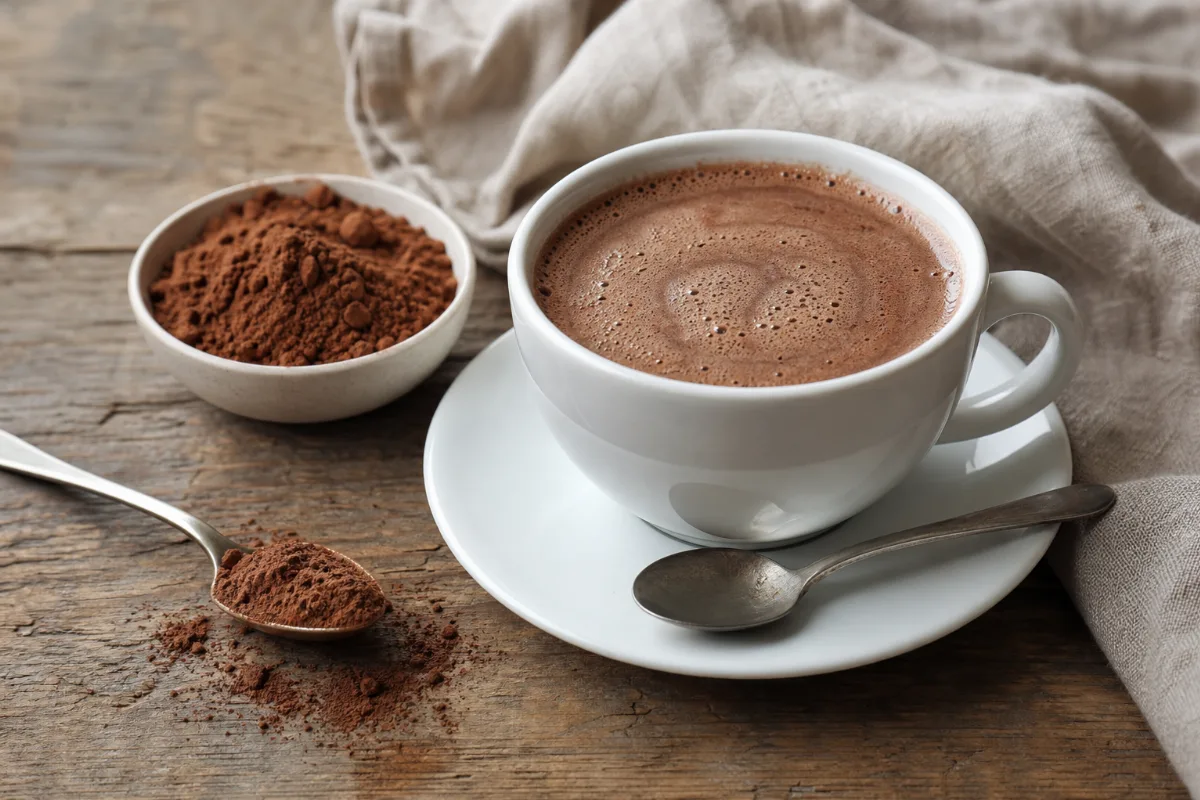
Beverages · Drink
Cocoa & Hot Chocolate
Theobroma cacao (seeds, as a drink) · also called Cocoa, hot cocoa, cacao drink, chocolate caliente
Cocoa and hot chocolate are drinks made by stirring cocoa powder or a cocoa mix into hot water or milk. Trials of flavanol-rich cocoa products found a small drop in blood pressure, about 2 mmHg, but most studies tested extracts, capsules or dark chocolate, not a cup of hot chocolate. Cocoa has a little caffeine, mixes can be high in sugar, and cocoa powder and chocolate can contain cadmium and lead. Milk, soy or nut ingredients in mixes matter for people with allergies.
General information, not medical advice. Last substantive update · Not medically reviewed. A named clinician has not signed off on this page. How this page is made
About Cocoa & Hot Chocolate
Cocoa and hot chocolate are drinks made from cocoa powder or a cocoa mix and water or milk. They are a food and a comfort drink, not a proven remedy. The research is mostly on flavanol-rich cocoa products, extracts and dark chocolate, so what it shows about a cup of hot chocolate is limited.
What it is
Cocoa comes from the seeds of the cacao tree, Theobroma cacao, family Malvaceae (GBIF). The seeds are processed into cocoa powder, which is stirred into hot water or milk to make cocoa or hot chocolate. This page is about the drink and the powders and mixes used to make it. Solid chocolate has its own page.
USDA data for unsweetened cocoa powder, per tablespoon (5.4 g): about 12 kcal, 2 g fibre, 27 mg magnesium, 82 mg potassium, 0.2 mg copper and 12 mg caffeine. Per 100 g: 228 kcal, 19.6 g protein, 8.07 g saturated fat, 37 g fibre and only 1.75 g of sugars. These are values for the dry powder, not a drink.
Powder or mix: the label matters
USDA lists a cocoa mix entry described as 'no sugar added' that still has 37.65 g of sugars per 100 g, about 5.7 g in a 15 g envelope, along with 876 mg of sodium and 576 mg of calcium per 100 g. Plain cocoa powder has 1.75 g of sugars per 100 g.
Once you add water or milk, calories, calcium, protein and allergens change, and the USDA entries do not cover the finished drink. Caffeine is small: about 12 mg in a tablespoon of cocoa powder and about 3 mg in a 15 g mix envelope.
What the research shows
For blood pressure, a Cochrane review of 35 trials found about a 1.76 mmHg fall in systolic and in diastolic pressure with flavanol-rich cocoa products, rated moderate-quality evidence. In people with high blood pressure the systolic fall was about 4 mmHg. Removing trials with industry-employed authors gave a slightly smaller effect. EFSA also concluded that cocoa flavanols help maintain normal blood vessel widening, on an application from a company.
Pooled trials of cocoa extract and dark chocolate found small falls in LDL cholesterol and fasting blood sugar, and no effect on HbA1c, HDL, triglycerides or weight. A large trial of a cocoa extract capsule did not significantly reduce total cardiovascular events but was linked to fewer cardiovascular deaths.
In observational studies of chocolate, higher intake went with lower death rates. That cannot show cause. None of these studies tested a cup of hot chocolate, and a sweet mix is a different exposure from the cocoa products in the trials.
Drink versus extract or chocolate
The blood pressure trials used cocoa products chosen for flavanols, the cholesterol and blood sugar trials used extracts or dark chocolate with at least 70% cocoa, the heart event trial used a capsule, and the death-rate studies were of chocolate. A cup of hot chocolate may carry much less flavanol than any of these. A 2026 review says alkalization (Dutch-process), an optional step, can reduce nutritional value; the abstract gives no flavanol numbers.
At a glance
Traditional uses history, not proof
- Drunk hot as a comfort drink
- Long use as a drink is not proof that it treats any condition
Studied for research
- Blood pressure, moderate certainty for a small fall with flavanol-rich cocoa products (not a typical cup)
- Blood vessel widening, moderate certainty (EFSA opinion on high-flavanol cocoa)
- Cholesterol and fasting blood sugar, low certainty (short trials of extracts and dark chocolate)
- Heart events, mixed (a capsule trial; main result not significant)
- Long-term death rates, low certainty (observational, chocolate)
- Body weight, low certainty of no effect
- Mood and memory, insufficient evidence
Main compounds
- Cocoa flavanols
- Caffeine
- Fibre (in cocoa powder)
- Magnesium, copper and potassium
- Sugar (in mixes)
Common forms
- Unsweetened cocoa powder, dry (USDA values read)
- Cocoa mix, a 'no sugar added' USDA entry, dry (values read)
- Cocoa made with water or milk (not covered by USDA entries)
- Alkalised (Dutch-process) cocoa (one review read)
- Cocoa extract capsules and dark chocolate are different products and are labelled where studied
Research links: 2017 Cochrane review: cocoa and blood pressure (35 trials) · 2022 COSMOS trial: cocoa extract and heart events · 2018 FDA study: cadmium and lead in cocoa and chocolate · Research Library · Genes & Biomarkers Library
What it is and its history
- Accepted scientific name
- Theobroma cacao L.
- Naming authority
- L. (GBIF accepted; the tree whose seeds are made into cocoa)
- Common names
- Cocoa (English); Hot cocoa (English); Hot chocolate (English); Cacao drink (English); Chocolate caliente (Spanish)
- Family or group
- Malvaceae (mallow family), as given by GBIF. Cocoa and hot chocolate are drinks made from the processed seeds of the cacao tree, not the plant itself.
- Classification
- Plantae > Tracheophyta > Magnoliopsida > Malvales > Malvaceae > Theobroma > Theobroma cacao
- Native range
- Not verified from a source read.
- Habitat
- Not verified from a source read.
- What it looks like
- Roots: Not verified.; Stems: Not verified.; Leaves: Not verified.; Flowers: Not verified.; Fruit: Not verified. USDA gives household portions of 1 tablespoon (5.4 g) and 1 cup (86 g) for unsweetened cocoa powder.
- Cultivation
- Not verified from a source read.
- Harvest and processing
- Our existing page says the seeds are fermented, dried, roasted and ground into cocoa powder, which is stirred into hot water or milk; no source for that was re-read, so it is not stated as a finding. A 2026 review says alkalization (Dutch-process) is an optional step that can reduce nutritional value and change the powder.
- Look-alikes and adulterants
- Name: Dark chocolate and cocoa as solid food; Note: Has its own page; most of the studies read were of dark chocolate or extracts.; Name: Cocoa extract capsules; Note: A supplement used in the COSMOS trial; not a drink.; Name: Sweetened cocoa mixes; Note: A different exposure, with more sugar than plain cocoa powder.
- Sustainability and conservation
- Not assessed.
Photographs
What is inside, and how it may work
What it contains and how those compounds act in cells and animals. Laboratory and animal mechanisms are not proven effects in people.
Main compounds
| Compound | Family | Where it is concentrated | Activity studied | Level of evidence |
|---|---|---|---|---|
| Cocoa flavanols | flavanol | Seed (cocoa) Not read for a cup of hot chocolate. Trials gave 30 to 1218 mg flavanols (mean 670 mg) a day in cocoa products; EFSA's opinion names 200 mg a day. | Studied for effects on blood pressure and blood vessel widening; the Cochrane authors say flavanols have been shown to increase endothelial nitric oxide. 5 9 | Human data |
| Caffeine | methylxanthine | Seed (cocoa) USDA per 100 g: 230 mg in unsweetened cocoa powder; 19 mg in the cocoa mix entry | A stimulant; the amount in a serving of cocoa is small but adds up with other sources. 15 16 11 | Human data |
| Copper and magnesium | mineral | Seed (cocoa) USDA per 100 g of unsweetened cocoa powder: copper 3.788 mg, magnesium 499 mg | Nutrient amounts in the dry powder; one tablespoon is a small amount. 15 | Database |
| Cadmium and lead | contaminant | Cadmium 0.004 to 3.15 mg/kg; lead below detection to 0.38 mg/kg in US retail cocoa powder, chocolate and nibs | Not nutrients; measured in products. See Safety. 1 | Lab |
Mechanisms, receptors and pathways
| Target or pathway | Gene or receptor | What was found | Level |
|---|---|---|---|
| Endothelium and nitric oxide (blood vessel lining) | Not specified in the sources read | The Cochrane authors say cocoa flavanols have been shown to increase formation of endothelial nitric oxide, which promotes vasodilation and so blood pressure reduction. EFSA says the mechanisms behind a lasting effect on the blood vessel test are unknown. This is background and an interpretation, not something shown in the trials we read. 5 9 | Human data |
Absorption, metabolism and elimination
- Absorption
- Not found.
- Distribution
- Not found.
- Metabolism
- Not found.
- Elimination
- Not found.
- Bioavailability
- Not established for cocoa in a drink in the sources read.
Isolated compounds versus whole extracts
The blood pressure, cholesterol and blood sugar findings are for flavanol-rich cocoa products, cocoa extracts and at least 70% dark chocolate, not for a cup of hot chocolate. COSMOS tested a capsule. The mortality studies are observational and are about chocolate. A sweetened mix adds sugar and may carry far fewer flavanols than trial products.
Nutritional composition
Nutrition from USDA FoodData Central (SR Legacy, April 2018 release; values read 2026-10-26 from the repo copy of the FoodData Central data). These are dry products, not the finished drink. Unsweetened cocoa powder (FDC 169593), per 100 g: 228 kcal, 19.6 g protein, 13.7 g fat (8.07 g saturated), 57.9 g carbohydrate, 1.75 g sugars, 37 g fibre, 128 mg calcium, 13.86 mg iron, 499 mg magnesium, 734 mg phosphorus, 1,524 mg potassium, 21 mg sodium, 3.788 mg copper, 0.241 mg riboflavin and 230 mg caffeine. One tablespoon (5.4 g, the 100 g values multiplied by 0.054): about 12 kcal, 1.1 g protein, 0.4 g saturated fat, 0.09 g sugars, 2.0 g fibre, 27 mg magnesium, 82 mg potassium, 0.2 mg copper and 12 mg caffeine. Cocoa mix, 'no sugar added' entry (FDC 171886), per 100 g: 377 kcal, 15.49 g protein, 3.0 g fat (1.777 g saturated), 71.93 g carbohydrate, 37.65 g sugars, 7.5 g fibre, 576 mg calcium, 4.96 mg iron, 208 mg magnesium, 2,702 mg potassium, 876 mg sodium, 1.4 mg riboflavin and 19 mg caffeine. One 15 g envelope (the 100 g values multiplied by 0.15): about 57 kcal, 2.3 g protein, 5.7 g sugars, 1.1 g fibre, 86 mg calcium, 405 mg potassium, 131 mg sodium and 2.9 mg caffeine; USDA also lists a 19 g envelope. Once you add water or milk, calories, calcium, protein and allergens change, and USDA's entries do not cover the finished drink. The entries differ a lot in sugar, so check the label.
2 moderate certainty1 mixed findings3 low certainty1 not enough evidence
What was looked at
The 7 benefits and uses checked for Cocoa & Hot Chocolate, each with how strong the evidence is. Tap one to open it.
- Blood pressure (flavanol-rich cocoa products)Moderate certainty
- Blood vessel widening (EFSA health claim on cocoa flavanols)Moderate certainty
- Cholesterol and blood sugar (cocoa extract and dark chocolate)Low certainty
- Heart attacks and strokes (cocoa extract capsule)Mixed findings
- Living longer (observational, chocolate)Low certainty
- Body weight and waistLow certainty
- Mood, memory and thinkingNot enough evidence
Lab markers tracked in the studies
Blood pressure (systolic and diastolic)LDL cholesterolFasting blood glucose
What is Cocoa & Hot Chocolate good for?
The main studied uses and how strong the human evidence is for each. Almost all of it is about cocoa products, extracts or dark chocolate, not a cup of hot chocolate.
Benefits, one by one
Each card is a research question, not a promise. Tap a goal to filter. Open a card to see the studies, doses and limits.
Blood pressure (flavanol-rich cocoa products)
Moderate certaintyA Cochrane review of 35 trials found that flavanol-rich cocoa and chocolate products lowered blood pressure by about 2 mmHg in mainly healthy adults over 2 to 18 weeks. The trials used cocoa products chosen for their flavanol content, not a cup of hot chocolate.
1 studiesFlavanol-rich chocolate and cocoa products in trials. Cocoa amounts i…
Studies, doses and limits
What the trials found
Cochrane (2017): 40 treatment comparisons in 1,804 mainly healthy people, mean 9 weeks. Systolic and diastolic blood pressure each fell by 1.76 mmHg. In people with high blood pressure the systolic fall was about 4 mmHg, and in people with normal pressure there was no significant difference, though the test for a difference was borderline. Excluding trials with industry-employed authors gave a slightly smaller effect.
Results
A small, short-term fall in blood pressure with flavanol-rich cocoa products. Not shown for ordinary hot chocolate.
Effect sizes as reported
Systolic -1.76 mmHg (95% CI -3.09 to -0.43); diastolic -1.76 mmHg (-2.57 to -0.94).
Why this rating
Moderate: the Cochrane authors downgraded from high to moderate because of unexplained differences between trials. The result is for cocoa products chosen for flavanols, not for a typical drink.
Form and dose studied
Flavanol-rich chocolate and cocoa products in trials. Cocoa amounts in the trials ranged from 1.4 to 105 g of product a day (a trial range, not advice).
Who was studied
Mainly healthy adults.
Limits
Short trials, no heart attacks or strokes counted, unexplained differences between trials, some bias from industry-employed trial authors, and a drink may carry far fewer flavanols than the trial products.
Why researchers looked
Cocoa flavanols are plant compounds that researchers think may help blood vessels relax.
Traditional use
Cocoa and hot chocolate are drunk for comfort; long use as a drink is not proof that they treat any condition.
Proposed mechanism Authors background
The Cochrane authors note that flavanols in cocoa have been shown to increase formation of endothelial nitric oxide, which promotes vasodilation. This is background from their introduction, not something the review tested.
A proposed mechanism does not show that the effect happens in people.
Side effects in the trials were mild (stomach complaints, nausea in 1% versus 0.4% in controls). See the Safety tab.
Blood vessel widening (EFSA health claim on cocoa flavanols)
Moderate certaintyEFSA, the European food safety agency, concluded that cocoa flavanols help maintain normal widening of blood vessels. Its opinion is about a blood vessel test in healthy people and applies to high-flavanol cocoa, not to every cup.
1 studiesHigh-flavanol cocoa powder or dark chocolate as defined by EFSA.
Studies, doses and limits
What the trials found
EFSA (2012) weighed a handful of human studies of flow-mediated dilation, a blood vessel function test, and concluded a cause-and-effect link with 'maintenance of normal endothelium-dependent vasodilation'. The opinion names 200 mg of cocoa flavanols a day, which it says could come from 2.5 g of high-flavanol cocoa powder or 10 g of high-flavanol dark chocolate. The application came from Barry Callebaut Belgium nv.
Results
A regulatory conclusion about a blood vessel function test. It is not a claim about heart disease, and ordinary cocoa may have much less flavanol.
Why this rating
Moderate: EFSA accepted the link, but it rests on a small number of studies of one function test, in high-flavanol products, from an application by a company.
Form and dose studied
High-flavanol cocoa powder or dark chocolate as defined by EFSA.
Who was studied
General healthy adult population (EFSA's target group).
Limits
Company applicant (Barry Callebaut Belgium nv). The test is not a disease outcome. Flavanol content of a typical hot chocolate was not found.
Why researchers looked
A company, Barry Callebaut Belgium nv, asked EFSA to check whether cocoa flavanols support healthy blood flow.
Traditional use
Cocoa and hot chocolate are drunk for comfort; long use as a drink is not proof that they treat any condition.
Proposed mechanism Regulatory opinion
EFSA says the mechanisms by which regular cocoa flavanols may produce a lasting effect on the blood vessel test are unknown.
A proposed mechanism does not show that the effect happens in people.
Not applicable.
Cholesterol and blood sugar (cocoa extract and dark chocolate)
Low certaintyTwo pooled analyses of short trials found lower LDL ('bad') and total cholesterol with cocoa products or dark chocolate. A 2024 analysis also found lower fasting blood sugar but no change in HbA1c (a three-month blood sugar marker). These are blood-test markers in trials of extracts and dark chocolate, not hot chocolate.
2 studiesCocoa extract and dark chocolate with at least 70% cocoa; flavanol-ri…
Studies, doses and limits
What the trials found
2011: 10 trials (320 people, 2 to 12 weeks) of flavanol-rich cocoa or dark chocolate found LDL -5.90 mg/dL and total cholesterol -6.23 mg/dL, with no significant change in HDL or triglycerides. 2024: 31 trials (1,986 adults, at least 4 weeks) of cocoa extract or at least 70% dark chocolate found total cholesterol -8.35 mg/dL, LDL -9.47 mg/dL, fasting glucose -4.91 mg/dL, with no effect on triglycerides, HDL, HbA1c or weight.
Results
Small falls in LDL, total cholesterol and fasting glucose in short trials. No change in HDL, triglycerides, HbA1c or body weight.
Effect sizes as reported
2011: LDL -5.90 mg/dL (95% CI -10.47 to -1.32). 2024: LDL -9.47 mg/dL (-13.75 to -5.20); fasting glucose -4.91 mg/dL (-8.29 to -1.52); HbA1c no significant effect.
Why this rating
Low: short trials of blood-test markers, extracts and dark chocolate pooled together, with no certainty rating in the abstracts. Not tested with hot chocolate, and a sweetened mix adds sugar.
Form and dose studied
Cocoa extract and dark chocolate with at least 70% cocoa; flavanol-rich cocoa products.
Who was studied
Adults, with and without health conditions (2024 analysis).
Limits
Markers, not disease. Short duration. Extract and chocolate pooled. Dark chocolate carries saturated fat and calories, which the 2011 authors point out.
Why researchers looked
Cocoa products are rich in flavanols, and researchers asked whether they change blood fats and sugar.
Traditional use
Cocoa and hot chocolate are drunk for comfort; long use as a drink is not proof that they treat any condition.
Proposed mechanism None
Not shown in the sources read.
A proposed mechanism does not show that the effect happens in people.
Sweetened mixes add sugar; see Safety.
Heart attacks and strokes (cocoa extract capsule)
Mixed findingsIn COSMOS, a large trial in older adults, a cocoa extract capsule did not significantly reduce total heart and blood vessel events, but fewer people died of cardiovascular causes. The trial tested a capsule, not a drink.
1 studiesCocoa extract capsule with 500 mg flavanols a day.
Studies, doses and limits
What the trials found
21,442 older US adults took a cocoa extract capsule (500 mg flavanols a day) or placebo for a median 3.6 years. Total cardiovascular events: 410 with cocoa vs 456 with placebo (HR 0.90, 95% CI 0.78 to 1.02, not significant). Cardiovascular death HR 0.73 (0.54 to 0.98); heart attack HR 0.87; stroke HR 0.91; all-cause death HR 0.89 (0.77 to 1.03). A per-protocol analysis (counting only adherent people) gave HR 0.85 (0.72 to 0.99). No safety concerns.
Results
The main result was not significant. A lower cardiovascular death rate and the per-protocol result are suggestive and need confirming.
Effect sizes as reported
Total events HR 0.90 (0.78 to 1.02); cardiovascular death HR 0.73 (0.54 to 0.98).
Why this rating
Mixed: a single large randomised trial where the primary outcome was not significant and a secondary outcome was. Capsule, not a drink.
Form and dose studied
Cocoa extract capsule with 500 mg flavanols a day.
Who was studied
Women 65 or older and men 60 or older, free of major cardiovascular disease.
Limits
A supplement, so it cannot be applied to hot chocolate. Secondary outcomes carry more chance of false positives. Older US adults.
Why researchers looked
After small trials suggested better blood pressure and blood vessel function, researchers tested real heart events.
Traditional use
Cocoa and hot chocolate are drunk for comfort; long use as a drink is not proof that they treat any condition.
Proposed mechanism None
Not tested in this trial.
A proposed mechanism does not show that the effect happens in people.
No safety concerns in the trial.
Living longer (observational, chocolate)
Low certaintyIn a large study of Finnish men who smoke and in a pooled analysis of cohort studies, more chocolate went with lower death rates. This links chocolate, not cocoa drinks, to outcomes and cannot show that chocolate was the cause.
1 studiesChocolate eaten as food, from a questionnaire.
Studies, doses and limits
What the trials found
ATBC cohort (27,111 men, followed through 2015): overall death risk was 9 to 12% lower in higher chocolate groups than in the lowest, and deaths from cardiovascular disease, heart disease and cancer were 13%, 16% and 12% lower in the highest group. A meta-analysis of cohort studies (21 estimates, 908,390 people) found a pooled relative risk of 0.98 per 5 g of chocolate a day for cardiovascular disease incidence and death.
Results
An association from food questionnaires, in chocolate rather than cocoa drinks.
Effect sizes as reported
Overall death HR 0.91, 0.89, 0.89, 0.88 across higher groups; cardiovascular death 13% lower; pooled RR 0.98 per 5 g a day.
Why this rating
Low: observational, so cannot show cause. People who eat more chocolate may differ in other ways. Chocolate, not hot chocolate.
Form and dose studied
Chocolate eaten as food, from a questionnaire.
Who was studied
Men in the ATBC cancer prevention study; cohort studies in adults for the meta-analysis.
Limits
Observational. Chocolate also carries sugar, fat and calories. The authors say calorie-balanced intake.
Why researchers looked
Observational studies can show whether people who eat more chocolate live longer, though not why.
Traditional use
Cocoa and hot chocolate are drunk for comfort; long use as a drink is not proof that they treat any condition.
Proposed mechanism Authors analysis
The authors found that 4.3% of the link with overall death was explained by lower blood pressure; other reasons were not shown.
A proposed mechanism does not show that the effect happens in people.
Not applicable.
Body weight and waist
Low certaintyThe 2024 pooled analysis of 31 trials found no effect of cocoa extract or dark chocolate on body weight, BMI or waist size.
1 studiesCocoa extract or at least 70% dark chocolate.
Studies, doses and limits
What the trials found
31 trials (1,986 adults, at least 4 weeks) found no significant effect on body weight, BMI or waist circumference.
Results
No effect found on these measures; nothing about hot chocolate with sugar and milk.
Effect sizes as reported
No significant effect (numbers not given in the abstract).
Why this rating
Low: a no-effect result from short trials of extracts and dark chocolate.
Form and dose studied
Cocoa extract or at least 70% dark chocolate.
Who was studied
Adults, with and without comorbidities.
Limits
Not hot chocolate. A sweetened drink adds calories and sugar; see Safety.
Why researchers looked
People ask whether cocoa helps or harms weight.
Traditional use
Cocoa and hot chocolate are drunk for comfort; long use as a drink is not proof that they treat any condition.
Proposed mechanism None
Not applicable.
A proposed mechanism does not show that the effect happens in people.
Not applicable.
Mood, memory and thinking
Not enough evidenceNo study of cocoa or hot chocolate and mood, memory or thinking was read for this page, so we cannot say whether it helps.
0 studiesNot applicable.
Studies, doses and limits
What the trials found
No study was read.
Results
Insufficient evidence in the sources read.
Why this rating
Insufficient: no human study was read.
Limits
The absence of evidence here reflects what we read, not proof that there is no effect.
Why researchers looked
Cocoa is often described as a comfort drink and a mood lifter.
Traditional use
Cocoa and hot chocolate are drunk for comfort; long use as a drink is not proof that they treat any condition.
Proposed mechanism None
Not applicable.
A proposed mechanism does not show that the effect happens in people.
Not applicable.
Connections to the rest of health
How Cocoa & Hot Chocolate connects to the rest of our health knowledge graph. Every link says what kind of connection it is. A safety link (for example to the liver) is a warning, not a benefit. A study that merely mentions a topic never creates a benefit link.
Explore every connection: goals, body systems, organs, symptoms, genes
A. Wellness goals
| Connected to | Kind of connection | Evidence status | Context | Studies |
|---|---|---|---|---|
| Blood Pressure Support | Demonstrated clinical effect | Moderate certainty | Blood pressure (flavanol-rich cocoa products): A Cochrane review of 35 trials found that flavanol-rich cocoa and chocolate products lowered blood pressure by about 2 mmHg in mainly healthy adults over 2 to 18 weeks. The trials used cocoa products chosen for their flavanol content, not a cup of hot chocolate. | 5 |
| Heart Health | Demonstrated clinical effect | Moderate certainty | Blood pressure (flavanol-rich cocoa products): A Cochrane review of 35 trials found that flavanol-rich cocoa and chocolate products lowered blood pressure by about 2 mmHg in mainly healthy adults over 2 to 18 weeks. The trials used cocoa products chosen for their flavanol content, not a cup of hot chocolate. | 5 |
| Circulation Support | Moderate certainty | Blood vessel widening (EFSA health claim on cocoa flavanols): EFSA, the European food safety agency, concluded that cocoa flavanols help maintain normal widening of blood vessels. Its opinion is about a blood vessel test in healthy people and applies to high-flavanol cocoa, not to every cup. | 9 | |
| Cholesterol Balance | Low certainty | Cholesterol and blood sugar (cocoa extract and dark chocolate): Two pooled analyses of short trials found lower LDL ('bad') and total cholesterol with cocoa products or dark chocolate. A 2024 analysis also found lower fasting blood sugar but no change in HbA1c (a three-month blood sugar marker). These are blood-test markers in trials of extracts and dark chocolate, not hot chocolate. | 7 2 | |
| Blood Sugar Balance | Low certainty | Cholesterol and blood sugar (cocoa extract and dark chocolate): Two pooled analyses of short trials found lower LDL ('bad') and total cholesterol with cocoa products or dark chocolate. A 2024 analysis also found lower fasting blood sugar but no change in HbA1c (a three-month blood sugar marker). These are blood-test markers in trials of extracts and dark chocolate, not hot chocolate. | 7 2 | |
| Heart Health | Low certainty | Cholesterol and blood sugar (cocoa extract and dark chocolate): Two pooled analyses of short trials found lower LDL ('bad') and total cholesterol with cocoa products or dark chocolate. A 2024 analysis also found lower fasting blood sugar but no change in HbA1c (a three-month blood sugar marker). These are blood-test markers in trials of extracts and dark chocolate, not hot chocolate. | 7 2 | |
| Heart Health | Mixed findings | Heart attacks and strokes (cocoa extract capsule): In COSMOS, a large trial in older adults, a cocoa extract capsule did not significantly reduce total heart and blood vessel events, but fewer people died of cardiovascular causes. The trial tested a capsule, not a drink. | 6 | |
| Longevity | Low certainty | Living longer (observational, chocolate): In a large study of Finnish men who smoke and in a pooled analysis of cohort studies, more chocolate went with lower death rates. This links chocolate, not cocoa drinks, to outcomes and cannot show that chocolate was the cause. | 8 | |
| Heart Health | Low certainty | Living longer (observational, chocolate): In a large study of Finnish men who smoke and in a pooled analysis of cohort studies, more chocolate went with lower death rates. This links chocolate, not cocoa drinks, to outcomes and cannot show that chocolate was the cause. | 8 | |
| Healthy Weight | Low certainty | Body weight and waist: The 2024 pooled analysis of 31 trials found no effect of cocoa extract or dark chocolate on body weight, BMI or waist size. | 2 | |
| Mood Support | Not enough evidence | Mood, memory and thinking: No study of cocoa or hot chocolate and mood, memory or thinking was read for this page, so we cannot say whether it helps. | ||
| Focus And Memory | Not enough evidence | Mood, memory and thinking: No study of cocoa or hot chocolate and mood, memory or thinking was read for this page, so we cannot say whether it helps. |
B. Body systems
| Connected to | Kind of connection | Evidence status | Context | Studies |
|---|---|---|---|---|
| Cardiovascular System | Biological association | Moderate certainty | Studied for: Blood pressure (flavanol-rich cocoa products) Studied for: Blood vessel widening (EFSA health claim on cocoa flavanols) | 5 9 7 2 6 8 |
| Endocrine System | Biological association | Low certainty | Studied for: Cholesterol and blood sugar (cocoa extract and dark chocolate) | 7 2 |
| Metabolic System | Biological association | Low certainty | Studied for: Body weight and waist | 2 |
| Nervous System | Biological association | Not enough evidence | Studied for: Mood, memory and thinking |
E. Health conditions
| Connected to | Kind of connection | Evidence status | Context | Studies |
|---|---|---|---|---|
| Food allergy | Adverse effect or risk | Documented risk | Milk and soybeans are major food allergens; mixes and milk-based drinks may contain them. Preparation or compound: Milk, soy or nut ingredients in mixes and prepared drinks |
10 13 |
| High blood pressure | Preliminary | Flavanol-rich cocoa products lowered blood pressure by about 2 mmHg in a Cochrane review; not a treatment and not tested with hot chocolate. Preparation or compound: Flavanol-rich cocoa products |
5 |
I. Biomarkers
| Connected to | Kind of connection | Evidence status | Context | Studies |
|---|---|---|---|---|
| Blood pressure (systolic and diastolic) | Biological association | Moderate certainty | Measured in trials: lowered. A lab change is not the same as a health benefit. | 5 2 |
| LDL cholesterol | Biological association | Low certainty | Measured in trials: lowered. A lab change is not the same as a health benefit. | 7 2 |
| Fasting blood glucose | Biological association | Low certainty | Measured in trials: lowered. A lab change is not the same as a health benefit. | 2 |
K. Biological pathways
L. Active compounds
| Connected to | Kind of connection | Evidence status | Context | Studies |
|---|---|---|---|---|
| Caffeine | Adverse effect or risk | Documented | Small amounts per serving that add to caffeine from other sources; pregnancy limit per NHS. Preparation or compound: Caffeine in cocoa |
11 14 15 |
| Cocoa flavanols | Biological association | Human | Studied for effects on blood pressure and blood vessel widening; the Cochrane authors say flavanols have been shown to increase endothelial nitric oxide. Preparation or compound: Seed (cocoa) |
5 9 |
| Caffeine | Biological association | Human | A stimulant; the amount in a serving of cocoa is small but adds up with other sources. Preparation or compound: Seed (cocoa) |
15 16 11 |
| Copper and magnesium | Biological association | Database | Nutrient amounts in the dry powder; one tablespoon is a small amount. Preparation or compound: Seed (cocoa) |
15 |
| Cadmium and lead | Biological association | Lab | Not nutrients; measured in products. See Safety. | 1 |
Each connection is stored with the ingredient, the connected record, the kind of connection, the evidence status, the supporting studies, the preparation or compound involved, and a review date (last reviewed October 26, 2026).
The evidence
The research centre for Cocoa & Hot Chocolate. Every record here was checked against PubMed or the publisher's page; we never list a study we have not verified.
Evidence by outcome
Bars show how many studies we found for each outcome, not how well it works. People are added up across trials only (reviews are not added, to avoid double counting).
How we rate evidence
High certainty
Several well-run trials or reviews agree; further research is unlikely to change the picture much.
Moderate certainty
Good trials point the same way, but some doubt remains.
Low certainty
Small, short or inconsistent trials. The finding could change with better research.
Very low certainty
Very little or very weak human data. Treat as a possibility only.
Mixed findings
Trials or reviews disagree with each other.
Not enough evidence
Not enough human research to say either way.
Evidence against
Good research found no benefit, or found harm.
We take the reviewers' own risk-of-bias and GRADE statements where they exist, and otherwise judge from study size, design, consistency, directness and whether a product matches what is sold. Many publications do not make evidence high. Method note: We started from our existing cocoa and hot chocolate summary, re-checked nutrition against saved USDA FoodData Central data, read the agency pages (FDA, NHS, WHO, MedlinePlus), the EFSA opinion abstract and re-read PubMed abstracts for the reviews, the trial, the cohort study and the metal analyses. Only abstracts were read for studies. This is a smaller page than most because little direct research on cocoa drinks exists in what we read. Items we could not verify are flagged in the research gaps.
Study library: every study we checked 17
| Study | Design | People | Product, dose, length | Result |
|---|---|---|---|---|
| Abt 2018 Cadmium and lead in cocoa powder and chocolate products in the US Market. Food Addit Contam Part B Surveill · PMID 29310543 · DOI |
Laboratory analysis n/a |
Convenience sample of cocoa powder, dark chocolate, milk chocolate and cocoa nibs bought at US retail | Retail cocoa powder and chocolate products Cocoa powder, chocolate and nibs |
Cadmium and lead were found in the products. Both rose with percent cocoa solids, with patterns varying by product type and origin. Cadmium was higher in products reported from Latin America than from Africa. Cadmium 0.004 to 3.15 mg/kg; lead below the limit of detection to 0.38 mg/kg (Not applicable) Methods, limits and fundingOutcomes: Cadmium and lead concentrations Limitations: A convenience sample, so not a market average. It measures the products, not what people absorb. It does not separate cocoa powder from the other products in the abstract. Funding and conflicts: Authors are US FDA scientists (government). No industry funding stated. Read: abstract |
| Arisi 2024 Effects of Cocoa Consumption on Cardiometabolic Risk Markers: Meta-Analysis of Randomized Controlled Trials. Nutrients · PMID 38931273 · DOI |
Systematic review meta analysis |
1986 31 randomised trials, 1,986 adults, at least 4 weeks |
Cocoa extract or dark chocolate with at least 70% cocoa Cocoa extract and dark chocolate Trial detail not given in the abstract At least 4 weeks · vs Control |
No effect on body weight, BMI, waist, triglycerides, HDL or HbA1c. Lower total cholesterol, LDL, fasting glucose and blood pressure. Total cholesterol -8.35 mg/dL; LDL -9.47 mg/dL; fasting glucose -4.91 mg/dL; systolic -2.52 mmHg; diastolic -1.58 mmHg (Total cholesterol -14.01 to -2.69; LDL -13.75 to -5.20; fasting glucose -8.29 to -1.52 mg/dL; systolic -4.17 to -0.88; diastolic -2.54 to -0.62 mmHg) Methods, limits and fundingOutcomes: Body weight, BMI, waist, cholesterol, triglycerides, blood glucose, HbA1c, blood pressure Limitations: Extracts and dark chocolate combined, not a drink. Blood-test markers, not disease. The abstract does not give certainty ratings. Funding and conflicts: Authors declare no conflicts of interest. Read: abstract |
| Binello 2026 An upgrade in cocoa alkalization: Functional changes, chemistry and new perspectives. Food Chem · PMID 41365157 · DOI |
Narrative review n/a |
Literature review of the past five years on cocoa alkalization | Alkalized cocoa powder Cocoa nibs, cake and powder |
Alkalization is an optional step in making cocoa powder. It can reduce nutritional value and change physical and chemical properties. The review says conditions are hard to standardise. No numbers in the abstract (Not applicable) Methods, limits and fundingOutcomes: Effects of alkalization on cocoa quality Limitations: A technology review; the abstract gives no flavanol numbers and no data for hot chocolate. Funding and conflicts: Authors declare no competing interests. Read: abstract |
| Nesic 2024 Impact of Chocolate Cadmium on Vulnerable Populations in Serbia. Foods · PMID 39796308 · DOI |
Laboratory analysis risk assessment n/a |
155 155 milk and dark chocolates from the Serbian market |
Chocolate (milk and dark) Chocolate |
Estimated weekly cadmium intakes were below tolerable limits in all samples, but in some samples reached about 61% and 64% of the limit for toddlers and other children. No health risk by hazard quotient; the cancer-risk calculation classed all chocolates as moderate risk. Cadmium 0.010 to 0.29 mg/kg; estimated weekly intake up to 60.9% (toddlers) and 63.5% (other children) of the tolerable limit (Not applicable) Methods, limits and fundingOutcomes: Cadmium levels and modelled health risk Limitations: Modelled estimates for chocolate, not cocoa drinks. Serbian market only. Funding and conflicts: Authors declare no conflicts of interest. Read: abstract |
| Ried 2017 Effect of cocoa on blood pressure. Cochrane Database Syst Rev · PMID 28439881 · DOI |
Systematic review meta analysis |
1804 35 randomised trials (40 treatment comparisons), 1,804 mainly healthy adults, 2 to 18 weeks (mean 9 weeks) |
Flavanol-rich chocolate and cocoa products versus flavanol-free or low-flavanol products Cocoa and chocolate products Trials gave 30 to 1218 mg flavanols (mean 670 mg) in 1.4 to 105 g of cocoa product a day (trial detail, not advice) 2 to 18 weeks (mean 9) · vs Flavanol-free or low-flavanol product or placebo |
Flavanol-rich cocoa products lowered blood pressure by a small amount. Quality of evidence moderate (downgraded from high because of unexplained differences between trials). Excluding trials with authors employed by industry gave a slightly smaller effect, which the reviewers read as some reporting bias. Side effects (stomach complaints, nausea) were reported by 1% in the cocoa groups and 0.4% in control groups. Systolic -1.76 mmHg (40 comparisons); diastolic -1.76 mmHg (39 comparisons). In people with high blood pressure, systolic about -4 mmHg; no significant difference in people with normal pressure (test for difference borderline). (Systolic -3.09 to -0.43; diastolic -2.57 to -0.94 mmHg) Methods, limits and fundingOutcomes: Systolic and diastolic blood pressure Limitations: Flavanol-rich products, not a cup of hot chocolate. Unexplained differences between trials. Short trials; no clinical outcomes. Unblinded trials tended to show larger drops. Funding and conflicts: Cochrane review. Two of the review authors were investigators on included trials (declared). Some included trials had authors employed by industry. Read: abstract |
| Sesso 2022 Effect of cocoa flavanol supplementation for the prevention of cardiovascular disease events: the COcoa Supplement and Multivitamin Outcomes Study (COSMOS) randomized clinical trial. Am J Clin Nutr · PMID 35294962 · DOI |
Randomised controlled trial |
21442 21,442 US adults (women 65 or older, men 60 or older) free of major cardiovascular disease and recently diagnosed cancer; median follow-up 3.6 years |
Cocoa extract supplement (500 mg flavanols a day, including 80 mg epicatechin) Cocoa extract capsule 500 mg flavanols a day (trial detail, not advice) Median 3.6 years · vs Placebo |
Cocoa extract did not significantly reduce total cardiovascular events but was linked to fewer cardiovascular deaths (a secondary outcome). Per-protocol analysis, which counts only people who kept taking it, supported fewer events. No safety concerns reported. Total events HR 0.90 (410 vs 456 people), P=0.11; cardiovascular death HR 0.73; heart attack HR 0.87; stroke HR 0.91; all-cause death HR 0.89; per-protocol HR 0.85 (Total events 0.78 to 1.02; cardiovascular death 0.54 to 0.98; per-protocol 0.72 to 0.99) Methods, limits and fundingOutcomes: Total cardiovascular events (heart attack, stroke, revascularisation, cardiovascular death, carotid disease, peripheral artery surgery, unstable angina) Limitations: A capsule, not a drink. The primary result was not significant; the death result is a secondary finding. Older US adults only. Funding and conflicts: Listed as NIH extramural research support. Other funding or product supply is not stated in the abstract, so industry involvement is not ruled out. Registration: NCT02422745 Read: abstract |
| Tokede 2011 Effects of cocoa products/dark chocolate on serum lipids: a meta-analysis. Eur J Clin Nutr · PMID 21559039 · DOI |
Systematic review meta analysis |
320 10 randomised trials, 320 participants, 2 to 12 weeks |
Flavanol-rich cocoa products or dark chocolate Cocoa products and dark chocolate Trial detail not given in the abstract 2 to 12 weeks · vs Control without the cocoa product |
Dark chocolate and cocoa products lowered LDL and total cholesterol and had no significant effect on HDL or triglycerides in short trials. LDL -5.90 mg/dL; total cholesterol -6.23 mg/dL; HDL -0.76 mg/dL (not significant); triglycerides -5.06 mg/dL (not significant) (LDL -10.47 to -1.32; total cholesterol -11.60 to -0.85; HDL -3.02 to 1.51; triglycerides -13.45 to 3.32 mg/dL) Methods, limits and fundingOutcomes: LDL, total cholesterol, HDL, triglycerides Limitations: Small (320 people), short trials, blood-test markers only. Dark chocolate and cocoa products combined; not hot chocolate. Funding and conflicts: Funding not stated in the abstract. Read: abstract |
| Zhao 2022 Relationship between chocolate consumption and overall and cause-specific mortality, systematic review and updated meta-analysis. Eur J Epidemiol · PMID 35460393 · DOI |
Cohort study and meta analysis |
27111 27,111 men in the ATBC cancer prevention study, recruited 1985 to 1988 and followed through 2015; plus a meta-analysis of cohort studies (21 risk estimates, 908,390 people) |
Chocolate eaten as food, from a food frequency questionnaire Chocolate Followed through 2015 · vs Lowest chocolate intake |
More chocolate went with lower overall, cardiovascular, heart disease and cancer death in the cohort. The meta-analysis linked more chocolate with lower cardiovascular disease incidence and death. Overall death HR 0.91, 0.89, 0.89, 0.88 for higher intake groups versus lowest; cardiovascular death 13%, heart disease death 16% and cancer death 12% lower in highest group; meta-analysis pooled RR 0.98 per 5 g a day (Not given in the abstract) Methods, limits and fundingOutcomes: Overall and cause-specific death, cardiovascular disease Limitations: Observational: cannot show cause. Chocolate, not cocoa drinks. Food questionnaire at the start. The cohort is men only. Funding and conflicts: Authors declare no conflict of interest. Read: abstract |
| s-efsa-2012 EFSA NDA Panel: Scientific Opinion on the substantiation of a health claim related to cocoa flavanols and maintenance of normal endothelium-dependent vasodilation (EFSA Journal 2012;10(7):2809) · Source |
Regulatory opinion n/a |
Methods, limits and fundingRead: abstract | ||
| s-fda-allergens US FDA: Food Allergies · Source |
Health agency n/a |
Methods, limits and fundingRead: full-text | ||
| s-fda-caffeine US FDA: Spilling the Beans: How Much Caffeine Is Too Much? · Source |
Health agency n/a |
Methods, limits and fundingRead: full-text | ||
| s-gbif-theobroma-cacao GBIF species match: Theobroma cacao L. · Source |
Reference database n/a |
Methods, limits and fundingRead: api-response | ||
| s-medlineplus-foodallergy MedlinePlus: Food Allergy · Source |
Health agency n/a |
Methods, limits and fundingRead: full-text | ||
| s-nhs-foods-to-avoid NHS: Foods to avoid in pregnancy · Source |
Health agency n/a |
Methods, limits and fundingRead: full-text | ||
| s-usda-169593 USDA FoodData Central: Cocoa, dry powder, unsweetened (SR Legacy, FDC 169593) · Source |
Reference database n/a |
Methods, limits and fundingRead: reference-copy | ||
| s-usda-171886 USDA FoodData Central: Beverages, Cocoa mix, no sugar added, powder (SR Legacy, FDC 171886) · Source |
Reference database n/a |
Methods, limits and fundingRead: reference-copy | ||
| s-who-healthy-diet WHO: Healthy diet fact sheet · Source |
Health agency n/a |
Methods, limits and fundingRead: full-text |
What we do not know yet
- No trial of a cup of cocoa or hot chocolate was found for blood pressure, cholesterol, blood sugar, heart events, mood or memory; the results are for flavanol-rich cocoa products, extracts, capsules or dark chocolate.
- The flavanol content of a typical cup of hot chocolate, and of Dutch-process cocoa, was not found.
- The long-term death findings are observational and about chocolate, not drinks.
- No source read gave cadmium or lead limits for cocoa drinks, or named a medicine interaction with cocoa.
- Lactose intolerance, kidney and potassium advice, acid reflux, migraine, tyramine, oxalate and storage were not researched.
- History, origin and how cocoa is made were not read from a source.
How new research is added
New studies are found by a saved PubMed search and placed in a review queue before the page changes.
Lab markers
What changed in blood or saliva tests during trials. A changed number is not the same as feeling or being healthier, and we give no "normal ranges".
Metabolic 1
LDL cholesterol
Lowered in trials
The 'bad' cholesterol carried in the blood. Higher levels are linked to more heart disease.
Low certaintyResults and what it means
Why it was measured
It is the usual blood marker used in diet trials for heart risk.
Statistical vs. clinical meaning
Small falls in short trials; extracts and dark chocolate, not hot chocolate.
Safety implication
None specific.
| Study | Result | People | Product |
|---|---|---|---|
| 7 | LDL -5.90 mg/dL (95% CI -10.47 to -1.32); total cholesterol -6.23 mg/dL | 320 people in 10 trials | Flavanol-rich cocoa products or dark chocolate, 2 to 12 weeks |
| 2 | LDL -9.47 mg/dL (95% CI -13.75 to -5.20); total cholesterol -8.35 mg/dL | 31 trials, 1,986 adults | Cocoa extract or at least 70% dark chocolate |
Other 2
Blood pressure (systolic and diastolic)
Lowered in trials
The pressure of blood in the arteries, written as two numbers. The top number is systolic and the bottom number is diastolic.
Moderate certaintyResults and what it means
Why it was measured
High blood pressure raises the risk of heart attack and stroke.
Statistical vs. clinical meaning
A small average fall in short trials with cocoa products chosen for flavanols.
Safety implication
None specific from the trials.
Fasting blood glucose
Lowered in trials
The level of sugar in the blood after not eating for several hours.
Low certaintyResults and what it means
Why it was measured
It is a standard marker for blood sugar control.
Statistical vs. clinical meaning
A small fall in one marker; the three-month marker HbA1c did not change.
Safety implication
A sweetened mix adds sugar; see Safety.
| Study | Result | People | Product |
|---|---|---|---|
| 2 | Fasting glucose -4.91 mg/dL (95% CI -8.29 to -1.52); HbA1c no significant effect | 31 trials, 1,986 adults | Cocoa extract or at least 70% dark chocolate, at least 4 weeks |
Safety
What studies and official sources say about side effects, medicines and who should check first. Each point shows what kind of evidence it comes from.
Main points to know 4
- Caffeine is small, but it counts. USDA lists 230 mg of caffeine per 100 g of unsweetened cocoa powder, about 12 mg in a tablespoon (5.4 g), and 19 mg per 100 g in the cocoa mix entry, about 3 mg in a 15 g envelope. That is much less than coffee, but cocoa adds to the caffeine from tea, cola and chocolate. The FDA has cited 400 mg a day as an amount not generally associated with negative effects for most adults, with wide differences in sensitivity. In pregnancy, the NHS says no more than 200 mg a day from all sources. Authoritative guidance 15 16 11 14
- Sugar and calories in mixes. USDA lists 1.75 g of sugars per 100 g of unsweetened cocoa powder but 37.65 g per 100 g for a cocoa mix entry that is named 'no sugar added'. WHO says free sugars should be less than 10% of daily energy, and 5% or less may give extra benefit. Read the label of the mix you use. Database and guidance 15 16 17
- Cadmium and lead. An FDA study found cadmium (0.004 to 3.15 mg/kg) and lead (below detection to 0.38 mg/kg) in retail cocoa powder, chocolate and nibs, rising with cocoa percentage and higher in products reported from Latin America than Africa. A study of 155 chocolates in Serbia estimated weekly cadmium intakes below tolerable limits but up to about 61% and 64% of the limit for toddlers and other children in some samples. These studies measured cocoa powder and chocolate, not the finished drink, and no regulatory limit for cocoa drinks was read. Laboratory analysis 1 4
- Milk and other allergens. The US FDA lists milk and soybeans among the nine major food allergens, and MedlinePlus lists cow's milk, soy and tree nuts among common causes of food allergy. Hot chocolate is often made with milk and mixes may contain milk, soy or nut ingredients: read the label. Anaphylaxis is a medical emergency; call 911 or your local emergency number. Authoritative guidance 10 13
Side effects 3
| Effect | How often | Severity and recovery | Evidence |
|---|---|---|---|
| Stomach complaints and nausea These were flavanol-rich cocoa products in trials, not a typical mix. | 1% of people in the cocoa groups versus 0.4% in control groups, in trials of flavanol-rich cocoa products | mild Not described in the abstract. | Randomised trials 5 |
| Allergic reactions to milk, soy or nut ingredients in mixes and prepared drinks Cocoa itself was not named as a major allergen in the sources read; the concern is the ingredients added to drinks. | Not established | can be severe (anaphylaxis) Not described. | Authoritative guidance 10 13 |
| Too much caffeine: sleep and other effects in sensitive people FDA says sensitivity varies widely, and certain conditions and some medications raise sensitivity. | Not established | varies Not described. | Authoritative guidance 11 |
Liver
No liver injury from cocoa or hot chocolate was found in the sources read. A liver-safety source (such as LiverTox) was not searched for cocoa.
How often. No frequency was found.
Monitoring. No agency monitoring advice was found.
This is a safety connection. It is not evidence that Cocoa & Hot Chocolate supports liver health.
Medicines and supplements 2
| With | Why it matters | Importance | Evidence | What to do |
|---|---|---|---|---|
| Medicines and conditions that raise caffeine sensitivity prescription-and-conditions | The FDA says certain conditions tend to make people more sensitive to caffeine and so can some medications. Cocoa has small amounts of caffeine. | The FDA page does not name a specific medicine or tie it to cocoa. The caffeine in a tablespoon of cocoa powder is small. | Authoritative guidance Very low certainty 11 | If you take medicine and notice jitters, a fast heartbeat or poor sleep after caffeine, ask your pharmacist or doctor whether caffeine matters for you. |
| Other medicines prescription | No interaction between cocoa as a drink and a named medicine was found in the sources read. | Not established either way. Absence of a finding is not proof of safety. | None found Not enough evidence | If you take medicine regularly, ask a pharmacist before making cocoa a daily habit. |
Who should check first 3
| Situation | Advice | Evidence |
|---|---|---|
| Milk allergy, soy allergy or tree nut allergy, with a mix or milk-based drink | Read the ingredient list and 'contains' statement. Ask an allergist about your own case. For trouble breathing or swelling of the face, lips or throat, call 911 or your local emergency number. | Authoritative guidance 10 13 |
| Pregnancy: caffeine from all sources | The NHS says to have no more than 200 mg of caffeine a day and lists chocolate among sources. Ask your midwife or doctor. | Authoritative guidance 14 |
| Babies and toddlers under 2: caffeinated drinks | The FDA says the Dietary Guidelines for Americans advise avoiding drinks containing caffeine for children younger than age 2. Ask your child's doctor. | Authoritative guidance 11 |
Overdose, product quality and regulators
Summary. No toxicity from cocoa or hot chocolate as ordinary food was found in the sources read. The points are caffeine, sugar, metals and allergens.
Animal. Not reviewed.
High dose or long term signals. The Cochrane review asks for long-term trials to assess possible adverse effects of regular cocoa product use. The COSMOS trial reported no safety concerns for a cocoa extract capsule over a median 3.6 years.
Overdose response. Not found.
Genotoxicity. Not researched.
Cadmium and lead occur in cocoa powder and chocolate from environmental sources. Levels vary by product, cocoa percentage and origin.
Cadmium and lead in US retail cocoa products. Cadmium 0.004 to 3.15 mg/kg and lead below detection to 0.38 mg/kg, higher with more cocoa solids; cadmium higher in products reported from Latin America than from Africa. 1
Cadmium in children from chocolate. Modelled weekly intakes were below tolerable limits but reached about 61% to 64% of the limit for toddlers and other children in some samples. 4
Alkalised (Dutch-process) cocoa. A 2026 review says alkalization, an optional step, can reduce nutritional value. It gives no flavanol numbers in the abstract. 3
| Body | Action | Date |
|---|---|---|
| US FDA (United States) | Caffeine: 400 mg a day cited as an amount not generally associated with negative effects for most adults; avoid caffeinated drinks for children younger than 2 per the Dietary Guidelines for Americans. source | 2024-08-28 |
| NHS (United Kingdom) | Foods to avoid in pregnancy: no more than 200 mg of caffeine a day; chocolate listed as a caffeine source. source | 2026-06-15 |
| US FDA (United States) | Food Allergies: milk and soybeans are among the nine major food allergens; the source must be named on packaged food labels. source | 2026-03-11 |
| EFSA (European Union) | Opinion that a cause-and-effect relationship exists between cocoa flavanols (200 mg a day) and maintenance of normal endothelium-dependent vasodilation. source | 2012 |
| WHO (International) | Healthy diet fact sheet: free sugars under 10% of daily energy, 5% or less may give extra benefit. source | 2026-01-26 |
When to get medical help
- Trouble breathing, wheezing, swelling of the lips, face, tongue or throat, widespread hives, repeated vomiting, dizziness or collapse after a cocoa drink, mix or other food (possible anaphylaxis): use epinephrine if prescribed, then call 911 or your local emergency number
- A very fast or irregular heartbeat, chest pain or severe agitation after caffeine: seek urgent medical help
Stop using the product and contact a clinician or emergency service. In the US, Poison Control is 1-800-222-1222.
General information only, not medical advice. Ask a clinician or pharmacist before use, especially with medicines, in pregnancy or with a health condition. See the Natural Remedy Safety guide.
Frequently asked questions
What is cocoa or hot chocolate?
Does hot chocolate lower blood pressure?
Trials of flavanol-rich cocoa products found a small fall of about 1.76 mmHg in a Cochrane review of 35 trials. A cup of hot chocolate was not tested, and it may have much less flavanol.
Is hot chocolate good for your heart?
Does cocoa lower cholesterol or blood sugar?
Does hot chocolate have caffeine?
Is hot chocolate safe in pregnancy?
The NHS says to have no more than 200 mg of caffeine a day from all sources in pregnancy and lists chocolate as a source. It gives under 25 mg for a 50 g bar of plain dark chocolate. Ask your midwife or doctor.
Is hot chocolate high in sugar?
Does cocoa contain cadmium and lead?
Can I have hot chocolate with a milk or soy allergy?
Is hot chocolate safe for young children?
Does cocoa help you live longer?
In observational studies, men who ate more chocolate had lower death rates, and a pooled analysis linked more chocolate to lower cardiovascular disease. These were studies of chocolate, not hot chocolate, and cannot prove cause.
Is Dutch-process cocoa different?
Alkalization is an optional step in making cocoa powder. A 2026 review says it can reduce nutritional value and change the powder. Its abstract gives no flavanol numbers for hot chocolate. 'Processed with alkali' on a label means Dutch-process.
Explore by health goal
Heart HealthBlood Pressure SupportCirculation SupportCholesterol BalanceBlood Sugar BalanceLongevityHealthy WeightMood SupportFocus And Memory
Editorial transparency
- Written by
- AlternativeMed editorial team. Research compiled with AI assistance, then checked against the sources listed.
- Medical review
- None. This page has not been reviewed by a physician or pharmacist.
- First published
- 2026-10-26
- Last substantive update
- 2026-10-26
- How we research
- We started from our existing cocoa and hot chocolate summary, re-checked nutrition against saved USDA FoodData Central data, read the agency pages (FDA, NHS, WHO, MedlinePlus), the EFSA opinion abstract and re-read PubMed abstracts for the reviews, the trial, the cohort study and the metal analyses. Only abstracts were read for studies. This is a smaller page than most because little direct research on cocoa drinks exists in what we read. Items we could not verify are flagged in the research gaps.
- How we rate evidence
- See "How we rate evidence" in the Evidence tab.
- Independence
- No product is promoted on this page. No affiliate links are shown. The EFSA opinion came from a company application, and some trials in the Cochrane review had industry-employed authors; both are stated where used.
Sources 17
Each source was opened and checked. Where we read only the abstract, it says so. The small numbers in the text point here.
- Abt E, Fong Sam J, Gray P, Robin LP. Cadmium and lead in cocoa powder and chocolate products in the US Market.. Food Addit Contam Part B Surveill. 2018. PMID 29310543. DOI 10.1080/19393210.2017.1420700. (abstract)
- Arisi TOP, da Silva DS, Stein E, et al.. Effects of Cocoa Consumption on Cardiometabolic Risk Markers: Meta-Analysis of Randomized Controlled Trials.. Nutrients. 2024. PMID 38931273. DOI 10.3390/nu16121919. (abstract)
- Binello A, Cravotto G, Mantegna S, Tagliapietra S. An upgrade in cocoa alkalization: Functional changes, chemistry and new perspectives.. Food Chem. 2026. PMID 41365157. DOI 10.1016/j.foodchem.2025.147370. (abstract)
- Nesic A, Lucic M, Veskovic J, et al.. Impact of Chocolate Cadmium on Vulnerable Populations in Serbia.. Foods. 2024. PMID 39796308. DOI 10.3390/foods14010018. (abstract)
- Ried K, Fakler P, Stocks NP. Effect of cocoa on blood pressure.. Cochrane Database Syst Rev. 2017. PMID 28439881. DOI 10.1002/14651858.CD008893.pub3. (abstract)
- Sesso HD, Manson JE, Aragaki AK, et al.. Effect of cocoa flavanol supplementation for the prevention of cardiovascular disease events: the COcoa Supplement and Multivitamin Outcomes Study (COSMOS) randomized clinical trial.. Am J Clin Nutr. 2022. PMID 35294962. DOI 10.1093/ajcn/nqac055. (abstract)
- Tokede OA, Gaziano JM, Djousse L. Effects of cocoa products/dark chocolate on serum lipids: a meta-analysis.. Eur J Clin Nutr. 2011. PMID 21559039. DOI 10.1038/ejcn.2011.64. (abstract)
- Zhao B, Gan L, Yu K, et al.. Relationship between chocolate consumption and overall and cause-specific mortality, systematic review and updated meta-analysis.. Eur J Epidemiol. 2022. PMID 35460393. DOI 10.1007/s10654-022-00858-5. (abstract)
- . EFSA NDA Panel: Scientific Opinion on the substantiation of a health claim related to cocoa flavanols and maintenance of normal endothelium-dependent vasodilation (EFSA Journal 2012;10(7):2809). . . (abstract)
- . US FDA: Food Allergies. . . (full-text)
- . US FDA: Spilling the Beans: How Much Caffeine Is Too Much?. . . (full-text)
- . GBIF species match: Theobroma cacao L.. . . (api-response)
- . MedlinePlus: Food Allergy. . . (full-text)
- . NHS: Foods to avoid in pregnancy. . . (full-text)
- . USDA FoodData Central: Cocoa, dry powder, unsweetened (SR Legacy, FDC 169593). . . (reference-copy)
- . USDA FoodData Central: Beverages, Cocoa mix, no sugar added, powder (SR Legacy, FDC 171886). . . (reference-copy)
- . WHO: Healthy diet fact sheet. . . (full-text)


