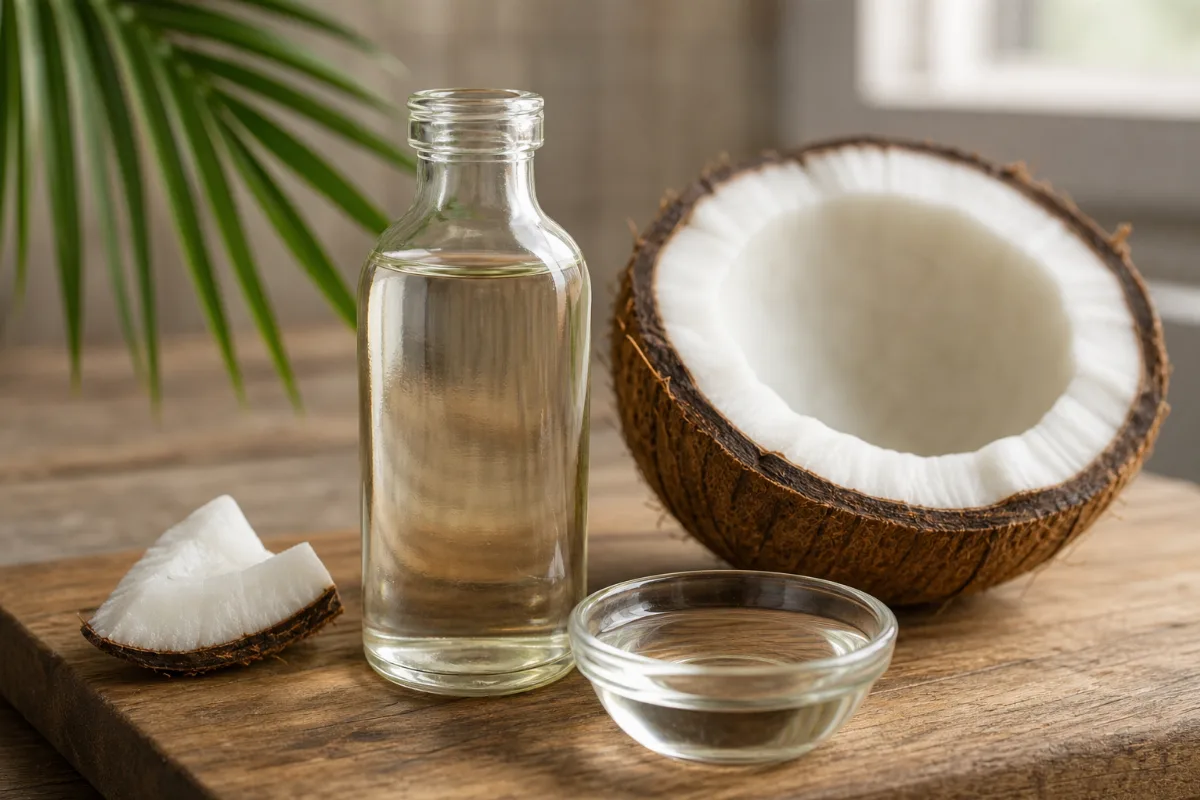
Oils & Fats · Special fat
MCT Oil
Medium-chain triglycerides (a purified fat, not a plant) · also called MCT oil, medium-chain triglyceride oil, C8/C10 oil, caprylic/capric triglyceride oil
MCT oil is a manufactured oil made of medium-chain fats, mostly caprylic and capric acid. In trials it gave a small extra loss of weight and raised blood ketones, but cholesterol results are mixed and memory benefits are unproven. The main cautions are stomach upset, cholesterol, a few medicines (valproate, triheptanoin, orlistat) and allergy.
General information, not medical advice. Last substantive update · Not medically reviewed. A named clinician has not signed off on this page. How this page is made
About MCT Oil
MCT oil is a manufactured oil made of medium-chain triglycerides, fats with 6 to 12 carbons, mostly caprylic and capric acid. It is a concentrated fat, not a normal food and not a proven remedy. The research is small and mixed, and the main cautions are stomach upset, cholesterol, a few medicines and allergy.
What it is
MCT oil is a purified fat. A 2000 toxicology review describes medium-chain triglycerides as mainly caprylic (C8) and capric (C10) fatty acids, with smaller amounts of caproic (C6) and lauric (C12). WebMD says MCT products contain caprylic, capric and/or lauric acid and are sold as oils, powders and capsules.
Products differ. One Alzheimer disease trial used a mix of 55% caprylic and 35% capric acid and another used a product of 95% tricaprylin. Results for one product may not carry over to another.
We found no USDA nutrient values for MCT oil and no peer-reviewed source giving its energy per gram, so we give no calorie or nutrient numbers. WebMD says MCTs are a source of calories. Check the product label.
What the research shows
The best-supported finding is small. When MCTs replaced long-chain fats, pooled trials found about 0.5 kg more weight loss in healthy adults (13 trials) and 1.53% more weight reduction in people with overweight. The 2015 authors say many trials lacked quality information and commercial bias was detected.
Cholesterol depends on what MCT oil replaces. In a metabolic-ward study of 9 men, MCT oil raised total cholesterol to about the level of palm oil and above high-oleic sunflower oil. The pooled weight trials found no blood fat difference from long-chain fats, and the 2024 analysis found lower triglycerides.
MCTs raise blood ketones. In Alzheimer disease, brain ketone uptake doubled in 17 people, and pooled trials found a small gain on thinking tests with risk of bias. A 2026 review says cognitive benefits are inconsistent and disease change is unproven.
In children with hard-to-treat epilepsy, a doctor-run MCT ketogenic diet and the classical ketogenic diet were comparable in a randomised trial. That is a medical treatment and does not mean adults can treat seizures with MCT oil.
MCT oil is not coconut oil
Coconut oil contains medium-chain fats but also long ones, and WebMD notes that foods such as coconut oil contain short, medium and long fatty acids. MCT oil keeps only the medium ones. The existing library lists coconut or palm kernel oil as the usual source, but no source we read confirms this. Coconut oil has its own page and its own evidence.
Food versus supplement
MCT oil is a concentrated product used like a supplement, not a normal food. Trials gave measured amounts as part of study diets, which describes how the studies were designed, not advice. For the wider picture on fats, WHO advises total fat of 30% or less of daily energy and saturated fat of no more than 10%. Ask a doctor or pharmacist about amounts.
At a glance
Traditional uses history, not proof
- A modern product, so there is no traditional use to report
- A medically supervised MCT ketogenic diet is used for some children with epilepsy
Studied for research
- Body weight and body fat, low certainty (small effects, bias concerns)
- Energy burned, mixed
- Cholesterol and blood fats, mixed
- Triglycerides and insulin resistance score, low certainty
- Blood ketones, moderate certainty that they rise
- Memory in Alzheimer disease, low certainty
- Epilepsy diet in children, low certainty (a medical treatment)
Main compounds
- Caprylic acid (C8)
- Capric acid (C10)
- Caproic acid (C6) and lauric acid (C12) in smaller amounts
- Tricaprylin in some products
Common forms
- Liquid MCT oil, mostly caprylic and capric acid (trial products named in the studies)
- Tricaprylin products (one trial product was 95% tricaprylin)
- MCT powders and 'keto' mixes are different products and are not covered
- Coconut oil is a different product, mostly lauric acid, and has its own page
Research links: 2015 review: MCTs and weight (13 trials) · 1997 study: MCT oil, palm oil and sunflower oil on cholesterol · 2020 review: MCTs and Alzheimer disease · Research Library · Genes & Biomarkers Library
What it is and its history
- Accepted scientific name
- Medium-chain triglyceride (MCT) oil
- Naming authority
- Not a plant or species. A manufactured, purified fat; there is no GBIF or NCBI entry to check.
- Common names
- MCT oil (English); Medium-chain triglyceride oil (English); C8/C10 oil (English); Caprylic/capric triglyceride oil (English); Aceite MCT (triglicéridos de cadena media) (Spanish)
- Family or group
- Not a plant. The existing summary lists the source as coconut or palm kernel oil, but no source read names the plant, so that is not confirmed here. WebMD says some foods, such as coconut oil, contain MCTs along with short and long fatty acids.
- Harvest and processing
- The 2000 review describes MCTs as a family of triglycerides with mostly caprylic (C8) and capric (C10) fatty acids and smaller amounts of caproic (C6) and lauric (C12). No source read describes how the oil is made.
- Look-alikes and adulterants
- Name: Coconut oil; Note: A natural oil that contains MCTs but is mostly lauric acid, which the WebMD page lists separately from caprylic and capric acid. It has its own page and its results are not interchangeable.; Name: MCT powders and 'keto coffee' products; Note: Oil dried onto a carrier or mixed with other ingredients; read the label.; Name: Triheptanoin (Dojolvi); Note: A prescription medium-chain fat product for certain rare metabolic disorders (WebMD); not the same as MCT oil.
Photographs
What is inside, and how it may work
What it contains and how those compounds act in cells and animals. Laboratory and animal mechanisms are not proven effects in people.
Main compounds
| Compound | Family | Where it is concentrated | Activity studied | Level of evidence |
|---|---|---|---|---|
| Caprylic acid (octanoic acid) PubChem 379 | medium-chain saturated fatty acid (C8:0) | A main fatty acid of MCT oil (2000 review). One trial product was 55% caprylic and 35% capric acid, another 95% tricaprylin. | MCTs raised blood ketones in pooled randomised trials. 13 3 1 15 | Human data |
| Capric acid (decanoic acid) PubChem 2969 | medium-chain saturated fatty acid (C10:0) | A main fatty acid of MCT oil (2000 review). | A 2021 review suggests decanoic acid may have anti-seizure effects; the mechanism work is rodent and lab based and from a review with industry links. 13 5 15 | Animal research |
| Caproic acid (hexanoic acid) PubChem 8892 | medium-chain saturated fatty acid (C6:0) | Smaller amounts (2000 review). | Not described in the sources read. 13 15 | Not studied here |
| Lauric acid PubChem 3893 | saturated fatty acid (C12:0) | Smaller amounts in MCT oil (2000 review); WebMD says MCT products may include caprylic, capric and/or lauric acid. | Not described separately in the sources read. 13 16 15 | Not studied here |
| Tricaprylin PubChem 10850 | triglyceride of caprylic acid | One Alzheimer disease trial product was 95% tricaprylin. | Raised brain ketone uptake in 6 people with Alzheimer disease. 3 15 | Human data |
Mechanisms, receptors and pathways
| Target or pathway | Gene or receptor | What was found | Level |
|---|---|---|---|
| Ketone production and brain fuel | Not specified in the sources read | WebMD says MCTs are broken down faster than long fatty acids and help the body make ketone bodies. MCTs raised blood ketones in pooled randomised trials, and in 17 people with Alzheimer disease brain ketone uptake doubled with no change in brain glucose use. 16 1 3 | Human data |
| Energy expenditure and the sympathetic nervous system | Noradrenaline (norepinephrine) in urine | In 8 men, 24-hour energy expenditure rose with more MCT and urine noradrenaline rose. The authors suggest the effect is mediated at least in part by the sympathetic nervous system. A 28-day trial found the energy expenditure difference was no longer significant. 4 12 | Human data |
| Blood cholesterol | Not specified in the sources read | In a small controlled-diet study, MCT oil raised total and LDL cholesterol compared with high-oleic sunflower oil; the authors estimate medium-chain fatty acids have about half the potency of palmitic acid. 2 | Human data |
| Seizure control by decanoic acid | Not specified in the sources read | A 2021 review (several authors work for or are funded by a pet food company that sells MCT dog diets) says MCT fatty acids may have anti-seizure effects, based mainly on rodent and lab work. 5 | Animal research |
Absorption, metabolism and elimination
- Absorption
- Not measured in the sources read beyond ketone levels. WebMD says MCTs are broken down faster than long fatty acids.
- Distribution
- Not found.
- Metabolism
- WebMD says the body turns MCTs into ketone bodies; the 2018 PET study showed brain ketone uptake in proportion to blood ketones.
- Elimination
- Not found.
- Bioavailability
- Not established in the sources read.
Isolated compounds versus whole extracts
MCT oil is a purified fat, not a whole food. Trial results are for specific products (mostly caprylic and capric acid, sometimes tricaprylin). Results do not carry over to coconut oil, which is mostly lauric acid, or to mixed medium- and long-chain products, which did not show the same weight effect in a 2024 analysis.
Nutritional composition
No USDA FoodData Central item for MCT oil was found in the project data, and a live USDA lookup on 2026-10-26 was refused with a rate-limit error. No peer-reviewed source read gives its energy per gram, so no calorie or nutrient numbers are given here. WebMD says MCTs are a source of calories and energy. Plain words: it is a concentrated fat; check the product label for energy and fat per serving. No serving size, portion or amount is suggested.
1 moderate certainty2 mixed findings4 low certainty
What was looked at
The 7 benefits and uses checked for MCT Oil, each with how strong the evidence is. Tap one to open it.
- Body weight and body fatLow certainty
- Energy burned (energy expenditure)Mixed findings
- Cholesterol and blood fatsMixed findings
- Blood triglycerides and insulin resistance scoreLow certainty
- Blood ketones and brain energyModerate certainty
- Memory, thinking and Alzheimer diseaseLow certainty
- Epilepsy (the MCT ketogenic diet, with a medical team)Low certainty
Lab markers tracked in the studies
Body weightLDL cholesterolTriglyceridesInsulin resistance score (HOMA-IR)Blood ketones (beta-hydroxybutyrate)ADAS-Cog thinking scoreSeizure frequency
What is MCT Oil good for?
The main studied uses and how strong the human evidence is for each. The trials used MCT oil in measured amounts as part of study diets, mostly in small groups.
Benefits, one by one
Each card is a research question, not a promise. Tap a goal to filter. Open a card to see the studies, doses and limits.
Body weight and body fat
Low certaintyIn pooled trials, swapping long-chain fats for MCTs gave a small extra loss of weight and body fat. The effect is small and the evidence has bias concerns.
3 studiesMCT oil replacing long-chain fats in the diet (caprylic and capric ac…
Studies, doses and limits
What the trials found
A 2015 analysis pooled 13 randomised trials (749 healthy adults). A 2024 analysis pooled trials in people with overweight or obesity. A 2003 crossover trial in 24 overweight men compared an MCT-rich diet with an olive oil diet.
Results
Compared with long-chain fats, MCTs lowered body weight by about half a kilogram in the 2015 analysis, plus small drops in waist, hip and body fat. The 2024 analysis found 1.53% more weight reduction, mainly with pure MCTs and not with a mixed medium- and long-chain product. In the 2003 trial upper-body fat fell by 0.67 kg on MCT versus 0.02 kg on olive oil.
Effect sizes as reported
2015: body weight -0.51 kg (95% CI -0.80 to -0.23), waist -1.46 cm. 2024: weight WMD -1.53% (95% CI -2.44 to -0.63); pure MCT -1.62%. 2003: upper-body fat -0.67 kg vs -0.02 kg (p < 0.05).
Why this rating
Low. Several analyses point the same small way, but the 2015 authors say many trials lacked quality information and commercial bias was detected, the trials differ in design, and the changes are small. Only abstracts were read.
Form and dose studied
MCT oil replacing long-chain fats in the diet (caprylic and capric acid products). Mixed medium- and long-chain products did not show the same effect in the 2024 analysis.
Who was studied
Healthy adults and adults with overweight or obesity.
Limits
Small effects, bias concerns, short trials, and MCT replaced other fats rather than being added to a normal diet in some trials. Not shown to be a weight-loss treatment.
Why researchers looked
MCTs are handled differently from ordinary fats, so researchers tested whether they help with weight.
Traditional use
MCT oil is a modern manufactured product, so there is no traditional use to report.
Proposed mechanism Human trial suggestion
The authors of the trials suggest MCTs may raise energy use and fat burning a little. This is a suggestion from trial results, not proven.
A proposed mechanism does not show that the effect happens in people.
Stomach upset is the most reported side effect, and MCT oil can raise LDL cholesterol compared with some other oils. See the Safety tab.
Energy burned (energy expenditure)
Mixed findingsMCTs raised the body's energy use a little in short studies, but in the one 28-day trial the difference faded.
2 studiesMCT mixed into meals in the 1996 study; an MCT-rich diet in the 2003 …
Studies, doses and limits
What the trials found
An 8-man respiratory chamber dose-response study (1996) and a 24-man crossover trial (2003).
Results
In the 1996 study, 24-hour energy expenditure rose with more MCT in the diet, by about 5% with 15 to 30 g of MCT a day. In the 2003 trial, energy expenditure was higher on day 2 but the difference was not significant by day 28.
Effect sizes as reported
1996: about +5% 24-hour energy expenditure (about 500 kJ a day; individual range 268 to 756 kJ), n = 8. 2003: +0.04 kcal/min on day 2 (p < 0.05); +0.03 kcal/min on day 28 (not significant), n = 24.
Why this rating
Mixed: a rise in a small 24-hour study, and an effect that was no longer significant after 28 days in the other. Both trials are small and old.
Form and dose studied
MCT mixed into meals in the 1996 study; an MCT-rich diet in the 2003 trial.
Who was studied
Healthy young men (1996) and healthy overweight men (2003).
Limits
Small, men only, short, and neither trial shows that a higher energy use leads to lasting weight loss.
Why researchers looked
A small rise in daily energy use could explain the weight results.
Proposed mechanism Human trial suggestion
In the respiratory chamber study, urine noradrenaline rose, and the authors suggest MCTs raise energy use partly by activating the sympathetic nervous system.
A proposed mechanism does not show that the effect happens in people.
See the Safety tab for stomach upset and cholesterol.
Cholesterol and blood fats
Mixed findingsResults are mixed. A small controlled-diet study found MCT oil raised total and LDL (bad) cholesterol compared with sunflower oil, while pooled trials found no lipid difference from long-chain fats.
4 studiesMCT oil of caprylic and capric acid compared with palm oil, sunflower…
Studies, doses and limits
What the trials found
A 1997 metabolic-ward crossover study in 9 men with mild high cholesterol; the 2015 pooled analysis (blood fats as a secondary outcome); the 2024 pooled analysis.
Results
In the 1997 study MCT oil and palm oil gave similar total cholesterol (5.87 and 5.79 mmol/L), significantly higher than high-oleic sunflower oil (5.22 mmol/L), and LDL followed the same pattern. The 2015 analysis found no blood lipid difference compared with long-chain fats. The 2024 analysis in people with overweight found lower blood triglycerides.
Effect sizes as reported
1997: total cholesterol 5.87 vs 5.79 vs 5.22 mmol/L (MCT, palm, high-oleic sunflower), n = 9. 2015: no difference in blood lipids. 2024: triglycerides lower (size not given in the abstract).
Why this rating
Mixed: one small controlled trial points to higher LDL against sunflower oil, while pooled analyses compared MCT with other fats and found no cholesterol difference or lower triglycerides. The answer depends on what the MCT replaces.
Form and dose studied
MCT oil of caprylic and capric acid compared with palm oil, sunflower oil and long-chain fats.
Who was studied
Men with mild high cholesterol (1997); healthy adults (2015); people with overweight (2024).
Limits
Nine men in the controlled study. No study read measured heart attacks or strokes. Only abstracts were read.
Why researchers looked
MCTs are saturated fats, and saturated fat is known to raise LDL cholesterol, so researchers checked whether MCTs behave the same way.
Proposed mechanism Human trial and guidance
In the 9-man study the authors estimate medium-chain fatty acids have about half the power of palmitic acid to raise total and LDL cholesterol. The AHA advisory links replacing saturated fat with unsaturated fat to lower LDL.
A proposed mechanism does not show that the effect happens in people.
People with high cholesterol or heart disease should ask a clinician. See the Safety tab.
Blood triglycerides and insulin resistance score
Low certaintyA 2024 pooled analysis in people with overweight or obesity found lower blood triglycerides and a lower insulin resistance score on MCT diets than on long-chain fat diets.
2 studiesMCT-enriched diets, mostly pure MCTs.
Studies, doses and limits
What the trials found
One 2024 systematic review and meta-analysis. The abstract does not give the number of trials or the sizes of these changes.
Results
Triglycerides and HOMA-IR (a score of insulin resistance) were lower with MCT-enriched diets than with long-chain fat diets. WebMD says some studies show MCTs lower blood sugar and others show no benefit, and some show lower triglycerides while others show higher.
Effect sizes as reported
Not given in the abstract.
Why this rating
Low. One pooled analysis whose abstract gives no numbers, and WebMD says other studies disagree.
Form and dose studied
MCT-enriched diets, mostly pure MCTs.
Who was studied
People with overweight or obesity.
Limits
Only the abstract was read. These are blood markers, not diabetes or heart outcomes.
Why researchers looked
Researchers checked whether MCT diets help the blood sugar and fat markers that go with overweight.
Proposed mechanism Not stated
Not explained in the abstract.
A proposed mechanism does not show that the effect happens in people.
WebMD asks people with diabetes to tell their provider before using MCTs.
Blood ketones and brain energy
Moderate certaintyMCTs reliably raise blood ketones, an alternative fuel. In a small Alzheimer disease study, brain ketone use doubled. Higher ketones are a lab measure, not a proven health benefit.
3 studiesCaprylic/capric mix and tricaprylin products; the 2018 study gave 30 …
Studies, doses and limits
What the trials found
A 2020 pooled analysis (12 records, 422 people) and a 2018 uncontrolled study in 17 people with mild to moderate Alzheimer disease.
Results
Compared with placebo, MCTs raised blood beta-hydroxybutyrate (a ketone) in the pooled randomised trials. In the 2018 study brain ketone uptake doubled on both MCT products, with no change in brain glucose use.
Effect sizes as reported
Beta-hydroxybutyrate MD 0.355 (95% CI 0.286 to 0.424; I2 = 0%); units not given in the abstract. Brain ketone uptake doubled (n = 11 and n = 6, no placebo).
Why this rating
Moderate that MCTs raise blood ketones: the pooled randomised trials agreed (I2 0%). It is a blood measure, and the brain-uptake study has no control group and 17 people.
Form and dose studied
Caprylic/capric mix and tricaprylin products; the 2018 study gave 30 g a day for a month (study design, not advice).
Who was studied
People with mild cognitive impairment or Alzheimer disease.
Limits
Raised ketones are not the same as feeling or thinking better. Only the people in these studies were tested; healthy people were not in the abstracts read.
Why researchers looked
Ketones can fuel the brain when it uses sugar poorly, as in Alzheimer disease.
Proposed mechanism Human trial and secondary source
WebMD says MCTs are broken down faster than ordinary fats and help the body make ketone bodies. The 2018 PET study found the brain took up ketones in direct proportion to blood ketones.
A proposed mechanism does not show that the effect happens in people.
See the Safety tab. WebMD asks people on a very low-carbohydrate (ketogenic) diet to tell their provider.
Memory, thinking and Alzheimer disease
Low certaintyA pooled analysis found a small improvement on thinking tests in people with mild cognitive impairment or Alzheimer disease, but bias limits it. A 2026 review calls the cognitive benefit inconsistent and disease change unproven.
2 studiesMCT supplements in people who already had memory problems.
Studies, doses and limits
What the trials found
The 2020 pooled analysis (12 records, 422 people) and a 2026 narrative review of diet in Alzheimer disease.
Results
The ADAS-Cog score showed a trend toward better thinking, and a combined ADAS-Cog and MMSE measure improved significantly. The authors say risk of bias in the studies means future trials are needed. The 2026 review says cognitive benefits remain inconsistent and disease modification has not been established.
Effect sizes as reported
ADAS-Cog MD -0.539 (95% CI -1.239 to -0.161); combined measure SMD -0.289 (95% CI -0.551 to -0.027); I2 = 0%.
Why this rating
Low: small effect sizes, risk of bias in the included studies, and a later review calling the benefit inconsistent. No evidence MCT oil prevents or treats Alzheimer disease.
Form and dose studied
MCT supplements in people who already had memory problems.
Who was studied
People with mild cognitive impairment or Alzheimer disease. Not tested in healthy people in the abstracts read.
Limits
Only abstracts were read. No evidence of benefit for memory in healthy adults was found.
Why researchers looked
Alzheimer disease brains use sugar poorly, so ketone fuel from MCTs was tried.
Proposed mechanism Human trial
Ketones from MCTs may supply the brain with extra fuel. The 2018 PET study showed this supply rises. Whether it helps thinking is the open question.
A proposed mechanism does not show that the effect happens in people.
Anyone with memory problems should talk to their care team before changing diet or adding supplements.
Epilepsy (the MCT ketogenic diet, with a medical team)
Low certaintyA doctor-run diet that uses MCT oil is an established option for children whose seizures resist medicines. It is a medical treatment, not a self-treatment, and the best trial only compared it with another ketogenic diet.
3 studiesA medically supervised MCT ketogenic diet in children with intractabl…
Studies, doses and limits
What the trials found
A 2009 randomised trial in 145 children (94 analysed) comparing the MCT and classical ketogenic diets; a 2013 narrative review; a 2021 narrative review of human, dog and rodent studies.
Results
In the trial there was no significant difference between the two diets in seizure frequency at 3, 6 or 12 months, or in tolerability apart from more tiredness and vomiting reported on the classical diet. The 2013 review calls the MCT diet as effective as the classical one, with stomach side effects. The 2021 review calls MCTs a promising add-on, with tolerance in 65% of people, and says larger trials are needed.
Effect sizes as reported
Percent of baseline seizures, classical vs MCT: 66.5% vs 68.9% (3 months), 48.5% vs 67.6% (6 months), 40.8% vs 53.2% (12 months); none significant.
Why this rating
Low for MCT itself. The one randomised trial compared two ketogenic diets with each other, not MCT against no diet, and a third of the children could not be analysed. The reviews are narrative and one is industry-linked.
Form and dose studied
A medically supervised MCT ketogenic diet in children with intractable epilepsy. Not the same as adding MCT oil to coffee or food.
Who was studied
Children with drug-resistant epilepsy.
Limits
Does not apply to adults taking MCT oil on their own. Stomach upset is common. Anyone on seizure medicine (WebMD lists valproate) should talk to their care team first.
Why researchers looked
Ketogenic diets are used for hard-to-treat epilepsy, and MCT oil makes ketones more easily, allowing more carbohydrate and protein in the diet.
Proposed mechanism Animal and lab
Ketones are thought to give the brain extra fuel. The 2021 review suggests the MCT fatty acid decanoic acid may have anti-seizure effects; that comes from rodent and lab work, and several of that review's authors have links to a pet food company.
A proposed mechanism does not show that the effect happens in people.
Never change epilepsy treatment on your own. See the Safety tab.
Connections to the rest of health
How MCT Oil connects to the rest of our health knowledge graph. Every link says what kind of connection it is. A safety link (for example to the liver) is a warning, not a benefit. A study that merely mentions a topic never creates a benefit link.
Explore every connection: goals, body systems, organs, symptoms, genes
A. Wellness goals
| Connected to | Kind of connection | Evidence status | Context | Studies |
|---|---|---|---|---|
| Weight Management | Low certainty | Body weight and body fat: In pooled trials, swapping long-chain fats for MCTs gave a small extra loss of weight and body fat. The effect is small and the evidence has bias concerns. Energy burned (energy expenditure): MCTs raised the body's energy use a little in short studies, but in the one 28-day trial the difference faded. | 8 6 12 4 | |
| Metabolic Health | Low certainty | Body weight and body fat: In pooled trials, swapping long-chain fats for MCTs gave a small extra loss of weight and body fat. The effect is small and the evidence has bias concerns. Energy burned (energy expenditure): MCTs raised the body's energy use a little in short studies, but in the one 28-day trial the difference faded. | 8 6 12 4 16 1 3 | |
| Cholesterol Balance | Mixed findings | Cholesterol and blood fats: Results are mixed. A small controlled-diet study found MCT oil raised total and LDL (bad) cholesterol compared with sunflower oil, while pooled trials found no lipid difference from long-chain fats. | 2 8 6 10 | |
| Metabolic Health | Mixed findings | Cholesterol and blood fats: Results are mixed. A small controlled-diet study found MCT oil raised total and LDL (bad) cholesterol compared with sunflower oil, while pooled trials found no lipid difference from long-chain fats. | 2 8 6 10 | |
| Brain Health | Moderate certainty | Blood ketones and brain energy: MCTs reliably raise blood ketones, an alternative fuel. In a small Alzheimer disease study, brain ketone use doubled. Higher ketones are a lab measure, not a proven health benefit. Epilepsy (the MCT ketogenic diet, with a medical team): A doctor-run diet that uses MCT oil is an established option for children whose seizures resist medicines. It is a medical treatment, not a self-treatment, and the best trial only compared it with another ketogenic diet. | 1 3 16 9 7 5 | |
| Brain Health | Low certainty | Memory, thinking and Alzheimer disease: A pooled analysis found a small improvement on thinking tests in people with mild cognitive impairment or Alzheimer disease, but bias limits it. A 2026 review calls the cognitive benefit inconsistent and disease change unproven. | 1 11 | |
| Memory Support | Low certainty | Memory, thinking and Alzheimer disease: A pooled analysis found a small improvement on thinking tests in people with mild cognitive impairment or Alzheimer disease, but bias limits it. A 2026 review calls the cognitive benefit inconsistent and disease change unproven. | 1 11 |
B. Body systems
| Connected to | Kind of connection | Evidence status | Context | Studies |
|---|---|---|---|---|
| Digestive system | Adverse effect or risk | Documented risk | Diarrhea, nausea and upset stomach are the most reported effects. Preparation or compound: MCT oil |
16 7 |
| Metabolism Weight | Biological association | Low certainty | Studied for: Body weight and body fat Studied for: Energy burned (energy expenditure) | 8 6 12 4 16 1 3 |
| Cardiovascular System | Biological association | Mixed findings | Studied for: Cholesterol and blood fats | 2 8 6 10 |
| Nervous System | Biological association | Moderate certainty | Studied for: Blood ketones and brain energy Studied for: Memory, thinking and Alzheimer disease | 1 3 16 11 9 7 5 |
E. Health conditions
| Connected to | Kind of connection | Evidence status | Context | Studies |
|---|---|---|---|---|
| Allergy to MCTs or coconut | Adverse effect or risk | Documented risk | WebMD warns of serious allergic reactions; coconut allergy may affect about 1 in 260 Americans. Preparation or compound: MCT oil |
16 14 |
I. Biomarkers
| Connected to | Kind of connection | Evidence status | Context | Studies |
|---|---|---|---|---|
| LDL cholesterol | Adverse effect or risk | Mixed findings | Higher than high-oleic sunflower oil in a 9-man study; no pooled difference from long-chain fats. Preparation or compound: MCT oil |
2 8 |
| Blood ketones | Moderate certainty | Raised by MCTs in pooled randomised trials. Preparation or compound: MCT oil |
1 | |
| Body weight | Biological association | Low certainty | Measured in trials: lowered. A lab change is not the same as a health benefit. | 8 6 |
| LDL cholesterol | Biological association | Mixed findings | Measured in trials: mixed. A lab change is not the same as a health benefit. | 2 8 |
| Triglycerides | Biological association | Low certainty | Measured in trials: lowered. A lab change is not the same as a health benefit. | 6 2 |
| Insulin resistance score (HOMA-IR) | Biological association | Low certainty | Measured in trials: lowered. A lab change is not the same as a health benefit. | 6 16 |
| Blood ketones (beta-hydroxybutyrate) | Biological association | Moderate certainty | Measured in trials: raised. A lab change is not the same as a health benefit. | 1 3 |
| ADAS-Cog thinking score | Biological association | Low certainty | Measured in trials: lowered. A lab change is not the same as a health benefit. | 1 11 |
| Seizure frequency | Biological association | Low certainty | Measured in trials: no-significant-difference-between-diets. A lab change is not the same as a health benefit. | 9 7 |
K. Biological pathways
| Connected to | Kind of connection | Evidence status | Context | Studies |
|---|---|---|---|---|
| Beta-hydroxybutyrate (ketone) | Preliminary mechanism | Human | Raised by MCTs in pooled randomised trials. | 1 |
| LDL cholesterol | Preliminary mechanism | Human | Higher than high-oleic sunflower oil in one small study; no pooled difference from long-chain fats. | 2 8 |
| Saturated fat | Preliminary mechanism | Guidance | WHO advises saturated fat of no more than 10% of energy; MCT oil is not named in the fact sheet read. | 17 |
L. Active compounds
| Connected to | Kind of connection | Evidence status | Context | Studies |
|---|---|---|---|---|
| Caprylic acid (octanoic acid) | Biological association | Human | MCTs raised blood ketones in pooled randomised trials. | 13 3 1 15 |
| Capric acid (decanoic acid) | Biological association | Animal | A 2021 review suggests decanoic acid may have anti-seizure effects; the mechanism work is rodent and lab based and from a review with industry links. | 13 5 15 |
| Caproic acid (hexanoic acid) | Biological association | Not studied here | Not described in the sources read. | 13 15 |
| Lauric acid | Biological association | Not studied here | Not described separately in the sources read. | 13 16 15 |
| Tricaprylin | Biological association | Human | Raised brain ketone uptake in 6 people with Alzheimer disease. | 3 15 |
Each connection is stored with the ingredient, the connected record, the kind of connection, the evidence status, the supporting studies, the preparation or compound involved, and a review date (last reviewed October 26, 2026).
The evidence
The research centre for MCT Oil. Every record here was checked against PubMed or the publisher's page; we never list a study we have not verified.
Evidence by outcome
Bars show how many studies we found for each outcome, not how well it works. People are added up across trials only (reviews are not added, to avoid double counting).
How we rate evidence
High certainty
Several well-run trials or reviews agree; further research is unlikely to change the picture much.
Moderate certainty
Good trials point the same way, but some doubt remains.
Low certainty
Small, short or inconsistent trials. The finding could change with better research.
Very low certainty
Very little or very weak human data. Treat as a possibility only.
Mixed findings
Trials or reviews disagree with each other.
Not enough evidence
Not enough human research to say either way.
Evidence against
Good research found no benefit, or found harm.
We take the reviewers' own risk-of-bias and GRADE statements where they exist, and otherwise judge from study size, design, consistency, directness and whether a product matches what is sold. Many publications do not make evidence high. Method note: We started from our existing MCT oil summary, re-read each PubMed abstract and the WebMD, Academy of Nutrition and Dietetics and WHO pages, and looked up the fatty acids in PubChem. Only abstracts were read for studies. Items we could not verify are flagged in the research gaps.
Study library: every study we checked 17
| Study | Design | People | Product, dose, length | Result |
|---|---|---|---|---|
| Avgerinos 2020 Medium Chain Triglycerides induce mild ketosis and may improve cognition in Alzheimer's disease. A systematic review and meta-analysis of human studies. Ageing Res Rev · PMID 31870908 · DOI |
Systematic review meta analysis |
422 People with mild cognitive impairment or Alzheimer disease; 12 records |
MCT supplements Manufactured oil Varied (not given in the abstract) Varied (not given in the abstract) · vs Placebo (in the randomised trials) |
Compared with placebo, MCTs raised blood ketones. The ADAS-Cog score showed a trend toward better thinking. A combined measure of ADAS-Cog and MMSE improved significantly. The authors say risk of bias in the studies means more trials are needed. Beta-hydroxybutyrate MD 0.355; ADAS-Cog MD -0.539; combined measure SMD -0.289; heterogeneity I2 = 0% (Beta-hydroxybutyrate 0.286 to 0.424; ADAS-Cog -1.239 to -0.161; combined SMD -0.551 to -0.027) Methods, limits and fundingOutcomes: Blood beta-hydroxybutyrate (a ketone) and cognitive scores (ADAS-Cog, MMSE) Limitations: The authors state risk of bias in the included studies. Small effect on a thinking score; units for the ketone result are not given in the abstract. The abstract calls the ADAS-Cog result a trend although the printed interval does not include zero, so treat it as small and uncertain. Funding and conflicts: Authors declare no competing interests; work supported by the NIH Intramural programme. Read: abstract |
| Cater 1997 Comparison of the effects of medium-chain triacylglycerols, palm oil, and high oleic acid sunflower oil on plasma triacylglycerol fatty acids and lipid and lipoprotein concentrations in humans. Am J Clin Nutr · PMID 8988911 · DOI |
Randomized crossover metabolic ward trial |
9 9 middle-aged men with mild high cholesterol |
Natural food diet supplemented with MCT oil (8:0 and 10:0 fatty acids), palm oil, or high-oleic sunflower oil Manufactured oil · vs Palm oil and high-oleic sunflower oil |
MCT oil gave total cholesterol similar to palm oil and significantly higher than high-oleic sunflower oil. LDL followed total cholesterol. HDL did not differ. Total cholesterol: MCT oil 5.87 mmol/L, palm oil 5.79 mmol/L, high-oleic sunflower oil 5.22 mmol/L. The authors estimate medium-chain fatty acids have about half the cholesterol-raising power of palmitic acid. (Not given in the abstract) Methods, limits and fundingOutcomes: Blood total, LDL and HDL cholesterol and triglycerides Limitations: Nine men, a metabolic-ward design, 1997. Measures blood cholesterol only, not heart attacks. Funding is not stated in the abstract. Funding and conflicts: Not stated in the abstract (the record lists a US Public Health Service grant as support). Read: abstract |
| Croteau 2018 Ketogenic Medium Chain Triglycerides Increase Brain Energy Metabolism in Alzheimer's Disease. J Alzheimers Dis · PMID 29914035 · DOI |
Uncontrolled sequential intervention |
17 People with mild to moderate Alzheimer disease: 11 took the caprylic/capric mix, 6 took tricaprylin |
MCT supplement: caprylic (55%) and capric (35%) acid mix, then tricaprylin (95%) Manufactured oil 30 g a day (study design, not advice) One month per supplement, with a wash-out between · vs Own measurements before and after (no placebo group) |
Brain ketone uptake doubled on both supplements. Total brain energy use rose, and brain glucose use did not change. Brain ketone consumption doubled on both MCT types (Not given in the abstract) Methods, limits and fundingOutcomes: Brain ketone and glucose uptake by PET scan Limitations: Very small, no placebo group, and the abstract does not report memory or thinking tests. It shows the brain can use ketones from MCT, not that people got better. Funding and conflicts: Not stated in the abstract (the record lists non-US government research support). Read: abstract |
| Dulloo 1996 Twenty-four-hour energy expenditure and urinary catecholamines of humans consuming low-to-moderate amounts of medium-chain triglycerides: a dose-response study in a human respiratory chamber. Eur J Clin Nutr · PMID 8654328 |
Randomized double blind crossover trial |
8 8 healthy young men |
MCT mixed with long-chain fat in set ratios of 0:30, 5:25, 15:15 and 30:0 g MCT:LCT, eaten at three meals Manufactured oil 30 g a day in total (study design, not advice) Four separate 24-hour respiratory chamber stays · vs Long-chain triglycerides (0 g MCT) |
24-hour energy expenditure rose as the MCT share rose. Urine noradrenaline was higher; adrenaline and dopamine did not change. 15 to 30 g MCT a day raised 24-hour energy expenditure by about 5% (about 500 kJ, individual range 268 to 756 kJ) (Not given in the abstract) Methods, limits and fundingOutcomes: 24-hour energy expenditure; urine catecholamines Limitations: Eight young men, 24-hour stays only. It did not test weight over weeks. Funding is not stated in the abstract. Funding and conflicts: Not stated in the abstract. Read: abstract |
| Han 2021 Dietary medium chain triglycerides for management of epilepsy: New data from human, dog, and rodent studies. Epilepsia · PMID 34169513 · DOI |
Narrative review |
Reviews data from people, dogs and rodents with seizures | MCT in the diet and decanoic acid Manufactured oil |
Calls MCTs a promising add-on to standard medicine in people and dogs with epilepsy, reports tolerance in 65% of humans, and says larger clinical trials are needed. Mechanism ideas (for example decanoic acid effects) come from rodent and lab work. Tolerated by 65% of humans (as reviewed) (Not applicable) Methods, limits and fundingOutcomes: Seizures; tolerance; possible mechanisms Limitations: A narrative review mixing human, dog and rodent data. Several authors work for, or were funded by, a pet food company (Nestle Purina PetCare) that makes MCT-enriched dog diets, and one holds a patent. Only the abstract and conflict statement were read. Funding and conflicts: Industry-linked: several authors are employed by or funded by Nestle Purina PetCare, which sells MCT-enriched dog diets; one reports a US patent. Read: abstract |
| He 2024 The impact of medium-chain triglycerides on weight loss and metabolic health in individuals with overweight or obesity: A systematic review and meta-analysis. Clin Nutr · PMID 38936302 · DOI |
Systematic review meta analysis |
People with overweight or obesity (number of trials and people not given in the abstract) | MCT-enriched diets, split into pure MCTs and mixed medium- and long-chain triglycerides (MLCTs) Manufactured oil · vs Long-chain triglyceride (LCT) diets |
MCT-enriched diets gave more weight reduction than long-chain fat diets, mainly with pure MCTs. Diets with the MLCT mix did not significantly reduce weight. Blood triglycerides and HOMA-IR were lower on MCT diets. Weight WMD -1.53% (pure MCT -1.62%); lower triglycerides and HOMA-IR (sizes not given in the abstract) (Weight -2.44 to -0.63%; pure MCT -2.78 to -0.46%) Methods, limits and fundingOutcomes: Weight loss, blood triglycerides, insulin resistance score (HOMA-IR) Limitations: Only the abstract was read, so trial numbers, sizes of the triglyceride and HOMA-IR changes and trial quality are not known here. Random-effects analysis. The authors report no conflict of interest. Funding and conflicts: The authors reported no potential conflict of interest. Read: abstract |
| Liu 2013 Medium-chain triglyceride ketogenic diet, an effective treatment for drug-resistant epilepsy and a comparison with other ketogenic diets. Biomed J · PMID 23515148 · DOI |
Narrative review |
Children with drug-resistant epilepsy (review of other studies) | MCT ketogenic diet Manufactured oil as part of a diet · vs Classical ketogenic diet |
The authors call the MCT ketogenic diet as effective as the classic diet and say it allows more carbohydrate and protein. They note stomach side effects: diarrhea, vomiting, bloating and cramps. No numbers in the abstract (Not applicable) Methods, limits and fundingOutcomes: Seizure control; side effects Limitations: A narrative review by authors who use the diet, so it may lean favourable. It is not a pooled analysis. Funding and conflicts: Not stated in the abstract. Read: abstract |
| Mumme 2015 Effects of medium-chain triglycerides on weight loss and body composition: a meta-analysis of randomized controlled trials. J Acad Nutr Diet · PMID 25636220 · DOI |
Systematic review meta analysis |
749 Healthy adults in 13 randomised trials lasting more than 3 weeks |
MCT (caprylic C8 and capric C10 fatty acids) in the diet Manufactured oil Varied between trials (the authors say dose, duration and energy control differed) More than 3 weeks · vs Long-chain triglycerides (LCTs) |
Compared with long-chain fats, MCTs lowered body weight, waist, hip, total body fat, subcutaneous fat and visceral fat by small amounts. Blood fat levels did not differ. Body weight -0.51 kg; waist -1.46 cm; hip -0.79 cm; total body fat SMD -0.39; subcutaneous fat SMD -0.46; visceral fat SMD -0.55. No difference in blood lipids. (Body weight -0.80 to -0.23 kg; waist -2.04 to -0.87 cm; hip -1.27 to -0.30 cm) Methods, limits and fundingOutcomes: Body weight, waist and hip size, body fat; blood fats as secondary outcomes Limitations: Many trials lacked enough information for a full quality check, and the authors say commercial bias was detected. Trial designs varied. Healthy adults, not people with a condition. Changes are small. Funding and conflicts: Not stated in the abstract. The abstract reports commercial bias among the included trials. Read: abstract |
| Neal 2009 A randomized trial of classical and medium-chain triglyceride ketogenic diets in the treatment of childhood epilepsy. Epilepsia · PMID 19054400 · DOI |
Randomized trial |
145 145 children with intractable epilepsy randomised; 61 started classical and 64 started the MCT diet; 94 analysed (45 classical, 49 MCT) |
MCT ketogenic diet (a medically supervised diet) Manufactured oil as part of a diet Set by the diet team (not given in the abstract) 3, 6 and 12 months · vs Classical ketogenic diet |
No significant difference between the two diets in seizures at 3, 6 or 12 months, in the numbers with more than 50% or 90% fewer seizures, or in tolerability (apart from more tiredness and vomiting reported on the classical diet). Percent of baseline seizures, classical vs MCT: 3 months 66.5% vs 68.9%; 6 months 48.5% vs 67.6%; 12 months 40.8% vs 53.2% (all p > 0.05) (Not given in the abstract) Methods, limits and fundingOutcomes: Seizure frequency, withdrawals, tolerability, blood ketones Limitations: Compares two diets with each other, not MCT against no treatment. Only 94 of 145 children could be analysed. The result shows the two diets were comparable, not how well either works. Funding and conflicts: Not stated in the abstract (the record lists NIH and non-US government research support). Read: abstract |
| Sacks 2017 Dietary Fats and Cardiovascular Disease: A Presidential Advisory From the American Heart Association. Circulation · PMID 28620111 · DOI |
Authoritative guidance n/a |
Evidence review on dietary fats and heart disease | Saturated fat and its replacement by other fats · vs Unsaturated fats |
Replacing saturated fat with polyunsaturated vegetable oil reduced heart disease by about 30% in randomised trials. Replacing saturated with unsaturated fat lowers LDL cholesterol, and the advisory concludes strongly that lowering saturated fat and replacing it with unsaturated fat will lower heart disease. About 30% fewer cardiovascular events in trials of swapping saturated fat for polyunsaturated vegetable oil (Not applicable) Methods, limits and fundingOutcomes: Cardiovascular disease Limitations: General advice about saturated fat. It does not mention MCT oil in the abstract. Funding and conflicts: American Heart Association advisory; members complete conflict disclosures. Read: abstract |
| Sierralta 2026 Dietary Patterns, Micronutrient Adequacy, and Metabolic Vulnerability in Alzheimer's Disease: A Critical Narrative Review. Nutrients · PMID 42797008 · DOI |
Narrative review |
Dietary research in Alzheimer disease (narrative review, search through April 2026) | Dietary patterns including ketogenic diets and MCTs Manufactured oil (one topic among many) |
Says ketogenic diets and MCTs may raise brain ketone supply, but cognitive benefits are inconsistent and disease change has not been established. Nutrition should not be seen as a stand-alone disease-modifying therapy. No numbers for MCT in the abstract (Not applicable) Methods, limits and fundingOutcomes: Cognitive outcomes Limitations: A narrative review, not a pooled analysis. MCT is one small part of it, and only the abstract was read. Funding and conflicts: Authors declare no conflicts of interest. Read: abstract |
| St-Onge 2003 Medium-chain triglycerides increase energy expenditure and decrease adiposity in overweight men. Obes Res · PMID 12634436 · DOI |
Randomized crossover trial |
24 24 healthy overweight men, BMI 25 to 31 kg/m2 |
Diet rich in MCT (called functional oil in the abstract) versus olive oil Manufactured oil 28 days per diet (crossover) · vs Diet rich in olive oil (long-chain fat) |
Upper-body fat fell more on the MCT diet than on olive oil. Energy expenditure was higher on day 2 but the difference was not significant by day 28. Upper-body fat -0.67 kg with MCT versus -0.02 kg with olive oil (p < 0.05); energy expenditure +0.04 kcal/min on day 2 (p < 0.05), +0.03 kcal/min on day 28 (not significant) (Not given in the abstract) Methods, limits and fundingOutcomes: Body composition (MRI), energy expenditure and fat burning (indirect calorimetry), appetite, ad libitum intake Limitations: Small trial in men only, 28 days per diet. The abstract calls the MCT product a functional oil without giving its fatty acid mix. Funding is not stated in the abstract. Funding and conflicts: Not stated in the abstract. Read: abstract |
| Traul 2000 Review of the toxicologic properties of medium-chain triglycerides. Food Chem Toxicol · PMID 10685018 · DOI |
Toxicology review animal-and-human-review |
Animal and lab tests, with some human trials, reviewed | Medium-chain triglycerides (mainly C8 and C10, less C6 and C12) Manufactured oil Animal feeding up to 9,375 mg/kg body weight a day in 90-day tests (animal result) 90-day animal studies; a 2-year rat study of tricaprylin |
MCTs were essentially non-toxic in acute tests, were not eye or skin irritants, and did not cause allergic sensitisation in tests. 90-day feeding tests showed no notable toxicity, with no harm to reproduction or fetuses in rats and pigs. A 2-year rat study of tricaprylin found no cancer effect. The review concludes MCTs are not likely to cause cancer or mutations and says clinical trials confirmed human dietary safety at levels up to 1 g per kg of body weight. No effect sizes; safety finding (Not applicable) Methods, limits and fundingOutcomes: Acute toxicity, irritation, sensitisation, 90-day toxicity, reproduction, cancer and mutation tests Limitations: Mostly animal and lab data from 2000. It does not cover cholesterol effects or stomach upset. The authors' funding is not stated in the abstract. Funding and conflicts: Not stated in the abstract. Read: abstract |
| s-eatright-coconut-allergy Academy of Nutrition and Dietetics (eatright.org): Coconut Is No Longer a Tree Nut Allergen (published 26 May 2026) · Source |
Professional body page n/a |
Methods, limits and fundingRead: full-text | ||
| s-pubchem-fatty-acids PubChem compound records: octanoic acid (CID 379), decanoic acid (CID 2969), hexanoic acid (CID 8892), lauric acid (CID 3893), tricaprylin (CID 10850) · Source |
Reference database n/a |
Methods, limits and fundingRead: full-text | ||
| s-webmd-mct WebMD: Medium-Chain Triglycerides - Uses, Side Effects, and More (written by C. McIntyre, PharmD; medically reviewed by B. Johnston, PharmD, 8 Oct 2025) · Source |
Consumer health reference n/a |
Methods, limits and fundingRead: full-text | ||
| s-who-healthy-diet WHO: Healthy diet fact sheet (26 January 2026) · Source |
Authoritative guidance n/a |
Methods, limits and fundingRead: full-text |
What we do not know yet
- No energy-per-gram or nutrient figures for MCT oil were found; no USDA item exists in the project data and a live USDA lookup was rate-limited.
- No source read confirms the plant (coconut or palm kernel) that MCT oil is made from or how it is made.
- No long trial of MCT oil on weight, and no study of heart attacks or strokes with MCT oil, was found in the abstracts read.
- The epilepsy diet result compares two diets, not MCT against no diet.
- The US regulatory position comes from WebMD; a primary FDA statement was not read. No LiverTox or LactMed entry was searched.
- Smoke point, heating, storage, shelf life, kidney disease and use in children outside epilepsy were not researched.
- Only abstracts of the studies were read.
How new research is added
New studies are found by a saved PubMed search and placed in a review queue before the page changes.
Lab markers
What changed in blood or saliva tests during trials. A changed number is not the same as feeling or being healthier, and we give no "normal ranges".
Metabolic 3
Body weight
Lowered in trials
How heavy a person is, measured on a scale.
Low certaintyResults and what it means
Why it was measured
It is the main outcome of the MCT weight trials.
Statistical vs. clinical meaning
A small average difference with bias concerns.
Safety implication
None specific.
| Study | Result | People | Product |
|---|---|---|---|
| 8 | Body weight -0.51 kg (95% CI -0.80 to -0.23) with MCTs versus long-chain fats | 749 healthy adults in 13 trials | MCT (C8 and C10) in the diet |
| 6 | Weight reduction WMD -1.53% (95% CI -2.44 to -0.63) with MCT-enriched diets versus long-chain fat diets | People with overweight or obesity | MCT-enriched diets |
LDL cholesterol
Mixed results in trials
The "bad" cholesterol carried in the blood. Higher levels are linked with more clogging of the arteries.
Mixed findingsResults and what it means
Why it was measured
It is the usual blood marker in diet trials for heart risk.
Statistical vs. clinical meaning
Higher than sunflower oil in one small trial; no difference from long-chain fats in the pooled analysis.
Safety implication
People with high LDL or heart disease should ask a clinician.
| Study | Result | People | Product |
|---|---|---|---|
| 2 | LDL followed total cholesterol, which was 5.87 mmol/L on MCT oil versus 5.22 mmol/L on high-oleic sunflower oil (significantly higher) | 9 men with mild high cholesterol | MCT oil in a controlled diet |
| 8 | No difference in blood lipid levels compared with long-chain fats | 749 healthy adults in 13 trials | MCT (C8 and C10) |
Triglycerides
Lowered in trials
A type of fat carried in the blood. High levels are another heart risk marker.
Low certaintyResults and what it means
Why it was measured
Reported in diet trials with cholesterol.
Statistical vs. clinical meaning
One pooled analysis; the 1997 study saw a non-significant tendency to higher triglycerides on MCT oil.
Safety implication
None specific.
| Study | Result | People | Product |
|---|---|---|---|
| 6 | Significantly lower blood triglycerides with MCT diets (size not given in the abstract) | People with overweight or obesity | MCT-enriched diets |
Other 4
Insulin resistance score (HOMA-IR)
Lowered in trials
A calculated score from fasting blood sugar and insulin. A higher score means the body responds less well to insulin.
Low certaintyResults and what it means
Why it was measured
Used to see whether a diet affects blood sugar control.
Statistical vs. clinical meaning
A blood marker, not diabetes itself.
Safety implication
WebMD asks people with diabetes to tell their provider before using MCTs.
| Study | Result | People | Product |
|---|---|---|---|
| 6 | Significantly lower HOMA-IR with MCT diets than long-chain fat diets (size not given in the abstract) | People with overweight or obesity | MCT-enriched diets |
Blood ketones (beta-hydroxybutyrate)
Raised in trials
A ketone body the liver makes from fat. The body and brain can use it as fuel.
Moderate certaintyResults and what it means
Why it was measured
It shows whether MCTs are being turned into ketones.
Statistical vs. clinical meaning
MCTs reliably raise ketones; a raised ketone level is not itself a health outcome.
Safety implication
WebMD asks people on a ketogenic diet to tell their provider.
| Study | Result | People | Product |
|---|---|---|---|
| 1 | Beta-hydroxybutyrate MD 0.355 (95% CI 0.286 to 0.424) higher with MCTs than placebo; units not given in the abstract | People with mild cognitive impairment or Alzheimer disease, 12 records | MCT supplements |
ADAS-Cog thinking score
Lowered in trials
A test of memory and thinking used in Alzheimer disease studies. A lower score means better performance.
Low certaintyResults and what it means
Why it was measured
It is a common outcome in Alzheimer trials.
Statistical vs. clinical meaning
A small change, with risk of bias in the included studies; a 2026 review calls the benefit inconsistent.
Safety implication
None specific.
| Study | Result | People | Product |
|---|---|---|---|
| 1 | ADAS-Cog MD -0.539 (95% CI -1.239 to -0.161), called a trend by the authors; combined ADAS-Cog and MMSE SMD -0.289 (95% CI -0.551 to -0.027) | People with mild cognitive impairment or Alzheimer disease | MCT supplements versus placebo |
Seizure frequency
No-significant-difference-between-diets in trials
How often seizures happen compared with before treatment.
Low certaintyResults and what it means
Why it was measured
It is the main outcome in epilepsy diet trials.
Statistical vs. clinical meaning
Shows the two diets were comparable, not how well MCT works against no diet.
Safety implication
A medical diet; stomach upset is common.
| Study | Result | People | Product |
|---|---|---|---|
| 9 | Seizures as a share of baseline at 12 months: classical 40.8%, MCT 53.2% (not significant, p > 0.05) | 94 children analysed of 145 randomised | MCT ketogenic diet versus classical ketogenic diet |
Safety
What studies and official sources say about side effects, medicines and who should check first. Each point shows what kind of evidence it comes from.
Main points to know 4
- Stomach upset is the most reported problem. WebMD lists diarrhea, nausea and upset stomach as the most common side effects of MCTs and says taking them with food can reduce certain side effects. Reviews of MCT ketogenic diets for epilepsy list diarrhea, vomiting, bloating and cramps. A 2021 review reports MCTs were tolerated by 65% of people in the human data it covered. Secondary source and reviews 16 7 5
- It can raise LDL cholesterol compared with unsaturated oil. In a small controlled-diet study of 9 men with mild high cholesterol, MCT oil gave total cholesterol similar to palm oil and significantly higher than high-oleic sunflower oil, with LDL following. Pooled trials compared with long-chain fats found no lipid difference. The American Heart Association advises replacing saturated fat with unsaturated fat. People with high cholesterol or heart disease should ask a clinician or dietitian. Small controlled trial and guidance 2 8 10
- Some medicines and conditions need a conversation first. WebMD names valproate medicines (divalproex, valproic acid), Dojolvi (triheptanoin) or any other product containing MCTs, and orlistat as interactions to discuss, and asks people with diabetes, liver problems, pancreatic insufficiency or a very low-carbohydrate (ketogenic) diet to tell their provider. It says the interactions are not fully understood. Secondary source listing 16
- Allergy is uncommon but possible. WebMD says MCTs may cause allergic reactions that can be serious, and that people allergic to caprylic, capric or lauric acid, to medium-chain triglycerides, or to any ingredient in the product should not use them. If the oil comes from coconut, coconut allergy exists. Secondary source listing 16 14
Side effects 2
| Effect | How often | Severity and recovery | Evidence |
|---|---|---|---|
| Diarrhea, nausea and upset stomach Diarrhea, vomiting, bloating and cramps are listed for the MCT ketogenic diet (2013 review). The 2021 review has industry links, see the studies list. | Described as the most common side effects (WebMD); no rate found. In the epilepsy diet data, tolerance was reported in 65% of people (2021 review). | mild to moderate Not described in the sources read. | Secondary source and review 16 5 |
| Allergic reactions, including serious ones Symptoms WebMD lists include breathing problems, swelling of the face, lips or throat, hives, dizziness and fainting. | Described as less common than stomach upset (WebMD); no rate found. | can be severe Not described. | Secondary source listing 16 |
Liver
No liver injury from MCT oil was found in the sources read, and a liver-safety source such as LiverTox was not searched. WebMD asks people with liver problems to tell their provider before using MCTs. 16
How often. No frequency was found.
Monitoring. No agency monitoring advice was found.
This is a safety connection. It is not evidence that MCT Oil supports liver health.
Medicines and supplements 4
| With | Why it matters | Importance | Evidence | What to do |
|---|---|---|---|---|
| Valproate medicines (divalproex sodium, valproate sodium, valproic acid) prescription | Not explained in the source read. | WebMD lists these medicines (used for seizures and other conditions) as medicines to discuss before taking MCTs. It says interactions are not fully understood. No study of the interaction was read. | Secondary source listing Not enough evidence 16 | If you take one of these medicines, ask your prescriber or pharmacist before using MCT oil. |
| Dojolvi (triheptanoin) or any other product containing MCTs prescription | Not explained in the source read. Triheptanoin is a prescription medium-chain fat product for certain rare metabolic disorders (WebMD). | WebMD lists it as an interaction to discuss. No study was read. | Secondary source listing Not enough evidence 16 | Ask the prescribing team before adding MCT oil to prescribed MCT products. |
| Orlistat (Alli, Xenical), a weight-loss medicine over-the-counter-and-prescription | Not explained in the source read. | WebMD lists orlistat as an interaction to discuss. No study was read. | Secondary source listing Not enough evidence 16 | Ask a pharmacist before combining them. |
| Foods and alcohol food | Not explained. | WebMD says taking MCTs with food may reduce certain side effects and that changing the type of food you eat may change how MCTs work. It is unknown whether alcohol affects MCTs. | Secondary source listing Not enough evidence 16 | Ask a clinician if you have questions. |
Who should check first 7
| Situation | Advice | Evidence |
|---|---|---|
| Allergy to caprylic, capric or lauric acid, to MCTs, or to any ingredient in the product | WebMD says these people should not use MCTs. Read the label and ask an allergist. | Secondary source listing 16 |
| Known coconut allergy (if the product comes from coconut) | Check the source on the label and ask an allergist. About 1 in 260 Americans could have a coconut allergy in a 2023 study, with fewer than half confirmed by a physician (Academy of Nutrition and Dietetics). | Professional body page 14 |
| Diabetes, liver problems, pancreatic insufficiency, or a very low-carbohydrate (ketogenic) diet | WebMD asks people in these situations to tell their provider before using MCTs. No further detail was found. | Secondary source listing 16 |
| High cholesterol or heart disease | Ask a clinician or dietitian. MCT oil is a saturated fat product, and the AHA advises replacing saturated fat with unsaturated fat. | Guidance and small trial 10 2 |
| Pregnancy | WebMD says it is not known if or how MCTs could affect pregnancy or harm a fetus, and asks pregnant people to tell their provider. In animal feeding tests a 2000 review found no harm to reproduction or fetuses. | Secondary source and animal review 16 13 |
| Breastfeeding | WebMD says MCTs pass into breast milk and asks breastfeeding people to tell their provider. No study of effects on the baby was read. | Secondary source listing 16 |
| Children | No source on everyday MCT oil for children was read. MCT ketogenic diets for children with epilepsy are run by a medical team. WebMD says to keep MCTs out of reach of children. | Secondary source and trial 16 9 |
Overdose, product quality and regulators
Summary. A 2000 toxicology review found MCTs essentially non-toxic in animal tests and without notable toxicity in 90-day feeding tests. The main practical concerns are stomach upset and cholesterol, not poisoning.
Animal. Acute, irritation and sensitisation tests were largely negative; 90-day tests showed no notable toxicity; rats and pigs showed no harm to reproduction or fetuses; a 2-year rat study of tricaprylin showed no cancer effect (2000 review). This is animal and lab evidence.
Human doses studied. The review says several clinical trials confirmed the safety of human dietary intake at levels up to 1 g per kg of body weight. This is a finding from the review, not advice, and the trials were not read.
High dose or long term signals. Not found in the sources read. WebMD advises getting medical help or calling poison control if someone has used too much.
Overdose response. Not found beyond the WebMD statement above.
Genotoxicity. The 2000 review says tricaprylin was positive in one of five Salmonella strains in one test with metabolic activation, and concludes from other tests that MCTs do not have cancer or mutation potential.
Quality and contamination of MCT oil products were not researched. WebMD says the FDA has not tested MCT products to confirm they contain what the label says and that some supplements are tested by third-party groups.
Label accuracy. WebMD says the FDA has not tested MCT products to confirm their label contents. Products differ in fatty acid mix; one trial product was 95% tricaprylin and another 55% caprylic and 35% capric acid. 16 3
Powders and keto supplements. WebMD says products marketed as keto supplements may include many ingredients with different effects, so read the label closely. 16
| Body | Action | Date |
|---|---|---|
| WebMD (secondary source, citing the FDA position) (United States) | States that the FDA has not reviewed MCTs for safety and effectiveness, that MCTs are sold as dietary supplements and cannot be marketed to treat or cure a disease, and that MCT benefits for any use are not well defined. source | 2025-10-08 |
| Academy of Nutrition and Dietetics (reporting US FDA 2025 guidance) (United States) | Coconut was removed from the tree nut list requiring allergen declaration under 2025 FDA guidance. source | 2026-05-26 |
| WHO (International) | For adults, total fat of 30% or less of daily energy and saturated fat of no more than 10%; unsaturated fat is preferable to saturated fat. MCT oil is not named. source | 2026-01-26 |
| American Heart Association (United States) | Presidential advisory (2017): lowering saturated fat and replacing it with unsaturated fat, especially polyunsaturated fat, will lower the incidence of cardiovascular disease. The abstract does not name MCT oil. source | 2017-07-18 |
When to get medical help
- Trouble breathing or wheezing, a racing heart, swelling of the face, lips, mouth, tongue or throat, trouble swallowing, widespread hives, dizziness or fainting after using it: stop and get medical help right away, calling 911 or your local emergency number.
- If someone has used far too much, get medical help or call poison control (in the US, 800-222-1222, as WebMD lists).
Stop using the product and contact a clinician or emergency service. In the US, Poison Control is 1-800-222-1222.
General information only, not medical advice. Ask a clinician or pharmacist before use, especially with medicines, in pregnancy or with a health condition. See the Natural Remedy Safety guide.
Frequently asked questions
What is MCT oil?
Does MCT oil help you lose weight?
Does MCT oil burn more energy?
Does MCT oil raise cholesterol?
Is MCT oil the same as coconut oil?
Does MCT oil raise ketones?
Yes. Pooled randomised trials found higher blood ketones with MCTs than with placebo. Ketones are a blood measure and not a proven health benefit.
Does MCT oil help memory or Alzheimer disease?
Is MCT oil used for epilepsy?
What are the side effects?
The most common are diarrhea, nausea and upset stomach, according to WebMD. Taking MCTs with food can reduce certain side effects. Serious allergic reactions are less common.
Does MCT oil interact with medicines?
WebMD lists valproate medicines, triheptanoin (Dojolvi) products and orlistat as interactions to discuss, and says they are not fully understood. Ask your prescriber or pharmacist.
Is MCT oil safe in pregnancy or while breastfeeding?
Explore by health goal
Metabolic HealthBrain HealthWeight ManagementCholesterol BalanceMemory Support
Editorial transparency
- Written by
- AlternativeMed editorial team. Research compiled with AI assistance, then checked against the sources listed.
- Medical review
- None. This page has not been reviewed by a physician or pharmacist.
- First published
- 2026-10-26
- Last substantive update
- 2026-10-26
- How we research
- We started from our existing MCT oil summary, re-read each PubMed abstract and the WebMD, Academy of Nutrition and Dietetics and WHO pages, and looked up the fatty acids in PubChem. Only abstracts were read for studies. Items we could not verify are flagged in the research gaps.
- How we rate evidence
- See "How we rate evidence" in the Evidence tab.
- Independence
- No product is promoted on this page. No affiliate links are shown. The 2015 weight analysis detected commercial bias among its trials, and several authors of a 2021 epilepsy review work for or are funded by a pet food company that sells MCT-enriched dog diets; both are stated where used.
Sources 17
Each source was opened and checked. Where we read only the abstract, it says so. The small numbers in the text point here.
- Avgerinos KI, Egan JM, Mattson MP, Kapogiannis D. Medium Chain Triglycerides induce mild ketosis and may improve cognition in Alzheimer's disease. A systematic review and meta-analysis of human studies.. Ageing Res Rev. 2020. PMID 31870908. DOI 10.1016/j.arr.2019.101001. (abstract)
- Cater NB, Heller HJ, Denke MA. Comparison of the effects of medium-chain triacylglycerols, palm oil, and high oleic acid sunflower oil on plasma triacylglycerol fatty acids and lipid and lipoprotein concentrations in humans.. Am J Clin Nutr. 1997. PMID 8988911. DOI 10.1093/ajcn/65.1.41. (abstract)
- Croteau E, Castellano CA, Richard MA, Fortier M, et al.. Ketogenic Medium Chain Triglycerides Increase Brain Energy Metabolism in Alzheimer's Disease.. J Alzheimers Dis. 2018. PMID 29914035. DOI 10.3233/JAD-180202. (abstract)
- Dulloo AG, Fathi M, Mensi N, Girardier L. Twenty-four-hour energy expenditure and urinary catecholamines of humans consuming low-to-moderate amounts of medium-chain triglycerides: a dose-response study in a human respiratory chamber.. Eur J Clin Nutr. 1996. PMID 8654328. (abstract)
- Han FY, Conboy-Schmidt L, Rybachuk G, Volk HA, et al.. Dietary medium chain triglycerides for management of epilepsy: New data from human, dog, and rodent studies.. Epilepsia. 2021. PMID 34169513. DOI 10.1111/epi.16972. (abstract)
- He H, Liu K, Liu M, Yang AJ, et al.. The impact of medium-chain triglycerides on weight loss and metabolic health in individuals with overweight or obesity: A systematic review and meta-analysis.. Clin Nutr. 2024. PMID 38936302. DOI 10.1016/j.clnu.2024.06.016. (abstract)
- Liu YM, Wang HS. Medium-chain triglyceride ketogenic diet, an effective treatment for drug-resistant epilepsy and a comparison with other ketogenic diets.. Biomed J. 2013. PMID 23515148. DOI 10.4103/2319-4170.107154. (abstract)
- Mumme K, Stonehouse W. Effects of medium-chain triglycerides on weight loss and body composition: a meta-analysis of randomized controlled trials.. J Acad Nutr Diet. 2015. PMID 25636220. DOI 10.1016/j.jand.2014.10.022. (abstract)
- Neal EG, Chaffe H, Schwartz RH, Lawson MS, et al.. A randomized trial of classical and medium-chain triglyceride ketogenic diets in the treatment of childhood epilepsy.. Epilepsia. 2009. PMID 19054400. DOI 10.1111/j.1528-1167.2008.01870.x. (abstract)
- Sacks FM, Lichtenstein AH, Wu JHY, Appel LJ, et al.. Dietary Fats and Cardiovascular Disease: A Presidential Advisory From the American Heart Association.. Circulation. 2017. PMID 28620111. DOI 10.1161/CIR.0000000000000510. (abstract)
- Sierralta I, Pinilla M, Servili E, Ormazabal P, et al.. Dietary Patterns, Micronutrient Adequacy, and Metabolic Vulnerability in Alzheimer's Disease: A Critical Narrative Review.. Nutrients. 2026. PMID 42797008. DOI 10.3390/nu18183025. (abstract)
- St-Onge MP, Ross R, Parsons WD, Jones PJ. Medium-chain triglycerides increase energy expenditure and decrease adiposity in overweight men.. Obes Res. 2003. PMID 12634436. DOI 10.1038/oby.2003.53. (abstract)
- Traul KA, Driedger A, Ingle DL, Nakhasi D. Review of the toxicologic properties of medium-chain triglycerides.. Food Chem Toxicol. 2000. PMID 10685018. DOI 10.1016/s0278-6915(99)00106-4. (abstract)
- . Academy of Nutrition and Dietetics (eatright.org): Coconut Is No Longer a Tree Nut Allergen (published 26 May 2026). . . (full-text)
- . PubChem compound records: octanoic acid (CID 379), decanoic acid (CID 2969), hexanoic acid (CID 8892), lauric acid (CID 3893), tricaprylin (CID 10850). . . (full-text)
- . WebMD: Medium-Chain Triglycerides - Uses, Side Effects, and More (written by C. McIntyre, PharmD; medically reviewed by B. Johnston, PharmD, 8 Oct 2025). . . (full-text)
- . WHO: Healthy diet fact sheet (26 January 2026). . . (full-text)
Where to buy
Check the label first. Whatever you buy, look for these:
- Which MCTs it contains (C8, C10) and the serving size
- Whether it is organic and coconut-only
- MCT oil can upset digestion, so start with the label amount
Talk to a pharmacist or doctor before you start any supplement, especially if you take medicines. See the Safety tab for interactions.
Support our free guides: as an Amazon Associate we earn from qualifying purchases. Full disclosure.


